Horatio Nelson
One eye, one arm and a habit of ignoring orders: he destroyed a French fleet at the Nile and fell at Trafalgar in the hour of victory.
Decisions, questions and your own progress, in the app
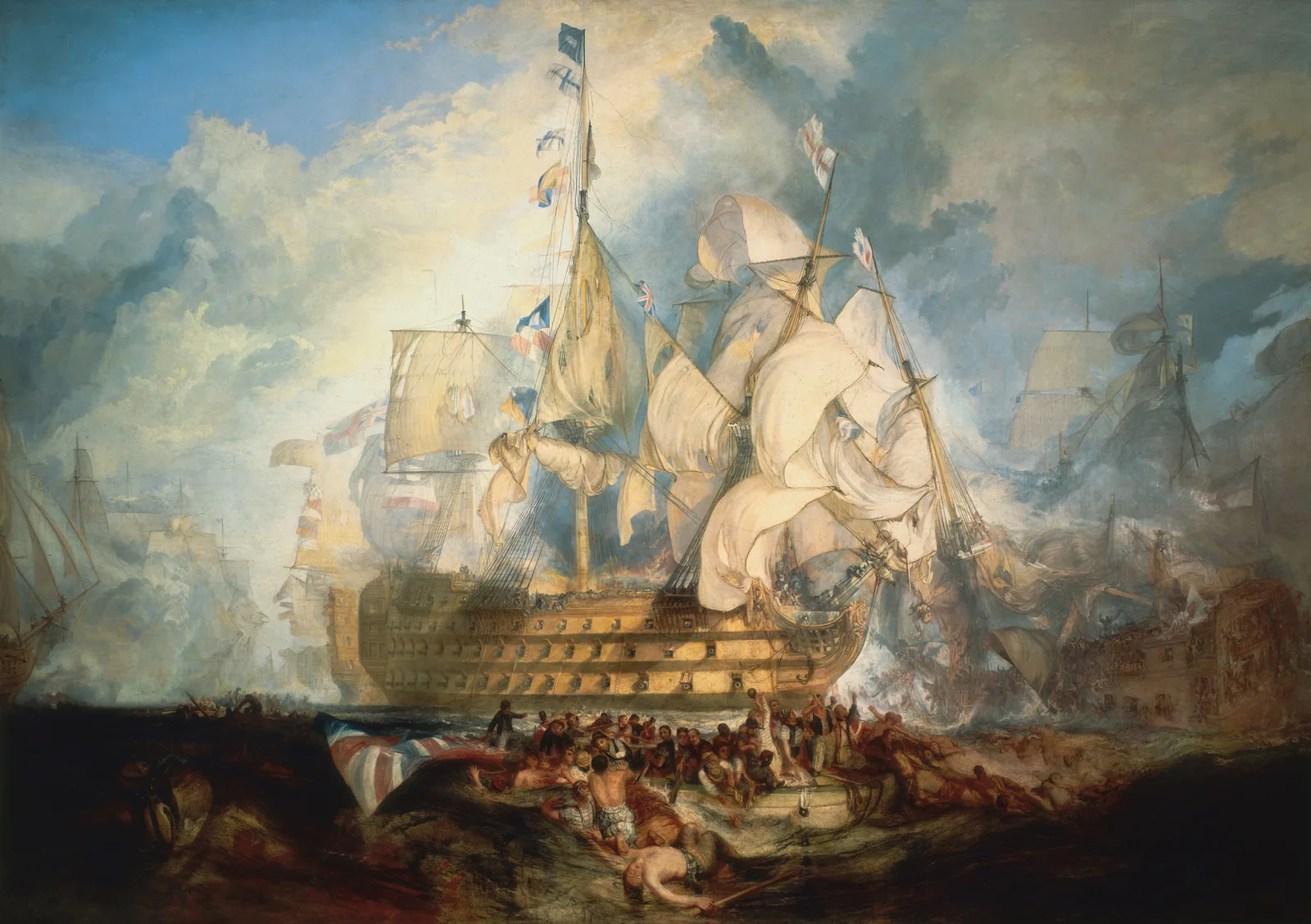
J. M. W. Turner, The Battle of Trafalgar, 1822–24. National Maritime Museum, Greenwich · Public domain · Source page
Fifteen yards
A quarter past one
Off Cape Trafalgar, 21 October 1805, a quarter past one. Two warships are locked together, so close that their crews fight through each other's gun ports. On the quarterdeck of the Victory a one-armed admiral, the stars of his orders sewn on his coat, turns to walk back the way he came.
In the rigging of the French Redoutable, fifteen yards away, a marksman fires his musket. The ball enters Nelson's left shoulder, passes through his lung and breaks his spine. ‘They have done for me at last, Hardy.’
He has about three hours to live. How did a country parson's son, blind in one eye and short of an arm, come to stand on that deck?
Horatio Nelson, Viscount Nelson
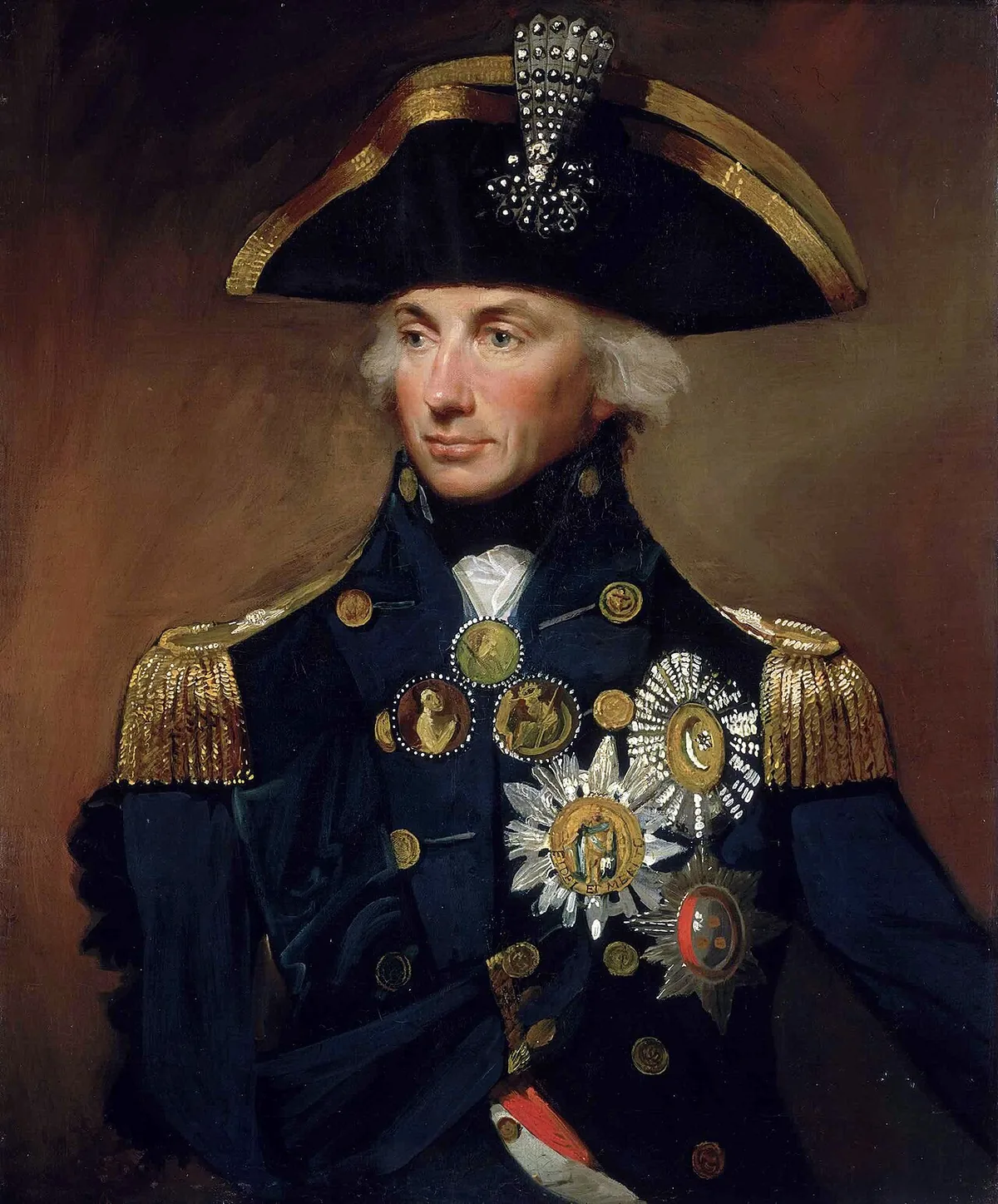
Lemuel Francis Abbott, Horatio Nelson, 1799. National Maritime Museum, Greenwich · Public domain · Source page
A country parson's son who went to sea at twelve, lost the sight of an eye and an arm, and won the most famous victories of the age of sail.
- Born: 29 September 1758, The rectory at Burnham Thorpe, Norfolk; sixth of eleven children
- Died: 21 October 1805, aged 47, Aboard the Victory, off Cape Trafalgar, A musket ball fired from the rigging of the French ship Redoutable
- Won: Cape St Vincent, 1797; The Nile, 1798; Copenhagen, 1801; Trafalgar, 1805
- Lost: Santa Cruz de Tenerife, 1797; Boulogne, 1801 (two failed attacks)
“Thank God, I have done my duty.”
The parson's son
Background
Twelve years old
Horatio is born in 1758 in the rectory of Burnham Thorpe, a Norfolk village; his mother dies when he is nine. At twelve he asks to go to sea with his uncle, Captain Maurice Suckling. The uncle is doubtful: ‘the first time we go into action, a cannon-ball may knock off his head, and provide for him at once.’ But he takes the boy. A ship of the line is a floating town of six hundred men.
1773
The bear
In 1773, at fourteen, he sails with an expedition towards the North Pole, until the ice turns it back. One foggy night, the story goes, he slips off with a friend to hunt a polar bear on the ice; his musket misfires, and he is ready to club the beast with the butt. The captain fires a gun and the bear runs off. The boy's excuse: ‘I wished to kill the bear, that I might carry the skin to my father.’
A perfect story, and that is the trouble: no record from 1773 mentions it. It appears in print only after Nelson was a hero.
1777–1794
Captain, husband, and an eye
At twenty he is a post-captain with a ship of his own. In the West Indies he enforces the Navigation Acts against American traders, and the planters hate him for it. On Nevis, in 1787, he marries a young widow, Frances (Fanny) Nisbet. Then peace leaves him on half-pay: five years in Norfolk, begging for a ship.
War with revolutionary France brings him the Agamemnon in 1793. At Naples he meets the British ambassador, Sir William Hamilton, and his wife, Emma. In July 1794, at the siege of Calvi in Corsica, a French shot throws sand and stone splinters into his face, and the sight of his right eye is gone. He never wore an eyepatch; that is a later invention. Remember that eye.
St Vincent, Tenerife and the Nile
A decision point
You are Commodore Horatio Nelson.
14 February 1797, early afternoon, off Cape St Vincent
Admiral Jervis's fifteen ships have found a Spanish fleet of 24 to 27 ships of the line in the haze, strung out in two groups. Jervis has led his line through the gap between them. Now the main Spanish body is bearing away downwind, to rejoin the rest or escape to Cádiz.
You command the Captain, 74 guns, third from the rear of the British line of battle. Jervis's signal tells the ships to turn one after another, where the leader turned. By the time your turn comes, the Spaniards may be gone.
What do you do?
- Keep your place and turn in succession, as signalled Nobody could blame you. But the rear of the line will come round far too slowly, the main Spanish body will probably rejoin its other ships or slip away, and Jervis's victory shrinks to a skirmish.
- Signal Jervis and ask for fresh orders A sensible-sounding precaution. But Jervis is more than a mile ahead and the sea is thick with smoke; by the time a signal is seen, answered and acted on, the moment is gone. To ask is to do nothing.
- Wear out of the line and throw your ship across the Spaniards' path You leave your station without orders. If it fails, one ship stands alone against the main Spanish fleet, and a court-martial awaits you. If it works, you hold the Spaniards until the rest of the British fleet comes up.
What really happened
Wear out of the line and throw your ship across the Spaniards' path
Nelson ordered Captain Miller to wear out of the line, and steered across the bows of the Spanish fleet. For a while the Captain fought alone against several giants, among them the Santísima Trinidad, the largest warship afloat, until Troubridge and Collingwood came up. Crippled, she ran against the San Nicolás; Nelson led the boarders across, and from her deck boarded the San Josef. The fleet called it ‘Nelson's patent bridge for boarding first-rates’. Spain lost four ships.
He saw that obeying the letter of the signal would waste the chance, and trusted Jervis to back him. Jervis did. Southey says Nelson ‘disobeyed the signal’; some historians argue that Jervis's signals left room for such a move. What is sure is the habit: act on what you can see, and carry the risk yourself.
July 1797
The arm
Five months later Nelson, now a rear-admiral, leads a night attack on Santa Cruz de Tenerife, hoping for Spanish treasure. The Spaniards are ready. On the night of 24 July, as he steps ashore, a ball shatters his right arm above the elbow. Fanny's son Josiah ties off the arm and saves his life, and it is amputated that night. The attack fails, at a cost of between about 140 and 250 British dead, depending on the count. Left-handed, Nelson writes to Jervis: ‘I am become a burthen to my friends, and useless to my country.’
1798
The hunt
In May 1798 a French fleet slips out of Toulon carrying General Bonaparte and his army, with Davout among its generals (the second lesson in this series). Nelson, sent back into the Mediterranean to find it, guesses Egypt, races there and finds Alexandria empty: he has arrived first. For ten weeks he searches. On 1 August his look-outs at last see French masts in Aboukir Bay, east of Alexandria.
A decision point
You are Rear-Admiral Nelson, in the Vanguard.
Late afternoon, 1 August 1798, Aboukir Bay
The fleet you have hunted for ten weeks lies before you: thirteen ships of the line and four frigates, anchored in a curved line across a bay full of shoals, guarded by an island battery. You have thirteen ships of the line and no good chart, and the sun sets in two hours. Three of your ships are far astern.
Your captains know your mind: against a fleet at anchor, come alongside, anchor by the stern and support one another. But when?
What do you do?
- Wait for morning, sound the shoals and gather your ships Safer for the ships, and the three stragglers would join you. But the French get a whole night: to clear their landward guns, to chain their ships together, perhaps to bring back the men they have ashore.
- Attack at once, from the seaward side only, two ships against each of theirs Bold but sound. The French seaward guns are ready, but you mass against the head of their line, and their rear, to leeward, will struggle to come up and help. The risk is the dark: ships feeling their way through water nobody has sounded.
- Attack at once, and send your leading ships round the head of the line, inside it If there is water enough, the head of the French line is caught on both sides, with its landward guns unready. But the gap is narrow and unsounded: a ship that grounds there is lost, and blocks those behind.
What really happened
Attack at once, from the seaward side only, two ships against each of theirs
Nelson attacked at once, with the sun going down. He meant, Southey says, to keep outside the French line. But Captain Foley, leading in the Goliath, saw room between the French and the shoal and took her round the head of the line; four ships followed him inside, while Nelson and the rest anchored outside.
The French expected an attack from the sea and had cleared only their seaward guns. Nelson had spent weeks making his captains think as he did, so that they could act without signals in smoke and darkness. As his officers rose from dinner he told them: ‘Before this time to-morrow I shall have gained a peerage or Westminster Abbey.’
The Nile: who fought whom
1–2 August 1798
Aboukir Bay, about 24 km east of Alexandria
The British fleet
- Commanders: Rear-Admiral Horatio Nelson, in the Vanguard, Captains Foley, Hood, Troubridge, Ball, Hallowell and others
- Strength: 13 ships of the line of 74 guns, the 50-gun Leander and a brig; about 8,200 men on paper (Nelson's own list)
- Losses: 218 killed, 677 wounded (Nelson's returns); none lost (Ships)
The French fleet
- Commanders: Vice-Admiral Brueys, in L'Orient (killed), Rear-Admirals Blanquet (Franklin) and Villeneuve (Guillaume Tell)
- Strength: 13 ships of the line and 4 frigates; about 10,800 men on paper (Nelson's own list)
- Losses: 5,225 perished; 3,105 prisoners, wounded included, sent ashore (Southey (1813)); 2,000 to 5,000 killed and wounded; 3,000–3,900 captured (Modern estimates); 9 captured, 2 burned, 2 escaped (Ships (Nelson's list))
Paper strength: many of the men were ashore fetching water and food.
Outcome: A crushing British victory: eleven of the thirteen French ships of the line were taken or destroyed. Bonaparte's army was cut off in Egypt.
Nobody counted the men lost when L'Orient blew up, so the French dead are estimates; Southey gives the highest.
The battle of the Nile
1 August 1798, from sunset to the next morning
Nelson’s British fleet, which has searched for ten weeks, comes to Aboukir Bay in Egypt, where the French fleet that carried General Bonaparte and his army lies at anchor. Thirteen French ships of the line are in a curved line, in a bay full of shoals, under an island battery. Nelson also has thirteen, but three are far astern, and the sun sets in two hours.
A reconstruction after Nelson's report, Southey (1813) and the usual accounts of the battle. The bearing of the French line, the end of the shoals and the ships' positions are approximate. The wind is disputed (north-north-west or north-east), but on every account it blew along the line from van to rear, so the French rear could not easily come up to help the van. The order of the ships at the rear is uncertain, so they are drawn in groups. Ships are drawn far larger than the scale.
Phases of the battle
- The French at anchor Late on 1 August the British round the shoals from the north-west before a fair wind. The French lie at anchor in a curved line and expect any attack from the sea: their guns on the landward side are not cleared. Three of Nelson's ships are still far behind.
- Doubling the head of the line At about half past six Foley's Goliath crosses the Guerrier's bows and turns inside, between the French and the shoal. Four ships follow. Nelson's Vanguard anchors outside, and so do the ships behind her: the head of the line is doubled. The Culloden runs aground.
- Night falls on the centre Darkness falls. Swiftsure and Alexander arrive and anchor against the French centre; the shattered Bellerophon drifts away without her masts. Nelson is struck on the forehead and carried below, sure he is dying. By nine the first French ships have struck their colours.
- L'Orient explodes Fire breaks out in the French flagship. At about ten it reaches her magazine and she blows up; Admiral Brueys is already dead on her deck. For some minutes every gun falls silent. Then the fighting starts again and goes on through the night.
- Morning: who got away The French rear has hardly fought. Before noon on 2 August the Guillaume Tell and the Généreux cut their cables and escape with two frigates. Of thirteen French ships of the line, nine are taken and two destroyed. The Guillaume Tell's admiral is Pierre Villeneuve. Remember the name.
The strategy
- British fleet: Nelson means to attack at once, before dark, bringing his ships alongside the anchored French and anchoring them by the stern, to support one another. The French expect an attack only from the sea, and their landward guns are not ready.
- French fleet: The French fleet, under Brueys, holds the bay at anchor in a curved line among the shoals, under an island battery, expecting an attack only from the sea. Its landward guns are not ready.
What decided it: The British doubled the head of the French line, with ships on both sides. Goliath passed inside, on the shore side where the French guns were not ready, while Nelson’s Vanguard anchored outside. The wind blew along the line, so the French rear could not easily come up to help the head.
After the battle
Baron Nelson of the Nile
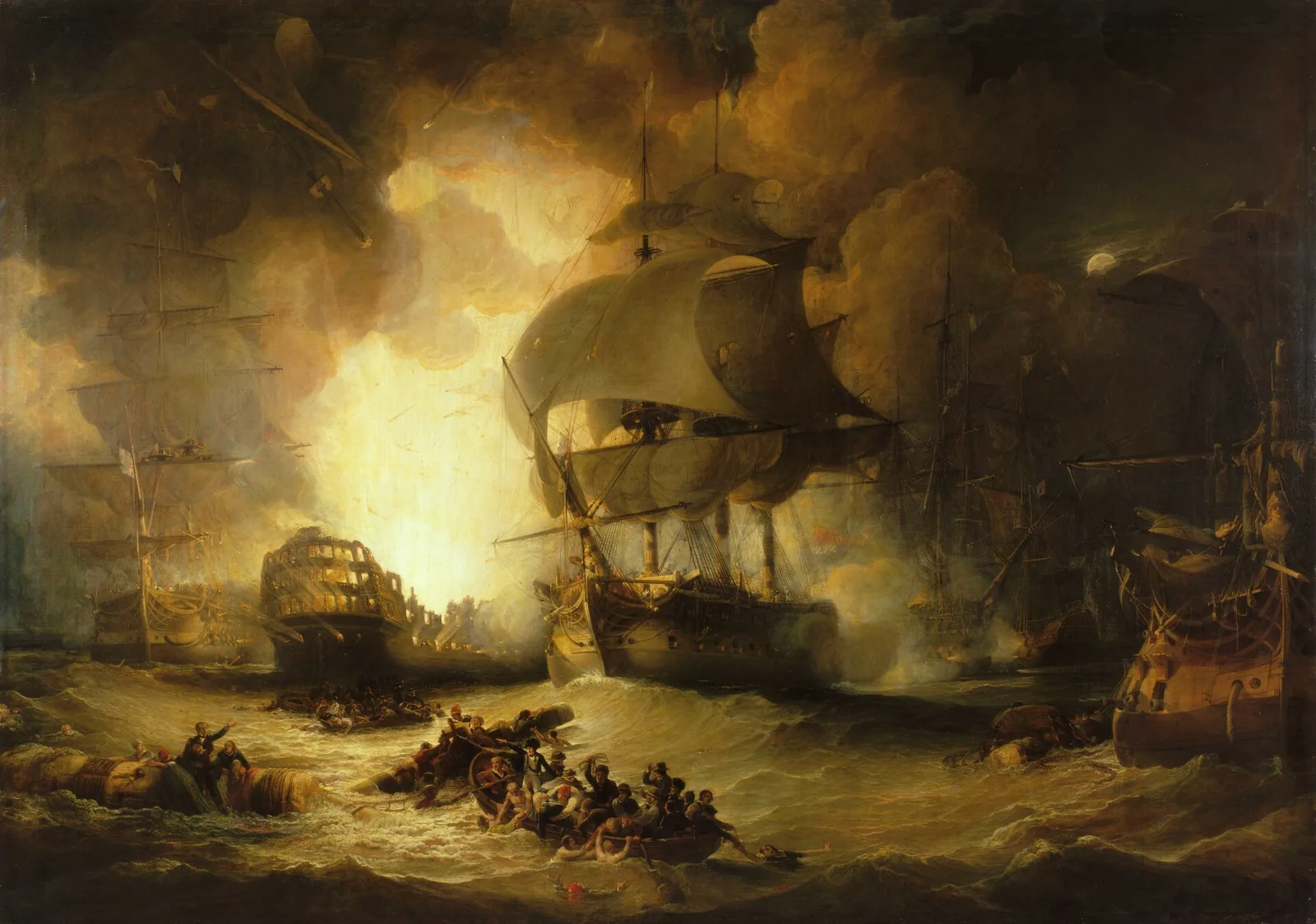
George Arnald, The Destruction of L'Orient at the Battle of the Nile, 1 August 1798, painted 1825. National Maritime Museum, Greenwich · Public domain · Source page
Nelson, his forehead bandaged, came back on deck to watch L'Orient burn, and sent boats to pick French survivors out of the water. He was made Baron Nelson of the Nile, and now all Europe knew his name. And Bonaparte? His army was trapped in Egypt, with no fleet to take it home.
Naples, Emma and Copenhagen
1798
A guardian angel
After the Nile, wounded and famous, Nelson recovers at Naples in the house of Sir William and Emma Hamilton. Emma, thirty-three, a blacksmith's daughter, has risen by beauty, wit and nerve to be the queen's friend. Nelson, whose wife is in England, falls deeply in love. In December, with a French army approaching, he carries the royal family to safety in Sicily.
Emma, Lady Hamilton

George Romney, Emma Hart (later Lady Hamilton), about 1785. National Portrait Gallery, London · Public domain · Source page
A blacksmith's daughter who became a painter's model, an ambassador's wife and Nelson's great love, and died poor in a foreign town.
- Born: About 1765, Ness, Cheshire, as Amy Lyon
- Died: 15 January 1815, Calais, France, Poor and in debt
- Won: Rose from poverty to the court of Naples
- Lost: The state refused her the ‘ample provision’ Nelson asked for; Lost Merton and sank into debt
“Take care of my Guardian Angel.”
June 1799
The treaty that was torn up
In January 1799 Neapolitan republicans, backed by France, proclaim the Parthenopean Republic. By June the king's peasant army under Cardinal Ruffo has retaken Naples, and the last republicans in the castles sign a surrender: they may sail to France. Ruffo and Russian, Turkish and British officers sign it. Nelson arrives with his fleet, declares the terms void, and the defenders are handed over to the king's justice. Admiral Francesco Caracciolo, once an officer in the king's own navy, who had commanded the republic's ships, is caught hiding in peasant's clothes and brought aboard Nelson's flagship. A court of royalist officers tries him there, and he is hanged the same day. About a hundred executions follow.
Southey, Nelson's admirer, called it ‘a stain upon the memory of Nelson and the honour of England’.
1801
North to Copenhagen
Late in 1800 the Baltic powers formed an Armed Neutrality against British searches of their ships, threatening the timber, hemp and iron the navy needs. A fleet goes north under the cautious Sir Hyde Parker, with Nelson, now a vice-admiral, as second in command. On 2 April Nelson takes twelve ships of the line down a narrow channel against the floating batteries and old hulks moored before Copenhagen. Three run aground or never reach their stations. The Danes fight hard.
A decision point
You are Vice-Admiral Nelson, in the Elephant.
2 April 1801, after one in the afternoon, Copenhagen
You have been fighting for three hours. Three of your ships are aground or out of the fight, the Danes have hardly slackened, and the smoke hides almost everything. From his flagship, miles away, Parker hoists signal 39: leave off action. Your signal officer asks whether to repeat it to your ships, as the rules require. Your own signal for close action is still flying.
What do you do?
- Obey: repeat the signal and withdraw You keep faith with your commander and the rules. But your damaged and grounded ships must pull back under the Danish guns, with fire in their sterns. Some might not get out, and Denmark would claim a victory.
- Send a boat to Parker to explain, and wait The proper way to disagree with a superior. But a boat through smoke and shoals takes an age, and meanwhile each ship decides for herself whether to fight or withdraw. By the time the answer comes, the moment has gone.
- Acknowledge the signal, do not repeat it, and keep your own flying Insubordination. If the Danes win, a court-martial and ruin; if you win, nobody asks. Your captains, watching you, will fight on. But the frigates, nearer Parker, will obey him.
What really happened
Acknowledge the signal, do not repeat it, and keep your own flying
Nelson had Parker's signal acknowledged but not repeated, and kept his own flying. Most of his ships fought on. The frigates, nearer Parker, obeyed; their commander, Captain Riou, was killed as they turned away. Soon after two the Danish fire faltered, and Nelson sent a letter ashore under a flag of truce: if the firing went on, he would have to burn the batteries he had taken, with their brave crews. A truce followed.
Nelson judged that his ships were winning, and that a retreat under the Danish guns would turn a hard fight into a disaster. Parker, Southey says, meant the signal as permission rather than an order. Parker was soon recalled, and Nelson took command. The story has grown since.
Myth
Nelson put his telescope to his blind eye and said: ‘I see no ships.’
The truth
The gesture is in the eyewitness account; the words are not. Colonel William Stewart, on the Elephant's quarterdeck, recorded Nelson telling Captain Foley, ‘I have only one eye, I have a right to be blind sometimes,’ raising the glass to his blind eye and saying: ‘I really do not see the signal!’ Southey (1813) repeats it. ‘I see no ships’ is a later dramatisation. The phrase ‘to turn a blind eye’ is said to come from this story.
The evidence
Colonel Stewart's narrative, printed in Nicolas's edition of Nelson's letters (vol. IV, 1845); Southey (1813) follows it.
1801–1803
Horatia
Nelson comes home a national hero, with his marriage at an end. His daughter by Emma, Horatia, born in January 1801, is passed off as an ‘adopted’ child. He parts from Fanny for good and buys Merton Place, near London, where he lives with Emma and Sir William, who dies in 1803. That May, with the war against France renewed, Nelson sails in the Victory to command in the Mediterranean.
Trafalgar
1805
The chase
In 1805 Napoleon gathers an army at Boulogne to invade Britain; Soult and Davout drill its corps in camps near the Channel coast (the two previous lessons). To clear the Channel for it, his scattered fleets must combine. In March Vice-Admiral Villeneuve slips out of Toulon, collects Spanish ships at Cádiz and runs for the West Indies, to draw the British after him. Nelson follows him across the Atlantic and back, but never catches him. By late August Villeneuve is in Cádiz, and Napoleon's army has marched away from Boulogne against Austria. On 28 September Nelson takes command of the fleet off Cádiz.
Pierre-Charles Villeneuve
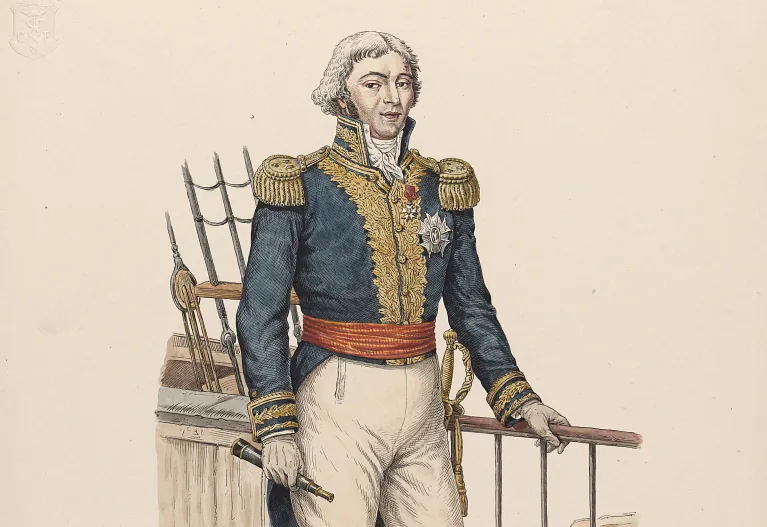
Charles Le Courneur, Vice-Admiral Pierre-Charles Villeneuve, about 1850. Pen, ink and watercolour. The Mariners' Museum and Park, Newport News (1937.1250.000001) · Public domain · Source page
A nobleman from Provence and a survivor of the Nile, ordered to clear the Channel for Napoleon's invasion, who took the blame when he could not.
- Born: 31 December 1763, Valensole, Provence
- Died: 22 April 1806, aged 42, Rennes, France, Found stabbed several times in an inn; the official verdict was suicide
- Won: Diamond Rock, Martinique, 1805
- Lost: Cape Finisterre, 1805 (indecisive; two ships lost); Trafalgar, 1805
“As for me, Monseigneur, deeply sensible of the whole extent of my misfortune…”
A decision point
You are Vice-Admiral Villeneuve.
Cádiz, 18 October 1805
Your thirty-three ships lie in Cádiz, watched by the British. Napoleon, furious that you ran for port in August, has ordered you to sail for the Mediterranean. At your council of war most of the captains advised against it: the crews are raw, the enemy strong, the season late. Now you hear that Admiral Rosily is on his way to replace you. The wind is fair for leaving. Outside waits Nelson.
What do you do?
- Stay in port and let Rosily find you there The fleet survives, ships and men. But Napoleon will call it cowardice, Rosily replaces you, and the British keep up the blockade. A fleet in port is still a threat, and Britain must pay to watch it.
- Wait for a gale to scatter the British, whatever Rosily does A real hope: the autumn gales here are fierce and the British ships are worn. But the same gale would batter your own ships, and before it comes you may already have handed your command to Rosily.
- Sail now with all thirty-three ships and make for the Strait You obey your orders and forestall your successor. If the wind holds, you might reach the Mediterranean. But leaving a narrow harbour takes hours, under British eyes; you will surprise nobody, and a battle is almost certain.
What really happened
Sail now with all thirty-three ships and make for the Strait
Villeneuve sailed. His ships crept out on 19 and 20 October in light airs and a heavy swell, watched by Nelson's frigates. At dawn on 21 October, off Cape Trafalgar, the British were in sight. Villeneuve turned his whole fleet back towards Cádiz, and the turn left it in a ragged crescent.
Villeneuve himself would not say. His report to the navy minister promised only the events, ‘free of any comment on the motives that guided my movements’. Historians point to Napoleon's orders, the shame of being replaced and his wish to show courage after August. Whether any choice could have saved the fleet is an open question.
Source: The Nelson touch, on paper
“Something must be left to chance; nothing is sure in a Sea Fight beyond all others. … in case Signals can neither be seen or perfectly understood, no Captain can do very wrong if he places his Ship alongside that of an Enemy.”
Nelson called the plan ‘the Nelson touch’, and wrote it for a fleet of forty.
- Who is this written for, and what does it ask of them? For his captains, not for history. If the signals fail, each must act alone and lay his ship beside an enemy: orders built to survive smoke and noise.
- Compare it with the day itself. He planned for forty ships and a fast squadron; he had twenty-seven, in two columns, and Collingwood cut the line nearer the centre than planned. A plan is a compass, not a script.
Trafalgar: who fought whom
21 October 1805
At sea off Cape Trafalgar, south-west Spain
The British fleet
- Commanders: Vice-Admiral Nelson, in the Victory (Captain Hardy), Vice-Admiral Collingwood, in the Royal Sovereign
- Strength: 27 ships of the line and 6 smaller; about 17,000 men; 2,148 guns (Most modern lists); two columns, of 14 and 13 ships (modern lists: 12 and 15) (Beatty (1807), aboard the Victory)
- Losses: 449–458 killed, about 1,200 wounded (Modern counts); none lost (Ships)
The Franco-Spanish fleet
- Commanders: Vice-Admiral Villeneuve (French), in the Bucentaure, Admiral Gravina (Spanish), in the Príncipe de Asturias, Rear-Admiral Dumanoir (French), in the van
- Strength: 33 ships of the line (18 French, 15 Spanish); some 30,000 men; 2,570–2,630 guns (Most modern lists)
- Losses: about 4,400 killed or drowned, about 2,500 wounded (Modern counts); 7,000–8,000 (in some sources about 20,000) (Prisoners); 17 captured and 1 blown up on the day; 4 more taken on 4 November (Ships)
Outcome: A decisive British victory. No British ship was lost; the storm that followed took most of the prizes.
The counts differ: guns are counted by a ship's rating, crews on paper were not the crews aboard, and nobody could count the dead in a storm.
The battle of Trafalgar
21 October 1805, from morning to late afternoon
On 21 October 1805, off Cape Trafalgar, the Franco-Spanish fleet of 33 ships of the line turns about to make for Cádiz, after heading south for the Strait. From the west the British bear down on it in two columns, under Nelson and Collingwood.
A reconstruction after Beatty (1807) and the usual accounts of the battle. The coast follows modern charts; the centre of the fight is placed about 17 km west-north-west of Cape Trafalgar, as in most reconstructions, but the fleets' positions are uncertain by a few kilometres, and the clocks in the ships' logs differ by up to an hour. The order of the Franco-Spanish line and the points where it was cut are approximate. The map shows two tidy British columns, but Collingwood's was really a ragged line of ships, and groups of Franco-Spanish ships are drawn as one block. Ships are drawn far larger than the scale.
Phases of the battle
- The Combined fleet turns back At about eight Villeneuve orders his fleet, heading south for the Strait, to turn about together and make for Cádiz. In light airs the turn takes more than an hour and leaves a ragged crescent some nine kilometres long. From the west the British bear down in two columns.
- The columns close Shortly before noon the Victory hoists ‘England expects’. Nelson's column steers for the enemy centre, Collingwood's for the rear. The Royal Sovereign, newly coppered, pulls ahead of her column, and at about noon the enemy opens fire on her.
- The line is cut Collingwood breaks through astern of the Santa Ana, raking her as he passes. Some forty minutes later the Victory, shot at all the way without replying, passes astern of Villeneuve's Bucentaure, rakes her and runs on board the Redoutable.
- Nelson falls, the centre breaks At about a quarter past one Nelson is shot. The Téméraire comes up on the Redoutable's other side, and she strikes. The Bucentaure and the giant Santísima Trinidad surrender, and Villeneuve is a prisoner. In the south Collingwood's ships overpower the rear.
- Victory, and its price Dumanoir's van turns back too late, and he leads four ships away to the south-west. Gravina takes eleven ships back to Cádiz. At half past four Nelson dies, knowing he has won. By evening seventeen ships are taken, the Achille has blown up, and no British ship is lost.
The strategy
- British fleet: Nelson means to break the Franco-Spanish line in two places, with Nelson striking the centre and Collingwood the rear, fighting each part at close range. He called the plan the Nelson touch and wrote it for a fleet of forty.
- Franco-Spanish fleet: Villeneuve orders the whole fleet to turn about together and make for Cádiz. At his council of war most captains had advised against sailing out: the crews were raw, the enemy strong and the season late.
What decided it: The Franco-Spanish line was cut in two places, and each part was fought at close range. Dumanoir’s van turned back too late and withdrew with four ships, and the centre broke when Nelson was hit. In the south Collingwood’s ships overpowered the rear.
11.45
‘England expects’
As the fleets close, Nelson tells his signal officer, John Pasco, to make: ‘England confides that every man will do his duty.’ Pasco asks to use ‘expects’, which is in the signal book; ‘confides’ would have to be spelt out letter by letter. ‘That will do, Pasco, make it directly.’ The flags go up shortly before noon, and the fleet cheers. Then comes the signal Nelson leaves flying to the end: ‘Engage the enemy more closely.’ We know the exchange from Pasco's own later account.
1.15 pm
‘I bargained for twenty’
For forty minutes the Victory takes fire without being able to reply with a single broadside; only at about a quarter to one does she break the line and run on board the Redoutable. At a quarter past one Nelson is hit. As he is carried down to the cockpit he covers his face with a handkerchief, so that the crew will not recognise him. The surgeon, William Beatty, can do nothing. When Captain Hardy reports fourteen or fifteen ships taken, Nelson answers: ‘That is well, but I bargained for twenty.’ Then: ‘Anchor, Hardy, anchor!’ A gale is coming. At half past four he dies.
Source: Two witnesses to one deathbed
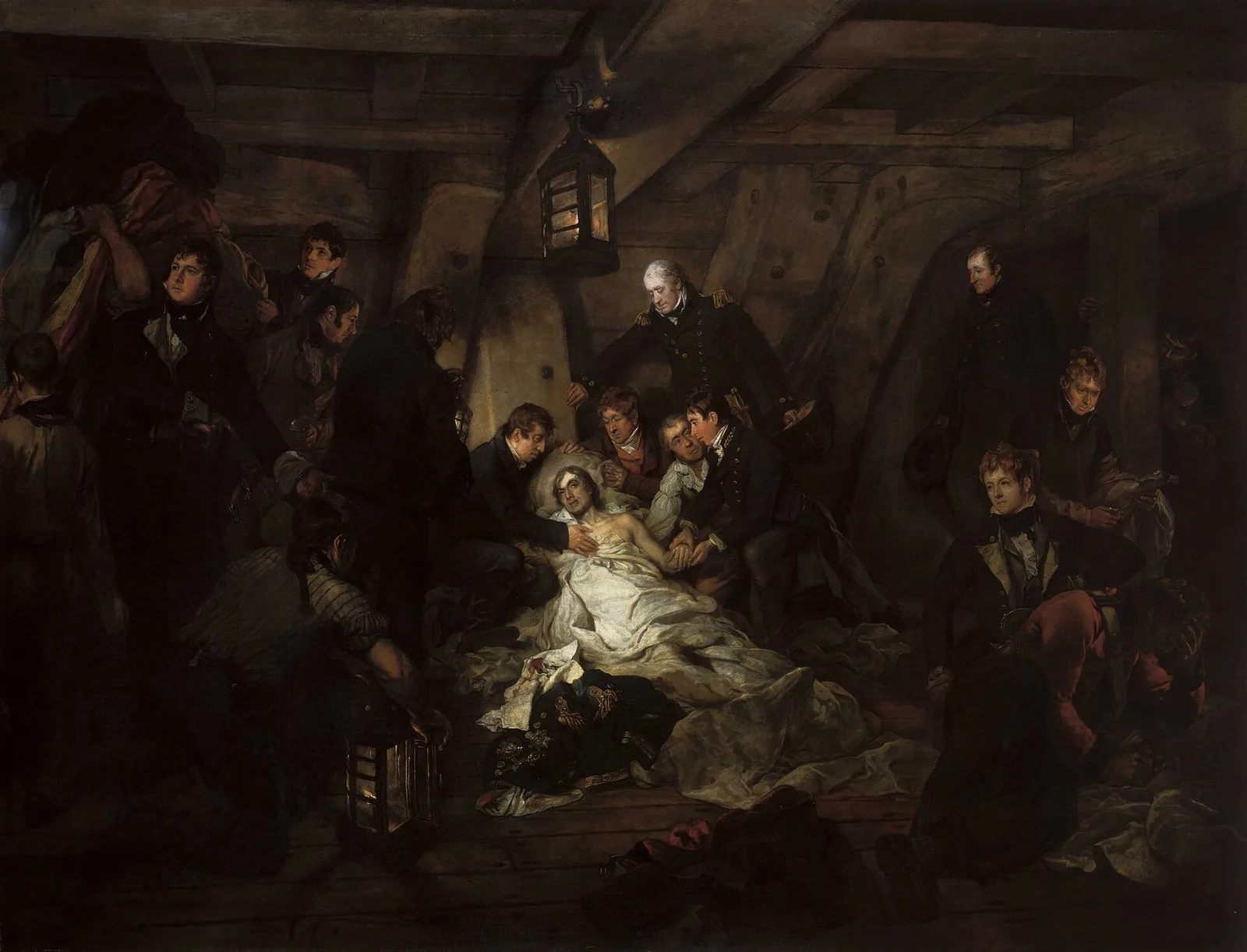
Arthur William Devis, The Death of Nelson, 21 October 1805, painted 1807. National Maritime Museum, Greenwich · Public domain · Source page
“Take care of my dear Lady Hamilton, Hardy; take care of poor Lady Hamilton. Kiss me, Hardy.” The Captain now knelt down, and kissed his cheek; when His Lordship said, “Now I am satisfied. Thank God, I have done my duty.”
Beatty, who was there, published his account in 1807. Devis painted Nelson's face from a sketch of the body.
- What does Beatty admit? That in the noise of the guns ‘the whole of His Lordship's expressions could not be borne in mind, nor even distinctly heard’. Other witnesses remembered other last words.
- Look at the painting. What is odd about it? It is calm and bright; the real cockpit was dark, hot and full of screaming men. It is a memorial, not a photograph.
- A later tale has ‘Kismet, Hardy’ (‘fate’). What does Beatty write? ‘Kiss me, Hardy’: Hardy knelt and kissed his cheek, then his forehead. ‘Kismet’ is in no witness's account, and was hardly an English word in 1805.
What he left
22–28 October
The storm
That evening the wind rises from the south-west, and the storm lasts for days. Exhausted crews tow shattered prizes away from the rocky shore; most founder, are wrecked or are burnt by the British themselves, and the Santísima Trinidad goes down. Only four reach Gibraltar. On 28 October the battered Victory follows, with Nelson's body in a cask.
Myth
Nelson's body came home in a barrel of rum, and the sailors drank it.
The truth
The cask was real, the rum was not. With no lead aboard to make a coffin, Beatty put the body in the largest cask on the ship and filled it with brandy; at Gibraltar spirit of wine was added. Beatty calls the belief he found in England, that rum would have preserved the body better, ‘a very general but erroneous opinion’. The story of sailors secretly ‘tapping the admiral’ is not in his careful account, and is later lore.
The evidence
Beatty, Authentic Narrative (1807), and his note 23.
After Trafalgar
- 4 November 1805 Strachan takes Dumanoir's four escaped ships off Cape Ortegal.
- 2 December 1805 Austerlitz: Napoleon crushes Austria and Russia on land, with Soult's corps taking the Pratzen Heights. Napoleon's own story is told in the lesson about him.
- 9 January 1806 A state funeral at St Paul's. The coffin, made from L'Orient's mainmast, lies in a sarcophagus once made for Cardinal Wolsey.
- 22 April 1806 Villeneuve is found dead in an inn at Rennes.
- 1843 Nelson's Column is completed in Trafalgar Square, London.
- 1916 Jutland: the first great fleet battle since Trafalgar to put Britain's command of the sea to the test.
The promise
A legacy to his country
On the morning of the battle Nelson added a codicil to his will: ‘I leave Emma Lady Hamilton therefore a legacy to my King and Country, that they will give her an ample provision to maintain her rank in life.’ He left Horatia to the nation too. The nation made his brother an earl and gave him a fortune; Emma got nothing. She fell into debt, was held for it, fled to Calais and died there in 1815. Horatia married a clergyman and lived until 1881.
Who won Trafalgar?
Was Trafalgar won by Nelson's bold plan, or by what the Royal Navy had built before him?
- A. T. Mahan (1897) The American naval officer and writer called his biography The Life of Nelson: The Embodiment of the Sea Power of Great Britain. To him the man and the nation's strength were one: Nelson's will to destroy the enemy fleet, and his gift for making his captains share it, explain Trafalgar, and what sea power can do to a continental empire.
- N. A. M. Rodger (2004) He looks behind the hero: the Royal Navy had spent years at sea, blockading, training crews and gunners, while in the Franco-Spanish fleet many men were soldiers and landsmen who had sat for months in port. In The Command of the Ocean Rodger places Trafalgar inside a long story of administration and seamanship.
- Julian Corbett (1910) In The Campaign of Trafalgar he told the whole chase: the blockade, Villeneuve's flight to the West Indies, the long pursuit. For him the battle is the last act of a long campaign, not a lone stroke of genius.
Most historians today give all three their due: a commander who made his captains think alike, a navy that had trained for years, and an enemy forced into a battle it could not win. Even so, Napoleon had given up the invasion of Britain in August 1805. Trafalgar closed the door on any French fleet challenging Britain at sea.
What do you know now?
Check yourself
What did Nelson do at Cape St Vincent that made him famous?
Answer: He left the line of battle without orders and cut across the Spanish fleet's path. Right. He turned his ship, the Captain, across the path of several Spanish giants, then led boarders onto two of them. It was the quality that would keep returning in him: initiative.
Check yourself
What gave Nelson's ships their edge at the Nile?
Answer: Some of them attacked the French line from the landward side too, where the guns were not ready. Right. Foley led the Goliath between the French line and the shoal, four ships followed, and doubling the head of the line broke it.
Check yourself
When Parker's signal to break off the action went up at Copenhagen, what did Nelson do?
Answer: Acknowledged it, did not repeat it, and kept his own close-action signal flying. Right. That is the real core of the ‘I see no ships’ story; the famous words are a later dramatisation.
Check yourself
Why is Nelson criticised over Naples in 1799?
Answer: He voided a treaty signed by the king's own cardinal and a British officer, the defenders were handed to the king, and Caracciolo was tried on his flagship and hanged. Right. That is why Southey wrote of a ‘stain’, and Fox attacked him in Parliament. His defenders point to the king's authority and the norms of the age.
Check yourself
How did Nelson attack at Trafalgar?
Answer: In two columns that cut through the enemy line, each captain free to act on his own if signals failed. Right. That is the ‘Nelson touch’: two columns driving into the Franco-Spanish line, and orders meant to survive smoke and noise.
Check yourself
What was Nelson's body kept in on the way home?
Answer: Brandy in a large cask (with spirit of wine added later). Right. There was no lead on board for a coffin, so Beatty used the biggest cask.
Terms
- ship of the line A big warship with 64 guns or more on two or three decks, strong enough to stand in the line of battle. Most ships at the Nile carried 74 guns and about 600 men.
- line of battle Warships sailing one behind another, so that each can fire all the guns on its side at the enemy's line. The standard tactic of the age of sail, and the origin of the name 'ship of the line'.
- broadside All the guns on one side of a ship, or the volley they fire together. The guns point sideways, so a ship can fire only at what lies beside her.
- rake To fire along the length of an enemy ship, from ahead or astern. The balls sweep her decks from end to end and she cannot fire back. The most feared shot in a sea fight.
- half-pay The small allowance paid to a naval officer without a ship. In peacetime most captains were on half-pay, waiting for a command that might never come.
- windward and leeward Windward is the side the wind blows from, leeward the side it blows towards. A fleet to windward can choose when to attack; a fleet to leeward cannot easily close with it or send help up against the wind, though it can run away downwind.
- to double a line To attack a line of ships from both sides at once, so that each enemy ship is caught between two fires. At the Nile, Nelson's ships doubled the head of the French line.
- prize An enemy ship captured at sea. The Royal Navy sold prizes and shared the money among the crews, so a victory could make a sailor rich. In a storm, a damaged prize could be a burden.
- Parthenopean Republic A short-lived republic set up in Naples in January 1799, with French backing, after the king fled. It fell in June and the Bourbon king returned. Parthenope is the ancient Greek name of Naples.
- Armed Neutrality A league of Baltic states (Russia, Denmark, Sweden and Prussia), formed in 1800, which refused to let the Royal Navy search their merchant ships. Britain feared it would be cut off from the timber, hemp and iron its navy needed.
- cockpit On a sailing warship, the surgeon's station on the lowest deck, below the waterline, where the wounded were carried in battle. Dark, cramped and lit by lanterns alone.
- Redoutable A French ship of the line at Trafalgar. A marksman in her rigging shot Nelson.
- HMS Victory The British ship of the line that carried Nelson at Trafalgar. He was wounded on her deck.
- Captain Hardy Captain of Nelson's ship, the Victory, at Trafalgar. Nelson spoke to him in his last hours.
- Robert Southey English poet whose 1813 biography shaped Nelson's image for a century.
- Maurice Suckling A British captain and Nelson's uncle, who took the boy to sea at twelve.
- Burnham Thorpe A village in Norfolk, eastern England. Nelson was born in its rectory.
- Naples A port city in southern Italy. Nelson recovered there after the Nile.
- Cádiz A port city in southern Spain. The French and Spanish fleets gathered there before Trafalgar.
- Napoleon A French general who became emperor of France. He sent an army to Egypt in 1798 and planned to invade Britain in 1805.
- Davout A French general in Napoleon's army. He sailed with the expedition to Egypt and later drilled troops for the invasion of Britain.
- Navigation Acts British laws that limited trade and shipping by foreigners with the British colonies.
- Agamemnon A British ship of the line that Nelson was given command of in 1793. Named after a king from Greek myth.
- Hyde Parker British admiral who led a fleet north against the Danes. Nelson was his second in command, and Parker ordered the fight to stop.
- Admiral Jervis British admiral, Nelson's commander. He later became Earl St Vincent.
- Santísima Trinidad The Spanish warship, the largest afloat at the time. She sank in the storm after the battle.
- London Gazette The official newspaper of the British government. Nelson's report of the battle was printed in it.
- Admiralty The British government department that ran the Royal Navy.
- Duke of Bronte A noble title that King Ferdinand gave Nelson, with an estate in Sicily.
- Cardinal Ruffo An Italian cardinal who led a peasant army that retook Naples in 1799.
- Francesco Caracciolo An admiral who commanded the republic's ships in Naples. He was tried on Nelson's flagship and hanged the same day.
- Signal book A book that gives a flag signal for each word or phrase, so ships could talk at a distance.
- Flagship The ship that carries the senior admiral of a fleet and flies his flag.
- Nelson touch A battle plan Nelson wrote for a large fleet: break into the enemy's line and fight at close range.
- Vice-Admiral Villeneuve French vice-admiral who slipped out of Toulon and commanded the fleet at Trafalgar.
- Emma Hamilton Wife of Sir William Hamilton, the British ambassador in Naples. She was the queen's friend, and Nelson fell in love with her.
Sources
- Horatio Nelson, dispatch to Earl St Vincent, 3 August 1798, in Sir Nicholas Harris Nicolas (ed.), The Dispatches and Letters of Vice Admiral Lord Viscount Nelson, vol. 3 (London: Henry Colburn, 1845); first printed in the London Gazette Extraordinary, 2 October 1798
- Horatio Nelson, secret memorandum to his captains, 9 October 1805, in Nicolas (ed.), Dispatches and Letters, vol. 7 (London: Henry Colburn, 1846)
- William Beatty, Authentic Narrative of the Death of Lord Nelson (London: T. Cadell and W. Davies, 1807)
- Robert Southey, The Life of Nelson (London: John Murray, 1813)
- Vice-Admiral Villeneuve, report to the navy minister Decrès on the battle of Trafalgar, 15 November 1805 (in French)
- Roger Knight, The Pursuit of Victory: The Life and Achievement of Horatio Nelson (London: Allen Lane, 2005)
- N. A. M. Rodger, The Command of the Ocean: A Naval History of Britain, 1649–1815 (London: Allen Lane, 2004)
- Andrew Lambert, Nelson: Britannia's God of War (London: Faber and Faber, 2004)
- Roy Adkins, Trafalgar: The Biography of a Battle (London: Little, Brown, 2004)
- Adam Nicolson, Men of Honour: Trafalgar and the Making of the English Hero (London: HarperCollins, 2005)
- Tim Clayton and Phil Craig, Trafalgar: The Men, the Battle, the Storm (London: Hodder & Stoughton, 2004)
- Julian S. Corbett, The Campaign of Trafalgar (London: Longmans, Green, 1910)
- A. T. Mahan, The Life of Nelson: The Embodiment of the Sea Power of Great Britain (Boston: Little, Brown, 1897)
- Colin White (ed.), Nelson: The New Letters (Woodbridge: Boydell Press, 2005)
- Jonathan North, Nelson at Naples: Revolution and Retribution in 1799 (Stroud: Amberley, 2018)
- Dudley Pope, The Great Gamble: Nelson at Copenhagen (London: Weidenfeld & Nicolson, 1972)
Image credits
- J. M. W. Turner, The Battle of Trafalgar, 1822–24. National Maritime Museum, Greenwich · Public domain · Source page
- Lemuel Francis Abbott, Horatio Nelson, 1799. National Maritime Museum, Greenwich · Public domain · Source page
- George Arnald, The Destruction of L'Orient at the Battle of the Nile, 1 August 1798, painted 1825. National Maritime Museum, Greenwich · Public domain · Source page
- George Romney, Emma Hart (later Lady Hamilton), about 1785. National Portrait Gallery, London · Public domain · Source page
- Charles Le Courneur, Vice-Admiral Pierre-Charles Villeneuve, about 1850. Pen, ink and watercolour. The Mariners' Museum and Park, Newport News (1937.1250.000001) · Public domain · Source page
- Arthur William Devis, The Death of Nelson, 21 October 1805, painted 1807. National Maritime Museum, Greenwich · Public domain · Source page


