Nationalism: the idea that remade the world
In 1789 most Europeans thought of themselves first by village, faith or king. A century later, millions were ready to die for a nation.
Decisions, questions and your own progress, in the app
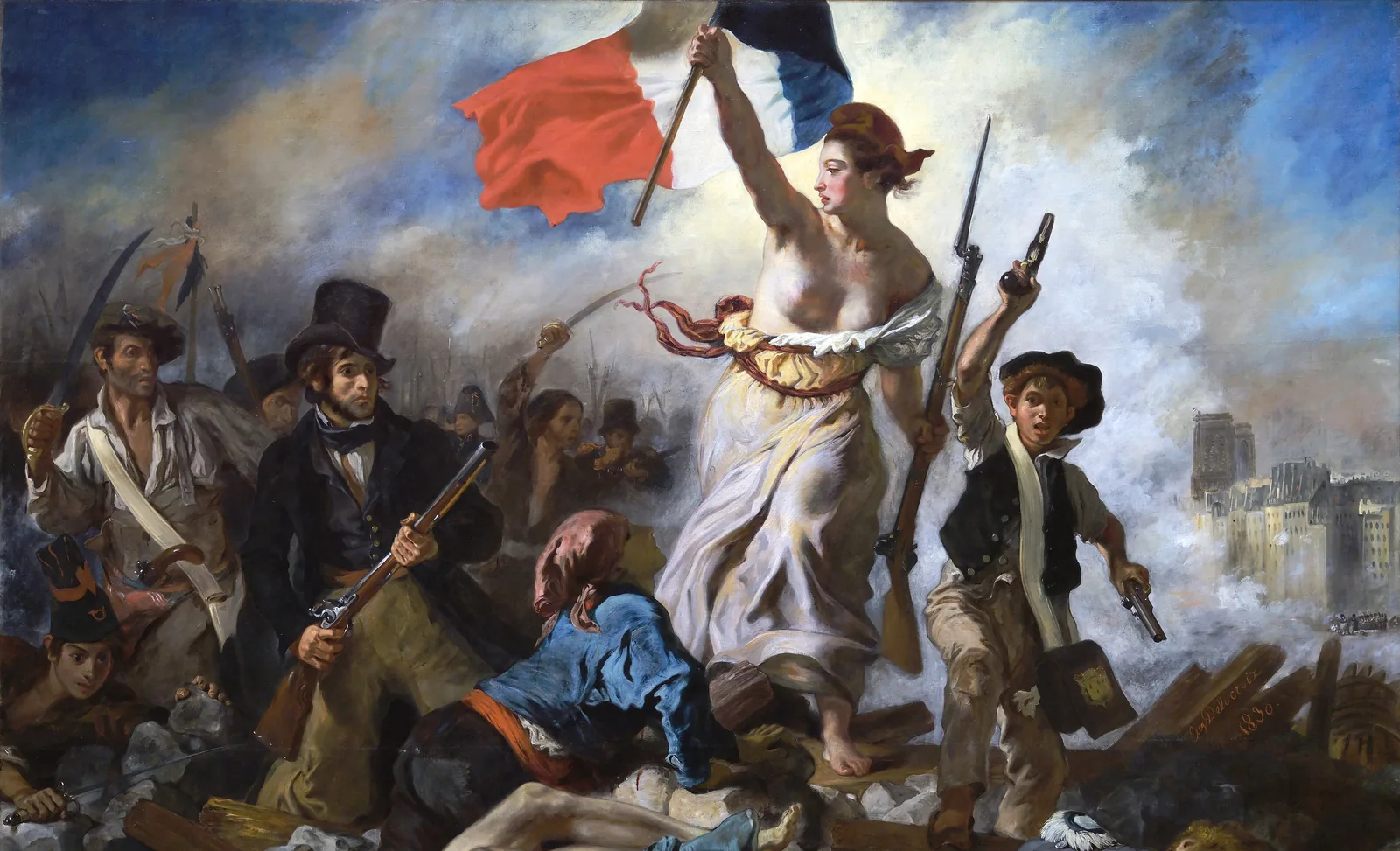
Eugène Delacroix, Liberty Leading the People, 1830 (detail, after the 2024 restoration). Musée du Louvre, Paris · Public domain · Source page
‘Long live the nation!’
A shout on a hill in Champagne
20 September 1792, a windmill on a hill near Valmy, in eastern France. All morning Prussian cannon have fired through the fog. On the French side, General Kellermann raises his hat on the point of his sword and shouts, and his men take up the cry. Not ‘Long live the king!’ but ‘Long live the nation!’
The Prussians do not attack, and soon they retreat. The next day, in Paris, the newly elected Convention abolishes the monarchy. Yet two years later a priest would report that millions of this nation's citizens did not know its language.
In 1789 most Europeans thought of themselves first by village, faith or king. A century later, millions were ready to die for a nation. Where did the idea come from, and how did it conquer the world?
The question
What is a nation?
Today the United Nations has 193 member states, and almost everyone on earth has a nationality. The philosopher Ernest Gellner defined the idea behind it: nationalism is ‘primarily a political principle, which holds that the political and the national unit should be congruent’ (1983). One nation, one state.
But what makes a nation? One answer says you are born into it, by descent, language and culture: ethnic nationalism. The other says citizens make it by choosing to live together under shared laws: civic nationalism. In 1882 the French scholar Ernest Renan made the question the title of a famous lecture. His answer comes later.
Kings, faiths and a pastor's songs
Background
A Europe of kings and empires
Before 1789, few Europeans asked which nation they belonged to. A peasant knew his village, his lord, his church and, far away, his king. Loyalty ran upwards, to a ruler, not sideways, to millions of strangers who spoke the same tongue.
States were family property. The Habsburg emperor in Vienna ruled Germans, Czechs, Hungarians, Poles, Italians, Croats and more, and nobody found this strange. In Poland or Hungary, ‘the nation’ meant the nobles in the diet, not the peasants who worked their land.
Check yourself
The lesson offers two answers to ‘What is a nation?’ A student writes: ‘A nation is made when citizens choose to live together under shared laws, whatever their descent or language.’ Which idea is the student describing?
Answer: The civic idea: a nation that citizens make by choosing to live together under shared laws.. Right. This is the second answer in the step ‘What is a nation?’: not descent or language, but a choice made by citizens. Ernest Renan gave this idea its famous form in 1882.
Johann Gottfried Herder
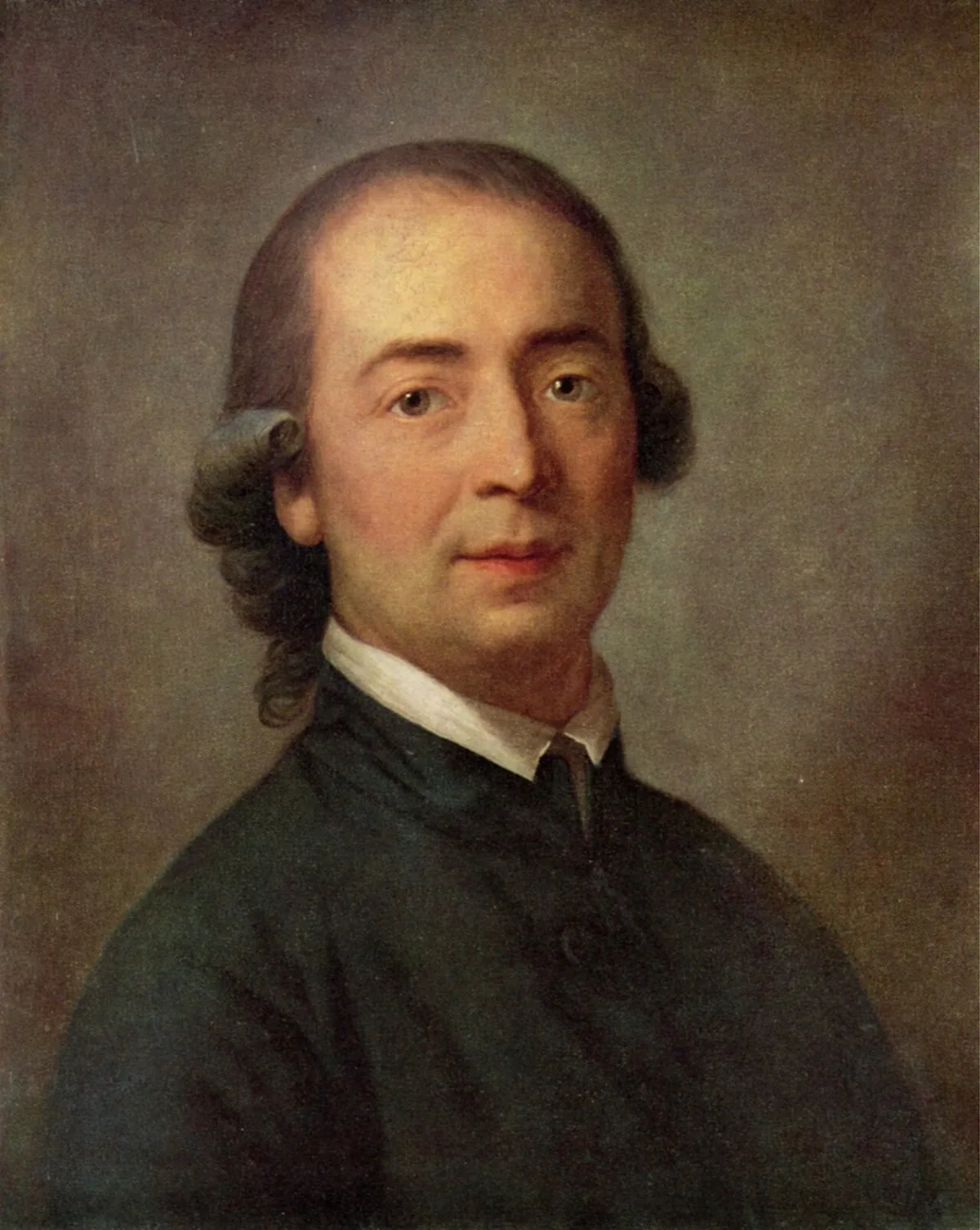
Anton Graff, Portrait of Johann Gottfried Herder, 1785. Gleimhaus, Halberstadt · Public domain · Source page
A Lutheran pastor who taught Europe that every people has a soul of its own, and a language of its own to speak it in.
- Born: 25 August 1744, Mohrungen, East Prussia (today Morąg, Poland)
- Died: 18 December 1803, Weimar
- Won: Treatise on the Origin of Language: prize of the Berlin Academy 1771, published 1772; Folk songs of many peoples, collected 1778–1779; Ideas on the Philosophy of the History of Mankind, 1784–1791
- Lost: Kant, his old teacher, savaged the Ideas in a review; His idea of the Volk was later taken up by nationalists who rejected his respect for all peoples
“these now deeply sunk, but once industrious and happy people, will at length awake from their long and heavy slumber, shake off the chains of slavery…”
Source: A nation is a plant
“Nature educates families: the most natural state therefore is one nation, with one national character. … for a nation is as much a natural plant as a family, only with more branches. Nothing therefore appears so directly opposite to the end of government as the unnatural enlargement of states, the wild mixture of various races and nations under one sceptre.”
As a young preacher in Riga, Herder listened to the songs of Latvian peasants whom the German elite despised. Each Volk, he came to believe, has its own spirit, carried in its language and songs; and no people is worth more than another. He demanded a state for no one, but Czech, Slovak and Serbian scholars quoted him again and again.
- Herder calls a nation a ‘natural plant’. What follows, if that is true? That a nation is not made but grows, and that each member belongs to it from birth. Then a state that mixes many peoples, like Austria or Russia, is unnatural. A beautiful metaphor, and a dangerous one: whatever comes from outside can be called a weed.
- We read Herder in an English translation of 1800. Why does that matter? Every translation chooses words. Where Churchill writes ‘races’, Herder's German speaks of kinds of people, and elsewhere in the same book Herder rejects dividing mankind into races at all. Ask what old words meant then.
Check yourself
What did Herder mean by a Volk?
Answer: A people with its own language, songs and customs, and so its own way of thinking; none worth more than another. Right. For Herder, language carries a people's spirit, and every people has its own. His nationalism was cultural: he thought one nation made the most natural state, but he called on no people to found one.
The nation takes power (1789–1794)
1789
Sovereignty changes hands
In January 1789 the Abbé Sieyès asked in a pamphlet what the Third Estate, the commoners, was. His answer: everything. That June its deputies called themselves the National Assembly. In August the Assembly's Declaration of the Rights of Man and of the Citizen stated: ‘The principle of all sovereignty resides essentially in the nation.’ (art. 3, trans. J. H. Robinson, 1906)
Power no longer came down from God through the king. It came up from the nation: sovereignty of the nation. In principle, anyone who accepted the law was a citizen, whatever his faith; by 1791 the Jews of France were equal citizens, the first in Europe.
1792–1794
A nation in arms
In April 1792 France went to war with Austria, and soon with Prussia. In Strasbourg an officer, Rouget de Lisle, wrote a war song for the Army of the Rhine. Volunteers from Marseille sang it as they marched into Paris that summer, so it became ‘the Marseillaise’, though it was born in a city where most people spoke a German dialect. It calls not on the king but on the ‘children of the fatherland’.
After Valmy came the Republic, and more enemies. In August 1793 the Convention decreed the levée en masse. By 1794 France had perhaps 750,000 men actually under arms, over a million on paper: more than any French king had ever fielded.
Source: Everyone has a job
“From this moment until that in which the enemy shall have been driven from the soil of the Republic, all Frenchmen are in permanent requisition for the service of the armies. The young men shall go to battle; the married men shall forge arms and transport provisions; the women shall make tents and clothing and shall serve in the hospitals; the children shall turn old linen into lint…”
Passed while foreign armies stood on French soil, by the Convention that within weeks would make terror ‘the order of the day’.
- Compare this with the way a king raised an army. What is new? A king hired or conscripted soldiers and left everyone else alone. Here the whole nation is mobilised, down to the old men sent to the squares to ‘preach … the unity of the Republic’: a unity that did not yet exist.
- Is this a description of what happened, or a programme? A programme. Enforcement was uneven and desertion common; an earlier levy, in February, had helped to set off the revolt in the Vendée. A decree shows what a government wanted, not what people did.
Check yourself
The levée en masse decree of 23 August 1793 declared all Frenchmen ‘in permanent requisition for the service of the armies’. What can we learn from it, and what can we not?
Answer: We can learn what the government wanted: the whole nation put at the service of the war. We cannot learn what people actually did.. Right. A decree is a programme. It shows a new idea, that everyone has a job, but enforcement was uneven and desertion common. In 1794 France had perhaps 750,000 men actually under arms, over a million on paper.
Myth
In 1789 France was a nation of French speakers, which is why the Revolution could speak to ‘the French people’.
The truth
French was the language of Paris, the court, the law and the educated. In the countryside people spoke Breton, Basque, Flemish, German dialects, Occitan, Catalan, Corsican and dozens of local patois. In 1794 Abbé Henri Grégoire told the Convention that at least six million French people (in a country of some 28 million) did not know the national language at all, as many again could barely converse in it, and no more than three million spoke it ‘purely’.
The evidence
Grégoire's report of 4 June 1794, built on a survey of 1790 and a few dozen replies, mostly from educated men. His figures are estimates made to support a policy.
A decision point
You are Henri Grégoire: priest, revolutionary bishop of Blois, and deputy in the Convention.
Paris, spring 1794
In 1790 you sent a questionnaire about local speech across France, and the replies describe a Babel. For years the assemblies have paid to translate their decrees into these languages, slowly and at great cost.
The Republic is at war on every frontier and with rebels in the west. In January your colleague Barère told the Convention that federalism and superstition speak Breton, the émigrés and hatred of the Republic speak German, counter-revolution speaks Italian, and fanaticism speaks Basque. That day the Convention ordered French teachers into those regions; few have arrived.
You have fought for the rights of Jews and against slavery. A citizen who cannot read the law, you believe, is at the mercy of whoever reads it to him.
What language policy do you propose?
- French for everyone: a teacher of French in every village, until the patois disappear One language would let every citizen read the law, plead in court and rise in the state. But you would be telling millions that their parents' speech is a relic to be wiped out, and you have neither the teachers nor the money to do it quickly.
- Keep translating: publish every law in the people's own languages Citizens would understand the Republic in their own words, and resentment would shrink. But translation is slow and costly, and the committees in Paris suspect that any text in Breton or Basque could smuggle in counter-revolution.
- Teach French in school, but leave the home languages alone Probably the gentlest road to a shared language: children would learn French without being shamed for their own. But in a war for survival the Convention wants unity now, and many deputies would call this weakness.
- Leave language alone: the nation is the will of its citizens, not their tongue Faithful to the idea of 1789 that citizenship is a choice. But the law would stay in a language most peasants cannot read, and those who read it to them, priests, notables and lawyers, would keep their power.
What really happened
French for everyone: a teacher of French in every village, until the patois disappear
On 4 June 1794 Grégoire presented his ‘Report on the necessity and the means of annihilating the patois and universalising the use of the French language’. The Convention had it printed and sent across France. Little came of it: there was no money, there were few teachers, and the Terror ended that July.
For Grégoire, one language meant equality and loyalty at once. ‘With thirty different patois,’ he said, ‘we are still, in language, at the Tower of Babel, while in liberty we form the vanguard of nations’ (own translation). Notice the paradox: the most ‘civic’ of nations decided that its citizens must share one culture.
Check yourself
Why did Abbé Grégoire want every French citizen to speak French?
Answer: Because he saw one language as the key to equal citizenship and to the Republic's unity in wartime. Right. A citizen who cannot read the law depends on others, he argued; and in 1794 the government feared that other languages carried counter-revolution. Equality and control went together.
Napoleon's gift (1806–1830)
1806–1814
The conqueror who woke his enemies
Napoleon's armies carried the new France across Europe: its laws, the end of old privileges, the sovereign nation, and also requisitions, conscription and foreign rule. France exported two things at once: the idea that a nation should govern itself, and a reason to hate the French.
In Berlin, occupied after Prussia's defeat at Jena, the philosopher Johann Gottlieb Fichte gave his Addresses to the German Nation in the winter of 1807–08. ‘Those who speak the same language,’ he declared, ‘are joined to each other by a multitude of invisible bonds by nature herself’ (trans. Jones and Turnbull, 1922). In Spain, from 1808, peasants and priests waged guerrilla war (Spanish for ‘little war’) against the French: for king, Church and home as much as for any nation.
1815
Vienna puts the lid back on
When Napoleon fell, the victors met in Vienna in 1814–1815 and redrew the map by two principles: legitimate dynasties and a balance of power. The nations were not consulted. Poland was partitioned again; Austria took Lombardy and Venice; Belgium went to the Netherlands; the Germans got a loose confederation of 39 states. For a generation, the censors and police of Austria's chancellor, Metternich, hunted ‘national’ students and secret societies.
1814–1821
Romans who became Hellenes
The Orthodox Christians of the Ottoman Empire called themselves Romioi, ‘Romans’: heirs of Byzantium, defined by their church. Greek merchants abroad, and scholars such as Adamantios Korais in Paris, taught a new name: Hellenes, heirs of ancient Athens. In 1814 three merchants in Odessa founded a secret society, the Filiki Eteria or ‘Society of Friends’, to free Greece.
Check yourself
Why is the step about Napoleon called ‘The conqueror who woke his enemies’?
Answer: Because his armies exported the idea that a nation should govern itself, and with it requisitions, conscription and foreign rule, which gave people a reason to hate the French.. Right. France exported two things at once: the idea, and a reason to hate the French. So the conqueror turned those he conquered into enemies who carried the idea of the nation.
A decision point
You are one of the leading shipowners of Hydra, a rocky island off the Peloponnese.
Hydra, late March 1821
Your family grew rich in the long wars, carrying grain and running blockades. Your island pays tribute to the sultan, runs its own affairs and even sends sailors to the Ottoman fleet. You are Orthodox; at home you speak Arvanitika, a form of Albanian.
Now the news arrives. Alexandros Ypsilantis, the Society's leader and a general in Russian service, has invaded Ottoman Moldavia, and the tsar has disowned him. The Peloponnese is in revolt. In Constantinople, Greeks may pay with their lives for every rebel. Since trade slumped your sailors have gone unpaid; they are restless, and agents of the Society are among them.
What do you do?
- Join the revolution at once, with the whole fleet The rebels would gain what they lack most: ships. But if the revolt fails, the sultan's fleet will burn your island, and your ships are your whole fortune.
- Stay loyal to the sultan and protect your ships and trade Your fortune would probably be safe, for now. But your sailors may not obey, and if the Greeks win, you will be remembered as those who stood aside.
- Wait to see whether Russia comes in, and give the rebels nothing yet Prudent: the tsar has disowned Ypsilantis, and the rising may be crushed within weeks. But waiting is also a choice, and the restless sailors in your harbour may make it for you.
- Send money in secret, but keep the ships out of it A hedge: you help the cause without risking the fleet. But the revolt needs ships more than money, and secrets do not last long on a small island.
What really happened
Wait to see whether Russia comes in, and give the rebels nothing yet
Most of Hydra's leading families thought the rising premature and held back. In late March 1821 (Julian calendar; accounts differ on the night), Antonios Oikonomou, a captain sworn into the Society, seized power on the island with the sailors. In mid-April Hydra joined the revolution. Once committed, the shipowners poured in ships and money, and the fleets of Hydra, Spetses and Psara kept the war alive at sea.
The push came from below, from unpaid sailors and a secret society; the shipowners weighed fortune, family and faith as well as Greece. Mark Mazower calls 1821 a social and international revolution, not only a national one. And notice: Albanian-speaking islanders fought for a Greek nation. Language did not decide who belonged.
Source: Greece as a martyr
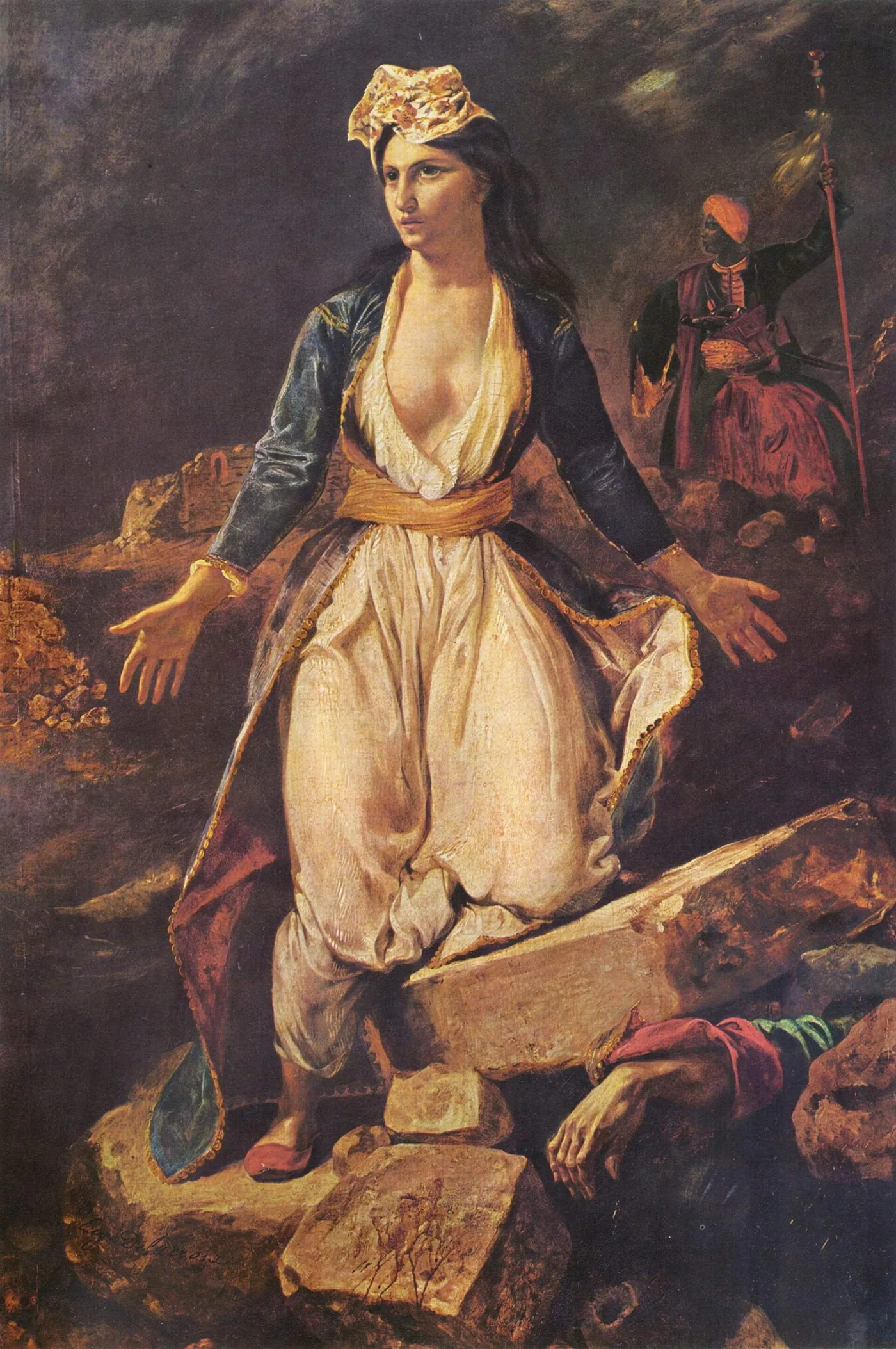
Eugène Delacroix, Greece on the Ruins of Missolonghi, 1826. Musée des Beaux-Arts, Bordeaux · Public domain · Source page
Eugène Delacroix, Greece on the Ruins of Missolonghi, 1826. Musée des Beaux-Arts, Bordeaux
The war lasted nine years and was cruel on both sides. Across Europe, philhellenes, ‘friends of the Greeks’, gave money or came to fight; Lord Byron died of fever at Missolonghi in 1824. In April 1826, after a year's siege, the starving defenders tried to break out at night; most were killed or captured. Delacroix painted this within months, for a Paris exhibition in aid of the Greeks.
- Who is the woman? Is she a real person? No: she is Greece herself, in Greek dress, kneeling on the ruins; under the stones lies a dead defender's hand. A nation as a woman: we meet her again in Delacroix's Liberty of 1830.
- What does the painter want Parisians to feel, and to do? Pity for a Christian woman, anger at the turbaned soldier, and the wish to help. It was painted for a charity show: propaganda, open about its aim. It shows nothing of the massacres committed by Greek rebels too, as at Tripolitsa in 1821.
- Did pictures like this matter? Public sympathy pushed governments. In 1827 British, French and Russian warships destroyed the Ottoman-Egyptian fleet at Navarino, and in 1830 the powers recognised an independent Greece.
Check yourself
What is the best way to use Delacroix's Greece on the Ruins of Missolonghi as a source?
Answer: As evidence of how the Greeks' French supporters wanted Europe to see the war in 1826. Right. It was painted for a charity exhibition, to stir pity and anger. It tells us about philhellene propaganda and the public mood, not about what happened at Missolonghi.
Springtime and second thoughts (1830–1882)
1830–1848
An opera, a barricade, a springtime
In July 1830 Paris overthrew its king in three days of street fighting: the moment Delacroix turned into Liberty Leading the People. A month later, in Brussels, an opera audience heard a duet about ‘sacred love of the fatherland’ and poured into the streets. By October Belgium had declared its independence from the Netherlands: a nation of French and Flemish speakers, united by Catholic faith, liberal ideas and dislike of Dutch rule.
In 1848 revolution swept Paris, Vienna, Berlin, Milan, Budapest and Prague within weeks: the ‘springtime of peoples’. Liberals demanded constitutions; nations demanded states. The Italian exile Giuseppe Mazzini taught that God had marked out the nations ‘by the courses of the great rivers, by the lines of the lofty mountains’ (The Duties of Man, 1860). What came of it in Italy and Germany is the story of the next two lessons.
A decision point
You are František Palacký, the historian of the Czech people.
Prague, April 1848
For years you have been writing the history of Bohemia, telling the Czechs that they were once a great and free people. Bohemia belongs to the Austrian Empire and lies inside the German Confederation. Most of its people speak Czech; perhaps two in five speak German.
In March, revolution broke the old order and Metternich fled Vienna. Now liberals in Frankfurt are preparing an all-German parliament, and their Committee of Fifty invites you to join. Bohemia, they assume, is German land. To the east, the tsar watches every Slav movement.
What do you answer Frankfurt?
- Accept: Bohemia joins a free, united Germany, with rights for its Czechs You would stand with the liberals against the old absolutism. But in a German nation-state the Czechs would be a minority, and their language would probably lose ground in schools and offices.
- Refuse, and work for a reformed Austria: a federation of equal peoples You would shield the Czechs from both Germany and Russia inside a familiar empire. But you are betting on the goodwill of the Habsburgs, who have never yet shared power with their peoples.
- Demand an independent Czech state The boldest answer, and the purest nationalism. But the Czechs have no army, Bohemia's Germans would resist, and Vienna and Frankfurt alike would probably crush the attempt.
- Look east: seek Russia's protection and the unity of all Slavs A powerful patron, and a Slav one. But the tsar is the most absolute ruler in Europe; you might trade German influence for Russian rule.
What really happened
Refuse, and work for a reformed Austria: a federation of equal peoples
On 11 April 1848 Palacký refused. He was, he wrote, a Bohemian of Slavic descent, and could not help to build a German nation. Austria should be kept as a shield for the small peoples between Germany and Russia; if it did not exist, it would have to be created, in the interest of Europe and of humanity. In June he presided over a Slav Congress in Prague, until Austrian troops bombarded the city.
Nationalism did not always mean ‘a state for every nation’: Palacký feared that one people's nation-state would make his own people a minority. The Habsburgs disappointed him. In 1865 he wrote a sentence Czechs still quote: ‘We existed before Austria, and we shall exist after it.’ In 1918 Czechoslovakia was born.
Check yourself
Why did Palacký refuse the invitation to Frankfurt in 1848?
Answer: In a German nation-state the Czechs would become a minority; he hoped instead for a federal Austria that protected small peoples. Right. He saw Austria as a shield between Germany and Russia, and wanted equal rights for its peoples inside it.
Ernest Renan
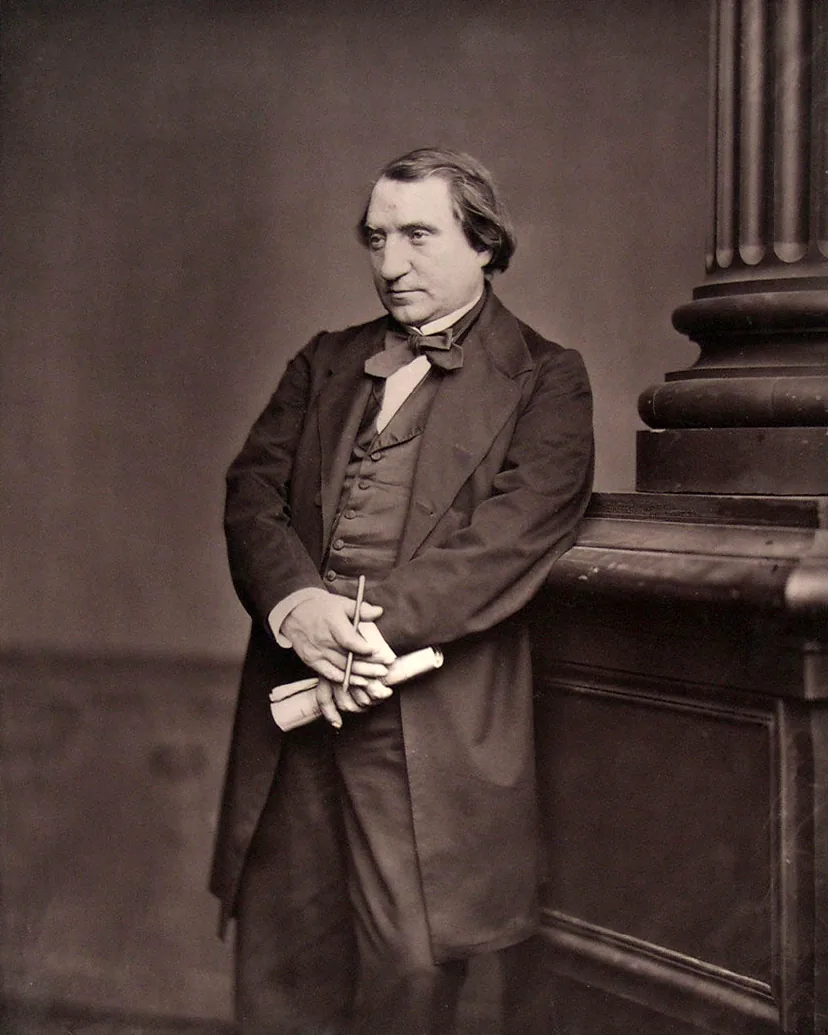
Antoine Samuel Adam-Salomon, Ernest Renan, woodburytype, 1870s, published in the Galerie contemporaine (1876–1884). Art Institute of Chicago · Public domain · Source page
A Breton who trained for the priesthood, lost his faith, and gave the world its most famous definition of a nation.
- Born: 28 February 1823, Tréguier, Brittany
- Died: 2 October 1892, Paris
- Won: Life of Jesus, 1863: a bestseller and a scandal; What Is a Nation?, a lecture at the Sorbonne, 11 March 1882
- Lost: Suspended from his chair after calling Jesus ‘an incomparable man’ in his opening lecture; Ranked ‘Aryan’ peoples above ‘Semitic’ ones, for which later critics attacked him
“Forgetfulness, and I shall even say historical error, form an essential factor in the creation of a nation.”
Source: A daily plebiscite
“A nation is then a great solidarity, constituted by the sentiment of the sacrifices that its citizens have made, and of those that they feel prepared to make once more. … A nation's existence is — if you will pardon the metaphor — a daily plebiscite, as the individual's existence is a perpetual affirmation of life.”
In 1871 the new German Empire took Alsace and north-eastern Lorraine from defeated France, justifying it by language and descent: most Alsatians spoke a German dialect, though many wanted to remain French. French-speaking Metz was taken as a fortress. Earlier in this lecture Renan had rejected race, language, religion, interests and geography, one by one, as the basis of a nation.
- Why would a Frenchman in 1882 insist that a nation rests on will, not on language? Because by the test of language Alsace was German; by the test of will, French. Renan's civic nationalism was also an argument in a quarrel over land. Always ask what a definition is for.
- Compare Renan with Fichte and Mazzini. Which of their ideas does he reject when he says that man is enslaved neither by his language ‘nor by the course of rivers, nor by the direction of mountain ranges’? Fichte's, that language is a nation's true border, and Mazzini's, that God drew the map of nations in rivers and mountains. Renan names neither, but answers both: nothing in nature decides; people do.
Check yourself
What did Renan mean by calling a nation's existence ‘a daily plebiscite’?
Answer: That a nation lives by its members' continuing will to live together, on the basis of a shared past. Right. For Renan, memory and sacrifice give a nation its past, and consent keeps it alive in the present. It was also an argument about Alsace, where most people spoke a German dialect but many wanted to stay French.
1863–1914
Peasants into Frenchmen
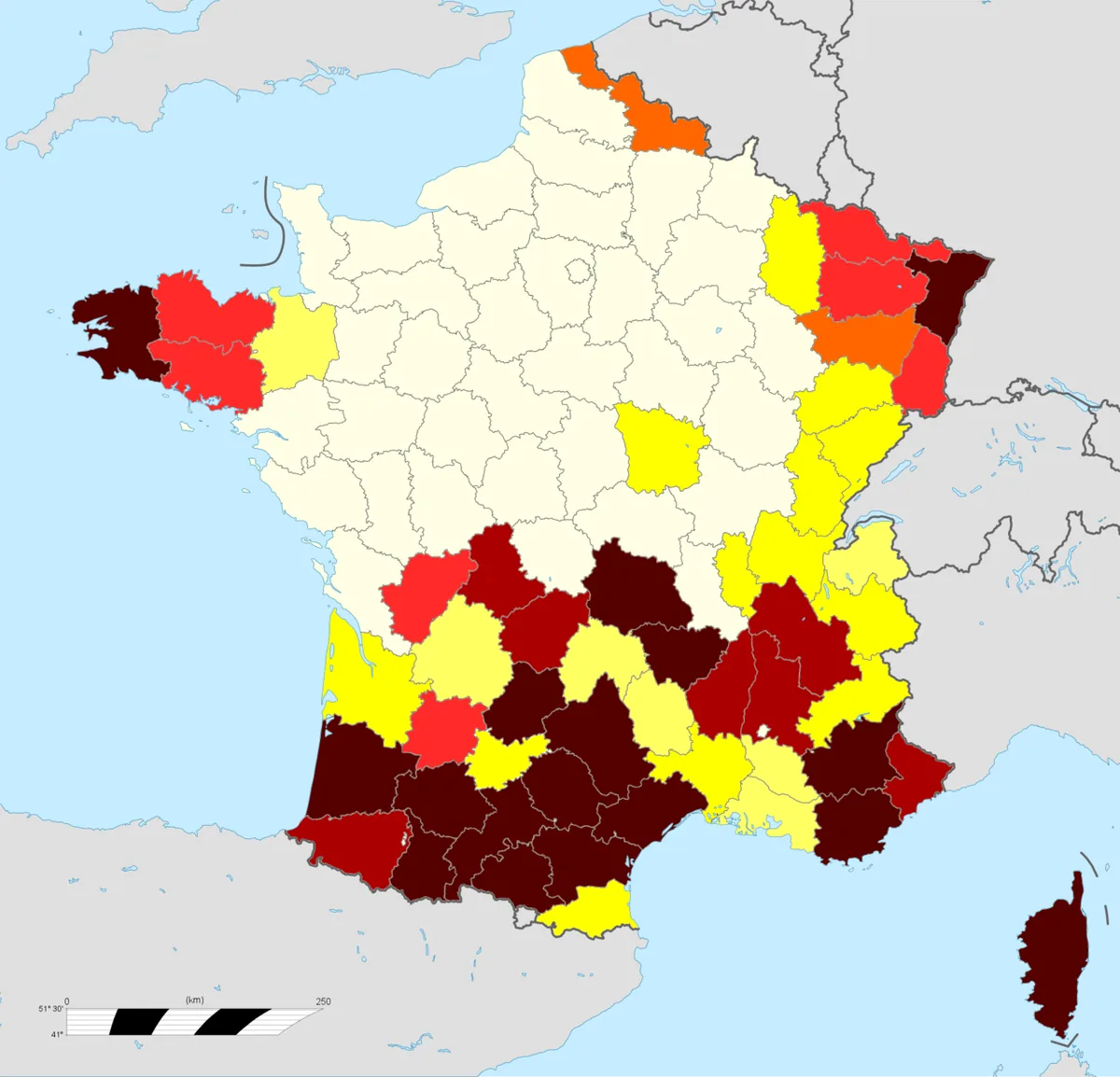
Communes speaking patois, 1863: map by XIIIfromTOKYO after the Archives nationales, F17 3160, as cited by Eugen Weber · CC BY-SA 4.0 · Source page
Even in 1863 a government survey found no French spoken in more than one commune in five, and almost half of the schoolchildren aged 7 to 13 either spoke no French or could not write it. In Peasants into Frenchmen (1976) the historian Eugen Weber argued that rural France became truly French only between 1870 and 1914: through roads, railways, army service, newspapers and, above all, free and compulsory schools.
Critics say Weber generalised from anecdotes and dated the change too late. But his point stands: the nation was not just found. It was taught.
The theory
Imagined communities
In 1983 three books changed how historians think about nations. Benedict Anderson called the nation an imagined community: you will never meet most of its members, yet you feel bound to them; books and newspapers in everyday languages let strangers imagine themselves reading together. Ernest Gellner argued that industrial society needs literate workers who share one standard culture, taught in mass schools. Eric Hobsbawm and Terence Ranger collected cases of the invention of tradition, such as Scotland's clan tartans, which owe more to the 19th century than to the Middle Ages, as Hugh Trevor-Roper argued.
One case Herder would have understood at once. In 1881 Eliezer Ben-Yehuda arrived in Jaffa, determined that his household would speak only Hebrew. Within a generation a language of prayer and books became a mother tongue.
Check yourself
When Benedict Anderson calls the nation an ‘imagined community’, what does he mean?
Answer: That its members will never meet most of the others, yet print and school let them feel bound together. Right. ‘Imagined’ does not mean fake. It means held together in the mind, through newspapers, books and a shared language.
A world of nation-states (1871 to today)
1871–1945
The dark side
Every new nation-state had minorities, and many states tried to make them fit: Hungary pressed Magyar on Slovaks and Romanians, Russia pressed Russian on Poles. Nationalism itself hardened, from Mazzini's liberal hope into the nation as a race, ranked above others, with enemies within. Racial antisemitism grew in this soil.
On 28 June 1914 a young Bosnian Serb nationalist, Gavrilo Princip, shot the heir to the Austrian throne in Sarajevo, and Europe went to war. By 1922 four empires had collapsed, and the victors promised self-determination. But tens of millions of people found themselves minorities in the new states. Then came population exchanges, expulsions and, under Nazi racial nationalism, the murder of Europe's Jews.
1882–1905
A nation without a land
In 1882, the year of Renan's lecture, a doctor in Odessa, Leon Pinsker, argued after a wave of pogroms that the Jews needed ‘auto-emancipation’: a land of their own. In Paris the journalist Theodor Herzl watched Captain Dreyfus publicly degraded; in Vienna, an antisemitic party win the city. In 1896 he published The Jewish State: ‘We are a people — One people’ (trans. Sylvie d'Avigdor). In 1897 he gathered the First Zionist Congress in Basel.
Zionism had an unusual problem: a people scattered across many countries, without one territory or one everyday language. It had to choose a land, and revive a language. In 1903, after a pogrom in Kishinev, Britain offered land in East Africa: the ‘Uganda’ plan. Herzl saw an urgent refuge; many delegates, above all from the Russian Empire, saw a betrayal of Zion, and in 1905 the movement turned the offer down.
1945 to today
From empires to 193 states
After 1945 the idea that had broken Europe's empires broke its colonial empires too. India and Pakistan became independent in 1947, in a partition that killed between 200,000 and two million people, by different estimates. In 1960 alone, 17 African states won independence, many inside borders drawn by others and with dozens of languages: there, a nation had to be built, not found.
The UN began in 1945 with 51 members; by 2011 it had 193. The Soviet Union and Yugoslavia broke apart in the 1990s, the second in war. Today nationalism is everywhere, often unnoticed: in flags at football matches, in the weather map that stops at the border, in the ‘we’ of the evening news. The psychologist Michael Billig calls this ‘banal nationalism’.
Check yourself
According to the lesson, what was ‘unusual’ about the problem facing Zionism?
Answer: It was a people scattered across many countries, with no one territory and no one everyday language, so it had to choose a land and revive a language.. Right. This is what the lesson calls an ‘unusual problem’: a scattered people, with no one territory and no one everyday language. Zionism had to choose a land and revive a language.
Myth
Nations are ancient and unchanging: the French, the Germans or the Greeks have always existed as they are today, and nationalism simply woke them up.
The truth
Many nations grew from far older names, faiths, languages and memories, and historians argue about how deep the roots go. But who belongs, which language counts and where the border runs have changed again and again: the Greeks of 1821 called themselves Romans. And the claim that every nation must govern itself in a state of its own is modern, born in the age of revolutions after 1789.
The evidence
Renan, 1882: ‘The nations are not something eternal. They have had their beginnings, they shall have their end.’ (trans. Hutchison, 1896)
What the idea did
- 1830 Greece and Belgium win independence, recognised by the great powers.
- 1861–1871 Italy and Germany are united as nation-states: the next two lessons.
- 1918–1923 Four empires fall; new nation-states rise, with tens of millions in minorities.
- 1939–1945 Nazi racial nationalism brings war and the Holocaust.
- 1947–1948 India and Pakistan become independent; the State of Israel is declared on 14 May 1948.
- 1960 The ‘Year of Africa’: 17 African states win independence.
- 1991–1993 The Soviet Union, Yugoslavia and Czechoslovakia break up into new nation-states.
Old or new?
Are nations products of the modern world, or did they grow from far older roots?
- The modernists: Ernest Gellner, Nations and Nationalism (1983); Benedict Anderson, Imagined Communities (1983); Eric Hobsbawm, Nations and Nationalism since 1780 (1990) Nations are modern. Before printing, mass schooling and industry, peasants did not imagine themselves part of a nation of millions. Nationalism came first and made the nations, not the other way round: it did not awaken nations, it invented them. The ‘ancient’ traditions are often recent inventions.
- The ethno-symbolists: Anthony D. Smith, The Ethnic Origins of Nations (1986) Modern nations did not appear from nothing. They grew out of older ethnic communities, with their names, myths of origin, memories, symbols and homelands. Nationalists could only ‘invent’ what people were ready to believe; the Greeks of 1821 reached back to a real past, and the Jews' attachment to Zion was centuries old.
- The ‘deep roots’ school: Adrian Hastings, The Construction of Nationhood (1997); Azar Gat (with Alexander Yakobson), Nations (2013) Some nations are pre-modern. England was a nation by the 14th century, Hastings argued, shaped by a vernacular Bible and a national church; the Hebrew Bible itself gave Europe its model of a nation. Gat, an Israeli historian, sees kinship and shared culture as ancient human bonds that states have always used.
Most historians today agree that the political demand of nationalism, one nation, one state, is modern. They still disagree about how old the feeling of belonging to a people is, and the answer may differ from nation to nation. The Israeli philosopher Yael Tamir argued in Liberal Nationalism (1993) that national belonging and liberal values can go together.
Check yourself
What divides the modernists, such as Gellner and Anderson, from the ethno-symbolist Anthony D. Smith?
Answer: The modernists say that nationalism created the nations. Smith says that modern nations grew out of older ethnic communities, and that nationalists could only ‘invent’ what people were ready to believe.. Right. For Smith, nations have older names, myths of origin, memories and symbols, and the Greeks of 1821 reached back to a real past. The modernists see nationalism as the cause and the nations as the result.
What do you know now?
Terms
- nation A large group of people who see themselves as one people, with a shared past and a shared future, and who claim the right to govern themselves. Most of its members never meet.
- nationalism The idea, and the movements built on it, that each nation should govern itself, ideally in a state of its own. It became a political force after 1789.
- nation-state A state whose borders are meant to match one nation, and which governs in that nation's name. In practice almost every nation-state includes minorities.
- sovereignty of the nation The principle, written into the French Declaration of 1789, that supreme authority belongs to the nation, not to a king or a church.
- Volk German for ‘a people’. For Herder, a people with its own language, songs, customs and way of thinking: a cultural community, not yet a state.
- civic nationalism The view that a nation is made by citizenship and the will to live together, whatever a person's descent or language. Renan's lecture of 1882 is its classic statement.
- ethnic nationalism The view that a nation is defined by shared descent, language and culture, so that one is born into it. Fichte's Addresses of 1808 argue in this direction.
- levée en masse The French decree of 23 August 1793 that placed the whole nation at the service of the war: young men to fight, everyone else to work for the army.
- patois French word for local speech, from a dialect of French to a separate language such as Breton or Occitan. Officials in Paris used it with contempt.
- self-determination The right of a people to choose its own government and status. The American president Woodrow Wilson made the phrase famous in 1918; the UN Charter named it in 1945.
- imagined community Benedict Anderson's term (1983) for the nation: imagined not because it is fake, but because its members will never meet most of the others, yet feel bound to them.
- invention of tradition Eric Hobsbawm's phrase (1983) for customs that look ancient but were created or reshaped recently, often to give a nation a past.
- Valmy A place in eastern France, near a windmill on a hill. On 20 September 1792 the Prussians retreated there.
- Kellermann A French general who raised his hat at Valmy and shouted, ‘Long live the nation!’
- Goethe The German poet. He rode with the Prussian army at Valmy and wrote about it thirty years later.
- Ernest Gellner A philosopher who defined nationalism as the idea that the political and national unit should be congruent.
- Ernest Renan A French scholar who asked ‘What is a nation?’ in a famous lecture in 1882.
- Herder A German thinker who believed each people has its own spirit, carried in its language and songs.
- Fichte A German philosopher who gave his Addresses to the German Nation in Berlin, in the winter of 1807–08.
- Metternich Austria's chancellor, who hunted ‘national’ students and secret societies.
- Marseillaise A French war song written in 1792 in Strasbourg. It is named after the volunteers from Marseille who sang it.
- Rouget de Lisle A French officer who wrote the war song ‘The Marseillaise’ for the Army of the Rhine.
- Filiki Eteria A secret society founded in Odessa in 1814 to free Greece.
- Hydra A Greek island that joined the revolt in 1821. Its ships helped keep the war alive at sea.
- Missolonghi A Greek town under siege for a year. The defenders’ breakout from it became a founding legend.
- Lord Byron An English poet who supported the Greeks and died of fever at Missolonghi in 1824.
- Giuseppe Mazzini An Italian exile who taught that God marked out the nations by great rivers and mountains.
- Palacký A Czech historian. In 1848 he refused to help build a German nation and wanted Austria kept as a shield.
- Bohemia A land in central Europe, inside the Austrian Empire. Most of its people spoke Czech.
- Delacroix A French painter who made ‘Liberty Leading the People’ after the July 1830 revolution.
- Sarajevo A city in Bosnia, where the Austrian heir to the throne was shot in 1914.
- Gavrilo Princip A young Bosnian Serb nationalist who shot the Austrian heir in 1914.
- Jules Ferry A French politician whose school laws of 1881–1882 made primary school free, compulsory and secular.
- Ottoman The empire that ruled the Greeks of that time, with its capital at Constantinople.
- Herzl Founder of the Zionist movement, who gathered the First Zionist Congress in Basel in 1897.
Sources
- Johann Gottfried Herder, Outlines of a Philosophy of the History of Man, trans. T. Churchill (London: J. Johnson, 1800), books IX.4 and XVI.4
- Declaration of the Rights of Man and of the Citizen, 26 August 1789, art. 3, trans. J. H. Robinson, Readings in European History, vol. 2 (Boston: Ginn, 1906)
- Decree of the levée en masse, 23 August 1793, in F. M. Anderson, The Constitutions and Other Select Documents Illustrative of the History of France, 1789–1907, 2nd ed. (Minneapolis: H. W. Wilson, 1908), no. 40
- Claude-Joseph Rouget de Lisle, Chant de guerre pour l'armée du Rhin (La Marseillaise), Strasbourg, April 1792
- Bertrand Barère, Rapport du Comité de salut public sur les idiomes, Convention nationale, 8 pluviôse an II (27 janvier 1794)
- Henri Grégoire, Rapport sur la nécessité et les moyens d'anéantir les patois et d'universaliser l'usage de la langue française, Convention nationale, 16 prairial an II (4 juin 1794)
- Johann Gottlieb Fichte, Addresses to the German Nation, trans. R. F. Jones and G. H. Turnbull (Chicago and London: Open Court, 1922), Thirteenth Address
- Johann Wolfgang von Goethe, Campaign in France in the Year 1792, trans. Robert Farie (London: Chapman and Hall, 1849)
- Giuseppe Mazzini, The Duties of Man, ch. V, trans. Ella Noyes, in The Duties of Man and Other Essays (London: J. M. Dent, Everyman's Library, 1907)
- František Palacký, letter to the Committee of Fifty in Frankfurt, 11 April 1848, in Spisy drobné, vol. I (Prague, 1898)
- Ernest Renan, Qu'est-ce qu'une nation? Conférence faite en Sorbonne, le 11 mars 1882 (Paris: Calmann Lévy, 1882)
- Ernest Renan, ‘What is a Nation?’, trans. W. G. Hutchison, in The Poetry of the Celtic Races, and Other Studies (London: Walter Scott, 1896)
- Theodor Herzl, A Jewish State, trans. Sylvie d'Avigdor (London: Nutt, 1896), rev. J. de Haas (New York: Maccabaean, 1904)
- Benedict Anderson, Imagined Communities: Reflections on the Origin and Spread of Nationalism (London: Verso, 1983; rev. ed. 1991)
- Ernest Gellner, Nations and Nationalism (Oxford: Blackwell, 1983)
- E. J. Hobsbawm, Nations and Nationalism since 1780: Programme, Myth, Reality (Cambridge: Cambridge University Press, 1990)
- Eric Hobsbawm and Terence Ranger (eds.), The Invention of Tradition (Cambridge: Cambridge University Press, 1983)
- Anthony D. Smith, The Ethnic Origins of Nations (Oxford: Blackwell, 1986)
- Eugen Weber, Peasants into Frenchmen: The Modernization of Rural France, 1870–1914 (Stanford: Stanford University Press, 1976)
- Adrian Hastings, The Construction of Nationhood: Ethnicity, Religion and Nationalism (Cambridge: Cambridge University Press, 1997)
- Azar Gat with Alexander Yakobson, Nations: The Long History and Deep Roots of Political Ethnicity and Nationalism (Cambridge: Cambridge University Press, 2013)
- David A. Bell, The Cult of the Nation in France: Inventing Nationalism, 1680–1800 (Cambridge, MA: Harvard University Press, 2001)
- Michel de Certeau, Dominique Julia and Jacques Revel, Une politique de la langue. La Révolution française et les patois: l'enquête de Grégoire (Paris: Gallimard, 1975)
- Isaiah Berlin, Vico and Herder: Two Studies in the History of Ideas (London: Hogarth Press, 1976)
- Charles Esdaile, Fighting Napoleon: Guerrillas, Bandits and Adventurers in Spain, 1808–1814 (New Haven: Yale University Press, 2004)
- Mark Mazower, The Greek Revolution: 1821 and the Making of Modern Europe (London: Allen Lane, 2021)
- David Brewer, The Greek War of Independence: The Struggle for Freedom from Ottoman Oppression (New York: Overlook, 2001)
- Christopher Clark, Revolutionary Spring: Fighting for a New World, 1848–1849 (London: Allen Lane, 2023)
- Mark Mazower, Dark Continent: Europe's Twentieth Century (London: Allen Lane, 1998)
- Erez Manela, The Wilsonian Moment: Self-Determination and the International Origins of Anticolonial Nationalism (Oxford: Oxford University Press, 2007)
- Shlomo Avineri, The Making of Modern Zionism: The Intellectual Origins of the Jewish State (New York: Basic Books, 1981)
- Michael Billig, Banal Nationalism (London: Sage, 1995)
- Yael Tamir, Liberal Nationalism (Princeton: Princeton University Press, 1993)
Image credits
- Eugène Delacroix, Liberty Leading the People, 1830 (detail, after the 2024 restoration). Musée du Louvre, Paris · Public domain · Source page
- Anton Graff, Portrait of Johann Gottfried Herder, 1785. Gleimhaus, Halberstadt · Public domain · Source page
- Eugène Delacroix, Greece on the Ruins of Missolonghi, 1826. Musée des Beaux-Arts, Bordeaux · Public domain · Source page
- Antoine Samuel Adam-Salomon, Ernest Renan, woodburytype, 1870s, published in the Galerie contemporaine (1876–1884). Art Institute of Chicago · Public domain · Source page
- Communes speaking patois, 1863: map by XIIIfromTOKYO after the Archives nationales, F17 3160, as cited by Eugen Weber · CC BY-SA 4.0 · Source page


