Napoleon
From a Corsican nobody to emperor of half of Europe, and the painting that sold the legend.
Decisions, questions and your own progress, in the app
The crown
He takes the crown himself.
Paris, 2 December 1804. Notre-Dame is cold and packed. Pope Pius VII has travelled all the way from Rome. He anoints the man before the altar with holy oil.
Then the man lifts the crown from the altar and places it on his own head. Next he crowns his wife, Josephine, kneeling before him.
Fifteen years ago he was a junior artillery officer with a foreign-sounding name. Now he is Napoleon I, Emperor of the French. How?
Myth
Napoleon snatched the crown out of the pope's hands: a sudden insult, in front of everyone.
The truth
It was planned. The pope knew in advance that Napoleon would crown himself. He anointed him and said the prayers; Napoleon placed the crown. The message was deliberate: his power came from himself and the nation, not from the Church.
The evidence
A pope had crowned Charlemagne in 800. Napoleon wanted a pope there, but not above him.
Background
An outsider from Corsica
Napoleone Buonaparte is born on 15 August 1769 in Ajaccio, on Corsica, an island France took over from Genoa only the year before. His family are minor nobles: proud, and short of money. At home they speak Corsican.
At nine he goes to a military school at Brienne, in mainland France, where the other boys mock his accent. At 16 he is an artillery officer: a career built on mathematics, open to clever young men without rich connections.
Then comes the Revolution of 1789. Within four years the king has been executed and Europe's monarchies are at war with France. Many officers, most of them nobles, have fled abroad. For a talented young officer, the doors swing open.
First fame
Toulon, 1793
24
That is his age when he is made a general, in December 1793.
That year the port of Toulon rebels against the Republic and lets in a British fleet. Captain Buonaparte, helped by a Corsican friend among the government's envoys, is put in charge of the besiegers' guns. He sees the key: a hill above the harbour. Put cannon on it, and no ship can stay.
On 17 December his troops storm the hill, and he takes a bayonet wound in the thigh. Within two days the British fleet sails away. Then his luck turns: in 1794 he is briefly arrested as a friend of Robespierre's brother. By 1795 he is in Paris, a general without an army.
Two gambles
A decision point
You are Napoleon Bonaparte.
The night before 13 Vendémiaire, Year IV of the Republic (4–5 October 1795), Paris
You are 26, a general without an army. The Convention, the assembly that rules France, has decreed that two-thirds of the next parliament must be its own members. Paris is furious, and royalists fan the anger. Perhaps 25,000 armed citizens plan to march on the Tuileries palace, where the Convention sits.
The defenders number about 6,000. Their general negotiated with the rebels this evening and has been sacked for it. Paul Barras, now in command, sends for you: he remembers your guns at Toulon. A cavalry officer, Joachim Murat, could fetch 40 cannon from a camp outside the city before the rebels do.
What do you do?
- Refuse. A soldier should not turn cannon on the people of Paris. Probably someone else defends the Convention, or it gives way to the crowd. If the rebels win, the next parliament may lean toward bringing back the king. And you stay an unemployed general nobody will remember.
- Take command, but keep the guns back and try to talk the crowds into going home. You are outnumbered about four to one. Talking is exactly what got your predecessor sacked, and every hour lets the rebels close in on the palace. If they break in, the Convention probably falls, and you with it.
- Take command, bring the guns, and fire if the columns attack. The rebels are probably broken within hours, at the price of Frenchmen killed by French cannon in the streets of Paris. The Convention survives, and its saviour becomes famous overnight.
What really happened
Take command, bring the guns, and fire if the columns attack.
Murat's horsemen reach the cannon first, and by morning the guns cover every street to the Tuileries. When the rebel columns advance in the afternoon, near the church of Saint-Roch, the cannon fire grapeshot into them at close range. Within hours it is over.
Estimates of the dead run to about 300 rebels and around 30 soldiers. Within weeks Bonaparte is promoted to general of division, the army's highest rank, and given command of the Army of the Interior. Royalists mock him as “General Vendémiaire”.
It was a career for a general without a post, and he had sided with the Republic since 1793. The guns made him famous, and useful to the men in power.
He never said that he cleared the streets with “a whiff of grapeshot”. Those words are the Scottish writer Thomas Carlyle's, in his history of the French Revolution, published in 1837.
A decision point
You are General Bonaparte.
Late October 1799, Paris
You are 30. Since 1796 you have married Josephine de Beauharnais, beaten the Austrians in Italy and invaded Egypt. In August 1799, with France in trouble, you slipped home and left your army there. The crowds on the road to Paris cheered you like a saviour.
France is governed by the Directory: five Directors and two elected councils, unpopular, nearly bankrupt and at war with half of Europe. One Director, Emmanuel Sieyès, a famous voice of the Revolution of 1789, wants to replace the constitution, which is almost impossible by legal means. He needs a popular general, a “sword”, and he turns to you.
What do you do?
- Join Sieyès's plot as its sword. If it works, you are one of the leaders of a new government, with the army behind you. If it fails, you can be declared an outlaw, and in revolutionary France outlaws were executed without trial.
- Turn him down and ask the Directory for a new army to command. Probably a new campaign on the Rhine or in Italy. You stay a famous general serving politicians, and Sieyès finds another sword, perhaps your rival, General Moreau.
- Use troops loyal to you to take power alone, without Sieyès. An open military takeover, with no politicians on your side, would probably look like naked tyranny. Parts of the army and the councils might resist, and the Republic could slide into civil war.
What really happened
Join Sieyès's plot as its sword.
On 18 Brumaire (9 November 1799) the Council of Ancients, warned of an invented Jacobin plot, moves both councils out of Paris to Saint-Cloud and puts Bonaparte in charge of the troops.
The next day the coup nearly collapses. Bonaparte's speeches ramble. In the Council of Five Hundred deputies shout “Outlaw!” and jostle him, and he is hustled out, shaken. His brother Lucien, the council's new president, saves him: he tells the soldiers that deputies with daggers threaten the assembly, and swears he would run his own brother through if he ever betrayed liberty. Grenadiers clear the hall. That night a handful of deputies name three consuls: Bonaparte, Sieyès and Roger Ducos.
Bonaparte later called it the rescue of a Revolution sinking into chaos. Historians note that he used Sieyès's plan more than he served it: within weeks a new constitution made him First Consul, with the real power, and Sieyès was eased aside with a title and an estate.
The vote
Three million yes, or half that?
3,011,007
The official “yes” vote in the plebiscite that approved the new constitution in early 1800. Only 1,562 voted “no”.
The count was run by the Minister of the Interior: Lucien Bonaparte. In 1972 the historian Claude Langlois showed from the registers that the totals had been padded: the real “yes” vote was perhaps 1.55 million. Voting was public, not secret. The constitution would probably have passed anyway; the fraud was about how big the welcome looked.
Order, slavery and a sale
First Consul
Order, at a price
As First Consul, Bonaparte gives France what it has lacked for ten years: order. Prefects sent from Paris run every department, and the Concordat of 1801, a deal with the pope, ends the Revolution's war with the Catholic Church.
His lawyers draft one law book for the whole country, the Civil Code. All men are equal before the law, property is protected, and marriage is a civil contract, not a church affair. A wife, the Code says, owes her husband obedience.
The price is freedom. In January 1800 he closes 60 of the 73 political newspapers in Paris; by 1811 the capital has four. Police informers are everywhere.
1802
The year slavery came back
In 1794 the revolutionary Convention had abolished slavery in all French colonies. The richest was Saint-Domingue, now governed by Toussaint Louverture, a man born into slavery who commanded an army.
In 1802 Bonaparte turned the clock back. A law of May 1802 kept slavery in the colonies where it had never ended. That summer, after a French army crushed armed resistance in Guadeloupe, slavery was imposed there again. In the French colonies it would last until 1848.
In Saint-Domingue, an army under Bonaparte's brother-in-law, General Leclerc, had landed early in 1802. Toussaint was seized by a trick and died in April 1803 in a fortress in the Jura mountains. When news came from Guadeloupe, the colony rose again, and war and yellow fever destroyed the French army, Leclerc included.
A decision point
You are Napoleon Bonaparte, First Consul.
April 1803, Saint-Cloud, near Paris
In 1800 Spain secretly handed Louisiana back to France: New Orleans and a vast, barely mapped land west of the Mississippi. You promised Spain never to pass it to another power. Your plan was an empire in the Americas, with Louisiana feeding the sugar island of Saint-Domingue.
That plan is dead: your army in Saint-Domingue is dying of war and fever. Peace with Britain is collapsing, and the British navy could take New Orleans quickly. President Thomas Jefferson's envoys are in Paris, offering to buy New Orleans. And you need money for the coming war.
What do you do?
- Keep Louisiana and send troops to hold New Orleans. Your ships would have to slip past the British navy, and without Saint-Domingue the colony has lost its purpose. Probably Britain or the United States takes it during the war, and you get nothing.
- Sell the whole of Louisiana to the United States. Cash for the war, and a growing rival to Britain across the Atlantic. But you break your word to Spain, and France gives up its place in North America.
- Give Louisiana back to Spain, your ally. You keep your promise, but Spain is too weak to defend it. Probably Britain or the United States takes it anyway, and France gains nothing.
What really happened
Sell the whole of Louisiana to the United States.
On 11 April 1803 the foreign minister, Talleyrand, startles the American envoy Robert Livingston: what would the United States pay for all of Louisiana? The treaty is dated 30 April. The price is 60 million francs, plus about 20 million francs of American claims against France that the United States takes over: some 15 million dollars in all. The country roughly doubles in size.
Britain declares war on 18 May. In Saint-Domingue the last French troops surrender in November. On 1 January 1804 the colony declares its independence as Haiti: the first country born of a revolt by enslaved people.
The colony could not be defended, and the money would pay for war. His negotiator, François Barbé-Marbois, wrote that Bonaparte said the sale gave England a rival at sea that would one day humble her pride. But he published that in 1829, 26 years later.
The people who lived on most of that land, dozens of Native American nations, were never asked. What France sold was its claim to rule them.
Moscow
1805–1812
The height, and the crack
Emperor from 1804, Napoleon beats Austria and Russia at Austerlitz in 1805 and crushes Prussia in 1806. His brothers become kings of Holland, Westphalia and Spain. He cannot beat Britain at sea, so he tries to strangle its trade: no port in his Europe may take British goods.
Russia's Tsar Alexander I joins the blockade in 1807, then lets it lapse. In June 1812 Napoleon invades Russia with the largest army Europe has yet seen, the Grande Armée. About half of it is not French: Poles, Germans, Italians and more.
The Russians fall back, burning what they leave. In the summer heat, typhus and dysentery spread through the ranks. At Borodino, on 7 September, a single day of battle leaves tens of thousands dead and wounded. A week later Napoleon enters Moscow. That night the city begins to burn.
A decision point
You are Napoleon, Emperor of the French.
Early October 1812, the Kremlin, Moscow
You have held Moscow for three weeks. The fires, set by the Russians themselves as most historians believe, have destroyed most of the city. Your army, about 100,000 men, is camped among the ruins. There is food in the cellars, for now.
You have written to Tsar Alexander offering peace. He has not answered. His army is regrouping south of the city. Paris is more than 2,000 kilometres away, and the leaves are turning.
What do you do?
- Spend the winter in Moscow and wait for spring. Roofs would help against the cold, but food and fodder would run out, Russian raiders would cut your road home, and for months Europe would wonder whether you were still in charge. Paris would have no emperor until spring.
- March north on St Petersburg, the Tsar's capital. A blow at the heart of Russia, but some 700 kilometres away, with winter coming and a shrinking army. Your marshals think it madness. Probably it would end like a retreat, only farther from home.
- Retreat now, while the weather holds, toward your supply depots at Smolensk and Vilnius. An admission of failure, but with most of your army still alive. Probably a hard march, yet far fewer dead than in a retreat begun weeks later, in snow.
- Wait a little longer for the Tsar's answer. Each week of waiting is a week less before winter. If Alexander never replies, you will have to retreat anyway: later, colder and hungrier.
What really happened
Wait a little longer for the Tsar's answer.
Napoleon waited. Alexander never answered. On 19 October, five weeks after entering Moscow, the army marched out, loaded with loot. Blocked by the Russians at Maloyaroslavets, it had to turn back to the road it had come by, already stripped bare.
The first hard frosts came in early November. Cossacks picked off stragglers; horses died, so guns and wagons were abandoned. In late November the army crossed the Berezina river under fire, at a terrible cost. On 5 December Napoleon left for Paris by sledge.
He was sure Alexander would negotiate, as beaten monarchs always had; leaving without peace meant admitting failure. Most historians see those weeks in Moscow as his fatal mistake. Alexander had vowed not to make peace while a single enemy soldier stood on Russian soil.
Source: A chart that counts the lost
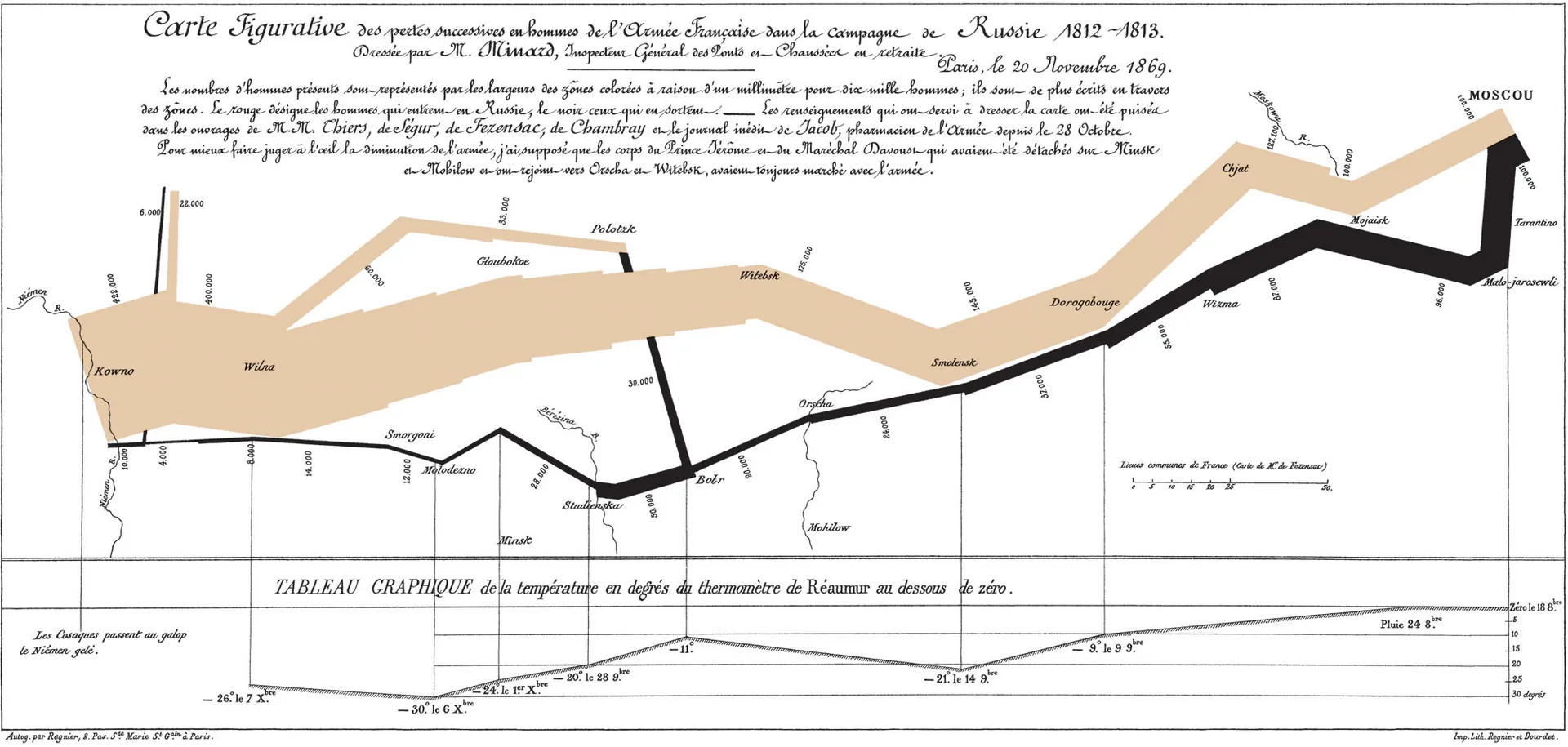
Charles Joseph Minard, Figurative Map of the Successive Losses in Men of the French Army in the Russian Campaign 1812–1813, 1869 · Public domain · Source page
Charles Joseph Minard, Figurative Map of the Successive Losses of the French Army in the Russian Campaign, Paris, 1869
Minard, a retired French engineer, made this chart at 88, 57 years after the campaign, from the memoirs of officers who were there and an army pharmacist's diary.
- What does the width of the band show? The number of men: on the original print, one millimetre per 10,000. Tan is the army marching to Moscow, black the army coming back: 422,000 men at the river Niemen, about 10,000 at the end.
- Find where the tan band shrinks the most. What season is it? Summer. By Moscow, in September, it is down to 100,000, before a single frost. Disease, heat, hunger, desertion, battle and garrisons left on the road had already taken most of the army. The temperature line at the bottom only starts on the way back.
- Minard was not there. Can we trust his numbers? As careful estimates, not counts, taken from memoirs written years later. Modern historians count differently: with reinforcements, perhaps over 600,000 men entered Russia, and many who never came back were taken prisoner, not killed. The shape of the story holds; the exact numbers do not.
The image makers
Look again
Calm on a fiery horse
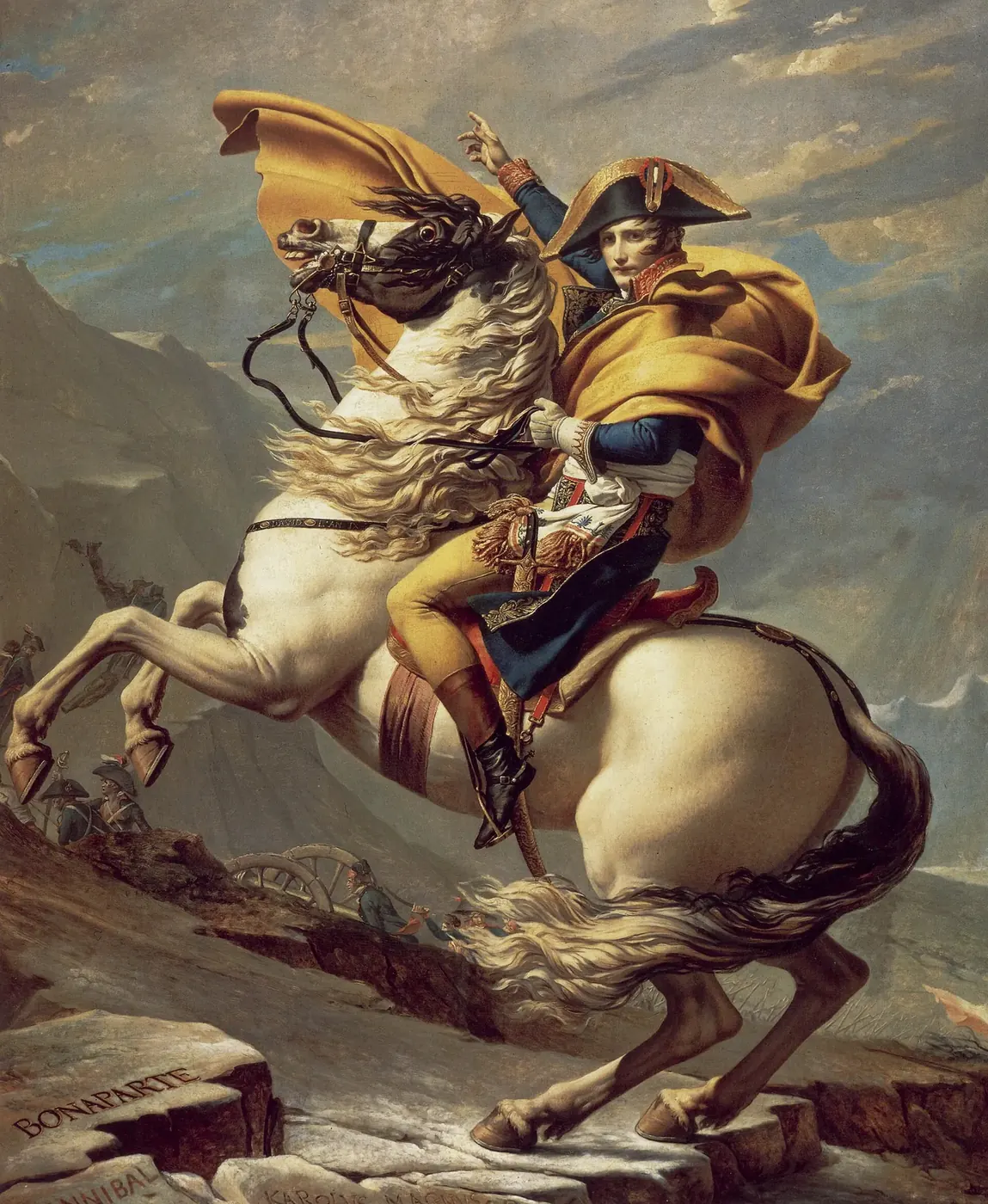
Jacques-Louis David, Napoleon Crossing the Alps, 1801. Château de Malmaison, Rueil-Malmaison · Public domain · Source page
In 1800 the King of Spain, France's new ally, asked for a portrait of the First Consul. Jacques-Louis David, France's most famous painter, got the job. Bonaparte refused to sit: what mattered in a great man, he said, was character, not a face. He asked to be shown “calm on a fiery horse”.
It shows his crossing of the Great St Bernard Pass in May 1800, on his way to war in Italy. Bonaparte ordered three more copies for palaces and public buildings; with the one David kept, there are five. It is propaganda, and one of the most successful political images ever made.
Source: Fifty years later, the same mountain
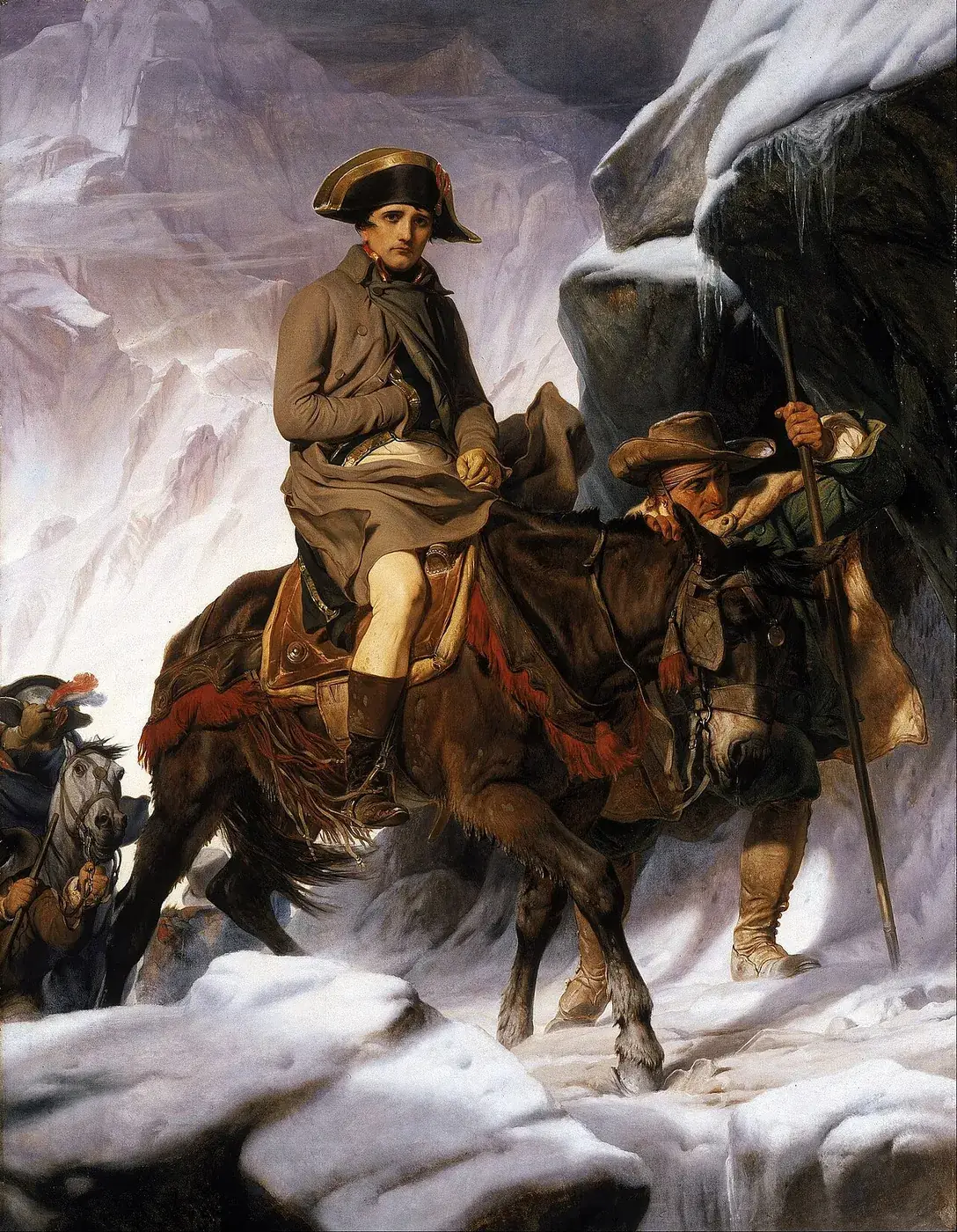
Paul Delaroche, Bonaparte Crossing the Alps, 1850. Walker Art Gallery, Liverpool · Public domain · Source page
Paul Delaroche, Bonaparte Crossing the Alps, 1850
Delaroche painted this for an English collector, usually named as the Earl of Onslow, who found David's picture unbelievable. He followed the historian Adolphe Thiers, who wrote in 1845 that the First Consul crossed on a mule, led by a local guide.
- Who paid for each picture, and what did they want from it? David's was a gift for an allied king, then copied for Bonaparte's own buildings: it had to show a master of men and mountains. Delaroche's was for a British collector, decades after Napoleon's death. Yet in 1848, the year Delaroche began, Napoleon's nephew was elected President of France: the legend was politics again.
- Delaroche shows the mule and the guide. So is his picture the true one? Truer in its facts, but still a point of view. David wants you to believe Bonaparte commands nature itself. Delaroche shows a lonely, weary man of destiny, which can make him even more admirable. Neither painter saw the crossing; both sell an idea of Napoleon. The second legend is just quieter.
Source: The coronation, edited
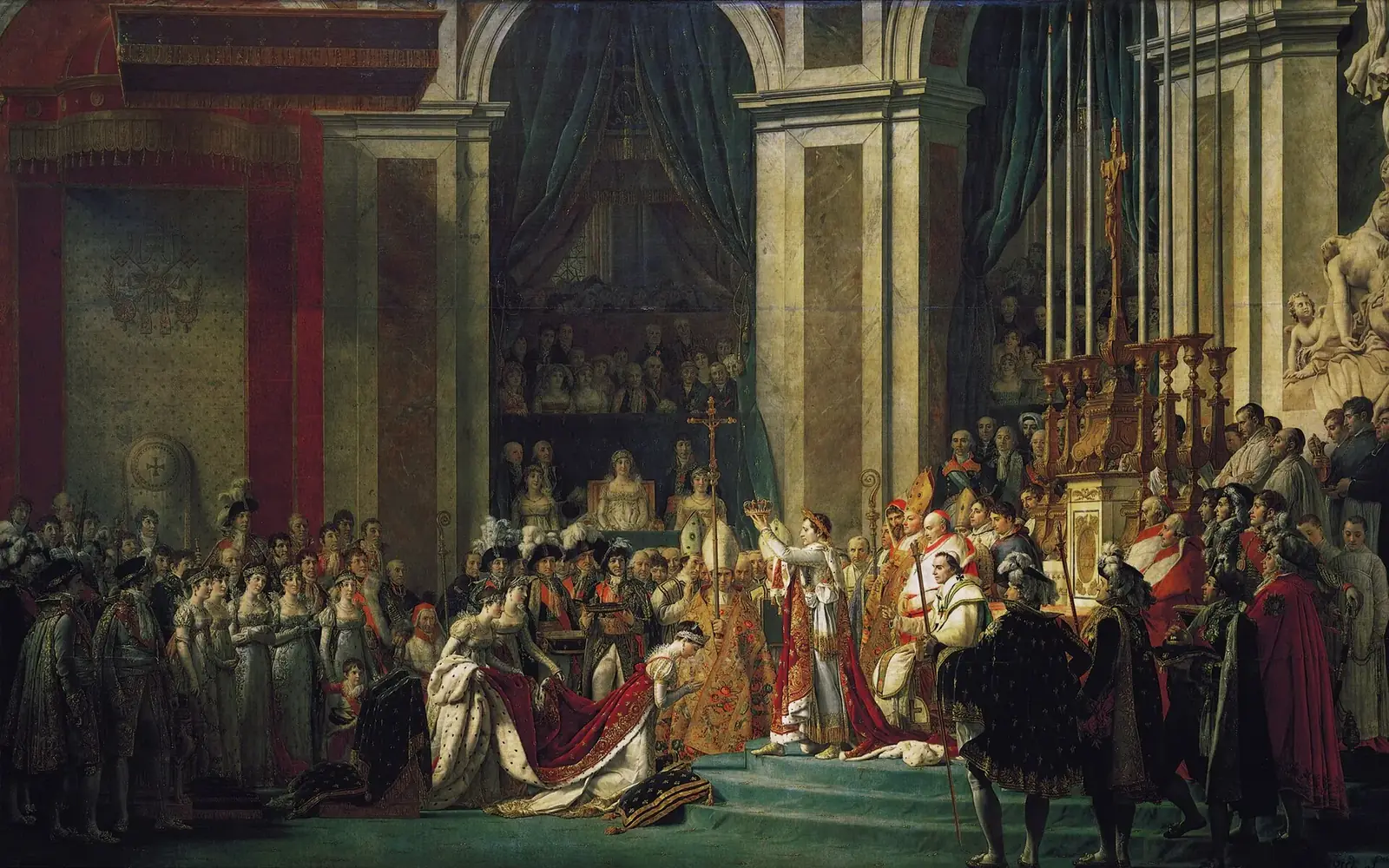
Jacques-Louis David, The Coronation of Napoleon, 1805–1807. Musée du Louvre, Paris · Public domain · Source page
Jacques-Louis David, The Coronation of Napoleon, 1805–1807
Napoleon ordered this huge canvas, about 6 by 10 metres, from David, now his official First Painter, and watched over the work. It does not quite show what happened.
- Who is being crowned here, and why this moment? Josephine, not Napoleon. David first sketched Napoleon crowning himself, then painted the next moment instead. The gesture that set him above the Church is gone; a gentler family scene replaces it.
- Find the woman seated in the central box, high above the altar steps. Who is she? Napoleon's mother, Letizia. She stayed away, angry at his quarrels with his brothers Lucien and Joseph. David painted her in anyway, in a place of honour: a united family, on canvas only.
- Look at the pope behind Napoleon. What is his hand doing, and why does it matter? It is raised in blessing. The pose was changed while David worked, under Napoleon's eye. The pope blesses; Napoleon acts. The Church is there to approve, not to decide.
Source: The enemy's view: “Little Boney”
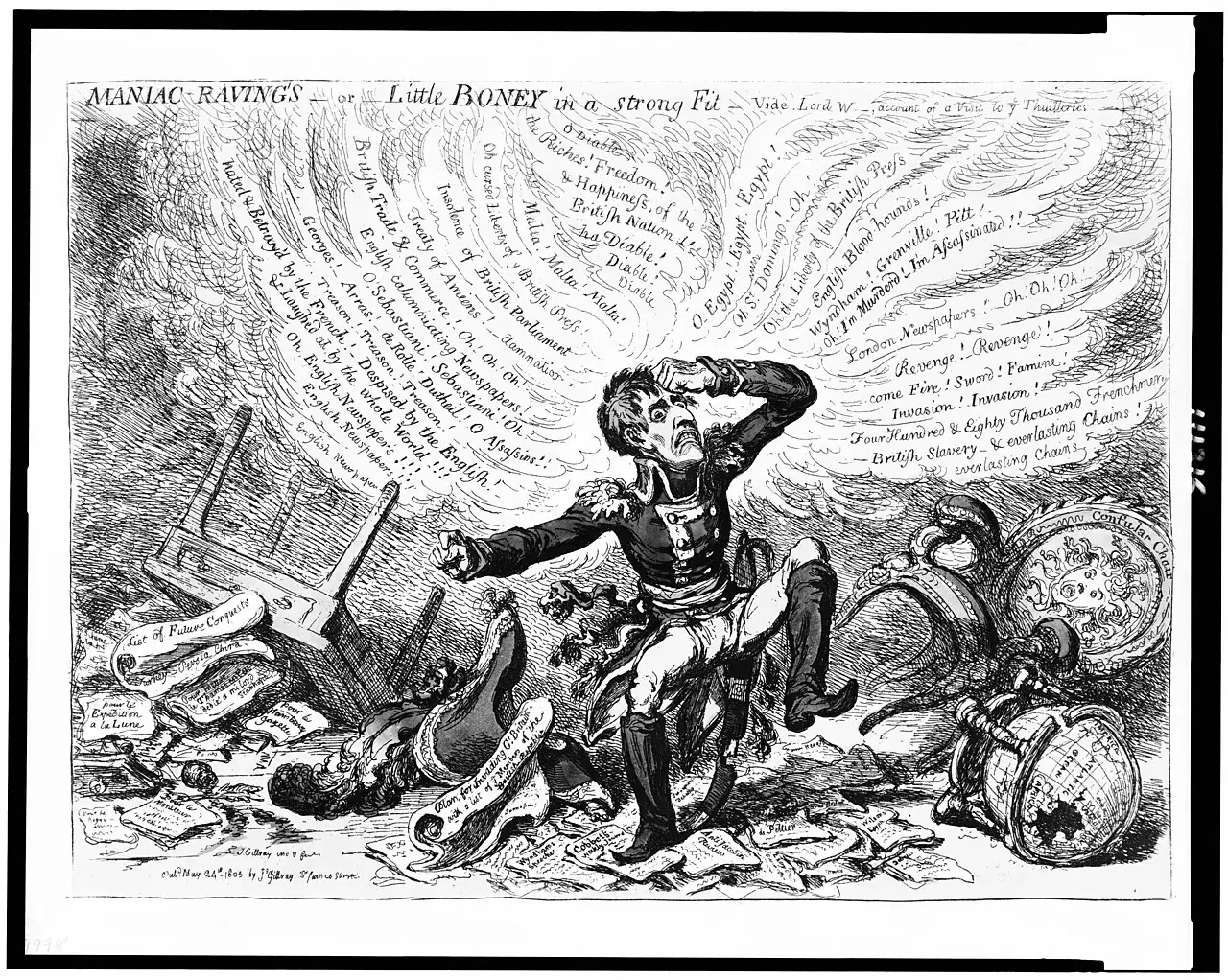
James Gillray, Maniac-Ravings, or Little Boney in a Strong Fit, 1803. Library of Congress, Washington · Public domain · Source page
James Gillray, Maniac-Ravings, or Little Boney in a Strong Fit, London, May 1803
Gillray was Britain's sharpest caricaturist; crowds gathered at the London shop window where his prints hung. This one came out days after Britain declared war. It mocks a real scene: in March 1803 Napoleon had lost his temper with the British ambassador, Lord Whitworth, in front of the court.
- Who made this, for whom, and what does he want you to think? A British artist, for British buyers, as a war began. Enemy propaganda: the most feared man in Europe is no genius, just a little man in a tantrum, kicking furniture because British newspapers criticise him. “Little Boney” became a stock figure: small, vain and hysterical.
- Is there anything true in it? Read the shouted words: Malta, Egypt, Saint-Domingue, the British press, invasion. These were the real quarrels of 1803. Even a picture made to mock can show what people were arguing about.
Myth
Napoleon was very short.
The truth
He was about 1.68 metres tall: average for a Frenchman of his time, or a little above. After his death his height was recorded as 5 pieds 2 pouces, in old French units. A French “inch” was longer than an English one; read as English measure, the figure shrinks to about 1.57 metres.
The evidence
British cartoons like Gillray's turned him into “Little Boney”. From 1796 his soldiers called him “le petit caporal”, the little corporal: a nickname of affection, not a measurement. And he was often seen beside the tall soldiers of his Guard.
Fall and legacy
1813–1821
Falling twice
After Russia, his enemies unite. In October 1813, at Leipzig, the “Battle of the Nations”, the armies of Russia, Prussia, Austria and Sweden crush his new army. In 1814 they take Paris, and he abdicates. He is sent to rule the island of Elba.
Within a year he escapes, lands in southern France and marches on Paris; the soldiers sent to stop him join him. The Hundred Days end at Waterloo, in Belgium, on 18 June 1815, against Wellington's British-led army and Blücher's Prussians.
This time the British send him to Saint Helena, a speck of rock in the South Atlantic. There he dictates his memories and polishes his legend. He dies on 5 May 1821, aged 51, most likely of stomach cancer.
What he left behind
- 1803 The Louisiana Purchase roughly doubles the size of the United States.
- 1804 Haiti declares independence. In France the Civil Code becomes law. It is still the basis of civil law in France, Belgium and Luxembourg, and shaped law from Italy and Spain to Latin America and Quebec.
- 1806 The Holy Roman Empire, almost a thousand years old, comes to an end. Napoleon had merged hundreds of German states into a few dozen; that simpler map later helped Germany to unite.
- 1807–1808 Fleeing his armies, the Portuguese court moves to Rio de Janeiro, in Brazil. In 1808 Napoleon forces Spain's kings off the throne and makes his brother Joseph king. Spain rises in a long war.
- 1810 With Spain's king gone, cities across Spanish America set up their own governments. The wars that follow make most of Latin America independent by the mid-1820s.
- 1814–1815 The Congress of Vienna redraws the map of Europe. The great powers aim for a balance; no war will involve all of them together again until 1914.
- 1821–1823 Two years after his death, his companion Las Cases publishes the Memorial of Saint Helena, Napoleon's own version of his life. It becomes a bestseller.
- 1840 His body is brought back to Paris and laid in Les Invalides before vast crowds.
Hero or tyrant? An argument without end
Was Napoleon the reformer who built modern law and government across Europe, or a conqueror whose ambition cost millions of lives and took freedom away from many?
- Pieter Geyl, Dutch historian, Napoleon: For and Against (1949) Geyl read more than a century of French historians on Napoleon and showed that each generation remade him to suit its own politics. The Nazis had held him hostage in Buchenwald, and he distrusted every cult of the great leader. His conclusion: “History is an argument without end.”
- Andrew Roberts, British historian, Napoleon the Great (2014) Roberts admires him. He argues that most of Napoleon's wars were declared on him by coalitions of kings, and that his law code, schools, administration and the end of old noble privileges built the modern state across much of Europe. In his view the good outweighs the bad.
- Charles Esdaile, British historian, Napoleon's Wars (2007) Esdaile argues that Napoleon's own ambition kept Europe at war: he would accept no peace that limited his power, and every victory set up the next war. Other critics add what the legend leaves out: censorship, police spies, and conscription that took some two million Frenchmen.
- Historians of Haiti and the Caribbean, such as Laurent Dubois and Philippe Girard They point out that the man who spread equality before the law in Europe sent armies to take freedom away from people in the Caribbean. In Haiti and Guadeloupe Napoleon was no reformer, but the ruler who brought back slavery. And in Haiti he was beaten.
In 2021, two hundred years after his death, France argued over how to mark the day. President Emmanuel Macron laid a wreath at his tomb, praised what he had built for the state, and called the restoration of slavery a betrayal of the spirit of the Enlightenment. Can a whole life be judged as a single sum? What would you write on his tomb?
What will you remember?
Check yourself
What happened when Napoleon was crowned in Notre-Dame in 1804?
Answer: He placed the crown on his own head, as agreed in advance with the pope. Right. The self-crowning was part of the planned order of service. The message: his power did not come from the Church.
Check yourself
The coup of Brumaire nearly failed. Who rescued it?
Answer: His brother Lucien, president of the Council of Five Hundred. Right. When the deputies shouted “Outlaw!” and Napoleon faltered, Lucien won over the soldiers, and they cleared the hall.
Check yourself
Why did Napoleon sell Louisiana to the United States in 1803?
Answer: His army in Saint-Domingue had been destroyed and war with Britain was coming, so he could not hold it and needed money. Right. Without Saint-Domingue the colony had lost its purpose, and the British navy could have seized it.
Check yourself
On Minard's chart, where does the band of men shrink the most?
Answer: On the march to Moscow, in summer, before any frost. Right. The army was down to about 100,000 when it reached Moscow in September. Disease, hunger, heat and desertion did most of the damage before winter.
Check yourself
How tall was Napoleon?
Answer: About 1.68 metres, average for a Frenchman of his time or a little above. Right. His recorded height, 5 pieds 2 pouces, was in French units, which were longer than the English ones.
Check yourself
What is the best way to compare David's and Delaroche's paintings of the Alps crossing?
Answer: Delaroche is closer to the facts, but both paintings sell an idea of Napoleon. Right. The mule and the guide are true; the lonely, weary hero is still an interpretation, painted 50 years later for a collector.
Terms
- the Convention The elected assembly that ruled revolutionary France from 1792 to 1795. It declared the Republic and put King Louis XVI on trial.
- grapeshot A cannon load of many small iron balls. At close range it sprays out like a giant shotgun blast, hitting many people at once.
- the Directory The government of France from 1795 to 1799: five “Directors” and two elected councils, the Council of Five Hundred and the Council of Ancients.
- coup The seizure of power by a small group, by force or trickery, outside the law. The word comes from the French coup d'état, “a blow against the state”.
- First Consul Napoleon's title from 1799 to 1804, borrowed from ancient Rome. There were three consuls, but only the First held real power.
- plebiscite A vote in which citizens answer yes or no to a single question. Napoleon used plebiscites to show that the people backed his rule.
- Civil Code France's single book of civil law, in force from March 1804 and renamed the Napoleonic Code in 1807. It covers property, contracts, marriage, family and inheritance.
- Saint-Domingue France's richest colony, in the western part of the Caribbean island of Hispaniola; today Haiti. Before 1791 nearly half a million enslaved Africans grew its sugar and coffee.
- Grande Armée “The Great Army”: the name of Napoleon's main army from 1805. The army that invaded Russia in 1812 drew soldiers from all over the Europe he controlled.
- propaganda Images or words made to win people over to one side, by showing only what helps it.
- the Hundred Days Napoleon's return to power in 1815, from his escape from Elba to his defeat at Waterloo and his second abdication. It lasted a little over a hundred days.
- Notre-Dame The great church in Paris where Napoleon's coronation took place.
- Pius VII The pope, head of the Catholic Church. He came from Rome for the coronation.
- Josephine Napoleon's wife. He crowned her beside him at the ceremony.
- Corsica A Mediterranean island where Napoleon was born. It had come under French rule.
- Paoli Pasquale Paoli, leader of Corsica's fight for independence. Young Napoleon admired him.
- Toulon A port city in southern France. In 1793 it rebelled against the Republic and let in a British fleet.
- Paul Barras One of the five Directors in France. He sent for Napoleon to bring the guns.
- Joachim Murat A cavalry officer. He brought the guns into Paris before the rebels could reach them.
- Vendémiaire A month in the French revolutionary calendar. Royalists mocked Napoleon as General Vendémiaire.
- Sieyès Emmanuel Sieyès, a Director and a voice of 1789 who wanted to change the constitution.
- Nelson The British admiral who destroyed Napoleon's fleet at the Nile.
- Abd al-Rahman al-Jabarti A Cairo historian who recorded the French occupation of Egypt and the revolt in Cairo.
- Rosetta Stone A stone slab French soldiers found in Egypt. It helped decode hieroglyphs.
- Talleyrand France's foreign minister, who surprised the American envoy by asking what the United States would pay for Louisiana.
- Toussaint Louverture Leader of Saint-Domingue, born into slavery. He was seized by a trick and died in a prison in the Jura mountains.
- Jean-Jacques Dessalines A commander in Saint-Domingue, once Toussaint's lieutenant. He led the final war against the French.
- Louis Delgrès An officer who led the resistance to the French in Guadeloupe. He died at Matouba with his men.
- Leclerc Napoleon's brother-in-law, sent at the head of an army to Saint-Domingue.
- Louisiana A vast territory in central North America that France sold to the United States in 1803.
- New Orleans A city on the Mississippi in Louisiana, which the American envoys wanted to buy.
- Thomas Jefferson President of the United States, whose envoys negotiated to buy Louisiana.
- Haiti The country that declared independence in 1804. It was born of a revolt by enslaved people.
- Borodino A battle in Russia, before Moscow, that killed or wounded tens of thousands in one day.
- Moscow Russia's capital. Napoleon took it in 1812, and most of it burned.
- Rostopchin Governor of Moscow. Most historians believe he ordered the fires, though he denied it.
Sources
- Treaty between the United States of America and the French Republic (the Louisiana Purchase), 30 April 1803
- Code civil des Français (Paris, 1804)
- Charles Joseph Minard, Carte figurative des pertes successives en hommes de l'Armée française dans la campagne de Russie 1812–1813 (Paris, 1869)
- François Barbé-Marbois, Histoire de la Louisiane et de la cession de cette colonie par la France aux États-Unis de l'Amérique septentrionale (Paris, 1829)
- Emmanuel de Las Cases, Le Mémorial de Sainte-Hélène (Paris, 1823)
- Thomas Carlyle, The French Revolution: A History (London, 1837)
- Claude Langlois, « Le plébiscite de l'an VIII ou le coup d'État du 18 pluviôse an VIII », Annales historiques de la Révolution française (1972)
- Pieter Geyl, Napoleon: For and Against, trans. Olive Renier (Jonathan Cape, 1949)
- Andrew Roberts, Napoleon the Great (Allen Lane, 2014)
- Charles Esdaile, Napoleon's Wars: An International History, 1803–1815 (Allen Lane, 2007)
- Philip Dwyer, Napoleon: The Path to Power, 1769–1799 (Bloomsbury, 2007)
- Adam Zamoyski, 1812: Napoleon's Fatal March on Moscow (HarperCollins, 2004)
- Dominic Lieven, Russia Against Napoleon: The Battle for Europe, 1807 to 1814 (Allen Lane, 2009)
- Laurent Dubois, Avengers of the New World: The Story of the Haitian Revolution (Harvard University Press, 2004)
- Philippe R. Girard, The Slaves Who Defeated Napoleon: Toussaint Louverture and the Haitian War of Independence, 1801–1804 (University of Alabama Press, 2011)
Image credits
- Charles Joseph Minard, Figurative Map of the Successive Losses in Men of the French Army in the Russian Campaign 1812–1813, 1869 · Public domain · Source page
- Jacques-Louis David, Napoleon Crossing the Alps, 1801. Château de Malmaison, Rueil-Malmaison · Public domain · Source page
- Paul Delaroche, Bonaparte Crossing the Alps, 1850. Walker Art Gallery, Liverpool · Public domain · Source page
- Jacques-Louis David, The Coronation of Napoleon, 1805–1807. Musée du Louvre, Paris · Public domain · Source page
- James Gillray, Maniac-Ravings, or Little Boney in a Strong Fit, 1803. Library of Congress, Washington · Public domain · Source page


