André Masséna, who saved France in 1799
An orphan who went to sea at 13 saved France at Zurich, and Napoleon is said to have called him the “darling of victory”.
Decisions, questions and your own progress, in the app
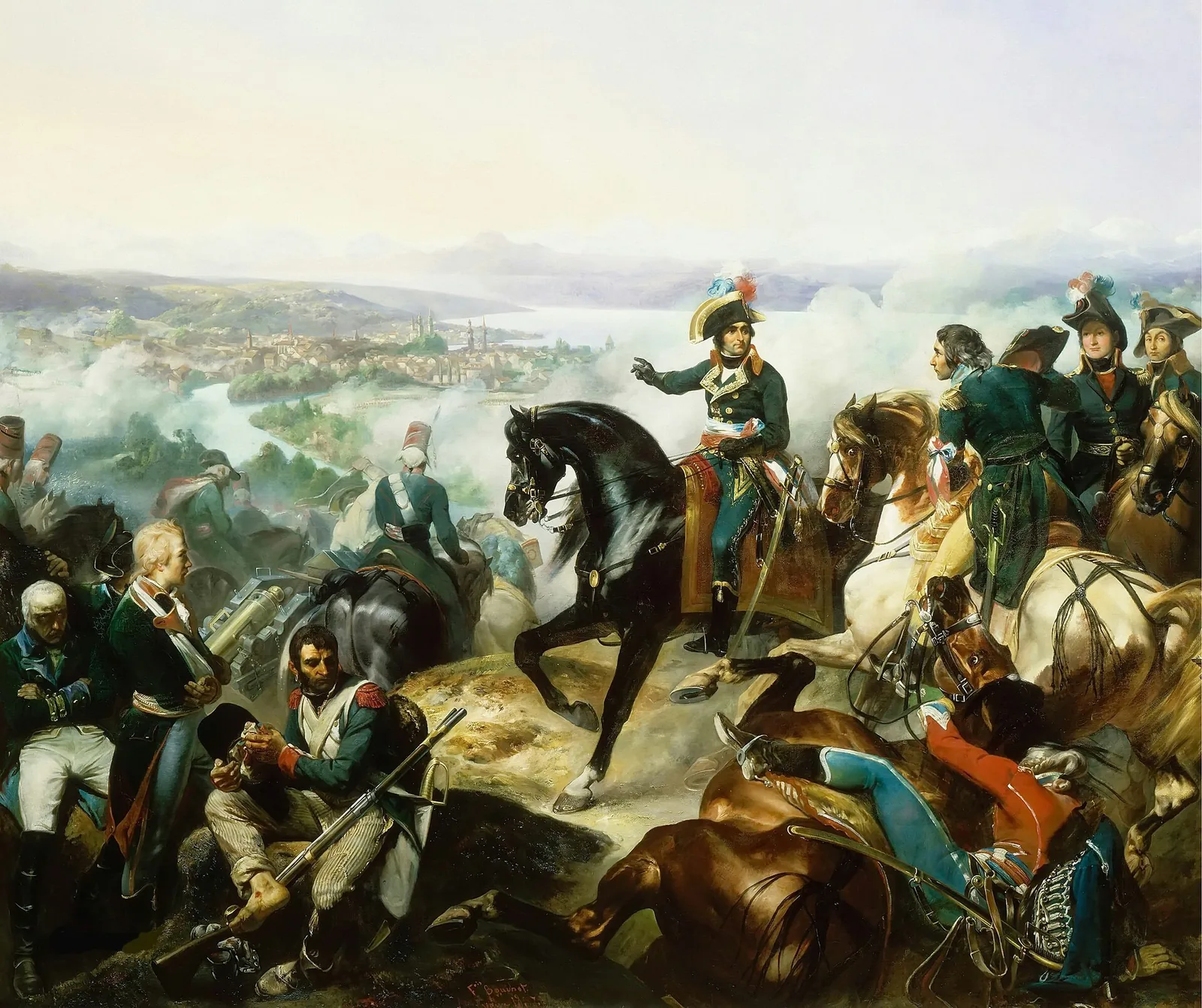
François Bouchot, The Battle of Zurich, 25 September 1799, 1835. Palace of Versailles · Public domain · Source page
Dawn on the Limmat
Thirty-seven boats
Before dawn, 25 September 1799, on the river Limmat in Switzerland. In the dark, 600 French soldiers climb into 37 boats and push off from the bank. On the far side, a Russian outpost has not yet seen them.
The man who planned this is 41, short and lean, with a sharp Italian face. He was born in a town that was not yet French and spent fourteen years in the ranks, because only nobles could be officers. If this crossing fails, the road to France lies open. His name is André Masséna.
André Masséna
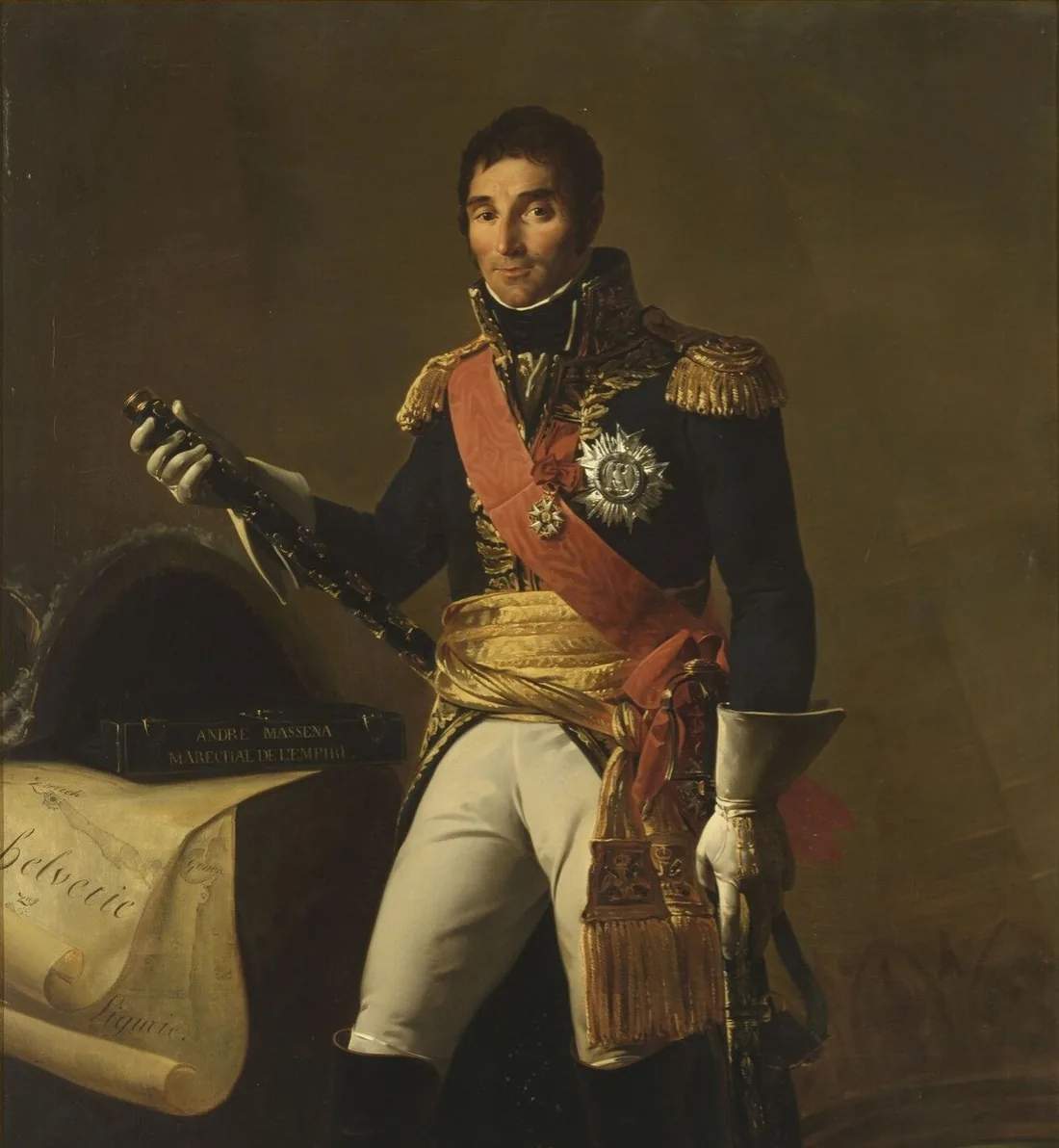
Edme-Adolphe Fontaine, copy after Antoine-Jean Gros’s portrait of Masséna, about 1853 · Public domain · Source page
A penniless orphan from Nice who rose from sergeant to marshal: a brilliant, stubborn and greedy commander, and the man who stopped the Russians in 1799.
- Born: 6 May 1758, Nice, then in the Kingdom of Sardinia
- Died: 4 April 1817, Paris, of lung disease, aged 58
- Won: Rivoli, 1797; Second Zurich, 1799
- Lost: Bussaco, 1810; Fuentes de Oñoro, 1811
He was a born general; his courage and tenacity did the rest.
The sergeant who could not be an officer
Background
An orphan in Nice
André was born on 6 May 1758 in Nice, then a port of the Kingdom of Sardinia, so by birth he was not French. His father, a small trader, died when André was about six, and relatives brought him up.
Tradition, accepted by his modern biographers, says he went to sea at 13 as a cabin boy on a relative’s ship. Many of its colourful details come from ‘memoirs’ that General Koch compiled in his name thirty years after his death. Masséna did not write them, so read the colour with care.
1775–1789
Fourteen years in the ranks
In 1775 he joined the Royal-Italien regiment. Corporal in 1776, sergeant in 1777, by 1784 he was adjudant, the highest rank a commoner could reach.
Above that, nothing: officers had to be nobles. In 1789, aged 31, he left the army, married Rosalie Lamarre, a surgeon’s daughter from Antibes, and kept a small shop. Later rumours said he smuggled goods. No document proves it.
1789–1796
The Revolution opens the door
Then came the Revolution, and a new rule: talent, not birth, would win rank. Volunteer battalions elected their officers. Masséna was elected captain in 1791 and lieutenant-colonel in 1792; by August 1793 he was a general of brigade, and that winter, at the siege of Toulon, a general of division. He was 35.
At Loano in November 1795 he helped beat the Austrians. The Directory was short of money, bread and victories. In March 1796 it sent a 26-year-old general to the Army of Italy. His story is told in our lesson on Napoleon.
Italy: the darling of victory
1796
A ragged army, a young general
Bonaparte found the Army of Italy hungry and ragged, and in a year led it through a string of victories. Masséna commanded a division in nearly all of them: Montenotte, Lodi, Castiglione, Bassano, Arcole.
The Austrians sent army after army to relieve Mantua, their fortress in the French rear, and the French beat each in turn. Bonaparte is said to have called Masséna l'enfant chéri de la victoire, ‘the darling of victory’. Other versions say ‘spoilt child’, and nobody knows when it was said.
A decision point
You are General Bonaparte, 27, commander of the Army of Italy.
Verona, evening of 13 January 1797
You are besieging Mantua, and for the fourth time an Austrian relief army under Alvinczi is coming down to free it. General Joubert, with about 10,000 men on the plateau of Rivoli, is being pushed back by columns of perhaps 25,000.
Another Austrian force, under Provera, is on the lower Adige near Legnago, to the south, within reach of Mantua. Which is the main blow, which the feint? You are fairly sure it is Rivoli; if you are wrong, Verona and the siege lines fall. Masséna’s division, at Verona, is the strongest force you can reach. Rivoli is some 24 kilometres away, in snow.
What do you do?
- Stay at Verona and wait to see where the Austrians really strike It looks safe, but Joubert would probably be crushed before help arrived, and Alvinczi would reach the walls of Mantua with his army intact.
- Order Joubert back to Verona and fight there with the whole army together It would unite your divisions, but give up the plateau and the road to Mantua’s relief. Alvinczi and Provera could probably link up near the city, and you would fight both at once.
- March Masséna’s division and another through the night to Rivoli, and fight Alvinczi at dawn It is a risk: Verona and Mantua are left thin against Provera, and tired men may arrive too late. But if it works you beat the bigger force on its own, before the second can help.
What really happened
March Masséna’s division and another through the night to Rivoli, and fight Alvinczi at dawn
Bonaparte chose the march. Masséna’s division left Verona at about 5 p.m. and covered some 24 kilometres in snow and bright moonlight, a true forced march. Bonaparte rode ahead, reached Rivoli at about two in the morning, and found Joubert about to retreat; he told him to hold on. At dawn the Austrians attacked.
Bonaparte trusted speed. Verona lay between the two Austrian forces, and he could hit each in turn: a lesson in using the central position, as R. G. Burton wrote in 1912. It had a price: Provera slipped through to within sight of Mantua.
Rivoli: who fought whom
14 January 1797 (and the pursuit on the 15th)
The plateau of Rivoli, above the river Adige, some 20 km north-west of Verona
The French Army of Italy
- Commanders: Napoleon Bonaparte (from 2 a.m.), Joubert, Masséna, Rey
- Strength: about 10,000 at dawn (Burton (1912)); about 22,000 after reinforcements (Bodart (1908))
- Losses: about 2,200 (Burton (1912)); about 3,200 killed and wounded, and 1,000 captured (Bodart (1908))
The French force grew all day as Masséna’s and Rey’s divisions arrived.
Alvinczi’s Austrian army
- Commanders: Josef Alvinczi, Quasdanovich, Wukassovich, Lusignan, Liptay and others
- Strength: about 28,000 (Bodart (1908); Clodfelter (2017)); about 25,000 in the morning attack (Burton (1912))
- Losses: about 3,400 killed and wounded and 7,000 prisoners (Burton (1912)); 12,000–14,300 in all (Clodfelter (2017))
The gap is because some writers count only 14 January and others add the pursuit on the 15th.
Outcome: A French victory. Alvinczi’s army was broken, and Mantua surrendered on 2 February.
Provera’s separate force, which surrendered at La Favorita on 16 January, is sometimes counted with the Austrians and sometimes not.
The battle of Rivoli
14–15 January 1797
In January 1797 the French are besieging Mantua, and about 10,000 men under Joubert hold the plateau of Rivoli. Austrian columns of perhaps 25,000 men come down from the north and along the Adige to relieve Mantua. Masséna is at Verona, some 24 km away.
After R. G. Burton (1912) and the French napoleon-empire study of the battle, with villages and the river placed from modern map data. The terrain is simplified; the times, the exact lines and the hour of Masséna’s arrival differ from source to source, so the positions here are approximate.
Phases of the battle
- Moonlit plateau Before dawn Bonaparte arranges Joubert’s 10,000 men on the plateau. Alvinczi’s columns close in from the north and along the Adige; the biggest, under Quasdanovich, is jammed in the gorge road. Masséna is still marching up from Verona.
- The French line bends At first the Austrians win. Liptay breaks the French left, Vial is driven from San Marco, and guns across the Adige force the French off the gorge road. Quasdanovich climbs onto the plateau. Masséna’s first troops arrive on the French left.
- The gorge becomes a trap The turning point, between about ten and noon. Quasdanovich’s column, squeezed at the mouth of the gorge, is blasted at point-blank range by 15 guns; wagons blow up and Austrian dragoons stampede through their own infantry. French cavalry charge, and Masséna’s infantry retake the heights.
- The rear attack fails Around noon Lusignan’s column appears near Affi, in the French rear, threatening the road to Verona. Masséna turns two demi-brigades on it and Rey strikes from behind. About 1,200 surrender; the rest flee. Alvinczi’s centre falls back.
- Pursuit, and Mantua On 15 January the French pursue the Austrians north towards the Tyrol. Masséna’s tired division marches south again, to La Favorita near Mantua, where Provera surrenders on the 16th.
The strategy
- French: Bonaparte is almost sure the main blow falls on Rivoli, so he sends Masséna’s division, the strongest force within reach, on a night march to attack Alvinczi at dawn. Joubert holds the plateau meanwhile.
- Austrians: Alvinczi comes to relieve Mantua for the fourth time, and to do so aims to push Joubert off the plateau. He sends columns from the north and along the Adige, and the biggest, under Quasdanovich, takes the gorge road. He has far more men than Joubert.
What decided it: The battle turned in the gorge. The Austrians’ biggest column, jammed into the narrow road, was blasted at point-blank range by French guns, and once Masséna’s men retook the heights, Alvinczi’s centre fell back.
15–16 January
No time to rest
That night Bonaparte heard that Provera was close to Mantua. Masséna’s men, who had marched all night and fought all day, marched again next morning, south, and caught Provera at La Favorita; he surrendered with several thousand men. On 2 February Mantua fell, and in April Austria signed a preliminary peace at Leoben.
Source: Napoleon at Rivoli, 47 years later
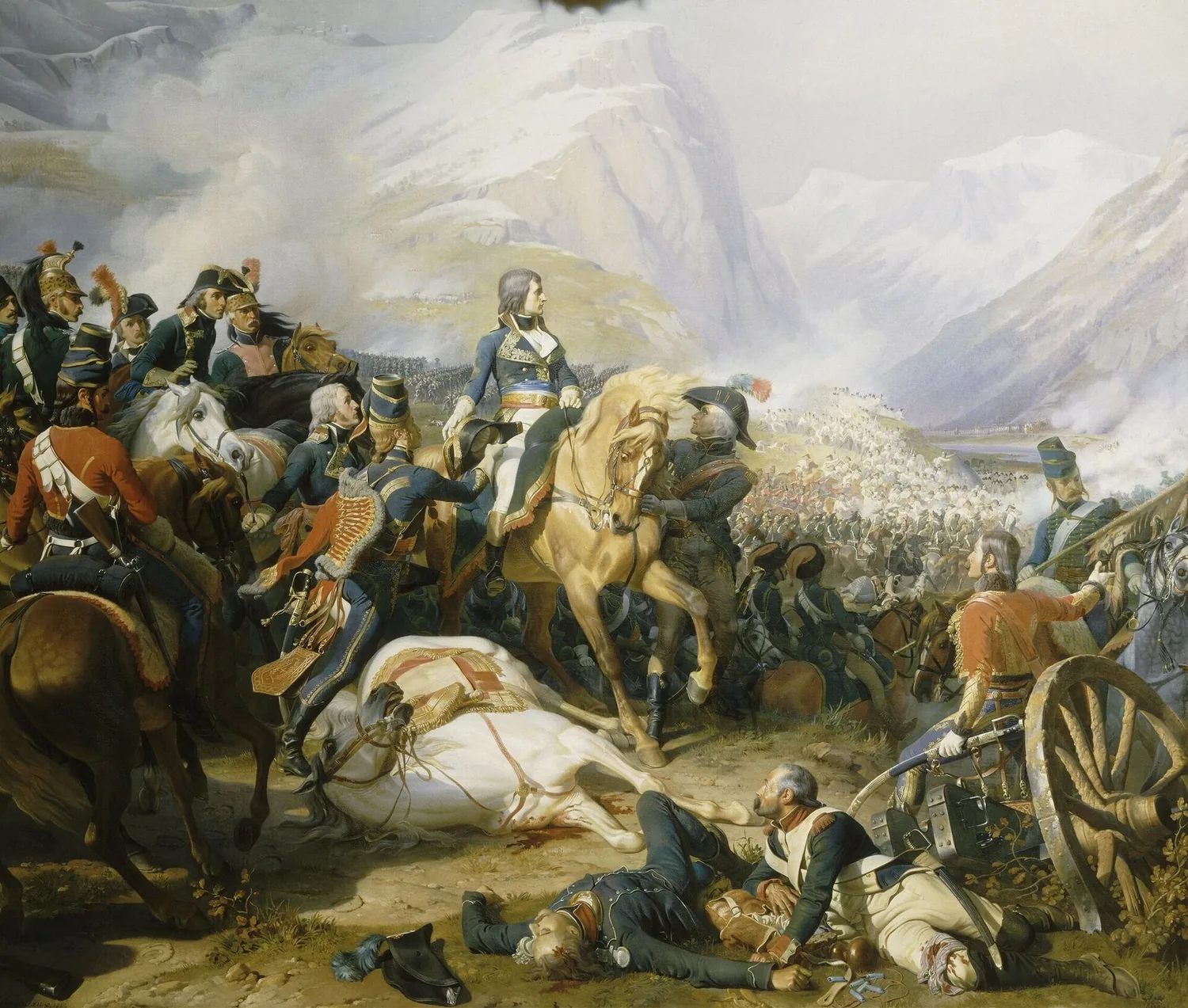
Henri-Félix-Emmanuel Philippoteaux, Napoleon at the Battle of Rivoli, 1844. Palace of Versailles · Public domain · Source page
Henri-Félix-Emmanuel Philippoteaux, 1844, Palace of Versailles
Philippoteaux painted this in 1844 for the museum of French glory at Versailles.
- Who is the hero, and how can you tell? Bonaparte: central, highest, and every officer looks at him. No one is named: nobody can say which officer is Masséna, or Joubert.
- The painter was born after 1797. Why does that matter, and why this picture in 1844? It is a memory, not an eyewitness. Napoleon’s body had been brought back in 1840, and King Louis-Philippe wanted all France, Bonapartists included, to see its glory at Versailles.
Myth
Bonaparte won Rivoli alone.
The truth
Joubert held the plateau for hours before Bonaparte came. Masséna’s division arrived in the morning, and his demi-brigades crushed Lusignan’s column that afternoon. Bonaparte’s gift was to bring everyone to the right place at the right time, and stay calm. All of them won Rivoli.
The evidence
R. G. Burton (1912) gives the day’s sequence.
Zurich, 1799
1798
Rome, and the money
Masséna’s next post nearly ended his career. In February 1798 the French entered Rome and he took over the Army of Rome. His officers, unpaid for months, said that those running the occupied Papal States were drawing millions; a hundred demanded to see the accounts. Masséna refused, and had to leave.
Who took the money is disputed: Donald Horward writes that senior officers had plundered Rome before he arrived, and that he took the blame. Masséna loved money, but in an army that lived off occupied Italy he was far from alone.
1799
The year everything went wrong
In 1799 Britain, Austria and Russia formed a Second Coalition against France, and the French lost battle after battle. In Italy the Russian marshal Suvorov swept them out of the north. In Switzerland, in June, Masséna fought off the first Austrian attack on Zurich but gave up the city to save his army, falling back behind the Limmat and the Albis ridge.
The Directory was furious and all summer ordered him to attack. Masséna refused and waited for his moment. Marbot compared him to Fabius, the Roman who won by delay.
Alexander Suvorov
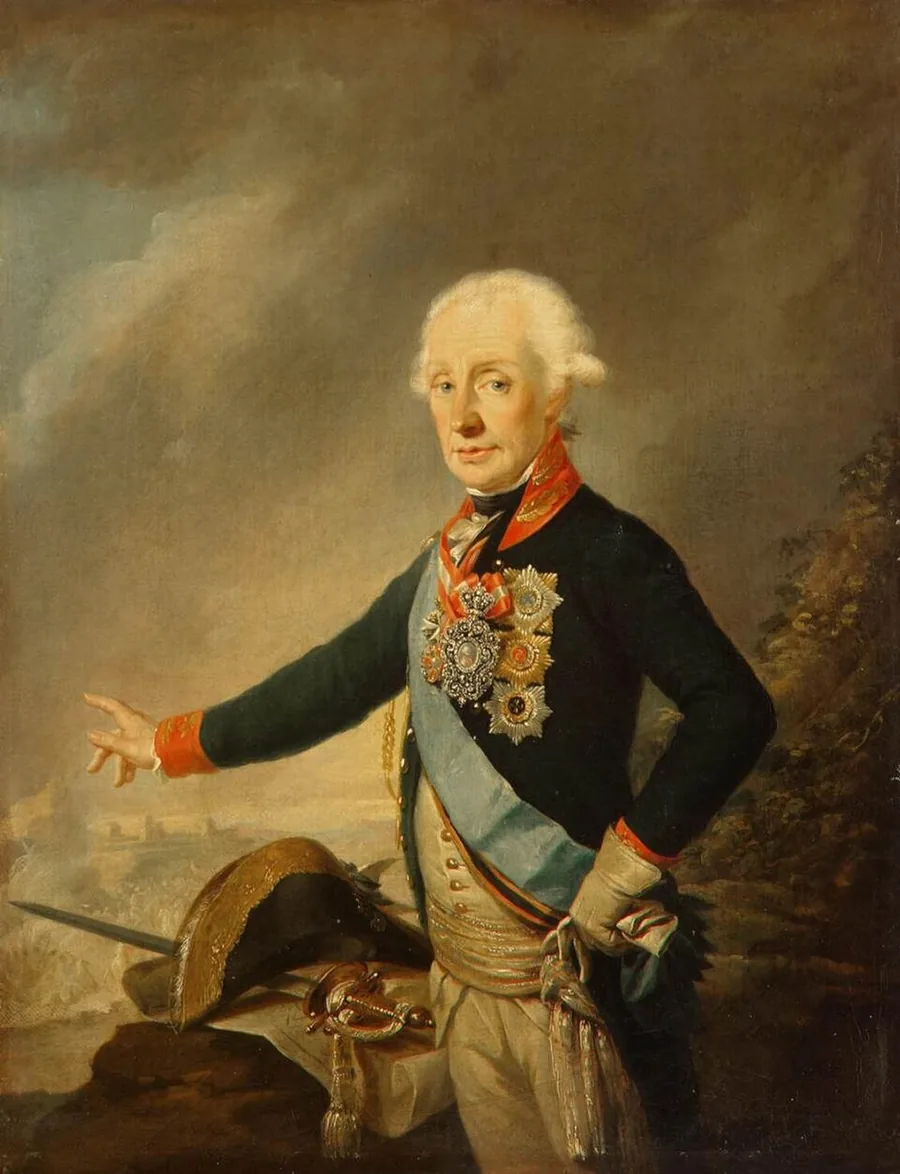
Joseph Kreutzinger, Portrait of Count Alexander Suvorov, 1799 · Public domain · Source page
A tough old Russian field marshal, famed as a general who never lost a battle.
- Born: 1730 (some sources say 1729), Moscow
- Died: 18 May 1800, St Petersburg, of illness
- Won: Cassano, 1799; The Trebbia, 1799; Novi, 1799
- Lost: The Swiss campaign, 1799: cut off and forced to retreat
The bullet is a fool; the bayonet is a fine fellow.
A decision point
You are General Masséna.
Zurich front, evening of 24 September 1799
Korsakov’s 25,000 Russians have reached Zurich but are strung out along 20 kilometres of the Limmat. East of them the Austrian Hotze holds the Linth. From Italy, over the Alps, comes Suvorov, whose army has just beaten the French there.
For weeks you have prepared a surprise: boats hidden near Dietikon, on a bend far from where the Russians look, and a pontoon bridge bridge. The attack is set for the 26th. This evening comes news that Suvorov has taken the Gotthard Pass. Paris has called you timid for months.
What do you do?
- Hold the Albis ridge and the Limmat and wait for the enemy It looks safe, and you have waited all summer. But if Suvorov joins Korsakov, the Allies would probably outnumber you at Zurich and could choose the day.
- Leave a screen at Zurich and march the main army into the Alps to stop Suvorov You would meet the toughest army in Europe in mountains it knows how to fight in, while the Russians would probably attack your thin screen behind you.
- Strike Korsakov now: cross the Limmat in the dark on the 25th, a day early A day ahead of the plan, with Soult still to cross the Linth. If it fails there is no second chance. If it works, you beat the Allies one army at a time.
What really happened
Strike Korsakov now: cross the Limmat in the dark on the 25th, a day early
Masséna struck early: before dawn on 25 September his first boats crossed the Limmat at Dietikon, while to the east Soult crossed the Linth and the Austrian commander Hotze was shot dead in the fog.
He used the news from the Gotthard as his signal: the Allies were at their most scattered, before the two Russian armies could meet. Marbot writes that Masséna would not strike ‘till he could strike decisively’.
Second Zurich: who fought whom
25–26 September 1799
Zurich and the river Limmat; the Linth, 45 km to the east
The French Army of Switzerland
- Commanders: André Masséna, Lorge, Oudinot, Mortier, Gazan; Soult on the Linth
- Strength: 35,448 at Zurich (Duffy (official list)); about 33,500 at Zurich (Bodart; Clodfelter); about 76,000 in all Switzerland (Duffy)
- Losses: about 4,000 killed and wounded (Clodfelter; Bodart)
Korsakov’s Russians
- Commanders: Alexander Rimsky-Korsakov, Gorchakov, Markov, Tuchkov
- Strength: 27,116 (Duffy); about 30,000 (Eggenberger); about 23,000 (Bodart); about 19,600 (Clodfelter)
- Losses: at least 8,000, and most guns and baggage (Duffy; Clodfelter); about 2,000 dead and 5,000 prisoners (Horward)
The figures differ because detached units, stragglers and late arrivals were counted differently.
Hotze’s Austrians
- Commanders: Friedrich von Hotze (killed 25 September)
- Strength: about 25,000 from the Linth to the Grisons, including some 3,000 Swiss (Kincaid (1802)); about 19,000 in the fighting on the Linth (Modern summaries)
- Losses: about 5,500 killed and wounded (Horward)
Outcome: A decisive French victory. Korsakov’s army was destroyed as a fighting force, Hotze was dead, and Suvorov, arriving too late, was cut off in the Alps.
Marbot, writing decades later, speaks of ‘50,000 Russians and Bavarians’ at Zurich and of 30,000 enemy killed or taken in the fighting against Korsakov and Suvorov. Both figures are far too high.
The second battle of Zurich
25–26 September 1799
In late September 1799 Korsakov’s Russians, about 25,000 men, have reached Zurich but are strung out along 20 km of the Limmat. Masséna’s French face them, and Suvorov is coming from Italy over the Alps.
One reconstruction, following the order of battle and the times given in modern summaries of Christopher Duffy’s study (1999), with the river and the places set from modern map data. Times differ between French and Russian sources. Only the fighting on the Limmat is shown; the Linth, 45 km to the east, is only marked.
Phases of the battle
- A river, and 20 km of Russians Night, 24–25 September. Masséna hides 8,000 men, 26 guns and 37 boats at Dietikon, on a bend far from the Russian main camp, while Mortier makes a show of attacking in front of Zurich.
- Across in the dark At 4.45 a.m. the first 600 men cross in 37 boats. At 5 the engineers begin a bridge, ready at 7.30. By 9 all of Lorge’s division is across. Markov’s grenadiers on the Fahr heights are driven off, and he is captured.
- Behind the Russian line The turning point. In all some 15,000 men cross during the day and fan out along the north bank. Oudinot takes Höngg, Gazan marches for the Winterthur road, the Russians’ way home, and Klein advances from Altstetten. By afternoon Korsakov gives up the Uetliberg and falls back into the city.
- The ring By evening Korsakov is shut into Zurich on three sides. Masséna calls on him to surrender and gets no answer. He does not bring up every reserve to close the ring on the fourth side; critics later asked why.
- Breakout and street fighting On 26 September the Russians attack at dawn, then retreat. French troops break into Zurich through the Limmat gate and fight in the streets. The Russians escape north-east towards the Rhine, with no real pursuit.
The strategy
- French: Masséna crosses the Limmat in the dark, a day before the planned date, at a bend near Dietikon where the Russians do not look. Boats are hidden there, and Mortier makes a show of attacking in front of Zurich. The news of Suvorov that evening pushes him to act at once.
- Russians: Korsakov spreads his men along 20 km of the Limmat. When the French cross behind him, he falls back into Zurich.
What decided it: The French crossed where the Russians were not looking, and by evening some 15,000 men were behind the Russian line. Korsakov, his men spread along the river, was shut into Zurich on three sides.
26 September – 8 October
Suvorov arrives too late
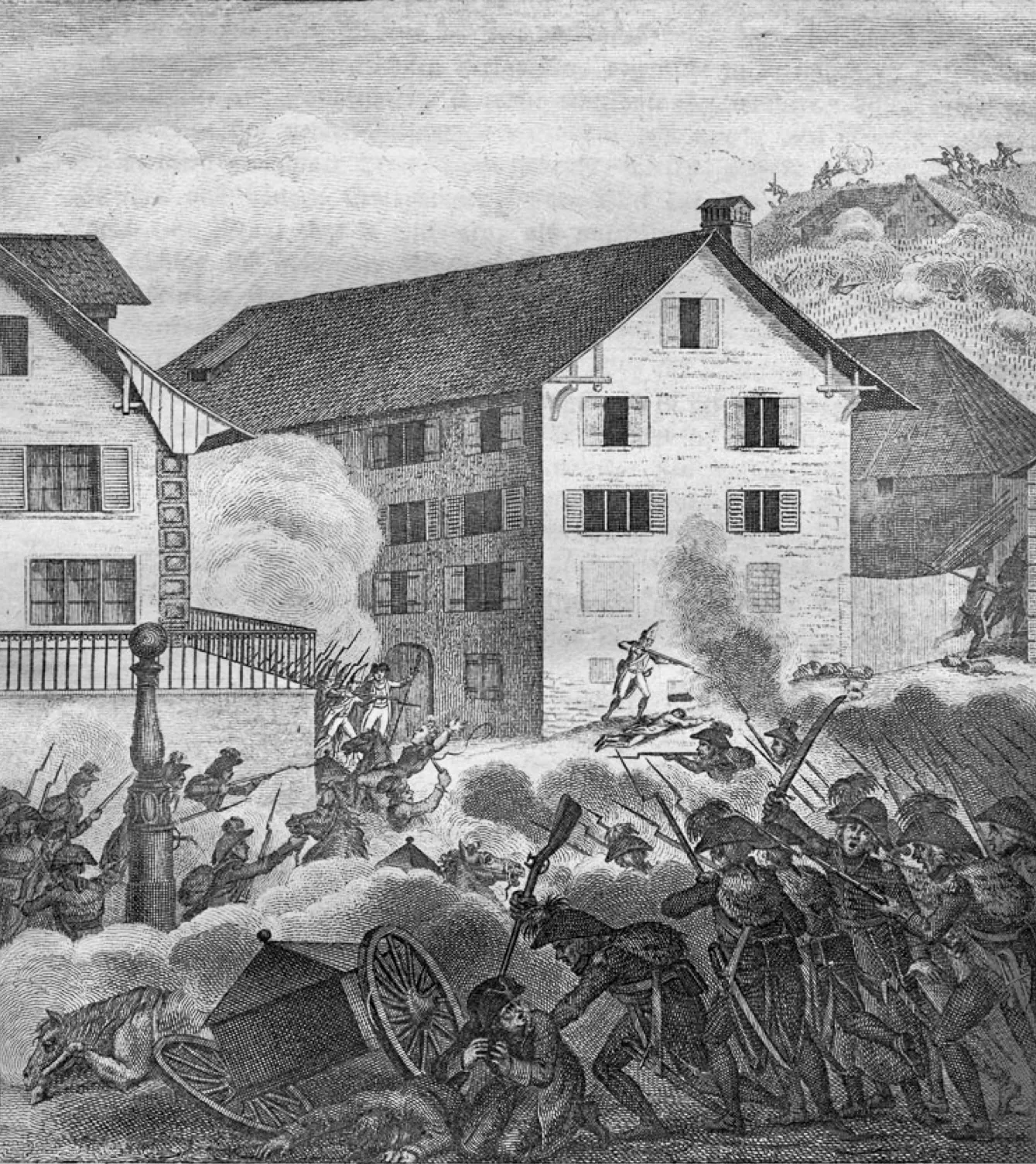
Johann Heinrich Lips after Johann Martin Usteri, Second Battle of Zurich: fighting at the Central, 26 September 1799, engraving, 1801 · Public domain · Source page
On 26 September the battle reached the streets of Zurich. Suvorov’s men, who had stormed the Gotthard and the Devil’s Bridge, found Zurich lost and Soult in front of them. Cut off in the Alps, Suvorov turned east and in October led his hungry army over the Panix Pass in snow. By some counts the whole Alpine march cost him his guns, his baggage and as many as 5,000 men.
Angry with his Austrian allies, Tsar Paul recalled his troops, and Russia left the coalition.
Myth
Zurich was a minor battle.
The truth
It was one of the most important French victories of the war. A defeat would have opened France to invasion; the victory broke the Russian army in Switzerland, ended Suvorov’s campaign and soon took Russia out of the coalition. Bonaparte returned from Egypt in October to find France safe, and seized power in November.
The evidence
Marengo, Austerlitz and Waterloo eclipsed it, and Bonaparte’s propaganda had no reason to praise a rival.
Genoa, and the marshal’s baton
1799–1800
A starving army
After Bonaparte seized power in November 1799 he sent Masséna to rescue the Army of Italy, hungry and ragged. In April 1800 an Austrian army under Melas cut it in two. Half withdrew west; Masséna, with some 12,000 fit men and many sick, was shut up in Genoa, and the British fleet blocked the sea.
A decision point
You are Masséna.
Genoa, mid-May 1800
You have been shut up in Genoa for five weeks. The Austrians are outside, the British fleet is in the bay, and bread is made of anything that can be ground. Typhus is spreading, and the city, home to perhaps a hundred thousand civilians, is hungry and angry. Soult, your best general, was captured in a sortie.
You know what the besiegers do not: the First Consul is gathering a reserve army to cross the Alps. Every day Genoa holds keeps the Austrian army here, far from where Bonaparte will strike. But how many days can you buy, and at what price?
What do you do?
- Negotiate now, while you can still demand honourable terms Your soldiers, and the civilians, would probably be spared more hunger. But the Austrian army would be free weeks earlier, and Bonaparte’s crossing of the Alps would meet it at full strength.
- Break out and fight your way west to join Suchet Your men are too weak to fight their way through the mountains against a well-fed army. Most would probably be caught or lost on the road.
- Hold the city as long as there is anything to eat Terrible for the soldiers and for the civilians. But every day pins the Austrians down at Genoa, and Bonaparte needs those days.
What really happened
Hold the city as long as there is anything to eat
Masséna held on. Soldiers ate horses, dogs and cats; civilians boiled nettles. He ordered his troops to fire on any gathering of more than four men, to stop bread riots. On 4 June, with about a day of food left, he agreed to a convention, not a capitulation, and on 6 June his troops marched out with their arms. Eight days later Bonaparte’s reserve army narrowly beat the Austrians at Marengo.
Marbot says the First Consul’s reserve army was the reason to hold on. Many historians think Genoa bought Bonaparte the time to cross the Alps and reach Marengo. Napoleon himself later played down the siege.
Source: What the soldiers ate
“The troops alone received a miserable ration of a quarter of a pound of horseflesh and a quarter of a pound of what was called bread — a horrible compound of damaged flour, sawdust, starch, hair powder, oatmeal, linseed, rancid nuts, and other nasty substances, to which a little solidity was given by the admixture of a small portion of cocoa.”
Marbot was a 17-year-old second lieutenant on Masséna’s staff in Genoa. He wrote in old age, for his family and in praise of the Empire.
- Why would an old man list every ingredient of the bread? To make us feel it, and to show how the army suffered. Lists are vivid and easy to exaggerate; a good reader looks for a second witness.
- Whose hunger is missing from this passage? The civilians’: their dead are counted in thousands, yet the passage speaks only of the soldiers.
1800–1807
Marshal of the Empire
In the summer of 1800 Masséna was recalled after a money scandal on his staff, and cleared. According to Marbot he refused to vote for making Bonaparte consul for life. Yet in 1804 he was among the first marshals Emperor Napoleon named.
In 1805 he held the Archduke Charles at Caldiero; in 1806 he took Gaeta for Joseph, Napoleon’s brother and the new king of Naples, and fought a dirty war in Calabria. In 1807, says Marbot, who heard it second-hand, Napoleon asked for a loan, was refused, and seized the three million francs Masséna kept in a bank at Livorno.
1809
Prince of Essling
In May 1809 Napoleon crossed the Danube near Vienna and fought the Austrians at Aspern and Essling. Masséna held the village of Aspern, which changed hands thirteen times, says Horward, until the army fell back to the island of Lobau. It was Napoleon’s first great defeat in the field; his friend Marshal Lannes was mortally wounded.
At Wagram, six weeks later, Masséna, hurt in a fall from his horse, commanded from a light carriage drawn by four white horses, which, Marbot says, drew a storm of Austrian shot. The Emperor made him Prince of Essling.
Myth
Masséna was only a greedy plunderer.
The truth
His greed is real and well attested: Rome in 1798, the money at Livorno, an enormous fortune. But many marshals took money, and Napoleon tolerated it until it went too far. The same men who called Masséna greedy, Marbot among them, also called him a born general. A plunderer does not hold Genoa for two months or win at Zurich.
The evidence
Marbot, Memoirs, on his greed and on his generalship; Donald Horward (1997).
The wall before Lisbon
1810
The last command
In April 1810 the Emperor sent Masséna, 51 and often ill, to conquer Portugal and throw the British out of the Peninsula. He had about 65,000 men, with Marshal Ney, who took orders from no one, under him. Marshal Soult, in Andalusia, was to help. He never came (the Soult lesson tells why).
At Bussaco, on 27 September, Wellington stood on a ridge with most of his men hidden on the reverse slope. Masséna, who had never fought the British, attacked head-on, as sure as most French officers who had not yet met them that they would not stand. The French lost about 4,500 killed and wounded, the Allies some 1,250. Next day the French found a road round the ridge, and Wellington fell back towards Lisbon anyway, leaving scorched earth behind him.
October 1810
A wall nobody had told him about
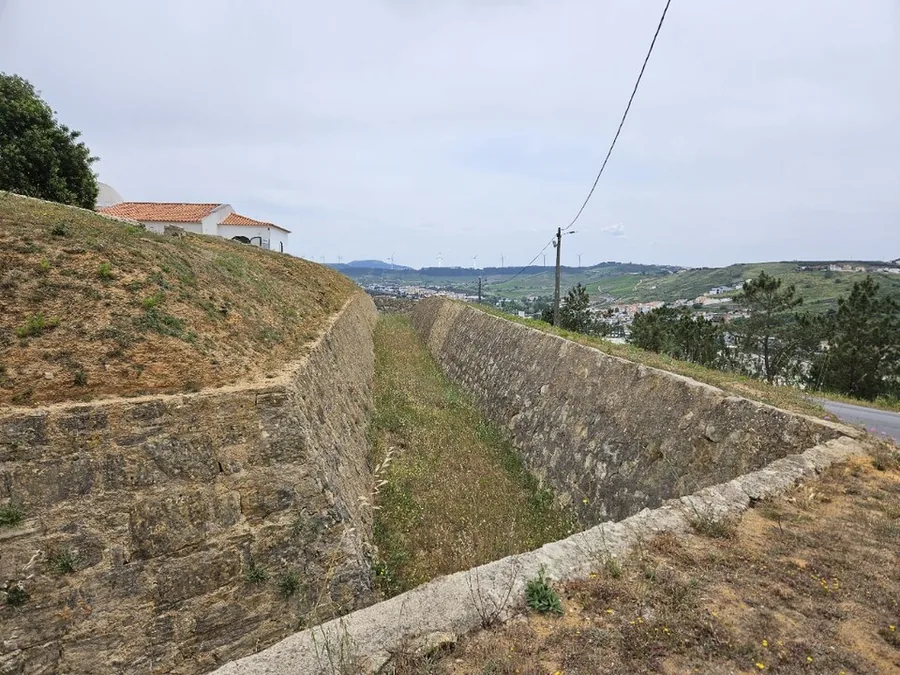
Forte de São Vicente, Torres Vedras. Photo: GualdimG, 2023 · CC BY-SA 4.0 · Source page
Since November 1809 Wellington had secretly built the Lines of Torres Vedras: three belts of 152 forts and redoubts, with hundreds of guns, across the hills north of Lisbon from the Atlantic to the Tagus. Behind them waited his army and the Portuguese militia, with the British fleet at their back.
Nobody had warned Masséna: Napoleon’s government knew nothing of the Lines either. His aide Pelet says the French learned of the Lines from prisoners in early October; Marbot says only on reaching Alenquer.
Source: At Sobral
“We saw steeply scarped mountains and deep ravines, a road-passage only a few paces broad, and on each side walls of rock crowned with ... field fortifications garnished with artillery; then at last it was plainly demonstrated to us that we could not attack the Lines of Montechique with the 35,000 or 36,000 men that still remained of the army.”
Pelet (1777–1858) was Masséna’s close aide and defender. He wrote after the campaign, to explain why the army stopped.
- Who is speaking, and what does he want? He wants us to see that an attack was impossible, which clears his chief.
- Pelet counts 35,000 to 36,000 men for an attack; modern accounts count about 61,000 near the Lines. Why might they differ? Perhaps Pelet counts only men fit to assault, others everyone on the books. But Oman, who translated the passage, called the figure ‘a ludicrous exaggeration’: a writer defending a decision picks the smaller number.
A decision point
You are Masséna.
Sobral, by the Lines, 14 October 1810
Your army has marched deep into Portugal, past burnt villages and empty fields, and found a wall before Lisbon: steep hills, ravines, redoubts with guns, and perhaps 60,000 defenders or more. A rush at a British barricade at Sobral cost you about 120 men for nothing.
There is nothing left to eat for miles. Napoleon has promised reinforcements and help from Soult, and none has come. Junot says attack now; Ney and Reynier say it would be a massacre. Winter is coming.
What do you do?
- Attack the Lines now, at the weakest point A few hills might fall, but Wellington would hurry his men to the threatened point and be ready for you. The likely result is a bloodier Bussaco, with your army broken before Lisbon.
- Stay in front of the Lines and wait for reinforcements and supplies You keep the army together and keep Wellington pinned in the Lines, but your men starve in a ruined country, and the reinforcements may never come.
- Retreat to Spain at once You would save the army from the worst of the hunger, but hand Wellington a clear victory in the campaign, and you would probably be recalled.
What really happened
Stay in front of the Lines and wait for reinforcements and supplies
He waited. For a month the French stayed in front of the Lines, then withdrew to Santarém, up the Tagus, and spent the winter there, living off a country already stripped. In March 1811 fewer than 41,000 men began the retreat of an army that had come in with about 65,000. Wellington did not attack them.
Pelet and Foy wrote that the Lines were too strong; Sir Charles Oman agreed that an attack would have failed. But hunger beat the French in the end. Wellington expected them to fall back from the Lines within days; Masséna stayed there a fortnight longer than he expected.
1811
The retreat and the recall
On 5 March 1811 the army began to retreat. Ney refused an order, and Masséna sent him home. In May Masséna attacked Wellington at Fuentes de Oñoro, to relieve Almeida; the Guard cavalry under Marshal Bessières did not give the support he asked for, and the attack failed. Days later he handed the army to Marshal Marmont. He never again commanded an army in the field.
1814–1817
The end
His last years were in poor health. From 1813 he held a quiet command in Provence, and in April 1814 he accepted Louis XVIII. After Waterloo he was governor of Paris, and in November he sat among the marshals who were to try Ney, the subordinate he had sent home from Portugal; the court declared itself not competent. The peers then tried Ney, and he was shot.
Masséna died in Paris on 4 April 1817, aged 58, of lung disease. His friend Thiébault gave the eulogy.
What Masséna’s work changed
- 1797 Rivoli breaks Alvinczi’s army. Mantua falls, and Austria soon makes peace.
- September 1799 Zurich: the Russian army in Switzerland is destroyed, Suvorov retreats, and Russia leaves the coalition. France escapes invasion.
- June 1800 Genoa is handed over on 4 June; Bonaparte wins at Marengo on the 14th, with the time Genoa bought.
- 1804 Masséna becomes a Marshal of the Empire.
- 1810–1811 The Lines stop Masséna; the French never again invade Portugal in force, a turning point of the Peninsular War.
How good was Masséna, and who failed in Portugal?
Did Masséna fail in Portugal, or was he set up to fail?
- Sir Charles Oman (1908) Masséna was right not to attack the Lines at Sobral. At Bussaco he underrated an army he had never met, though Oman says he ‘must not be too much blamed for his experiment’. His real fault was that he was ‘proud and obstinate’: unable to go forward and unwilling to go back, he stayed in front of Lisbon until hunger wore his army down.
- Donald Horward (1997) Masséna was the ablest French commander of the age after the Emperor himself, a born commander though a weak administrator. The campaign failed mainly because of Napoleon: he gave too little, put quarrelsome subordinates under him, and never sent the help he had promised.
Both may be right, about different moments. Oman judges the decisions made in the field, Horward the conditions in which they were made. What a final verdict lacks is hard evidence about supply: how long the French army could really have held out, and what would have happened had Wellington attacked it at Santarém.
What do you know now?
Check yourself
Why could Masséna not become an officer in the royal army before 1789?
Answer: Officers had to be nobles, and he was a commoner. Correct. Adjudant was the highest rank a commoner could reach, and the Revolution removed the bar.
Check yourself
What was the idea behind Bonaparte’s night march to Rivoli?
Answer: To hit the bigger Austrian force with everything he had, before the second force could help it. Correct. Verona stood between the two Austrian forces, and Bonaparte used that to beat them one at a time.
Check yourself
How did Masséna win at Zurich?
Answer: He crossed the Limmat in boats before dawn at a spot the Russians barely guarded, while Suvorov was still in the Alps. Correct. Surprise and speed let him beat Korsakov before Suvorov arrived.
Check yourself
What followed from the victory at Zurich?
Answer: Tsar Paul took Russia out of the coalition and Suvorov’s army retreated over the Alps. Correct. France was saved from invasion.
Check yourself
Why did the long defence of Genoa matter?
Answer: It kept the Austrian army busy for about two months while Bonaparte brought a reserve army over the Alps. Correct. The time it bought let Bonaparte reach Marengo.
Check yourself
Pelet wrote that only 35,000 to 36,000 men remained to attack the Lines. Why should we be careful about taking that figure at face value?
Answer: He was Masséna’s aide, writing to explain and defend a decision that had been criticised. Correct. A writer defending a decision tends to choose the number that justifies it.
Terms
- the Directory The five-man government of France from 1795 to 1799. It was weak, short of money and unpopular, and Bonaparte overthrew it in November 1799.
- Second Coalition The alliance of Britain, Austria, Russia and other states against France in 1798–1802. Russia left it in the autumn of 1799.
- demi-brigade The infantry unit of the French Revolutionary armies: three battalions, some 2,000 to 3,000 men. It replaced the old regiment, until the name ‘regiment’ came back in 1803.
- forced march A march faster and longer than normal, with few rests, to arrive before the enemy expects you. It exhausts the men but can win a battle.
- pontoon bridge A bridge laid on boats or floats side by side, which an army carries with it to cross a river quickly.
- convention An agreement between commanders to hand over a city on agreed terms. At Genoa Masséna called it a ‘convention’, not a capitulation, so that his army could march out with its weapons.
- Marshal of the Empire The highest rank in Napoleon’s army. He created it on 19 May 1804 and gave it at first to eighteen generals. Masséna was one of them.
- redoubt A small fort, built of earth or stone, closed on all sides and armed with guns, meant to be held by a small garrison.
- scorched earth Destroying crops, food and shelter so that an advancing enemy finds nothing to live on. Wellington ordered it in Portugal in 1810.
- reverse slope The side of a hill that faces away from the enemy. Troops standing there cannot be seen or shot at by enemy guns until the enemy reaches the crest.
- Limmat A river in Switzerland, near the city of Zurich. The French army crossed it in the dark.
- Zurich A Swiss city that the French and Russians fought over in September.
- Dietikon A spot by the Limmat where the French crossed the river in boats before dawn.
- Korsakov A Russian commander whose 25,000 men reached Zurich and were driven into the city.
- Hotze An Austrian general who held the Linth and was shot dead in the fog on the day of the attack.
- Linth A river in Switzerland, held by the Austrians. The French crossed it on the morning of the attack.
- Suvorov A Russian marshal who drove the French out of northern Italy, then led his army over the Alps.
- Jomini A military writer who asked why Masséna did not surround the Russians at Zurich.
- Archduke Charles An Austrian commander. Masséna stopped him at Caldiero.
- Tsar Paul The Tsar of Russia, angry at his Austrian allies, ordered his troops home.
- Genoa A port city in Italy where Masséna was besieged with his army and many civilians.
- Marengo A place in northern Italy where Bonaparte's army narrowly beat the Austrians.
- Marbot A young lieutenant on Masséna's staff in Genoa, who wrote memoirs in praise of the Empire.
- Mantua A fortress in Italy that the French besieged. The Austrians tried again and again to free it.
- Rivoli A plateau in Italy where the French held off an Austrian attack in the snow.
- Provera An Austrian commander who surrendered with several thousand men near Mantua.
- Leoben A town in Austria where a first peace agreement was signed.
- Aspern A village near Vienna that changed hands many times in the fight against the Austrians.
- Wagram A village near Vienna where Napoleon fought the Austrians six weeks after Aspern.
- Bussaco A ridge in Portugal where Masséna attacked Wellington head-on and failed.
- Wellington The British commander who led the defence of Portugal against the French.
- Lines of Torres Vedras Three belts of forts north of Lisbon that Wellington built in secret.
- Pelet Masséna's close aide, who wrote after the campaign to explain why the army stopped.
- Koch A general who compiled Masséna's memoirs from papers, rewriting parts of them.
- Ney A French marshal who took orders from no one. Masséna sent him home from Portugal; he was later tried and shot.
Sources
- Marbot, Jean-Baptiste Antoine Marcelin de, The Memoirs of Baron de Marbot, trans. Arthur John Butler (London: Longmans, Green, 1892; one-volume edition 1903). Genoa pp. 58–60, Zurich pp. 479–480, character of Masséna p. 483 in the 1903 edition.
- Thiébault, Paul Charles, The Memoirs of Baron Thiébault, trans. and condensed by Arthur John Butler, 2 vols (London: Smith, Elder, 1896).
- Pelet, Jean-Jacques, on the French advance to the Lines of Torres Vedras, in Charles Oman’s translation, A History of the Peninsular War, vol. 3 (Oxford: Clarendon Press, 1908), pp. 443–446.
- Koch, General (ed.), Mémoires de Masséna, rédigés d’après les documents qu’il a laissés, 7 vols (Paris, 1848–50). Compiled by Koch; not written by Masséna.
- Horward, Donald D., ‘André Masséna, Prince d’Essling, in the Age of Revolution (1789–1815)’, Journal of the International Napoleonic Society, 1997.
- Horward, Donald D., Napoleon and Iberia: The Twin Sieges of Ciudad Rodrigo and Almeida, 1810 (Tallahassee: University Presses of Florida, 1984).
- Horward, Donald D. (ed.), The French Campaign in Portugal, 1810–1811: An Account by Jean Jacques Pelet (Minneapolis: University of Minnesota Press, 1973).
- Marshall-Cornwall, James, Marshal Massena (London: Oxford University Press, 1965).
- Chandler, David G., The Campaigns of Napoleon (New York: Macmillan, 1966); and Chandler, David G. (ed.), Napoleon’s Marshals (New York: Macmillan, 1987).
- Oman, Charles, A History of the Peninsular War, vol. 3: September 1809 to December 1810 (Oxford: Clarendon Press, 1908).
- Duffy, Christopher, Eagles over the Alps: Suvorov in Italy and Switzerland, 1799 (Chicago: The Emperor’s Press, 1999).
- Boycott-Brown, Martin, The Road to Rivoli: Napoleon’s First Campaign (London: Cassell, 2001).
- Burton, R. G., Napoleon’s Campaigns in Italy, 1796–1797 and 1800 (London: George Allen, 1912).
- Bodart, Gaston, Militär-historisches Kriegs-Lexikon (1618–1905) (Vienna and Leipzig: C. W. Stern, 1908); and Clodfelter, Michael, Warfare and Armed Conflicts: A Statistical Encyclopedia of Casualty and Other Figures, 1492–2015, 4th edition (Jefferson, NC: McFarland, 2017). Casualty and strength figures.
Image credits
- François Bouchot, The Battle of Zurich, 25 September 1799, 1835. Palace of Versailles · Public domain · Source page
- Edme-Adolphe Fontaine, copy after Antoine-Jean Gros’s portrait of Masséna, about 1853 · Public domain · Source page
- Henri-Félix-Emmanuel Philippoteaux, Napoleon at the Battle of Rivoli, 1844. Palace of Versailles · Public domain · Source page
- Joseph Kreutzinger, Portrait of Count Alexander Suvorov, 1799 · Public domain · Source page
- Johann Heinrich Lips after Johann Martin Usteri, Second Battle of Zurich: fighting at the Central, 26 September 1799, engraving, 1801 · Public domain · Source page
- Forte de São Vicente, Torres Vedras. Photo: GualdimG, 2023 · CC BY-SA 4.0 · Source page


