Marx and the Communist Manifesto: an idea sets out
In February 1848 a small pamphlet in German came out in London, and almost nobody noticed. Less than a century later, parties and states acted in its name. Who wrote it, and what does it really say?
Decisions, questions and your own progress, in the app
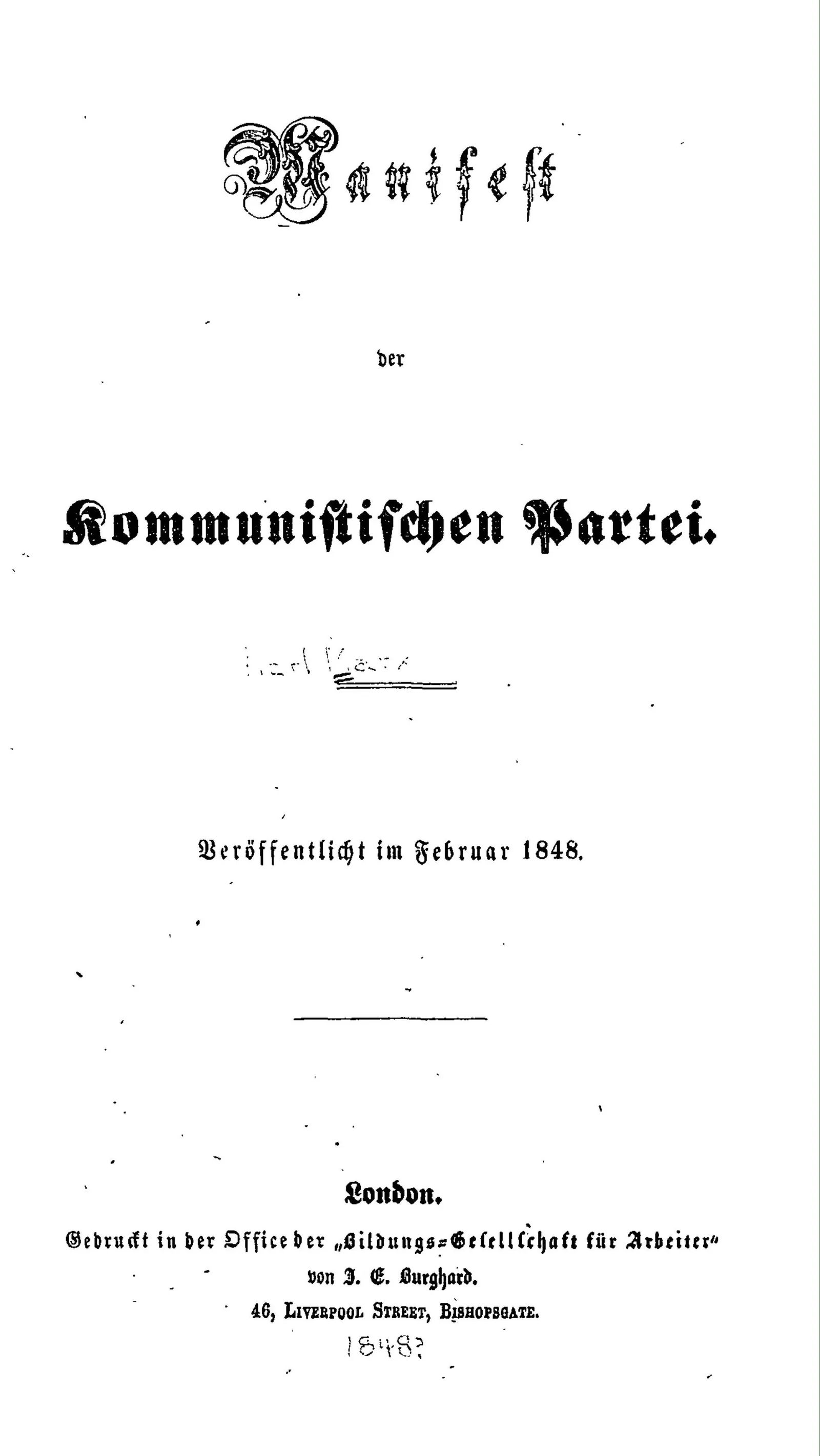
Manifest der Kommunistischen Partei, London 1848, title page. Scan from The Making of the Modern World (Gale) · Public domain · Source page
A spectre over Europe
A spectre is haunting Europe
In February 1848 a small pamphlet in German came out in London. Its first line is still known: “A spectre is haunting Europe — the spectre of communism.”
It was called Manifesto of the Communist Party. Who wrote it, for whom, and what does it really say?
Two writers
Two young men in London
Karl Marx and Friedrich Engels wrote it. Marx was born in Trier on 5 May 1818, and Engels was born in Barmen on 28 November 1820. In February 1848 Marx was 29 and Engels was 27.
The pamphlet was written for the Communist League, an association of German exiles and workers living in London. Engels wrote that it was published as the platform of the League: its working programme, not a scholarly book.
Myth
Marx invented communism.
The truth
No. The word and the idea of shared property were in use before 1848. In 1888 Engels wrote that in 1847 communism was a working-class movement, and he named the Utopian communism of Étienne Cabet in France and of Wilhelm Weitling in Germany. Marx and Engels were among the writers, not the first.
The evidence
Engels, Preface to the English edition, 1888: he names the communism of Cabet and Weitling as earlier than the manifesto. In the same passage he writes that in 1847 socialism was a middle-class movement and communism a working-class movement.
The opening
The old order against the spectre
The Manifesto describes Europe in 1848: all the powers of the old order have joined to chase this spectre. It names the Pope and the Tsar, Metternich and Guizot, French Radicals and German police spies.
The authors add that every opposition party had been called “communistic” by those in power. By then the word was a label thrown by enemies.
Source: The opening and the close of the Manifesto
“A spectre is haunting Europe — the spectre of communism.”
“Working Men of All Countries, Unite!”
The opening and the close come from the English translation of 1888, which Engels approved. It is not the text of 1848 but a version made forty years later, and the German original differs in places.
- Who is speaking here, and who is the audience? Two men in their late twenties, writing for League members and for workers who might read it. They also warn the ruling classes, but their main call is to people who could join a movement.
- Why does the close end on a call rather than an explanation? A manifesto is written to recruit, not to win a debate. A call to unity is a way to end a text like a speech.
- What is missing from these lines? There is no proof here. These are sentences of aim and belief, and whether they are right is left open to the reader.
Check yourself
In which city was the Manifesto first published, in February 1848?
Answer: In London. Correct: the Manifesto came out in German in London in February 1848, issued by an association of exiles and workers.
A newspaper under the censor's scissors
Cologne, 1842
An editor on the Rhine
15 October 1842
On 15 October 1842 Marx, then 24, became editor of the Rheinische Zeitung, a liberal newspaper printed in Cologne on the Rhine.
Within months its future would depend on the Prussian government. The story starts with a question every editor under an unfriendly state faces: what can you say, and what does it cost you to say it?
The censor
Who decides what is printed
In Prussia of those years a newspaper was not free. Censorship could cut articles and demand a change of line. The government could also close a paper it disliked.
In January 1843 the government decided to close the Rheinische Zeitung. The closure was due at the end of March.
A decision point
You are Karl Marx, editor of the paper.
Cologne, March 1843.
The government in Berlin has decided to close the paper. It made the decision in January, and the closure is due at the end of March. The censor has already cut your articles.
You could keep the paper open for a while by softening what it says. You could resign and say openly why. Or you could leave Prussia and carry the radical work into another country.
What do you do?
- Soften the line and keep the paper alive for a while. The paper might limp on for a few months. But its line would belong to the censor, and readers who came for a bold paper would probably stop reading it.
- Resign at once and state publicly that censorship makes honest editing impossible. The closure becomes a public argument about the press. You lose the platform, but your reason is known. The paper would probably close on the date set.
- Leave Prussia and carry the radical work into another country. You escape the censor, but you lose the paper and its readers in the Rhineland. The paper would close without you, and your ideas would reach fewer people at home.
What really happened
Resign at once and state publicly that censorship makes honest editing impossible.
Marx resigned on 17 March 1843. The notice he printed on 18 March said that, because of the present conditions of censorship, he was leaving the editorial board from that day. The paper was suppressed from 1 April 1843.
In June Marx married Jenny von Westphalen. In late October he moved to Paris.
The notice is one sentence. It blames the conditions of censorship, and it does not name the owners, the readers or any plan for what came next. Historians read it as a protest against a state that could close a paper it disliked.
What the notice leaves out matters most: what the editor would do next. The answer lies in Paris, where Marx went.
Paris, 1844
A journal of exiles
In Paris Marx worked on the German-French yearbook Deutsch-Französische Jahrbücher. Its one double issue appeared in February 1844, and it printed his introduction to a critique of Hegel's philosophy of right, written in the winter of 1843–44.
Engels had been in Paris before and returned to Barmen in 1844, where he wrote the book on the working class in England.
Paris and the opium line
Paris, 1844
Suffering and protest
In a text of 1844 Marx writes about religion. He opens by saying that religious suffering is both the expression of real suffering and a protest against it. Then comes the line that is quoted more than any other from his writing: religion is the opium of the people.
In the passage, religion is the sigh of the oppressed creature, the feeling of a heartless world. The point is a criticism of a world in which people look for comfort instead of justice. It is not an attack on believers.
Myth
Marx called religion “the opium of the people” to show contempt for believers.
The truth
The line sits in the middle of a paragraph that opens by saying religious suffering is both an expression of real suffering and a protest against it. The paragraph ends with a demand that people be freed from religion as an illusory happiness, so that they can claim their real happiness. The target is the world, not the believers.
The evidence
Marx, Introduction to the Critique of Hegel's Philosophy of Right, 1844. The English text on the Marxists Internet Archive does not name its translator, so the claims here are paraphrased, not quoted.
Barmen, 1844–45
A book about English workers
Engels had worked in Manchester from 1842 to 1844 and gathered material there on the lives of workers. He wrote The Condition of the Working Class in England in Barmen in 1844, after returning from Paris. It was published in Leipzig in 1845.
The book describes the lives of working people in the industrial towns. Engels did not write it as a manifesto. He wrote it as a description of a reality he had seen with his own eyes.
January 1845
Expelled from Paris
On 16 January 1845 the French government ordered Marx out of France, under pressure from the Prussian government. In early February he arrived in Brussels.
It was the first of four expulsions in four years. Governments, not only the censors, decided where Marx could live.
Source: The eleventh of the Theses on Feuerbach
“The philosophers have only interpreted the world, in various ways; the point is to change it.”
Eleven short theses that Marx wrote and did not publish in his lifetime. Engels published them in 1888, and the eleventh became one of the best-known lines of Marx.
- Who are “the philosophers” Marx has in mind? Philosophers of his own time, above all Feuerbach, whose approach the Theses criticise. Marx does not condemn them for what they wrote, but for stopping at understanding the world.
- What is the difference between interpreting and changing? To interpret is to think about the world; to change it is to act on it. The line became a slogan for many movements, yet it is very short and does not say how change should happen.
- What is missing from this text? There is no programme here and no reckoning of cost. It is a sentence of intent. Historians have argued ever since about how that intent was carried out, and by what means.
The League's programme
1847
A programme for an association
In the summer of 1847 the Communist League had a draft “confession of faith” setting out what its members believed. The League wanted a text that explained its aim to ordinary people.
In the autumn a further text was written, Principles of Communism, in the form of questions and answers. It opens by asking what communism is and answers that it is the doctrine of the conditions for the liberation of the proletariat. It is a catechism: a book of questions and answers to be learned by heart.
A decision point
You are Karl Marx, together with Friedrich Engels.
Brussels, late November 1847.
The League's congress is due to open in London within days, and the League needs a programme to work by. A draft “confession of faith” exists, and so does a question-and-answer text that members could learn.
You know that the text must also be read outside the League, and that the word “communism” may put people off. The question is not only what to write, but whom the text speaks to and what it asks of its reader.
What programme do you write, and whom does it speak to?
- Write a short list of moderate demands that democrats could sign, without spelling out the League's aim. The programme might win friends among democrats, but it gives up the League's aim and could split members who joined for that aim.
- Write a catechism of principles: questions and answers that members can learn by heart. The text is easy to learn, but it stays a members' text. It is hard to explain in it why history moves, and a reader outside the League would probably never reach it.
- Write a bold history of class struggle that ends with a call to workers to act. A text that makes an argument to a wide audience. It is harder to write and to defend, and it would draw attention and hostility, but it could spread beyond the League.
What really happened
Write a bold history of class struggle that ends with a call to workers to act.
In a letter of 23–24 November 1847 Engels suggested dropping the catechism form and calling the text the Communist Manifesto. In his view the earlier form was unsuitable, because history had to be told in it.
The League's congress, held in London from 29 November to 8 December 1847, asked Marx and Engels to draft the programme in the form of a manifesto. The text was printed in London and appeared in February 1848.
Engels's letter is the main source for why this form was chosen. It gives the argument in a few words and does not explain fully why the catechism was dropped.
Historians see the choice as a turning point: the text stopped being the property of League members and became a public document. The catechism stayed out of print for decades.
1914
A text that waited sixty-six years
Principles of Communism was not published in 1848. It first appeared only in 1914, when Eduard Bernstein printed it in Vorwärts, the paper of the German Social Democratic Party.
The Manifesto, by contrast, became the famous text. The catechism shows what the choice of form meant: the ideas were close, but the readers and the echo were not.
The year of revolutions
February–March 1848
France rises, Belgium expels
In February 1848 a revolution broke out in Paris, and within days the French monarchy fell. Protests and hopes for constitutions and freedoms spread across Europe.
On 3 March 1848 the Belgian authorities ordered Marx to leave Belgium within a day. He reached Paris on 5 March.
March 1848
Demands for Germany
In late March 1848 Marx and Engels drafted a leaflet of demands for Germany. Its first demand was a single, indivisible German republic. Another asked that people's representatives be paid, so that workers too could sit in parliament.
It was a text for one moment, not a book. It was meant to serve the revolution in Germany in those weeks.
Cologne, 1848
A workers' association in Cologne
In Cologne a workers' association was led by Andreas Gottschalk, a doctor to the poor who was one of the city's leading figures. He published the “Demands of the People”, and the association worked on its own reform proposals.
In Cologne the association faced two roads. One leaned on the democratic middle classes; the other kept an independent voice for workers.
A decision point
You are Karl Marx, in Cologne, in the summer of 1848.
Cologne, April to October 1848.
You are back in Cologne in April 1848, and your paper, the Neue Rheinische Zeitung, is about to appear. The revolution in Germany rests on the middle classes and on the workers, and these forces do not agree with each other.
Gottschalk's association has its own reform programme, which includes a call to boycott the elections. You see the danger: if the workers stand apart, the democrats will be left alone against the monarchy.
Which line do you push, in the paper and in the association?
- Choose an alliance with the democratic middle classes, and press for the demands through them. Democratic reforms might come sooner, but workers could end up dependent on property owners, with their own demands put off.
- Keep the association independent, with its own reform proposals and a boycott of the elections. The association would keep its own voice but stay small. An election boycott might leave the field to the conservatives.
- Let the association vote on the question and accept the majority. The decision would bind everyone, but it could split the leadership or leave the question open for a long time.
What really happened
Choose an alliance with the democratic middle classes, and press for the demands through them.
Marx took the first road. The Neue Rheinische Zeitung came out from 1 June 1848 and backed the democratic fight against the monarchy. On 3 July 1848 the authorities arrested Andreas Gottschalk and Fritz Anneke, two of the association's leaders.
In October Marx was elected head of the association. The paper appeared until 19 May 1849.
Marx argued that the monarchy had to be weakened first, with the democratic middle classes as allies, and that workers would then push for wider demands. Gottschalk argued that workers needed an independent voice and a programme of their own. Historians read the dispute partly as a question of who should lead.
Marx's choice was not only ideological. He saw the paper as an instrument of influence, and whether this was the right move is still debated.
Source: The title page of the Manifesto, 1848
Karl Marx and Friedrich Engels, Manifesto of the Communist Party, London, February 1848. A scan of an 1848 copy from the Gale collection The Making of the Modern World
The title page of the first German printing, in London. It gives the title Manifest der Kommunistischen Partei, the date “February 1848” and the printer. The handwriting on the scan, the name and the pencilled “1848?”, is not part of the printing.
- Who appears as author on the title page, and what is handwritten? Marx's and Engels's names are not printed on the title page. The name “Karl Marx” appears handwritten on this copy, which means someone marked it after printing.
- Where and by whom was it printed? In London, at the printing office of the Workers' Educational Society, by J. E. Burghard of Liverpool Street, Bishopsgate. It was not a well-known publisher, but the printing office of a workers' educational society.
- What does the date tell us, and what does it not tell us? It gives the month of publication, February 1848. It does not give the number of copies or who read them. No reliable figure survives for either.
Doomed to oblivion
1849
Expelled again and again
On 16 May 1849 the Prussian authorities ordered Marx out of Prussia. The Neue Rheinische Zeitung stopped appearing on 19 May. In August he was ordered out of Paris too.
Marx reached London on 26 August 1849 and stayed there for the rest of his life.
London, 1850–56
A house on Dean Street
The family lived at Dean Street in Soho, and two of their children died there between 1850 and 1856. Marx did much of his research in the reading room of the British Museum, and money was short.
In London Marx gave lectures on the Manifesto to a German workers' educational society.
A decision point
You are Friedrich Engels, in London, 1850.
London, 1850.
You took part in the 1849 uprisings: in May you were in the Elberfeld rising, then in the Baden-Palatinate uprising. You reached London late in 1849, and Marx's family lives in poverty.
You know your family's cotton business in Manchester. You could go back, work for the firm and send money to Marx. You could stay a full-time revolutionary with no income. Or you could write for newspapers in London and earn your living that way.
What do you do?
- Return to Manchester, work for the firm and send money to Marx. Marx's family could keep going, and he could read and write in London. Engels would leave direct revolutionary work, but stay in touch with the movement and with writing.
- Stay a full-time revolutionary, with no income. The movement would gain one more organiser, but Marx's family would stay in deep poverty, and the leadership would depend on donations with no firm base.
- Write for newspapers in London and earn a living from writing. The writing would pay, but it would take time from political writing and from the movement's work, and the family would still depend on the goodwill of others.
What really happened
Return to Manchester, work for the firm and send money to Marx.
Engels moved to Manchester and joined the firm Ermen & Engels in 1850. From then on he gave the Marx family regular financial help. He left the firm later and moved to London in September 1870.
The money let Marx work for years in the British Museum, and Capital came out in 1867.
The sources say little about Engels's own reasons. What is documented is that the money let Marx work without interruption, and that Engels did not give up his politics: he expressed them in letters and in his writing.
The choice made Engels a man of two worlds: a partner in a cotton firm in a manufacturing city, and a writer on the questions of revolution.
Myth
The Manifesto was a bestseller in 1848.
The truth
No. No evidence supports that. In 1888 Engels himself wrote that after 1848 the Manifesto seemed doomed to oblivion. In 1890 he wrote that few had responded when its words were proclaimed forty-two years earlier. The text returned to attention with the International and in the 1870s.
The evidence
Engels, Preface to the English edition, 1888; Preface to the German edition, 1890. The first English translation appeared in 1850, by Helen Macfarlane, in George Julian Harney's Red Republican in London. No reliable sales figure survives.
Source: Engels's preface of 1888
“As to the Manifesto, it seemed henceforth doomed to oblivion.”
Engels wrote this forty years after the revolutions, to explain the fate of the text to a new reader. A preface like this is written by one of the authors, and it gives his own reading of what happened.
- Why would a co-author say the Manifesto was forgotten? It can be read as an honest admission, but also as a way of stressing later success. A writer of a preface in 1888 knows the text has come back to life, and the preface is written from that vantage.
- What is the reader meant to think about the text's fame? That the Manifesto's popularity was not automatic, and that it was built in later years, through the movement.
- What is missing for an understanding of the text's fate? Sales figures and the responses of readers in 1848. Engels tells the story from the vantage of 1888, not from records of the time.
1864
An international association
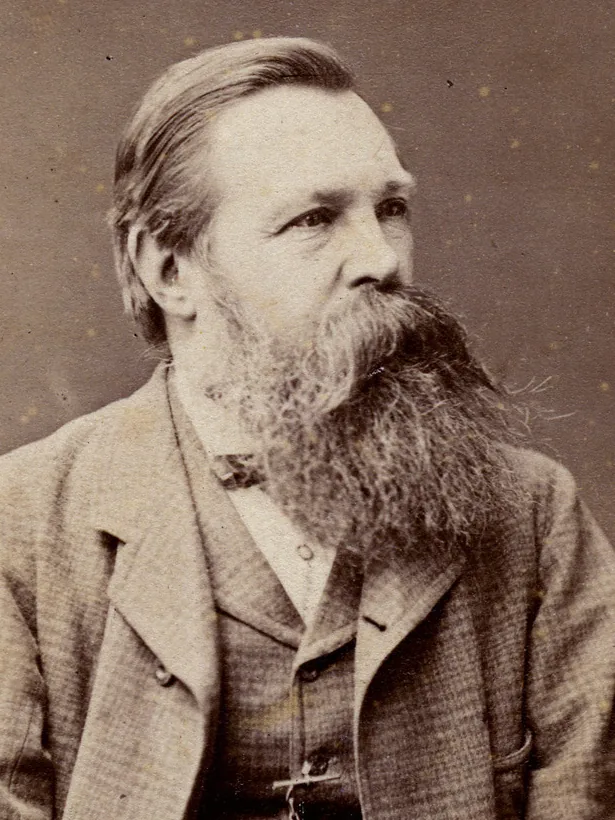
Friedrich Engels. Photo: William Hall, 1877 (cropped) · Public domain · Source page
On 28 September 1864 the First International, an international association of workers, was founded at St Martin's Hall in London. Marx became one of its central figures.
This was the moment the Manifesto came back into view. The text became a subject of debate, and it was translated again.
Capital, the Commune and the afterlife
1867
The book Capital
In 1867 the first volume of Capital appeared, Marx's major work on the economy of capitalist society. He sent the manuscript to his publisher in April 1867, and the volume came off the press on 14 September 1867 in Hamburg. The publisher was Otto Meissner.
Paris, 1871
The Paris Commune
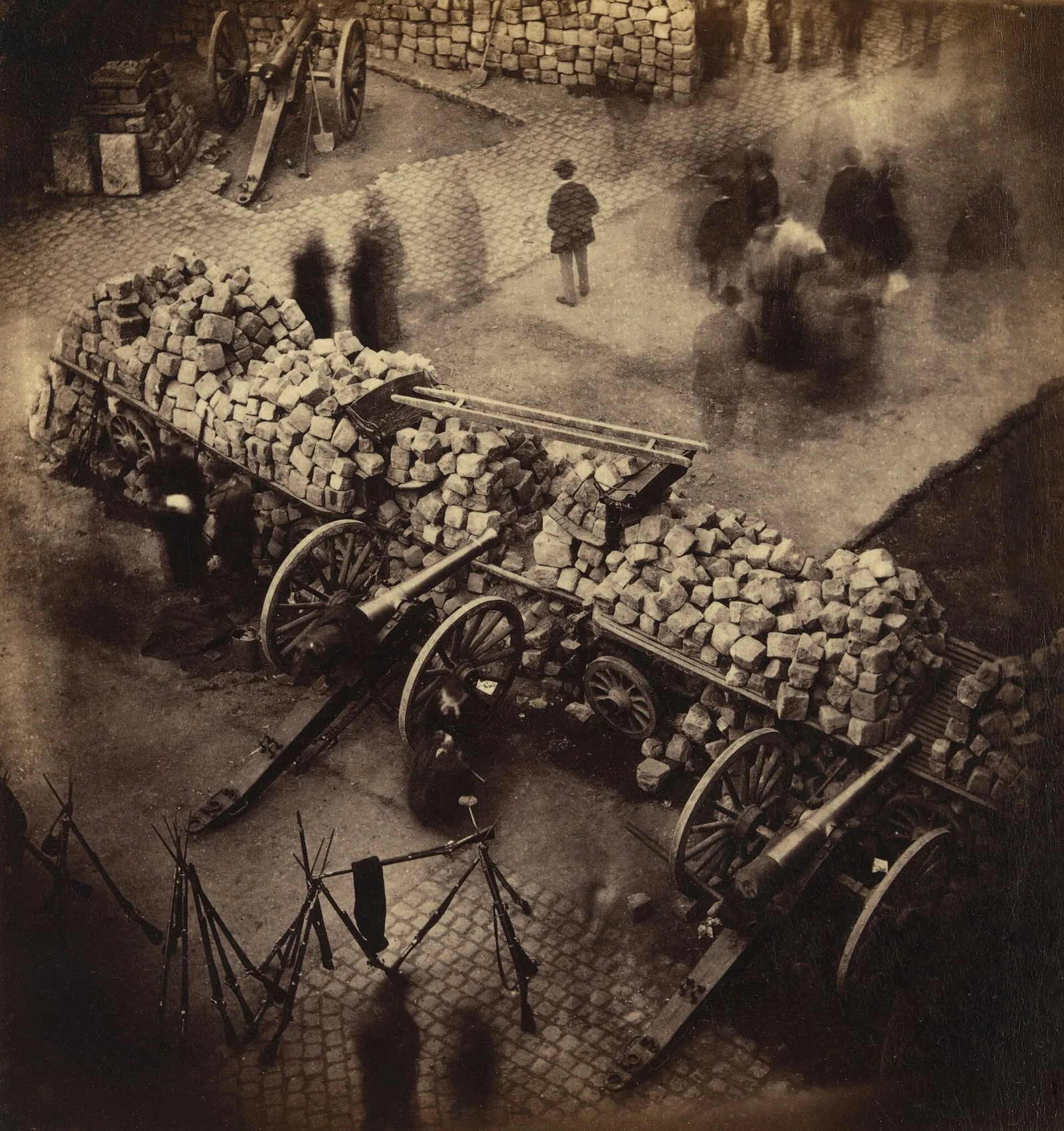
Pierre-Ambroise Richebourg, Barricades of the Paris Commune, April 1871. Metropolitan Museum of Art collection · Public domain · Source page
From 18 March 1871 the citizens of Paris took the city into their own hands, and the Paris Commune was run by an elected local government. Marx wrote about it in The Civil War in France, which he published that year.
The government's troops took the city back in the last week of May 1871. The killing that followed was on a mass scale. Estimates of the dead vary widely, and this lesson gives no figure.
A letter, 1882
“I am not a Marxist”
In France the name “Marxism” had become a label for a particular current. In a letter of 1882 Engels wrote that Marx once told Paul Lafargue, in French: “Ce qu'il y a de certain, c'est que moi, je ne suis pas Marxiste.” It sounds like a rejection of the idea, but it was about one French movement, not about communism.
The line is known here only through Engels's letter, not as a public statement by Marx.
London, 1883
Marx's death
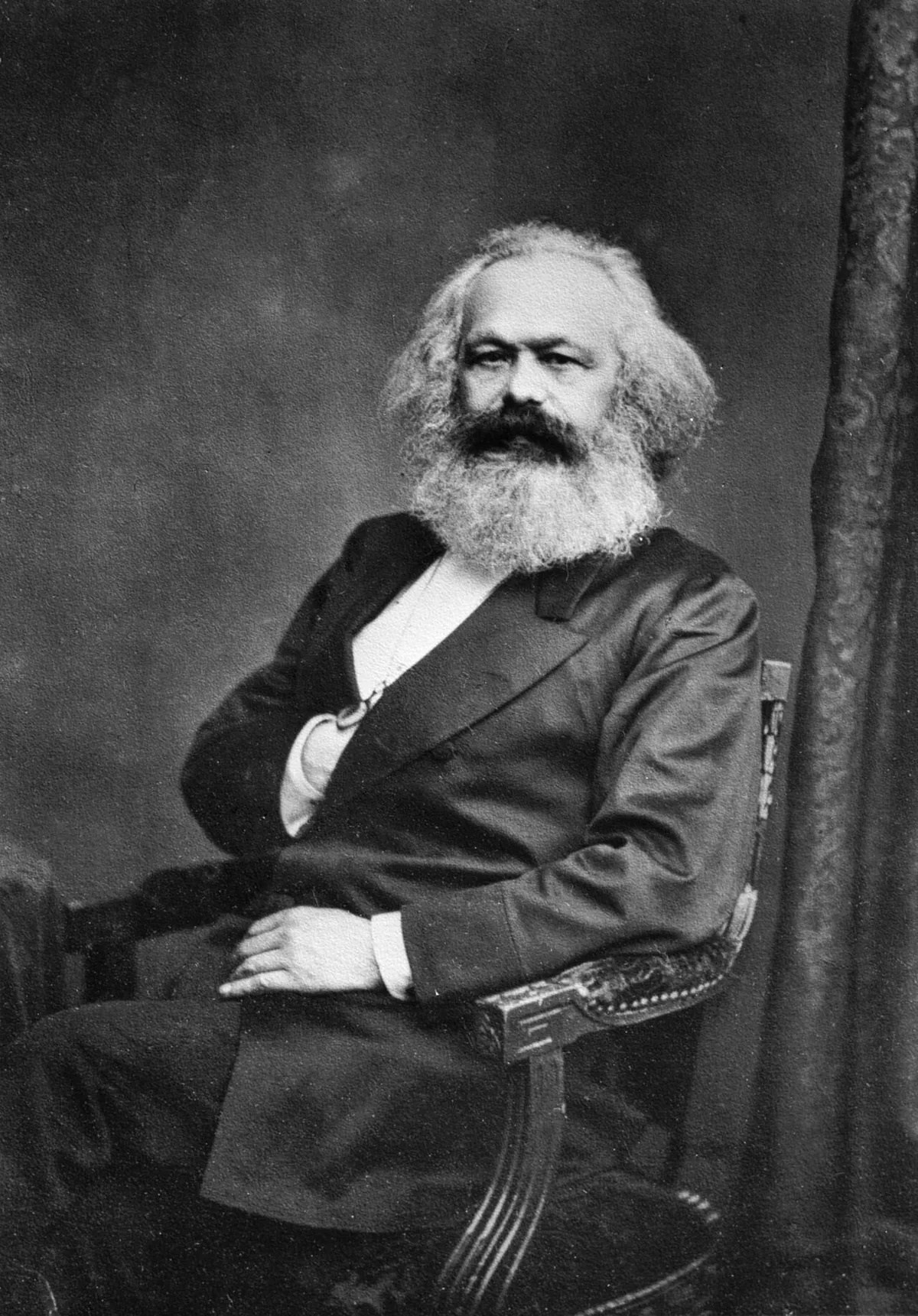
Karl Marx. Photo: John Jabez Edwin Mayall, before 1875. International Institute of Social History · Public domain · Source page
Marx died in London on 14 March 1883 and was buried at Highgate Cemetery on 17 March. In his 1883 preface Engels wrote that the first grass was already growing over the grave.
The figure that later movements made into an icon was built in the years after his death.
What the Manifesto asks
The ideas as they were stated
The Manifesto presents history as a history of class struggles. In every society, the authors argue, groups with opposed interests fight, and that struggle drives change. The bourgeoisie owns the means of production, and the proletariat is the class of wage workers who have only their labour to sell.
The authors aim to end private ownership of the means of production: the factories, the machines and the land. They argue that the proletariat will use its political power to bring the instruments of production under the control of the state, and they concede that at first this would need harsh measures against property rights. These are the authors' own aims, set out here as their aims, not as proof.
What came next
- February 1848 The Manifesto comes out in London.
- May 1849 The Neue Rheinische Zeitung closes, and Marx is expelled from Prussia.
- September 1864 The First International is founded in London.
- September 1867 The first volume of Capital comes out in Hamburg.
- May 1871 The Paris Commune is crushed by government troops.
- March 1883 Marx dies in London.
- 1914 Principles of Communism is published for the first time.
- 1917 The Bolsheviks take power in Russia. Later the Soviet state claimed Marx as its inspiration.
- 1949 The People's Republic of China is founded under the Communist Party, which also claims Marx.
How responsible was Marx?
The one-party states of the twentieth century claimed to act in Marx's name. How much of what they did follows from his ideas, and how much from the choices of their leaders in conditions he never saw?
- Jonathan Sperber, Karl Marx: A Nineteenth-Century Life (2013) Sperber writes a biography of Marx the person, with new detail on his father and on the von Westphalen family. Reviewers find it stronger on the man than on the theory. Its title says what it covers: a life in the nineteenth century, not the history of the regimes that came after.
- Gareth Stedman Jones, Karl Marx: Greatness and Illusion (2016) Stedman Jones writes an intellectual biography that places Marx in his German and European context, using much archival material. Reviewers describe it as a deflationary reading: it brings Marx closer to social democracy than to revolution. On this reading, the historical Marx differs from the regimes that claimed his name.
Some readers argue that a theory cannot be cut off from the regimes that claimed it, and that the one-party states drew on his texts. The Manifesto itself contains the passages on harsh measures against property rights and on state control of production. The question stays open, and the reader is invited to judge without a ready answer.
Check yourself
At whose pressure was Marx ordered out of France in January 1845?
Answer: Prussia. Correct: the French government ordered him out, under pressure from the Prussian government.
Check yourself
On what date did Marx arrive in London to stay?
Answer: August 1849. Correct: Marx reached London on 26 August 1849 and stayed until his death.
Check yourself
In which city was the First International founded in 1864?
Answer: London. Correct: the First International was founded at St Martin's Hall in London on 28 September 1864.
Check yourself
Which volume of Capital was published in Hamburg in 1867?
Answer: Volume one. Correct: volume one, whose manuscript went to the publisher in spring 1867, came off the press on 14 September.
Check yourself
How long did the Paris Commune last?
Answer: About ten weeks. Correct: from 18 March to 28 May 1871 is about ten weeks.
Check yourself
Where was Marx buried?
Answer: Highgate. Correct: Marx was buried at Highgate Cemetery in London on 17 March 1883.
Terms
- Communist League A small association of German exiles and workers in London, for which the Manifesto was written in 1847–48.
- censorship State control of what may be printed. The authorities could cut articles, demand a change of line or close a paper. In Prussia in 1843 it struck Marx's own newspaper.
- Rheinische Zeitung A liberal newspaper printed in Cologne. Marx edited it from October 1842 until the Prussian government closed it in 1843.
- catechism A book of questions and answers, meant to be learned by heart. Principles of Communism of 1847 is written in this form.
- proletariat Wage workers who own no means of production and must sell their labour to live.
- bourgeoisie The class that owns the means of production and capital and employs wage workers.
- class struggle The conflict between groups with opposed interests which, the Manifesto argues, drives history.
- First International An international association of workers, founded in London in 1864. Marx was one of its central figures.
- Paris Commune The elected local government of Paris, from March to May 1871. Government troops retook the city at the end of May, after fighting and mass killing.
- one-party state A state in which a single party rules and no other party may compete freely. In the twentieth century several such states claimed Marx.
Sources
- Karl Marx and Friedrich Engels, Manifesto of the Communist Party (1848), English text translated by Samuel Moore in cooperation with Frederick Engels (1888), Marxists Internet Archive
- Friedrich Engels, Preface to the English edition (1888), and Preface to the German edition (1890), in the Marxists Internet Archive text of the Manifesto
- Karl Marx, Contribution to the Critique of Hegel's Philosophy of Right: Introduction (1844), Marxists Internet Archive (translator not named there; paraphrased in this lesson)
- Karl Marx, Theses on Feuerbach (1845), thesis 11, translated by W. Lough (1888)
- Karl Marx and Friedrich Engels, Demands of the Communist Party in Germany (March 1848), Marxists Internet Archive (translation not public domain; paraphrased in this lesson)
- Friedrich Engels, Principles of Communism (1847), with the Marxists Internet Archive introduction quoting Engels's letter of 23–24 November 1847 (paraphrased in this lesson)
- Friedrich Engels, The Condition of the Working Class in England (Leipzig, 1845)
- Friedrich Engels, letter to Eduard Bernstein, London, 2–3 November 1882, quoting Marx's French words to Paul Lafargue
- Gareth Stedman Jones, Karl Marx: Greatness and Illusion (Cambridge, MA: Harvard University Press, 2016)
- Jonathan Sperber, Karl Marx: A Nineteenth-Century Life (New York: Liveright, 2013)
- Landschaftsverband Rheinland, "Der Kölner Arbeiterverein 1848/1849", Rheinische Geschichte
Image credits
- Manifest der Kommunistischen Partei, London 1848, title page. Scan from The Making of the Modern World (Gale) · Public domain · Source page
- Friedrich Engels. Photo: William Hall, 1877 (cropped) · Public domain · Source page
- Pierre-Ambroise Richebourg, Barricades of the Paris Commune, April 1871. Metropolitan Museum of Art collection · Public domain · Source page
- Karl Marx. Photo: John Jabez Edwin Mayall, before 1875. International Institute of Social History · Public domain · Source page


