Gaius Marius, saviour of Rome
A “new man” from a country town is elected consul seven times, saves Rome from the Cimbri and Teutones, and dies amid a bloodbath he began.
Decisions, questions and your own progress, in the app
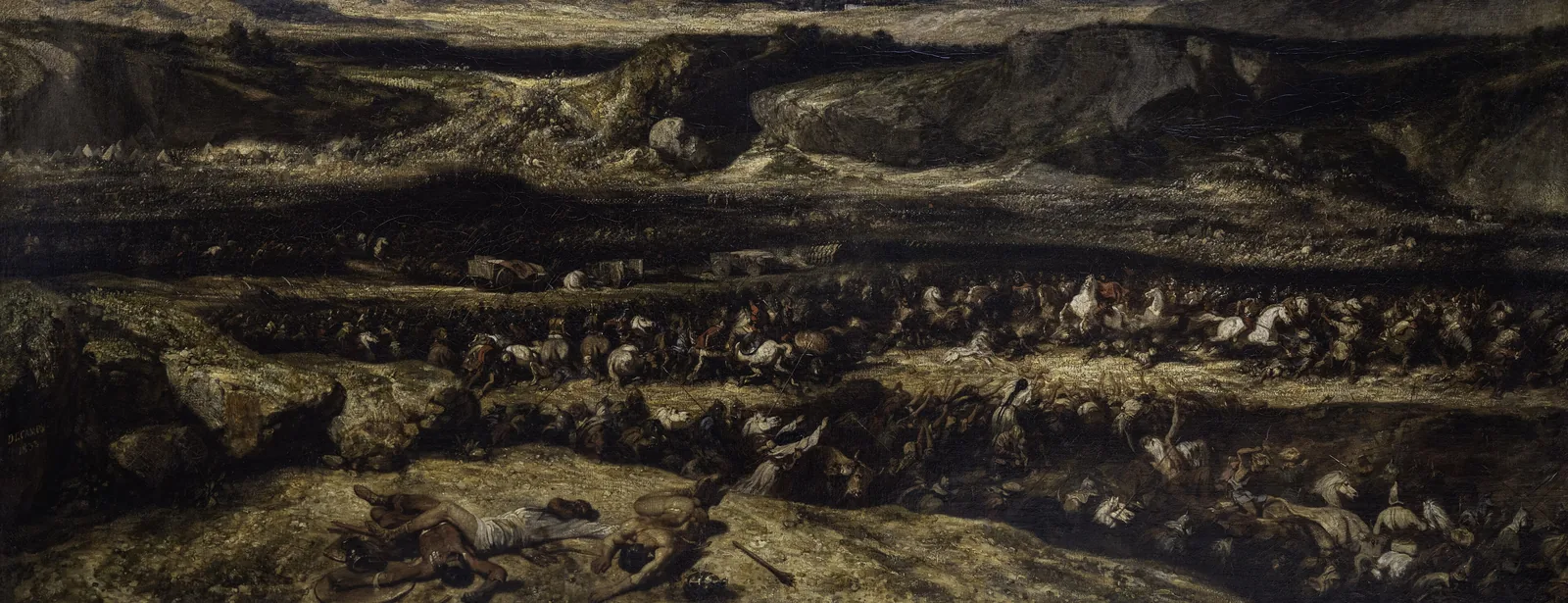
Alexandre-Gabriel Decamps, The Defeat of the Cimbri, 1833. Musée du Louvre, Paris · CC0 · Source page
The man in the marsh
Six times consul, up to his neck in mud
88 BC, the marshes near Minturnae, on the coast south of Rome. An old man lies hidden in the thick, muddy water among the reeds. Horsemen are searching the shore for him. He is about seventy, and six times consul of Rome.
Thirteen years earlier the people hailed him as the third founder of Rome, after he wiped out the invaders from the north. Now he is a public enemy, and anyone may kill him.
His name is Gaius Marius. How did the saviour of Rome end up in a marsh? And what did he really change in the Roman army?
Gaius Marius
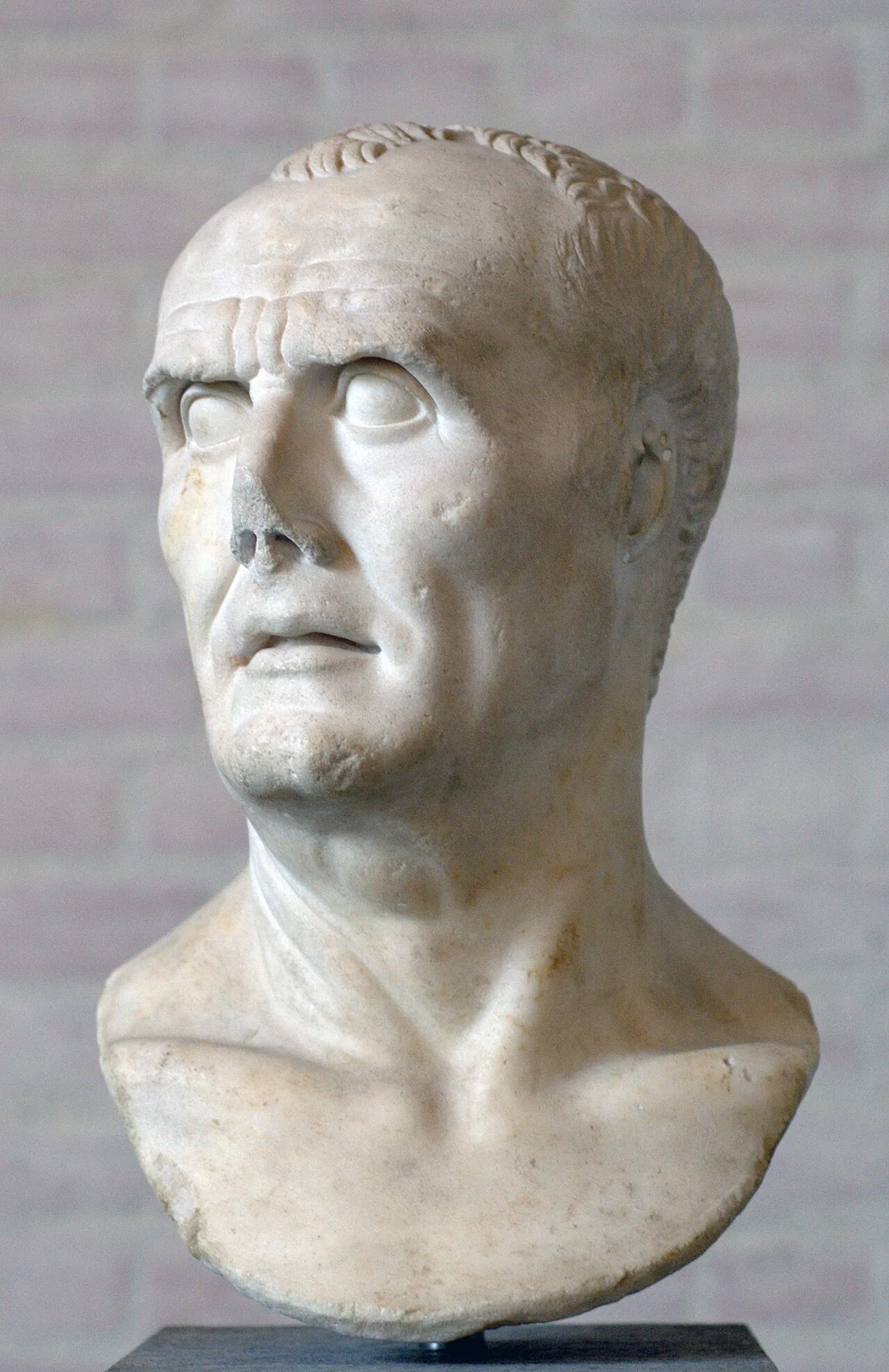
So-called “Marius”, Roman copy. Glyptothek, Munich (inv. 319). Photo: Bibi Saint-Pol · Public domain · Source page
A “new man” from a country town who saved Rome from the northern invaders, broke its rules to do it, and died after turning an army on his own city.
- Born: 157 BC, Probably Cereatae, a village near Arpinum in Latium
- Died: 13 or 17 January 86 BC, Rome, in bed, probably of pleurisy, in his seventh consulship
- Won: The Jugurthine War, 107–105 BC; Aquae Sextiae, 102 BC; Vercellae, 101 BC (with Catulus); A victory over the Marsi in the Social War, 90 BC
- Lost: The street fighting in Rome against Sulla’s army, 88 BC
“These are my portraits, these my patent of nobility, not left me by inheritance as theirs were, but won by my own innumerable efforts and perils.”
Our witnesses
A life written by his enemies
Marius left nothing in writing. Most of what we know comes from his enemies, or from writers who used their books. Two of them wrote memoirs: Sulla, who drove him out of Rome, and Catulus, who shared his greatest victory and wanted the credit for himself.
The full stories, by Sallust and Plutarch, were written decades and centuries later. Keep asking: who is telling this, and why?
From Arpinum to Africa
Background
A rich outsider
Marius was born in 157 BC near Arpinum, a hill town about 100 kilometres south-east of Rome whose people had received full Roman citizenship only in 188 BC.
Plutarch says his parents were poor. The evidence points to a well-off local family with powerful patrons in Rome. But no one in it had ever sat in the Senate. In Rome that made him a new man, and the old families never let him forget it.
Spain, 134 BC
In Scipio’s camp
As a young man Marius served at the siege of Numantia in Spain under Scipio Aemilianus, who had destroyed Carthage in 146 BC, as we saw in the last lesson. Once, it is said, someone at dinner asked where Rome would find another general like Scipio. Scipio tapped Marius on the shoulder: “Here, perhaps.” In the same camp served a Numidian prince: Jugurtha.
In Rome, in 133 BC, the tribune of the plebs Tiberius Gracchus was killed for trying to give land to the poor. One of his arguments: the small farmers who filled the legions were disappearing. As a rule, only men with property served as legionaries.
Rome, 119–110 BC
The climb
Marius climbed slowly. In 119 BC he was elected tribune of the plebs with the help of the powerful Metellus family, and promptly fell out with it. He lost two elections on a single day, and became praetor in 115, elected last of all.
Around 110 BC he married Julia, of an old patrician family. Her nephew, born about ten years later, was Gaius Julius Caesar.
Jugurtha
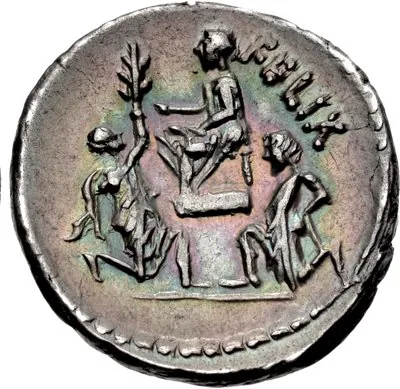
Denarius of Faustus Cornelius Sulla, Rome, 56 BC (Crawford 426/1), reverse · Classical Numismatic Group, Inc. (CNG), www.cngcoins.com · CC BY-SA 2.5 · Source page
A Numidian prince who learned war in a Roman camp, bought friends in Rome’s Senate, and fought Rome for six years.
- Born: c. 160 BC, Numidia; grandson of King Masinissa, raised by his uncle Micipsa
- Died: 104 BC, The Tullianum prison pit in Rome, after Marius’s triumph: starved, says Plutarch; executed, says the summary of Livy
- Won: Suthul, 110 or 109 BC: a Roman army surrendered and passed under the yoke
- Lost: The Muthul river, 109 BC; Capsa, 107 BC; Two battles near Cirta, 106 BC; Betrayed by Bocchus, 105 BC
“A city for sale and doomed to speedy destruction if it finds a purchaser!”
Numidia, 112–108 BC
A city for sale
Numidia, roughly northern Algeria today, was Rome’s ally. When its king died, Jugurtha murdered one cousin and besieged the other in Cirta. When the city fell in 112 BC, Italian traders were massacred too, and in 111 Rome went to war.
It went badly. Sallust, our main source, claims that Roman nobles took Jugurtha’s gold, and in 110 or early 109 a Roman army even surrendered. In 109 the consul Quintus Caecilius Metellus took over, with Marius as one of his legates. Metellus won battles but could not catch the king.
Marius asked leave to go home and stand for consul. Metellus sneered that he could stand when Metellus’s son did; the son was about twenty. Marius, nearly fifty, never forgave it.
A decision point
You are Gaius Marius, the new consul.
Early 107 BC, in Rome
The people elected you consul for 107, and an assembly has voted you the war in Africa against the Senate’s wishes. You promised to finish Jugurtha quickly.
You need more soldiers. The Senate gladly grants reinforcements: it thinks the people hate military service, and hopes you will lose your popularity.
By custom the levy calls citizens up by property class. The poorest, the capite censi, are not called. Many of them would gladly serve for pay and plunder.
Whom do you enlist?
- Hold the normal levy of property owners, class by class Lawful and expected. But a forced levy is slow and hated, the men come unwillingly, and the Senate’s trap works: you lose popularity, and may fail to deliver the quick victory you promised.
- Call back veterans and ask the allies and friendly kings for troops Experienced soldiers, and no custom broken. But probably not enough of them for a war in the desert against a king who never stands still.
- Take volunteers whatever their property, including the poorest You get eager men, fast, and your voters cheer. But you break an old custom, and the nobles will say you are building an army of the poor, loyal to you.
What really happened
Take volunteers whatever their property, including the poorest
Marius took men from every source. He gathered veterans, allies and kings’ troops, and also took volunteers of every kind, “for the most part” men without property. He sailed for Africa with more men than the Senate had authorised.
Sallust reports two explanations heard at the time: a shortage of good men, or a bid for the voters’ favour. Plutarch calls it an act “contrary to law and custom”.
Modern historians stress that it was one levy for one war, probably a modest reinforcement. The decision mattered more as a precedent than as a reform.
Africa, 107–104 BC
Sulla’s ring
Marius drilled his new men hard and won: he took the desert town of Capsa, and twice beat Jugurtha and his father-in-law, King Bocchus of Mauretania, near Cirta. But the war ended in betrayal, not battle.
In 105 BC Bocchus seized Jugurtha at a meeting and handed him to Marius’s quaestor, the young officer in charge of money: Lucius Cornelius Sulla. This, says Plutarch, was “the first seed” of their hatred, and Sulla fed it: he had a seal ring made showing the scene, and wore it constantly.
On 1 January 104 BC Marius held his triumph. Jugurtha walked in chains before his chariot, then died in the prison pit at the foot of the Capitol.
The terror from the north
113–105 BC
Arausio
6 October 105 BC
For years whole peoples had been on the move north of the Alps: the Cimbri, the Teutones and the Ambrones, with wives, children and wagons, looking for land. In 113 BC the Cimbri first clashed with a Roman army. They probably came from Jutland, in today’s Denmark.
One Roman army after another was beaten. The worst came at Arausio, today’s Orange, on the Rhône. The two Roman commanders, a proud patrician and a new man, refused to cooperate and camped apart, and both armies were destroyed.
104–102 BC
Five consulships, and “Marius’s mules”
The law forbade a second consulship until many years had passed, but the people wanted no other general: Marius was elected consul every year from 104 to 100 BC.
The northern peoples gave him time: the Cimbri went off to Spain. Marius used it to train. His soldiers ran, marched long distances, carried their own baggage and cooked their own food. Plutarch gives this as one explanation of the nickname “Marius’s mules”.
Myth
Marius invented the eagle, the standard of the Roman legions.
The truth
The eagle was there before him. The only ancient writer to tell the story, Pliny the Elder, says it was the first of five animal standards, and that before Marius it was already the only one carried into battle. In 104 BC Marius abolished the others.
The evidence
Pliny the Elder, Natural History 10.16, written c. AD 77, some 180 years later (trans. J. Bostock and H. T. Riley, 1855): “Caius Marius, in his second consulship, assigned the eagle exclusively to the Roman legions.”
A decision point
You are Gaius Marius, consul for the fourth time.
Summer 102 BC, in your fortified camp on the Rhône
The Teutones and Ambrones have come. For days they have dared you to fight and attacked your rampart. You have kept your men inside to get used to the sight of the enemy, and they grumble that you use them as labourers.
Now the enemy packs up and marches past your camp, east towards Italy. Every Roman army that met these peoples in the open has been destroyed. Your colleague Catulus is guarding the Alps against the Cimbri, who are coming another way.
What do you do?
- Lead the men out now and fight in front of the camp Your angry soldiers fight eagerly. But on open ground of the enemy’s choosing, against a fresh host, you risk another Arausio, and there is no army left behind you.
- Attack the column while it is strung out on the march You might cut off part of the host. But outside your rampart you face its whole weight before your men are formed up; that is how Roman armies died before you.
- Let them pass, then follow them and choose your ground The enemy gets ahead of you on the road to Italy, a real gamble. But you can camp on strong ground every night, and fight when and where you choose.
- Fall back to the Alps and join Catulus Rome’s armies are united. But southern Gaul, the Roman Province, is left to be plundered, and the two northern hosts may unite too.
What really happened
Let them pass, then follow them and choose your ground
Marius let them pass. Plutarch says the column took six days to go by the camp, its warriors “inquiring whether the Romans had any messages for their wives; ‘for,’ said they, ‘we shall soon be with them.’” Then Marius followed, fortifying a camp beside them every evening, until both armies reached Aquae Sextiae, today’s Aix-en-Provence.
In Plutarch, Marius explained that because of oracles he was waiting “for a fit time and place for his victory”, and he wanted his men to master their fear first. Many historians see this patience as his finest generalship: he refused to fight on the enemy’s terms.
Aquae Sextiae: who fought whom
102 BC, probably late summer or autumn; two battles, two days apart
Near Aquae Sextiae (Aix-en-Provence), southern Gaul; the exact site is unknown
Romans and allies
- Commanders: Gaius Marius, consul, Claudius Marcellus, commanding the ambush
- Strength: no figure for the army; 3,000 with Marcellus (Plutarch); usually 30,000–40,000; a guess (Modern estimate)
- Losses: not recorded (Ancient writers)
Teutones and Ambrones
- Commanders: Teutobod, king of the Teutones
- Strength: the Ambrones alone: over 30,000 (Plutarch); unknown; perhaps tens of thousands of warriors, with families (Modern estimate)
- Losses: over 100,000 killed or taken (Plutarch); over 150,000 killed (Velleius Paterculus); 200,000 killed, 90,000 taken (Livy’s summary); 200,000 killed, 80,000 taken (Orosius)
Outcome: A Roman victory. The Ambrones and Teutones ceased to be a fighting force. King Teutobod was captured, say Florus and Eutropius; Orosius says he was killed.
Livy, the earliest writer, gives the largest number; Plutarch, the only one to describe the battle in detail, gives the smallest. None can be checked.
The battles of Aquae Sextiae
102 BC, probably late summer or autumn: two battles, two days apart
Marius is camped on a hill without water, in a fortified camp on the Rhône. The Teutones and Ambrones, who came with their wives, children and wagons, have for days dared the Romans to fight. Now they are about to march east, towards Italy, past the Roman camp.
One reconstruction, after Plutarch, Marius 18–21, the only detailed account, and Michel Clerc (1906), who argued that both fights took place in front of one Roman camp near Aix. No archaeological find fixes either battle; local tradition puts the second about 20 km further east, near Pourrières. The camp on the slopes of Montaiguet, the enemy camps and all the numbers are guesses. Plutarch says only that Marius followed the column and camped close to it; this map assumes he overtook it and fortified east of it, across the road to Italy, which no source states.
Phases of the battle
- Day one: water at a price Marius camps on a hill without water. His servants go down to the river with jars and axes; across it many Ambrones are bathing in the hot springs. A skirmish breaks out at the water.
- The fight in the river More than 30,000 Ambrones come on, chanting their own name, and Marius’s Ligurians shout back the same name, which is theirs too. The Ambrones lose order in the river, and the Romans charge down the slope.
- To the wagons, and a night of fear The Romans chase them to the wagons, where the women fight with swords and axes. In their unfortified camp the Romans spend a night of terror. Marius sends Marcellus with 3,000 men to hide in the wooded hills.
- Day three: the charge uphill At dawn the legions form up in front of the camp. The Teutones cannot wait and charge up the slope. The Romans throw their javelins, close with swords, and shove them back down with their shields.
- Marcellus in the rear As the Teutones are pushed down to level ground, Marcellus bursts out behind them with a shout. Trapped, the host breaks and flees.
The strategy
- Romans: Marius keeps his men in camp so they grow used to the sight of the enemy. Then he lets the column pass, follows it and camps close by. Marcellus, with 3,000 men, hides in the wooded hills and strikes from behind when the enemy is driven onto the plain.
- Teutones and Ambrones: The Teutones and Ambrones mean to march east to Italy, past the Roman camp, in search of land. They do not wait for the Romans: the Ambrones advance chanting their name, and the Teutones cannot hold back and charge up the slope.
What decided it: The ambush decided it. As the Teutones were pushed onto level ground, Marcellus burst out behind them with a shout, and the trapped host broke and fled. The force that waited out of sight for the right moment is what decided it.
The battlefield
A mountain named for the victory?
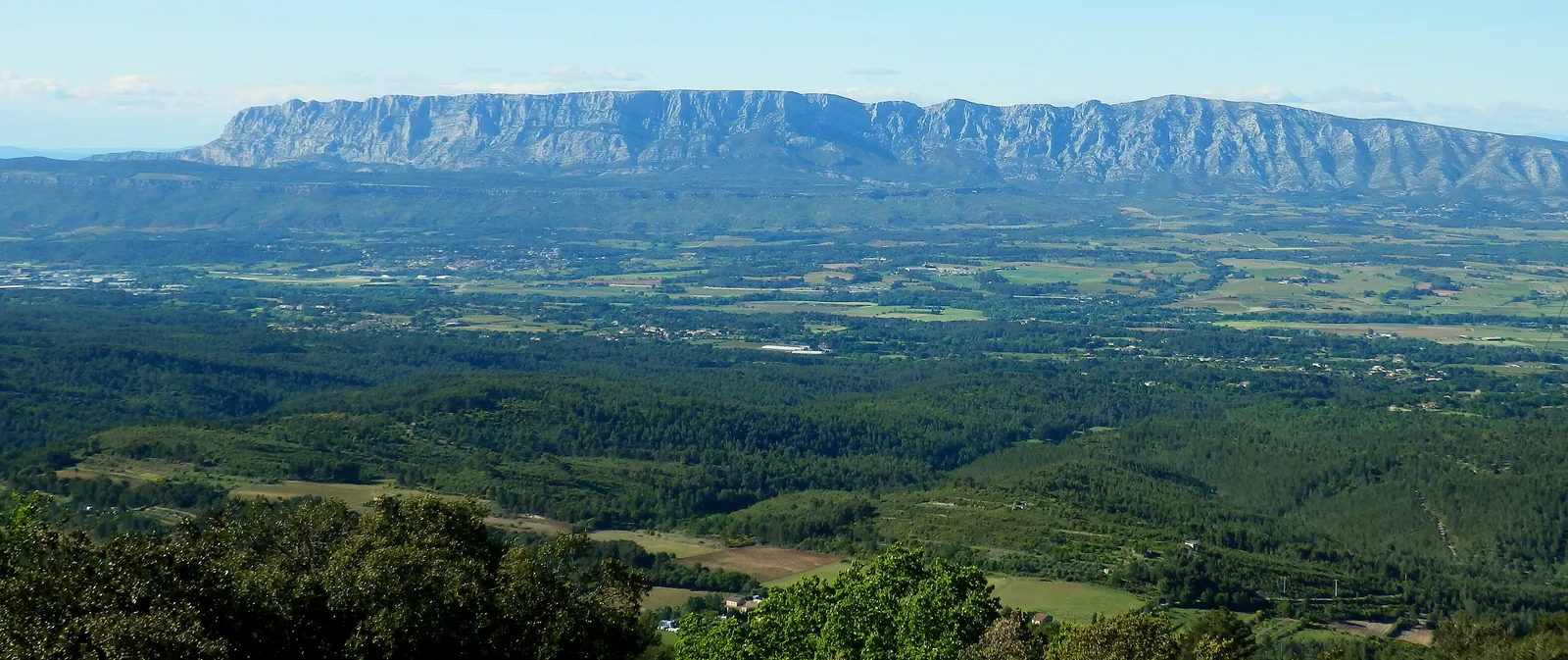
Mont Sainte-Victoire from the Régagnas hills, Provence, 2017. Photo: BaptisteMPM · CC BY-SA 4.0 · Source page
Nobody has found the battlefield. Tradition puts the second battle below Mont Sainte-Victoire, east of Aix, and says the mountain was named for it. But its medieval name was Sainte-Venture, and, as Camille Jullian and Michel Clerc noted, no ancient writer links it to Marius.
Northern Italy, 102–101 BC
Land they will keep forever
Meanwhile the Cimbri crossed the Alps, drove Catulus from the river Adige and poured into the plain of the Po.
Marius joined Catulus. The Cimbri asked for land for themselves and their brothers, the Teutones. Marius answered that their brothers already had land, which they would keep forever: the land the Romans had given them.
Before the battle, says Plutarch, Marius changed the pilum: he replaced one of the two iron nails fixing its head to the shaft with a wooden peg that broke on impact. Stuck in an enemy shield, the javelin’s shaft then bent at the iron head and dragged on the ground.
Vercellae: who fought whom
30 July 101 BC
The Raudine Plain, somewhere in the Po valley; traditionally near Vercelli in Piedmont, but the site is unknown
Romans and allies
- Commanders: Gaius Marius, consul for the fifth time, Quintus Lutatius Catulus, proconsul
- Strength: Marius 32,000; Catulus 20,300 (Plutarch, after Sulla); about 50,000 is thought plausible (Modern estimate)
- Losses: fewer than 300 (Florus); 300 from both armies (Eutropius)
Cimbri
- Commanders: Boiorix, king of the Cimbri (killed)
- Strength: foot in a square 30 stades (about 5.5 km) a side; 15,000 horse (Plutarch, after Sulla); unknown; such a square is impossible (Modern estimate)
- Losses: 120,000 killed, over 60,000 taken (Plutarch); 140,000 killed, 60,000 taken (Livy’s summary, Eutropius and Orosius); 65,000 killed (Florus)
Outcome: A crushing Roman victory. The migrating Cimbri were destroyed; only those who had stayed in the north survived. Rome hailed Marius as its third founder.
The detailed account comes from Sulla and Catulus, who fought in the centre and wanted the glory. Catulus’s men took 31 of the 33 captured standards, says Eutropius. The Roman people gave the credit to Marius.
The battle of Vercellae
30 July 101 BC, a hot summer day
The Cimbri crossed the Alps, pushed Catulus back from the river Adige and poured into the plain of the Po. Marius has joined Catulus, and the two armies now face each other on a hot summer day, on a plain agreed with the Cimbrian king. Nobody has located that plain.
A diagram, not a map. Plutarch calls the field “the plain of Vercellae”, Velleius and Florus the Raudine Plain, and nobody has located it. Tradition puts it near the town of Vercelli in Piedmont; Jacopo Zennari (1958) argued for the eastern Po valley, near Rovigo. The direction is unknown too: Plutarch puts the sun in the Cimbri’s faces, while Florus says the Roman line faced east. The positions follow Plutarch 25–27, who follows Sulla. The north arrow means nothing here.
Phases of the battle
- 30 July: the lines On the day and plain agreed with the Cimbrian king, the Romans form up. Sulla says Marius put his own 32,000 men on both wings and Catulus’s 20,300 in the centre. The Cimbri come on in a huge, deep mass.
- The cavalry feint The 15,000 Cimbrian horsemen, in helmets shaped like the jaws of beasts, swerve to their right, to draw the Romans after them and catch them between horse and foot.
- Lost in the dust A huge cloud of dust hides the armies. In Sulla’s telling, Marius and his wings miss the enemy, while the Cimbrian foot falls on Catulus in the centre, where Sulla himself stood.
- Heat, and chained ranks The Cimbri, Plutarch says, wilt in the summer heat. Their front ranks are chained together and cannot give way. The centre holds; Marius’s wings probably came back into the fight, but no source says how.
- At the wagons The Cimbri are driven back to their wagons. There the women, dressed in black, kill the fugitives, their children and themselves. How many died, nobody knows.
The strategy
- Romans: According to Sulla, whose account is the main detailed source, Marius puts his own 32,000 men on both wings and Catulus’s 20,300 in the centre.
- Cimbri: The Cimbri come on in a huge, deep mass. Their 15,000 horsemen swerve to the right, to draw the Romans after them and catch them between horse and foot.
What decided it: According to Plutarch, what weakened the Cimbri were the heat and their chained ranks: they wilted in the summer heat, and their front ranks, chained together, could not give way. The Roman centre held, and Marius's wings probably came back into the fight, though no source says how.
From saviour to outlaw
A decision point
You are Gaius Marius, consul for the sixth time.
December 100 BC, in Rome
Lucius Appuleius Saturninus, a tribune of the plebs, and Gaius Servilius Glaucia, a praetor, are your allies. They passed the laws that give your veterans land, and drove into exile Metellus, who refused to swear to obey them.
But their methods are violent. At the consular elections their men beat a candidate, Gaius Memmius, to death in front of everyone. Now they have seized the Capitol, and the city has turned against them.
The Senate passes its emergency decree: the consuls must protect the state. That means you. The last time, in 121 BC, a consul used it against Gaius Gracchus, who died with thousands of his supporters.
What do you do?
- Obey the decree and take the Capitol, but try to save their lives You remain a law-abiding consul. But the men who gave your soldiers land will remember that you turned on them, and you may not be able to protect them.
- Refuse, and stand by the men who gave your veterans land Probably fighting in the streets, with you as a rebel consul against the Senate. The saviour of Rome would become its enemy.
- Stand aside: delay, or leave the city, until others act Others probably storm the Capitol anyway, and both sides call you a coward.
What really happened
Obey the decree and take the Capitol, but try to save their lives
Marius besieged the Capitol. The water was cut, and Saturninus and Glaucia surrendered on a promise of safety. Marius shut them in the Senate house, but the crowd climbed onto the roof and killed them with the tiles, says Appian.
Duty, and the mood of the city. Appian describes a consul who armed his men “reluctantly” and delayed, until others cut the water. Plutarch, who disliked him, says Marius cut it himself.
Plutarch: “This affair made Marius obnoxious alike to the nobles and to the people.” He did not even dare to stand for censor.
98–89 BC
Waiting for a war
In Asia Minor Marius met Mithridates VI, king of Pontus, and told him: “O King, either strive to be stronger than Rome, or do her bidding without a word.”
In 91 BC Rome’s Italian allies, who fought in Rome’s wars without a vote there, rose in revolt. In this Social War Marius, sixty-seven by 90 BC, beat the Marsi but soon retired, pleading illness, while Sulla made his name. Rome won by giving the Italians its citizenship.
A decision point
You are Gaius Marius, about sixty-nine years old.
88 BC, in Rome
Mithridates has overrun the Roman province of Asia and had tens of thousands of Romans and Italians killed in a single day. The war against him promises glory and enormous wealth.
The Senate has given the command to the consul Lucius Cornelius Sulla, your former quaestor and now your rival. His army is besieging Nola in Campania. But the tribune Publius Sulpicius offers a law giving you the command by popular vote. There is a precedent, and it is yours: 107. And no Roman army has ever marched on Rome.
Do you take the command?
- Accept the command by a vote of the people, as in 107 One last great war, and a chance to outshine Sulla. But Sulla holds the command lawfully and has six legions; he will not give them up quietly.
- Refuse, and retire with your triumphs and your wealth Sulla probably fights Mithridates, and you die old, rich and respected: the saviour of Rome.
- Seek a compromise: a share of the war, or a decision by the Senate Sulla will probably still refuse to share, but the quarrel might stay within the law, and no army would turn on Rome.
What really happened
Accept the command by a vote of the people, as in 107
Marius accepted, and the law passed. He sent two officers to take over Sulla’s army. The soldiers stoned them to death, and Sulla marched on Rome with six legions: the first Roman army to take the city. Marius lost the street fighting, and he, his son and ten others were declared public enemies.
Plutarch and Appian say greed. In Appian, Marius thinks it “an easy and lucrative war”. Marius himself claimed he wanted to give his son experience of war.
Modern historians add that Marius could not have known a consul would turn his army on Rome, and the precedent of 107 made the transfer look lawful.
88–87 BC
Amid the ruins of Carthage
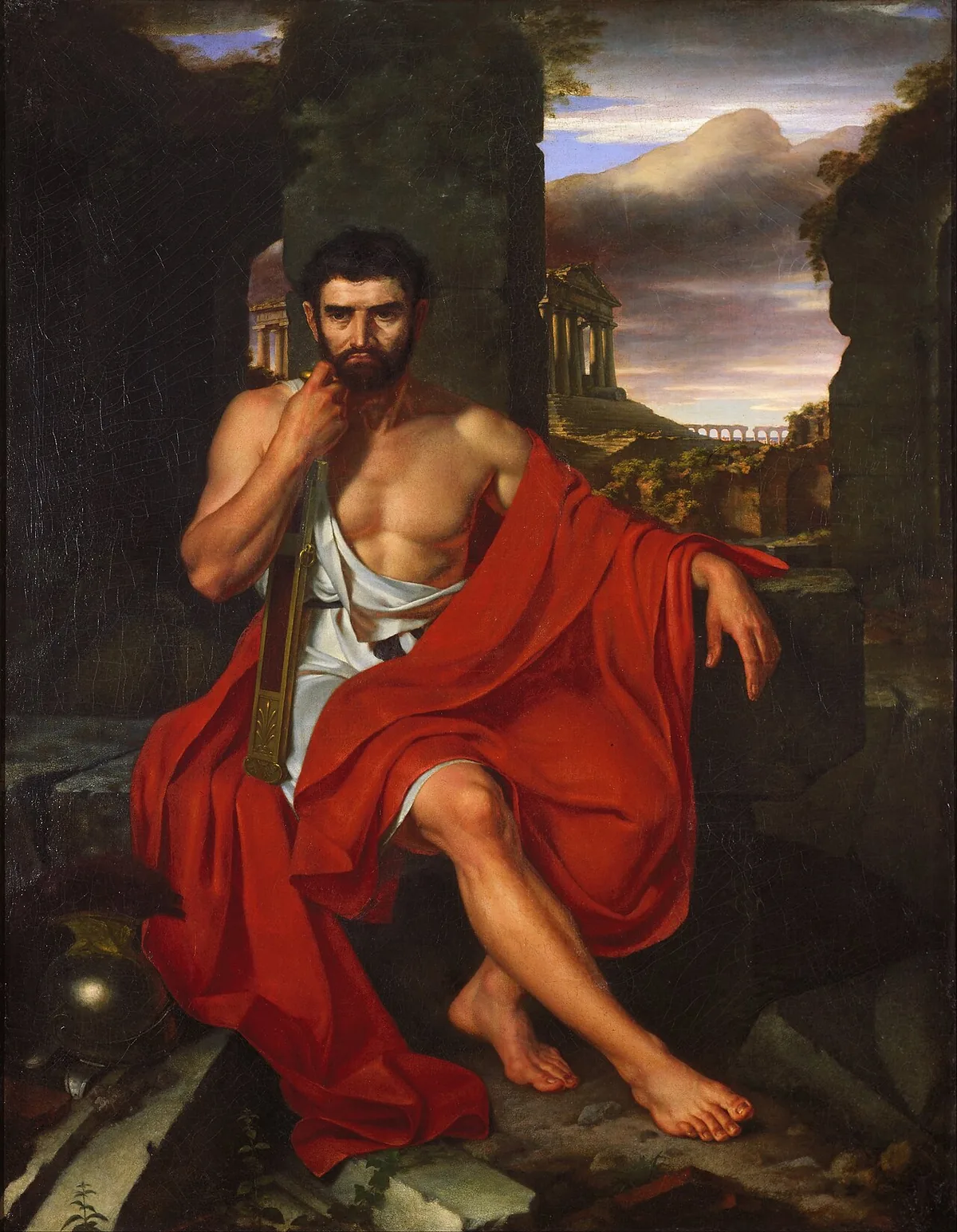
John Vanderlyn, Caius Marius Amid the Ruins of Carthage, 1807. Fine Arts Museums of San Francisco · Public domain · Source page
Marius was dragged out of the marshes near Minturnae naked and covered in mud, and locked in a house. The town sent a man with a sword to kill him: a slave or a horseman, a Gaul, a German or a Cimbrian, depending on the source. In Appian’s version Marius rose from his bed and shouted: “Do you dare to kill Gaius Marius?” The man ran out crying that he could not, and the town let Marius go.
In Africa the Roman governor ordered him to leave, and Plutarch gives him a famous reply: “Tell him, then, that thou hast seen Caius Marius a fugitive, seated amid the ruins of Carthage.”
87–86 BC
The seventh consulship
In 87 BC the consul Lucius Cornelius Cinna was driven out of Rome. Marius landed in Etruria with fewer than a thousand men, his hair uncut since his flight, and joined him. Together they starved Rome into surrender.
Then came revenge. Marius’s bodyguard, slaves who had flocked to him, killed men in the street simply because he did not return their greeting, and senators’ heads were displayed in the Forum. Catulus, his partner at Vercellae, took his own life.
On 1 January 86 BC Marius became consul for the seventh time. About two weeks later he was dead, probably of pleurisy, after nights of drinking and fear. In Greece, Sulla was besieging Athens. He would be back.
How do we know?
Source: “For the most part the proletariat”
“He himself in the meantime enrolled soldiers, not according to the classes in the manner of our forefathers, but allowing anyone to volunteer, for the most part the proletariat. Some say that he did this through lack of good men, others because of a desire to curry favour, since that class had given him honour and rank.”
Sallust was a new man himself and a supporter of Julius Caesar, writing after the civil wars. “Proletariat” translates capite censi, “those counted by head”.
- Sallust wrote some 65 years later, after the civil wars. How might that colour his view of 107? He knew how the story ended. His next sentence says that to a man seeking power the poorest are the most useful, having nothing to lose: a lesson from his own time.
- Does Sallust describe a reform of the army? No. He describes one levy for one war, and says “for the most part”: veterans and allies came alongside the poor. The idea of “Marian reforms” is modern.
- Why does Sallust give two motives that “some say”? People already argued then: need, or politics? He shows the disagreement instead of hiding it.
Source: Vercellae, as Sulla told it
“Marius, when he first led his forces to the attack, missed the enemy, passed by their lines of battle, and moved aimlessly up and down the plain for some time. Meanwhile, as chance would have it, the Barbarians engaged fiercely with Catulus, and he and his soldiers, among whom Sulla says he himself was posted, bore the brunt of the struggle.”
Plutarch is retelling Sulla’s memoirs. Just before, Sulla claims that Marius put Catulus in the centre so that his own wings would win the glory.
- Where did Sulla stand in the battle, and how did he feel about Marius when he wrote? With Catulus, in the centre that “bore the brunt”. He wrote after driving Marius out and destroying his party: hardly a neutral witness.
- Which details make Marius look bad, and could anyone check them? The plan to steal the glory, the wandering in the dust: they came from Sulla and Catulus. No one on Marius’s side wrote anything that survives.
- Who got the credit in the end? The people gave it to Marius. But the version that survived in books was his enemies’. Victory was a political prize, and so was its history.
Source: A king hands over a king
A silver denarius struck in Rome by Faustus Cornelius Sulla, 56 BC
Sulla sits on a raised seat. On the left King Bocchus kneels and offers an olive branch; on the right kneels Jugurtha, his hands tied. FELIX, “the lucky”, was Sulla’s surname.
- Who is missing from this picture of the end of the Jugurthine War? Marius, the commander who won the war and held the triumph. The coin gives all the credit to Sulla.
- Who struck the coin, and when? Sulla’s son Faustus, in 56 BC, half a century after the event, to advertise his family. It probably copies the scene on his father’s seal ring.
Myth
In 107 BC Marius created Rome’s professional army in one great reform: volunteers instead of conscripts, equipment paid by the state, cohorts, eagles and land for veterans.
The truth
No ancient writer describes such a reform. Sallust and Plutarch report one decision: poor volunteers for one army, for one war. Poor men had served before him, conscription went on long after him, and Polybius mentions cohorts a century earlier. “The Marian reforms” is a label invented by modern historians.
The evidence
Sallust, The War with Jugurtha 86.2; Plutarch, Marius 9.1; Aulus Gellius 16.10, who reports that some put it in the war with the Cimbri, though he prefers Sallust’s date; Polybius 11.23 (cohorts at Ilipa, 206 BC).
After Marius
83–69 BC
The nephew
Sulla came back in 83 BC and won the civil war. He had Marius’s remains dug up and thrown into the river Anio.
In 69 BC, at the funeral of his widow Julia, her nephew had images of Marius carried through Rome for the first time since Sulla, and the crowd cheered. His name was Gaius Julius Caesar.
What Marius left behind
- 107 BC Poor volunteers in the legions, and a command given by the people against the Senate: two precedents.
- 104–100 BC Five consulships in a row: the indispensable general, a model for Pompey and Caesar.
- 103 and 100 BC Tribunes give land to Marius’s soldiers; soldiers learn to expect land from their general, not the Senate.
- 102–101 BC The danger from the north ends for two generations.
- 100 BC The emergency decree is used against Marius’s allies. Political violence becomes normal.
- 91–88 BC The Social War; the Italians receive Roman citizenship, and the legions become Italian.
- 88 BC Sulla marches on Rome: the first Roman army to take it (the next lesson).
- 87–86 BC Marius and Cinna take Rome; massacres, and Marius’s death in his seventh consulship.
- 82 BC Sulla wins; revenge becomes a system, the proscriptions: lists of citizens anyone may kill.
- 49 BC Julia’s nephew, Julius Caesar, crosses the Rubicon with an army loyal to him.
Did Marius create the army that destroyed the Republic?
Within sixty years of 107 BC Roman armies marched on Rome again and again, loyal to their generals. Did Marius’s levy start it?
- Emilio Gabba (1949; in English 1976), and Christopher Matthew (2010) A turning point. Gabba saw the levy of 107 as the end of a long process: the legions became an army of the poor, who looked to their general for pay, plunder and land, and that made the civil wars possible. Matthew argues that Marius also made deliberate changes to training and equipment, creating Rome’s first professional soldiers.
- P. A. Brunt (1962, 1971) Less than it seems. Conscription went on, and most soldiers were still peasants. What bound them to their generals was not a new kind of recruit but the Senate’s failure to provide them with land on discharge.
- J. W. Rich (1983) and François Cadiou (2018) A modern myth. Rich showed that the evidence for a manpower shortage in the 2nd century BC is weak. Cadiou argues that “the Marian reform” is a construction of modern scholars: 107 was an emergency measure, conscription remained the normal way of raising legions, and there is little evidence that the armies of the Republic’s last century were armies of landless volunteers.
If the levy of 107 was a one-off, why were the armies of the 80s BC willing to follow their generals against Rome? And if it was not, what changed?
What do you know now?
Check yourself
Why do historians doubt Plutarch’s picture of Marius as the son of poor peasants?
Answer: Velleius’s text, as it has come down, says he was born of equestrian rank, and he had powerful patrons. Right. Only a 17th-century scholar’s “correction” turned Velleius’s words into “of rustic birth”. The new man was an outsider, not a pauper.
Check yourself
What did Marius do in 107 BC that broke with custom?
Answer: He took volunteers whatever their property, mostly the capite censi. Right. One levy, for one war in Africa, alongside veterans and allies.
Check yourself
Who actually captured Jugurtha?
Answer: His father-in-law Bocchus, who handed him to Sulla. Right. Bocchus seized him at a meeting in 105 BC; Sulla, Marius’s quaestor, received him and had the moment engraved on his ring.
Check yourself
Why did Marius let the Teutones march past his camp in 102 BC?
Answer: To fight at a time and place of his choosing, once his men had mastered their fear. Right. He followed them, camped on strong ground each night, and fought at Aquae Sextiae from a hill he had chosen.
Check yourself
Why should we be careful with Plutarch’s account of Vercellae?
Answer: It rests on Sulla’s memoirs and Catulus’s book, men who wanted the glory for themselves. Right. Both fought in the centre, and Sulla wrote after becoming Marius’s bitter enemy.
Check yourself
What made 88 BC a turning point?
Answer: For the first time a Roman army marched on Rome and took it. Right. When the command against Mithridates was moved to Marius, Sulla led his legions against the city itself.
Terms
- new man In Rome (novus homo): a man who was the first of his family to reach the Senate, and above all the consulship. The old families looked down on him.
- consul One of the two elected heads of the Roman Republic, chosen for one year. The consuls commanded the armies. The law forbade a second term until many years had passed.
- tribune of the plebs One of ten officials elected each year by the common people of Rome. A tribune could propose laws to the people’s assembly and veto the acts of other officials.
- legate A senior officer chosen by a commander as his deputy, usually a senator.
- triumph A Roman general’s victory parade through Rome, with his prisoners and plunder, up to the temple of Jupiter on the Capitol. Normally the Senate granted it.
- capite censi Latin for “counted by head”: the poorest citizens, listed in the census only by head because they owned nothing worth recording. By custom they were not called to the legions.
- legion The main unit of the Roman army, about 4,000 to 5,000 foot soldiers, most of them heavy infantry, all Roman citizens. Allied contingents fought beside it.
- pilum A heavy Roman throwing spear with a long iron shank. Soldiers threw it just before contact, then drew their swords.
- eagle Latin aquila: the standard of a legion, a silver or gold eagle on a pole. Losing it in battle was the worst disgrace.
- emergency decree Latin senatus consultum ultimum: a Senate decree calling on the consuls to protect the state by any means. It was first used to kill citizens without trial in 121 BC.
- Italian allies The peoples of Italy bound to Rome by treaties. They supplied half or more of Rome’s soldiers but had no vote in Rome.
- Minturnae A town on the coast south of Rome, near the marshes where Marius was caught.
- Arpinum A hill town about 100 kilometres south-east of Rome, where Marius was born.
- Numantia A town in Spain that the Romans besieged for a long time in a hard war.
- Scipio Aemilianus A Roman general who destroyed Carthage and led the siege of Numantia.
- Jugurtha King of Numidia who murdered his cousins and fought Rome. In the end he was captured and died in prison.
- Numidia A kingdom in North Africa, roughly today's northern Algeria, that was an ally of Rome.
- Metellus A powerful Roman noble family. Quintus Metellus was the consul who led the war against Jugurtha.
- Cirta A city in Numidia. When it fell, Italian traders there were massacred too.
- Bocchus King of Mauretania and father-in-law of Jugurtha, who handed him over to the Romans.
- Sallust A Roman historian, a new man and supporter of Julius Caesar. He wrote about the corruption and arrogance of the nobles.
- Plutarch A Greek biographer and philosopher who wrote the lives of famous men to teach good and bad character.
- Appian A Greek historian from Alexandria. He told the civil wars of Rome as a chain leading to one ruler.
- Livy A Roman historian who wrote many books on Rome. Most of them are lost.
- Velleius A Roman historian and officer of the emperor Tiberius, who wrote about Marius and his time.
- Cimbri A people from north of the Alps who wandered with wives, children and wagons to look for land.
- Teutones A people who moved north of the Alps together with the Cimbri, looking for land.
- Arausio A place on the river Rhône where two Roman armies were destroyed.
- Catulus A Roman noble who shared Marius's victory and wrote memoirs, wanting the glory for himself.
- Vercellae A town in northern Italy where the Romans fought the Cimbri.
- Mithridates King of Pontus in north Asia Minor, who fought against Rome.
Sources
- Plutarch, Life of Marius, trans. B. Perrin, Plutarch’s Lives vol. IX (Loeb Classical Library, 1920)
- Plutarch, Life of Sulla 3–10, trans. B. Perrin, Plutarch’s Lives vol. IV (Loeb Classical Library, 1916)
- Sallust, The War with Jugurtha, trans. J. C. Rolfe (Loeb Classical Library, 1921)
- Appian, Civil Wars 1.28–75, trans. H. White (Loeb Classical Library, 1913)
- Velleius Paterculus, Roman History 2.9–23, trans. F. W. Shipley (Loeb Classical Library, 1924)
- Florus, Epitome of Roman History 1.36–38, trans. E. S. Forster (Loeb Classical Library, 1929)
- Livy, Periochae 61–80; Orosius, Histories against the Pagans 5.15–19; Eutropius, Breviarium 5.1–4
- Frontinus, Stratagems 2.4.6, 2.7.12, 4.1.7, trans. C. E. Bennett (Loeb Classical Library, 1925)
- Pliny the Elder, Natural History 10.16, trans. J. Bostock and H. T. Riley (Bohn, 1855)
- Aulus Gellius, Attic Nights 16.10
- Denarius of Faustus Cornelius Sulla, 56 BC: M. H. Crawford, Roman Republican Coinage (Cambridge University Press, 1974), no. 426/1
- Richard J. Evans, Gaius Marius: A Political Biography (Pretoria: University of South Africa, 1994)
- Federico Santangelo, Marius (London: Bloomsbury Academic, 2016)
- T. F. Carney, A Biography of C. Marius (2nd ed., Chicago: Argonaut, 1970)
- Emilio Gabba, Republican Rome: The Army and the Allies, trans. P. J. Cuff (Oxford: Blackwell, 1976)
- P. A. Brunt, Italian Manpower 225 B.C.–A.D. 14 (Oxford: Clarendon Press, 1971)
- P. A. Brunt, “The Army and the Land in the Roman Revolution”, Journal of Roman Studies 52 (1962), 69–86
- J. W. Rich, “The supposed Roman manpower shortage of the later second century B.C.”, Historia 32 (1983), 287–331
- François Cadiou, L’armée imaginaire: les soldats prolétaires dans les légions romaines au dernier siècle de la République (Paris: Les Belles Lettres, 2018)
- Christopher Anthony Matthew, On the Wings of Eagles: The Reforms of Gaius Marius and the Creation of Rome’s First Professional Soldiers (Newcastle upon Tyne: Cambridge Scholars Publishing, 2010)
- Arthur Keaveney, Sulla: The Last Republican (2nd ed., London: Routledge, 2005)
- Erich S. Gruen, Roman Politics and the Criminal Courts, 149–78 B.C. (Cambridge, Mass.: Harvard University Press, 1968)
- Michel Clerc, La bataille d’Aix: études critiques sur la campagne de Caius Marius en Provence (Paris: Fontemoing, 1906)
- Camille Jullian, “Encore la bataille d’Aix”, Revue des études anciennes 10 (1908), 262–264
- W. H. Hall, The Romans on the Riviera and the Rhone (London: Macmillan, 1898), ch. 11
Image credits
- Alexandre-Gabriel Decamps, The Defeat of the Cimbri, 1833. Musée du Louvre, Paris · CC0 · Source page
- So-called “Marius”, Roman copy. Glyptothek, Munich (inv. 319). Photo: Bibi Saint-Pol · Public domain · Source page
- Denarius of Faustus Cornelius Sulla, Rome, 56 BC (Crawford 426/1), reverse · Classical Numismatic Group, Inc. (CNG), www.cngcoins.com · CC BY-SA 2.5 · Source page
- Mont Sainte-Victoire from the Régagnas hills, Provence, 2017. Photo: BaptisteMPM · CC BY-SA 4.0 · Source page
- John Vanderlyn, Caius Marius Amid the Ruins of Carthage, 1807. Fine Arts Museums of San Francisco · Public domain · Source page


