Marco Polo: did he really go to China?
The book of his travels was dictated in a Genoese prison. Historians still disagree on whether he reached China. What is the evidence?
Decisions, questions and your own progress, in the app
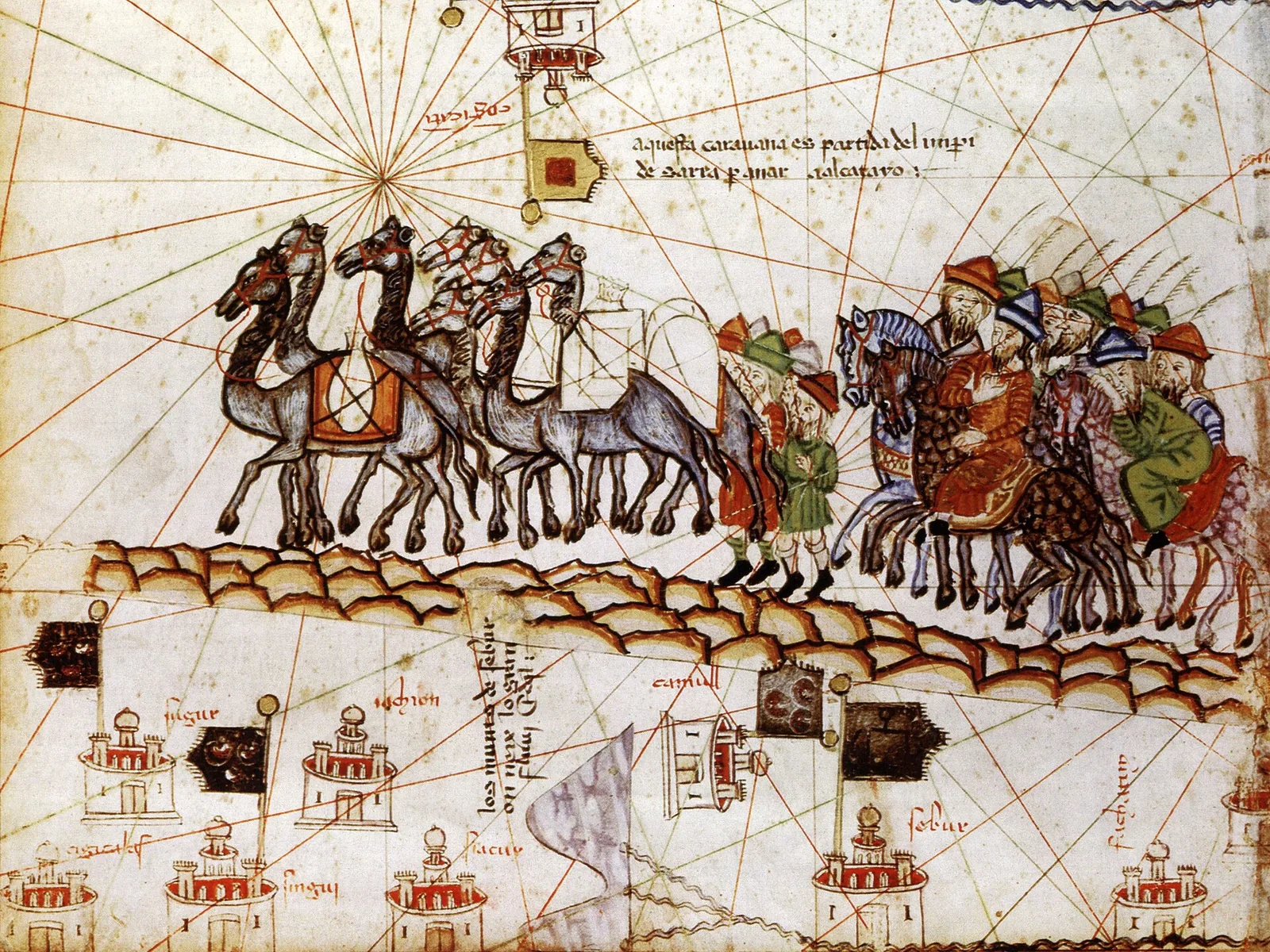
Catalan Atlas, sheet 10, 1375, by Abraham Cresques. Bibliothèque nationale de France, Paris · Public domain · Source page
Two brothers and a papal letter
A cell in Genoa, 1298
Genoa, 1298. In a prison cell sits a Venetian captive, about forty-four years old. He is telling a fellow prisoner from Pisa about the court of the Great Khan in China, about deserts, and about great cities that none of his listeners has seen.
By his own count he spent about twenty-six years in the East. How would anyone tell what he saw from what he was merely told?
Did he really reach China? Historians still argue about it. Let us begin where his story begins: in Constantinople, in 1260.
Background
Two brothers in Constantinople
In 1260 two brothers from Venice were in Constantinople: Niccolò Polo and his brother Maffeo. They were merchants, and they had brought goods and jewels to trade.
They decided to travel much farther east, into lands ruled by the Mongols. They crossed the Black Sea to Soldaia, today Sudak in Crimea, and kept going.
The Great Khan
A request from Kublai Khan
The two brothers reached the court of Kublai Khan, ruler of the Mongol Empire, which included China. Polo calls him the Great Khan.
He asked the Pope for as many as a hundred learned men, skilled in the seven liberal arts and able to prove to people of other faiths that the law of Christ was best. If they proved it, he said, he and all his people would become Christians. He also asked for oil from the lamp that burns over the Holy Sepulchre in Jerusalem.
The way back
Acre, 1269
It took years to get home. In 1269 they reached Acre, a port on the coast of the Holy Land, where Christian rulers still held a major city. There they met their friend Tedaldo Visconti, an archdeacon whom the book calls the legate of the Pope in Syria.
Then they went back to Venice. Niccolò found his son Marco, about fifteen years old, at home. In 1271 the three Polos set out again from Venice, with Marco, now about seventeen.
A decision point
You are Marco Polo, about seventeen, in Acre with your father Niccolò and your uncle Maffeo.
Acre, 1271
The Khan asked for a hundred learned men. Your friend Tedaldo Visconti has now been elected Pope, taking the name Gregory X, and he has sent his answer. But instead of a hundred scholars he can spare only two Dominican friars.
The friars are ready to set out with you. The road east is long and dangerous, and nobody has promised that they will last it. You have been away from home for years. You can go home to Venice with the answer, travel east with the friars, or go east without them.
What do you do?
- Go home to Venice with the answer and give up the journey. Probably you return home safely. There is no road to the Khan’s court, no years in his service, and no book. Trade carries on as before.
- Set out east with the two Dominican friars, as the Pope intended. Probably a slow and wearing start, with two friars who may not have the stomach for the road. If they turn back, you will have to decide again, alone.
- Set out east with the answer, even if the friars refuse to come. Probably the Khan receives the Pope’s answer, but without the scholars he asked for. You have already travelled east once, and he knows your family.
What really happened
Set out east with the two Dominican friars, as the Pope intended.
The three Venetians set out from Acre again, about November 1271, with the two friars. The friars lost heart and drew back after barely taking the first step. The Polos went on alone. Yule reconstructs their route through Persia, over the Pamir plateau and across the Gobi desert.
The book does not say why the friars turned back, or how the brothers felt about it. What is clear is that the Pope sent far fewer scholars than the Khan asked for, and that the Polos, who had already travelled east once, chose to go on.
Three and a half years on the road
The road
Through Persia and over the Pamir
The book says the three Venetians travelled for three and a half years. Yule, who edited the text, reconstructed the route. They probably went through northern Syria and Iraq to the Persian Gulf, meaning to continue by sea from Hormuz. Some obstacle stopped that, and they turned north.
They crossed Persia and the lands of today’s Afghanistan to the Pamir, the high plateau of central Asia. Then they went down to Kashgar, passed Yarkand and Khotan, crossed the Gobi desert, and followed the northern edge of China until they reached the Khan.
1275
Kai-ping fu, the summer court
They reached Kublai at his summer retreat, Kai-ping fu, north of the Great Wall, near the Khingan Mountains. The book’s timing puts their arrival at about May 1275. Yule’s note 15 gives an alternative date, half a year earlier, if the count starts from Venice instead of Acre.
Kublai, founder of the Yuan dynasty dynasty in China, received the Venetians warmly, and took a liking to young Marco, who was about twenty-one.
The result
A reply instead of scholars
The Polos could not bring the scholars. They brought a reply from the Pope, their years of travel, and a place in the Khan’s court. After a time, Kublai began to give Marco public work.
Messer Marco, the Khan’s man
Service
Languages and errands
Marco learned quickly. The book says he picked up several of the languages of the Mongol Empire.
Kublai began to send him out as an envoy: a year at Kan-chau in Tangut with his uncle Maffeo, a journey to Champa, and a mission to the Indian seas. The book gives few details of most of them.
The Khan’s taste
What the Khan liked to hear
Marco noticed something. Kublai loved to hear about strange countries, their marvels and their odd customs.
So Marco stored up every curious fact he came across, in his memory and in his notebooks, and told them with energy when he came back to court.
A decision point
You are Marco Polo, about twenty-three, in the Khan’s service.
The Khan’s court, about 1277
Kublai has a new task for you. The road to Vochan, on the frontier with Burma, runs south-west into the province of Yunnan, where Mongol armies had conquered part of the land years earlier. The road is long, mostly through mountains and tribal country, and takes about half a year with the halts.
The Khan knows you, and he trusts you. Nobody has told you how long you will be away. To accept means months away from court. To refuse means disappointing the Khan.
What do you do?
- Accept the mission and set out south-west. Probably a long, dangerous journey through mountains and tribal country, months away from court. If it goes well, the Khan trusts you more and your family’s standing rises.
- Ask leave to go home to Venice instead. The Khan values the Polos’ service, so the request would probably be refused. It might also cost you his favour.
- Ask that your father or your uncle go in your place. The Khan may agree, but he could read the request as reluctance. Probably the errand would pass to your father or uncle, and your name would suffer at court.
What really happened
Accept the mission and set out south-west.
The book says Marco went. Yule places the journey between 1277 and 1280. The earlier limit comes from Polo’s own account of a battle with the Burmese near Vochan, which the Chinese annals date to 1277. The later limit comes from a prince, Mangalai, who is said to govern Kenjanfu and who died in 1280.
By the book’s itinerary, the road to Vochan is about 147 days’ journey, which with the halts might be six months.
The book does not say why Marco accepted. One guess is that he had learned how much the Khan enjoyed tales of far countries, and that a long journey through unknown provinces gave him more to tell. No document says so.
Source: A Chinese record of 1277 that may name ‘Polo’
The record says that “a certain Polo was nominated a second-class commissioner or agent attached to the Privy Council.”
We know this record only through Pauthier’s reading of the Chinese annals, as Yule reports it. It names only ‘Polo’. Yule was willing to believe it referred to Marco. Other scholars dispute this, and the Chinese original is not printed in the sources used for this lesson.
- Who read the Chinese record, and how did it reach us? Pauthier, a French scholar, read the annals and wrote about them in French. Yule then quoted him in English. The record passed through two languages before it reached this lesson.
- What does the record say about Marco, and what does it leave out? It names a man called only ‘Polo’, who held a second-class post in 1277. It does not say that he came from Venice, or that he was Marco. The name is the only link.
- Why might a scholar want this record to be about Marco? Because it would support the book at a point where the evidence is thin. A careful reader asks how far a wish to find the traveller shapes the reading of a short, unclear record.
A claim in the book
Three years in Yangzhou
The book makes one more claim: that Marco governed the great city of Yangzhou for three full years, by order of the Great Khan. Cordier, who edited the 1903 text, quotes the sentence in a note: “And Messer Marco Polo himself, of whom this Book speaks, did govern this city (Yanju) for three full years, by the order of the Great Kaan.”
Cordier thinks the claim is hardly possible, and Yule also doubts it. The sources this lesson uses contain no independent record of the post.
The princess and the journey
The bride
A bride for the Persian Khan
Arghun Khan, the Mongol ruler of Persia and a grandson of Kublai’s brother, needed a bride. Envoys went to Kublai’s court at Khanbaliq, today’s Beijing, to find one.
The choice fell on the lady Kokachin, “a maiden of 17”. The French of the source calls her “moult bele dame et avenant”, very beautiful and charming.
The road
A request from the bride’s envoys
The Polos had wanted to go home for years, but the old Kaan rejected every hint. Then the bride’s envoys made a request. The overland road from Peking to Tabriz was very long for such a journey, and it ran through lands at war. The envoys wanted to go by sea. The Mongols were strangers to all navigation, and the envoys, impressed by the Venetians and eager to use their experience, asked the Khan to send the three of them too.
The Khan agreed, reluctantly. He equipped the party generously and sent friendly messages to the rulers of Europe, including the King of England.
A decision point
You are Marco Polo, in your late thirties, at the port of Zayton (Quanzhou) on the coast of China, with your father and uncle.
Zayton, January 1292
The envoys are ready to sail with the princess, who is seventeen. Three options lie before you.
The overland road is long and runs through war zones. The sea road is new to the Mongols, most of whom are not sailors. The envoys asked you to come, and the Khan agreed, though he was not pleased. If you stay at court, the envoys will sail without you.
What do you do?
- Take the overland road with the envoys. Probably a very long journey, months through lands where armies are fighting. The danger comes from the war, not from the sea.
- Take the sea road with the envoys and the princess. Probably faster on paper, but a long voyage through unknown waters, with a party that is mostly not sailors. Sickness, storms and long waits in port are likely. Whether you arrive depends on the wind.
- Refuse, and stay at the Khan’s court. Probably the Khan’s displeasure, since he has already agreed with reluctance. The envoys would sail without you, and your family would lose its chance to go home with the Khan’s blessing.
What really happened
Take the sea road with the envoys and the princess.
They sailed by sea from Zayton in January 1292. The ships spent a long time at Sumatra, waiting out the monsoon, and long delays followed on the coasts of South India. Most of the party died on the way.
Yule’s French text says there were 600 people, of whom only eight survived. An older manuscript gives eighteen, probably also survivors. The two manuscripts disagree, so the exact numbers are uncertain. The princess and the three Venetians came through, and it took about two years to reach Persia.
The envoys wanted sailors and the Venetians’ experience. The Polos had wanted to go home for years, and the escort gave them a way home with the Khan’s blessing. The book does not say how they weighed the danger of the sea. This lesson’s reading is that their long wish to go home may have been the strongest pull, but the book does not say so.
Persia
The princess arrives
Arghun had died before the party left China, and the princess married his son Ghazan.
The road home
Back to Venice
The Venetians reached Tabriz, and then travelled home by Trebizond and the Bosphorus. The text gives 1295 as the year they reached Venice. Yule (note 22) prefers 1296, which would fit better with the twenty-six years the Prologue gives for the travels.
Source: Yule’s note on the dates
“All dates are found so corrupt that even in this one I do not feel absolute confidence.”
A note by the 19th-century editor on the dates he prints. The book dates Ghazan’s accession to 1294, though it happened in October 1295. Yule also notes that a return in 1296 would fit the twenty-six years of absence better.
- Who is doubting the dates here, and why does it matter that he prints them anyway? Yule, the editor, prints the book’s dates and then questions them. A modern reader can use the book’s words and still refuse to trust its chronology.
- What else could explain a wrong date? A copyist’s mistake, or memory of years spent far away with no calendar to check against. Yule does not say which it is, and neither does this lesson.
- Does a wrong date make the whole book wrong? No. A date can be wrong while the places, roads and customs are right. Each claim has to be checked on its own.
The prisoner of Genoa
War at sea
The battle of Curzola
Venice and Genoa were rivals at sea. In 1298 a Venetian fleet met a Genoese fleet off the island of Curzola, on the Adriatic coast of Dalmatia, today in Croatia. Both fleets were made up of galleys, the main warships of the day.
The book says that Marco Polo was taken prisoner in this battle and held in Genoa afterwards. How do we know? The next steps ask that question.
The date
7 September 1298
The Genoese inscription on the church of San Matteo in Genoa gives the date as 7 September, and a Genoese poet says the battle was on a Sunday. In 1298, under the Julian calendar then in use, 7 September fell on a Sunday. That is 14 September by our reckoning.
The capture
Was he captured there?
The book says Marco was taken prisoner at Curzola. No document from the time confirms it, though Yule considers the capture all but certain.
A rival text claims a capture at the battle of Ayas in May 1294. Yule rejects this, because Polo did not reach Venice until 1295.
The prison
A cell with Rusticiano
Rusticiano of Pisa was in the same Genoese prison, as the book’s Prologue says. Yule guesses that Rusticiano may have been a prisoner from the battle of Meloria, which Genoa won against Pisa. This is only a guess. Almost nothing is known of Rusticiano beyond the book.
A decision point
You are Marco Polo, a prisoner in Genoa, with Rusticiano of Pisa, also a prisoner, on the bench beside you.
Genoa, 1298
By your own count you have spent about twenty-six years in the East: in the Khan’s China, in Persia, on the seas, and in India. Your listeners will be merchants and nobles, and many of them have never been further than the next town.
Rusticiano offers to write everything down. But you know that some of what you have to tell you saw yourself, and some you were told by others, at court, in markets, and on ships. Whatever you say will be copied again and again, by hands you will never see.
What do you tell him to write?
- Only what you saw with your own eyes. A short, sober book. Readers would trust it, but would know less: the cities and rulers you only heard about would be lost.
- What you saw, and what men you trusted told you, with the difference marked. A fuller book, and more honest about its gaps. The risk is that the marks are lost in copying, and readers take every line as an eyewitness account.
- Everything, including the most marvellous stories, because wonders sell. Probably a popular book, and the most dazzling passages would be copied most. But no reader could tell the true from the invented, and your word would count for less.
What really happened
What you saw, and what men you trusted told you, with the difference marked.
He chose the middle road. The book’s Prologue says that some things he beheld himself and others he heard from men of credit and veracity, and it marks the difference between them. Rusticiano wrote the whole down in 1298, in the Genoese prison.
The Prologue wants its readers to trust the book. Naming men of credit and veracity is one way to earn that trust, and separating seen from heard is another.
Source: The Prologue, 1298
“Some things indeed there be therein which he beheld not; but these he heard from men of credit and veracity.”
“…he caused Messer Rusticiano of Pisa, who was in the said Prison likewise, to reduce the whole to writing; and this befell in the year 1298 from the birth of Jesus.”
A preface, not a letter from an eyewitness. It states the book’s aim and its method, and it was written by the people who made the book, in the same prison. Its promises are claims that a reader has to test.
- Who speaks in this preface, and who is named as the writer? The preface speaks of Marco in the third person. It names Rusticiano as the man who wrote the account down. The voice is that of the book’s makers, not of a single named eyewitness.
- What does the preface promise, and how does it try to win trust? It promises to separate what was seen from what was heard, and it stresses the men of credit and veracity who told him the rest. Naming trusted witnesses is a way of earning belief.
- What is still missing? The preface does not name the witnesses, and it does not say which passage came from which source. A promise to separate seen from heard is not the same as doing it. The reader has to check the book’s contents for themselves.
Release
Peace in 1299
Peace between Venice and Genoa was signed on 25 May 1299. The doge of Venice ratified it on 1 July. Yule infers that Polo was back at his house in Venice by the end of August 1299, and that his captivity had ended.
Il Milione
Copies
A book copied many times
The book was copied by hand, in French, Italian and Latin, and each copy changed a little. Yule translated from a French text. One of the main early versions is a Latin one by Francesco Pipino, a contemporary of Polo, according to Yule. In the 16th century the Venetian editor Ramusio published a version of his own.
1311
A merchant, not only a traveller
In 1311 Polo sued an agent in Venice’s Court of Requests, over a pound and a half of musk that he had entrusted to him.
In Yule’s account (section 46) he appears as a merchant as well as a traveller.
Columbus
Notes in the margin, in Seville
Christopher Columbus read Polo too. A printed copy of Pipino’s Latin text, with the admiral’s marginal notes, is kept in the Biblioteca Colombina in Seville, Cordier reports.
The editors’ notes suggest that Columbus knew Polo mainly at second hand, through letters from a Florentine scholar. “I cannot find that he ever refers to Polo by name,” one editor’s note says.
The nickname
Il Milione
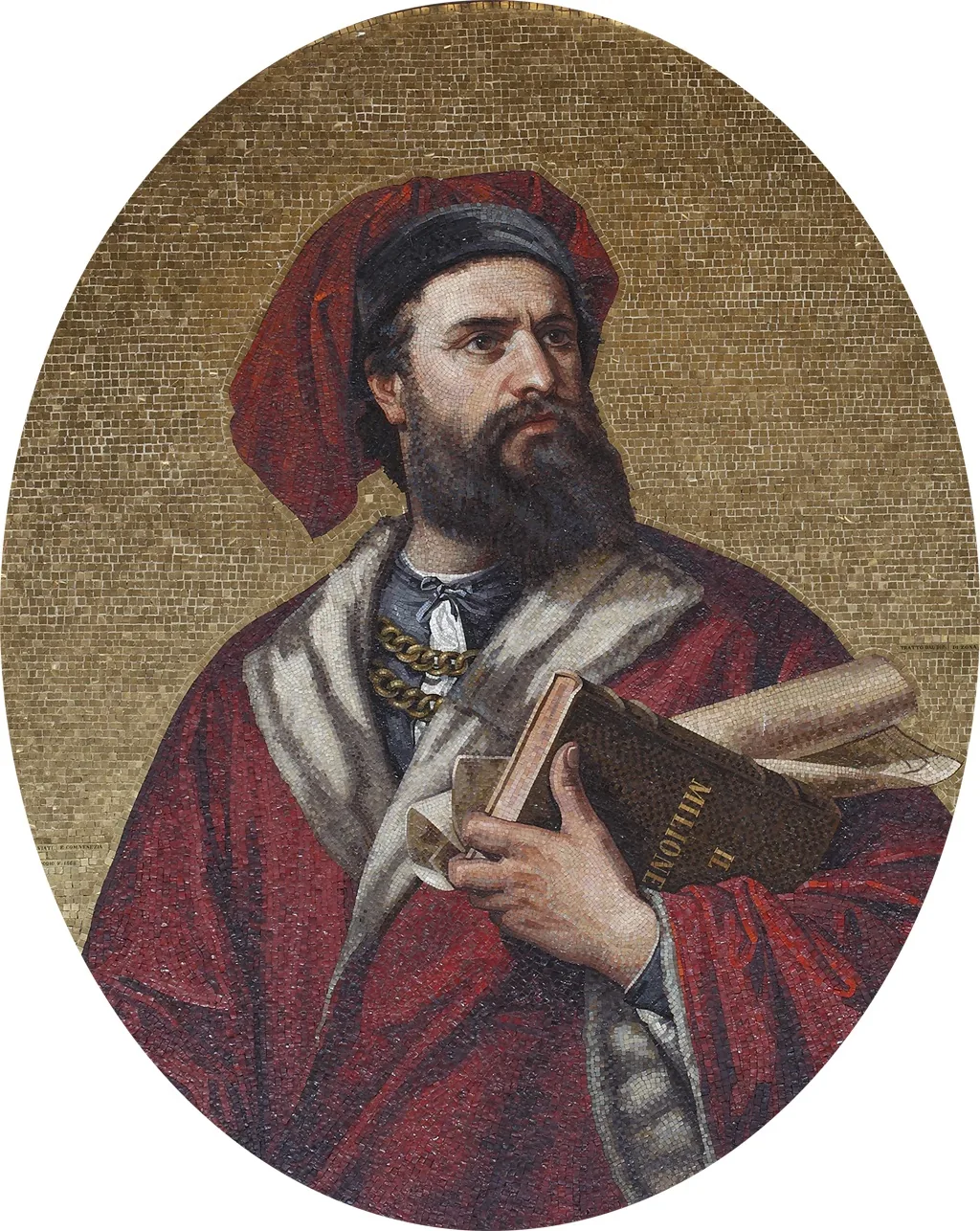
Marco Polo mosaic, Palazzo Tursi, Genoa, 1867. Salviati workshop · Public domain · Source page
Polo, his house and his book all acquired the nickname Il Milione, “the Million”. In Genoa, in the Palazzo Tursi, the town hall, a mosaic made in 1867 shows Polo holding a book with that title on its spine. It is an imagined portrait, made more than five centuries after his death.
What does the nickname mean? As with most questions of this kind, the answer has to be tested.
Myth
Il Milione means the family’s fortune: they came home with a million.
The truth
That is one explanation, and it is not proved. Fra Jacopo d’Acqui put it down to the family’s wealth, and later writers such as Sansovino and Barbaro repeated it. Fontanini suggested the name refers to the book’s many stories. The origin is not settled.
The evidence
The nickname is documented, and Yule accepts that it existed (section 44).
Source: The Ca’ Million story, 1566
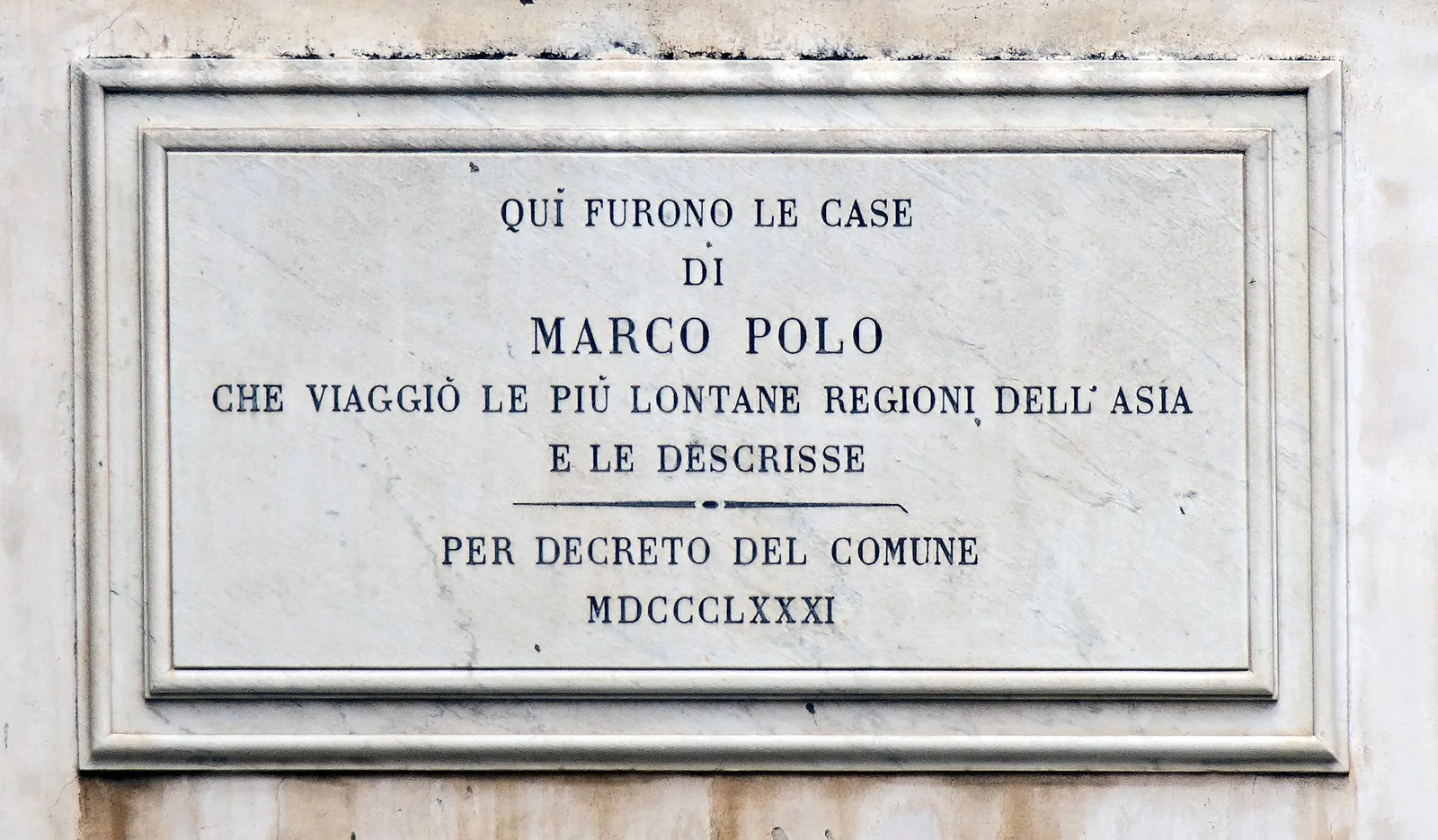
Memorial plaque on the site of the old Casa Polo, Venice. Photo: Didier Descouens, 2015 · CC BY-SA 4.0 · Source page
“the family got among the vulgar the name of the Ca’ Million, because the report was that they had jewels to the value of a million of ducats.”
Barbaro wrote more than 240 years after Polo’s death. He tells a family story, passed on by word of mouth, which explains the name of a palace. It is a folk tale: an old coat with jewels sewn into it, a beggar, and a man who turns a wheel on the Rialto Bridge to draw the coat back. It is no evidence for where the nickname came from.
- Who wrote this, and when? How long after Polo’s death? Marco Barbaro, a Venetian writing in 1566, more than 240 years after Polo died in 1324.
- What does the story add to the nickname, and what does it not prove? It adds a palace and a legend of jewels in a coat. It is a folk story that explains a building’s name, not the origin of a nickname: there is no record from the time.
- Why would a family history prefer a story about jewels? Families like to tell stories that honour their past. A tale that makes the ancestors rich and clever explains why it was kept, whether or not it happened.
The will
The last years
In 1324 Polo was ill. He sent for a notary to make his will. The will is dated 1323 in the Venetian style, which is January 1324 by our reckoning. Yule gives 9 January 1324.
We do not know the day he died.
What happened, and when
- 1260 Niccolò and Maffeo Polo are in Constantinople, and their journey east begins.
- 1271 The three Polos set out again, and the friars turn back at the first step.
- 1275 About May: they reach Kublai at Kai-ping fu, if the three and a half years are right.
- 1292 January 1292: they sail from Zayton with the princess. Of 600 people, only eight survive, according to the French text.
- 1295 Return to Venice: the text says 1295; Yule prefers 1296.
- 1298 7 September: battle of Curzola. Marco is taken, by the book’s account, and held in Genoa, where the book is dictated.
- 1299 25 May: peace between Venice and Genoa. By late August Polo is home, Yule infers.
- 1311 1311: a Venice court case over musk entrusted to an agent.
- 1324 In January 1324 Polo makes his will before a notary. He died that year.
Did he reach China?
Silences
What the book leaves out
Yule’s strongest point is about what the book leaves out. On the Wall he writes: “The Great Wall is never mentioned, though we have shown reason for believing that it was in his mind when one passage of his book was dictated.” On tea: “The use of Tea, though he travelled through the Tea districts of Fo-kien, is never mentioned.”
Foot-binding is not in Polo either. Yule notes that Friar Odoric mentions the women’s compressed feet. The Wall that visitors see today is mostly Ming work, built much later than Polo’s time.
Did he reach China?
Did Marco Polo reach China, or did he write from what he heard?
- Frances Wood (1995): probably not Wood, a historian of China, argues that Polo probably never got as far as China, and may not have gone beyond the Black Sea or Persia. Her case rests on silence: no Great Wall, no tea, no foot-binding, no Chinese writing, and no clear Chinese record naming him. She disputes the 1277 entry.
- Stephen G. Haw (2006): yes, he went Haw’s book is titled Marco Polo’s China. He argues that the accuracy of Polo’s detail shows he was there, and that the silences have answers.
- Hans Ulrich Vogel (2012/13): yes, and the paper money supports it Vogel, a sinologist at Tübingen, titled his book Marco Polo Was in China, with the subtitle New Evidence from Currencies, Salts and Revenues. He argues that Polo’s account of paper money, salt and revenue matches Chinese records.
What evidence would settle it? A Chinese record that names Marco in a clear post? A Persian or Italian witness? Or is the question too big for any single document? Decide what would count as proof, then test each side against that standard.
Myth
Marco Polo brought pasta from China to Italy.
The truth
Almost certainly false. Pasta was made and eaten around the Mediterranean before Polo’s time. Some food historians point to the Arab geographer al-Idrisi, who wrote in 1154 for the Norman king Roger II of Sicily and described a dried pasta called itriyya, made in Sicily and exported. That is about a century before Polo was born.
The evidence
According to a 2019 article in Lapham’s Quarterly by Diego Zancani, the famous version was probably invented by the Macaroni National Manufacturers Association in the late 1920s, and the article dismisses it as false. Even if Polo ate noodles in China, that would not prove he brought pasta to Italy.
Check yourself
In which year were the Polo brothers in Constantinople, when their first journey began?
Answer: 1260. Right. The first chapter of the book places the two brothers in Constantinople in 1260, when their first journey began.
Check yourself
Which pope answered Kublai’s request with only two Dominican friars?
Answer: Gregory X. Right. Their friend Tedaldo Visconti was elected Pope and took the name Gregory X.
Check yourself
What did Kublai ask the envoys to bring back from Jerusalem?
Answer: Oil from the lamp on the Holy Sepulchre. Right. The book has Kublai ask for oil from the lamp burning on the Holy Sepulchre at Jerusalem.
Check yourself
How old was Kokachin, the princess, when she was chosen as Arghun’s bride?
Answer: Seventeen. Right. Yule translates the French as ‘a maiden of 17’.
Check yourself
In which year does the Prologue date the dictation in the Genoese prison?
Answer: 1298. Right. The Prologue says the dictation took place in the year 1298.
Check yourself
Does Polo mention tea in his book?
Answer: No, it is never mentioned. Right. Yule notes that tea is never mentioned, even though Polo travelled through the tea districts of Fujian.
Terms
- Great Khan The title Polo gives to Kublai Khan, ruler of the Mongol Empire, which included China.
- Yuan dynasty The dynasty Kublai founded in China. It ruled from 1271 to 1368.
- legate A papal envoy, sent abroad with the Pope’s authority.
- envoy A person sent to carry a message or a request from one ruler to another.
- Dominican A friar of the Dominican order, a preaching order founded in 1216.
- galley A long, low warship, driven by oars and a sail, the main battleship of Mediterranean fleets in Polo’s day.
- notary An official who drew up and certified legal documents, such as wills and contracts.
- marginalia Notes a reader writes in the margins of a book.
- Venetian style Venice began its year on 1 March, so a January date carried the previous year’s number. January 1323 in Venice is January 1324 in ours.
- monsoon A seasonal wind that blows one way for half the year and the other way for the rest. Ships in the Indian Ocean depend on it.
- Constantinople A great city on the border of Europe and Asia, capital of the Byzantine Empire. The two brothers from Venice stayed there before heading east.
- Mongols A people from central Asia who built a huge empire. China was part of it.
- Crimea A peninsula on the Black Sea. The city of Soldaia lies there.
- Soldaia A city in Crimea, on the Black Sea. Today it is called Sudak.
- Black Sea A sea between Europe and Asia. The two Venetians crossed it on their way east.
- Kublai Khan Ruler of the Mongol Empire, which included China. He founded the Yuan dynasty and received the Venetians warmly.
- Gregory X The pope who took the name Gregory X. He was Tedaldo Visconti, the Polos’ friend.
- Pope The head of the Catholic Church. The Khan asked him for a hundred learned men, and he sent two friars.
- Archdeacon A senior church official, above ordinary priests. Tedaldo Visconti was an archdeacon.
- Tedaldo Visconti A friend of the Polos, an archdeacon who represented the Pope in Syria. He was later elected pope.
- the seven liberal arts The seven subjects that formed the basis of education in medieval Europe, such as grammar, logic and music.
- Holy Sepulchre The tomb in Jerusalem where, according to tradition, Jesus was buried. A lamp burns above it.
- Zayton A port in China from which the mission sailed. The sea voyage to Persia was long and dangerous.
- Sumatra A large island, today part of Indonesia, where the envoys waited for the monsoon.
- Tabriz A city in Persia, today in Iran, where the Venetians arrived at the end of their journey.
- Khanbaliq The name of Beijing in Kublai’s day, the city of the Khan’s court.
- Kokachin A young princess from the Khan’s court, chosen to be the bride of Arghun Khan. After his death she married his son Ghazan.
- Ghazan Son of Arghun Khan, who became the Mongol ruler of Persia. He married the princess Kokachin.
- Curzola An island off the Dalmatian coast in the Adriatic. In 1298 a Venetian and a Genoese fleet met there.
- Il Milione The nickname of Polo, his house and his book. It means the Million, and its origin is not settled.
- Rusticiano A prisoner from Pisa who wrote down Polo’s stories in a Genoese prison.
- Ming dynasty The Chinese dynasty that ruled from 1368 to 1644, after the Yuan. Most of the Great Wall visitors see was built under it.
- Christopher Columbus The explorer who read Polo in a Latin copy with his own notes. He knew Polo mainly at second hand.
- Yunnan A province in south-west China, part of which Mongol armies had conquered years earlier.
- Francesco Pipino A writer who translated Polo’s book into Latin. According to Yule, he was Polo’s contemporary.
Sources
- Henry Yule and Henri Cordier, The Book of Ser Marco Polo, the Venetian (3rd ed., 1903), vol. 1: Prologue, Book I and the notes, cited by section and note number
- Marco Barbaro, Genealogies of the Venetian families (manuscript, Museo Civico, Venice, 1566), as quoted in Yule and Cordier, note 23
- G. Pauthier’s reading of the Chinese annals of the Mongol dynasty, as quoted in Yule and Cordier, section 20 and note 16
- Muhammad al-Idrisi, Nuzhat al-mushtaq (1154), as described in later histories of pasta; the Arabic text was not consulted for this lesson
- Frances Wood, Did Marco Polo Go to China? (1995)
- Stephen G. Haw, Marco Polo’s China: A Venetian in the Realm of Khubilai Khan (Routledge, 2006)
- Hans Ulrich Vogel, Marco Polo Was in China: New Evidence from Currencies, Salts and Revenues (Brill, 2012; many citations give 2013)
- Secondary food-history accounts of the Polo pasta legend (a 1929 story in a trade magazine for American pasta makers); the original magazine was not consulted
Image credits
- Catalan Atlas, sheet 10, 1375, by Abraham Cresques. Bibliothèque nationale de France, Paris · Public domain · Source page
- Marco Polo mosaic, Palazzo Tursi, Genoa, 1867. Salviati workshop · Public domain · Source page
- Memorial plaque on the site of the old Casa Polo, Venice. Photo: Didier Descouens, 2015 · CC BY-SA 4.0 · Source page


