Marathon: the first Persian invasion
About ten thousand Athenians, no cavalry, no allies but Plataea, and the largest empire on Earth on the beach.
Decisions, questions and your own progress, in the app
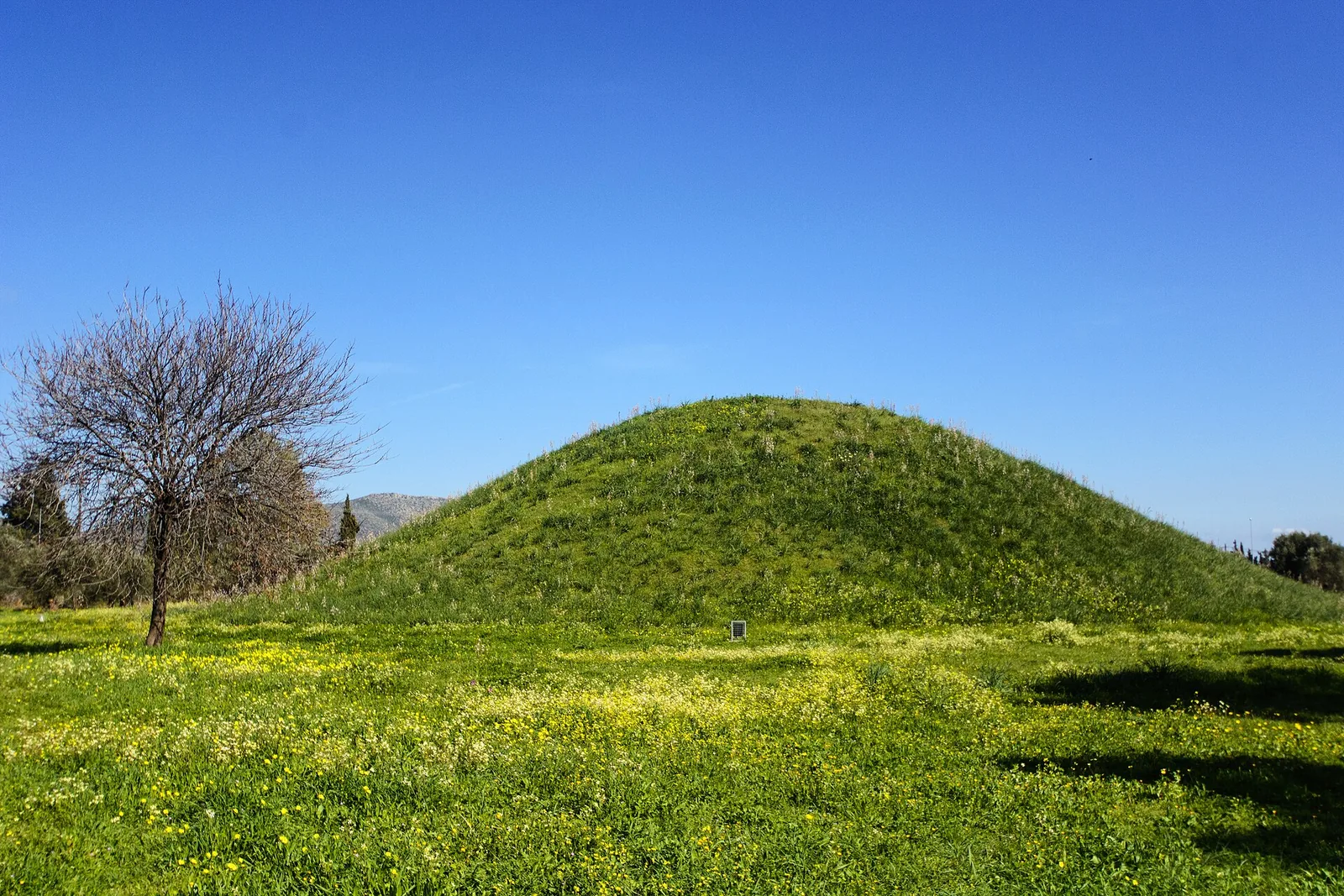
The Soros, the Athenians’ burial mound at Marathon, 2016. Photo: George Fournaris · CC BY-SA 4.0 · Source page
The mound on the plain
192 names under a mound
A plain by the sea, about 40 kilometres by road north-east of Athens. In its southern part, about a kilometre from the beach, rises a grassy mound about nine metres high. Under it lie the ashes of 192 Athenians, burned and buried where they fell, late in the summer of 490 BC.
That morning an army of citizens, with no cavalry and no archers, ran at the soldiers of the largest empire on Earth, and won. For centuries Athenians remembered it as their finest hour. The marathon race is named after it, though the famous runner’s story is probably not true.
How did it happen? And how much of what you have heard about it really happened?
Our witness
One storyteller
Almost everything we know about Marathon comes from one man: Herodotus. He was born in Halicarnassus, a Greek city under Persian rule, about six years after the battle, and wrote his Histories some fifty to sixty years after it. He talked to old soldiers and to the families of the generals.
No Persian text mentions Marathon at all. So we hear the story only from the winners, and mostly from one of them. Keep that in mind, and at every turn ask: how did he know?
Fire at Sardis
Background
The king of kings and a small city
Thirty years after Cyrus the Great died, his empire belonged to Darius I. It ran from the Aegean Sea to the river Indus, and its governors, the satraps, collected tribute from dozens of peoples. On its western edge lived the Greeks of Ionia, on the coast of what is now Turkey, conquered for Cyrus half a century before.
Across the sea stood Athens, a city of perhaps 30,000 citizens, with a brand-new democracy. Its last tyrant, Hippias, had been driven out in 510 BC and had gone to the Persian court. In 507 BC Athenian envoys at Sardis, the seat of the Persian governor in the west, had even given the king earth and water to win an alliance; at home they were disowned.
Darius I
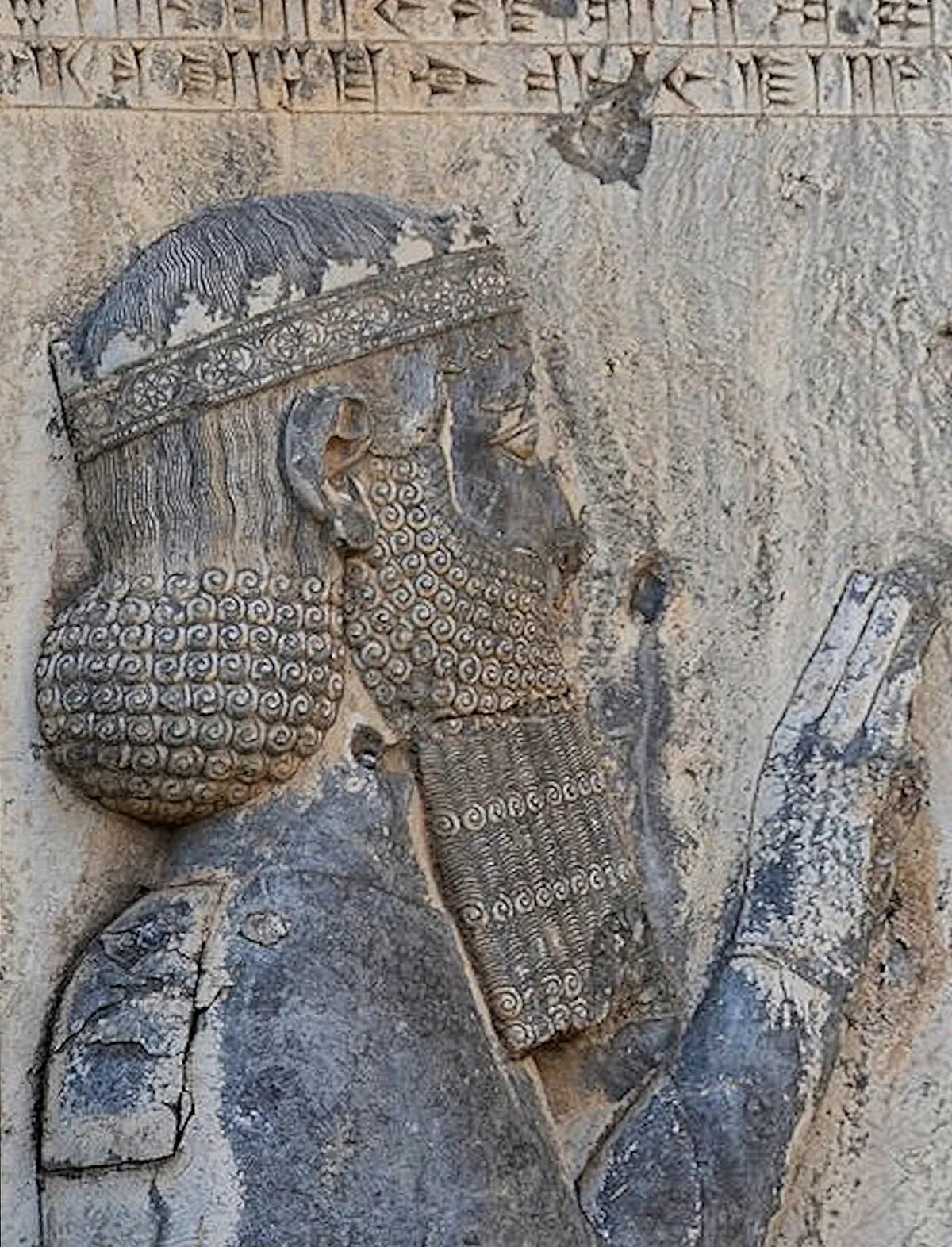
Darius I, detail of the relief at Behistun (Bisotun), Iran, about 520 BC. Photo: Leen van Dorp (Livius.org) · CC0 · Source page
The usurper who became the great organiser of the Persian Empire, and the king who sent the first army against Athens.
- Born: c. 550 BC, Persia; son of Hystaspes, of the Achaemenid clan
- Died: 486 BC, Persia; buried in a rock-cut tomb at Naqsh-e Rustam, a natural death, while preparing a new war on Greece
- Won: The revolts of 522–519 BC crushed; The Ionian Revolt crushed, 494 BC
- Lost: The Scythian campaign, c. 513 BC (no victory); Marathon, 490 BC (his generals were beaten)
“I am Darius, the great king, the king of kings, the king of Persia, the king of the provinces, the son of Hystaspes, the grandson of Arsames, the Achaemenian.”
A decision point
You are citizens of Athens, voting in the assembly.
499 BC, in Athens
A visitor from Miletus, the richest city in Ionia, stands before you. His name is Aristagoras. The Ionian cities have risen against Persia, and he has come for help. Sparta has already turned him away.
He says the Persians fight without shields or spears and will be easy to beat. He reminds you that Athenians founded Miletus. And he talks of the riches of Asia.
Persia is enormous. But its governor at Sardis has already ordered you to take back the tyrant Hippias, and you refused. In Persian eyes you are rebels already. If Ionia falls, who is next?
How do you vote?
- Send a fleet to help the rebels You strike at Persia far from home while it is busy, and win friends across the Aegean. But you make an enemy of the Great King, and a small fleet may not be enough to decide the war.
- Refuse, as Sparta did: Ionia is far away Persia has no new grievance against you. But Hippias is still at the governor’s side, and once Ionia is crushed, Persia will be free to look west, towards you.
- Send envoys to Sardis again and try to make a deal Peace might be bought. But the price is probably Hippias back in Athens, and the end of your young democracy.
What really happened
Send a fleet to help the rebels
The assembly voted to send 20 ships. Eretria, on the island of Euboea, sent five more. In 498 BC the Athenians and Ionians marched inland and took Sardis, all but its citadel. Fire spread through the reed-roofed houses and burned the temple of the goddess Cybebe.
On the way back they were beaten near Ephesus. The Athenians sailed home and did not return. The revolt went on without them.
Herodotus mocks the vote: “it is easier to deceive many than one”, since Aristagoras could not fool one Spartan king but fooled 30,000 Athenians. He calls those ships “the beginning of troubles for Greeks and foreigners”.
Many historians are kinder: Athens was already Persia’s enemy over Hippias. The real mistake may have been going home after a year, angering Persia without helping Ionia win.
498–494 BC
“Remember the Athenians”
353 against 600
When Darius heard that Sardis had burned, Herodotus says, he asked who the Athenians were. Then he shot an arrow into the sky, asked Zeus for vengeance, and ordered a servant to say to him three times at every dinner: “Master, remember the Athenians.”
It is a Greek story; no Persian source mentions Athens. But the revenge was real. In 494 BC the Persian fleet met the rebel fleet off the island of Lade, near Miletus: in Herodotus’s figures, 353 Greek ships against 600. Persian agents had promised pardon to any city that deserted, and the Samians and Lesbians sailed away. The rest fought and were beaten.
Miletus was stormed. Most of its men were killed, and its women and children were deported to the far end of the empire, on the Persian Gulf. In Athens a play called The Fall of Miletus made the whole audience weep, and its author, Phrynichus, was fined for reminding Athens of a disaster so close to home.
The fleet comes
492–491 BC
A storm, and heralds in a pit
In 492 BC Darius sent his young son-in-law Mardonius west. Eretria and Athens were the avowed goal, Herodotus says, but the real aim was to subdue as many Greek cities as possible. Thasos and Macedon submitted, but off Mount Athos, at the tip of a rocky peninsula in northern Greece, a gale wrecked the fleet. Herodotus repeats a report of 300 ships and more than 20,000 men lost. Mardonius turned back.
The next year Darius sent heralds around Greece to demand earth and water. Many islands gave it, and so did Aegina, Athens’ neighbour and rival. Athens threw the heralds into a pit used for executing criminals; Sparta threw its heralds into a well. Killing a herald was sacrilege. Now there was no way back.
Spring–summer 490 BC
Datis sails
In 490 BC a new fleet crossed the Aegean, carrying an army and, on special transports, its horses. Its commanders were Datis, a Mede, and Artaphernes, the king’s nephew. Their orders, Herodotus says, were to enslave Athens and Eretria and bring the captives before the king. Herodotus gives 600 triremes; it is his usual round figure for a great fleet.
They burned Naxos, whose people fled to the hills. At Delos, the sacred island of Apollo, Datis made offerings instead. Then they landed at Eretria. The walls held for six days; on the seventh, two leading citizens opened the gates. The temples were burned in revenge for Sardis, and the people were carried off.
Marathon
Guided by Hippias
From Eretria the fleet crossed to the bay of Marathon, on the coast of Attica, 40 kilometres from Athens. Their guide was Hippias, the old tyrant, now about 80. His father had landed on this same beach more than fifty years before, on his way to seize power. Herodotus says they chose Marathon as “the fittest part of Attica for horsemen to ride over, and nearest to Eretria”.
The bay offered a sheltered beach, fresh water and open ground, and Hippias hoped his friends inside Athens would rise. Herodotus tells how, as the old man came ashore, he sneezed and coughed so hard that a loose tooth flew into the sand, and he could not find it. “This land is none of ours,” he groaned. The only share of it he would ever have, he said, was the spot where his tooth lay.
Athens asks for help
A runner to Sparta
Athens’ ten generals marched out with the army, about 9,000 to 10,000 hoplites. Before they left, they sent a professional long-distance runner, Pheidippides, to Sparta, about 240 kilometres away. Herodotus says he arrived the next day. On a mountain pass on the way, he said, the god Pan called him by name.
The Spartans promised to come, but not yet: a religious law forbade them to march before the full moon, probably because of their festival, the Carneia. Meanwhile one small city did come. Plataea, Athens’ ally, sent its whole army, perhaps 600 to 1,000 men. No one else came.
The Athenians camped in a sanctuary of Heracles, probably at the southern end of the plain, where the road to Athens leaves it. The Persians camped by their ships in the north-east. For some days, neither side moved.
Miltiades
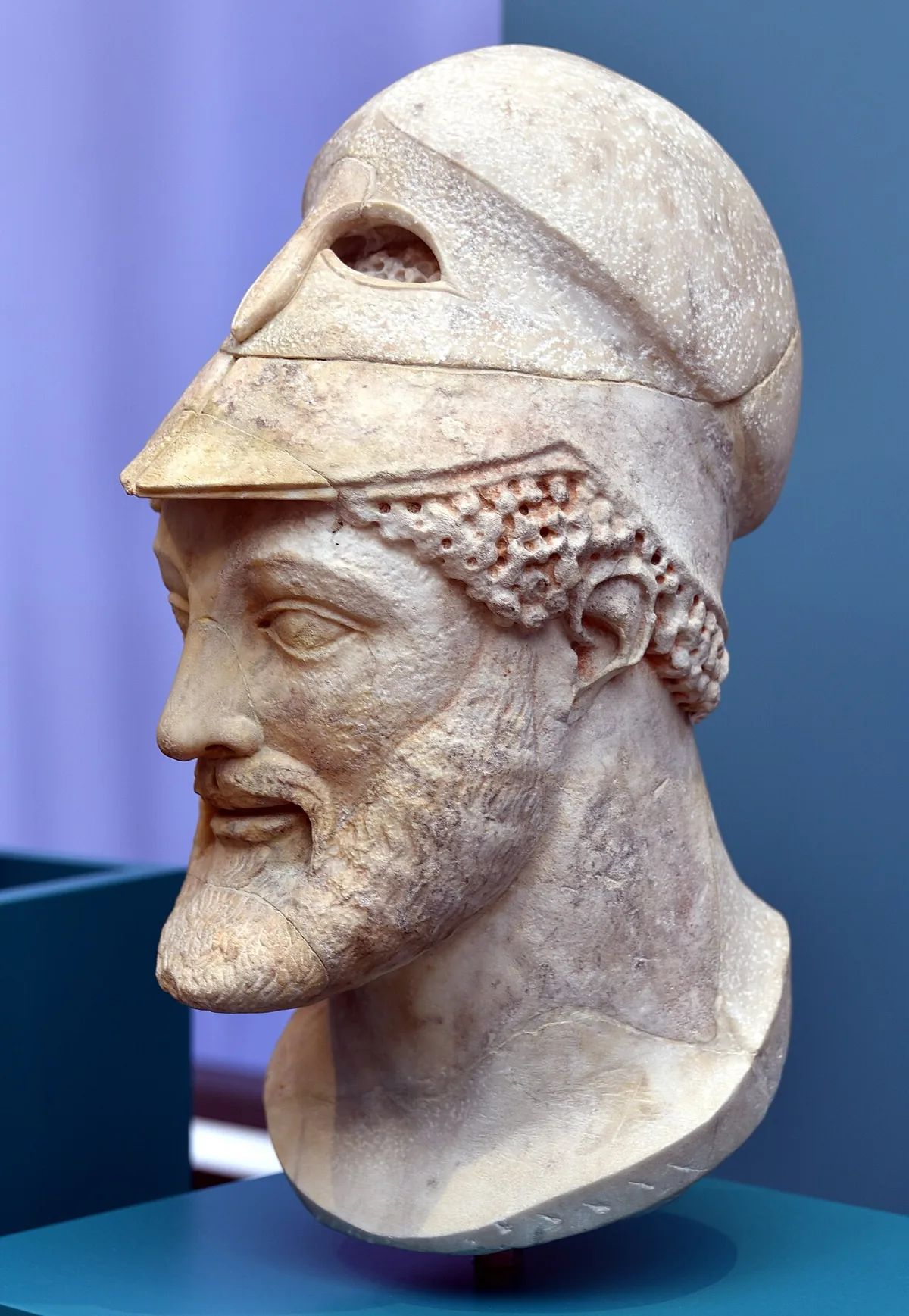
Head of a warrior, so-called Miltiades, Roman copy. Glyptothek, Munich (GL 172), photographed on loan in Berlin, 2019. Photo: Osama Shukir Muhammed Amin FRCP(Glasg) · CC BY-SA 4.0 · Source page
A Persian vassal who became the man who beat Persia, and died in disgrace a year later.
- Born: c. 555–550 BC, Athens, into the rich Philaid family
- Died: 489 BC, Athens, of gangrene from a leg wound, after a fine of 50 talents
- Won: Lemnos, taken for Athens; Marathon, 490 BC (with Callimachus)
- Lost: Flight from the Chersonese, 493 BC; The siege of Paros, 489 BC
“Callimachus, it is for you to-day to choose, whether you will enslave Athens, or free her…”
A decision point
You are Callimachus of Aphidna, the polemarch of Athens.
The plain of Marathon, August or September 490 BC
The ten generals are split down the middle. Five want to fight. The other five say the army is too small to take on the Medes and should wait. By old custom you hold an eleventh vote, and it decides.
You know what happened at Eretria: a week of siege, then traitors opened the gates. The Persians have more men, and archers and horsemen besides; you have neither. The Spartans have promised to come after the full moon. Your camp blocks the road to Athens.
Miltiades comes to you. If we wait, he says, some men’s courage will crack, and someone will go over to the Persians. If we fight now, Athens can become the first city in Greece.
How do you vote?
- Vote with Miltiades: fight soon The army keeps its nerve and the waiting ends. But you will fight a larger army, with archers and perhaps horsemen, on open ground and without the Spartans.
- Vote to wait for the Spartans In a few days you might have 2,000 Spartans beside you. But every day gives Hippias’ friends in the city time to act, and the Persians time to sail for Athens while you sit here.
- Fall back and defend the walls of Athens Behind walls the Persian horsemen are useless. But you abandon the countryside to be burned, and Eretria has just shown how a city under siege can be betrayed from within.
What really happened
Vote with Miltiades: fight soon
Callimachus voted to fight. Even so, Herodotus says, the battle did not come at once. Each general held the command for a day in turn, and the generals who sided with Miltiades handed him their days. He accepted them, but waited until his own day came round.
Herodotus wrote Miltiades a stirring speech, but the words are his own: no one took notes in the camp at Marathon. The fear in it was real, though: Herodotus insists that on the day of the battle someone did signal to the Persians. Callimachus probably agreed for the same reason: an army that waits can be betrayed.
Eight stades at a run
A decision point
You are Miltiades, a general of Athens.
The morning of the battle, 490 BC
Your day of command has come. Across the plain, about a kilometre and a half away, the Persian army is drawn up. You lived twenty years as Darius’s vassal, and you know how Persians fight: archers behind a wall of wicker shields, horsemen on the flanks, the best troops in the centre.
Their line is longer than yours. If you stand eight ranks deep all along, they will overlap your ends and get behind you. If you stretch your line to match theirs, you must weaken it somewhere.
How do you draw up the army?
- A short, deep line: eight ranks all along Your centre will be as strong as your wings. But the Persians will overlap both ends of your line and attack from the sides, where a phalanx cannot defend itself.
- A line as long as theirs: a thin centre and strong wings No one can get round you. But your centre, only a few ranks deep, faces the best Persian troops, and it may break.
- Stay in camp and make them come to you On the slopes by your camp, horsemen can do little. But the Persians do not have to attack you: they can board their ships and sail for Athens.
What really happened
A line as long as theirs: a thin centre and strong wings
Miltiades matched the Persian line. Callimachus led the right wing, the place of honour; the tribes stood side by side in order; the Plataeans held the left. In Herodotus’s words, the centre “was but a few ranks deep, and here the line was weakest, each wing being strong in numbers”. When the sacrifices gave good omens, the line charged at a run.
Herodotus says it “so fell out”: the thin centre was the result of matching the length, not necessarily a trap. Many historians think Miltiades knew exactly what he was doing; others think the brilliant plan was read into the result afterwards. Either way, the strong wings won the day.
Marathon: who fought whom
August or September 490 BC
The plain of Marathon, about 40 km from Athens
Athens and Plataea
- Commanders: Callimachus, the polemarch, Miltiades and nine other generals
- Strength: gives no figure (Herodotus); 10,000, including 1,000 Plataeans (Nepos (1st c. BC)); at most 9,000 Athenians, old men and slaves included (Pausanias (2nd c. AD)); about 9,000–10,000 hoplites, plus 600–1,000 Plataeans (Modern estimate)
- Losses: 192 Athenians; Plataeans and slaves not counted (Herodotus)
The Persian Empire’s army
- Commanders: Datis the Mede, Artaphernes, the king’s nephew, Hippias, as guide
- Strength: 600 triremes; no figure for the army (Herodotus); 500,000 (Plato and Lysias (4th c. BC)); 200,000 foot, 10,000 horse (Nepos (1st c. BC)); 600,000 (Justin (Roman era)); about 15,000–30,000 fighting men (Modern estimates)
- Losses: about 6,400 dead and seven ships (Herodotus)
No Persian source mentions the battle.
Outcome: An Athenian victory. The Persian fleet sailed round Cape Sounion for Athens, found the Athenian army already back, and returned to Asia.
The huge Persian figures appear only in writers who lived generations after the battle, and they disagree; Herodotus, the earliest, gives none. Ships set the limit: even Herodotus’s 600 could carry perhaps 20,000 to 30,000 soldiers with their horses.
The battle of Marathon
490 BC, one morning, after some days of waiting
The Persian army has landed in the bay of Marathon, about 40 km from Athens by road. Facing it are the Athenians and Plataeans, a smaller army of heavy foot soldiers. After some days of waiting, the two armies draw up across the plain.
One reconstruction, after Herodotus 6.102–117 and Pausanias 1.32. The Athenian camp is at the sanctuary of Heracles near the southern exit of the plain (after A. P. Matthaiou, 2003); the Persian camp and fleet are at Schinias beach, sheltered by the Kynosoura headland; the lines face each other across the plain, roughly as in N. Sekunda (2002).
N. G. L. Hammond (1968) had the Athenians attack from the Vrana valley instead; P. Krentz (2010) puts the main fighting further north-east, near the trophy. The course of the Charadra stream in 490 BC, the shoreline of the time and the presence of Persian cavalry are all unknown. The coastline is today’s; unit depths are exaggerated so they can be seen; positions are approximate.
Phases of the battle
- Two lines across the plain After some days of waiting, the Athenians and Plataeans form up in front of their camp, facing north-east. To make their line as long as the Persian one, they thin the centre to a few ranks and keep the wings strong. The Persian line stands about a kilometre and a half away.
- At a run The whole line goes forward and, Herodotus says, charges at a run over eight stades, about a kilometre and a half. Many historians think they ran only the last 150–200 metres, inside bow range; others think hoplites could run the whole way.
- The centre breaks, the wings win In the centre the Persians and Sakae, the best troops, break through the thin Athenian ranks and chase them inland. But on both wings the Athenians and Plataeans win, and the enemy facing them runs.
- The wings close in Instead of chasing the beaten wings, the winners turn inward and attack the victorious Persian centre from both sides. Whether it was planned or improvised on the field, this is the move that decided the battle.
- To the ships The Persians flee north-east to their ships; many are trapped in the marsh and killed there. At the water’s edge the Athenians call for fire and seize seven ships; the rest get away. Callimachus falls here, and so does Cynegirus, his hand cut off by an axe as he grips a ship’s stern. Herodotus counts about 6,400 Persian dead and 192 Athenians.
The strategy
- Athenians and Plataeans: The Persian line is longer, and a short, deep line facing it could be outflanked. So Miltiades stretches his line to match: a thin centre and strong wings. Then the whole line charges, to cross the zone of the arrows as fast as possible.
- Persian army: The Persians fight as they always have: archers behind a wall of wicker shields wear the enemy down from a distance, and the best troops, Persians and Sakae, stand in the centre to break through. The fleet is beached behind them.
What decided it: The thin centre broke, but that was the price Miltiades had accepted. The strong wings won, and instead of chasing the beaten enemy they turned inward and struck the Persian centre from both sides. The ability to stop in the middle of a victory and turn is what decided it.
A decision point
You are one of the Athenian generals.
The afternoon of the battle
You have won. The plain is covered with the dead, and your men are exhausted after a morning of fighting in bronze. Callimachus is dead.
But most of the Persian fleet has escaped, with much of the army back on board, and it is heading south. Someone has raised a shield to signal to the Persian ships. The city has almost no fighting men in it. By sea round Cape Sounion, Athens is about 100 kilometres away; by road, about 40.
What do you do?
- March back to Athens at once Your men must cover 40 kilometres after a battle. If they make it, the Persians will find the city defended. If they fail, the fleet gets there first.
- Rest, bury the dead, then go home The men recover and the dead are honoured. But the Persian fleet could reach Phalerum, Athens’ harbour, while you are still here, and whoever raised the shield could open the gates.
- Send a runner to warn the city, and stay The city is warned, but what can it do? With no army inside, a warning cannot stop a landing, and Eretria fell to traitors, not to surprise.
What really happened
March back to Athens at once
The army marched back “with all speed”, Herodotus says; Plutarch adds that one tribe stayed to guard the prisoners and spoils. They camped at another sanctuary of Heracles, at Cynosarges outside Athens. When the Persian fleet came in to Phalerum, it found the army waiting. It lay at anchor for a while, then sailed back to Asia.
Many historians think this march saved Athens as surely as the battle did. Who raised the shield was never known. Rumour blamed the Alcmaeonids, a great Athenian family; Herodotus defends them at length but admits: “Indeed a shield was held aloft, and that cannot be denied.”
How do we know?
Source: The first Greeks to run
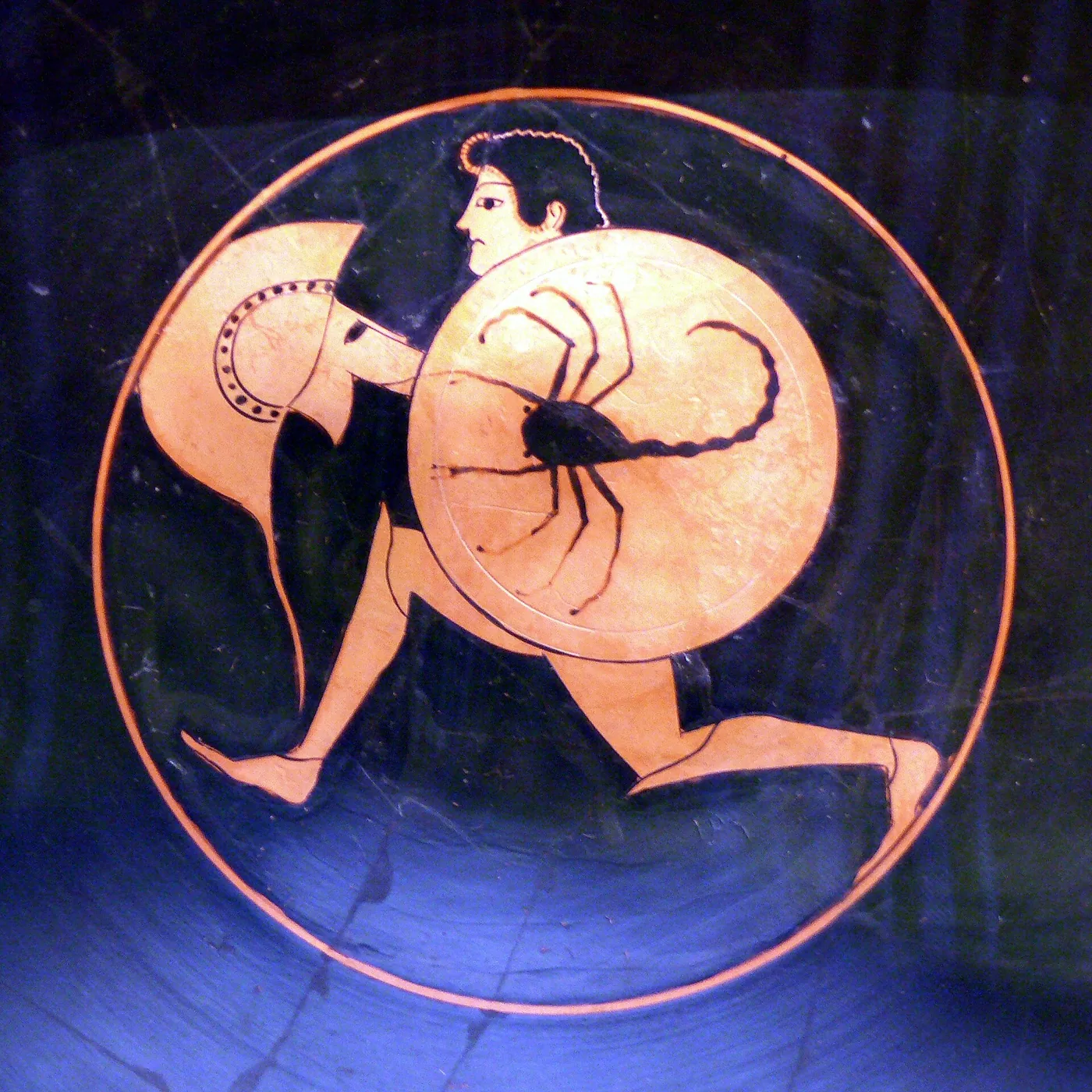
Red-figure cup (kylix), made by Pamphaios and painted by the Nikosthenes Painter, about 510–500 BC. Walters Art Museum, Baltimore (48.2747). Photo: Ad Meskens · CC BY-SA 3.0 · Source page
“When the Persians saw them come running they prepared to receive them, deeming the Athenians frenzied to their utter destruction, who being (as they saw) so few were yet charging them at speed, albeit they had no horsemen nor archers… they were the first Greeks, within my knowledge, who charged their enemies at a run.”
Herodotus heard the story some fifty years later, from Athenians who had grown up on it. The cup was painted in Athens a decade or two before the battle.
- Who could have told Herodotus what the Persians were thinking? Almost certainly no one. “Frenzied” is how Athenians imagined the enemy saw them. It makes the Athenians look daring and the Persians smug.
- Why does he add “within my knowledge”? He is careful: it is a boast he heard and cannot check. Marathon was already a legend full of Athenian “firsts”.
- Does the cup show what the Athenians looked like at Marathon? Only partly. The shield and crested helmet are right, but in battle hoplites wore body armour, and this may be a runner in a race in armour, not a soldier. Art is a source, not a photograph.
Source: Who ran, and where?
Herodotus, c. 430 BC: “…the generals sent as a herald to Sparta Phidippides, an Athenian, and one, moreover, that was a runner of long distances and made that his calling.”
Lucian, 2nd century AD: “The modern use of the word dates back to Philippides the dispatch-runner. Bringing the news of Marathon, he found the archons seated… ‘Joy, we win!’ he said, and died upon his message.”
Lucian was a satirist writing some 650 years after the battle, in an essay about the Greek greeting chairete, “joy to you”.
- Which writer lived closer to the battle, and where does his runner go? Herodotus, fifty to sixty years after it. His runner goes to Sparta, before the battle, to ask for help. He says nothing of a run to Athens afterwards.
- Plutarch, around AD 100, says that Heraclides of Pontus, a 4th-century BC writer, named the runner to Athens Thersippus, but that ‘most report’ Eucles. Lucian calls him Philippides. What does that tell you? Three names for one runner: the story was told many ways and grew over centuries. Lucian probably borrowed the famous name from Herodotus.
- Why does Lucian tell the story at all? To explain a word. The dying runner is a colourful example in an essay on greetings, not evidence about the battle.
Myth
After the battle a messenger ran 40 kilometres from Marathon to Athens, cried “We have won!” and dropped dead. That is why the race is called a marathon.
The truth
Herodotus, our only early account of the campaign, knows nothing of it. His runner went to Sparta before the battle. What really rushed from Marathon to Athens was the whole army, to beat the Persian fleet. The dying messenger first appears in writers of the Roman era, more than 500 years later.
The evidence
Herodotus 6.105–106 and 6.116; Plutarch, Moralia 347c; Lucian, A Slip of the Tongue in Salutation 3. Robert Browning’s poem “Pheidippides” (1879) merged the two runs, and the French scholar Michel Bréal proposed a “marathon” race for the first modern Olympics, held in 1896. The run to Sparta has been tested too: since 1983 the Spartathlon covers about 246 km in under 36 hours.
Source: A helmet for Zeus
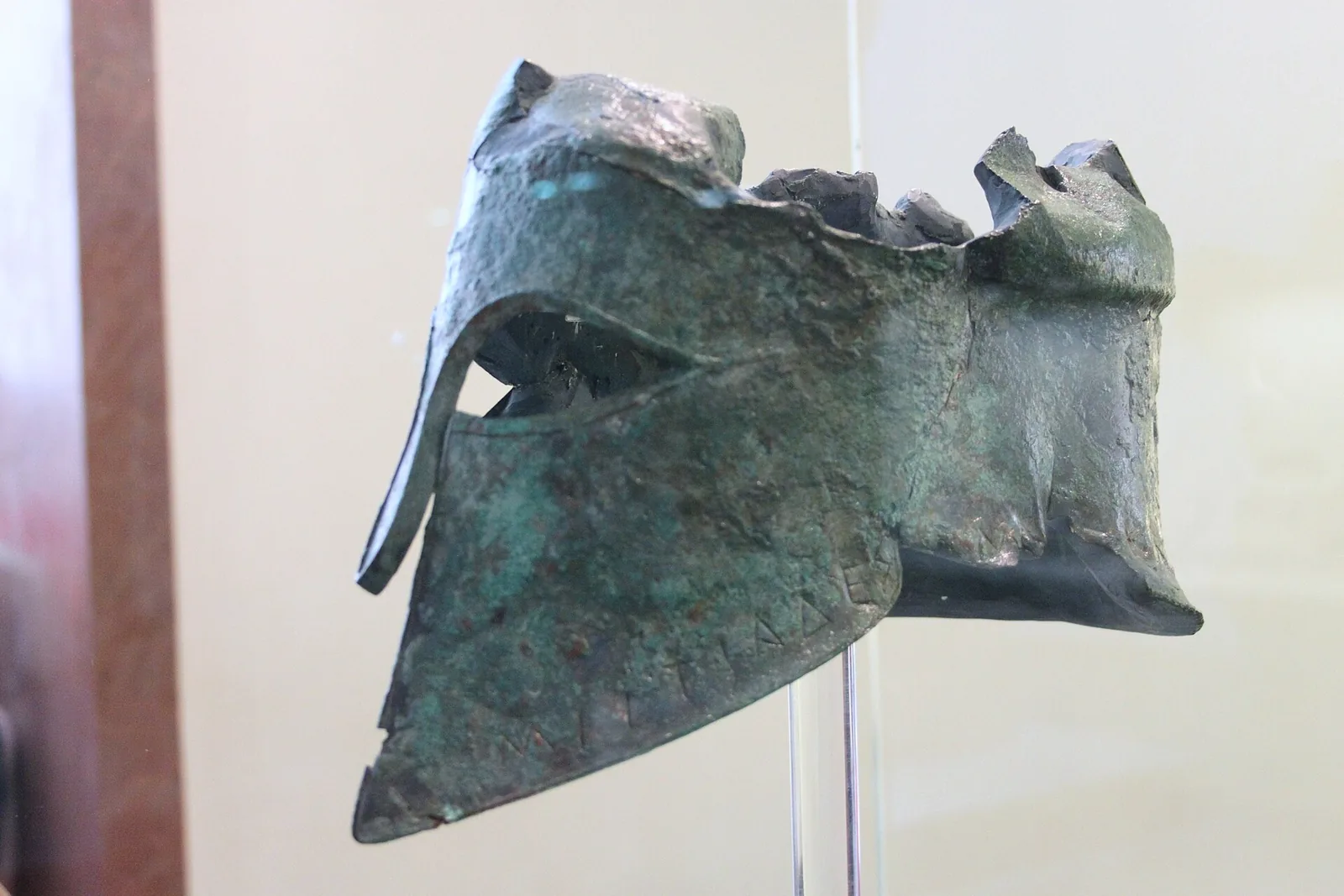
Bronze helmet inscribed by Miltiades, about 500–490 BC. Archaeological Museum of Olympia. Photo: Oren Rozen, 2011 · CC BY-SA 3.0 · Source page
Bronze Corinthian helmet, c. 500–490 BC. Archaeological Museum of Olympia
The helmet was found in excavations at Olympia, the sanctuary of Zeus where the Games were held. Letters scratched on the cheek-piece read: “Miltiades dedicated [me] to Zeus.”
- What does the inscription say, and what does it leave out? It names Miltiades and Zeus. No battle, no date, no city. The link to Marathon is an inference from the shape of the letters, which fits the years around 490 BC.
- Why give a helmet to a god instead of keeping it? To thank Zeus for a victory, and to show it off: Greeks from every city came to Olympia. A gift to a god was also an advertisement.
- Is this the helmet Miltiades wore at Marathon? Possibly, but it could come from another of his campaigns. Objects usually prove less than the stories told about them.
Source: Persia’s soldiers, as Persia showed them
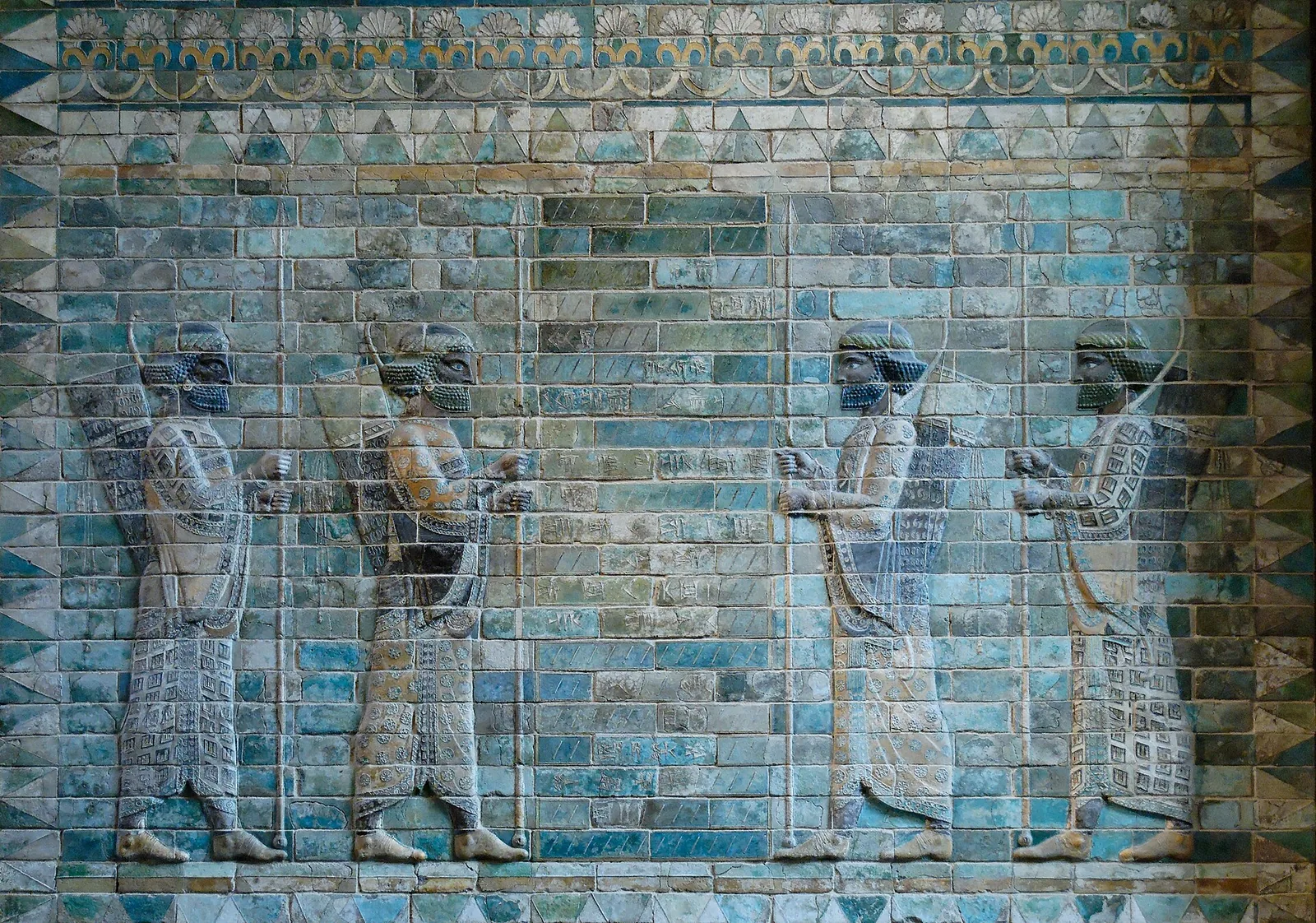
Frieze of Archers, glazed brick, palace of Darius I at Susa, about 510 BC. Musée du Louvre, Paris (AOD 488). Photo: Jastrow, 2007 · Public domain · Source page
The “Frieze of Archers”, glazed brick from Darius’s palace at Susa, c. 510 BC. Musée du Louvre
The bricks decorated the walls of Darius’s palace at Susa, about twenty years before Marathon.
- Who made this, and for whom? The king’s craftsmen, for the walls of his palace. They show royal guards in court robes, as the king wished to be served, not men on campaign.
- Look at the weapons. Why might a charge at a run make sense against them? Spear, bow and quiver: Persian foot soldiers relied heavily on arrows, shot from behind wicker shields. The faster the hoplites crossed the killing ground, the fewer arrows could hit them.
- What is missing, here and in every Persian record? Marathon itself. No Persian text mentions it. For the empire it was a setback on a distant frontier, and the whole story we have comes from the winners.
What Marathon changed
The dead
192 heroes, and two graves
After the full moon 2,000 Spartans set out, and within three days they were in Attica. They were too late. They asked to see the dead Medes, went to Marathon, praised the Athenians, and went home.
Athens gave its dead a rare honour: burial on the battlefield itself, under a great mound, the Soros. Some sixty years later Thucydides noted that all other Athenian war dead were brought home to the city. The names of the 192 were carved in stone, tribe by tribe, and the Plataeans and the slaves who had fought beside their masters had a grave of their own. Later a trophy of white marble, a victory monument, was raised on the field.
Among the survivors was a playwright of about 35, Aeschylus. His epitaph, said to be his own, says nothing of his plays: only that he fought at Marathon.
489 BC
The fall of Miltiades
After Marathon no Athenian stood higher than Miltiades. In 489 BC he asked the assembly for 70 ships and money without saying where he would take them, only that he would make Athens rich. He sailed to the island of Paros, which had sent a ship with the Persians, and demanded 100 talents.
Paros refused. After a 26-day siege Miltiades gave up, with a badly injured leg. At home he was tried for deceiving the people; his prosecutor was Xanthippus, father of Pericles. Miltiades lay in court on a couch, too ill to speak, while his friends reminded the jury of Marathon. He was fined 50 talents, a fortune, and soon died of gangrene. His son Cimon paid the fine, and later became the leading man of Athens.
After Marathon
- 490 BC The Persian fleet sails home. The people of Eretria are settled near Susa. Athens is untouched.
- 489 BC Miltiades fails at Paros, is fined and dies. His son Cimon pays the fine.
- 488/487 BC Athens holds its first ostracism, a vote to exile a citizen for ten years, against a relative of Hippias: the democracy turns on suspected friends of the tyrants.
- 486 BC Egypt revolts and Darius dies. His son Xerxes inherits the unfinished revenge.
- 483/482 BC A rich vein of silver is found at Laurion. Themistocles persuades Athens to build a large fleet (200 triremes in Herodotus, 100 in the Athenian Constitution).
- 480 BC Xerxes invades by land and sea, after cutting a canal through the Athos peninsula to avoid the storm of 492. Thermopylae, Artemisium and Salamis follow.
- c. 460 BC A painting of the battle in Athens’ Painted Stoa shows Miltiades in front. Veterans are proudly called “Marathon-fighters”.
- AD 1896 A “marathon” race from Marathon to Athens is run at the first modern Olympics. A Greek water-carrier, Spyridon Louis, wins it.
Myth
A tiny band of Greeks beat a Persian horde of hundreds of thousands, ten or more to one.
The truth
Herodotus gives no size for the Persian army. The huge numbers appear only in later writers, and they disagree wildly: 500,000 in Athenian speeches of the 4th century BC, 200,000 in Nepos, 600,000 in Justin. The fleet set the limit: modern estimates are about 15,000 to 30,000 fighting men, against some 10,000 to 11,000 Greeks. Between one and a half and three to one, not twenty. And the Athenians were not alone: the Plataeans came, and slaves fought beside their masters.
The evidence
Herodotus 6.95, 6.117; Plato, Menexenus 240a; Lysias 2.21; Nepos, Miltiades 4–5; Justin 2.9; Pausanias 1.32.3. Athenian speakers later boasted that at Marathon Athens “faced the barbarian single-handed” (Thucydides 1.73), forgetting the Plataeans.
Why attack that day?
The Athenians waited for days, then suddenly attacked without the Spartans. What changed?
- N. G. L. Hammond, ‘The Campaign and the Battle of Marathon’ (1968) A 10th-century Byzantine dictionary, the Suda, preserves an odd story: Ionian Greeks in the Persian army climbed trees and signalled to the Athenians that “the cavalry are away”, and Miltiades attacked. Hammond took it seriously: the Persians had begun loading their horses to sail for Athens, and the Athenians struck at an army half on board. It would explain why Herodotus mentions no cavalry in the fight.
- Peter Krentz, The Battle of Marathon (2010) Krentz argues that the horsemen were on the field, whatever Herodotus’s silence. Miltiades’ answer was speed: the charge at a run, all the way, was meant to reach the Persian foot before the cavalry and archers could do much harm. In his view hoplite kit was light enough to make it possible.
- C. Hignett (1963), G. Shrimpton (1980), J. P. Stronk (2019) Hignett dismissed the Suda story as worthless. Shrimpton thought the cavalry was there but was caught by the sudden attack before it could form up. Stronk suggests that the Persians themselves advanced to offer battle, so that the Athenians had to fight or lose the plain.
Herodotus says the Persians chose Marathon for their horses, then never mentions a horse in the battle. Was the cavalry absent, beaten by speed, or simply forgotten by the men who told the story?
What do you know now?
Check yourself
Why did Darius want to punish Athens in particular?
Answer: Athenian ships had helped the Ionian rebels burn Sardis. Right. Athens sent 20 ships in 499 BC, and Sardis burned in 498. Athens had also refused to take back Hippias, so in Persian eyes it was a rebel.
Check yourself
Who cast the deciding vote to fight?
Answer: Callimachus, the polemarch. Right. The ten generals were split, and the polemarch’s eleventh vote decided it. He fell in the battle itself, at the ships.
Check yourself
Why was the Athenian centre so thin?
Answer: To make the line as long as the Persian line. Right. Herodotus says that in matching the Persian length it “so fell out” that the centre was only a few ranks deep and the wings strong.
Check yourself
According to Herodotus, where did the runner Pheidippides run?
Answer: From Athens to Sparta, before the battle, to ask for help. Right: about 240 kilometres, arriving the next day. Herodotus has no runner to Athens after the battle.
Check yourself
Why did the Athenian army march back to Athens on the day of the battle?
Answer: The Persian fleet was sailing round to Athens, and someone had signalled to it with a shield. Right. The army had to reach the city before the ships, and the shield hinted at traitors inside. It got there first, and the fleet sailed home.
Check yourself
Why do historians doubt huge figures such as Justin’s 600,000 Persians?
Answer: The big figures appear only in much later writers, who disagree with each other, and the fleet could carry only some 20,000 to 30,000 soldiers. Right. Herodotus gives no figure; Plato and Lysias say 500,000, Nepos 200,000, Justin 600,000. The ships set the limit.
Terms
- hoplite A Greek citizen foot-soldier who paid for his own arms: a large round shield, a spear, a bronze helmet and greaves. Hoplites fought shoulder to shoulder, in close ranks called a phalanx.
- phalanx Hoplites in close ranks, shields overlapping, usually about eight men deep. Its strength was its front; its weakness, its open ends.
- trireme A long, fast warship rowed by about 170 oarsmen on three levels, with a bronze ram at the bow.
- satrap The governor of a province (a satrapy) of the Persian Empire. At Sardis it was Artaphernes, Darius’s brother.
- tyrant In Greece, a man who seized sole power outside the law. It did not have to mean cruel: Pisistratus ruled Athens fairly mildly, his son Hippias harshly.
- earth and water The token of submission the Persian king asked of a city or people: a little of its soil and water, as a sign that they accepted him as their lord.
- medize To side with Persia. The Greeks called the Persians “Medes”, so a Greek who went over to them “medized”.
- strategos One of the ten generals Athens elected every year, one from each tribe. In 490 BC they decided together, by vote.
- polemarch The “war-ruler”: one of the nine archons, Athens’ chief officials. By law he commanded the army and held the right wing, the place of honour.
- Carneia A Spartan festival of Apollo in late summer. Until it ended, at the full moon, the Spartan army did not march.
- stade A Greek measure of length, about 180 metres: the length of a running track, hence our word “stadium”.
- Soros Greek for “heap”: the earth mound on the plain of Marathon raised over the Athenian dead of 490 BC.
- Pheidippides A professional long-distance runner. According to Herodotus, he ran from Athens to Sparta before the battle to ask for help.
- Plataea A small Greek city and ally of Athens. It sent its whole army to help the Athenians.
- Aristagoras A visitor from Miletus who asked for help in the Ionian revolt against Persia. Sparta had already turned him away.
- Miltiades An Athenian general who knew the Persians well and pushed for the battle at Marathon. Later he was heavily fined in Athens.
- Callimachus The polemarch, one of Athens’ commanders at Marathon. He voted to fight and died in the battle.
- Cimon Miltiades’ son. For years he was the leading man in Athens, and he looked after his father’s glory.
- Alcmaeonids A great Athenian family, accused of treason during the battle. Herodotus defends it, and Pericles’ mother came from it.
- Pericles The leader of Athens in Herodotus’s day. His mother came from the Alcmaeonid family.
- Mardonius Darius’s young son-in-law and a Persian commander. He led an expedition whose fleet a storm wrecked off Mount Athos.
- Datis A Persian commander of Median origin who led the expedition against Eretria and Athens with Artaphernes.
- Artaphernes The king’s nephew, who shared command of the expedition against Eretria and Athens with Datis.
- Darius I King of Persia. According to Herodotus he wanted revenge on Athens after Sardis burned.
- Cyrus the Great King of Persia who founded the great Persian Empire. In his time the Greek cities of Ionia were conquered.
- Ionia A region of Greek cities on the western coast of Asia Minor, now in Turkey. The Ionian cities rebelled against Persia.
- Miletus The richest city in Ionia. It rebelled against Persia and was then stormed by the Persians.
- Sardis A city in the west of the Persian Empire, seat of the Persian governor. Athenians and Ionians burned it during the revolt.
- Eretria A Greek city on the island of Euboea. Its walls held for six days before the gates were opened from inside.
- Attica The region where Athens lies. The bay of Marathon is on its coast.
- Sparta A major Greek city. Its army came late, because a religious law forbade it to march before the full moon.
- Zeus The chief god of the Greeks. Darius asked him for vengeance on the Athenians.
- Plutarch A Greek writer who wrote centuries after the battle. He says one tribe stayed behind to guard the prisoners and the spoils.
- Thucydides An ancient Greek historian. He noted that Athens’ other war dead were brought home to the city, unlike those of Marathon.
- The Athenian Constitution A work on Athens’ institutions, written in Aristotle’s school. According to it, the polemarch was the commander of the whole army.
- Archon A senior official in Athens. The polemarch was one of the archons.
Sources
- Herodotus, Histories 5.28–6.140, trans. A. D. Godley, Herodotus vol. III (Loeb Classical Library, 1922)
- Thucydides, History of the Peloponnesian War 1.73, 2.34, 6.59, trans. R. Crawley (1874)
- Aristotle (school of), Athenian Constitution 22, trans. F. G. Kenyon
- Plato, Menexenus 240a and Laws 698e, trans. B. Jowett (1892); Lysias 2.21
- Xenophon, Anabasis 3.2.12
- Cornelius Nepos, Miltiades 4–8, trans. J. C. Rolfe (Loeb Classical Library, 1929)
- Justin, Epitome of Pompeius Trogus 2.9, trans. J. S. Watson (1853)
- Plutarch, Aristides 5, trans. B. Perrin (Loeb Classical Library, 1914); Moralia 347c (On the Glory of the Athenians 3), trans. R. Smith, ed. W. W. Goodwin (1874)
- Pausanias, Description of Greece 1.14–15, 1.32, 10.20, trans. W. H. S. Jones (Loeb Classical Library, vol. I, 1918; vol. IV, 1935)
- Lucian, A Slip of the Tongue in Salutation 3, trans. H. W. and F. G. Fowler, The Works of Lucian vol. II (Clarendon Press, 1905)
- Suda, s.v. χωρὶς ἱππεῖς (“cavalry apart”)
- The Behistun inscription of Darius I §1, trans. L. W. King and R. C. Thompson (British Museum, 1907)
- Inscriptions: the Miltiades helmet from Olympia (SEG 14.351); the Erechtheis casualty list from Loukou (SEG 56.430)
- Peter Krentz, The Battle of Marathon (Yale University Press, 2010)
- J. F. Lazenby, The Defence of Greece, 490–479 B.C. (Aris & Phillips, 1993)
- Richard A. Billows, Marathon: How One Battle Changed Western Civilization (Overlook Duckworth, 2010)
- Peter Green, The Greco-Persian Wars (University of California Press, 1996)
- A. R. Burn, Persia and the Greeks: The Defence of the West, c. 546–478 B.C., 2nd ed. with a postscript by D. M. Lewis (Duckworth, 1984)
- C. Hignett, Xerxes’ Invasion of Greece (Clarendon Press, 1963)
- Nicholas Sekunda, Marathon 490 BC: The First Persian Invasion of Greece (Osprey, 2002)
- Pierre Briant, From Cyrus to Alexander: A History of the Persian Empire, trans. P. T. Daniels (Eisenbrauns, 2002)
- Simon Hornblower and Christopher Pelling, Herodotus: Histories Book VI (Cambridge University Press, 2017)
- N. G. L. Hammond, ‘The Campaign and the Battle of Marathon’, Journal of Hellenic Studies 88 (1968), 13–57
- W. Donlan and J. Thompson, ‘The Charge at Marathon: Herodotus 6.112’, Classical Journal 71 (1976), 339–343
- G. Shrimpton, ‘The Persian Cavalry at Marathon’, Phoenix 34 (1980), 20–37
- J. A. S. Evans, ‘Herodotus and the Battle of Marathon’, Historia 42 (1993), 279–307
- A. P. Matthaiou, ‘Ἀθηναίοισι τεταγμένοισι ἐν τεμένεϊ Ἡρακλέος (Hdt. 6.108.1)’, in P. Derow and R. Parker (eds), Herodotus and His World (Oxford University Press, 2003)
- J. P. Stronk, ‘From Sardis to Marathon. Greco-Persian Relations 499–490 BC: A Review. Part Two: The Battle of Marathon and Its Implications’, Talanta 51 (2019), 77–226
Image credits
- The Soros, the Athenians’ burial mound at Marathon, 2016. Photo: George Fournaris · CC BY-SA 4.0 · Source page
- Darius I, detail of the relief at Behistun (Bisotun), Iran, about 520 BC. Photo: Leen van Dorp (Livius.org) · CC0 · Source page
- Head of a warrior, so-called Miltiades, Roman copy. Glyptothek, Munich (GL 172), photographed on loan in Berlin, 2019. Photo: Osama Shukir Muhammed Amin FRCP(Glasg) · CC BY-SA 4.0 · Source page
- Red-figure cup (kylix), made by Pamphaios and painted by the Nikosthenes Painter, about 510–500 BC. Walters Art Museum, Baltimore (48.2747). Photo: Ad Meskens · CC BY-SA 3.0 · Source page
- Bronze helmet inscribed by Miltiades, about 500–490 BC. Archaeological Museum of Olympia. Photo: Oren Rozen, 2011 · CC BY-SA 3.0 · Source page
- Frieze of Archers, glazed brick, palace of Darius I at Susa, about 510 BC. Musée du Louvre, Paris (AOD 488). Photo: Jastrow, 2007 · Public domain · Source page


