Mansa Musa: the king who turned gold into a story
In 1324 a king from West Africa arrived in Cairo with a huge caravan. What do we really know about him, and who told the story?
Decisions, questions and your own progress, in the app
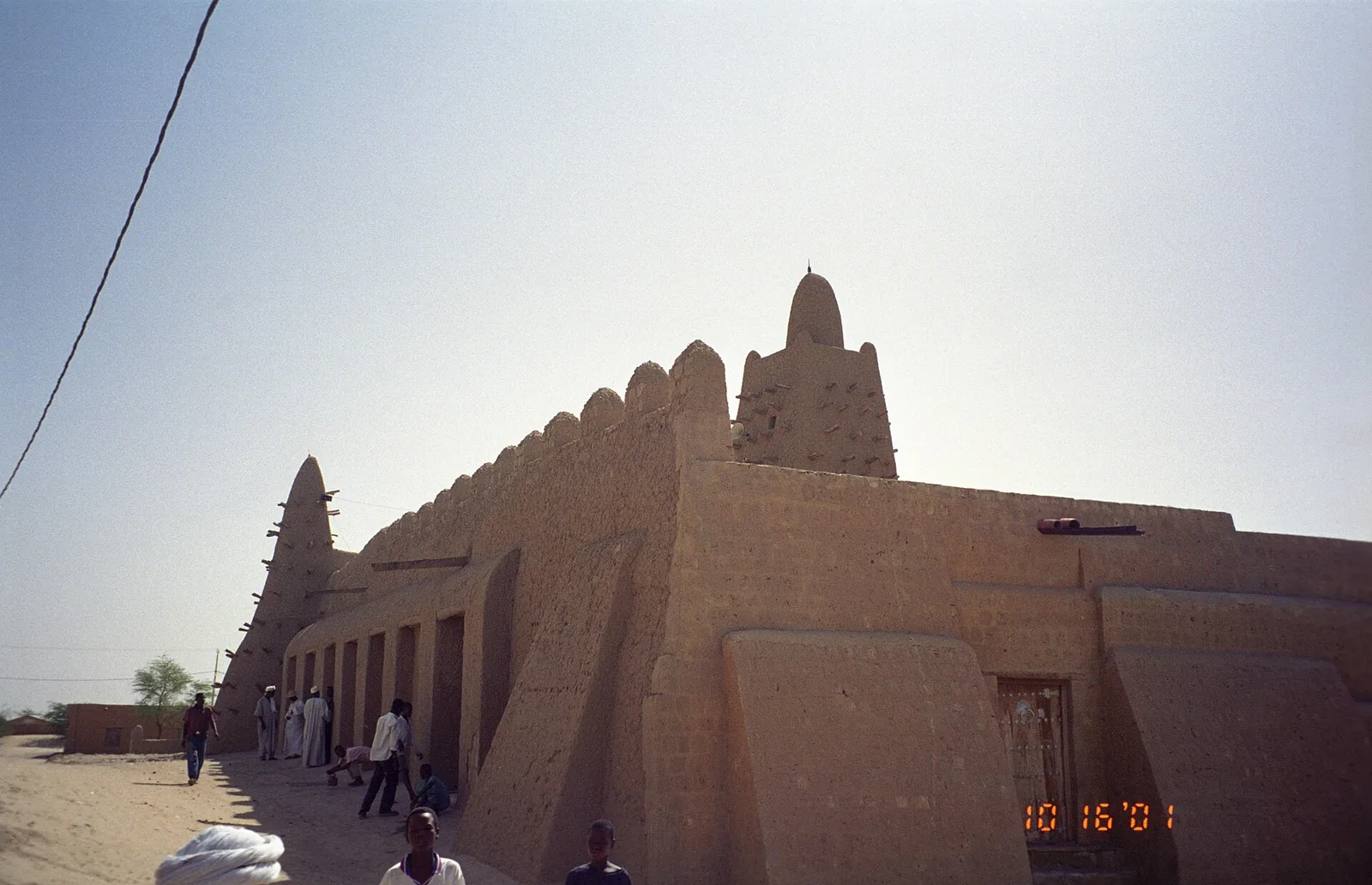
Djinguereber Mosque, Timbuktu. Photo: upyernoz, 2005 (Flickr, via Wikimedia Commons) · CC BY 2.0 · Source page
Sundiata's empire
Cairo, summer of 1324
A large caravan crosses the desert and reaches Cairo in the summer of 1324. At its head is Mansa Musa, king of the Mali Empire in West Africa. He is on his way to the hajj, the pilgrimage to Mecca, and he stops in Cairo on the way.
A familiar story about him is about the gold he carried. What really happened to that gold, and who told the story? Almost everything we know about him was written by people who never met him, and some of the famous details are myths.
Mansa Musa
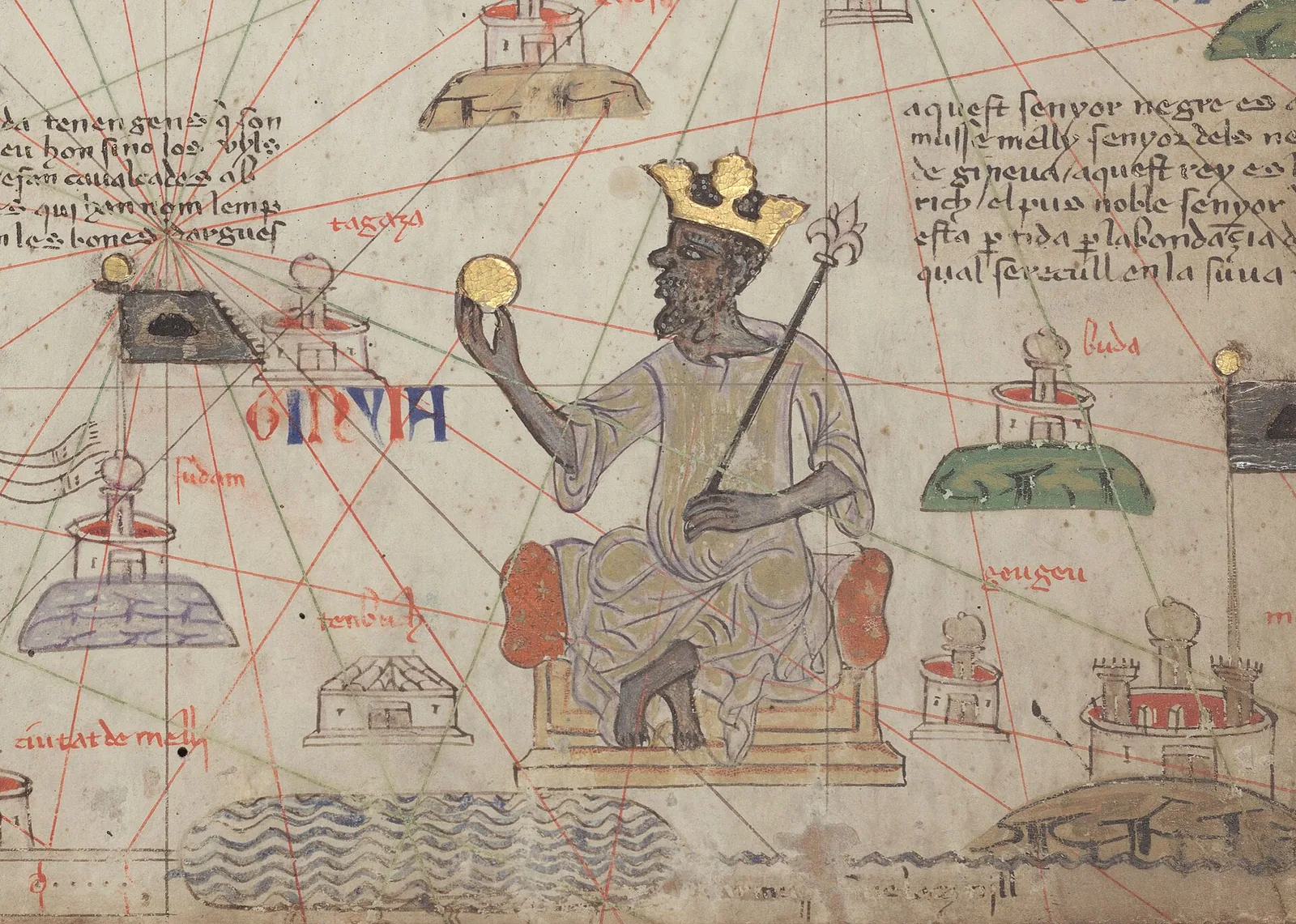
Abraham Cresques (attributed), Catalan Atlas, sheet 6, 1375. Bibliothèque nationale de France, Espagnol 30 · Public domain · Source page
King of the Mali Empire in West Africa, who made the hajj in 1324 and became a legend.
- Born: Not known
- Died: c. 1337 (another count gives 1332)
- Won: Retaking Timbuktu from the Mossi (one source, c. 1330)
This Black ruler is named Musse Melly (Musa of Mali), lord of Guinea.
Background
Sundiata and Kirina
Around 1235, near a place called Kirina, a prince named Sundiata Keita defeated a rival king, Sumanguru Kante. The battle is seen as the start of the Mali Empire, which Musa ruled some eighty years later.
No written account of the battle survives from its own time. The epic that tells it was passed on by word of mouth for generations and only later written down. The date does not appear in the epic itself: it comes from later Arabic and North African writers.
Memory in performance
The jeliw
The epic is kept by the griot, in Mali called a jeli: a professional keeper of memory, royal genealogies, songs and stories among the Mande peoples. He remembers the history of the rulers, is paid for it, and often sings their praises.
Some jeliw later criticised Musa for spending Mali's wealth. This matters: the most detailed stories about Mali come from people whose standing was tied to the courts they sang about.
Trade
Gold, salt and caravans
Mali sat on two things the world wanted: gold from the southern goldfields, and salt from the mines of the Sahara. Caravans carried both across the desert along the trans-Saharan trade routes, and merchants in the desert towns grew rich on them.
Salt was scarce in the south, and it had to come by caravan from the northern mines. Gold travelled the other way, north, and some of it reached Cairo, as we shall see.
Capital
Niani or Timbuktu?
Where was the centre of the empire? One modern encyclopaedia names Niani, on the upper Niger, as the capital. No second source we have confirms this, so treat it as a single claim.
Timbuktu, the city that is famous today, joined the empire only early in the 14th century. In Musa's time it was a trading town on the edge of the desert, not the famous city of the later stories.
A king who went away
Accession
Coming to the throne
Musa came to the throne in about 1312. The dates are uncertain. The reign lengths in the sources do not fit neatly, so his death is given as either 1337 or 1332, and most historians prefer 1337. If the dates are right, he had ruled for about twelve years when he set out for Mecca in 1324.
His predecessor is also a puzzle. The sources disagree about his name. Some older books call him Abu Bakr II, while the French historian François-Xavier Fauvelle takes Muhammad ibn Qu to be the likely predecessor. Some historians suggest that Musa removed his predecessor rather than inheriting the throne.
A story Musa told
Two voyages into the ocean
The predecessor matters because of a famous story. Al-Umari, who wrote from reports he received, passes on what Musa said about him. According to this account, the predecessor sent out expeditions into the Atlantic Ocean to find where it ended. He did not come back from them, and he left Musa as his deputy.
As far as the sources we have go, al-Umari is the main source for this story, and historians treat it with caution. Some popular writers go further and say the voyage reached America. No source says so.
A decision point
You are Mansa Musa, king of the Mali Empire.
The Mali Empire, about 1324, before the journey to Mecca
You have ruled for about a dozen years. Your empire is rich in gold and in the trade that carries it, and your people are proud of that wealth. The hajj is a duty for every Muslim who is able to make the journey, and you are able.
You must decide how to go: how much gold to take, how many people to bring, and who will govern while you are away. The journey could take a year or more.
What do you do?
- Travel light, with a small escort and little gold, and keep the journey quiet. The trip would be cheaper and less noticed. But a king who arrives with little gold would make little impression in Cairo, and your own people might wonder why he left so quietly.
- Travel with a very large caravan of gold, and leave a son to govern. It would be a great show of wealth, and a long absence. Your name would probably become known in Cairo, and its gold markets would feel the effect. A deputy at home would rule for about a year.
- Send envoys and gold ahead, and stay at home. Your gold would reach Cairo before you did, and the court would hear of your wealth through your envoys. But the hajj is a personal duty, and you would not perform it yourself.
What really happened
Travel with a very large caravan of gold, and leave a son to govern.
He went with a very large caravan, and according to al-Umari he left one of his sons to govern in his absence. The size of the caravan is much disputed; see the next chapter. He was away for about a year, from 1324 into 1325, and he came home to Mali.
The pilgrimage was a duty, and such a journey could also serve as a display. We cannot read his mind. Historians suggest that a display of wealth was part of how a West African king showed his standing to rulers in Egypt and Arabia. The sources describe the gold, not his reasons.
The caravan
The road
Across the desert
The route of the caravan cannot be fully reconstructed. One encyclopaedia lists Walata and Tuat, two places on the desert roads, among the stops between Mali and Cairo. Cairo itself is well attested: the party reached it in July 1324, and it stayed there for about three months.
Only one encyclopaedia lists these stops, so treat them as likely rather than certain.
The numbers
Who was in the caravan?
12,000
Most numbers about the caravan come from later writers, and some of them seem to have enjoyed the size. Later Arabic writers speak of more than 12,000 enslaved people in the procession, dressed in brocade, a silk cloth with raised patterns. Popular books speak of 60,000 men. The sources give no headcount for the men, and the figure of 60,000 has no early source behind it.
If the figure of 12,000 is right at all, it describes people held in bondage, and that is the part of the story the gold tends to hide. Michael Gomez, a modern historian, estimates that the empire may have captured more than 6,000 people a year. That is his estimate, not a count.
The gold
How much gold?
Gold travelled on camels. Later writers give figures of 23 to 136 kilograms of gold dust for each camel. Modern historians read such figures as rhetoric: upper limits meant to sound impressive, not counts. A modern reconstruction, built from al-Umari and Ibn Khaldun, gives a total of up to about 18 tons of gold for the journey.
Those two writers probably share one chain of transmission, so they are not two independent witnesses. The total is a reconstruction, and it should be read as one.
By the pyramids
Three days at Giza
Before entering Cairo, the sources say, the party camped for three days by the Pyramids of Giza. It entered the city on 19 July 1324. The camp is a detail the sources report. What later tellers add around it, such as stories of haggling, is not in the scholarly sources.
The ground
Cairo
At the sultan's court
Cairo in 1324 was the capital of the Mamluk sultanate, which ruled Egypt and Syria. The Mamluks were a military elite, most of them bought as slaves in childhood, and they held power in Egypt from 1250 to 1517. Their sultan received visitors with elaborate ceremony.
Al-Umari describes how Mansa Musa was received at the sultan's court, and the details of that reception are among the most important parts of the story.
A decision point
You are Mansa Musa, in Cairo in July 1324.
Cairo, July 1324, before the audience at the sultan's court
The sultan's officials have come to meet you. They explain the custom: a visitor kisses the ground before the sultan. Your escort is watching you, and your people are waiting to see what their king will do.
You are a king in your own right, not a vassal of this sultan. A bad start could cost you the goodwill of the ruler whose markets your gold will soon enter.
What do you do?
- Kiss the ground, as visitors do, and be received as a guest. The audience would go smoothly and the sultan would be pleased. But your escort and your people might see you as a guest below the sultan, and that would be hard to undo in later talks.
- Refuse to kiss the ground, and bow only to God. The start would be tense. The officials might refuse you an audience, and the sultan might take offence. If a compromise were found, it would have to save face on both sides.
- Refuse the ground, but greet the sultan with a formal bow and send an envoy to explain. This middle road could save both honour and peace. The officials might still object, and the sultan might insist on the custom anyway.
What really happened
Refuse to kiss the ground, and bow only to God.
According to al-Umari, Musa refused at first. Then one of his companions whispered to him, and he said that he bowed only to God. He prostrated himself and went forward. The sultan half rose, seated Musa beside himself, and the two men talked for a long time.
The account is second-hand, from informants in Cairo, so its outline is stronger than its details.
Al-Umari does not give Musa's own words about his reasons. A king who saw himself as a ruler in his own right would not want to kneel as a subject. The whisper and the prostration suggest a compromise: Musa honoured God, and the sultan honoured him by seating him beside himself. Whether that was a real concession or only courtesy is a matter of interpretation.
A custom from another court
Earth on the head
A later writer describes a custom that looks similar. Leo Africanus, who visited Timbuktu around 1510 and described it, says that anyone who wished to speak to the king had first to fall before his feet and sprinkle earth on his head and shoulders. That is a different city, a different court, and about two centuries later, so it does not prove what happened in Cairo. It shows that such gestures of humility existed at African courts, though not that the same ritual was used in Cairo.
Three months of gold
A decision point
You are Mansa Musa, in Cairo in August 1324.
Cairo, summer 1324
Your party has been in Cairo for weeks. Gold leaves your chests as fast as it is given out, and the merchants are glad of the trade. Your treasury is large, but it is not endless, and the road home is long.
Some of your people say that the gold is a sign of your greatness, and that you must not count it. Others say that it has to be counted, because the road home must be paid for.
What do you do with your gold?
- Keep the gold in your chests, buy goods, and give only small gifts. The price of gold would probably stay steady and your treasury would last longer. But Cairo would take your visit as modest, and your name as a generous king would suffer.
- Give gold freely as a show of wealth, and sell the rest in the markets. You would impress the court and the merchants. But a great deal of gold sold at once would probably push its price down, and the merchants would profit more than you.
- Give gold freely, and when it runs short, borrow from Cairo's moneylenders to keep the show going. Your reputation for generosity would grow and be remembered. But debts would follow you home, and repaying them would depend on your goodwill and on more gold.
What really happened
Give gold freely, and when it runs short, borrow from Cairo's moneylenders to keep the show going.
He gave gold freely, in Cairo and on the road. When the gold ran short, he borrowed from Cairo's moneylenders. Several writers, al-Umari among them, say so. Al-Umari also reports a change in the price of gold. Before the caravan, a mithqal of gold was worth more than 25 silver dirhams. After it, the price fell to 22 dirhams or less, and stayed low for about twelve years. The lenders were never repaid, or only partly.
The sources do not say that he planned to run short. He probably wanted to be seen as a generous king, and in Cairo generosity was a way to be taken seriously. Historians disagree about what the gold did to Cairo's market; the debate in the last chapter sets out the positions.
Source: Al-Umari on Mansa Musa's visit to Cairo
A paraphrase, not a quotation: al-Umari writes that Cairo's traders made large profits from the gold the party brought, and that the price of gold fell. He blames the fall on the traders who dealt in gold with the party.
Al-Umari was not an eyewitness. He wrote some years after the visit, from what informants in Cairo told him. It is the main Arabic account of the gold, but it is second-hand evidence.
- Who told al-Umari, and when? People in Cairo, some years after the visit. We cannot name them.
- Why might Cairo's traders have wanted the blame to fall on the party? If the price fell because of gold they had traded themselves, it was safer to blame a visitor who had already gone home.
- What is missing from the story? Musa's own voice, and any measure of how much gold was actually sold. Without those figures, the size of the damage cannot be known.
Myth
Musa crashed Egypt's economy with his gold.
The truth
Al-Umari reports a fall in the price of gold in Cairo, and he blames the traders who dealt in gold with the party. 'Crashed' is a big word for something recorded by one writer. Historians disagree about how serious the fall was, and whether it had lasting effects.
The evidence
See the debate in the last chapter. The fall appears in al-Umari's account; what has been added to it is interpretation.
The road home
18 October
On 18 October 1324 the party left Cairo for home, with a long road ahead.
Building on the way back
The road home
A costly crossing
Modern historians describe the return as very costly. On the crossing near Suez, many members of the party died. The sources do not give a number.
Musa returned to Mali around 1325, about a year after he had left it.
A decision point
You are Mansa Musa, back in the Mali Empire, about 1325.
The Mali Empire, about 1325
You have seen Cairo and Mecca. You have walked among the great cities of the Islamic world, with their mosques, their learned men and their stone buildings. Your own towns are built mostly of earth, and Timbuktu, a trading town on the desert edge, has only lately joined your empire.
Builders and architects can be found in the lands you have visited, and some would come for gold and honour. Your treasury is lighter than when you left.
What do you build, and whom do you bring?
- Invite builders and architects from Andalusia and Cairo, and have them build a mosque and a royal hall. A new place of worship and teaching would probably grow in Timbuktu, and the city would gain standing in the Islamic world. It would cost time and gold, and some builders might not come.
- Build a grand palace and audience hall, using local workers only. You would show power at home quickly. But without outside builders, the city's reputation abroad would grow slowly, and the new buildings would copy only what local builders knew.
- Pay what you owe first, and keep the gold in the treasury before building anything. The lenders in Cairo would be paid, and your name there would be kept. But for years nothing new would be built in Timbuktu, and the city would stay a trading town.
What really happened
Invite builders and architects from Andalusia and Cairo, and have them build a mosque and a royal hall.
He invited builders and, on the return journey, persuaded Abu Ishaq al-Sahili, an Andalusian architect, to come to Mali. The Arabic sources tie Sahili to one building: an audience chamber. According to Ibn Khaldun, 12,000 mithqals (about 51 kilograms of gold) were paid for it.
The Djinguereber mosque in Timbuktu is dated to 1327, in Musa's reign, by one modern source. Later tradition credits Sahili with that mosque too, and the question is debated.
The sources do not say why Musa chose builders over a palace alone. Historians suggest that he wanted his cities to look like the Islamic lands he had seen, and that a mosque was a public sign of both faith and rule. These are interpretations, not his own words.
The building
Who designed the mosque?
The Djinguereber mosque is a building linked to Musa. Historians disagree about who designed it. The older view, common in popular histories, credits Sahili with the mosque and the palace. A more cautious view, based on the Arabic sources, notes that they link Sahili clearly only to the audience chamber. The attribution of the mosque to him is a later belief.
Some historians argue that the earth building of the Niger bend is a local blend of mud construction and Islamic design rather than an import. Labelle Prussin, an architectural historian, made this case in 1986. Who built Timbuktu's earth buildings is therefore still an open question.
Myth
Musa founded Timbuktu.
The truth
According to one modern encyclopaedia, Timbuktu began as a seasonal camp and became a permanent settlement early in the 12th century, a development credited to the Maghsharan, a Tuareg group. The same source says it joined the Mali Empire early in the 14th century. Musa's part was growth and building, not foundation.
The evidence
Leo Africanus visited the city around 1510. In John Pory's 1600 translation he reports a tradition about its name: it came from another town of the same name, which (they say) a king he calls Mensae Suleiman founded in the year 610 of the Hegira. That is about 1213–14, and “they say” marks it as a folk claim, not a record. Paraphrase, not a quotation.
After the gold
Last years
Musa's last years
Around 1330, according to one modern source, the Mossi kingdom from the south took Timbuktu. Musa is said to have won it back and to have built a stone fort and a standing army there. That claim rests on a single source, so treat it with care.
Musa died around 1337. Another count gives 1332. The sources say very little about the years that followed.
The brother
Ibn Battuta in Mali
Musa's brother Sulayman was the ruler of Mali when the traveller Ibn Battuta arrived in 1352 and spent time at his court. His account is one of the few eyewitness accounts of Mali from the 1300s, and the episodes of his stay are dated 1352 or 1353.
In that account Sulayman comes off badly. The traveller calls him stingy and sets him against his brother Musa. We have only one side of the brothers' story.
Source: Ibn Battuta on Sulayman, 1352–53
A paraphrase, not a quotation: Ibn Battuta describes Sulayman as stingy, a ruler from whom no generous gift can be expected, and sets him against Musa.
Ibn Battuta was a traveller from Morocco who visited Mali in 1352–53. We have his words as they were recorded. Sulayman's own view of his brother has not survived.
- What does Ibn Battuta want us to believe about Sulayman? That he is stingy, and that Musa was the greater king. It is one traveller's judgment, not Sulayman's own account.
- Who could have told Sulayman's side? None of the sources we have. Court records might have kept it, but the texts before us contain no voice of his.
- Why does it matter how the text reached us? The record passed through several hands before it was printed and translated, so a single word cannot be treated as an exact record.
Source: Leo Africanus on Timbuktu, about 1510
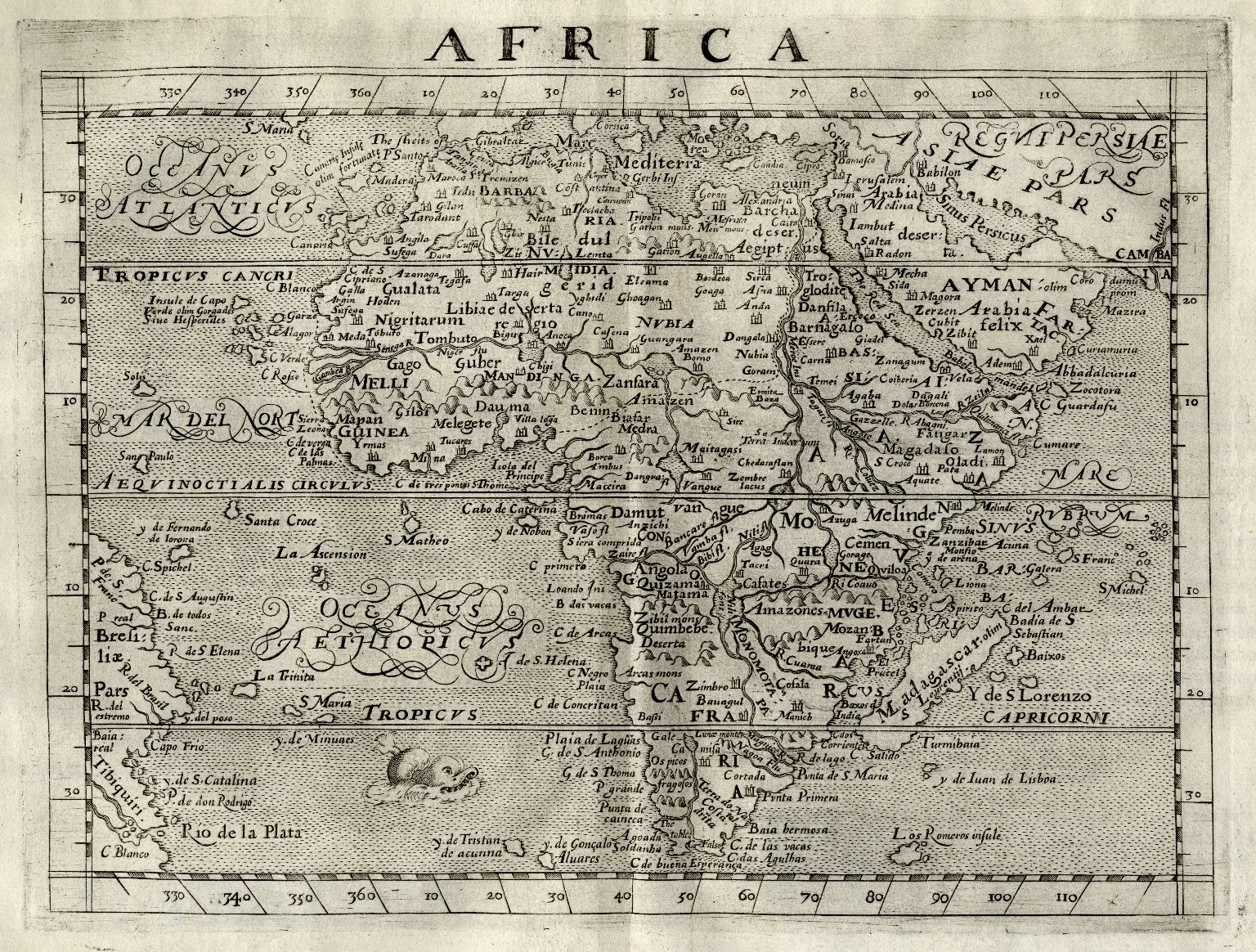
Map of Africa from John Pory's translation of Leo Africanus, London, 1600. Scan from the Folger Shakespeare Library, via Wikimedia Commons · Public domain · Source page
“Whosoever will speak unto this king must first fall down before his feet, & then taking up earth must sprinkle it upon his own head & shoulders.”
Paraphrase, not a quotation: Leo says salt is very scarce in Timbuktu and is brought in by land from Tegaza.
Leo was born in Granada, travelled in North Africa, and visited Timbuktu about 1510, when the city was part of the Songhai Empire. That is some 180 years after Musa. He describes the city of his own time, not Musa's.
- Whose city is Leo describing, and when? Timbuktu around 1510, under the Songhai, about 180 years after Musa. It is not Musa's city.
- What does the phrase 'they say' tell us about how sure Leo was? That he is repeating what he heard, not what he checked. Even good sources repeat rumours.
- What does the map show, and what does it not show? A European map of 1600 that marks 'Melli' and 'Tombuto', drawn from Leo's book. It is not a survey: its shapes and distances are approximate.
Source: The Catalan Atlas, sheet 6, 1375
The Catalan Atlas, sheet 6, attributed to Abraham Cresques, 1375. Bibliothèque nationale de France, Espagnol 30 (public domain).
- Who made the map, and for whom? A workshop in Majorca, attributed to Abraham Cresques, that made maps for European patrons. It is a European picture of Africa, not a survey by someone who had been there.
- What do the crown, the gold and the sceptre tell us? That the painter wants to show status and wealth, not a likeness drawn from life. The round gold object in his hand is uncertain: the British Library suggests an orb, a coin or a nugget.
- What is missing if we use it as evidence of Musa's wealth? Measurements and numbers. The map does not show how much gold he had. Like a portrait painted decades after the king's death, it shows what others thought of him.
What came next
- c. 1235 Sundiata defeats Sumanguru at Kirina. The start of the Mali Empire.
- c. 1312 Musa comes to the throne. The date is uncertain.
- July 1324 The party enters Cairo after three days by the pyramids.
- 18 October 1324 The party leaves Cairo for home.
- c. 1325 Musa returns to Mali and brings Abu Ishaq al-Sahili to it.
- 1327 The Djinguereber mosque is built in Timbuktu, according to one modern source.
- c. 1330 The Mossi take Timbuktu, according to one source. Musa takes it back.
- c. 1337 Musa dies. Another count gives 1332.
- 1352–53 Ibn Battuta visits the court of Sulayman, Musa's brother.
- 1375 The Catalan Atlas shows Musa on a European map.
- c. 1510 Leo Africanus sees Timbuktu, then under Songhai rule.
- 2013 Armed fighters pull 4,202 manuscripts off the shelves of the Ahmed Baba Centre in Timbuktu.
Manuscripts
The library in the sand
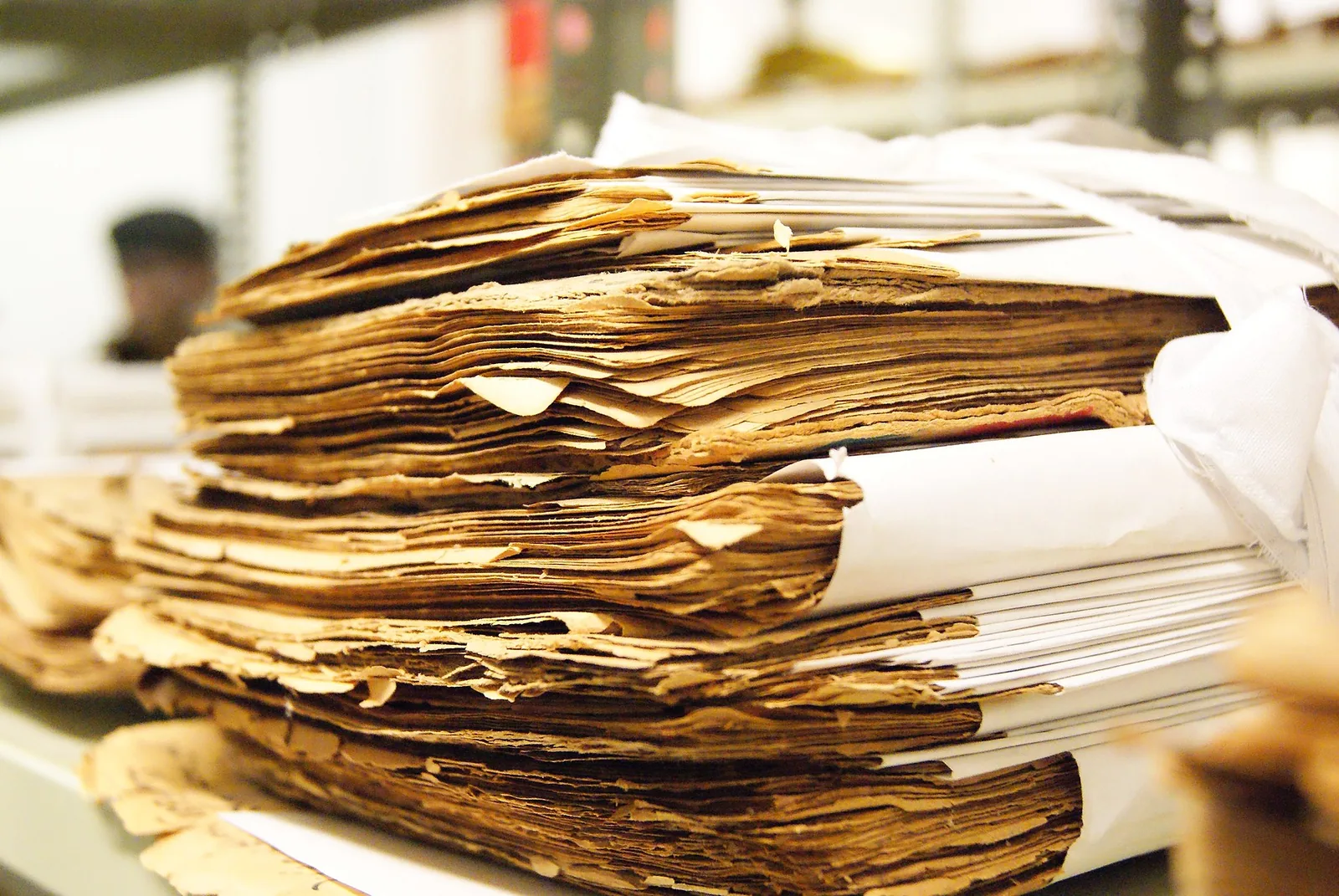
Manuscripts of the Ahmed Baba Centre, Timbuktu, 2013. Photo: UNESCO Bureau of Mali · CC BY-SA 3.0 · Source page
Timbuktu became known for its books. Over the centuries, hundreds of thousands of manuscripts were collected there, in Arabic and in local languages, on law, faith and science. Most of them are much later than Musa, and the collection grew with the city. An estimate from 2003 put it at up to 700,000 manuscripts.
On 25 January 2013 armed fighters swept 4,202 manuscripts off the shelves of the Ahmed Baba Centre. Many other manuscripts had been moved to safety, about 350,000 by one account. In 2022 some 300,000 were still kept in Bamako, the capital of Mali.
Was the gold a crisis?
Did Musa's gold cause a real crisis in Cairo, or was it an ordinary swing in prices?
- Warren Schultz (2006) The price did fall around 1324, but the fall fits the normal swings of the Mamluk-era gold market, and the evidence does not show that the party's gold alone caused a lasting collapse.
- Naima Mohamud (2019) The gifts and the borrowing did real harm to Cairo's market, not only for a moment. The fall was a real loss.
- Other historians The party showed power on purpose. The gold was a display, not only an economic mistake.
What new evidence would change your mind? And what would a Cairo merchant have written that year, and what did he want you to believe?
Myth
Musa was the richest man in history.
The truth
Nobody can total all the gold in history, so the title cannot be tested. The inscription on the Catalan Atlas calls him the richest and noblest lord of the region: a regional claim, not a world record. A modern reconstruction of his journey gives up to about 18 tons of gold, but it rests on two writers who probably share one chain of transmission.
The evidence
The Catalan Atlas, 1375. Gomez (2018): a reconstruction of up to 18 tons of gold from al-Umari and Ibn Khaldun.
Check yourself
Before entering Cairo in July 1324, what did Musa's party do, according to the sources?
Answer: Camped for three days by the Pyramids of Giza. Right. The sources describe three days' camp by the Pyramids before the entry on 19 July.
Check yourself
The Catalan Atlas of 1375, which shows Musa seated, is held today in which city?
Answer: Paris. Right. The sheet is kept in Paris, at the Bibliothèque nationale de France, as manuscript Espagnol 30.
Check yourself
Ibn Battuta visited Mali in 1352. At the court of whom?
Answer: Musa's brother Sulayman. Right. Sulayman, Musa's brother, ruled Mali, and Ibn Battuta's account of his court is one of our few sources for those years.
Check yourself
The battle of Kirina, where Sundiata defeated Sumanguru, is dated to about which year?
Answer: Around 1235. Right. Two sources agree on about 1235. The epic has no calendar date; the year comes from later Arabic and North African writers.
Check yourself
Leo Africanus visited Timbuktu about 1510. About how many years after Musa's time was that?
Answer: About 180 years. Right. From the Cairo journey of 1324 to about 1510 is roughly 180 years. The city Leo describes belongs to a much later period.
Check yourself
According to al-Umari, how did the price of the mithqal in Cairo change after the party's gold?
Answer: It fell from above 25 dirhams to 22 or fewer. Right. Al-Umari reports the price dropped in this way and stayed low for about twelve years.
Terms
- hajj The pilgrimage to Mecca, which every Muslim who is able must make at least once in a lifetime.
- mithqal A unit of weight for gold, about 4.25 grams, and also the name of a gold coin. Gold was weighed and traded in mithqals.
- dirham A silver coin of the Islamic world. The price of gold in Cairo was counted in dirhams.
- mansa A royal title in the Mande languages, meaning king or emperor. Mansa Musa means roughly 'King Musa'.
- griot (jeli) A professional keeper of oral history, song and family lines in West Africa. In Mali they are called jeli.
- trans-Saharan trade Trade by caravan across the Sahara, which carried gold from the south and salt from the north.
- Mamluks A military elite, most of them bought as slaves as children, who ruled Egypt and Syria from 1250 to 1517.
- sultan The ruler of a Muslim state. Here, the ruler of Egypt and Syria under the Mamluks.
- Songhai An empire on the middle Niger that controlled Timbuktu by about 1510.
- Mali Empire A large state in West Africa, ruled by Mansa Musa. It grew rich on gold and on the trade that crossed the desert.
- Niger A large river in West Africa. According to one source, the capital Niani lay on its upper course.
- Niani A town that one modern encyclopaedia names as the empire's capital, on the upper Niger. No second source confirms it.
- Timbuktu A trading town on the edge of the desert, known for its manuscripts. In Musa's time it was not yet the famous city of later stories.
- Giza An area near Cairo in Egypt, where the pyramids stand. Musa's party camped there for three days before entering the city.
- Walata A stop on the desert routes between Mali and Cairo. Only one encyclopaedia lists it, so it is likely rather than certain.
- Sundiata Keita A prince who defeated a rival king around 1235. The battle is seen as the start of the Mali Empire.
- Sumanguru Kante The rival king whom Sundiata Keita defeated in the battle near Kirina.
- Kirina The place where the battle between Sundiata Keita and Sumanguru Kante took place, according to the epic.
- Mande peoples West African peoples who remembered their kings through songs and stories passed on by performers.
- Al-Umari An Arab writer who wrote from reports he received, not from his own eyes. He is the main Arabic source for the story of the gold.
- Ibn Khaldun A later historian who wrote in Arabic. He gives the sum paid for an audience chamber, the figure most often cited.
- Ibn Battuta A traveller from Morocco who visited Mali in 1352–53 and wrote down what he saw. His is one of the few eyewitness accounts of Mali from the 1300s.
- Leo Africanus A writer born in Granada who visited Timbuktu around 1510. He described the city of his own time, not Musa's.
- Abu Ishaq al-Sahili An Andalusian architect whom Musa persuaded to come to Mali on the return journey. Arabic sources tie him clearly only to one audience chamber.
- Catalan Atlas An old map of the known world. Its inscription calls Mansa Musa the richest and noblest lord of the region, a regional claim rather than a world record.
- Djinguereber mosque A mosque in Timbuktu linked to Musa. Historians disagree about who designed it, and tying it to Abu Ishaq al-Sahili is a later belief.
- Maghsharan A Tuareg group which, according to one modern source, turned Timbuktu from a seasonal camp into a permanent settlement.
- Tuareg A nomadic people of the Sahara. One of their groups, the Maghsharan, is linked to Timbuktu becoming a permanent settlement.
- Mossi kingdom A kingdom from the south which, according to one modern source, took Timbuktu around 1330. That claim rests on a single source.
- Bamako The capital of Mali today. In 2022 some 300,000 manuscripts from Timbuktu were still kept there.
- Sulayman Musa's brother, who ruled Mali when the traveller Ibn Battuta visited his court. In that account the traveller calls him stingy.
- Brocade A silk cloth with raised patterns. Later writers say the procession was dressed in it.
Sources
- Al-Umari, account of Mansa Musa's visit to Cairo, in Nehemia Levtzion and John F. P. Hopkins (eds.), Corpus of Early Arabic Sources for West African History (Cambridge University Press, 1981), pp. 269–273
- Ibn Battuta on Mali (1352–53), as recorded by Ibn Juzayy, in Levtzion and Hopkins (eds.), Corpus of Early Arabic Sources for West African History (1981; reprinted 2000)
- Leo Africanus, A Geographical Historie of Africa, trans. John Pory (London: George Bishop, 1600). Public domain; EarlyPrint transcription of EEBO A05331
- The Catalan Atlas (1375), sheet 6, attributed to Abraham Cresques, Bibliothèque nationale de France, Espagnol 30
- Michael A. Gomez, African Dominion: A New History of Empire in Early and Medieval West Africa (Princeton University Press, 2018)
- François-Xavier Fauvelle, The Golden Rhinoceros: Histories of the African Middle Ages (Princeton University Press, 2018)
- Labelle Prussin, Hatumere: Islamic Design in West Africa (University of California Press, 1986)
- Djibril Tamsir Niane, Sundiata: An Epic of Old Mali (Longman, 1965)
- Warren Schultz, "Mansa Musa's Gold in Mamluk Cairo: A Reappraisal of a World Civilizations Anecdote" (2006)
- Naima Mohamud, BBC article on Mansa Musa and the gold of Cairo (2019); original article not checked
Image credits
- Djinguereber Mosque, Timbuktu. Photo: upyernoz, 2005 (Flickr, via Wikimedia Commons) · CC BY 2.0 · Source page
- Abraham Cresques (attributed), Catalan Atlas, sheet 6, 1375. Bibliothèque nationale de France, Espagnol 30 · Public domain · Source page
- Map of Africa from John Pory's translation of Leo Africanus, London, 1600. Scan from the Folger Shakespeare Library, via Wikimedia Commons · Public domain · Source page
- Manuscripts of the Ahmed Baba Centre, Timbuktu, 2013. Photo: UNESCO Bureau of Mali · CC BY-SA 3.0 · Source page


