Mandela: struggle, prison and choices
Mandela spent 27 years in prison and came out to lead a country. Which choices took him there, and which of them are still disputed?
Decisions, questions and your own progress, in the app
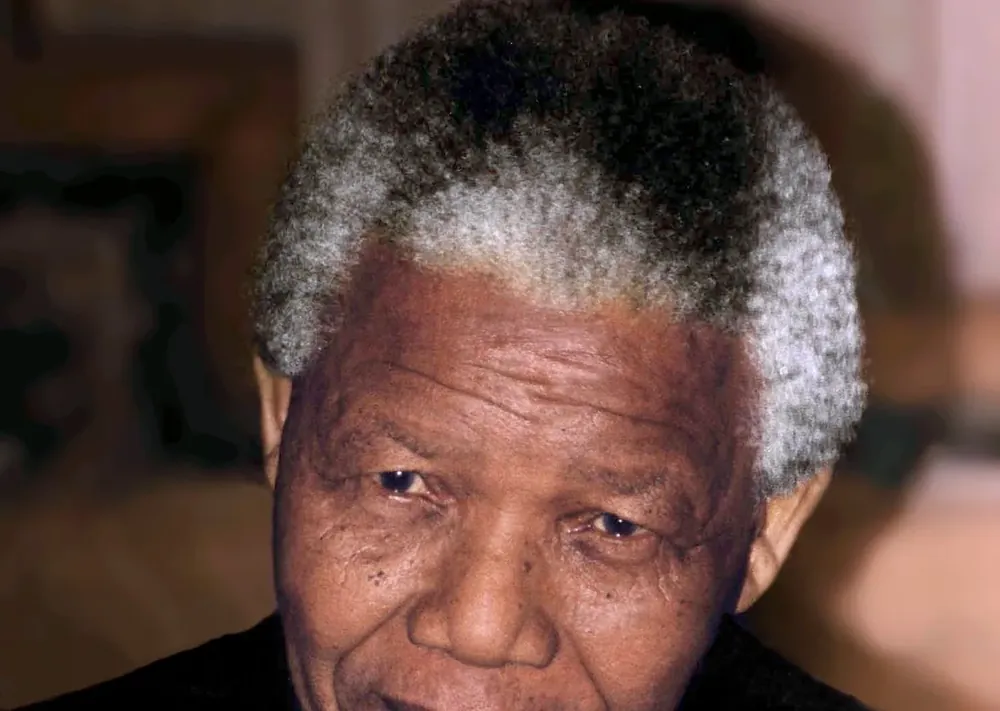
Kingkongphoto & www.celebrity-photos.com, via Flickr, 1994 · Kingkongphoto & www.celebrity-photos.com from Laurel · CC BY-SA 2.0 · Source page
A protest, a ban and a closing door
How many people died?
On 21 March 1960 a crowd gathered outside the police station in Sharpeville, a town south of Johannesburg, to protest against the pass laws. The police opened fire.
How many people died? There are two answers, and they do not agree. This is not a riddle. It is the first question a historian has to settle: who counted, and when?
Background
A pass in every pocket
Under the pass laws, Black South Africans had to carry a document that set out where they could live, work and travel. The pass laws were one of the main tools of apartheid, the system of laws that divided people by race.
One of the main organisations against these laws was the African National Congress, the ANC. For decades it had fought them by peaceful means: petitions, boycotts and protests. The protest at Sharpeville was one of them.
The count
Who counted?
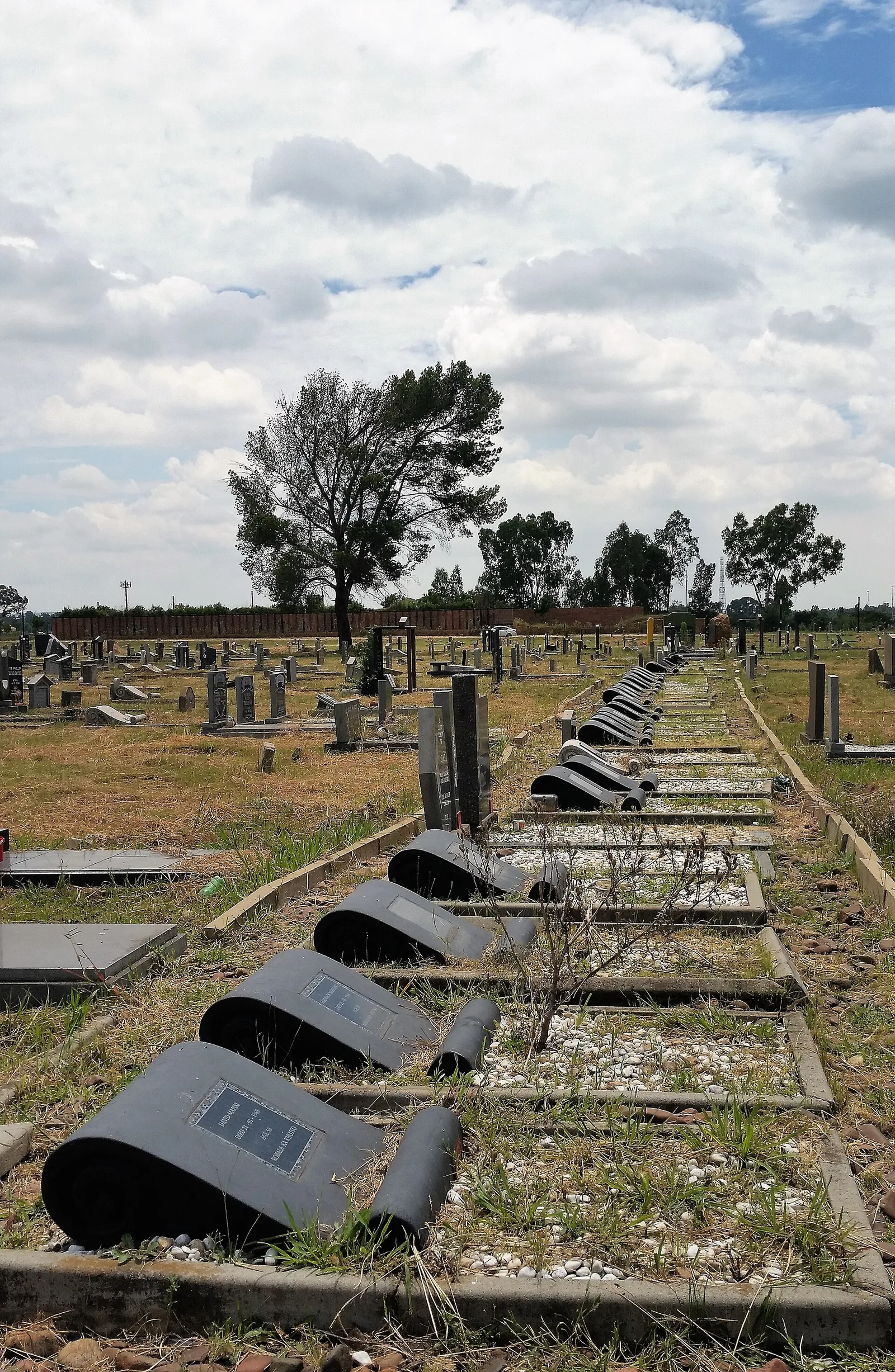
Andrew Hall, 2017. Wikimedia Commons · CC BY-SA 4.0 · Source page
69 vs 91
The older figure is the police count: 69 people killed. New research by the historians Nancy Clark and William Worger puts the number at least 91 killed and more than 238 wounded.
The two counts were made at different times, by different people. The older one came from the police; the new research was made decades later. So every number in this lesson needs a name beside it: who gave it, and when.
The ban
Banned
On 8 April 1960, less than three weeks after Sharpeville, the government banned the ANC and the Pan Africanist Congress (PAC). A banned organisation was outlawed. Its meetings could be broken up, and its members could be arrested.
A peaceful protest had been answered with a massacre and a ban. The organisations that had asked for change were now illegal.
1961
Where the road ends
By 1961 the peaceful road seemed closed. The government had refused to call a national convention, a meeting of all races to decide the country's future. The ANC was banned, and its leaders were pursued by the police.
A leader does not decide alone. He needs a mandate from the people or organisation he speaks for. Nelson Mandela, living underground and a fugitive from the police, was one of those arguing over what to do next.
The armed wing
A decision point
You are Nelson Mandela, an underground leader of the ANC.
June 1961. You are in hiding. The ANC has been banned since April 1960.
Sharpeville ended in a massacre, and the ANC and the PAC were banned. The government refuses to call a national convention. Your movement has tried petitions, boycotts and protests, and each one has met force or a new law.
Some of your colleagues say the peaceful road is closed. Others warn that force would bring the full weight of the state down on your people. You must decide what the movement does next.
What do you propose?
- Keep the movement non-violent. Press for a national convention, boycotts and protests, and accept that the state may keep answering with arrests. Probably the movement keeps its moral standing, but gives the government no reason to talk. Protests can be crushed, and the leaders stay exposed to arrest.
- Form a separate armed wing for sabotage: attacks on property and power lines, with a rule that no one is to be killed or hurt. Probably the state answers with more arrests and harsher laws, and secret cells would have to be built. But the movement would keep acting, and those who said nothing could be done would have an answer. The rule against harming people would be hard to keep as the campaign grew and the pressure rose.
- Give the government a deadline to call a national convention. If it refuses, threaten sabotage. Probably the government ignores the deadline. You then face the same choice again, with less time and less support.
What really happened
Form a separate armed wing for sabotage: attacks on property and power lines, with a rule that no one is to be killed or hurt.
In the end the ANC chose option b. A new armed wing, Umkhonto we Sizwe (MK), was set up. The decision is dated to early June 1961. Its first attacks came on 16 December 1961, against government installations, beginning with an electrical substation. Its stated aim was to avoid any injury or loss of life.
As the next steps show, that aim did not hold.
Mandela later argued that sabotage did not involve loss of life, and that it offered the best hope for future race relations. Historians ask how far that was the real reason, and how far it was the reason that could be defended in public.
Those who defend the choice point to a closed road: the ban, the massacre and the refusal to talk. Critics point to what came later, and ask whether a campaign that began with a rule against killing could keep that rule.
What followed
16 December 1961
The first attacks came on 16 December 1961. The targets were government installations, and the first was an electrical substation. The early plan named targets such as power-line pylons. Nobody was meant to be hurt.
1962
A roadblock near Howick
On 5 August 1962 police arrested Mandela at a roadblock near Howick. He had spent more than a year underground, and the first attacks had come while he was there.
From here the story moves to the courtroom and the prison.
1983 to 1986
When the rule broke
The aim of no loss of life did not hold. Later MK attacks sometimes killed civilians.
On 20 May 1983 a bomb exploded in Church Street, Pretoria. Nineteen people died, two of them the bombers, and about 217 were injured. The ANC later told the Truth and Reconciliation Commission (TRC) that an MK special operations unit carried out the attack.
In December 1985 an attack on a shopping centre at Amanzimtoti, shortly before Christmas, killed five civilians and injured 40. The ANC told the TRC that the attack was not in line with its policy.
In 1986 an attack on Magoo's Bar in Durban killed three civilians and injured 69. The TRC called it a gross violation of human rights.
Each attack is on the record, and so are the explanations. Historians ask how a campaign that began with a rule against killing came to this.
The dock
Background
A farm in Rivonia
On 11 July 1963 the police raided a farm in Rivonia, near Johannesburg, where members of the underground had been living and meeting. Many of the men found there were arrested.
Mandela was already in prison. The Rivonia Trial opened in Pretoria in October 1963, in the Palace of Justice. Eleven men were accused of sabotage and conspiracy.
The prosecution never formally asked for the death penalty. Observers believed a death sentence was implied.
A decision point
You are Nelson Mandela, in the dock at Pretoria.
20 April 1964. The trial has run for more than six months.
You are accused with others of sabotage and conspiracy. The state has built its case. Your lawyers want you to say nothing about politics, because they fear that a political speech could bring a death sentence.
Silence would leave the court and the world with the state's version of the movement.
What do you say?
- Let the lawyers argue the case on the law. Make no statement on politics. Probably a shorter trial, and less risk of a heavy sentence. But the court and the public would never hear what the accused believed, and the case would be argued entirely on the state's terms.
- Make a long political statement, but leave out the final line, as the lawyers ask. Probably a powerful speech with less risk. The sentence would depend on the state's case and the evidence, not on a final line of yours.
- Make a long political statement, and end it with a declaration that you are ready to die for your ideal. Probably the statement becomes the most remembered part of the trial, and the sentence may be heavy. The prosecution never asked for death, but your words could make a death sentence easier to argue for, and they would reach a wide audience.
What really happened
Make a long political statement, and end it with a declaration that you are ready to die for your ideal.
He chose option c. The lawyers had strongly resisted the final line, fearing it could bring a death sentence. In the account most often cited, Mandela's concession was to put the words “if needs be” before it, so that it read as a conditional commitment.
The statement was delivered in English on 20 April 1964.
In his memoir, Mandela gives his own version of the argument with his lawyers. Other accounts differ on the exact wording, and on whether the lawyers were ever persuaded.
Read in full, the statement is a long account of why the sabotage was chosen. The line about being ready to die comes at its end. It is often quoted alone, and that changes its meaning. Historians disagree about how much of the speech was a plea to the court, and how much a message to history.
Source: Statement from the dock, 20 April 1964
…it is an ideal for which I am prepared to die.
The statement was delivered in English, so there is no translator to blame for the wording. The line is a short fragment of a long speech.
- Who is the statement for? A court that could sentence him, the press that would print it, and history. Mandela knew all three would read it. A speech in court is always also a message to the public.
- Which part of the text was the lawyers' compromise? On the usual account, the words “if needs be”, which come just before the line. The lawyers and the accused did not always agree on how the speech should end.
- How do we know these are his exact words? We cannot be certain. The online text says its source document is not known. Check it against other versions, as historians do, before trusting every word.
12 June 1964
Eight life sentences
On 12 June 1964 the court sentenced eight of the accused to life imprisonment. Eleven men had been on trial. Lionel Bernstein was acquitted. The charges against Bob Hepple were withdrawn, and James Kantor was discharged.
Mandela was one of the eight. A life sentence meant years in prison, with no fixed release date.
The island and the wall
June 1964
Prisoner 466/64
In June 1964 a prisoner with the number 466/64 arrived on Robben Island, an island off Cape Town where the state held its political prisoners.
The prison records keep this number. They are a primary source: a date, a name and a number, written at the time. A historian can check them, and a memory can be checked against them.
1982
Moved to the mainland
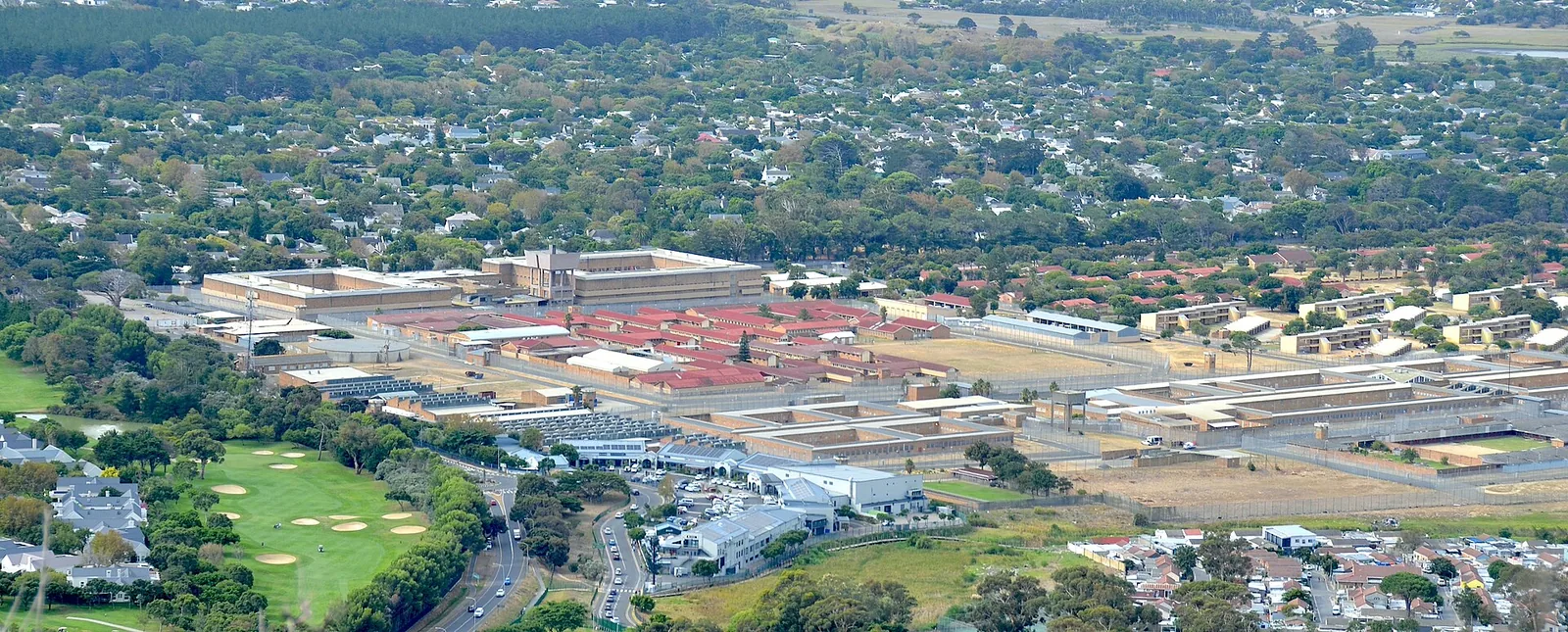
Olga Ernst, 2024. Wikimedia Commons · CC BY-SA 4.0 · Source page
On 31 March 1982 Mandela, Walter Sisulu, Raymond Mhlaba and Andrew Mlangeni were moved from Robben Island to Pollsmoor Prison in Cape Town. Ahmed Kathrada joined them there later.
Pollsmoor stands on the mainland, in Tokai. After eighteen years on the island, the men were now on the mainland.
Source: A photograph of the island cells
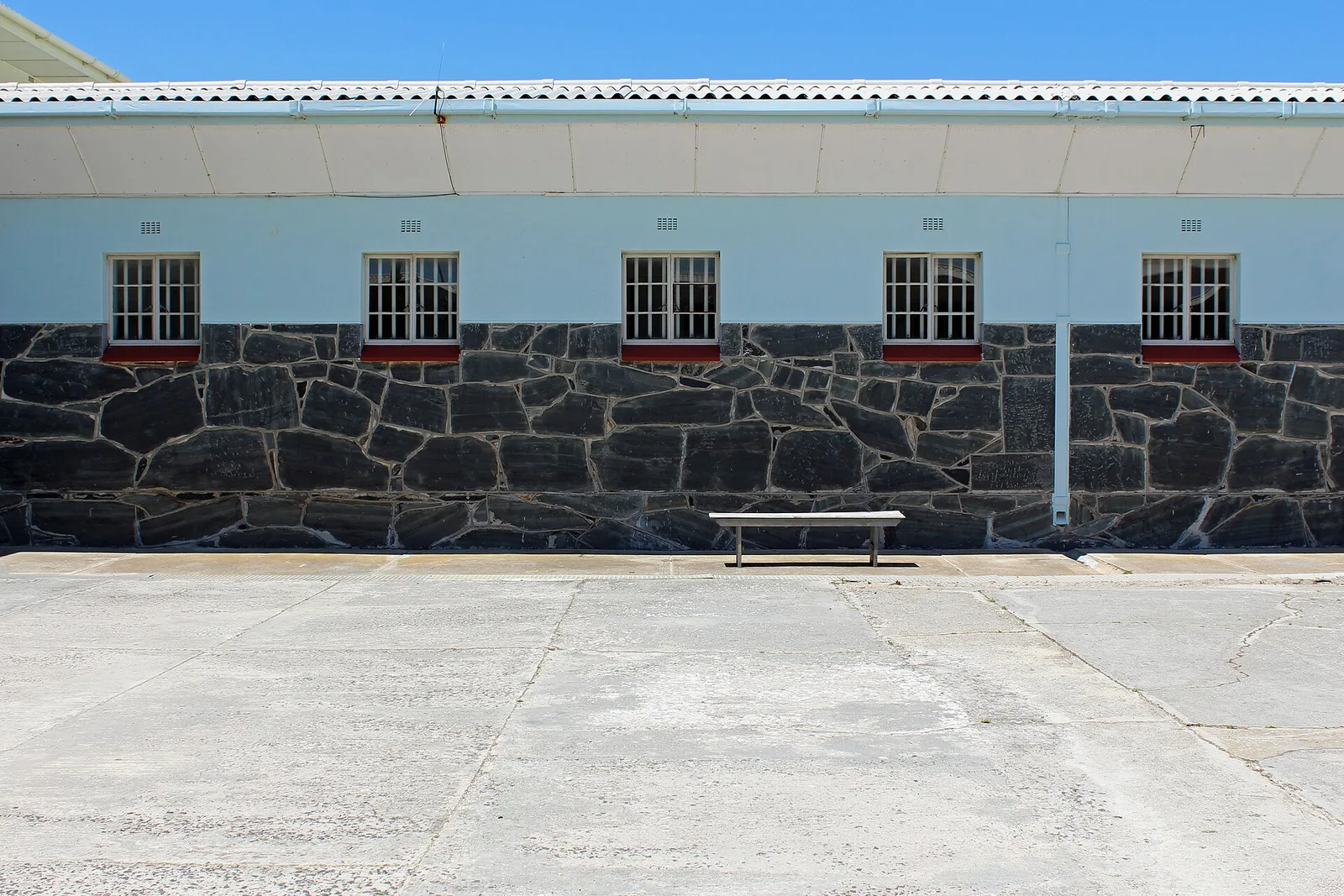
HelenOnline, 2013. Wikimedia Commons · CC BY-SA 3.0 · Source page
Photograph by HelenOnline, 28 November 2013, Robben Island Maximum Security Prison (Wikimedia Commons).
The file's description says Mandela's cell is the fourth from the left. The photograph itself does not show that.
- When was this photograph taken, and does that matter? In November 2013, almost fifty years after Mandela arrived on the island. It shows the place as it is now, not as it was when he was held there. It tells us about the building, not about a prisoner's day.
- Why does a historian want prison records as well as a photograph like this? A record, such as the number 466/64, is a document written at the time and dated. A photograph shows what a place looks like later, not what happened there.
- Which cell is Mandela's, and how do we know? The fourth from the left, according to the file's description. A photograph alone could not show whose cell it is.
The offer
31 January 1985
An offer in Parliament
On 31 January 1985 State President P. W. Botha offered in Parliament to release political prisoners who gave up violence as a political weapon. The offer was conditional, and the condition was the point.
Ahmed Kathrada later said that Mandela was called to an office and given a printed extract from Hansard, the official record of what is said in Parliament. The offer was there, in print.
An offer like this looks simple. The question is what it really gives, and who would have to pay for it.
A decision point
You are Nelson Mandela, a prisoner at Pollsmoor, in February 1985.
February 1985. You have been in prison since August 1962.
The offer is release for political prisoners who give up violence as a political weapon. The condition is the point. You are asked to renounce, in public, the method your movement has used since 1961.
The ANC is still banned, its leaders are in exile, and its members inside the country are under pressure. If you walk out, will the movement walk with you? If you refuse, what does the state gain?
Do you accept?
- Accept the conditional release, and renounce violence as a political weapon. Probably you leave prison soon. But you would have given up the method your movement had chosen, and many in the townships and in exile would read it as a betrayal of those who fought.
- Refuse. Demand unconditional release and the legal right for the ANC to work openly. Probably you stay in prison. The government holds its position, and the refusal makes you a symbol for people inside the country. It may keep you in prison for years, with no sign of talks.
- Refuse, but offer talks on the ANC's terms, and only once the ban on the organisation has been lifted. Probably the government calls this a stall and says no. The talks would wait for a change the government had no reason to grant, and the offer would look like a bargaining position, not a way out.
What really happened
Refuse. Demand unconditional release and the legal right for the ANC to work openly.
He refused. On 10 February 1985 his reply was read at a mass meeting in Jabulani Stadium, Soweto. The rally was organised by the United Democratic Front, and it celebrated Desmond Tutu's Nobel Peace Prize.
No release followed. The next contact between Mandela and the government was in secret, later that year, as the next chapter shows.
The reply's central argument is that the organisation of the people must be legal before anyone can talk freely. Mandela asks what freedom is being offered while the ANC remains banned, and says that prisoners cannot make binding agreements.
The refusal was a choice to hold out for the organisation, not for himself alone. Read it beside the offer, and decide whether the refusal was a principle or a bargaining position.
Source: The reply, read by his daughter
What freedom am I being offered while the organisation of the people remains banned?
The reply was read aloud by his daughter, Zindzi Mandela, not by Mandela himself. The reply also says that his wife and their attorney had seen him at Pollsmoor the Friday before.
- Who wrote the reply, who spoke it, and who printed it? Mandela's words, spoken by his daughter, and published by the ANC in London. The reply itself says his family and lawyer had visited him the Friday before, which suggests how it left the prison.
- Who was the audience? The crowd in Soweto, the government, and readers abroad. A text read aloud is written for the ear: short claims, heard once. It was also written for the people who had banned the organisation.
- What is missing from it? The offer itself. The reply answers an offer that must be found in another source, such as the Hansard record. Compare the two before you decide what the reply means.
1985
The months after the reply
On the surface nothing changed. The government did not free him, and the ANC stayed banned. Below the surface, the question of talks was already being tested. The next chapter follows the first meeting, which one account places in a hospital bed.
The back channel
November 1985
A hospital bed in Cape Town
One account says the first meeting took place in a Cape Town hospital in November 1985. Mandela was recovering from prostate surgery.
In that account his visitor was Kobie Coetsee, the Minister of Justice. The contact that began there went on in secret for years.
August 1989
A new head of state
P. W. Botha resigned as State President on 14 August 1989. F. W. de Klerk became acting State President the next day, and was elected State President on 20 September 1989.
The talks had begun under Botha. Now another man led the state, and the question was whether the new leadership would go on with them.
A decision point
You are Nelson Mandela, in Victor Verster Prison, in late 1989.
Late 1989. You have been at Victor Verster since December 1988.
For about four years, officials have met you in secret, while the government still bans your organisation. The count of meetings is disputed. One account, drawn from prison records, reaches at least fifteen between 1985 and 12 December 1989.
Your organisation's leaders are in exile, and Oliver Tambo leads the ANC from abroad. Whether they approved each step is disputed, even among those who were there. The state now has a new leader, F. W. de Klerk.
What do you do next?
- Keep the talks secret, and get the exile leadership's approval before any move. Probably the talks go on for months and could produce a deal. But the approval would come late, through messages, and the exiles could feel bypassed. The dispute over who approved what would be harder to settle later.
- Demand all-party talks, with the banned organisations present, before any deal with the government. It would keep the banned organisations in view, so no deal could be made behind their backs. But probably the government refuses. Talks with banned organisations at the table would mean accepting them as partners, which it had not done. The meetings would stop, and you would stay in prison longer.
- Accept release on the government's terms, before the ANC is legal again. Probably you leave prison, but the organisation stays banned, and you have little to bargain with afterwards. The exile leaders would have less say in what follows.
What really happened
Keep the talks secret, and get the exile leadership's approval before any move.
The authors Mac Maharaj and Z. Pallo Jordan, both ANC insiders, say that Mandela did what option a describes. They write that he sent word to Oliver Tambo, through George Bizos, that he would commit to nothing without the ANC's backing. In their account Tambo then gave the green light.
Critics disagree. A 2020 opinion piece in the Daily Maverick argues that Mandela had no mandate from Tambo, and that an emissary was sent only later. Whether the exile leadership approved in time is the disputed point, and this lesson does not decide it.
Mandela had no direct line to the exiles. Messages went through trusted people, and each one took time. That slowness is why the question of approval matters so much.
The authors also write that he did not consult his four fellow prisoners. Later, Thabo Mbeki was unhappy that Mandela had not fully confided in him. Both points show what was at stake, whatever the answer.
Who gave the green light?
Did the ANC leadership approve the talks before they began?
- Mac Maharaj and Z. Pallo Jordan, Breakthrough (2021). ANC insiders. Mandela sent word through George Bizos that he would commit to nothing without the ANC's backing. Tambo, they write, gave the green light, and Mandela then moved. They also write that he did not consult his fellow prisoners.
- A 2020 opinion piece in the Daily Maverick. The author argues that Mandela had no mandate from Tambo, and that he sent an emissary only later. On this view the talks ran ahead of the leadership.
- Niel Barnard, a former state security official. He disputes that Coetsee was the main figure in the talks. The figure of 48 meetings in the 2020 opinion piece comes from his team.
Can the question be settled with the evidence we have? Which document would change your mind?
Freedom, and what came after
February 1990
Unbanning, then release
On 2 February 1990 F. W. de Klerk announced in Parliament the unbanning of the ANC.
On 11 February 1990 Mandela was released from Victor Verster Prison. He had been in prison since August 1962.
Nelson Mandela
An ANC leader whose life became a series of hard choices.
- Born: 1918, Mvezo
- Died: 2013, Johannesburg
…it is an ideal for which I am prepared to die.
Myth
Mandela spent 27 years on Robben Island.
The truth
No. He spent 18 years on Robben Island, from June 1964 to March 1982. He was then held at Pollsmoor Prison and, from December 1988, at Victor Verster Prison. In all, he was in prison for over 27 years.
The evidence
The Mandela Foundation's chronology gives the dates, and his prisoner number 466/64. The myth mixes the island years with the total. The total is the sum of three prisons, not of one island.
1993
A shared prize
In 1993 Mandela and F. W. de Klerk were jointly awarded the Nobel Peace Prize for their work in ending apartheid. The ceremony was held in Oslo on 10 December 1993.
Two men who had sat on opposite sides of the table now shared a prize. Historians still argue over how much each man did, and when. The shared prize does not settle that question.
1994 to 2008
A first fully representative vote
In 1994 South Africa held its first fully representative democratic election. Mandela was elected president, the first chosen in such an election. His term ran from 10 May 1994 to 14 June 1999.
He declined a second term. Thabo Mbeki succeeded him in 1999.
In 2008 the United States lifted the terrorism-related immigration bar that had applied to Mandela and the ANC. The change came after he had left office.
24 June 1995
The final at Ellis Park
On 24 June 1995 South Africa met New Zealand in the final of the Rugby World Cup, at Ellis Park in Johannesburg. The match went to extra time. South Africa won 15–12. The winning points came from a drop goal by Joel Stransky.
Mandela attended and presented the Webb Ellis Cup to the Springbok captain, François Pienaar. He wore a Springbok shirt numbered 6.
Myth
Before the final, Mandela gave Pienaar a copy of William Ernest Henley's poem “Invictus”, and the poem carried the team to victory.
The truth
This is the film's version. Invictus is a docudrama: real people and events, with dramatised scenes. The poem scene is one of them. According to a 2010 Daily Telegraph article by the historian Dominic Sandbrook, as Wikipedia cites it, the gift was a copy of Theodore Roosevelt's speech “The Man in the Arena”.
The evidence
The film also shows Pienaar visiting Mandela's cell on Robben Island. No such visit is documented. The critic Roger Ebert visited the cell himself, guided by Ahmed Kathrada. The film draws on John Carlin's book Playing the Enemy (2008).
Myth
A well-known passage about fear and power is often quoted as Mandela's, from his 1994 inauguration.
The truth
No. The passage is from Marianne Williamson's book A Return to Love, first published in 1992. One sentence from it reads: “Our deepest fear is that we are powerful beyond measure.”
The evidence
The New York Times noticed the misattribution in 1998. The Mandela Foundation said in 2007 that the line is not his, and that none of his three public addresses around the 1994 inauguration contains it.
What followed the choices
- 1960 After Sharpeville, the ANC and the PAC are banned, on 8 April.
- 1961 The armed wing is set up. Its first attacks come on 16 December.
- 1962 Mandela is arrested near Howick, on 5 August.
- 1964 On 20 April he speaks from the dock. On 12 June eight men receive life sentences.
- 1985 Botha's offer is made on 31 January. Mandela refuses; the reply is read on 10 February. By one account, the first meeting with the government follows in November.
- 1989 Botha resigns on 14 August. De Klerk is elected State President on 20 September.
- 1990 The ANC is unbanned on 2 February. Mandela is released on 11 February.
- 1994 The first fully representative election. His term as president begins on 10 May.
- 1999 He declines a second term. Thabo Mbeki succeeds him.
Check yourself
On what date were eight of the Rivonia accused sentenced to life imprisonment?
Answer: 12 June 1964. Right. The sentence was passed about seven weeks after the statement.
Check yourself
Who read Mandela's reply to Botha's offer at Jabulani Stadium, on 10 February 1985?
Answer: Zindzi Mandela, his daughter. Yes. His daughter read the reply aloud, and the text is held in the SAHO archive.
Check yourself
Mandela left prison on 11 February 1990. Which prison was it?
Answer: Victor Verster Prison. Yes. He had been there since December 1988, and was released from there.
Check yourself
In 1993 Mandela shared the Nobel Peace Prize with whom?
Answer: F. W. de Klerk. Yes. The two were jointly awarded the prize for their work in ending apartheid.
Check yourself
Who kicked the drop goal that won the 1995 Rugby World Cup final for South Africa?
Answer: Joel Stransky. Yes. His drop goal decided the match after extra time.
Check yourself
Whose words are “Our deepest fear is that we are powerful beyond measure”?
Answer: Marianne Williamson, 1992. Yes. The line comes from her book A Return to Love, first published in 1992.
Terms
- pass laws The laws that required Black South Africans to carry a pass, a document that set where they could live, work and travel.
- apartheid The system of laws in South Africa that separated people by race and gave white South Africans control.
- African National Congress (ANC) One of the main organisations against apartheid. It was banned in April 1960.
- sabotage Attacks on property and infrastructure, meant to damage a state without a battle.
- Umkhonto we Sizwe (MK) The armed wing of the ANC, set up in 1961.
- Rivonia Trial The trial in Pretoria, from October 1963, of eleven men accused of sabotage and conspiracy. It takes its name from the farm in Rivonia where members of the underground were arrested in July 1963.
- Robben Island An island off Cape Town used as a prison for political prisoners. Mandela was held there from 1964 to 1982.
- mandate The authority a leader receives from the people or organisation he speaks for.
- Hansard The official written record of what is said in Parliament.
- unbanning Lifting a ban on an organisation, so that it may again meet, print and speak in public.
- docudrama A film that mixes real events and people with dramatised scenes.
- primary source A document, object or testimony made at the time of the events, or by someone who saw them.
- Sharpeville A town south of Johannesburg. On 21 March 1960 police opened fire on a crowd protesting the pass laws, and the number killed is disputed.
- Johannesburg A large city in South Africa. Sharpeville lies south of it, and the Rivonia farm, where underground members were arrested, was near it.
- Pretoria A city in South Africa where the Rivonia Trial opened in 1963. In 1983 a bomb exploded there, in Church Street.
- Cape Town A city in South Africa. Robben Island lies off it, and Pollsmoor Prison is in the city too.
- Pollsmoor Prison A prison in Cape Town, on the mainland. Mandela and others were moved there from Robben Island in 1982.
- Victor Verster Prison The prison where Mandela was held from December 1988, and from which he was released in 1990.
- Soweto A township near Johannesburg where Black South Africans lived. In 1985 a mass rally was held there.
- Pan Africanist Congress A South African political organisation that demanded change. The government banned it, with the ANC, less than three weeks after Sharpeville.
- Truth and Reconciliation Commission An official commission that investigated violence from the apartheid years, to establish the truth and promote reconciliation.
- United Democratic Front A coalition of organisations inside South Africa that fought apartheid. It organised the mass rally in Soweto.
- Walter Sisulu A senior ANC leader. In 1982 he was moved from Robben Island to Pollsmoor together with Mandela.
- Ahmed Kathrada A political prisoner who joined Mandela and the others at Pollsmoor. He later said Mandela was given a printed extract from Parliament's official record.
- Oliver Tambo The ANC's leader in exile. He ran the banned movement from outside South Africa.
- P. W. Botha State President who offered in 1985 to free prisoners who gave up violence. He resigned in 1989.
- F. W. de Klerk State President who announced the unbanning of the ANC in 1990. In 1993 he shared the Nobel Peace Prize with Mandela.
- Thabo Mbeki The man who succeeded Mandela as president in 1999.
- Desmond Tutu A senior clergyman and anti-apartheid activist who won the Nobel Peace Prize.
- François Pienaar Captain of South Africa's rugby team. Mandela presented him with the trophy in 1995.
- Albert Luthuli President of the ANC when the armed-struggle decision was taken. One account says he took no part in the discussions; others say he accepted a separate armed wing or opposed it.
- Kobie Coetsee The Minister of Justice who, in one account, visited Mandela in hospital in 1985, where a secret contact began that lasted for years.
- Long Walk to Freedom Mandela's own memoir. For some events it gives a different sequence from the one told by one of the defence lawyers.
- Invictus A film about Mandela and the 1995 Rugby World Cup. It is a docudrama: real events, with some scenes invented.
- Stephen Ellis A historian who argues that the documents contradict the official account of the armed-struggle decision.
Sources
- Nelson Mandela, statement from the dock at the Rivonia Trial, Pretoria, 20 April 1964 (English text from Wikisource)
- Nelson Mandela, reply to P. W. Botha's offer, read by Zindzi Mandela at Jabulani Stadium, Soweto, 10 February 1985 (South African History Online archive)
- Nelson Mandela, Long Walk to Freedom (1994)
- Nelson Mandela Foundation, trials and prison chronology
- Truth and Reconciliation Commission of South Africa, final report (1998)
- Quote Investigator, ‘Our deepest fear’ (2019)
- Mac Maharaj and Z. Pallo Jordan, Breakthrough (2021)
- Nancy Clark and William Worger, Voices of Sharpeville (new research on the 1960 death toll)
- John Carlin, Playing the Enemy: Nelson Mandela and the Game That Made a Nation (2008)
- Marianne Williamson, A Return to Love: Reflections on the Principles of A Course in Miracles (1992)
- Dominic Sandbrook, Daily Telegraph, 30 January 2010
Image credits
- Kingkongphoto & www.celebrity-photos.com, via Flickr, 1994 · Kingkongphoto & www.celebrity-photos.com from Laurel · CC BY-SA 2.0 · Source page
- Andrew Hall, 2017. Wikimedia Commons · CC BY-SA 4.0 · Source page
- Olga Ernst, 2024. Wikimedia Commons · CC BY-SA 4.0 · Source page
- HelenOnline, 2013. Wikimedia Commons · CC BY-SA 3.0 · Source page


