The Long March, 1934–1935: retreat or legend?
In the most famous version of the Long March, twenty-two men crawl over burning iron chains above the Dadu River. Parts of that story happened, and other parts were added later. In this lesson you decide which is which, by weighing the sources yourself.
Decisions, questions and your own progress, in the app
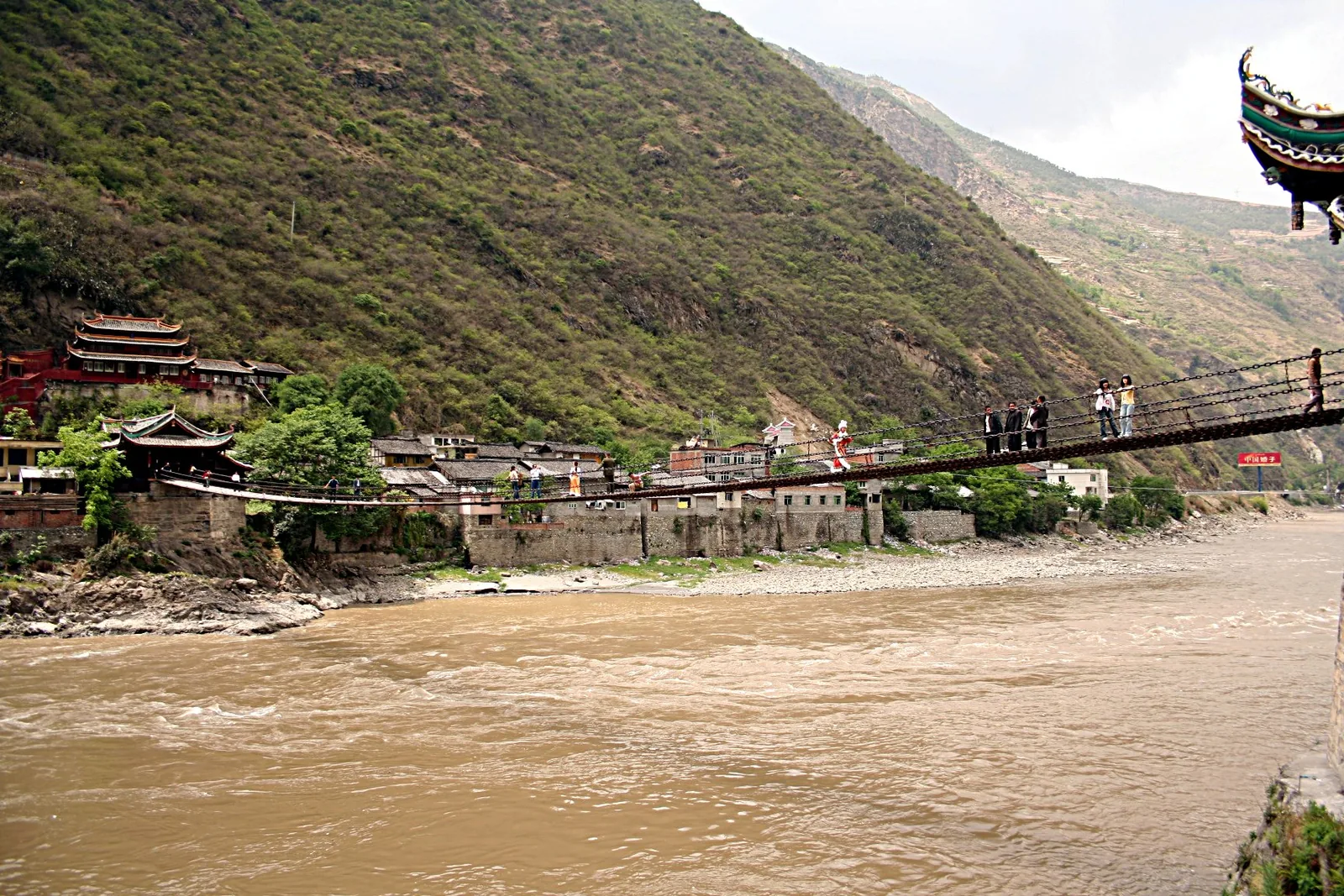
Rolf Müller, Luding Bridge, Luding, Sichuan, 2006. Own work · Rolf Müller (User:Rolfmueller) · CC BY-SA 3.0 · Source page
The scene
The legend of the bridge
In the most famous version of the story, twenty-two men crawl out over an iron-chain bridge above the Dadu River, in Sichuan, in south-west China. The chains are on fire, and the enemy’s machine guns are firing at them.
Part of this happened. Other parts were added later, and some are still argued over. In this lesson you will work out which part is which, and why.
Background
A year on the road
1934–35
The Long March was the retreat of the Chinese Communist army from its base area in Jiangxi, in south-east China, through the mountains of the south-west and north to Shaanxi. It took about a year, from October 1934 to October 1935. Its Chinese name, changzheng, means ‘long march’.
The army crossed mountains and rivers, and for much of the way it was pursued. CGTN reports that Mao later told the American journalist Edgar Snow that the distance was 25,000 li: about 12,500 km.
The march became a founding story for Communist China. Sun Shuyun’s book on it carries the subtitle ‘The True History of Communist China’s Founding Myth’.
Mao Zedong
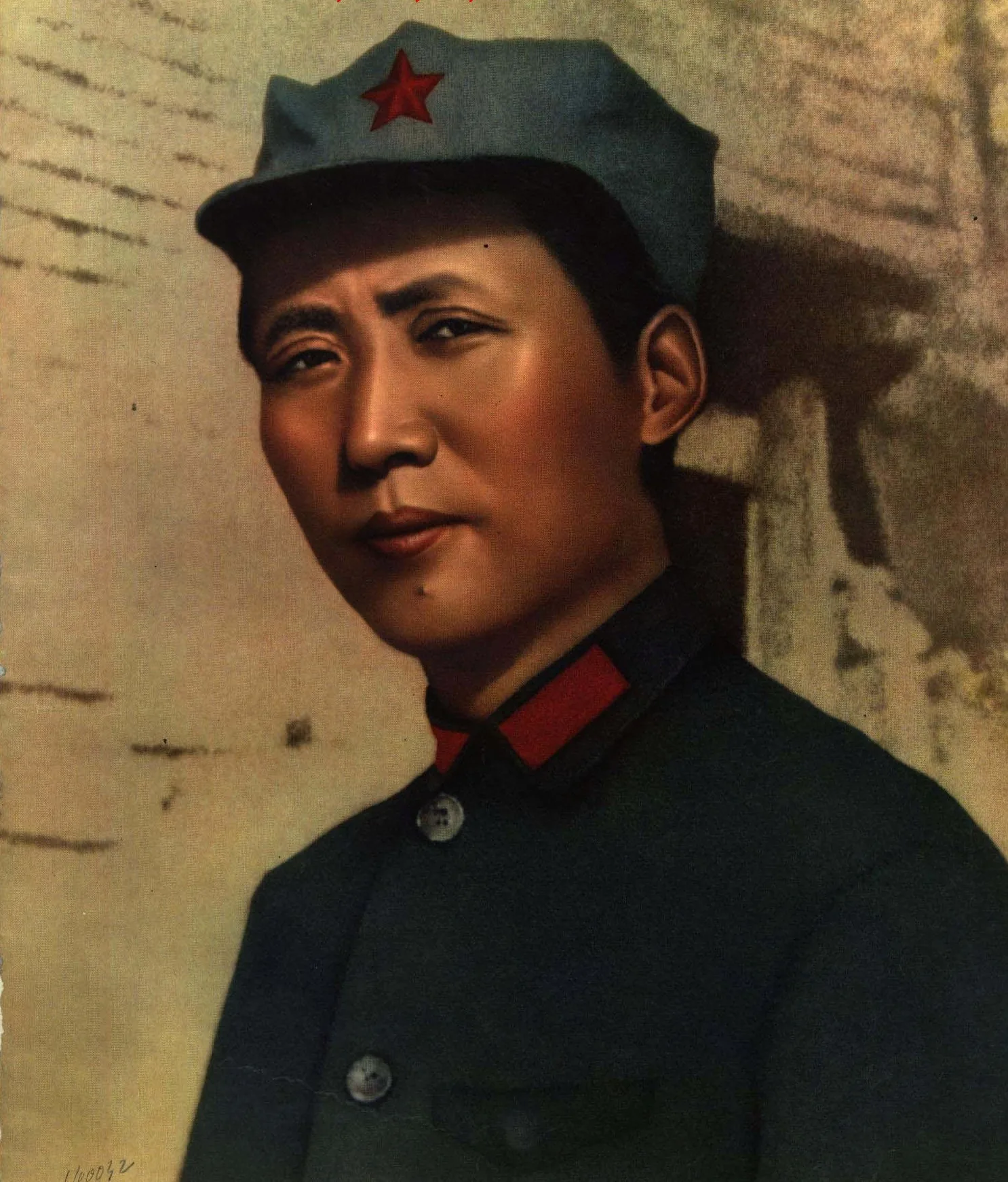
Edgar Snow, photograph of 1936. Published in People’s Pictorial (人民画报), 1967, no. 10 · Public domain · Source page
A Communist leader whose rise is linked to the march, though how far the march made him is disputed.
- Born: 1893
- Died: 1976
The march was 25,000 li long.
The road to it
Background
A ring around the base
86,000
In 1933 and 1934 the Nationalist army of Chiang Kai-shek tried to choke the base area the Communists held in Jiangxi, in south-east China. The method was encirclement: a ring of troops and blockhouses, built step by step around the base.
The Communists had a German military adviser, Otto Braun, sent through the Comintern. Braun backed a war of fixed positions: hold the line, dig in, and defend every post. The party later blamed him for its defeats.
In October 1934 the army broke out of the ring and left Yudu, in Jiangxi, with about 86,000 troops.
The river
The Xiang River
The army’s first big test came at the Xiang River, in Guangxi province, in late November 1934. The Nationalists caught up with it, and the fighting ran into early December.
CGTN, the Chinese state broadcaster, says in a 2026 feature only that the army ‘suffered heavy casualties’. How many died here? Sources disagree sharply. See the panel below.
A decision point
You are Mao Zedong.
15–17 January 1935, Zunyi, Guizhou
You are at a meeting of the Politburo at Zunyi, a town in Guizhou. The army has taken heavy losses on the Xiang River, and the Nationalists are still following it.
The leadership, Bo Gu and the German adviser Otto Braun among them, has kept to fixed positions and set-piece fights. The army is still on the road. You do not yet know how the march will end, or how the leadership will change.
What do you propose?
- Keep the present leaders and their tactics, and fight the next battle the same way. Probably the army keeps paying in lives for set-piece fights, while the Nationalists keep pursuing it. The men who led on the Xiang River stay in command.
- Replace the military commanders and move to a more mobile war. Probably the army becomes harder to pin down, but the new plan is untested in the field, and the men pushed aside will resent it.
- Carry on the march as planned, and leave the question of command for later. Probably nothing changes at once: the column keeps moving under the same leaders and the same plan, with the Nationalists still pursuing it.
What really happened
Replace the military commanders and move to a more mobile war.
The sources say the military command changed at Zunyi. How far Mao gained from it, and how far he drove the change, is disputed. Benjamin Yang (1986) argues that scholars have given Zunyi too much weight as a turning point.
No words of Mao’s on his reasons survive that we could check. Historians point to the losses on the Xiang River and to the old tactics.
The march itself
Guizhou and Sichuan
Four crossings
Between 19 January and 22 March 1935 the army crossed the Chishui River four times, on the border of Guizhou and Sichuan. Sources differ on the date of each single crossing, but agree on the span.
CGTN puts about 30,000 Red soldiers against roughly 400,000 enemy troops. That is a state figure, and we could not check it against a second source.
May 1935
A bridge over the Dadu
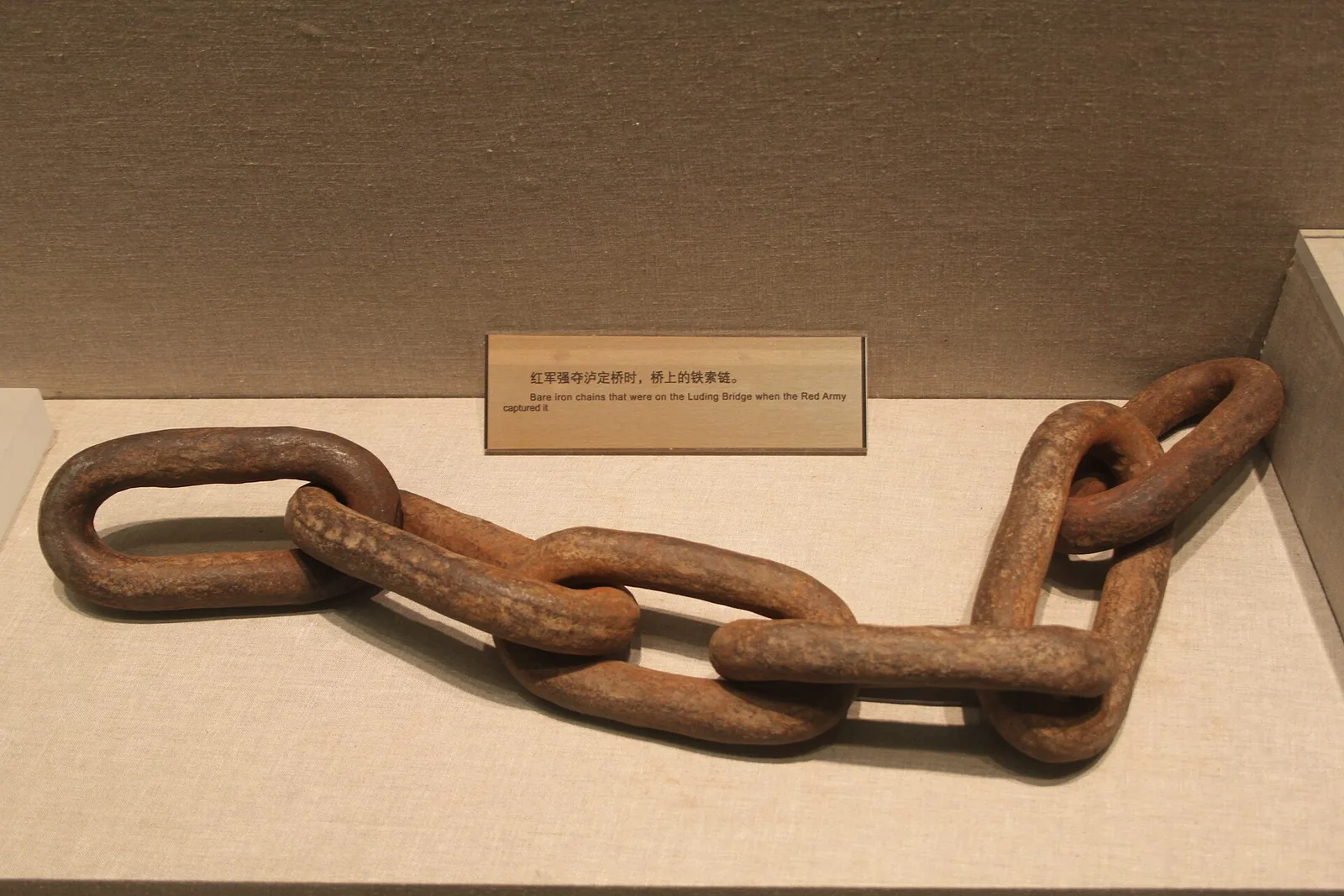
Iron chains from Luding Bridge, on display in the National Museum of China. Photo: Gary Lee Todd, Ph.D., 2011 · CC0 · Source page
22
According to China Daily (2021), the vanguard, the front of the column, covered about 120 km on 28 May 1935. Most sources we checked give 29 May for the seizure of the bridge at Luding. The research guide EBSCO gives 27 May.
Chinese official accounts say the defenders had removed the planks, and the attackers laid new ones under covering fire. CGTN (2021) puts it simply: ‘A team of 22 commandos volunteered to seize the bridge.’
This is the Chinese official version. Later in the lesson you will see which parts other sources doubt.
A decision point
You are Zhang Guotao, commander of the Fourth Front Army.
Summer 1935, Sichuan
Your army is larger than Mao’s. You did not go to Zunyi, and you oppose the march north.
Mao wants the whole column to march north into Shaanxi. Two leaders now want different routes.
What do you do?
- Follow Mao north, and keep the army in one column. Probably you lose your independent command, but the two armies keep moving together.
- Go west towards the Soviet borders, with your own army. Probably the route is harder, and local forces would make trouble on the way. You keep your command, but you lose contact with Mao.
- Set up a rival leadership, with yourself at its head. Probably this splits the Communist forces and makes you their leader in the field, but it makes Mao a rival and ends any joint march.
What really happened
Set up a rival leadership, with yourself at its head.
Zhang split from Mao in the summer of 1935 and set up a rival leadership. Sources differ on the date and the place, and one 2026 commentary calls the rival body the ‘Second Central’. His army was weakened in the months that followed.
We could not verify his own reasons. His army was larger than Mao’s, which made the question of command a real one.
October 1935
Who was counted?
In October 1935 the First Front Army reached northern Shaanxi: near Wuqi, according to EBSCO, or at Yan’an, according to other accounts. The sources do not agree on how many came with it.
EBSCO says only about 4,000 reached Shaanxi. A general encyclopedia gives about 7,000 to 8,000 for the same arrival. The sources disagree, and we cannot settle it here.
CGTN (2026) follows the story to the end: 86,000 set out, and ‘only just over 30,000 made it to the end’, at Huining in Gansu, in October 1936. That is a different end point a year later, so it does not contradict the Shaanxi figures.
What we really know
Source: A poem written at the end of the march
Paraphrase: the poem describes the iron chains over the Tatu (Dadu) River as cold.
Mao wrote it in October 1935, when the march was over. A poem is a celebration written by the march’s leader, not a report of it.
- Who wrote this, and when? Mao, the march’s leader, in October 1935, just after it ended.
- What is it for? To celebrate the march and its leader. It is not a record, so do not look in it to settle a number.
- What does it leave out? Whatever a celebration skips: names, numbers and doubts.
Myth
Luding Bridge was a heroic battle over burning chains.
The truth
A real crossing took place at Luding. The dispute is over what happened, not over whether it happened. No source we checked says the chains were set alight. In Snow’s book, which records Mao’s telling, paraffin on the planks begins to burn. Some historians think the story was also shaped as propaganda.
The evidence
The official account (CGTN, 2021) speaks of smoke-blackened faces and of clothes on fire, not of burning chains. Mao’s own 1935 poem describes the chains as cold. The official account also tells a version of the legend, so it is no clean debunking.
Source: Edgar Snow’s book, from interviews
Paraphrase: paraffin on the planking began to burn.
Snow, an American journalist, spent about four months with the Communists at Bao’an in 1936 and interviewed Mao there. The book came out in London in 1937 and in New York in 1938.
- Who wrote it, and what was his link to the subject? An American journalist sympathetic to the Communists, who had interviewed Mao at Bao’an.
- Who checked the text before it was printed? The Communists did. Mao’s side corrected and cut Snow’s draft before it was returned to him, according to Jonathan Spence in a 2005 review.
- Is it an independent eyewitness account? No. It is largely the leader’s own telling, and his people shaped it.
A decision point
You are Chiang Kai-shek.
12 December 1936, Xi’an
Troops under Zhang Xueliang and his ally Yang Hucheng have seized you in Xi’an. You are their prisoner.
For years you have pressed the campaign against the Communists. Japan took Manchuria in 1931. The captors’ demands, as reported later, include united resistance to Japan.
Your captors want an answer. A deal with the Communists is on the table.
What do you do?
- Refuse, and keep the campaign against the Communists going. Probably the captors hold you longer, the fight with Japan waits, and the Communists gain time.
- Agree to a united front with the Communists against Japan. Probably you are freed soon. But a promise given under pressure is easy to break, and the front would be fragile.
- Order your army to attack Xi’an and free yourself by force. Probably you are freed sooner, but your captors could kill you first, and your army would fight its own men instead of Japan.
What really happened
Agree to a united front with the Communists against Japan.
Chiang agreed, in words, to a united front against Japan, and refused to sign any document. Zhou Enlai, a Communist leader, met him on Christmas Eve, and Chiang was freed on 25 December 1936.
We did not check Chiang’s own reasons in his words. Critics say he put the fight against the Communists before the fight against Japan. One account, from the China Project, says he argued that China was too weak to fight Japan while divided. No other source we checked says so.
What followed, and the quiz
Afterwards
Released, and not released
Chiang was freed on 25 December 1936, and a second united front against Japan began. The China Project calls it fragile.
Zhang Xueliang was not freed. His house arrest in Taiwan ended only with Chiang’s death in 1975, and his freedom was officially restored in 1988. He died in Honolulu in 2001. His custody lasted more than fifty years.
After the march
- 25 December 1936 Chiang is freed after the Xi’an talks. The agreement stays verbal, unsigned.
- 1937–38 Snow’s book appears in London and New York, taking the march to readers outside China.
- 1938 Zhang Guotao defects to the Nationalists, according to later accounts.
- 1975 Chiang dies. Zhang Xueliang’s house arrest in Taiwan ends, but he is not yet officially free.
- 1988 Zhang Xueliang’s freedom is officially restored, on 26 March.
- 2006–07 Sun Shuyun’s book comes out in Britain and then in the United States, and questions the Luding story.
Legend or history?
What was the Long March: a real battle, a founding story, or both?
- Sun Guangjun, a former chairman of Luding’s advisory body and a party history expert, as cited by the state media Luding was a real and heroic assault, and the march a true story of courage. The official account says so, and the state media repeat it.
- Sun Shuyun, in her book The Long March (2006 in Britain, 2007 in the United States) Luding was at most a skirmish with a warlord’s guards, and probably no Red soldiers died there. The founding legend was shaped later, and she relies on interviews, a veteran general’s memo and a missionary’s diary.
- Benjamin Yang, in an article in The China Quarterly (1986) Zunyi has been given too much weight as a turning point.
Ask of each side: what evidence does it rest on, and who gains if it is believed?
Check yourself
Why is Snow’s book not an independent eyewitness account?
Answer: The Communists corrected and cut Snow’s draft before it was returned to him.. Right. Mao’s side changed the text before Snow got it back, according to Jonathan Spence (2005). The book is a leader’s account, not a neutral record.
Check yourself
What do the sources say about the chains at Luding?
Answer: No source we checked says the chains were set alight.. Right. In Snow’s account paraffin on the planks begins to burn, the Chinese official account speaks of smoke and clothes, and Mao’s poem calls the chains cold.
Check yourself
CGTN says ‘just over 30,000’ made it to the end, and EBSCO says about 4,000 reached Shaanxi. Why do the two not contradict each other?
Answer: They count different end points: Shaanxi in October 1935, and Gansu a year later.. Right. The Shaanxi figure is the arrival of October 1935. CGTN counts the end of the route at Huining in Gansu, in October 1936.
Check yourself
Did Chiang sign a united front agreement at Xi’an?
Answer: No. He agreed in words, and he refused to sign any document.. Right. So the deal rested on his word, not on a signed text, which is one reason it was fragile.
Check yourself
What does Benjamin Yang’s 1986 article argue about Zunyi?
Answer: That later scholars overrated Zunyi’s importance.. Right. Yang argues that scholars have given the conference too much weight in Mao’s rise.
Check yourself
When was Zhang Xueliang’s freedom officially restored?
Answer: In 1988.. Right. On 26 March 1988 Zhang Xueliang’s freedom was officially restored, after more than fifty years.
Terms
- encirclement A campaign to surround a base, cut off its supplies and wear down its defenders. Chiang Kai-shek ran one against the Communist base area in Jiangxi in 1933 and 1934.
- base area An area under Communist control, from which their army operated. The Red Army left the Jiangxi base area in October 1934.
- Comintern The Communist International, a body based in Moscow that guided Communist parties around the world. Otto Braun was its military adviser to the Chinese Communists.
- Politburo The inner council of the Chinese Communist Party, where its top leaders decide policy. At Zunyi, its members met to decide the military leadership.
- front army A large Red Army force. The First Front Army left Jiangxi in 1934, and the Fourth Front Army was led by Zhang Guotao.
- united front A temporary alliance between rivals for a shared goal. Here, the Nationalists and the Communists against Japan.
- Nationalists (Kuomintang) The party led by Chiang Kai-shek, known as the Kuomintang. Its army fought the Communists in the 1930s.
- li A traditional Chinese unit of distance. By CGTN’s conversion, 25,000 li is about 12,500 kilometres.
- propaganda Information spread to win support for a cause, often by leaving out what does not fit.
- changzheng The Chinese name for the Long March, meaning ‘long march’. The earliest known official use is in a Red Army document of February 1935.
- Dadu River A river in Sichuan, in south-west China. Above it stands an iron-chain bridge, the setting of the march's most famous story.
- Luding Bridge An iron-chain bridge over the Dadu River. The army seized it in May 1935, but sources disagree on the exact day.
- Xiang River A river in Guangxi province, in south China. In late November 1934 the Communist army and the Nationalists fought there, and sources differ sharply on the number killed.
- Chishui River A river on the border of Guizhou and Sichuan. Between 19 January and 22 March 1935 the army crossed it four times.
- Zunyi A town in Guizhou where the Communist leadership met during the march. Sources differ on how much changed there.
- Yudu A town in Jiangxi from which the Communist army broke out in 1934, when the Nationalist forces had encircled its base area.
- Jiangxi A province in south-east China. The Communists held a base area there, and the army set out on the Long March from it.
- Shaanxi A province in north-west China, which the army reached in 1935. Different sources name different end points for the march.
- Yan'an A city in Shaanxi. According to other accounts, the army arrived there in 1935, instead of near Wuqi.
- Xi'an A city in north-west China. There Zhang Xueliang's troops seized Chiang Kai-shek, who was held until December 1936.
- Manchuria A region in north-east China. Japan took it in 1931.
- Sichuan A province in south-west China, where the Dadu River and the Luding bridge are.
- Otto Braun A German military adviser to the Communists, sent through the Comintern. He backed a war of fixed positions, and the party later blamed him for its defeats.
- Bo Gu One of the Communist leaders in the march. The leadership he sat in kept to fixed positions and set-piece fights.
- Edgar Snow An American journalist who spent about four months with the Communists at Bao'an in 1936 and interviewed Mao there.
- Sun Shuyun An author who wrote a book about the march. According to the book, probably no Red soldiers died at Luding.
- Chiang Kai-shek The leader of the Nationalists. In 1933 and 1934 he sent his army against the Communist base area. In 1936 he was seized at Xi’an and freed on 25 December 1936.
- Zhou Enlai A Communist leader. On Christmas Eve 1936 he met Chiang Kai-shek, who was freed on 25 December.
- Zhang Xueliang A Chinese military commander whose troops seized Chiang Kai-shek at Xi'an. His house arrest in Taiwan lasted until Chiang's death in 1975.
- Paraffin A wax made from petroleum that burns easily. In the story of the bridge, paraffin on the planks is said to have begun to burn.
- Commando A soldier in a small special unit that carries out dangerous, fast missions.
- China Daily A Chinese state newspaper. In 2021 it wrote that some 50,000 soldiers lost their lives in the battle on the Xiang River. No other source we found confirms that figure.
- CGTN The Chinese state broadcaster. Its 2026 feature says only that the army suffered heavy casualties, without a number.
- Benjamin Yang A scholar who argued in 1986 that historians have given Zunyi too much weight as a turning point.
- Sixth Tone A Chinese news website. Its 2026 article gives a march of 18,000 li, from a resolution of a 1935 meeting.
Sources
- Sun Shuyun, The Long March: The True History of Communist China’s Founding Myth (New York: Doubleday, 2007)
- Benjamin Yang, ‘The Zunyi Conference as One Step in Mao’s Rise to Power’, The China Quarterly 106 (1986), pp. 235–271
- Edgar Snow, Red Star Over China (London: Victor Gollancz, 1937)
- Mao Zedong, ‘The Long March’ (poem, October 1935), Selected Works, Poems, Marxists.org
Image credits
- Rolf Müller, Luding Bridge, Luding, Sichuan, 2006. Own work · Rolf Müller (User:Rolfmueller) · CC BY-SA 3.0 · Source page
- Edgar Snow, photograph of 1936. Published in People’s Pictorial (人民画报), 1967, no. 10 · Public domain · Source page
- Iron chains from Luding Bridge, on display in the National Museum of China. Photo: Gary Lee Todd, Ph.D., 2011 · CC0 · Source page


