Abraham Lincoln: four decisions that decided a war and a nation
When Lincoln took office in 1861, seven states had already left the Union. Four years later the war was over and he was dead. Which decisions mattered, and what is true and what is legend in the story?
Decisions, questions and your own progress, in the app
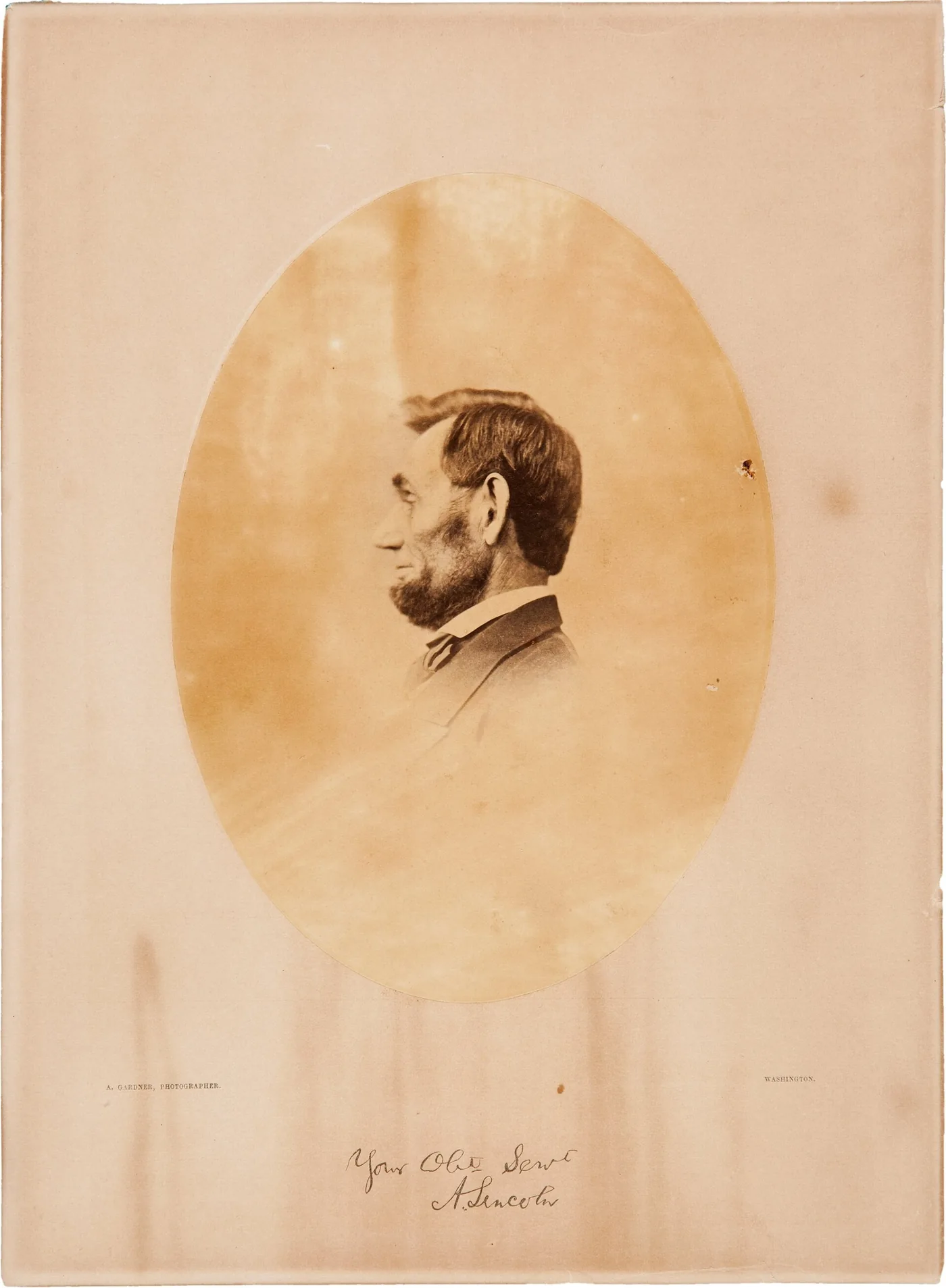
Alexander Gardner, Abraham Lincoln, Washington, 8 November 1863. Public domain. · Public domain · Source page
A lawyer from Springfield
Two stories about Lincoln and slavery
In one story, Abraham Lincoln frees the enslaved with the stroke of a pen. In the other, he never meant to free anyone. Both stories are only partly true.
The truth lies in four decisions he had to take while the country was tearing itself apart. You will take them one at a time, knowing only what he knew then, and then you can judge.
Abraham Lincoln
An Illinois lawyer, elected President of the United States in 1860 and killed in 1865.
- Born: 12 February 1809, Kentucky
- Died: 15 April 1865, Washington, D.C., Shot at Ford’s Theatre; died the next morning
- Won: Presidential election, 1860
- Lost: Senate race, 1858
“We are not enemies, but friends. We must not be enemies.”
Background
A lawyer in Springfield
Lincoln was a lawyer and politician in Springfield, the capital of Illinois. He rode from county to county to try cases before judges and juries, and there he learned to explain hard things in plain words.
In 1858 he ran for the United States Senate against Stephen A. Douglas, a powerful politician. The two men held a series of public debates about slavery and how far it could spread. Douglas won, because the Illinois legislature chose him. But the debates made Lincoln’s name known far beyond Illinois.
1860
An election without the South
Lincoln won the presidential election of 1860, although he received almost no votes in the South. His Republican Party opposed the spread of slavery into new territories. It did not demand an end to slavery where it already existed.
Keep that difference in mind. When we reach the decisions, the question will not be whether he was against slavery in general, but what he was prepared to do about it, and when.
The winter of secession
December 1860
Seven states leave
On 20 December 1860 South Carolina voted to secede from the Union, about six weeks after Lincoln’s election. By 1 February 1861 Florida, Mississippi, Alabama, Georgia, Louisiana and Texas had followed.
In February 1861 the seven states adopted a provisional constitution for a new government, the Confederate States of America. When Lincoln took office, the breakaway states already had their own government.
February 1861
A journey in disguise
Lincoln set out from Springfield for Washington. In Baltimore, where plots against his life were feared, he travelled in disguise, wearing a soft felt hat instead of his customary stovepipe hat. He reached Washington on 23 February, a capital under military guard.
4 March 1861
Friends, not enemies
On 4 March 1861 Lincoln gave his First Inaugural Address. He said he had no intention, directly or indirectly, of interfering with slavery where it already existed, and that he believed no lawful right allowed him to do so. He added that he had no objection to such a guarantee being written into the Constitution in explicit and permanent terms.
Near the end he spoke to the South directly: “We are not enemies, but friends. We must not be enemies.”
March 1861
A fort with six weeks of food
On the day of the inauguration a report reached Washington from Charleston. Fort Sumter, a federal fort in Charleston harbour, was held by Major Robert Anderson and about 85 men. Anderson reported that the fort had only about six weeks of food left.
The government of South Carolina wanted the troops out. Whoever held Sumter would, in effect, control the harbour.
Decision one: Fort Sumter
March 1861
The first month in office
Lincoln was a new president, and few in Washington yet knew how he would act. One urgent matter was on his desk: Fort Sumter.
Secretary of State William Seward wanted to give the fort up, as a gesture of goodwill to the South. Others disagreed. Virginia, still in the Union, had not yet left, and what the government did now would weigh on it.
A decision point
You are Abraham Lincoln.
Washington, late March 1861
About 85 men of the garrison sit in Fort Sumter. In early March their food was reckoned at about six weeks, and it is running out. The government of South Carolina demands that the troops leave, and the seceded states see a federal fort in their harbour as an affront they will not tolerate.
Your Secretary of State, Seward, wants to give the fort up, and part of the cabinet agrees with him. Others say that giving way will look like weakness, and that the seceding states will learn they can press the government. In the North people expect you to protect federal property. In the South they are waiting to see what you will do. The undecided states, Virginia among them, are watching to decide whether to stay in the Union.
What you do at Sumter will shape how you are seen for a long time. You know there is no answer that costs nothing.
What do you do?
- Withdraw Anderson and his men from Sumter, and leave the fort to South Carolina. Probably no shots would be fired at Sumter. But the South would read the withdrawal as proof that the new government gives way under pressure, and the states still in the Union, Virginia among them, would draw their own conclusions. The question of federal authority would stay open.
- Send ships carrying food only, with no troops and no ammunition, and tell South Carolina exactly what they carry. Probably the garrison would hold out, and the South would have to choose: let the food in, or open fire on ships that carry only bread. Either way, the next move would be theirs.
- Send warships and soldiers to hold the fort by force. Probably a battle would begin in the harbour. The North would rally to the fort, but Virginia and the other undecided states might turn toward the South, unwilling to fight their neighbours.
What really happened
Send ships carrying food only, with no troops and no ammunition, and tell South Carolina exactly what they carry.
Lincoln ordered a relief expedition. On 6 April he told the governor of South Carolina that the attempt would bring provisions only; if it was not resisted, no men, arms or ammunition would be sent without further notice. Earlier, Anderson had told the Confederate envoys that he would leave by noon on 15 April unless he received new orders or supplies.
At 4:30 in the morning on 12 April, the Confederate batteries opened fire on the fort.
Lincoln set the terms himself, in writing: food only, and no men or arms unless the attempt was resisted. He wanted to keep the fort without declaring war, and to leave it to the South to decide whether to attack. Historians disagree about whether this was a trap or an honest last attempt to keep the fort. See the note below.
12 April 1861
The first shots
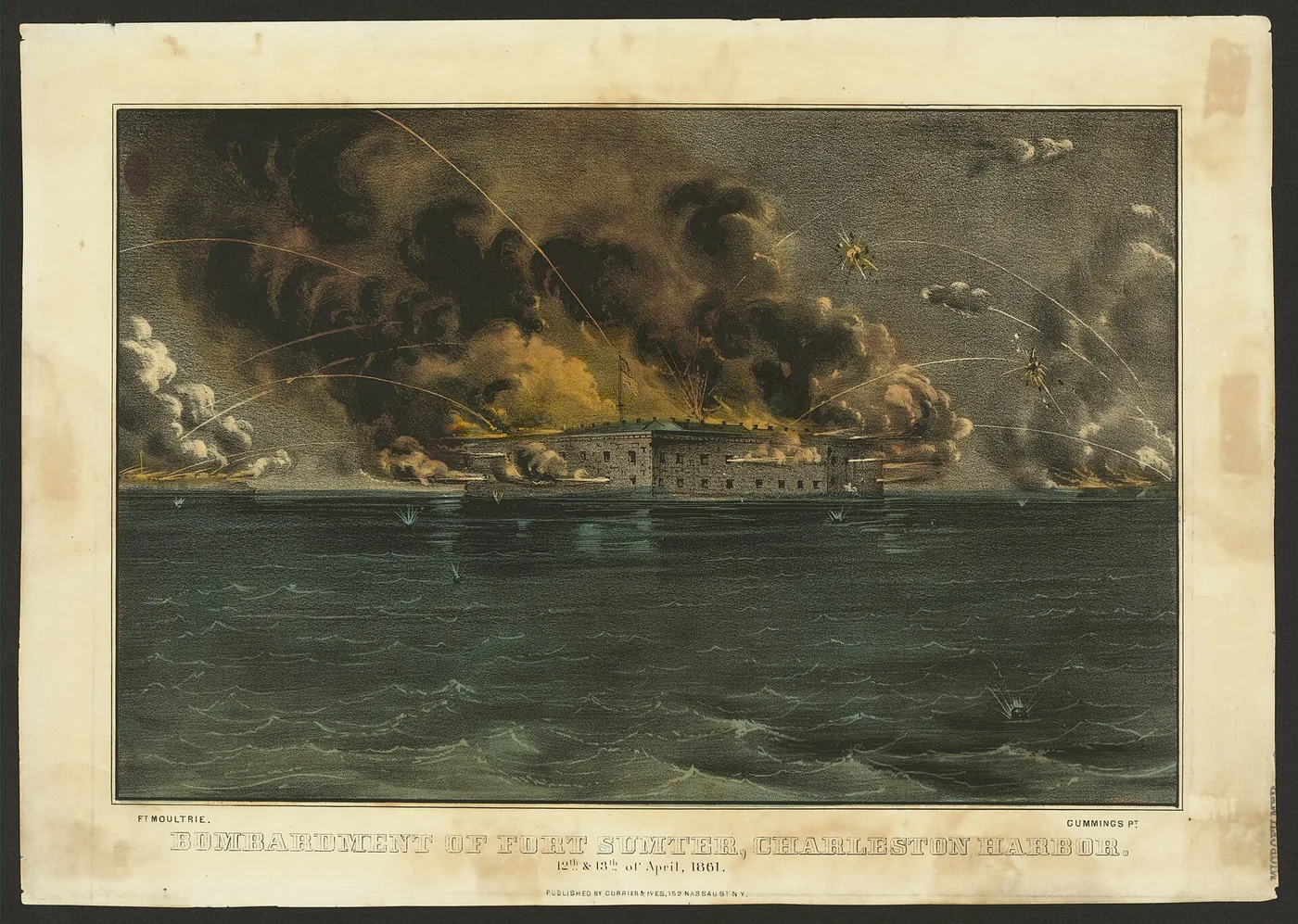
Currier & Ives, Bombardment of Fort Sumter, Charleston Harbor, 12th and 13th of April, 1861. Coloured lithograph, Library of Congress. Public domain. · Public domain · Source page
At 4:30 in the morning, batteries ringing the harbour opened fire on Fort Sumter. Anderson’s men returned fire, but they were badly outgunned. After 34 hours Anderson agreed to leave. No one on either side was killed directly in the engagement.
15 April 1861
A call for volunteers
On 15 April Lincoln called for 75,000 volunteers to put down the rebellion. The call led four more Southern states to declare their secession and join the Confederacy, Virginia among them. The war was no longer about one fort.
A war that would not end
July 1861
A first defeat
At the battle of Bull Run, not far from Washington, the Union army was defeated in July 1861. Its soldiers fell back in confusion toward the capital. Anyone who had expected a short war had to think again.
1861–1862
The border states
Four slave states stayed in the Union: Maryland, Delaware, Kentucky and Missouri. These are the border states. They sat between North and South, and Lincoln could not afford to lose them. Maryland bordered Washington itself.
Later in the war, Maryland and Missouri ended slavery by their own state laws. Until then slavery remained legal there. A line often attributed to Lincoln about Kentucky is popular, but no primary source for it has been found, so this lesson does not use it.
May 1861
Those who reached the Union lines
While the armies fought, enslaved people ran for the Federal army camps. In May 1861 General Benjamin Butler declared that those who reached his lines would not be returned, but held as contraband of war. The government approved that policy at the end of May.
As Union armies advanced through the South, more and more enslaved people escaped to Union lines. That reality was already on the ground before Lincoln wrote anything about it. Keep it in mind when you reach the decision on emancipation: people had already begun to act for themselves.
1862
A general who would not advance
George B. McClellan commanded the Army of the Potomac, the Union’s main army in the East. He was a gifted organiser who prepared his men carefully, but he was slow to move. In the summer of 1862 his army came close to Richmond, the Confederate capital, and was pushed back in a series of long battles against General Robert E. Lee.
Lincoln tended to think McClellan hesitated too much. McClellan argued that he never had enough troops. There was some truth in both views.
Summer 1862
A war with no end in sight
By the summer of 1862 many thousands had died on both sides, and no end was in sight. The question was no longer whether the war would last, but how it would end and what it would be about.
That summer Lincoln faced a choice. A proclamation freeing the enslaved was already drafted, but it had not been published.
The decision on emancipation
A decision point
You are Abraham Lincoln.
Washington, late July 1862
The war is not going to plan. Your army in Virginia has been pushed back from Richmond, and in the North people ask why the Union is losing.
A draft Emancipation Proclamation sits among your papers: a declaration that would free the enslaved in the areas in rebellion. Your cabinet has heard it, and the public has not. Some say such a declaration would hearten the opponents of slavery and make it harder for the South to raise men. Others warn that a proclamation issued after a defeat will look like despair. Your Secretary of State, Seward, believes you should wait for a victory.
The question in front of you is not whether, but when.
What do you do with the draft?
- Announce emancipation now, this summer, for every enslaved person in the areas in rebellion. Probably many more enslaved people would head for Union lines at once. But the proclamation would look like a desperate move after defeats, the border states would be angry, and its legal force would be unclear.
- Wait for a military victory, then announce emancipation as a war measure. Probably the proclamation would be accepted as a legitimate war measure, and it would reach the Southern territories without turning the border states into enemies. But waiting leaves the enslaved in the rebel areas without a promise of freedom for months, and if the victory is delayed, so is the proclamation.
- Say nothing about slavery, and make saving the Union the only aim. Probably the fighting would go on with no promise of freedom. Abolitionists in the North would press harder, and the enslaved would keep running to Union lines with no clear status.
What really happened
Wait for a military victory, then announce emancipation as a war measure.
Lincoln did not publish the draft that summer. He waited for a victory, which came at Antietam on 17 September 1862, where the Army of the Potomac stopped Lee’s invasion of Maryland. Five days later, on 22 September, he issued the preliminary Emancipation Proclamation: enslaved people in areas still in rebellion on 1 January 1863 would be declared free.
Those areas were given one hundred days to return to the Union. None of them did.
The proclamation presents itself as a war measure: the act of a commander in wartime, not a social reform. Historians divide: some see the wait as a tactical choice, others as a fear of how the public and the border states would react. What he wrote in public that summer appears in the letter you are about to read.
Source: The letter to Greeley
My paramount object in this struggle is to save the Union, and is not either to save or to destroy slavery. If I could save the Union without freeing any slave I would do it, and if I could save it by freeing all the slaves I would do it; and if I could save it by freeing some and leaving others alone I would also do that.
Horace Greeley, editor of the New-York Tribune, had published an open letter urging Lincoln to free the enslaved. Lincoln replied in a public letter, which he wrote while a draft proclamation lay in his desk drawer. Eight days before that letter, on 14 August, he had received a committee of Black men at the White House and proposed that they consider voluntary emigration to Central America, arguing that the two races would be better off apart. Greeley later said that Lincoln used the exchange to prepare the public for a change of position.
- What does Lincoln name as his main aim? Saving the Union. Slavery appears as a means to be chosen as needed, not as an aim in itself.
- How should we read the ‘If I could’ passage? As a carefully made political argument, written for the public. Lincoln lists three options, including freeing everyone. He does not say he is for slavery. He says everything depends on what serves the Union.
- What is missing from the letter, compared with what we know of the draft in the drawer? The draft itself. The letter states a position, not a plan. That gap only shows when it is compared with other documents.
Source: The Emancipation Proclamation, first page
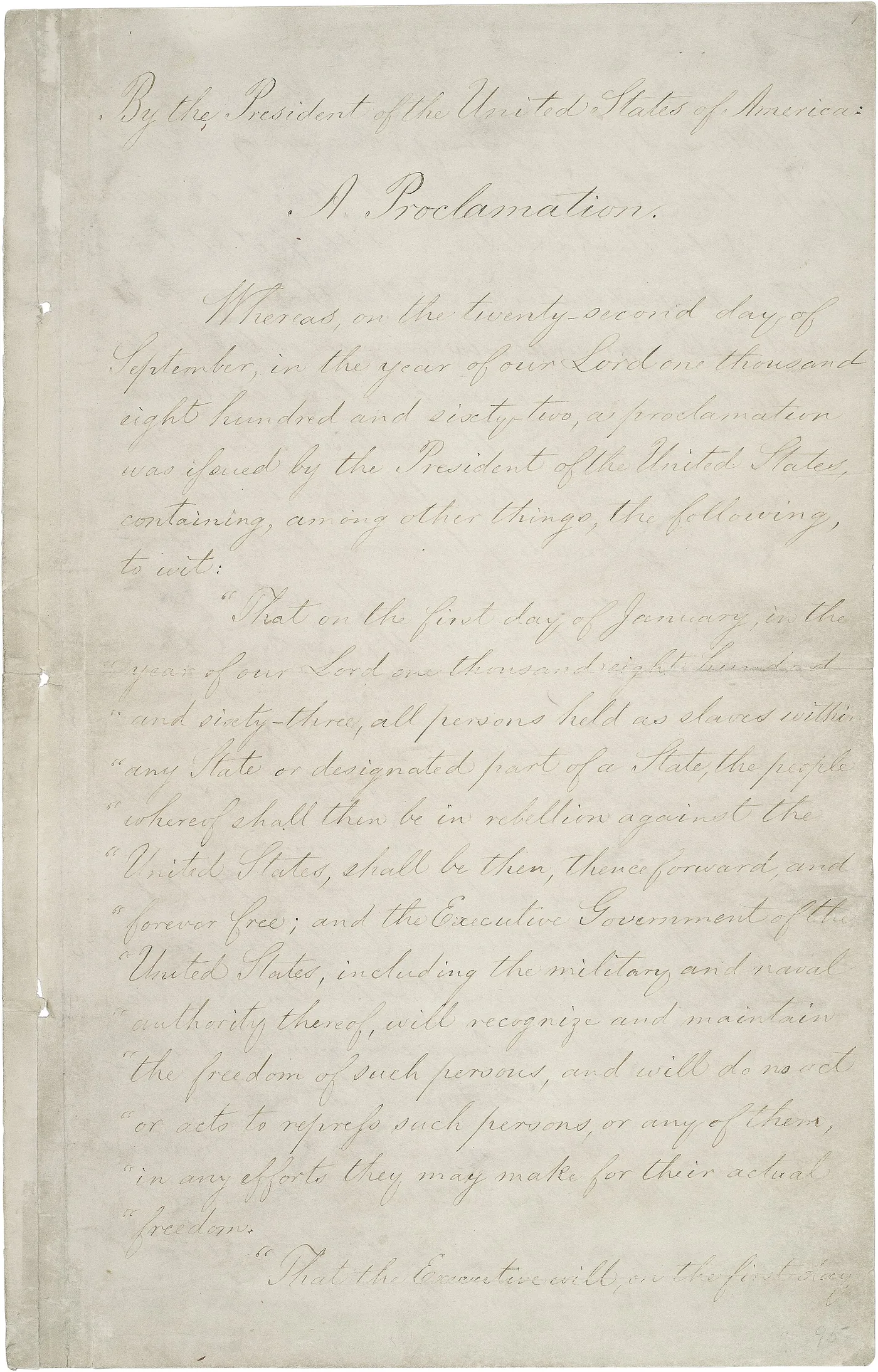
Emancipation Proclamation, 1 January 1863, page 1 of 5. US National Archives. Public domain. · Public domain · Source page
all persons held as slaves within said designated States, and parts of States, are, and henceforward shall be free; and that the Executive government of the United States, including the military and naval authorities thereof, will recognize and maintain the freedom of said persons.
This is the final version, issued after the preliminary of 22 September. It was an order from the commander-in-chief, not a law passed by Congress. The picture shows the first of the five pages.
- Which areas does it cover? The states and parts of states named as in rebellion. It does not cover the border states. Parts of Louisiana and Virginia were also left out: New Orleans, the 48 counties that became West Virginia, and some other areas.
- What does it rest on? The president’s power as commander-in-chief in a rebellion. That is a military power, not a law passed by Congress.
- What happens to an enslaved person in an area the Union does not control? On paper the proclamation covers him. In practice, his freedom depended on Union troops reaching his area. The National Archives stresses that the freedom it promised depended on military victory.
Myth
The Proclamation freed all the enslaved people in America.
The truth
No. The proclamation covered only the areas in rebellion. The border states were excluded, and so were areas that the Union held at the time. In Kentucky and Delaware slavery stayed legal even after the war ended, until the Thirteenth Amendment was ratified in December 1865.
The evidence
The list of areas in the proclamation’s own text (see the source above). The National Archives explains that the freedom it promised depended on military victory.
1863–1865
The men who came forward
The proclamation also announced that Black men would be accepted into the army and navy. By the end of the war, the National Archives says, almost 200,000 Black soldiers and sailors had fought for the Union.
The proclamation opened a door, but people walked through it under their own power. Many of them had been enslaved until recently. Their story deserves its own telling, and it is not only part of Lincoln’s.
November 1862
Meanwhile, a general is replaced
On 5 November 1862 Lincoln ordered command of the Army of the Potomac handed to Ambrose Burnside. The order reached McClellan on 7 November. In 1864 McClellan would run against Lincoln for the presidency, as the Democratic candidate.
Gettysburg, the copies and the memo
19 November 1863
A speech of a few minutes
On 19 November 1863 Abraham Lincoln stood at the new national cemetery at Gettysburg, Pennsylvania, to dedicate it to the men who had died in the battle there in July. The main speaker that day, Edward Everett, talked for about two hours. Lincoln spoke for a few minutes.
Source: The speech, in its printed text
that this nation under God shall have a new birth of freedom, and that government of the people, by the people, for the people shall not perish from the earth. … The world will little note nor long remember what we say here, but it can never forget what they did here.
This is the standard printed text, but the speech has no single text. Five manuscripts in Lincoln’s hand survive. Two of them, the Nicolay and Hay copies, are at the Library of Congress. The other three were written later, in 1864, for people who wanted a copy of their own.
- How many manuscripts are there, and when were they written? Five. Two were written close to the speech and three were written after it, in 1864. The differences between them are small.
- Which phrase appears in the printed text but not in the first two copies? “Under God”. It appears in the three later copies, but not in the Nicolay or Hay copies.
- What does that tell us about what was said that day? We cannot be sure Lincoln said those words exactly as written. Three newspaper correspondents who telegraphed reports from the ceremony included the phrase. Some scholars maintain that he likely did not utter it, and others disagree. The text we read is one of several.
Myth
The Gettysburg Address was written on an envelope on the train to the dedication.
The truth
There is no evidence for it. The Nicolay copy, one of the surviving texts, is partly in ink on Executive Mansion stationery and partly in pencil on lined paper. No envelope is known. Scholars think he may have drafted the text before or during the trip, so the train itself is not impossible. What is unsupported is the envelope story.
The evidence
The story was popularised in 1906 by Mary Raymond Shipman Andrews, in her book The Perfect Tribute. Two of the manuscripts, the Nicolay and Hay copies, are at the Library of Congress, given there by John Hay’s descendants in 1916.
9 March 1864
One commander for all the armies
On 9 March 1864 Lincoln appointed Ulysses S. Grant as general-in-chief of the Union armies. Grant, who had won battles in the West, chose to strike Lee’s army directly in Virginia. The cost in lives was heavy on both sides, and by the summer of 1864 it was clear the war would not end soon.
A decision point
You are Abraham Lincoln.
Washington, late August 1864
The presidential election will be held on 8 November. The summer has been hard on both sides. Grant’s army has paid a heavy price in Virginia, and the fighting has not decided the war. In the North people are tired of the war, and many want an agreement that stops the fighting.
The political reports reaching you say you may well lose. If that happens, your successor takes office on 4 March 1865, and not before. Between November and March you remain president, but without a fresh mandate.
What do you prepare for the election?
- Campaign with all your strength, and accept whatever the vote brings. Probably the campaign would go on as before. If you lost, the months until March would be dangerous: the war would continue, and no one would know how power was to pass.
- Open peace talks now, on any terms that will stop the fighting. Probably the South would ask for independence, and the offer would look like surrender. The aim of saving the Union would be dropped, and your own party might split.
- Prepare quietly even for defeat: plan with the likely winner how to keep the Union together between the vote and the inauguration. Probably the transition would be calmer, and the war would still go on. The risk is that the South reads the plan as proof that the Union is coming apart, and holds out longer.
What really happened
Prepare quietly even for defeat: plan with the likely winner how to keep the Union together between the vote and the inauguration.
Lincoln wrote the memorandum on 23 August 1864, folded it, and asked his seven cabinet members to sign it without reading what it said. He put it away in his desk and told no one what it said until after the victory on 8 November. The document is known as the blind memorandum.
The folding and the blind signatures did not decide the election. They kept the memorandum as a plan for afterwards.
In the memorandum Lincoln wrote: “This morning, as for some days past, it seems exceedingly probable that this Administration will not be re-elected. Then it will be my duty to so co-operate with the President elect, as to save the Union between the election and the inauguration.” The memorandum does not discuss postponing the election. It assumes the vote will be held and plans what comes after. In the gap between a defeat and the inauguration, the outgoing president is a lame duck.
8 November 1864
The vote
On 8 November 1864 Lincoln was re-elected, with about 55 per cent of the popular vote and 212 electoral votes to McClellan’s 21. The memorandum stayed in his desk.
Decision four, and memory
1864
Two votes and one failure
The Thirteenth Amendment to the Constitution, which would abolish slavery throughout the United States, was debated in Congress as early as 1864. In April the Senate approved it, 38 to 6.
In June the House failed to pass it, 93 to 65. It was thirteen votes short of the two-thirds majority that a constitutional amendment needs.
A decision point
You are Abraham Lincoln.
Washington, January 1865
You have been re-elected, and your second term begins on 4 March. The war is nearing its end but is not over, and the proclamation you signed is only a war order.
The House is short of votes for the Thirteenth Amendment. The Speaker, Schuyler Colfax, estimates it is five votes short, and Representative James Ashley has postponed the vote. Some members who will vote have lost their seats in the November election, and they remain in office only until March. A new Congress begins after that.
If the amendment fails, the courts may rule that the proclamation does not apply after the war, and the freedom of millions of people could be tied up in a long legal dispute.
How do you get the amendment through?
- Leave the vote to the House and do not intervene. Probably the vote would be put off, and might fail. The amendment would not take effect before a new Congress, and until then the proclamation would remain only a war order.
- Use every tool of the presidency, from jobs and favours to personal appeals to members of the House, to gather the votes. Probably the amendment would pass. But the methods would look like bribery, and opponents would claim the vote had been bought. Even a good result would carry a stain on its legitimacy.
- Rely on the proclamation already signed, and trust that it will be enough. Probably the war would end, but freedom would still rest on a war order. Courts might rule that it no longer applied after the war, and the freed people would face a long legal struggle.
What really happened
Use every tool of the presidency, from jobs and favours to personal appeals to members of the House, to gather the votes.
Lincoln intensified the push. He made direct appeals to individual members, above all to Democrats whose terms would end in March. On 31 January 1865 the House passed the amendment, 119 to 56. Some of the votes in favour came from lame ducks: members who would not be returning.
Lincoln’s precise role in winning those votes is not documented.
The sources point to two reasons. The proclamation was a war order whose force after the war was uncertain. An amendment would put the abolition of slavery beyond legal challenge. Lincoln’s own reasons for pressing so hard are less fully recorded than his actions, which is why historians argue about his motives.
4 March 1865
The second inaugural
On 4 March 1865 Lincoln took the oath for a second term. The war was still going on, and in his short speech he did not talk of triumph. He spoke of how both sides read the same Bible and prayed to the same God, and of a war neither side had expected to last so long.
Near the end he wrote: “With malice toward none, with charity for all, with firmness in the right as God gives us to see the right, let us strive on to finish the work we are in, to bind up the nation’s wounds…”
9–14 April 1865
Appomattox, then Ford’s Theatre
On 9 April 1865 General Robert E. Lee surrendered his army at Appomattox, in Virginia. Five days later, on 14 April, Lincoln was shot at Ford’s Theatre in Washington by John Wilkes Booth. He died the next morning.
What followed
- 1 January 1863 The final Proclamation takes effect. The enslaved people in the areas it names are declared free.
- 8 November 1864 Lincoln is re-elected. The memorandum stays in his desk.
- 31 January 1865 The House passes the Thirteenth Amendment, 119 to 56.
- 14 April 1865 Lincoln is shot at Ford’s Theatre and dies the next morning.
- 6 December 1865 The Thirteenth Amendment is ratified. Slavery ends throughout the United States, including Kentucky and Delaware.
- 14 April 1876 Frederick Douglass gives a speech in memory of Lincoln at the dedication of the Emancipation Memorial in Washington.
Source: Douglass looks back
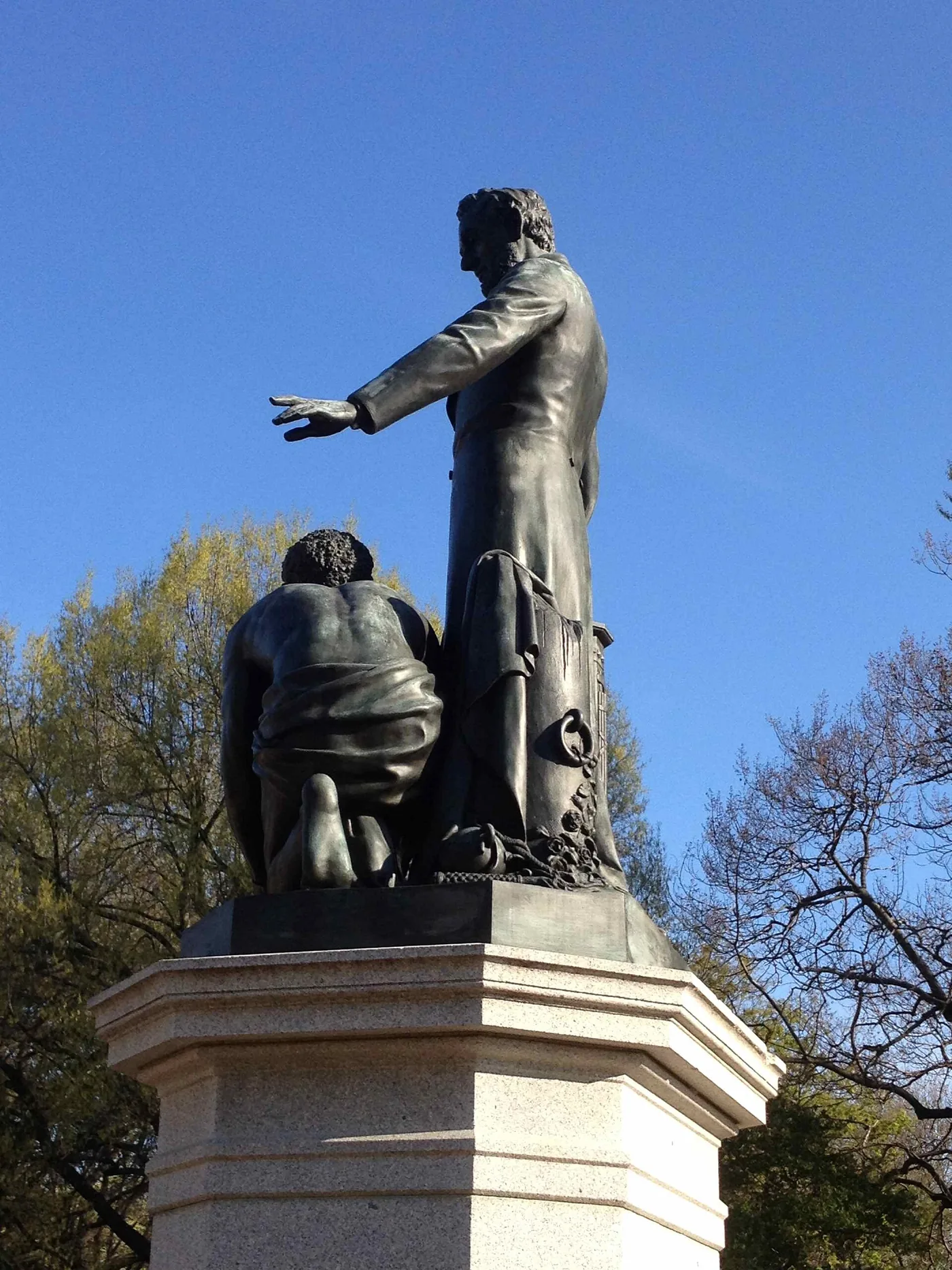
Thomas Ball, Emancipation Memorial, Lincoln Park, Washington, 1876. Photo: Djembayz, 2014. CC BY-SA 3.0. · CC BY-SA 3.0 · Source page
He was preëminently the white man’s President, entirely devoted to the welfare of white men.
Douglass spoke at the dedication of the Emancipation Memorial in Lincoln Park, Washington, more than a decade after the war. Born enslaved, he had escaped and became one of the leading voices of the abolition movement. The speech praises Lincoln and criticises him in the same breath. The picture shows the memorial itself.
- Who is speaking, and when? A man born enslaved who escaped, and a leading figure of the abolition movement, speaking in 1876. Ask yourselves whether the distance from the war shapes what he chooses to say.
- Why does Douglass praise Lincoln and criticise him in the same speech? He sees Lincoln as the president who took the decisive step, and at the same time as a man who thought in the ways of his time, so not a champion of his own people in the fullest sense. He also says that Lincoln came to the presidency on one principle alone: opposition to the extension of slavery. Douglass tries to balance respect with criticism.
- Who is left out of the speech? The people who freed themselves. The speech is about Lincoln, and far less about those who escaped and fought for their freedom. Notice who is shown acting, and who is shown receiving.
Myth
Lincoln was an abolitionist from the start.
The truth
No. Lincoln opposed the spread of slavery into new territories, and in his letter to Greeley he wrote that if he could save the Union by freeing everyone, he would. But at the start his main aim was saving the Union, not ending slavery. Historians disagree about how far he moved after that.
The evidence
Lincoln’s letter to Greeley (above). The historian Eric Foner, in The Fiery Trial (2010), argues in paraphrase that Lincoln was not an abolitionist or a Radical Republican, but showed a remarkable capacity for moral and political growth. This paraphrases a published summary; it is not Foner’s own wording.
Did Lincoln change?
Did Lincoln change during the war, or did he remain a man of his time, pushed into action by events?
- Eric Foner (2010): Lincoln changed According to a published summary of his work, Lincoln was not an abolitionist at first, but he showed a remarkable capacity for moral and political growth, which is visible in the proclamation and in the Thirteenth Amendment.
- Lerone Bennett Jr. (2000): Lincoln was a white supremacist Bennett argues that Lincoln was a white supremacist, that he saw emancipation as a means rather than a goal, and that the proclamation was a hoax meant to free no one. Many scholars have rejected his arguments, saying they rest on faulty research and a narrow political agenda.
What counts as change? What Lincoln said, what he did, or what his actions brought to the people who had been enslaved?
Check yourself
What is the date of Lincoln’s letter to Greeley, in which he names saving the Union as his main aim?
Answer: 22 August 1862. Correct. The letter is dated 22 August 1862, while the draft proclamation was already in his drawer.
Check yourself
How long did the preliminary Proclamation of 22 September 1862 give the areas in rebellion to return, before the final one took effect?
Answer: One hundred days. Correct. The preliminary Proclamation gave one hundred days, and the final one took effect on 1 January 1863.
Check yourself
How did the House vote on the Thirteenth Amendment on 31 January 1865?
Answer: 119 to 56. Correct. The House passed the amendment 119 to 56.
Check yourself
At what time did the bombardment of Fort Sumter begin, and on what date?
Answer: At 4:30 in the morning, 12 April 1861. Correct. The Confederate batteries opened fire on the fort at that hour.
Check yourself
When did Ulysses S. Grant become general-in-chief of the Union armies?
Answer: 9 March 1864. Correct. Grant was appointed general-in-chief on 9 March 1864.
Check yourself
What did Lincoln’s cabinet do with the memorandum he wrote on 23 August 1864?
Answer: Signed it without reading it. Correct. By the account we rely on, the seven cabinet members signed the folded memorandum without knowing what it said.
Terms
- secession A state’s decision to leave the Union. In 1860–61 Southern states did this one after another.
- Confederacy The government set up in February 1861 by the states that had seceded, under the name Confederate States of America.
- border states Four slave states that stayed in the Union: Maryland, Delaware, Kentucky and Missouri. They were not named in the Emancipation Proclamation.
- abolitionist A person who demanded that slavery end at once, everywhere, rather than in some distant future.
- Emancipation Proclamation The order Lincoln issued as commander-in-chief. The preliminary version came on 22 September 1862 and the final on 1 January 1863. It freed the enslaved in areas in rebellion, not everywhere.
- lame duck A politician who has lost an election or is leaving, but still holds office until a successor takes over. From November 1864 to March 1865, Lincoln was in this position.
- blind memorandum A note Lincoln wrote on 23 August 1864 about what he would do if he lost. He folded it, and had his cabinet sign it without reading it.
- general-in-chief The officer in command of all the army’s forces, under the president. Grant took the post on 9 March 1864.
- Thirteenth Amendment The amendment to the Constitution that abolished slavery and involuntary servitude throughout the United States, except as punishment for a crime. The House passed it on 31 January 1865, and it was ratified on 6 December 1865.
- Fort Sumter A fort held by the US government in Charleston harbour, South Carolina. Southern forces opened fire on it on 12 April 1861, the start of the war.
- Secretary of State The minister in charge of the United States' relations with other countries. In Lincoln's time the post was held by William Seward.
- William Seward Lincoln's Secretary of State. He wanted to give up Fort Sumter and believed the government should wait for a victory before proclaiming emancipation.
- Robert Anderson A major in the Union army who commanded Fort Sumter, with about 85 men. After 34 hours of firing he agreed to leave the fort.
- Stephen A. Douglas A powerful politician from Illinois. In 1858 Lincoln ran against him for a US Senate seat. Douglas won, because the Illinois legislature chose him.
- Republican Party A political party in the United States. Lincoln was elected president as its candidate in 1860. The party opposed the spread of slavery into new territories, but did not demand an end to slavery where it already existed.
- Electoral vote A vote in the US presidential election. Each state gets a number of them according to its size, and the candidate with a majority wins. In 1864 Lincoln got 212, McClellan 21.
- Contraband of war What the Union army called enslaved people who escaped to its lines. They were not returned to their owners, but held as contraband of war.
- Battle of Bull Run A battle near Washington in July 1861, in which the Union army was defeated. Its soldiers fell back in confusion toward the capital.
- Army of the Potomac The Union's main army in the East. George B. McClellan commanded it, and in the summer of 1862 it came close to Richmond.
- George B. McClellan A Union general, a gifted organiser who prepared his men carefully but was slow to move. In 1864 he ran against Lincoln for the presidency as the Democratic candidate.
- Robert E. Lee A Confederate general who led the Southern army in Virginia. On 9 April 1865 he surrendered his army at Appomattox.
- Battle of Antietam A battle in September 1862 in Maryland, where the Army of the Potomac stopped Lee's invasion. Lincoln had waited for that victory before issuing the preliminary Emancipation Proclamation.
- Horace Greeley Editor of the New-York Tribune. He published an open letter urging Lincoln to free the enslaved, and Lincoln replied in a public letter.
- Ulysses S. Grant A Union general who had won battles in the West. On 9 March 1864 Lincoln made him general-in-chief of the Union armies.
- House of Representatives One of the two houses of the US Congress. To pass a constitutional amendment, it needs a two-thirds majority there.
- Ford's Theatre A theatre in Washington where Lincoln was shot on 14 April 1865. He died the next morning.
- John Wilkes Booth An actor who shot Lincoln at Ford's Theatre on 14 April 1865.
- Appomattox A place in Virginia where General Robert E. Lee surrendered his army on 9 April 1865.
- Richmond The capital of the Confederacy, in Virginia. In summer 1862 the Army of the Potomac came close to it, but was pushed back.
- Inaugural Address The speech a president gives when taking office. Lincoln gave his first on 4 March 1861, saying he had no intention of interfering with slavery where it already existed.
- South Carolina A state in the south of the United States, and the first to leave the Union. On 20 December 1860 it voted to secede.
- State legislature The body that makes a state's laws, such as the Illinois legislature. In 1858 it chose Stephen Douglas for the US Senate.
- National Archives The official archive of the United States, where government papers are kept. It says almost 200,000 Black soldiers and sailors fought for the Union.
- Charleston A city in South Carolina, with Fort Sumter at its harbour. In 1861 Southern batteries around the harbour opened fire on the fort.
Sources
- Abraham Lincoln to Horace Greeley, 22 August 1862, in Roy P. Basler (ed.), The Collected Works of Abraham Lincoln (1953)
- The Emancipation Proclamation, 1 January 1863, US National Archives, Milestone Documents
- Abraham Lincoln, Address at the Dedication of the Gettysburg National Cemetery, 19 November 1863, Avalon Project, Yale Law School
- Abraham Lincoln, First Inaugural Address, 4 March 1861, Avalon Project, Yale Law School
- Abraham Lincoln, Second Inaugural Address, 4 March 1865, Avalon Project, Yale Law School
- Abraham Lincoln, memorandum on the election, 23 August 1864 (the “blind memorandum”), House Divided Project, Dickinson College
- Frederick Douglass, Oration in Memory of Abraham Lincoln, 14 April 1876, Teaching American History
- Abraham Lincoln, Address on Colonization to a Committee of Colored Men, 14 August 1862, Teaching American History
- Eric Foner, The Fiery Trial: Abraham Lincoln and American Slavery (New York: W. W. Norton, 2010)
- Lerone Bennett Jr., Forced into Glory: Abraham Lincoln’s White Dream (2000)
- Battlefields.org, “Versions of the Gettysburg Address”
Image credits
- Alexander Gardner, Abraham Lincoln, Washington, 8 November 1863. Public domain. · Public domain · Source page
- Currier & Ives, Bombardment of Fort Sumter, Charleston Harbor, 12th and 13th of April, 1861. Coloured lithograph, Library of Congress. Public domain. · Public domain · Source page
- Emancipation Proclamation, 1 January 1863, page 1 of 5. US National Archives. Public domain. · Public domain · Source page
- Thomas Ball, Emancipation Memorial, Lincoln Park, Washington, 1876. Photo: Djembayz, 2014. CC BY-SA 3.0. · CC BY-SA 3.0 · Source page


