Leonardo da Vinci: the man, the work and the legend
He wrote a job letter to a duke and listed his skills, one by one. What would you put at the top? What do we really know about Leonardo, and where does the legend begin?
Decisions, questions and your own progress, in the app
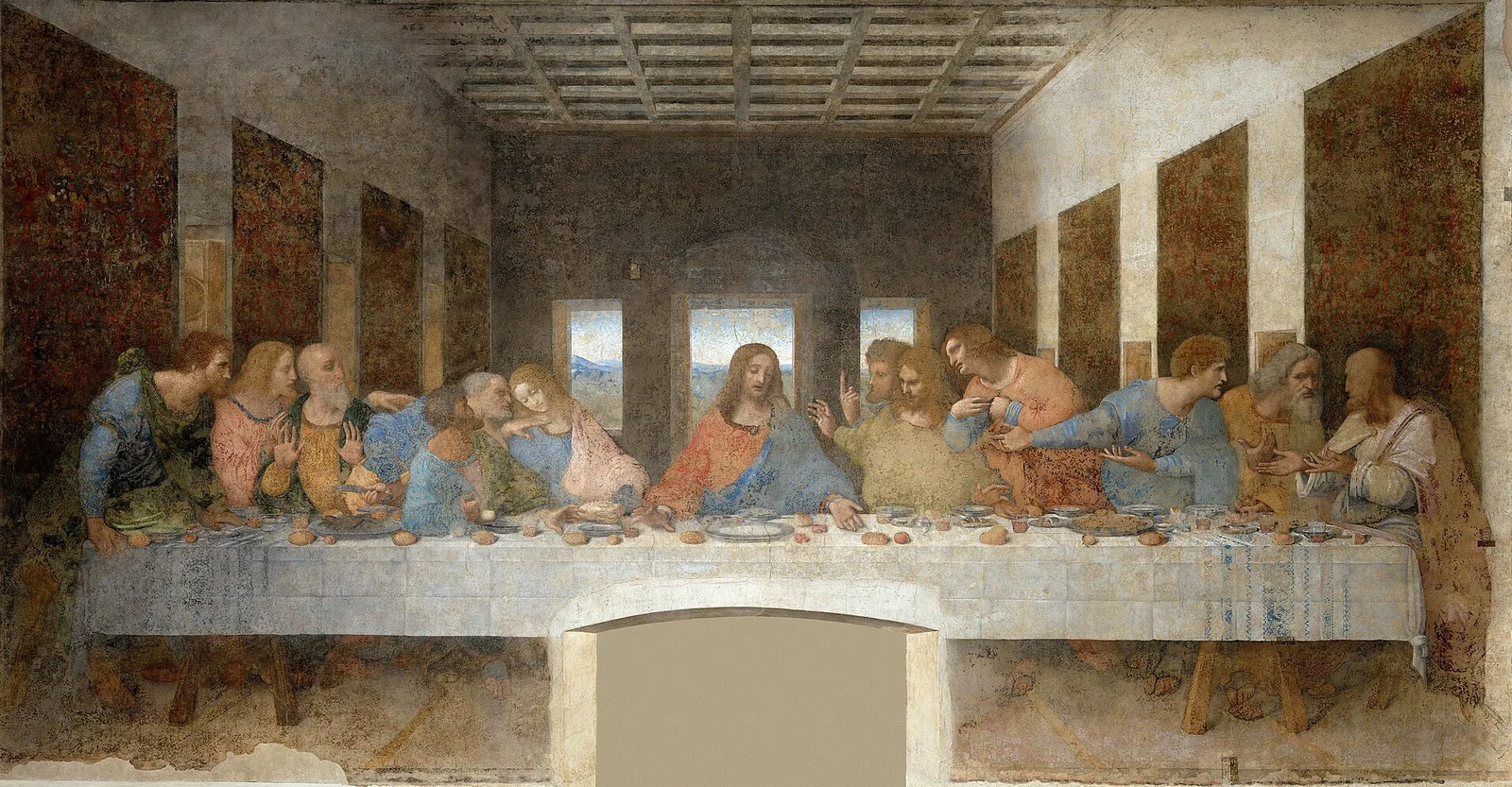
Leonardo da Vinci, The Last Supper, 1495–98, Santa Maria delle Grazie, Milan. Photo: author unknown, Wikimedia Commons · Public domain · Source page
A job letter to the ruler of Milan
A job letter to the ruler of Milan
The writer is a painter in his thirties. The reader is Ludovico Sforza, the man who runs Milan.
The letter lists, item by item, what the writer can do. Each item is a promise to a ruler who needs able people. What would you put at the top of the list?
Background
A boy from near Vinci
Leonardo was born in 1452, near the town of Vinci in Tuscany. His father was Ser Piero da Vinci. The name da Vinci means ‘from Vinci’, not a family surname in the modern sense.
A local tradition names the nearby hamlet of Anchiano as his birthplace. We found no record that confirms it, so this lesson says only: near Vinci.
Florence
A workshop in Florence
Ser Piero took the boy to Florence to learn art with Andrea del Verrocchio, a sculptor and painter who ran a busy workshop. The year is not certain. The 1460s is the safe answer.
Giorgio Vasari, a painter who wrote the lives of the artists decades after Leonardo died, tells a story. Verrocchio was painting the Baptism of Christ. The boy painted an angel holding garments, and the angel was better than the master’s own figures. Vasari says that Verrocchio, out of disdain, never touched colour again. It is a story, not a record, and should be read as one.
The market
Who pays the painter?
In Florence and the other cities of Italy, a painter lived on commissions. A patron (a family, a church or a ruler) paid for the work and often chose its subject. The painter sold his skill, and his name travelled with his work.
This was the world of the Renaissance, a time when painting, sculpture and science grew quickly, and patrons competed for the best artists.
A decision point
You are Leonardo da Vinci, a painter from Florence in your thirties.
Between about 1482 and 1485. Historians disagree about the exact date.
Ludovico Sforza rules Milan. He is rich and powerful, and he needs engineers as much as painters. A ruler who fights needs bridges, siege works and machines of war.
You write him a job letter. You can paint, sculpt and build, and you understand water and buildings. The list has room for all your skills, but the first item is the one he will read first.
What do you put first?
- War engineering first: bridges, siege works and machines of war. Probably the ruler reads an offer from a war engineer first. A ruler who needs weapons and bridges wants people who can build them. Painting would still be on the list, but not at the top.
- Painting and sculpture first, and the bronze horse, in honour of the ruler’s father. Probably the ruler sees a court painter, not a war engineer. That might win a portrait or a religious commission, but not a role in the state’s defence.
- Peacetime work only: buildings, public works and water channels. Probably the offer sounds safe and useful. But it leaves out what rulers paid for most in war, and another engineer might get the post.
What really happened
War engineering first: bridges, siege works and machines of war.
The draft survives in the Codex Atlanticus, a collection of Leonardo’s notes and drawings kept in the Ambrosiana library in Milan.
Most of the list is war work. Peacetime building and water work come near the end, then a short paragraph on sculpture and painting, then the offer of a bronze horse in honour of the ruler’s father. We do not know whether the letter was sent in this form, or whether it reached Ludovico.
Leonardo does not explain the order in the draft. A job letter is a sales pitch, so the order shows what he thought the ruler needed most. J. P. Richter, who published the text in 1883, thought it neither a forgery nor the work of another artist. But it may have been dictated, or copied out by someone else.
Source: The draft job letter
I have a sort of extremely light and strong bridges, adapted to be most easily carried, and with them you may pursue, and at any time flee from the enemy
This is a draft, not the letter as sent, so we cannot know whether the ruler read it.
- Who wrote this, and for whom? Leonardo, or someone writing from his dictation, for Ludovico, who ran Milan. It is a sales pitch: it promises a great deal and does not say what it would cost.
- Why does the writer open with bridges? Because a ruler at war needs a way across a river and a way into a city. The first item was probably written to catch the reader’s attention.
- What is missing from the draft? A price, a date and a reply. Nothing in it shows that it was sent, and nothing shows what the ruler answered.
Milan and the horse
Milan
A court, a title and a letter
Ludovico Sforza ran Milan, but he did not yet hold the title of duke. He took it only in 1494. The address on a second fragment, which Richter dates to 1493, calls him ‘Duke of Bari’, a title the Sforza family held.
Vasari’s sentence puts Leonardo’s summons to Milan right after Ludovico became duke, in 1494. The letter points to the early 1480s or later. The dates do not match, and the sources do not settle them.
Stories
A lion and a shield
Vasari tells two stories about Milan. A king of France came to the city, and Leonardo was asked to devise something strange. He built a mechanical lion, which walked several steps and then opened its breast to show lilies.
In another story, his father sold a painted shield made by Leonardo to Florentine merchants for a hundred ducats. It reached the Duke of Milan for three hundred. Vasari wrote decades later. Read these as stories, not as records.
The horse
A bronze horse that was never cast
Leonardo proposed a bronze horse of huge size. His letter presents it as an honour to the memory of Ludovico’s father, Francesco Sforza. Vasari says the horse was to carry an image of the duke himself.
Leonardo spent years on the clay model. Vasari says the horse was so vast that it could never be completed. A later report, which Richter cites, says the model was damaged when the French took Milan in 1499. The bronze was never cast.
A wall in Milan
Milan, 1495
A dining hall for the friars
In 1495 Ludovico commissioned a Last Supper for the dining hall of the Dominican friars at Santa Maria delle Grazie in Milan. Leonardo was about forty-three. The scene is the moment when Christ tells his twelve apostles that one of them will betray him.
He worked on the wall from 1495 to 1498. Frank Zollner’s catalogue of Leonardo’s paintings dates the work to those years.
A decision point
You are Leonardo, about forty-three, facing a large wall to paint.
Milan, 1495.
The wall is large, and the friars expect a meal scene. fresco is the usual method for a wall like this: you paint into wet plaster, a section at a time, and each section must be finished before it dries. A mistake cannot be painted over later.
You know fresco, but you have had little practice with it. You also know other methods, which let you go back, change and add. Still, the wall is public, and a failure would be a shame before everyone who eats in that hall.
How do you paint the wall?
- True fresco, in daily sections, on wet plaster. Probably the paint would bond well with the wall, and the work would last longer. But each section must be finished before the plaster dries, and nothing can be reworked once it has set.
- Paint on a panel or canvas in the workshop, and fix it to the wall. Probably you can finish at leisure and change things as you go, and the work could be moved later. But it would be a picture fixed to a wall, not a painting made as part of the wall.
- Oil mixed into tempera, painted onto dry plaster, and reworked as you go. Probably the colours would be rich, and the surface could be worked again and again, which suits a painter who likes to change things. But oil on dry plaster does not bond with the wall the way fresco does, so the paint may flake and the wall would need care.
What really happened
Oil mixed into tempera, painted onto dry plaster, and reworked as you go.
He chose his own method: oil mixed into tempera, painted onto dry plaster. Ross King, who wrote a book on the painting in 2012, says Leonardo had little experience of fresco.
The result is rich colour, and the paint could be worked over. But it did not bond with the wall as fresco does, and by 1517 the surface was already deteriorating.
No document from the time explains the choice. Two reasons are possible, and neither is documented: Leonardo’s habit of working slowly and changing his mind, and his limited experience of fresco. For a painter who kept revising, a surface that could be worked again was probably an attraction.
Source: The head of Christ, left unfinished
he left the head of Christ unfinished, not believing that he was able to give it that divine air which is essential to the image of Christ.
Vasari wrote his Lives in the 1550s and revised them in 1568, thirty to fifty years after Leonardo died in 1519.
- Who wrote this, and when? Vasari, a painter, writing thirty to fifty years after Leonardo’s death. He relied on stories and on what other people remembered.
- What does the sentence praise, and what does it excuse? It praises Leonardo’s high standard: he left Christ’s head unfinished, because he did not believe he could give it the divine look. It also excuses an unfinished work by calling it a sign of greatness.
- What would you need to check it? A document from the friars, the duke’s accounts, or the wall itself. Vasari gives a motive, not a record.
Myth
He never finished anything.
The truth
Many of his works were left unfinished. Vasari lists several: the head of Christ in the Last Supper, the Mona Lisa and the bronze horse. But ‘never’ is too strong. Vasari also calls the Last Supper almost finished.
The evidence
Vasari tells of Florentine friars who waited a long time for a painting from Leonardo, while he never began anything. In the end he made a cartoon of the Virgin and Saint Anne, and people came for two days to see it. He left work unfinished, but he also finished work that drew crowds.
Afterlife
Damp, dust and repairs
The paint did not last. By 1517 it was already deteriorating. A record from 1582 describes the wall as in a state of total ruin. In 1726 a restorer named Bellotti filled the cracks with tempera and covered the work with oil. Such a layer, an overpaint, later restorers had to deal with.
In 1976 the authorities ordered a full examination. The restoration that followed lasted twenty-one years and ended on 28 May 1999. Its leader, Pinin Brambilla Barcilon, wrote an account of the work. The wall survives, but only in part of its original paint.
Notebooks, machines and mirror writing
The notebooks
Pages that kept growing
Leonardo kept notebooks for most of his life. They are full of drawings of machines, water, plants, bones and faces, and of notes that jump from one subject to the next. Many pages survive, scattered over collections. The largest group is the Codex Atlanticus, a collection of loose sheets kept in the Ambrosiana library in Milan.
The drawing
The man in the circle
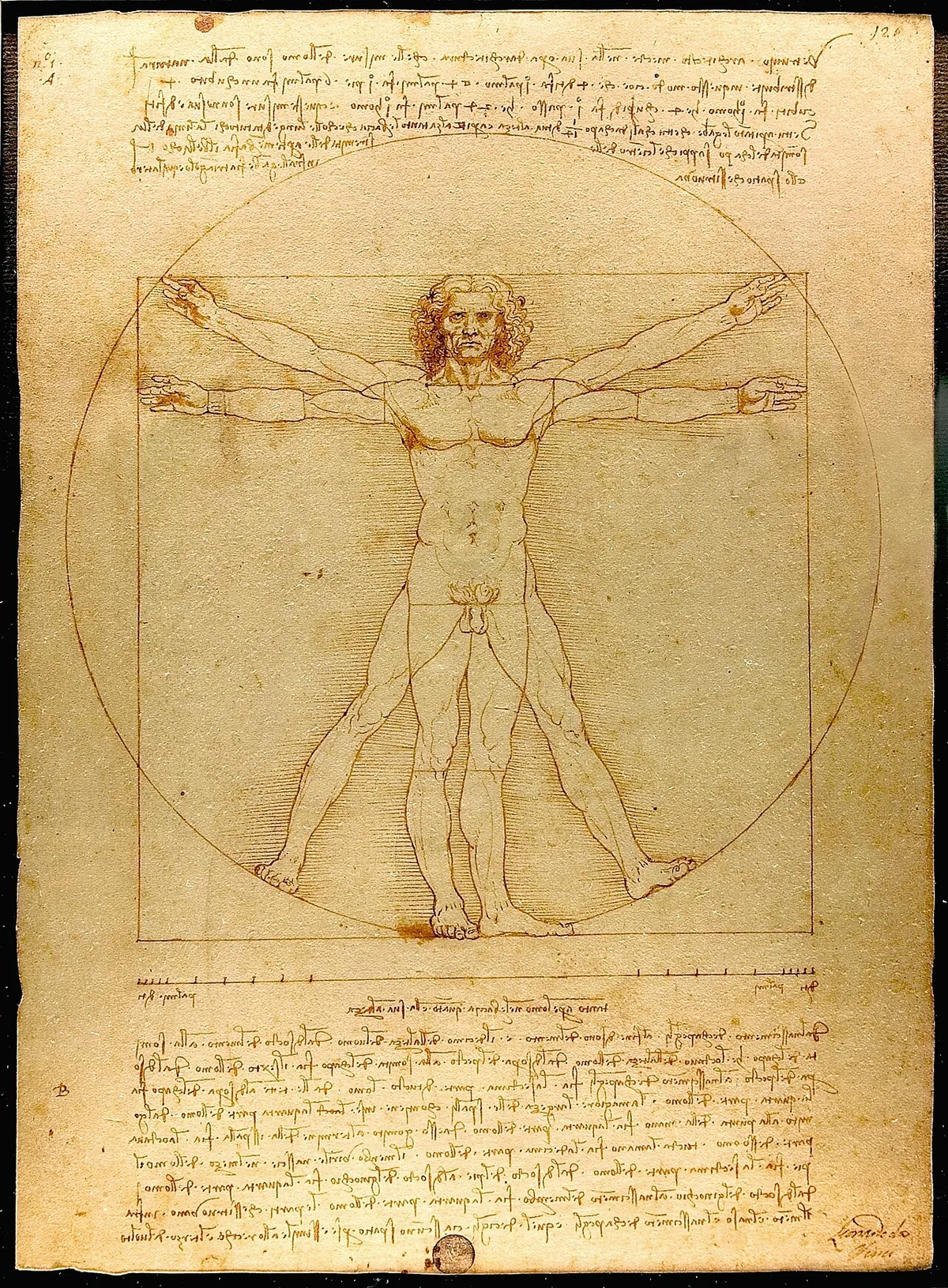
Leonardo da Vinci, Vitruvian Man, pen and ink, about 1492, Gallerie dell’Accademia, Venice. Photo: Luc Viatour. Wikimedia Commons (the photograph’s licence is disputed) · Public domain · Source page
This pen-and-ink drawing shows a naked man, arms and legs spread, inside a circle and a square. It is dated to about 1492 and is kept in the Accademia in Venice. The idea comes from the Roman writer Vitruvius, who described the proportions of the human body for builders. Leonardo turned that text into a figure.
The drawing was also printed, in Fra Giocondo’s edition of Vitruvius (Venice, 1511), so it reached many more readers.
Source: A note beside the drawing
If you open your legs so much as to decrease your height 1/14 and spread and raise your arms till your middle fingers touch the level of the top of your head you must know that the centre of the outspread limbs will be in the navel and the space between the legs will be an equilateral triangle.
The note begins by citing Vitruvius, then goes on in Leonardo’s own words. The drawing appears in Fra Giocondo’s 1511 edition.
- Who made this note, and who was it for? Leonardo, for himself and for readers who wanted to see Vitruvius’s ideas drawn. The wording is practical: it tells the reader where the centre of the outspread body lies, at the navel.
- Is this a measurement of a real body? Not as a record. The text gives ratios, and the drawing turns them into a figure. The note does not say that he measured a living man.
- What is the note not telling you? How the figure was made, or whether he checked the ratios on anyone. The sources do not say.
Myth
He invented the helicopter, the tank and the parachute.
The truth
He drew and proposed machines, and some of his ideas were far ahead of his time. None of the sources we checked shows that any of these machines was built, or flew, in his lifetime.
The evidence
In the draft letter to Ludovico he offers ‘covered chariots, safe and unattackable’. That is a proposal, not a machine that was built. We did not check the helicopter and parachute drawings in depth, so find a source before you repeat the claim.
Myth
Mirror writing was a secret code.
The truth
Leonardo often wrote from right to left, with his left hand, so that the words run backwards on the page. Vasari says the notes could be read only in a mirror. No source we read says he meant it as a code. The reason is not recorded.
The evidence
Richter, who published the notes in 1883, thought a mirror helps only a first reading, and that using one for long is too tiring. A cipher that a mirror makes easy to read is a weak cipher. This is our reasoning, not a documented motive.
The battle that peeled
1503
A battle for the great hall
In 1503 Florence was a republic. The Republic commissioned Leonardo to paint a battle on one wall of the Great Council Hall in the Palazzo Vecchio. The subject was the battle of Anghiari, fought in 1440, in which Florence and its allies defeated Milan. Leonardo was about fifty-one. Everyone who came to the council would see the wall.
Parallel work
A river and a general
Leonardo also worked on a plan to divert the River Arno, in Florence’s long war with Pisa. In 1502 and 1503 he served Cesare Borgia as a military engineer. In October 1502, at Imola, he met Niccolò Machiavelli, a Florentine official. Some accounts put Machiavelli at the Arno works, but no document proves it.
One modern source gives 1503 for a survey and 1504 for digging. We do not rely on those dates.
A decision point
You are Leonardo, about fifty-one, in the council hall, facing a blank wall.
Florence, 1503.
The Republic wants a battle on the wall: horses and soldiers fighting over a standard. You already have a full-size drawing, a cartoon, to copy from. fresco is the usual method, and it means working fast, one section at a time, on a timetable you do not fully control.
You have another idea: paint in oil directly on the wall. The colours would be rich, and the surface could be changed as you go. You used a similar method in Milan. But this wall is public: everyone who comes to the council will see it.
How do you paint the battle?
- Fresco, in sections, the usual method for a public wall. Probably the work is sound, and the method is proven. But it means working fast, section by section, with little room for the changes you want.
- Oil directly on the dry wall: rich colour, slow work, changes allowed. Probably the colours would be richer, and you could change them as you go. But if the binder does not hold the paint, the failure would show on the wall in front of the whole Republic.
- Hand over the cartoon to another painter, and let him paint the wall. Probably the work gets finished quickly and safely. But the wall would not be yours, and you would lose the painting you wanted to make.
What really happened
Oil directly on the dry wall: rich colour, slow work, changes allowed.
He chose oil. Vasari says he tried to paint in oils directly on the wall, with a binder so heavy that the paint began to peel, and that he stopped when he saw it spoiling.
A modern account from the Royal Academy in London describes warmed beeswax mixed with oil pigments, after the ancient method of encaustic. The two accounts disagree about the medium, and historians still argue the point. Sources give 1504 or 1505 for the abandonment.
No note of his explains the choice. Two reasons are possible, and neither is documented: he trusted the method he had already used, and he did not want to hand the wall to another painter. No document shows how the public pressure weighed on him.
The failure
Colours that would not stay
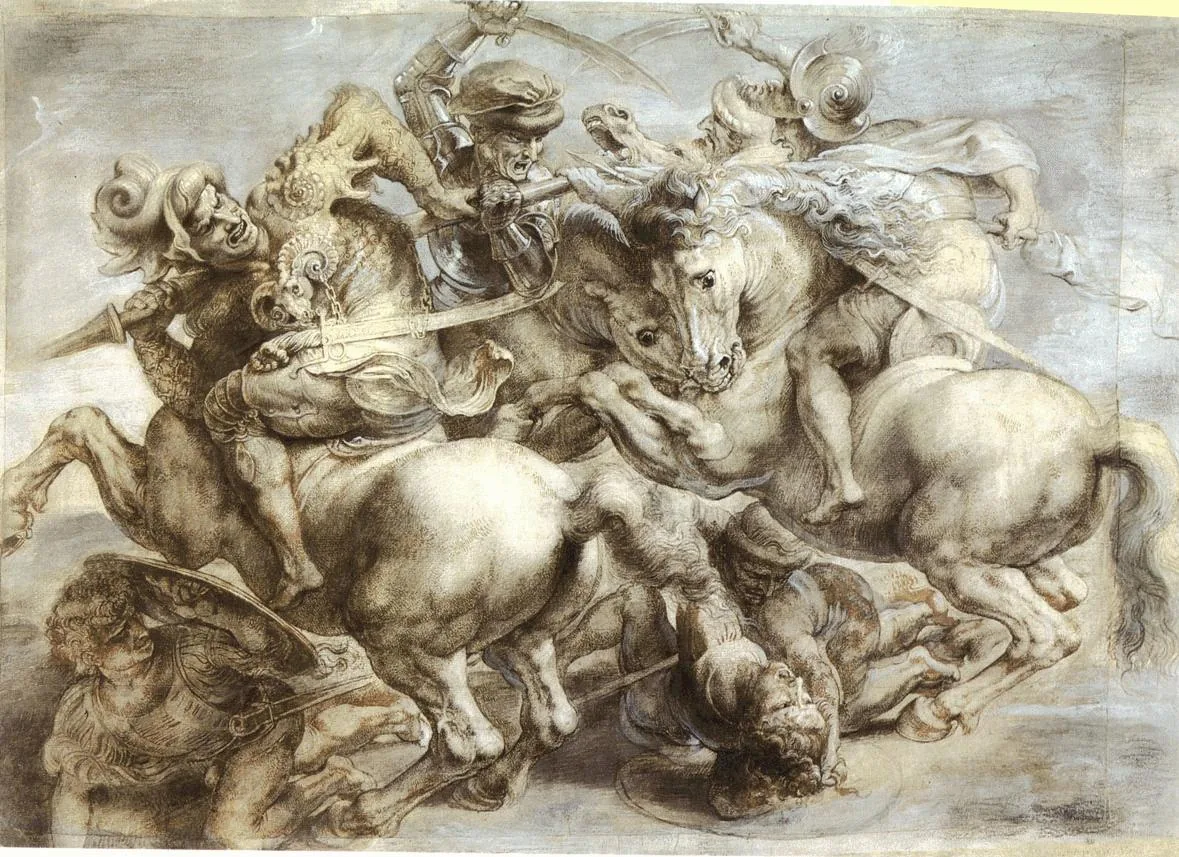
Peter Paul Rubens, after Leonardo da Vinci, The Battle of Anghiari (copy), about 1603. Wikimedia Commons, public domain · Public domain · Source page
Vasari gives the failure one long sentence: Leonardo made ‘a composition of so gross an admixture, to act as a binder on the wall’ that, when he went on to paint in the hall, ‘it began to peel off’, and ‘in a short time he abandoned it, seeing it spoiling’.
The painting is not known to survive. What survives are copies, such as the one Rubens made about a century later. Vasari is our main witness, and he wrote decades after the event.
The smile and the sale
A witness
A note in a book
In October 1503 Agostino Vespucci, a Florentine official, wrote a note in the margin of a book: an edition of Cicero printed in 1477. The note compares Leonardo with Apelles, a painter of ancient Greece, and mentions a portrait of Lisa del Giocondo.
The note was found in 2005, when Heidelberg University Library catalogued old books for an exhibition, and was announced in 2008. It is one of the few witnesses from Leonardo’s own time to the picture we know as the Mona Lisa.
The sitter
A portrait that took four years
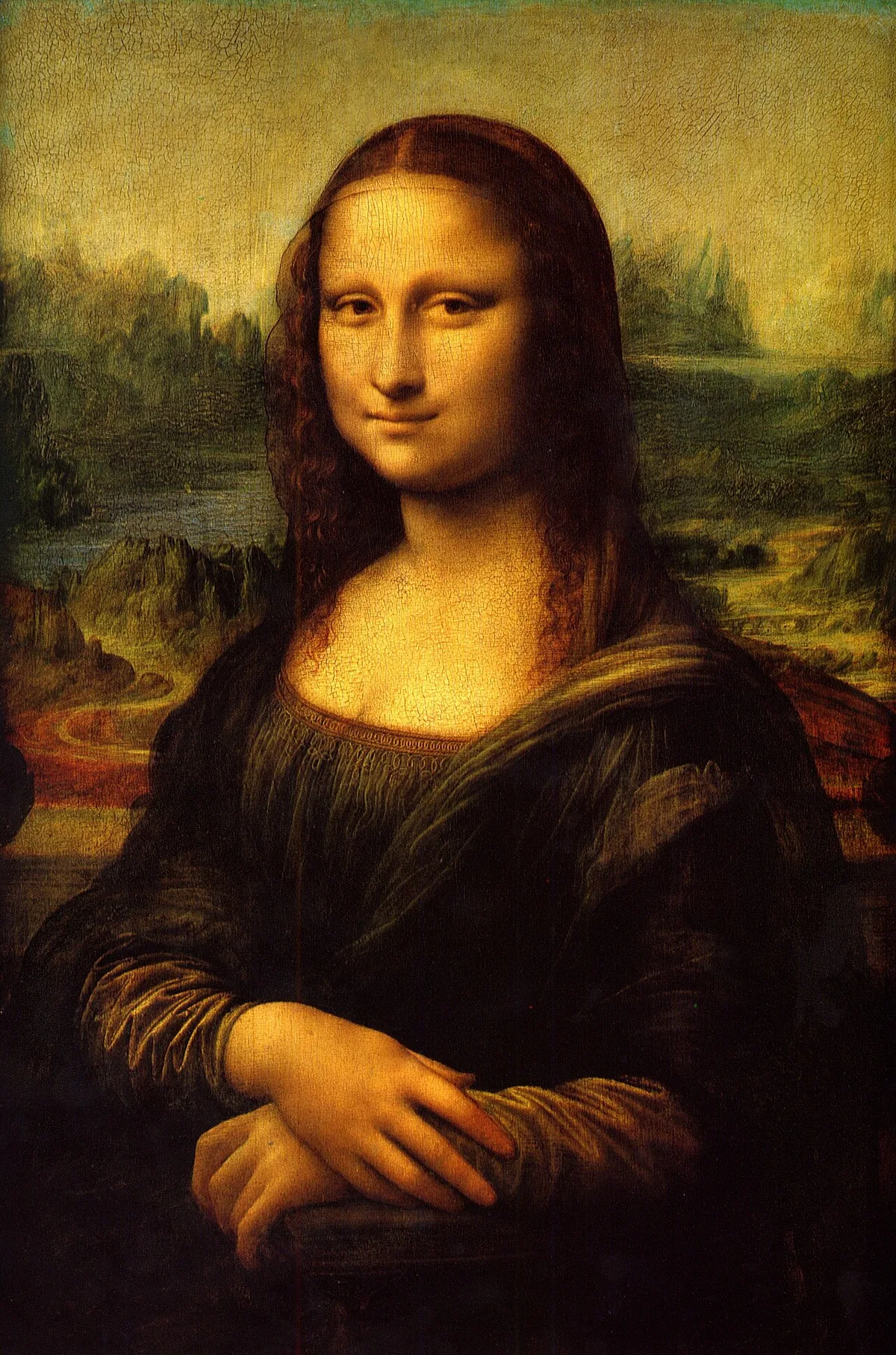
Leonardo da Vinci, Mona Lisa, Musée du Louvre, Paris. Wikimedia Commons, public domain · Public domain · Source page
Vasari says that Francesco del Giocondo commissioned a portrait of his wife, Lisa. Leonardo ‘after toiling over it for four years, … left it unfinished’. Vasari praises the painted detail: the lashes, the eyes that shine as they do in life, and the eyebrows, which ‘could not be more natural’.
Some people say the eyebrows are missing today. We did not check that claim, so test it before you repeat it.
1911
A gap on the wall
On 21 August 1911 the Mona Lisa vanished from the Louvre. The thief was Vincenzo Peruggia, a former glazier who had worked at the museum. Some accounts say that in 1913 he tried to sell it to an art dealer in Florence, and was arrested there. By the same accounts, the painting went back to the Louvre in early 1914.
What happened to the paintings
- 1517 The Last Supper is already deteriorating, according to King.
- 1582 A record describes the wall painting as in total ruin.
- 1726 Bellotti covers the Last Supper with oil.
- 1911 On 21 August the Mona Lisa is stolen from the Louvre.
- 1913 According to some accounts, Peruggia is arrested in Florence and the painting is recovered.
- 1914 In early 1914, by the same accounts, the Mona Lisa returns to the Louvre.
- 1999 The twenty-one-year restoration of the Last Supper ends on 28 May.
- 2017 The Salvator Mundi sells at Christie’s in New York for $450.3 million.
2017
A sale in New York
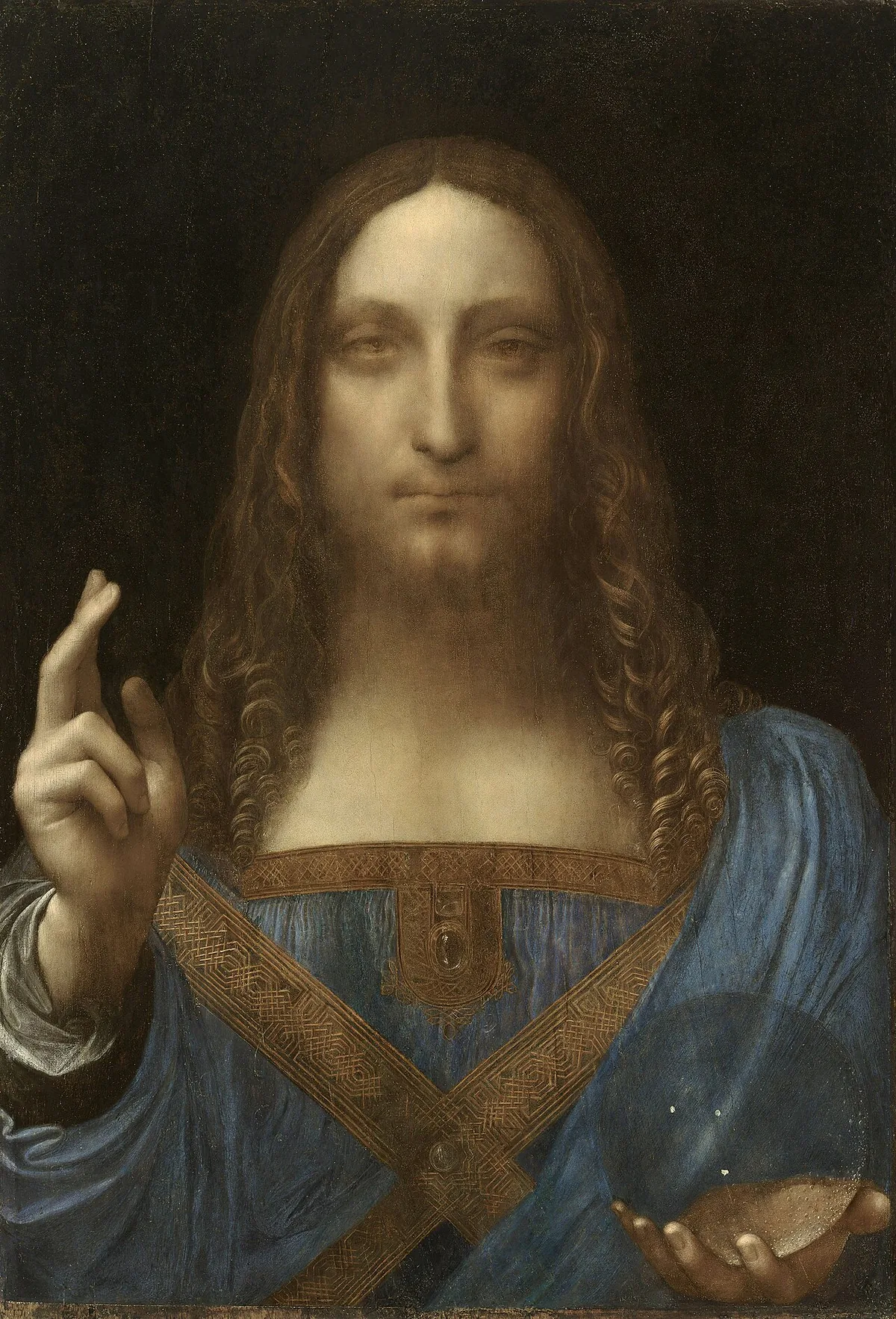
Leonardo da Vinci, Salvator Mundi, oil on walnut, after restoration by Dianne Dwyer Modestini. Wikimedia Commons (the photo is credited to Getty Images) · Public domain · Source page
The Salvator Mundi shows Christ holding a crystal orb. It was bought in 2005 at an estate sale in New Orleans and catalogued as a copy. One source gives about $1,175 as the price paid, and another gives under $10,000. After restoration, and a display at the National Gallery in London in 2011–12 as a work by Leonardo, it was sold at Christie’s in New York on 15 November 2017 for $450.3 million.
The buyer, Prince Badr bin Abdullah, was reported to be acting for the Saudi crown prince.
Who decides who painted it?
Is the Salvator Mundi by Leonardo, and who should decide the attribution?
- Christie’s (the 2017 sale) The auction house says most leading scholars consider the picture an original by Leonardo, and that some leading specialists dispute this.
- Martin Hope, in the London Review of Books argues that the National Gallery’s 2011–12 display of the picture as a Leonardo helped to inflate its price. He criticises how the picture was presented to the public.
- The National Gallery, and Robert Simon The gallery replies that it was testing a new attribution. Robert Simon disputes Hope’s account.
Should the market decide who painted a picture, or the scholars who study the artist? And what would convince you?
France and the end
Rome
A varnish and a rival
Vasari tells of a commission from Pope Leo X. Leonardo was given a work, and at once began to distil oils and herbs to make a varnish to protect the painting. The pope is said to have complained that the man would never do anything, because he began by thinking about the end of a work before its beginning.
Vasari also describes a bitter rivalry with Michelangelo, who left Florence for a competition for the façade of San Lorenzo.
A decision point
You are Leonardo, about sixty-four, in Italy.
Italy, 1516.
The pope has lost patience. Your great rival, Michelangelo, has been called to a major commission. Your commissions in Italy are behind schedule, and you are sixty-four.
King Francis I of France already has works by your hand, and he wants you at his court. He has invited you. What do you do?
What do you do?
- Stay in Italy, and take the commissions that come from families and rulers there. Probably you keep your friends and your standing in Italy, and some work comes. But the pope has already lost patience, and new commissions would take as long to finish as the old ones.
- Accept Francis I’s invitation to his court at Amboise, in France. Probably you move to a court that values your work, without pressing commissions due by a set date. You would have time to think, but you would leave your friends in Italy behind.
- Return to Florence and take whatever work comes. Probably you take smaller commissions, in a city where you already have a name for delay. It is a safe choice, but a small one.
What really happened
Accept Francis I’s invitation to his court at Amboise, in France.
He went to France. In the autumn of 1516 he settled at Clos Lucé, a house near the royal château at Amboise. Vasari says the king, who ‘had works by his hand’, ‘bore him great affection’.
Vasari links the move to the rivalry with Michelangelo: when Michelangelo left Florence, Leonardo went to France. The pope’s complaint is told in a separate story, and is not linked to the move.
Vasari’s account is the main source for the move. He links it to the rivalry with Michelangelo. Leonardo’s own reasons are not recorded in the sources we read, so the choice is open to interpretation.
France
A house near a king
Clos Lucé stands in the town of Amboise, on the Loire, a short walk from the royal château. Leonardo lived there with a few helpers, among them his pupil Francesco Melzi. Vasari says the king often came to visit him. The Louvre records that Francis I bought the Mona Lisa in 1518.
1519
A will and a death
Leonardo’s will is dated 23 April 1519. It leaves his manuscripts and drawings to Francesco Melzi. He died at Clos Lucé on 2 May 1519, at the age of 67.
Vasari says he had been ill for many months and died with the king at his side. The details of the death scene are Vasari’s, written decades later.
Source: The death, as Vasari tells it
his spirit, which was divine, knowing that it could not have any greater honour, expired in the arms of the King, in the seventy-fifth year of his age.
Vasari was not present. He wrote decades later, and the scene is shaped to honour its hero.
- Who wrote this, and was he there? Vasari, writing decades later. He was not a witness, so the scene is what he was told, shaped to honour its subject.
- Can the age be right? Leonardo was born in 1452 and died in 1519, so he was 67, not 75. Vasari’s ‘seventy-fifth year’ is wrong, which should make you doubt the rest of the scene.
- What would make the scene more reliable? A witness account, a letter from the court, or a record of the king’s visits. Vasari gives none of these.
Leonardo da Vinci
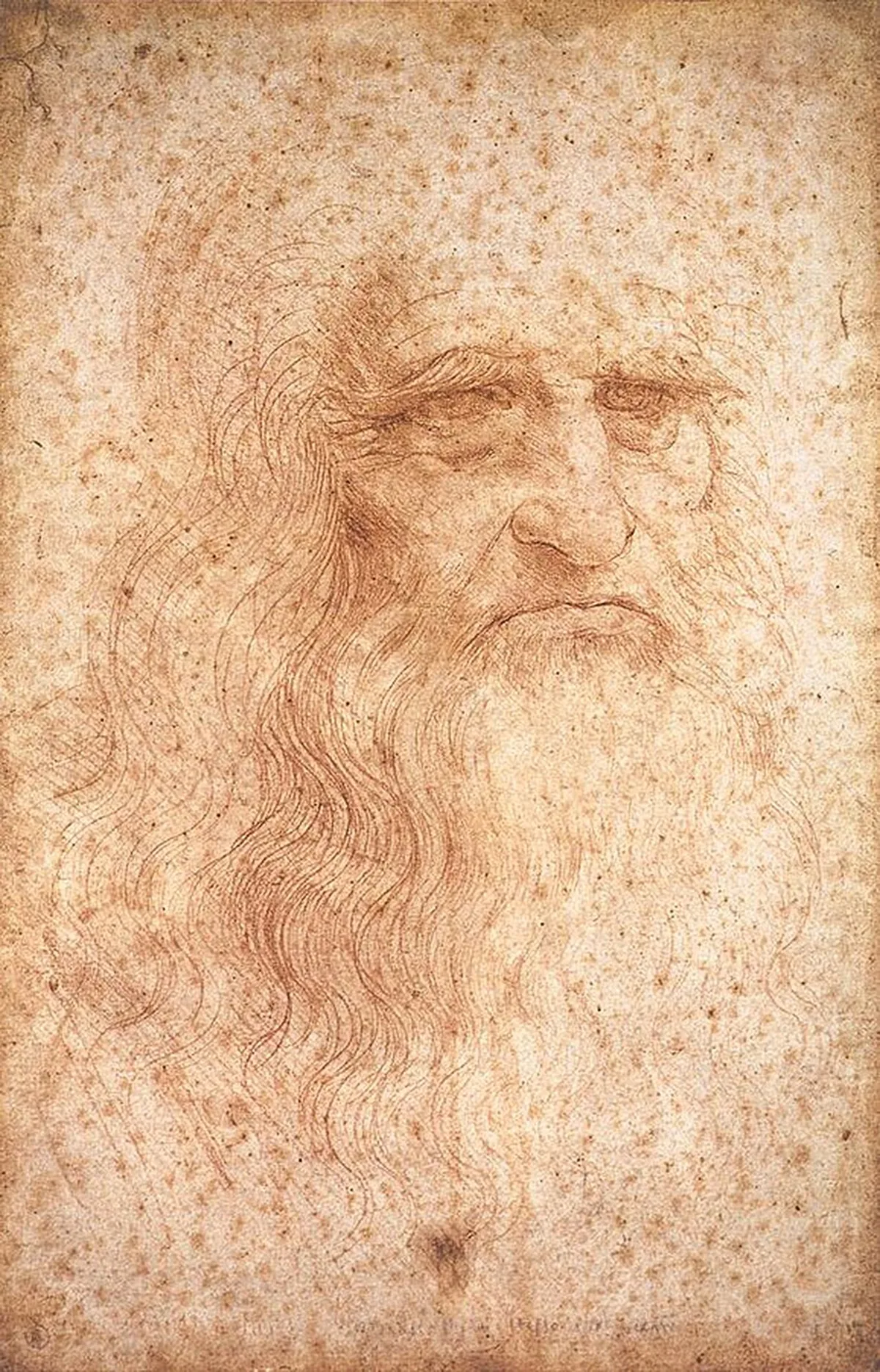
Leonardo da Vinci, so-called self-portrait, red chalk, Biblioteca Reale, Turin. Wikimedia Commons, public domain · Public domain · Source page
A painter from near Vinci who also drew machines, buildings and the human body, and left many works unfinished.
- Born: 1452, Near Vinci, Tuscany
- Died: 2 May 1519, Clos Lucé, near Amboise, France
- Won: The Last Supper in Milan, in part; The Mona Lisa, in the Louvre
- Lost: The Battle of Anghiari: the paint failed; The bronze horse: never cast
I can carry out sculpture in marble, bronze or clay, and also in painting whatever may be done, and as well as any other, be he whom he may.
Check yourself
Which statement about Leonardo’s job letter to Ludovico Sforza is best supported by the sources?
Answer: The surviving text is a rough draft, and whether it was sent is not known.. This is the careful answer. The draft survives in the Codex Atlanticus, and the sources do not show whether it was sent or reached the ruler.
Check yourself
Which description of the Last Supper’s method is best supported?
Answer: Oil mixed into tempera, painted onto dry plaster: not true fresco.. This matches Ross King’s account. The method gave rich colour and room to rework, but it did not bond like fresco.
Check yourself
What does Vasari say about the portrait of Lisa del Giocondo?
Answer: That it took four years, and Leonardo left it unfinished.. This is Vasari’s account: four years of toil, then the portrait was left unfinished.
Check yourself
Why do historians value Agostino Vespucci’s note of October 1503?
Answer: It is a contemporary note that mentions a portrait of Lisa del Giocondo.. Correct. The note was written in Leonardo’s own time, not long after the fact.
Check yourself
Vasari writes that Leonardo died ‘in the seventy-fifth year of his age’. What is the best response?
Answer: Check it: born 1452 and died 1519, so he was 67.. Correct. A wrong detail is a reason to doubt the rest of the scene.
Check yourself
Which claim about the Battle of Anghiari is best supported by the sources we used?
Answer: Commissioned in 1503, it was abandoned when the paint began to peel.. Correct. The commission came in 1503, and abandonment followed when the paint began to peel, according to Vasari.
Terms
- Renaissance A revival of art and learning based on classical antiquity, first in Italy and then across Europe, roughly from 1400 to 1600.
- patron A person, family, church or ruler who commissions and pays for a work of art.
- medium The substance that holds the pigment, such as egg, oil or wax. It decides how the paint looks, dries and lasts.
- tempera Paint made from pigment mixed with a binder, usually egg, which dries quickly.
- fresco Painting on wet plaster, so that the pigment bonds into the wall as the plaster dries. Each section is finished in a day.
- cartoon A full-size preparatory drawing, from which the design is copied onto a wall or panel.
- encaustic A painting method in which pigment is mixed into warm wax. It is an ancient technique.
- Vitruvius A Roman architect and writer of the first century BC, whose book on architecture describes the proportions of the human body.
- overpaint A layer of paint added later over an original painting, sometimes to repair it and sometimes to change it.
- attribution A judgement about who made a work, based on style, documents and tests. An attribution can change over time.
- Ludovico Sforza The ruler of Milan. He was rich and powerful, and needed engineers as much as painters.
- Ser Piero da Vinci Leonardo's father, a man from Vinci. He took the boy to Florence to learn art.
- Andrea del Verrocchio A sculptor and painter in Florence who ran a busy workshop. Leonardo learned with him.
- Giorgio Vasari A painter who wrote the lives of the artists, decades after Leonardo died. He tells many stories that are not recorded.
- Codex Atlanticus A collection of loose sheets with Leonardo's notes and drawings. It is kept in Milan.
- Ambrosiana library A library in Milan that keeps Leonardo's manuscripts, including the Codex Atlanticus.
- Last Supper Leonardo's huge painting on the dining-hall wall of the friars in Milan. It shows the moment of the betrayal.
- Santa Maria delle Grazie A Dominican monastery in Milan. Leonardo's great painting is in its dining hall.
- Ross King A writer who wrote a book on Leonardo's painting in 2012. He says Leonardo had little experience of fresco.
- Bellotti A restorer who filled the cracks in Leonardo's painting in 1726 and covered it with oil.
- Pinin Brambilla Barcilon The leader of the restoration of the great painting in Milan, which lasted twenty-one years. She wrote a book about the work.
- Michelangelo An artist from Florence, Leonardo's great rival. He left Florence for a competition for a church façade.
- Francis I The king of France who invited Leonardo to his court. He already had works by him.
- Clos Lucé A house in the town of Amboise, near the royal château. Leonardo lived there in his last years.
- Francesco Melzi Leonardo's pupil, who lived with him in France. Leonardo left him his manuscripts and drawings.
- Vincenzo Peruggia A former glazier who had worked at the Louvre. He stole the Mona Lisa in 1911.
- Niccolò Machiavelli A Florentine official who met Leonardo at Imola in October 1502.
- Cesare Borgia An Italian general and ruler. Leonardo served him as a military engineer in 1502 and 1503.
- Anghiari A battle fought in 1440, in which Florence and its allies beat Milan. The Republic wanted Leonardo to paint it.
- Louvre A museum in Paris. The Mona Lisa is kept there.
- Florence A city in Tuscany. Painters there lived on commissions.
- Milan A city in northern Italy, ruled by Ludovico Sforza. Leonardo worked there for many years.
- Vinci A town in Tuscany. Leonardo was born near it, and da Vinci means from Vinci.
Sources
- Leonardo da Vinci, draft letter to Ludovico Sforza (Codex Atlanticus, no. 1340), trans. J. P. Richter, The Notebooks of Leonardo da Vinci (London, 1883)
- Giorgio Vasari, Lives of the Most Eminent Painters, Sculptors and Architects, vol. 4, trans. Gaston du C. de Vere (Project Gutenberg ebook 28420), Life of Leonardo da Vinci
- Ross King, Leonardo and the Last Supper (London: Bloomsbury, 2012)
- Pinin Brambilla Barcilon, Leonardo: The Last Supper (1999), the account of the restoration by its leader
- Pietro Marani, Leonardo da Vinci’s Last Supper (Skira, 2009)
- Frank Zollner, Leonardo da Vinci: The Complete Paintings (Taschen, 2011)
- Musée du Louvre, collection notice on the Mona Lisa (portrait of Lisa Gherardini, wife of Francesco del Giocondo)
- Heidelberg University Library, press release on Agostino Vespucci’s marginal note, 14 January 2008
- Christie’s, sale of the Salvator Mundi, New York, 15 November 2017 (sale record and statement)
Image credits
- Leonardo da Vinci, The Last Supper, 1495–98, Santa Maria delle Grazie, Milan. Photo: author unknown, Wikimedia Commons · Public domain · Source page
- Leonardo da Vinci, Vitruvian Man, pen and ink, about 1492, Gallerie dell’Accademia, Venice. Photo: Luc Viatour. Wikimedia Commons (the photograph’s licence is disputed) · Public domain · Source page
- Peter Paul Rubens, after Leonardo da Vinci, The Battle of Anghiari (copy), about 1603. Wikimedia Commons, public domain · Public domain · Source page
- Leonardo da Vinci, Mona Lisa, Musée du Louvre, Paris. Wikimedia Commons, public domain · Public domain · Source page
- Leonardo da Vinci, Salvator Mundi, oil on walnut, after restoration by Dianne Dwyer Modestini. Wikimedia Commons (the photo is credited to Getty Images) · Public domain · Source page
- Leonardo da Vinci, so-called self-portrait, red chalk, Biblioteca Reale, Turin. Wikimedia Commons, public domain · Public domain · Source page


