The Hundred Years’ War III: Joan of Arc to Castillon
A village girl of seventeen tells the heir to the throne that God has sent her to drive out the English. He has her tested, then sends her to Orléans.
Decisions, questions and your own progress, in the app
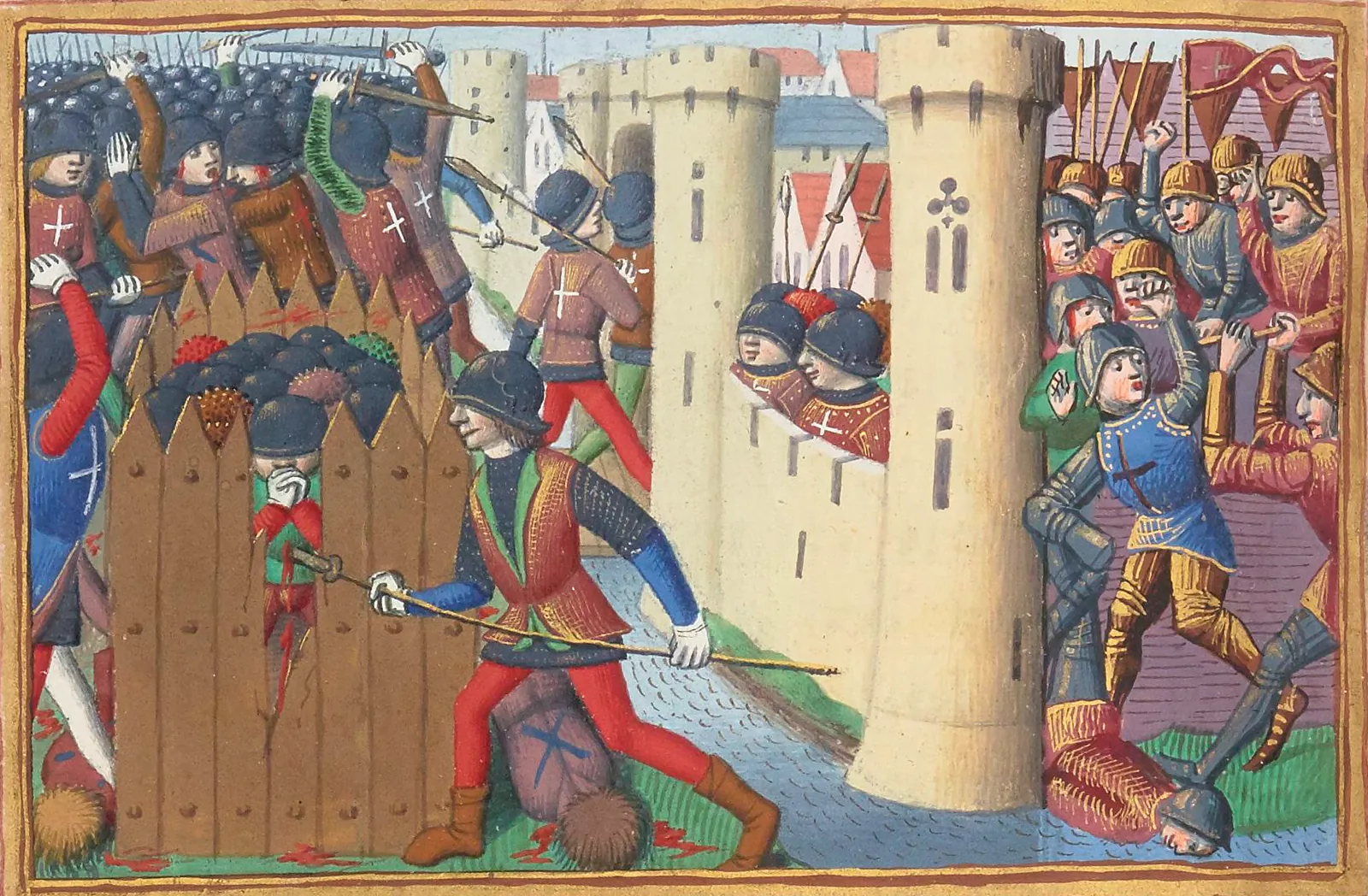
The relief of Orléans, miniature in Martial d’Auvergne, Les Vigiles de Charles VII, c. 1484. Bibliothèque nationale de France, Français 5054 · Public domain · Source page
A girl at Chinon
The girl who came to the king
Chinon, early March 1429. A girl of about seventeen walks into the great hall of the castle, her hair cut short like a boy’s, in men’s clothes. She has ridden eleven days through enemy country to tell the man who should be king of France one thing: God has sent her to drive out the English.
Two years later she will be burned in Rouen. In between, she will change the course of a war that has already lasted ninety years. She called herself Jehanne, the Maid. We know her as Joan of Arc.
Joan of Arc
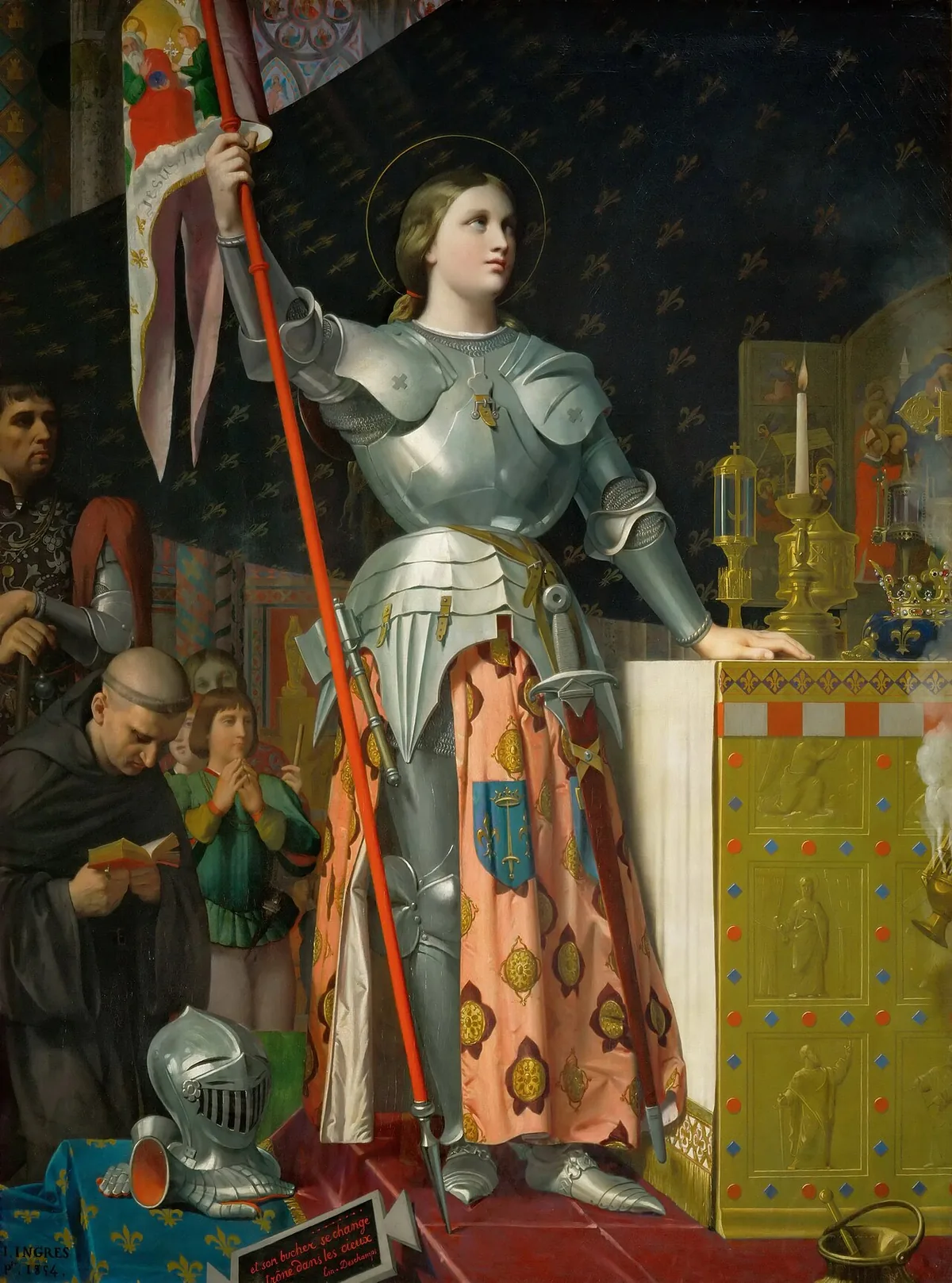
Jean-Auguste-Dominique Ingres, Joan of Arc at the Coronation of Charles VII, 1854. Musée du Louvre, Paris · Public domain · Source page
A farmer’s daughter who heard voices, broke a siege, brought a king to his crowning, and was condemned at nineteen by her enemies’ Church court and burned.
- Born: c. 1412, Domrémy, on the borders of Lorraine
- Died: 30 May 1431, Rouen, Normandy, burned at the stake as a relapsed heretic
- Won: The relief of Orléans, 1429; Jargeau and Beaugency, 1429; Patay, 1429 (with the main army, which arrived after the fight)
- Lost: The attack on Paris, 1429 (wounded); The siege of La Charité, 1429; Compiègne, 1430 (captured)
“Better, forty times better, my banner than my sword!”
Two kings for one France
Background, 1422–1424
A baby and a disinherited son
In 1422 two kings died within two months. Henry V of England left a son of nine months; Charles VI of France, long subject to fits of madness, had already disinherited his own son in Henry’s favour. So the baby, Henry VI, was proclaimed king of England and of France.
His uncle John, Duke of Bedford, governed for him in France as regent. The English held Normandy, Paris and the north; in France’s civil war between Armagnacs and Burgundians, Burgundy was their ally.
South of the Loire, the disinherited son called himself Charles VII. His enemies called him the Dauphin, or ‘the king of Bourges’. He had never been crowned. In 1424, at Verneuil, Bedford destroyed his army so completely that some called it a second Agincourt.
John, Duke of Bedford
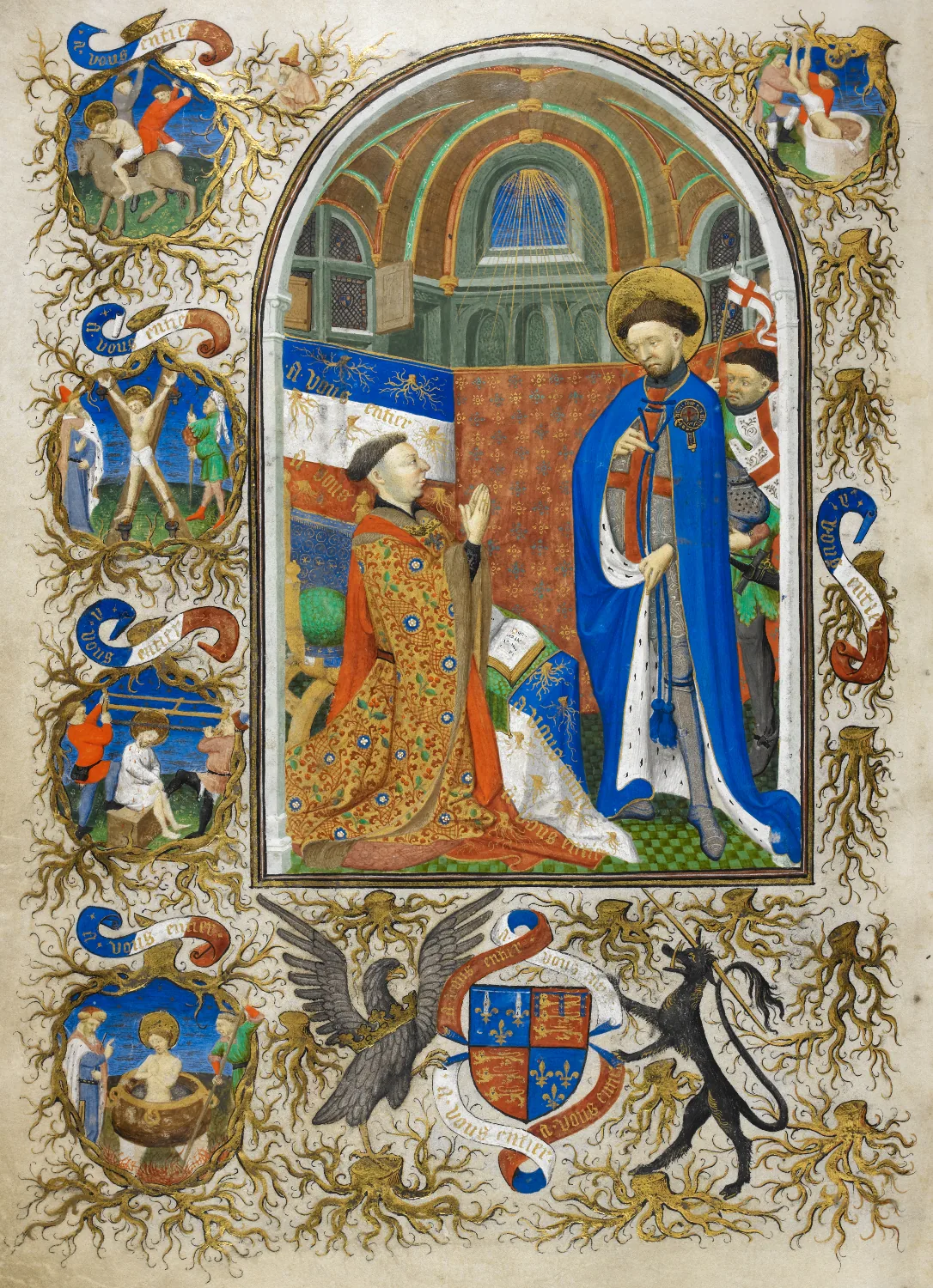
The Bedford Master, John, Duke of Bedford before Saint George, the Bedford Hours, Paris, 1420s. British Library, Add MS 18850, f. 256v · Public domain · Source page
Henry V’s brother, who held the English kingdom of France together for thirteen years, and died as it began to come apart.
- Born: 20 June 1389, England
- Died: 14 September 1435, Rouen, of illness, a week before the Treaty of Arras
- Won: Verneuil, 1424
- Lost: The siege of Orléans, 1429 (his captains); Patay, 1429 (his captains)
“A disciple and lyme of the Feende, called the Pucelle, that used fals enchauntements and sorcerie.”
1428
Why Orléans?
In October 1428 the English reached Orléans, the great gateway over the Loire: a walled city on the north bank, joined to the south by a long stone bridge. Take it, and the road into Charles’s last provinces lay open. It even broke a rule of chivalry: the city’s duke was a prisoner in England, and a captive’s lands were meant to be spared.
The English took the Tourelles, the fortified gatehouse at the southern end of the bridge, with its earthwork boulevard. Their commander, the Earl of Salisbury, was mortally wounded there by a cannon ball. Through the winter his successors ringed the city with bastilles.
Domrémy, 1412–1429
A farm girl and her Voices
Joan was born around 1412 in Domrémy, a village on the border of Lorraine that stayed loyal to Charles. A farmer’s daughter, she could not read or write, though she later learned to sign her name. ‘In sewing and spinning I fear no woman in Rouen,’ she told her judges.
At about thirteen, she said, she first heard a Voice, at noon, in summer, in her father’s garden. Later she named Saint Michael, Saint Catherine and Saint Margaret. Historians do not diagnose her; they report what she said.
In May 1428 she asked Robert de Baudricourt, captain of nearby Vaucouleurs, to send her to the Dauphin. He sent her home. She came back in January 1429, when Orléans was under siege and, she said, her Voices were telling her to go and raise it. In February he sent her to Chinon with six men.
The Maid at Orléans
A decision point
You are Charles, the uncrowned king of France.
Chinon, March 1429
Orléans could fall within weeks. Your treasury is empty and your army beaten.
Now a peasant girl of about seventeen, in men’s clothes, says God has sent her to raise the siege and take you to Reims to be crowned. A prophecy is going round: France, lost by a woman, will be saved by a maid from Lorraine.
If she is mad, or a witch, your enemies will laugh. If God has sent her and you turn her away, you refuse heaven’s help.
What do you do with her?
- Thank her politely and send her home Safe: nobody can mock you. But you throw away a hope that costs almost nothing, at the moment you have least to lose.
- Have churchmen examine her first; if she passes, send her with the relief convoy, without a command It costs weeks. But if she is false, the theologians share the blame; if she is true, your cause looks blessed. The captains keep command.
- Believe her at once and give her command of the relief army Your captains, proud men of noble birth, would probably refuse to obey a peasant girl. And if she failed, all Christendom would hear that you had trusted a madwoman.
- Keep her at court as a holy prophetess, far from the fighting A holy girl at court might comfort you, but she would not save Orléans. The people most likely to believe in her, the soldiers, would never see her.
What really happened
Have churchmen examine her first; if she passes, send her with the relief convoy, without a command
Charles tested her. For about three weeks theologians questioned her at Poitiers, and noblewomen confirmed that she was a virgin. They found nothing evil in her, and advised the king not to reject her but to test her at Orléans. She was given armour, a small household and a white standard, and dictated a letter ordering the English to go home, or the Maid would come upon them ‘to your very great hurt’.
The court was desperate, and a test cost little: if she failed, the blame was hers; if she succeeded, God was plainly on Charles’s side. Historians such as Malcolm Vale see Charles as cautious, not gullible. The record of the Poitiers examination is lost; only its conclusions survive.
The siege of Orléans: who fought whom
12 October 1428 – 8 May 1429
Orléans, on the Loire, about 110 km south of Paris
Charles VII’s French and their Scots allies
- Commanders: Jean, the Bastard of Orléans (later Count of Dunois), La Hire, Gilles de Rais and other captains, Joan, with no formal command
- Strength: 400–500, then ‘seven thousand more’ with a convoy (Monstrelet); ‘ten or twelve thousand men’ (Joan, at her trial); garrison 2,000–3,000 plus armed townsmen; relief army 3,000–4,000 (Modern estimate)
- Losses: no reliable count (The sources)
The English and their Burgundian allies
- Commanders: Thomas Montagu, Earl of Salisbury (killed 1428), The Earl of Suffolk, Lord Talbot and Lord Scales, William Glasdale, at the Tourelles
- Strength: 6,000 raised in England by Salisbury (Monstrelet); 4,000–5,000 at most, Burgundians included; about 3,500 by May 1429 (Modern estimate)
- Losses: ‘four or five hundred’ fighting men at the Tourelles, all killed or drowned but a few prisoners (Journal of the siege (final text before 1467, from notes kept at the time)); a garrison of perhaps 700–800, almost all killed, drowned or captured (Modern estimate)
The Burgundians went home in April 1429, after Bedford refused to let the city surrender to the Duke of Burgundy.
Outcome: A French victory. On 8 May 1429, nine days after Joan entered the city, the English abandoned the siege.
Chroniclers counted everyone and liked round numbers; English pay records count only paid soldiers.
The siege of Orléans
October 1428 – 8 May 1429
In October 1428 an English army under Salisbury comes to Orléans, a city held for Charles VII. The defenders hold the Tourelles, the gatehouse at the south end of the bridge, and the siege is only beginning.
After the plan of the siege drawn by J.-B.-P. Jollois in 1833, which most modern accounts follow (Kelly DeVries, 1999; Juliet Barker, 2009), checked against the modern city. The exact sites, names and number of the English forts are uncertain, and several were built only in spring 1429. The river is drawn at its summer width; the islands are approximate.
Phases of the battle
- October 1428: the bridge Salisbury’s army storms the Tourelles, the gatehouse at the south end of the bridge, and the defenders break arches behind them. Salisbury, looking out from a Tourelles window, is hit by a cannon ball and dies days later.
- Winter: a ring with a gap The English build small forts west and north of the city and hold the south bank. They are too few to close the ring: convoys keep entering through the Burgundy Gate in the east.
- 29 April – 4 May 1429: the Maid arrives Joan enters through the Burgundy Gate with the supplies on 29 April. On 4 May the relief army marches in from the west, unopposed, and the French storm Saint-Loup, the lonely fort in the east.
- 6–7 May: across the river The French cross to the south bank by an island upstream and take the Augustins. On 7 May they assault the boulevard and the Tourelles from the south, while townsmen bridge the broken arches. Joan is wounded by an arrow but returns to the fight. By nightfall the Tourelles is French.
- 8 May: the English march away On Sunday the English draw up for battle west of the city, and the French come out to face them. Joan will not attack on a Sunday. After a long stand-off the English march away.
The strategy
- French: The French keep convoys entering through the Burgundy Gate in the east, since the English are too few to close the ring. When the relief army marches in from the west, unopposed, they cross the river by an island upstream and assault the Tourelles from the south.
- English: Salisbury first stormed the Tourelles, the gatehouse at the south end of the bridge. The English then built small forts west and north of the city and held the south bank, aiming to close the ring. The sites of the forts, and when some were built, are uncertain.
What decided it: The English were too few to close the ring, and convoys kept getting in from the east. Once the French had crossed to the south bank and taken the Augustins and the Tourelles, the English abandoned the siege on 8 May 1429.
Source: News in Paris
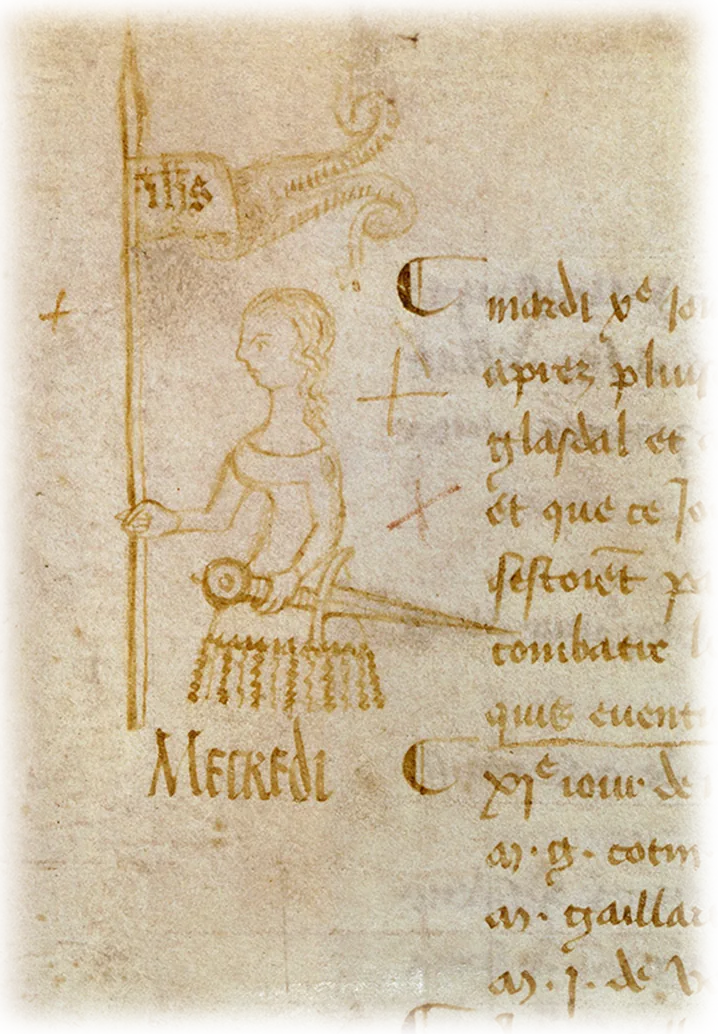
Clément de Fauquembergue, drawing in the register of the Parlement of Paris, 10 May 1429. Archives nationales, Paris (X1a 1481, fol. 12r) · Public domain · Source page
Clément de Fauquembergue, clerk of the Parlement of Paris, register entry of 10 May 1429
Two days after the siege was lifted, the clerk of the high court in English-held Paris noted in his register that the Dauphin’s men had taken the English forts at Orléans, with a Maid among them carrying a banner. In the margin, he drew her.
- Does this show what Joan looked like? No. The clerk had never seen her. He drew a girl as he imagined one, with long hair and a dress; the real Joan wore men’s clothes and short hair.
- Then what is this drawing evidence of? Of rumour. Two days after Orléans, news of a girl with a banner had already reached enemy Paris and caught an official’s imagination. Joan’s fame travelled faster than armies.
June – July 1429
Patay and the crown
In June the French took the Loire towns of Jargeau, Meung and Beaugency. On 18 June, near Patay, their vanguard caught the English on the march; in the chronicler Monstrelet’s telling, a stag ran into the English lines and the soldiers’ shouts gave them away. Talbot had no time to plant his archers’ stakes. The English broke, and Talbot was captured. Joan, with the main body, arrived when it was over.
Then Joan pressed for Reims. On 17 July 1429 Charles was crowned and anointed in the cathedral: the sacre that made him, in most French eyes, the true king. Joan stood near the altar with her standard. ‘It had shared the pain,’ she said later of her standard; ‘it was only right it should share the honour.’
Myth
Joan commanded the French army and led every attack, sword in hand.
The truth
She held no formal command. Captains such as the Bastard of Orléans and La Hire made the plans and gave the orders, though she argued with them and often pushed them to attack. She was in the thick of the fighting and was wounded twice, but in battle she carried her standard, not her sword: ‘I have never killed any one,’ she told her judges. Her power was the confidence she gave the soldiers and the legitimacy she gave the king.
The evidence
Her answers at her trial, 27 February 1431, and her comrades’ testimony in 1456. Christine de Pizan’s poem of July 1429 calls her the ‘chief captain’ of the French soldiers: poetry, not a record of command.
From Reims to Rouen
A decision point
You are John, Duke of Bedford, regent of France for your nephew Henry VI.
Paris, late July 1429
Since May your Loire army has been destroyed; Suffolk, Talbot and Scales are prisoners. Charles has been anointed at Reims, and towns in Champagne and Picardy are opening their gates to him.
You are short of money and men. An English crusading army, raised to fight heretics in Bohemia, is passing through France. Your ally the Duke of Burgundy is wavering. Your own king is seven years old and has never been crowned.
How do you save the English kingdom of France?
- Gather every man you can and seek a decisive battle, as at Verneuil A victory would undo everything since Orléans. But your army is smaller than ever and shaken; a second Patay would cost you Paris, and perhaps Normandy too.
- Hold Paris and Normandy, keep Burgundy close, and answer Reims with a coronation of your own king Charles’s unpaid army cannot stay in the field for ever. You keep the heart of the kingdom, but you leave the initiative to the enemy.
- Open peace talks with Charles while you still hold half of France It might save something. But it would abandon your brother’s life’s work, and the council in England would almost certainly refuse any peace that gave up the crown of France.
What really happened
Hold Paris and Normandy, keep Burgundy close, and answer Reims with a coronation of your own king
Bedford held on. He took over the crusaders for the war in France. In August he and Charles faced each other at Montépilloy, but neither would attack the other’s position; there was only skirmishing. Paris held when Joan assaulted it in September. In 1431 the boy Henry VI was crowned king of France in Paris.
Historians such as Juliet Barker think Bedford handled the crisis well: the English kingdom of France outlived 1429 by twenty years. But the Paris coronation came late, without the holy oil of Reims, and changed few minds.
September 1429 – May 1430
Paris, then Compiègne
On 8 September 1429 the French attacked Paris. Joan was shot through the thigh by a crossbow bolt and dragged away; the next day Charles called off the attack, preferring to bargain with Burgundy.
In May 1430 Joan rode to help Compiègne, besieged by the Burgundians. On 23 May, covering a retreat, she was cut off outside the walls and pulled from her horse. The English, wrote the Burgundian Monstrelet, who was there, were ‘more pleased than if they had taken five hundred other combatants’. John of Luxembourg, whose man had taken her, sold her to them for 10,000 livres. No record survives of any attempt by Charles to ransom or rescue her.
Source: A Parisian on the walls
“…on the word of a creature in the form of a woman, whom they called the Maid: who it was, God knows.”
“And there was their Maid with her standard on the bank of the ditches… ‘Indeed!’ said one, ‘you hussy!’ And he shot his crossbow straight at her and pierced her leg right through.”
An unknown churchman kept this diary in Paris from 1405 to 1449. He hated the ‘Armagnacs’, as he called Charles’s party. He was inside the city when it was attacked.
- Which words show where the writer stands? He will not even call Joan a woman, only ‘a creature in the form of a woman’, and he reports the crossbowman’s insult with relish. The attackers are ‘Armagnacs’, a faction, not the king’s army.
- Two years later he noted that many called her a martyr, and others did not. Why does that matter? Because he hated her, he had no reason to invent it. He ends: whatever evil or good she had done, she was burned that day.
Rouen, 1431
A trial for heresy
Joan was tried not by the English but by a Church court, at English expense, in Rouen. Her chief judge was Pierre Cauchon, Bishop of Beauvais, a Burgundian partisan whom Charles’s advance had driven from his city. The charge was heresy: false revelations, men’s clothes, and refusing to submit her Voices to the Church’s judgement.
The trial opened in January 1431; from 21 February she was questioned again and again, without a lawyer. She was kept in chains, guarded by English soldiers, not in a Church prison with women, as she asked. Notaries wrote down the questions and her answers. Thanks to her enemies, we can still hear her voice.
Source: Joan answers her judges
Asked whether she knew she was in the grace of God: “If I am not, may God place me there; if I am, may God so keep me. I should be the saddest in all the world if I knew that I were not in the grace of God.”
The question was put to her by a theologian. The Church taught that no one could be certain of being in God’s grace.
- Why was the grace question a trap? If she said yes, she claimed a certainty the Church said no one could have. If she said no, she confessed she was in sin, and then her Voices could not be from God. Her answer, almost a prayer, escaped both.
- Her enemies wrote this down. Why can we still trust some of it? Because they kept answers that make her look quick and devout, which they had no reason to invent. What the record left out is much harder to know.
A decision point
You are Joan, about nineteen years old.
The cemetery of Saint-Ouen, Rouen, 24 May 1431
This decision is not like the others. It was faced by a frightened young woman whose life was at stake: the question is what choices she really had.
You have been a prisoner for a year, five months of it in chains in Rouen. Today you stand before a crowd, your judges, a preacher and the executioner’s cart. If you do not submit to the Church, you will be burned, today.
You have been promised, you will later say, Mass and release from your irons if you submit; later witnesses add a Church prison.
What can you do?
- Refuse to sign, as you have refused for months You keep faith with your Voices. But the judge is ready to read the final sentence, and you would almost certainly be burned that same day.
- Appeal over your judges’ heads to the Pope in Rome You have every reason to try, and you do. But the judges answer that the Pope is too far away and that they are the judges here. The appeal changes nothing.
- Sign the abjuration and accept prison You are spared the fire and sentenced to prison for life. But the promise of a Church prison is not kept: you go back to the same cell and the same guards.
What really happened
Sign the abjuration and accept prison
Joan first appealed to the Pope; the judges refused. As Cauchon read out the sentence, she gave way and put her mark on a short abjuration and relapse: a cross, said one witness; a circle, said another, before an English secretary guided her hand. She was sentenced to perpetual prison and put into a woman’s dress. Within days she was found in men’s clothes again. ‘All I said and revoked, I said for fear of the fire,’ she told her judges. In their eyes she was now a relapsed heretic.
Why she put on men’s clothes again is still debated. She said the promises had been broken; the court usher Jean Massieu later testified that the guards had taken away her dress. Régine Pernoud saw a trap; Helen Castor gives more weight to Joan’s own words. We cannot know for certain.
30 May 1431
The Old Market
On 30 May 1431 the court gave its sentence: ‘WE DECREE THAT THOU ART A RELAPSED HERETIC.’ She was handed to the secular authorities and burned at the stake in the Old Market square of Rouen. Witnesses said she asked for a cross and died calling on Jesus. Her ashes were thrown into the Seine.
Myth
Joan was burned as a witch.
The truth
She was condemned for heresy, not witchcraft. The first, long list of charges did include sorcery, and Bedford called her a limb of the Devil. But the twelve articles sent to the theologians of Paris, and both sentences, rest on heresy: false revelations, men’s clothes against the Church’s rules, and refusal to submit to the Church.
The evidence
Trial record: the 70 articles of accusation (March 1431), the 12 articles (April), and the sentences of 24 and 30 May 1431 (trans. Murray, 1902).
The end of English France
1431–1436
Burgundy changes sides
Joan’s death did not save the English. The real blow came in 1435, when Philip, Duke of Burgundy, made peace with Charles VII at Arras. Bedford had died in Rouen a week before. In April 1436 Paris opened its gates to Charles’s men. Without Burgundy the English kingdom of France had no future, though it took seventeen more years to die.
1439–1450
A new kind of army
Charles VII, mocked as weak, proved a patient builder. In 1445 he created the compagnies d’ordonnance, cavalry companies paid all year round from a regular tax; in 1448 the francs-archers, archers supplied by the villages in return for freedom from tax.
The brothers Jean and Gaspard Bureau built up the royal artillery. When war broke out again in 1449, their guns, from huge bombards to lighter culverins, forced English castles to surrender in days, not months. Normandy fell in about a year. At Formigny, in April 1450, French guns and Breton cavalry destroyed the last English relief army.
John Talbot, Earl of Shrewsbury
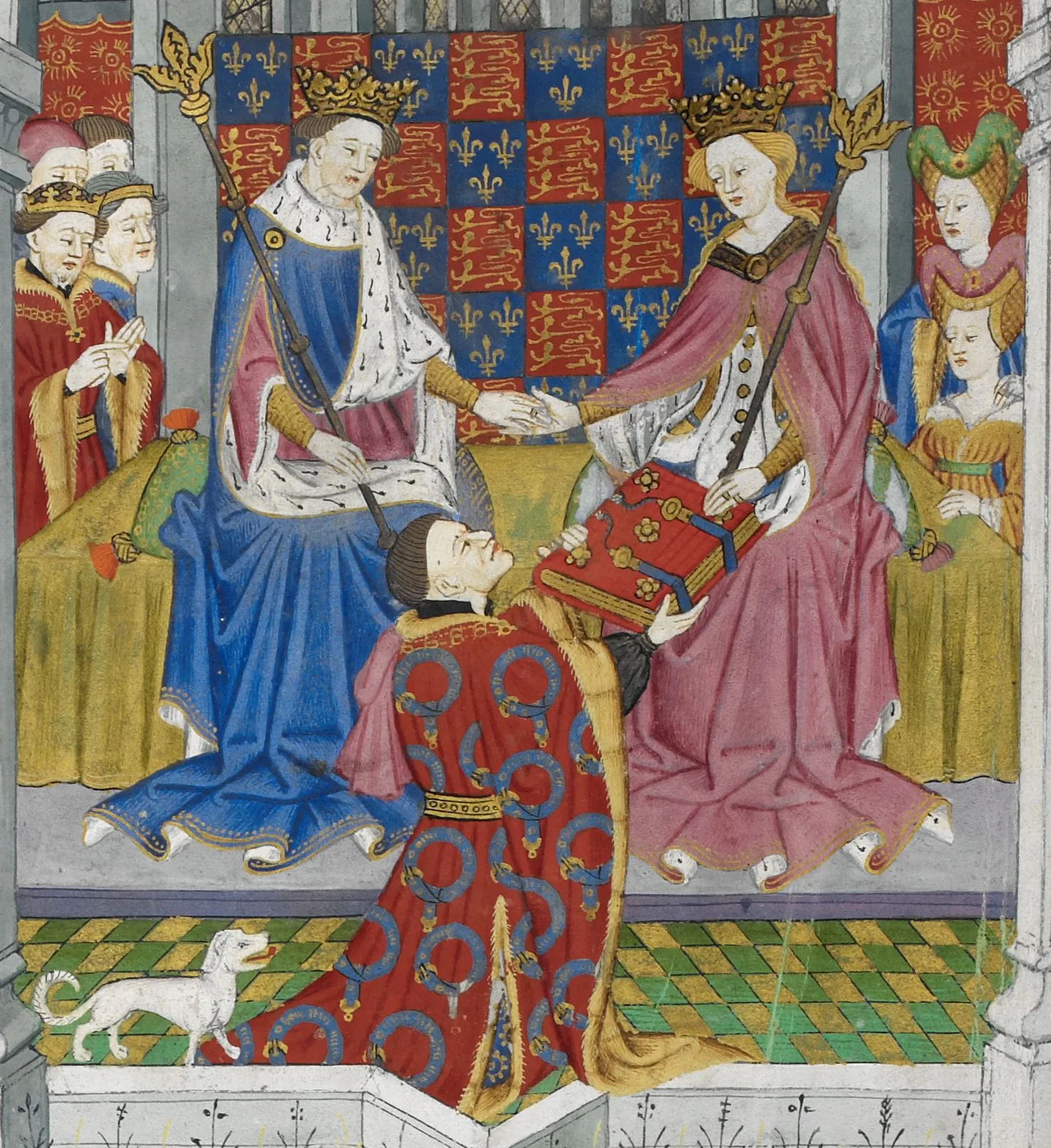
The Talbot Master, the Shrewsbury Book, Rouen, c. 1445. British Library, Royal MS 15 E VI, f. 2v · Public domain · Source page
The English captain the French feared most for twenty years, still charging at them in his mid-sixties.
- Born: c. 1387, England
- Died: 17 July 1453, Castillon, Gascony, killed in battle, pinned under his horse after a gun brought it down
- Won: Pontoise, taken by surprise in the snow, 1437; Bordeaux, retaken in 1452
- Lost: Patay, 1429 (captured); Rouen, 1449 (the city surrendered; he was handed over as a hostage); Castillon, 1453 (killed)
“How would it have joyed brave Talbot (the terror of the French) to think that after he had lain two hundred years in his tomb, he should triumph again on the stage.”
1451–1453
Gascony, lost and won back
In 1451 the French took Gascony too, and Bordeaux, English for three hundred years, surrendered. But the Gascons had grown rich selling wine to England, and in 1452 they called the English back. Talbot, about 65, landed with an army and Bordeaux opened its gates.
In July 1453 the French besieged Castillon, on the Dordogne east of Bordeaux, and the Bureau brothers had a fortified camp dug for their guns: a ditch, an earth bank and a palisade of tree trunks.
A decision point
You are John Talbot, Earl of Shrewsbury, about 66 years old.
Outside Castillon, at dawn, 17 July 1453
Messengers from Castillon begged you to hurry: if you march at once, they said, the French will run. You have ridden through the night with 800 to 1,000 horsemen. Your foot soldiers are hours behind.
At dawn you cut down a company of French archers at a priory near the town. Now your scouts report a cloud of dust and horses leaving the French camp. It looks like a retreat.
What do you do?
- Attack at once, before the French get away If the French really are fleeing, you win a cheap victory. If they are not, you are attacking a fortified gun park with tired men and no infantry.
- Wait for your foot soldiers and attack with the whole army You lose hours, and perhaps the chance to catch a retreating enemy. But you would attack with your whole army, several thousand men, and see the French position before committing.
- Put men into Castillon and let the French besiege it The town is saved for now, and the French must attack walls instead of you. But the French guns would batter Castillon as they battered Normandy, and the Gascons who called you want a victory, not a waiting game.
- Fall back to Bordeaux and gather a bigger army Safe, but Castillon would fall, and the Gascon lords who rebelled for you might lose heart and make their peace with France.
What really happened
Attack at once, before the French get away
Talbot attacked. At the camp he found the French not fleeing but waiting behind their ditch, their guns aimed along it; the dust had probably been raised by servants or horses sent away. He ordered his men to dismount and storm the palisade, while he himself, because of his age, stayed on a small horse.
His biographer A. J. Pollard explains it by his career: Talbot had always won by speed and surprise, and he believed what he wanted to hear. Alfred Burne called it a classic error: attacking a fortified position piecemeal. A story that he wore no armour because of an oath never again to fight the king of France cannot be confirmed.
Castillon: who fought whom
17 July 1453
Castillon, on the Dordogne, about 45 km east of Bordeaux
The French royal army
- Commanders: Jean Bureau and his brother Gaspard, masters of the artillery, The marshals of France and other captains, The Breton men-at-arms, under the lords of Montauban and La Hunaudaye
- Strength: 1,600–1,800 men-at-arms and archers, the Breton and other companies included, plus the royal artillery and 700 labourers (Monstrelet’s continuator); about 7,000–9,000, plus about 1,000 Bretons (Modern estimate); many, perhaps hundreds of all sizes (Modern estimate (guns))
- Losses: about 100 (Modern estimate)
The English and Gascons
- Commanders: John Talbot, Earl of Shrewsbury (killed), His son John, Viscount Lisle (killed)
- Strength: 800–1,000 horse, followed by 4,000–6,000 on foot (Monstrelet’s continuator); 5,000–10,000 in all, not all of whom reached the field (Modern estimate)
- Losses: 400–500 English dead buried; 800–1,000 fled into Castillon (Monstrelet’s continuator); up to 4,000 killed or captured (Modern estimate)
Outcome: A decisive French victory. Talbot and his son were killed; Castillon surrendered within days, and Bordeaux in October.
The French chronicle counts only the men-at-arms and archers of the companies it names; modern estimates of the whole army are far higher. English totals depend on whether the Gascons who never reached the field are counted.
The battle of Castillon
17 July 1453
The French have besieged Castillon, on the Dordogne, and their guns stand in a fortified camp between the Lidoire stream and the river. At dawn on 17 July 1453 Talbot, who has ridden all night, arrives with his horsemen to relieve the town.
After the traditional reconstruction of Léo Drouyn (1876) and Alfred Burne (1956), followed by A. J. Pollard and David Nicolle: the French camp some 1.5–2 km east of the town, with the Lidoire stream along its north side. A recent French study (Julien Adam and Florent Vincent, 2024) places the camp much closer to the town; the site of the priory, the direction of the Breton charge and the number of guns are also disputed. The rivers follow their modern courses.
Phases of the battle
- 13–16 July: the gun park East of the town, between the Lidoire stream and the Dordogne, Jean Bureau’s labourers dig a fortified camp for the guns. Breton men-at-arms wait on the high ground to the north; francs-archers hold a priory near the town.
- Dawn, 17 July: Talbot arrives After a night ride, Talbot’s horsemen fall on the archers at the priory. The survivors run for the camp, and to the English it looks as if the whole French army is running.
- Morning: the charge Talbot attacks at once. His men dismount and storm the ditch under the banners of England and Saint George; he stays on his horse. The French guns fire along the ditch at close range. English foot soldiers join as they arrive.
- An hour later: the Bretons After about an hour the Breton men-at-arms come down from the north, cross the Lidoire and charge into the English flank. The English break.
- The rout Talbot’s horse is struck by a culverin ball and falls on him, and he is killed where he lies; his son dies near him. Some English escape into Castillon; many drown trying to cross the Dordogne.
The strategy
- French and Bretons: The Bureau brothers had a fortified camp dug for the guns, with a ditch, an earth bank and a palisade of tree trunks, so that the guns could fire along the ditch at close range. The Breton men-at-arms wait on the high ground to the north.
- English and Gascons: Talbot rode through the night with 800 to 1,000 horsemen, leaving his foot soldiers hours behind. To the English it looked as if the whole French army was running, so he attacked at once: his men dismounted to storm the ditch under the banners of England and Saint George, while he stayed on his horse.
What decided it: Talbot attacked before all his foot soldiers had arrived, and his men stormed a ditch that the guns fired along at close range. About an hour later the Breton men-at-arms charged into the English flank, and the English broke. Talbot was killed where he lay, and Castillon surrendered within days.
Myth
The Hundred Years’ War ended in 1453 with a peace treaty.
The truth
Bordeaux fell in October 1453, leaving England only Calais. But no treaty ended the war, and nobody knew it was over. English, later British, kings called themselves kings of France until 1801; Edward IV invaded France in 1475, Henry VIII three times. Calais was lost only in 1558. Even the name ‘Hundred Years’ War’ was coined in the 19th century.
The evidence
The Treaty of Picquigny (1475), which paid Edward IV to go home. The name appears in French books in the 1820s, in English ones from the 1860s.
What she left behind
1450–1920
The second trial
Charles VII had an awkward problem: he had been crowned with the help of a girl the Church had burned as a heretic. In 1450 he ordered an inquiry. Joan’s mother and brothers petitioned the Pope, and in 1455–56 a nullification trial heard some 115 witnesses. On 7 July 1456 the trial of 1431 was declared null and void.
In the 19th century Joan became a national heroine for right and left alike, and in 1920 the Catholic Church declared her a saint.
What followed
- 1429 Charles VII is crowned at Reims; in most French eyes he is now the true king.
- 1435 Bedford dies; Burgundy makes peace with Charles at Arras.
- 1445–1448 A permanent royal army, paid by a permanent tax.
- 1453 Castillon; Bordeaux surrenders; Henry VI breaks down.
- 1455 The Wars of the Roses begin in England; the Tudors win them in 1485. The second Tudor king, Henry VIII, is the next lesson.
- 1456 Joan’s sentence is declared null and void.
- 1558 Calais, the last English town in France, falls.
- 1920 Joan is declared a saint.
How much did Joan change the war?
Was Joan the reason France won the Hundred Years’ War, or a brilliant episode in a war won by other means?
- Kelly DeVries, Joan of Arc: A Military Leader (1999) A real military leader. Her insistence on attacking turned a defensive war into an offensive one, and between Orléans and Patay the English field army on the Loire was broken in six weeks. Her effect on morale was immediate, and the captains knew it.
- Helen Castor, Joan of Arc: A History (2014) Read her within the politics and religion of her time. The court and the captains used her; her power was the belief she created. To her contemporaries she was neither saint nor fraud but an open question, and the failure at Paris and her death show the limits of that power.
- Juliet Barker, Conquest (2009); Malcolm Vale, Charles VII (1974) The war was won later: by the peace with Burgundy in 1435, by money, by the standing army and the Bureau guns, and by English mistakes. Joan’s year changed morale and gave Charles his crown, but it did not decide the war.
Everyone agrees that 1429 changed the mood of the war and gave Charles a crown that counted. Whether it changed the outcome is still argued.
What do you know now?
Check yourself
Why could the English not starve Orléans into surrender?
Answer: They were too few to close the ring, and convoys kept entering from the east. Right. A dozen small forts could not cover a ring some ten kilometres round; the east side stayed open all winter.
Check yourself
What did Charles VII do with Joan when she reached Chinon?
Answer: Had theologians examine her for weeks, then sent her with the relief convoy, without a command. Right. The theologians at Poitiers found ‘nothing evil’ in her and advised testing her at Orléans; the captains kept command.
Check yourself
Why did the coronation at Reims matter so much?
Answer: Anointing at Reims made Charles, in most French eyes, the true king. Right. Until the sacre his enemies could call him ‘the Dauphin’; after it Henry VI’s claim looked weaker, and Bedford had to answer with a coronation of his own.
Check yourself
On what charge was Joan finally sent to her death?
Answer: As a relapsed heretic, after she had abjured and put on men’s clothes again. Right. Only a relapse could send someone who had abjured to the fire, and the sentence says so in so many words.
Check yourself
Why did Talbot’s attack at Castillon fail?
Answer: He attacked a fortified gun park piecemeal, and Breton cavalry struck his flank. Right. The guns cut his men down at the ditch, and after about an hour the Breton charge broke them from the side.
Check yourself
Joan’s trial record was written by her enemies. Why do historians still use it?
Answer: It keeps her answers day by day, including many that helped her and embarrassed her judges. Right. When a hostile source keeps something that helps the accused, it is probably genuine; we must still ask what was left out.
Terms
- the Maid (la Pucelle) The name Joan gave herself. In French a pucelle is a young unmarried girl, a virgin. She never called herself ‘Joan of Arc’.
- Dauphin The title of the eldest son and heir of the king of France. After 1422 the English and Burgundians kept calling Charles VII ‘the Dauphin’, to deny that he was king.
- regent Someone who governs for a king too young, or too ill, to rule. Bedford was regent of France for his nephew Henry VI from 1422 to 1435.
- Armagnacs and Burgundians The two parties of the French civil war that grew out of the murder of the Duke of Orléans in 1407. The Armagnacs backed Charles VII; the Burgundians, led by the Duke of Burgundy, sided with England from 1419 to 1435.
- bastille A small fort of earth and timber built by besiegers round a town. Around Orléans the English built about a dozen; one chronicler claimed sixty.
- boulevard An earth-and-timber outwork in front of a gate or tower, built to keep attackers and their guns at a distance. Our word for a wide avenue comes from the promenades later laid out on old town ramparts.
- the sacre at Reims French kings were crowned and anointed in Reims cathedral with holy oil said to have come from heaven. Until he was anointed there, many French people did not see Charles VII as truly king.
- heresy Holding beliefs the Church has condemned, and refusing to give them up. Church courts judged heresy; the punishment of a stubborn heretic, death, was carried out by the secular authorities.
- abjuration and relapse To abjure was to renounce one’s errors publicly before a Church court. It saved a heretic’s life, usually in exchange for prison. One who relapsed afterwards was handed over to be put to death, with no second chance.
- compagnies d’ordonnance Companies of heavy cavalry created by Charles VII in 1445 and paid all year round from a regular tax. They are often called the first permanent army in western Europe since Roman times.
- culverin A long, fairly light 15th-century gun firing lead or iron balls. Unlike the huge siege bombards, it could be moved and aimed on a battlefield.
- nullification trial The Church inquiry of 1455–56, held with the Pope’s permission, that declared Joan’s trial of 1431 null and void. It is often called her rehabilitation.
- Charles VII The son his father disinherited in favour of Henry V. Joan helped him be crowned at Reims.
- Henry VI A baby proclaimed king of England and France in 1422. He was crowned in Paris in 1431.
- Henry V King of England who died in 1422, leaving a nine-month-old son.
- John, Duke of Bedford The uncle of Henry VI, who governed France for him as regent. He won at Verneuil in 1424.
- Talbot An English commander taken prisoner at Patay in 1429.
- Burgundy A duchy in France that allied with the English in the French civil war.
- Orléans A city on the Loire that the English besieged in 1428. Joan lifted the siege.
- Loire The longest river in France. Orléans lies on its north bank.
- Tourelles The fortified gatehouse at the south end of the bridge at Orléans.
- Earl of Salisbury English commander at Orléans, mortally wounded by a cannon ball.
- Domrémy A village on the border of Lorraine that stayed loyal to Charles. Joan was born there.
- Lorraine A region in north-east France, where Joan came from.
- Rouen A city in northern France where Joan was tried and burned.
- Chinon The castle where Charles received Joan in 1429.
- Poitiers A city where theologians questioned Joan for about three weeks.
- Vaucouleurs A town near Domrémy. Its captain sent Joan home the first time.
- Robert de Baudricourt Captain of Vaucouleurs. He first sent Joan home, then in February 1429 sent her to Chinon.
- Saint Michael One of the Voices Joan said she heard. She named him only later.
- Saint Catherine A saint whose voice Joan said she heard.
- Saint Margaret A saint whose voice Joan said she heard.
- Compiègne A town in northern France besieged by the Burgundians in 1430. Joan was captured outside its walls.
Sources
- Trial of condemnation (Rouen, 1431) and depositions of the nullification inquiries (1450–56), trans. T. Douglas Murray, Jeanne d'Arc, Maid of Orleans, Deliverer of France: Being the Story of Her Life, Her Achievements, and Her Death, as Attested on Oath and Set Forth in the Original Documents (London: Heinemann, 1902)
- Jules Quicherat (ed.), Procès de condamnation et de réhabilitation de Jeanne d'Arc, 5 vols (Paris: Renouard, 1841–49); vol. V includes Christine de Pizan, Ditié de Jehanne d'Arc (31 July 1429), and Bedford's letter to the council
- Enguerrand de Monstrelet, The Chronicles, trans. Thomas Johnes (1809–10), vol. 6: Verneuil, Joan at Chinon, Orléans, Patay, Compiègne
- Continuation of Monstrelet's Chronicles, trans. Thomas Johnes, vol. 9: the battle of Castillon, 1453
- Journal d'un bourgeois de Paris, 1405–1449, ed. Alexandre Tuetey (Paris: Champion, 1881), §§ 519 (8 September 1429) and 578 (Rouen, 1431)
- Clément de Fauquembergue, register of the Parlement of Paris, entry of 10 May 1429, with marginal drawing. Archives nationales, Paris, X1a 1481, fol. 12r
- Christine de Pizan, Ditié de Jehanne d'Arc, ed. Angus J. Kennedy and Kenneth Varty (Oxford: Society for the Study of Mediaeval Languages and Literature, 1977)
- Helen Castor, Joan of Arc: A History (London: Faber & Faber, 2014)
- Kelly DeVries, Joan of Arc: A Military Leader (Stroud: Sutton, 1999)
- Régine Pernoud and Marie-Véronique Clin, Joan of Arc: Her Story, trans. and rev. Jeremy duQuesnay Adams (New York: St Martin's Press, 1998; French original Paris: Fayard, 1986)
- Régine Pernoud, Joan of Arc by Herself and Her Witnesses, trans. Edward Hyams (London: Macdonald, 1964)
- Craig Taylor (ed. and trans.), Joan of Arc: La Pucelle (Manchester: Manchester University Press, 2006)
- Daniel Hobbins (trans.), The Trial of Joan of Arc (Cambridge, MA: Harvard University Press, 2005)
- Juliet Barker, Conquest: The English Kingdom of France 1417–1450 (London: Little, Brown, 2009)
- Jonathan Sumption, The Hundred Years War, vol. V: Triumph and Illusion (London: Faber & Faber, 2023)
- Malcolm G. A. Vale, Charles VII (London: Eyre Methuen, 1974)
- A. J. Pollard, John Talbot and the War in France 1427–1453 (London: Royal Historical Society, 1983; 2nd edn Barnsley: Pen & Sword, 2005)
- Philippe Contamine, Guerre, État et société à la fin du Moyen Âge: Études sur les armées des rois de France 1337–1494 (Paris and The Hague: Mouton, 1972)
- Richard Vaughan, Philip the Good: The Apogee of Burgundy (London: Longman, 1970)
- Alfred H. Burne, The Agincourt War (London: Eyre & Spottiswoode, 1956)
- David Nicolle, The Fall of English France 1449–53 (Oxford: Osprey, 2012)
- Christopher Allmand, The Hundred Years War: England and France at War c. 1300–c. 1450 (Cambridge: Cambridge University Press, 1988)
- Marina Warner, Joan of Arc: The Image of Female Heroism (London: Weidenfeld & Nicolson, 1981)
Image credits
- The relief of Orléans, miniature in Martial d’Auvergne, Les Vigiles de Charles VII, c. 1484. Bibliothèque nationale de France, Français 5054 · Public domain · Source page
- Jean-Auguste-Dominique Ingres, Joan of Arc at the Coronation of Charles VII, 1854. Musée du Louvre, Paris · Public domain · Source page
- The Bedford Master, John, Duke of Bedford before Saint George, the Bedford Hours, Paris, 1420s. British Library, Add MS 18850, f. 256v · Public domain · Source page
- Clément de Fauquembergue, drawing in the register of the Parlement of Paris, 10 May 1429. Archives nationales, Paris (X1a 1481, fol. 12r) · Public domain · Source page
- The Talbot Master, the Shrewsbury Book, Rouen, c. 1445. British Library, Royal MS 15 E VI, f. 2v · Public domain · Source page


