Jikji, 1377: the book printed with metal type before Gutenberg
About 75 to 78 years before Gutenberg, a Buddhist book was printed in Korea with movable metal type. One volume of it survives, and it is in Paris. How did it get there, and what was invented first?
Decisions, questions and your own progress, in the app
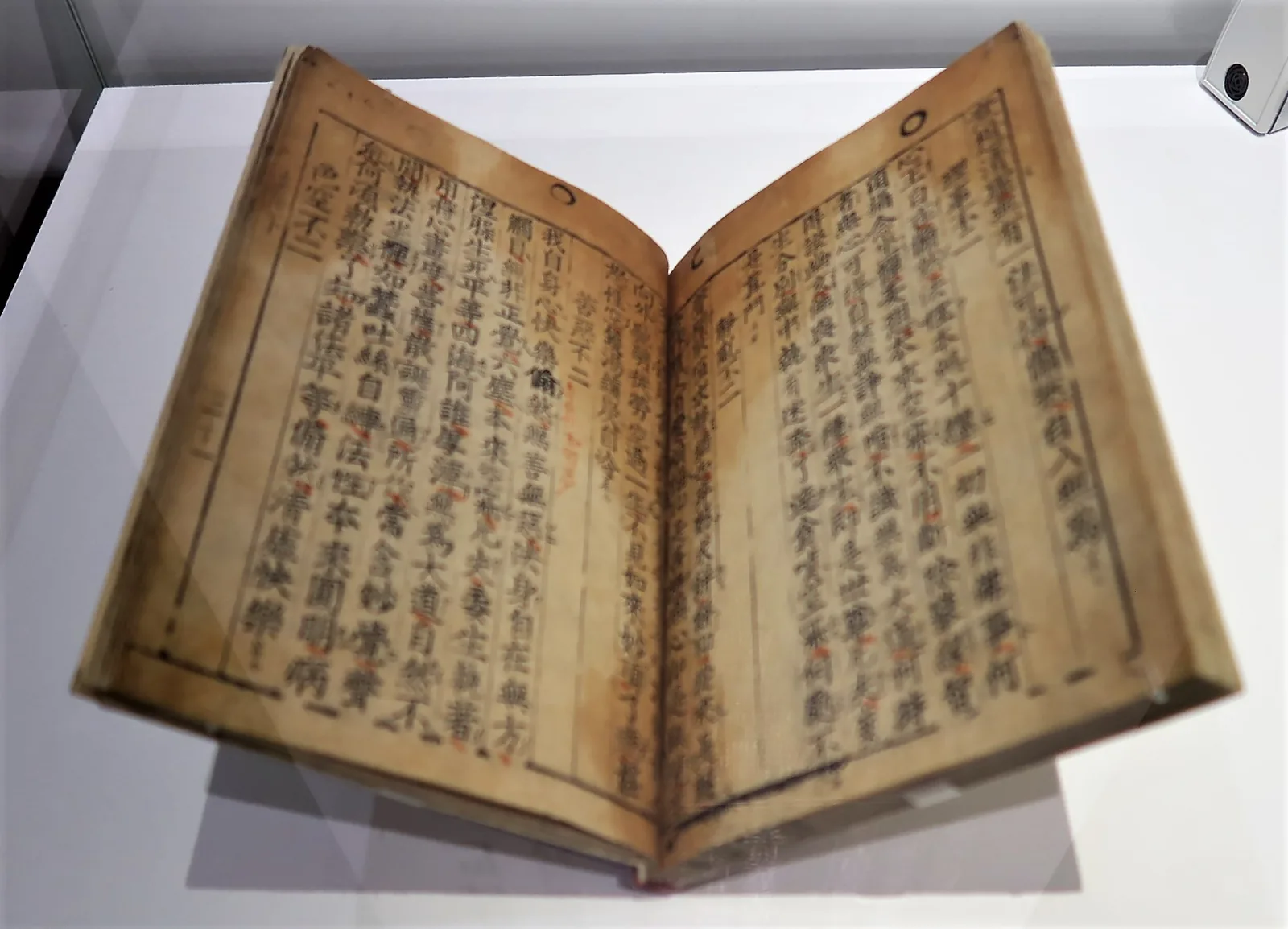
Zythème, 2023. Own work. · CC0 · Source page
The scene and the background
The National Library, Paris
The National Library of France in Paris holds one volume of a Buddhist book printed in Korea in 1377.
That is about 75 to 78 years before the Bible printed by Johannes Gutenberg. How did a Korean book reach Paris, and what was really invented first?
Background
A monk, and a book printed after his death
The book is called Jikji for short. It is an anthology of teachings from Seon, Korean Zen Buddhism. The monk Baegun (1298–1374) collected them, around 1372 according to one source.
Baegun died in 1374. Three years later the book was printed by a team of monks.
Background
Goryeo Korea
1237–1248
In 1377 Korea is ruled by Goryeo, a kingdom where Buddhism matters greatly. Between 1237 and 1248, monks at Haeinsa temple carved the whole Buddhist canon onto woodblocks, thousands of them. That set, the Tripitaka Koreana, is still kept at Haeinsa.
Korea already knew how to print books. The question was which method to use.
Ways to print
A decision point
You are Seokchan, a monk who leads a team of monks at Heungdeoksa temple in Cheongju.
Korea, 1377. Three years after Baegun's death.
Baegun's teachings are in front of you, and you must decide how to print them. Every page must be clear and correct. Each method takes time, money and work, and none is certain.
How do you print it?
- Carve each page on a wooden block and print from it. It is a familiar method. Safe and familiar. But each block belongs to one page, and every correction means carving a new block. The work would take a long time.
- Cast separate characters in metal, set them for each page, then return them to a box for reuse. The characters can be kept and reused, and corrections are easier. But casting each one takes skill, and you cannot be sure every character comes out clean.
- Copy the book by hand, as monks have done for generations. You can start at once with no special equipment. But every copy is new work, and dozens of copies would take years.
What really happened
Cast separate characters in metal, set them for each page, then return them to a box for reuse.
In practice the book was printed with movable metal type. The National Library of France says its characters were cast in metal.
No source explains why this method was chosen.
Background
A metal-type book from 1234
1234
In 1234 the Goryeo court ordered a book printed with metal type, the Sangjeong gogeum yemun. Most sources date its printing to about 1241, though one says it ran to 1250. No copy is known to survive.
There is no evidence that the monks of Cheongju knew that book. But the order itself shows that metal type was already in use in Korea by 1234.
Money, a note and a myth
A decision point
You are a Buddhist nun with money you can give.
Korea, 1377.
Monks from Cheongju ask for help printing Baegun's teachings. He died three years ago. Printing costs money for paper, ink and the monks' work. You do not know the full sum.
Will you give money, and how much?
- Give a significant sum to the printing. The book gets printed, and Baegun's teachings can reach more readers. But the money is gone, and your own temple's needs must wait.
- Give a small sum and leave the monks to find the rest. Printing may be delayed or cut short. The monks might find other donors, or they might not.
- Keep the money for your own temple's needs. The money stays with you. If no other funds turn up, Baegun's teachings may survive only as hand-copied manuscripts.
What really happened
Give a significant sum to the printing.
The book's closing note says that a nun named Myodeok helped fund the printing. The amount is not given in the translation we have.
We do not know what she thought, or whether anyone asked her. This scene is imagined. It rests on one fact: printing needed money.
What happened
July 1377, Cheongju
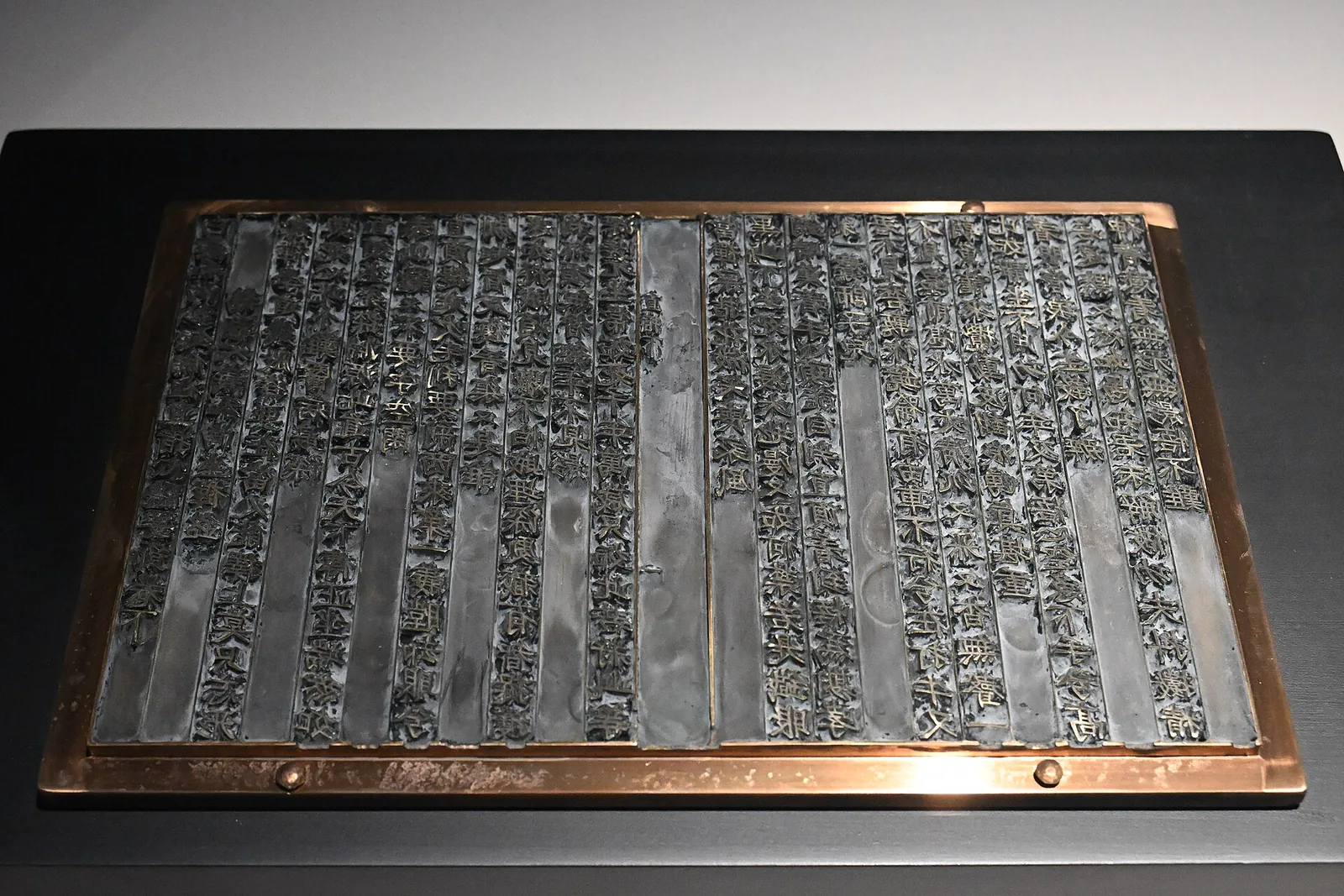
Kjoonlee, 2026. Own work. · CC BY 4.0 · Source page
1377
The book was finished in July 1377, by most sources. It was printed at Heungdeoksa, a regional temple in Cheongju, and its characters were movable metal type.
Each character was cast separately and set in rows for each page. In woodblock printing, by contrast, each page is one block.
Source: Two pages from the book
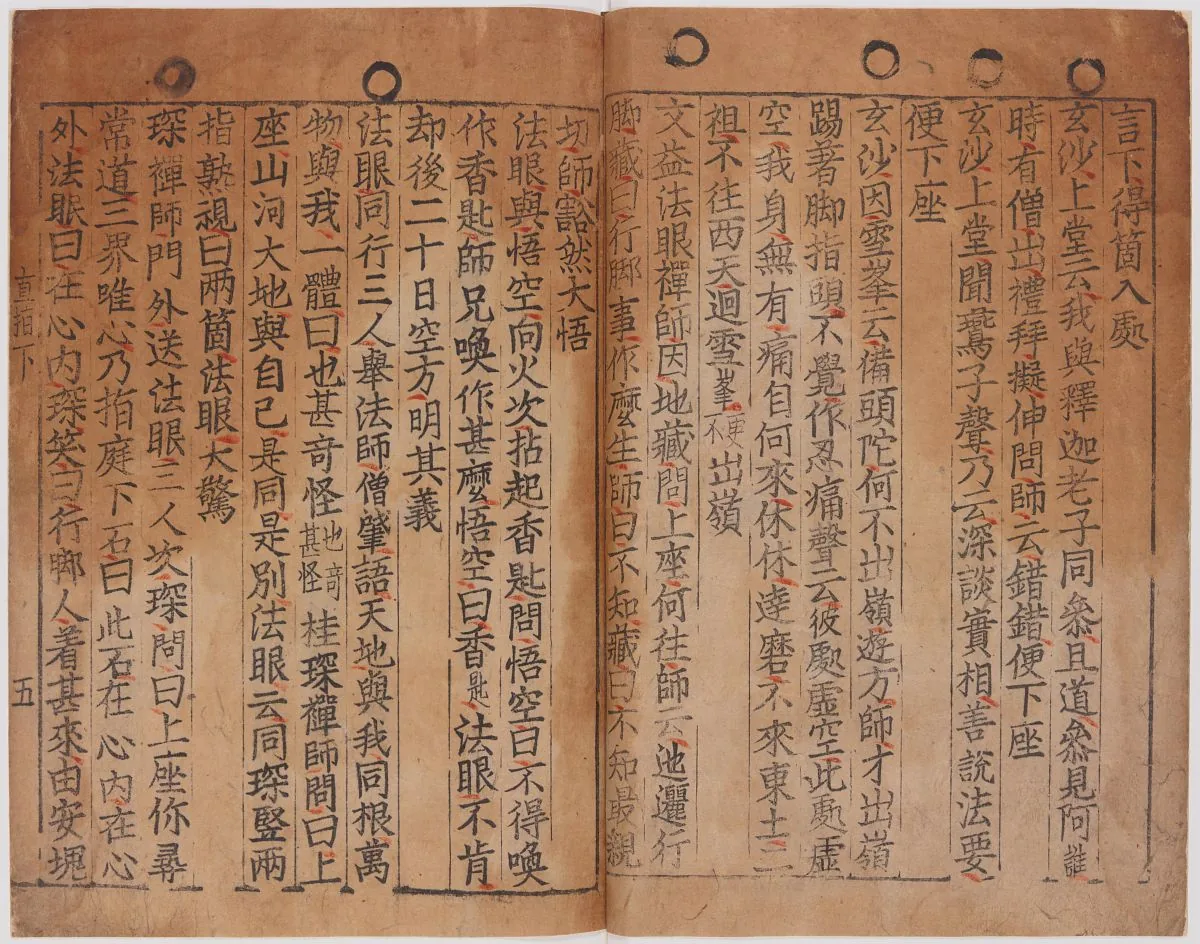
Unknown author, Jikji, 1377. Scan by the Bibliothèque nationale de France (Gallica). · Public domain · Source page
Jikji, 1377, pages 4v–5r. Scan from Gallica, Bibliothèque nationale de France
This is a digital scan. The caption on Wikimedia Commons calls it a manuscript, but it is a printed book.
- How can you tell it was printed, not copied by hand? The lines are straight and evenly spaced, and repeated characters look almost identical across the page. A hand copyist changes the shape slightly from line to line.
- What can these two pages not tell us? Who paid for the book, and what it cost. We need other sources for that.
Source: The closing note of the book
Printed by a team of monks led by Seokchan three years after Baegun passed away.
Published with the financial assistance of the Buddhist nun Myodeok.
A closing note like this, a colophon, is printed inside the book in 1377, so it is close to events. But the printers probably wrote it, so it shows their side. Here we have only an English translation, not the original.
- Why name a nun? It thanks a donor and honours her. The printers may also have wanted the book to look like a community effort.
- What is missing from this note? In the part we have, it says nothing about the characters or the method. It tells us who helped, but not how the book was made.
Myth
Johannes Gutenberg invented printing, and his Bible was the first printed book.
The truth
No. Printing existed in East Asia for centuries before him. The Diamond Sutra was printed from woodblocks, and its closing note gives the date 11 May 868. The Jikji is the oldest surviving book printed with metal type. It is not the oldest printed book.
The evidence
Around 1040, Bi Sheng in China made movable type from baked clay. Shen Kuo recorded the method in his Dream Pool Essays and did not claim it as his own.
The road to Paris
The road
A consul in Seoul
Victor Collin de Plancy was the French consul in Seoul under King Gojong. He brought several hundred Korean books back to France, and the Jikji reached France through his collection.
We do not know when he acquired the book. The route is clearer than the date.
A decision point
You are a book collector in Paris, in 1911.
Paris, 1911.
A dealer offers you an old Buddhist book from Korea, printed. You do not know it well, and you must decide.
What do you do?
- Buy the book and keep it in your private collection. The book stays in private hands, and it is hard to say when the public will see it. If it stays there, few will read it.
- Buy the book and offer it at once to a public library. The book would probably reach the public sooner. But the library might refuse it.
- Pass on the purchase and let another buyer take the book. The book goes back onto the market, and there is no way to know where it goes.
What really happened
Buy the book and keep it in your private collection.
The real buyer was Henri Vever, who acquired the book in 1911. He kept it, and in 1950 he bequeathed it to the National Library of France. The library took it into its collection in 1952.
We do not know what Vever thought, or why he bought the book. The National Library of France records only that it was sold to him in 1911. We can see what happened next, not his reasons.
After
One volume left
What survives in Paris is only the second volume. The first is not known to survive. In 1900 the book was shown at the Paris Universal Exhibition, in the Korean pavilion, its first public showing in Europe.
In 1972 the Korean librarian and historian Park Byeong-seon found the book at the library in Paris. She is credited with showing that it predates the Gutenberg Bible. Another account says it lay among unsorted papers, so the story of its discovery is not entirely clear.
What remains, and what is not known
The book's road
- 1377 Printed at Heungdeoksa, in Cheongju, with movable metal type.
- c. 1452–1455 Gutenberg prints his Bible. The Jikji came some 75 to 78 years earlier.
- 1911 Henri Vever buys the book.
- 1950–1952 Vever leaves the book to the National Library of France in his will. The library takes it into its collection in 1952.
- 1972 Park Byeong-seon identifies the book. The same year it is shown in Paris during International Book Year.
Did it change the world?
Was the Jikji a turning point in the history of printing, or a local chapter in Korea's history?
- Those who see a turning point It is the oldest surviving book printed with metal type, and it gives its date and the names of its printers. It proves the method worked in practice by 1377.
- Those who stress its limits Our sources do not show that the method spread quickly. The book ordered in 1234 survives in no copy, so we know it only from records. Woodblock printing stayed very important in Korea, as the Tripitaka Koreana shows.
We do not know whether Johannes Gutenberg ever heard of Korean printing. No evidence has been found either way.
Check yourself
What sets movable-type printing apart from woodblock printing?
Answer: The text is built from separate characters that can be rearranged and reused, not one block per page.. Correct. A carved block keeps the text it was carved with, while a movable character goes back into the box.
Check yourself
Which statement about the Diamond Sutra of 868 is most accurate?
Answer: It is a book printed from woodblocks, dated 868, more than five centuries before the Jikji.. Correct. Its closing note gives the date, and it shows that printing existed long before 1377.
Check yourself
Which statement about the Jikji's closing note as a source is most accurate?
Answer: It was printed inside the book in 1377, but it is written from the printers' view.. Correct. It combines a strength and a limit, which is exactly the critical reading the source step asked for.
Check yourself
Roughly how many years before the Gutenberg Bible was the Jikji printed?
Answer: About 75 to 78 years. Correct. The gap between 1377 and 1452 to 1455 is about 75 to 78 years.
Check yourself
What is the correct order of the book's road to Paris?
Answer: The consul brought it, Vever bought it in 1911, and in 1950 he left it to the library.. Correct. This is the recorded order, and it entered the library's collection in 1952.
Check yourself
What is Park Byeong-seon credited with?
Answer: Finding the book in Paris, and showing that it predates the Gutenberg Bible.. Correct. Both achievements are credited to her, according to the sources we read.
Terms
- Seon The Korean name for Zen, a school of Buddhism that stresses personal practice and meditation.
- Goryeo The kingdom that ruled Korea in the 13th and 14th centuries, when the Jikji was printed.
- woodblock A wooden board carved with text in reverse. It is inked and pressed onto paper to print one page.
- movable type Separate characters that can be set for each page and used again. In woodblock printing, by contrast, each page is one block.
- colophon A note at the end of a book in which its makers say who made it, and when.
- Diamond Sutra A short Buddhist text printed from woodblocks in 868. It is the oldest known dated printed book.
- consul An official who represents a state in a foreign city, looking after its citizens and trade. Not an ambassador.
- Baegun A Korean monk who collected the Zen teachings in the book. He lived from 1298 to 1374.
- Sangjeong gogeum yemun A book the Goryeo court ordered in 1234 to be printed with metal type. No copy is known to survive.
- Tripitaka Koreana The whole Buddhist canon, carved on thousands of wooden blocks between 1237 and 1248. It is still kept at Haeinsa.
- Haeinsa A temple in South Korea that keeps the Tripitaka Koreana.
- Cheongju A city in South Korea. A temple there, Heungdeoksa, printed the Jikji.
- Heungdeoksa A regional temple in Cheongju where the book was printed with movable metal type in 1377.
- Gojong King of Korea when the French consul Victor Collin de Plancy served in Seoul.
- Victor Collin de Plancy The French consul in Seoul. He brought several hundred Korean books to France, and the Jikji reached Paris through his collection.
- Park Byeong-seon A Korean librarian and historian. In 1972 she found the book at the library in Paris and is credited with showing that it predates the Gutenberg Bible.
- Myodeok A nun who helped pay for printing the book, according to its closing note.
- Johannes Gutenberg A German printer who printed the Bible. He is usually credited with bringing printing to Europe.
- Gutenberg Bible The Bible printed by Johannes Gutenberg. The Jikji is about 75 to 78 years older.
- Seoul The capital of Korea.
- Korea A country in East Asia, where the Jikji was printed in 1377.
- Paris Universal Exhibition A huge international fair. In 1900 the book was shown there, in the Korean pavilion, its first showing in Europe.
- National Library of France The national library of France, in Paris. It holds the second volume of the Jikji.
- Buddhist canon The collection of sacred Buddhist texts. In Korea it was carved onto wooden blocks.
- Buddhism A religion founded in India and based on the teachings of the Buddha. In Goryeo Korea it mattered greatly.
- Henri Vever A French collector who bought the Jikji in 1911 and in 1950 left it to the National Library of France.
Sources
- Closing note of the Jikji (1377), translation on the project page jikji.utah.edu (translator not named), https://jikji.utah.edu/?p=495
- The Diamond Sutra, dated 11 May 868, British Library, Or.8210/P.2 (dated closing note, woodblock print).
- Shen Kuo, Dream Pool Essays (Mengxi bitan), passage on Bi Sheng's movable type of baked clay.
- Bibliothèque nationale de France, web page on the Jikji, 'Jikji, treasure of world printing'.
- Korea Times, 'Royal book finder dies in Paris', 23 November 2011 (obituary of Park Byeong-seon).
- Encyclopaedia Britannica, entry 'Jikji'.
Image credits
- Zythème, 2023. Own work. · CC0 · Source page
- Kjoonlee, 2026. Own work. · CC BY 4.0 · Source page
- Unknown author, Jikji, 1377. Scan by the Bibliothèque nationale de France (Gallica). · Public domain · Source page


