The unification of Italy
Austria’s chancellor called Italy “a geographical expression”. Fourteen years later it was a kingdom.
Decisions, questions and your own progress, in the app
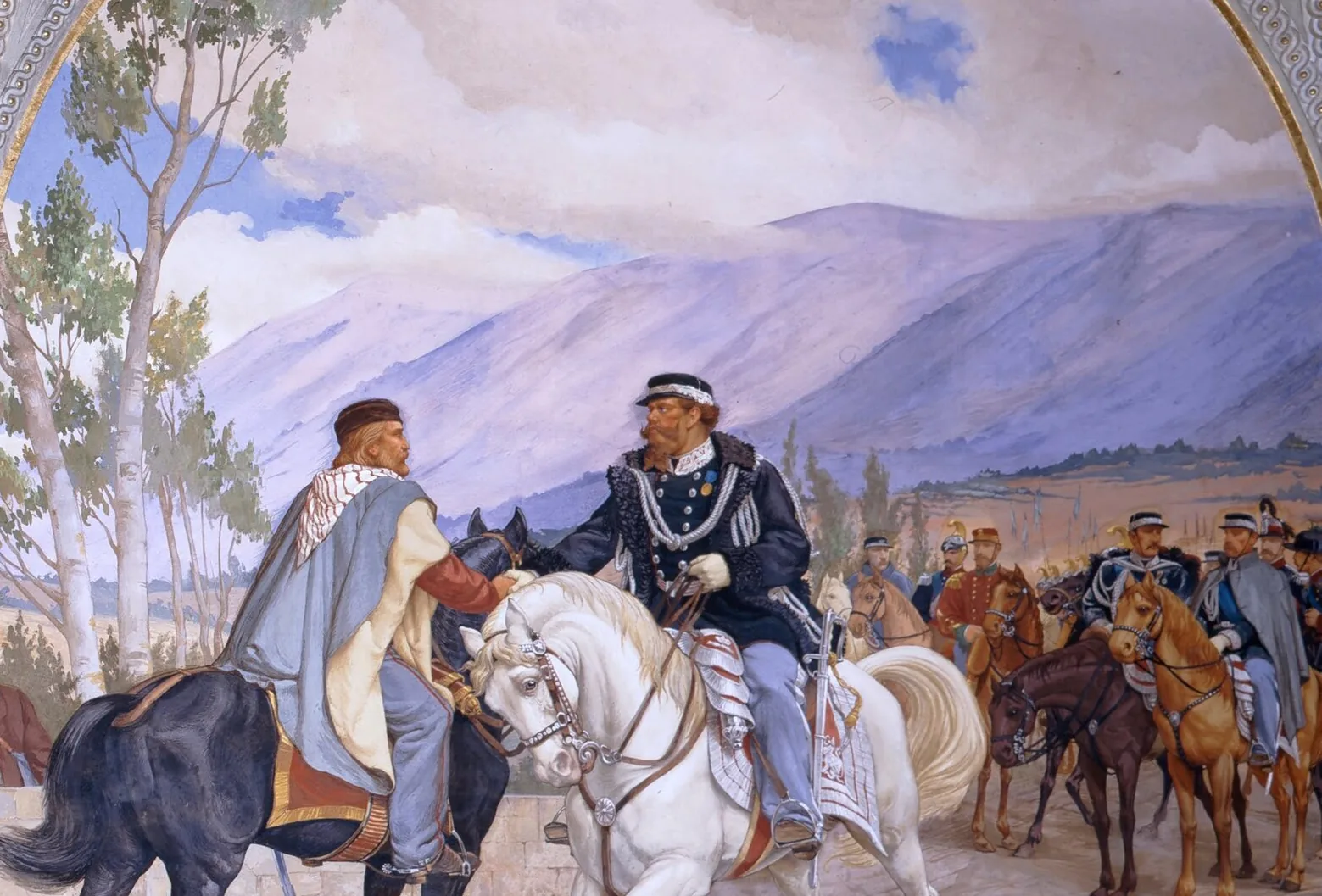
Pietro Aldi, The Meeting at Teano (detail), fresco, 1886. Sala del Risorgimento, Palazzo Pubblico, Siena · Public domain · Source page
A handshake near Teano
‘I salute the first King of Italy!’
26 October 1860, a dusty crossroads north of Naples. A bearded man in a grey poncho rides up to a king on a white horse and, so the story goes, calls out: ‘I salute the first King of Italy!’
He is Giuseppe Garibaldi. Less than six months ago he sailed from Genoa with about a thousand volunteers. Since then he has conquered Sicily and Naples, a kingdom of nine million people. Now he is giving it away.
Thirteen years earlier, Austria's chancellor Metternich had called Italy ‘a geographical expression’. Five months after this meeting it was a kingdom. Who made it: conspirators, generals, diplomats or the people?
Giuseppe Garibaldi
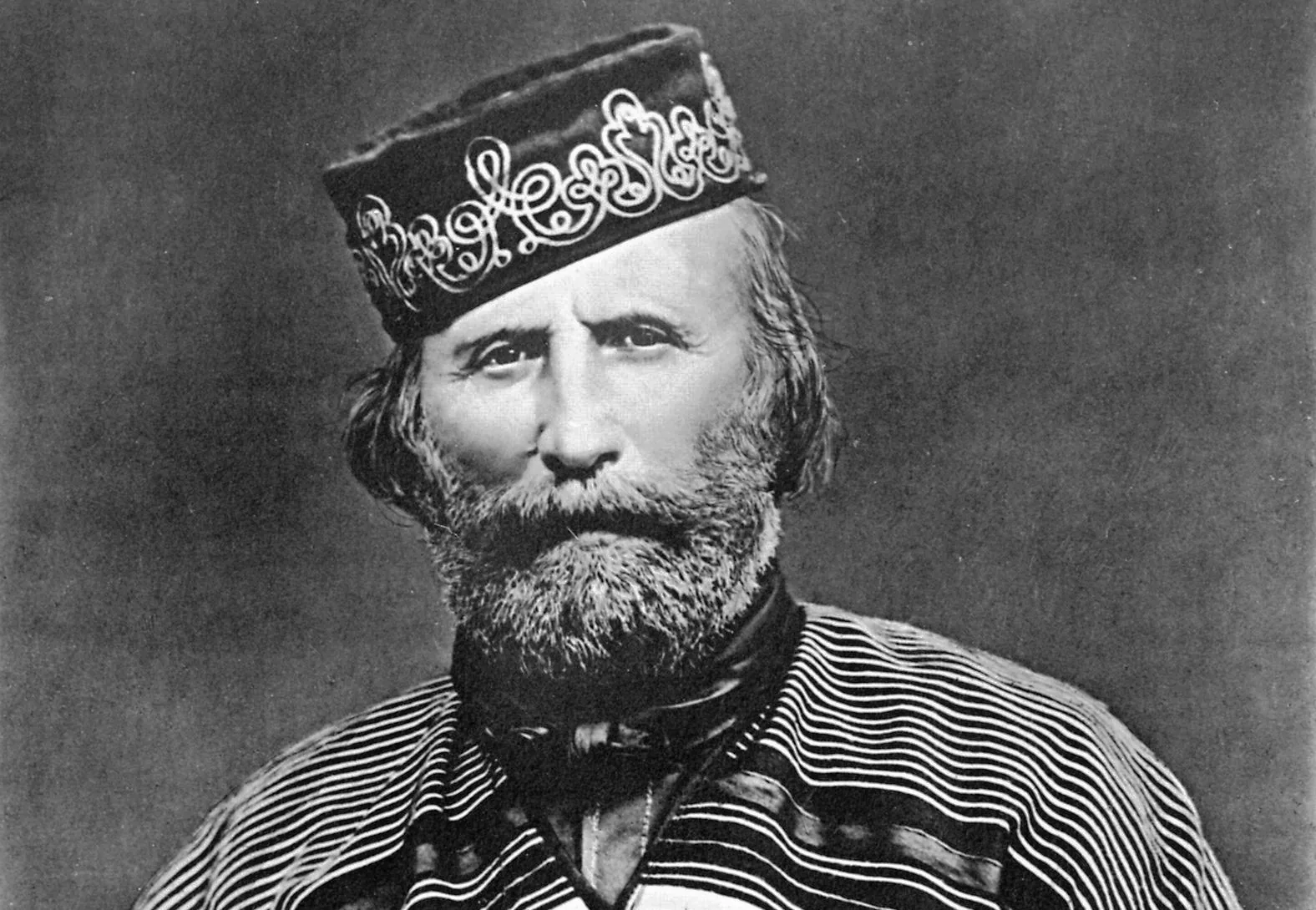
Fratelli Alinari, portrait of Giuseppe Garibaldi, photograph, c. 1866–67. Archivi Alinari, Florence · Public domain · Source page
A sailor from Nice who became one of the most famous men of his century, conquered half of Italy with volunteers, and handed it to a king he never fully trusted.
- Born: 4 July 1807, Nice, then part of Napoleon's France
- Died: 2 June 1882, Caprera, his island off Sardinia, of illness, aged 74, half-crippled by rheumatism
- Won: Rome, against the French, 30 April 1849; Calatafimi, 1860; Palermo, 1860; The Volturno, 1860; Bezzecca, 1866
- Lost: The fall of the Roman Republic, 1849; Aspromonte, 1862: wounded by Italian troops; Mentana, 1867
‘Obbedisco.’ (‘I obey.’)
A geographical expression
Background
Eight states and one foreign army
8
After Napoleon's fall, the Congress of Vienna redrew the map in 1815. Italy was split into eight states. In the north-west lay the Kingdom of Sardinia: Piedmont, Savoy, Nice, Genoa and the island of Sardinia, ruled by the House of Savoy. Lombardy and Venetia belonged to Austria itself; Parma, Modena, Lucca and Tuscany to the Austrian emperor's relatives and clients. The Pope ruled the centre, and a Bourbon king in Naples ruled the south and Sicily, the Kingdom of the Two Sicilies.
Austria's army stood behind them all.
Check yourself
What was Italy's situation after the Congress of Vienna in 1815?
Answer: It was split into eight states, with the Austrian army standing behind them all. Right. Lombardy and Venetia were Austrian; the emperor's relatives and clients ruled Parma, Modena, Lucca and Tuscany; the Pope ruled the centre, a Bourbon king the south, and the House of Savoy the Kingdom of Sardinia. Austria's army stood behind them all.
1820–1834
Charcoal-burners and a man in black
The Risorgimento, Italy's ‘revival’, began in secret. The Carbonari rose in Naples in 1820 and Piedmont in 1821; Austrian troops crushed them, and crushed new revolts in 1831.
That year Giuseppe Mazzini, a young lawyer from Genoa exiled in Marseille, whom we met in the previous lesson, founded Young Italy. Its plots of 1833–34 failed too. Among those sentenced to death in their absence was a sailor from Nice, Giuseppe Garibaldi. He fled to South America and fought for twelve years in the wars of Brazil and Uruguay, where his Italian Legion first wore the red shirt.
Source: What Young Italy wanted
“Young Italy is a brotherhood of Italians who believe in a law of Progress and Duty, and are convinced that Italy is destined to become one nation… Young Italy is Republican and Unitarian.”
Written in Marseille for new members, who were sworn in secretly; in most Italian states joining was a crime. ‘Unitarian’ means one single state, not a federation.
- ‘Republican and Unitarian’: what Italy is this, and what Italy was made? One republic, with no kings and no federation. The Italy of 1861 was a monarchy. Mazzini won the argument that there should be one state, and lost the argument about what it would be.
- Who wrote this, for whom, and who is missing? A conspirator, for educated young recruits. It is a programme, not a description: the Pope, the kings and the peasants are absent. That gap runs through the whole story.
1848–1849
The year of revolutions
In 1848 revolution swept Europe, and Italy with it. In Piedmont, Charles Albert granted the Statuto. Milan fought Marshal Radetzky's Austrians for five days on the barricades and drove them back to the fortresses of the Quadrilateral. Venice declared a republic, and Piedmont declared war.
Then it fell apart. The Pope refused to fight Catholic Austria. Radetzky beat Piedmont at Custoza in 1848 and Novara in 1849, and Charles Albert abdicated for his son, Victor Emmanuel II. In Rome a republic led by Mazzini rose and fell: Garibaldi defended it against a French army, then slipped away with a few thousand men, and his wife Anita died on the march. By late 1849 only Piedmont kept its constitution.
Check yourself
In 1831 Mazzini wrote that Young Italy was ‘Republican and Unitarian’. How much of that had come true by 1861?
Answer: The idea of one state came true, but as a monarchy, not a republic. Right. Mazzini won the argument that there should be one state, and lost the argument about what it would be: the Italy of 1861 was a monarchy.
Cavour's chessboard
1850–1857
A small kingdom in a hurry
After 1849 Piedmont was the only Italian state with a constitution, a parliament and a free press, and thousands of exiles found refuge in Turin. Its young king, Victor Emmanuel II, was a blunt soldier who preferred hunting to paperwork. Its rising star was Count Camillo Cavour.
Cavour admired England: railways, banks, free trade. As prime minister from 1852 he signed trade treaties, curbed the Church's privileges and built railways; by 1859 Piedmont had about 800 kilometres of track, close to half of Italy's. The Two Sicilies, with nearly twice the people, had little more than a hundred.
Camillo Benso, Count of Cavour
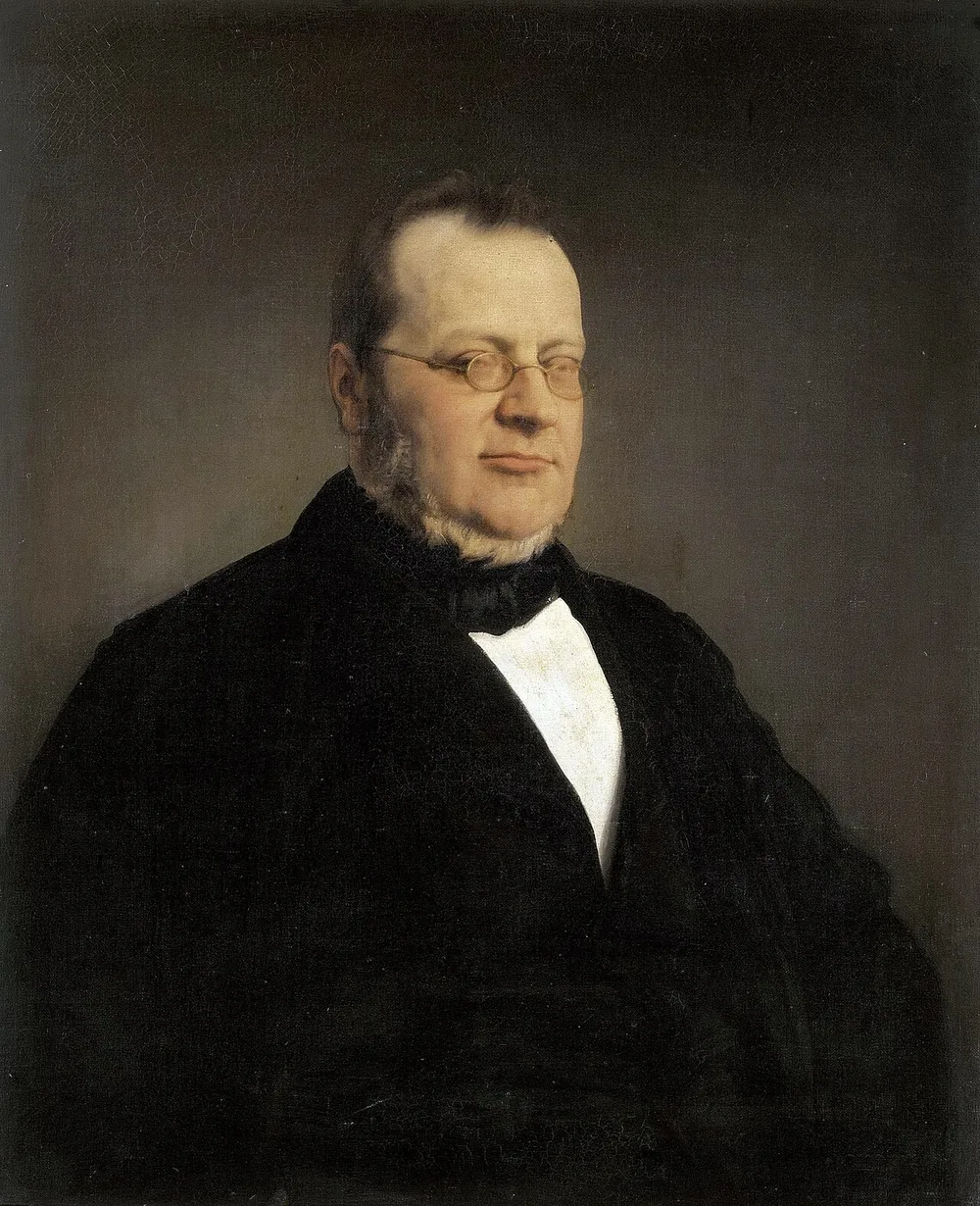
Francesco Hayez, Portrait of Camillo Benso, Count of Cavour, oil on canvas, 1864. Pinacoteca di Brera, Milan · Public domain · Source page
A Piedmontese count who spoke French better than Italian, ran his estates like a business, and made Italy more by diplomacy than by war.
- Born: 10 August 1810, Turin, then part of Napoleon's France
- Died: 6 June 1861, Turin, of a fever, probably malaria, after his doctors bled him again and again; aged 50
- Won: The alliance with France, Plombières, 1858; Lombardy, 1859; Central Italy and the south annexed, 1860; The Kingdom of Italy proclaimed, 1861
- Lost: Villafranca, 1859: resigned in fury; Nice and Savoy given up to France, 1860; Rome, still the Pope's at his death
‘A free Church in a free State.’
A decision point
You are Count Cavour, Prime Minister of Piedmont-Sardinia.
January 1855, Turin
Britain and France are fighting Russia in the Crimea and want 15,000 Piedmontese soldiers. Austria, your enemy, has just allied with them and may win their gratitude instead.
Your cabinet objects: Piedmont has no quarrel with Russia, the treasury is still paying for 1848, and Austria may strike while the army is away. Your foreign minister wants a written promise on Italy; the Allies refuse. The King wants to fight anyway.
What do you do?
- Stay out: keep your soldiers and your money at home Piedmont stays safe and solvent. But Austria earns the gratitude of London and Paris, and when peace is made nobody will invite you. The King will probably find another prime minister to send the troops.
- Join only in return for a written promise on Italy The Allies have already said no. Holding out probably means no alliance and no promise, and the King replacing you with someone less demanding.
- Join without conditions, for a seat at the peace table You send men to die in a distant war with nothing in writing. The bet is that the Allies will owe you at least a hearing.
What really happened
Join without conditions, for a seat at the peace table
When the foreign minister resigned, Cavour took his post and signed without conditions. About 18,000 men sailed in April 1855. They fought one battle, on the Chernaya, and lost about 2,000 men, nearly all to disease. At the Congress of Paris in 1856 Piedmont gained no land, but Cavour was allowed to raise ‘the Italian question’, and Napoleon III, emperor of the French and nephew of the great Napoleon, began to listen.
‘You have the future of the country in your haversacks,’ Cavour wrote to the commander, La Marmora (trans. W. R. Thayer, 1911). Older historians saw a masterstroke; Denis Mack Smith thought the King pushed and Cavour followed, partly to keep office. Most agree the prize was France's goodwill.
Check yourself
Why did Cavour send Piedmontese troops to the Crimean War in 1855?
Answer: To win a hearing from Britain and France at the peace conference, and their goodwill against Austria. Right. Piedmont had no quarrel with Russia. Cavour signed without conditions, betting that the Allies would owe him a hearing; in Paris in 1856 he did put the Italian question to the powers.
1858
A secret meeting at a spa
In January 1858 an Italian revolutionary, Felice Orsini, threw bombs at Napoleon III in Paris, and before his execution begged him to free Italy. Napoleon, who had joined an Italian revolt in his youth, was moved, and saw a chance to replace Austria as Italy's master.
On 21 July 1858 he met Cavour secretly at the spa of Plombières. They agreed to provoke Austria into war. Piedmont would gain Lombardy and Venetia as a ‘Kingdom of Upper Italy’, inside a federation of four states under the Pope's presidency; France would take Savoy, and probably Nice. ‘There we discovered what we were hunting for with so much ardor,’ Cavour told the King (trans. Thayer): an excuse for war. It was a plan for a bigger Piedmont, not yet for one Italy.
1859: the war Cavour wanted
April–June 1859
Austria takes the bait
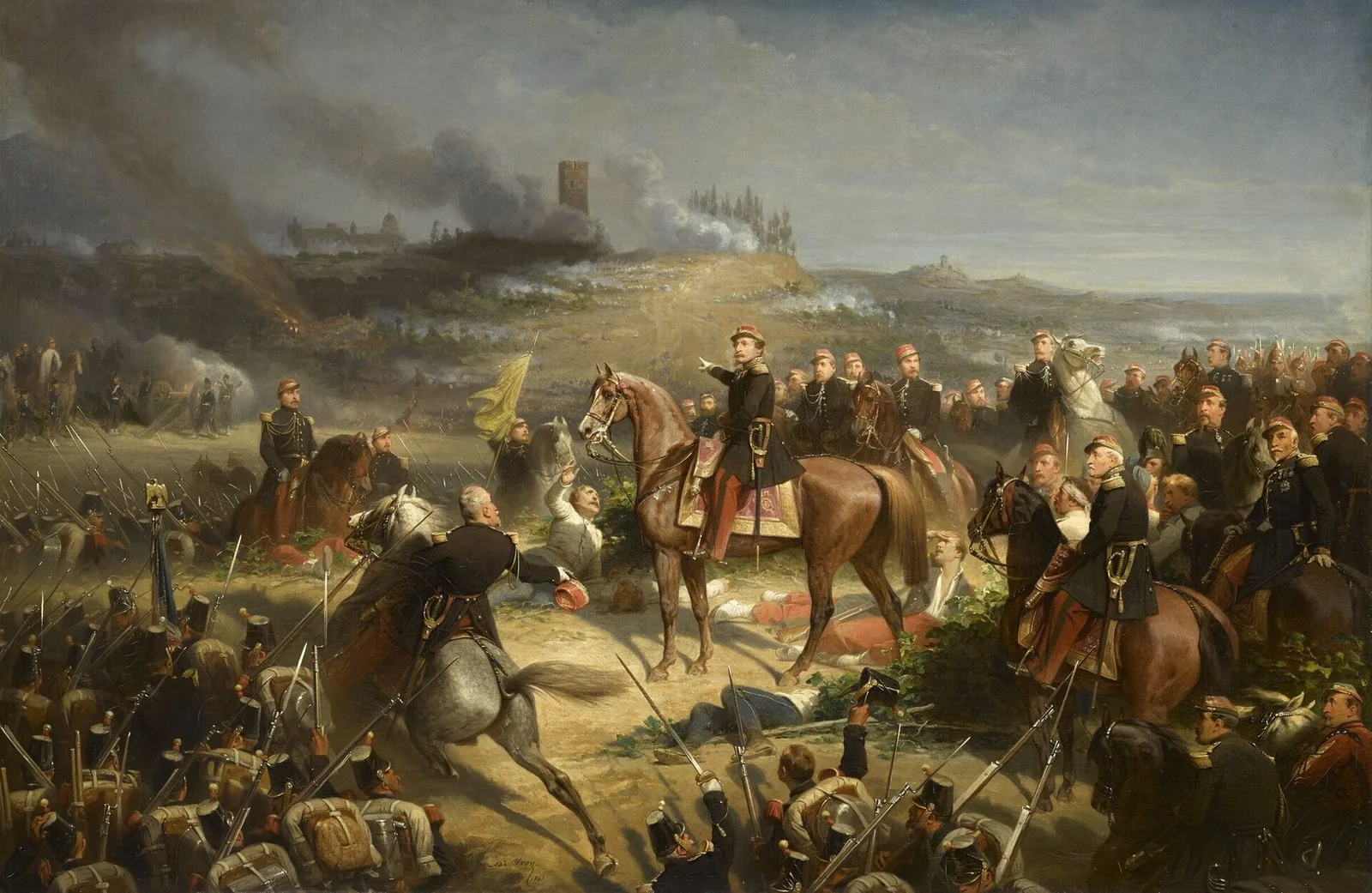
Adolphe Yvon, The Battle of Solferino, oil on canvas, 1861. Musée du Second Empire, Château de Compiègne · Public domain · Source page
Cavour spent the winter provoking Vienna. In April 1859 Austria demanded that Piedmont disarm, and Cavour was delighted: now Austria was the aggressor, and France was bound to help.
French armies arrived by rail and sea. On 4 June they beat the Austrians at Magenta, and four days later Napoleon III and Victor Emmanuel rode into Milan, while Garibaldi's volunteers, the Alpine Hunters, fought in the hills. The Austrians fell back towards the river Mincio, and their young emperor, Franz Joseph, took command himself.
Check yourself
Why was Cavour delighted when Austria demanded in April 1859 that Piedmont disarm?
Answer: Because now Austria was the aggressor, so France was bound to help. Right. At Plombières Cavour and Napoleon agreed to go to war with Austria, and Cavour was hunting for an excuse. Vienna's demand gave him one, and the French armies came.
Solferino and San Martino: who fought whom
24 June 1859, from about 4 a.m. until nightfall
The hills south of Lake Garda and the plain of Medole, west of the river Mincio
France
- Commanders: Emperor Napoleon III, Marshals Baraguey d'Hilliers, MacMahon and Canrobert; General Niel
- Strength: c. 92,000 and 240 guns (Brooks, from French staff returns); c. 97,000 (Schneid (2012))
- Losses: 1,622 killed, 8,530 wounded, 1,518 missing (French official history (German edition, 1865))
Piedmont-Sardinia
- Commanders: King Victor Emmanuel II, Generals Durando, Fanti, Mollard and Cucchiari
- Strength: c. 38,700 and 80 guns (Brooks)
- Losses: 1,027 killed, 3,305 wounded, 671 missing (French official history (1865): San Martino brigades only); 869 killed, 3,982 wounded, 774 missing (Italian table (it.wikipedia, unsourced), probably whole army)
The Austrian Empire
- Commanders: Emperor Franz Joseph, Franz von Wimpffen (1st Army), Schlick (2nd Army), Benedek (VIII Corps)
- Strength: c. 129,000 and 429 guns (Brooks, from Austrian sources); Fewer (Estimates of men actually engaged: some corps barely fought)
- Losses: 2,386 killed, 10,634 wounded, 9,290 missing (French official history (German edition, 1865))
Most of the ‘missing’ were prisoners and stragglers.
Outcome: A French and Piedmontese victory. The Austrians fall back across the Mincio, and both emperors, shaken by the slaughter, agree an armistice two weeks later.
By the number of men involved, about 260,000, it was the largest battle in Europe since Leipzig in 1813.
The battle of Solferino and San Martino
24 June 1859, from dawn to nightfall
The French and Sardinian armies are advancing, and the Austrians, who fell back towards the Mincio after Magenta, are also on the move under their young emperor, Franz Joseph. No one has planned a battle for today: the armies run into each other near Medole, Solferino and San Martino.
A reconstruction after Richard Brooks, Solferino 1859 (2009), F. C. Schneid (2012) and the usual accounts of the battle; the towns follow modern maps, in a box about 27 by 17 kilometres. Each corps is drawn as one block, far simpler than the brigades and columns that really fought; times and positions are approximate. Disputed: exactly when Solferino and Cavriana fell, and how many Austrians were really engaged. Neither side had planned a battle that day: both armies were advancing when they collided.
Phases of the battle
- Two armies collide Neither side expected a battle. At dawn the French, marching east, ran into Austrians at Medole and below Solferino; in the north the Sardinians met Benedek's corps near San Martino. By seven the fight ran along 15 kilometres.
- Deadlock on the heights Baraguey d'Hilliers' corps storms the hill of Solferino again and again and is thrown back. MacMahon holds the centre, and Niel's thin line holds the plain. In the north the Sardinians take San Martino and lose it again.
- The Guard goes in Napoleon III throws in his reserve, the Imperial Guard. In the early afternoon the cemetery, the village and the tower of Solferino fall, and the Austrian centre breaks.
- Cavriana and the storm Franz Joseph orders his northern army back. The French push on to Cavriana, and an Austrian counter-attack in the plain fails. At about five a violent storm halts the fighting for an hour.
- Retreat over the Mincio The Austrians retreat over the Mincio. Benedek gives up San Martino, and the Sardinians take it at about eight, in their fourth assault. Some 40,000 men are dead, wounded or missing. That evening Henry Dunant reaches Castiglione.
The strategy
- French: The French are marching east without expecting a battle, and they press on when they run into the Austrians at Medole and below Solferino. When the fighting stalls on the heights, Napoleon III throws in his reserve, the Imperial Guard, to break the Austrian centre.
- Sardinian army: The Sardinians are advancing in the north and meet Benedek's corps near San Martino. They attack the village again and again, and in their fourth assault they take it. The reconstruction does not say why the village mattered so much to them.
- Austrians: After Magenta the Austrians fell back towards the Mincio, and they have no set battle plan for the day. When things turn against them they try a counter-attack in the plain, which fails, and Franz Joseph orders his northern army back.
What decided it: Napoleon III's reserve, the Imperial Guard, went in during the early afternoon and broke the Austrian centre. Once the centre gave way, Franz Joseph ordered his northern army back, and the Austrians withdrew over the Mincio.
Source: A businessman in Castiglione
“‘Tutti Fratelli,’ they repeat with compassion. ‘All are brothers.’… Would it not be possible to establish in every country of Europe, Aid Societies, whose aim would be to provide, during war, volunteer nurses for the wounded, without distinction of nationality?”
Dunant, a Geneva businessman, had come hoping to see Napoleon III about a deal in Algeria. He reached Castiglione on the evening of the battle and spent days with the town's women nursing thousands of wounded from every army.
- He arrived that evening. What can he witness, and what not? Not the fighting: those chapters are built from officers' stories, told in the present tense. The aftermath he saw himself, and that is the book's real evidence.
- What does he want the reader to do? Act. The book, sent to kings and generals, asks for permanent relief societies to help the wounded of every nation alike. In 1863 the committee that became the Red Cross met in Geneva.
Check yourself
What makes Henry Dunant's ‘A Memory of Solferino’ valuable evidence, and what limits it?
Answer: He saw the aftermath himself but not the fighting, and he wrote to persuade. Right. He arrived on the evening of 24 June. His hospital scenes are eyewitness; his battle chapters are second-hand, and the whole book is an appeal for relief societies.
July 1859 – April 1860
Villafranca: the price of an ally
Then Napoleon III stopped. Shaken by the slaughter and worried by Prussian troops on the Rhine, he met Franz Joseph at Villafranca on 11 July and made peace without asking Cavour. Lombardy went to Piedmont, through French hands; Venetia stayed Austrian. Cavour raged at the King and resigned.
But in Tuscany, Parma, Modena and the Romagna, liberals had taken power and would not have their old rulers back. In March 1860 plebiscites voted these lands into Piedmont. Napoleon agreed, for a price: by the Treaty of Turin, Savoy and Nice went to France. Garibaldi, born in Nice, never forgave Cavour.
The Thousand
A decision point
You are Giuseppe Garibaldi.
Late April 1860, a villa at Quarto, near Genoa
On 4 April Palermo rose against its Bourbon king. The city revolt was crushed in hours, but armed bands hold out in the hills. Sicilian exiles led by Francesco Crispi beg you to lead an expedition; a telegram from Malta seems to say the revolt has failed.
About a thousand volunteers have gathered, many with old muskets. Naples has some 25,000 soldiers on the island and a navy at sea. Cavour will not help you openly. And a month ago he gave your birthplace, Nice, to France.
What do you do?
- Sail now for Sicily with the volunteers you have A thousand men against an army of 25,000, if the Neapolitan navy does not sink you first. If Sicily rises again, it could be the gamble of your life; if it does not, you are all dead men.
- Wait for clear news and the King's open backing The Sicilian bands may be crushed while you wait, and the King cannot back you openly without a war. The moment would probably pass.
- Go to Nice and fight the vote that hands it to France You might disrupt the vote in your home town, but you would be fighting France, Piedmont's ally, and Cavour. Nice would very likely be lost anyway, and the south left alone.
What really happened
Sail now for Sicily with the volunteers you have
After the gloomy telegram Garibaldi called it off; Crispi and Nino Bixio talked him round. On the night of 5–6 May the volunteers seized two steamers, with the quiet help of the shipping company's manager, and sailed. On 11 May they landed at Marsala, in western Sicily.
Garibaldi preferred action to waiting, and his name could raise men where a government could not. Lucy Riall stresses that it worked because Sicily was already in revolt, and because his fame went ahead of him.
May 1860
A thousand amateurs
They were not soldiers. The Thousand were students, lawyers, doctors, artisans and veterans of 1849, almost all northerners: about 160 from Bergamo alone, and only a few dozen Sicilians. One was a woman, Rosalie Montmasson. Only some had the red shirt, and their muskets misfired.
At Marsala two British warships happened to be in harbour, and the Neapolitan navy hesitated to fire. At Salemi Garibaldi proclaimed himself dictator of Sicily ‘in the name of Victor Emmanuel, King of Italy’, and Sicilian bands began to join him. On 15 May a royal army barred the road to Palermo.
Check yourself
Who were ‘the Thousand’ who sailed with Garibaldi to Marsala in May 1860?
Answer: Volunteers who were not soldiers: students, lawyers, doctors and artisans, almost all from the north. Right. There were also veterans of 1849, but only a few dozen Sicilians. Only some had the red shirt, and their muskets misfired.
Calatafimi: who fought whom
15 May 1860, from about noon to mid-afternoon
Pianto Romano, a hill between Vita and Calatafimi, in western Sicily
The Thousand
- Commanders: Giuseppe Garibaldi, Türr, Sirtori, Bixio and the company commanders
- Strength: 1,089 landed at Marsala (Official list of the Thousand); about 1,200 in action, with the Sicilians who fought beside them (Trevelyan (1909))
- Losses: about 30 killed and over 100 badly wounded (Trevelyan); 32–33 killed, 174 wounded (Later Italian count)
Sicilian bands
- Commanders: Local leaders, among them Baron Sant'Anna of Alcamo
- Strength: perhaps 1,000 on the hills; only about 200 fought (Trevelyan)
- Losses: not recorded (The sources)
The Neapolitan royal army
- Commanders: Brigadier-General Francesco Landi, Major Michele Sforza, 8th Cacciatori battalion
- Strength: 3,000 (De Sivo, a pro-Bourbon historian); 4,000 (De Cesare); about 2,000 (Garibaldi); about 2,000 engaged: 14 of 20 companies (Trevelyan, from Landi's report)
- Losses: 35–36 killed, 118–150 wounded (Italian counts)
Outcome: The Thousand take the hill. Landi abandons Calatafimi that night and retreats to Palermo, and Sicily begins to rise.
A small fight next to Solferino: fewer than a hundred dead on both sides together. Garibaldi himself wrote that its gains were ‘of slight importance’ and its moral result ‘immeasurable’.
The battle of Calatafimi
15 May 1860, from noon to mid-afternoon
The Thousand stand on the Pietralunga with the tricolour, facing the royal army of Naples on the Pianto Romano across a valley. That army bars the road to Palermo, and Sicilian bands watch from the side hills.
A reconstruction after G. M. Trevelyan, Garibaldi and the Thousand (1909), who walked the ground twice and used Landi's report and veterans' memoirs, and after Garibaldi's own memoirs; the battle monument on the hill and the towns are placed from modern maps. No modern survey of the battlefield is known to us. The distance between the two hills, the Neapolitan strength at the start and the line of the terraces are uncertain; the terraces are drawn schematically.
Phases of the battle
- Two hills, one valley Garibaldi's men stand on the Pietralunga with the tricolour, facing the Neapolitans on the Pianto Romano across a valley. Sicilian bands watch from the side hills. Major Sforza decides to sweep the ‘rabble’ away.
- A charge too soon Neapolitan skirmishers cross the valley. A bugle sounds, the Genoese marksmen fire, and the leading companies charge downhill before Garibaldi meant them to. He sends everyone after them.
- Terrace by terrace The volunteers climb from terrace to terrace, sheltering under each bank, as Landi sends up more companies. On the right, Cairoli and some 200 Sicilians take a gun. Here, by later tradition, Bixio urges retreat.
- The last terrace About 300 men crouch under the last terrace. The Neapolitans, short of ammunition, throw stones; one hits Garibaldi. A final rush carries the top.
- Retreat to Palermo Landi abandons Calatafimi that night and marches for Palermo. A small battle, but word spreads across Sicily: the royal army can be beaten.
The strategy
- The Thousand: The reconstruction does not say when Garibaldi meant the attack to begin. His leading companies charge too early, and he sends everyone after them. The Thousand then climb from terrace to terrace, sheltering under the wall of each one.
- Sicilian bands: The reconstruction gives no plan for the Sicilian bands. They watch from the side hills, and only some 200 of them fight, taking a gun on the right with Cairoli.
- Neapolitan army: Major Sforza decides to sweep the ‘rabble’ away with an attack across the valley. When the fight drags on, Landi sends more companies up, and the Neapolitans run short of ammunition.
What decided it: The volunteers kept climbing under cover, terrace by terrace, and the Neapolitans, short of ammunition, could not stop the final rush to the top. Landi abandoned Calatafimi that night.
Source: Two witnesses of the same hour
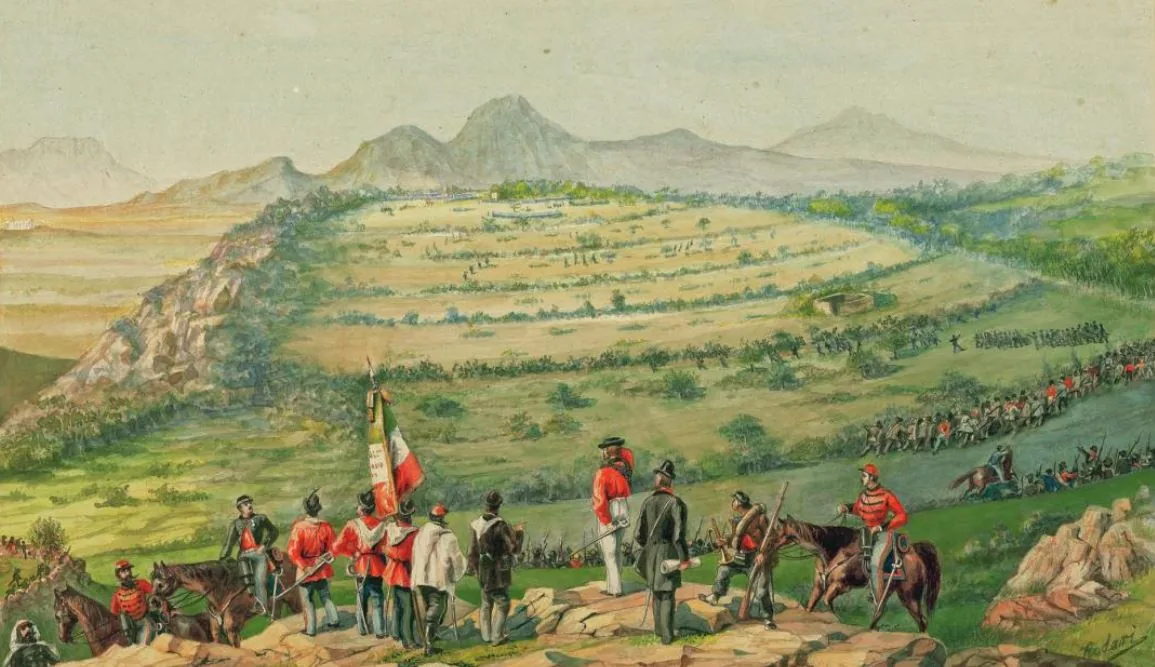
Giuseppe Nodari (1841–1898), one of the Thousand, The Battlefield of Calatafimi, coloured drawing, dated 1860 · Public domain · Source page
“I had no intention of a front attack on a formidable position occupied by a strong force of Bourbon troops. But who could stop those fiery and impetuous volunteers in their rush on the foe?”
Garibaldi revised his memoirs in 1872; they appeared after his death. Nodari drew the moment before the clash: Garibaldi's men on the Pietralunga with the tricolour, the Neapolitans on the terraced Pianto Romano opposite.
- Garibaldi says the frontal attack was not his plan. Why would a commander admit that? It makes his volunteers the heroes, and it is probably true: Trevelyan too says the leading companies dashed forward before the moment Garibaldi intended. But the memoir was still written to build a legend.
- Look at the clothes in the drawing. What does Garibaldi's own text say? The drawing puts the men in red shirts. Garibaldi writes that the Thousand were ‘clad just as at home’. The artist was there, but he drew the uniform of the legend.
Check yourself
What mattered about the battle of Calatafimi on 15 May 1860, although fewer than a hundred men died on both sides together?
Answer: The victory showed that the royal army could be beaten, and the rising in Sicily began to spread. Right. Landi abandoned Calatafimi that night, and the word spread across Sicily. Garibaldi himself wrote that the gains of the battle were ‘of slight importance’ but its moral result ‘immeasurable’.
May–October 1860
From Palermo to the Volturno
Garibaldi slipped round the royal army and broke into Palermo on 27 May. The city rose, and within days some 20,000 royal troops agreed to sail away. In August he crossed to the mainland, and the army of Naples melted before him. On 7 September he entered Naples by train; King Francis II had fled to the fortress of Gaeta.
Cavour, afraid that Garibaldi would march on Rome and drag France in, sent the Piedmontese army south through the Pope's lands. Meanwhile, on 1–2 October, the Bourbon army struck back on the river Volturno. Some 20,000 volunteers held a 20-kilometre front. It was Garibaldi's largest battle and last great victory.
A decision point
You are Garibaldi, Dictator of Sicily and Naples.
October 1860, Caserta, north of Naples
In five months you have conquered a kingdom of nine million and beaten its army on the Volturno. But the Bourbon king still holds Capua and Gaeta.
The Piedmontese army is marching towards you, partly to stop you going on to Rome, where French troops guard the Pope. Mazzini's republicans urge you to set conditions, or to march on Rome. Cavour wants the south annexed at once, by plebiscite.
What do you do?
- March on Rome War with France, and very probably civil war with the Piedmontese army now in front of you. Everything won since May could be lost.
- Keep your dictatorship and set conditions for union You could demand an assembly, reforms or land for the peasants. But Victor Emmanuel's army is already at the door, and a standoff between Italians could tear the new country apart before it is born.
- Accept the plebiscite, hand the south to the King and go home Italy is united at once, under the King. You give up your power, and probably your say in what the south becomes.
What really happened
Accept the plebiscite, hand the south to the King and go home
A plebiscite on 21 October approved union. On 26 October Garibaldi met Victor Emmanuel near Teano and hailed him King of Italy. His request to govern the south for a year was refused, and his army was disbanded. On 9 November he sailed for his farm on Caprera, refusing titles and land.
‘I handed over to Victor Emmanuel the dictatorship conferred on me by the people, proclaiming him King of Italy,’ he wrote in his memoirs (trans. A. Werner, 1889). He believed only the King could unite Italy without civil war. Lucy Riall argues that the gesture, a hero returning to his plough like the Roman Cincinnatus, made his legend.
Check yourself
Why did Garibaldi hand the south to Victor Emmanuel in 1860?
Answer: He believed only the King could unite Italy without a civil war. Right. The Piedmontese army was at his door, France guarded Rome, and since 1859 he had fought for ‘Italy and Victor Emmanuel’. He sailed for Caprera, refusing titles.
Myth
Garibaldi was a republican rebel who fought against the King.
The truth
He stayed a republican at heart. But from the late 1850s he served the monarchy: the Thousand's motto was ‘Italy and Victor Emmanuel’, he ruled Sicily in the King's name and handed him the south. In 1866, ordered to halt in mid-victory, he obeyed. He clashed with the King's government over Rome, but it was Cavour he despised.
The evidence
The Salemi proclamation (1860); the ‘Obbedisco’ telegram (1866); Lucy Riall, Garibaldi: Invention of a Hero (2007).
Italy made
1861
A kingdom with a Piedmontese number
On 17 March 1861 the first Italian parliament, in Turin, proclaimed Victor Emmanuel II King of Italy. He kept his number, ‘the Second’, as if Italy were Piedmont made larger, and in many ways it was: Piedmont's Statuto, laws, taxes, conscription and officials were extended to the whole country. Fewer than 2 per cent of Italians could vote.
Rome and Venice were still missing. Cavour told parliament that Rome must be the capital, by agreement with the Pope. On 6 June 1861, aged 50, he died of a fever.
Myth
When Italy was united, Massimo d'Azeglio said: ‘We have made Italy; now we must make Italians.’
The truth
The idea was d'Azeglio's; the famous sentence was not. D'Azeglio, a novelist and former prime minister of Piedmont, feared that Italians lacked the character a nation needed: in his memoirs (1867) he wrote that we must make Italians if we want to have Italy. The neat slogan circulated from the 1870s, and in 1896 Ferdinando Martini put it in his mouth. Its point stands: in 1861 perhaps 2.5 to 10 per cent of Italians spoke Italian, and three in four could not read.
The evidence
D'Azeglio, I miei ricordi (1867); Claudio Gigante, in Incontri (2011); language estimates by Tullio De Mauro and Arrigo Castellani.
Check yourself
What is true about ‘We have made Italy; now we must make Italians’?
Answer: The idea is Massimo d'Azeglio's, but the famous wording was pinned on him later. Right. His memoirs (1867) say that Italians must be made if Italy is to exist; the slogan circulated from the 1870s and was put in his mouth above all in 1896.
1861–1865
War in the south
In the south, unification soon felt like conquest. New taxes and conscription came; the land many peasants had hoped for did not. Former Bourbon soldiers, deserters, bandits and desperate villagers took to the hills, encouraged by the exiled king and the Pope. The government called it brigandage.
By 1863 perhaps 100,000 troops were fighting in the south. Military courts tried rebels and punished their families; villages were burned in reprisal. Official figures count more than 5,000 ‘brigands’ killed or shot by 1865.
1862–1866
Venice by defeat
Garibaldi could not wait for Rome. In 1862 he raised volunteers crying ‘Rome or death’, and Italian troops stopped him at Aspromonte. In 1866 Italy allied with Prussia against Austria and lost its two main battles, on land at Custoza and at sea off Lissa; only Garibaldi's volunteers won, at Bezzecca. But Prussia crushed Austria, as the next lesson shows, and Venetia was handed to Italy through Napoleon III. Italy had won Venice by losing.
A decision point
You are Pope Pius IX.
19 September 1870, the Vatican, Rome
Ten years ago Italy took most of your lands. Only Rome and its surroundings remain, guarded by a French garrison, and in August France recalled it to fight Prussia. On 2 September Napoleon III surrendered at Sedan.
Now about 50,000 Italian soldiers stand outside the walls; you have some 13,000. King Victor Emmanuel offers guarantees of your freedom and dignity if you let his troops in. In July a Church council declared the Pope infallible in matters of doctrine.
What do you do?
- Defend Rome to the last Your Zouaves would fight bravely and die. Rome would be shelled and stormed anyway, at the cost of hundreds or thousands of lives.
- Leave Rome, as in 1848, and rule from exile You would stay free of the King, but leave him the city without a fight, and a Pope abroad might find it hard to come back.
- Accept the King's offer Lives would be saved. But it would look as if the Pope had consented to the loss of Rome, and the Church's claim would be gone.
- Resist just long enough to show force was used, then surrender Few would die, and the Church could say for ever that Rome was taken by violence, not given.
What really happened
Resist just long enough to show force was used, then surrender
Pius told his commander, General Kanzler, to make the defence no more than a protest: enough to prove that violence was done, then surrender at the first breach. On 20 September Italian guns opened a breach beside Porta Pia, and by about ten the white flag was up. Some 45 to 70 men died in all. A plebiscite voted Rome into Italy.
Pius wanted no massacre, but would never consent to losing Rome. He rejected Italy's guarantees, called himself a ‘prisoner in the Vatican’ and told Catholics to stay out of national elections. Christopher Duggan stresses the cost: for decades devout Catholics turned their backs on the new state. The Roman Question stayed open until 1929.
Check yourself
Why could Italy take Rome in September 1870?
Answer: France withdrew its garrison to fight Prussia, and Napoleon III fell at Sedan. Right. The French troops who had guarded the Pope since 1849, apart from a few months in 1866–67, left in August; after Sedan no power was left to stop Italy.
Source: A hole in the wall
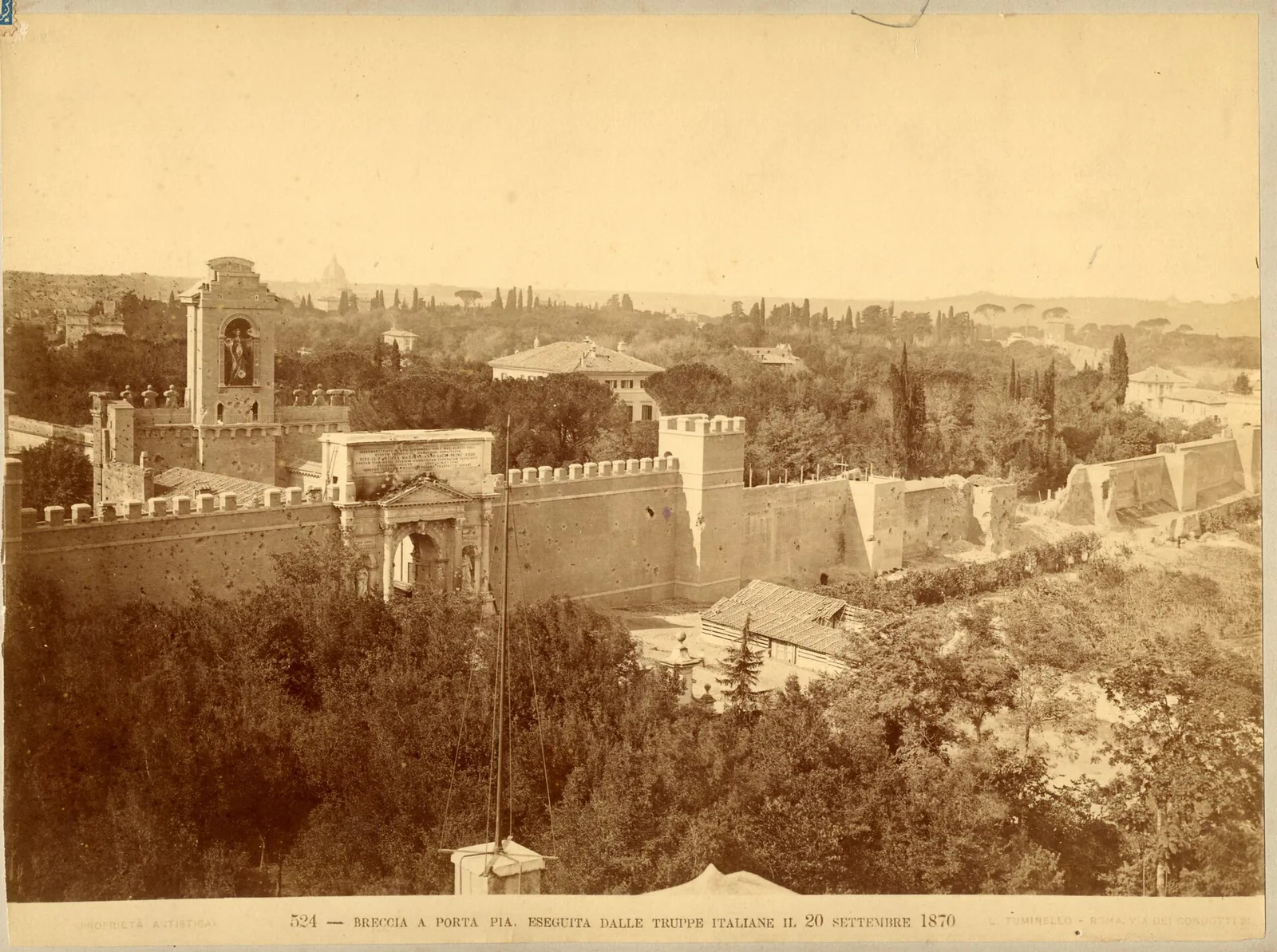
Photograph of the breach at Porta Pia, 1870: albumen print from the studio of Lodovico Tuminello, Rome (his imprint is on the mount; Commons credits Gioacchino Altobelli) · Public domain · Source page
Studio of Lodovico Tuminello, photograph of the breach at Porta Pia, Rome, 1870
Rome's photographers hurried to the breach, and their prints sold all over Italy as patriotic souvenirs. The printed caption reads: ‘Breach at Porta Pia made by the Italian troops on 20 September 1870’.
- What does the photograph show, and what not? A damaged wall after the event: no fighting and no dead. Cameras of 1870 needed long exposures; any ‘battle’ photograph from that day, and Altobelli made some, was staged afterwards.
- Why sell a picture of a hole in a wall? For patriots it was the end of the story, the moment Rome became Italian. For devout Catholics the same picture showed a sacrilege. One image, two opposite meanings.
Myth
Italy was united by a great popular uprising of the Italian people.
The truth
Ordinary people did fight: on Milan's barricades, as volunteers in 1859–60, in Palermo's streets. But Lombardy was won by French and Piedmontese armies and Cavour's diplomacy, and the Thousand were mostly educated northerners. Many Sicilian peasants fought for land, not for Italy; when those of Bronte seized estates in August 1860, Bixio had five men shot. Only men voted in the plebiscites, and openly. It was a revolution of active minorities, with real but narrow support.
The evidence
Trevelyan's list of the Thousand by home town (1909); Lucy Riall, Sicily and the Unification of Italy (1998); A. M. Banti, La nazione del Risorgimento (2000).
Check yourself
What is the fairest thing to say about the claim that Italy was united by a great popular uprising of the Italian people?
Answer: It is partly true: ordinary people fought, but Lombardy was won by French and Piedmontese armies, and the support was real but narrow. Right. People fought on Milan's barricades, as volunteers in 1859–60 and in Palermo's streets, but the Thousand were mostly educated northerners. It was a revolution of active minorities.
What came after
- 1861 The Kingdom of Italy is proclaimed; Cavour dies.
- 1864 The first Geneva Convention protects wounded soldiers, as Dunant had asked.
- 1866 Venetia joins Italy after Prussia's victory over Austria.
- 1870 The Italian army enters Rome, and the Pope shuts himself in the Vatican.
- 1871 Rome becomes the capital of Italy.
- 1872 Mazzini dies in Pisa under a false name, in a kingdom he never accepted.
- 1882 Garibaldi dies on Caprera.
- 1915 Italy enters the First World War against Austria to win Trento and Trieste, the goal of irredentism.
- 1929 The Lateran Pacts: the Pope recognises Italy, and Italy recognises Vatican City.
Revolution, conquest or improvisation?
Was the Risorgimento a popular revolution cut short, the only realistic road, or a chain of improvisations?
- Antonio Gramsci, Prison Notebooks (written 1929–35) The Marxist thinker, writing in a fascist prison, called the Risorgimento a ‘passive revolution’. Cavour's moderates absorbed the democrats of Mazzini and Garibaldi, who never won over the peasants with land reform. The result was a narrow state, imposed from above, that the masses did not feel was theirs.
- Rosario Romeo, Risorgimento e capitalismo (1959) Romeo answered that a peasant revolution would have brought foreign intervention and destroyed the capital Italy needed for railways and industry. Cavour's liberal path was not a betrayal but the only one that could have worked.
- Denis Mack Smith, Cavour and Garibaldi 1860 (1954) Mack Smith argued that unification was improvised, not planned. Cavour was an opportunist who distrusted Garibaldi, tried to contain him and then took over his conquest; their rivalry produced a centralised state. Many Italian historians found him unfair to Cavour.
Since the 1990s historians such as Alberto Mario Banti and Lucy Riall have asked a different question: how did people come to feel Italian at all? Their answer runs through novels, operas, prints, newspapers and the deliberately built celebrity of Garibaldi. And the oldest question has not gone away: was the south liberated, or annexed?
What do you know now?
Check yourself
What did France receive for its help in 1859–60?
Answer: Savoy and Nice. Right. Savoy was promised at Plombières and Nice half-promised; both were signed away in the Treaty of Turin in March 1860, with plebiscites in April. Garibaldi's birthplace became French.
Terms
- Risorgimento Italian for ‘revival’ or ‘resurgence’: the name for the Italian national movement and the unification of Italy, roughly 1815 to 1871.
- Carbonari ‘Charcoal-burners’: secret societies active in Italy from the 1810s to the 1830s, working for constitutions and against Austrian rule. They borrowed their rituals from craftsmen's guilds.
- Young Italy Giovine Italia: the secret society Giuseppe Mazzini founded in exile in Marseille in 1831, for one united Italian republic.
- Statuto The constitution King Charles Albert of Piedmont granted on 4 March 1848. It was the only Italian constitution of 1848 not withdrawn, and became the constitution of all Italy until 1948.
- Quadrilateral Four Austrian fortresses in northern Italy, Peschiera, Mantua, Verona and Legnago, guarding Venetia. An army that fell back into them was very hard to dislodge.
- plebiscite A yes-or-no vote on a single question. Between 1860 and 1870 plebiscites, in which only men voted and often in public, approved the joining of each region to the kingdom.
- the Thousand I Mille: the 1,089 or so volunteers who sailed with Garibaldi from Quarto, near Genoa, on 5 May 1860 and conquered Sicily.
- Red Shirts Garibaldi's volunteers, named after the red shirt his Italian Legion wore in Montevideo from the mid-1840s. In 1860 only some of the Thousand actually had one.
- dictator In the old Roman sense: a temporary ruler with full powers in an emergency. Garibaldi took the title in Sicily and Naples in 1860 and gave up power after six months.
- brigandage Brigantaggio, ‘banditry’: the government's name for the armed revolt and robbery in southern Italy in 1861–65, which drew in peasants, former soldiers and supporters of the Bourbons.
- Roman Question The dispute between the Kingdom of Italy and the papacy over Rome and the Pope's status, from 1861 and above all from 1870. It was settled only by the Lateran Pacts of 1929.
- irredentism From Italia irredenta, ‘unredeemed Italy’: the demand for the Italian-speaking lands left to Austria after 1866, above all Trento and Trieste.
- Metternich Austria's chancellor, who saw Italy as only a geographical idea and not a country.
- Radetzky An Austrian marshal. He beat Piedmont at Custoza in 1848 and at Novara in 1849.
- Charles Albert King of Piedmont who granted a constitution in 1848, then gave up the crown to his son.
- Napoleon III Emperor of the French and nephew of the great Napoleon. He helped Italy against Austria, for a price.
- Franz Joseph The young emperor of Austria in 1859. He took command himself.
- Felice Orsini An Italian revolutionary who threw bombs at Napoleon III in Paris in 1858.
- Francesco Crispi A Sicilian exile who urged Garibaldi to lead an expedition. He later became prime minister of Italy.
- Nino Bixio One of Garibaldi's close men. The story says he advised a retreat at the hardest moment of a battle.
- Rosalie Montmasson One woman among the Thousand, who sailed with Garibaldi to Sicily in 1860.
- Pius IX The Pope who ruled Rome. He ordered a token defence only, in 1870.
- Porta Pia A gate in the walls of Rome, where Italian guns opened a breach in 1870.
- Dunant A Geneva businessman who nursed wounded men at Castiglione in 1859, and later founded the Red Cross.
- Castiglione A town in northern Italy near the battlefield where the French and Austrians fought in 1859.
- Magenta A battle in 1859 where the French beat the Austrians in northern Italy.
- Custoza A battle where Radetzky beat Piedmont in 1848.
- Villafranca The place where Napoleon III and Franz Joseph made peace in 1859, without asking Cavour.
- Plombières A French spa town where Napoleon III and Cavour agreed in 1858 to provoke war with Austria.
- Treaty of Turin An agreement in which Piedmont gave Savoy and Nice to France, the price Napoleon III asked.
- San Marino A small republic inside Italy. In 1849 about 1,500 of Garibaldi's men reached it.
- Marsala A town in western Sicily where Garibaldi's men landed in 1860.
- Sicily A large island off southern Italy, conquered by Garibaldi in 1860.
- Lombardy A region in northern Italy that belonged to Austria until the 1859 war, then passed to Piedmont.
- Venetia A region in north-east Italy that stayed Austrian after 1859 and was given to Italy in 1866.
- Piedmont A region in north-west Italy, ruled by the House of Savoy. After 1849 it was the only Italian state with a constitution.
Sources
- Giuseppe Garibaldi, Autobiography of Giuseppe Garibaldi, authorized translation by A. Werner, 3 vols (London: Walter Smith and Innes, 1889), vol. 2, ch. IV (Calatafimi) and ch. XVIII
- J. Henry Dunant, Un souvenir de Solférino (Geneva, 1862); English: The Origin of the Red Cross: ‘Un souvenir de Solferino’, trans. Mrs. David H. Wright (Philadelphia: John C. Winston, 1911)
- Giuseppe Mazzini, General Instructions for the Members of Young Italy (1831), in Life and Writings of Joseph Mazzini, vol. 1 (London: Smith, Elder, 1864; new ed. 1890), pp. 96–97
- Camillo Cavour, letters to Victor Emmanuel II and to Alfonso La Marmora, 1855–1858, in Lettere edite ed inedite di Camillo Cavour, ed. Luigi Chiala, vol. 2 (Turin, 1883); English translations in W. R. Thayer, The Life and Times of Cavour, 2 vols (Boston: Houghton Mifflin, 1911)
- Giuseppe Cesare Abba, Noterelle d'uno dei Mille (Bologna: Zanichelli, 1880; expanded as Da Quarto al Volturno, 1891)
- Massimo d'Azeglio, I miei ricordi (Florence: Barbèra, 1867)
- Denis Mack Smith, Cavour and Garibaldi 1860: A Study in Political Conflict (Cambridge: Cambridge University Press, 1954)
- Denis Mack Smith, Cavour (London: Weidenfeld & Nicolson, 1985)
- Denis Mack Smith, Mazzini (New Haven: Yale University Press, 1994)
- Lucy Riall, Garibaldi: Invention of a Hero (New Haven and London: Yale University Press, 2007)
- Lucy Riall, Risorgimento: The History of Italy from Napoleon to Nation-State (Basingstoke: Palgrave Macmillan, 2009)
- Christopher Duggan, The Force of Destiny: A History of Italy since 1796 (London: Allen Lane, 2007)
- Derek Beales and Eugenio F. Biagini, The Risorgimento and the Unification of Italy, 2nd ed. (Harlow: Longman, 2002)
- G. M. Trevelyan, Garibaldi and the Thousand (London: Longmans, Green, 1909)
- Richard Brooks, Solferino 1859: The Battle for Italy's Freedom (Oxford: Osprey, 2009)
- Frederick C. Schneid, The Second War of Italian Unification 1859–61 (Oxford: Osprey, 2012)
- Antonio Gramsci, Quaderni del carcere, ed. Valentino Gerratana, 4 vols (Turin: Einaudi, 1975), written 1929–1935
- Rosario Romeo, Risorgimento e capitalismo (Bari: Laterza, 1959)
- Alberto Mario Banti, La nazione del Risorgimento (Turin: Einaudi, 2000)
- Carmine Pinto, La guerra per il Mezzogiorno. Italiani, borbonici e briganti 1860–1870 (Rome and Bari: Laterza, 2019)
- Owen Chadwick, A History of the Popes 1830–1914 (Oxford: Clarendon Press, 1998)
- Claudio Gigante, ‘“Fatta l'Italia, facciamo gli Italiani”. Appunti su una massima da restituire a d'Azeglio’, Incontri 26/2 (2011), pp. 5–15
Image credits
- Pietro Aldi, The Meeting at Teano (detail), fresco, 1886. Sala del Risorgimento, Palazzo Pubblico, Siena · Public domain · Source page
- Fratelli Alinari, portrait of Giuseppe Garibaldi, photograph, c. 1866–67. Archivi Alinari, Florence · Public domain · Source page
- Francesco Hayez, Portrait of Camillo Benso, Count of Cavour, oil on canvas, 1864. Pinacoteca di Brera, Milan · Public domain · Source page
- Adolphe Yvon, The Battle of Solferino, oil on canvas, 1861. Musée du Second Empire, Château de Compiègne · Public domain · Source page
- Giuseppe Nodari (1841–1898), one of the Thousand, The Battlefield of Calatafimi, coloured drawing, dated 1860 · Public domain · Source page
- Photograph of the breach at Porta Pia, 1870: albumen print from the studio of Lodovico Tuminello, Rome (his imprint is on the mount; Commons credits Gioacchino Altobelli) · Public domain · Source page


