1947–1948: from partition to a state
Friday, 14 May 1948, four in the afternoon: in Tel Aviv a state is declared, while the armies are already on their way.
Decisions, questions and your own progress, in the app
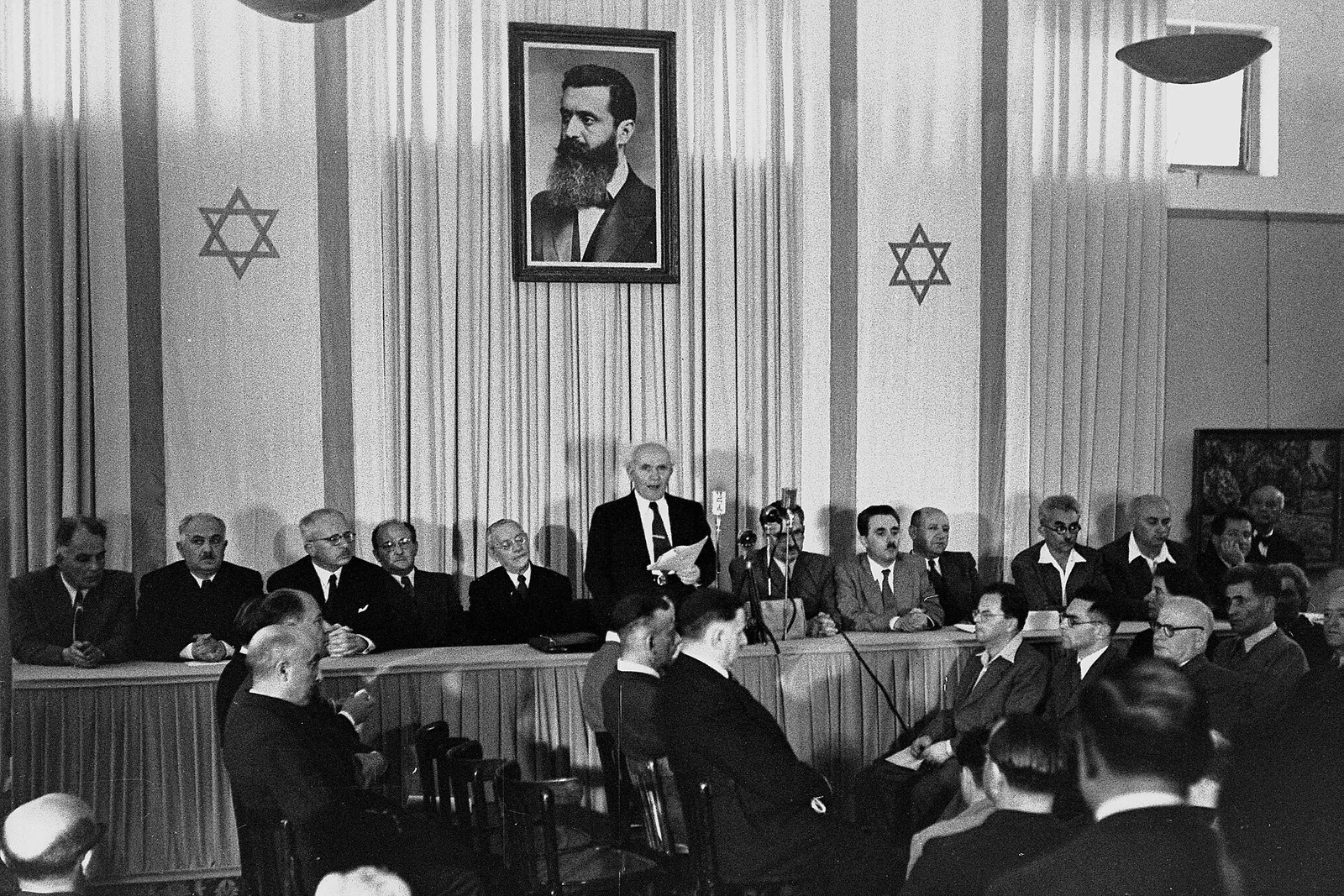
Rudi Weissenstein, 14 May 1948. National Photo Collection of Israel, Government Press Office (D247-041) · Public domain · Source page
Friday, four o’clock
Four o’clock, Rothschild Boulevard
Friday, 14 May 1948, Tel Aviv. In the hall of a small art museum on Rothschild Boulevard, a portrait of Theodor Herzl, who convened the First Zionist Congress in Basel in 1897, hangs between two flags. It is four in the afternoon. David Ben-Gurion rises and begins to read the Declaration of Independence.
The scroll is unfinished: the calligrapher had time to write only its lower part, so Ben-Gurion reads from a typed draft. In eight hours the British Mandate ends, and in the morning the armies of the neighbouring Arab states will cross the frontiers.
Less than six months earlier, the UN voted to divide the country. How did some 600,000 Jews get from that vote to this room, and what happened meanwhile to the country’s Arab majority? This is the story of two peoples and a handful of decisions.
David Ben-Gurion
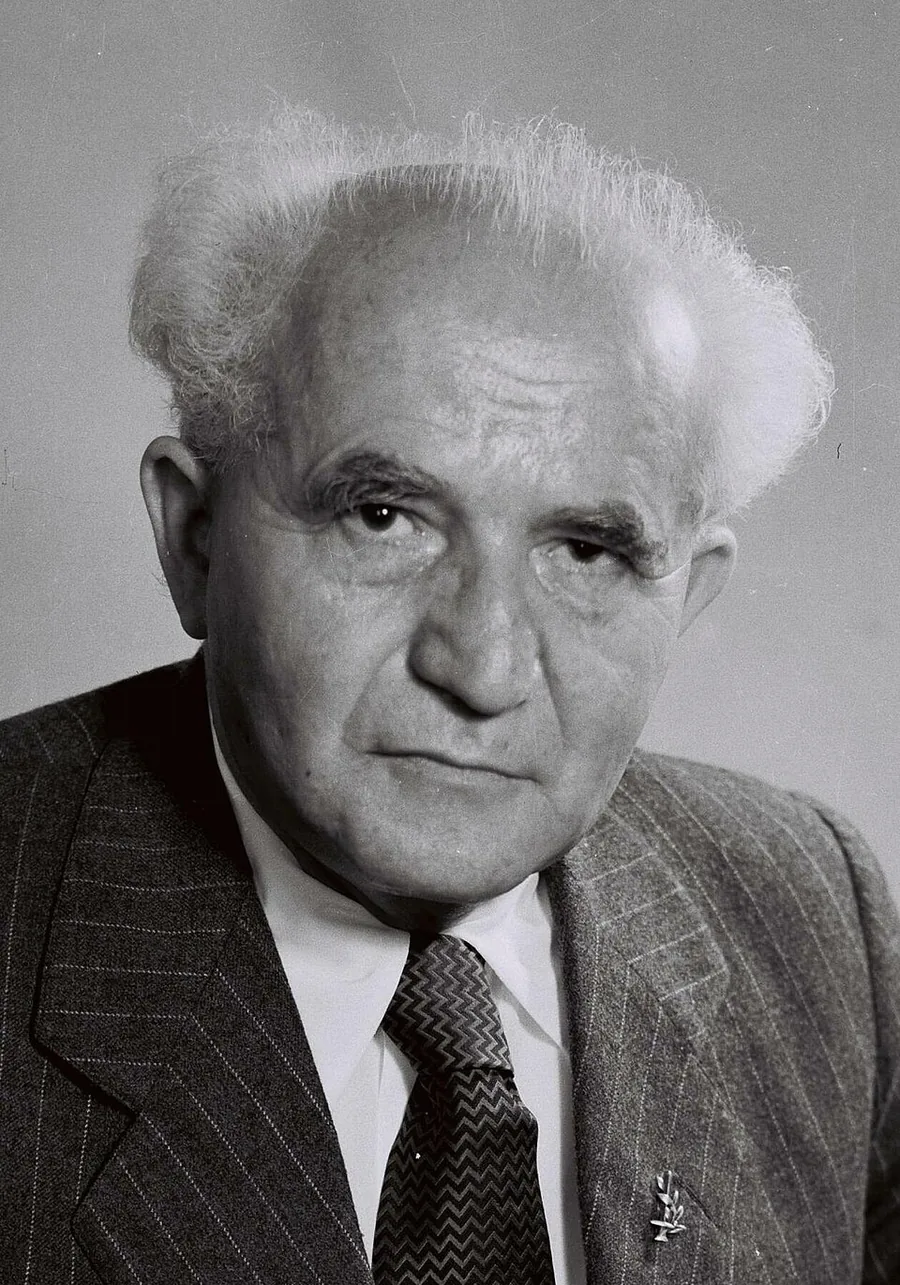
Israeli Government Press Office photographer, 16 April 1951 (D683-095). National Photo Collection of Israel · Public domain · Source page
The leader of the Jewish community who, within a single year, accepted partition, declared a state and founded its army.
- Born: 16 October 1886, Płońsk, Poland (then the Russian Empire)
- Died: 1 December 1973, Ramat Gan
- Won: The declaration of the state, 14 May 1948; The founding of the IDF by order, 26 May 1948
- Lost: The Altalena affair, June 1948: about 19 dead and a bitter dispute over responsibility; A costly war: over 6,000 Israeli dead, about one per cent of the Jewish population; The refugee question: his government barred return before peace, and historians dispute his part in the expulsions of 1948 (Lydda, 12 July)
At four in the afternoon Jewish independence was declared and the state was established. Its fate is in the hands of the security forces.
A closed door, an open question
1923–1939
Two promises, one country
The Mandate you met at the end of the lesson on Herzl and Zionism promised both a Jewish national home and the rights of all the inhabitants. Between 1923 and 1939 the Jewish community, the Yishuv, grew from some 84,000 people (census of 1922) to about 450,000, nearly a third of the country (British White Paper, 1939); after 1933 many newcomers were fleeing the Nazis. The Jewish Agency spoke for the Yishuv to the British. Arab leaders feared losing their majority and their land, and in 1936–1939 the Arabs of Palestine revolted; British forces put the revolt down.
In July 1937 a Royal Commission under Lord Peel proposed the first partition plan: a small Jewish state, an Arab state, and Jerusalem and a corridor to the sea under British rule. Arab leaders rejected it; the Zionist Congress rejected its borders but allowed negotiation. By 1939 Britain judged partition impracticable and chose another road.
Check yourself
How did the two sides react in July 1937 to the first partition plan, proposed by a Royal Commission under Lord Peel?
Answer: Arab leaders rejected it, and the Zionist Congress rejected its borders but allowed negotiation. Right. The Zionist Congress’s answer was partial: it rejected the borders but did not close the door to negotiation. By 1939 Britain judged partition impracticable.
1939
The White Paper
In May 1939, with Europe heading for war, Britain published the White Paper. For five years 75,000 Jews could enter, 10,000 a year plus 25,000 refugees. After that, none, ‘unless the Arabs of Palestine are prepared to acquiesce in it’. Within ten years there was to be an independent Palestine.
The Zionist movement rejected it at once, as a betrayal of the Balfour Declaration’s promise of a Jewish national home. The Arab Higher Committee, the main Palestinian leadership, rejected it too: it called the promised independence illusory, because the Jews could block it, and demanded an end to Jewish immigration for good.
When the war ended, after the Holocaust (see that lesson), the White Paper was still British policy.
1945–1947
The ships
The survivors had nowhere to go, and many sat in camps for displaced persons in Germany, Austria and Italy. The Yishuv answered the White Paper by smuggling people in: ha’apala, old, crowded ships trying to slip past the Royal Navy. Tens of thousands tried; the British stopped most of them and held about 52,000 on Cyprus.
The most famous voyage was the Exodus 1947. On 18 July 1947 British sailors boarded it off the coast, and three people died. Most of its 4,515 passengers were Holocaust survivors without immigration certificates. The British sent them not to Cyprus but back to Europe: first to France, where they refused to land, and on 7 September to Hamburg. The affair made news around the world.
1947
The question goes to the UN
In February 1947 Britain handed the question of Palestine to the UN. In May the UN set up UNSCOP, a committee of 11 states, none of them a great power. The Arab Higher Committee boycotted it. Some of its members watched at Haifa as British soldiers removed the passengers of the Exodus 1947 by force, and a delegation toured displaced-persons camps in Germany and Austria. All agreed that the Mandate should end. In September seven of its members proposed dividing the country into a Jewish and an Arab state in an economic union; three (India, Iran and Yugoslavia) proposed one federal state; Australia abstained. The majority gave its reasoning in the report: the claims of Arabs and Jews to Palestine, ‘both possessing validity, are irreconcilable’, and partition offered ‘the most realistic and practicable settlement’. What would the General Assembly decide?
Check yourself
Four events: the White Paper, Britain handing the question of Palestine to the UN, British forces boarding the Exodus 1947, and the UNSCOP majority’s proposal to divide the country. Which order is right, earliest first?
Answer: White Paper → handed to the UN → British board the ship → majority proposal. Right. The White Paper was published in May 1939; in February 1947 Britain handed the question to the UN; on 18 July 1947 British forces boarded the ship; and in September seven UNSCOP members proposed dividing the country.
29 November 1947: half a country?
Resolution 181
What the vote decided
33–13–10
On 29 November 1947 the UN General Assembly voted on Resolution 181: 33 for, 13 against, 10 abstentions. It recommended that Britain and every UN member adopt a plan: a Jewish state, an Arab state and a special UN regime for Jerusalem, tied together by an economic union. The states were to come into existence ‘not later than 1 October 1948’.
Two-thirds were needed; in committee four days earlier the plan had passed, but one vote short of that. The United States and the Soviet Union, rivals in everything else, both voted yes.
Source: The map of the plan
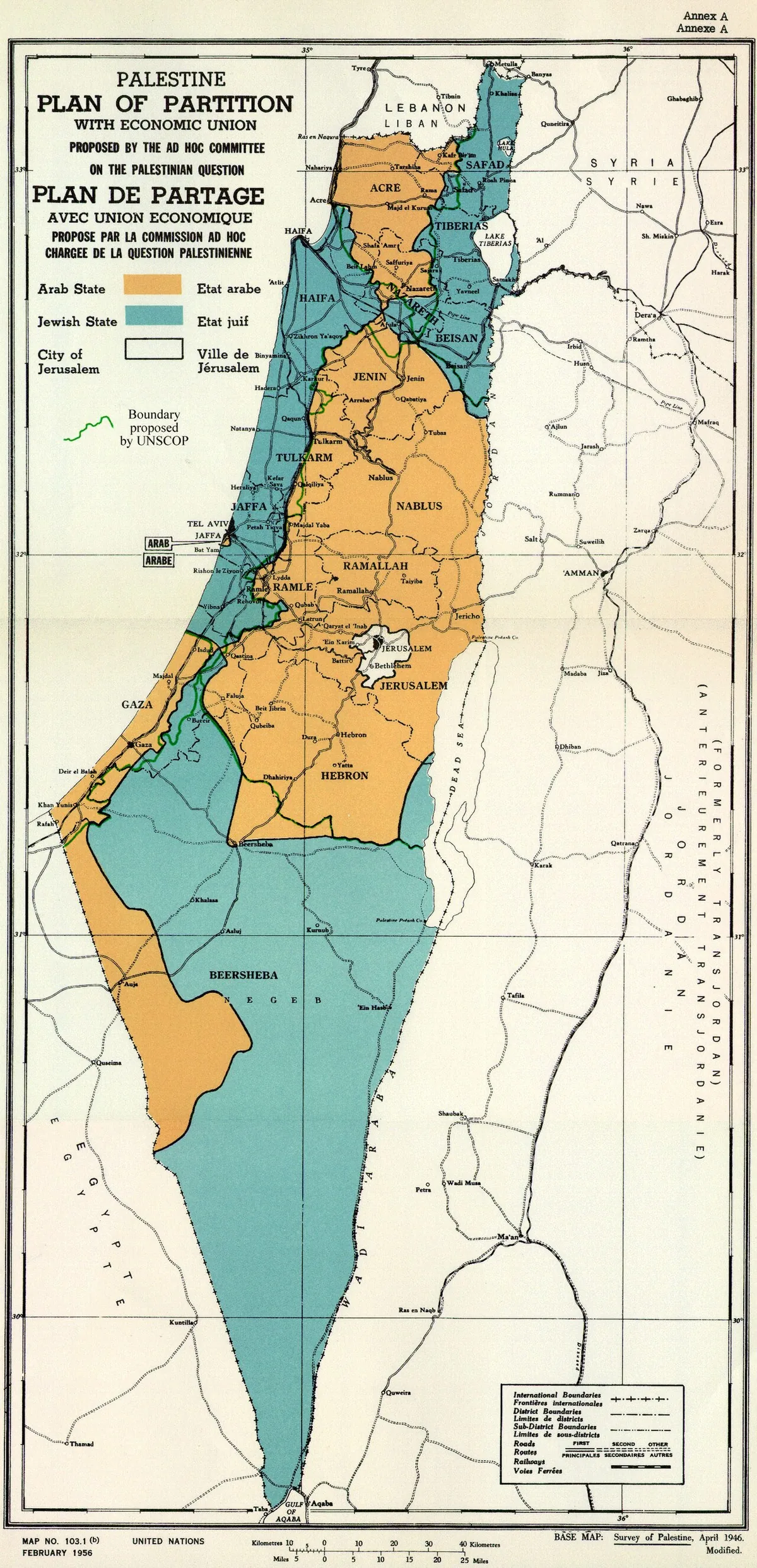
United Nations, Map No. 103.1(b), February 1956; the UNSCOP line was added by Wikimedia user Zero0000 · Public domain · Source page
United Nations, Map No. 103.1(b), “Plan of Partition with Economic Union”, printing of February 1956
The plan voted on 29 November 1947, drawn on a British survey map. The thin green outline, added later by a Wikimedia editor, shows UNSCOP’s earlier proposal.
- Where is the Jewish state (blue-green) and where the Arab state (orange)? The Jewish state: the coastal strip from Haifa to south of Tel Aviv, eastern Galilee, and most of the Negev, its largest part. The Arab state: western Galilee, the central hills and a strip around Gaza. Jerusalem is white, under UN rule.
- Count the pieces of each state. What problem does that create? Three main parts each, meeting at only a few points, with Jaffa, a large Arab city, an enclave in the Jewish coast. The plan could work only with free passage and someone to enforce it, but the resolution only recommended, and the UN did not act to implement it.
A decision point
You are David Ben-Gurion, chairman of the Jewish Agency Executive.
Tel Aviv, late November 1947
Immigration is still limited; many survivors wait in camps. Under the plan the Jewish state would get a little over half the country, much of it the arid Negev, but not Jerusalem. By UN estimates it would hold about half a million Jews and 400,000 to 500,000 Arabs.
The vote needs two-thirds, and in committee it passed one vote short of that. The Arab Higher Committee and the Arab governments say they will oppose the plan. The plan has Britain leaving by August, and nobody has said who will enforce it.
What position do you take?
- Accept the plan as it stands, openly Probably the surest way to keep the United States and the Soviet Union, both of which back the plan, on your side. You would get a state with a large Arab minority and without Jerusalem, and you would have to defend it yourselves.
- Reject it and demand the whole country, like the Irgun and Lehi Probably the end of any UN plan: the powers that backed it would not back a demand for everything. The Mandate would end in disorder, immigration would stay limited, and you would face the Arabs alone and without international standing.
- Accept, but announce that you will demand more land later Delegations that are still hesitating might hear a disguised rejection, and a plan that passed committee one vote short of two-thirds could fail. If it passed anyway, you would have kept a door open to expansion, but your opponents would quote your words.
- Back the minority proposal: one federal state The idea had three votes in UNSCOP and nobody to enforce it. The Arab governments want one democratic state, which would have an Arab majority, and the Yishuv’s mainstream wants sovereignty and free immigration. Probably no state and no peace either.
What really happened
Accept the plan as it stands, openly
The Jewish Agency accepted the plan, with misgivings. On 29 November it passed. The Jewish community celebrated, and Arabs across the country protested. The Arab Higher Committee and the Arab governments rejected it and announced that they would act to prevent its implementation.
Ben-Gurion wanted a state, but he was uneasy: within days of the vote he told his party that a state in which 40 per cent were not Jews would not be stable. The Arab leaders replied that Arabs were the majority of the country’s people, that Jews owned only a small part of the land (about 6 to 7 per cent, by common estimates) yet would receive more than half of it, and that no outside body could divide the country without their consent.
Check yourself
What did UN Resolution 181 of 29 November 1947 do?
Answer: It recommended dividing the country into a Jewish and an Arab state, with a special regime for Jerusalem. Right. The resolution’s wording is a recommendation, and it said the states should come into existence not later than 1 October 1948. It did not create them: the Yishuv declared the Jewish state on 14 May 1948, and the Arab state never came into being.
The civil war: roads, villages, fear
30 November 1947 – 14 May 1948
A war of the roads
The day after the vote a Jewish bus was ambushed near Kfar Sirkin, and five people were killed. The Arab Higher Committee called a general strike. Both sides soon struck civilians: on 30 December an Irgun bomb killed six Arab workers at the Haifa refinery gate, and Arab workers then killed 39 of their Jewish colleagues. The civil war had begun: the Yishuv and its Haganah against the Arabs of Palestine and Arab volunteers, while Britain still held the country and prepared to leave.
It was mostly a war of the roads. About 100,000 Jews lived in Jerusalem, and the road from the coast ran through Arab hills. In April Operation Nachshon fought big convoys through, and the Arab commander in the Jerusalem area, Abd al-Qadir al-Husayni, was killed on 8 April. But the road closed again, until volunteers cut a bypass track through the hills, the ‘Burma Road’, in June.
April 1948
Two attacks in four days
On 9 April fighters of the Irgun and Lehi, with Haganah support, attacked the Arab village of Deir Yassin near Jerusalem. Villagers were killed, among them women and children, in what is known as the Deir Yassin massacre. The first figure announced, 254 dead, came from the Irgun and was repeated by Jewish and Arab spokesmen alike; historians now say around a hundred (estimates run from 93 to 140). Four days later a convoy of doctors, nurses, patients and Haganah fighters, on its way to the Hadassah hospital on Mount Scopus, was ambushed, and 78 or 79 Jews and a British soldier were killed.
News of Deir Yassin travelled through Arab towns and villages. Benny Morris judged in 1988 that it probably had the most lasting effect of any single event of the war in precipitating the flight of villagers.
Winter and spring 1948
Leaving home
People had been leaving since the winter, first better-off families from the mixed cities, then villagers and townspeople as the fighting spread. In March the Haganah finalised Plan D; what it meant for the Arab villages in its path is one of the great arguments about 1948. Yoav Gelber writes that half to two-thirds of the people of Haifa and Jaffa left before Jewish forces took those cities in late April, and that in the last six weeks of the Mandate, 250,000 to 300,000 Palestinians and other Arabs fled. The Arab League’s own cable to the UN speaks of ‘over a quarter of a million’, a similar number that it explains differently.
Why did they go? Chapter 7 returns to that. For now, remember who they were: shopkeepers, farmers, clerks, women and children.
Check yourself
What was Plan D, and what do historians disagree about?
Answer: A Haganah military plan to secure the future state’s territory and its roads; historians disagree on whether it included planned expulsion. Right. The same passage of the plan is read in four ways: defence (Gelber), a shift to offence and to ‘pacification’ of villages (Morris), a plan of conquest (Khalidi) and ethnic cleansing (Pappé).
Myth
Arab leaders told the Palestinians over the radio to leave, and so they left of their own accord.
The truth
No general order has been found, though some local commanders evacuated villages. Yoav Gelber, an Israeli historian of the traditional school, writes that the documentary evidence ‘shows that Palestinian and other Arab leaders did not encourage the flight. On the contrary, they tried in vain to stop it.’ Benny Morris found no evidence of a general call either. But the opposite story is no more complete: ‘The old Israeli narrative of conspiracy is as wrong as the new Palestinian one of expulsion’, Gelber adds, and in places people were deported (chapter 7).
The evidence
Yoav Gelber (2009); Avi Shlaim’s summary of Morris’s findings (2009).
To declare or to wait?
May 1948
Three days before the end
On 12 April the Zionist Executive had set up the People’s Council, a kind of parliament, and the People’s Administration under Ben-Gurion, a kind of cabinet, to take over when the Mandate ended.
But Washington pulled the other way. On 8 May Secretary of State George Marshall told Moshe Shertok, the Jewish Agency’s foreign-affairs chief, that the Jewish leaders were taking a gamble and could expect no American help if it failed. The United States wanted a truce. Then Golda Meyerson, later Meir, returned from a secret meeting in Amman: King Abdullah of Transjordan had said he would join the war.
A decision point
You are David Ben-Gurion, chairman of the People’s Administration.
Tel Aviv, Wednesday 12 May 1948, the Jewish National Fund building
Ten of the 13 members of the People’s Administration sit around the table (two are stuck in besieged Jerusalem, and one more is absent). Moshe Shertok reports that Marshall wants a three-month truce and warns of a gamble. Yigael Yadin, the Haganah’s chief of operations, puts the chances if the Arab armies invade at ‘very much equal’, but admits that their advantage is large if they bring all their strength. Menachem Begin has said that if you do not declare a state, he will.
Do you declare a state on Friday?
- Declare the state on Friday 14 May Probably war with the Arab states in any case: nobody in the room believes they would accept a truce. But the Yishuv would stay united, Begin would have no state of his own to declare, and you would have an address from which to ask for recognition.
- Accept the American truce and postpone for up to three months Probably no Arab ceasefire (you have just been told otherwise), though a truce might give you time to build up forces and buy arms. But the Mandate would end with no authority in the country, Begin might declare a state of his own and split the Yishuv, and America’s reward is uncertain.
- Declare only a provisional government, not a state A hedge: it might ease the legal and diplomatic risk. But to a public expecting the word ‘state’ it would look like a half-measure, and Begin could still say that you had flinched.
What really happened
Declare the state on Friday 14 May
The People’s Administration decided to declare, and on 14 May the People’s Council approved the text. At four Ben-Gurion read the Declaration, and that same day the United States recognised the new state de facto. The next day the armies crossed the frontiers.
Nobody in the room believed the Arab states would honour a truce. Peretz Bernstein of the General Zionists said so: ‘there is no force that can guarantee it’. A Jewish authority had already been announced for 16 May, and Begin threatened to declare one himself. But how the decision was taken is disputed, as you will see.
Check yourself
Why did the People’s Administration decide to declare the state, even though Marshall had warned it against a gamble?
Answer: Nobody in the room believed the Arab states would honour a truce, and Begin threatened to declare a state himself. Right. Peretz Bernstein said that no force could guarantee a truce, and a Jewish authority had already been announced for 16 May. And Begin said that if you did not declare a state, he would.
Myth
Ben-Gurion won the vote to declare the state by six to four, almost alone.
The truth
That is the story in Zeev Sharef’s book of 1959, written eleven years later by the man who kept the minutes. But the minutes themselves contain no such vote. Ben-Gurion himself wrote in 1969 that there had been none, though some participants remembered one. Martin Kramer concludes that the declaration was probably decided by consensus, as Shertok wrote: ‘taken unanimously’. The documented vote is a different one: five to four not to name borders. Historians still disagree.
The evidence
Martin Kramer, Mosaic, April 2018, drawing on Sharef’s book, Ben-Gurion’s letter to Mordechay Naor (1969) and the minutes.
Source: The Declaration
Accordingly we, members of the People’s Council … by virtue of our natural and historic right and on the strength of the resolution of the United Nations General Assembly, hereby declare the establishment of a Jewish State in Eretz-Israel, to be known as the State of Israel. … We appeal – in the very midst of the onslaught launched against us now for months – to the Arab inhabitants of the State of Israel to preserve peace and participate in the upbuilding of the State on the basis of full and equal citizenship and due representation in all its provisional and permanent institutions.
Read on 14 May 1948 after three weeks of drafting and disputes over borders, God and the word ‘democratic’.
- What reasons does it give, and whom does it address? Reasons: the historic tie to the land, the Zionist Congress of 1897, the Balfour Declaration and the Mandate, the Holocaust and the UN resolution, all resting on a ‘natural and historic right’. It addresses the UN, the Arab inhabitants, the neighbouring states and Jews abroad.
- Who wrote it, and why does that matter for how you read it? The leaders of the Yishuv, who needed recognition abroad and who describe the fighting as ‘the onslaught launched against us’: a public, polished text. The promise to the Arabs was written while the war raged and many Arabs had already left their homes. A document like this shows what leaders chose to promise, not what happened afterwards.
War and state: 1948–1949
15 May 1948
The armies cross
On 15 May the armies of Egypt, Transjordan, Syria and Iraq, with a smaller Lebanese force, crossed into the country. The Yishuv saw an invasion meant to destroy the new state. The Arab governments said they came to restore order where the Mandate had left none. Behind the statements lay rivalries: the coalition had no single plan, writes Avi Shlaim, and King Abdullah of Transjordan wanted to enlarge his kingdom.
The picture of the few against the many does not fit the numbers: on Shlaim’s best estimate, Israel fielded 35,000 troops on 15 May against 20,000 to 25,000 for the Arab armies. Still, the war cost Israel, by Israeli records, more than 6,000 dead, about one per cent of its Jews. On the Arab side there is no exact count of the dead.
Check yourself
According to Avi Shlaim, what was the balance of forces on 15 May 1948, and what does it mean?
Answer: About 35,000 Israeli troops against 20,000 to 25,000 Arab troops: not the few against the many. Right. Shlaim adds that the IDF’s problem was firepower, not manpower. Gelber, who disagrees with Shlaim on much, agrees that the Jews were stronger for most of the war, except in the first month, when the Arab forces led in the air, in artillery and in light armour.
Source: The Arab League’s cable
Peace and order have been completely upset in Palestine, and, in consequence of Jewish aggression, approximately over a quarter of a million of the Arab population have been compelled to leave their homes … the Arab Governments find themselves compelled to intervene for the sole purpose of restoring peace and security and establishing law and order in Palestine.
Sent on the day the armies crossed, to justify the intervention in legal terms.
- What reasons do the Arab states give for sending armies? To restore law and order and stop disorder spreading into their own lands, in the vacuum left when the Mandate ended with no ‘legally constituted authority’.
- What does it say about the Arab population, and what does it not tell you? It says that ‘in consequence of Jewish aggression’ over a quarter of a million had been compelled to leave. Gelber’s estimate for the last six weeks of the Mandate is of the same order; the explanation is what sources argue about. A cable shows only what governments chose to say to the UN.
May–July 1948
One army
On 26 May Ben-Gurion ordered the creation of the IDF, with the Haganah as its core, and the same order dissolved the other Jewish armed forces. The Irgun and Lehi agreed to join, but wanted units of their own. A truce from 11 June lasted 28 days, and fighting resumed in July. The Palmach, the Haganah’s strike force, close to the left-wing Mapam, became IDF brigades, and on 7 November Ben-Gurion had its headquarters closed.
A decision point
You are David Ben-Gurion, prime minister and defence minister.
Tel Aviv, Sunday 20 June 1948
The truce bans bringing arms and fighters into the country. An Irgun ship, the Altalena, with about 900 volunteers and weapons from France, has reached the coast near Kfar Vitkin. You agreed that a fifth of the weapons would go to the Irgun’s battalion in Jerusalem, still outside the new army. Begin now demands the rest for Irgun units inside the army. Your officers call that an ‘army within an army’.
What do you do?
- Let the Irgun keep control of its cargo Probably the Irgun becomes a second army, and Lehi and others follow its example. Your order of 26 May would be a dead letter, and the new state would have more than one hand on its weapons.
- Insist that all the arms go to the army, and give Begin time It might work if Begin gives way. But time also lets him unload and spread the weapons, and the Arab armies are at the frontiers.
- Order the army to seize the ship, by force if necessary A short, sharp clash if Begin gives way, and a civil war inside the war if he does not. Either way you will have shown that the state, and not an underground, decides.
What really happened
Order the army to seize the ship, by force if necessary
At Kfar Vitkin the army demanded the weapons, and fighting broke out. The ship sailed on to Tel Aviv and ran aground off the beach, and on 22 June Ben-Gurion ordered it shelled. Sixteen Irgun fighters and two or three IDF soldiers were killed, and Begin told his men not to shoot back. Afterwards the Irgun and Lehi units were merged into the IDF or disbanded.
For Ben-Gurion it was a test of whether the state would have a single army. Begin later said that his greatest achievement was not hitting back, which prevented a civil war. Opinion is still divided on whether the shelling was necessary.
Check yourself
What can we learn from the Arab League’s cable to the UN of 15 May 1948?
Answer: The reasons the Arab governments chose to give the UN: restoring order, and ‘Jewish aggression’ as the cause of the flight. Right. This is the governments’ position as they chose to word it. The number in the cable, over a quarter of a million, is similar to Gelber’s estimate, but the explanation is what the sources argue about.
1949
Rhodes and the Green Line
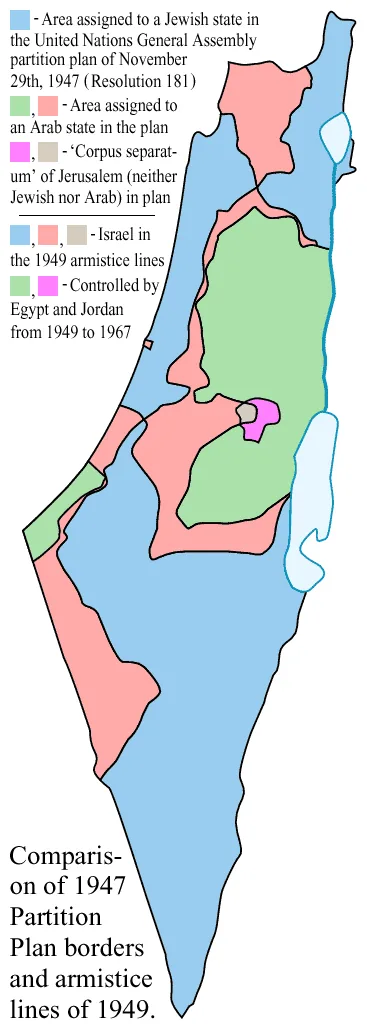
AnonMoos, 2005, based on UN data · Public domain · Source page
The fighting went on until early 1949, when Israel signed four separate armistice agreements agreements: with Egypt (Rhodes, 24 February), Lebanon (23 March), Jordan (Rhodes, 3 April) and Syria (20 July). The lines they set are the Green Line.
The texts are careful. Egypt’s says its line ‘is not to be construed in any sense as a political or territorial boundary’; the others word it differently (see ‘Go deeper’ below). In law these were military lines, not borders, but in practice they were Israel’s frontier until 1967.
Israel now held about 78 per cent of Mandatory Palestine, against about 56 per cent in the partition plan. Jordan held the hills in the centre and East Jerusalem, with the Old City and the Etzion bloc, where Jewish defenders had fallen or surrendered in May; Jerusalem was divided. Egypt held the Gaza Strip. No Palestinian Arab state was born, and the Palestinians were not a party to the agreements.
The people who left and the people who came
Refugees
How many people?
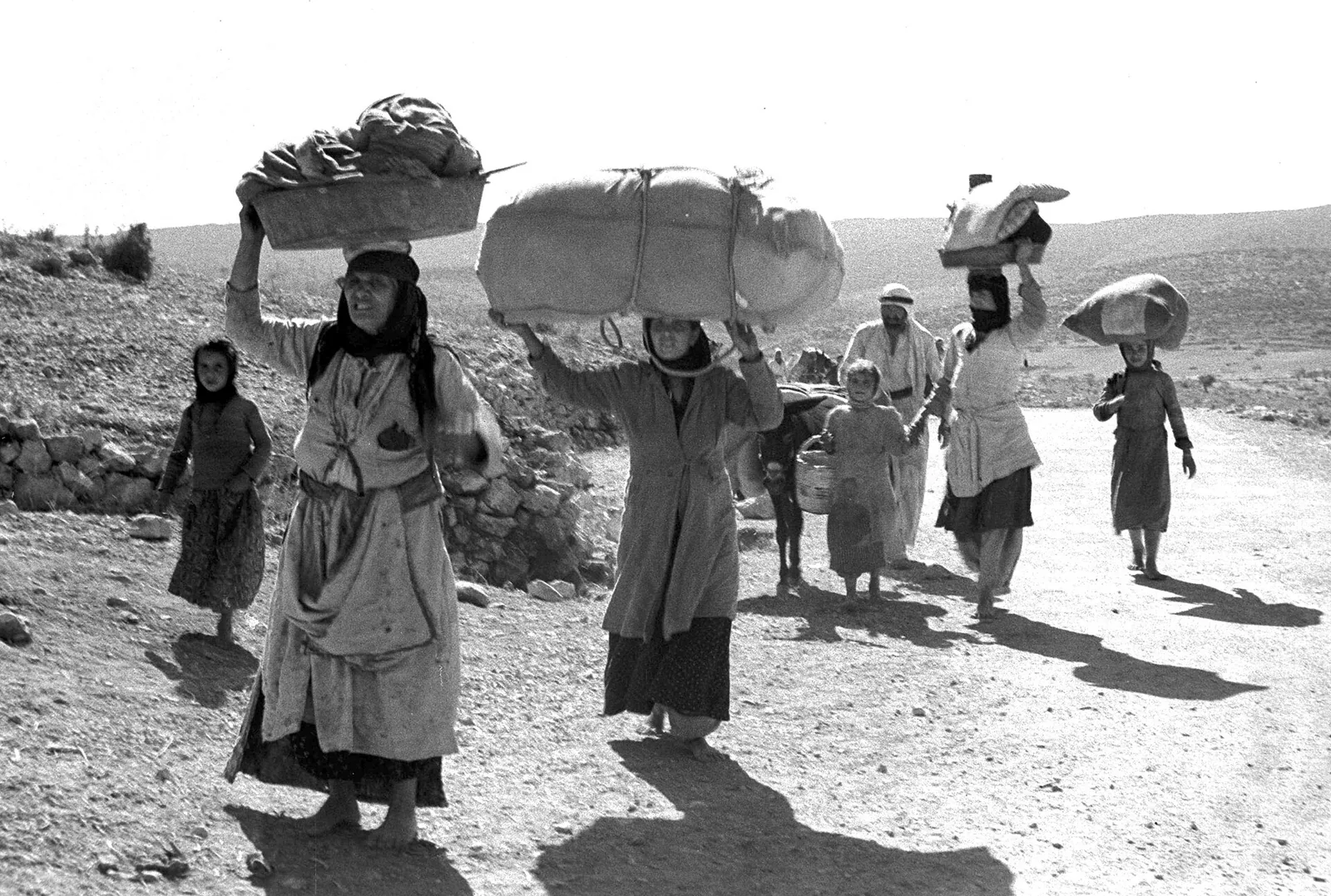
David Eldan, 30 October 1948. Government Press Office, Israel (D275-120) · CC BY-SA 3.0 · Source page
600–760 thousand
Hundreds of thousands of Palestinian Arabs left or were driven from their homes between 1947 and 1949, and almost none were allowed to return: the refugee problem. The estimates differ, because they count different periods and different groups.
Benny Morris: ‘an estimated 600,000 to 760,000’ Palestinian Arabs departed their homes between November 1947 and October 1950. The UN Economic Survey Mission, 1949: 726,000 refugees. Avi Shlaim: between 700,000 and 750,000. Behind each number are families from Haifa and Jaffa and villagers from the Galilee and the hills, who ended up in the West Bank, in Gaza, in Lebanon, Syria and Jordan.
Why?
Why they left, or were driven out
Almost every answer has been used as a weapon. Here is where the historians we have read agree, and where they part.
They agree that the exodus began months before the Arab armies came in on 15 May, and that no general Arab order to leave has been found. Gelber, of the traditional school, stresses defeatism and the collapse of Palestinian society. Benny Morris, one of the New Historians, found no Zionist master plan to expel them, but ranks Jewish military attack as the most important single factor in the exodus of April to June; Ilan Pappé reads Plan D as exactly such a plan. All agree that some people were expelled. Gelber writes that later refugees were ‘sometimes literally deported across the lines’ and that in certain cases IDF units ‘terrorized Palestinians so as to hasten their flight’.
The best-known case is Lydda and Ramle, two Arab towns with 50,000 to 70,000 people between them, taken by Israeli forces in July in Operation Dani. On 12 July, after Arab Legion armoured cars entered Lydda and shooting broke out, Israeli troops killed some 250 people in a few hours, by Morris’s count, among them dozens of unarmed detainees in a mosque compound. From 13 July Israeli forces made most of the population leave on foot. A written order attributed to Yitzhak Rabin, as Morris cites it, said that Lydda’s inhabitants must be expelled quickly, regardless of age.
Check yourself
On the question of why the Palestinians left, what do Gelber and Morris agree on, although they belong to different schools?
Answer: That neither found a general Arab order to leave, and both record that some people were expelled. Right. Gelber writes that later refugees were ‘sometimes literally deported across the lines’, and Morris ranks Jewish military attack as the most important single factor in the exodus of April to June. They differ over the overall explanation, not over these facts.
Return
The door that did not open
In the summer of 1948 the provisional government objected to any return of refugees before a peace treaty was signed, writes Gelber. The UN Economic Survey Mission reported in 1949 that ‘the Arab refugees have not been able to return to their homes because Israel will not admit them’.
On 11 December 1948 the UN General Assembly resolved that ‘the refugees wishing to return to their homes and live at peace with their neighbours should be permitted to do so at the earliest practicable date’, and that compensation should be paid for the property of those who chose not to return. This is Resolution 194. Palestinians and Arab governments read it as a right of return; Israel reads it as a recommendation, conditional on the refugees being ready to live at peace. Except for Jordan, writes Gelber, the Arab states did not absorb the refugees.
The name
Two names for one year
Israelis call the war the ‘War of Independence’, and Palestinians call it the Nakba, ‘the catastrophe’. The word was already in use in August 1948, in The Meaning of the Disaster by the Syrian-born historian Constantine Zurayk: ‘The defeat of the Arabs in Palestine is no simple setback or light, passing evil. It is a disaster in every sense of the word.’
About 160,000 Palestinian Arabs, by a UN estimate of 1949, remained in the territory that Israel held. This lesson uses both.
Immigration
A state that opens its gates
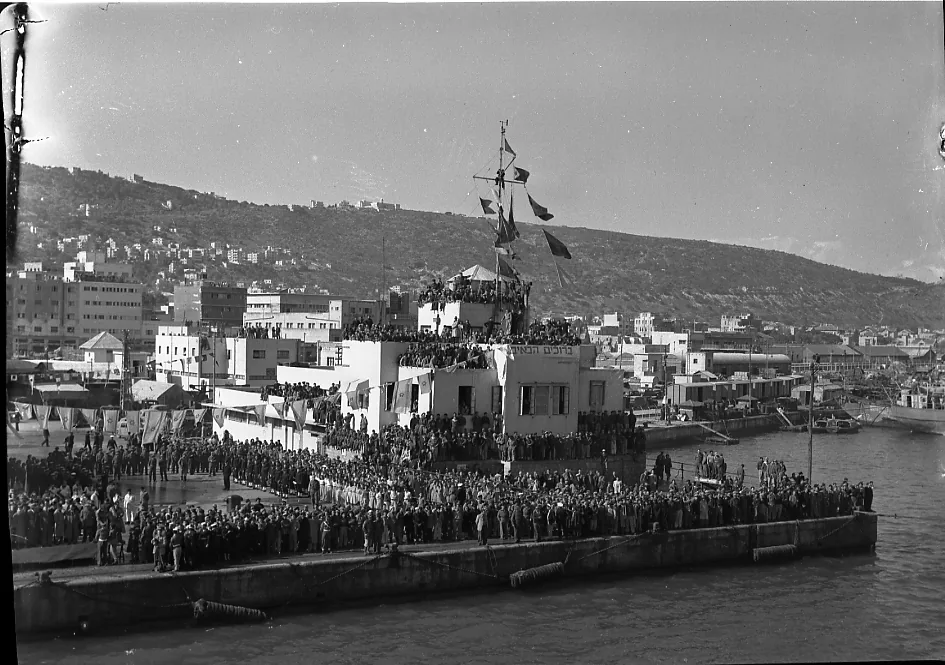
Benno Rothenberg, February 1949. Meitar Collection, National Library of Israel · CC BY 4.0 · Source page
about 688,000
In the same years the Jewish state opened its gates. Between 1948 and 1951 about 688,000 immigrants arrived, according to Israel’s Central Bureau of Statistics. The Jewish population almost doubled in four years. Many were survivors from the displaced-persons camps and from Cyprus, and about 250,000, by one estimate, came from Arab countries.
Check yourself
What do the two sides disagree about in reading UN General Assembly Resolution 194 of 11 December 1948?
Answer: Palestinians and Arab governments read it as a right of return; Israel reads it as a recommendation, conditional on the refugees being ready to live at peace. Right. The wording speaks of refugees ‘wishing to return to their homes and live at peace with their neighbours’, and of compensation for those who choose not to return. Hence the two readings.
From partition to the armistice, and after
- 29 November 1947 The UN General Assembly votes for partition.
- 14–15 May 1948 The state is declared; the Arab armies enter the country.
- 20–22 June 1948 The Altalena affair.
- July 1948 Lydda and Ramle: the population leaves or is driven out.
- 11 December 1948 UN General Assembly Resolution 194.
- February–July 1949 Four armistice agreements: the Green Line.
- 11 May 1949 Israel is admitted to the UN.
The argument about 1948
What caused the refugee problem, and how should the story of 1948 be told?
- The traditional account: Yoav Gelber, Efraim Karsh The war was forced on the Yishuv by those who rejected the UN plan, and the invasion by the Arab states turned a civil war into a war for survival. The refugees left mainly because of the war itself and the collapse of Arab society, and no master plan expelled them. Karsh argues, in Fabricating Israeli History: The ‘New Historians’ (1997), that claims of an expulsion plan rest on distorted readings of documents, and he reads Ben-Gurion’s speech of December 1947 as concern for Jewish immigration, not an idea of transfer. He goes as far as saying that Morris ‘has distorted the evidence’ (Middle East Quarterly, 1996). Gelber is blunt about the other side: in the civil war, he writes, ‘the Palestinians were not expelled; they simply ran away’, and he calls the Palestinian narrative of deliberate expulsion ‘a false narrative’. Those are their strong words, not ours. But Gelber too rejects the old story of an Arab order to leave, and records local deportations and a Jewish decision to bar return until peace.
- The New Historians: Simha Flapan, Benny Morris, Ilan Pappé, Avi Shlaim Four books of 1987–1988 (Flapan, The Birth of Israel: Myths and Realities; Morris, The Birth of the Palestinian Refugee Problem, 1947–1949, revised in 2004; Pappé, Britain and the Arab-Israeli Conflict, 1948–51; Shlaim, Collusion across the Jordan) challenged, in Shlaim’s list, four things: Britain’s policy at the end of the Mandate, the military balance, Arab war aims and the causes of the refugee problem. Morris found no Arab calls to leave and no Zionist master plan, and concluded that the refugee problem was ‘a by-product of the war’ (in Shlaim’s summary). Pappé reads Plan D as a blueprint for ethnic cleansing (The Ethnic Cleansing of Palestine, 2006), a reading Morris rejects. Shlaim thinks the evidence points to a far higher degree of Israeli responsibility than Morris concluded, and calls the traditional version ‘the propaganda of the victors’. Those are his strong words, not ours.
- The Palestinian account and Arab self-criticism: Walid Khalidi, Constantine Zurayk For Palestinians 1948 is the Nakba: a catastrophe in which a people lost its homes and its country. In this account the refugees did not leave on any Arab order, as Khalidi showed in 1959 (‘Why Did the Palestinians Leave?’) from the broadcasts and the Arab League’s own papers; they fled or were driven out by Jewish military action and by fear, and Israel’s refusal to let them return made the loss permanent. Khalidi called Plan D a ‘master plan for the conquest of Palestine’ (1961), and later edited All That Remains (1992), which lists 418 emptied localities in his count. Nur Masalha, in The Expulsion of the Palestinians (1992), traced the idea of ‘transfer’ in Zionist thought. Zurayk wrote as early as 1948 both of a country ‘snatched from its people’ and of the failure of the Arab governments.
Which kind of evidence should count most: a written order, a document written afterwards, a memoir, a government statement, an eyewitness? Who wrote it, when and for whom? Even historians who disagree sharply stand on common ground: Gelber and Morris both found no Arab order to leave, and both record expulsions. This site does not decide. Start from there, and ask what each remaining question would need in order to be settled.
Final quiz
Check yourself
What does the Declaration of Independence not contain?
Answer: The borders of the new state. Right. The text leans on Resolution 181 but never says where the state ends. The borders were left open on purpose, after a vote of five to four in the People’s Administration.
Check yourself
What can be said about the story that Ben-Gurion won a six-to-four vote to declare the state?
Answer: It is disputed: the minutes record no such vote, though some participants remembered one. Right. That is what Martin Kramer shows: Sharef’s story is not in the minutes, Ben-Gurion himself wrote that there was no vote, and Shertok wrote that the decision was unanimous. The documented vote was a different one: five to four not to name borders.
Check yourself
Which statement about the 1949 armistice lines is accurate?
Answer: Most of the agreements say the line does not settle the final border; in practice it was Israel’s frontier until 1967. Right. The wordings differ, but all three leave the final border open. The line with Lebanon follows the existing international boundary.
Check yourself
Why do estimates of the number of Palestinian refugees differ?
Answer: They count different periods and groups, by different methods. Right. Morris covers the period up to October 1950, and the Mission calculated in 1949 by subtraction. These are estimates with a method, not an agreed fact.
Terms
- the Yishuv The Jewish community of Palestine before the state existed. In 1947 it numbered some 600,000 people.
- White Paper A British policy paper of May 1939. It limited Jewish immigration to 75,000 over five years, then made it depend on Arab consent, and promised an independent Palestine within ten years. Not to be confused with Churchill’s White Paper of 1922.
- ha’apala Illegal immigration to Palestine in defiance of the British quotas, mostly on small, old ships. Those who came this way were called ma’pilim.
- UNSCOP The UN Special Committee on Palestine, made up of 11 states and set up on 15 May 1947. Most of its members recommended dividing the country.
- Resolution 181 The UN General Assembly’s recommendation of 29 November 1947 to divide the country into a Jewish and an Arab state, with an economic union and a special regime for Jerusalem. 33 states voted for, 13 against, 10 abstained.
- civil war The first phase of the 1948 war, from 30 November 1947 to 14 May 1948: the Jewish community against the Arabs of Palestine and Arab volunteers, while Britain still ruled the country.
- Haganah, Irgun and Lehi The Haganah was the Yishuv’s official underground army. The Irgun (National Military Organisation) and Lehi (Fighters for the Freedom of Israel) were breakaway nationalist undergrounds, Lehi the most extreme. Between 1944 and 1947 the Irgun and Lehi also attacked British forces; the Irgun’s bombing of the King David Hotel in July 1946 killed 91 people.
- Plan D A Haganah military plan, finalised on 10 March 1948, to secure the future state’s territory and its roads before an expected invasion. Historians disagree on whether it included planned expulsion.
- People’s Administration A 13-member executive body under Ben-Gurion, created on 12 April 1948 as a provisional government for the end of the Mandate.
- People’s Council A council of 37 members representing the Jewish community and the Zionist movement, set up on 12 April 1948. It proclaimed the state and then served as the Provisional Council of State.
- Declaration of Independence The document proclaiming the State of Israel, read on 14 May 1948 and signed by the 37 members of the People’s Council.
- IDF Israel Defense Forces. Ben-Gurion ordered its creation on 26 May 1948, with the Haganah as its core. The same order dissolved the other Jewish armed forces.
- Altalena An Irgun arms ship that arrived in June 1948. The IDF shelled it off Tel Aviv on the government’s orders. Sixteen Irgun fighters and two or three soldiers were killed.
- armistice agreements Four separate agreements in 1949 between Israel and Egypt, Lebanon, Jordan and Syria. They set military demarcation lines without settling the final border.
- Green Line The 1949 armistice lines, which served as the de facto frontier until 1967. The name comes from the green ink used to mark them on the map.
- refugee problem Hundreds of thousands of Palestinian Arabs who left or were driven from their homes in 1947–49 and were not allowed back. Their number and the reasons are disputed.
- Nakba Arabic for “the catastrophe”: the Palestinian name for the events of 1948. The word was already in use in August 1948, in Constantine Zurayk’s book The Meaning of the Disaster.
- New Historians Israeli historians, among them Benny Morris, Ilan Pappé, Avi Shlaim and Simha Flapan, who published studies of 1948 in the late 1980s that challenged the traditional story.
- the Jewish Agency The body that represented the Jewish community and the Zionist movement to the British under the Mandate, and later to the UN (the ‘Jewish agency’ of Article 4 of the Mandate). Ben-Gurion chaired its executive from 1935.
- Balfour Declaration A British promise of a Jewish national home in Palestine.
- Theodor Herzl The founder of the Zionist movement, who convened the First Zionist Congress in Basel in 1897.
- First Zionist Congress The first meeting of the Zionist movement, held in Basel in 1897.
- British Mandate British rule over the land of Israel, which ended in May 1948.
- Peel Commission A British commission that proposed a first partition plan in 1937: a Jewish state and an Arab state.
- Arab Higher Committee The main Palestinian leadership body, which rejected the White Paper and the partition plan.
- Royal Navy The British navy.
- Displaced persons camps Camps in Germany, Austria and Italy where survivors lived after the war, because they had nowhere to return to.
- Irgun An underground Jewish military group that operated before the state was founded.
- Lehi A small underground Jewish group that operated before the state was founded, alongside the Irgun.
- Deir Yassin An Arab village near Jerusalem. On 9 April 1948 Irgun and Lehi fighters attacked it, and many villagers were killed, among them women and children.
- Abd al-Qadir al-Husayni An Arab commander in the Jerusalem area, killed on 8 April.
- Operation Nachshon A Jewish operation in April that pushed large convoys through to Jerusalem by force.
- Lydda and Ramle Two Arab towns taken by Israeli forces in Operation Dani. Most of their people were made to leave on foot.
- Arab Liberation Army An army of Arab volunteers that fought in the war alongside the Arab armies.
- Arab League A union of Arab states. It sent the UN a cable calling partition a mistake.
- Resolution 194 UN General Assembly resolution of 11 December 1948: refugees who want to return should be allowed to, and those who do not should receive compensation.
- Palmach The strike force of the Haganah, close to the left-wing Mapam party.
- Mapam A left-wing party that was close to the Palmach.
- Etzion bloc A group of Jewish villages near Jerusalem, which fell to Jordan in May 1948.
- Moshe Shertok A Zionist leader, head of the political department of the Jewish Agency, who later became Israel's foreign minister.
- Benny Morris An Israeli historian of the New Historians school, who studied the Palestinian departure of 1948.
- Walid Khalidi A Palestinian historian who argued as early as 1959 that no general Arab order to leave existed.
- Constantine Zurayk A Syrian-born historian who wrote The Meaning of the Disaster in 1948, using the word nakba.
Sources
- Declaration of the Establishment of the State of Israel, 14 May 1948. Hebrew text: Wikisource, “הכרזה על הקמת מדינת ישראל”; official English translation, Israel Ministry of Foreign Affairs, in the Avalon Project, Yale Law School. The Knesset's own copy could not be reached.
- United Nations General Assembly, Resolution 181 (II), “Future government of Palestine”, 29 November 1947, Avalon Project
- British White Paper of 1939 (Cmd. 6019), Avalon Project (the 75,000 quota and the clause on Arab consent; the Jewish population, ‘some 450,000, or approaching a third’; partition ‘impracticable’).
- David Ben-Gurion, diary entry of 14 May 1948 (Hebrew; the English translations in the lesson are ours), Ben-Gurion Archive, Ben-Gurion University of the Negev
- Cablegram of 15 May 1948 from the Secretary-General of the League of Arab States to the Secretary-General of the United Nations, UN document S/745.
- General Armistice Agreements between Israel and Egypt (Rhodes, 24 February 1949), Lebanon (Ras en Naqoura, 23 March 1949), Jordan (Rhodes, 3 April 1949) and Syria (near Mahanayim, 20 July 1949), Avalon Project, pages arm01 to arm04.
- United Nations General Assembly, Resolution 194 (III), 11 December 1948, Jewish Virtual Library (its address says “resolution-181” but the page shows Resolution 194)
- United Nations General Assembly, Resolution 273 (III), 11 May 1949, admission of Israel to the United Nations, Jewish Virtual Library.
- First Interim Report of the United Nations Economic Survey Mission for the Middle East, UN document A/1106, Beirut, 6 November 1949 (the PDF's text layer is a poor scan; quotations were checked against it).
- Constantine K. Zurayk, The Meaning of the Disaster (Ma‘na al-Nakba; first Arabic edition August 1948), trans. R. Bayly Winder (Beirut: Khayat's College Book Cooperative, 1956).
- Yoav Gelber, “The Israeli-Arab War of 1948”, in Israel Studies: An Anthology, Jewish Virtual Library, July 2009 (read again in full as text 2026-10-17)
- Avi Shlaim, “Israel's ‘new history’ and the Palestinians”, Open Democracy, reprinted by History News Network, 4 November 2009
- Martin Kramer, “The May 1948 Vote That Made the State of Israel”, Mosaic, April 2018 (read as the PDF of the Washington Institute for Near East Policy).
- Efraim Karsh, “Rewriting Israel's History”, Middle East Quarterly 3:3 (1996).
- Benny Morris, The Birth of the Palestinian Refugee Problem Revisited (Cambridge: Cambridge University Press, revised edition 2004; the first edition appeared in 1988). Only the abstract of the introduction was read.
- Eugene Rogan and Avi Shlaim (eds.), The War for Palestine: Rewriting the History of 1948 (Cambridge: Cambridge University Press, 2001; 2nd ed. 2007). Further reading; not consulted in this run.
- Walid Khalidi (ed.), All That Remains: The Palestinian Villages Occupied and Depopulated by Israel in 1948 (Washington, DC: Institute for Palestine Studies, 1992). Further reading; not consulted in this run.
- English Wikipedia, read as a finding aid for dates and figures (which the lesson attributes to the historians the articles cite): “Exodus 1947”, “United Nations Special Committee on Palestine”, “1947 UN Partition Plan”, “White Paper of 1939”, “Aliyah Bet”, “Siege of Jerusalem (1948)”, “Jewish exodus from the Muslim world”; and, in the review pass, “Plan Dalet”, “Deir Yassin massacre”, “Haifa Oil Refinery massacre”, “Ben Yehuda Street bombing”, “Battle of Haifa (1948)”, “Kfar Etzion massacre”, “Battle for Jerusalem (1948)”, “Palmach”, “King David Hotel bombing”, “Altalena affair”, “Israel Defense Forces”, “United Nations General Assembly Resolution 194”, “1948 Palestinian expulsion from Lydda and Ramle”, “1948 Palestinian expulsion and flight”, “Provisional State Council”; and, in the set-edit pass, “Peel Commission”, “1936–1939 Arab revolt in Mandatory Palestine”, “Fifth Aliyah” and “United Nations Special Committee on Palestine” (the visits to Haifa and to the camps, the date of the report).
- Hebrew Wikipedia, “מגילת העצמאות”, on the drafting, the signing and the scroll; and, in the review pass, “מועצת העם”, “תוכנית ד׳” (the Hebrew wording of the resistance clause, quoted from the Haganah history), “הפלמ״ח” (the dissolution of the staff on 7 November 1948) and “לוד” (the Hebrew wording of the order of 12 July).
- Cross-checks for Rabin’s memoir passage on Lydda and Ramle (the primary text, Peretz Kidron’s translation printed in The New York Times on 23 October 1979, was not reachable): David K. Shipler, review of Khirbet Khizeh, Moment, May–June 2015, on the censorship of the passage; University of Southern California, “Arab Literary Travels”, “The Fall of Lydda”, which quotes the wording; and English Wikipedia, “1948 Palestinian expulsion from Lydda and Ramle”, which gives the wording of the order (note 14: Morris, 1987, p. 207) and of the memoir (note 61: Shipler, New York Times, 23 October 1979). The lesson quotes both at second hand, as it says.
- Yehuda Slutsky (ed.), Sefer Toldot Ha-Haganah (History of the Haganah), vol. 3, part 3, Tel Aviv 1972, the text of Plan D. Not read directly: the wording is quoted from Hebrew Wikipedia.
- Walid Khalidi, “Why Did the Palestinians Leave?”, Middle East Forum, 1959 (reprinted in the Journal of Palestine Studies, 2005); Erskine B. Childers, “The Other Exodus”, The Spectator, 12 May 1961, and the letter of 16 June 1961 by Khalidi, Cairns and Childers. Further reading; the texts were not retrieved in this run, only reports of them.
- Simha Flapan, The Birth of Israel: Myths and Realities (New York: Pantheon, 1987); Avi Shlaim, Collusion across the Jordan (Oxford: Clarendon Press, 1988); Ilan Pappé, Britain and the Arab-Israeli Conflict, 1948–51 (London: Macmillan, 1988) and The Ethnic Cleansing of Palestine (Oxford: Oneworld, 2006). Further reading; not consulted in this run.
- Efraim Karsh, Fabricating Israeli History: The ‘New Historians’ (London: Frank Cass, 1997); Nur Masalha, The Expulsion of the Palestinians: The Concept of “Transfer” in Zionist Political Thought, 1882–1948 (Washington, DC: Institute for Palestine Studies, 1992). Further reading; not consulted in this run.
- Report of the United Nations Special Committee on Palestine to the General Assembly, UN document A/364, 3 September 1947: the majority plan, Part I, paragraph 1 (‘both possessing validity, are irreconcilable’; ‘the most realistic and practicable settlement’). Text read as reproduced at PalQuest; the UN’s own page (un.org/unispal, document 179435) shows only the title.
- USHMM, ‘Cyprus Detention Camps’ (the British apprehended most of the 70,000 who embarked for Palestine and held about 52,000 on Cyprus).
Image credits
- Rudi Weissenstein, 14 May 1948. National Photo Collection of Israel, Government Press Office (D247-041) · Public domain · Source page
- Israeli Government Press Office photographer, 16 April 1951 (D683-095). National Photo Collection of Israel · Public domain · Source page
- United Nations, Map No. 103.1(b), February 1956; the UNSCOP line was added by Wikimedia user Zero0000 · Public domain · Source page
- AnonMoos, 2005, based on UN data · Public domain · Source page
- David Eldan, 30 October 1948. Government Press Office, Israel (D275-120) · CC BY-SA 3.0 · Source page
- Benno Rothenberg, February 1949. Meitar Collection, National Library of Israel · CC BY 4.0 · Source page


