Mohenjo-daro: a city without kings?
About 4,500 years ago the Indus valley had planned cities with drains. No one can read their script, and it is unclear who ruled there. What do we know, and what do we only guess?
Decisions, questions and your own progress, in the app
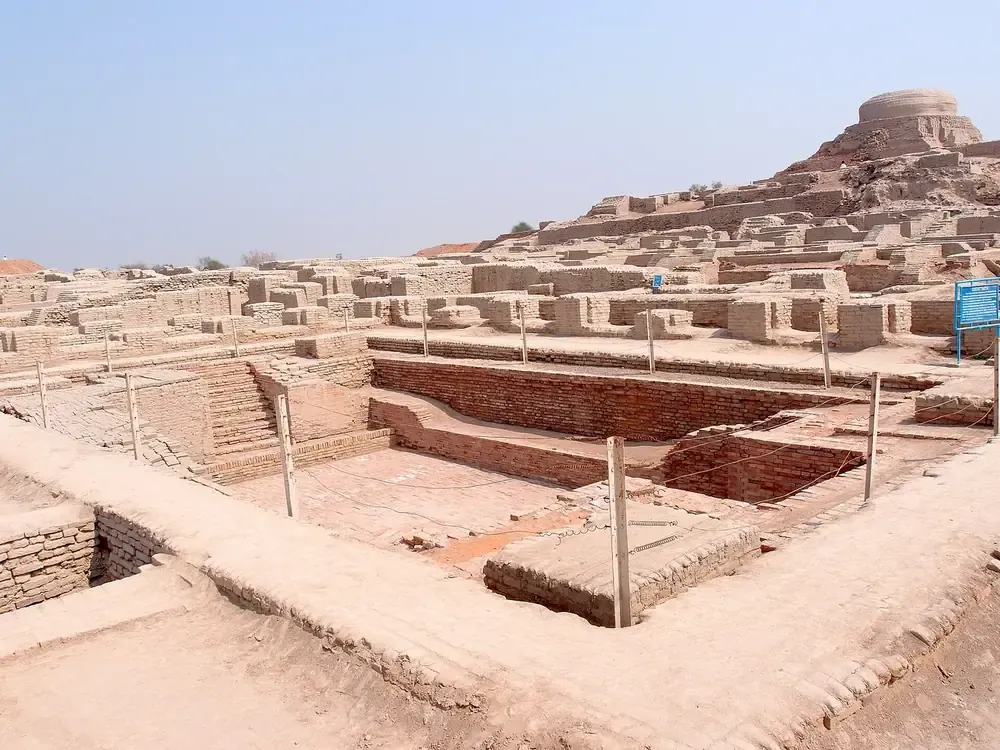
Saqib Qayyum, 2014. Own work, via Wikimedia Commons. · CC BY-SA 3.0 · Source page
A city with drains, 4,500 years ago
A straight street, with a brick drain underneath
Picture a street as straight as a ruler, with a brick drain running under it to carry water away. About 4,500 years ago, in Mohenjo-daro in the Indus valley, this was an ordinary street.
But the people who built the city left no names of kings, and their writing has still not been deciphered. So what do we really know, and what do we only guess? Let us find out, one step at a time.
Background
Cities on a river
2600–2000 BCE
The Indus civilisation is commonly dated to around 3300 BCE. It covered much of what is now Pakistan and north-west India. Its best-known cities are Harappa, Mohenjo-daro, Dholavira and Lothal.
Its height, the mature phase, is roughly 2600 to 2000 BCE. In that period Mohenjo-daro was at its peak. Some estimates put its population at that time at about 35,000 to 40,000 people, but these are estimates, not counts. The civilisation lasted longer, and by about 1700 BCE its cities declined and were abandoned.
Check yourself
When was the mature phase of the Indus civilisation at its height?
Answer: Around 2600 to 2000 BCE. Correct. This is the mature phase, when the big cities were at their peak.
A mound with a stupa
The first digs
Under a Buddhist monument
In the early 1920s R. D. Banerji, an officer of the Archaeological Survey of India, worked at Mohenjo-daro. A Buddhist stupa already stood on the mound, a monument built long after the city was abandoned.
What lay under that monument? Answering that meant digging layer by layer and recording each one, because stratigraphy, the order of layers in the ground, shows what came before what.
A decision point
You are R. D. Banerji.
Mohenjo-daro, early 1920s.
The mound is already known as a Buddhist site, with a stupa on top. Below it, your diggers reach layers that look older, with remains and seals.
What do you do?
- Stop at the stupa and record only the Buddhist buildings. Probably the older city stays hidden under the mound, and the stupa looks like the whole story.
- Keep digging under the stupa, layer by layer, recording each one. Probably the layers give a sequence: which find is older and which is newer, and the age of the city becomes visible.
- Dig fast, take the finest objects to the collection, and leave the rest. Probably the objects reach a museum, but without a record of their layers they tell much less about when they were made.
What really happened
Keep digging under the stupa, layer by layer, recording each one.
Banerji dug beneath the stupa into the older levels. There he found remains and seals far older than the Buddhist monument.
The stupa was already known, so the new question was what lay beneath it. Without digging deeper, the older finds would never have appeared.
The announcement
A civilisation nobody had heard of
In September 1924 John Marshall, director-general of the Archaeological Survey of India, announced the discovery in The Illustrated London News.
The finds included seals with signs that no one could read.
Check yourself
Why did Banerji digging below the stupa matter?
Answer: It showed older layers lay under the stupa, so the city came first. Correct. What lies beneath the stupa is older than it, so the city existed long before the monument.
Streets, weights and a statue
What the digs found
A planned city
In the Lower Town of Mohenjo-daro the streets ran in a planned grid of straight lines that crossed at right angles. Many houses had wells. Waste water flowed from the houses into covered drains along the streets.
People also used standard cube-shaped weights. Their series ran in a binary pattern up to 16 steps, then in tens. The smallest weighs about 0.86 grams, and a common one about 13.7 grams.
Source: The statue called the "Priest-King"
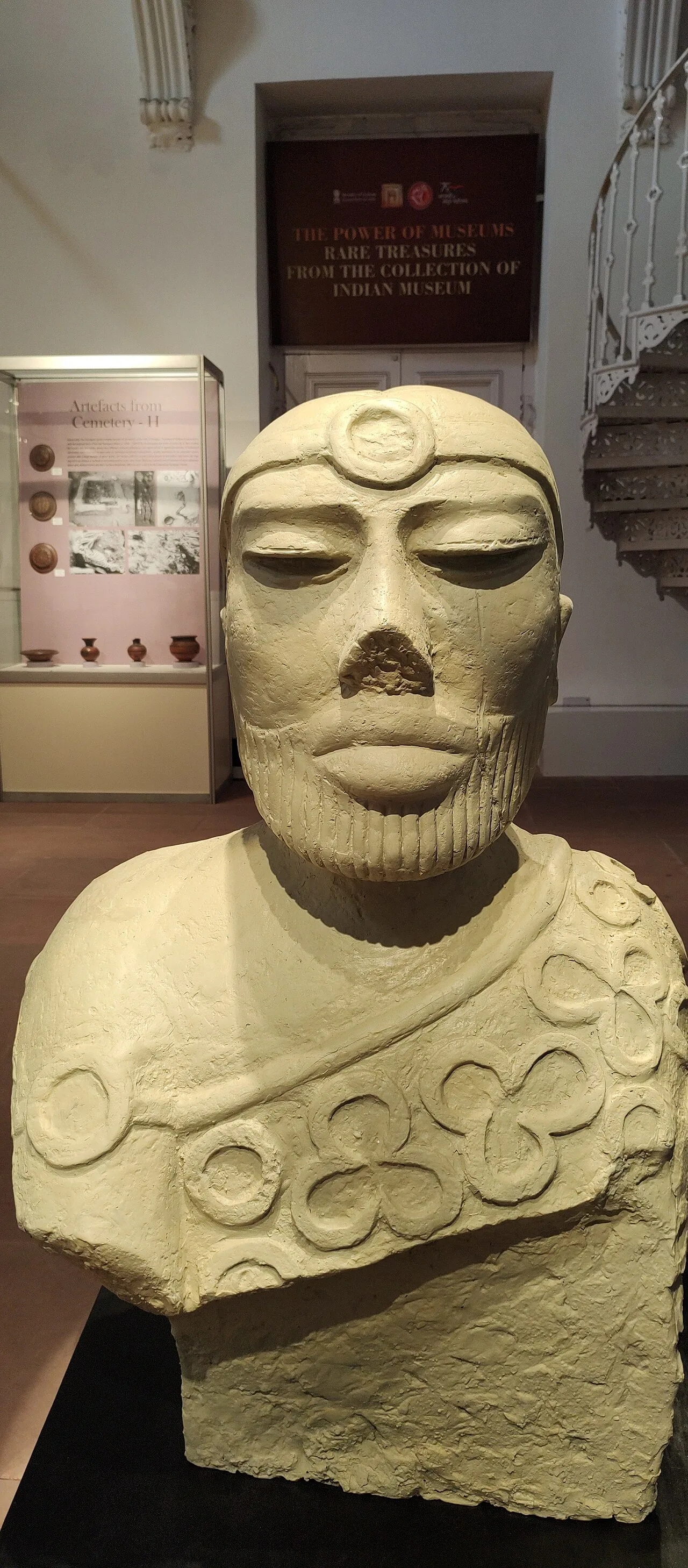
Ganesh Mohan T, 2022. Wikimedia Commons. · CC BY-SA 4.0 · Source page
Photograph by Ganesh Mohan T, 2022, Wikimedia Commons. The original is in Pakistan; this photo was taken in Kolkata.
Found in 1927 in a building with ornamental brickwork. It is about 17.5 cm tall. The name "priest-king" is modern, and there is no text from the time that explains who the figure is.
- Who made it, and for whom? We do not know. No inscription on it says.
- What does the name "priest-king" suggest? That it shows a leader. But there is no evidence that priests or kings ruled the city. The name is a guess.
- What would we need to know for certain? A text that explains the figure, and the name of its maker. Without them the statue speaks only through its appearance.
The bath
A pool at the heart of the citadel
At the heart of the citadel stands the Great Bath: about 12 metres long, 7 metres wide and 2.4 metres deep. Its lining was made watertight with bitumen, a natural tar.
What was it for? Perhaps ritual purification, perhaps public bathing. We do not know for certain.
Source: The bath as it looks today
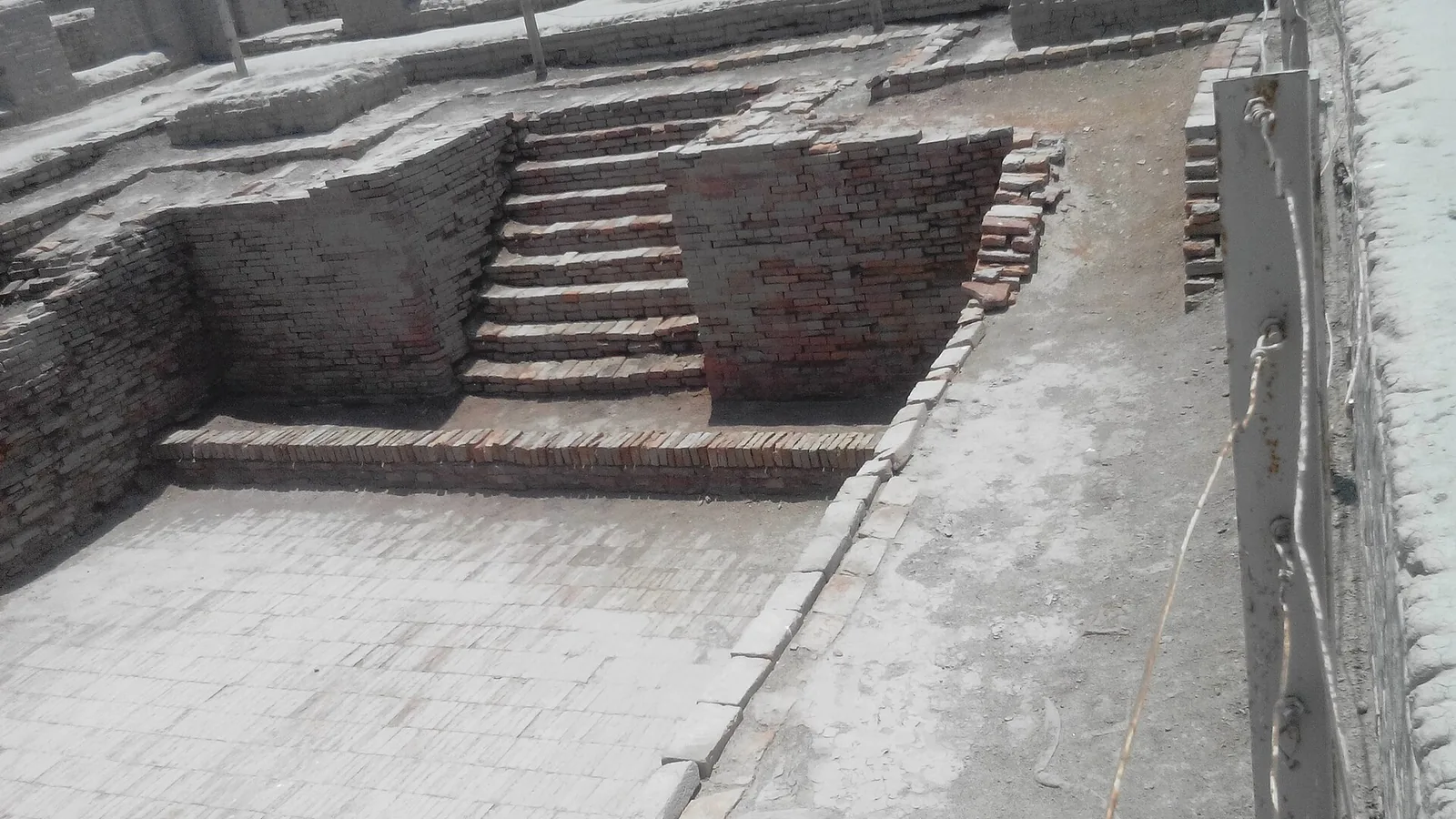
Aakashaliraza, 2016. Wikimedia Commons. · CC BY-SA 4.0 · Source page
Photograph by Aakashaliraza, 2016, Wikimedia Commons.
A modern photograph: almost a century after the dig, the pool looks like a preserved space open to visitors.
- When was the picture taken, and what does it show? In 2016. It shows the pool as it is now, so it cannot show the city as it was.
- Does the picture answer what the pool was used for? No. A picture shows the shape, not the purpose. The pool alone does not say what it was for.
- What does the picture leave out? The streets and houses around the pool, the water that was put in, and the people who used it.
Check yourself
Which claim about the Great Bath is correct?
Answer: It is about 12 by 7 metres, but its use is still not known. Correct. The size is known, and its use is a hypothesis.
Who ran the city?
No king in sight
No clear evidence of kings
There is no clear evidence of kings, palaces or temples. No clear royal tomb has been identified. That does not prove there were no kings. It means the city does not tell us who ran it.
A decision point
You sit on the committee that plans a new district in Mohenjo-daro.
About 2500 BCE. An imagined scene, with no record.
The new district will use the same street grid as the old city, and it needs a way to carry away rain and waste water. The area is low, and the river may flood it in the rainy season.
What do you decide?
- A straight street grid like the old city, with covered drains under the streets. Probably the district works well and keeps an order that others can follow, but the drains will need regular cleaning.
- Build the district on a raised mound of earth and clay, with no drain network, and let the water soak into the ground. Probably part of the district stays dry, but in heavy rain water gathers at the edges of the mound, and rebuilding takes a lot of work.
- Build a new district on higher ground away from the river, and move some residents there. Probably the new district is drier, but it splits from the city and needs its own services, and the old city keeps its problems.
What really happened
A straight street grid like the old city, with covered drains under the streets.
No record of such a committee survives. What survives is the city itself: a straight grid of streets with drains running along them.
This scene is imagined. The reasoning: the grid was already there, and the drains were part of it.
Did someone run the city?
Do the signs of uniform planning point to central rule, or to something else?
- Some scholars No clear palace, royal tomb or temple has been identified. The uniform plan could reflect agreement among communities, without a single ruler.
- Other scholars Uniform weights and a uniform street plan could point to a system that organised trade and building. But the proof has not been found.
What would convince you? A readable inscription, a royal tomb, or something else?
Check yourself
Why can we not know for certain how the city was governed?
Answer: Because we cannot read the script, and no palace has been found. Correct. Both of these are missing, so the question stays open.
The massacre that may not have happened
1947
Thirty-seven skeletons
In 1947 Mortimer Wheeler, a senior British archaeologist who had worked on Indus sites, wrote about skeletons found in the lower town of the city. He counted 37 bodies and read them as victims of violence. He linked the scene to the Rig Veda, a collection of hymns that describes the god Indra destroying fortresses.
A decision point
You are Mortimer Wheeler, in 1947.
After years of digging at Mohenjo-daro.
The lower town yielded 37 skeletons. The question is what they prove, and what to publish about them.
What do you write?
- Publish only the number and the positions of the skeletons, and say the cause of death is not known. Probably the report is cautious and accurate, and the story of the city’s end stays unclear for longer.
- Write that the skeletons are victims of an invasion, and point to Rig Veda hymns that describe fortresses being destroyed. Probably the story spreads fast, and later readers take the invasion as fact. Challenging a famous archaeologist would be hard.
- Wait for more digging before writing about the skeletons. Probably you get more evidence, but the public waits, and other writers fill the gap with their own ideas.
What really happened
Write that the skeletons are victims of an invasion, and point to Rig Veda hymns that describe fortresses being destroyed.
Wheeler published the reading of the skeletons as evidence of violence by invaders, and linked it to Rig Veda hymns about the god Indra. The idea reappeared in other writings for years.
Some historians suggest that Wheeler was looking for an explanation of the city's end, and an ancient text seemed to fit. As evidence, the bones alone did not prove an invasion.
Myth
The idea: invaders broke into the city and killed its people in a massacre.
The truth
It is a story the evidence has not proved. In 1964 George Dales argued that the skeletons do not prove a massacre. He suggested another explanation, such as bandits who left their dead in the abandoned city.
The evidence
Some scholars have proposed explanations such as floods, shifting rivers and changes in trade or climate. How much weight each deserves is still debated.
What came next
- c. 1700 BCE The late phase ends. The cities decline and are abandoned, and the exact cause is unclear.
- 1922–1924 Banerji digs beneath the stupa. Marshall announces the discovery in September 1924.
- 1926–1927 The small Dancing Girl (1926) and the Priest-King (1927) are found. Their names are modern.
- 1964 Dales proposes another explanation for the skeletons, without a massacre.
- 2025 In 2025 the Indian state of Tamil Nadu offered a prize for deciphering the script. So far no one has won it, and its framing is disputed.
Check yourself
What did George Dales argue in 1964?
Answer: That the skeletons do not prove a massacre. Correct. This is his central claim, and it appears in the myth step.
Check yourself
Which claim about Mohenjo-daro is the safest?
Answer: It had planned streets and drains. Who ran it is not known. Correct. What is found is the planning, and what is not found is the rule.
Terms
- stratigraphy The order of layers in the ground. The lower layer is usually older, so digging layer by layer shows what came first.
- stupa A Buddhist monument, a dome-shaped mound built to honour the Buddha or to hold relics. The stupa on the Mohenjo-daro mound was built long after the city was abandoned.
- decipher To read a writing system whose signs and language we do not know, and understand what it says.
- seal A small carved stamp, often of stone, with a sign or writing on it. Pressed into soft clay, it leaves an impression.
- bitumen A natural tar. It is sticky, dark and waterproof. At the Great Bath it lined the pool to keep water in.
- Rig Veda A collection of hymns in Sanskrit, built up over centuries. It describes the god Indra, who destroys fortresses.
- Harappa A well-known city of the Indus civilisation.
- Dholavira A well-known city of the Indus civilisation.
- Lothal A well-known city of the Indus civilisation.
- Archaeological Survey of India The official Indian body that studies antiquities and carries out archaeological digs.
- R. D. Banerji An officer of the Archaeological Survey of India, who dug at Mohenjo-daro and found older layers beneath a stupa.
- John Marshall Director-general of the Archaeological Survey of India, who announced the discovery in 1924.
- Mortimer Wheeler A senior British archaeologist who worked on Indus sites and read the skeletons as victims of violence.
- George Dales A scholar who argued in 1964 that the skeletons do not prove a massacre.
- Indra A god in the Indian tradition, described in the Rig Veda hymns as destroying fortresses.
- Lower Town The low part of Mohenjo-daro, with planned streets and many houses with wells.
- Great Bath A large bathing pool in the citadel of Mohenjo-daro. Its exact purpose is not known.
- Mature phase The peak stage of the Indus civilisation, roughly 2600 to 2000 BCE.
- Cube weights Cube-shaped weights, used in a fixed series. The series ran in a binary pattern up to 16 steps.
- Ritual purification A ceremony that cleanses the body or a place according to religious belief.
- Pakistan A country that includes much of the area of the Indus civilisation.
- Buddhism A religion that began in India and teaches letting go of desire and meditation.
Sources
- John Marshall, Mohenjo-daro and the Indus Civilization, 3 vols. London: Arthur Probsthain, 1931.
- George F. Dales Jr., "The Mythical Massacre at Mohenjo-Daro," Expedition 6, no. 3 (1964): 36–43.
- Mortimer Wheeler, "Harappa 1946: The Defences and Cemetery R-37," Ancient India 3 (1947): 58–130.
- J. Mark Kenoyer, Ancient Cities of the Indus Valley Civilization. Oxford University Press with the American Institute of Pakistan Studies, 1998.
- Gregory L. Possehl, The Indus Civilization: A Contemporary Perspective. Walnut Creek, CA: AltaMira Press, 2002.
- Iravatham Mahadevan, The Indus Script: Texts, Concordance and Tables. New Delhi: Archaeological Survey of India, 1977.
Image credits
- Saqib Qayyum, 2014. Own work, via Wikimedia Commons. · CC BY-SA 3.0 · Source page
- Ganesh Mohan T, 2022. Wikimedia Commons. · CC BY-SA 4.0 · Source page
- Aakashaliraza, 2016. Wikimedia Commons. · CC BY-SA 4.0 · Source page


