The imperial exams: how one test ran an empire
For over a thousand years the road to power in China led through a narrow exam cell. On 2 September 1905 the empire approved abolishing it. Why was it brilliant, and why was it cruel?
Decisions, questions and your own progress, in the app
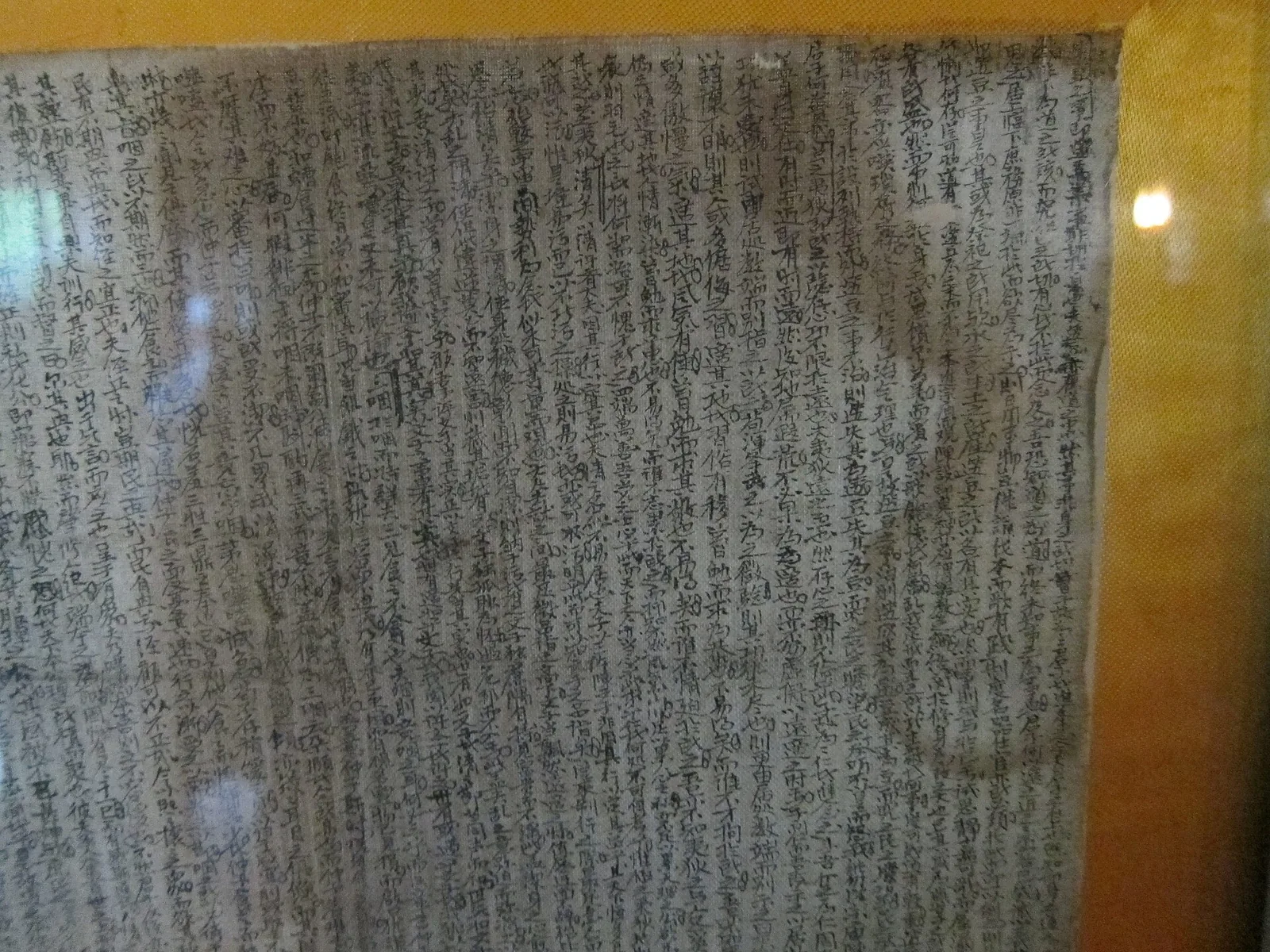
Jack No1, cheating material, Suzhou, 2012. Own work. · CC BY-SA 3.0 · Source page
A cell and a name
A cell, a brush, a verdict
You sit in a narrow wooden cell with a brush and a sheet of paper, and you stay there until the exam ends. Outside, examiners read what you wrote and decide.
Success means office. Failure means trying again. For more than a thousand years, this was the main road into office in China.
Background
The first exams
The Chinese call the system keju. Historians date its first official exams to the early 600s. Tradition credits Emperor Yang of the Sui, and the sources give 605, 606 or 607.
In 607 Emperor Yang created the category of jinshi, or presented scholar. Many historians see that as the real start.
Tang
Hidden names
From 702, in the Tang dynasty, candidates’ names were hidden from the examiners. The method is called sealed names.
The palace exam, 992
A decision point
You are a senior official at the Song court.
992. The palace exam is the top stage of the system.
The papers carry the candidates’ names, and examiners sometimes know the writers. Some officials fear examiners favour men they know. Three proposals are on your desk.
What do you advise?
- Keep the system, and trust the examiners’ judgement. Probably the worry would stay, and every result would be questioned.
- Cover the names on the papers, so no examiner knows who wrote each one. Probably fairer, because no examiner sees a name. Some risks would remain.
- Add more examiners, so no single man decides a candidate’s fate. Probably harder to sway. But examiners who know each other could still favour friends.
What really happened
Cover the names on the papers, so no examiner knows who wrote each one.
In 992 the court began covering candidates’ names on the palace exam. The sources do not record the debate.
Hiding names had been tried since 702, so this was a tested remedy, not a new experiment.
A second step
Hiding names was not enough
Covering the name hid the writer, but not the handwriting. So from 1015 clerks copied the papers out again for the capital and departmental exams, and from 1037 in the prefectures. In 1009 the court also set quotas on degrees.
The revival and the essay
A decision point
You are an adviser at the Yuan court, the Mongol dynasty that rules China.
1315. No exams have been held since 1279.
Many educated Chinese see no clear road into public office. If the exams return, you must also decide what the candidates study.
What do you advise?
- Keep the exams closed, and fill posts another way. Probably educated men would stay without a formal road into office.
- Bring the exams back, and leave open what the candidates study. Probably candidates would not know what to prepare for, and results would look arbitrary.
- Bring the exams back, and set Zhu Xi’s commentaries as the standard. Probably one clear standard, and one set of commentaries to study.
What really happened
Bring the exams back, and set Zhu Xi’s commentaries as the standard.
In 1315 the exams were revived, with Zhu Xi’s scholarship on the classics as the standard.
The sources do not record the court’s reasons. One standard probably made the exams easier to run, but that is a guess.
Ming
The eight-legged essay
By the Ming dynasty, candidates wrote in a fixed form, the eight-legged essay: eight parts, about 550 to 700 characters. The scholar Gu Yanwu criticised it.
Myth
China chose officials purely by merit, the same way, for 1,300 years.
The truth
Not quite. The rules kept changing. The Yuan closed the exams for decades, names were covered in 992, and the essay became a rigid form.
The evidence
Each change here is recorded in the sources. Bribery accusations come later in this lesson.
Who got in?
The paper
What they were asked
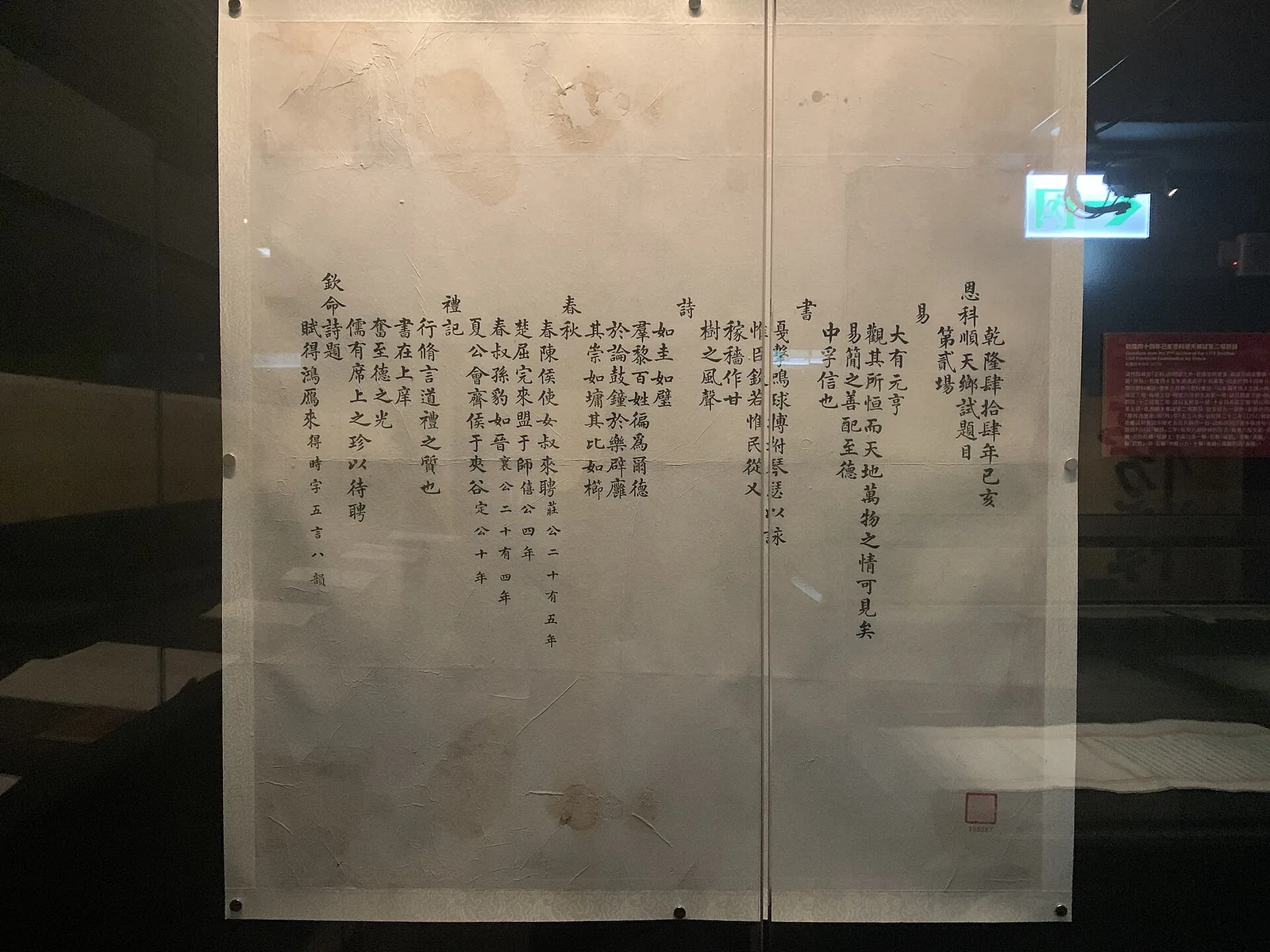
Tbatb, Shuntian exam questions, 1779. Museum of the Institute of History and Philology, Academia Sinica. Photo, 2019. · CC BY-SA 4.0 · Source page
The sheet in the picture is a question paper from 1779, for the provincial exam of the Shuntian region, around Beijing. Its questions quote the Confucian classics.
Passing the provincial exam earned the juren degree.
Numbers
How many passed?
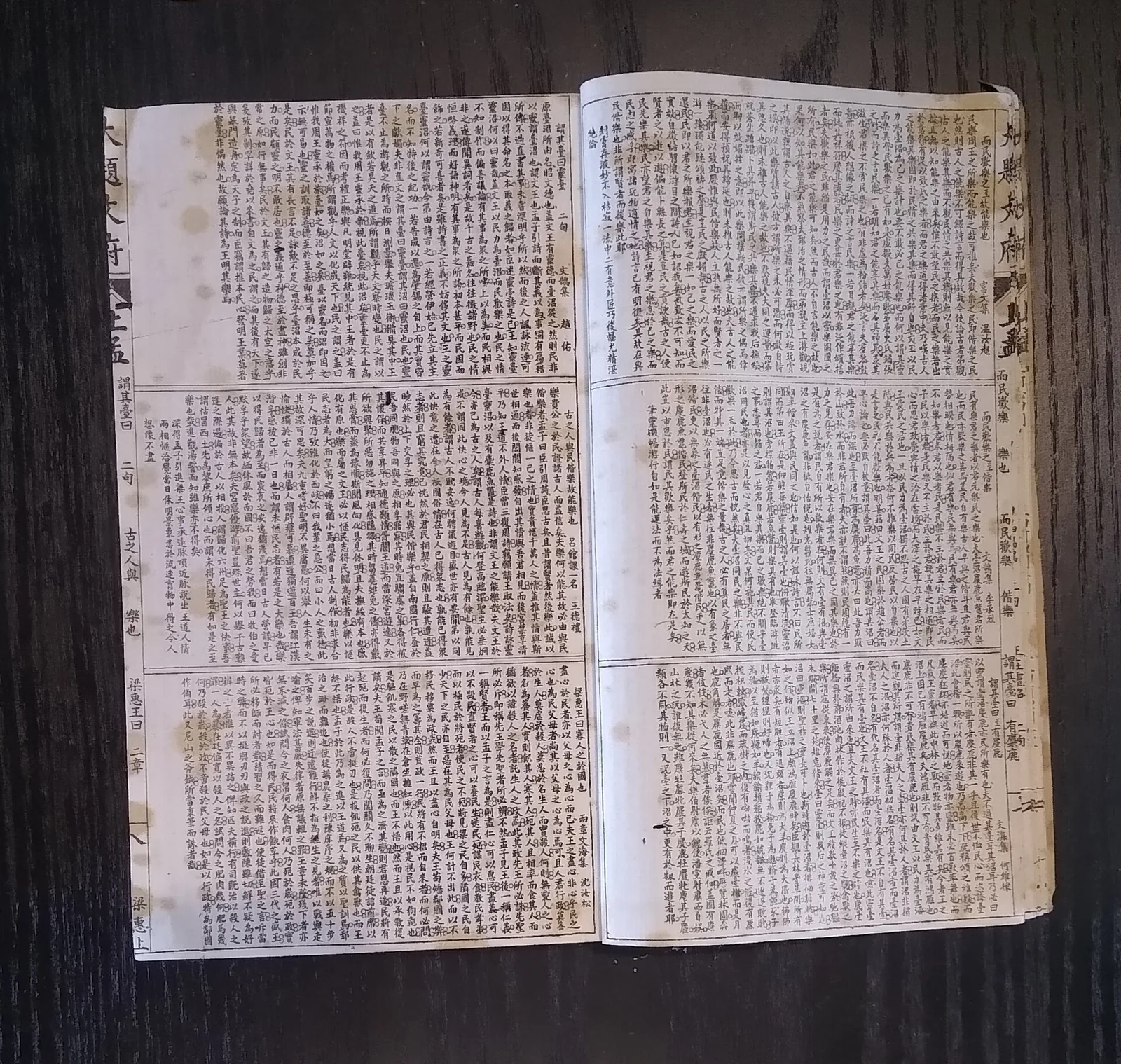
Mx. Granger, exam reference book, 1887. Photo. · CC0 · Source page
The historian Ping-ti Ho counted about 26,700 jinshi degrees between 1644 and 1905, depending on the source. In the late 19th century, two or three million people sat the exams each year. Figures often cited from Benjamin Elman suggest that only about one in a hundred passed.
Source: A cloth full of tiny writing
Object photographed in Suzhou in 2012 (Wikimedia Commons, Jack No1)
A cloth like this is a crib. Commons describes it as cheating material for exams. The photo alone cannot show how it was used.
- What was a cloth like this used for? The label calls it cheating material. The photo shows cloth, not a candidate.
- What would you need before trusting the label? A museum record would give when the object was made, who found it, and how it was labelled. The Commons page alone does not give those details.
Source: A drawing of the exam cells
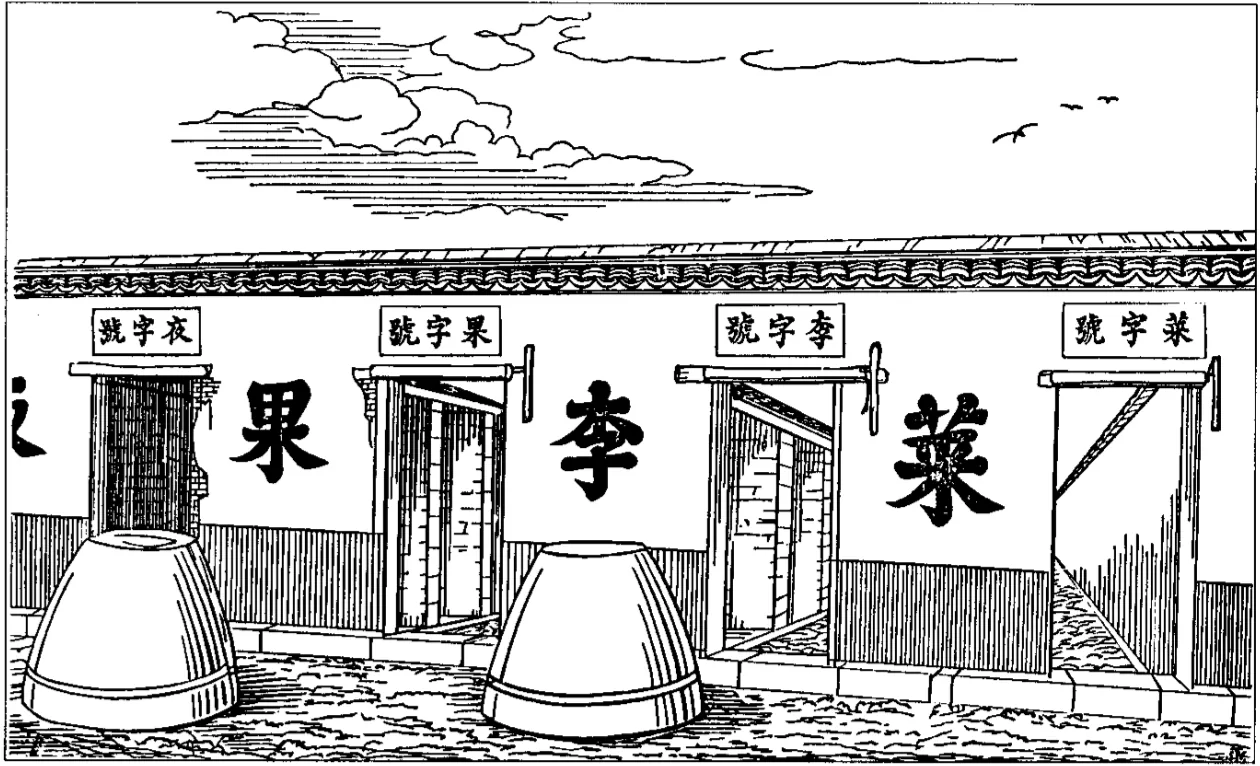
Drawing. Commons links it to a book by Benjamin Elman. · Public domain · Source page
Drawing; Commons links it to a book by Benjamin Elman
This is a drawing, not a photo, and its artist is unknown. Commons dates it to 1894, and we have not confirmed that.
- What does the drawing show that words would not? The layout: narrow cells in a row, each with a sign showing a Chinese character and the word for "number".
- What is missing? People. No candidate appears, so we see the place, not what it was like to sit in it.
Scandals
Yangzhou and Shuntian
In 1711, in Yangzhou, failed candidates protested. They accused officials of bribery after the sons of salt-merchant families passed. The chief examiner was later put to death.
In 1858 a scandal in the Shuntian exam led to the execution in 1859 of Bai Jun, president of the Board of Revenue. A 2016 article by Luca Gabbiani calls him the highest-ranking official executed in a Qing exam scandal.
A novel
Fan Jin and the butcher
In Wu Jingzi’s satirical novel The Scholars (1750), Fan Jin has failed for years. In chapter 3 he hears he has passed the provincial exam. He laughs wildly, and his in-laws fear he has lost his mind.
His father-in-law, the butcher Hu, slaps him back to his senses. Then the neighbours change their attitude and give him houses and property. The novel is satire and fiction. Fan Jin is not a real man.
Did the ladder really work?
Did the exams really let ordinary families climb?
- Ping-ti Ho, 1962 Yes. Ho argues that social mobility was real, and uses statistics on degree-holders, especially for the Ming.
- Benjamin Elman, 2000 As one review summarises him, mobility happened, but mostly within the educated elite. Elman stresses that the exams were also a cultural institution that shaped elite life.
Both sides work from similar kinds of records. What would convince you: one family that rose from nothing, or a whole class of families?
1905 and the quiz
A decision point
You are a senior Qing governor, one of the officials who can write to the throne.
1905. The exams have run for more than a thousand years.
The exams are still the official road to office. New schools need time, teachers and money. Some colleagues want slow reform; others want an end.
What do you ask the throne to do?
- Ask that the exams end now, and new schools be built. Probably the official road to office would close at once, and new schools would have to be built fast.
- Keep the exams for a few years, and add modern subjects. Probably the exams would stay with new subjects, and the argument over the balance would go on.
- Keep the exams as they are, to avoid unrest. Probably the criticism would continue, and the new schools would be delayed.
What really happened
Ask that the exams end now, and new schools be built.
On 2 September 1905 the throne ordered the exams ended. The decree approved a joint memorial from senior officials, among them Yuan Shikai and Zhang Zhidong, and called for new-style schools. The sources differ on whether the end took effect in 1905 or from the 1906 examinations.
Yuan Shikai and Zhang Zhidong asked for the change. The sources record the request, not all their reasons. We do not quote the decree, because we have only a summary of it.
From the first exam to the last
- 605–607 Emperor Yang of the Sui: the first official exams.
- 702 Candidates’ names are hidden from examiners under the Tang.
- 992 Names are covered on the palace exam under the Song.
- 1315 The exams return under the Yuan, with Zhu Xi’s commentaries as the standard.
- 1711 In Yangzhou failed candidates protest, accusing officials of bribery.
- 1859 Bai Jun is executed after the Shuntian exam scandal.
- 1905 On 2 September the throne orders the exams ended.
Check yourself
Why did the palace exam cover candidates’ names in 992?
Answer: So examiners could not tell the writer.. Right. Covering the name was meant to stop examiners knowing the writer.
Check yourself
Which standard was set for the exams when they were revived in 1315?
Answer: Zhu Xi’s commentaries on the classics.. Right. The exams were revived with Zhu Xi’s scholarship as the standard.
Check yourself
Which statement best corrects the myth of 1,300 years of pure merit?
Answer: The rules changed: the Yuan closed the exams, names were hidden in 992, and the essay hardened.. Right. Each of those changes appears in the lesson.
Check yourself
What is the main disagreement between Ho and Elman?
Answer: Whether ordinary families could rise, or mobility stayed mainly within the elite.. Right. Ho argues mobility was real, and Elman argues it mostly stayed within the educated elite.
Check yourself
What date does the abolition decree carry, and what do the sources disagree about?
Answer: 2 September 1905. Sources differ on the year the end took effect.. Right. That is the decree date, and the dispute is over when it took effect.
Check yourself
What can the photo of the cloth prove on its own?
Answer: That it is a cloth with tiny writing, behind glass.. Right. That is what the photo shows; anything more needs other sources.
Terms
- keju The exam system that chose officials in imperial China. Candidates wrote on the Confucian classics and climbed a ladder of degrees.
- jinshi Presented scholar. The highest degree of the system under the Qing. The category is linked to Emperor Yang of the Sui.
- juren The degree won at the provincial exam. The jinshi, the highest degree, sits higher on the ladder.
- sealed names Candidates’ names are covered on their papers, so examiners cannot see who wrote them. Used from 702 in the Tang, and from 992 on the Song palace exam.
- eight-legged essay A fixed essay form of the Ming: eight parts, about 550 to 700 characters.
- crib Notes hidden on clothing or the body to cheat in an exam.
- memorial A formal written request or report sent to the emperor by one or more officials.
- Sui dynasty A short-lived dynasty that reunited China after a long period of division.
- Tang dynasty A dynasty that ruled China after the Sui.
- Ming dynasty The dynasty that ruled China before the Qing.
- Qing dynasty The last imperial dynasty of China, before the republic.
- Ping-ti Ho A historian who studied the imperial exams and counted the jinshi degrees.
- Wu Jingzi A Chinese writer who wrote the satirical novel The Scholars.
- The Scholars A Chinese satirical novel about candidates who failed the exams, published in 1750.
- Fan Jin A fictional character in The Scholars, a candidate who failed the exams for years.
- Salt merchants Merchants who traded in salt, a large and influential source of income in China.
- Bai Jun A senior Chinese official who was executed after a scandal in an exam.
- Luca Gabbiani A scholar who wrote an article about an exam scandal in the Qing period.
- Board of Revenue A Chinese government office in charge of state money and taxes.
- Shuntian A region around Beijing. Its provincial exam was named after it.
- Beijing The capital city of China, in the north of the country.
- Yangzhou A city in China. In 1711 failed candidates protested there.
- Gu Yanwu A Chinese scholar who criticised the eight-legged essay.
- Zhu Xi A Chinese scholar whose commentaries on the classics became the standard for the exams.
- Zhang Zhidong A senior official who signed the memorial that led to the end of the exams.
- Yuan Shikai A senior Chinese official who, with others, called for new-style schools.
- Provincial exam An exam held at the level of the province. Whoever passed it earned an official degree.
- Wikimedia Commons A free online archive of files, where pictures and drawings are described.
- Benjamin Elman A scholar whose figures on the exams are often cited.
- Confucian classics The ancient books taught by Confucius, which the candidates were examined on.
Sources
- Wu Jingzi, The Scholars (Rulin waishi), 1750, chapter 3 (Fan Jin)
- Ping-ti Ho, The Ladder of Success in Imperial China: Aspects of Social Mobility, 1368–1911 (Columbia University Press, 1962)
- Benjamin Elman, A Cultural History of Civil Examinations in Late Imperial China (University of California Press, 2000)
- Luca Gabbiani, article on the 1858 Shuntian exam scandal, Études chinoises (2016)
- Princeton University Library, East Asian Library, Gest collection, cribbing garment (GM160)
- Wikipedia, "Imperial examination" (used to check dates; its own sources were not all read)
Image credits
- Jack No1, cheating material, Suzhou, 2012. Own work. · CC BY-SA 3.0 · Source page
- Tbatb, Shuntian exam questions, 1779. Museum of the Institute of History and Philology, Academia Sinica. Photo, 2019. · CC BY-SA 4.0 · Source page
- Mx. Granger, exam reference book, 1887. Photo. · CC0 · Source page
- Drawing. Commons links it to a book by Benjamin Elman. · Public domain · Source page


