The Holocaust
Before there are numbers there are people: families, neighbours, teachers and pupils who lived in the towns and cities of Europe. This lesson starts with them.
Decisions, questions and your own progress, in the app
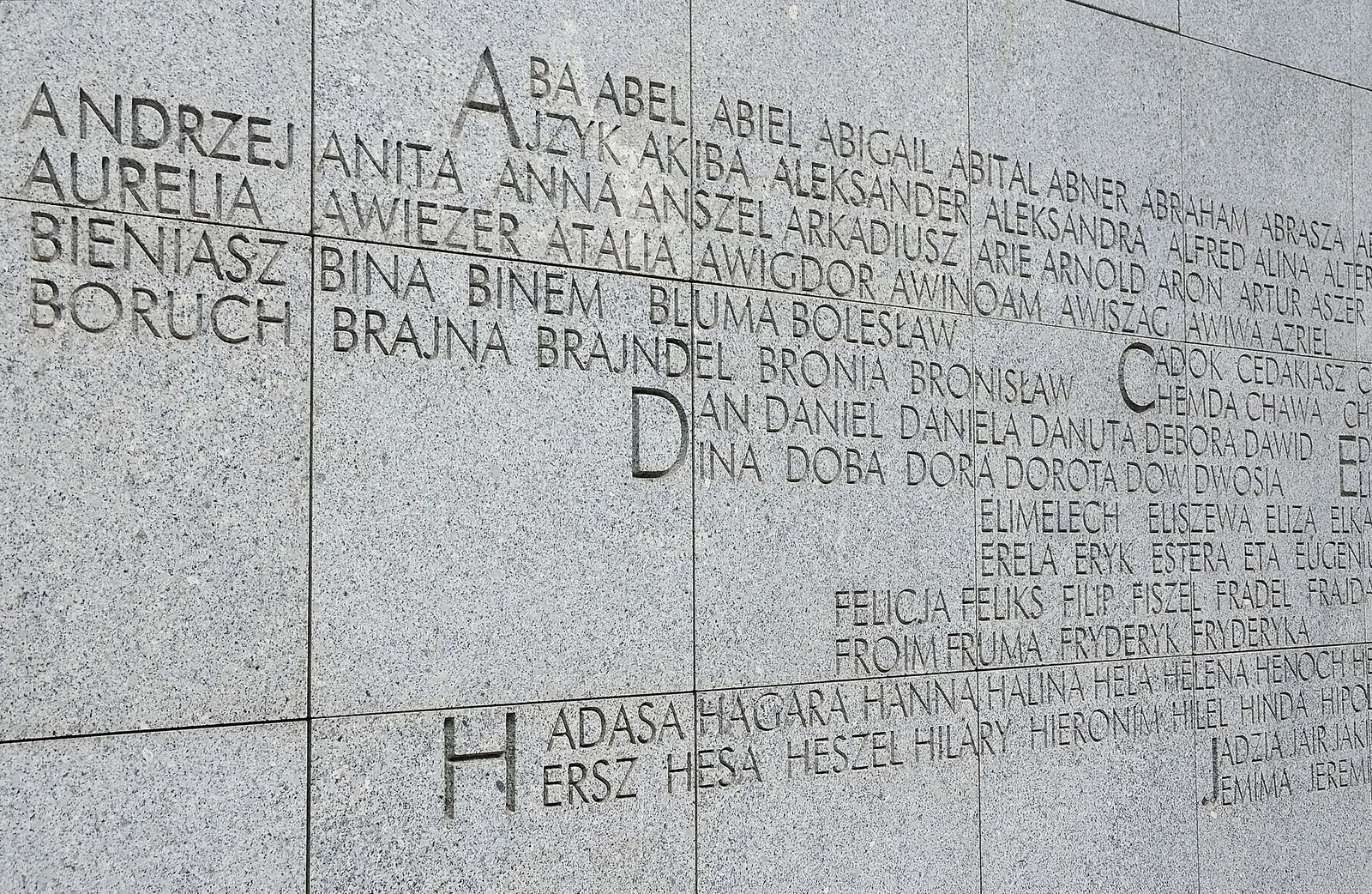
Adrian Grycuk, Umschlagplatz Monument, Warsaw, 2012 · CC BY-SA 3.0 · Source page
The world that was
Four hundred names
A note before you start: this lesson speaks plainly about persecution and mass murder, including of children, and is written for readers of about fourteen and over. There are no points, no choices to make and no pictures of the victims; this is not a game. You can stop at any time.
In Warsaw, on Stawki Street, a grey wall carries four hundred first names cut in alphabetical order, from Aba to Żanna: Abraham and Bluma, Andrzej and Bolesław. Some are Jewish names, some Polish. They were the names of neighbours in one city.
The monument stands at the Umschlagplatz, German for ‘transfer point’, from which in 1942 the Germans sent Jews from the Warsaw ghetto to Treblinka and other camps.
Before there are numbers, there are people. This lesson is about the Holocaust: the persecution and murder of Europe’s Jews by Nazi Germany and its allies and collaborators between 1933 and 1945. It begins with the lives that came before.
Before the war
Who lived there
9,500,000
In 1933 about 9.5 million Jews lived in Europe: 1.7 per cent of Europeans and more than 60 per cent of the world’s Jews (the American Jewish Year Book’s figure, as reported by the United States Holocaust Memorial Museum, USHMM). About 3 million lived in Poland, roughly one in ten of its people; about 2.5 million in the European part of the Soviet Union; about 525,000 in Germany, three quarters of one per cent of the population.
In the east, many lived in mostly Jewish towns, spoke Yiddish, read Yiddish books and went to Yiddish theatre and films. In the west, Jews tended to adopt the culture of their neighbours. Everywhere they were farmers, tailors, factory hands, accountants, doctors, teachers and shopkeepers; some were rich, many poor. In many countries the law made them equal, and still they met antisemitism and discrimination.
About six million of the 9.5 million would be murdered: roughly two out of three.
People
Three of them
Three people whose words and deeds survive; we meet them again.
Mordechai Gebirtig, born in Kraków in 1877, was a Yiddish poet and songwriter who wrote and sang his poems for his three daughters. Among them is a lullaby, ‘Your Kitten Is Hungry’.
Janusz Korczak, the pen name of the doctor and writer Henryk Goldszmit, ran a Jewish orphanage in Warsaw from 1911 as a ‘children’s republic’, with a court and a newspaper written by the children. On the radio he was ‘the Old Doctor’.
Emanuel Ringelblum, born in Buczacz in 1900, was a historian with a Warsaw doctorate (1927) and 126 scholarly articles by 1939. He was a member of Left Poale Zion, a socialist Zionist party (English Wikipedia).
Check yourself
What does the start of the lesson show about Jewish life in Europe in 1933?
Answer: They lived in very different ways, in the east and in the west, in every trade and every social class; in many countries the law made them equal, and still they met antisemitism and discrimination.. This is how the lesson puts it: communities very different from one another, and equality in law that did not protect them from discrimination and hatred.
From law to pogrom, 1933–1939
1933–1935
Law by law
On 30 January 1933 Adolf Hitler became Chancellor of Germany. His party held to racial antisemitism: hatred of Jews presented as science.
On 1 April 1933 came the first nationwide, planned action against them: SA men stood in front of Jewish-owned shops and the offices of Jewish doctors and lawyers, and the Star of David was painted on thousands of doors. The boycott lasted a day, and many Germans went on shopping in Jewish shops, but it was the start of a campaign. On 7 April a civil-service law began the removal of Jews from public posts.
Source: The Nuremberg Laws, 15 September 1935
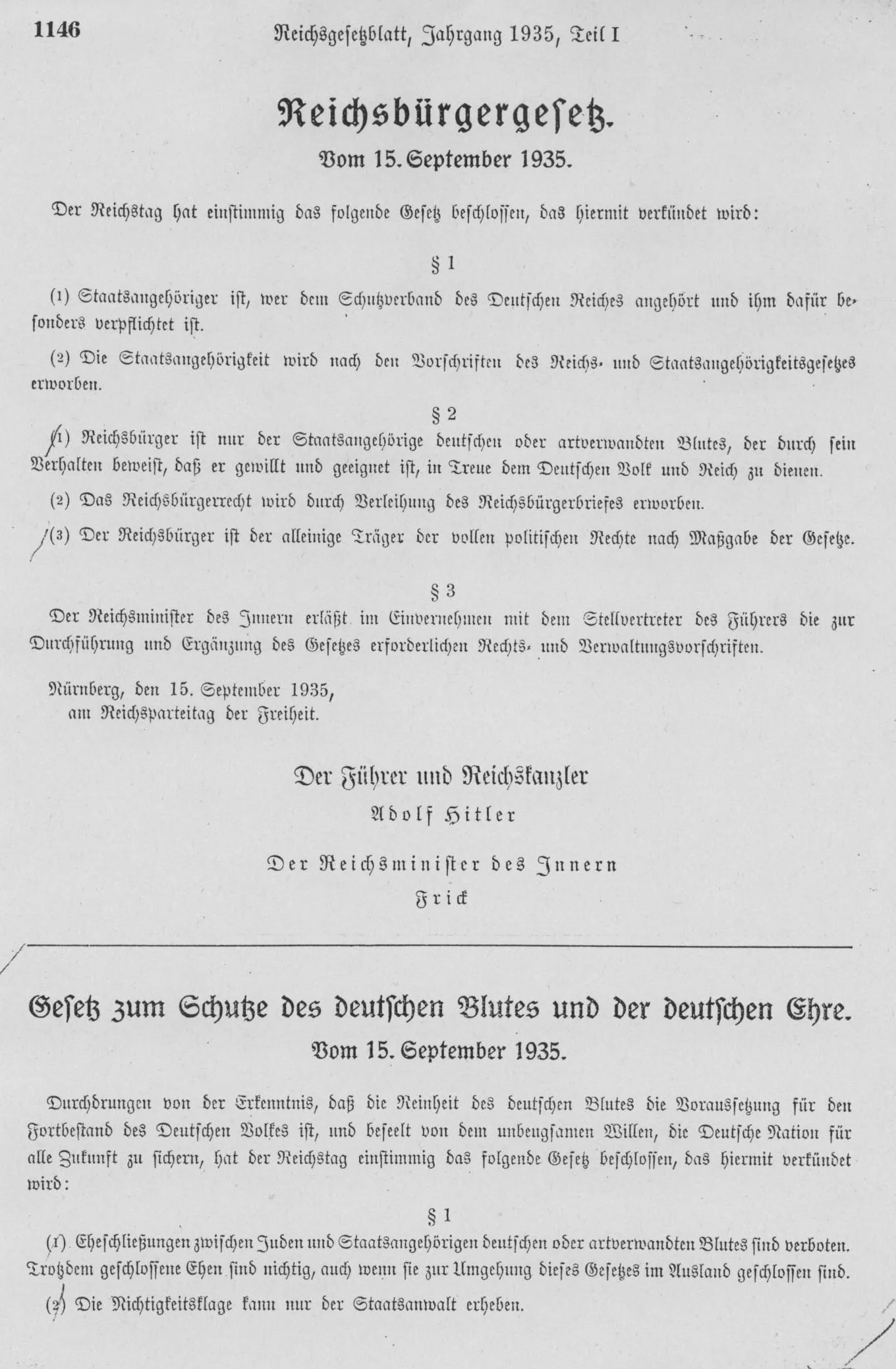
Reichsgesetzblatt 1935, Part I, p. 1146 (official gazette of the German Reich) · Public domain · Source page
Reich Citizenship Law, art. 2: “A citizen of the Reich is only that subject, who is of German- or kindred blood and who, through his conduct, shows that he is both desirous and fit to serve faithfully the German people and Reich.”
First Regulation, 14 November 1935, art. 4: “A Jew cannot be a citizen of the Reich. He has no right to vote in political affairs, he cannot occupy a public office.”
Same regulation, art. 2: “One grandparent shall be considered as full-blooded if he or she belonged to the Jewish religious community.”
The Reichstag passed the Nuremberg Laws unanimously at the Nazi Party rally, and the Reich Law Gazette printed them openly, as ordinary law, on the page shown here. The Blood Law banned marriage between Jews and non-Jews; the regulation of 14 November defined who counts as a Jew. These are Nazi laws, shown so that you can read what they say and what they leave out.
- By what test was a person defined as a Jew? By the religion of the grandparents: a person with three or four who had belonged to the Jewish community was a Jew (the regulation added further cases). The law speaks of ‘blood’, but the test is a religious record, not biology.
- Why were the laws published openly, and what is missing from them? A public law makes exclusion look orderly and legitimate, and obliges every office and school to apply it. It has no word about deportation or killing; the persecution of 1938–1941 went far beyond it.
Check yourself
Under the regulation of November 1935, how was a person defined as a Jew?
Answer: By the number of grandparents who belonged to the Jewish religious community.. The regulation treated a grandparent as ‘full-blooded’ if he or she had belonged to the Jewish community, and a person with three or four such grandparents was a Jew. The law spoke of ‘blood’, but the test was a religious record.
9–10 November 1938
A night in November
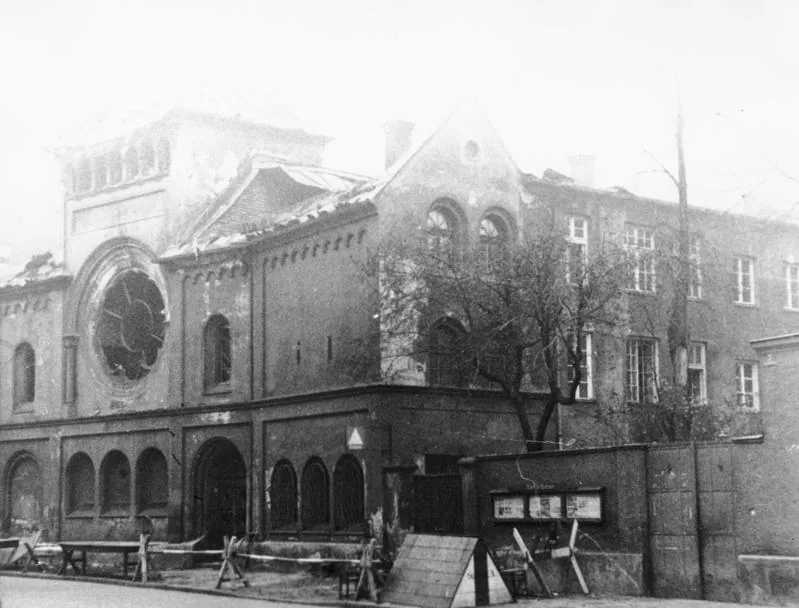
Bundesarchiv, Bild 146-1971-099-63, photographer unknown · CC BY-SA 3.0 · Source page
In October 1938 Germany expelled more than 17,000 Jews who held Polish citizenship: the first mass deportation of Jews from Nazi Germany. The Grynszpan family was sent to the border town of Zbąszyń. Their son Herschel, seventeen, was living in Paris; on 7 November he shot a German diplomat, Ernst vom Rath, who died two days later. The USHMM considers it likely that he acted out of anger at his family’s fate.
Using it as an excuse, and with Hitler’s support, Goebbels and others coordinated a pogrom on the night of 9–10 November, meant to look like the people’s spontaneous anger. At 1:20 a.m. Heydrich ordered the police not to interfere. More than 1,400 synagogues were burned, with firefighters protecting only the buildings next to them; thousands of Jewish-owned businesses were wrecked; about 26,000 Jewish men were sent to concentration camps. Jews were murdered, and hundreds died by suicide during and after the pogrom. The Jewish community was then fined one billion Reichsmarks (USHMM).
The night is known as Kristallnacht. At Zbąszyń about 6,000 Jews expelled from Germany were stranded at the border; Ringelblum was sent there for five weeks to run the aid.
1938–1939
Doors that closed
After the November pogrom, thousands of Jews tried to leave Germany and Austria, and few countries would take them. In July 1938 delegates from 32 countries met at Évian, on Lake Geneva, to discuss the refugees; only the Dominican Republic agreed to accept more. More than 60 per cent of German and Austrian Jews did flee between 1938 and 1940 (USHMM).
Palestine was one destination. In May 1939 Britain, which governed it for the League of Nations, issued a White Paper: 75,000 Jews could enter over five years, and after that none without Arab consent. The lesson on 1947–1948 tells what followed.
Check yourself
A student wrote: ‘Kristallnacht was a spontaneous outburst of anger by the German public.’ What does the lesson say about this?
Answer: The pogrom was coordinated in advance and only meant to look spontaneous: Goebbels and others organised it with Hitler’s support, and Heydrich ordered the police not to interfere.. This is how the lesson describes the night. The pogrom was ‘meant to look like the people’s spontaneous anger’, but it was organised.
War and the ghettos
1939–1941
Sealed districts
On 1 September 1939 Germany invaded Poland, home to about 3 million Jews, and began to confine Jews in guarded districts: ghettos. The Warsaw ghetto was sealed in November 1940 behind a wall almost three metres high. More than 400,000 people were inside: almost 30 per cent of the city’s population on 2.4 per cent of its area. The Germans set the official food ration at 181 calories a day, and smuggling added to it. By August 1941 more than 5,000 people a month were dying of hunger and disease (USHMM).
Inside the walls
Keeping life going
Inside the walls, people tried to keep life going. Korczak sought donations and carried food back to the children’s home, and his staff kept up lessons, lectures, concerts and plays. Ringelblum ran welfare programmes and soup kitchens and set up house committees.
The Judenrat
A Jewish council
In every ghetto the Germans set up a Jewish council, a Judenrat, to carry out their orders. The USHMM calls their dilemmas ‘impossible’ and the subject ‘controversial and delicate’; historians still disagree about how to judge.
Warsaw’s council was led by Adam Czerniaków, an engineer. On 20 July 1942, he wrote, a German official said he could tell people their fears of deportation were groundless: all the talk was ‘Quatsch und Unsinn’, ‘utter nonsense’. On 22 July he wrote: ‘We were told that all the Jews irrespective of sex and age, with certain exceptions, will be deported to the East. By 4 P.M. today a contingent of 6,000 people must be provided. And this (at the minimum) will be the daily quota.’ (The 1979 English edition of the diary.)
He raised the fate of the children in the orphanages, ‘the most tragic dilemma’ in his words, and the German in charge told him that his wife would be the first shot as a hostage if the deportation were obstructed. In his last entry, on 23 July, he wrote: ‘A sewing machine can save a life. It is 3 o’clock. So far 4,000 are ready to go. The orders are that there must be 9,000 by 4 o’clock.’ That day he took his own life. He left a note; sources word it differently, so we do not quote it.
Other council leaders acted differently. Joseph Parnes in Lvov refused to hand over Jews for a labour camp, and the Nazis killed him. Mordechai Chaim Rumkowski in Łódź believed in ‘rescue through labor’. Having failed to persuade the Germans to deport fewer people, and ordered by them to supply deportees, he urged residents on 4 September 1942 to give up their young children; about 15,000 people, the sick, the elderly and children under ten, were sent to Chełmno that month (USHMM).
Check yourself
What was the Judenrat, and who set it up?
Answer: A Jewish council the Germans set up in each ghetto to carry out their orders, which also provided basic community services such as soup kitchens, schools and hospitals.. This is how the lesson defines it. Its members faced ‘impossible’ dilemmas, and historians still disagree about how to judge them.
The mass murder
1941
Shootings in the East
On 22 June 1941 Germany invaded the Soviet Union. Behind the army came the Einsatzgruppen, SS and police units of about 3,000 men, helped by other German units, Romanian forces and local collaborators. In the first nine months more than half a million people were shot, the great majority of them Jews. In many villages, local helpers and their Jewish victims had known each other as neighbours. At Babi Yar, near Kyiv, 33,771 Jews were shot on 29–30 September 1941, according to the killers’ own report to Berlin. In all, about two million Jews were shot (USHMM).
Source: The Wannsee protocol, 20 January 1942
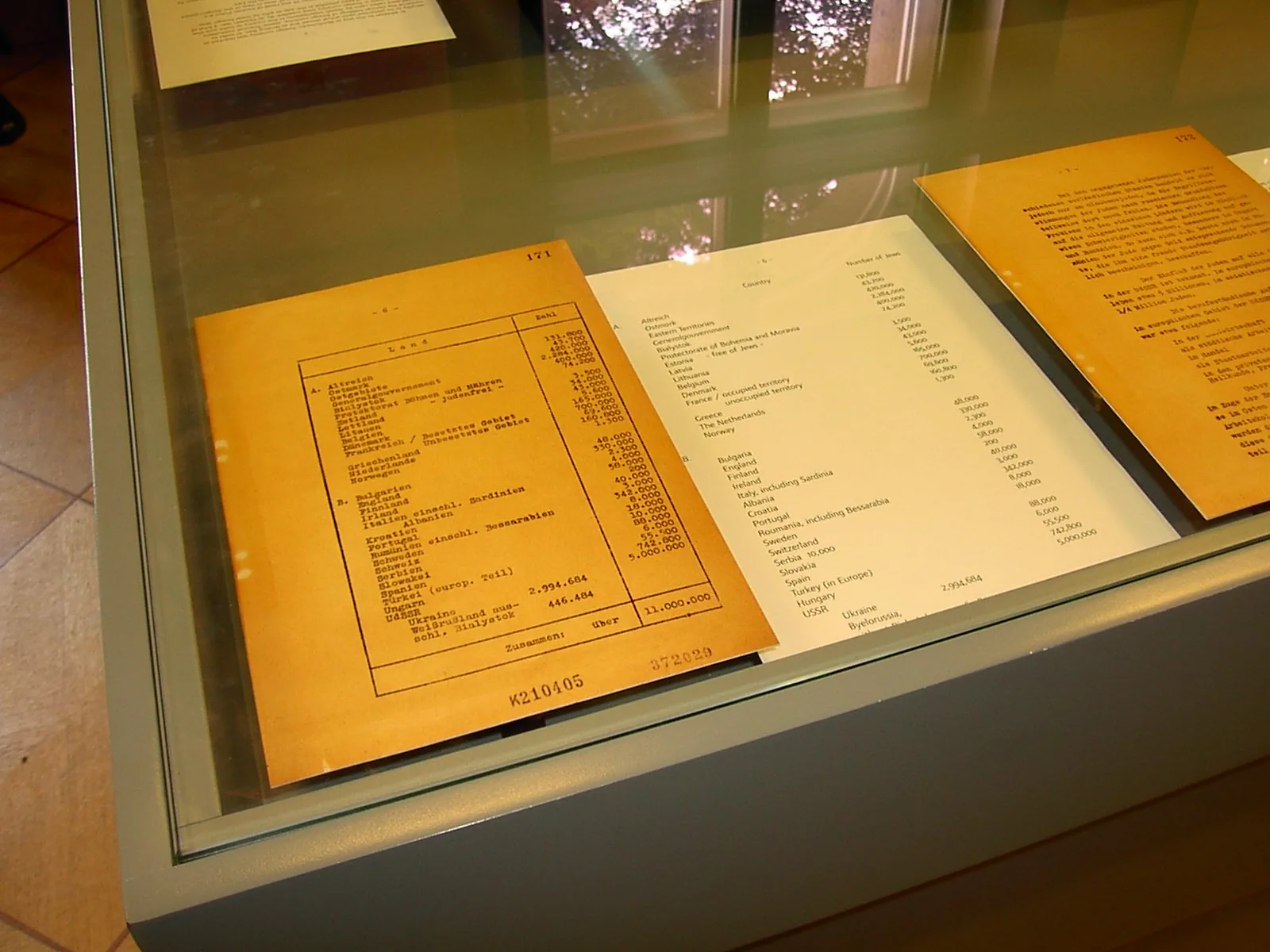
Adam Carr, pages of the Wannsee protocol in a display case, 2006 · Public domain · Source page
“Under proper guidance the Jews are now to be allocated for labor to the East in the course of the final solution. Able-bodied Jews will be taken in large labor columns to these districts for work on roads, separated according to sexes, in the course of which action a great part will undoubtedly be eliminated by natural causes. The possible final remnant will, as it must undoubtedly consist of the toughest, have to be treated accordingly, as it is the product of natural selection, and would, if liberated, act as a bud cell of a Jewish reconstruction (see historical experience).”
In a villa on Lake Wannsee, in Berlin, fifteen men met: Reinhard Heydrich, who chaired, and fourteen officials from the ministries, the Party and the SS. Adolf Eichmann prepared the minutes. Thirty copies were stamped as state secrets; only one survives, no. 16, found in March 1947 in the German Foreign Office files. It is a summary, not a word-for-word record. The Wannsee Conference dealt with what the Nazis called the ‘Final Solution’. This is a perpetrators’ document, shown so that you can read how its language hides the planned murder of Europe’s Jews.
- Find the words the writers use instead of ‘kill’. ‘Allocated for labor to the East’ (Arbeitseinsatz), ‘eliminated by natural causes’ (natürliche Verminderung), ‘treated accordingly’ (entsprechend behandelt); elsewhere the protocol says ‘evacuation of the Jews to the East’ (Evakuierung). The language hides the act and makes it administrative, and the stamp ‘state secret’ shows the writers knew it could not be said openly.
- What does the table in the photograph show about the plan’s reach? Every Jewish community in Europe is counted, ‘over 11,000,000’ in all, even in countries Germany did not rule, such as England (330,000) and Switzerland. The target was all of Europe’s Jews.
Myth
‘The Holocaust was decided at the Wannsee Conference.’
The truth
The killing had already begun. Mass shootings in the Soviet Union began in June 1941, nearly seven months earlier, and when Heydrich and his guests met, Chełmno had been killing since 8 December 1941 and Belzec was being built. Historians tend to think the decisions lay with Hitler and Himmler. At Wannsee the ministries were coordinated and the plan’s scope fixed, which is why the protocol matters.
The evidence
Jewish Virtual Library, ‘The Wannsee Conference’. See also the chapter ‘Memory’.
Check yourself
What does the Wannsee protocol show?
Answer: That fifteen officials discussed, in euphemisms, a plan that concerned some 11 million European Jews, when the killing had already begun.. The table lists every community in Europe, and the language is euphemism: ‘evacuation’, ‘labour deployment’, ‘natural decrease’. Mass killing had begun in June 1941.
1941–1944
The killing centres
Five killing centres were built to murder Jews with poison gas: Chełmno, Belzec, Sobibor, Treblinka and Auschwitz-Birkenau, all in German-occupied Poland. The first mass gassing was at Chełmno on 8 December 1941. By the end of 1942 more than 1.5 million Jews had been murdered in them. Almost everyone brought to Chełmno, Belzec, Sobibor and Treblinka was murdered on arrival; at Auschwitz-Birkenau the SS selected a smaller group from the incoming trains for forced labour and murdered the rest at once.
Trains came from across Europe. From Warsaw to Treblinka, between 22 July and 21 September 1942, about 265,000 people were sent (the USHMM’s figure; other sources count up to 300,000). Among those sent from Warsaw were the children of Korczak’s orphanage. In early August 1942 nearly two hundred children walked to the Umschlagplatz with their carers. Korczak, who had turned down the offers of Polish friends to hide him, and his staff boarded the train with them. It went to Treblinka, and there they were murdered.
The numbers
How the number is built
about 6 million
‘About six million’ is an estimate, not a count: no single Nazi document accounts for every death. The USHMM builds it from hundreds of thousands of pages of German records and from population data from before and after the war: about 2.7 million murdered at the five killing centres; about 2 million shot; 800,000 to 1,000,000 murdered in ghettos and camps through starvation, disease and brutality; and at least 250,000 in other violence. Our own sum of those rounded figures gives roughly 5.75 to 5.95 million. Historians who did their own sums land between about 5.1 and 6.2 million.
Myth
‘“Six million” is a symbolic number, or an invented one.’
The truth
It is a calculated estimate from the Germans’ own records and from population data. Researchers differ by hundreds of thousands, not about the scale: every independent count lands between about 5 and 6.2 million. And behind the number there are names: Yad Vashem has gathered close to 4.8 million of them.
The evidence
USHMM, ‘How Many People Did the Nazis Murder?’; Yad Vashem’s page on identifying victims.
Check yourself
What is the right way to describe ‘about six million’?
Answer: A documented estimate, resting on German records and population data, which independent historians put between about 5.1 and 6.2 million.. It is an estimate, with a method and sources, and independent estimates stand beside it.
Standing up
Amidah
What resistance meant
Resistance meant many things. The Israeli bagrut syllabus calls it amidah, ‘standing firm’: staying alive, keeping life sacred, helping one another, running schools and youth movements, and also fighting with weapons. Korczak’s lessons, Ringelblum’s soup kitchens and the secret archive you are about to meet were all amidah. Fighting with weapons was the hardest, because weapons were so few.
Source: A milk can from a secret archive
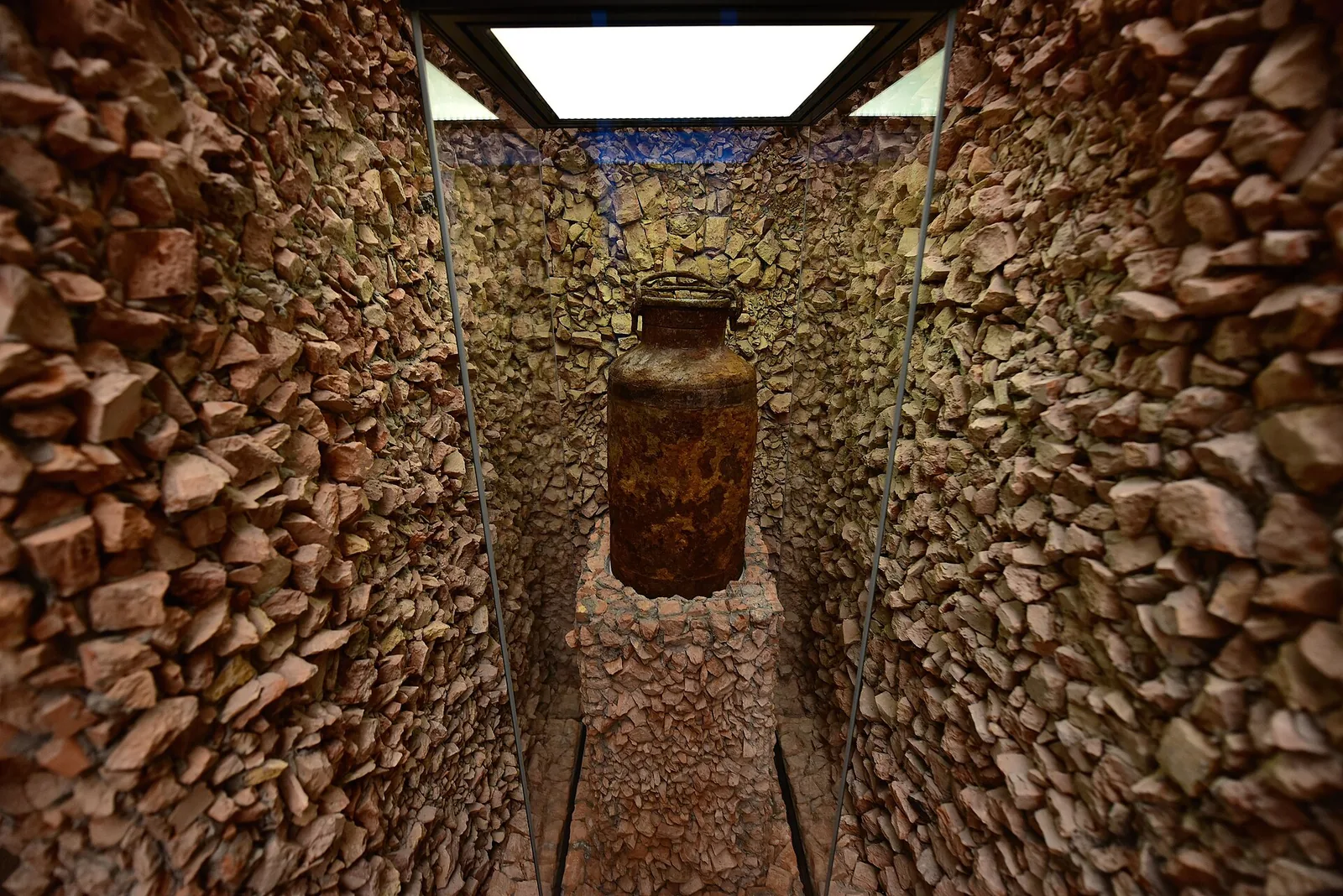
Adrian Grycuk, milk can of the Oneg Shabbat archive, Jewish Historical Institute, Warsaw, 2017 · CC BY-SA 3.0 · Source page
“It must all be recorded with not a single fact omitted. And when the time comes – as it surely will – let the world read and know what the murderers have done.”
In November 1940 Emanuel Ringelblum founded a secret group in the Warsaw ghetto, Oneg Shabbat, ‘Joy of the Sabbath’, after its Saturday meetings. It collected diaries, testimonies, posters, food stamps, the underground press, photographs and drawings; educators wrote essays and children gave testimonies. In 1942 its reports on the killings reached the West. The first part was buried in the summer of 1942, more in milk cans in early 1943; the sources differ on the dates and on whether there were two cans or three. The first part was found in 1946, the second in 1950, the third never. The collection numbers some 35,000 documents. Ringelblum was discovered in hiding and murdered with his family in March 1944.
- Why bury papers in milk cans, and for whom? Metal containers can lie in the ground for years, and most of the documents survived. They were buried for future readers.
- Why collect children’s testimonies and food stamps too? The group wanted a complete and objective picture of reality, so it gathered many voices. The archive records life, not only death.
19 April – 16 May 1943
The Warsaw ghetto uprising
On 19 April 1943, the eve of Passover, the Germans entered the Warsaw ghetto, where tens of thousands remained, to clear it. About 700 Jewish fighters answered, in two groups: the Jewish Combat Organization (ŻOB), commanded by Mordechai Anielewicz, 24, of the socialist Zionist youth movement Hashomer Hatzair, and the smaller Jewish Military Union (ŻZW). Against them stood about 2,000 SS and police soldiers under Jürgen Stroop, with artillery and tanks. On the first day the Germans were forced back outside the wall. Civilians resisted too, hiding in bunkers. The fighting, the Warsaw ghetto uprising, lasted twenty-seven days.
On 8 May the Germans seized the headquarters at 18 Mila Street. Anielewicz and many of his staff died there; the USHMM says they are thought to have taken their own lives rather than be captured, and accounts differ. At least 7,000 Jews were killed in the fighting or in hiding; about 7,000 more were captured and sent to Treblinka, where they were murdered; about 42,000 others were sent to labour camps and to Majdanek, and most of them were murdered in November 1943 (USHMM).
Check yourself
Why did the members of Oneg Shabbat create the secret archive and bury it in milk cans?
Answer: To record the whole reality of the ghetto, in many voices, and to keep the record for future readers.. The group collected diaries, testimonies of adults and children, posters and food stamps, and wanted a complete and objective picture. Metal containers can lie in the ground for years, and most of the documents did survive.
Source: A letter from the ghetto, 23 April 1943
“It is impossible to describe the conditions under which the Jews of the ghetto are now living. Only a few will be able to hold out. The remainder will die sooner or later. Their fate is decided.”
“The fact that we are remembered beyond the ghetto walls encourages us in our struggle. Peace go with you, my friend! Perhaps we may still meet again! The dream of my life has risen to become fact. Self-defense in the ghetto will have been a reality. Jewish armed resistance and revenge are facts.”
The letter was written on the fifth day of the uprising, and Yad Vashem calls it Anielewicz’s last letter. In it he reports that the Germans ran twice from the ghetto and the fighters’ losses were small. He died fifteen days later.
- What does Anielewicz count as success, and what does he admit about the future? Self-defence has become a fact: ‘the dream of my life has risen to become fact’. But only a few will hold out, and the fate of the rest is decided. He fights knowing how it will end.
- The letter reached us in translation, and versions differ. How do you read a source like that? Versions differ in their closing lines; an archive summary of Zuckerman’s 1961 Eichmann-trial testimony gives one that speaks of being privileged to see Jewish self-defence in all its greatness. The meaning holds and the words move. A careful reader names the edition and compares.
And elsewhere
Revolt, forests and rescue
On 14 October 1943 prisoners rose up at the Sobibor killing centre: about 300 broke out, most were hunted down and killed, and about 50 survived the war. In the forests of eastern Europe as many as 20,000 Jews fought the Germans as partisans, the USHMM writes, finding little support among the surrounding population.
Others were saved by people who put themselves at risk. Yad Vashem gives the title Righteous Among the Nations to non-Jews who risked their lives to rescue Jews. Rescuers were a small minority. One of them was Irena Sendler, a Polish social worker in Warsaw’s welfare department. With a permit to inspect sanitary conditions she entered the ghetto and helped Jews get out and find hiding places. From September 1943 she directed the children’s department of Żegota, the Council for Aid to Jews, sending children to orphanages and convents. She was arrested on 20 October 1943, sentenced to death and released in February 1944, when underground activists bribed officials. Yad Vashem recognised her in 1965.
Myth
‘Europe’s Jews went like sheep to the slaughter and did nothing.’
The truth
The evidence shows people acting under conditions that made success almost impossible: they kept up schools, welfare and culture, documented what was happening, escaped to the forests and fought with weapons in Warsaw and Sobibor. Weapons were few, the ghettos were sealed, and Anielewicz himself wrote that he foresaw the end.
The evidence
USHMM: ‘Warsaw Ghetto Uprising’, ‘Jewish Partisans’, ‘Sobibor’; Yad Vashem: ‘Let the World Read and Know’.
Check yourself
In this lesson, what does ‘amidah’ (‘standing firm’) include?
Answer: Many things: keeping schools and soup kitchens going, helping one another, documenting events in a secret archive, and also fighting with weapons.. The Israeli syllabus’s term covers all of these. Korczak’s lessons, Ringelblum’s soup kitchens and the Oneg Shabbat archive were amidah as much as the uprising was.
Liberation and afterwards
1945
Liberation
As the Soviet army advanced, the Germans forced camp prisoners to march away from the front: the death marches. Guards shot prisoners who could not keep up, and many died of cold, hunger and exhaustion. On 27 January 1945 Soviet troops reached Auschwitz, and Germany’s surrender took effect on 8 May.
1945–1952
After liberation
From 1945 to 1952 more than 250,000 Jewish displaced persons lived in camps in Germany, Austria and Italy, run by the Allies and by the United Nations relief agency, UNRRA. Many could not go back, or would not, to the countries where their families had been murdered. They searched for relatives through a Central Tracing Bureau; there were many weddings and many births; they opened schools. More and more chose British-controlled Palestine, but Britain, under its White Paper of 1939, restricted immigration. About 70,000 people set out for Palestine by sea without permits; the British caught most of them and held about 52,000 on Cyprus (USHMM). These voyages, among them the Exodus 1947, are told in the lesson on 1947–1948.
On 14 May 1948, the day the State of Israel was proclaimed, the United States recognised it; the Soviet Union followed on 17 May. By 1952 about 136,000 Jewish DPs had gone to Israel, over 80,000 to the United States and about 20,000 elsewhere, and almost all the camps had closed (USHMM).
Check yourself
Which statement about the Jewish survivors after liberation fits the lesson?
Answer: Many could not or would not go back to the countries where their families had been murdered and lived in displaced-persons camps; more and more of them chose Palestine, although Britain restricted immigration.. This is how the lesson describes it. The camps were run by the Allies, and by 1952 almost all had closed, after the displaced persons had emigrated to Israel, the United States and elsewhere.
1945–1948
The Nuremberg trials
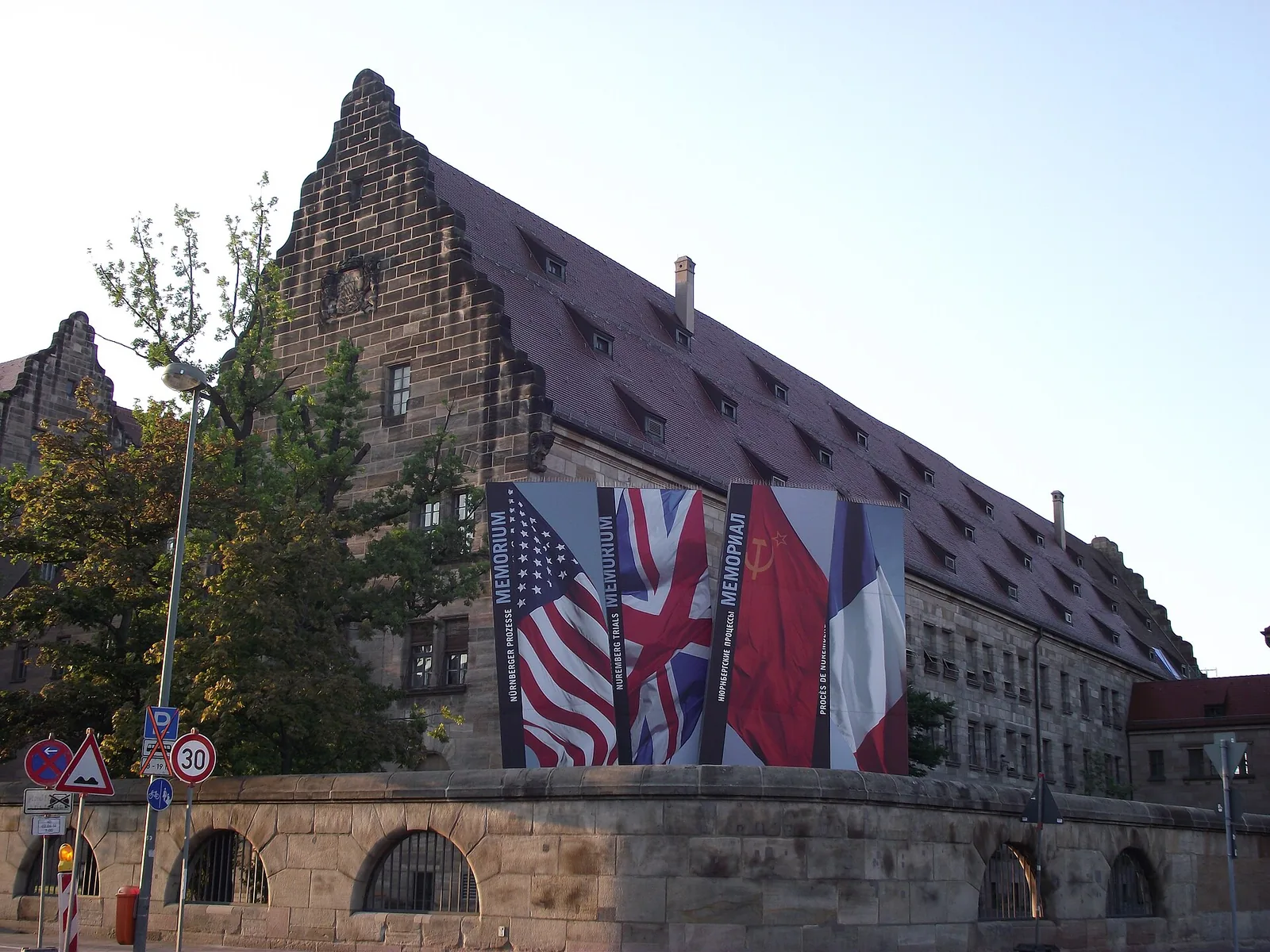
Fred Romero, Palace of Justice, Nuremberg, 2014 · CC BY 2.0 · Source page
On 20 November 1945 the International Military Tribunal opened in Nuremberg, with a judge from each of the four main Allies. Twenty-two leading Nazis stood trial. On 1 October 1946 nineteen were convicted and three acquitted; twelve were sentenced to death. The judges considered crimes against humanity only if committed during the war, so the persecution before it, including that of the Jews, was acknowledged but not judged. Between 1946 and 1948 American tribunals tried 185 more Germans in twelve further trials (USHMM).
Key dates
- 30 January 1933 Hitler becomes Chancellor.
- 15 September 1935 The Nuremberg Laws.
- 9–10 November 1938 Kristallnacht.
- 22 June 1941 The invasion of the Soviet Union; mass shootings.
- 8 December 1941 The first mass gassing, at Chełmno.
- 20 January 1942 The Wannsee Conference.
- 19 April 1943 The Warsaw ghetto uprising begins.
- 27 January 1945 Soviet troops reach Auschwitz.
- 20 November 1945 The Nuremberg trial opens.
- 14 May 1948 Israel is proclaimed; the United States recognises it (the Soviet Union follows on 17 May).
Check yourself
Put the events in order of time, from the earliest to the latest.
Answer: The Nuremberg Laws, the invasion of the Soviet Union, the first mass gassing at Chełmno, the Wannsee Conference.. 15 September 1935, 22 June 1941, 8 December 1941, 20 January 1942. The killing had already begun when they met at Wannsee.
Memory
Names
What remains
Yad Vashem collects the names of the murdered. Close to 4.8 million of the six million are now recorded in its database. Over one million victims remain unidentified. In Israel, Yom HaShoah is marked on 27 Nisan, a date the Knesset chose in 1951 and wrote into law in 1959.
Mordechai Gebirtig was shot in the Kraków ghetto in June 1942. Korczak and the children of his orphanage were murdered at Treblinka in August 1942. Adam Czerniaków took his own life on 23 July 1942. Emanuel Ringelblum and his family were discovered in hiding and murdered in March 1944; parts of his archive were found, and thanks to them we can read about the ghetto in the voices of those who lived there. Irena Sendler lived until 2008.
Back to the wall in Warsaw: four hundred names, from Aba to Żanna. A name is a person; a number is a total. This lesson used both, because each does what the other cannot.
When was it decided?
When and how was the decision to murder all of Europe’s Jews made, and what was the Wannsee Conference?
- Peter Longerich, David Cesarani, Laurence Rees The decision lay at the top and came before Wannsee. According to Longerich, Wannsee was not where it was made: Heydrich used the meeting to impose SS authority over the ministries and to settle the scope of the deportations and who counted as a Jew. Cesarani agrees, and Rees stresses that the men present were second-level officials and that Hitler, Himmler and Goebbels were absent. Some historians date a basic order to July 1941 or earlier and see Wannsee as secondary, sometimes almost symbolic. (The Jewish Virtual Library describes the first view in general terms. The positions of Longerich, Cesarani and Rees are as summarised in the English Wikipedia article ‘Wannsee Conference’; the books were not consulted.)
- Christopher Browning, Christian Gerlach The decision to murder all of Europe’s Jews took shape step by step in the second half of 1941, and the meeting fits into that process, perhaps also to make sure the ministries were on board (the Jewish Virtual Library describes this view). Browning points to a decision in the autumn of 1941. Gerlach argues that Hitler announced a decision ‘in principle’ around 12 December 1941, a date not every historian accepts.
It is hard to settle, because no written order from Hitler to kill Europe’s Jews is known, and the process was uneven: shootings in the Soviet Union, then gassing, then a Europe-wide programme. No historian doubts the murder itself. The disagreement is about a date and about who gave the final word. Does the exact date change what happened to the people in the trains? Does it change who is responsible? And one more question, which belongs to all of us: how do we remember, with a number or with names?
A quiet check
Terms
- racial antisemitism Hatred of Jews presented as science. Nazi ideology claimed that humanity is divided into unequal ‘races’ and that Jews were a danger. In practice the regulation of 1935 defined who is a Jew by the religion of the grandparents.
- Nuremberg Laws Two laws announced on 15 September 1935, the Reich Citizenship Law and the Law for the Protection of German Blood and German Honour, with a regulation of 14 November 1935. They made Germany’s Jews subjects without political rights and banned marriage with non-Jews.
- Kristallnacht The organised pogrom of 9–10 November 1938 in Germany, Austria and the Sudetenland. The name, ‘Night of Broken Glass’, comes from the shards of window glass in the streets. In German today it is often called the November Pogrom.
- ghetto A crowded, sealed and guarded district where the Germans forced Jews to live, with little food. The first was probably at Piotrków Trybunalski in October 1939; the Warsaw ghetto was sealed in November 1940.
- Judenrat ‘Jewish council’: the Jewish administration the Germans set up in each ghetto to carry out their orders. It also provided basic community services such as soup kitchens, schools and hospitals.
- Einsatzgruppen ‘Task forces’: SS and police units that followed the army into the Soviet Union from June 1941 and shot Jews and others, helped by other German units and local collaborators.
- the ‘Final Solution’ The Nazi code name for the plan to murder all of Europe’s Jews. It is a euphemism: the words hide the murder.
- Wannsee Conference A meeting of fifteen officials at a villa in Berlin on 20 January 1942, chaired by Reinhard Heydrich, that coordinated the deportation and murder of Europe’s Jews among the ministries. Its minutes survive in a single copy.
- concentration camp A prison camp for opponents of the regime and persecuted groups, with forced labour and terrible conditions. The first, Dachau, opened in March 1933. Many prisoners were killed or died of starvation, disease and abuse, but unlike the killing centres they were not built mainly for mass murder by gas.
- killing centre A camp built to murder people, mainly with poison gas. There were five: Chełmno, Belzec, Sobibor, Treblinka and Auschwitz-Birkenau. Also called an extermination camp or death camp.
- amidah ‘Standing firm’: the Israeli syllabus’s term for the many forms of Jewish resistance: survival, keeping life sacred, mutual aid, youth movements, documenting, and armed revolt.
- Warsaw ghetto uprising The armed revolt of the Jews of the Warsaw ghetto, 19 April – 16 May 1943, led by the Jewish Combat Organization (ŻOB).
- partisans Irregular fighters who operate behind enemy lines. Many Jews fled the ghettos and joined partisan units in the forests of eastern Europe.
- Righteous Among the Nations The title Yad Vashem gives to non-Jews who risked their lives to save Jews during the Holocaust.
- death marches Forced marches of camp prisoners away from the approaching front in the winter of 1944–1945. On 18 January 1945 nearly 60,000 prisoners left the Auschwitz camps this way.
- displaced persons Survivors and others who after the war could not or would not return home, and lived in camps run by the Allies. More than 250,000 of them were Jews, in the years 1945–1952. The Jewish survivors were known as She’erit Hapletah, ‘the surviving remnant’.
- Nuremberg trials The trial of leading Nazis before the International Military Tribunal (1945–1946), and twelve further American trials (1946–1948) in the same city.
- Reichstag Germany's parliament. In the Nazi years it unanimously passed the Nuremberg Laws at a party rally.
- Blood Law One of the Nazi Nuremberg Laws. It banned marriage between Jews and non-Jews.
- SA The Nazi Party's armed wing. Its men stood in front of Jewish shops and offices in the first nationwide action against Jews.
- Herschel Grynszpan A 17-year-old Jewish youth living in Paris. After his family was expelled from Germany, he shot a German diplomat, and the Nazis used this as an excuse for the pogrom.
- Ernst vom Rath A German diplomat, shot by Herschel Grynszpan, who died two days later. The Nazis used his death as an excuse for the pogrom.
- Goebbels The Nazi minister of propaganda. He coordinated the November pogrom, which was meant to look like the people's spontaneous anger.
- Aktion German word meaning operation. The Nazi authorities used it for the pogrom, instead of calling it a pogrom.
- Évian conference A town on Lake Geneva. Delegates from 32 countries met there in 1938 to discuss refugees, and only the Dominican Republic agreed to take in more.
- White Paper A 1939 policy paper from the British government, which then ruled Palestine. It limited Jewish immigration and, after five years, allowed no entry without Arab consent.
- Eichmann A Nazi official who prepared the minutes of the Wannsee Conference, a document describing the plan to murder Europe's Jews.
- Umschlagplatz German for transfer point. In Warsaw, it was where Jews from the ghetto were sent to Treblinka and other camps.
- Quatsch und Unsinn A German expression meaning complete nonsense. A German official used it to deny that fears of deportation in Warsaw were justified.
- Joseph Parnes Head of the Jewish council in Lvov. He refused to hand Jews over to a labour camp, and the Nazis killed him.
- Mordechai Chaim Rumkowski Head of the Jewish council in Łódź, who believed work would save the Jews. He urged residents to hand over their young children, and that month the sick, the elderly and children were sent to Chełmno.
- choiceless choices A phrase coined by the scholar Lawrence Langer for situations with no good way out, where both options are abnormal and neither is the victim's doing.
- Oneg Shabbat A secret group in the Warsaw ghetto, founded by Emanuel Ringelblum, which collected diaries, testimonies and documents about the ghetto.
- Hashomer Hatzair A socialist Zionist youth movement. Mordechai Anielewicz, commander of the Jewish Combat Organization, came from it.
- Jewish Combat Organization The larger of the two fighting groups in the Warsaw ghetto uprising, also known as ŻOB. It was commanded by Mordechai Anielewicz.
- Jürgen Stroop The German commander of the SS and police force that crushed the Warsaw ghetto uprising.
- Majdanek A concentration camp near Lublin, where Jews judged unfit for work were murdered. It was long counted as a sixth killing centre.
- Chełmno A killing centre in occupied Poland, where the first mass gassing took place. Jews from Łódź were also sent there.
- Sobibor A killing centre in occupied Poland. Prisoners rose up there and broke out, but most of those who escaped were hunted down and killed.
- Treblinka A killing centre in occupied Poland. Jews from Warsaw were sent there, and almost all were murdered on arrival.
- UNRRA The United Nations relief agency. Together with the Allies it ran the camps for displaced persons in Germany, Austria and Italy after the war.
Sources
- Reichsgesetzblatt 1935, Teil I, S. 1146–1147: Reichsbürgergesetz und Gesetz zum Schutze des deutschen Blutes und der deutschen Ehre, 15.9.1935. Transkription: de.wikisource.org. First Regulation (14.11.1935): Reichsgesetzblatt 1935, Teil I, S. 1333.
- Nazi Conspiracy and Aggression, vol. IV (Washington: US Government Printing Office, 1946): documents 1416-PS (Reich Citizenship Law), 2000-PS (Blood Law, partial translation) and 1417-PS (First Regulation, 14 Nov. 1935). The Avalon Project, Yale Law School.
- Protocol of the Wannsee Conference, 20 Jan. 1942, copy 16 of 30 (Politisches Archiv des Auswärtigen Amts, Berlin). English translation: German History in Documents and Images.
- Raul Hilberg, Stanisław Staron and Josef Kermisz (eds.), The Warsaw Diary of Adam Czerniakow: Prelude to Doom (New York: Stein and Day, 1979), pp. 381–385; excerpts in German History in Documents and Images.
- Mordechai Anielewicz, letter to Yitzhak Zuckerman, 23 April 1943: Yad Vashem, Documents on the Holocaust (Jerusalem, 1981), doc. 145. English text from Yad Vashem’s PDF.
- מרדכי אנילביץ׳, מכתב ליצחק צוקרמן, 23.4.1943: יד ושם, השואה בתיעוד (ירושלים, תשל״ח), תעודה 135. הנוסח העברי מקובץ ה־PDF של יד ושם.
- Ringelblum Archive (Oneg Shabbat), Jewish Historical Institute, Warsaw: ‘About the Ringelblum Archive’.
- Yad Vashem, ‘Let the World Read and Know: The Oneg Shabbat Archives’ (online exhibition, with the biography of Emanuel Ringelblum).
- Yad Vashem, Righteous Among the Nations database: Sendler (Krzyżanowska) Irena, item 4017433, file M.31.2/153.
- Yad Vashem (Canadian Society for Yad Vashem page), ‘Identifying Victims and Survivors’: names database and Pages of Testimony. The live count is higher.
- Jewish Virtual Library, ‘The Wannsee Conference’ (after the Encyclopaedia Judaica and the Encyclopedia of the Holocaust).
- United States Holocaust Memorial Museum, Holocaust Encyclopedia: ‘How Many People Did the Nazis Murder?’ (documenting numbers of victims of the Holocaust and Nazi persecution).
- USHMM, ‘Jewish Population of Europe in 1933: Population Data by Country’ and ‘Jewish Life in Europe before the Holocaust’.
- USHMM, ‘Kristallnacht’; ‘The Nuremberg Race Laws’; ‘Boycott of Jewish Businesses’.
- USHMM, ‘Warsaw’; ‘Warsaw Ghetto Uprising’; ‘Ghettos’; ‘Jewish Councils (Judenräte)’; ‘Janusz Korczak’.
- USHMM, ‘Einsatzgruppen’; ‘Killing Centers: An Overview’; ‘Sobibor’; ‘Jewish Partisans’.
- USHMM, ‘Displaced Persons’; ‘International Military Tribunal at Nuremberg’; ‘The Holocaust and World War II: Key Dates’.
- משרד החינוך, אשנ״ב (המסמך הפדגוגי) להיסטוריה, פרק 2 ״טוטליטריות, אנטישמיות, מלחמת העולם השנייה והשואה״
- Raul Hilberg, The Destruction of the European Jews (Chicago: Quadrangle Books, 1961; 3rd ed., New Haven: Yale University Press, 2003). The victim total is quoted as reported by English Wikipedia; the book was not consulted.
- Lucy S. Dawidowicz, The War Against the Jews, 1933–1945 (New York: Holt, Rinehart and Winston, 1975). The victim total is quoted as reported by English Wikipedia; the book was not consulted.
- Saul Friedländer, Nazi Germany and the Jews, vol. 1: The Years of Persecution, 1933–1939 (1997) and vol. 2: The Years of Extermination, 1939–1945 (2007) (New York: HarperCollins).
- Christopher R. Browning, with Jürgen Matthäus, The Origins of the Final Solution: The Evolution of Nazi Jewish Policy, September 1939 – March 1942 (Lincoln: University of Nebraska Press; Jerusalem: Yad Vashem, 2004).
- Peter Longerich, Holocaust: The Nazi Persecution and Murder of the Jews (Oxford: Oxford University Press, 2010).
- Mark Roseman, The Villa, the Lake, the Meeting: Wannsee and the Final Solution (London: Allen Lane, 2002).
- Samuel D. Kassow, Who Will Write Our History? Emanuel Ringelblum, the Warsaw Ghetto, and the Oyneg Shabes Archive (Bloomington: Indiana University Press, 2007).
- Isaiah Trunk, Judenrat: The Jewish Councils in Eastern Europe under Nazi Occupation (New York: Macmillan, 1972).
- Lawrence L. Langer, Versions of Survival: The Holocaust and the Human Spirit (Albany: State University of New York Press, 1982).
- Christian Gerlach, ‘The Wannsee Conference, the Fate of German Jews, and Hitler’s Decision in Principle to Exterminate All European Jews’, Journal of Modern History 70/4 (1998), 759–812.
- USHMM, Holocaust Encyclopedia: ‘Cyprus Detention Camps’ (about 70,000 illegal immigrants embarked for Palestine; about 52,000 held on Cyprus).
- Jewish Virtual Library, ‘International Recognition of Israel’ (United States recognition on 14 May 1948; Soviet Union on 17 May 1948).
- EHRI Portal (from the USHMM film archive): ‘Eichmann Trial – Session 25 – Testimony of Y. Zuckerman’, an archival summary of the 1961 testimony, not a transcript.
- British White Paper of 1939 (Cmd. 6019), Avalon Project, Yale Law School (the quota of 75,000 over five years and the clause on Arab consent).
- USHMM, ‘Emigration and the Evian Conference’ (delegates from 32 countries, July 1938; only the Dominican Republic agreed to accept additional refugees; more than 60 per cent of German and Austrian Jews fled between 1938 and 1940).
- English Wikipedia, ‘Emanuel Ringelblum’ (member of Left Po’alei Zion) and ‘Mordechai Anielewicz’ (from Betar to Hashomer Hatzair); secondary, used for the movements only.
Image credits
- Adrian Grycuk, Umschlagplatz Monument, Warsaw, 2012 · CC BY-SA 3.0 · Source page
- Reichsgesetzblatt 1935, Part I, p. 1146 (official gazette of the German Reich) · Public domain · Source page
- Bundesarchiv, Bild 146-1971-099-63, photographer unknown · CC BY-SA 3.0 · Source page
- Adam Carr, pages of the Wannsee protocol in a display case, 2006 · Public domain · Source page
- Adrian Grycuk, milk can of the Oneg Shabbat archive, Jewish Historical Institute, Warsaw, 2017 · CC BY-SA 3.0 · Source page
- Fred Romero, Palace of Justice, Nuremberg, 2014 · CC BY 2.0 · Source page


