Henry VIII
Six wives, a break with Rome, and a king who went from golden prince to sick and suspicious tyrant.
Decisions, questions and your own progress, in the app
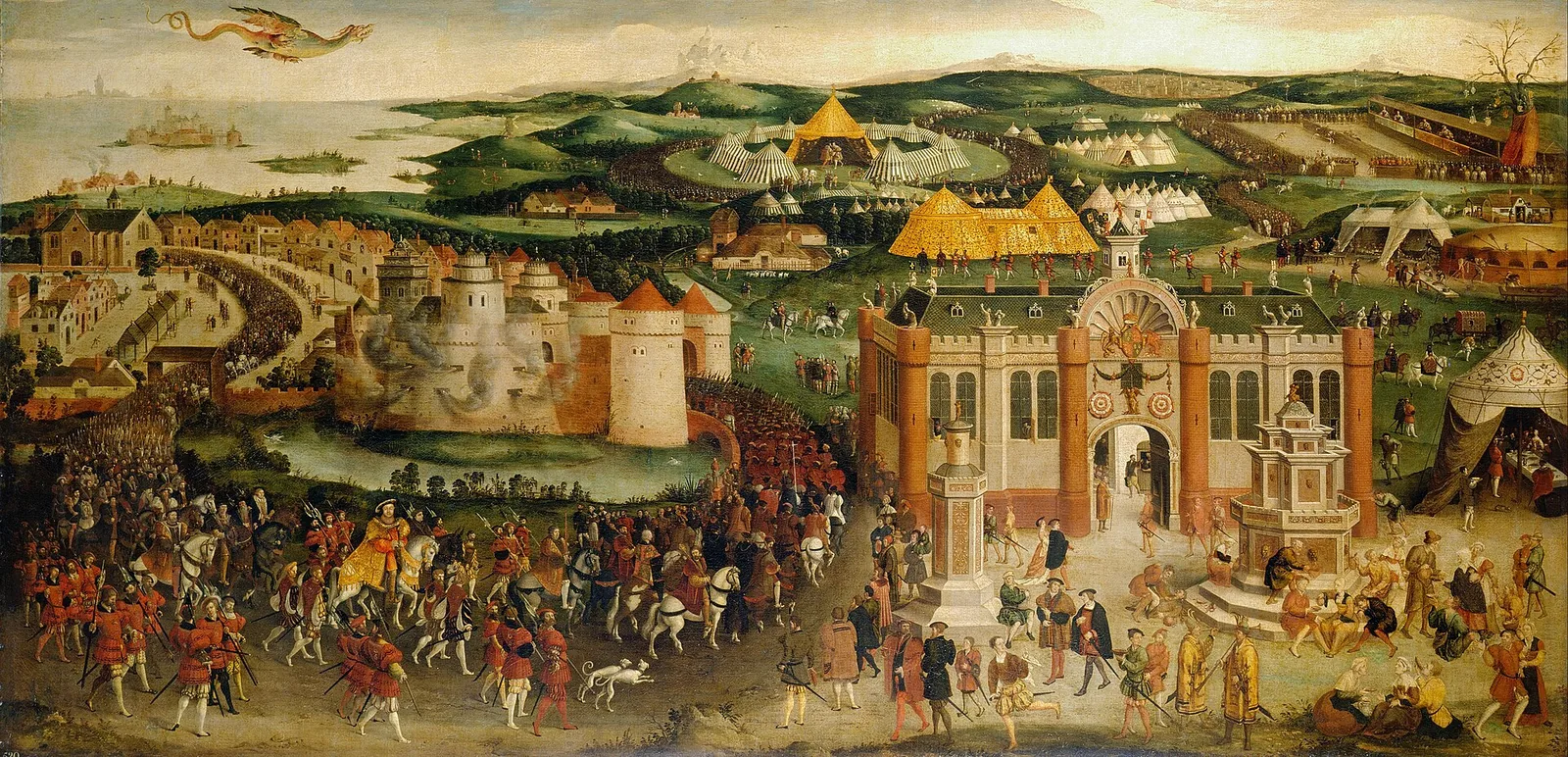
The Field of the Cloth of Gold, British School, c. 1545. Royal Collection, Hampton Court Palace · Public domain · Source page
The golden king
A palace of cloth and gold
June 1520, outside Calais. Two young kings meet in a camp of golden tents: Henry VIII of England, 28, and Francis I of France, 25. For more than two weeks they feast and joust, while wine flows from a fountain before a palace of painted canvas.
The man in gold is the most admired prince in Europe: tall, athletic, learned and devout. Twenty-seven years later he will die having broken with the Pope, closed every monastery in England, married six times and sent two wives and many of his closest servants to the block. How did the one become the other?
Henry VIII
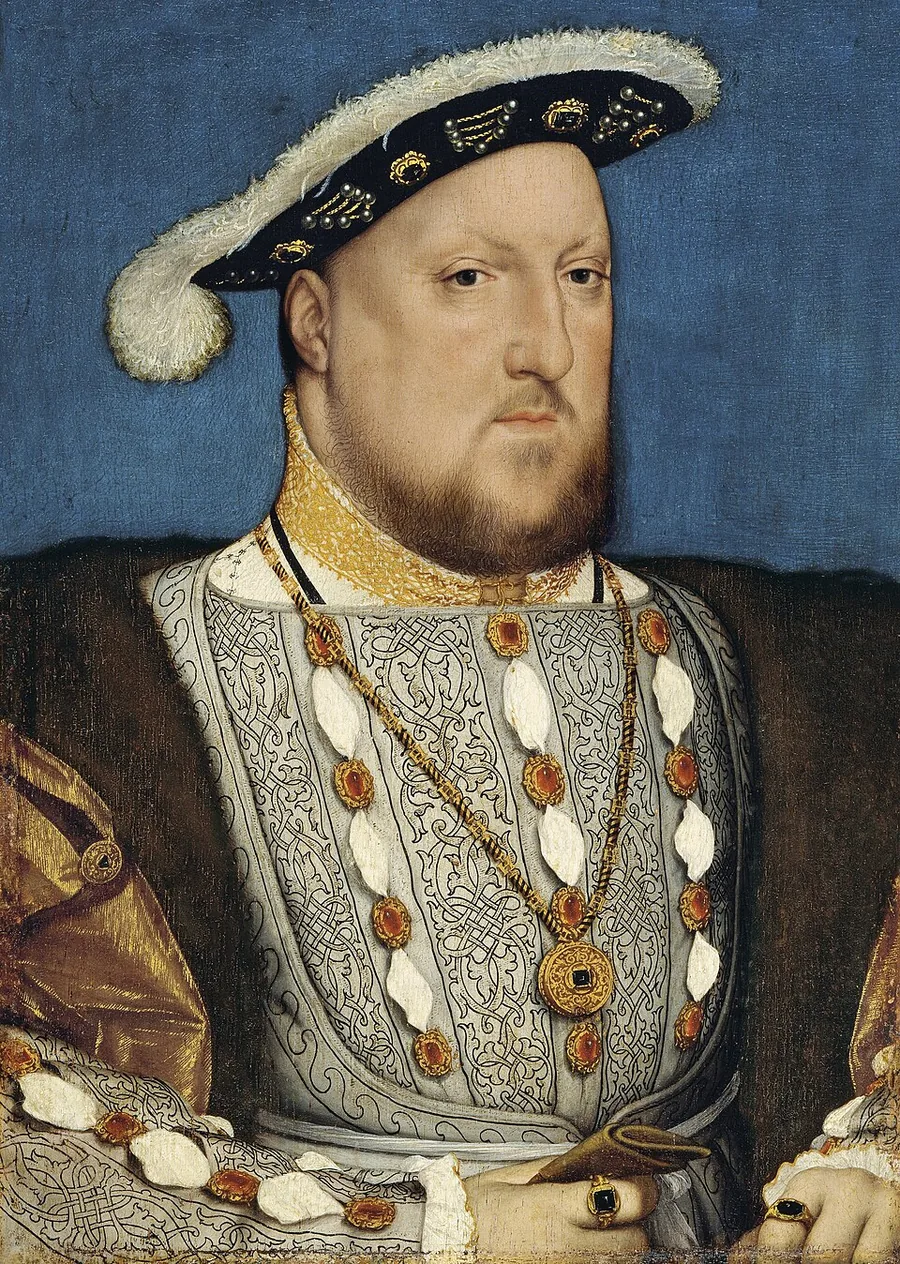
Hans Holbein the Younger, Portrait of Henry VIII, c. 1537. Museo Nacional Thyssen-Bornemisza, Madrid · Public domain · Source page
A second son who never expected to rule, he became the most splendid king in Europe and ended as its most feared.
- Born: 28 June 1491, Greenwich Palace, near London
- Died: 28 January 1547, Whitehall Palace, London, of illness, aged 55, after years of crippling leg ulcers
- Won: The Battle of the Spurs, 1513 (present); Flodden, 1513 (his commanders, while he was in France); Solway Moss, 1542 (his commanders); The capture of Boulogne, 1544 (present)
- Lost: The Gascony expedition, 1512; Ancrum Moor, 1545 (his commanders); The Solent, 1545: an indecisive fight, the Mary Rose sunk
“…that most precious jewel the word of God is disputed, rhymed, sung and jangled in every alehouse and tavern…”
The second son
Background
A new dynasty, a spare son
When Henry was born in 1491, his father Henry VII, the first Tudor, had been king for six years, since winning the crown in battle at the end of the Wars of the Roses. Of all the French lands England’s kings had fought for, only Calais remained.
The heir was Henry’s elder brother Arthur. In November 1501 Arthur, 15, married a Spanish princess of the same age, Catherine of Aragon, daughter of Ferdinand and Isabella. Less than five months later he was dead. Henry, ten, was suddenly the next king.
1509
King at seventeen
Henry VII did not want to return Catherine’s dowry or lose the Spanish alliance. So Catherine was promised to Henry instead, and the Pope granted a dispensation, since church law forbade marrying a brother’s widow.
In April 1509 the old king died. Henry, 17, at once arrested his father’s two hated tax collectors, Empson and Dudley, and later had them beheaded. In June he married Catherine. The new king was everything his careful father was not: a superb jouster, a musician, a reader of theology, generous and hungry for glory.
Catherine of Aragon
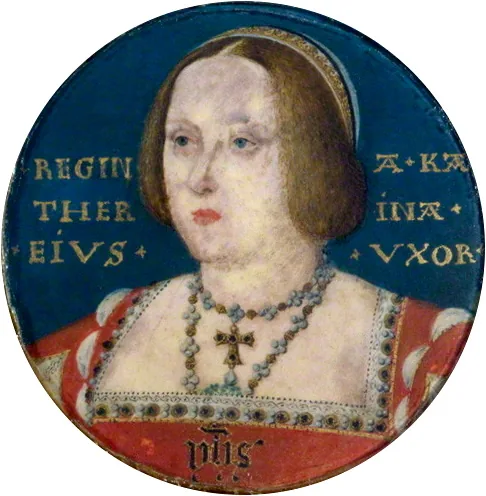
Attributed to Lucas Horenbout, Catherine of Aragon, watercolour on vellum, c. 1525. National Portrait Gallery, London · Public domain · Source page
A Spanish princess who ran England in wartime, and never accepted, to her dying day, that her marriage was void.
- Born: 16 December 1485, Alcalá de Henares, Castile
- Died: 7 January 1536, Kimbolton Castle, England, of illness, probably cancer, aged 50
- Won: Flodden, won under her regency (1513); Rome ruled her marriage valid (1534), too late
- Lost: Six pregnancies, one surviving child; Her marriage annulled in England (1533); Kept from her daughter Mary from 1531, and never saw her again
“I take God and all the world to witness, that I have been to you a true humble and obedient wife.”
1509–1516
The butcher’s son
Henry wanted to hunt, joust and make war; the paperwork bored him. It was taken off his hands by Thomas Wolsey, an Ipswich butcher’s son who rose through the Church to become Archbishop of York, cardinal, Lord Chancellor and the Pope’s legate.
The marriage was happy, and full of grief. In 1511 Catherine bore a son, who died at 52 days old. Of all her pregnancies, only one child survived: Mary, born in 1516.
War on two fronts
1512–1513
Henry V again?
Henry grew up on tales of Henry V and Agincourt. Allied with the Pope and Spain against France, he sent an army to Gascony in 1512; it ended in disease and mutiny.
In 1513 Henry crossed to Calais himself with some 25,000 to 30,000 men and besieged Thérouanne. On 16 August French cavalry ran into his army near Guinegate, panicked and fled: the French called it the Battle of the Spurs. Thérouanne and Tournai fell. Glory, at enormous cost.
A decision point
You are Catherine of Aragon, queen of England, 27.
Late August 1513, Richmond Palace
Henry is in France with most of the nobility and the best troops and guns. He has made you regent of England.
Now James IV of Scotland, though married to Henry’s sister, has kept faith with France. On 22 August he crossed the Tweed with a large army, heavy siege guns and French captains, and took Norham Castle. In the north the Earl of Surrey, about 70, is raising the northern shires. Scottish raids usually end with burning and a march home before winter.
How do you meet the invasion?
- Order Surrey to seek battle at once A quick blow might catch James before he settles in. But Surrey’s men are still gathering; a hasty fight with half an army could hand James a victory, and the north with it.
- Defend only: hold the castles and let James go home Probably the cheapest course, and James would probably go home before winter. But the north of England would burn, and Henry’s glory in France would look hollow beside a Scottish triumph at home.
- Back Surrey, raise a second army in the Midlands, and lead a third yourself It costs money and men you must scrape together. But if Surrey is beaten, James still meets another army before London, and Surrey can decide whether to fight knowing he is not the last line.
- Ask Henry to send troops home from France Help would take weeks to arrive, and the French campaign, Henry’s great dream, would collapse. Henry would not easily forgive the queen who called him home.
What really happened
Back Surrey, raise a second army in the Midlands, and lead a third yourself
Catherine did it all at once. Surrey got men, money and guns; Sir Thomas Lovell raised a second army in the Midlands; and Catherine set out north at the head of a third. She had reached Buckingham when the news came: on 9 September, at Flodden, Surrey had fought, and James IV was dead.
There was no time to ask Henry: letters took days each way. Catherine had grown up watching her mother Isabella run the war against Granada; Garrett Mattingly and Giles Tremlett credit her organisation. The decision to fight on 9 September was Surrey’s own.
Flodden: who fought whom
9 September 1513, from about 4 pm until dusk
Branxton Hill, Northumberland, about 5 km from the Scottish border at Coldstream
England
- Commanders: Thomas Howard, Earl of Surrey, Lord Thomas Howard, the Lord Admiral (vanguard), Sir Edmund Howard, Sir Edward Stanley, Lord Dacre (horse)
- Strength: 26,000 (Hall (muster of 5 September)); 40,000 (Brian Tuke, Clerk of the Signet, writing from France); 20,000–26,000 (Modern estimate)
- Losses: fewer than 500 (William Knight, letter of 20 September); 5,000 (Italian newsletters); about 1,500 (Modern estimate)
Mostly men of the northern shires, armed with the bill and the bow, with light, quick-firing field guns.
Scotland
- Commanders: James IV, King of Scots, Lord Home and the Earl of Huntly (left), The Earls of Errol, Crawford and Montrose, The Earls of Lennox and Argyll (right), The Earl of Bothwell (reserve)
- Strength: 60,000 (Tuke); about 42,000 (Modern estimate: crossed the Tweed); 30,000–35,000 (Modern estimate: at the battle)
- Losses: 10,000 (Tuke); 12,000 (William Knight); 18,000–20,000 (Italian newsletters); 5,000–14,000; most estimates about 10,000 (Modern estimate)
Deep blocks of pikemen trained by French captains, and heavy siege guns.
Outcome: An English victory. James IV is killed, the last monarch in Britain to die in battle, with his son the archbishop, nine or more earls and many lords.
Victory letters inflated the enemy and shrank their own losses, and no Scottish herald came to count the dead. Hall wrote some 35 years later, from the official reports.
The battle of Flodden
9 September 1513, late afternoon
In the late afternoon of 9 September 1513, James IV’s Scottish army stands on Branxton Hill in England, after invading with heavy siege guns while Henry is in France. Surrey has marched round them and comes at them from the north. The guns are about to open fire.
A reconstruction after Edward Hall’s chronicle (1548), the English letters of September 1513, and the studies of Niall Barr (2001), George Goodwin (2013) and the Remembering Flodden project. Hall puts Huntly beside Lennox and Argyll on the Scottish right; most modern writers put him with Home on the left, as here. Frontages, depths and the exact lines are estimates. North is up: the English came from the north, so Scotland lay behind them, not behind the Scots. Stanley’s attack on the rear of the king’s division in the last phase follows modern writers; Hall denies it.
Phases of the battle
- Guns across the dip Surrey has marched round the Scots and come at them from the north; James has moved onto Branxton Hill. At about four the guns open fire. The heavy Scottish guns, firing downhill, shoot slowly and too high; the light English pieces hit the packed pike blocks.
- The Scottish left charges Home and Huntly’s pikemen charge downhill and smash Edmund Howard’s men, who break and run. Dacre’s horsemen ride up and steady the English right, and the fight there stalls.
- Into the dip The Scottish centre follows, the king’s division heading straight for Surrey’s banner. In the soft, wet ground at the foot of the hill the pike blocks lose their order, and the English bills hack at the pike heads and get in among them.
- Stanley on the hill Unseen, Stanley’s men have climbed the eastern end of the hill; Hall says they reached the top before the Scots knew. They shoot into Lennox and Argyll’s Highlanders, then charge. The Scottish right breaks.
- The king’s last fight The king’s division, pressed by Surrey’s and the Admiral’s men, fights on until dusk. Many modern writers think Stanley’s men, coming over from the east, struck it from behind; Hall, citing Scottish prisoners, says it fought only Surrey’s men. James IV is killed close to Surrey’s banner; few Scots are taken alive.
The strategy
- English: Surrey marched round the Scots and came at them from the north. His light, quick field guns hit the packed pike blocks, and Stanley’s men climbed the eastern end of the hill unseen and charged the Scottish right.
- Scots: James IV took the hill of Branxton, with heavy siege guns firing downhill and deep pike blocks trained by French captains. His left wing charged downhill, the centre followed, and the king’s division headed straight for Surrey’s banner.
What decided it: What decided it was that on the soft, wet ground at the foot of the hill the pike blocks lost their order, and the English bills got in among them. Stanley’s men, who had climbed the hill unseen, then broke the Scottish right, and James IV was killed close to Surrey’s banner. Whether Stanley also struck the king’s division from behind is disputed.
9 September 1513
To the brave of both nations
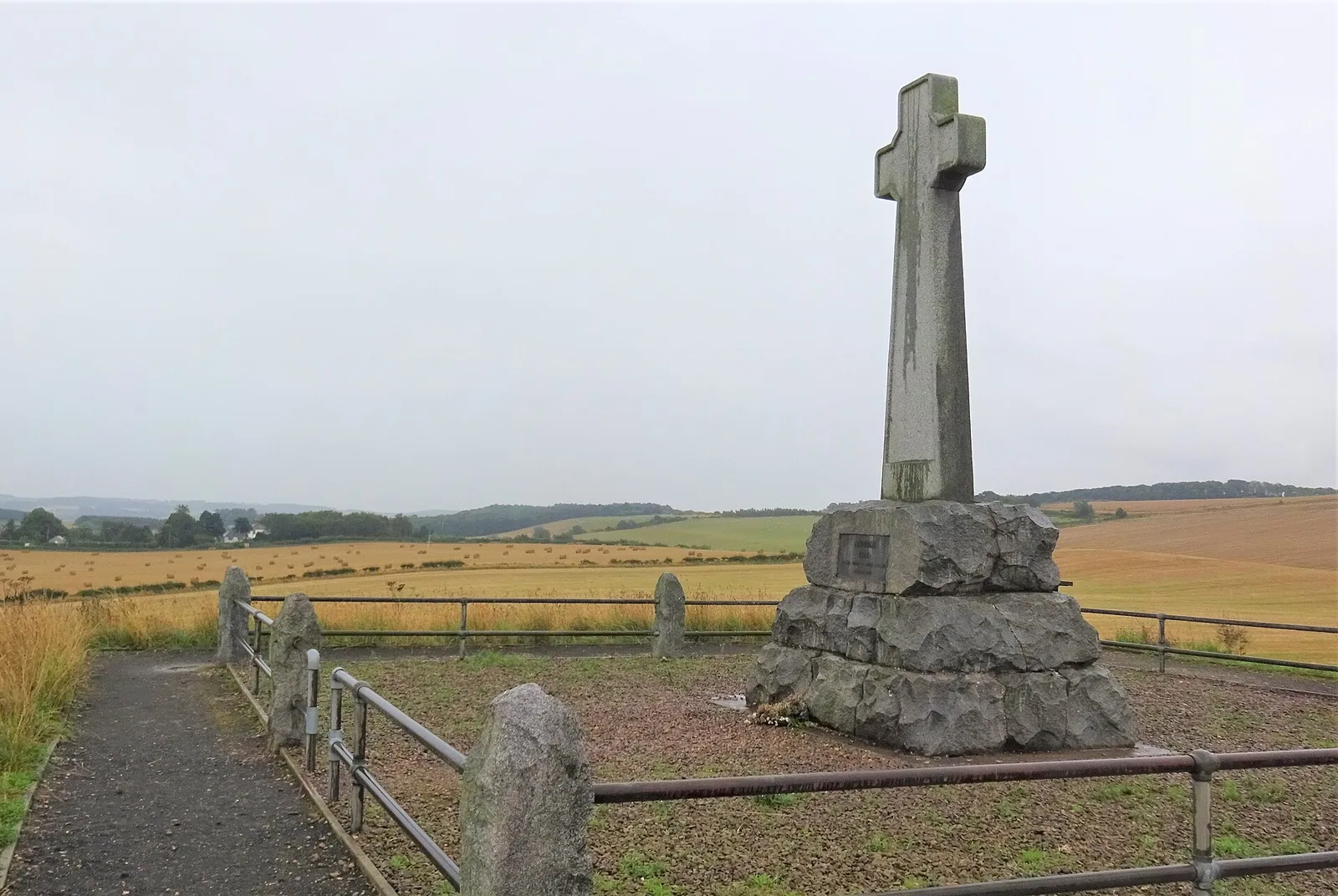
Flodden memorial cross, Branxton, Northumberland, 2021. Photo: Rosser1954 · CC BY-SA 4.0 · Source page
Flodden is often called the worst disaster in Scotland’s history. The new king, James V, was 17 months old. Henry was in France; the victory that saved his kingdom had been won without him, by an old earl and by his wife.
Source: A dead king’s coat
“To my thinking, this battle hath been to your Grace and all your realm the greatest honour that could be, and more than ye should win all the crown of France… In this your Grace shall see how I can keep my promise, sending you for your banners a king’s coat. I thought to send himself unto you, but our Englishmen’s hearts would not suffer it.”
The ‘coat’ is a piece of the surcoat James IV wore over his armour, taken from his body.
- Why say the victory is worth more than ‘all the crown of France’? Henry was in France chasing that very crown. Tactful praise with an edge: the real triumph of 1513 was at home, and Catherine says nothing of her own part.
- Why send a piece of a dead king’s coat at all? A trophy for Henry’s banners, and proof that James was really dead. Wanting to send ‘himself’ shows that in 1513 a dead enemy king was a prize.
The King’s Great Matter
1520–1521
Gold, and the Pope’s thanks
In 1520 Wolsey staged the meeting with Francis I that opened this lesson, the Field of the Cloth of Gold. Within two years the kings were at war again.
When Martin Luther launched the Reformation, Henry put his name to a Latin book against him, the Defence of the Seven Sacraments (1521). A grateful Pope Leo X named him ‘Defender of the Faith’, a title British monarchs still carry on their coins.
1525–1527
No son
By 1525 Catherine was 40, and there would be no more children. Henry had one legitimate child, Mary, and no woman had yet ruled England securely.
Henry began to read the Bible in a new light. Leviticus says of a man who takes his brother’s wife: ‘they shall be childless’. Was his sonless marriage God’s punishment? And he had fallen for one of Catherine’s ladies, Anne Boleyn, who apparently refused to be merely his mistress. In 1527 Henry asked Rome to declare his marriage void: an annulment.
Anne Boleyn
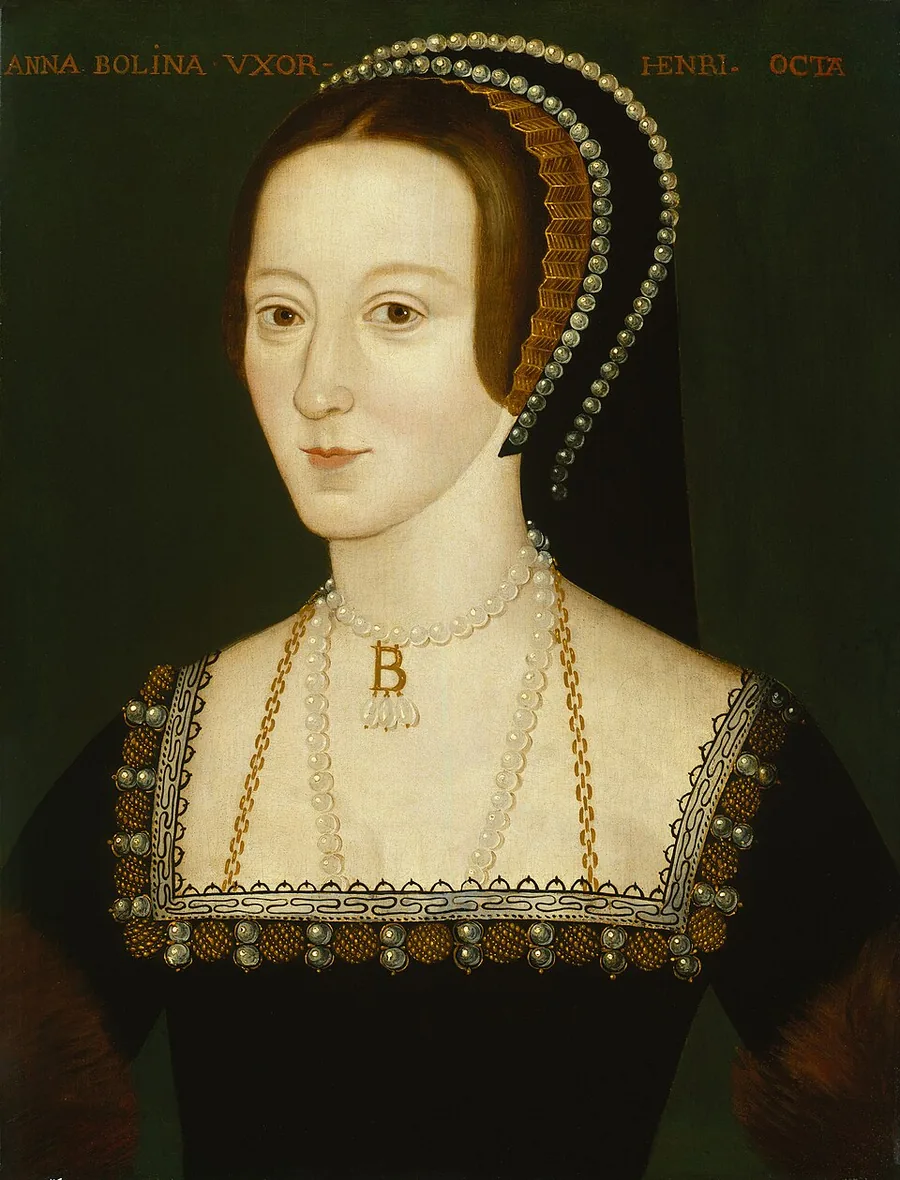
Unknown English artist, Anne Boleyn, late 16th century. National Portrait Gallery, London · Public domain · Source page
A sharp, French-educated courtier and friend of reform who became queen, and was beheaded three years later.
- Born: c. 1501 (or c. 1507: historians disagree), Norfolk or Kent, England (unknown)
- Died: 19 May 1536, The Tower of London, beheaded with a sword, after a trial for adultery and treason
- Won: Crowned queen, 1 June 1533; Elizabeth born, 7 September 1533
- Lost: No surviving son; From queen to scaffold in 17 days (May 1536)
“I am come hither to accuse no man… but I pray God save the king and send him long to reign over you, for a gentler nor a more merciful prince was there never.”
1527–1530
A court at Blackfriars
The Pope, Clement VII, could not help: in 1527 the troops of Catherine’s nephew, the Emperor Charles V, had sacked Rome. He played for time. In 1529 his legate Campeggio sat with Wolsey to judge the case at Blackfriars in London. Catherine knelt before Henry, begged for justice and walked out; Campeggio adjourned, and the case was called to Rome.
Henry blamed Wolsey. Charged with praemunire and later arrested for treason, the cardinal died on the road to London in 1530. ‘If I had served God as diligently as I have done the king,’ Cavendish remembered him saying, ‘he would not have given me over in my grey hairs.’
A decision point
You are Henry VIII, 41.
January 1533, London
For six years you have asked the Pope to annul your marriage. He will not: Catherine’s nephew, the emperor, dominates Italy. Your new adviser, the lawyer Thomas Cromwell, argues that England is an ‘empire’ whose king answers to no foreign power.
You have already cowed the clergy: charged with praemunire, they paid £118,840 for a pardon and accepted you as Supreme Head, ‘as far as the law of Christ allows’. And you can make Thomas Cranmer, a scholar close to the Boleyns, Archbishop of Canterbury.
And Anne is pregnant. A son must be born in a lawful marriage.
What do you do?
- Keep waiting, and keep pressing Rome The Pope might still give way, if the emperor’s power slipped. But the child would be born out of wedlock, and every month of waiting would tell Europe that the King of England obeys a Pope who is his enemy’s captive.
- Marry Anne now, forbid appeals to Rome, and let your own archbishop judge the case Your son would be lawful, in England at least. But you would defy the head of Western Christendom, risk excommunication, and give the emperor a reason for war.
- Give Anne up, stay with Catherine, and make Mary your heir Peace with Rome and with the emperor. But England would face a ruling queen, or a foreign king through her marriage, and you would lose the woman you have waited six years for.
What really happened
Marry Anne now, forbid appeals to Rome, and let your own archbishop judge the case
Henry married Anne in secret, probably in late January 1533. That spring the Act in Restraint of Appeals declared ‘this realm of England is an empire’ and stopped appeals to Rome. In May Cranmer annulled the marriage to Catherine; on 1 June Anne was crowned; in September she bore a girl, Elizabeth.
Geoffrey Elton saw Cromwell’s plan behind it; J. J. Scarisbrick and George Bernard see Henry himself, convinced by Leviticus and by his own royal power. Either way, the break was improvised over years: Henry left Rome only when Rome would not give him what he believed was his right.
Source: A law that says it changes nothing
“Albeit the king’s majesty justly and rightfully is and ought to be the supreme head of the Church of England… yet nevertheless for corroboration and confirmation thereof… be it enacted… that the king our sovereign lord, his heirs and successors, kings of this realm, shall be taken, accepted, and reputed the only supreme head in earth of the Church of England…”
The clergy’s old limit, ‘as far as the law of Christ allows’, has gone, and the Act grants the king the ‘profits, and commodities’ of the title.
- Does the Act say it makes Henry head of the Church? No. It says he already is, ‘justly and rightfully’, and merely confirms it. An old right sounds safer than a new power.
- What is missing from the text? Any statement of belief, and any word about Catherine or Anne; even the Pope is only an unnamed ‘foreign authority’. It changes who rules the Church, not what it teaches, though the king may now correct ‘errors, heresies’. And follow the money: who gets the ‘profits’?
Myth
Henry founded the Church of England just to get a divorce.
The truth
The annulment started the break, but it was not the whole story. Henry’s lawyers built a theory of royal ‘empire’ over the Church, the Crown wanted the Church’s wealth, and reformers such as Cranmer and Cromwell pushed further. Nor did Henry make England Protestant: his Six Articles of 1539 upheld the Mass, and he burned Protestants as well as executing Catholics.
The evidence
The Act of Supremacy (1534); the Act of Six Articles (1539); the burning of the Protestant Anne Askew (1546).
The oath and the axe
A decision point
You are Sir Thomas More, 56.
13 April 1534, Lambeth Palace, London
You were Henry’s friend and Lord Chancellor, the author of Utopia and a hard hunter of heretics. You resigned in 1532 rather than back the break with Rome, and have kept silent since. You once told your son-in-law that if your head could win the king a castle in France, it would go.
Now the Act of Succession makes Anne’s children Henry’s heirs, and every subject must swear to it. The words of the oath also reject the Pope’s authority. Refusing means prison and the loss of all you own.
What do you do?
- Swear, as almost everyone has You go home to Chelsea and your family. But you would be swearing to what you believe is false, and all your life you have written that a man’s soul is worth more than his comfort.
- Refuse, and say openly why: no Parliament can override the Pope and the law of the whole Church Your conscience would be clear and your words would ring across Europe. Under the law as it stands, spoken words bring prison and the loss of your goods, not death; but you would be handing the king’s lawyers your exact words, ready for any harsher treason law to come.
- Refuse the oath as it stands, offer to swear to the succession alone, and keep your reasons to yourself Silence is not yet treason, and a lawyer knows it. You will go to prison, but it will be hard to put you to death for words you have never said.
What really happened
Refuse the oath as it stands, offer to swear to the succession alone, and keep your reasons to yourself
More refused. He would not deny the succession, he wrote from the Tower, but could not swear the oath offered ‘without the jeoparding of my soul to perpetual damnation’. From 1535, denying the king’s supremacy in words was treason. At More’s trial in July 1535 the Solicitor General, Richard Rich, swore that More had denied it to him; More called him a liar. He was beheaded on 6 July, two weeks after Bishop John Fisher.
More held that no Parliament could overrule the law of the whole Church, and used silence as a lawyer’s shield. His son-in-law William Roper, writing 20 years later, remembered him whispering on the way to Lambeth: ‘I thank our Lord the field is won.’ Roper wrote a saint’s life; the historian John Guy reminds us that More had also hunted heretics to the fire.
January 1536
A fall in the lists
January 1536 began with a death. Catherine of Aragon died on the 7th, still calling herself queen. According to Chapuys, Henry dressed in yellow from head to foot and celebrated.
On the 24th, at Greenwich, Henry, now 44, was jousting in full armour when his horse fell and came down on top of him. Five days later, on the day of Catherine’s funeral, Anne miscarried. The child, people said, was a boy.
Source: What the ambassador heard
“On the day of the interment the Concubine had an abortion which seemed to be a male child which she had not borne 3½ months, at which the King has shown great distress.”
Five days after the fall, Chapuys wrote that everyone thought it ‘a miracle he was not killed, but he sustained no injury’. In March a Spanish envoy in Rome passed on the French king’s report: Henry had been ‘for two hours without speaking’.
- What does the word ‘Concubine’ tell you about the writer? He served Catherine’s nephew and never accepted Anne as queen; in his letters she is always ‘the Concubine’. Well informed, never neutral.
- Unhurt, or two hours without speaking: which report do you trust? The one closer in time and place. Chapuys saw nothing himself, but the ‘two hours’ came third-hand, from Greenwich through the French court to Rome, and stories grow as they travel.
A decision point
You are Anne Boleyn, queen of England.
April 1536, Greenwich
You have been queen for three years. Elizabeth is two and a half; your son was lost in January. The king is giving gifts to one of your ladies, Jane Seymour.
With Catherine dead, the emperor offers Henry friendship if her daughter Mary is restored. Thomas Cromwell favours the deal; you oppose it, and want the monasteries’ wealth spent on education and the poor. On 2 April your almoner preached a sermon that everyone took as an attack on Cromwell.
What do you do?
- Make peace with Cromwell and the emperor’s friends, and welcome Mary back You would give up a policy you believe in and humble yourself before Catherine’s daughter. But you might turn your most dangerous enemy into an ally, at least until you bear a son.
- Fight on: keep opposing Cromwell, and try to bring him down You have beaten enemies before; Wolsey fell. But Cromwell controls the king’s business and the king’s information, and a minister fighting for his life may strike first.
- Keep quiet, stay close to the king, and hope for another pregnancy Perhaps the wisest course. But it depends on things you cannot control: the king’s affection, and a son.
What really happened
Fight on: keep opposing Cromwell, and try to bring him down
Anne fought on, and lost. On 30 April a court musician, Mark Smeaton, was arrested and, probably under pressure, confessed to adultery with her. Anne, her brother George and four other men were charged with adultery, incest and plotting the king’s death, and condemned. Cranmer annulled her marriage on 17 May; two days later she was beheaded.
In June Cromwell told Chapuys he had ‘set himself to arrange the plot’. Eric Ives sees a coup by Cromwell to save himself; George Bernard thinks Anne may have been guilty of something; most historians think the charges were false. Either way, the king allowed it. Elizabeth’s story is told in the lesson on Elizabeth I.
1536–1537
A son at last
Eleven days after Anne’s death, Henry married Jane Seymour. A new Act of Succession declared Elizabeth illegitimate, as Mary had been before her. In October 1537, at Hampton Court, Jane gave birth to the son Henry had waited 28 years for: Edward. Twelve days later Jane was dead, of an illness after the birth.
1535–1540
Closing the monasteries
In 1535 Cromwell’s agents surveyed the Church’s wealth and hunted for scandal in the monasteries. In 1536 Parliament closed the smaller houses; by 1540 all were gone. This was the Dissolution of the Monasteries: some 800 houses and perhaps 10,000 monks, nuns and friars. Their lands went to the Crown, and most were soon sold.
In the autumn of 1536 some 30,000 northerners rose under the banner of the Five Wounds of Christ: the Pilgrimage of Grace. Henry promised a pardon; after a new revolt in 1537 he took his revenge, executing about 200, the leader Robert Aske among them.
The last decade
1540–1543
Three more wives
Cromwell found Henry a German ally and bride, Anne of Cleves. Henry disliked her on sight; the marriage of January 1540 was annulled within six months, and Cromwell fell. Condemned by attainder without a trial, he was beheaded in July. That same day Henry married Catherine Howard, a young cousin of Anne Boleyn, perhaps still in her teens. Accused of affairs before and during the marriage, she was beheaded in February 1542.
In 1543 Henry married Catherine Parr, a learned widow. She outlived him.
Myth
‘Divorced, beheaded, died; divorced, beheaded, survived’: Henry divorced two of his wives.
The truth
Henry never divorced anyone in the modern sense. The Church allowed no divorce with remarriage, so his case was always that a marriage had never been valid: an annulment, which is what contemporaries meant by ‘the divorce’. Three were annulled: Catherine of Aragon’s in 1533, Anne Boleyn’s two days before her execution, and Anne of Cleves’s in 1540. Catherine Howard was condemned by attainder. Annulment mattered: it made a wife’s children illegitimate, which is how Mary and Elizabeth lost their places in the succession.
The evidence
Cranmer’s judgments of 1533 and 1536; the ruling of Convocation of July 1540. The rhyme itself is modern.
1542–1546
The last wars
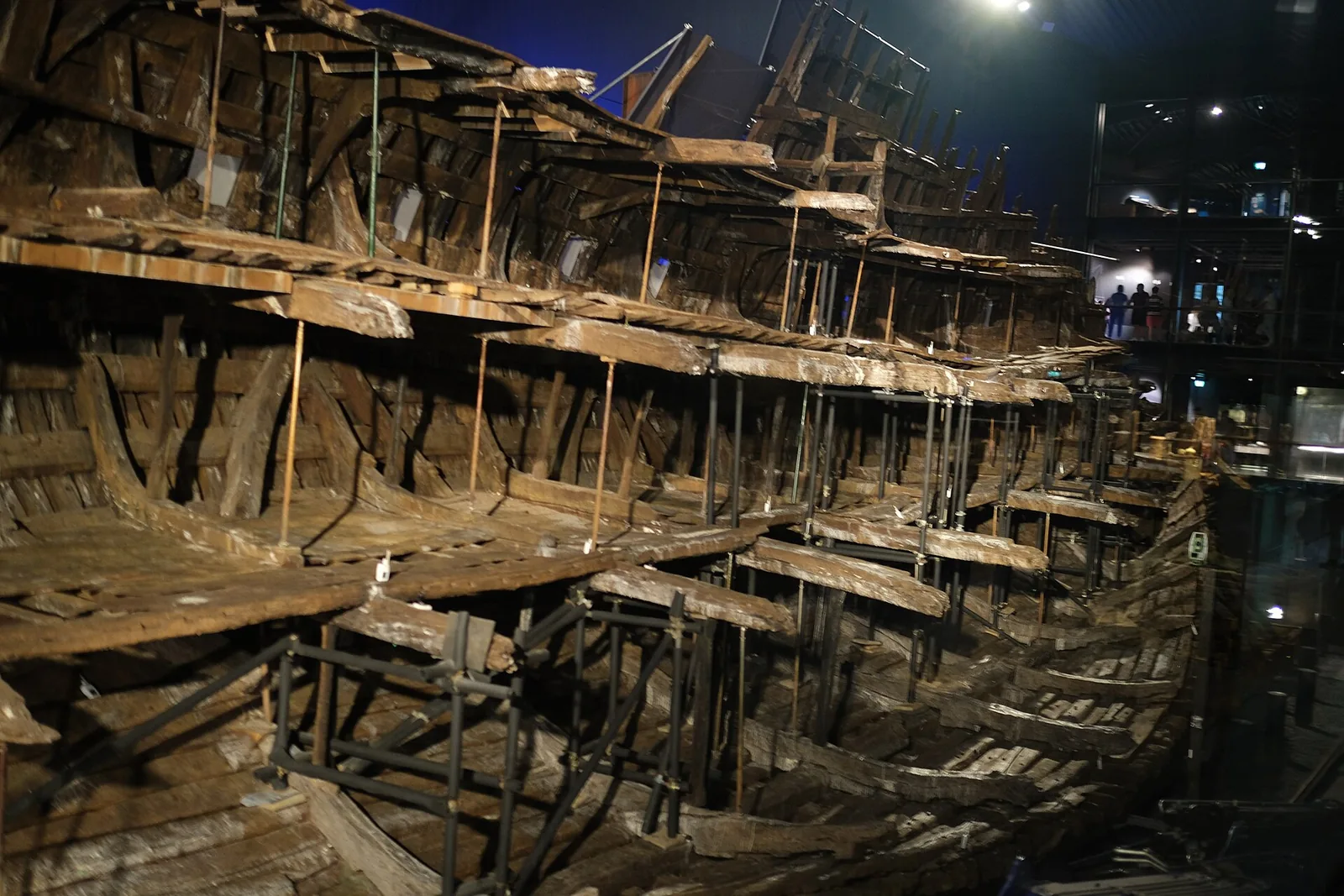
The hull of the Mary Rose, Mary Rose Museum, Portsmouth, 2023. Photo: Bob Harvey · CC BY-SA 2.0 · Source page
In 1542 Henry’s army crushed the Scots at Solway Moss, and James V died weeks later, leaving a baby daughter, Mary, Queen of Scots. When the Scots refused her as a bride for Edward, Henry sent armies to burn Edinburgh: the ‘Rough Wooing’. In 1544, aged 53, he took Boulogne in person.
In July 1545 a French fleet entered the Solent. From Southsea Castle Henry watched his warship the Mary Rose heel over and sink. Of some 400 to 500 men aboard, probably fewer than 40 survived.
Source: Two faces of a king
“His Majesty is the handsomest potentate I ever set eyes on; above the usual height, with an extremely fine calf to his leg, his complexion very fair and bright, with auburn hair combed straight and short, in the French fashion…”
The Venetian describes Henry at 23; Holbein, his court painter, shows him at about 46, a year after his fall. Holbein’s lost Whitehall mural created the famous image of the king standing legs apart.
- What does the portrait want you to feel? Power and permanence. Henry fills the panel, broad as a wall, glittering with jewels, staring straight at you. Neither witness is neutral.
- What is left out? Age, pain and illness. By 1537 his legs were ulcerated and his jousting days were over.
Myth
Henry VIII was a lifelong glutton who tore at chicken legs and tossed the bones over his shoulder.
The truth
That scene comes from a film: Charles Laughton’s Oscar-winning performance in The Private Life of Henry VIII (1933). The young Henry was a superb athlete who, Pasqualigo wrote, drew the bow ‘with greater strength than any man in England’. He grew huge only in his last decade, when leg ulcers ended his exercise: his armours show his waist growing from under 90 to over 120 centimetres.
The evidence
Pasqualigo’s letter of 1515; Henry’s armours in the Royal Armouries; Korda’s film of 1933.
28 January 1547
The death of the king
On Christmas Eve 1545 Henry begged Parliament to stop his subjects calling each other ‘Papist’ and ‘heretic’, yet he burned Protestants and hanged Catholics to the end. In his last weeks he had the Earl of Surrey, grandson of the victor of Flodden, beheaded for treason.
Henry died at Whitehall in the early hours of 28 January 1547, aged 55. His death was kept secret for three days. Henry was buried at Windsor, beside Jane Seymour.
What Henry left behind
- 1547 Edward VI, nine, becomes king; his advisers make England Protestant.
- 1547–1550 The Rough Wooing fails: Mary, Queen of Scots, is sent to France, and Boulogne is sold back to the French.
- 1553–1558 Mary I restores the Pope’s authority but cannot take back the monastery lands. In 1558 Calais, England’s last foothold in France, falls.
- 1558–1559 Elizabeth I renews the break with Rome, as ‘Supreme Governor’ of the Church.
- 1603 Henry’s children leave no heirs. James VI of Scotland, great-grandson of James IV and Margaret Tudor, becomes King of England.
- 1801 British monarchs drop the title ‘King of France’, borne since Edward III.
Who really ruled?
Was Henry the master of his reign, or the instrument of the men and women around him?
- G. R. Elton, The Tudor Revolution in Government (1953) Thomas Cromwell was the architect. He planned the break with Rome as a legal revolution carried out through Parliament, and built a modern bureaucratic state. Henry supplied the will, not the ideas.
- J. J. Scarisbrick, Henry VIII (1968), and G. W. Bernard, The King’s Reformation (2005) Henry decided. The Great Matter was his own obsession, the theology was his, and his ministers rose and fell at his will. Bernard sees a king steering a consistent middle way between Rome and Luther.
- David Starkey (1985) and Eric Ives (2004) Power flowed through the king’s private rooms. Rival factions, Boleyns and Seymours, reformers and conservatives, competed for Henry’s ear, and his decisions often followed whoever won. Anne Boleyn fell to such a coup.
Most historians today give Henry more credit than Elton did, but the sources rarely show who first proposed an idea. Diarmaid MacCulloch’s life of Cromwell (2018) shows a minister with his own religious agenda, working through, and sometimes around, a dangerous master.
What do you know now?
Check yourself
Why did Henry, a second son, become king?
Answer: His elder brother Arthur died in 1502, aged 15. Right. Arthur died less than five months after marrying Catherine of Aragon, and ten-year-old Henry became the heir.
Check yourself
Where was Henry VIII when the English beat the Scots at Flodden?
Answer: Besieging towns in France, while Catherine ruled England as regent. Right. Henry was on campaign in France; the victory was won by Surrey under Catherine’s regency.
Check yourself
Which word best describes how Henry’s marriages to Catherine of Aragon and Anne of Cleves ended?
Answer: Annulment: a ruling that the marriage had never been valid. Right. That is why a wife’s children could be declared illegitimate, as Mary was.
Check yourself
According to its own words, what did the Act of Supremacy of 1534 do?
Answer: Confirmed that the king already was, by right, supreme head of the Church of England. Right. The Act says Henry ‘is and ought to be’ supreme head, and claims only to confirm it: a new power dressed as an old right.
Check yourself
Chapuys says the fall left Henry unhurt; a report from Rome says two hours speechless. How should you weigh them?
Answer: Prefer the earlier report from London, and treat the third-hand report from Rome with caution. Right. Chapuys wrote from London five days after the fall; the Roman story passed through the French court, and stories grow as they travel.
Check yourself
What happened to the lands of the monasteries closed between 1536 and 1540?
Answer: They passed to the Crown, and most were sold to nobles and gentry. Right. The sales paid for Henry’s wars and created landowners who would never give the land back.
Terms
- dispensation Special permission from the Pope to set aside a rule of church law. In 1503 Pope Julius II allowed Henry to marry his brother’s widow.
- legate An envoy of the Pope who carries his powers. Wolsey held the post permanently in England; in 1528 the Pope sent Cardinal Campeggio as legate to judge the king’s marriage.
- regent Someone who rules in the monarch’s place while the monarch is too young, ill or away. In 1513, while Henry fought in France, Catherine was regent of England.
- pike An infantry spear about five metres long, held in both hands by men packed in dense blocks. France sent the Scots pikes and instructors for the campaign of 1513.
- bill An English staff weapon about two metres long, with a curved blade, a hook and a spike. Most of the English foot at Flodden carried one.
- Reformation The movement to reform the Church begun by Martin Luther in 1517, which split Western Christianity into Catholics and Protestants.
- annulment A church court’s ruling that a marriage had never been valid, for example because it broke church law. It is not a divorce: the Catholic Church allowed no divorce with remarriage.
- praemunire An offence under 14th-century English statutes: upholding a foreign authority, above all the Pope’s, against the rights of the Crown. Wolsey was charged with it in 1529, and the whole English clergy in 1530–31.
- Supreme Head Henry’s title under the Act of Supremacy of 1534: ‘the only supreme head in earth of the Church of England’. It gave the king the authority the Pope had held.
- Dissolution of the Monasteries The closing of every monastery, nunnery and friary in England and Wales between 1536 and 1540, and the seizure of their lands and treasures by the Crown.
- attainder An Act of Parliament that convicts a person of treason and condemns them without a trial. Thomas Cromwell (1540) and Catherine Howard (1542) died this way.
- Francis I King of France. He met Henry VIII at the Field of the Cloth of Gold, and within two years the two kings were at war.
- Thomas Wolsey An Ipswich butcher's son who became cardinal and Lord Chancellor. Henry blamed him for the failed annulment, and he died on the road to London after being arrested for treason.
- Eustace Chapuys Ambassador of the Emperor Charles V. He loved Catherine of Aragon and loathed her rival, so his reports must be read with care.
- Thomas Cromwell Henry's adviser, who pushed for the break with Rome and for the Church's wealth to go to the Crown. He was condemned without a trial and beheaded.
- Anne Boleyn Henry's second wife. He fell for her when she was one of Catherine's ladies, and she was later beheaded on charges of adultery and plotting against the king.
- Julius II The Pope who granted Catherine a dispensation to marry Henry, her first husband's brother. It covered both cases, whether or not the first marriage had been consummated.
- Wars of the Roses A series of civil wars in England over the crown, between the houses of Lancaster and York. Henry VII won the crown in the battle that ended them.
- Tudor The royal house of England. Henry VII was its first king, and the father of Henry VIII.
- Calais A town in northern France. Of all the French lands England's kings had fought for, only Calais was still theirs.
- Flodden A battle on the Anglo-Scottish border, won by an English army under the Earl of Surrey. King James IV of Scotland was killed there.
- Solway Moss A battle on the Scottish border where Henry's army crushed the Scots. Their king, James V, died weeks later.
- Mary Rose Henry's warship. She heeled over and sank in the Solent while Henry watched from the shore.
- Pilgrimage of Grace A great revolt of northerners against Henry's policies, including the closing of the monasteries. The rebels flew the banner of the Five Wounds of Christ. Henry promised a pardon, then took revenge.
- Defence of the Seven Sacraments A Latin book published under Henry's name against Martin Luther. The grateful Pope then gave him the title Defender of the Faith.
- Utopia A book by Thomas More about an imaginary island with a perfect society. The name comes from Greek and means no place.
- Leviticus One of the five books of the Torah. Henry's lawyers argued that it forbids a man to marry his brother's wife.
- Act of Succession A law that set who would inherit the crown and made every subject swear to it. The wording of the oath also rejected the Pope's authority.
- Lord Chancellor A senior office in the English government. Its holder was in charge of the law and of the king's Great Seal.
- Empson and Dudley Two hated tax collectors of Henry VII. Henry VIII arrested them as soon as his father died, and later had them beheaded.
- hydrogeologist A scientist who studies groundwater, the water that lies under the ground.
- Field of the Cloth of Gold A splendid camp outside Calais where Henry VIII and Francis I met. It had golden tents, feasts and jousts.
- Defender of the Faith A title the Pope gave Henry VIII. British monarchs still carry it, and it appears on their coins.
- Battle of the Spurs The French name for the battle near Guinegate, where French cavalry panicked and fled.
- Charles V Holy Roman Emperor and king of Spain, nephew of Catherine of Aragon. His troops sacked Rome, and he dominated Italy.
Sources
- Edward Hall, The Union of the Two Noble and Illustre Famelies of Lancastre and Yorke (London: Grafton, 1548), ed. H. Ellis as Hall's Chronicle (London, 1809): Flodden, Anne Boleyn's execution, Henry's speech of 24 December 1545
- Henry Ellis (ed.), Original Letters Illustrative of English History, 1st series, vol. I (London, 1824), letters XXX–XXXII: Catherine of Aragon to Wolsey and to Henry VIII, and the Earl of Surrey to James IV, August–September 1513
- J. Gairdner (ed.), Letters and Papers, Foreign and Domestic, Henry VIII, vol. X: January–June 1536 (London, 1887): dispatches of Eustace Chapuys, 29 January, 10 February and 6 June 1536; Pedro Ortiz, 6 March 1536
- H. Gee and W. J. Hardy (eds.), Documents Illustrative of English Church History (London: Macmillan, 1896): the Act in Restraint of Appeals (1533) and the Act of Supremacy (1534)
- George Cavendish, The Life and Death of Cardinal Wolsey (written c. 1554–58), ed. S. W. Singer (London, 1827)
- William Roper, The Life of Sir Thomas More (written c. 1557; London: Burns & Oates, 1905), with More's letter to Margaret Roper from the Tower, April 1534
- Rawdon Brown (trans.), Four Years at the Court of Henry VIII: Despatches of Sebastian Giustinian, vol. I (London: Smith, Elder, 1854), with the letter of Piero Pasqualigo, 1515
- J. J. Scarisbrick, Henry VIII (London: Eyre & Spottiswoode, 1968; new ed. New Haven: Yale University Press, 1997)
- Eric Ives, The Life and Death of Anne Boleyn: ‘The Most Happy’ (Oxford: Blackwell, 2004)
- Diarmaid MacCulloch, Thomas Cromwell: A Life (London: Allen Lane, 2018)
- Suzannah Lipscomb, 1536: The Year that Changed Henry VIII (Oxford: Lion Hudson, 2009)
- G. W. Bernard, The King's Reformation: Henry VIII and the Remaking of the English Church (New Haven: Yale University Press, 2005)
- G. R. Elton, The Tudor Revolution in Government (Cambridge: Cambridge University Press, 1953)
- David Starkey, The Reign of Henry VIII: Personalities and Politics (London: George Philip, 1985)
- Giles Tremlett, Catherine of Aragon: Henry's Spanish Queen (London: Faber & Faber, 2010)
- Garrett Mattingly, Catherine of Aragon (Boston: Little, Brown, 1941)
- John Guy, Thomas More (London: Arnold, 2000)
- Niall Barr, Flodden 1513: The Scottish Invasion of Henry VIII's England (Stroud: Tempus, 2001)
- George Goodwin, Fatal Rivalry: Flodden 1513 (London: Weidenfeld & Nicolson, 2013)
- Glenn Richardson, The Field of Cloth of Gold (New Haven: Yale University Press, 2013)
- Eamon Duffy, The Stripping of the Altars: Traditional Religion in England c. 1400–c. 1580 (New Haven: Yale University Press, 1992)
- Mary Rose Trust, ‘Why did the Mary Rose sink?’
- P. L. Younger, ‘Crouching enemy, hidden ally: the decisive role of groundwater discharge features in two key battles in the Anglo-Scottish Wars’, Geological Society, London, Special Publications 362 (2012), 19–33
Image credits
- The Field of the Cloth of Gold, British School, c. 1545. Royal Collection, Hampton Court Palace · Public domain · Source page
- Hans Holbein the Younger, Portrait of Henry VIII, c. 1537. Museo Nacional Thyssen-Bornemisza, Madrid · Public domain · Source page
- Attributed to Lucas Horenbout, Catherine of Aragon, watercolour on vellum, c. 1525. National Portrait Gallery, London · Public domain · Source page
- Flodden memorial cross, Branxton, Northumberland, 2021. Photo: Rosser1954 · CC BY-SA 4.0 · Source page
- Unknown English artist, Anne Boleyn, late 16th century. National Portrait Gallery, London · Public domain · Source page
- The hull of the Mary Rose, Mary Rose Museum, Portsmouth, 2023. Photo: Bob Harvey · CC BY-SA 2.0 · Source page


