Saladin and the Horns of Hattin, 1187
Saturday evening, 4 July 1187: a captive king, half dead with thirst, in Saladin's tent. That day the Kingdom of Jerusalem lost its army.
Decisions, questions and your own progress, in the app
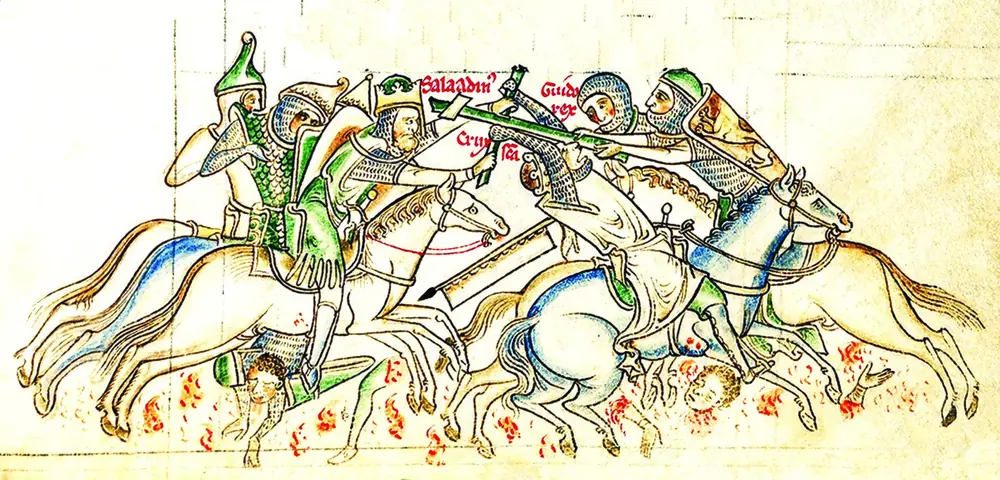
Matthew Paris, Chronica Majora, Cambridge, Corpus Christi College, MS 26, fol. 140r, 13th century. Photo: Levan Ramishvili · Public domain · Source page
A cup of iced water
The cup in the tent
Saturday evening, 4 July 1187. In Saladin’s tent sits a captive king, parched with thirst. The sultan hands him a bowl of sherbet made with iced rose-water.
King Guy of Jerusalem drinks and passes the bowl to Reynald of Châtillon, the lord who, Muslim and Latin writers agree, broke the truce. The sultan tells his interpreter: the king gave this man a drink, not I. Soon afterwards Reynald is dead.
That same day, near a hill called the Horns of Hattin, the largest army the Kingdom of Jerusalem ever raised was destroyed. Three months later Saladin entered Jerusalem. How did it happen?
Who tells the story
Nobody wrote it down on the field
Not one writer whose account survives watched the whole battle. The cup comes from Baha ad-Din, Saladin’s qadi, who met him only in 1188 and paints him almost as a saint. Imad ad-Din, his secretary, was in the camp but wrote to glorify him.
On the Frankish side, Ernoul, a squire of the baron Balian of Ibelin, told his story in a chronicle that took shape some forty years later. An English cleric who lived through the siege of Jerusalem wrote the Libellus, a little book on the conquest. Each took sides. Always ask: who says so, and why?
Saladin (Salah ad-Din Yusuf ibn Ayyub)
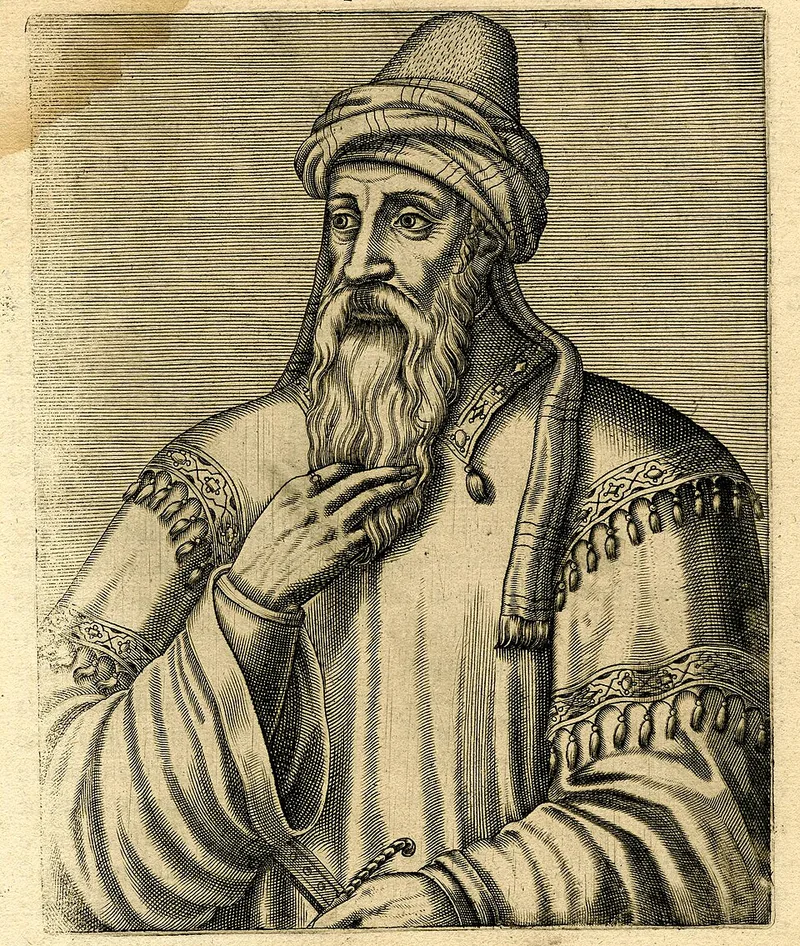
Engraving in André Thevet, Les vrais pourtraits et vies des hommes illustres (Paris, 1584), p. 627. British Museum 1879,1213.302 · Public domain · Source page
A Kurdish officer who became sultan of Egypt and Syria, beat the Franks at Hattin, took Jerusalem from them, and, says his biographer, died with almost nothing in his treasury.
- Born: 1137 or 1138, Tikrit, on the Tigris (today in Iraq)
- Died: March 1193 (the 3rd or the 4th; the sources differ), The citadel of Damascus, of a fever, after twelve days’ illness
- Won: Marj Ayyun and Jacob’s Ford, 1179; Hattin, 4 July 1187; Jerusalem, 2 October 1187
- Lost: Montgisard, 1177, against the young King Baldwin IV; Kerak: sieges that failed, 1183 and 1184; Tyre: a siege that failed, 1187–1188
“It is not the wont of kings,” said he, “to kill kings; but that man had transgressed all bounds, and therefore did I treat him thus.”
The sultan and the kingdom
Background: 1099–1171
A reluctant officer
Since 1099 Jerusalem had been the capital of a Frankish kingdom. Preachers in Damascus called for jihad against the Franks as early as 1105, but few answered. Only Nur ad-Din, ruling from Aleppo and Damascus, made holy war the policy of a state.
Saladin was a Kurd, born in Tikrit, and his family served Nur ad-Din. In 1168 he was sent to Egypt with his uncle Shirkuh. “I went like one driven to my death,” he remembered. Within months his uncle was dead and Saladin, about 31, was vizier of Egypt. In 1171 he ended the Shi’ite Fatimid caliphate.
A decision point
You are Saladin, vizier of Egypt.
Summer and autumn 1174, Cairo
Nur ad-Din, your master, died in May. His heir, as-Salih, is eleven. In Damascus a council of emirs rules in his name and has bought peace from the Franks with gold; Aleppo has a regent of its own; Mosul is taking cities for itself.
Egypt is rich, but the troops loyal to you are few. You owe your rise to Nur ad-Din, and you have promised his son your loyalty.
What do you do?
- Stay in Egypt and leave Syria to its quarrels Probably the safest course. Egypt would be yours, but Syria might split among rival emirs, or fall piece by piece to the Franks, and someone else would claim Nur ad-Din’s inheritance.
- Offer yourself as the boy’s protector, then ride to Damascus A bold claim: you would come as a loyal servant, but with an army. If Damascus opens its gates, you hold the key city of Syria; Nur ad-Din’s other heirs will call it theft.
- First ask the caliph in Baghdad to appoint you over Syria Legitimacy matters, and the caliph’s word would help later. But letters take months, and the emirs of Damascus and Aleppo would not wait.
What really happened
Offer yourself as the boy’s protector, then ride to Damascus
He rode across the desert with 700 horsemen, and in the autumn of 1174 Damascus opened its gates to him. In December he besieged Aleppo, to “rescue” the boy from evil counsellors, and failed.
In his own letter he is the loyal servant: “I perceive that to my hurt you have arrogated to yourselves the care of my Master, the son of my Master.” Ibn al-Athir, a Mosul historian loyal to the house of Zengi, saw a servant taking his master’s lands.
1174–1186
One ruler, a divided kingdom
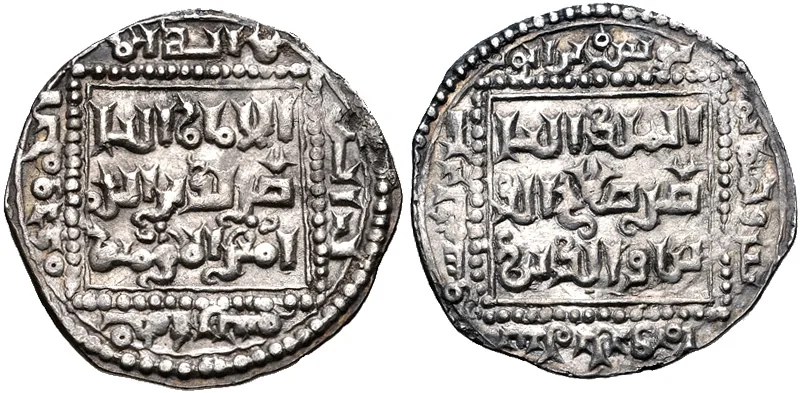
Ayyubid coin of Saladin, Damascus, AH 583 (1187–88). Photo: Classical Numismatic Group (CNG) · CC BY-SA 2.5 · Source page
For twelve years Saladin fought mostly other Muslims, Nur ad-Din’s heirs and the rulers of Mosul. He called it the unity of Islam; his rivals called it ambition. In March 1186 Mosul made peace and sent him troops: Egypt, Damascus, Aleppo and Mosul now answered to one man.
The Franks were going the other way. Their leper king, Baldwin IV, who had routed Saladin at Montgisard in 1177, died in 1185. In 1186 his sister Sibylla was crowned, and crowned her husband, Guy of Lusignan, a knight from Poitou. Raymond III, count of Tripoli, twice the kingdom’s regent, refused to accept him, and from his town of Tiberias treated Saladin as a neighbour.
Source: A caravan in time of truce
Baha ad-Din, Saladin’s biographer: “A caravan coming from Egypt, and taking advantage of the truce, ... this man set upon them, in defiance of his oath, and killed (a number) of them.”
*The Itinerarium, an English crusader’s chronicle:* “... a large and wealthy caravan of Mahometans were passing from Damascus to Egypt, and, trusting to the truce, ... the aforesaid prince suddenly attacked them, and dishonourably carried them off prisoners ...”
Reynald of Châtillon, lord of the castle of Kerak, sat on the road between Egypt and Syria. In late 1186 or early 1187 he seized a caravan. King Guy ordered him to give it back; he refused. Saladin swore to kill him with his own hand.
- One writer served Saladin; the other hated him. What do they agree on? On the core: a caravan, a truce, and Reynald breaking it. When a hostile source confirms the other side, the fact is much stronger.
- Where do they differ? On the details: where the caravan came from, and whether Reynald killed the travellers or took them prisoner.
The road to Tiberias
Spring 1187
The spring of Cresson
At the end of April 1187 Saladin’s son al-Afdal asked Raymond’s leave for a large force to cross Galilee for one day, and Raymond agreed. On 1 May, at the spring of Cresson near Nazareth, the Masters of the two military orders, the Templars and the Hospitallers, attacked it with about 130 knights. Almost all were killed. Gerard of Ridefort, Master of the Temple, escaped wounded.
After the disaster Raymond made peace with the king. In June the whole army gathered at the springs of Saffuriyah: about 1,200 knights, light horsemen called turcopoles, and thousands on foot, paid from Henry II of England’s treasure. From Jerusalem came the True Cross.
A decision point
You are Saladin.
Early July 1187, the hills of Kafr Sabt, west of the Sea of Galilee
You have crossed the Jordan with perhaps 12,000 regular horsemen and many volunteers. The Frankish army sits by the springs of Saffuriyah, about 15 kilometres west, with all the water it needs. You have offered battle; it did not move.
Between you lies a dry plateau in high summer, and an army like yours melts away if it waits too long. Close by, on the lake, lies Tiberias, Raymond’s town; his wife is inside.
What do you do?
- Attack their camp at Saffuriyah You would fight where the enemy has water and you have none, against heavy cavalry waiting for you. The Franks have won battles like that before.
- Raid deep into Galilee and let them chase you Plunder would pay your army, and the Franks might follow you onto ground of your choosing. Or they might simply wait, as they did in 1183, until your army goes home.
- Storm Tiberias and wait for them to come to its rescue You strike at something the Franks will find hard to abandon. If they march to save it, they must cross the dry plateau in July, under your archers.
What really happened
Storm Tiberias and wait for them to come to its rescue
On Thursday 2 July (by the Latin sources) Saladin attacked Tiberias and took the town; Baha ad-Din says it fell within an hour. The citadel held out under Raymond’s wife, Eschiva, who sent to the king for help.
He wanted a battle on his own terms. In the Libellus he says of the defenders in the citadel: “So be it! They are my prisoners.” Yet Baha ad-Din writes that on the night before the final fight his men “felt that God alone was able to save them”.
Raymond III of Tripoli
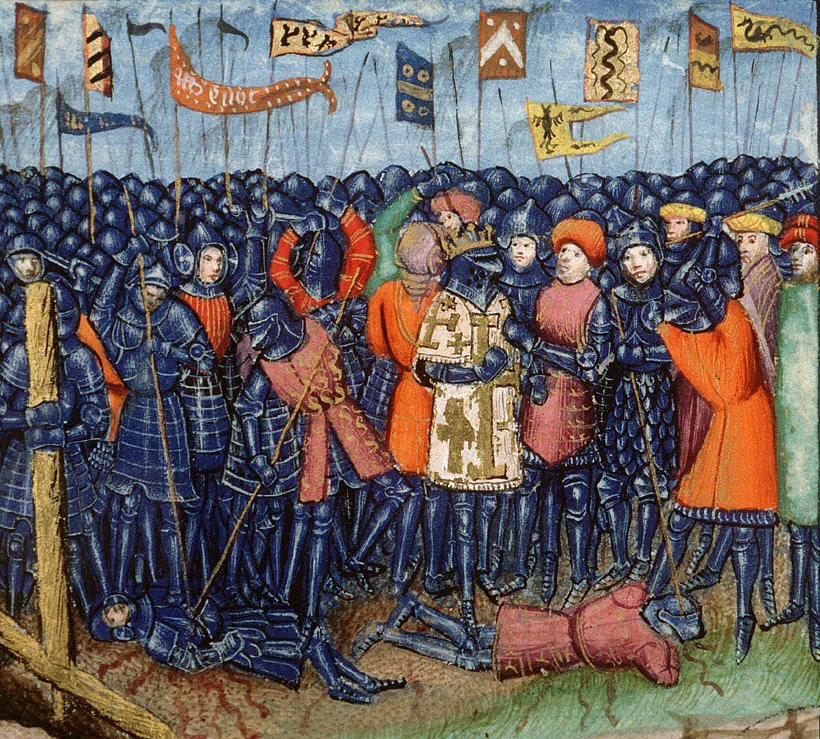
Anonymous, Guillaume de Tyr, Histoire d’Outremer, Amiens, Bibliothèques d’Amiens Métropole, Ms. 483, f. 202, 1440–45 · Public domain · Source page
Count of Tripoli and lord of Galilee, who made his own peace with Saladin, warned the army not to march, and was called a traitor when it was lost.
- Born: 1140
- Died: September or October 1187, Tripoli, of pleurisy, says Baha ad-Din
- Won: A four-year truce with Saladin, as regent, 1185
- Lost: Harim, 1164: captured; Marj Ayyun, 1179: fled to Tyre; Hattin, 1187: broke out and escaped
“Between this place and Tiberias,” he said, “there is no water. We shall all die of thirst before we get there.”
Thursday night, 2 July
The council at Saffuriyah
On Thursday evening the king called his barons. Raymond spoke first, as Ernoul tells it: let Tiberias fall. In an 1898 English version: “Better,” said Raymond, “that my city of Tiberias fall, and my wife and all I possess be taken by the Saracens, than that the whole land be lost ...”
The barons agreed, and so did the king. But late that night Gerard of Ridefort came to Guy’s tent. Would the king trust a traitor? Would a newly crowned king, with such an army, let a town six leagues away be lost?
A decision point
You are Guy of Lusignan, King of Jerusalem.
Near midnight, Thursday 2 July 1187, the camp at Saffuriyah
You were crowned ten months ago, and some of the greatest barons did not want you. This evening the council agreed with Raymond: stay by the water.
Now Gerard stands in your tent; his order paid your army. He says Raymond is a traitor, and that the Templars would sooner sell their white mantles than bear this shame. Four years ago, as regent, you were dismissed for not fighting Saladin.
What do you order?
- Keep to the council’s plan: stay at the springs Tiberias and Eschiva would probably fall. Your army would stay whole, by water, and Saladin would have to attack you or go home. But Gerard and others would call you a coward, and your crown is not yet secure.
- March at dawn with the whole army to relieve Tiberias You would answer the call of honour and show that you are king. But the whole army would cross a dry plateau in July, under attack all the way.
- Send only the knights, fast, and leave the foot at the springs Knights could ride the distance in half a day. But without the foot soldiers and their bows to shield the horses, Saladin’s horse archers could wear them down.
What really happened
March at dawn with the whole army to relieve Tiberias
Guy gave the order to march. Before dawn on Friday 3 July the trumpets sounded. Raymond led the vanguard, the king the centre with the True Cross, the orders the rear.
The sources that blame Gerard were written after the disaster. B. Z. Kedar argues the army could not have stayed at the small Tur’an spring; Lyons and Jackson call Guy’s advance a sound probe that failed because he underestimated the Muslim force.
Saturday, 4 July
The ground
A plateau without water
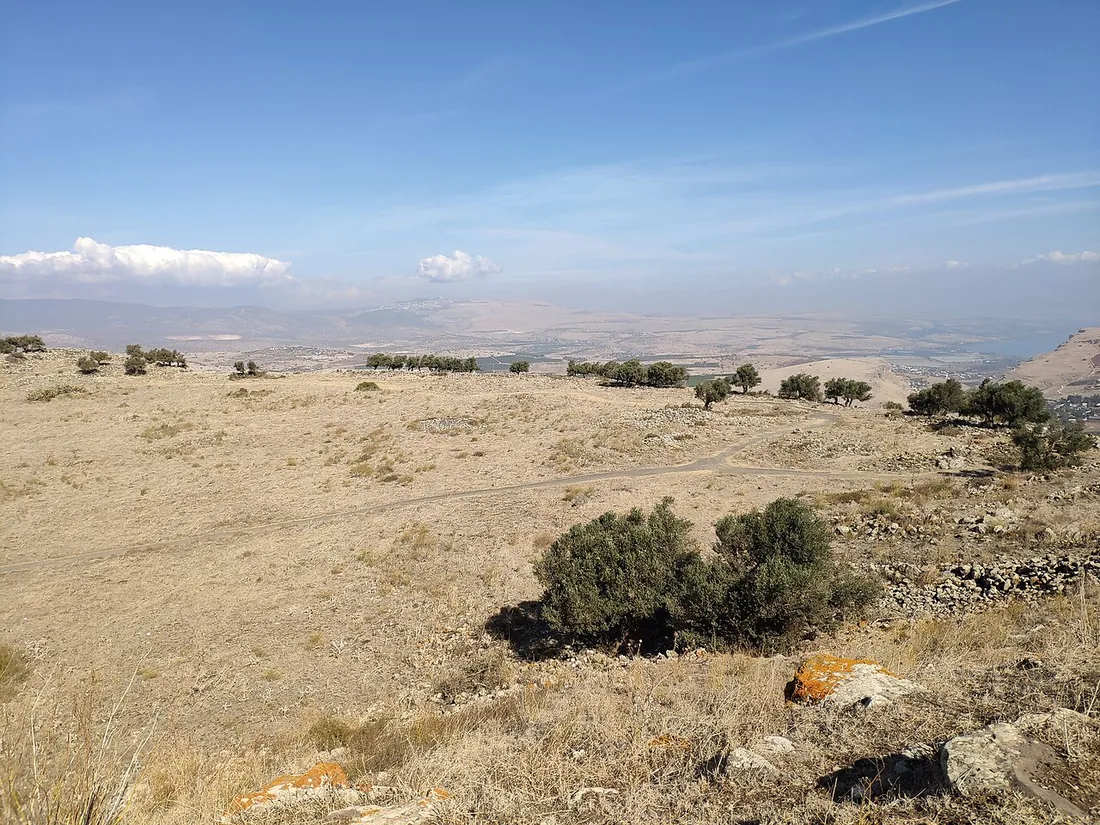
The crater of the Horns of Hattin, looking east. Photo: Shayshal2, 29 November 2019 · CC BY-SA 4.0 · Source page
From Saffuriyah to Tiberias is about 25 kilometres as the crow flies. The road crosses a plateau, then drops to the lake, below sea level. In July the fields were dry grass, and the one spring on the way, at Tur’an, was far too small for thousands of men and horses.
Above the road, about seven kilometres west of Tiberias, rises an old volcano with two peaks: the Horns of Hattin. The battle did not begin there. That is where it ended.
Hattin: who fought whom
Friday 3 – Saturday 4 July 1187
The plateau west of Tiberias, as far as the Horns of Hattin
The Kingdom of Jerusalem
- Commanders: King Guy, with the True Cross, Raymond of Tripoli, in the vanguard, Gerard of Ridefort and the military orders, in the rear, Reynald of Châtillon, Balian of Ibelin and the other barons
- Strength: 1,200 knights, “innumerable” turcopoles, 18,000 or more foot (The Libellus (written within a few years)); 50,000 (Imad ad-Din); from about 15,000 to 20,000 (Modern estimates)
- Losses: “a whole multitude” killed; 230 Templar brothers beheaded, “as we verily believe” (The letter of the Templar Terricius, 1187); most of the army killed or captured; no reliable count (Muslim and Latin writers)
Saladin’s army
- Commanders: Saladin, in the centre, His nephew Taqi ad-Din and Gökböri, lord of Harran, on the wings, His son al-Afdal, aged about 17, at his side
- Strength: 12,000 regular horsemen, besides volunteers (Imad ad-Din, his secretary); about 20,000–40,000 in all (Modern estimates)
- Losses: no figure (The sources)
Imad counted the paid horsemen, the core of the army; nobody counted the volunteers and the foot.
Outcome: A crushing victory for Saladin. The king, the True Cross and many of the leading barons were taken; the kingdom’s field army was gone.
Medieval numbers here are rough: the knights (about 1,200) are probably close; the large totals mean “very many”.
The battle of the Horns of Hattin
Friday 3 – Saturday 4 July 1187
In July 1187 the army of the Kingdom of Jerusalem leaves the springs of Saffuriyah for Tiberias, led by King Guy, with the True Cross in its ranks. The road crosses a dry plateau with a single small spring, and Saladin's horse archers attack the column from the first day.
One reconstruction, after the Latin sources (Ernoul and the Libellus), the Arabic accounts in Baha ad-Din and in Lane-Poole (Imad ad-Din, Ibn al-Athir), and for the ground B. Z. Kedar, “The Battle of Hattin Revisited” (1992). Places are drawn from their coordinates on a modern map (the Horns of Hattin, Hittin, Lubiya, Tur’an, Kafr Sabt, Tiberias, Mount Arbel, the shore of the lake); 1 km is 40 map units. The camp at Maskana is placed from Kedar’s distances (about 2 km north-west of Lubiya), to within about half a kilometre. North is up.
Disputed: the route (Kedar’s northern Roman road, or a southern one after Prawer); whether the Franks were making for the lake or for the springs of Hattin; who ordered the halt at Maskana (the king in the Libellus, Raymond’s advice in Ernoul); when the grass was fired (at night in the Libellus, in the morning in Ernoul); whether Raymond charged on the king’s order; which division Balian rode with; which emir held which Muslim wing; and all the numbers. Unit sizes are not to scale.
Phases of the battle
- Friday morning: the march The army leaves the springs of Saffuriyah at dawn: Raymond in front, the king and the Cross in the centre, the orders behind. Horse archers attack the column from the start.
- Friday afternoon: past the spring At noon the column passes the spring of Tur’an and moves on. Saladin’s wings close in on both sides. By evening the army has covered barely half the way.
- Friday night: no water The army halts at Maskana, on the open plateau, without water. All night the Muslims surround the camp; the Libellus says they set the dry scrub alight all around.
- Saturday morning: the break At dawn the Franks push east. The foot soldiers break and climb the Horns. Raymond charges; the Muslims open their ranks, let him through and close again. He rides away.
- Midday: the last stand The king’s knights stand on the Horns, around the red royal tent. Twice they charge down, almost reaching Saladin. Then the tent falls; the Cross is taken, the king captured.
The strategy
- The Franks: The Franks march in column: Raymond in the vanguard, the king and the Cross in the centre, the orders at the rear, towards Tiberias. The sources disagree on whether they were making for the lake or for the springs of Hattin, and on who ordered the halt at Maskana.
- Saladin’s army: Saladin sends his horse archers to attack the column from the start, his wings close in on both flanks, and his men surround the camp at Maskana all night. The army is left without water. The sources differ on whether the dry scrub was fired at night or in the morning.
What decided it: The army was weakened before the fighting: a day's march across a dry plateau, then a night surrounded without water at Maskana. When the foot broke at dawn, the king's knights, standing on the Horns, could not break out either. Thirst and encirclement decided it.
Source: “So long as that tent stands”
Al-Afdal, Saladin’s son, as Ibn al-Athir reports him: “... Again I shouted, ‘We have routed them!’ But Father turned to me and said: ‘Hold thy peace! We have not beaten them so long as that tent stands there.’ At that instant the royal tent was overturned.”
Baha ad-Din: “The Moslems hemmed them in, and lighted fires all round them, so that, tortured by thirst and reduced to the last extremity, they gave themselves up to escape death.”
Al-Afdal, about 17, watched the king retire to the hill and his knights charge twice. Ibn al-Athir wrote his story down about 1231. Baha ad-Din was not there.
- Al-Afdal is an eyewitness. Why still be careful? He was a boy, telling it long afterwards, through another writer and a translator. “At that instant” is a storyteller’s touch. The words are not a recording.
- What do the Muslim and the Latin writers agree on? On the thirst, the fires, the foot soldiers fleeing up the hill, and a last stand around the king’s tent. When enemies tell the same story, it is probably close to what happened.
Evening, 4 July
The sultan’s tent
Saladin said that the king had given Reynald the drink, not he: by Arab custom, a captive who has eaten or drunk of his captor’s food is granted his life. He reminded Reynald of his crimes and offered him Islam. Reynald refused. Saladin struck him with his sword, and the guards finished him.
Over the next day or two Saladin had the captured Templars and Hospitallers beheaded; one Templar’s letter says 230 brothers of his order, as he believed, were beheaded. Gerard, their Master, was spared. Most ordinary prisoners were sold as slaves.
Myth
At the Horns of Hattin a small Muslim army sprang a trap on the crusaders in the hills.
The truth
Saladin probably had more men. He did try to lure them out: he attacked Tiberias to make them leave their water. But he did not hide in the hills. The trap was the waterless march the Franks chose themselves, and the battle began on the open plateau, kilometres west of the Horns.
The evidence
Baha ad-Din: the enemy “were not moving”, so Saladin went down to Tiberias; B. Z. Kedar (1992), who has him trying to draw the Franks into a decisive battle.
Myth
Raymond of Tripoli betrayed the army to Saladin.
The truth
The charge was made by Latin writers in the years after the battle. Raymond had in fact advised against the march. The Templar Terricius, who escaped the field, wrote that he got away together with Raymond, Reynald of Sidon and Balian, and accused nobody. His separate peace with Saladin made the rumour easy to believe. Accused, not proven.
The evidence
Roger of Howden: “the designer of this treachery”; Terricius’s letter, in the same chronicle, says nothing of the kind.
Myth
Saladin sent the True Cross to Baghdad, where it was buried under a gate.
The truth
That is one story among several. The Cross was carried into battle by the bishops of Acre and Lydda; the bishop of Acre was killed and the Cross taken. From there it vanishes into conflicting rumours. Nobody knows what became of it.
The evidence
Lane-Poole (1898) sums up the muddle: “There were doubtless several ‘True Crosses’—and imitations.”
July–September 1187
Less than three months
The kingdom had emptied its castles to fill the army. The citadel of Tiberias surrendered the next day, Acre within a week, then Nablus, Haifa, Caesarea, Sidon and Beirut. Among the ports only Tyre held, because Conrad of Montferrat sailed in from Constantinople and took command.
On 20 September, less than three months after Hattin, Saladin stood before Jerusalem.
Jerusalem
Balian of Ibelin
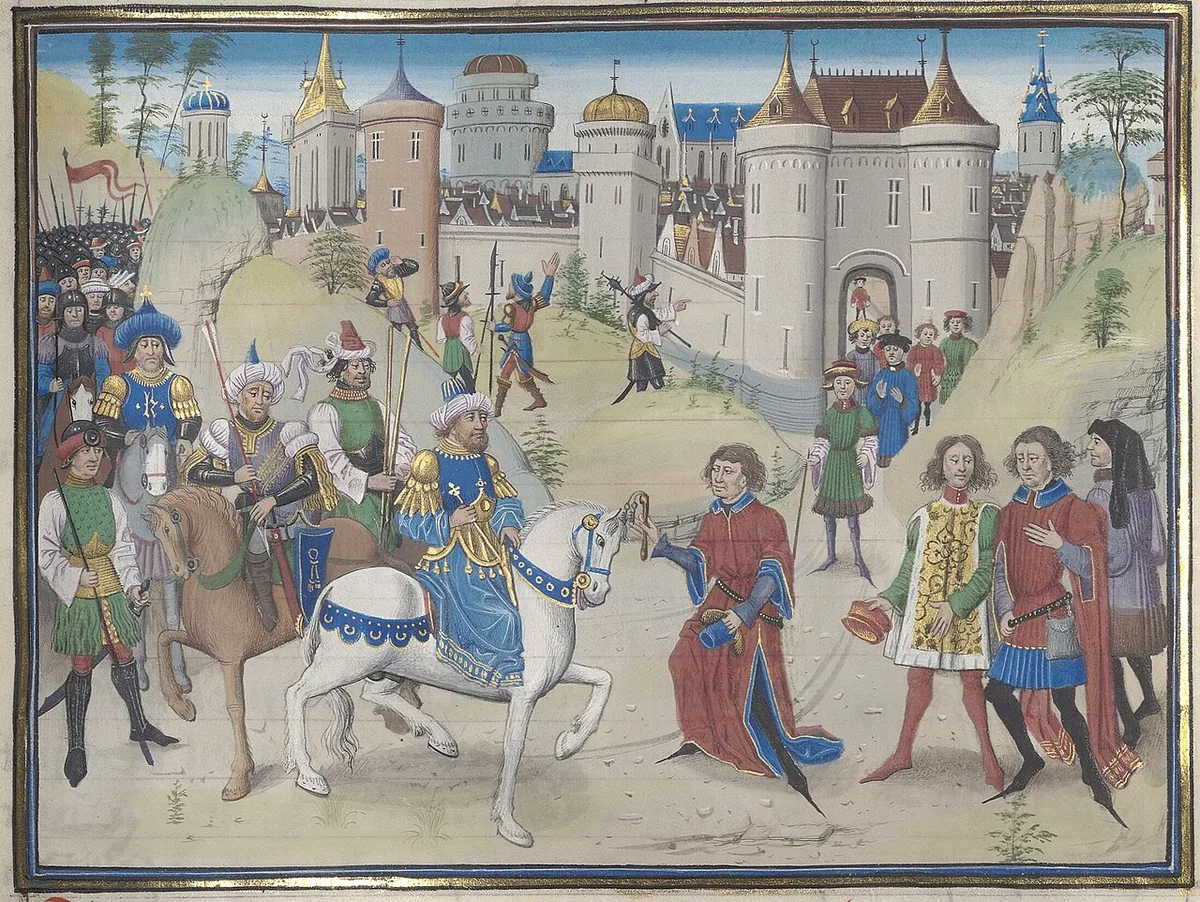
Loyset Liédet, in David Aubert, Chroniques abrégées, Paris, Bibliothèque de l’Arsenal, Ms. 5090 réserve, f. 144, 1462 · Public domain · Source page
A great baron of the kingdom who escaped from Hattin, broke his oath to Saladin to defend Jerusalem, and bargained with him for the lives of its people.
- Born: c. 1143 (not known for certain), The Kingdom of Jerusalem; the family took its name from the castle of Ibelin, near Jaffa
- Died: 1193
- Won: The surrender terms of Jerusalem, 1187: many thousands went free
- Lost: Hattin, 1187: escaped; Jerusalem, surrendered on terms, 2 October 1187
“But for ourselves, when we see that death must needs be ... we will sally out in a body to you, and will fight you for our lives.”
A decision point
You are Balian of Ibelin.
Summer 1187, Tyre, then Jerusalem
You escaped from Hattin to Tyre. Your wife, Queen Maria, and your children are in Jerusalem. Saladin gave you a safe-conduct to fetch them, on two conditions: you will stay one night, and never bear arms against him again. You swore.
In Jerusalem the people beg you to stay and lead them. The city is full of the widows and orphans of Hattin, and there are hardly any knights. The Patriarch Heraclius says he will release you from your oath.
What do you do?
- Keep your oath: take your family and leave Your honour with Saladin would stand, and your family would be safe. Jerusalem would be left with almost no leader, and would probably fall sooner, perhaps by storm.
- Stay and lead the defence, released by the Patriarch The city gains a commander. But you break your word to the man who trusted you, and if the city is stormed, you may die in it.
- Stay, but only to arrange a surrender You might save lives quickly. But the citizens want to fight, and a commander who talks of surrender at once may lose them.
What really happened
Stay and lead the defence, released by the Patriarch
Balian stayed. The Patriarch, in Lane-Poole’s version of Ernoul, told him it was an oath “which it were a greater sin in you to keep than to break”. Balian knighted dozens of townsmen and wrote to Saladin to excuse himself. The sultan sent fifty horsemen to escort his family to Tripoli.
The story comes from Ernoul, Balian’s own squire. He admits that the oath was broken, and gives the Patriarch’s absolution as the excuse. Both sides in this lesson broke oaths.
Jerusalem: who faced whom
Sunday 20 September – Friday 2 October 1187
The walls of Jerusalem
The defenders of Jerusalem
- Commanders: Balian of Ibelin, The Patriarch Heraclius
- Strength: two knights, and thirty townsmen whom Balian knighted (Lane-Poole, after Ernoul); fifty knights (Conder (1897)); over 60,000 soldiers in the city, not counting women and children (Baha ad-Din)
- Losses: not counted (The sources)
Saladin’s army
- Commanders: Saladin, His brother al-Adil
- Strength: about 10,000 horsemen guarding the gates, and 10,000 or more archers (The Libellus); no figure for the whole army (The sources)
- Losses: no figure (The sources)
Outcome: Jerusalem surrendered on terms on Friday 2 October 1187. Those who could pay went free; many thousands who could not were enslaved.
Baha ad-Din calls the 60,000 “soldiers, both horse and foot”, but the Libellus and Ernoul describe almost no real fighters, so his figure is not credible: by the end, says the Libellus, “scarcely twenty or thirty men” appeared on the walls.
The siege of Jerusalem
20 September – 2 October 1187
Less than three months after Hattin, on 20 September 1187, Saladin's army camps west and north-west of Jerusalem, facing the wall between David's Gate and St Stephen's Gate. The city is crowded with refugees, and its defence is in the hands of Balian of Ibelin and the Patriarch Heraclius.
After the Libellus (written by a defender), Baha ad-Din, Lane-Poole’s versions of Ernoul and the Arabic writers, and the Old French text of Ernoul. The city is drawn on the same stylised plan as the 1099 siege in the first lesson of this series (after Herder, 1831), so that the two can be compared; it is not a survey. North is up; positions are approximate.
Disputed: where exactly Saladin’s camps stood on each day (the Libellus names the Valley of Jehoshaphat, the Mount of Olives and Montjoie (“Mount Joy”); Baha ad-Din says north of the city); the exact place of the breach; the dates of Balian’s visits; and the size of the garrison. In 1187 the Franks called the north gate (today’s Damascus Gate) St Stephen’s Gate. As in 1099, the decisive attack came from the north-east; unlike 1099, it came by mining, not by siege tower.
Phases of the battle
- 20 September: from the west Saladin camps on the west and north-west, facing the wall from David’s Gate to St Stephen’s Gate. The city is crowded with refugees.
- Five days without success Sorties and arrows every day. The towers of David and Tancred command the attackers, and the sun is in their eyes.
- Night of 25 September: the move Saladin moves his camp by night to the north-east. The defenders cheer, sure he has gone. At dawn his banners are on the Mount of Olives.
- 29 September: the breach Under stones and arrows, sappers dig beneath the north-east corner and fire their mine. Thirty or forty paces of wall fall. The defenders beat back the first assault.
- 2 October: terms Balian rides out to Saladin’s tent. After days of bargaining the city surrenders on Friday 2 October; only those who have paid may leave.
The strategy
- Saladin’s army: Saladin makes no progress under the west wall, where the towers command his attackers and the sun blinds them. He moves his camp by night to the north-east, where his sappers dig a mine under the north-east corner. The sources disagree on where the camps stood, day by day.
- The city’s defenders: The defenders rely on the walls and on the towers of David and Tancred, which command the attackers; they sortie and shoot arrows every day. When Saladin left his camp by night, they cheered, sure that he had gone.
What decided it: The mine under the north-east corner decided it: after five days without success, the sappers breached the wall at a different place. The defenders beat back the first assault, but the city had almost no real fighters left to hold the breach.
Source: One meeting, three versions
Ibn al-Athir, as Lane-Poole gives it: “... by God we will slaughter our sons and our women, we will burn our wealth and our possessions, and leave you neither sequin nor stiver to loot ... we will demolish the Rock and the Mosque el-Aksa ...”
*The Libellus, written by a defender:* the citizens offer money, are refused, and send to ask Saladin what terms he wants. If possible they would comply; “if not, they would hold out to the death.”
The third version, by Balian’s squire Ernoul, has no threat at all: Balian begs for mercy, and Saladin comes down from 20 bezants a man to 10 when Balian tells him the city is full of the poor.
- Which version is “true”? We cannot tell. The threat appears only in Ibn al-Athir and Abu Shama, who wrote decades later and were not in the city. Balian may have bluffed, or the threat may have grown in the telling.
- What does each version explain? The Arabic version explains why Saladin gave terms: he faced a last stand that would destroy the holy places. Ernoul explains it by pity and arithmetic. Each suits its own side, and all agree the city surrendered for ransom.
A decision point
You are Saladin.
Late September 1187, your tent before Jerusalem
Your miners have broken the wall. Before the siege you offered the city terms; its people refused, and you swore to take it by the sword.
Now Balian asks for terms. Your army has been in the field for three months. Inside the walls are Muslim prisoners, the Dome of the Rock and the al-Aqsa mosque. Your advisers say a vow can be kept in more than one way.
What do you decide?
- Keep your vow to the letter: storm the breach The city would probably fall within days. But a city taken by storm usually meant killing and plunder, the holy places might be damaged, and your own men would die in the breach.
- Accept surrender as if the city had been taken, and let its people buy their freedom You keep the letter of your vow, take the city undamaged and gain money for your army. But those who cannot pay remain your captives, and the Franks will remember both your mercy and their slavery.
- Leave a blockade and march on Tyre Tyre is one of the Franks’ last great ports, and it grows stronger every week. But a blockade could take months, and the prize of Jerusalem would slip away from you.
What really happened
Accept surrender as if the city had been taken, and let its people buy their freedom
The city surrendered at his discretion on Friday 2 October, as though taken by assault, and so his vow was kept. Each man would pay ten dinars, each woman five, each child one, within forty days. Balian bought the freedom of 7,000 poor people for 30,000 bezants.
Baha ad-Din notes that 2 October was the anniversary of the Prophet’s Night Journey and Ascension, a “wonderful coincidence”. It was a bargain as much as mercy: a city undamaged, a vow kept in letter, and a treasury of ransoms, which Saladin then gave away.
October 1187
Forty days
There was no massacre. Saladin’s guards kept order. His brother al-Adil asked for a thousand of the poor as his share and set them free; old people who could not pay were let go too.
But when the forty days ran out, somewhere between 11,000 and 15,000 people were still unransomed, and they were taken as slaves. Eastern Christians were allowed to stay if they paid a tax.
The cross on the Dome of the Rock was thrown down. On Friday 9 October a qadi preached in the al-Aqsa mosque, thanking God for bringing back “this strayed camel” to Islam after nearly a hundred years.
Myth
Saladin was a tolerant, chivalrous hero who never broke his word.
The truth
He could be generous. But he beheaded the captured knights of the orders, struck Reynald down himself, by most accounts, and enslaved thousands at Jerusalem. In 1191 he had a young Sufi philosopher, al-Suhrawardi, put to death; in Baha ad-Din’s words he “detested philosophers, heretics, materialists”. And he swore that he came as the servant of Nur ad-Din’s heir, and took his lands. The flawless knight was built later, from the 1200s on: by Latin and French writers, Dante, Walter Scott and Victorian historians.
The evidence
Baha ad-Din, The Life of Saladin, pp. 9–11 in the 1897 translation; Jonathan Phillips, The Life and Legend of the Sultan Saladin (2019).
After the Horns
Source: The news reaches the pope
“On hearing of the severity of the tremendous judgment which the hand of God has inflicted upon the land of Jerusalem, ... it did not readily suggest itself to us what we were to do.”
“... the Cross of our Lord was captured, the bishops slaughtered, the king made prisoner, and nearly all either slaughtered with the sword or taken by the hands of the enemy.”
Urban III had died on 20 October, grieving at the news. His successor sent out this letter within days, calling for a new crusade.
- Whose fault is the defeat, according to the pope? God’s judgement on sin, and the Christians’ quarrels. Saladin’s skill does not appear. And sin can be undone by repentance, and by a crusade.
- Why does the Cross come first in the list of disasters? For Latin Christians the capture of the Cross was a worse humiliation than the king’s: a wound to all Christendom.
After Hattin
- 1187–1188 Saladin besieges Tyre, and fails.
- 1188 The kings of England and France take the cross; England levies the “Saladin tithe”. Guy is released.
- 1189–1191 Guy besieges Acre; the Third Crusade retakes it.
- 1192 Treaty of Jaffa: Jerusalem stays with Saladin; Christian pilgrims may visit.
- 1193 Saladin dies in Damascus in March, leaving, says Baha ad-Din, 47 silver dirhams and one gold coin.
- 1291 Acre, the last great Frankish city, falls to the Mamluks.
Voices
Who is missing
Almost every voice in this lesson belongs to a soldier, a courtier or a churchman. The Eastern Christians of Jerusalem stayed under Muslim rule, as their ancestors had before 1099; their own chronicles of these years are rarely translated.
Under the Franks few Jews had lived in Jerusalem. Under Saladin and his heirs Jews were allowed to settle in the city again, and a community grew there in the following decades; the poet Judah al-Harizi visited it around 1216–1218. The popular claim that Saladin invited the Jews back by proclamation rests only on what al-Harizi was told some thirty years later; no document survives.
Why did it happen?
Was Hattin a blunder, a gamble, or the fruit of a holy war that had been building for decades?
- The “two parties”: Marshall W. Baldwin (1936), Steven Runciman (1952) Following William of Tyre and Ernoul, they saw two camps: native barons like Raymond, who wanted to live with their neighbours, and reckless newcomers like Gerard, Reynald and Guy, whose aggression lost the kingdom.
- Revision: Bernard Hamilton (2000), Malcolm Barber (2012) The picture is too neat. Barber, for example, writes that Raymond’s actions were usually driven by his own ambitions and needs, and the sources that made him wise (William of Tyre, Ernoul) were written by his friends. The kingdom’s leaders split over interests, not simply over origins.
- Politics or faith: Lyons and Jackson (1982); Carole Hillenbrand (1999) Malcolm Lyons and D. E. P. Jackson read Saladin’s career mainly as a ruler’s politics, with holy war as its banner. Carole Hillenbrand follows the idea of jihad through the whole century and takes its religious force seriously, while reminding us that Saladin’s own secretaries wrote most of the evidence.
- John France, Hattin (2015) The Franks lost through their own rivalries and a weak king. And Saladin did not finish the job: he failed to take the coast, and so the crusaders could come back.
Was the kingdom bound to fall? It had lived through hard defeats before, such as Marj Ayyun and Jacob’s Ford in 1179, and the coast survived Saladin. But after 4 July 1187 it had no field army left. Historians still argue how much was chance and how much had been long in the making.
What do you know now?
Check yourself
Why was the march of 3 July so dangerous?
Answer: The road crossed a dry plateau in July, far from water. Right. Raymond warned there was no water on the way, and the spring at Tur’an was far too small. Thirst wore the army down before the battle began.
Check yourself
Baha ad-Din and the English Itinerarium were on opposite sides. What do they agree on?
Answer: That Reynald attacked a caravan during a truce. Right. A Muslim source and a hostile crusader source agree on the core: a caravan, a truce, and its breach. That is the strongest kind of evidence.
Check yourself
What did the Templar Terricius write about Raymond of Tripoli?
Answer: That he escaped with him. Right. The writer, a Templar who led the Order while Gerard, who had called Raymond a traitor, was a prisoner, says he escaped with him, and accuses nobody. The charge of treason grew only later.
Check yourself
Balian’s threat to kill the women and children and destroy the holy places appears...
Answer: Only in the Arab writers. Right. The Libellus and Ernoul, written on the defenders’ side, do not mention it. It may have been a bluff, or it may have grown in the telling.
Check yourself
What happened to the people of Jerusalem who could not pay a ransom?
Answer: 11,000–15,000 were enslaved. Right. No massacre, but no full mercy either: the sources differ on the number, not on the fact.
Check yourself
What helped Saladin to attack the kingdom with all his strength in 1187?
Answer: Peace with Mosul in 1186. Right. After twelve years of wars against other Muslims, Egypt, Damascus, Aleppo and Mosul answered to him for the first time. This was one of the things that let him march.
Terms
- jihad Arabic for “striving”; here, armed struggle in God’s cause, which Nur ad-Din and Saladin directed against the Franks. Preachers in Damascus called for it from about 1105.
- sultan Arabic for “power”: the title of a Muslim ruler who held real power, usually in the name of the caliph. Saladin ruled as sultan of Egypt and Syria.
- vizier The chief minister of a Muslim ruler. In Fatimid Egypt the vizier, not the caliph, held the real power.
- caliph “Successor” of the Prophet: the head of the Muslim community. In 1169 there were two: the Sunni Abbasid caliph in Baghdad and the Shi’ite Fatimid caliph in Cairo.
- Franks What Muslims and Byzantines called Western Europeans (in Arabic, Ifranj). The settlers in the crusader states called themselves Franks too.
- military orders Brotherhoods of knights who lived under monks’ vows and fought for the kingdom: the Templars and the Hospitallers. They held castles and great wealth, and answered to their Masters and the pope, not to the king.
- True Cross A large relic believed to be part of the cross on which Jesus died. It was kept in the Holy Sepulchre in Jerusalem and carried before the army in war.
- turcopoles Light horsemen of the Frankish armies, often archers, many of them local Christians. Muslims treated captured turcopoles as renegades.
- regent Someone who rules for a king who is a child, or too ill to rule.
- qadi A Muslim judge who rules by religious law. Baha ad-Din, Saladin’s biographer, was the qadi of his army.
- dinar A gold coin of the Islamic world. The Franks struck gold coins of their own on its model, which they called bezants.
- sherbet A cold, sweet drink made from water, sugar and fruit juice or rose-water.
- Horns of Hattin An old volcano with two peaks, above the road to Tiberias. The battle of Hattin ended there.
- Imad ad-Din Saladin's secretary. He was in the camp at the battle, but wrote to glorify Saladin.
- Baha ad-Din Saladin's qadi, who wrote of him almost as a saint. He met Saladin only in 1188.
- Ernoul Squire of the baron Balian of Ibelin. He wrote a chronicle of the war about forty years after the battle.
- chronicle A book that tells history year by year, usually written by someone who saw or heard about the events.
- Balian of Ibelin A Frankish baron who stayed in Jerusalem after Hattin and negotiated the city's surrender.
- Gerard of Ridefort Master of the Templars at the time of the battle. In the text he tells the king that Raymond is a traitor.
- Sibylla Sister of King Baldwin IV. In 1186 she was crowned queen and crowned her husband Guy.
- Baldwin IV King of Jerusalem who had leprosy. He defeated Saladin at Montgisard in 1177 and died in 1185.
- Raymond III Count of Tripoli, who twice served as regent of the kingdom. He refused to accept King Guy.
- Tripoli A port city in today's Lebanon, the centre of a Frankish county.
- al-Afdal Saladin's son. He asked to cross Galilee, and his force was attacked at the Cresson spring.
- Templars A military order of monk-warriors who fought alongside the Franks in the Holy Land.
- Hospitallers Another military order of monks, who ran a hospital and also fought against the Muslims.
- Nur ad-Din Ruler of Aleppo and Damascus, who made holy war against the Franks the policy of a state.
- Shirkuh Saladin's uncle. He was sent with Saladin to Egypt and died a few months later.
- Fatimids A Shi'ite dynasty that ruled Egypt. Saladin ended its caliphate in 1171.
- Kurds A people who live in the mountains of the northern Middle East. Saladin was a Kurd.
- Tikrit A town in Iraq on the Tigris river, where Saladin came from.
- Kinneret A freshwater lake in northern Israel, on whose shore Tiberias lay.
- Saffuriyah A village in the Galilee where the Frankish army gathered before the battle, by its springs.
- Acre A port city on the Mediterranean coast of northern Israel. It fell to Saladin within a week.
- bezant A gold coin from the Byzantine world, common in the region in the time of the Crusades.
- Mosul A large city in northern Iraq. After Nur ad-Din died, its rulers took cities for themselves.
Sources
- Baha ad-Din ibn Shaddad, The Life of Saladin, trans. C. R. Conder and C. W. Wilson, Palestine Pilgrims’ Text Society 13 (London, 1897)
- Roger of Howden, Chronica, year 1187, with the letter of Terricius and Gregory VIII’s Audita tremendi, in The Annals of Roger de Hoveden, trans. Henry T. Riley, vol. 2 (H. G. Bohn, 1853)
- Itinerarium Peregrinorum et Gesta Regis Ricardi, Book I, in Chronicles of the Crusades (H. G. Bohn, 1848; reprinted 1888)
- Libellus de expugnatione Terrae Sanctae per Saladinum, extracts trans. James A. Brundage, The Crusades: A Documentary Survey (Marquette University Press, 1962)
- Chronique d’Ernoul et de Bernard le Trésorier, ed. L. de Mas Latrie (Société de l’histoire de France, 1871)
- Stanley Lane-Poole, Saladin and the Fall of the Kingdom of Jerusalem (G. P. Putnam’s Sons, 1898): English versions of passages of Ibn al-Athir, Imad ad-Din and Ernoul
- C. R. Conder, The Latin Kingdom of Jerusalem, 1099 to 1291 A.D. (Palestine Exploration Fund, 1897)
- Benjamin Z. Kedar, “The Battle of Hattin Revisited”, in B. Z. Kedar (ed.), The Horns of Hattin (Yad Izhak Ben-Zvi and Variorum, 1992), pp. 190–207
- Malcolm Cameron Lyons and D. E. P. Jackson, Saladin: The Politics of the Holy War (Cambridge University Press, 1982)
- Carole Hillenbrand, The Crusades: Islamic Perspectives (Edinburgh University Press, 1999)
- Bernard Hamilton, The Leper King and His Heirs: Baldwin IV and the Crusader Kingdom of Jerusalem (Cambridge University Press, 2000)
- Anne-Marie Eddé, Saladin, trans. Jane Marie Todd (Belknap Press of Harvard University Press, 2011)
- John France, Hattin (Oxford University Press, 2015)
- Jonathan Phillips, The Life and Legend of the Sultan Saladin (Bodley Head, 2019)
- Peter W. Edbury, The Conquest of Jerusalem and the Third Crusade: Sources in Translation (Ashgate, 1998)
Image credits
- Matthew Paris, Chronica Majora, Cambridge, Corpus Christi College, MS 26, fol. 140r, 13th century. Photo: Levan Ramishvili · Public domain · Source page
- Engraving in André Thevet, Les vrais pourtraits et vies des hommes illustres (Paris, 1584), p. 627. British Museum 1879,1213.302 · Public domain · Source page
- Ayyubid coin of Saladin, Damascus, AH 583 (1187–88). Photo: Classical Numismatic Group (CNG) · CC BY-SA 2.5 · Source page
- Anonymous, Guillaume de Tyr, Histoire d’Outremer, Amiens, Bibliothèques d’Amiens Métropole, Ms. 483, f. 202, 1440–45 · Public domain · Source page
- The crater of the Horns of Hattin, looking east. Photo: Shayshal2, 29 November 2019 · CC BY-SA 4.0 · Source page
- Loyset Liédet, in David Aubert, Chroniques abrégées, Paris, Bibliothèque de l’Arsenal, Ms. 5090 réserve, f. 144, 1462 · Public domain · Source page


