Hannibal crosses the Alps: from Trebia to Cannae
Elephants in the Alpine snow, three Roman armies destroyed, and one afternoon at Cannae still studied in staff colleges.
Decisions, questions and your own progress, in the app
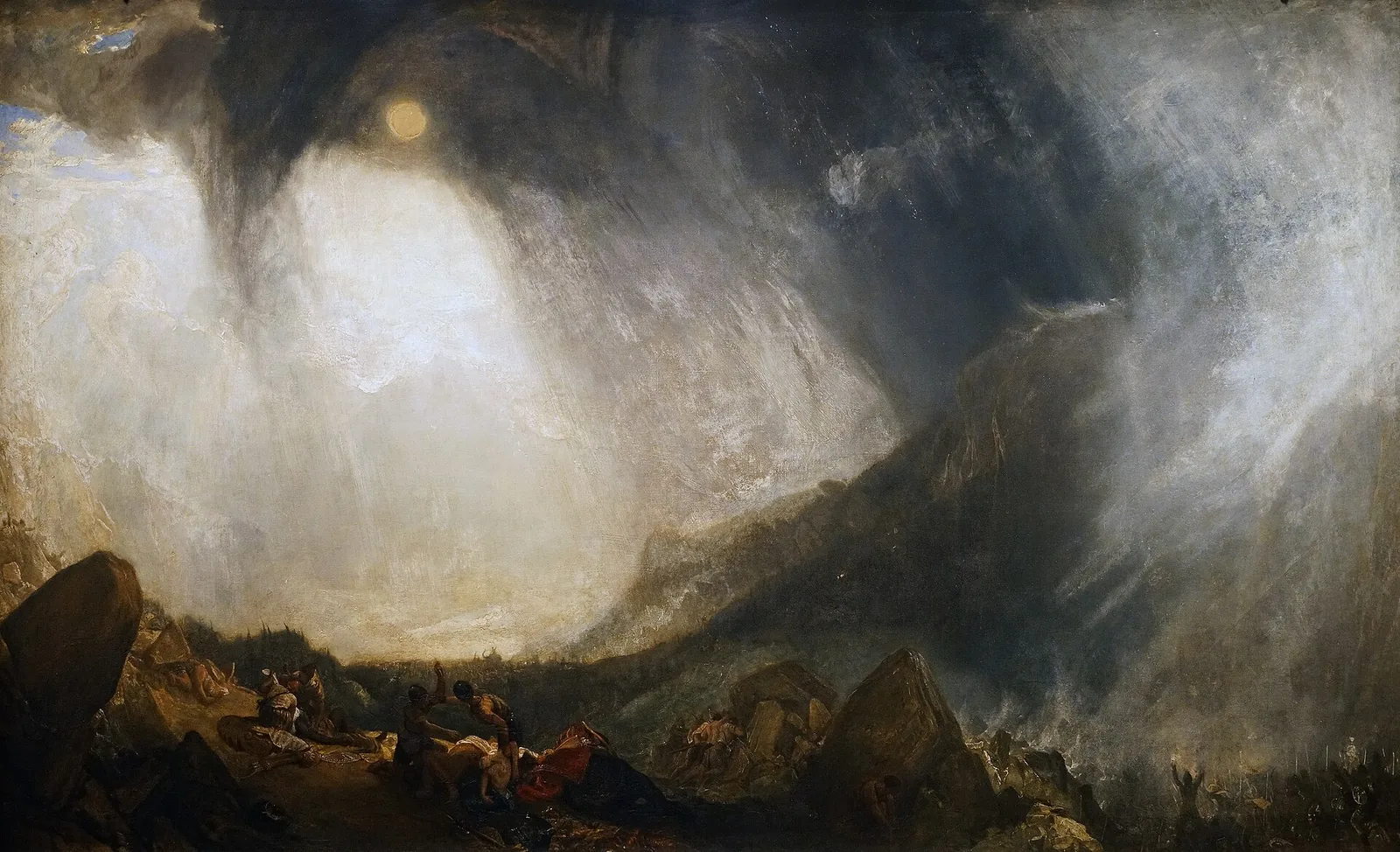
J. M. W. Turner, Snow Storm: Hannibal and his Army Crossing the Alps, 1812. Tate Britain, London. Photo: Steven Zucker · Public domain · Source page
The oath
A boy at the altar
Carthage, 237 BC. A boy of nine stands at an altar, his hand on the body of a sacrificed animal. His father, the general Hamilcar Barca, is about to sail for Spain, and the boy begs to go with him. Hamilcar agrees, on one condition: the boy must swear never to be a friend of Rome.
Nineteen years later the boy, Hannibal, led an army with elephants out of Spain, over the Alps and into Italy. Within twenty months he had destroyed three Roman armies. On one summer day at Cannae about 50,000 Romans and their allies were killed, one of the deadliest days of battle ever recorded.
And still he lost the war. How did he do all that, and why was it not enough?
Who tells the story
Witnesses from the other side
For the oath we have one witness: Hannibal himself. More than forty years later, as an exile at the court of King Antiochus III, he told it to prove that he could never be Rome’s friend. It may be true, but it was told for a purpose.
That is the problem with the whole war. No Carthaginian account survives; even the two Greek historians Hannibal took on campaign are lost. We hear the story from his enemies, or from Greeks writing for them.
The best of them is Polybius, a Greek hostage in Rome who wrote some seventy years after Cannae. He talked to survivors, read Hannibal’s own records, and crossed the Alps to see the route. The other is Livy, a patriotic Roman writing under Augustus, almost two centuries later: vivid, moral, and fond of speeches nobody could have written down. He calls Hannibal brave and tireless, then accuses him of “a perfidy worse than Punic”. At every step, ask: who is telling this, and why?
Hannibal Barca
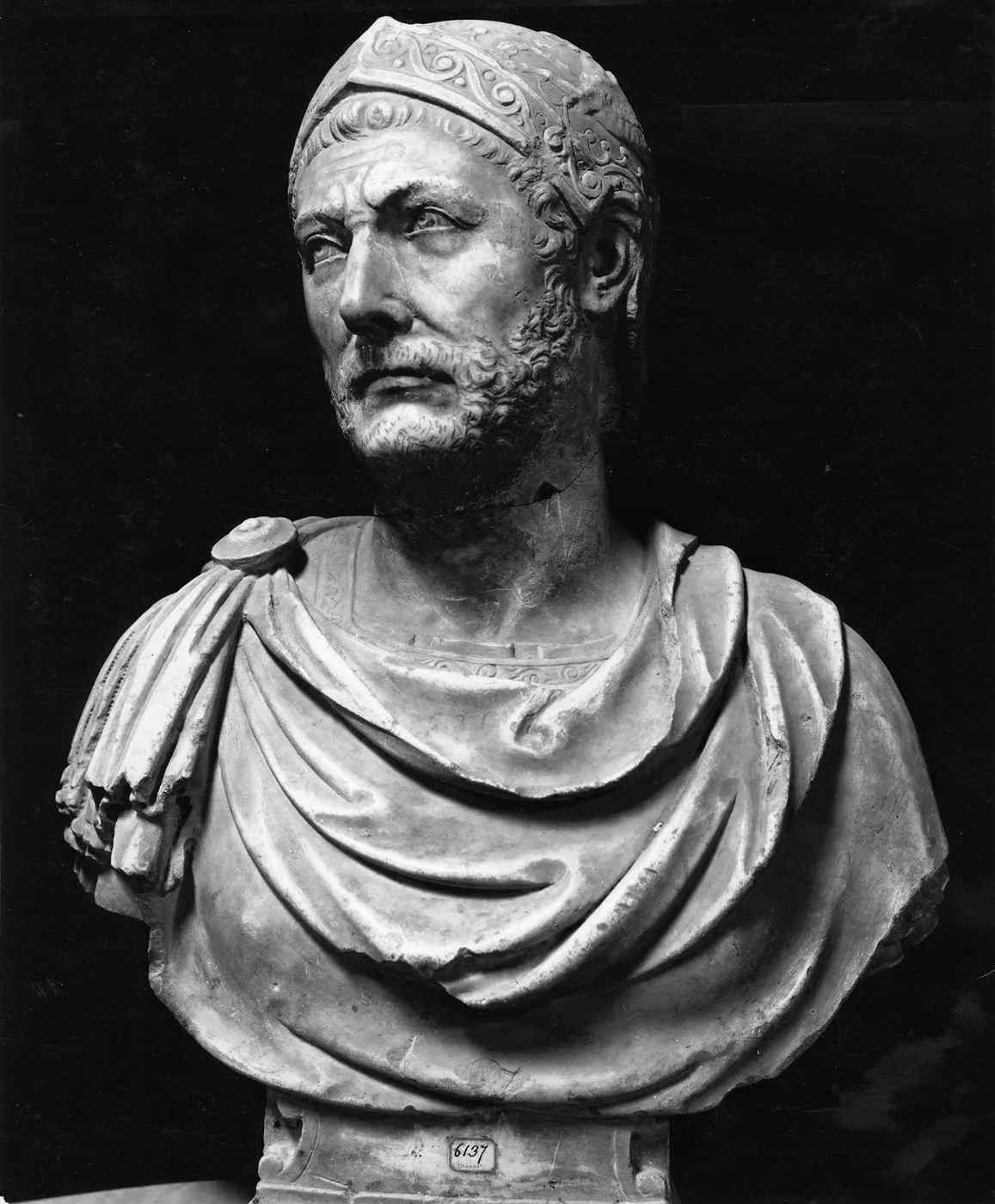
The “Hannibal” bust, National Archaeological Museum, Naples. Photo: Fratelli Alinari, about 1900 · Public domain · Source page
He crossed the Alps, destroyed three Roman armies in twenty months and stayed in Italy for fifteen years, and still lost the war.
- Born: 247 BC (or 248), probably Carthage
- Died: 183 BC (or 182/181), Libyssa in Bithynia (now north-west Turkey), took poison rather than be handed over to Rome
- Won: Siege of Saguntum, 219 BC; Ticinus, 218 BC; Trebia, 218 BC; Lake Trasimene, 217 BC; Cannae, 216 BC
- Lost: Zama, 202 BC; Sea battle off Side, 190 BC, for Antiochus
“He was not come to fight with the Italians, but with the Romans for the freedom of Italy.”
Spain, Saguntum, war
Background
A family empire in Spain
As the previous lesson told, Carthage lost the First Punic War in 241 BC and gave up Sicily. Three years later, just after it had crushed a revolt of its own unpaid mercenaries, Rome took Sardinia too. Polybius thought this, more than anything, made the next war certain.
Hamilcar went to Spain to build a new power: its silver mines and fighting men could pay for an army and fill its ranks. His son-in-law and successor, Hasdrubal ‘the Fair’, founded New Carthage (today Cartagena). When Hasdrubal was murdered in 221 BC, the army chose Hannibal, then about 26, as its general.
219–218 BC
Saguntum
Saguntum, an Iberian town on the coast south of the river Ebro, had put itself under Rome’s protection. Hasdrubal had promised Rome not to cross the Ebro in arms, and Saguntum lay on his side of that line. Was it Carthage’s to take? Each side had its own answer.
In 219 BC Hannibal besieged it. It held out for eight months, and Rome, whose consuls were busy fighting in Illyria, sent no help. The spoils of Saguntum paid Hannibal’s army.
In spring 218 BC Roman envoys came to Carthage. The eldest pointed to a fold of his toga: he carried peace and war in it, they should choose. “Give whichever you like,” said the Carthaginians. He shook out the fold: war.
A decision point
You are Hannibal, general of Carthage’s army in Spain.
Spring 218 BC, New Carthage
Rome has declared war. One consul will sail from Sicily to Africa; the other will land in Spain to attack you. Rome rules the sea: this year it has manned 220 large warships. You have about fifty.
Envoys from the Gauls of the Po valley have come to you. Two of their peoples, the Boii and the Insubres, are furious at the Roman colonies being planted on their land, and they promise guides and warriors if you come.
But Italy by land is about 1,500 kilometres away, through Gaul, over the Rhône and over mountains no one in your army has seen. The summer is short.
How do you fight Rome?
- Take the army to Italy by sea Quick, if it works. But the Roman fleet is far larger, an army at sea can be sunk or caught landing piece by piece, and Carthage lost the last war at sea.
- Stay in Spain and wait for the Romans You fight on ground you know, close to your silver and your recruits. But Rome chooses where and when, and Africa lies open to the consul in Sicily.
- March overland, through Gaul and over the Alps If you get there, the war is in Italy, the Gauls join you, and Rome’s invasion plans collapse. But the march will cost men, and beyond the mountains you will have no road home.
What really happened
March overland, through Gaul and over the Alps
Leaving his brother Hasdrubal to hold Spain, Hannibal set out from New Carthage in late spring 218 BC, fought his way to the Pyrenees and crossed them with about 50,000 foot and 9,000 horse. At the Rhône he had 37 elephants (all figures from Polybius).
The surprise worked: the consul in Sicily was called back to defend Italy, and the invasion of Africa was cancelled.
Polybius insists it was no blind gamble: Hannibal had sent men to learn the route and counted on the Gauls. Most historians agree it was the only way to fight in Italy at all. They argue about the price, and about whether he had a plan for winning once he was there.
Over the Alps
Autumn 218 BC
Elephants on rafts
In late summer the army reached the Rhône. Gauls held the far bank, but a force Hannibal sent upstream by night crossed and took them from behind.
The elephants were ferried on rafts covered with earth to look like solid ground, two females leading. Some panicked and fell in; they walked along the bottom, says Polybius, breathing through their trunks.
The consul Publius Cornelius Scipio, on his way to Spain, reached the crossing three days too late. He then made a choice that mattered for years: he sent his army on to Spain under his brother and went back to Italy himself, to wait for Hannibal there.
The Alps
Fifteen days in the mountains
15 days
It was autumn. On the climb the army was ambushed twice by mountain peoples, the second time by men who had come to it with olive branches and hostages. Men and animals fell from narrow paths. After nine days it reached the top, near the setting of the Pleiades, late October or early November, and snow already lay on the summit.
Hannibal showed his exhausted men the plain of the Po below: Italy. The way down was worse. A landslide had carried away about one and a half stades of path, some 270 metres, and fresh snow lay over old ice. The soldiers built a new ledge: a day’s work for the horses, three more for the elephants, which came through starving.
Fifteen days after the climb began, the army stood in the Po valley. It had left the Rhône with 38,000 foot and over 8,000 horse, says Polybius; Hannibal’s own figures, which Polybius read, give 20,000 foot and 6,000 horse at the end. The rest had died, deserted or been left behind.
Myth
To clear the rock that blocked the way down, Hannibal heated it with fire and split it with vinegar.
The truth
Livy, writing two centuries later, tells it first, and Appian and the poet Juvenal repeat it: the soldiers set the rock ablaze with felled trees, and “when the rock was red hot they poured vinegar upon it to disintegrate it”. Polybius, who walked the route and questioned survivors, says only that the men rebuilt the broken path, and that the heights there were bare of trees.
The evidence
Livy 21.37, trans. W. M. Roberts; Appian, Hannibalic War 4; Juvenal 10.153; Polybius 3.54–55. Cracking rock with fire was a real ancient technique, and Pliny the Elder writes of Spanish miners breaking rock “by the aid of fire and vinegar”. On one boulder, perhaps. As the story of how an army got through, it is Livy’s, not Polybius’s.
November 218 BC
First blood at the Ticinus
Scipio met Hannibal on the plain by the river Ticinus, north of the Po. In a cavalry fight Hannibal’s Numidian horsemen rode round the Roman flanks, and Scipio was badly wounded. Polybius, a friend of the family, says his 17-year-old son, the future Scipio Africanus, saved him; another Roman writer credited a slave.
The Romans fell back to their colony of Placentia (Piacenza). Gauls in the Roman camp went over to Hannibal, and the second consul, Tiberius Sempronius Longus, arrived from Sicily. By December both Roman armies were camped by the river Trebia.
Trebia: who fought whom
December 218 BC
The river Trebia, near Placentia (Piacenza)
Hannibal’s army
- Commanders: Hannibal, Mago, his brother, in the ambush
- Strength: about 20,000 heavy foot, 8,000 light, over 10,000 horse, and elephants (Polybius); about 40,000, including the new Gallic allies (Modern estimate)
- Losses: few, mostly Gauls (Polybius)
In the rain and snow after the battle, all the elephants but one died.
Two Roman consular armies
- Commanders: Tiberius Sempronius Longus, Publius Cornelius Scipio (wounded, in camp)
- Strength: 16,000 Romans, 20,000 allies, about 4,000 horse (Polybius); 18,000 Romans, 20,000 allies, 4,000 horse (Livy)
- Losses: no total; 10,000 broke out to Placentia (Polybius); perhaps 20,000 killed or captured (Modern estimate)
Outcome: A victory for Hannibal. About 10,000 Romans cut their way out to Placentia; most of the rest were killed by the river or taken. Sempronius reported to Rome that a storm had robbed him of victory.
The sources give no figure for the Roman dead. Modern estimates subtract the survivors from the size of the army.
The battle of the Trebia
December 218 BC, near the shortest day of the year
December 218 BC, by the river Trebia. Hannibal, who reached the Po valley after a hard march through the mountains, waits for the Romans on the far side of the river. Both Roman armies are camped by the river, and the weather is cold and wet.
After Polybius 3.70–74 and Livy 21.54–56. The Roman camp on the first hills of the east bank, Hannibal’s camp and the battle itself on the west bank, as in most modern reconstructions (after Kromayer, 1912); some scholars put the Roman camp on the west bank instead. The exact field, the ambush stream and the route of the 10,000 to Placentia are unknown. Placentia lies east of the Trebia, so on this reconstruction the 10,000 must have recrossed the river downstream; that is one reason some scholars put the battle on the east bank. The river is drawn in its modern course; north is to the right; unit depths are exaggerated so that the blocks can be seen.
Phases of the battle
- Dawn: the bait Before breakfast, on a day of sleet, Numidian horsemen cross the Trebia and hurl javelins into the Roman camp. Sempronius sends out his cavalry, then his light troops, then the whole army. In a stream bed with steep, overgrown banks, Mago waits with 2,000 picked men.
- Across the river The Romans wade the river, swollen and breast-high, and form up on the far bank: 36,000 infantry, wet, frozen and unfed. Hannibal’s men, fed and oiled by their fires, come out to meet them, cavalry and elephants on the wings.
- The wings break; Mago strikes Hannibal’s horsemen, ten thousand against four thousand, drive the Roman cavalry off both wings, then turn with the elephants on the open ends of the line. Then Mago’s men rise out of the stream bed and fall on the Roman rear.
- Breakout and rout The Roman centre keeps its order and cuts straight through the Gauls in front of it: about 10,000 men march away to Placentia. The rest, trapped between the enemy and the river, are cut down or drowned.
The strategy
- Hannibal’s army: Hannibal sends Numidian horsemen to bait the Romans, and hides Mago and 2,000 picked men in a steep, overgrown stream bed. His horse, 10,000 against 4,000, and his elephants on the wings are to drive off the Roman cavalry and strike the open ends of the line, while the ambush rises behind.
- Romans and allies: Sempronius answers the raid at once, to drive off the horsemen who threw javelins into his camp: first the cavalry, then the light troops, then the whole army, across the swollen river. This account gives no wider aim.
What decided it: The Roman army, wet and hungry, fought on the far bank with 4,000 horse against 10,000, and after the wings broke Mago rose from the stream bed and struck the rear. The ambush sprang when the enemy was already committed to the river.
Fog, and the Delayer
Spring 217 BC
The road along the lake
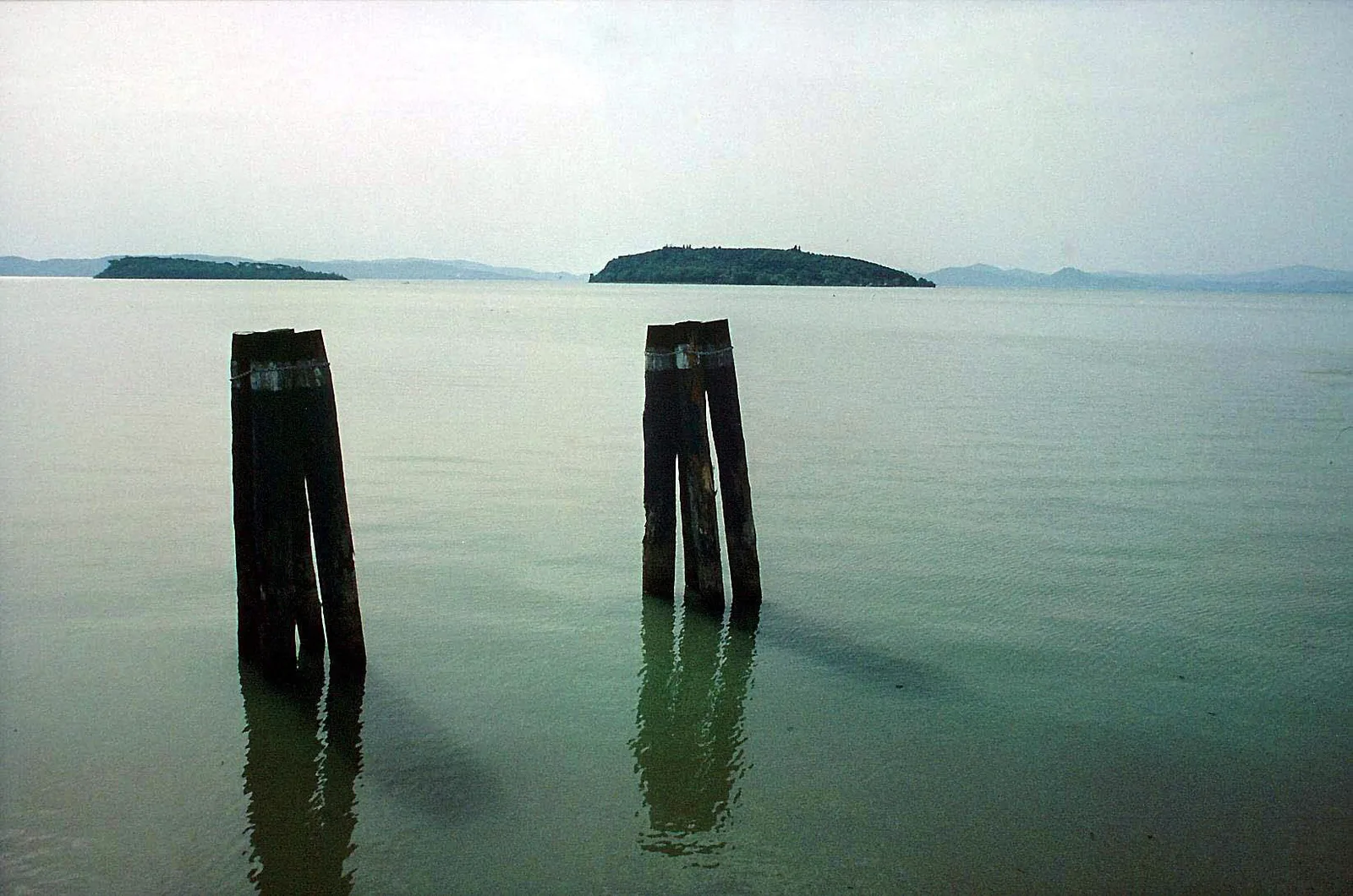
Lake Trasimene from Tuoro, 2003. Photo: Andreas Wahra · Public domain · Source page
In spring 217 BC Hannibal crossed the Apennines by a route the Romans did not expect, through the flooded marshes of the Arno: three days and nights in water, says Polybius. Hannibal lost the sight of one eye to an infection; he rode through on his last elephant.
The consul Gaius Flaminius, a popular politician whom the senatorial writers despised, waited at Arretium (Arezzo). Hannibal marched past him, burning the farms of Etruria. Flaminius’s officers begged him to wait for the other consul. He went after Hannibal instead.
On the north shore of Lake Trasimene the road runs through narrows, then along a plain closed in by hills. Hannibal camped at the far end and hid his army in the hills above the road.
Lake Trasimene: who fought whom
June 217 BC
The north shore of Lake Trasimene, Umbria
Hannibal’s army
- Commanders: Hannibal, Maharbal, cavalry commander
- Strength: no figure (Polybius and Livy); perhaps 50,000 or more, many of them Gauls (Modern estimate)
- Losses: about 1,500, mostly Gauls (Polybius); 2,500 on the field, and many more died of wounds (Livy)
Flaminius’s consular army
- Commanders: Gaius Flaminius (killed)
- Strength: no total (Polybius and Livy); about 25,000: two legions and allies (Modern estimate)
- Losses: about 15,000 killed; over 15,000 captured (Polybius); 15,000 killed; 10,000 escaped to Rome (Livy)
Outcome: A victory for Hannibal; the consul Flaminius was killed. Days later Maharbal destroyed 4,000 Roman cavalry. In Rome the praetor told the crowd: “We have been defeated in a great battle.”
Polybius’s dead and prisoners together come to more than a normal consular army: one figure is probably too high.
The battle of Lake Trasimene
June 217 BC, a misty morning
June 217 BC, a misty morning by Lake Trasimene. The consul Flaminius is pursuing Hannibal, who has crossed the Apennines and is burning the farms of Etruria. The road along the northern shore runs through a narrow pass, then along a plain closed in by hills.
After Polybius 3.82–85 and Livy 22.4–7. The battle in the plain of Tuoro on the north shore, between the narrows by Monte Gualandro and the spur at the east end, as in most modern reconstructions. Others put the main slaughter in the Sanguineto valley, or further east near Passignano. The shoreline is today’s; in 217 BC the lake may have reached further inland. Positions are approximate.
Phases of the battle
- Night: the trap Flaminius camps late by the lake, west of the narrows. In the dark Hannibal’s army lies hidden in the hills around the valley ahead: Africans and Spaniards across the far end, light troops along the slopes, Gauls and cavalry by the entrance.
- Dawn, in fog: the column enters At dawn thick mist lies over the lake and the plain. Without scouting, the Romans march through the narrows in a column several kilometres long. When the vanguard meets Hannibal’s men, the rear is only entering the valley.
- Attack from every side On Hannibal’s signal his troops charge down from every side at once. The Romans, still in marching order and blind in the fog, cannot form a line; men fight in clumps where they stand. Gauls kill Flaminius.
- Into the lake About 6,000 men at the head of the column cut their way through and climb out of the mist on to the hills. Behind them the army is driven into the lake. Some wade in up to their necks and are killed there.
- Surrender When the fog lifts, the 6,000 see the disaster below. Surrounded by Maharbal’s cavalry, they surrender next day. About 15,000 Romans are dead; Hannibal has lost 1,500 to 2,500, mostly Gauls.
The strategy
- Hannibal’s army: Hannibal hides his army in the hills around the narrow valley: Africans and Spaniards block the far end, light troops hold the slopes, and Gauls and cavalry the entrance. The thick fog keeps the Romans from seeing this. On his signal, all of them charge together from every side.
- Flaminius’s army: Flaminius pursues Hannibal, who is burning the farms of Etruria, and does not heed his officers, who begged him to wait for the other consul. He means to catch Hannibal before he goes further, so he marches a long column through the narrows, without scouts.
What decided it: The Romans entered the valley in a long column without scouts, and the fog hid the trap. When the enemy attacked from every side at once, they had no time to form a line, and men fought in clumps where they stood, so the army was caught on the move.
Quintus Fabius Maximus
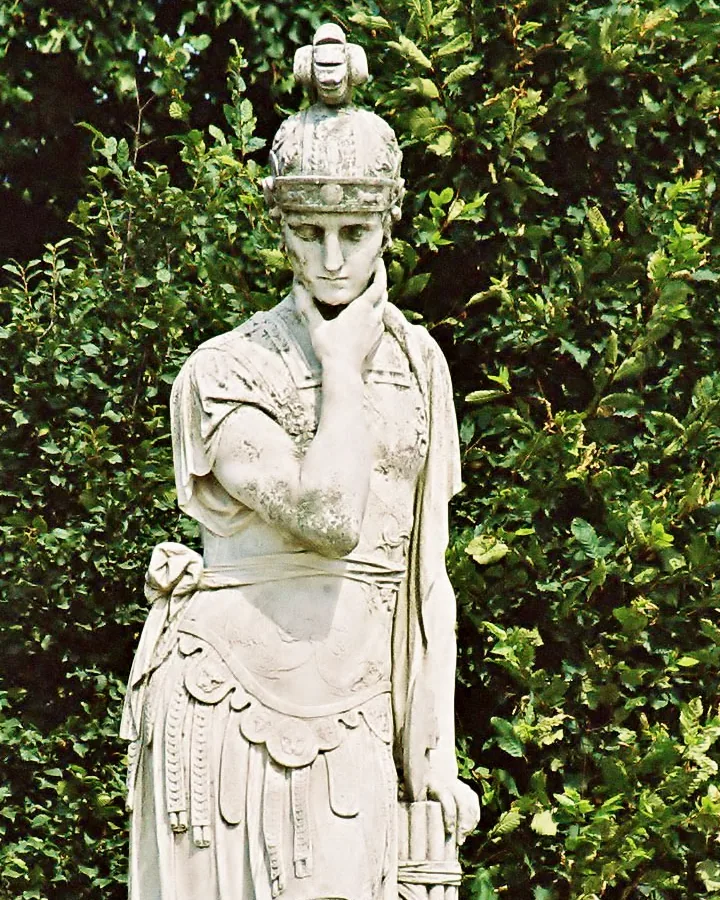
Johann Baptist Hagenauer, Fabius Cunctator, 1773–1780. Schönbrunn gardens, Vienna. Photo: schurl50 · Public domain · Source page
The man Rome mocked as a coward for refusing to fight Hannibal, and later honoured for the same reason.
- Born: c. 280 BC, Rome, into the patrician Fabii
- Died: 203 BC, Rome, of old age, in the year Hannibal left Italy
- Won: Kept Rome’s army whole after Trasimene, 217 BC; Rescued Minucius near Gerunium, 217 BC; Retook Tarentum, 209 BC
- Lost: Let Hannibal slip out of the trap in Campania, 217 BC
“One man’s delay alone restored our State; / He valued safety more than mob’s applause.”
A decision point
You are Quintus Fabius Maximus, chosen to lead Rome in its emergency.
Summer 217 BC, after Trasimene
In half a year two Roman armies have been destroyed and a consul killed. In this emergency Rome has given one man, you, supreme command for six months, as dictator. Your deputy, the master of the horse, is Marcus Minucius Rufus.
You have four new legions and the remains of the other consul’s army, raw and shaken. Hannibal’s cavalry is far better. But he has no base in Italy, no siege engines, and must feed his army by plunder. So far Rome’s Italian allies have stayed loyal.
The people expect you to find Hannibal and beat him.
How do you fight him?
- Seek a decisive battle with the new legions If you win, the war is over. But you would be fighting Hannibal’s veterans and cavalry on ground he chooses, with men who have just seen two armies destroyed. Lose, and Rome has no army left in the field.
- Follow him through the hills, never fight in the open, and starve him Your army survives and gets used to the enemy, and Hannibal bleeds men in small fights. But he can burn the farms of Italy while you watch, and Rome may run out of patience.
- Pull back behind the walls of the cities and colonies and let him wander Safe for the army, but the countryside and the allies are left to fend for themselves. An ally no one protects may decide that Hannibal is the better friend.
What really happened
Follow him through the hills, never fight in the open, and starve him
Fabius followed Hannibal along the hills, close enough to strike at his foragers, never close enough to be forced into battle. Hannibal laid waste the rich plain of Campania before his eyes, and when Fabius seemed to have him trapped, he tied torches to the horns of about 2,000 oxen and drove them up the hills at night. The Roman guards ran towards the lights, and Hannibal’s army slipped away.
Rome lost patience: the assembly gave Minucius power equal to the dictator’s, something never done before. He soon walked into one of Hannibal’s traps, and Fabius saved him.
Polybius explains that Fabius relied on Rome’s advantages, “inexhaustible supplies of provisions and men”: Rome could replace its losses, and Hannibal, far from home, could not easily replace his.
In Livy, Minucius twists Fabius’s virtues into vices, “calling his deliberation indolence and his caution cowardice”. The poet Ennius praised the delay itself, and Cunctator, the Delayer, became a title of honour. We still speak of a Fabian strategy. Rome itself dropped it the very next year.
Cannae
Summer 216 BC
The plain by the Aufidus
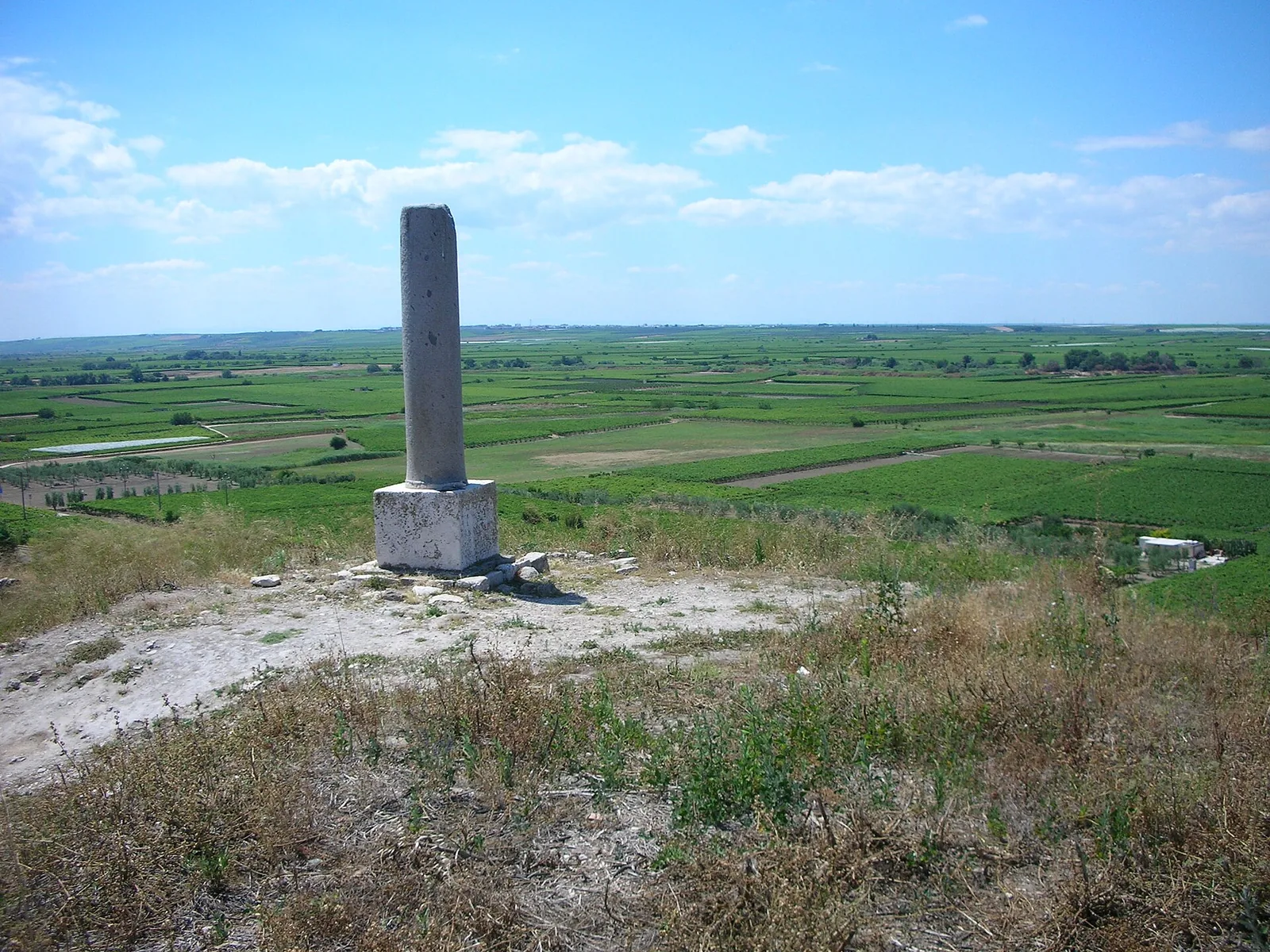
The memorial column of the battle of Cannae, Canne della Battaglia. Photo: Jörg Schulz · CC BY-SA 3.0 · Source page
Fabius’s way had saved the army, but it cost a year of burned farms, and the allies were grumbling. For 216 BC the Senate decided on battle. The new consuls, Lucius Aemilius Paullus and Gaius Terentius Varro, were given the largest army Rome had ever sent out: eight legions and as many allies, about 80,000 infantry and 6,000 horse.
In early summer Hannibal seized the Roman supply depot at Cannae, on a low hill above the river Aufidus (today the Ofanto) in Apulia. Around it lay a flat, bare plain: horse country. The Romans followed him there and camped on both banks of the river.
A decision point
You are Gaius Terentius Varro, consul. Today the command is yours.
Early August 216 BC, by the Aufidus
The consuls command on alternate days. Your colleague Paullus does not want to fight here: the plain is flat and open, and Hannibal has some 10,000 horsemen to your 6,000.
But you have about 80,000 infantry, nearly twice his 40,000, and the Senate sent you to fight. The plan: pack the maniples deep and close, and smash through his centre, as the legions broke through at the Trebia.
Hannibal has drawn up his army on the plain, and he is waiting.
What do you do?
- Cross the river and give battle today Your infantry may crush his centre before his cavalry can make a difference. But you fight on ground he has chosen, against a general who has won every battle so far.
- Refuse battle here and wait for ground where his horsemen cannot ride round you Probably safer. But Hannibal holds your supplies, the country is burning, and the voters who elected you to fight will call it cowardice, as they did with Fabius.
- Go back to shadowing him, as Fabius did The army survives. But another year of ravaged land may push Rome’s allies in the south to Hannibal’s side, and Rome has just raised its largest army in order to use it.
What really happened
Cross the river and give battle today
On his day of command Varro crossed the river and drew up the army facing south: the Roman horse on the right by the river, the allied horse on the left, the maniples packed many times deeper than they were wide. Hannibal crossed too, and accepted.
Livy and the Roman tradition blame Varro, a “popular” politician painted as a demagogue, and clear the noble Paullus. Polybius, whose patron was Paullus’s grandson, also blames Varro, but makes it clear that the Senate wanted the battle.
Most historians today see a shared decision that made sense in Roman terms. The mistake was to underrate Hannibal’s cavalry, and the man.
Cannae: who fought whom
2 August 216 BC (Roman calendar)
The plain of the Aufidus (Ofanto), Apulia
Hannibal’s army
- Commanders: Hannibal and Mago, in the centre, Hasdrubal (not his brother), the cavalry by the river, Hanno or Maharbal, the Numidians
- Strength: just over 40,000 foot, 10,000 horse (Polybius); 40,000 foot, 10,000 horse (Livy)
- Losses: about 5,700, 4,000 of them Gauls (Polybius); about 8,000 (Livy)
Rome and its allies
- Commanders: Gaius Terentius Varro, Lucius Aemilius Paullus (killed)
- Strength: about 80,000 foot, over 6,000 horse (Polybius); 88,000 (Plutarch); 80,000–86,000, about 10,000 of them left in camp (Modern estimate)
- Losses: 48,200 killed (Livy); 50,000 killed (Plutarch and Appian); about 70,000 killed (Polybius); 45,000–55,000 killed, thousands more captured (Modern estimate)
Outcome: A complete victory for Hannibal. The consul Paullus fell; Varro escaped with a few dozen horsemen. About 10,000 men left in the camp were captured. Livy has 14,000 to 15,000 survivors gathering later at Canusium and Venusia; Polybius has only about 3,000 escaping.
Polybius’s 70,000 seems to be a subtraction: the army’s paper strength minus the prisoners and survivors. Livy’s 48,200 looks like a count from a Roman list. Most historians accept a figure near 50,000.
The battle of Cannae
2 August 216 BC, by the Roman calendar
2 August 216 BC, by the Roman calendar, in Apulia on the banks of the river Aufidus. The two Roman consuls have brought the largest army Rome ever sent into the field, and Hannibal waits for them on a flat, open plain near the supply depot he has seized.
After Polybius 3.110–117 and Livy 22.44–52. The battle on the right (south-east) bank of the Aufidus, north-east of the Cannae ridge, with the Romans facing roughly south and their right on the river, as in Kromayer (1912) and Daly (2002). The river’s course in 216 BC is unknown; the map shows today’s. Others place the field on the left bank (Delbrück, De Sanctis), or in a narrower space against the hill (Connolly, Goldsworthy). Livy has the Romans facing north. Frontages and positions are approximate; depths are exaggerated.
Phases of the battle
- Deployment Varro crosses the river and draws up over 70,000 men facing south, their right on the river, the maniples packed deep to smash the enemy’s centre. Hannibal crosses in two places with about 50,000: heavy cavalry by the river, Gauls and Spaniards in the centre, Africans on either side, Numidians on the far wing.
- The crescent Hannibal pushes his centre of Gauls and Spaniards forward into a crescent bulging towards the Romans. By the river his heavy cavalry crashes into the Roman horse in a narrow space; there is no room to wheel, and men dismount and fight man to man.
- The pocket The legions push the crescent back until it bends inward, and crowd forward into the gap. Now the Africans, standing fresh on both sides, turn inward and attack the Roman flanks.
- Behind the Romans Hasdrubal’s horsemen, victorious by the river, ride right round behind the Roman army and fall on the allied horse on the far wing, which breaks and runs. He leaves the pursuit to the Numidians.
- Surrounded Hasdrubal charges the Roman rear. Hemmed in on every side and packed too tight to fight, the Romans are killed where they stand. Paullus dies; Varro escapes. By evening perhaps 50,000 are dead: Livy counts 48,200, Polybius 70,000.
The strategy
- Hannibal’s army: Hannibal pushes his Gauls and Spaniards forward in the centre, in a crescent bulging towards the Romans, with fresh Africans on either side. His heavy cavalry by the river meets the Roman horse, and Hasdrubal rides round behind the army. The centre is meant to give ground and close the pocket.
- Romans and allies: Varro packs the maniples deep and close, to smash through Hannibal's centre as the legions had at the Trebia. He has about 80,000 foot, nearly twice Hannibal's, and the Senate sent him to fight. His colleague Paullus opposed a battle on this flat, open plain.
What decided it: The Romans were packed too deep and tight to fight. When Hannibal's centre gave ground, the fresh Africans turned in on the flanks, and Hasdrubal's horse closed the rear, so the ring shut on every side. A dense army has no room to manoeuvre.
A decision point
You are Hannibal, on the evening of Cannae.
2–3 August 216 BC, on the battlefield
The largest army Rome ever raised has been destroyed. One consul is dead, the other has fled. Your cavalry commander, Maharbal, urges you to ride for Rome at once.
But Rome is about 400 kilometres away, two to three weeks’ march. It has walls, two legions and a huge citizen population. You have no siege engines; Saguntum held out for eight months. Your army is exhausted.
And your aim, as you said after Trasimene, is to fight Rome “for the freedom of Italy”: to break the alliance that gives Rome its soldiers. After today, the cities of the south may come over to you.
What do you do?
- March on Rome at once, before it recovers from the shock Perhaps panic does the work and the Senate asks for terms. But if the city shuts its gates, you face a siege you cannot win, far from your allies, while new armies gather around you.
- Offer Rome a ransom for the prisoners, and win over the cities of the south A beaten enemy usually talks, and every city that comes over gives you food, a base and soldiers and takes them from Rome. But it all depends on Rome being willing to talk, and each city you win may push its rivals into Rome’s arms.
- Wait for reinforcements and siege engines from Carthage before you strike at Rome Then a siege might be possible. But Carthage is far away across a sea that Rome controls, and every month gives Rome time to raise new legions.
What really happened
Offer Rome a ransom for the prisoners, and win over the cities of the south
Hannibal stayed. He sent an officer, Carthalo, to Rome with ten prisoners to arrange a ransom, and perhaps a peace. The Senate refused to receive him or to buy back its own men. Rome armed 8,000 slaves, sent the survivors of Cannae to Sicily in disgrace, and spoke of no peace.
In the south the plan half worked: Capua, the second city of Italy, went over to him, with many Samnites, Lucanians and Bruttians. But the Latin colonies and central Italy held. Hannibal stayed in Italy for thirteen more years, was never decisively beaten there, and never took Rome.
Livy gives Maharbal a famous retort to this choice; the next chapter looks at it closely.
Most historians think a march on Rome would have failed. Hannibal’s plan rested on Rome behaving like a beaten state; Rome refused, and the plan could not survive it.
After Cannae
- 216 BC Mago reports in Carthage and pours out the gold rings of the Roman dead.
- 215 BC Hannibal makes an alliance with Philip V of Macedon. Rome returns to Fabius’s way: avoid Hannibal, fight everywhere else.
- 211 BC Hannibal marches to the gates of Rome to draw the Romans off Capua. Rome does not flinch, the siege goes on, and Capua falls.
- 209 BC Fabius retakes Tarentum. In Spain the young Scipio takes New Carthage.
- 207 BC Hannibal’s brother Hasdrubal crosses the Alps with a second army and is destroyed at the river Metaurus.
- 203 BC Hannibal is recalled to defend Africa, after fifteen years in Italy. Fabius dies.
- 202 BC Scipio defeats Hannibal at Zama (the next lesson).
- 183 BC Hannibal, an exile in Bithynia, takes poison rather than be handed over to Rome.
How do we know?
Source: Hannibal’s own numbers
“I found on the Lacinian promontory a bronze tablet on which Hannibal himself had made out these lists during the time he was in Italy…”
“…his surviving forces numbered twelve thousand African and eight thousand Iberian foot, and not more than six thousand horse in all, as he himself states in the inscription on the column at Lacinium…”
Hannibal set up this record of his deeds, in Punic and Greek, at the temple of Hera on the Lacinian promontory near Croton, before he left Italy in 203 BC. Polybius read it decades later.
- Why is a list made by Hannibal better evidence than a Roman historian’s figure? It comes from the man who knew his army best, not from his enemies’ hearsay, and Polybius tells us exactly where he found it, which ancient historians rarely do.
- Could it still be less than the whole truth? Yes. Hannibal set it up for every visitor to the temple to read, and a small army that beat Rome makes a better story than a large one. We have no other list to check it against.
- Livy says his authorities gave anything from 20,000 to 100,000 foot for the army that reached Italy. Why did Polybius not have that problem? He went back to a document instead of copying other writers. When later writers disagree wildly, ask first: who saw the original?
Source: “You know how to win”
“I prophesy that in five days you will be feasting as victor in the Capitol. Follow me; I will go in advance with the cavalry…” … “The gods have not given all their gifts to one man. You know how to win victory, Hannibal, you do not [know] how to use it.” “That day’s delay is believed to have saved the City and the empire.”
Livy wrote some two centuries after Cannae. An older version survives in Aulus Gellius, who quotes the elder Cato, a veteran of this war: “the master of the horse thus advised the Carthaginian dictator: ‘Send me to Rome with the cavalry; on the fifth day your dinner shall be ready for you in the Capitol.’” Gellius quotes only this sentence, for an old word in it, so there is no reply. There is no name either: Cato named no generals.
- Cannae is about 400 km from Rome by road. Could an army get there in five days? Not an army, and hardly horsemen, who would then face walls. It is a boast inside a story, not a plan: a clue that we are reading literature.
- Compare Livy with Cato. What does Livy have that Cato’s surviving words lack? Cato’s surviving words have neither a name nor a reply. Livy has both: Maharbal, and a sharp retort that turns the scene into a verdict: Rome was saved by Hannibal’s hesitation. A named man with a memorable line makes a better story.
- Why might Romans like the idea that “that day’s delay” saved them? It makes Cannae a near miss rather than the start of a long recovery, and puts Rome’s survival down to the enemy’s mistake. Polybius, writing earlier, credits Rome’s institutions and the endurance of its people.
Source: Elephants on silver
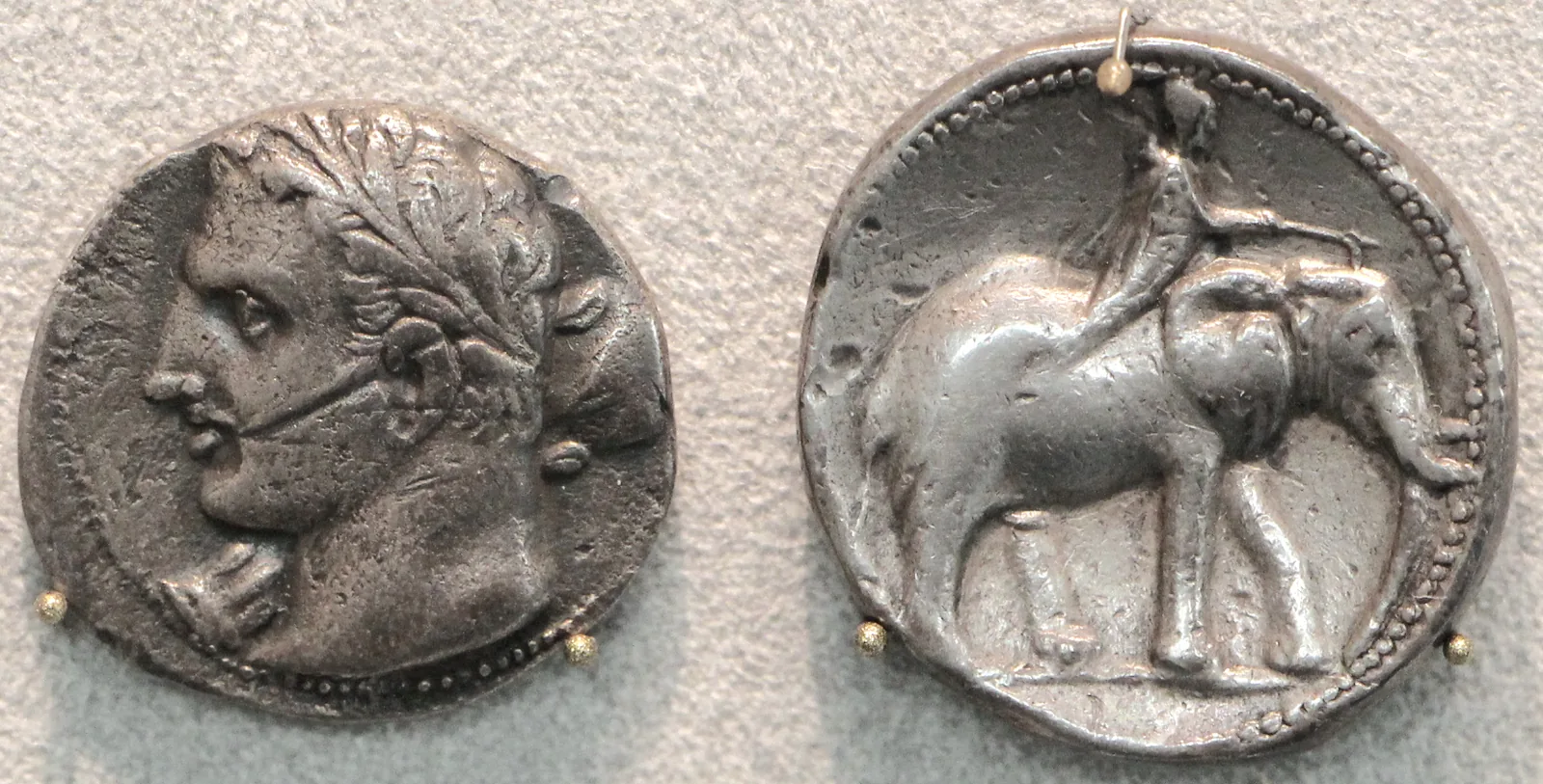
Carthaginian silver coins from Barcid Spain, about 237–209 BC. Altes Museum, Berlin. Photo: Sailko · CC BY 3.0 · Source page
Silver coins struck in Barcid Spain, c. 237–209 BC. Altes Museum, Berlin
The Barcids struck their own coins in Spain, probably to pay their soldiers: on one side the head of the god Melqart (the Greeks’ Heracles), on the other a war elephant and its rider.
- Who paid with this coin, and whom did it need to impress? The Barca family, who ruled Spain almost like kings. The coins paid soldiers and allies, and told them who held the silver.
- Is the head a portrait of Hamilcar or Hannibal? Some scholars think the god was given a Barcid’s features; others disagree. Without a name on the coin it cannot be proved. Coins show how rulers wanted to be seen, not always what they looked like.
- What can a coin tell us that Livy cannot? It was made at the time, by the Barcids themselves, not by enemies two centuries later, and it shows what they were proud of. It tells us nothing about any battle.
Myth
Hannibal’s elephants died crossing the Alps.
The truth
Polybius says the elephants were the last to get past the landslide and came through starving, but he does not say that any died there. Two months later they fought at the Trebia, in front of the wings, and, says Livy, frightened the Roman horses. What killed them was the winter after the battle, the rain and snow: “all the elephants perished except one”. The survivor carried the half-blind Hannibal through the Arno marshes in 217 BC.
The evidence
Polybius 3.42, 3.55, 3.72, 3.74, 3.79; Livy 21.55–56 (“nearly all the elephants perished”). Polybius counts 37 elephants at the Rhône. Livy 21.58 then has seven more die in an Apennine storm, against his own “nearly all”. The picture of elephants dying in the snow comes from later imagination.
Why not Rome?
After Cannae Rome seemed defenceless. Was staying away Hannibal’s great mistake?
- J. F. Lazenby, Hannibal’s War (1978); Adrian Goldsworthy, The Punic Wars (2000) Rome was 400 kilometres away, walled and full of citizens of fighting age, and Hannibal had no siege train. A failed siege would have wrecked his reputation, his best weapon. Staying in the south to win over Rome’s allies was the logical next step.
- Dexter Hoyos, Hannibal’s Dynasty (2003) Hannibal never meant to destroy Rome. He wanted a negotiated peace that would cut Rome down to an Italian power and give Carthage back what it had lost. Cannae was meant to make the Senate talk. The plan failed because the Senate would not.
- Michael P. Fronda, Between Rome and Carthage (2010) The real limit was Italy itself. Cities chose sides by local rivalries: when Capua went over to Hannibal, its neighbours and rivals clung to Rome. Every defection made new enemies, so his coalition could never grow large enough to win.
Livy believed one day’s delay saved Rome; few historians today agree. But if the city could not be taken, did Hannibal have any other road to victory, or did Rome’s refusal to give in doom every plan?
What do you know now?
Check yourself
Why did Hannibal take the land route over the Alps instead of sailing to Italy?
Answer: Rome controlled the sea, and the Gauls of the Po valley promised him help. Right. Rome manned 220 warships in 218 BC; Hannibal had about fifty. The Gauls of the Po valley promised guides and warriors, and that summer the Boii and Insubres rose against Rome.
Check yourself
What killed most of Hannibal’s elephants?
Answer: The cold and rain of the winter after the Trebia. Right. The elephants got over the Alps and fought at the Trebia. In the rain and snow that followed the battle, says Polybius, all but one died.
Check yourself
Why could the Romans at Lake Trasimene not form a battle line?
Answer: They were attacked in fog while still marching in column along the shore. Right. Without scouts, on a misty morning, the army was strung out in a long column between the hills and the lake, and was attacked from every side at once.
Check yourself
Why was Fabius at first mocked in Rome?
Answer: Romans expected a general to seek battle, and his refusal let Hannibal burn Italy. Right. Polybius says he was at first despised and called a coward, and Minucius called his caution cowardice. Only later, with Ennius’s verse and Rome’s eventual victory, did “the Delayer” become a title of honour.
Check yourself
At Cannae, what turned the Roman attack into a trap?
Answer: Hannibal’s centre gave way, the Africans on both sides turned inward, and the cavalry closed the rear. Right. This is the double envelopment: the further the Romans crowded into the yielding centre, the deeper they went between the Africans, and Hasdrubal closed in behind.
Check yourself
Why do historians trust Polybius’s figure for Hannibal’s army in Italy more than other numbers?
Answer: He copied it from a record Hannibal himself set up. Right. Polybius read the inscription Hannibal set up on the Lacinian promontory, and says so plainly.
Terms
- consul One of the two elected heads of the Roman Republic, chosen for one year. The consuls also commanded the armies.
- dictator A single commander with supreme power, appointed by Rome in an emergency for six months at most. The word did not yet mean what it means today.
- master of the horse The Roman dictator’s deputy (in Latin, magister equitum).
- legion The Roman citizen army unit: in Hannibal’s day about 4,200 to 5,000 infantry and 300 cavalry, fighting in three lines.
- maniple A company of 60 to 160 men, the building block of the legion. Maniples stood in three lines with gaps between them, like squares on a chessboard.
- Italian allies Cities and peoples of Italy bound to send soldiers to Rome’s wars (in Latin, socii). They made up half of every Roman army, sometimes more.
- Numidians Light horsemen from North Africa who rode without bridles and threw javelins. They were Hannibal’s best light cavalry.
- double envelopment A move in which a force closes on both flanks of an enemy and meets behind it, until the enemy is surrounded. Cannae is the most famous example.
- Fabian strategy Avoiding a pitched battle in order to wear down a stronger enemy over time. Named after Fabius Maximus.
- stade A Greek measure of distance, about 180 to 185 metres. Polybius gives his distances in stades.
- Polybius Greek historian (about 200–118 BC) who was taken to Rome as a hostage and wrote the history of Rome's rise. He is our most important and most reliable source for the war with Hannibal.
- Livy Titus Livius (about 59 BC–AD 17), a Roman historian who wrote the history of Rome from its founding in 142 books. Only part survives, including the books on the war with Hannibal.
- Augustus The first Roman emperor, who ruled from 27 BC until his death in AD 14. Under him the Roman Republic became an empire.
- Antiochus III King of the Seleucid empire (222–187 BC), which stretched from Syria to Persia, and father of Antiochus IV of the Hanukkah story. Hannibal found refuge with him, and Rome defeated him in war.
- Hamilcar Barca Carthaginian general, father of Hannibal. He fought the Romans in Sicily and later conquered large parts of Spain for Carthage. His nickname Barca probably means ‘lightning’.
- Scipio Africanus Publius Cornelius Scipio (236–183 BC), son of the consul wounded at the Ticinus. He took Spain from Carthage and beat Hannibal at Zama in Africa in 202 BC.
- Fabius Pictor Quintus Fabius Pictor, a senator who wrote the first history of Rome. He wrote it in Greek, and Polybius used it, but the book itself is lost.
- Fabius Maximus Quintus Fabius Maximus, made dictator after Trasimene in 217 BC. He avoided open battle with Hannibal, and so was nicknamed ‘the Delayer’ (Cunctator).
- Senate Rome's council of nobles and senior politicians, who sat in it for life. In practice it ran the wars, the money and relations with other states.
- popular assembly The meeting where Roman citizens gathered to elect officials such as the consuls and to vote on laws and on war and peace.
- Punic ‘Punic’ is the Roman name for the Carthaginians and everything to do with them, from the Latin word for Phoenicians. Hence the ‘Punic Wars’, and the Punic language, the Phoenician dialect spoken in Carthage.
- mercenaries Professional soldiers who fight for pay rather than for their own country. Carthage's armies relied heavily on mercenaries from Africa, Spain and Gaul.
- Saguntum An ancient port town in eastern Spain, near today's Valencia. Hannibal's siege of it in 219 BC set off the Second Punic War.
- Ebro The great river of north-eastern Spain. In a treaty Hasdrubal made with Rome (about 226 BC), Carthage promised not to cross it in arms, so it became a boundary line.
- toga A long garment of white wool that Roman citizens wrapped around the body. It was a sign of Roman citizenship, worn mainly on formal occasions.
- Gauls Celtic peoples who lived in what is now France, Belgium and northern Italy. In the 4th century BC they sacked Rome, and in Hannibal's time many of them still fought it.
- Roman colony A town Rome founded on conquered land and settled with Roman or Latin citizens. Colonies held the conquered land and were loyal Roman strongholds.
- Pleiades A bright star cluster, also named in the Bible (‘who made the Pleiades and Orion’). For Greeks and Romans its setting at dawn in early November marked the coming of winter.
- radiocarbon dating A way of finding the age of plant and animal remains from the amount of radioactive carbon left in them. The result always comes with a margin of error of decades or more.
- siege engines Large machines for taking walled cities: battering rams to smash gates, wheeled towers to reach the top of the walls, and machines that hurled heavy stones.
- hostage A person handed over to another side as a guarantee that his people or family would keep an agreement. Polybius was one of a thousand leading Greeks sent to Rome this way in 167 BC.
- Melqart The chief god of the Phoenician city of Tyre and of Carthage, which settlers from Tyre founded. His name means ‘king of the city’.
- Capitol One of the seven hills of Rome, and the most important. The great temple of Jupiter stood on it, making it the religious heart of the city and a symbol of its power.
- Alfred von Schlieffen Chief of the German General Staff from 1891 to 1906. He drew up the ‘Schlieffen Plan’ for a quick victory over France, which Germany tried to carry out at the start of World War I in 1914.
- Lake Trasimene A large lake in central Italy, between Rome and Florence. In 217 BC Hannibal ambushed a Roman army there and destroyed it, and the consul Flaminius was killed.
Sources
- Polybius, Histories 3.6–3.118, 9.22–26, 10.3, trans. W. R. Paton, Polybius vol. II (Loeb Classical Library, 1922) and vol. IV (1925)
- Livy, History of Rome 21–22 and 23.12, trans. W. M. Roberts (Everyman’s Library, J. M. Dent, 1905)
- Plutarch, Life of Fabius Maximus, trans. B. Perrin, Plutarch’s Lives vol. III (Loeb Classical Library, 1916)
- Cicero, On Old Age (Cato Maior de Senectute) 10, quoting Ennius, Annals fr. 363 Skutsch, trans. W. A. Falconer (Loeb Classical Library, 1923)
- Aulus Gellius, Attic Nights 10.24.6–7 (quoting Cato’s Origines), trans. J. C. Rolfe (Loeb Classical Library, 1927)
- Appian, The Hannibalic War 4 and 25, trans. Horace White (1899)
- Pliny the Elder, Natural History 33.21, trans. J. Bostock and H. T. Riley (Bohn, 1855)
- Cornelius Nepos, Hannibal 3.4, trans. J. C. Rolfe (Loeb Classical Library, 1929)
- Juvenal, Satires 10.147–167, trans. G. G. Ramsay (Loeb Classical Library, 1918)
- J. F. Lazenby, Hannibal’s War: A Military History of the Second Punic War (Aris & Phillips, 1978)
- Adrian Goldsworthy, The Punic Wars (Cassell, 2000)
- Adrian Goldsworthy, Cannae (Cassell, 2001)
- Gregory Daly, Cannae: The Experience of Battle in the Second Punic War (Routledge, 2002)
- Dexter Hoyos, Unplanned Wars: The Origins of the First and Second Punic Wars (de Gruyter, 1998)
- Dexter Hoyos, Hannibal’s Dynasty: Power and Politics in the Western Mediterranean, 247–183 BC (Routledge, 2003)
- Serge Lancel, Hannibal, trans. Antonia Nevill (Blackwell, 1998; French edition Fayard, 1995)
- Eve MacDonald, Hannibal: A Hellenistic Life (Yale University Press, 2015)
- Michael P. Fronda, Between Rome and Carthage: Southern Italy during the Second Punic War (Cambridge University Press, 2010)
- F. W. Walbank, A Historical Commentary on Polybius, vol. I (Clarendon Press, 1957)
- H. H. Scullard, The Elephant in the Greek and Roman World (Thames & Hudson, 1974)
- Dennis Proctor, Hannibal’s March in History (Clarendon Press, 1971)
- Gavin de Beer, Alps and Elephants: Hannibal’s March (Geoffrey Bles, 1955)
- J. Kromayer and G. Veith, Antike Schlachtfelder, vol. III (Weidmann, 1912)
- W. C. Mahaney, C. C. R. Allen et al., “Biostratigraphic evidence relating to the age-old question of Hannibal’s invasion of Italy”, parts I and II, Archaeometry 59 (2017), 164–178 and 179–190
- J. W. Rich, “The origins of the Second Punic War”, in T. Cornell, B. Rankov and P. Sabin (eds), The Second Punic War: A Reappraisal (Institute of Classical Studies, 1996)
Image credits
- J. M. W. Turner, Snow Storm: Hannibal and his Army Crossing the Alps, 1812. Tate Britain, London. Photo: Steven Zucker · Public domain · Source page
- The “Hannibal” bust, National Archaeological Museum, Naples. Photo: Fratelli Alinari, about 1900 · Public domain · Source page
- Lake Trasimene from Tuoro, 2003. Photo: Andreas Wahra · Public domain · Source page
- Johann Baptist Hagenauer, Fabius Cunctator, 1773–1780. Schönbrunn gardens, Vienna. Photo: schurl50 · Public domain · Source page
- The memorial column of the battle of Cannae, Canne della Battaglia. Photo: Jörg Schulz · CC BY-SA 3.0 · Source page
- Carthaginian silver coins from Barcid Spain, about 237–209 BC. Altes Museum, Berlin. Photo: Sailko · CC BY 3.0 · Source page


