King Sejong's alphabet: how Hangul was born
In the 1440s the king of Korea introduced a new script meant to be easy for anyone to learn. Parts of the elite opposed it. Who really made it, and why did some try to stop it?
Decisions, questions and your own progress, in the app
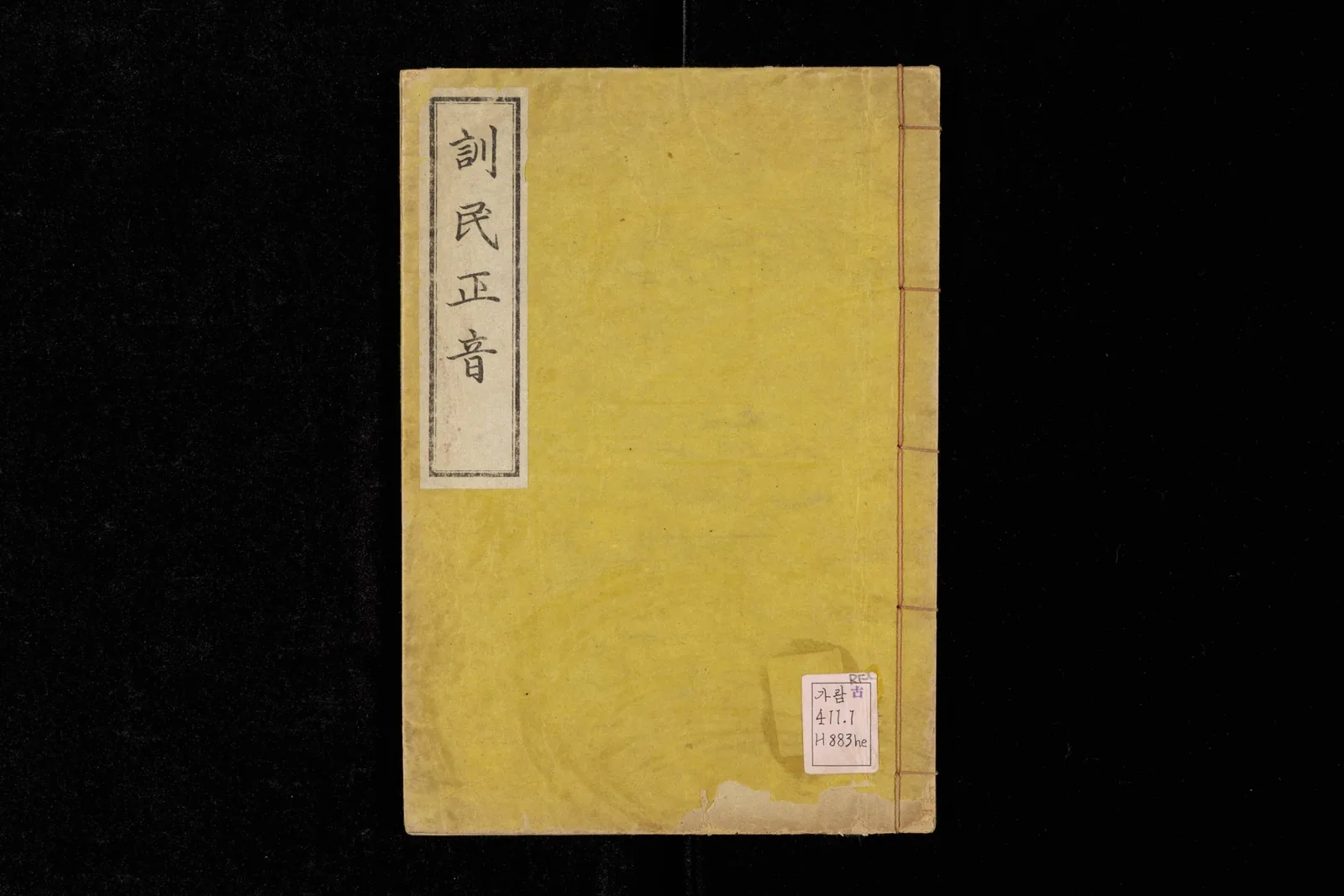
Hunminjeongeum Haerye, later reprint of a 15th-century book. Scan on Wikimedia Commons; source: kyudb.snu.ac.kr (Seoul National University). · Public domain · Source page
A language you speak but cannot write
Can you write your own language the way you speak it?
In 15th-century Korea people spoke Korean, but the court’s official writing was in Chinese.
A book once presented a new script for Korean. Its cover is yellow, and the title on it is written in Chinese. This is the story of that script, and of the scholars who argued against it.
The problem
What is said and what is written
Korean speech is different from Chinese, and its words do not fit easily into Chinese characters. The preface of the book opens on exactly this point: the sounds of the country’s language differ from those of the Middle Kingdom, that is China.
The elite learned Chinese characters, which Koreans call hanja. Anyone who had not learned them stayed outside the official written world.
The background
A script made on purpose
The script was not an accident. It was designed on purpose, and the king pushed the project forward.
Alongside the king, scholars of the Hall of Worthies worked on the script. Who did which part is an open question.
The names
A name for the script, a name for the book
The name hangul was coined only between 1910 and 1913, by the linguist Ju Si-gyeong. Before that the script was called eonmun, the vernacular script.
The book itself is called Hunminjeongeum.
The script is built, and the king must decide
The design
Shapes from the mouth and the sky
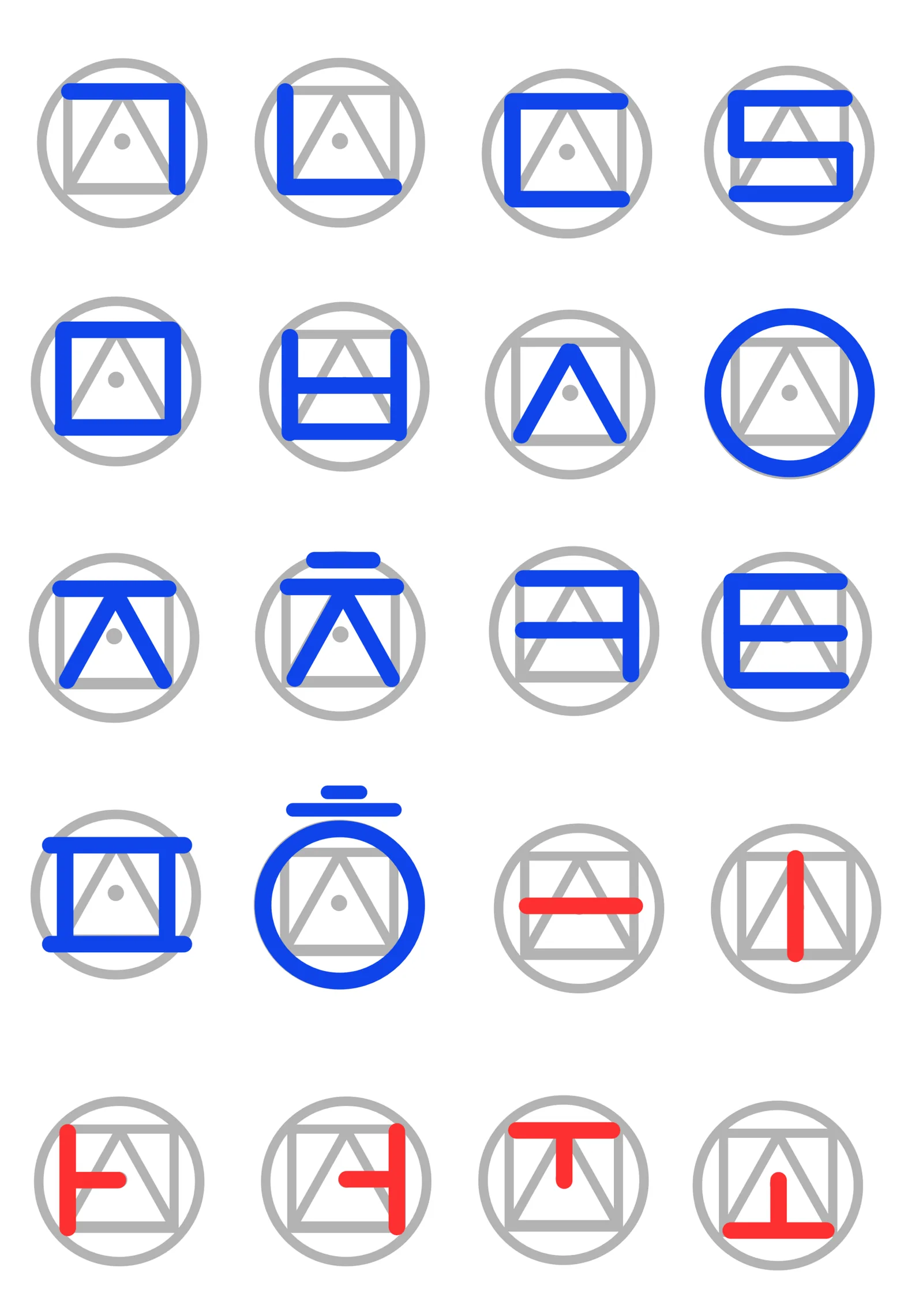
Greeirds, Hangul construction, 2024. Own work, released under CC0. · CC0 · Source page
The new script is built from simple shapes. The basic consonants are modelled on the organs of speech. The basic vowels come from three marks: a dot, a horizontal line and a vertical line, which stand for heaven, earth and human.
How many letters
Twenty-eight, and then twenty-four
According to the preface, the king newly designed 28 letters. Later sources split them into 17 consonants and 11 vowels. Today 24 remain, 14 consonants and 10 vowels. Four letters fell out of use.
A decision point
You are King Sejong.
The palace, 1443, once the script is ready
The letters are ready. Your scholars have a clear design: consonants taken from the organs of speech, and vowels built from three marks.
How and when to release the script is your decision, and each route has a cost.
What do you do with the script?
- Publish the full explanation now, with all the rules Probably the scholars would get the rules at once, and so would the opponents. But with no time to test the letters in use, any flaw would surface after the book was already in everyone's hands.
- Announce the script now, and publish the full book later Probably there would be time to write a proper explanation and settle questions of shape. But the announcement would come before the rules were on paper, so questions would stay open with no written answer. Opponents would also have time to organise.
- Keep the script inside the court, as an internal tool Probably opposition stays small for a while. But the script would reach no one outside the court, and most people beyond it would never know it existed.
What really happened
Announce the script now, and publish the full book later
The king announced the script in 1443. The full book, with its explanation, appeared in the ninth lunar month of 1446. The sources do not say why it took three years, so the gap is an open question.
No source we use records what the king thought about timing. The full explanation did not come with the announcement. Historians disagree about whether the script was kept secret for a while, and that argument returns at the end of this lesson.
What the sources say, and who objects
Source: A page of the book
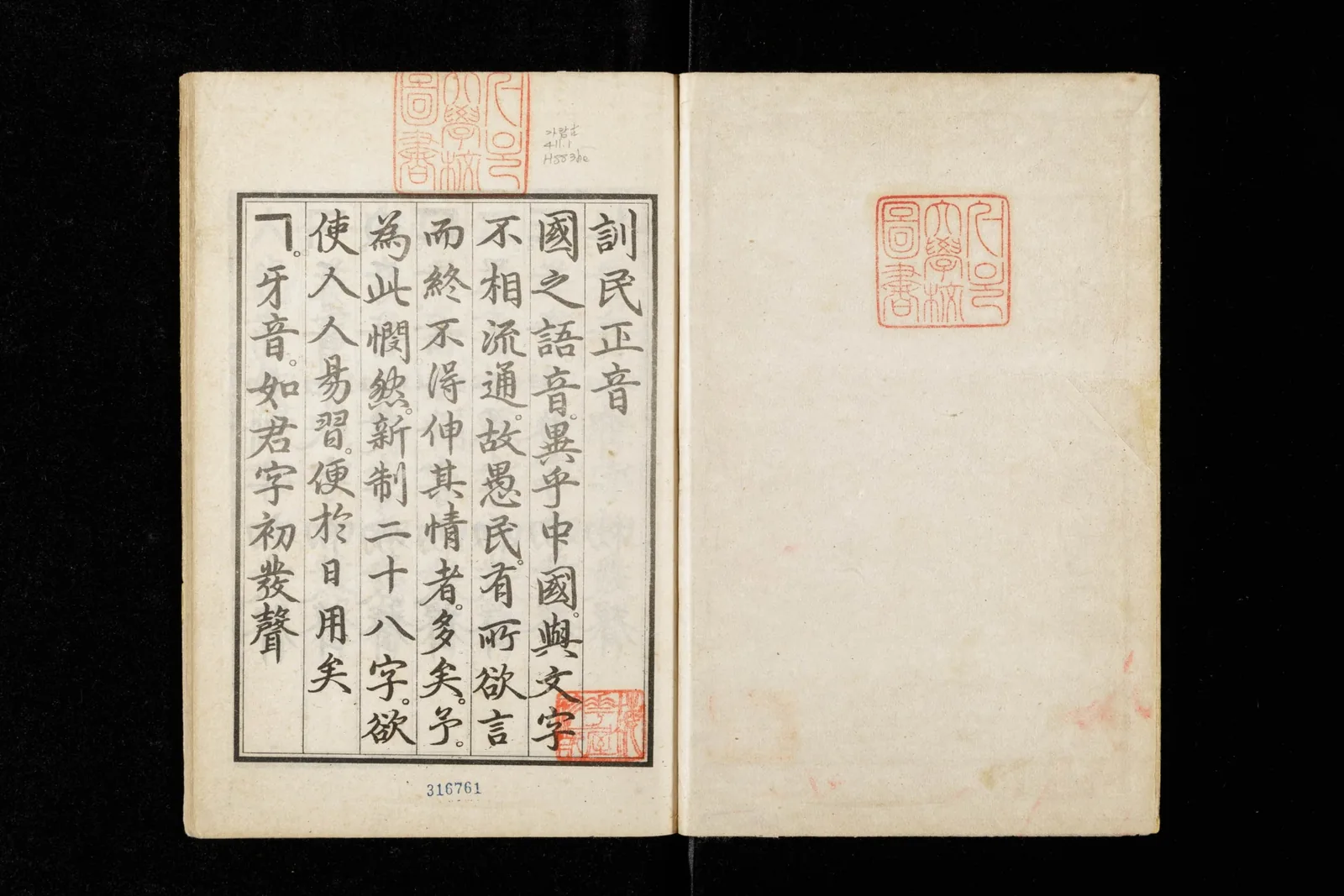
Hunminjeongeum Haerye, later reprint of a 15th-century book. Scan on Wikimedia Commons; source: kyudb.snu.ac.kr (Seoul National University). · Public domain · Source page
Hunminjeongeum Haerye, 1446. This scan is of a later reprint
This page is from the preface, in Chinese characters like the rest of the book. The scan is from a reprint.
- What language is the book written in? In Chinese characters, the writing the court already used. It is a book about a new script, written in the old one.
- What kind of text is this page? It is the preface, the opening section of the book. It gives the reasons for a new script.
Source: The preface: a summary, not a quotation
A summary, not a direct quotation: the preface opens by saying that the sounds of the country’s language differ from those of the Middle Kingdom, that is China, and that the king newly designed twenty-eight letters.
This is the preface. It gives reasons for a new script, but not how the work was done or who did which part.
- What problem does the preface present? That the sounds of the language differ from Chinese, and that the Chinese writing does not carry them. That is the king’s account of the problem. The preface does not prove it.
- What is missing from this summary? Any account of how the work was done, or who helped. A preface gives reasons, not a record, so it cannot settle who made the letters.
A decision point
You are King Sejong, in 1444.
The palace, 1444, after the protest reaches you
The senior Confucian scholar Choe Malli and several others have sent you a formal protest, a memorial, against the new script. As later historians summarise it, the protest argued:
that Korea follows Chinese cultural standards, so a separate script would look like copying peoples who are not Chinese; that the existing system, idu, already serves officials, so a new script is unnecessary; that a separate script could split the officials; and that learning it would distract the crown prince.
What do you do about Choe Malli?
- Dismiss him from office at once and end the argument Probably open protest would fall silent for a while. But others would see a threat, and the argument would move to places you do not control.
- Reply in writing and explain why the script is needed Probably the argument would be fought over the text itself, which takes time and effort. If you persuaded them, the script would arrive with a clear case behind it. If not, the protest would stay on record, and you would still have to decide what to do next.
- Ignore the protest and carry on with the work Probably the work continues, but the opponents would not drop it. The protest would remain on record as their objection, and it would resurface.
What really happened
Dismiss him from office at once and end the argument
The king dismissed Choe Malli. The next day he reinstated him. Choe then resigned, went home, and died in 1445. The sources we checked do not support a story of imprisonment. Readings of the protest differ: some take it as opposing the script itself; others take it as opposing the reform of Sino-Korean pronunciation and the Tongguk jeongun project more than the script.
The sources we use do not explain why the king dismissed him, or why he reversed within a day. What is clear is the sequence. The motive is not.
Myth
King Sejong invented the script alone, in total secrecy.
The truth
The common view among historians is that the king drove the project, and scholars of the Hall of Worthies helped with publication and theory. How far he worked alone is disputed. The secrecy claim has no direct evidence behind it.
The evidence
The historian Ahn Pyong-hi argues that there is no direct evidence for secrecy.
An explanation, or only a list
A decision point
You are Chŏng Inji, one of the writers of the explanation at the Hall of Worthies.
The palace, 1446, before the book is finished
The script already exists, and the king wants a book that explains it to anyone who reads it. You have the letters and their rules. The question is how much to write down.
You could write a short list of letters and sounds, a full explanation, or nothing, passing the knowledge on by word of mouth.
What do you write?
- A short list of letters and sounds, with no explanations Probably the list could be copied quickly. But anyone who wanted to know why the letters look as they do, or how to use them, would have to guess.
- A full explanation: what each letter stands for, why it is built as it is, and how to write with it Probably the book would be long and slow to finish. But the rules would be written so that someone who was not in the room could read and reconstruct them. On the other hand, every rule would be open to criticism, and the opponents could read it too.
- Write nothing, and pass the knowledge on by word of mouth in the court Probably the knowledge would stay in the court, where it could be taught quickly to those who need it. But if the few who knew it died or left, what was known would go with them, and no one could check it.
What really happened
A full explanation: what each letter stands for, why it is built as it is, and how to write with it
The scholars wrote a full explanation. This explanatory part is the haerye, and it survives with the book. We do not know what the scholars argued among themselves.
No source records what Chŏng Inji thought. Assuming the team wanted a script that could be reconstructed and checked is a guess, not evidence.
What remains, and what is still unclear
What happened next
- 1443 The king announces the new script. The full book is not yet published.
- 1444 Choe Malli and other scholars submit a protest against the script. The king dismisses him and takes him back a day later.
- 1445 Choe Malli, who had resigned and gone home, dies.
- 1446 The book Hunminjeongeum, with its explanation, the haerye, is published in the ninth lunar month.
- 1910–1913 The linguist Ju Si-gyeong coins the name hangul for the script.
- 1926 The Korean Language Society sets a day to mark the book’s publication in 1446. The day is now 9 October, but the exact publication date is not known.
- 1940 A complete copy of the explanation, the Kansong copy, resurfaces.
- 1997 The Kansong copy is entered on UNESCO’s Memory of the World register.
Who made the script?
Did the king work alone, and if so, was it in secret?
- The common view: the king led, the scholars helped The common view among historians is that King Sejong drove the project, and scholars of the Hall of Worthies helped with publication and theory. The full explanation was written by a team led by Chŏng Inji.
- The king worked almost alone Some scholars argue that the king worked largely alone, perhaps consulting the scholars.
What counts as inventing a script: the idea, the shapes, the explanation, or the publication? Each could point to a different person.
Check yourself
What does the book’s preface say about the sounds of the Korean language?
Answer: That they differ from those of the Middle Kingdom. Correct. This is how the preface opens, as the summary in this lesson gives it.
Check yourself
What shapes are the basic vowels built from?
Answer: A dot, a horizontal line and a vertical line. Correct. The dot and the lines stand for heaven, earth and human, as the lesson says.
Check yourself
When was the full book, with its explanation, published?
Answer: In the ninth lunar month of 1446. Correct. This is the date we have, matching the 1446 of the book.
Check yourself
What is true about Choe Malli and what happened to him?
Answer: He was dismissed, reinstated, resigned, and died in 1445. Correct. This is the sequence given in the sources used in the lesson.
Check yourself
Where does the name hangul come from?
Answer: Ju Si-gyeong coined it; earlier it was eonmun. Correct. This is what the sources in the lesson give. Eonmun was the earlier name, the vernacular script.
Check yourself
Which claim about who made the script is best supported by what the lesson shows?
Answer: The king led and the scholars helped; the split is still debated. Correct. This is the common view together with the open dispute, as the lesson presents it.
Terms
- hanja The Chinese characters in which the court wrote its books and official documents. Koreans call them hanja.
- hangul The name of the Korean script. It was coined between 1910 and 1913 by the linguist Ju Si-gyeong.
- vernacular script A script for the everyday spoken language, rather than the court’s written language. Eonmun, the earlier name of the Korean script, means vernacular script.
- Hall of Worthies A group of scholars at King Sejong’s court, who worked, among other things, on the script. Its Korean name is Jiphyeonjeon.
- haerye The explanatory part of the Hunminjeongeum. It explains the letters and the rules for using them, and was written by scholars led by Chŏng Inji.
- memorial A formal written petition sent to the king, in which an official or scholar presents an objection or proposal. Here, Choe Malli and others objected to the new script.
- Choe Malli A senior Confucian scholar who sent the king a formal protest against the new script.
- Ju Si-gyeong A Korean linguist who gave the script the name hangul between 1910 and 1913.
- linguist A scholar who studies languages and how they are built, such as their sounds and words.
- Confucian Relating to the teachings of Confucius, which shaped education and government in Korea.
- crown prince The son who is expected to inherit the throne after the king.
- elite The highest class in society, made up of wealthy and influential families.
- consonant A speech sound made when air is blocked or narrowed in the mouth, using the lips, tongue or teeth.
- vowel An open speech sound made when air flows out of the mouth without being blocked.
- preface The introduction at the front of a book, where the author explains why it was written.
- reprint A new printing of a book that was published earlier.
- lunar calendar A calendar based on the cycles of the moon, not the sun.
- heaven, earth and human Three parts of the world: heaven, earth and humanity. In the new script each one is shown by one mark.
- reform A large change meant to fix or improve something that already exists.
- pronunciation The way a word or a sound is spoken.
- convention Something people agree to use by custom, even without exact proof.
- reading An interpretation or understanding of the same text.
- scan A digital copy of a page or book, saved as a file on a computer.
- organs of speech The parts of the body used to make speech, such as the lips, tongue and teeth.
Sources
- Hunminjeongeum Haerye (1446), Kansong copy; inscribed on UNESCO’s Memory of the World register, 1997
- Gari Keith Ledyard, The Korean Language Reform of 1446 (1998), p. 170: cited on Wikipedia for the preface; not read directly
- Annals of King Sejong (Sejong sillok), 1444 entry on Choe Malli’s memorial; known here through secondary sources, not read directly
- Language Log, post 69269, quoting Ross King on Choe Malli’s dismissal and reinstatement
- koreanculture.org, “Hangeul” (gallery article, April 2024)
Image credits
- Hunminjeongeum Haerye, later reprint of a 15th-century book. Scan on Wikimedia Commons; source: kyudb.snu.ac.kr (Seoul National University). · Public domain · Source page
- Greeirds, Hangul construction, 2024. Own work, released under CC0. · CC0 · Source page
- Hunminjeongeum Haerye, later reprint of a 15th-century book. Scan on Wikimedia Commons; source: kyudb.snu.ac.kr (Seoul National University). · Public domain · Source page


