Hendrick Hamel: a Dutchman stranded in Korea for 13 years
In 1653 a Dutch ship was wrecked off Jeju island. About 36 sailors survived, and after thirteen years some escaped, and one wrote one of the first Western accounts of Korea. What did he really see, and what did he not understand?
Decisions, questions and your own progress, in the app
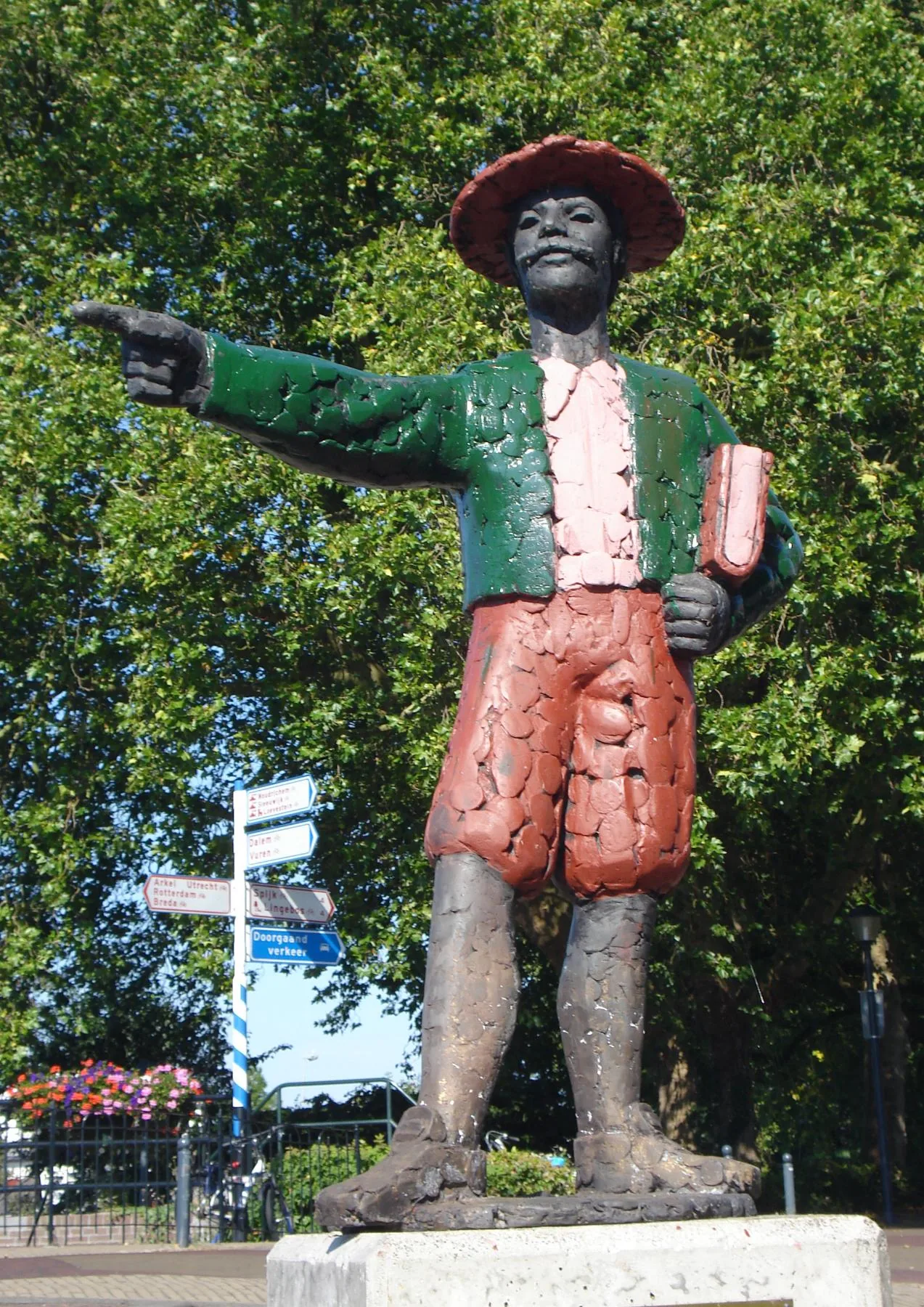
Statue in Gorinchem by Jaap Hartman. Photo: Wikifrits, 2013 · CC BY-SA 3.0 · Source page
A ship on a strange coast
A ship lost on an unknown coast
Imagine your ship hits the rocks at night. You wake on a coast whose name you do not know, among people who speak a language you cannot understand.
That happened to a Dutch sailor in the summer of 1653. He spent thirteen years in Korea and wrote one of the earliest detailed Western accounts of the country. But he wrote it as a report for his employers, and a language barrier stood between him and much of what he saw.
Background
A bookkeeper from Gorinchem
1630
Hendrick Hamel was born in 1630 in Gorinchem, a town in the Netherlands. In 1650 he sailed to the Dutch East Indies and worked there as a bookkeeper for the Dutch East India Company. The company ran ships and trading bases across Asia.
Background
A kingdom with few open doors
Korea was ruled by the Joseon dynasty, which lasted from 1392 to 1897. The Japanese traded from a Japanese enclave in the port of Busan, and most foreigners were kept out. Later, Westerners called Korea the Hermit Kingdom, a name made famous by the title of an 1882 book. The real picture is more complicated.
On Jeju island
August 1653
The Sperwer is wrecked
36 of 64
In mid-August 1653 the Sperwer, a Dutch ship on its way to Dejima in Japan, was wrecked on rocks off Jeju island. Sources give different days, from 15 to 17 August. Of the 64 people aboard, 36 survived.
Four days later
Officials arrive
About four days after the wreck, local officials came to the survivors. The two sides could barely talk to each other.
A decision point
You are Hendrick Hamel, the bookkeeper.
Jeju island, a few days after the wreck, 1653
The ship is gone, and some of your shipmates drowned. You stand on a coast you do not know, with no ship and no clear way off the island.
Local officials approach. They are officials, not hosts, and neither side understands the other.
You do not know what they will do with you, or whether anyone will come looking.
What do you do?
- Cooperate with the officials and wait for their decision. Probably you are kept under guard while the officials ask the capital what to do. Life is hard, but you stay alive and keep a chance of going home.
- Steal a boat at night and try to sail for Japan. Probably you are caught on the coast or lost at sea. A failed escape would also make any later request for help look like a threat.
- Hide in the hills and wait for a Dutch ship to find you. Probably no rescue comes. Nobody outside the island knows where you are, and people hiding for long without support are usually found in the end.
What really happened
Cooperate with the officials and wait for their decision.
The men cooperated. They were moved to Jeju City, and the local prefect reported their case to the king and asked for instructions.
The sources do not say how the men weighed the options. Cooperating was the most cautious choice, and it kept them alive.
October 1653
Who can speak to them?
In October 1653 the officials brought in a Dutchman who could help them talk to the crew: Jan Janse Weltevree. The officials needed him to ask questions, and the crew needed him to understand the answers.
Check yourself
In which year was the Sperwer wrecked, and how many of the people on board survived?
Answer: 1653, and 36 survived. Correct: the wreck came in mid-August 1653, and 36 of the 64 people aboard survived.
In the capital, before the king
June 1655
Before the king
In June 1655 the men were taken to Hanseong, the capital, which is today's Seoul, and brought before King Hyojong, who ruled from 1649 to 1659. The sources give the month, not the exact day.
A decision point
You are Hendrick Hamel, standing before the king.
Seoul, June 1655
Almost two years have passed since the wreck. Your chance of going home now depends on the king of Korea.
The king refuses to release you and gives the country's rules as the reason. Then he asks you to entertain him with songs and dances from your homeland.
What do you do?
- Do as the king asks, and hope his favour grows over time. Probably you get a role and some standing at court. That keeps you in the capital, but it does not open the way home.
- Refuse, and insist as Dutch subjects on going home. Probably you are punished or ignored. An open refusal before the king would not win your release, and it would make your position worse.
What really happened
Do as the king asks, and hope his favour grows over time.
The king did not release them. The men stayed in Seoul and served in his guard for about two years. The sources do not say whether they sang or danced.
The sources do not record the men's thinking. Accepting the court's terms was the more cautious of the two, and it did not provoke the court.
1657
Sent out of the capital
After about two years in the guard, in 1657, the men were sent to a military garrison in Jeolla province, in the south-west of the peninsula.
Check yourself
What did the king ask the men to do in Seoul, according to the sources?
Answer: Sing and dance songs from their homeland. Correct: the king asked them to entertain him with songs and dances from their homeland. No words of those songs survive in the sources.
Who wrote the journal?
Source: The journal's title
Journal addressed to the Governor-General, Joan Maetsuycker, and the councillors of Netherlands India
A title, not a passage; the translation is ours. Hamel wrote the journal in Nagasaki in 1666–1667, on commission from the company, and it was printed in the Netherlands in 1668.
- Who was this text written for? To the company's managers. It is a report to employers, so it stresses what they wanted to know, and probably how the writer wanted to look.
- What does the title not tell us? It promises a report to the company, not a full picture of Korea.
Source: A map from 1920
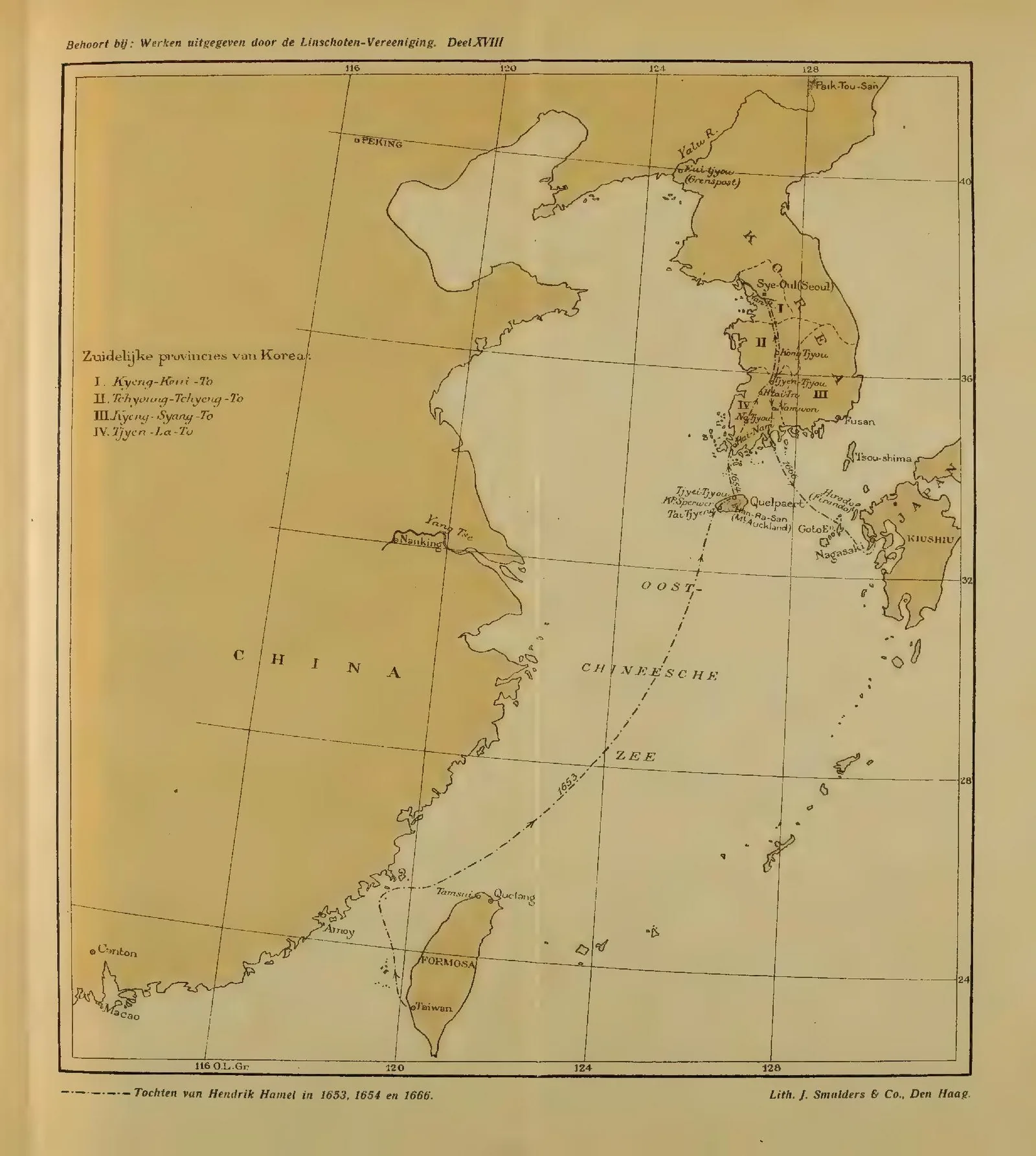
Map from the 1920 Dutch edition of the journal, edited by B. Hoetink (Linschoten Society, vol. XVIII) · Public domain · Source page
From the 1920 Dutch edition of the journal, edited by B. Hoetink and published in The Hague
Printed in the 1920 Dutch edition, more than 250 years after the voyages. Its map marks Hamel's journeys.
- When was the map made, and who made it? Printed in 1920 in The Hague, in an edition edited by B. Hoetink. It is a later printing, not a survey made during the voyage.
- The map marks Hamel's route. Dutch Wikipedia, citing the National Archives, says he boarded the Sperwer at Batavia, while English Wikipedia names no port of departure. What does this tell you? A modern map can show one editor's reading as if it were fact, and it does not show what the sources leave open.
Myth
Hamel was the first European ever to set foot in Korea.
The truth
No. Jan Janse Weltevree, known in Korea as Pak Yon, had been there since about 1627, some 26 years earlier. He made artillery for the capital and later served as a translator.
The evidence
The officials used that translator in 1653. Hamel's book, printed in 1668 and translated, became one of the best-known Dutch accounts. 'First' and 'best known' are not the same.
Check yourself
Which Westerner was already in Korea before the Sperwer was wrecked?
Answer: Jan Janse Weltevree (Pak Yon). Correct: he had been in Korea since about 1627, which is why the officials could use him as a translator in 1653.
Can we trust the journal?
Is the journal a window onto seventeenth-century Korea, or a company report that mostly tells us about the company?
- Readers who trust the account It is an eyewitness account of thirteen years in Korea. Its details about places, officials and daily life are worth using, even if the text is not neutral.
- Readers who doubt it It was written for the company, by a man serving his employers, and most readers know it only from the printed edition of 1668 and its translations. It should be read with care.
Which parts of the journal could be checked against Korean records, and which could not?
The escape and the memory
1659–1663
Famine and a split
22 still alive
Between 1659 and 1663 a famine struck. The 22 men still alive were split three ways: five to Suncheon, five to Namwon, and twelve, Hamel among them, to the headquarters of the Left Provincial Naval District, near modern Yeosu.
A decision point
You are Hendrick Hamel, one of the twelve men near Yeosu.
Near Yeosu, 1666
Thirteen years have passed, and there is still no sign of a Dutch ship.
A fishing boat is for sale. If you are caught trying to escape, the punishment may be severe.
What do you do?
- Stay where you are and hope a Dutch ship arrives. Probably nothing changes. Waiting keeps you alive, but with no sign of a ship, the years may simply go on.
- Ask the authorities for a ship to take you back to Batavia. Probably you get a refusal, or no answer at all. The request means explaining who you are, and the authorities have had years to decide what to do with you.
- Buy the boat and sail for Japan. Four days at sea. Then Japanese boats find you near the Goto Islands, and eight of you reach Dejima in Nagasaki.
What really happened
Buy the boat and sail for Japan.
On 4 September 1666 the men left in a purchased fishing boat. Four days later Japanese boats found them near the Goto Islands. Eight men, Hamel among them, reached Dejima on 14 September 1666.
The sources do not record the men's reasoning. What is known is that the boat was bought, not stolen.
What followed
- August 1653 The Sperwer is wrecked off Jeju. 36 of 64 survive.
- June 1655 Before the king in Seoul. Their release is refused.
- 1657 They are sent to a garrison in Jeolla province.
- 1659–1663 Famine. 22 men still alive are split three ways.
- September 1666 Eight men, Hamel among them, reach Dejima in Nagasaki.
- 1666–1667 Hamel writes the journal in Nagasaki. It is printed in the Netherlands in 1668.
- 1670–1672 Translations into French (1670) and German (1672).
- 1692 Hamel's last recorded year.
Centuries later
A statue, a museum and a tree
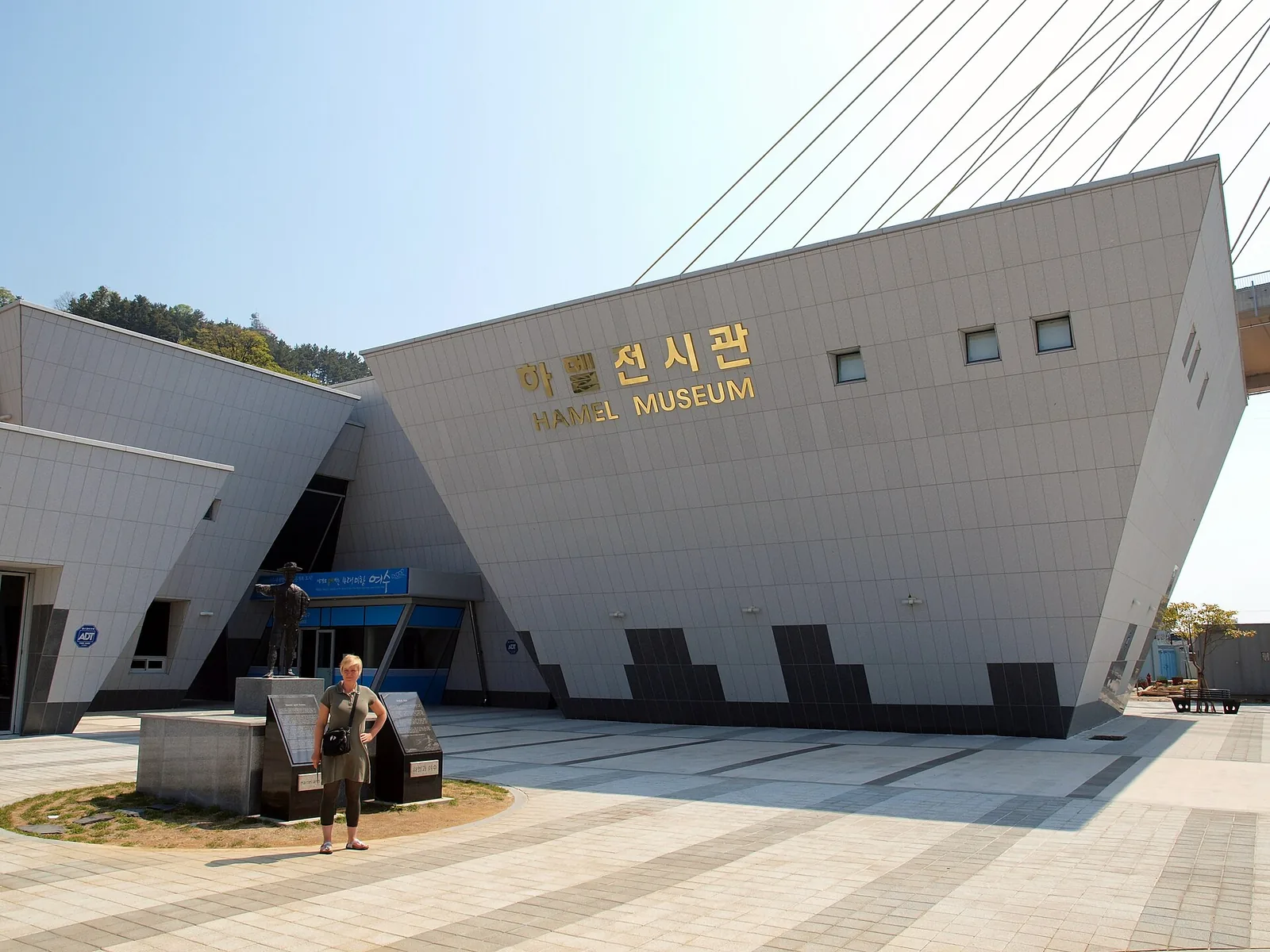
Hamel Museum, Yeosu. Photo: Davey400, 2013 · CC BY-SA 3.0 · Source page
2015
Gorinchem has a statue of him, made after his death, and a museum that opened in 2015. Gangjin has a second statue, and a ginkgo tree believed to be in the journal became a natural monument in 1997.
Check yourself
In the famine years, where was the group of twelve men, Hamel among them, sent?
Answer: To the naval headquarters near Yeosu. Correct: twelve of the survivors, Hamel among them, were sent there.
Check yourself
Which claim about the journal is best supported by what you have read?
Answer: It was written in Nagasaki for the company, and printed in the Netherlands in 1668. Correct: it was written in Nagasaki from 1666 to 1667 on the company's commission, and printed in the Netherlands in 1668.
Check yourself
Why is a statue or a museum in his memory no proof of what happened in 1653?
Answer: Because they were made long after the events, to show a chosen memory. Correct: these are later works, and they show which memory was chosen, not what happened.
Terms
- Dutch East India Company The Dutch trading company that ran ships and trading bases across Asia. Hamel worked for it, and his journal was written on its commission.
- Joseon dynasty The dynasty that ruled Korea from 1392 to 1897. When the men were brought to the capital, the king was Hyojong.
- Jeju A large island off Korea's southern coast. The Sperwer was wrecked off its shore, near Gapado.
- Dejima The Dutch trading post in the harbour of Nagasaki, Japan. The eight survivors of the escape reached it in 1666.
- Japanese enclave A Japanese trading enclave in the port of Busan, Korea. Japanese trade with Korea was limited to a few ports.
- Hermit Kingdom A Western nickname for Korea, made famous by the title of William Elliot Griffis's 1882 book. It simplifies a more complicated picture.
- Gorinchem A small town in the Netherlands, where Hendrick Hamel was born.
- Sperwer A Dutch ship that was wrecked on rocks off Jeju island in 1653.
- Jeju City The main town on Jeju island, where the Dutch sailors were taken.
- Hyojong King of Korea who held the sailors at his court; he ruled from 1649 to 1659.
- Hanseong The capital of Korea in the Joseon period. Today it is Seoul.
- Seoul The capital city of South Korea today.
- Jeolla A province in the south-west of the Korean peninsula.
- military garrison A base where soldiers are stationed to guard an area.
- Suncheon A town in South Korea where some of the men were sent after the famine.
- Namwon A town in South Korea where five of the men were sent.
- Left Provincial Naval District A naval military district on the Korean coast, where some of the men served.
- Yeosu A port city in South Korea, near the naval district headquarters.
- Goto Islands A group of islands off the coast of Japan, near where the men's boat was found.
- Nagasaki A port city in Japan. Hamel wrote his journal there.
- Gangjin A town in south-west Korea with a second statue of Hamel and a ginkgo tree.
- ginkgo tree An ancient tree that is a natural monument in Gangjin.
- fishing boat A small boat that fishermen use to catch fish at sea.
- bookkeeper A person who records a company's income and spending and keeps its books.
- Dutch archive An institution that keeps old documents, including records of the Dutch company.
- journal A book in which a person writes down what happened and what they saw each day.
Sources
- Hendrick Hamel, Journael gericht aenden Ed. heer gouverneur generael Joan Maetsuijcker en d'Ed. heeren raaden van Nederlants India (manuscript title, as the Nationaal Archief gives it; printed in the Netherlands in 1668). English modern title: Hamel's Journal and a Description of the Kingdom of Korea, 1653-1666
- Hendrick Hamel, Verhaal van het vergaan van het jacht de Sperwer, ed. B. Hoetink (Linschoten-Vereeniging, vol. XVIII; 's-Gravenhage: Martinus Nijhoff, 1920)
- William Elliot Griffis, Corea: The Hermit Nation (New York: Charles Scribner's Sons, 1882)
- Nationaal Archief, description of the Hamel journal (as cited in the Dutch Wikipedia article 'Hendrick Hamel')
- English Wikipedia, 'Hendrick Hamel' and 'Jan Janse Weltevree'
Image credits
- Statue in Gorinchem by Jaap Hartman. Photo: Wikifrits, 2013 · CC BY-SA 3.0 · Source page
- Map from the 1920 Dutch edition of the journal, edited by B. Hoetink (Linschoten Society, vol. XVIII) · Public domain · Source page
- Hamel Museum, Yeosu. Photo: Davey400, 2013 · CC BY-SA 3.0 · Source page


