The Great Revolt, 66–73: from Jerusalem to Masada
In the summer of 66 they stopped offering a sacrifice for the Roman emperor in Jerusalem. Four years later the Temple was burning. Who wanted the war, and who wrote the story?
Decisions, questions and your own progress, in the app
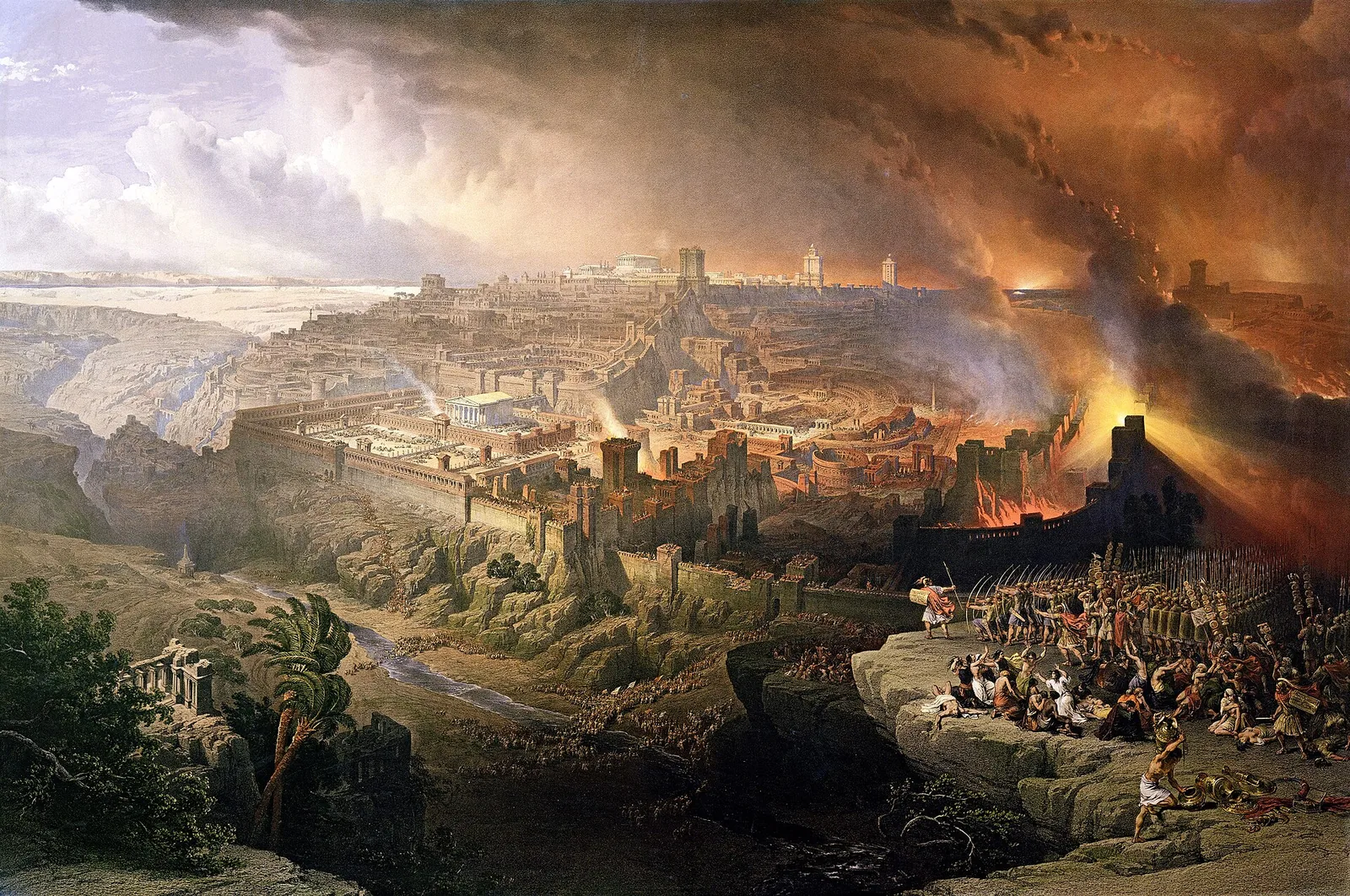
David Roberts, The Siege and Destruction of Jerusalem by the Romans under the Command of Titus, A.D. 70, 1850. Oil on canvas; a private collection, according to Wikimedia Commons. · Public domain · Source page
A sacrifice for the emperor
The summer of the offering
Jerusalem, summer 66 CE. In the Temple, priests offer sacrifices in the name of the Roman emperor and the Roman people.
According to Josephus, that summer a question arose about what to do with that offering. Who decides, and why?
Background
A Roman province since 6 CE
Judaea has been a Roman province since 6 CE. Archelaus, a son of Herod, was removed, and the land came under direct Roman rule. The emperor is the final authority. In the province, a procurator runs the country in his name.
From 64 to 66 the procurator was Gessius Florus. He was in office when the war broke out, with Roman soldiers behind him to keep order.
The money
Seventeen talents
According to Josephus, Florus sent men to take seventeen talents out of the Temple treasury. In his words, Florus “sent some to take seventeen talents out of the sacred treasure.”
Unrest in Caesarea, and then clashes in Jerusalem, followed. In 66 the conflict became open war, and it reached the city itself.
A decision point
You are Eleazar ben Hananiah, son of the high priest Ananias, in charge of the Temple.
Jerusalem, summer 66
Some in the city want to cut ties with Rome. Others want to wait and talk. The procurator has taken money from the Temple treasury.
The offering for the emperor is a sign of loyalty to Rome. If you stop it, everyone will know, the Romans included.
What do you propose?
- Keep the offering, and send a delegation to the procurator to ask for an explanation about the money. Probably the offering would continue, and the delegation would come back without a satisfactory answer. Florus was not likely to give way. The city would see the Temple still trusting Rome, and angry people would call it betrayal.
- Call together the priests and leading men, and delay the decision until the debate is settled. Probably the debate would drag on, and people would decide without you. Those who wanted revolt would act in the streets, and those who wanted peace would wait for an answer that might not come.
- Stop the offering for the emperor, and accept no more gifts or sacrifices from foreigners. Probably Rome would read this as a declaration of revolt. The Roman troops in the city would be in danger, and the clash would come sooner. Some of the people would back you wholeheartedly, and others would pay the price.
What really happened
Stop the offering for the emperor, and accept no more gifts or sacrifices from foreigners.
According to Josephus, Eleazar had the ministers refuse offerings from foreigners, so the offering for Caesar and the Roman people was rejected. Soon after, the Roman garrison in Jerusalem laid down its arms, and Eleazar’s men attacked and killed them. Only Metilius was spared, after he offered to become a Jew and be circumcised.
Why choose this? Josephus calls Eleazar “a very bold youth”, and presents the decision as an act of courage rather than careful calculation. He wrote after the war, knowing how it ended, so the decision looks to him like a turning point. Historians ask whether it was a planned revolt, or a bold act that others then had to follow.
From Jerusalem to Galilee
Peace
A king asks for peace
King Agrippa II was a Jewish ruler who governed under Roman protection, a client king in the Roman system. In Josephus’s account he made a long speech, urging the people not to go to war.
One line runs: “Had I perceived that you were all zealously disposed to go to war with the Romans…” The speech did not stop the war.
An ambush
The army falls back to Beth Horon
Cestius Gallus, the Roman governor of Syria, led an army south to Jerusalem. He marched on the city, then turned back. In Josephus’s account the army went on as far as Beth Horon, where Jewish fighters blocked the narrow passes and pelted the soldiers from above.
Josephus dates the defeat exactly: “This defeat happened on the eighth day of the month Dius, [Marchesvan,] in the twelfth year of the reign of Nero.” That is about October or November of 66 CE.
Galilee
A priest from Jerusalem takes command
Josephus came from a priestly family in Jerusalem. In his own account he is given command of Galilee: “as was Josephus, the son of Matthias, of both the Galilees.”
Upper and Lower Galilee were the two regions he had to hold.
67 CE
Nero sends Vespasian
60,000
In 67 Nero sent Vespasian to put down the revolt, and, according to Josephus, could find no one else equal to the task. Vespasian then sent for his son Titus, from Achaia in Greece.
Josephus gives the army as “sixty thousand, besides the servants.” Its units were “the fifth and the tenth legions”, and also “that fifteenth legion which was with his father.”
These are Josephus’s own figures, and they are hard to check against other sources.
Jotapata: the pit
The siege
Forty-seven days
Jotapata, a town in Galilee, is where Josephus holds out. The Romans besiege it and raise banks of earth and stone up to the walls.
Josephus writes: “on the forty-seventh day [of the siege] the banks cast up by the Romans were become higher than the wall.”
The pit
Forty men of rank
At the last, Josephus finds himself in an underground pit with about forty men of rank. He records the debate that followed. One proposal was a pact of mutual death, settled by lot: “let us commit our mutual deaths to determination by lot.”
A decision point
You are Josephus, commander of Jotapata.
Jotapata, 67 CE
The siege has lasted weeks, and the Roman banks stand higher than the walls. You are in the pit with about forty men. Some would rather die than be taken, and all of them are looking to you.
You know the soldiers will search for you soon. There are three clear options, and each one is dangerous.
What do you do?
- Leave the pit and fight the Romans to the end. Probably you would fall in the open, surrounded, before you could do real harm. The men with you would gain nothing, and the town would gain nothing either.
- Stay in the pit and wait for the Romans to find you. Probably the Romans would find you before you had decided anything. The choice would be taken from you, and the men with you would be left without direction.
- Surrender to Vespasian, and offer yourself to him. Probably you would be taken as a valuable prisoner. If the Romans judged you worth something, your life might be spared, and new paths might open. But those who saw you as a traitor would never forget it.
What really happened
Surrender to Vespasian, and offer yourself to him.
Josephus says he escaped the death pact and gave himself up. He writes: “I willingly give them my hands, and am content to live.” He also says that he told Vespasian what the future held: “Thou, O Vespasian, art Caesar and emperor, thou, and this thy son.”
Why surrender? Josephus says he chose to live, and tells of a prophecy that Vespasian would become emperor. Historians disagree. Was this an honest choice, backed by a real prophecy? Or a later story that made a surrender look like destiny? We know that Josephus wrote his works while living in Rome under the patronage of the Flavians, the dynasty whose rise he describes.
Four emperors and a siege
Nero
An emperor dies
In June 68 Nero took his own life. He was the last emperor of the family that began with Augustus.
A struggle for the throne opened in Rome, and whoever won it would need the legions, not just the city.
69 CE
The year of the four emperors
The year after Nero’s death is known as the year of the four emperors, because four men were proclaimed emperor one after another. On 1 July 69, in Alexandria, the troops in Egypt and Judaea proclaimed Vespasian emperor.
Titus
The son stays in the field
Vespasian did not stay in the field. He left the war to his son Titus, who was to finish it.
Jerusalem
The siege at Passover, 70
The siege of Jerusalem began around Passover in 70 CE. Inside the city stood three walls, and the Roman siege works broke through the outer walls.
Josephus describes food running short inside the city, and hunger spreading among the people. This is the setting for the decision that follows.
A decision point
You are Yohanan ben Zakkai, a scholar of Jerusalem who teaches Torah.
Jerusalem, during the siege, 70 CE
The city is under siege, and food is running out. You think the walls will not hold for long.
You know the learning and wisdom of your people, and you think about what will survive if the city falls.
What do you do?
- Stay in the city, share its fate, and encourage the people. Probably you would stay with the people to the end. Your voice would be heard inside the walls, but no school would be left to carry on the teaching after the fall.
- Go openly to the Romans and ask for terms for the whole city. Probably the Romans would refuse to give up the conquest. The fighters inside the city might see your talks as betrayal, and put you in danger.
- Slip out of the city secretly, and ask Vespasian for a small place to study. Probably the request was modest and hard to refuse: a small group of sages and a place to study. Such a place could survive the fall of the city, and keep learning alive.
What really happened
Slip out of the city secretly, and ask Vespasian for a small place to study.
In the tradition in the Talmud (Gittin 56a–b), Yohanan pretends to be ill. His nephew Abba Sikra plans the escape, and Yohanan is carried out of the city in a coffin. Once outside, he asks Vespasian for the town of Yavne and its sages, and to spare the family of Rabban Gamliel.
The story is told in the Talmud, centuries after the events, and it does not appear in the passages from Josephus read in this lesson. Historians treat it as legend. What it shows is what later sages wanted to remember: that learning could survive the fall of the city. It is a tradition, not a record of what Yohanan did.
The Temple burns
Josephus (Yosef ben Matityahu)
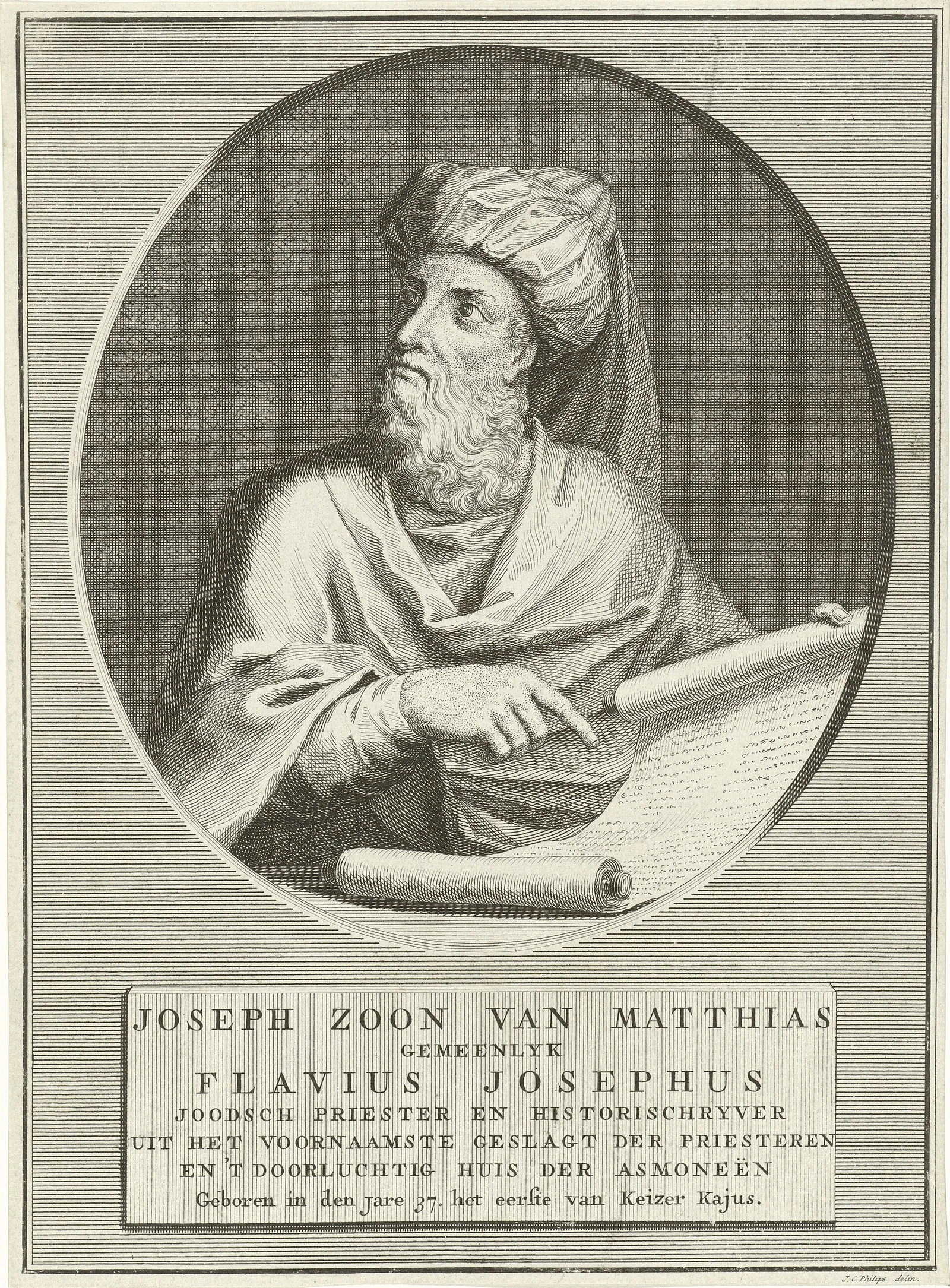
Jan Caspar Philips after his own drawing, Portrait of Flavius Josephus, engraving, Amsterdam, 1736–1775. Rijksmuseum, Amsterdam. · CC0 · Source page
A commander in Galilee from a priestly family, who surrendered to Rome, and later wrote the fullest account we have of the revolt.
- Born: c. 36–37 CE, Jerusalem
- Died: c. 100 CE
- Lost: Jotapata, 67
“Thou, O Vespasian, art Caesar and emperor, thou, and this thy son.”
70 CE
The fighting reaches the Temple
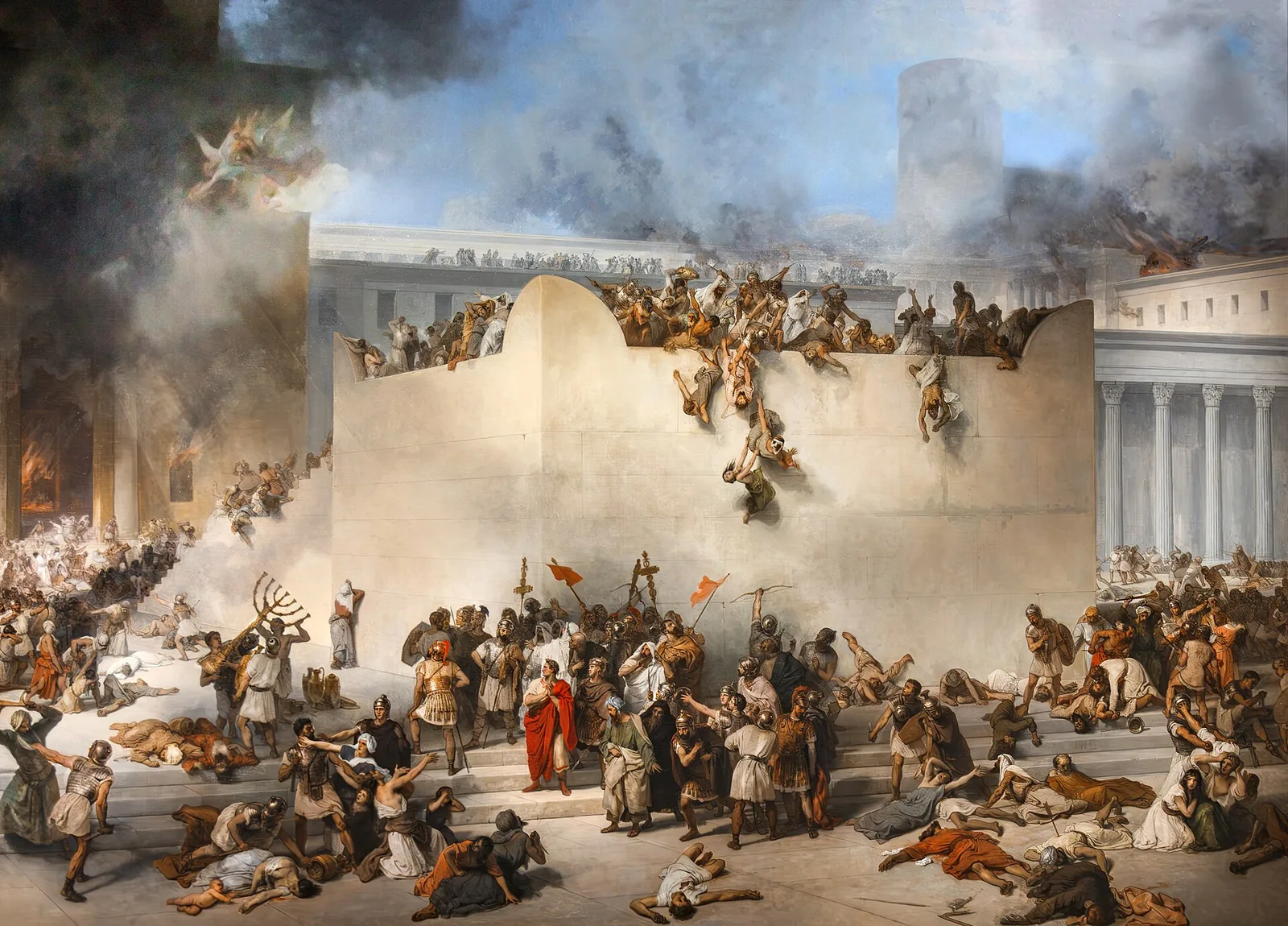
Francesco Hayez, La distruzione del tempio di Gerusalemme, 1867. Oil on canvas, Gallerie dell’Accademia, Venice. Photo: Didier Descouens, 2023, via Wikimedia Commons. · Public domain · Source page
In summer 70 the fighting reached the Temple. We know most about the fire from Josephus, who wrote after the war, and from a Christian writer who wrote more than three centuries later.
The two versions do not match. We will read them one after the other, and ask who saw, who wrote, and for whom.
Source: Josephus: “without Caesar’s approbation”
Titus argued “not in any case for burning down so vast a work as that was.”
Josephus dates the fire: “it was the tenth day of the month Lous, [Ab,] upon which it was formerly burnt by the king of Babylon.”
Of the soldiers he writes that they “did not hear what he said, though he spake so loud.”
And thus was the holy house burnt down, without Caesar’s approbation.
Written after the war by a Jew who was in the Roman camp during the siege, and who wrote for Roman readers.
- Who wrote this, and for whom? Josephus, a Jew who surrendered to Rome and wrote after the war, for readers some of whom were Romans. He has reasons to describe the Romans in a way that suits them.
- What does the text say about Titus? Two things at once. Titus argued against burning the house, yet Josephus also says he ordered the gates set on fire. The text makes him neither simply innocent nor simply guilty.
- What is missing? The text does not say what the soldier was thinking, or how Josephus knew what was said and heard amid the flames.
Source: Sulpicius Severus, Chronicle 2.30
Titus is said, after calling a council, to have first deliberated whether he should destroy the temple.
“others and Titus himself thought that the temple ought specially to be overthrown.”
A Christian writer, more than three centuries after the fall of Jerusalem. He was not there. He may have drawn on an earlier source that has been lost, but this cannot be proved.
- Who speaks here, and how far is he from the events? A Christian writer of around 400 CE, more than three centuries after 70. He had no firsthand knowledge.
- How does he differ from Josephus? In Sulpicius, Titus himself wants the Temple overthrown. In Josephus, Titus argues against burning the house. And Sulpicius never says the Temple was burned, only that it should be “overthrown”.
- Why might a writer far away in time change a story? He may simplify, copy from another writer, or retell the story to suit his own purposes. Before believing either version, compare both, and ask who gains from each.
The calendar
Why the tenth, not the ninth?
Josephus dates the fire to the tenth day of Av. The fast that marks the destruction of the Temple is kept on the ninth, Tisha B’Av.
The sources read here do not explain the difference.
Myth
The Temple was burned by an angry mob of Roman soldiers, against Titus’s orders.
The truth
Not quite. In Josephus, Titus ordered the gates set on fire, but he did not want the house itself burned. A soldier set the house alight without waiting for an order, and Titus ran to stop the fire, but the soldiers did not hear him. Josephus describes one soldier starting the fire, not a mob, and soldiers who did not stop it.
The evidence
The two passages from Josephus, and Sulpicius 2.30, which gives another version: Titus himself thought the Temple ought to be overthrown. The sources disagree with each other, and that disagreement is the heart of the question.
Afterwards: numbers, a triumph and an arch
The numbers
1,100,000
Josephus gives two totals. He says that the number of “those that perished during the whole siege” was eleven hundred thousand, and that the number taken captive in the whole war “was collected to be ninety-seven thousand”.
The first total is said to include the Passover pilgrims who were trapped in the city. Many historians doubt both totals. The historian Menahem Stern rejects the larger totals as exaggerated.
Tacitus
Six hundred thousand besieged
The Roman historian Tacitus gives a different figure, but he counts the people trapped in the city, not the dead. He reports that the besieged, of all ages and both sexes, numbered about six hundred thousand.
For the men able to fight, Stern accepted Josephus’s figure of 23,400 armed men inside the city as realistic. He rejected the larger totals.
71 CE
A victory on a coin
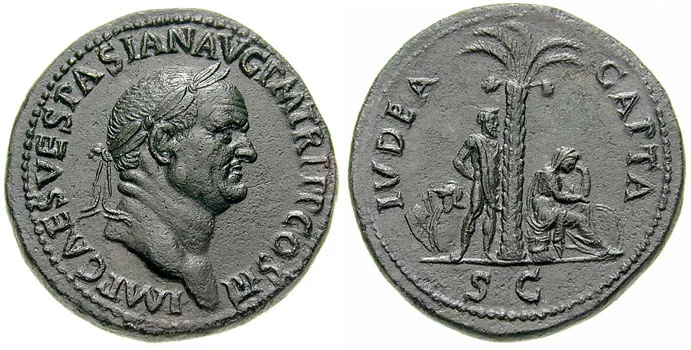
Sestertius of Vespasian, Judaea Capta issue, struck 71 CE. Photo: CNG, 2002, via Wikimedia Commons. · CC BY-SA 3.0 · Source page
In 71 Vespasian and Titus celebrated a triumph in Rome. To mark the victory a coin series was struck, called Judaea Capta, “Judaea taken”. One side shows the emperor’s head. The other shows a mourning woman sitting under a palm tree, with a bound captive standing nearby and captured arms behind.
The series ran for about 25 years, under Vespasian and his two sons.
Source: The Arch of Titus: spoils from the Temple
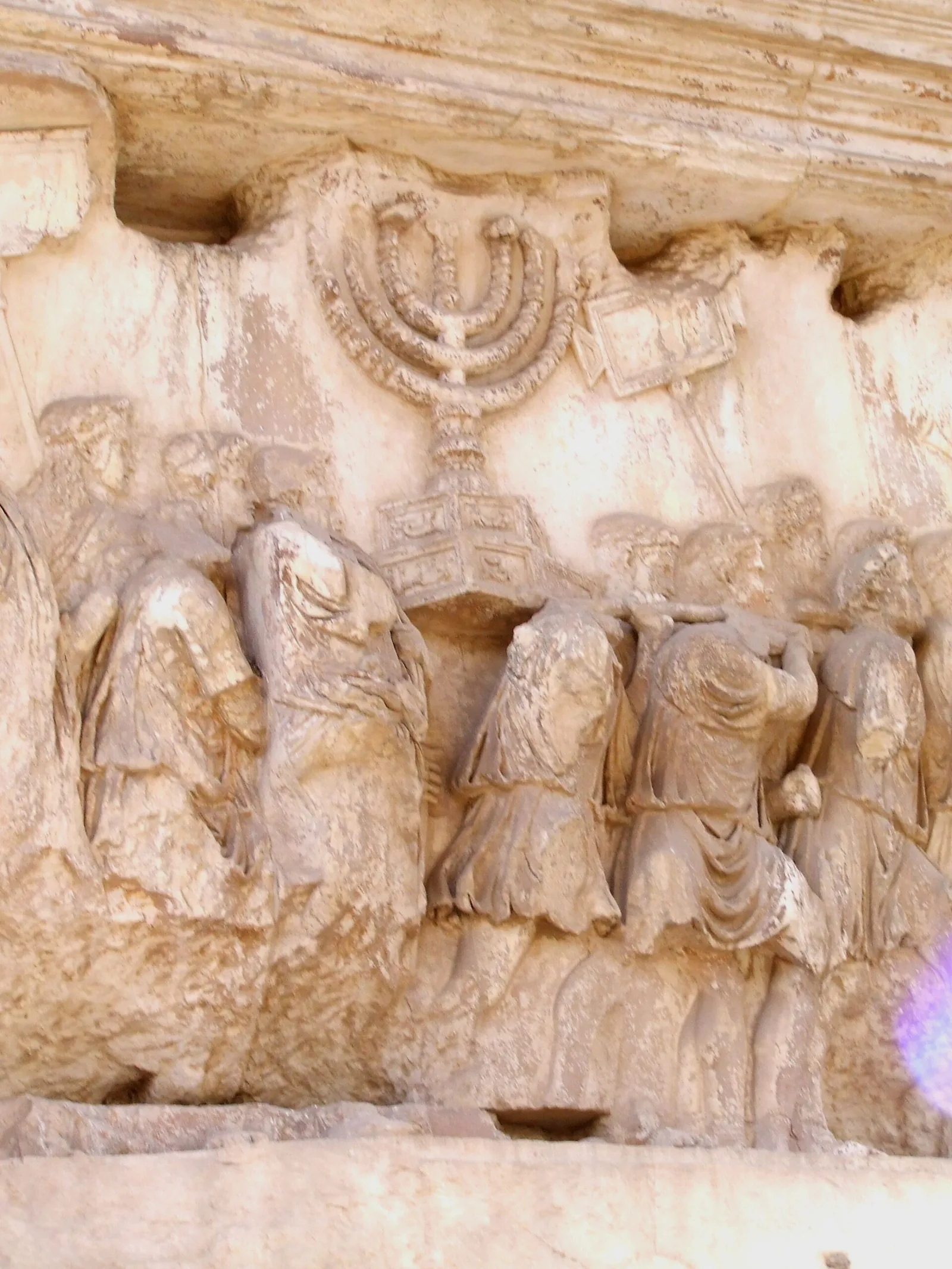
Relief on the Arch of Titus, Roman Forum. Photo: Laurel Lodged, 2010, via Wikimedia Commons. · Public domain · Source page
Arch of Titus, Roman Forum, c. 81 CE
The arch was built around 81 CE by Domitian, Titus’s brother, in his honour. The relief shows the spoils from the Temple carried through Rome in the triumph.
- What does the relief show, and what is missing? A menorah, and other objects from the Temple carried in procession. It shows the spoils, not the fire, the fighting or the dead.
- Who commissioned the arch, and for whom was it meant? Domitian, Titus’s brother, built it around 81 CE. It was meant for the people of Rome and for everyone who passed beneath it, as a memorial to his family’s victory.
- Why show the menorah at all? The menorah was the proof of victory: sacred objects from the Jerusalem Temple were carried to Rome as loot. That was the message.
After 70
A tax on the Jews
After 70, Vespasian imposed a tax on Jews, the fiscus Judaicus. It was two denarii a head, paid into the imperial treasury.
In 96 the emperor Nerva reformed it.
What followed
- 66 CE The offering for the emperor stops. The Roman garrison in Jerusalem is killed. Cestius’s army is attacked at Beth Horon on its way back.
- 67 CE Vespasian and Titus lead a large army into Galilee. Jotapata falls after 47 days, and Josephus gives himself up.
- 68 CE Nero takes his own life in June.
- 69 CE On 1 July Vespasian is proclaimed emperor at Alexandria. It is the year of the four emperors.
- 70 CE The siege of Jerusalem begins around Passover. In summer the Temple burns, on the tenth of Av by Josephus’s reckoning. The city falls.
- 71 CE A triumph in Rome, and the Judaea Capta coins.
- 72–74 CE Masada falls. The date is disputed, and it is discussed in the last chapter.
- 81 CE The Arch of Titus is built in Rome, under Domitian.
- 96 CE Nerva reforms the tax on the Jews.
Masada, and what remains
Masada
A fortress on the rock
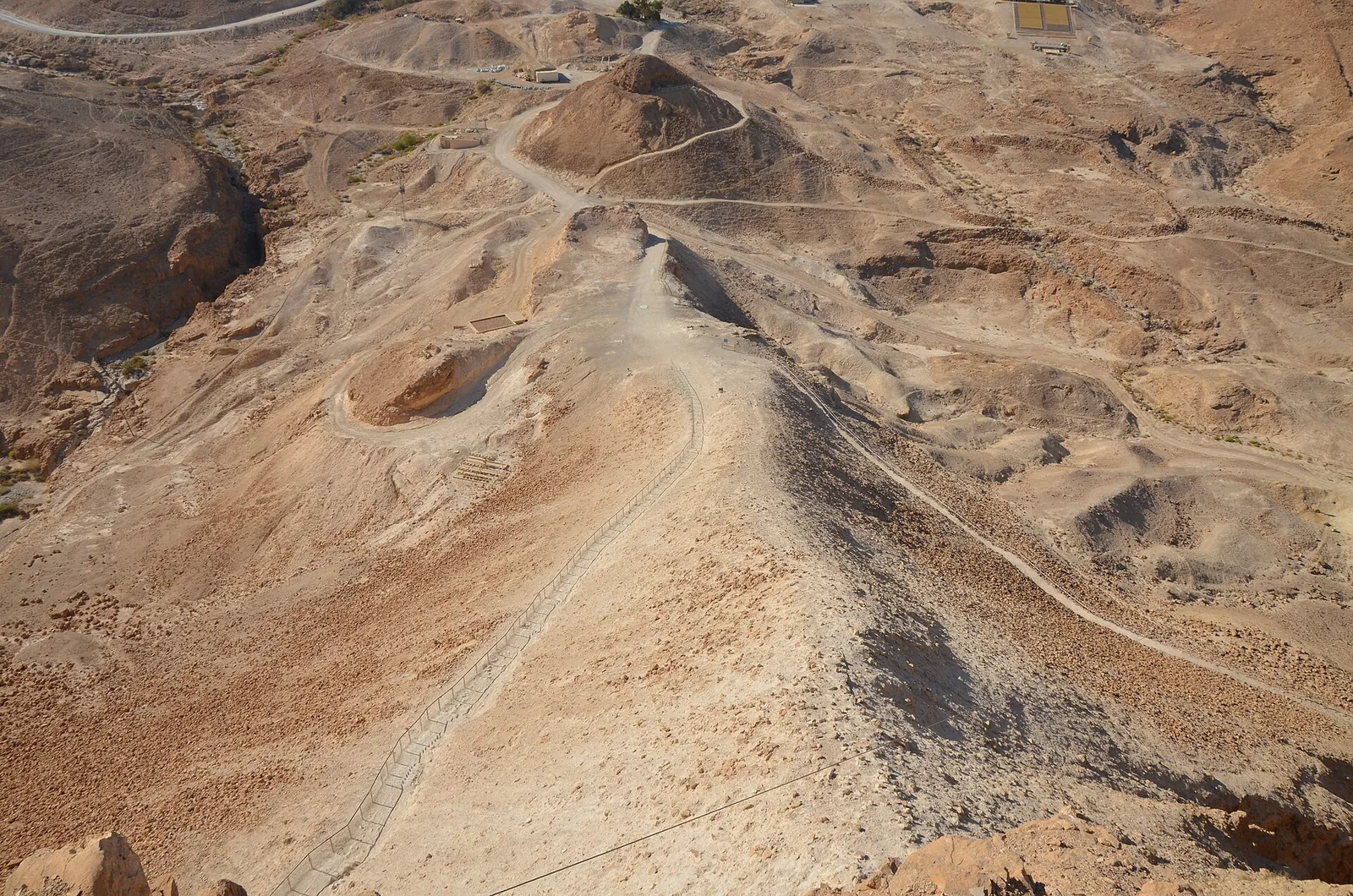
The Roman siege ramp at Masada. Photo: Carole Raddato, 2014, via Wikimedia Commons. · Carole Raddato from FRANKFURT, Germany · CC BY-SA 2.0 · Source page
Masada is a fortress on a cliff above the Dead Sea. According to Josephus, the Hasmoneans first built it, and Herod later fortified it as a refuge for himself. In the revolt it was held by a group of Sicarii, led by Eleazar ben Yair.
The Romans brought up the Tenth Legion under Flavius Silva, and surrounded the fortress. They built a great ramp up the slope to the wall. Josephus says the bank “was raised, and became solid for two hundred cubits in height.”
The night
Tomorrow morning
The Roman ramp now reaches the wall. The Romans expect the defenders to fight in the morning.
Inside the fortress are men, women and children.
A decision point
You are Eleazar ben Yair, leader of the Sicarii at Masada.
Masada, the night before the attack
The Roman ramp now reaches the wall. The attack is expected at dawn, and you know it.
Inside the fortress are men, women and children. Before the night is over, you must decide what to tell them, and what to do.
What do you say and do?
- Give a speech about freedom: none of us will be a slave to the Romans, and ask everyone to stay united. Probably the speech would bring most of the people to one common stand. But it would close every other path, and the decision would be made in the night by the group, not by any one person.
- Send envoys to Silva and offer to hand over the fortress on terms. Probably Silva would accept only terms he dictated, and the answer would be harsh: captivity, and slavery for the living. No one could trust a promise made from that position.
- Break out at night into the desert, towards Ein Gedi, and try to escape. Probably the Romans would watch the routes, and the people would have little water or food. Few would get far, and those who did would face a harsh reality in the desert.
What really happened
Give a speech about freedom: none of us will be a slave to the Romans, and ask everyone to stay united.
According to Josephus, Eleazar gave a speech about freedom, saying that his people had long resolved never to be servants to the Romans. He reports that 960 died that night, the women and children included, and that they died by mutual killing, settled by lot. Only an old woman, a relative of Eleazar, and five children who hid in underground caverns survived. The Romans, who expected a fight in the morning, came into the palace and found the dead.
Why such a speech? Josephus is the only ancient source for that night, and he gives Eleazar a long speech. Some historians think he composed it himself rather than reporting the words exactly. The only survivors were a few women and children, and it is unclear how much of the speech any of them heard.
Myth
960 heroes chose death together, and archaeology proves it.
The truth
Josephus is the only ancient source for the story. Archaeologists found human remains at Masada, but their number and place are disputed. The finds neither prove the story nor disprove it.
The evidence
Yigael Yadin excavated at Masada in 1963–65 and found potsherds with names, one bearing the name Ben Ya’ir. Yadin linked them to Josephus’s lots, a hypothesis rather than proof. Nachman Ben-Yehuda argues that the team shaped its conclusions to fit the myth. The historian Kenneth Atkinson writes that there is no archaeological evidence that the defenders committed mass suicide.
Source: Josephus on Masada: a speech and a count
“Since we, long ago, my generous friends, resolved never to be servants to the Romans, nor to any other than to God himself,”
“Those others were nine hundred and sixty in number, the women and children being withal included in that computation.”
Written after the war, in Greek, for Roman readers. It is the only ancient account of that night.
- Who could have heard the speech? Almost no one. The survivors were few, women and children who hid. Anything we know of the speech comes through them, or through Josephus himself.
- Why include a speech at all? A speech lets an author explain motives and shape characters. This one turns the group into heroes of freedom, which suits Roman readers who might have seen them as rebels. It is a story, not only a report.
- What does the figure 960 include? The women and children, as Josephus states explicitly. The number covers everyone counted that night, not only fighters. Anyone who thinks of Masada as “960 warriors” is wrong, because that is not what Josephus wrote.
Can we trust Josephus?
When a historian writes for Roman readers, under Roman patronage, can his account of the Temple and of Masada be trusted?
- Martin Goodman Martin Goodman finds Josephus plausible, and takes his account seriously, even though Josephus was a party to the war.
- Lester Grabbe Lester Grabbe finds Josephus’s account of the fire hard to believe.
- Shaye Cohen, Kenneth Atkinson and Jodi Magness Cohen finds Josephus’s account of Masada incomplete and inaccurate. Atkinson writes that no archaeological evidence shows mass suicide. Magness argues that archaeology can neither prove nor disprove Josephus.
Perhaps the question is not only whether Josephus lied, but what he wanted his readers to understand, and what we are willing to accept as proof.
Check yourself
According to Josephus, who had the offering for the emperor stopped?
Answer: Eleazar ben Hananiah, the officer in charge of the Temple. Correct. Josephus names him as the officer in charge of the Temple, who had the ministers refuse offerings and gifts from foreigners.
Check yourself
Which statement about the Temple fire is best supported by the texts in this lesson?
Answer: Josephus says Titus ordered the gates burned, and a soldier fired the house.. Correct. This is the sequence Josephus gives in book 6. Titus argued against burning the house, and tried to stop the fire.
Check yourself
According to the tradition recorded in the Talmud, what did Yohanan ben Zakkai ask Vespasian for?
Answer: Yavne and its sages, and mercy for Rabban Gamliel’s family. Correct. In the tradition in Gittin 56, this is what he asks for. It is legend, not Josephus.
Check yourself
According to Josephus, how many people died at Masada that night, and who was counted?
Answer: 960 people, with the women and children included. Correct. Josephus says the count includes the women and children.
Check yourself
Which statement about the figure of 1.1 million dead is correct?
Answer: It is Josephus’s own figure, which Menahem Stern rejects as exaggerated.. Correct. This is Josephus’s own figure, and the historian Menahem Stern calls the larger totals exaggerated.
Check yourself
Which is the best summary of the debate about when Masada fell?
Answer: Traditionally late 72 or early 73; Campbell and Cotton proposed late 73 or early 74.. Correct. This is the difference between the traditional date and the proposals of Campbell and Cotton. Others argue for 74.
Terms
- procurator A Roman official who governed a province in the emperor’s name, usually responsible for money and taxes as well.
- legion A large Roman army unit, several thousand soldiers strong. Each legion had a number, such as the Tenth.
- client king A ruler who governed under Roman protection and depended on Rome for his power. Agrippa II was one of them.
- Flavians The dynasty of the emperors Vespasian, Titus and Domitian, who ruled Rome from 69 to 96 CE.
- triumph A Roman victory parade through the city of Rome, with spoils, captives and the victorious commanders.
- Sicarii A radical group of Jewish fighters in the revolt. Their name comes from the sica, a short dagger.
- ostracon A piece of broken pottery with writing on it, used like a label or a note.
- Talmud A large collection of Jewish law, tradition and debate, written down centuries after the events it describes.
- Tisha B’Av The fast that marks the destruction of the Temple, kept on the ninth of Av in the Jewish calendar.
- fiscus Judaicus A tax Vespasian imposed on Jews after the war, paid into the imperial treasury.
- year of the four emperors The year 69 CE, when four men were proclaimed emperor one after another.
- Gessius Florus The procurator of Judaea from 64 to 66. The war broke out during his time in office, and according to Josephus he took money from the Temple treasury.
- Archelaus Herod's son. He was removed from power in Judaea, and from then on Rome ruled the land directly.
- Herod A Jewish king from before the revolt, who strengthened Masada as a refuge for himself. His son Archelaus was removed from power.
- Josephus A Jewish historian who wrote about the revolt against Rome from his own point of view. He came from a priestly family in Jerusalem.
- Cestius Gallus The Roman commander in Syria. He led an army to Jerusalem, marched on the city, then turned back, and his army was defeated at Beth Horon.
- Beth Horon A narrow hill pass, where Jewish fighters blocked the way and pelted the Roman soldiers from above.
- Agrippa II A Jewish king who ruled under Roman protection. According to Josephus, he gave a long speech urging the people not to go to war.
- Jotapata A fortress town in Galilee, where Josephus held out. The Romans besieged it for weeks and built banks up to its walls.
- Hasmoneans A Jewish dynasty that ruled Judaea before Herod and before Roman rule. According to Josephus, they built Masada first.
- Eleazar ben Yair The leader of the rebels who held Masada. According to Josephus, he gave a speech about freedom on the last night in the fortress.
- Flavius Silva The Roman commander who surrounded Masada. Under his command a great ramp was built up to the fortress wall.
- Tenth Legion A Roman legion sent to besiege Masada under Silva.
- Vespasian A Roman commander sent to crush the revolt in Judaea, who later became emperor. He founded the Flavian dynasty.
- Titus Vespasian's son, who carried on the war in Judaea and celebrated a triumph in Rome with his father.
- Nero A Roman emperor, the last of the dynasty founded by Augustus. He took his own life in June 68.
- Metilius A Roman soldier who was spared in Jerusalem after offering to become a Jew and be circumcised.
- Abba Sikra The nephew of Yohanan, who planned his escape from the city in a coffin, according to the Talmud tradition.
- Gittin A tractate of the Talmud, which tells the story of Yohanan leaving Jerusalem in a coffin.
- Tacitus A Roman historian who wrote about the revolt. By his account, about six hundred thousand besieged people were in the city, not the dead.
- Menahem Stern A historian who accepted Josephus's figure for the fighting men in Jerusalem, but rejected the larger totals.
- denarius A Roman silver coin. After 70, the tax on Jews was two denarii a head.
- Domitian A Roman emperor, Titus's brother. He built the arch in Titus's honour, and its relief shows spoils from the Temple.
- Nerva A Roman emperor who reformed the tax on the Jews in 96.
- Rabban Gamliel A leading sage of Yavne. Yohanan asked Vespasian to spare his family.
Sources
- Flavius Josephus, The Jewish War, books 2, 3, 6 and 7, trans. William Whiston (1737), Project Gutenberg ebook 2850
- Tacitus, Histories 5.13 (paraphrased in this lesson)
- Sulpicius Severus, Chronicle 2.30 (c. 400 CE), trans. in Nicene and Post-Nicene Fathers, second series
- Babylonian Talmud, Gittin 56a–b
- Sue Parker Gerson, “Gittin 56”, My Jewish Learning (a secondary summary of the Talmud passage)
- Relief on the Arch of Titus, Rome, c. 81 CE (photographs in this lesson)
- Yigael Yadin, Masada: Herod’s Fortress and the Zealots’ Last Stand (1966)
- Yigael Yadin and Joseph Naveh, Masada I: The Aramaic and Hebrew Ostraca and Jar Inscriptions (1989)
- Duncan B. Campbell, “Dating the Siege of Masada”, Zeitschrift für Papyrologie und Epigraphik 73 (1988)
- Hannah M. Cotton, “The Date of the Fall of Masada: The Evidence of the Masada Papyri”, Zeitschrift für Papyrologie und Epigraphik 78 (1989)
- Shaye J. D. Cohen, The Significance of Yavneh and Other Essays in Jewish Hellenism (2010)
- Kenneth Atkinson, in Zuleika Rodgers (ed.), Making History: Josephus and Historical Method (2007), p. 397
- Jodi Magness, “The Masada Myth(s)”, Ancient Jew Review (2019)
- Nachman Ben-Yehuda, Sacrificing Truth: Archaeology and the Myth of Masada (Amherst, NY: Humanity Books, 2002)
- Livius.org, “Roman Jewish Wars 6”
Image credits
- David Roberts, The Siege and Destruction of Jerusalem by the Romans under the Command of Titus, A.D. 70, 1850. Oil on canvas; a private collection, according to Wikimedia Commons. · Public domain · Source page
- Jan Caspar Philips after his own drawing, Portrait of Flavius Josephus, engraving, Amsterdam, 1736–1775. Rijksmuseum, Amsterdam. · CC0 · Source page
- Francesco Hayez, La distruzione del tempio di Gerusalemme, 1867. Oil on canvas, Gallerie dell’Accademia, Venice. Photo: Didier Descouens, 2023, via Wikimedia Commons. · Public domain · Source page
- Sestertius of Vespasian, Judaea Capta issue, struck 71 CE. Photo: CNG, 2002, via Wikimedia Commons. · CC BY-SA 3.0 · Source page
- Relief on the Arch of Titus, Roman Forum. Photo: Laurel Lodged, 2010, via Wikimedia Commons. · Public domain · Source page
- The Roman siege ramp at Masada. Photo: Carole Raddato, 2014, via Wikimedia Commons. · Carole Raddato from FRANKFURT, Germany · CC BY-SA 2.0 · Source page


