Mao and the Great Leap Forward: the plan and the famine
In 1958 China set out to leap forward: steel furnaces in the villages, communal kitchens and targets nobody dared to question aloud. What went wrong, and who paid the price?
Decisions, questions and your own progress, in the app
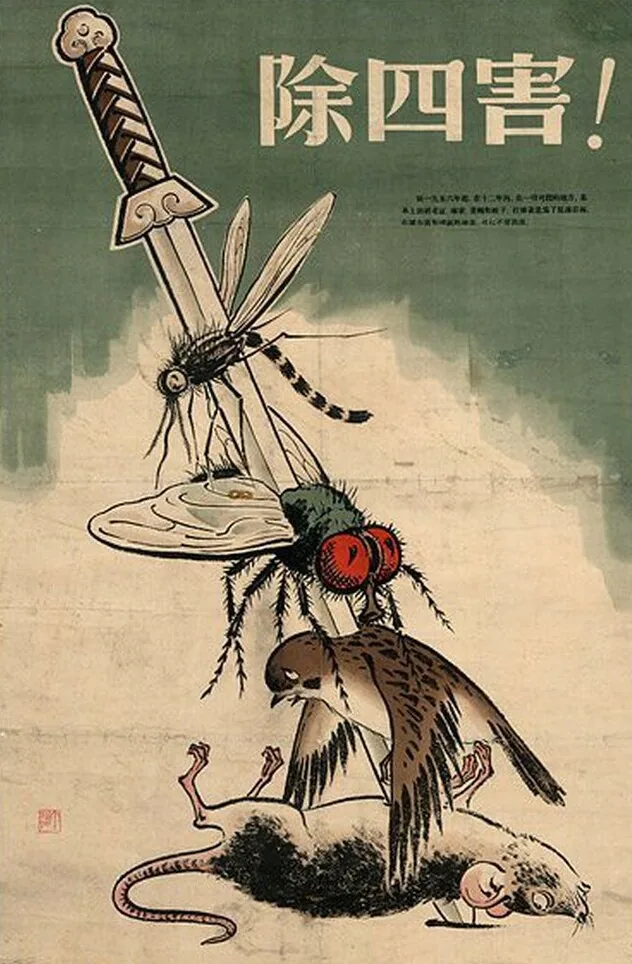
Chinese government poster, 1958. Credit in the image file: “China Government” · Public domain · Source page
Fifteen years
Beijing, 1958: a country in a hurry
In 1958 posters went up in China with a sword held over four pests: a rat, a fly, a mosquito and a sparrow. The campaign’s slogan told every family to act quickly.
How did a plan to overtake the industrial world in a few years look from inside? And who knew what was happening on the ground, and when?
Background
A new state
In 1949 the Chinese Communist Party won the civil war and proclaimed the People’s Republic of China. In its first three years the new state carried out agrarian reform, and the land was redistributed.
At the head of the Party stood Mao Zedong. The second five-year plan, for 1958 to 1963, was meant to push industry forward quickly.
Background
Invited to speak
In 1956 and 1957 the Party invited people to criticise it openly, under the slogan of the Hundred Flowers. When the criticism grew sharp, it was suppressed. The Anti-Rightist Campaign of 1957, led by Deng Xiaoping, branded the critics as “rightists”.
Moscow
Moscow, November 1957
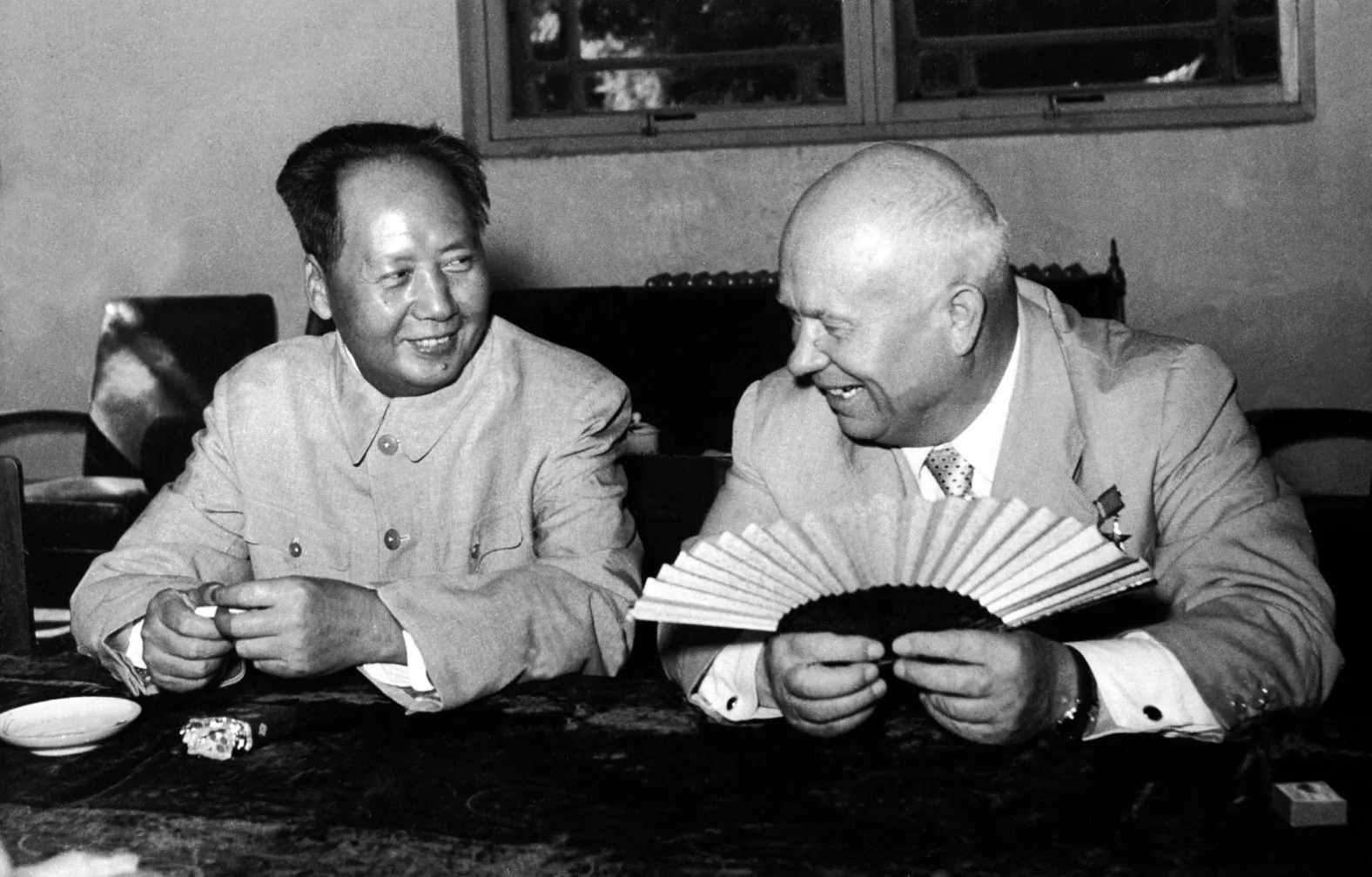
Mao and Khrushchev, Beijing, 1958. United Press photograph, Library of Congress collection · Public domain · Source page
In November 1957 Mao travelled to Moscow for the fortieth anniversary of the October Revolution. There Nikita Khrushchev promised that the Soviet Union would overtake the United States in about fifteen years.
The slogan that spread in China was to overtake Britain and catch up with America: Britain first, America second. Mao himself used the line about Britain about two months later, in January 1958, in a speech to a state conference.
Source: Mao: a speech to a conference
“It is possible to catch up with Britain in fifteen years.”
A party leader’s speech to senior officials, not a forecast. The sentence sounds like a measurement, but it is a political target: an aim, not a figure that can be checked before the date arrives.
- Who is speaking, to whom, and when? Mao, the Party leader, to senior state officials in January 1958, about two months after Moscow.
- Why Britain, when the Moscow pledge was about the United States? The sources do not say why Britain comes first. The pledge in Moscow named the United States, and the Chinese slogan put Britain ahead of it.
- What does the sentence leave out? How the target would be reached, and what it would cost. The sentence gives the result without the road to it.
Communes
The experiment
Chayashan, April 1958
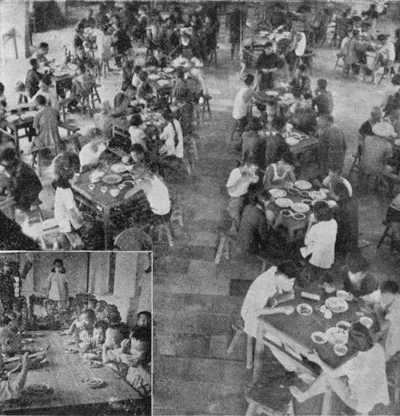
Communal canteen in a people’s commune, 1958. Photograph, author unknown · Public domain · Source page
In April 1958 an experimental people’s commune opened at Chayashan, in Henan province in central China. It abolished the families’ private plots and set up communal kitchens, where meals were free or almost free.
That year the commune movement spread across the country.
Industry
Steel in the yard
The great goal was steel. Small backyard furnaces appeared in yards, fields and villages, and farmers tried to melt iron and steel in them. The national target for 1958 was 10.7 million tons of steel.
Official figures said the target had been reached.
The machine
The chain of targets and reports
Targets came down from the top, through provinces, counties and communes, and the pressure grew at each level. What came back up were the reports, and on them the state set each area’s quota of grain.
A decision point
You are the party secretary of a county in Henan in 1958.
Henan, 1958, at harvest time. A composite: it stands for many local officials, not one named person.
The targets from the centre are very high, and in your county’s fields the harvest does not look like the figures you have been asked for.
Your report sets the county’s quota: how much grain it must hand to the state. A low report will look like failure, and a high one will bring praise. You know what is in the storehouses.
What do you report upwards?
- Report the real harvest and the real grain in the storehouses. The county would look like a laggard, and the target might still be set high. Probably the honest report would be ignored, or whoever sent it punished, and the county would have to find grain it does not have.
- Report the result the target expects, so the county meets its goal. The county looks successful, and the quota is set on the report. Probably grain is collected from the villages on figures that do not exist, and the farmers are left without enough to eat.
- Ask the higher level for a lower quota, and keep accurate local books. The request might be granted in one county and refused in another. Accurate books keep the truth for later, but do not stop the collection now. Probably the quota stays high, and whoever asked for relief is suspected.
What really happened
Report the result the target expects, so the county meets its goal.
Inflated reports were common. The state encouraged officials to report success and hide failure. Quotas were set on false figures, and excessive grain was collected. The consequences showed in 1959 to 1961. Steel reports in 1958 worked the same way: the target was reported as met, though more than three million tons of the steel could not be used.
The pressure from above was real. A low report looked like failure in the plan, and few officials wanted that label. Historians stress that the system rewarded good figures and left little room to say what was true.
The sparrow war
The campaign
The four pests
On 12 February 1958 the official Four Pests campaign was launched against rats, flies, mosquitoes and sparrows. It was one of the first campaigns of the Great Leap Forward, and the sparrow became its main target.
The slogan told every family to move fast and to beat drums and gongs to get rid of the four pests.
The numbers
Numbers that cannot be counted
In 1958 an official figure claimed that more than 300 million rats and sparrows had been killed. It is best read as propaganda, not as a count.
Estimates of the sparrows killed range from at least 200 million to nearly 2 billion. The higher figure comes from a government report, as quoted in a book of 1969.
Culture
A poem against the sparrow
On 21 April 1958 the writer Guo Moruo published a poem, “Cursing the Sparrow”, in the Beijing Evening News. It calls the bird a criminal of thousands of years and promises to settle accounts with it.
Chinese sources say that leading scientists and writers, among them Qian Xuesen and Ba Jin, took part in the sparrow hunt.
Source: A 1958 poster: “Eliminate the four pests”
“…flies and mosquitoes are like right-wingers.”
The slogan belongs to the whole campaign, and it is not certain that it is printed on this poster. In 1957 critics of the Party had been called “rightists”, which is why the word sounds familiar. The poster itself shows only pests and a sword.
- Who made this poster, and for whom? The file credits the Chinese government, and no artist is named. It was made for the general public, who were meant to feel that destroying the pests was a civic duty.
- The slogan calls flies and mosquitoes “rightists”. Where was that word borrowed from? From the Anti-Rightist Campaign of 1957, when critics of the Party were labelled rightists. The campaign takes a political label and uses it for insects.
- What is missing from the poster? The people who would bear the results. The poster shows pests and a sword only: there are no farmers, and there is no cost.
1960
A new target
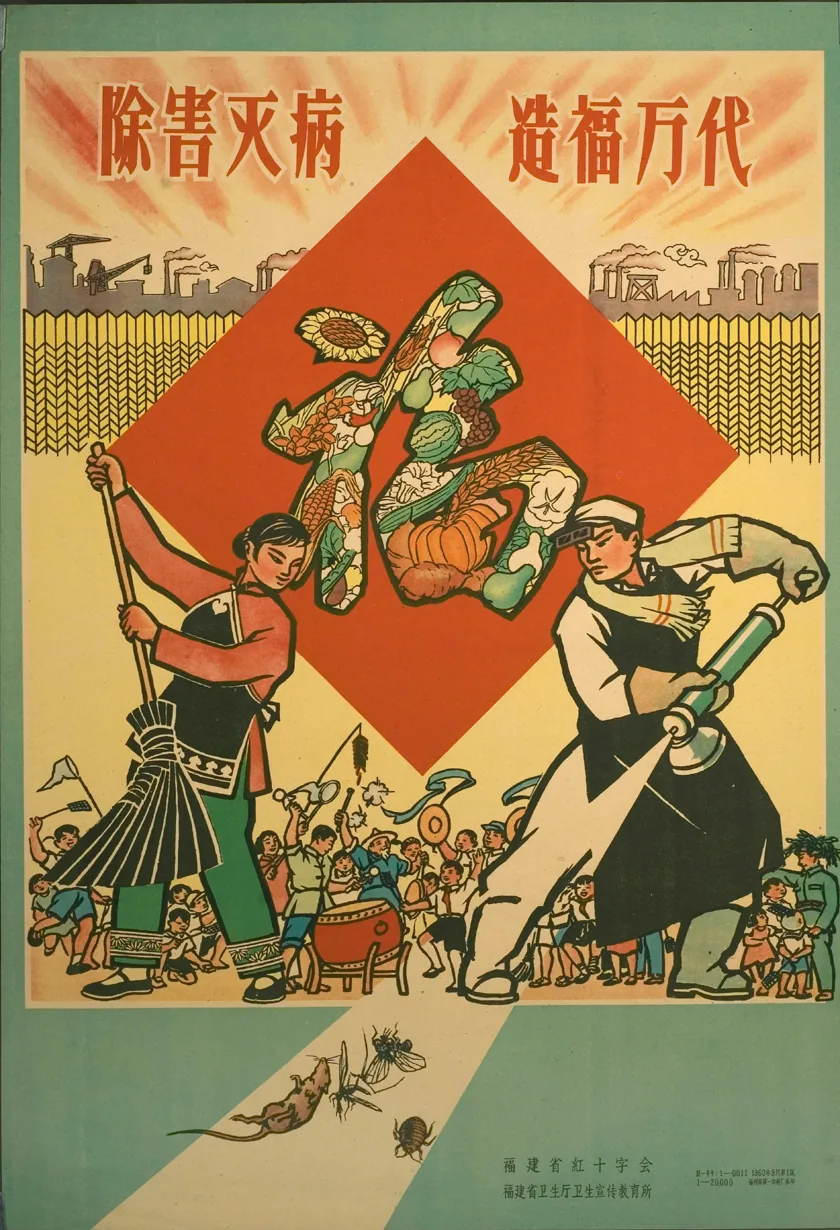
Poster by the Red Cross and the Health Propaganda Office of Fujian Province, September 1960 · Red Cross and the Health Propaganda Office of the Health Department of Fujian Province, September 1960. · CC BY-SA 4.0 · Source page
In 1960 a new poster came out of Fujian. It has no sparrow: a rat, flies and mosquitoes appear, and beside them a flat bug that is usually identified as a bedbug.
The sparrow, the main target in 1958, has disappeared from the picture. The campaign had changed its target.
Myth
The sparrow campaign alone caused the famine.
The truth
Partly true. The campaign was one of the causes, but not the only one. Inflated reports, excessive procurement and the wider policies of the Great Leap were others, as in the first decision.
The evidence
The 1960 poster has no sparrow, only other pests: the target had changed. Historians who list the causes of the famine name the campaign among them, not as the only one.
Lushan
The place
Lushan, July 1959
Lushan is a mountain resort in Jiangxi province. In July 1959 the Party’s leaders met there in an expanded session of the Politburo, which ran from 2 July to 1 August.
In April that year Mao Zedong had stepped down as chairman of the state, but kept the chairmanship of the Party. The state post passed to Liu Shaoqi.
The man
The defence minister
Peng Dehuai was China’s defence minister, a veteran commander who had fought in the wars before 1949. He came from Hunan province.
A decision point
You are Peng Dehuai, defence minister, at Lushan in July 1959.
Lushan, July 1959, during the expanded session.
At the meeting the communes are spoken of as a success, and the steel as an achievement. Anyone who raises doubts looks as if he questions the line.
You come from Hunan, and what reaches you from home does not match the reports read out at the meeting.
What do you do?
- Stay silent, and keep your criticism to the closed discussions. The problems stay out of the record. The leadership probably keeps its course, and reports from the villages go unanswered. Silence protects you, but changes nothing.
- Write to Mao in private, setting out what you have seen and what you think is wrong with the line. The letter reaches the Party’s leader directly. It might open a real debate, but Mao might also see it as a threat to the line. Probably the personal cost to you rises.
- Accept the line of the meeting, and say no more. There is no clash, and your view has no voice. The line holds, and change is delayed. Difficulties probably grow in the villages without anyone at the top receiving a clear report.
What really happened
Write to Mao in private, setting out what you have seen and what you think is wrong with the line.
Peng wrote the letter to Mao on 14 July 1959. It dealt with what he had seen in the villages of his home province, including deaths, and with faults he saw in the policy. This lesson summarises the letter and does not quote it.
He had seen the cost with his own eyes, in the place he came from. The sources do not say what he expected in return.
A decision point
You are Mao Zedong, Party chairman, at the end of July 1959.
Lushan, late July 1959.
The defence minister’s letter lies in front of you. It questions the communes and the steel drive that you led, and describes what is happening in his home province.
You gave up the chairmanship of the state, but the chairmanship of the Party is still yours.
What do you do with the letter?
- Accept the criticism, and slow the communes and the steel drive. The course would change earlier, and the famine might be smaller. But a campaign presented as a success would have to be pulled back, at a political price. The leadership would probably resist.
- Answer Peng in private, and settle the problems inside the Politburo. The dispute probably stays inside, and the line slows by quiet agreement. The criticism is heard in a closed room, and nobody announces it in public.
- Treat the letter as an attack on the line, and launch a campaign against “right opportunism” in the Party. The debate shifts from the policy to its critics. The radical course probably goes on, and anyone who reports bad news learns to keep quiet. The campaign sends a message to everyone who sees things differently: keep quiet.
What really happened
Treat the letter as an attack on the line, and launch a campaign against “right opportunism” in the Party.
The letter was circulated among the leaders in the days after it was written; the sources give 17 or 23 July as the date. In August, at the eighth plenum of the Party, a group headed by Peng was denounced as anti-Party, and a campaign against “right opportunism” was launched.
The sources do not give Mao’s private reasons. The letter attacked a policy that Mao himself led, at a time when the Party was being asked to back it.
Grain on paper
1959–1961
The hungry years
From 1959 to 1961 hunger spread through the countryside and the towns. Historians now call it the Great Chinese Famine.
In his book Tombstone, Yang Jisheng describes people dying while they waited at the doors of grain warehouses in Xinyang, in Henan. A Xinhua reporter in Xinyang later explained to Yang why he had never reported the deaths.
According to a figure reported by People’s Daily in 2010, China’s population in 1961 was 658.59 million, 14.58 million below its level in 1959. The figure shows the result in numbers, not the cause.
Source: Demographers, 1984
“…it is impossible to assess to what extent.”
Four demographers, writing more than twenty years after the famine. Later studies drew on new material, including provincial archives.
- What does the study say about the weather? That it contributed to the sharp fall in output, and none of the authors denies it.
- Why do the authors refuse to give a percentage? In their words, it is impossible to assess how far the weather went. Policy and quotas also worked in those years.
- When was the study written, and by whom? In 1984, by demographers who worked with population figures.
Myth
The famine was caused by bad weather.
The truth
Partly true. The weather contributed to the fall in output, and none of the studies cited here denies it. But some researchers put the main weight on policy: Yang Jisheng blames Mao’s policies and the political system. One study from 2009 attributes about 69 per cent of the excess deaths to national policies.
The evidence
Sources: Ashton and colleagues (1984); Houser, Sands and Xiao (2009), whose article is titled “Three parts natural, seven parts man-made”.
Myth
Mao did not know.
The truth
Partly true. According to Yang Jisheng, Mao was kept unaware of part of the starvation in 1958 and 1959. But not all of it was missing: Peng’s letter of July 1959 cited deaths in his home province.
The evidence
Sources: Yang Jisheng, Tombstone; Peng’s letter of July 1959, discussed in the chapter on Lushan.
Seven thousand
1960–1961
Turning back
By the winter of 1960 the leadership had begun to correct the course. In early 1961 the Ninth Plenum began the shift to “adjustment”: a slower, more cautious economy, with modest targets.
The conference
Beijing, January 1962
From 11 January to 7 February 1962 the Seven Thousand Cadres Conference met in Beijing. The Party’s 1981 resolution says that 7,000 people attended. Cadres are the party and state officials who run the work locally. What had happened in the past years was on the agenda, and Mao himself made a self-criticism at the meeting.
Power
Who runs the country?
When Mao handed over the day-to-day leadership, the work fell mainly to two men: Liu Shaoqi, as chairman of the state, and Deng Xiaoping. Mao kept the chairmanship of the Party.
A decision point
You are Liu Shaoqi, chairman of the state, at the Seven Thousand Cadres Conference.
Beijing, January 1962.
The famine is no longer in doubt. Many people in the hall know the villages from their own work, or have heard of them. The question is not whether there was a famine, but how to explain it.
You are asked to say what caused it: nature, human error, or both. Whatever you say will be repeated in every province and county, and it will help decide who is to blame.
How do you put the cause?
- Blame mainly nature and the weather, which no one could control. The wording is comfortable and does not require any change of policy. The line probably stays, and responsibility stays blurred. Those who bore the burden in the villages go unacknowledged.
- Speak of mistakes in general terms, without naming any policy or decision. The conference hears criticism, but does not know where to point it. The correction probably stays partial, and those who wanted to understand the causes get no answer.
- Put it precisely: three parts of the damage come from nature, seven parts from human error. It is a clear verdict that places the responsibility on the Party’s own decisions. It would probably anger those who made the policy, and the speaker would be remembered for it. But it also opens the way to correction.
What really happened
Put it precisely: three parts of the damage come from nature, seven parts from human error.
Liu put the idea as “three parts natural disaster, seven parts man-made”, a Chinese phrase translated here. The official formula gave 30 per cent to nature and 70 per cent to human error. The sources disagree on whether the formula was prepared in advance or improvised.
The formula split the blame between nature and people. It let the conference speak of forces no one could control, and also say plainly that most of the damage came from human decisions. The sources do not say what Liu meant beyond the words themselves.
Source: The Party’s verdict, 1981
“without careful investigation and study and without prior experimentation”
The Party’s official verdict on the Great Leap, written after Mao’s death in 1976. It speaks of “Left” errors, of excessive targets and arbitrary directions, and names Liu and Peng among the victims.
- Who wrote this text, and why twenty years after the events? The Party itself, to fix its official account. It is the verdict of the body that led the policy, not of an outside researcher.
- The text speaks of “Left” errors. What does that label let the writers avoid saying? That the blame belonged to particular people, and to decisions that could be traced to them. The phrase describes a direction, not who decided. Ask yourselves who is left out of the picture.
- Which people does the text name as victims? Liu Shaoqi, Peng Dehuai and others, whom the text says were “persecuted to death” in the Cultural Revolution. It is an important acknowledgement, but the text does not name those who persecuted them.
1966
Four years later
In 1966 the Cultural Revolution began. Historians record that Liu was then accused of treachery, partly for the formula that gave only 30 per cent of the damage to nature.
Counting the dead, and the quiz
1981
A new name for the famine
In June 1981, alongside the Party’s resolution, the official name of the famine changed. It had been “Three Years of Natural Disasters”; it became “Three Years of Difficulty”.
The first name blames nature. The second blames no one. Both describe the same years, but they tell the story in different ways.
The numbers
How many died?
Even after decades of research there is no single number. Most estimates run from about 15 million dead (Houser, Sands and Xiao, 2009) to at least 45 million (Dikotter, 2010). A few Chinese scholars propose far lower figures, such as 3.5 to 4 million (Yang Songlin, 2013), well below all the other estimates. Demographers work with excess deaths, because death records were incomplete at the time, and they compare population, births and deaths instead.
Why it matters
A number that decides a question
The number matters for the question of responsibility. A toll near 15 million raises a different problem from one near 45 million. In both cases the question is how much of the death came from policy, and how much from forces that no one controlled.
How many, and why?
How many people died, and what was the main cause of their deaths?
- Frank Dikotter, Mao’s Great Famine (2010) At least 45 million people died from starvation, overwork and state violence. Dikotter separates deaths from hunger and overwork from torture and summary executions, and he builds his case on provincial archives.
- Cormac Ó Gráda, Famine: A Short History (2009) He reads a retrospective fertility survey, and on his reading the total is much lower: about ten million below Yang’s figure. His argument concerns how the numbers are built, not whether there was a famine.
- Houser, Sands and Xiao (2009) Their study estimates about 15.4 million excess deaths, and attributes about 69 per cent of them to national policies. The article is titled “Three parts natural, seven parts man-made”.
Most estimates run from about 15 million to at least 45 million, and the gap comes partly from method: whether one counts by census, by death registration, or by births that did not happen. Access to archives matters too. The question of how to measure is not settled.
The sequence, in order
- April 1959 Mao gives up the chairmanship of the state, and keeps the chairmanship of the Party.
- July–August 1959 Lushan: Peng writes to Mao, and in August a campaign against “right opportunism” begins.
- 1959–1961 The famine.
- Winter 1960 The correction of the line begins.
- 11 January to 7 February 1962 The Seven Thousand Cadres Conference in Beijing.
- 23 May 1962 At a news conference, US President Kennedy says there is no sign that China wants food from the United States.
- 1966 The Cultural Revolution. Liu is accused of treachery.
- 1975 Dozens of dams built during the Great Leap collapse at Zhumadian, in Henan.
- June 1981 The Party’s resolution, and the renaming to Three Years of Difficulty.
- 1984 The US National Research Council, through Ansley Coale, estimates about 27 million excess deaths in 1958 to 1963.
- 1987 Judith Banister estimates about 30 million excess deaths in 1958 to 1961.
- 2008 (Chinese) and 2012 (English) Yang Jisheng: 36 million starvation deaths. With about 40 million births that did not happen, the total is 76 million.
- 2009 Houser, Sands and Xiao: about 15.4 million excess deaths.
- 2010 Frank Dikotter: at least 45 million.
- 2013 Yang Songlin proposes a very low estimate: 3.5 to 4 million.
Check yourself
What date does Peng Dehuai’s letter to Mao carry?
Answer: 14 July 1959. Correct. The letter is dated 14 July 1959, twelve days after the meeting opened.
Check yourself
Where and when did the Seven Thousand Cadres Conference meet?
Answer: Beijing, January to February 1962. Correct. The conference met in Beijing, from 11 January to 7 February 1962.
Check yourself
Which four pests did the 1958 campaign name?
Answer: rats, flies, mosquitoes, sparrows. Correct. The four pests were rats, flies, mosquitoes and sparrows.
Check yourself
In which province was the Chayashan experimental commune set up in 1958?
Answer: Henan. Correct. Chayashan is in Henan, in central China.
Check yourself
Yang Jisheng counts 36 million deaths from starvation. What does that figure include?
Answer: Deaths from starvation alone. Correct. The 36 million are deaths from starvation. The total of 76 million only comes when the births that did not happen are added.
Check yourself
What minimum death toll does Frank Dikotter give in Mao’s Great Famine?
Answer: 45 million. Correct. Dikotter gives at least 45 million people who died from starvation, overwork and state violence.
Terms
- cadre A party or state official who carries out policy in a province, county or commune. In these years cadres enforced the targets.
- people’s commune A large collective unit that replaced the family farm. Land, tools and labour were pooled, and meals were served in a communal kitchen.
- backyard furnace A small furnace built in a yard, field or village to melt iron and make steel in 1958. It became a symbol of the drive.
- quota The amount an area had to hand over to the state, such as grain. It was set according to the reported harvest.
- Hundred Flowers A campaign in 1956–57 that invited people to criticise the Party. When the criticism grew sharp, it was cut short.
- Anti-Rightist Campaign A 1957 campaign that labelled the Party’s critics “rightists” and suppressed them. Deng Xiaoping led it.
- Four Pests A 1958 campaign against rats, flies, mosquitoes and sparrows. In 1960 the bedbug replaced the sparrow as a target.
- plenum A full session of the Party’s Central Committee, held several times a year. Its decisions usually settle the official line.
- Politburo The small committee at the top of the Communist Party, which makes the main decisions between plenums.
- excess deaths The number of deaths above what would be expected in normal years. Demographers use it to measure a famine when death records are incomplete.
Sources
- Mao Zedong, “Speech at the Supreme State Conference”, 28 January 1958, in Selected Works, vol. 8 (Foreign Languages Press, 1977). English text from the Marxists Internet Archive
- Central Committee of the Chinese Communist Party, “Resolution on Certain Questions in the History of Our Party since the Founding of the People’s Republic of China”, 27 June 1981 (English text in Peking Review, 1981)
- Frank Dikotter, Mao’s Great Famine (Walker & Company, 2010)
- Yang Jisheng, Tombstone (Farrar, Straus and Giroux, 2012; Chinese edition 2008)
- Ashton, Hill, Piazza and Zeitz, “Famine in China, 1958–61”, Population and Development Review 10, no. 4 (1984)
- Houser, Sands and Xiao, “Three parts natural, seven parts man-made”, Journal of Economic Behavior and Organization (2009)
- Cormac Ó Gráda, Famine: A Short History (2009)
- Judith Banister, China’s Changing Population (1987)
Image credits
- Chinese government poster, 1958. Credit in the image file: “China Government” · Public domain · Source page
- Mao and Khrushchev, Beijing, 1958. United Press photograph, Library of Congress collection · Public domain · Source page
- Communal canteen in a people’s commune, 1958. Photograph, author unknown · Public domain · Source page
- Poster by the Red Cross and the Health Propaganda Office of Fujian Province, September 1960 · Red Cross and the Health Propaganda Office of the Health Department of Fujian Province, September 1960. · CC BY-SA 4.0 · Source page


