Giap: the history teacher who beat France
He was a history teacher with no formal military training. In 1954 he defeated France at Dien Bien Phu. How did they get guns up the mountains, and what is fact and what is legend?
Decisions, questions and your own progress, in the app
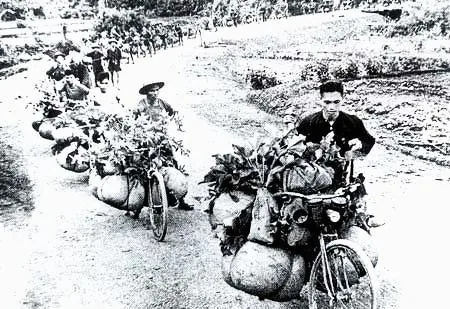
Porters (dân công), 1954. Vietnam News Agency (TTXVN), via Wikimedia Commons. Public domain (tagged PD-Vietnam). · Public domain · Source page
A history teacher
A man with no military academy
In March 1954 a French army sat in a valley in north-west Vietnam, confident in its guns and its aircraft. The man who led the attack against it had never been to a military academy. Before the war he taught history.
How does a history teacher defeat a colonial army? And how did the guns get up to the tops of the hills? We will check what is true in the story, and what only sounds good.
Background
A father who died in prison
1919
Giap's father was a minor official and a nationalist. In the 1880s he took part in the Can Vuong movement, which resisted French rule. The name means ‘support the king’.
In 1919 he was arrested. He died in prison a few weeks later. His son was about eight.
Background
A French school in Hue
1924
At 13, Giap entered Quoc Hoc, a French-run secondary school in Hue, a former imperial capital. French was at the centre of the teaching there.
Two years later he was expelled for taking part in protests.
Background
Thirteen months in prison
13 months
In 1930 he was arrested again, this time for student protests. Of a two-year sentence, he served 13 months in the prison at Lao Bao.
Nothing in this record makes him a soldier yet. It shows a student on the wrong side of the colonial authorities.
Teaching
A teacher who wrote
He taught history at Thang Long School in Hanoi. In the 1930s he also wrote for Vietnamese newspapers, among them Tiếng Dân, and campaigned for press freedom.
So far this is the story of a teacher and a writer, not of a commander. He had no troops yet.
Across the border
The party
Joining the party
3 May 1940
In 1931 Giap joined the Indochinese Communist Party. Later the French outlawed it.
Giap left Hanoi and crossed into China on 3 May 1940.
In China
A new name and a new language
In China he took a new name, Duong Huai-nan, and learned to speak and write Chinese.
In southern China, in 1940, he joined up with Ho Chi Minh, who was then advising the Chinese communist army. Some sources date his departure from Vietnam to 1939, so even the year is not settled.
Self-taught
War learned from books
Giap never attended a military academy. He taught himself war from books.
He studied Napoleon's generalship closely. He read Mao's writings on war, and adapted them to Vietnam by trial and error. Some accounts also name Carl von Clausewitz as an influence, but we found no source showing that he read On War.
Viet Minh
A front for independence
1941
In May 1941, at a party congress, the Viet Minh was formed: a front for Vietnamese independence, open to nationalists who were not communists. Ho Chi Minh led it.
Giap was given intelligence networks and political bases in the far north.
The Japanese occupation
Between France and Japan
In 1940 Japanese forces entered Vietnam. Until March 1945 the French administration stayed in place, but under Japanese pressure. In March 1945 the Japanese took direct control.
The Viet Minh used those years to build networks in the villages and the hills, and they were ready when the Japanese surrender came.
August 1945
When Japan lost
1945
When Japan surrendered in August 1945, the Viet Minh moved into the vacuum it left. They took control of several towns, Hanoi among them. The August Revolution was not the act of one man. It was a movement, led by Ho Chi Minh.
Source: Ho Chi Minh's Declaration of Independence
“…we have wrested our independence from the Japanese and not from the French.”
Read in Hanoi on the day Japan's formal surrender was signed. It is a political argument, written to persuade Vietnamese readers and foreign governments.
- Who wrote it, and to whom? Ho Chi Minh, leader of the Viet Minh, to the Vietnamese people and to the world. It is a claim to power, made in public.
- What does it claim about the French? It says the country won its freedom from Japan, not from France, and it accuses the French of building more prisons than schools. That is a political story, with the Viet Minh at its centre.
- What does it not prove? It gives a figure of more than two million who died of hunger in 1944 and 1945. Historians do not agree on that number. Treat it as the declaration's claim, not as an established figure.
The war opens
1946
Talks that failed
In 1946 French forces returned to Vietnam. In the summer, talks were held at Fontainebleau, near Paris, between the French government and a Vietnamese delegation led by Ho Chi Minh. They did not reach agreement.
After the talks failed, the road to a trial of strength lay open. The question of how to fight now fell to the Viet Minh, and to their military commander.
December 1946
Fighting starts in Hanoi
19 December
On 19 December 1946 fighting broke out in Hanoi. What became known as the First Indochina War began that day.
The French still held much of the country. Their army had armour, aircraft and paratroopers. The Viet Minh had very few heavy weapons.
The French
An army with armour
1947
In 1947 the French ran large operations with tanks, from the sea and by parachute. The Viet Minh could not match that firepower in open battle.
A decision point
You are Vo Nguyen Giap, military commander of the Viet Minh.
December 1946 to 1947.
The fighting in Hanoi has begun. Your army is weaker than the French in heavy weapons and in open battle.
The French hold the cities. You must find a way to keep the struggle going.
What do you do?
- Hold the cities in open battle, street by street. Probably heavy losses against an enemy with armour and air power. Morale might hold, but the army could collapse quickly.
- Pull back into the hills and fight a long war: raids, sabotage and ambushes, with no large set-piece battles. Probably the cities stay in French hands for a time. The war would last years with no quick decision, but the French would have to hold a huge territory.
- Negotiate a deal that leaves the French in the cities. Probably the French would not give up their hold easily, and any deal would leave them in the cities. The movement might weaken as a result.
What really happened
Pull back into the hills and fight a long war: raids, sabotage and ambushes, with no large set-piece battles.
Giap chose the second option. The Viet Minh pulled out of the big towns into the countryside and the hills, and the war became a long one. Historians call this approach a protracted war, and the small-unit fighting within it guerrilla warfare.
The sources we checked do not give Giap's own written reasons. Historians point to the army's weakness in heavy weapons and open battle. The hills gave him room to build up forces without losing them in large set-piece fights.
The result
The initiative shifts
The first years were a low-level, semi-conventional resistance. By 1947 the Viet Minh were carrying out sabotage and raids, and the French had lost the military initiative.
The choice made in 1946 would shape the eight years that followed.
Route 4
Background
The Chinese border
Along the Chinese border the French held a chain of posts. The post at Cao Bang depended on Route 4 for its supplies.
In the autumn of 1950 the Viet Minh looked at that road and weighed what to do about it.
A decision point
You are Vo Nguyen Giap, in the autumn of 1950.
Late September 1950, on Route 4.
The post at Cao Bang depends on Route 4 for supplies. French convoys move along it, and your forces are close by.
If you cut the road, the French cannot send reinforcements or supplies. If you wait, they may strengthen their position.
What do you do?
- Ambush the convoys on the road and split the French column. Probably the French column would be broken up and the road cut. But fighting on the road would draw in large forces from both sides.
- Bypass the road, surround Cao Bang and hope for a surrender. Probably a long siege. The French could try to break it with air supply and reinforcements, and there is no certainty that Cao Bang would fall.
- Wait for better supplies and avoid a large battle. Probably the chance to close the border route would pass, and the French would use the time to strengthen their posts.
What really happened
Ambush the convoys on the road and split the French column.
Giap chose the ambush. Between 30 September and 18 October 1950 the French suffered a defeat on Route 4. Wikipedia gives about 4,800 French killed and missing, citing Martin Windrow's book The Last Valley (2004). Other summaries count the wounded and captured too, and give a larger total. The dates also vary by source.
The sources we checked do not give Giap's own account of this choice. They point to the road as the weak point of the French position, since Cao Bang depended on it for supplies.
Victory
The border opens
1950
After the battle, Wikipedia says, the Viet Minh received help from China, and the border route opened to them.
The Viet Minh's own report counts about 1,000 killed and 1,550 wounded on their side. Those figures come from one side only, so treat them with care.
1951
Two battles in 1951
1951
In January 1951 the Viet Minh attacked Vinh Yen, close to Hanoi. The French held on after air strikes and napalm, and the Viet Minh pulled back.
In March at Mao Khe, a number of mass infantry assaults were beaten back. Wikipedia counts both battles as French victories.
Lesson
What was learned?
Mao Khe and Vinh Yen show what happened when Viet Minh infantry attacked French positions head-on, against air power. The sources we checked do not say exactly what Giap concluded.
The next big battle, almost three years later, was fought at Dien Bien Phu.
The trap
The plan
Operation Castor
20 November
On 17 November 1953 a conference chaired by Henri Navarre ordered Operation Castor, which was set to start on 20 November. Parachute troops would drop into the valley of Dien Bien Phu and build a base there.
Historians usually describe Navarre's aim as drawing the Viet Minh into a set battle, where French firepower and air power would count most.
The ground
A valley among hills
Dien Bien Phu is a wide valley in north-west Vietnam, near the border with Laos. Steep hills ring it, and few roads lead in.
Whoever holds the hills above the valley can look down on it. That makes the question of where to place guns a central one.
The valley
Women's names
The French named their strongpoints after women: Béatrice in the north-east, Isabelle about six kilometres to the south, and Éliane at the centre of the valley. Each was a fortified position. The garrison depended on an airstrip for its supplies.
According to Wikipedia, French intelligence officers repeatedly assured the commanders that the risk was very small.
A decision point
You are Vo Nguyen Giap, in late January 1954.
A few days before the planned attack.
The fast attack is set for 25 January at 17:00. The plan is to strike quickly and win quickly.
By 21 January your intelligence suggests the French may have worked out the plan. Guns are still coming up the slopes by hand, and porters carry food and ammunition.
What do you do?
- Attack on 25 January as planned, in a fast assault. Probably you would attack before every gun was in place. If the French really know the plan, the assault would meet a strong defence, and the cost would be high.
- Postpone, and change the method to a siege: surround the strongpoints, advance step by step, and concentrate the guns. Probably it would take much longer, and the French would have time to strengthen their posts. But a step-by-step advance would reduce the risk of one ruinous battle.
- Call off the battle and withdraw to the hills. Probably you would keep your forces intact, but give up the chance to defeat the French in the valley. The French would keep building their positions.
What really happened
Postpone, and change the method to a siege: surround the strongpoints, advance step by step, and concentrate the guns.
The 25 January attack was cancelled on 26 January, and a slower plan was adopted: the strongpoints would be encircled, approached step by step, and the guns concentrated. Wikipedia and the Vietnamese army newspaper Quân Đội Nhân Dân give 26 January. Vietnamnet places the decision about 23 January, after a survey of the battlefield.
The sources we checked do not give Giap's own detailed reasons. What they record is the intelligence report that the French had grasped the plan, and the change that followed.
Source: Porters with bicycles
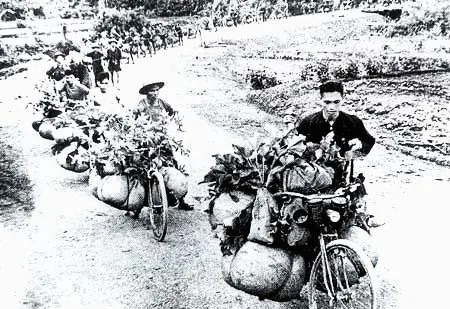
Porters (dân công), 1954. Vietnam News Agency (TTXVN), via Wikimedia Commons. Public domain (tagged PD-Vietnam). · Public domain · Source page
Vietnam News Agency (TTXVN) photograph, 1954, as dated on Wikimedia Commons. The caption reads ‘Dân công’ (porters).
A photograph by a state news agency. Porters push loaded bicycles along a dirt road. The Commons caption is one word, so what the picture means depends on who published it and why.
- Who took it, and for whom? A state news agency, which photographed the war to show the war effort. The picture is real, but it is also a message: it shows what the state wanted seen.
- What does the picture show, and what does it not show? Men pushing bicycles heavily loaded with sacks along a dirt road. No gun is visible.
- What does this mean for the bicycle story? That bicycles carried heavy loads and that porters used them. It does not show what was hauled by hand. The next step tests that.
Myth
The Viet Minh hauled their artillery by bicycle.
The truth
Not quite. Wikipedia reports that Giap ordered the artillery to be positioned by hand, covertly. The Viet Minh put 24 105 mm howitzers on the forward slopes, in emplacements dug by hand. Bicycles carried rice and ammunition.
The evidence
Both can be true at once: the photograph shows loaded bicycles, and the guns went up by hand. The total number of guns also differs between accounts, so ask who counted, and how.
The siege
A decision point
You are Vo Nguyen Giap, on 13 March 1954.
13 March 1954, the valley at Dien Bien Phu.
The French hold a ring of strongpoints in the valley. Your guns are now in place on the slopes above some of them.
You must choose which strongpoint to open against. The first target sets the pattern for everything that follows.
Which strongpoint do you open against?
- Béatrice, the north-eastern outpost, held by a battalion of the Foreign Legion. Probably a quick first blow against the nearest outpost, starting the siege. The French would try to reinforce by air and from the other posts.
- Isabelle, an isolated post about six kilometres to the south. Probably a hard fight at a distant post, which is hard for both sides to reinforce quickly.
- Éliane, the central complex, where you expect the fighting to be fiercest. Probably a heavy assault on the core of the defence. The outcome would depend on your guns, and losses could be very high.
What really happened
Béatrice, the north-eastern outpost, held by a battalion of the Foreign Legion.
Giap opened against Béatrice, held by a battalion of the Foreign Legion. That attack began the siege, which ran from 13 March to 7 May 1954, about eight weeks.
The sources we checked do not give Giap's written reason for this choice. What they record is the order of attack: Béatrice was attacked first, and the other strongpoints in the weeks that followed.
The siege
Trenches, guns and an airstrip
Eight weeks
During the siege the Viet Minh moved closer through trenches, and their guns fired on the posts and on the airstrip. The French depended on supplies by air, and the airstrip became dangerous to land on and take off from. A garrison that loses its last supply route is quickly trapped inside its own position.
Supply
Supplies on human backs
The siege could not be fed without porters. They brought rice, ammunition and equipment over the hill tracks, sometimes on bicycles and sometimes on their backs. One magazine article, on HistoryNet, gives about 200,000 porters and 60,000 bicycle pushers. Other accounts give different numbers, so treat all of these figures as estimates.
Inside the camp
Spies and the gunnery commander
Viet Minh spies worked inside the camp as labourers and passed the positions of the French guns to the attackers.
According to Wikipedia, the French artillery commander said he had been completely disgraced, and killed himself with a grenade during the siege.
The prisoners
What happened to the prisoners
858
By the end of May 1954 the Red Cross had evacuated 858 of the most seriously wounded prisoners. About 11,700 French soldiers were taken prisoner, according to Wikipedia. About 3,290 came back four months later.
Many did not come back. Wikipedia gives an estimated death rate in captivity of about 60 per cent. That is an estimate, not a count.
7 May
The surrender
7 May 1954
On 7 May 1954 the French surrendered at Dien Bien Phu. The next day the French government announced its withdrawal from the war.
Some accounts put the surrender of the survivors on 8 May, so check the date against the source you use.
Myth
Giap won by throwing waves of men at the French until their defence broke.
The truth
Only part of it. Mass assaults were beaten back at Mao Khe in 1951. At Dien Bien Phu the siege was built slowly, with trenches and guns. The historian Qiang Zhai, as summarised in a Texas Tech University presentation, writes that Giap turned down a human-wave plan. Who shaped the plan itself is disputed.
The evidence
Compare the 1951 battles with the siege itself. The Qiang Zhai claim comes through a summary of a presentation, not his book, so treat it as one historian's view.
After, and the quiz
Geneva
The table in Geneva
21 July 1954
The Geneva Accords were signed on 21 July 1954, after a conference that had opened on 26 April. They divided Vietnam into two zones along the 17th parallel, for a time, and called for nationwide elections that never took place.
The First Indochina War is counted as ending on 11 August 1954.
What came next
- 19 December 1946 Fighting breaks out in Hanoi, and the First Indochina War begins.
- 1950 The French lose on Route 4. According to Wikipedia, the Viet Minh receive Chinese help afterwards.
- 1951 Vinh Yen and Mao Khe: the Viet Minh's head-on assaults are beaten back.
- 7 May 1954 The surrender at Dien Bien Phu ends the siege.
- 21 July 1954 The Geneva Accords are signed, and the country is divided for a time.
- January 1968 The Tet offensive in South Vietnam. Historians disagree about Giap's part in the decision (see the debate below).
- 1972 The Easter Offensive, from 30 March to 22 October. Wikipedia lists Giap as its commander.
Source: Navarre, writing in 1956
“Under the influence of Chinese advisers”
Written by the French commander after the defeat, two years on. The quotation is as Wikipedia gives it. Read the book before relying on the exact wording.
- Who wrote this, and when? The French commander in Indochina, writing two years after the defeat. He explains the defeat, and he also defends himself.
- What does he blame? On the influence of Chinese advisers on the Viet Minh's methods. The fragment we have points outward, to the advisers. The book may say more.
- Why not take it at face value? Because we have only the sentence as Wikipedia quotes it. Historians disagree about the Chinese advisers' role at Dien Bien Phu, so read the book itself.
Myth
Giap said human life means nothing.
The truth
Not in that form. The phrase “a disregard for human life” is a criticism that General William Westmoreland, the American commander in Vietnam, made of Giap in a 1998 interview, as Wikipedia quotes it. In a 1990 interview with the writer Stanley Karnow, Giap spoke about wearing down the will of the American government to keep fighting.
The evidence
Heavy losses have been read in two ways. Westmoreland saw cruelty. Others read them as the logic of a long war, in which the weaker side accepts losses to wear down the stronger. Read both, and check the wording in the original.
1968 and 1972
The Tet offensive
30 January 1968
On 30 January 1968, the Tet holiday of the Lunar New Year, Communist forces attacked targets across South Vietnam. The first phase ran until 20 March.
Many historians see Tet as a heavy military defeat for the attackers, and a political shock in the United States. In 1972 a larger offensive, the Easter Offensive, ran from 30 March to 22 October. Wikipedia lists Giap as its commander.
Who decided on Tet?
Who pushed for the Tet offensive, and what did Giap think of it?
- Gregory Daddis, historian of the Vietnam War According to Daddis, Le Duan, the party's first secretary, drove the offensive, aiming at a decisive battlefield victory.
- Accounts that put Giap against the plan Later accounts say Giap objected to the plan, and that the objection cost him politically. Wikipedia notes that Tet led to a fall in his influence. These accounts rest on interviews and summaries, and historians have not settled them. Lien-Hang T. Nguyen, Hanoi's War (2012), describes Ho and Giap on the other side from Le Duan's faction. That account comes here from a popular summary of the book, not from the book itself.
What would decide it? The Politburo's minutes and the leadership's letters from 1967, if they were open to researchers, would show who pushed for the offensive and what was written at the time. A summary of a talk by Lien-Hang T. Nguyen, posted on a Hanoi university's website, notes that Ho, Le Duan and Giap were all absent from an October 1967 Politburo meeting on the plan, which went ahead anyway.
The last years
After the war
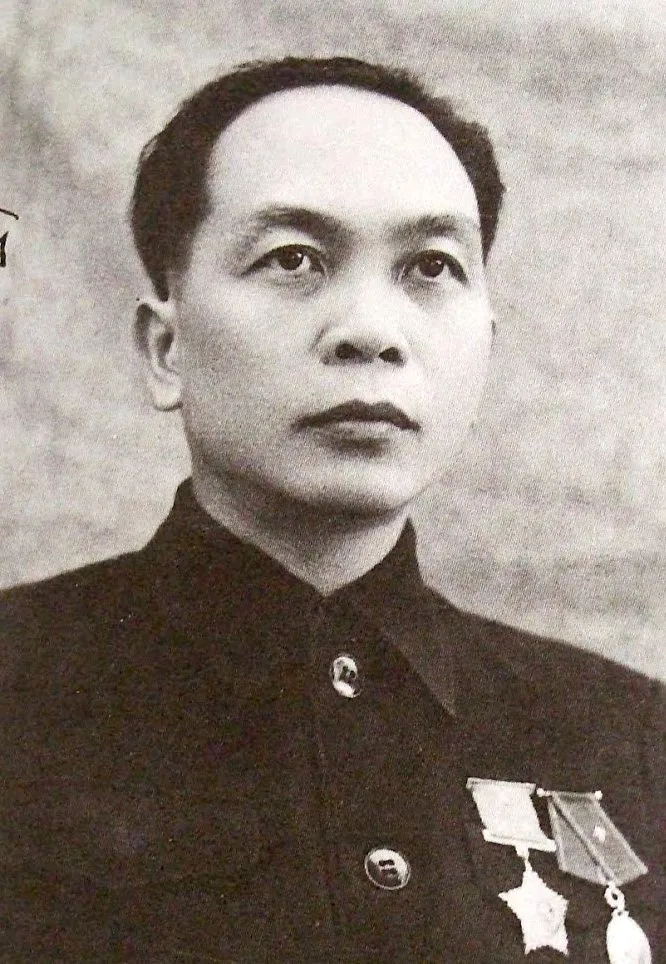
Vo Nguyen Giap, portrait, 1957. Photographer unknown. Public domain as tagged on Wikimedia Commons (PD-Vietnam). · Public domain · Source page
102
In July 1976 Giap became deputy prime minister. He was defence minister until 1981 and left the Politburo in 1982. He stayed on the Central Committee and as deputy prime minister until he retired in 1991.
He oversaw the 1978 war with Cambodia and the 1979 war with China. He died on 4 October 2013 at Central Military Hospital 108 in Hanoi, aged 102. Historians still disagree about how much of the victory at Dien Bien Phu was his, and how much was shared.
Check yourself
When were the Geneva Accords signed?
Answer: 21 July 1954. Right. The accords were signed on 21 July 1954, after a conference that had opened on 26 April.
Check yourself
What happened on 19 December 1946?
Answer: Fighting broke out in Hanoi. Right. The fighting in Hanoi marks the start of the First Indochina War.
Check yourself
What happened to the fast attack planned for 25 January 1954?
Answer: It was cancelled on 26 January, and a slower siege plan was adopted. Right. The attack was cancelled on 26 January, and a slower method, with a siege, was chosen.
Check yourself
When was Ho Chi Minh's declaration of independence adopted?
Answer: 2 September 1945. Right. The declaration was adopted on 2 September 1945 and read out in Hanoi.
Check yourself
When did Vo Nguyen Giap die, and at what age?
Answer: On 4 October 2013, aged 102, in Hanoi. Right. He died at Central Military Hospital 108 in Hanoi.
Check yourself
When did the French lose the battle on Route 4?
Answer: In the autumn of 1950, on Route 4. Right. Between late September and mid-October 1950 the French lost on Route 4. The dates vary by source.
Terms
- Viet Minh The League for the Independence of Vietnam: a front of nationalists and communists, formed in May 1941 and led by Ho Chi Minh.
- protracted war A long war in which the weaker side avoids decisive battles, wears the stronger side down over years, and builds its strength for a final push.
- guerrilla warfare Fighting by small, mobile units that raid, ambush and sabotage, instead of holding ground in open battle.
- Route 4 A French road in the north-east that supplied the posts along the Chinese border, including Cao Bang. In 1950 it was the scene of a major French defeat.
- strongpoint A fortified position held by a small garrison, usually part of a larger line of defence.
- siege A long encirclement of a position: the attacking army cuts off its supplies and attacks it step by step.
- porter A person who carries loads on foot or by bicycle. In the Viet Minh war many thousands of civilians served as porters, carrying rice, ammunition and supplies.
- human-wave attack A mass infantry attack in which waves of soldiers advance one after another, accepting heavy losses to break through the defence.
- Geneva Accords The agreements of July 1954 that ended the French war in Indochina, divided Vietnam for a time, and called for elections to unify it that never took place.
- French Indochina The French colony that covered today's Vietnam, Cambodia and Laos.
- Tet offensive A series of attacks on South Vietnamese and American targets, begun on 30 January 1968 at the Lunar New Year holiday called Tet.
- Ho Chi Minh The leader of the Viet Minh, the front for Vietnamese independence. He led the August Revolution of 1945.
- Mao Zedong The leader of China's Communist Party, who wrote on warfare. Giap studied his writings and adapted them to Vietnam.
- Napoleon A famous French general and emperor. Giap studied closely how he ran his battles.
- Carl von Clausewitz A Prussian military thinker. Some say he influenced Giap, but there is no proof that Giap read his book On War.
- Cao Bang A French post along the Chinese border. Its supplies came by convoy along Route 4.
- Hue A city in Vietnam that was once an imperial capital. Giap went to a French secondary school there.
- Lao Bao A colonial prison where Giap served 13 months after being arrested for student protests.
- Vinh Yen A place close to Hanoi. In 1951 the Viet Minh attacked the French there, who held on with air strikes.
- Mao Khe A place where, in 1951, several mass infantry assaults by the Viet Minh were beaten back.
- Henri Navarre A French general who led the French command in Indochina. He chaired the meeting that ordered Operation Castor at Dien Bien Phu.
- Wei Guoqing A Chinese adviser who supported the Viet Minh. Vietnamese state media stress his support, and historians disagree about his part in the planning.
- Qiang Zhai A historian who argues that the Chinese advisers dominated the planning and that Giap rejected a human-wave plan.
- William Westmoreland The American commander in Vietnam. In a 1998 interview he criticised Giap.
- Stanley Karnow A writer who interviewed Giap in 1990. In the interview Giap spoke of wearing down the will of the American government to keep fighting.
- First Indochina War The war between the Viet Minh and the French, from December 1946 to August 1954.
- napalm A burning fuel that sets a wide area on fire. The French used it against the Viet Minh at Vinh Yen.
- howitzer A type of cannon that fires shells on a high arc. The Viet Minh placed 24 of them on the slopes at Dien Bien Phu.
- Foreign Legion A unit of the French army made up mostly of foreigners. One of its battalions held the Béatrice post.
- Politburo The top decision-making committee of a communist party. Giap left it in 1982.
- 17th parallel A line of latitude that, under the Geneva Accords, divided Vietnam into two zones for a time.
- Béatrice One of the French strongpoints at Dien Bien Phu, named after a woman. Giap opened the siege by attacking it.
- Fontainebleau A town near Paris, where talks in 1946 between France and a Vietnamese delegation did not reach agreement.
- Hanoi The capital of Vietnam. The Viet Minh took control of it after Japan's surrender, and fighting broke out there in December 1946.
- Isabelle One of the French strongpoints at Dien Bien Phu, named after a woman.
Sources
- Ho Chi Minh, Declaration of Independence of the Democratic Republic of Vietnam, 2 September 1945. English text as reproduced at servat.unibe.ch/icl, where the translation is credited to the Embassy of Vietnam in the United States.
- Henri Navarre, Agonie de l'Indochine (Paris, 1956), as quoted in the English Wikipedia article 'Battle of Dien Bien Phu'. The book itself was not checked for this lesson.
- Dân công (porters), photograph by the Vietnam News Agency (TTXVN), 1954, Wikimedia Commons, 'File:Dan cong tho luong thuc.jpg'.
- Cecil B. Currey, Victory at Any Cost: The Genius of Viet Nam's Gen. Vo Nguyen Giap (first published 1997; later editions).
- Martin Windrow, The Last Valley: Dien Bien Phu and the French Defeat in Vietnam (2004). Cited by Wikipedia for the Route 4 French losses.
- T. Derbent, Giap et Clausewitz (Brussels: ADEN, 2006).
- Stanley Karnow, Vietnam: A History (1983; revised 1991), for his 1990 interview with Giap, as quoted in Wikipedia.
- Gregory Daddis, article on Le Duan and the 1968 Tet offensive, War on the Rocks.
- Qiang Zhai, as summarised in a Texas Tech University Vietnam Center presentation, 7a-Trung.pdf.
- Wikipedia, English articles 'Battle of Dien Bien Phu', 'Vo Nguyen Giap', 'Route Coloniale 4', 'Vinh Yen', 'Mao Khe' and 'First Indochina War' (accessed October 2026).
- Hamichlol, the Hebrew encyclopedia: articles on Vo Nguyen Giap and on Dien Bien Phu (accessed October 2026).
- Lien-Hang T. Nguyen, talk on the 1968 Tet decision, summarised on the website of a Hanoi university (ussh.vnu.edu.vn, news item on the Tet 1968 talk).
- Popular summary of Lien-Hang T. Nguyen, Hanoi's War (2012), on Grunge.com. Used only for the reported split between Le Duan and Ho and Giap.

Image credits
- Porters (dân công), 1954. Vietnam News Agency (TTXVN), via Wikimedia Commons. Public domain (tagged PD-Vietnam). · Public domain · Source page
- Porters (dân công), 1954. Vietnam News Agency (TTXVN), via Wikimedia Commons. Public domain (tagged PD-Vietnam). · Public domain · Source page
- Vo Nguyen Giap, portrait, 1957. Photographer unknown. Public domain as tagged on Wikimedia Commons (PD-Vietnam). · Public domain · Source page
