The unification of Germany
“Not by speeches and majority decisions,” said Bismarck, “but by iron and blood.” Three wars later a German emperor was proclaimed at Versailles.
Decisions, questions and your own progress, in the app
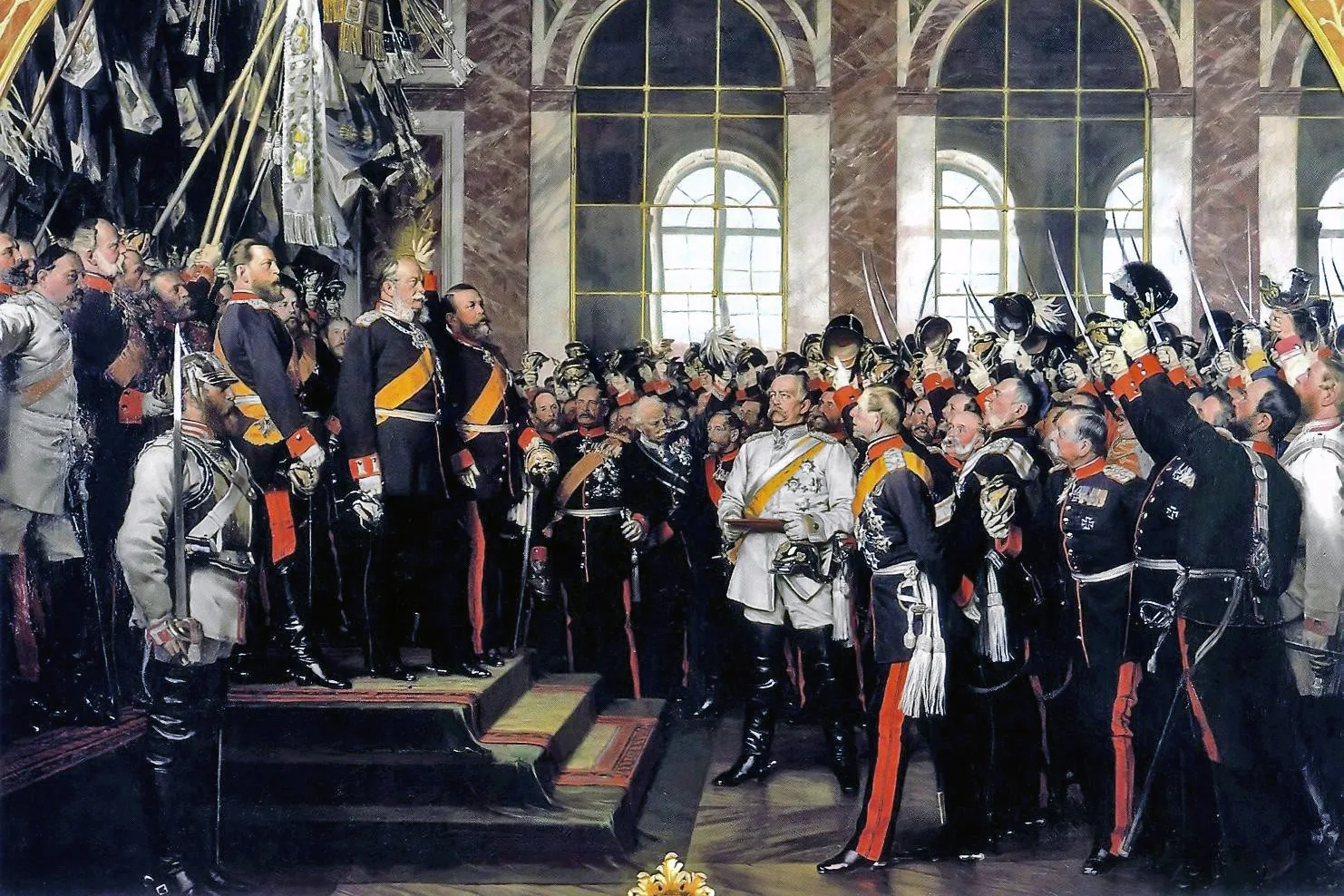
Anton von Werner, The Proclamation of the German Empire, 18 January 1871 (third version, 1885), detail. Bismarck Museum, Friedrichsruh · Public domain · Source page
A hall of mirrors
An emperor in the enemy’s palace
Versailles, 18 January 1871, midday. In the Hall of Mirrors, built for Louis XIV, hundreds of German officers crowd beneath their regiments’ flags, while Paris starves under siege nearby. On a low dais the king of Prussia, Wilhelm I, hears himself proclaimed German emperor.
Sixty years earlier there was no single German state, only dozens of kingdoms, duchies and free cities. How did they become one country, and why was it born in a French palace, to the cheers of an army?
The question
Thirty-nine states, three wars
In 1815 the German lands were a league of 39 states; by 1871, an empire led by Prussia, with Austria shut out. In between came a failed revolution, a customs union and three short wars.
The credit usually goes to Otto von Bismarck, Prussia’s chief minister, who later hinted that he had foreseen it all. Had he? Italy, in the last lesson, was made by war, diplomacy and Garibaldi's volunteers; Germany far more by an army and a state.
Thirty-nine Germanies
Background
A league, not a nation
39
In 1815 the Congress of Vienna created the German Confederation: 39 states, with a Diet at Frankfurt and Austria presiding. It was a club of princes, made to keep order, not to build a nation.
Some Germans wanted one nation, with a constitution and a parliament. In 1817 about 500 members of the student fraternities met at the Wartburg castle under black, red and gold. Metternich, Austria’s foreign minister, answered with the Carlsbad Decrees of 1819: censorship and a ban on the fraternities. In 1832 some 20,000 to 30,000 people rallied at Hambach castle under the same colours, and again came repression.
Check yourself
What was the German Confederation set up at the Congress of Vienna in 1815?
Answer: A league of 39 states led by Austria, a club of princes made to keep order. Right. In 1815 the Congress created a league of 39 states, with a Diet at Frankfurt and Austria presiding, to keep order and not to build a nation.
1834
Trade before the nation
Unity came first to trade. Prussia’s lands were scattered from the Rhine to the Baltic, with customs posts at every border. In 1834 Prussia led 18 states, about 23 million people, into the Zollverein, a customs union. Austria stayed out, and Prussia kept it out. Railways followed from 1835, and within a generation coal, iron and trains tied northern Germany together around Berlin.
1848
A parliament in a church
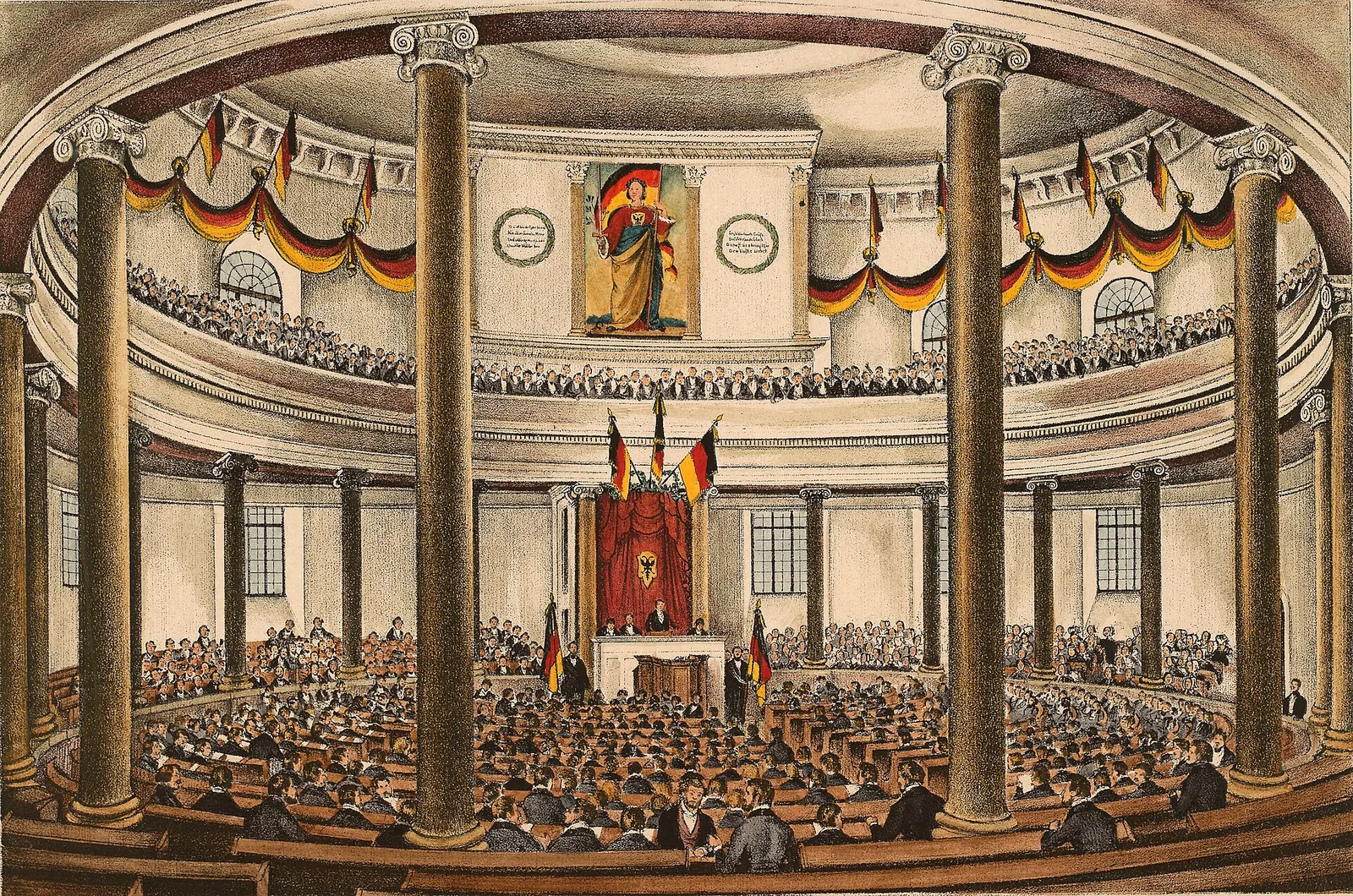
The National Assembly in St Paul’s Church, Frankfurt: coloured lithograph after Ludwig von Elliott, 1848 · Public domain · Source page
In March 1848 revolution spread from Paris. In Berlin hundreds died at the barricades, and King Friedrich Wilhelm IV rode through the city wearing a black, red and gold armband.
In May an elected National Assembly met in St Paul’s Church in Frankfurt. Its lawyers, officials and professors drew up basic rights and argued over the nation’s borders: a Greater Germany with Austria, or a Little Germany without it. Most Czechs stayed away: Palacký, as we saw in the first lesson, refused to join. When Austria refused to split its empire, the Assembly offered the crown of a Little Germany to the king of Prussia, in March 1849.
A decision point
You are Friedrich Wilhelm IV, king of Prussia.
Berlin, 3 April 1849
A deputation from Frankfurt stands before you. The Assembly has elected you ‘Emperor of the Germans’, by 290 votes with 248 abstaining. The crown comes with a constitution and a parliament elected by all adult men.
Austria is furious, and so is your ally the tsar. The kings of Bavaria, Saxony and Hanover want no Prussian emperor. Your army has already crushed the revolution in Berlin. And you believe that kings are made by God and their fellow princes, not by votes counted in a church.
What do you do?
- Accept the crown and the constitution You would lead a united Little Germany, but as a king bound by a parliament. Austria and Russia would probably fight to stop you, and Prussia might well lose.
- Reply that you can accept only if the German princes freely agree It sounds polite and keeps your options open. But the princes will not agree, so in practice it is a refusal, and an Assembly with no army of its own is left with nothing.
- Refuse outright, and say what you think of a crown offered by revolutionaries Honest, but it would humiliate the moderate liberals who still look to Prussia, and drive the radicals towards a new rising.
- Turn down the Assembly, but try to unite Germany yourself through a league of princes You would keep the lead without bowing to a parliament. But Austria will treat any Prussian-led union as a challenge, and you would need the strength to face it.
What really happened
Reply that you can accept only if the German princes freely agree
He said he could accept only with the princes’ free agreement, and on 28 April refused for good. The Assembly collapsed; risings to save its constitution were crushed in 1849, largely by Prussian troops. In 1850, at Olmütz, Prussia backed down before Austria and Russia: ‘the humiliation of Olmütz’.
In private he was blunter: such a crown, he wrote in December 1848, was baked of mud and clay and reeked of revolution; in effect, a crown from the gutter. He also feared war with Austria and Russia, a war that, Christopher Clark argues, Prussia could not have won. The liberal road to unity closed here.
Check yourself
Why did Friedrich Wilhelm IV turn down the crown offered by the Frankfurt Assembly in 1849?
Answer: He would not take a crown from an elected parliament, and he feared war with Austria and Russia. Right. In private he called it a crown baked of mud and clay; in public he said he needed the princes’ consent. Austria and Russia were both hostile.
Iron and blood
Otto von Bismarck
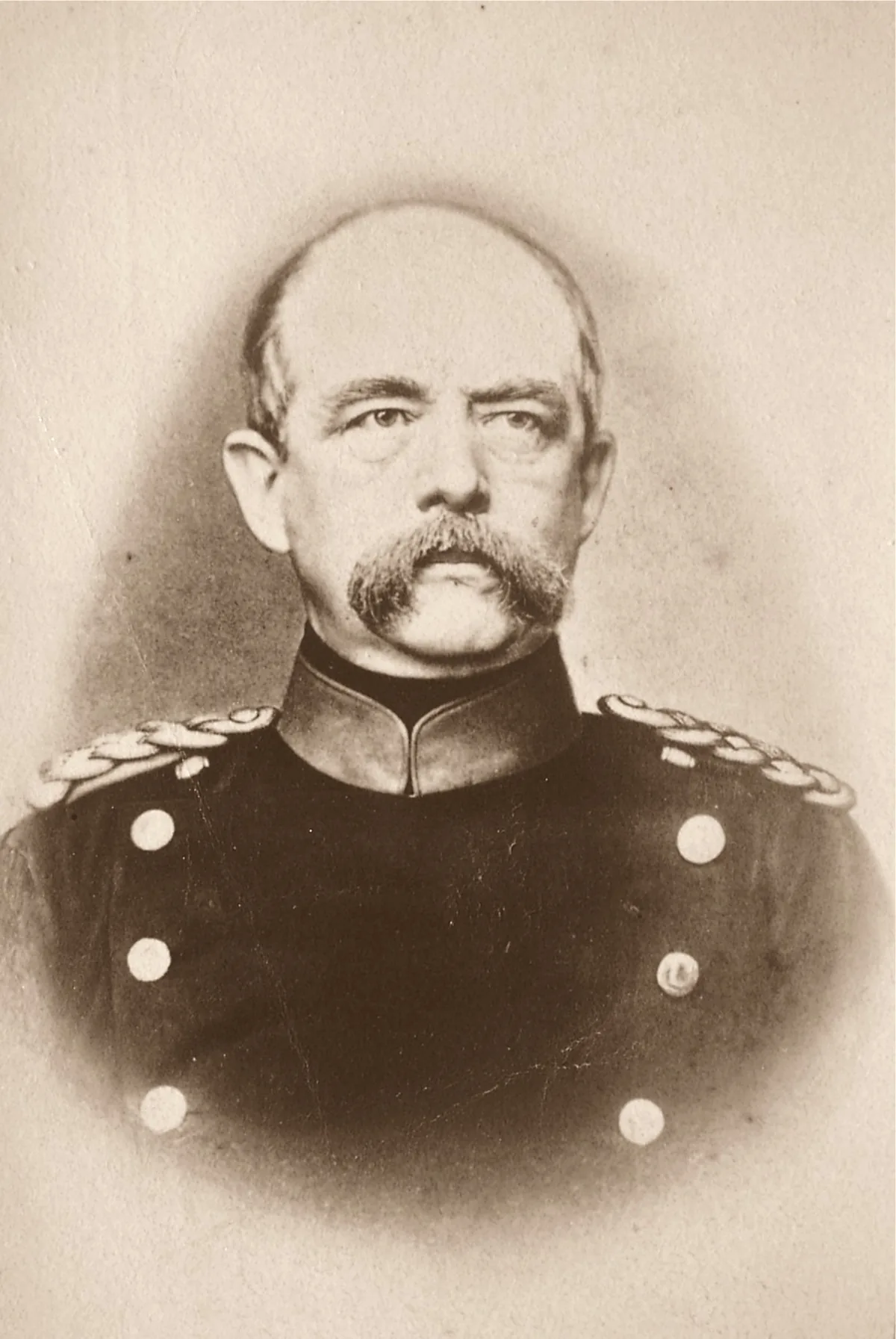
Otto von Bismarck in general’s uniform, albumen photograph, 1871, photographer unknown · Public domain · Source page
A Prussian country noble who made Germany through three wars, then spent twenty years trying to keep the peace.
- Born: 1 April 1815, Schönhausen in the Altmark, Prussia, into a Junker family
- Died: 30 July 1898, Friedrichsruh, near Hamburg, of old age and illness, eight years after the young emperor Wilhelm II dismissed him
- Won: The war with Denmark, 1864; The war with Austria, 1866; The war with France, 1870–71; The Congress of Berlin, 1878, as host and broker
- Lost: The ‘Kulturkampf’ against the Catholic Church, 1871–1878, abandoned; The anti-socialist laws: the Social Democrats grew all the same; Dismissed by Wilhelm II, 1890
“It is important that we should be the party attacked.”
1862
The last card
Bismarck was one of the Junkers, Prussia’s landowning nobles, and in 1848 an ultra-conservative who hated the revolution. Eight years as Prussia’s envoy in Frankfurt convinced him that Austria would never share Germany.
In 1862 Prussia was in deadlock: King Wilhelm I wanted a bigger army, and the liberal majority in parliament refused to pay for it. Wilhelm drafted his abdication. In September Bismarck became minister-president, promising to carry the reform with a budget or without one, and for four years he did. This was Realpolitik: power and interests first, principles later.
Check yourself
Why was Bismarck made minister-president of Prussia in September 1862?
Answer: The king wanted a bigger army, the liberal majority refused to pay for it, and Bismarck promised to carry the reform through even without a budget. Right. The deadlock was so deep that Wilhelm I drafted his abdication. Bismarck then governed for four years without an approved budget: that is realpolitik, power and interests first and principles later.
Source: Iron and blood
“Prussia’s borders under the treaties of Vienna are not favourable to a healthy political life. Not by speeches and majority decisions are the great questions of the day decided – that was the great mistake of 1848 and 1849 – but by iron and blood.”
He spoke a week into office, to a committee and without a text; the minutes partly summarise him. Liberals were outraged; by Bismarck’s later account, even his ally the war minister, Albrecht von Roon, called the remarks ‘witty digressions’ that did their cause no good.
- What does ‘iron and blood’ mean here: war, or something else? It was about the army budget: give the king soldiers and guns. But ‘the great questions’ beyond Prussia’s borders made many hear a threat of war.
- These are minutes, not a recording. What does that change? A clerk summarised an improvised speech. The famous phrase is probably close, but we cannot be sure of every word or of the tone.
- In his memoirs, 36 years later, Bismarck tells it differently. Why be careful? He dictated them after his dismissal, to defend his record. There he writes ‘blood and iron’ and speaks openly of ‘a serious contest’, but as a reasoned plan, not a blunder. Memoirs show how a man wanted to be remembered.
Myth
Bismarck said Germany would be united by ‘blood and iron’.
The truth
In 1862 he said ‘iron and blood’ (Eisen und Blut); later writers, German and English, and in time Bismarck himself, flipped the order. The meaning shifted too: in 1862 it was a remark in a budget debate, a threat to liberals and a blunder to his friends; only after the wars did it look like a programme carried out.
The evidence
The minutes of 30 September 1862 say ‘Eisen und Blut’. J. W. Headlam (1899) and, mostly, the English translation of Bismarck’s memoirs (1898) say ‘blood and iron’; in German it is the ‘Blut-und-Eisen-Rede’.
Check yourself
According to the minutes of 30 September 1862, what did Bismarck say would decide the great questions of the day?
Answer: Iron and blood. Right: ‘Eisen und Blut’, in that order. And in context he was asking for money for the army.
1864
Denmark, together with Austria
The first war was over two duchies, Schleswig and Holstein, ruled by the king of Denmark and claimed by German nationalists. In 1864 Prussia and Austria invaded together, bypassing the Confederation, and Prussian troops stormed the Danish redoubts at Dybbøl. Denmark gave up both duchies. Austria then ran Holstein and Prussia Schleswig, and every dispute between them was a chance for Bismarck to pick a quarrel.
Helmuth von Moltke
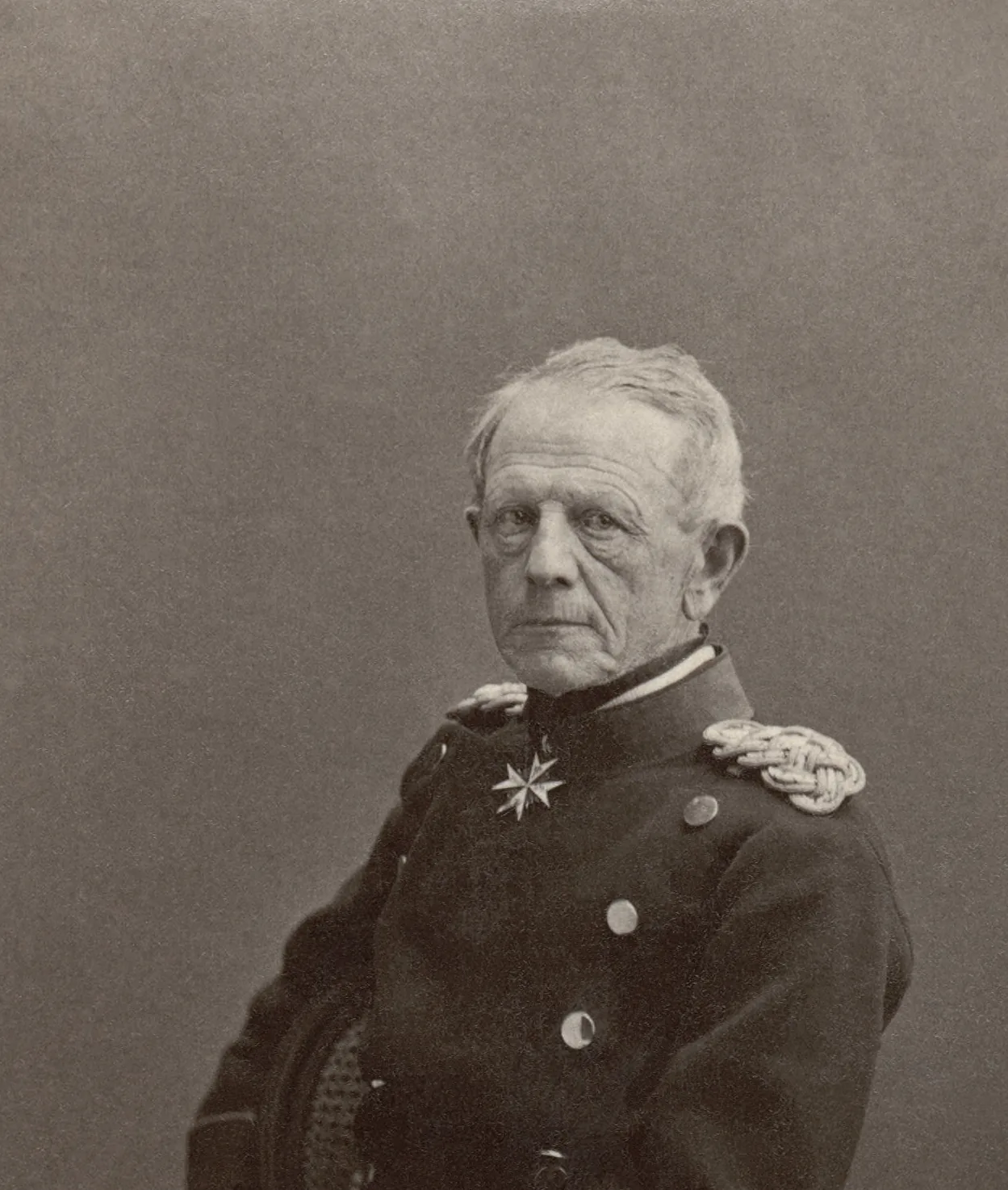
Carl Günther, photograph, Berlin, 1870s. Bibliothèque nationale de France (Gallica) · Public domain · Source page
A quiet staff officer who turned railways, telegraphs and timetables into a way of winning wars.
- Born: 26 October 1800, Parchim, in Mecklenburg
- Died: 24 April 1891, Berlin, at home, aged 90
- Won: Königgrätz, 1866; Sedan, 1870; The siege of Metz, 1870; The siege of Paris, 1870–71
- Lost: Nezib, 1839, as an Ottoman adviser whose advice was ignored
“It is difficult to understand why we Germans celebrate the 2nd of September – a day on which nothing memorable happened, but what was the inevitable result of the previous day’s work.”
1866
Railways and rifles
By 1866 Bismarck had isolated Austria: Russia was grateful for Prussian help against the Poles in 1863, Napoleon III hoped to gain from a German war, and Italy signed a secret alliance with Prussia for Venetia. Most of the larger German states still sided with Austria.
Moltke, chief of the General Staff since 1857, had studied the railways: Prussia could send its armies to the frontier along five lines, Austria along one. Prussian infantry carried the Dreyse needle gun, a breech-loader that could be reloaded lying down. The Austrians loaded at the muzzle, standing, and were trained to charge with the bayonet.
Check yourself
What was Moltke’s part, as chief of the Prussian General Staff, in Prussia’s advantage over Austria in 1866?
Answer: He planned the army’s moves and the railway timetables in advance, so Prussia could send its armies to the frontier along five lines and Austria along one. Right. Moltke’s General Staff drew up war plans and timetables already in peacetime, and Moltke had studied the railways closely.
Königgrätz, 1866
A decision point
You are Ludwig von Benedek, commander of Austria’s North Army.
Bohemia, 2 July 1866
In 1859 you held San Martino all day against the Piedmontese, as the last lesson told; you know Italy, not Bohemia, and took this command reluctantly. Now three Prussian armies have marched into Bohemia, and in the border battles your corps have lost tens of thousands of men to the needle gun.
On 1 July you begged the emperor Franz Joseph to make peace at any price: a catastrophe was unavoidable. His answer: peace is impossible; retreat in good order if you must; and, has there been a battle? It reads like an order to fight first.
Your army stands before the fortress of Königgrätz, the Elbe behind it. Two Prussian armies face you from the west; a third, under the crown prince, is somewhere to the north.
What do you do?
- Retreat behind the Elbe towards Olmütz, and save the army You would probably save most of your men and guns, but give up Bohemia without a battle. With no victory to bargain with, Vienna might have to accept Prussia’s terms anyway, and you would be blamed.
- Stand on the heights and fight a defensive battle Your guns have fine positions above the Bystřice stream, and the Prussians must attack uphill. But the river at your back makes retreat dangerous, and everything depends on holding your northern flank against the third army.
- Attack the two Prussian armies in front of you before the third arrives If it worked, you could beat the Prussians one army at a time. But your army is tired and shaken, and attacks in column against the needle gun have already cost you dearly.
What really happened
Stand on the heights and fight a defensive battle
Benedek fought on 3 July. Two corps of his northern flank swung west into the Svíb forest to crush one Prussian division; when the crown prince arrived around midday, the flank was almost bare.
He believed he had been ordered to fight. Geoffrey Wawro blames his passivity and lost grip on his corps commanders; Gordon Craig saw a brave soldier out of his depth. Austria’s official history blamed him alone, and he kept a loyal silence until his death in 1881.
Königgrätz: who fought whom
3 July 1866, from about 8 a.m. to evening
Between the Bystřice stream and the Elbe, north-west of Königgrätz (Hradec Králové, Czech Republic)
Prussia
- Commanders: King Wilhelm I (in name), Helmuth von Moltke, chief of the General Staff, Prince Friedrich Karl (First Army), Crown Prince Friedrich Wilhelm (Second Army), Herwarth von Bittenfeld (Elbe Army)
- Strength: 220,984 (Prussian General Staff history (1867)); about 221,000 (Gordon Craig (1964))
- Losses: 9,172 killed, wounded and missing (Prussian General Staff)
Austria
- Commanders: Ludwig von Benedek
- Strength: about 215,000, with the Saxons (Gordon Craig (1964)); 206,000–240,000, with the Saxons (Other modern estimates)
- Losses: about 43,000, including some 22,000 prisoners (Gordon Craig (1964)); about 31,000 (Lower counts)
Many Austrian ‘missing’ were prisoners, or stragglers who came back later.
Saxony (Austria’s ally)
- Commanders: Crown Prince Albert of Saxony
- Strength: about 22,000 (Modern estimate)
- Losses: about 1,500 (Gaston Bodart (1908))
Outcome: A crushing Prussian victory. The Austrian army escaped over the Elbe, but lost three to five men for every Prussian, and three weeks later Austria signed a preliminary peace.
Counts differ: some include whole armies, others only the men who fought. With 430,000 men or more on one field, it was among the century’s largest battles.
The battle of Königgrätz
3 July 1866, from about eight in the morning to evening
Bohemia, 3 July 1866. Austria’s North Army, under Ludwig von Benedek, stands before the fortress of Königgrätz with the Elbe behind it. Two Prussian armies approach from the west, and a third, under the crown prince, is somewhere to the north.
A reconstruction after Gordon Craig, The Battle of Königgrätz (1964), Geoffrey Wawro, The Austro-Prussian War (1996), and the Prussian General Staff history (1867), with the villages placed from modern maps. Woods, heights and the road are drawn approximately, and units much smaller than life: the front ran some ten kilometres from north to south. The times are disputed, and so is whether Benedek allowed IV and II Corps to go forward into the wood.
Phases of the battle
- Morning: rain, mist and guns About eight, in rain and mist. The First Army crosses the Bystřice at Sadowa; the Elbe Army marches on Nechanice. Austrian guns open fire from the heights. The crown prince’s Second Army is still hours away.
- The Svíb forest Nine to eleven. Fransecky’s 7th Division pushes into the Svíb forest, and Austrian IV and II Corps leave their line facing north to crush it. In the centre, artillery pins the First Army in the woods east of the stream.
- The crown prince arrives Around midday the Prussian Guard reaches the hill at Hořiněves, on the Austrian flank, with VI Corps beside it. IV and II Corps hurry back, too late. In the south the Elbe Army attacks the Saxons.
- Chlum About three. In smoke and drizzle the 1st Guard Division walks almost unseen into Chlum, the key height behind the Austrian centre. Benedek’s reserves counter-attack and are cut down within minutes. Problus falls.
- Retreat to the Elbe Cavalry charges and batteries fighting to the last cover the retreat. The beaten army streams east to the Elbe bridges and the fortress of Königgrätz. The tangled, exhausted Prussians hardly pursue.
The strategy
- Prussians: The three Prussian armies moved to close on the Austrians from the west and north. The First Army and the Elbe Army came from the west, and the crown prince’s army from the north, to reach the Austrian flank.
- Austrians: Benedek placed his guns on the heights to pin the First Army in the woods east of the stream. IV and II Corps turned north to crush the 7th Division in the Svíb forest, and historians disagree on whether Benedek approved that move. He kept his reserves ready in the centre.
- Saxons: What the Saxons planned is not known. They fought as Austria’s allies, and in the south the Elbe Army attacked them.
What decided it: What decided it was that IV and II Corps had gone north and came back too late, while the 1st Guard Division walked into Chlum, the height behind the Austrian centre. Benedek’s counter-attacking reserves were cut down within minutes.
Check yourself
Why did the Prussian Guard find Benedek’s northern flank almost bare at Königgrätz?
Answer: Two Austrian corps had swung west into the Svíb forest to fight one Prussian division. Right. IV and II Corps left the line facing north to crush Fransecky’s 7th Division, and the crown prince’s army walked into the gap.
July–August 1866
A mild peace
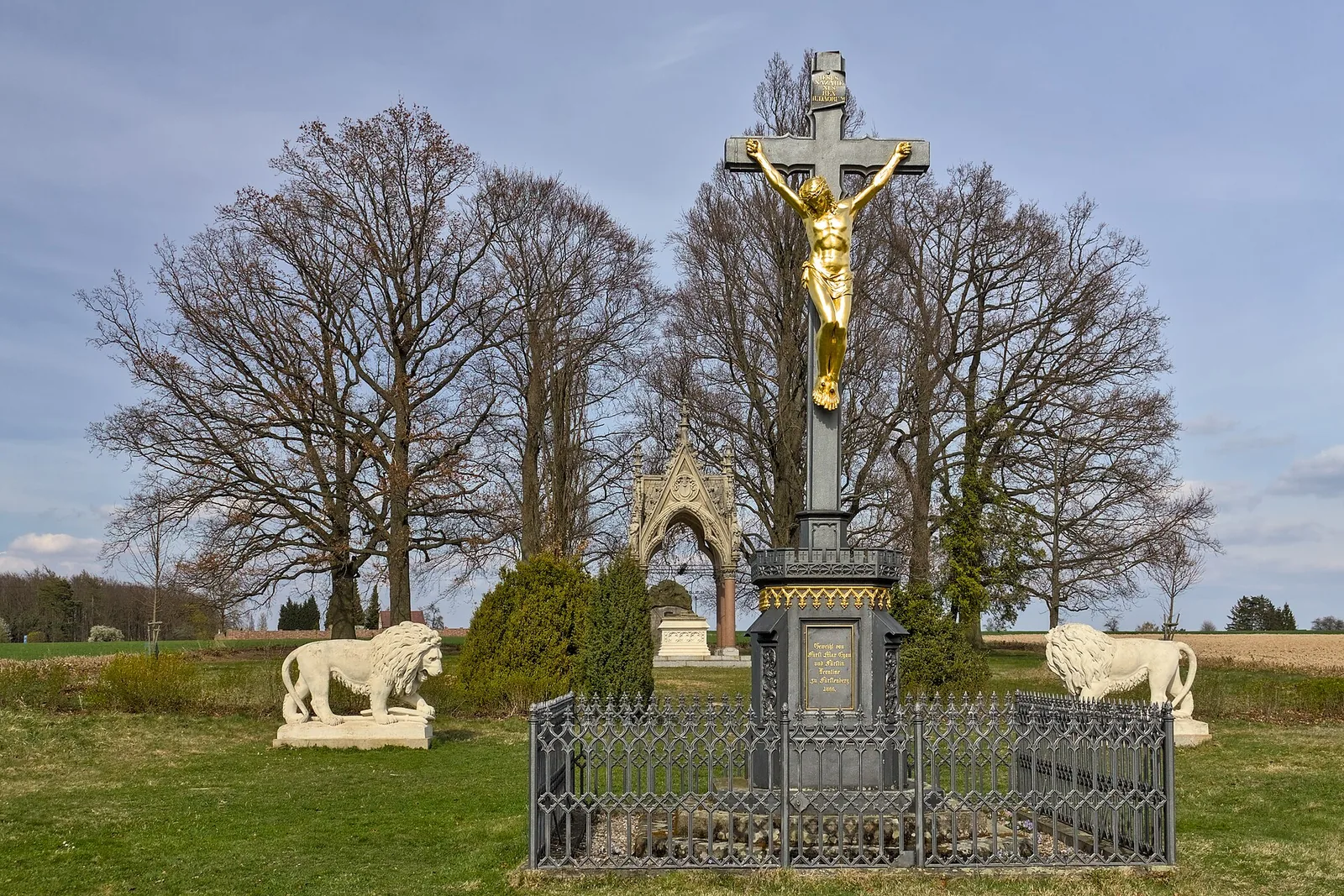
Chlum, Všestary (Czech Republic), April 2022. Photo: Miloslav Rejha · CC BY 4.0 · Source page
The king and his generals wanted to march on Vienna. Bismarck refused: Austria must be pushed out of Germany, not humiliated, and France might step in. He threatened to resign, and won.
By the Peace of Prague Austria lost no land to Prussia but left German affairs for good, and Italy got Venetia. Prussia annexed Hanover, Hesse-Kassel, Nassau, Frankfurt and the duchies. North of the Main, 22 states formed the North German Confederation, with a parliament elected by all adult men. Most liberals forgave Bismarck his years without a budget: unity, it seemed, came before liberty.
Check yourself
After Königgrätz the king and the generals wanted to march on Vienna, and Bismarck refused. Why?
Answer: He wanted to push Austria out of Germany without humiliating her, and feared that France might step in. Right. Bismarck threatened to resign, and won. By the Peace of Prague Austria left German affairs, and Italy got Venetia.
Ems and Sedan, 1870
1868–1870
A throne in Madrid
In 1870 Spain offered its vacant throne to Prince Leopold of Hohenzollern-Sigmaringen, a Catholic kinsman of the Prussian king. Bismarck pushed the candidacy in secret, and later denied it. To Paris it looked like a Prussian ring closing round France.
The French foreign minister, the Duke of Gramont, made threats, and on 12 July the candidacy was withdrawn: a clear French success. Gramont wanted more. On 13 July, on the promenade at Ems, the ambassador Count Benedetti asked Wilhelm to promise it would never happen again. The king politely refused.
A decision point
You are Otto von Bismarck.
Berlin, the evening of 13 July 1870
You are at dinner with Moltke and Roon, and the mood is grim. The candidacy you secretly promoted has been withdrawn under French pressure.
A telegram arrives from Ems: the new French demand, the king’s refusal, his decision not to see the ambassador again. The king leaves it to you whether to publish. Moltke says the army is ready and delay helps France. The south German states will fight only if France attacks.
What do you do with the telegram?
- Publish nothing, and let the crisis fade Peace would probably hold, but France would keep its diplomatic victory, and Prussia would look as if it had backed down twice in one week.
- Publish the whole telegram as it came Honest and calm: it reads like a polite conversation still going on. It might ease the crisis, or let France press for more.
- Publish a shortened version that makes the king’s refusal look final Every word would be true, but it would read like a door slammed in the ambassador’s face. Published that night and sent to every embassy, it would probably goad France into declaring war, and make France look the aggressor.
What really happened
Publish a shortened version that makes the king’s refusal look final
Bismarck cut the telegram and released it that evening to the press and the embassies. Paris read it on Bastille Day, 14 July; crowds shouted ‘To Berlin!’. France declared war on 19 July, and the south German states joined Prussia under their treaties of 1866.
His memoirs boast that the edit would act like ‘a red rag upon the Gallic bull’. Otto Pflanze sees a ‘strategy of alternatives’: a French climb-down or a war France started would both suit him.
Source: One telegram, two versions
The telegram from Ems (extract): “…I refused at last somewhat sternly, as it is neither right nor possible to undertake engagements of this kind à tout jamais. Naturally I told him that I had as yet received no news… His Majesty leaves it to your Excellency whether Benedetti’s fresh demand and its rejection should not be at once communicated both to our ambassadors and to the press.”
Bismarck’s version: “After the news of the renunciation of the hereditary Prince of Hohenzollern had been officially communicated to the imperial government of France by the royal government of Spain, the French ambassador at Ems further demanded of his Majesty the King that he would authorise him to telegraph to Paris that his Majesty the King bound himself for all future time never again to give his consent if the Hohenzollerns should renew their candidature. His Majesty the King thereupon decided not to receive the French ambassador again, and sent to tell him through the aide-de-camp on duty that his Majesty had nothing further to communicate to the ambassador.”
Abeken, a diplomat travelling with the king, summarised Wilhelm’s note. Bismarck says he cut it ‘by striking out words, but without adding or altering’. Check that against the texts.
- What did Bismarck cut? The king’s own voice: ‘somewhat sternly’, ‘naturally’, his waiting for news, the sense that the talks could go on. What was left was a demand and a snub.
- Bismarck invented no facts. Is his version a forgery? No: the demand, the refusal and the snub are all in the original, and the king had allowed publication. Bismarck mostly cut, adding only an opening clause and the words ‘on duty’. But cutting changes meaning: he admitted the short text made the refusal ‘appear decisive’, where the original read as ‘a fragment of a negotiation still pending’.
- Who tells us about the dinner at which he made the cut? Bismarck himself, in memoirs dictated twenty years later, after his dismissal. The texts can be checked; the dinner talk cannot.
Check yourself
What exactly did Bismarck do to the Ems telegram?
Answer: He cut words so that the king’s refusal looked final, and published it at once. Right. In his own words, the short text made the refusal ‘appear decisive’, and he made sure it reached Paris fast.
Myth
The Ems telegram was a forgery that tricked France into war.
The truth
Bismarck forged nothing: he shortened a real telegram, with the king’s leave to publish, so that a polite refusal read as an insult. Nor was France simply tricked; its government had turned a diplomatic victory into a demand for guarantees, and chose war.
The evidence
Both texts stand side by side in Bismarck’s memoirs (1898). The stronger charge is his secret backing of the candidacy, which he denied and which documents published in 1957 confirmed.
August 1870
Six weeks
Germany mobilised over a million men in under three weeks. After defeats at Spicheren and Wörth on 6 August, Marshal Bazaine’s Army of the Rhine fell back on Metz, and after the bloody battles of Mars-la-Tour and Gravelotte in mid-August it was shut in there. Marshal MacMahon marched a new army north-east to rescue it, with Napoleon III riding along. The Germans swung north to meet it.
Check yourself
Before Sedan: what happened to Marshal Bazaine’s Army of the Rhine, and what did Marshal MacMahon try to do?
Answer: Bazaine was shut in at Metz, and MacMahon marched with a new army to rescue him. Right. After the defeats at Spicheren and Wörth Bazaine fell back on Metz, and after Mars-la-Tour and Gravelotte he was shut in there. MacMahon marched to rescue him, with Napoleon III riding along; the Germans swung north to meet them.
Sedan: who fought whom
1 September 1870, from about 4 a.m. to 5 p.m.
Around the fortress town of Sedan on the Meuse, close to the Belgian border
Germans: Prussians, Bavarians, Saxons and Württembergers
- Commanders: King Wilhelm I, with Moltke, Crown Prince Friedrich Wilhelm of Prussia (Third Army), Crown Prince Albert of Saxony (Army of the Meuse)
- Strength: about 200,000 (Michael Howard (1961)); up to about 225,000, counting both armies in full (Other estimates)
- Losses: 460 officers and 8,500 men (Moltke)
The French Army of Châlons
- Commanders: Marshal MacMahon (wounded early), General Ducrot, General de Wimpffen, Napoleon III, present but not in command
- Strength: about 120,000–130,000 (Modern estimates)
- Losses: 17,000 killed and wounded; 104,000 prisoners (Moltke); ‘from forty to sixty thousand’ prisoners by the surrender: a first guess (Bismarck, letter of 3 September)
Outcome: The French army surrendered with its emperor on 2 September. Two days later Paris proclaimed a republic.
Paper strengths and men engaged differ, and the French had lost men on the march.
The battle of Sedan
1 September 1870, from four in the morning to late afternoon
MacMahon’s French Army of Châlons has marched north-east to free Bazaine, shut up at Metz, and has reached the Meuse round Sedan. German armies are closing in on it from several sides.
A reconstruction after Michael Howard, The Franco-Prussian War (1961), and Moltke’s history of the war (1891), with the villages placed from modern maps. The loop of the Meuse, the woods and the heights are drawn approximately, and units much smaller than life. The hour at which the ring closed, and whether Ducrot’s retreat to the west could still have succeeded, are disputed.
Phases of the battle
- Fog over Bazeilles Before dawn, in fog, Bavarians storm Bazeilles, where French marines fight house by house. Around six a shell fragment wounds MacMahon, who hands command to Ducrot. In the west, two German corps cross the Meuse at Donchery.
- Two orders Ducrot orders a retreat west. Two hours later General de Wimpffen produces a letter from Paris naming him commander, and orders a breakout east instead. German XI and V Corps march north round the loop of the Meuse.
- The ring closes XI Corps reaches Saint-Menges and Floing, V Corps Fleigneux; the Prussian Guard pushes towards Illy from the east. Around midday the pincers meet. Several hundred German guns line the heights, and nowhere is out of range.
- The cavalry charges Above Floing, General Margueritte’s cavalry charges again and again and is shot to pieces; Margueritte is mortally wounded. King Wilhelm reportedly exclaimed, ‘Ah, the brave men!’ The Calvary of Illy falls.
- Inside the trap Beaten units crowd into the town under constant shellfire. Wimpffen’s last push through Balan fails. In Sedan, Napoleon III has to decide what to do.
The strategy
- Germans: The Germans aimed to close pincers on the French: XI and V Corps marched north round the loop of the Meuse, and the Prussian Guard pushed from the east towards Illy. Several hundred guns on the heights covered the whole ground.
- French: MacMahon marched north-east to free Bazaine, shut up at Metz. After he was wounded, command passed to Ducrot, who ordered a retreat west, and then to Wimpffen, who showed a letter from Paris and ordered a breakout east.
What decided it: What decided it was the closing of the pincers round the town, and several hundred German guns on the heights that turned every movement into a target. Cavalry charges were cut down by fire, and the army was pressed into a trap.
A decision point
You are Napoleon III, emperor of the French.
Sedan, the afternoon of 1 September 1870
You did not want to be here. The regency in Paris, led by your wife, insisted on this march to rescue Bazaine, to save the dynasty. You are very ill, in such pain you can hardly sit a horse, and this morning you rode for hours among the guns, perhaps hoping to be hit.
Now your army is packed round the town, shelled from every height. Wimpffen insists that a breakout to the east can still succeed.
What do you do?
- Back Wimpffen: gather what men you can and break out to the east A few might get through, but most would probably be cut down by the guns: thousands more dead for little gain.
- Try to escape north into neutral Belgium Those who reached the border would be disarmed and interned. The roads north are under German fire, and an emperor in flight would look worse than one captured.
- Hold the town and the fortress to the last The fortress is old and overcrowded. The German guns would turn it into a slaughterhouse, for townspeople and soldiers alike.
- Raise the white flag, and give yourself up It would stop the killing. It would also end your army, and very probably your empire.
What really happened
Raise the white flag, and give yourself up
Over Wimpffen’s protests, Napoleon had the white flag raised at about half past four, and wrote to Wilhelm that, having failed to die among his troops, he placed his sword in the king’s hands. Next day’s capitulation brought the prisoners to 104,000; on 4 September Paris proclaimed a republic.
Napoleon could not command and would not abandon his army. The fatal decision had been taken in Paris: even Moltke wrote that MacMahon ‘only carried out the orders forced upon him by the Paris authorities’. The surrender saved thousands of lives.
Check yourself
Why did Napoleon III raise the white flag at Sedan?
Answer: His army was surrounded and shelled from every height, and he wanted to stop the slaughter. Right. The ring had closed around midday; by late afternoon the town was full of beaten men under constant shellfire.
2 September 1870
The morning after
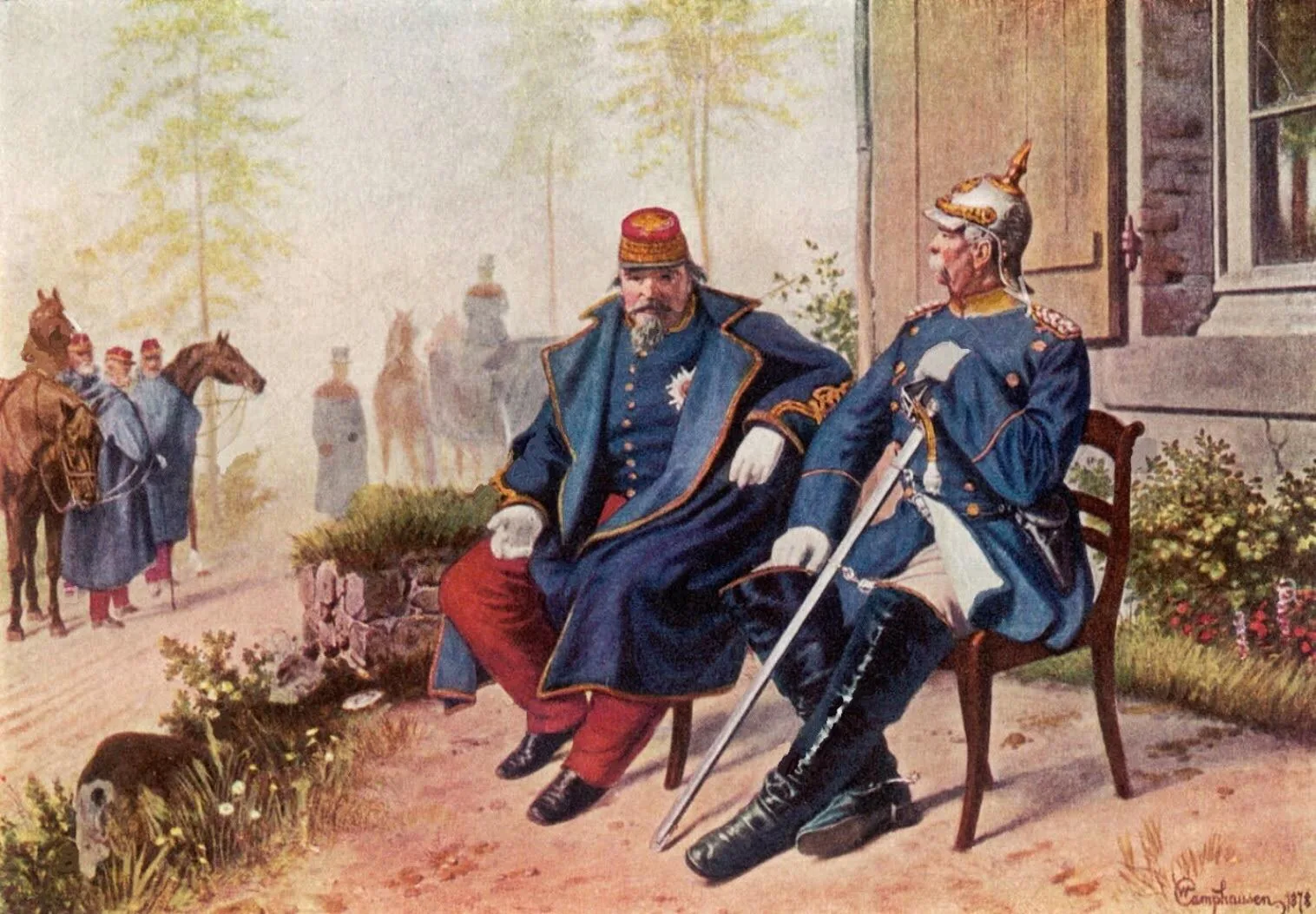
Wilhelm Camphausen, Napoleon III and Bismarck on the Morning after Sedan, 1878 (reproduced in a book of 1915) · Public domain · Source page
Next morning Napoleon drove out hoping for gentler terms. He and Bismarck talked in a workman’s cottage near Donchery, but Bismarck gave nothing away, and Moltke settled the surrender within hours.
Napoleon went into comfortable captivity near Kassel. The new republic in Paris refused to give up an inch of French soil, and on 19 September the Germans laid siege to Paris.
An empire and its price
January 1871
A crown from the princes
In November 1870, after hard bargaining, Baden, Hesse-Darmstadt, Bavaria and Württemberg agreed to join. King Ludwig II of Bavaria signed a letter, drafted by Bismarck, inviting Wilhelm to become emperor; he was later paid in secret from a fund Bismarck controlled.
On 18 January 1871 the empire was proclaimed at Versailles. In 1849 a Prussian king had refused a crown from a parliament; now one took it from the princes. Of the empire’s 25 states, Prussia held about two thirds of the land and three fifths of the people.
Source: A painting of the founding day
Anton von Werner, The Proclamation of the German Empire, third version, 1885
Werner was there and sketched. Of his three versions, the first two were destroyed in the Second World War; this one was the royal family’s gift for Bismarck’s 70th birthday.
- Who stands at the centre, and what is he wearing? Bismarck, in a white cuirassier’s uniform he did not wear that day: it makes him the brightest figure. He also wears an order he received only in 1884.
- Why paint it again, fourteen years later, for Bismarck? By 1885 the day was a founding myth, and Werner rearranged the figures for each patron: here Roon, absent that day, was added. A painting shows how an event was remembered, not what happened.
Check yourself
What can we learn from Anton von Werner’s painting The Proclamation of the German Empire, the third version of 1885?
Answer: How the event was remembered: Bismarck at the centre, in a uniform he did not wear that day, with figures arranged or added to suit the patron. Right. By 1885 the day had become a founding myth; Werner added Roon here, who was absent, so the painting shows how an event was remembered, not what happened.
1871
Alsace, Lorraine and the Commune
Paris, starving after four months of siege, gave in at the end of January. In March it rose and set up the Commune, which the French army crushed in May in a week of street fighting, as German troops watched from the forts. Thousands died.
By the Treaty of Frankfurt France agreed to pay five billion francs and lost Alsace-Lorraine, with Strasbourg and Metz: about one and a half million people, never asked. Moltke wanted the fortresses; nationalists said Alsace was German by language. Much of it was, but most Alsatians wanted to stay French, and Metz spoke French. Eleven years later Ernest Renan answered the annexation with his lecture on the nation, as we saw in the first lesson.
What 1871 led to
- 1866–1871 The idea of a Little Germany wins: Germany without Austria, whose millions of German speakers stay outside.
- 1871 The German Empire: a federation of princes under Prussia’s king. All men vote for parliament, but the chancellor answers to the emperor alone, and the army to no parliament.
- 1871–1878 The ‘Kulturkampf’ against the Catholic Church, then laws against the socialists: whole groups branded enemies of the empire.
- 1873–1890 Bismarck, now for peace, builds alliances to isolate France, which dreams of revanche.
- 1890 Wilhelm II dismisses Bismarck.
- 1914 War. Regaining Alsace-Lorraine is one of France’s aims.
- 1919 The peace treaty with Germany is signed on 28 June in the same Hall of Mirrors; Alsace-Lorraine returns to France.
- 1938 Hitler annexes Austria: a dark sequel to the ‘Greater Germany’ of 1848.
- 1990 Germany is reunited, again without Austria.
Check yourself
Which description fits the German Empire proclaimed in 1871?
Answer: A federation of princes under the king of Prussia: all men vote for parliament, but the chancellor answers only to the emperor and the army to no parliament. Right. That is how the timeline describes it. Prussia held about two thirds of the land and three fifths of the people, so in practice the empire was led by her.
Myth
Bismarck planned German unification step by step from the day he took office.
The truth
He had a goal, Prussian mastery of northern Germany without Austria, but no timetable. He worked with Austria in 1864–65 and in spring 1866 still explored dividing Germany with it along the Main. 1870 was a chance he seized.
The evidence
His memoirs (1898) and Heinrich von Sybel’s history (1889–94) read success backwards; A. J. P. Taylor (1955) and Otto Pflanze (1963) showed how much was improvised.
Bismarck: master planner or gambler?
How much did one man make Germany?
- A. J. P. Taylor, Bismarck (1955) An improviser of genius. Bismarck had no plan; he exploited other people’s mistakes, kept several options open and chose at the last moment.
- Otto Pflanze, Bismarck and the Development of Germany (1963; 1990) A ‘strategy of alternatives’: the aim was fixed, Prussian power in Germany, but the means stayed open. In 1870 either a French climb-down or a war that France started would have served him.
- Jonathan Steinberg, Bismarck: A Life (2011) A ruthless genius who dominated a weak king, lied freely, and did want war in 1866 and 1870. His power rested on one man’s will, and he left Germany a system that nobody after him could run.
- Christopher Clark, Iron Kingdom (2006) Beware of hindsight. Battles like Königgrätz could have gone the other way, and economics did not decide loyalties: most of the larger Zollverein states fought for Austria. Prussia did not simply swallow Germany; in the end it dissolved into it.
Still open: was the empire built by one man, by an army or by an economy? And did its birth ‘from above’ set Germany on a special path towards 1933, as Hans-Ulrich Wehler argued, or was the road still open, as David Blackbourn, Geoff Eley and Thomas Nipperdey replied?
What do you know now?
Check yourself
Which of these was never part of the German Empire of 1871–1918?
Answer: Austria. Right. This was the Little German solution: after 1866 Austria stayed outside Germany, until Hitler annexed it in 1938.
Terms
- German Confederation The league of German states created in 1815 at the Congress of Vienna: 39 states at first, with a Diet of envoys in Frankfurt and Austria presiding. It was dissolved after Prussia’s victory in 1866.
- student fraternities The Burschenschaften: patriotic student associations founded after 1815 that called for a united, constitutional Germany. They were banned by the Carlsbad Decrees of 1819 but lived on in secret.
- Zollverein The German customs union led by Prussia, in force from 1 January 1834: no duties between its members and one tariff towards the outside. Austria never joined.
- Little Germany The plan for a German state without Austria (kleindeutsch), led by Prussia. Its rival, ‘Greater Germany’ (großdeutsch), would have included Austria’s German lands.
- Junkers The landowning nobility of Prussia, above all east of the river Elbe. Junkers filled the officer corps and the senior civil service; Bismarck was one of them.
- Realpolitik Politics based on power and interests rather than ideals or principles. The German writer Ludwig von Rochau coined the word in 1853; it is often used of Bismarck.
- General Staff The Prussian army’s planning office. Under Moltke (1857–1888) its officers drew up war plans and railway timetables in peacetime and guided the armies in war.
- needle gun The Dreyse rifle, adopted by the Prussian army in 1841. It was loaded at the breech, and a long firing pin, the ‘needle’, set off the charge, so a soldier could reload lying down.
- North German Confederation A federation of 22 states north of the river Main, led by Prussia, 1867–1871. Its parliament, the Reichstag, was elected by all adult men; in 1871 it became the core of the German Empire.
- Alsace-Lorraine The lands France ceded to Germany in 1871: most of Alsace and north-eastern Lorraine, including Strasbourg and Metz. Ruled from Berlin as an ‘imperial territory’, they returned to France at the end of the First World War.
- revanche French for ‘revenge’: the wish, after 1871, to win back Alsace-Lorraine and undo the defeat.
- Versailles A grand palace near Paris, where the German Empire was proclaimed on 18 January 1871.
- Hall of Mirrors A grand hall in the Versailles palace, built for Louis XIV. Wilhelm I was proclaimed emperor there.
- Louis XIV The French king for whom the Versailles palace and its Hall of Mirrors were built.
- Friedrich Wilhelm IV The king of Prussia. In 1848 he rode through Berlin with a black, red and gold armband. In 1849 he refused the crown offered by the Frankfurt assembly.
- Metternich Austria's foreign minister, who answered the national movement with the Carlsbad Decrees of 1819.
- Carlsbad Decrees Orders issued in 1819 by Metternich: censorship and a ban on the fraternities.
- Wartburg castle A castle in central Germany where about 500 student nationalists met in 1817 under black, red and gold.
- Hambach castle A castle where in 1832 some 20,000 to 30,000 people rallied under the black, red and gold flag. Repression followed.
- black, red and gold The colours of the German unity movement, carried at the Wartburg and at Hambach, and at the Frankfurt assembly in 1848.
- Congress of Vienna A meeting of European statesmen in 1815 that reordered Europe after Napoleon and set up the German Confederation.
- John Maynard Keynes A famous British economist. In 1919 he argued that the German Empire was built more on coal and iron than on blood and iron.
- Bavaria A large state in southern Germany. In 1866 it fought on Austria's side, and later joined the empire.
- Hanover A state in northern Germany. It fought for Austria in 1866, and Prussia later annexed it.
- Dybbøl Danish fortifications that Prussia stormed in 1864 in the war over the two duchies.
- Königgrätz A fortress and battlefield in Bohemia, and the great battle of the 1866 war, where the Prussians beat Austria.
- Lorenz rifle The Austrian rifle. It fired about two shots a minute, against the Prussian needle gun.
- Albrecht von Roon Prussia's war minister and Bismarck's ally. By Bismarck's later account, he thought the remarks to the committee did the cause no good.
- San Martino A battle in northern Italy in 1859, where the Austrians held out against the Piedmontese all day.
- Franz Joseph Emperor of Austria. When asked for peace in 1866, he answered that peace was impossible.
- Peace of Prague The settlement that ended the 1866 war between Prussia and Austria. Austria left German affairs for good.
- Nikolsburg A town where Prussia's war council met on 23 July. Bismarck pushed there for a quick, mild peace.
- Olmütz A town where in 1850 Prussia backed down before Austria and Russia. The retreat is called the humiliation of Olmütz.
- Palacký A Czech historian who refused to join the national assembly at Frankfurt in 1848.
- Garibaldi An Italian volunteer leader who helped unite Italy.
- Duke of Gramont France's foreign minister in 1870. He pressed Prussia for more after Leopold's candidacy was withdrawn.
Sources
- Otto von Bismarck, Bismarck, the Man and the Statesman: Being the Reflections and Reminiscences of Otto, Prince von Bismarck, trans. under the supervision of A. J. Butler, 2 vols (London: Smith, Elder, 1898), I, 309–311 (1862); II, 95–101 (Ems), 130–133 (18 January 1871)
- Otto von Bismarck, speech to the budget committee of the Prussian House of Deputies, 30 September 1862, committee minutes, in Die gesammelten Werke (Friedrichsruh edition), vol. 10: Reden 1847–1869, ed. W. Schüßler (Berlin: Otto Stolberg, 1924–1935), pp. 139–140
- The Love Letters of Prince Bismarck, trans. under the supervision of Charlton T. Lewis, 2 vols (New York and London: Harper & Brothers, 1901), letter of 3 September 1870, pp. 416–417
- Helmuth von Moltke, The Franco-German War of 1870–71, trans. Clara Bell and Henry W. Fischer, revised by Archibald Forbes (London: Osgood, McIlvaine & Co., 1893)
- Prussian General Staff, The Campaign of 1866 in Germany, trans. von Wright and Henry M. Hozier (London, 1872)
- John Maynard Keynes, The Economic Consequences of the Peace (London: Macmillan, 1919), ch. IV
- J. W. Headlam, Bismarck and the Foundation of the German Empire (New York and London: G. P. Putnam’s Sons, 1899)
- Gaston Bodart, Militär-historisches Kriegs-Lexikon (1618–1905) (Vienna and Leipzig: C. W. Stern, 1908)
- Otto Pflanze, Bismarck and the Development of Germany, 3 vols (Princeton: Princeton University Press, 1990); vol. I: The Period of Unification, 1815–1871
- Jonathan Steinberg, Bismarck: A Life (Oxford: Oxford University Press, 2011)
- Christopher Clark, Iron Kingdom: The Rise and Downfall of Prussia, 1600–1947 (London: Allen Lane, 2006)
- Geoffrey Wawro, The Austro-Prussian War: Austria’s War with Prussia and Italy in 1866 (Cambridge: Cambridge University Press, 1996)
- Gordon A. Craig, The Battle of Königgrätz: Prussia’s Victory over Austria, 1866 (Philadelphia: Lippincott, 1964)
- Michael Howard, The Franco-Prussian War: The German Invasion of France, 1870–1871 (London: Rupert Hart-Davis, 1961)
- Geoffrey Wawro, The Franco-Prussian War: The German Conquest of France in 1870–1871 (Cambridge: Cambridge University Press, 2003)
- A. J. P. Taylor, Bismarck: The Man and the Statesman (London: Hamish Hamilton, 1955)
- Thomas Nipperdey, Germany from Napoleon to Bismarck, 1800–1866, trans. Daniel Nolan (Princeton: Princeton University Press, 1996)
- John Breuilly, The Formation of the First German Nation-State, 1800–1871 (Basingstoke: Macmillan, 1996)
- David E. Barclay, Frederick William IV and the Prussian Monarchy, 1840–1861 (Oxford: Clarendon Press, 1995)
- David Blackbourn, The Fontana History of Germany 1780–1918: The Long Nineteenth Century (London: Fontana, 1997)
- Matthew Jefferies, Imperial Culture in Germany, 1871–1918 (Basingstoke: Palgrave Macmillan, 2003)
- Robert Tombs, The Paris Commune 1871 (London: Longman, 1999)
Image credits
- Anton von Werner, The Proclamation of the German Empire, 18 January 1871 (third version, 1885), detail. Bismarck Museum, Friedrichsruh · Public domain · Source page
- The National Assembly in St Paul’s Church, Frankfurt: coloured lithograph after Ludwig von Elliott, 1848 · Public domain · Source page
- Otto von Bismarck in general’s uniform, albumen photograph, 1871, photographer unknown · Public domain · Source page
- Carl Günther, photograph, Berlin, 1870s. Bibliothèque nationale de France (Gallica) · Public domain · Source page
- Chlum, Všestary (Czech Republic), April 2022. Photo: Miloslav Rejha · CC BY 4.0 · Source page
- Wilhelm Camphausen, Napoleon III and Bismarck on the Morning after Sedan, 1878 (reproduced in a book of 1915) · Public domain · Source page


