Murasaki Shikibu: the woman who wrote Japan's great novel
In the early 11th century a Japanese court lady wrote a long story about a prince and his loves, and it is still read today. But the original manuscript is lost. How do we know what she wrote?
Decisions, questions and your own progress, in the app
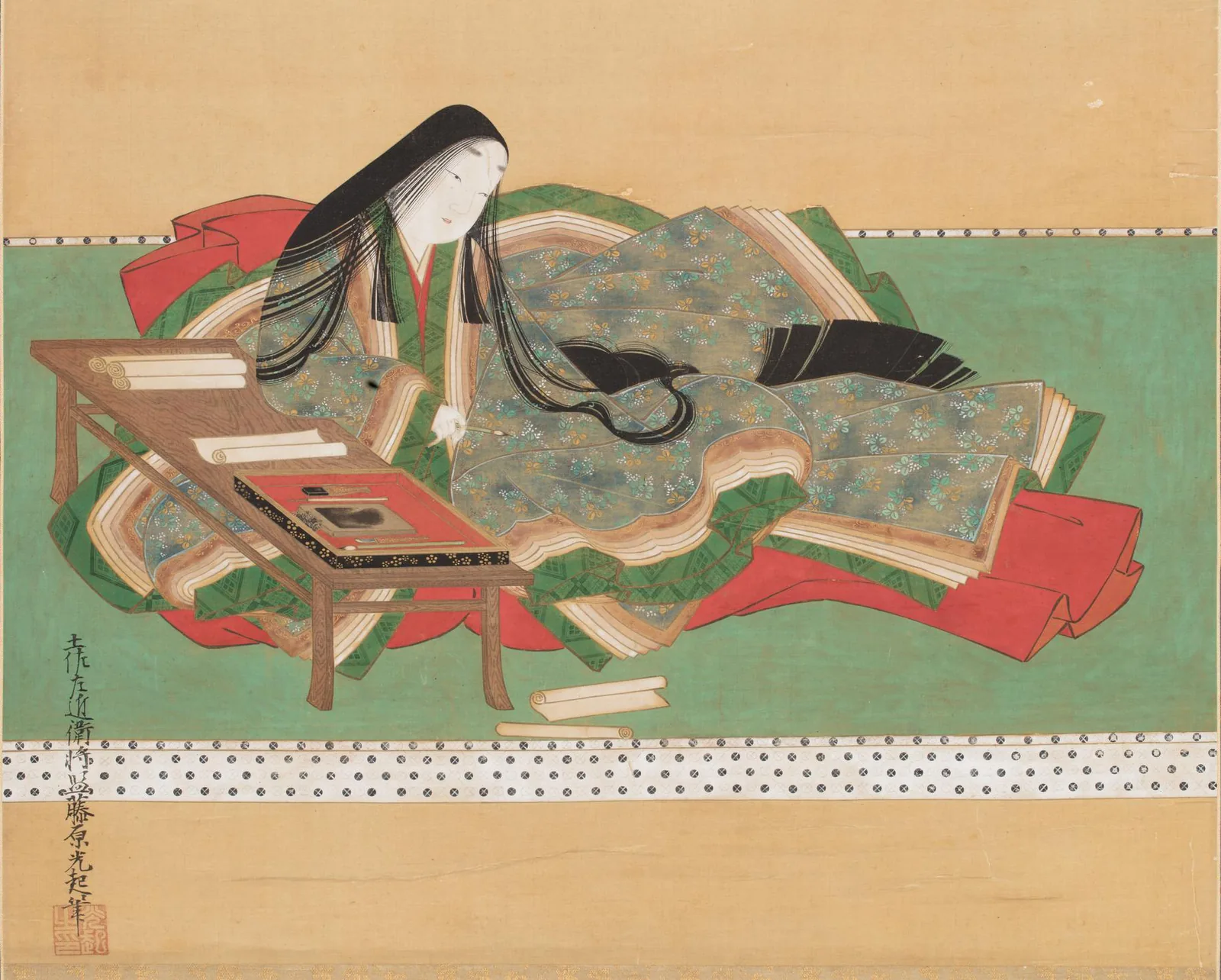
Tosa Mitsuoki (1617–1691), Murasaki Shikibu composing the Genji Monogatari, 17th century. · Public domain · Source page
The scene
Kyoto, around the year 1000
Picture a novel about a thousand years old, with 54 chapters and a hero who falls in love again and again. The author's original text has not survived.
She was a woman at the imperial court in Kyoto, and the book is The Tale of Genji. So how do we know what she actually wrote?
Background
A name that is not a name
We do not know her real name. 'Shikibu' probably comes from her father's post at the Ministry of Ceremonial.
'Murasaki' is probably the name of the heroine of the story, and so it became her nickname.
Background
A scholar's daughter
Her father, Fujiwara no Tametoki, was a scholar and official from a minor branch of the Fujiwara family, the powerful clan of the court.
She was born around 973 to 978 and died around 1014 or 1015. The dates are uncertain.
A widow with a daughter
Background
Two years of marriage
Around 998 or 999 she married Fujiwara no Nobutaka. Their daughter, Kenshi, was born in 999 and was later known as Daini no Sanmi.
Her husband died about two years after the marriage, around 1001. Murasaki was left a widow with a small daughter.
A decision point
You are a widow with a small daughter, in Kyoto.
Around 1005. This scene is imagined. The choices are ones a woman in your position could have faced.
Your husband has been dead for some years. You live quietly with your daughter. A relative asks whether you would consider work at court.
The household of the powerful Fujiwara no Michinaga is looking for women to serve the Empress Shoshi, his daughter. It is an honour, but it means court life, strict rules and little privacy.
What do you do?
- Refuse. Stay home with your daughter, your books and your memories. Probably a quiet life, with time to write, but far from court life and from the readers there.
- Accept the post in the Empress's household. Probably a steady place among the court's readers and writers, with strict rules and long nights.
- Ask a relative to find a post in a provincial household far from the capital. Probably a fresh start, but far from the court and from the people who would read what you write.
What really happened
Accept the post in the Empress's household.
She did enter the service of Empress Shoshi, the daughter of Fujiwara no Michinaga, around 1005 or 1006. As far as we know, no source explains why.
We do not know her reasons. We can only guess from her situation: a widow with a small child, a scholar for a father, and a court that needed women who could read and write.
That is a guess, not a record.
Check yourself
Which of these is recorded in the sources, rather than imagined in this lesson?
Answer: She entered the Empress's service around 1005 or 1006.. Correct. This is the best-supported fact about her move, and the sources give it as 'about', not as an exact day.
The court and two scripts
Court life
Two ways to write
The tale is written mostly in kana, the Japanese syllable script, not mainly in Chinese characters.
Each kana sign stands for one syllable, not for a whole word or idea.
Court life
The Empress and her court
Empress Shoshi was the daughter of the powerful Fujiwara no Michinaga. Murasaki served her as a court lady from about 1005 or 1006.
The tale itself has about 800 poems, and the exact count depends on the edition.
A decision point
You are one of the Empress's women, around 1006.
Around 1006. This scene is imagined, built from what we can learn about court life.
The Empress asks you to explain a Chinese poem that the other women cannot read. Few people at court can manage such a poem.
If you read it aloud and explain every line, everyone will hear it. If you pretend not to understand, you stay one of the quiet ones.
What do you do?
- Read the poem aloud and explain every line in front of everyone. Probably the Empress is impressed, but rivals grow jealous, and from now on they watch you more closely.
- Say you cannot read Chinese, and pass the question to someone else. Probably safe, but the Empress gets no help, and your learning stays hidden from the one person who could use it.
- Read the poem in private and teach the Empress quietly, in secret. Probably a close bond with the Empress, and a secret the court never hears about. But secrets are fragile: if this one came out, the gossip could harm your name.
What really happened
Read the poem in private and teach the Empress quietly, in secret.
Scholars suggest that she studied Chinese, and that she read Chinese poetry with the Empress in secret, perhaps the poems of the Chinese poet Bai Juyi. This is a reading by later scholars, not a clear statement by Murasaki herself.
We do not know what she thought. A woman who showed off Chinese learning could be mocked, so caution would make sense.
That is a guess from her position, not from a source.
Check yourself
What can we say for sure about Murasaki's Chinese learning?
Answer: A suggestion by scholars, not a clear statement by her.. Correct. Scholars suggest the secret teaching from later reading. The sources do not state it plainly.
The diary
Her own pages
We also have a diary she wrote. It covers about autumn 1008 to the New Year of 1010, and gives a close, first-person view of court life.
But the diary does not explain how the tale was written.
The first line
A decision point
You are writing the opening of your long story.
Around 1000 to 1010. The years are estimates, and this scene is imagined.
Many readers at court would know a famous Chinese poem by Bai Juyi, 'Song of Everlasting Regret', about Emperor Xuanzong and his beloved consort, Yang Guifei.
You want your story to open with an emperor who loves one woman above all others. Every reader who knows the poem will notice the match at once.
How do you open the story?
- Follow the Chinese story closely: the same emperor, the same consort, the same disaster to come. Probably recognised at once and admired by learned readers, but the story would remain someone else's, retold.
- Keep the emperor and his consort, but change the tone: love in place of a warning. Probably readers would recognise the poem and see the opening as a reply to it. That would start an argument about what the poem really means.
- Drop China altogether, and open in an ordinary family household, with no emperor. Probably a quieter, more local story, which learned readers would not link easily to the poem.
What really happened
Keep the emperor and his consort, but change the tone: love in place of a warning.
Many scholars read the opening of the tale as an echo of Bai Juyi's poem. They describe it as an adaptation, not a copy: the pair is kept, but the story is told as a love story, not as a poem of regret.
For the revolt behind that poem, see the lesson 'An Lushan, 755: the revolt that broke the Tang' on this site.
Why borrow? Readers who knew the poem would hear the echo at once, and it tells them where to listen.
We have no words of hers on this. This is the scholars' reading, not her statement.
Source: The opening, in our own words
Our paraphrase, not a quotation: the tale opens at an emperor's court, among many ladies, with one lower-ranking lady whom the emperor favours above all the others.
Our summary, not her words. The 1925 English translation it is based on came about 900 years after the text was written.
- Whose words are in this step, and when were they written? They are ours, a short summary of the opening. Murasaki wrote the original Japanese, but its date is uncertain. The English translation it is based on dates from 1925.
- What is missing from this source? The original. No original manuscript of the tale survives, so we cannot check any English version against her own hand.
Myth
Murasaki Shikibu wrote the first novel in the world.
The truth
She wrote a long, skilled prose story. It is often called the first psychological novel. But earlier prose fiction exists, including Greek romances such as Daphnis and Chloe.
The evidence
Scholars disagree about what counts as a novel. The answer depends on the definition you choose.
Check yourself
Why is 'the first novel in the world' a risky claim?
Answer: Because earlier long prose stories exist, and 'novel' is disputed.. Correct. Greek romances come earlier, and the word 'novel' has more than one definition.
What survived
The gap
A book with no first copy
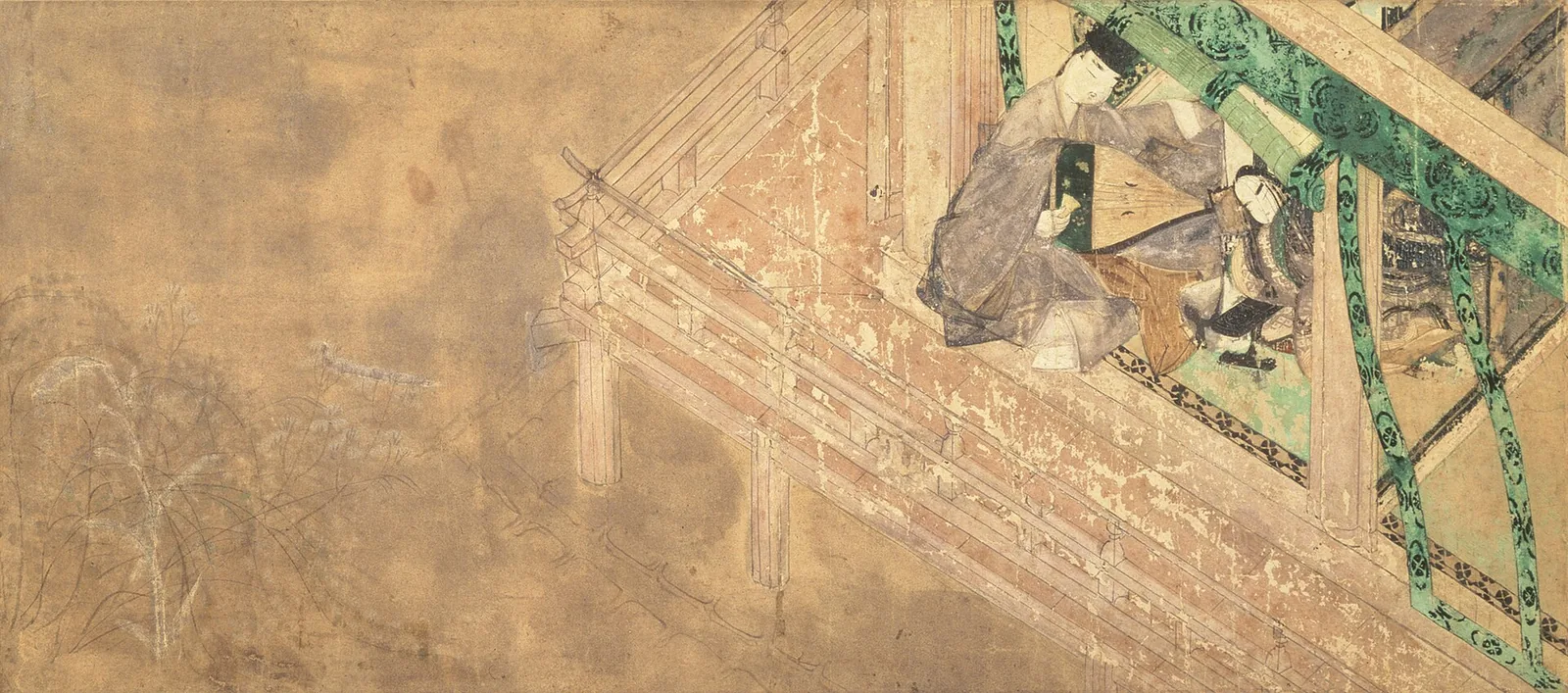
Illustrated scroll of The Tale of Genji, 'Yadorigi' scene, twelfth century. Tokugawa Art Museum, Nagoya. · Public domain · Source page
No original manuscript of the tale survives. What we have are later copies, made by hand by copyists, generation after generation.
The painting here comes from a 12th-century picture scroll. It was made about a century or more after Murasaki died.
Source: A twelfth-century picture scroll
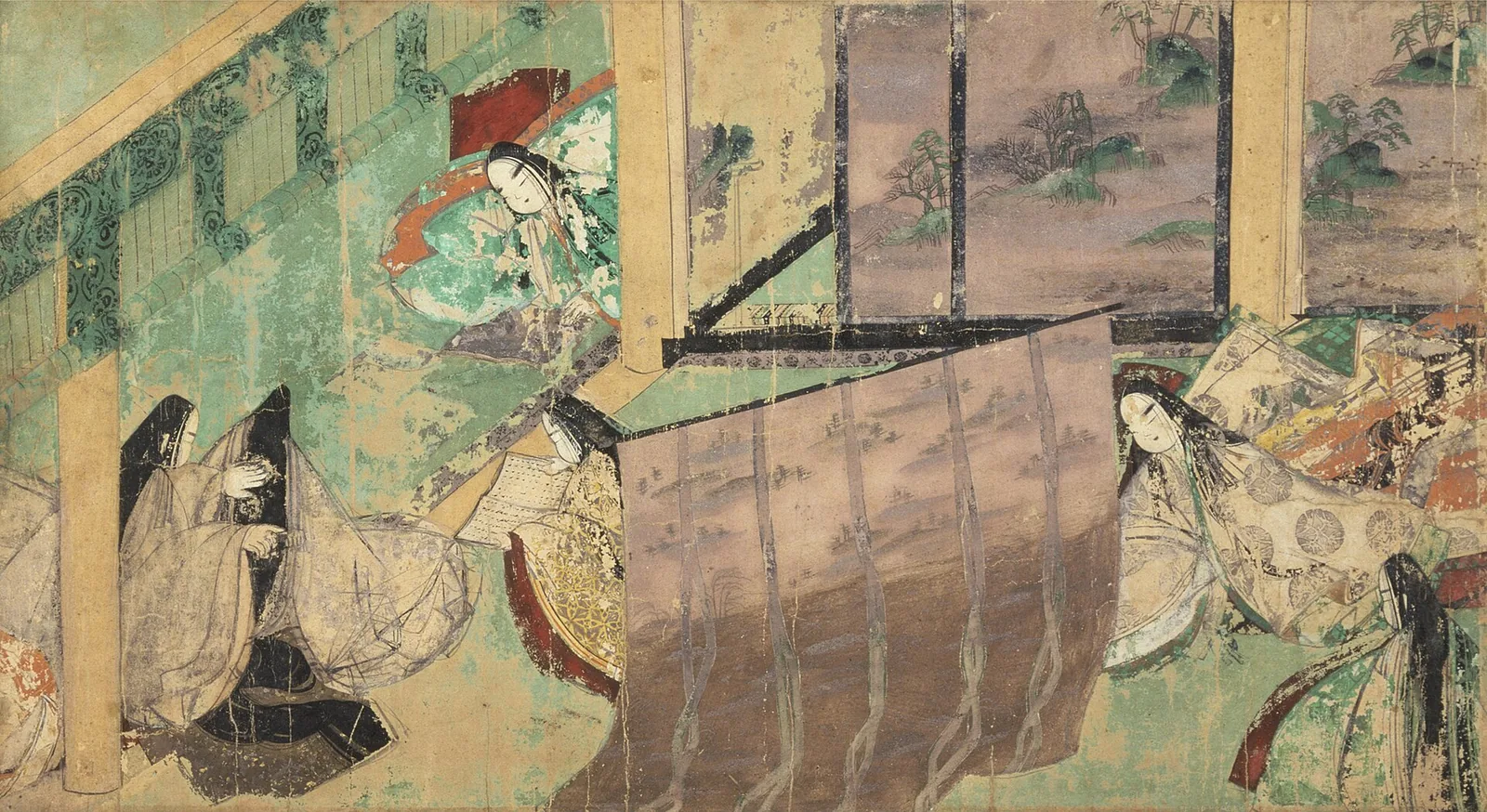
Illustrated scroll of The Tale of Genji, 'Azumaya' scene, first half of the 12th century. Tokugawa Art Museum, Nagoya. · Public domain · Source page
Genji Monogatari Emaki, 'Azumaya' scene, first half of the 12th century (Tokugawa Art Museum, Nagoya)
It was made about a century or more after she died, and it does not contain her words. The painters' names are not certain.
- When was this made, and who painted it? The museum dates it to the first half of the 12th century. The painters' names are not certain, so the date and the makers are estimates.
- What can it tell us, and what can it not? It shows that the tale was read and painted about a century or more after her death. It cannot tell us what Murasaki herself wrote.
What happened next
- c. 1001 Her husband dies. She is left a widow with a small daughter.
- c. 1005 or 1006 She enters the service of Empress Shoshi.
- 1008 to 1010 Her diary covers the period from autumn 1008 to the New Year of 1010.
- c. 1014 or 1015 She dies. The date is uncertain.
- c. 1120 to 1140 A picture scroll of the tale is painted.
- 1225 The poet Fujiwara no Teika records in his diary that thieves broke into his house and stole, among other things, his copy of the tale.
- 2019 A chapter called Wakamurasaki, copied out by Teika, is reported found in Tokyo.
Did she write all 54 chapters?
Did Murasaki write the whole tale, including the Uji chapters (45 to 54)?
- Many readers and translators They see one story, with one voice, and read the Uji chapters as its natural continuation.
- Some scholars who doubt it They argue that the Uji chapters differ in style from the earlier part, and doubt that she wrote them.
What fact could settle it? Decide what evidence would convince you, and notice what neither side can prove.
Check yourself
Why can we not read Murasaki's original manuscript today?
Answer: The original did not survive, and only later copies remain.. Correct. No original manuscript survives. What we have are copies made later, by hand.
Check yourself
What does the 1225 record show us?
Answer: That a copy was in a famous poet's house by 1225, and was stolen.. Correct. His diary records his copy among the stolen items.
Check yourself
Which claim does the 12th-century picture scroll support?
Answer: That the tale was still read and painted long after she died.. Correct. A scroll of this kind shows that the story was known and valued long after its author.
Terms
- kana The Japanese syllable script: each sign stands for one syllable. The tale is written mostly in hiragana, not in Chinese characters.
- manuscript A text written by hand. The original manuscript is the version the author wrote, before anyone copied it.
- copyist A person who copies a text by hand. Before printing became common, most copies of a story were written out by copyists.
- picture scroll A long hand-painted scroll, unrolled a section at a time to show a story in pictures. In Japanese: emaki.
- court lady A woman who worked at the imperial court, serving an empress or another high-ranking lady.
- novel A long prose story about invented characters. The word is also used loosely for long stories written long before the modern novel.
- adaptation A new work built on an earlier one and changed for a new audience or purpose.
- Empress Shoshi An empress at the court in Kyoto, daughter of Fujiwara no Michinaga. Murasaki served her as a court lady.
- Fujiwara no Michinaga A powerful man at court and father of Empress Shoshi. His household looked for women to serve his daughter.
- Fujiwara no Nobutaka Murasaki's husband. He died about two years after the wedding, leaving her a widow with a small daughter.
- Daini no Sanmi Murasaki's daughter, born in 999. Her original name was Kenshi, and she was later known by this name.
- Ministry of Ceremonial An office at the imperial court that handled ceremonies. Murasaki's father worked there, and her nickname probably comes from it.
- Fujiwara no Tametoki Murasaki's father, a scholar and official from a minor branch of the Fujiwara family.
- Bai Juyi A famous Chinese poet. His poem about Emperor Xuanzong and Yang Guifei was well known to readers at court.
- Xuanzong A Chinese emperor who loved his consort Yang Guifei above all others, as a famous poem by Bai Juyi tells.
- Yang Guifei Consort of Emperor Xuanzong, and the subject of Bai Juyi's famous poem.
- Daphnis and Chloe The two lovers of an ancient Greek romance about love. An example of prose tales that came before Murasaki's story.
- psychological novel A novel that shows the feelings and thoughts of its characters from the inside. Murasaki's tale is often called the first psychological novel.
- Kyoto A city in Japan that served as the capital and home of the imperial court for centuries.
- Chinese characters Chinese writing signs, each standing for a word or idea rather than a syllable.
- Tang dynasty The Chinese dynasty that ruled China. An Lushan's revolt in 755 broke it, the background to Bai Juyi's poem.
- Murasaki's diary The diary Murasaki wrote from about autumn 1008 to the New Year of 1010. It describes court life in the first person.
- Fujiwara family A powerful noble family that held real power at the imperial court.
- Greek romance A kind of prose tale about love, written in ancient Greece. Tales like this came before Murasaki's story.
Sources
- Omori and Doi, Diaries of Court Ladies of Old Japan (Houghton Mifflin, 1920), includes the diary of Murasaki Shikibu
- Murasaki Shikibu, The Tale of Genji, trans. Arthur Waley (Houghton Mifflin, 1925), chapter 1
- Fujiwara no Teika, Meigetsuki (his diary), entry for the 16th day of the 2nd month, 1225, on the robbery of his house
- Dalia Svambarytė, article on the opening of The Tale of Genji and Bai Juyi's poem, Acta Orientalia Vilnensia (2003)
- The Open University, OpenLearn, 'World changing women: Murasaki Shikibu'
- Tokugawa Art Museum, Genji Monogatari Emaki (painting treasures)
- Smithsonian magazine, October 2019, report on a Wakamurasaki chapter found in Tokyo
Image credits
- Tosa Mitsuoki (1617–1691), Murasaki Shikibu composing the Genji Monogatari, 17th century. · Public domain · Source page
- Illustrated scroll of The Tale of Genji, 'Yadorigi' scene, twelfth century. Tokugawa Art Museum, Nagoya. · Public domain · Source page
- Illustrated scroll of The Tale of Genji, 'Azumaya' scene, first half of the 12th century. Tokugawa Art Museum, Nagoya. · Public domain · Source page


