Genghis Khan
An outcast boy who fed his family on roots built the largest land empire in history.
Decisions, questions and your own progress, in the app
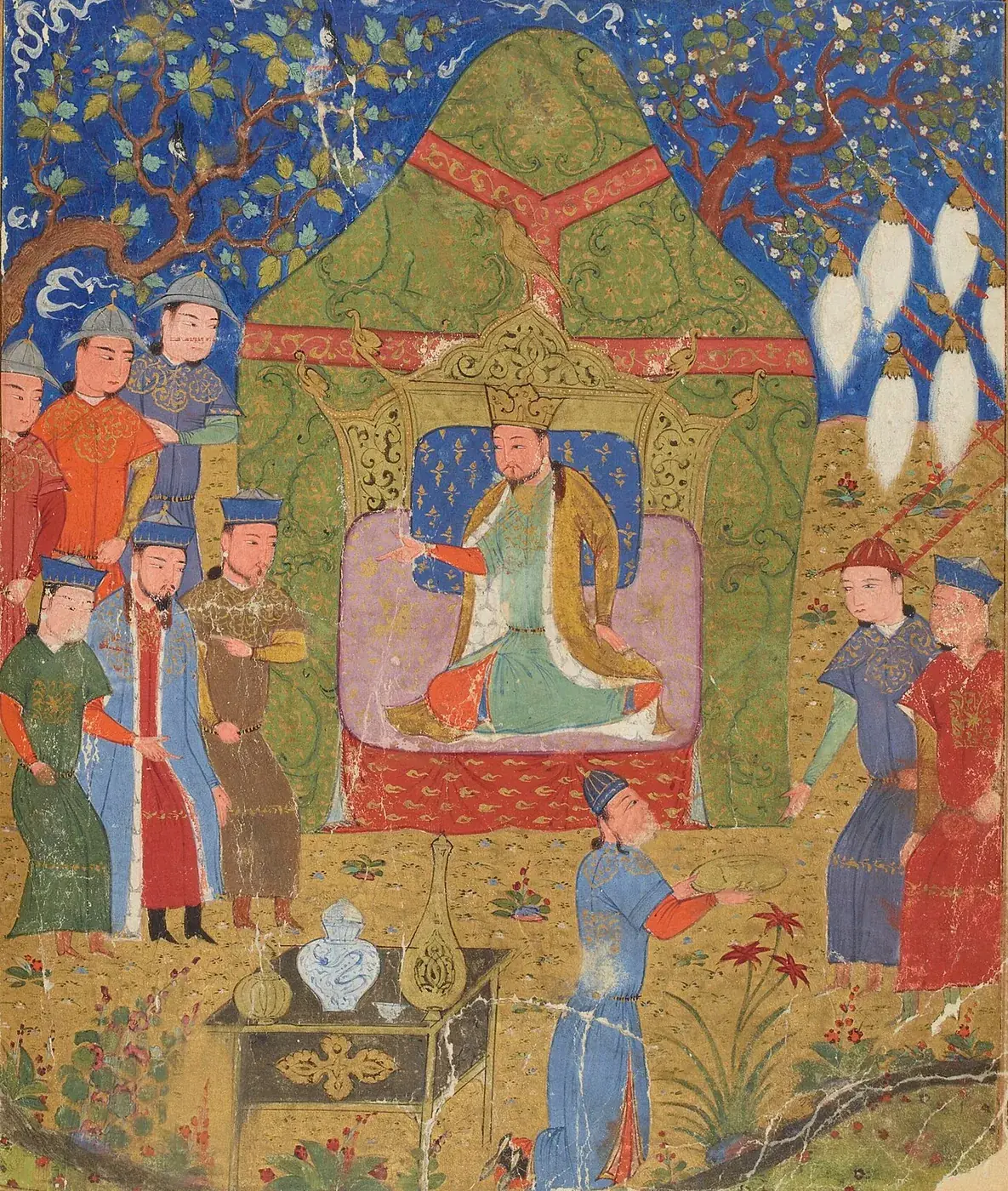
Herat painter, c. 1430–1434, in a manuscript of Rashid al-Din's Jami' al-tawarikh (Compendium of Chronicles). Bibliothèque nationale de France, Paris (Supplément persan 1113, fol. 44v) · Public domain · Source page
The outcast boy
Left behind
Spring, around 1171. On the bank of the Onon river a mother watches her own people take down their tents, round up the herds and ride away. They leave her behind with her children. No one turns back.
Her eldest son is about nine. His father has just died, poisoned by enemies. On the open steppe, a family without a clan is not expected to last the winter. The boy's name is Temüjin. The world will know him as Genghis Khan.
How they survived
Roots, wild fruit and fish
His father, Yesügei, a Mongol chief, had shared a meal with Tatars, old enemies of his family: steppe custom said a traveller must be fed. They recognised him and, the story goes, poisoned his food.
His followers would not obey a widow and small boys, so they left. Temüjin's mother, Hö'elün, ran up and down the river, says the Secret History, gathering wild pears, bird cherries, roots and wild onions. The boys bent needles into fish hooks.
Hunger made them hard. When his half-brother Begter kept taking what they caught, Temüjin and his brother Qasar shot him dead. Later, enemies captured Temüjin and locked his neck in a wooden collar. He escaped at night, hidden by a family who risked their lives for him.
Our main witness
A family saga
Almost everything we know about Temüjin's youth comes from one book, the Secret History of the Mongols, written for his family by an unknown author, probably in 1228 or 1240.
Read it like a family saga: honest about ugly moments, like the killing of Begter, but written to show that Heaven had chosen this man.
A sea of grass
Background
Life on the steppe
The Mongolian steppe is high, dry grassland, with winters that can fall below minus 30 °C. People lived on what their animals made of the grass: meat, milk, yoghurt, dried curds and fermented mare's milk.
Families lived in round felt tents, gers, which they loaded onto carts when the herds moved between summer and winter pastures. Wealth meant horses, sheep, goats, cattle and camels.
Every man was a rider and an archer. European visitors in the 1240s wrote that Mongol children learned to ride at two or three. On campaign each warrior brought several spare horses and a short, powerful bow of wood, horn and sinew.
The neighbours
A patchwork of peoples
The steppe was not one country. To the east lived the Tatars, allies of the Jin emperors of northern China. In the northern forests lived the Merkits, in the centre the powerful Keraits, and in the west the Naimans. Many Keraits and Naimans were Christians.
Power came from sworn brothers, called andas, and from men who left their own clans to follow a khan they trusted.
The test
Börte
As a boy Temüjin had been promised a bride, Börte, of the Onggirat people. When they married, her mother sent a coat of black sable as a gift, and Temüjin gave it to Toghrul, khan of the Keraits and his father's sworn brother, to renew their alliance.
Then the Merkits struck. Long before, Yesügei had carried off Hö'elün from a Merkit husband; now they raided the camp at dawn and took Börte.
Temüjin had no army, so he went to Toghrul and to his childhood anda, Jamukha. Together they raided the Merkits and brought Börte home. Soon after, she gave birth to a son, Jochi. Whispers about who his father was would follow Jochi all his life.
The two friends became rivals. Over the next twenty years Temüjin fought Jamukha, the Tatars, the clan that had abandoned his mother, and in the end even Toghrul, by then called Ong Khan.
Building a people
A decision point
You are Temüjin.
About 1201, by the Onon river, after a battle with the Tayichi'ud
Yesterday you fought the Tayichi'ud, the clan that once abandoned your mother. An arrow from a ridge struck your war horse in the neck. You were wounded yourself.
Today the enemy has scattered and their people are coming over to you. A young man named Jirqo'adai steps forward and says he shot your horse. Kill him, and he will rot like a clod of earth; spare him, and he will ride ahead of you through deep water and over shining rocks.
Your men are watching.
What do you do with him?
- Execute him. He shot at you in battle, and everyone should see what that costs. Your men would understand. But you would lose a bold, skilled archer, and send a message to every Tayichi'ud warrior still deciding whether to join you: surrender means death. Probably fewer would come over.
- Spare him, but put him in the ranks with the other captives and keep an eye on him. Safe and sensible: one more archer. But a man who risked his life to tell you the truth would learn that honesty earns nothing special. You would probably never find out what he could do.
- Spare him, give him a new name and take him into your own following. A gamble on character. If he is loyal, you gain a commander, and every defeated warrior learns that you reward courage and honesty, even in an enemy. If he is not, you have put a skilled enemy close to you.
What really happened
Spare him, give him a new name and take him into your own following.
Temüjin spared him. In the Secret History he says that an enemy usually hides what he has done, but this man admitted it openly, and such a man is worth having as a companion. He named him Jebe, an old Mongolian word for an arrowhead. Jebe became one of Chinggis Khan's greatest generals.
The Secret History prizes one value above all: loyalty. Temüjin rewarded men who stayed loyal even to a defeated master, and executed men who betrayed their own lords, even when it helped him. Jebe's honesty fitted that code.
Popular retellings say Jebe shot Temüjin himself. In the Secret History, it is the horse.
A decision point
You are Temüjin.
1204, before the war with the Naimans
You have crushed the Tatars and the Keraits. Thousands of men who were your enemies a year ago are now your warriors. In the west the Naimans, the last great power on the steppe, are preparing for war.
You know how fast loyalty can vanish. Your father's followers abandoned your mother. Last year some of your own kinsmen deserted you for Ong Khan. On the steppe, warriors follow their chief, and a chief can change sides overnight.
How do you organise your army?
- Keep each tribe together under its own chiefs, as steppe armies have always been. Quick and familiar. The chiefs stay content and men fight beside their kin. But their loyalty runs to their chiefs, not to you. After a defeat, or your death, the army could split along tribal lines.
- Keep the tribes, but bind their chiefs to you with marriages, gifts and a share of the plunder. The classic way to hold a steppe alliance together. It probably works while you keep winning and paying. But it rests on the chiefs' self-interest, and one quarrel over plunder could bring it down.
- Break the tribes up into units of ten, a hundred and a thousand under commanders you choose, and form a guard from the commanders' sons. A deep change. Some chiefs will resent losing their men. But every soldier now owes his place to you and to commanders who owe everything to you. The sons in your guard are both your students and a guarantee of their fathers' loyalty.
What really happened
Break the tribes up into units of ten, a hundred and a thousand under commanders you choose, and form a guard from the commanders' sons.
In 1204 Temüjin organised his men into tens, hundreds and thousands, each under a commander he appointed. He formed a personal guard, the keshig, many of them sons and younger brothers of his commanders. In 1206 he named 95 commanders of a thousand and enlarged the guard to 10,000. Many units mixed men from different tribes, especially defeated ones.
Counting soldiers by tens was not new: earlier steppe empires, such as the Xiongnu and the Khitans, had done it. What was new was how far Temüjin pushed it, and whom he trusted. He gave command to companions who had proved themselves, whatever their birth: Jelme was a blacksmith's son, and Muqali came from a family of hereditary servants.
The assembly
Chinggis Khan
1206
In 1206, at the source of the Onon river, the leaders of the steppe gathered for a quriltai, a great assembly. They raised a white standard with nine tails and proclaimed Temüjin Chinggis Khan, ruler of all “the people of the felt-walled tents”.
He was perhaps in his forties. The steppe was united. Its neighbours were about to find out what that meant.
War in the west
Beyond the steppe
From China to Central Asia
After a campaign in 1209–1210, the Tangut kingdom on his southern border submitted. In 1211 Chinggis invaded the Jin empire of northern China, and in 1215 his armies took its capital, Zhongdu, today's Beijing.
In 1218 Jebe destroyed the realm of the Qara Khitai. The Mongols now bordered the Khwarazmian Empire, a rich Muslim empire of great cities, from the Caspian Sea to Afghanistan.
A decision point
You are Chinggis Khan.
1218–1219, in Mongolia
You want trade with the rich cities of Central Asia. You sent the Shah of Khwarazm a large caravan: about 450 merchants, Muslims according to Juvaini, with goods paid for by you, your family and your commanders.
At Otrar, a border town of the Shah's, some chronicles say the governor called the merchants spies; he killed them and took the goods. One man escaped to tell you. You sent envoys to demand justice; the chronicles differ: in one the Shah's men killed the leading envoy and sent the others back with their beards shaved, in another all the envoys were killed.
Part of your army, under Muqali, is still fighting in northern China. The Shah's empire is large, rich and full of walled cities.
How do you answer?
- Send one more embassy and give the Shah a last chance to make amends. Probably more humiliation. Two outrages have gone unanswered; a third embassy would look like weakness, to the Shah and to the peoples who have only just submitted to you. You might gain time, but lose the fear that holds your new empire together.
- Punish Otrar only: take the town and its governor, and leave the rest of the Shah's lands alone. A middle way, but probably not a stable one. The Shah would almost certainly treat an attack on his town as war, and you would face his whole army with only part of yours.
- Make full war on the Shah with most of your army, even if China must wait. The biggest gamble of your life: a campaign thousands of kilometres from home against an empire of great cities. If it works, the Shah is destroyed and the trade routes are yours. If it fails, everything you built could fall apart.
What really happened
Make full war on the Shah with most of your army, even if China must wait.
In 1219 Chinggis Khan marched west with most of his army, leaving his general Muqali to carry on the war in China. Within three years the Khwarazmian Empire had collapsed. Otrar fell after a long siege, and its governor was executed.
For Chinggis Khan, harming an envoy was among the worst of crimes. The Persian historian Juvayni writes that he climbed a hilltop alone, bared his head and prayed for three days and nights before deciding on war.
A decision point
You are Chinggis Khan.
1219, before the campaign in the west
You are about to ride thousands of kilometres to war, and you are no longer young. Your wife Yisüi asks what no one else dares: if you fall, who will rule?
You have four sons with Börte. Jochi, the eldest, is a proven commander, but some whisper that his father was the Merkit who held Börte captive. Chagatai is strict and proud. Ögedei is generous, easy-going and drinks too much. Tolui, the youngest, is a bold soldier; by custom the youngest son keeps his father's hearth.
You ask Jochi to speak first. Chagatai cuts in: how could they be ruled by someone born of the Merkits? Jochi seizes him by the collar, and your commanders pull them apart.
Whom do you name as your heir?
- Jochi. He is your eldest, and you have always treated him as your son. You defend Börte's and Jochi's honour. But Chagatai has just said in front of everyone that he will not accept it. The two eldest princes would probably fight each other after your death.
- Chagatai. He is forceful and knows the law, and the empire needs a strong hand. You would reward the man who has just insulted his brother and his mother in public. Jochi and his followers would probably refuse to serve him.
- Ögedei. He is neither the eldest nor the fiercest, but both brothers might accept him. A compromise. Neither Jochi nor Chagatai wins, so neither loses face. Ögedei's easy, generous nature might keep the family together.
- Tolui. He is the boldest soldier of the four, and custom already gives the youngest son the family hearth. Passing over three older brothers would offend all of them. Custom gave the youngest son the home camp, not the right to rule his elder brothers.
What really happened
Ögedei. He is neither the eldest nor the fiercest, but both brothers might accept him.
According to the Secret History, Chagatai himself proposed Ögedei, and Jochi agreed. Chinggis named Ögedei his heir and promised his other sons lands of their own. In 1229, two years after his father's death, a quriltai confirmed Ögedei as Great Khan.
Chinggis Khan needed a choice his strongest sons could live with. In the Secret History an old companion, Kökö Chos, rebukes Chagatai: Börte did not choose to be captured, and her sons must not shame her. Was Jochi's paternity really in doubt? We cannot know. Chinggis always treated him as his eldest son.
1219–1221
An empire falls
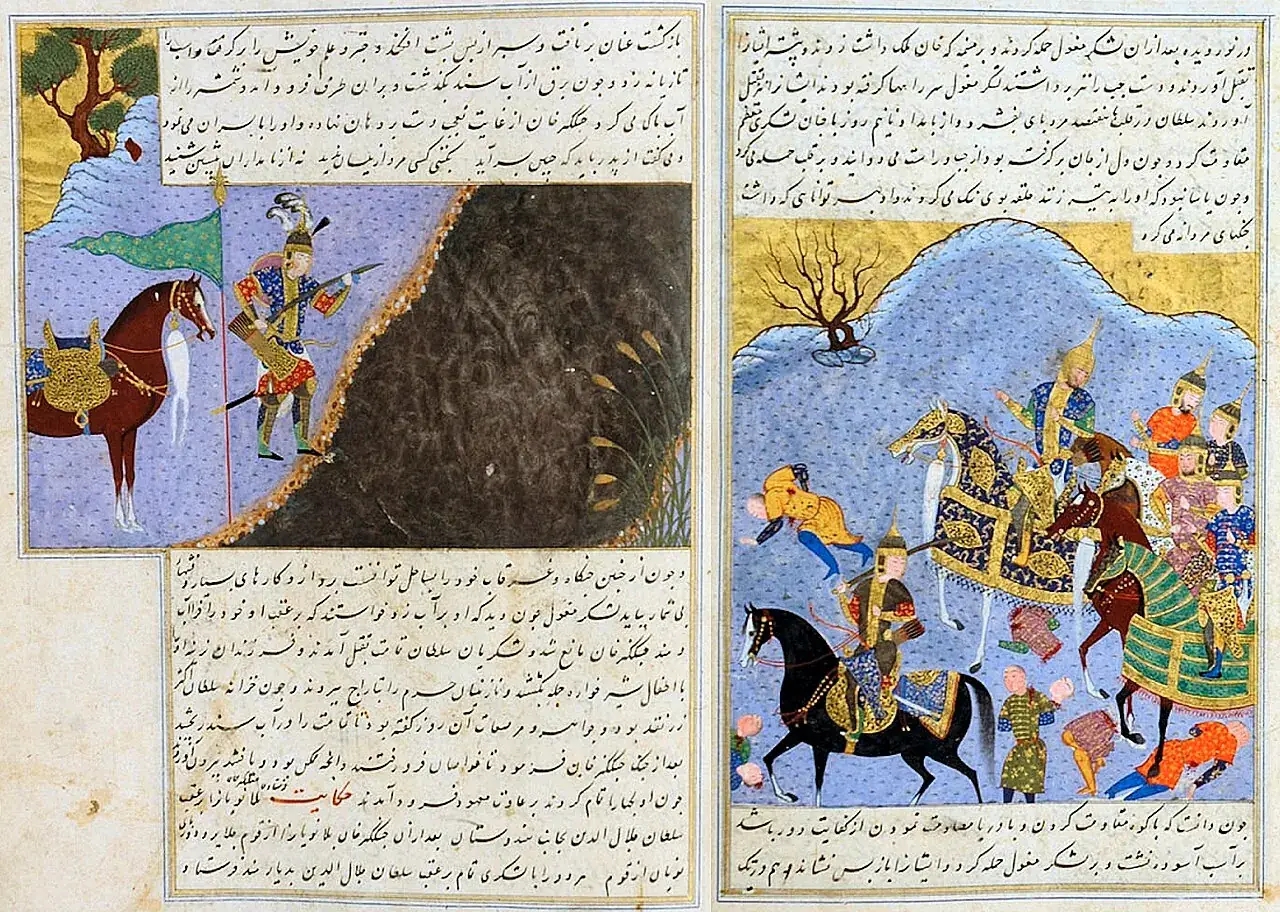
Unknown painter, in a copy of Rashid al-Din's Jami' al-tawarikh made at Turusht, near Rayy (Iran), 1529. National Library of Russia, St Petersburg (MS Dorn 289, fols. 125v–126r) · Public domain · Source page
The Mongols took Otrar, then Bukhara and Samarkand in 1220. Cities that surrendered quickly usually suffered less, though they were plundered and many of their people taken. Cities that resisted, like Urgench, Merv and Nishapur in 1221, were stormed, and the chroniclers say most of their people were killed, except craftsmen the Mongols could use. Fear became a weapon: news of one massacre opened the gates of the next town.
Shah Muhammad fled and died, a hunted man, on an island in the Caspian Sea. His son Jalal al-Din fought on. In 1221, cornered on the bank of the Indus, he rode his horse into the river and escaped. Persian historians say Chinggis Khan watched and told his sons that every father should wish for such a son.
Reading the sources
Source: A coronation painted 224 years later
Painter in Herat, c. 1430, illustrating Rashid al-Din's Compendium of Chronicles. Bibliothèque nationale de France
Rashid al-Din, a Persian vizier of the Mongol rulers of Iran, finished a vast history of the Mongols around 1307–1310. Over a century later, artists in Herat, capital of the Timurid ruler Shah Rukh, copied and illustrated it.
- What can this painting tell us about 1206? Very little directly. It was made about 225 years later, far from Mongolia, from a text written a century after the event. Only a few details, like the white standards, echo the tradition.
- Find an object that did not exist in 1206. The blue-and-white porcelain jar on the table. Chinese potters perfected this style in the 14th century, under the Mongols' own Yuan dynasty; at Timurid courts in the 1400s it was a treasured luxury.
- Why would rulers in Herat in 1430 want this picture? The Timurids ruled lands the Mongols had conquered. Their founder, Timur, was not descended from Chinggis Khan, so he married a princess of Chinggis's family and called himself “royal son-in-law”. Honouring Chinggis Khan linked the dynasty to the most prestigious name in Asia.
Source: The founder's official face
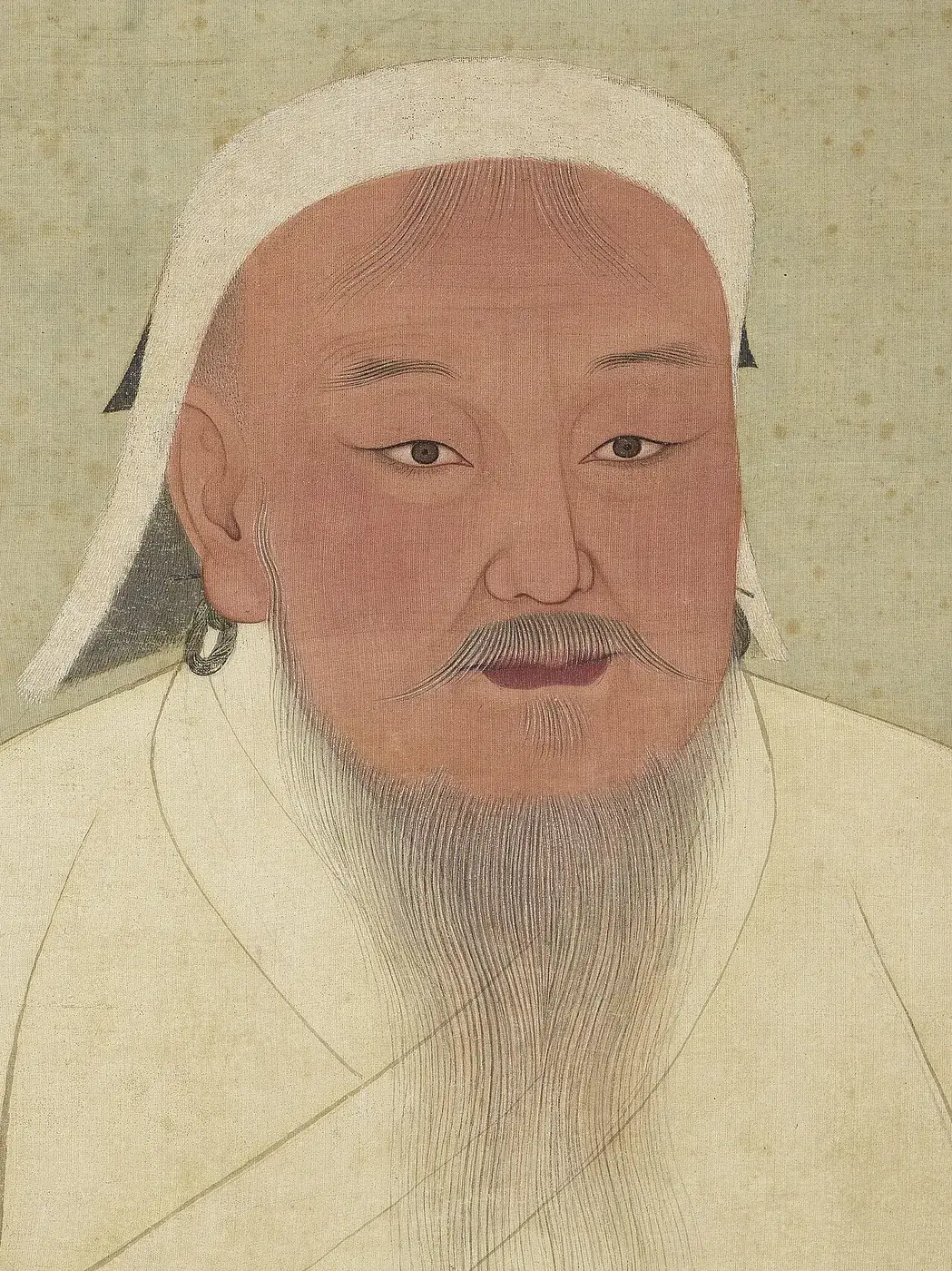
Unknown court painter, portrait of Taizu (Chinggis Khan) from an album of Yuan emperors, probably late 13th or 14th century, ink and colour on silk. National Palace Museum, Taipei · Public domain · Source page
Unknown court painter, Yuan dynasty, probably late 13th or 14th century. National Palace Museum, Taipei
Chinggis Khan's grandson Kublai founded the Yuan dynasty in China. Its court honoured Chinggis as its first ancestor, with the temple name Taizu, “Grand Ancestor”, and kept portraits of its dead rulers, probably for ceremonies in their honour.
- Nobody painted Chinggis Khan from life. So what is this a portrait of? Of an idea: the founder as his heirs wanted him remembered. The painter may have worked from descriptions, or from the faces of his descendants. It is evidence about the Yuan court, not a photograph of the man.
- What is missing, and how does it differ from the Herat painting? Everything about war: no armour, no bow, no horse. A dynasty ruling millions of Chinese subjects wanted a founder who looked like a wise ancestor, not a conqueror. In Herat he wears a Persian crown; here, a Mongol cap. Each painter dressed him for his own audience.
Source: The historian who could not bear to write
“To whom, indeed, can it be easy to write the announcement of the death-blow of Islam and the Muslims, or who is he on whom the remembrance thereof can weigh lightly? O would that my mother had not born me or that I had died and become a forgotten thing ere this befell!” … “these Tatars spared none, slaying women and men and children …”
Ibn al-Athir (1160–1233), one of the great historians of the Islamic world, lived in Mosul, in today's Iraq, nearly 2,000 km from Bukhara. In the same passage he compares the invasion with Nebuchadnezzar's destruction of Jerusalem.
- He lived at the time. Does that make him an eyewitness? No. He was contemporary, but far from Central Asia and Iran. He relied on reports, letters and travellers' stories that reached Mosul, and stories of horror grow on the way.
- Why does he wish he had never been born? He wrote as a Muslim scholar for Muslim readers who had seen nothing like it. Words like these show the depth of the shock: evidence of fear and grief, not a count of the dead. One voice is missing: the Mongols', who appear only as a disaster from outside.
Source: The historian who worked for the conquerors
“They came, they dug, they burned, they killed, they plundered and they left.”
Ata-Malik Juvayni was born in Khurasan in 1226, after the invasion. He served the Mongols all his life, visited their capital in Mongolia, knew their officials and later governed Baghdad for them. He finished his history around 1260.
- Why would a Mongol official describe their massacres? He explains the conquest as God's punishment for the sins of Muslims. That lets him show the full horror and still praise the conquerors. He even has Chinggis Khan tell the people of Bukhara that he is the punishment of God; historians doubt he said it.
- Juvayni says the dead at Merv were counted for thirteen days, and came to more than 1.3 million. Do you believe it? No. That is far more people than the city is thought to have held, even crowded with refugees, and Ibn al-Athir gives 700,000 for the same city. Huge medieval numbers measure horror, not heads. The massacre was real; the number is not a count.
After Chinggis
1227
Death on campaign
Back in Mongolia, Chinggis Khan turned on the Tangut, who had refused to send troops for the war in the west. In the winter of 1226, the Secret History says, his horse threw him during a hunt; he fell ill with fever but would not turn back. He died in August 1227, as the Tangut capital was about to fall. The exact cause is unknown; later stories blamed lightning, an arrow or a Tangut queen. The Tangut state was destroyed and many of its people killed.
He was buried in secret in Mongolia. The grave has never been found.
Myth
Everyone who saw Genghis Khan's funeral procession was killed, so that the secret of his grave would die with them.
The truth
No source from the time says this. The closest early version is Marco Polo's, written some seventy years later: he says the escorts of dead Mongol khans killed everyone they met on the road. Polo was not there and wrote from hearsay, about khans in general. What we do know: the burial was kept secret, and the area became forbidden ground.
The evidence
The Secret History, written within a generation of his death, does not describe the funeral at all. Polo's book was written down in 1298.
Myth
DNA proves that 16 million men alive today descend from Genghis Khan.
The truth
In 2003 geneticists led by Tatiana Zerjal found that about 8 percent of men in a large region of Asia carry almost the same Y chromosome, which passes from father to son: some 16 million men. The lineage seemed to have spread from Mongolia about 1,000 years ago, and the team suggested Genghis Khan and his male relatives spread it. That was an educated guess, not a proof: his body has never been found, so his DNA has never been tested.
The evidence
A 2018 study argued that the lineage is older and was carried by many ordinary Mongols, not by one ruling family. And descent through daughters, who do not pass on a Y chromosome, was never counted.
Myth
The Mongols were savage raiders who could only destroy.
The truth
They destroyed a great deal, and nothing here hides that. But they also built one of the best-organised states of the Middle Ages: a script, judges, a register of rulings, and under his heirs a relay post, the yam, whose riders carried metal passes called paiza. They held censuses, hired Chinese, Persian and Uyghur officials, and protected Buddhist, Christian, Muslim and Daoist clergy, often freeing them from taxes.
The evidence
Several paiza survive in museums, some inscribed in a script created for Kublai Khan's empire.
What came after
- 1227 Chinggis Khan dies, ruling from northern China to the Caspian Sea.
- 1229 Ögedei becomes Great Khan, and later builds a capital at Karakorum.
- 1234 The Jin empire of northern China falls.
- 1237–1242 Mongol armies conquer the Rus' principalities, invade Poland and Hungary, then withdraw for reasons still debated.
- 1258 His grandson Hülegü takes Baghdad, ending the Abbasid caliphate. In 1260 the Mamluks of Egypt stop the Mongols at Ain Jalut.
- 1260s A war between his grandsons splits the empire into four khanates: the Golden Horde, the Chagatai Khanate, the Ilkhanate in Iran, and the Great Khan's realm in China.
- 1271 Kublai Khan proclaims the Yuan dynasty and by 1279 rules all of China. The Mongol realms now cover roughly 23 to 24 million km², the largest connected land empire in history (estimates vary).
- c. 1250–1350 The Pax Mongolica: merchants, envoys and missionaries cross Asia more safely than before. Marco Polo is one of them.
- 1340s The same routes probably helped carry the Black Death west from Central Asia to Europe.
- 1368 The Ming dynasty drives the Mongols out of China.
Destroyer, or maker of a connected world?
How should we judge Chinggis Khan: by the cities his armies destroyed, or by the connected world his heirs ruled?
- Jack Weatherford, anthropologist, Genghis Khan and the Making of the Modern World (2004) Chinggis Khan was a visionary. He broke the power of the old aristocracy, promoted men for merit, protected merchants and envoys, and tolerated every religion. His empire joined East and West and helped make the modern world. The book is hugely popular, especially in Mongolia; critics say it projects modern ideas onto the 13th century and plays down the killing.
- Historians who stress the cost, such as Peter Jackson, The Mongols and the Islamic World (2017) Start from the evidence of the victims. The campaigns of 1219–1223 wrecked cities and farmland in Central Asia and Iran, and some regions took generations to recover. The trade and culture of the “Mongol peace” came decades later, under his heirs, and the khanates often fought each other. The silk and porcelain should not hide the dead.
- Historians in between: Timothy May, The Mongol Conquests in World History (2012); Morris Rossabi; David Morgan Both are true, and they are linked. May speaks of a “Chinggis Exchange”: goods, ideas, technologies, people and diseases moving across Eurasia. That exchange was made possible by conquest. Chinggis built the military machine and the first institutions; his sons and grandsons built most of the government that made the connected world work.
- Where you stand In Mongolia today he is the father of the nation: his face is on the banknotes and the international airport bears his name. In Russia, the memory is of the “Tatar yoke”. Persian chroniclers wrote of the end of the world. The Yuan emperors of China honoured him as their first ancestor.
Can the same man be both a destroyer and a builder? And should the trade of 1280 count in his favour, if the cities of 1220 paid for it?
Final quiz
Check yourself
What was really new about Temüjin's army reform of 1204–1206?
Answer: He broke up tribes and mixed their men into units under commanders he chose for loyalty and skill. Right. Loyalty now ran to him and his appointed commanders, not to tribal chiefs, and his guard of commanders' sons bound their fathers to him too.
Check yourself
What set off the war between Chinggis Khan and the Shah of Khwarazm in 1219?
Answer: The killing of the caravan he had sent, at Otrar, and then of his envoy. Right. The governor of Otrar killed about 450 merchants, and the Shah's side then killed the leading envoy sent to demand justice. For Chinggis Khan, harming an envoy was unforgivable.
Check yourself
Why did Chinggis Khan choose Ögedei, his third son, as heir?
Answer: He was a compromise both older brothers could accept after their quarrel. Right. Chagatai would not accept Jochi, and Jochi would not have accepted Chagatai. Chagatai himself proposed Ögedei, and Jochi agreed.
Check yourself
Which detail in the Herat painting shows most clearly that it was made long after 1206?
Answer: The blue-and-white Chinese porcelain jar on the table. Right. That kind of porcelain was perfected in the 14th century, under the Mongols' own Yuan dynasty, and it was a treasured luxury at Timurid courts in the 1400s. It does not belong to the steppe of 1206.
Check yourself
Juvayni writes that more than 1.3 million people were killed at Merv. How should we treat this number?
Answer: As a sign of the scale of the horror, not a real count: the massacre happened, but the number is far too high. Right. The city is thought to have held far fewer people, and Ibn al-Athir gives a different figure. Medieval writers used huge numbers to express catastrophe.
Check yourself
What did the famous 2003 genetic study actually find?
Answer: That about 8 percent of men in a large region of Asia share one Y-chromosome lineage, which the authors linked, as a hypothesis, to Genghis Khan's family. Right. The link to Genghis Khan was an inference from where and when the lineage spread. It has never been tested against his own DNA, and later studies questioned it.
Terms
- Secret History of the Mongols The oldest Mongolian account of Chinggis Khan and his family, by an unknown author, probably written in 1228 or 1240. It survives only in a Chinese-character transcription made in the late 14th century.
- ger The round tent of the steppe: a wooden lattice frame covered with felt. Mongolians call it a ger; in English it is often called a yurt.
- anda A sworn brother. Two men became andas by exchanging gifts and oaths, and from then on owed each other help for life.
- khan The ruler of a steppe people. Chinggis Khan's successors used a higher title, qa'an, the Great Khan, ruler over all the other khans.
- keshig Chinggis Khan's personal guard, set up in 1204 and grown to 10,000 men in 1206. Many guardsmen were commanders' sons, and the guard was also a school for future generals and officials.
- tümen A unit of ten thousand soldiers, the largest in the Mongol army. In practice, units were often smaller than their names suggest.
- quriltai A great assembly of Mongol princes and commanders, called to choose a khan or decide on war.
- Jin The dynasty that ruled northern China from 1115 to 1234. Its rulers were Jurchens, a people from Manchuria.
- Khwarazmian Empire A Muslim empire ruled by the Khwarazm-Shahs. Around 1215 it stretched from the Caspian Sea to Afghanistan, with great cities such as Bukhara, Samarkand and Merv.
- Tangut A people who ruled the kingdom of Western Xia (1038–1227), in what is now north-western China. The Mongols destroyed it in 1227.
- yam The Mongol relay post: a chain of stations with fresh horses, food and lodging for official messengers, organised across the empire under Ögedei.
- Pax Mongolica Latin for “Mongol peace”: a modern name for the period, roughly 1250 to 1350, when Mongol rule made travel and trade across Asia safer than before.
- Yesügei Temüjin's father, a Mongol clan chief. He died after enemies poisoned his food.
- Hö'elün Temüjin's mother. After the clan left her, she raised her children alone on the steppe.
- Begter Temüjin's half-brother. Temüjin and his brother Qasar shot him dead after he kept taking their catch.
- Tatars A people of the eastern steppe, allies of the Jin emperors of northern China and old enemies of Temüjin's family.
- Merkits A people of the northern forests. They raided Temüjin's camp at dawn and took his wife Börte.
- Onggirat The people that Börte, Temüjin's wife, came from. She was promised to him when he was a boy.
- Keraits A powerful people of the central steppe, ruled by Toghrul. Many of them were Christians.
- Naimans A strong people of the west steppe, the last great power there before Chinggis Khan united the tribes.
- Toghrul Khan of the Keraits and Yesügei's sworn brother. Temüjin turned to him in need and later fought him.
- Jamukha Temüjin's childhood sworn brother, who later became his rival.
- Börte Temüjin's wife. The Merkits kidnapped her, and Temüjin brought her home with his friends' help.
- Jebe A fighter whose life Temüjin spared because he openly admitted shooting his horse. He became one of Chinggis Khan's greatest generals.
- Muqali A Mongol general who stayed in northern China to carry on the war when Chinggis Khan marched west.
- Shigi Qutuqu Chinggis Khan's adopted brother. He became chief judge and recorded the rulings in a blue register.
- Uyghur alphabet The alphabet from which the traditional Mongolian script came. Chinggis had the princes learn to write Mongolian in it.
- Shah Muhammad Ruler of the Khwarazmian Empire. He fled the Mongols and died a hunted man on an island in the Caspian Sea.
- Jalal al-Din Son of Shah Muhammad, who kept fighting the Mongols. In 1221 he escaped them by riding his horse into the Indus river.
- Otrar A border town of the Shah. The caravan merchants were killed there, and it fell after a long siege.
- Bukhara A great city in Central Asia on the Silk Road, taken by the Mongols in 1220.
- Samarkand A great city in Central Asia on the Silk Road, taken by the Mongols in 1220.
- Urgench A city in Central Asia that resisted the Mongols. It was stormed in 1221, and by the chroniclers' account most of its people were killed.
- Ibn al-Athir A great Muslim historian who lived in Mosul. He compared the Mongol invasion to the destruction of Jerusalem.
- Juvayni A Persian historian born after the Mongol invasion. He served the Mongols and wrote their history.
- Rashid al-Din A Persian historian who served the Mongol rulers of Iran and wrote a great history of the Mongols.
Sources
- The Secret History of the Mongols: A Mongolian Epic Chronicle of the Thirteenth Century, trans. Igor de Rachewiltz, 2 vols (Brill, 2004)
- Ibn al-Athir, al-Kamil fi'l-ta'rikh, events of AH 617 (1220–21), trans. E. G. Browne in A Literary History of Persia, vol. 2: From Firdawsi to Sa'di (T. Fisher Unwin, 1906); text as modernised by J. S. Arkenberg, Internet Medieval Sourcebook
- 'Ata-Malik Juvaini, The History of the World-Conqueror, trans. J. A. Boyle, 2 vols (Manchester University Press, 1958)
- Rashiduddin Fazlullah, Jami'u't-tawarikh: Compendium of Chronicles, trans. W. M. Thackston, 3 parts (Harvard University, Department of Near Eastern Languages and Civilizations, 1998–1999)
- John of Plano Carpini, History of the Mongols, in Christopher Dawson (ed.), The Mongol Mission (Sheed and Ward, 1955)
- Marco Polo, The Book of Ser Marco Polo, trans. Henry Yule, 3rd ed. revised by Henri Cordier (John Murray, 1903), book 1
- Paul Ratchnevsky, Genghis Khan: His Life and Legacy, trans. and ed. Thomas Nivison Haining (Blackwell, 1991)
- Michal Biran, Chinggis Khan (Oneworld, 2007)
- David Morgan, The Mongols, 2nd ed. (Blackwell, 2007)
- Timothy May, The Mongol Conquests in World History (Reaktion Books, 2012)
- Peter Jackson, The Mongols and the Islamic World: From Conquest to Conversion (Yale University Press, 2017)
- Morris Rossabi, The Mongols: A Very Short Introduction (Oxford University Press, 2012)
- Jack Weatherford, Genghis Khan and the Making of the Modern World (Crown, 2004)
- Tatiana Zerjal et al., “The Genetic Legacy of the Mongols”, American Journal of Human Genetics 72 (2003): 717–721
- Lan-Hai Wei et al., “Whole-sequence analysis indicates that the Y chromosome C2*-Star Cluster traces back to ordinary Mongols, rather than Genghis Khan”, European Journal of Human Genetics 26 (2018): 230–237
- Maria A. Spyrou et al., “The source of the Black Death in fourteenth-century central Eurasia”, Nature 606 (2022): 718–724
Image credits
- Herat painter, c. 1430–1434, in a manuscript of Rashid al-Din's Jami' al-tawarikh (Compendium of Chronicles). Bibliothèque nationale de France, Paris (Supplément persan 1113, fol. 44v) · Public domain · Source page
- Unknown painter, in a copy of Rashid al-Din's Jami' al-tawarikh made at Turusht, near Rayy (Iran), 1529. National Library of Russia, St Petersburg (MS Dorn 289, fols. 125v–126r) · Public domain · Source page
- Unknown court painter, portrait of Taizu (Chinggis Khan) from an album of Yuan emperors, probably late 13th or 14th century, ink and colour on silk. National Palace Museum, Taipei · Public domain · Source page


