Frederick II: the emperor who took Jerusalem without a battle, 1229
March 1229: an excommunicated emperor crowns himself in the Church of the Holy Sepulchre after signing a treaty with the sultan of Egypt. The pope is furious, and Europe cannot decide whether to marvel or to fear.
Decisions, questions and your own progress, in the app
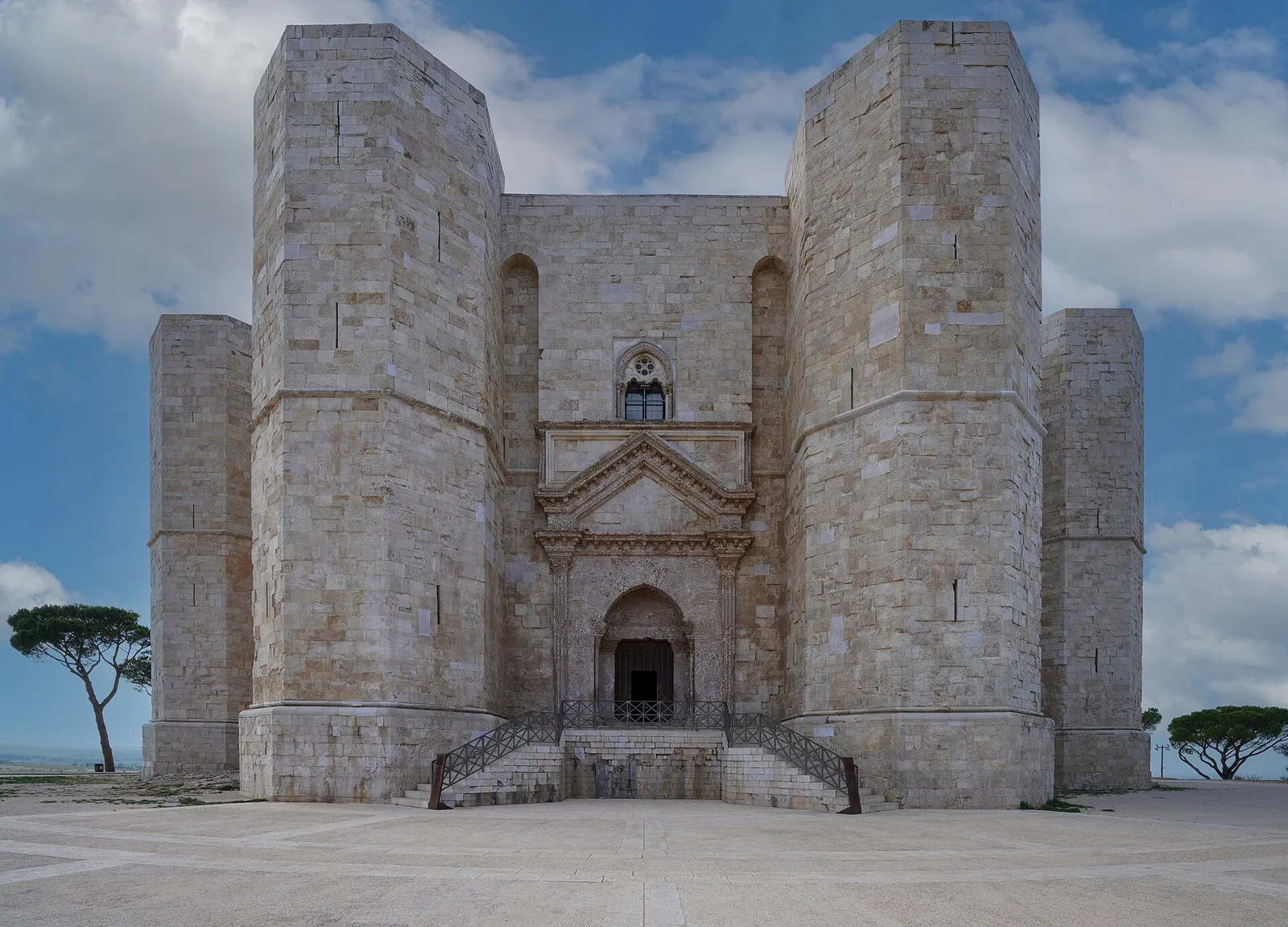
Photo: ParisTaras, 2022. Wikimedia Commons, Castel del Monte – Andria · CC BY-SA 4.0 · Source page
A child born in a square
A birth in the market square
Jesi, a walled town in central Italy, 26 December 1194. Queen Constance of Sicily goes into labour on the road to her husband. According to tradition, the town set up a tent in its main square so that everyone could watch.
Rumours spread. Constance was far past the age when women usually have children, and some said the baby was not hers. The boy was Frederick. He became one of the most famous and most hated rulers of the thirteenth century, and he tried to be the emperor of the ancient Romans.
Keep the rumours in mind. For the next thirty years, people would argue about who Frederick really was, and what he was for.
Frederick II of Hohenstaufen
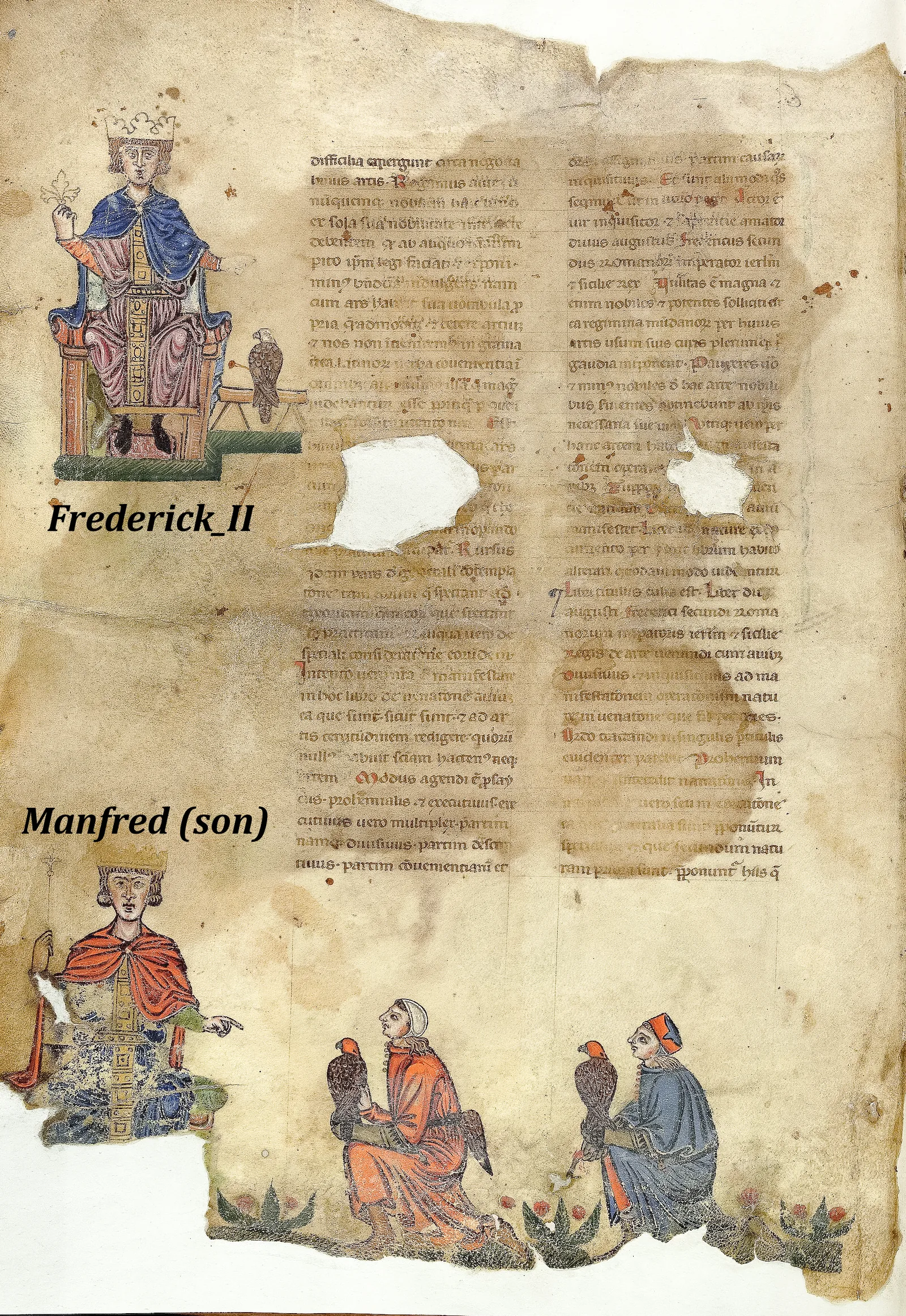
Vatican Apostolic Library, Pal. lat. 1071, f. 1v. Photo: Ray Oaks, 2021 · CC BY-SA 4.0 · Source page
Barbarossa’s grandson, born at Jesi, raised in Palermo without parents, who became an emperor determined to rule Sicily, Italy, Germany and Jerusalem.
- Born: 26 December 1194, Jesi, near Ancona
- Died: 13 December 1250, Castel Fiorentino, Apulia, dysentery
- Won: The Treaty of Jaffa, 1229, without a battle; Cortenuova, 1237
- Lost: Parma, 1248
Philip records that the emperor left Acre cursed and despised.
Background
A king at three
Palermo, spring 1198. A boy of three is crowned king of Sicily. His father, Henry VI, had died in 1197, and his mother Constance died in November 1198. Frederick was the heir of two dynasties: the German Hohenstaufen and the Norman kings of Sicily, the Hauteville family.
Pope Innocent III became his guardian. Constance had chosen that arrangement herself. She judged that the Church could protect her son from the German barons and the Sicilian nobles, who both wanted his lands.
Childhood in Palermo
Everyone wanted the throne, and nobody wanted the boy
The boy passed from hand to hand among rival regents and barons.
He learned anyway. He reportedly spoke six languages: Latin, Sicilian, Middle High German, Old French, Greek and Arabic. He grew up in a court where Latin Christians, Greeks and Muslims met, and that court shaped him more than anything he had in Germany.
The vow he kept postponing
1212–1220
A king who took the cross early
In 1212 German princes chose Frederick as King of the Romans, and he was crowned at Mainz that December. He crossed the Alps with little army, and had to fight for the throne against Otto of Brunswick, the rival whom the pope had excommunicated in 1210. At Aachen, the city of Charlemagne, he was crowned again in July 1215.
There he announced that he would take the cross. Pope Innocent III was delighted. Many kings had promised a crusade and few had kept the promise, and Frederick knew how to promise in a way that bought time.
On 22 November 1220 Pope Honorius III crowned him emperor in Rome, and Frederick renewed the vow.
1225
A deadline, a bride and a kingdom
July 1225, San Germano, south of Rome. Frederick agreed with Honorius III that he would sail for the Holy Land by August 1227. If he broke the promise he would be excommunicated.
The same year he married Isabella II, heiress of the kingdom of Jerusalem. Her father, John of Brienne, lost his rights to the throne when Frederick claimed them. Isabella died in 1228, after bearing their son Conrad, and Frederick claimed to rule in the child’s name. A king of Jerusalem who had never seen the city now had a title to fight for.
A decision point
You are Frederick II, the emperor.
Brindisi, southern Italy, September 1227
Your fleet is ready in the harbour at Brindisi, and the crusaders have taken the cross because you asked them to. The deadline agreed at San Germano is almost up. An epidemic is raging in the port, and your close friend Landgrave Louis IV of Thuringia has died of it.
The fleet puts out to sea and within hours you are gravely ill. Your physicians say the voyage will kill you. Hermann von Salza, master of the Teutonic Knights and one of your most trusted advisers, urges you to return to land, recover and sail later.
What do you do?
- Sail on, sick, and trust God with the outcome. The army would probably sail without a clear leader, and a sick emperor might die at sea or at Acre. The crusade would go on with no one able to command it, and the pope would gain nothing.
- Land, recover in southern Italy, and sail the next year. The pope will see one more delay. Excommunication is almost certain, and the crusade will shrink while you recover. You keep your army and your reputation at home.
- Send the army east under a deputy and stay home. The crusaders would lose the authority a crowned emperor carries. The Templars and Hospitallers might not take orders from a deputy. The army would probably stall on Cyprus.
What really happened
Land, recover in southern Italy, and sail the next year.
Frederick landed to recover. On 29 September 1227 Gregory IX excommunicated him. The pope saw the turn-back as one more excuse. He answered with a manifesto attacking the papacy’s claims, and went on preparing.
Frederick said his doctors ordered him home. Most historians accept that the illness was real. But he had postponed the crusade for twelve years, and Gregory was not alone in suspecting that he had found yet another excuse.
Sailing under the ban
A decision point
You are Frederick II, excommunicated for nine months.
Brindisi, 28 June 1228
You have been excommunicated since September. A man under the ban may not take part in Church rites, and the pope will see any crusade you lead as a farce. Rumours say Gregory IX is gathering money and men to act against your lands in Italy while you are away.
The fleet is ready. In Egypt a sultan is willing to talk. The Frankish lords in the East still wait for you, but your standing there depends on Christians who do not recognise you as one of them.
Do you sail, or wait for the ban to be lifted?
- Wait for absolution, then sail. The pope could take months or years. The campaign might fade away, and every rival in Germany and Italy would profit from the delay.
- Sail now, excommunicated, and fight for your standing in the Holy Land. You may reach Acre, but without the Church behind you. The Templars and Hospitallers are unlikely to serve under an excommunicate, and your men would be denied the sacraments. At home your enemies would have a free hand.
- Send the army without you, and stay in Italy to fight the Church. The pope would have no crusade to attack in the eyes of Christendom, but you would give up any bargaining in the East. An army without an emperor could decide nothing with a figure like the sultan.
What really happened
Sail now, excommunicated, and fight for your standing in the Holy Land.
Frederick sailed on 28 June 1228 and reached Acre on 7 September with his fleet, Germans and some Cypriot lords. He remained excommunicated. The military orders were reluctant to serve under him while the ban stood. The Church did not lift the ban until 1230.
Frederick would not wait. The fleet was ready, and he believed that his diplomacy could win what the crusade had been unable to win by arms. The sources give different motives: power, glory, or real conviction. Historians disagree, and no single letter lays bare his mind.
Cyprus, July 1228
A stop before Acre
The emperor stopped on Cyprus before he reached the mainland. The boy king, Henry I, was formally his vassal. But the strongest family on the island, the Ibelins, saw Frederick as a threat rather than a help.
Philip of Novara, a knight who later wrote his memoirs, describes a dinner at Limassol at which, he says, armed men were brought secretly into the house. The Ibelin lord was threatened, and some Ibelin men were held as hostages. Philip’s story is one of the richest sources we have for the Cyprus affair, and also one of the most one-sided. Read his words in the next step, and judge them for yourself.
Source: The dinner at Limassol
“The Emperor had three thousand or more armed men ... enter secretly at night through this false postern.”
Philip, a soldier living on Cyprus, wrote his memoir in the middle of the thirteenth century, decades after the events, and served the Ibelin family he describes. He is writing about a conflict he was part of, so his account is late and one-sided.
- Who wrote this, when and why? An Italian soldier who speaks for the Ibelin side. He was not neutral, and a figure of three thousand armed men is the kind of number a partisan tells in order to show how dangerous his enemy was.
- What would Frederick have said? We do not have his version of this dinner. In his letters he claims rights as the imperial and regent figure. Set the two accounts side by side, and you see two parties each sure that they were right.
- What is missing? The voice of the men who went through that door. And the number may be exaggerated: the figure is there to show danger, not to count soldiers.
Acre, September 1228
A king with no kingdom
In Acre the emperor found a divided kingdom. The barons did not want him as regent, and the Church did not recognise him. Quickly he decided that success would come by diplomacy rather than by battle.
It was a surprising choice. A crusade launched to win Jerusalem turned into a bargain between two rulers who never met.
The sultan’s bargain
Background: Damascus and Egypt
A family fighting itself
The Muslims of the Levant at the start of the thirteenth century were not one bloc. The Ayyubid dynasty, founded by Saladin, ruled Egypt, Damascus and the north, and its princes fought each other. In Cairo ruled al-Kamil, who wanted his brother’s lands.
His brother al-Muʿazzam ruled Damascus and died in 1227, leaving a young son, al-Nasir Dawud. The inheritance was disputed between the brothers. The Sixth Crusade landed in the middle of that family quarrel.
1228
Envoys and gifts
Envoys had been moving between the courts since 1227. The negotiations ran from September 1228 to February 1229, and gifts passed between the two courts.
A decision point
You are al-Kamil, sultan of Egypt.
Northern Palestine, late 1228
The Christian emperor has come with a small army. For him the crusade is a matter of honour, and Jerusalem is its prize. He asks you for the city.
Your brother al-Ashraf is waiting for your help to take Damascus from your nephew. Your army would have to march far north, and your treasury in Egypt does not want another war with the Franks.
What do you do?
- Refuse, and fight on the coast. A costly campaign on the coast, with probably no clear result. Your army would not reach Damascus, and your brother al-Ashraf might switch sides to your nephew.
- Offer him Jerusalem, and keep the sacred places. The emperor leaves for Italy with a prize he cannot hold for long. You gain time to settle Damascus. Muslim anger will rise, and the city may return to you when the truce ends. A peace of about ten years is likely.
- Offer the coast and the roads, but keep Jerusalem. The emperor may come back with his fleet and his soldiers and press his demand for Jerusalem. The talks might reopen, and you could agree later, but without the time you needed.
What really happened
Offer him Jerusalem, and keep the sacred places.
Al-Kamil offered Jerusalem.The treaty was signed on 18 February 1229. Jerusalem passed to the emperor, while the Haram stayed in Muslim hands. Damascus went to al-Ashraf.
Al-Kamil needed time and Damascus, and his brother would not give him what he wanted without a war. Many historians think Damascus was his real prize, and Jerusalem a currency for bargaining.
Jerusalem without a battle
February 1229
What the treaty says
The text of the treaty is lost. Historians rebuild it from Christian letters and Arabic chronicles, and the sources do not always agree. In broad outline: Jerusalem, Bethlehem and a corridor to the coast go to the emperor, and Toron is ceded. Nazareth and Sidon are recognised as Christian. The Haram al-Sharif stays in Muslim hands, with a garrison and a judge, but Christians and Muslims may both pray there.
The truce runs for about ten years from February 1229. Jerusalem’s walls had been pulled down in 1219. Christian accounts say the emperor had the right to rebuild them; Muslim accounts deny it, and the walls were not rebuilt during the truce.
A decision point
You are Frederick II, at Jaffa.
Jaffa, February 1229
On the table is a draft: Jerusalem, Bethlehem and a corridor to the sea, without the Haram, for a ten-year truce. Some Crusaders object that the deal was made without the agreement of the local lords. Your army is small, and a war waits for you in Italy.
The sultan could harden his terms at any time, and if you demand the Haram the whole deal may collapse. You must choose between a limited gain and nothing.
What do you do?
- Sign the draft as it stands. Ten years of peace, and Jerusalem in Christian hands without a battle. The Church will be angry, but Christians regain a city they had lost to Saladin in 1187. Muslim outrage would follow and grow.
- Demand the Haram as well, and break off the talks if refused. War is likely. Your chances of taking the Haram by force are low, and your army is too small. You would probably lose the whole gain, and the roads to the coast with it.
- Sign, and claim the right to rebuild Jerusalem’s walls. The sultan could reject the demand, and the dispute would stay open until the truce ends. The peace might stay hazy for ten years, and the quarrel would come back at the end.
What really happened
Sign the draft as it stands.
Frederick accepted the agreed text, which was finally approved on 18 February 1229. Afterwards he claimed the right to rebuild the walls, but no walls were rebuilt during the truce.
Frederick needed a result he could show his supporters and the pope. His troops were few, and news of trouble in Italy was already reaching him. Demanding the Haram risked everything already won. Historians note that the terms gave him what he could hold without a war.
17–19 March 1229
A crown in the Holy Sepulchre
On 17 March Frederick entered Jerusalem, where an official of al-Kamil handed him the keys. The next day, 18 March, he crowned himself in the Church of the Holy Sepulchre. On 19 March the city was placed under interdict by the patriarch’s deputy, which closed the churches and stopped most services.
In a letter to Henry III of England, Frederick claimed the right to rebuild Jerusalem’s walls. Historians still argue over whether the ceremony was a coronation at all.
Myth
The emperor took Jerusalem without a drop of blood, and all Christendom rejoiced.
The truth
No battle was fought, but the phrase “without a drop of blood” is a modern summary, written long after 1229, not a verdict of the time. The reaction was divided. The patriarch’s deputy put the city under interdict. There was no single triumphant verdict.
The evidence
For the treaty’s sources, Hiroshi Takayama (2010) and David Abulafia, Frederick II (1988).
Source: Jerusalem on a map of about 1250
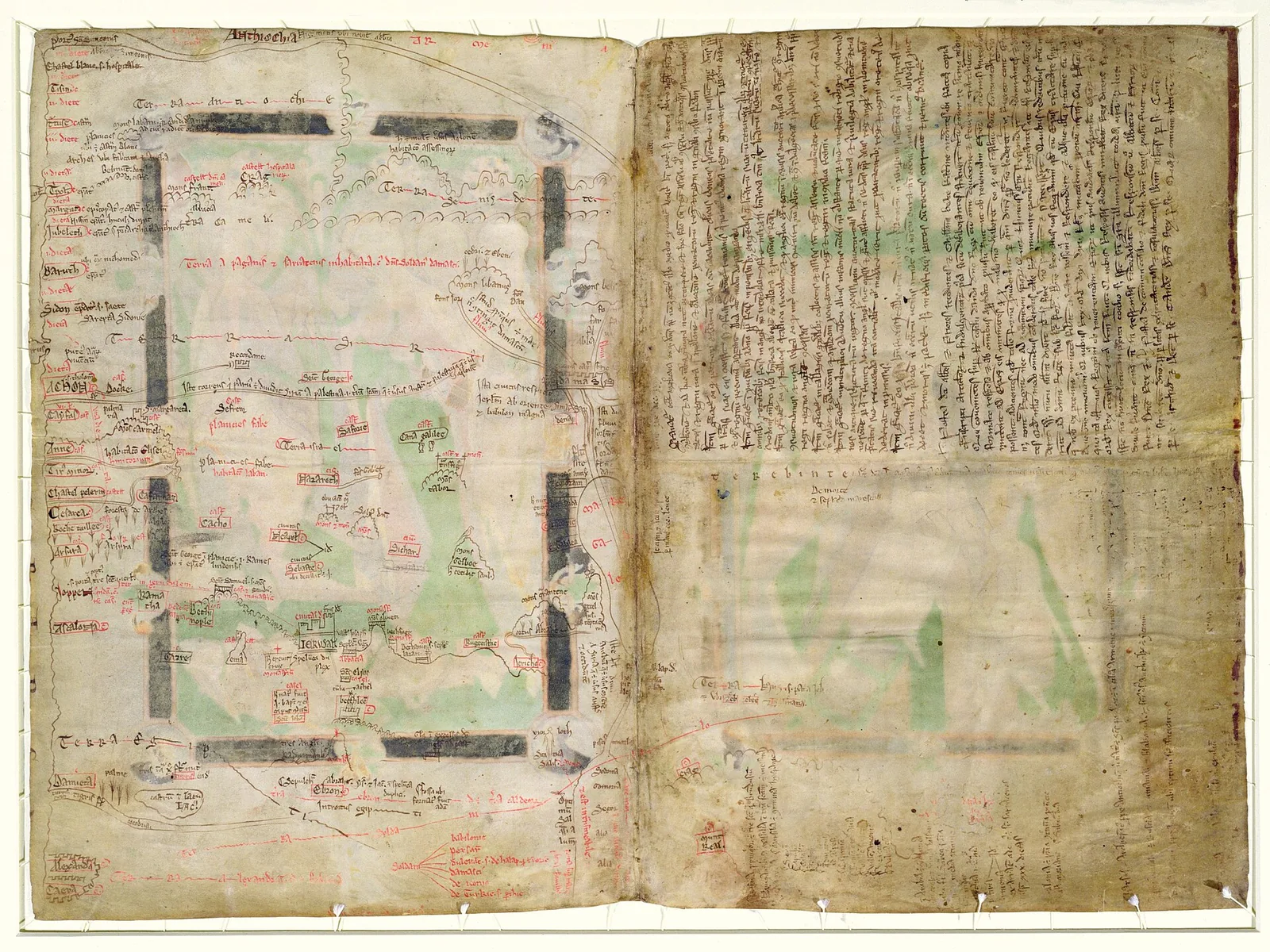
Matthew Paris, map of Palestine, about 1250. Corpus Christi College, Oxford · Public domain · Source page
Matthew Paris, map of Palestine, about 1250, Corpus Christi College, Oxford
Drawn by a monk of St Albans in England, about twenty years after the treaty, for readers who had never seen the Holy Land. Its details were learned, not surveyed.
- Find Jaffa and Jerusalem. Which is nearer the sea? Jaffa, on the coast at the left edge. Jerusalem lies inland, in the lower middle. The coast runs down the left side of the map.
- The map dates from about 1250. What does it show about the Christian kingdom at that date? Jerusalem was lost again in 1244. The map records the kingdom as it had been, not as it stood in the year it was drawn.
- Who drew the map, and for whom? Matthew Paris, a monk in England. He drew for English readers, so the map tells us what they wanted to know as much as what was there.
The pope, the kingdom and the emperor
A decision point
You are Gregory IX, pope.
The papal court, summer 1229
News from the East has come. The excommunicated emperor has won Jerusalem by treaty and crowned himself there, and the patriarch has put the city under interdict. The Templars and Hospitallers are angry about the treaty.
In southern Italy your army under John of Brienne has invaded, and you have raised money across Europe for a crusade against Frederick. The emperor is about to return, and you have little time.
What do you do about the ban and the treaty?
- Keep the ban, and press the war in the south. The emperor returns to Italy, so the war would likely go on until one side gives way. The ban stays in force, and the outcome would be settled by negotiation, not prayer.
- Lift the ban at once and recognise the treaty as a Christian gain. The emperor gets the honour he wanted, but the Church gives up its leverage in Sicily. If you hand him the victory, you have nothing left to bargain with.
- Declare the treaty void, and call on the Templars and Hospitallers to renew the war in the Holy Land. The Templars and Hospitallers could not afford a new war, so little would change on the ground. The Christians would split, and Muslims in Damascus would feel safer.
What really happened
Keep the ban, and press the war in the south.
Gregory kept the ban, and his forces under John of Brienne invaded southern Italy. Frederick returned to the mainland in June 1229, and the invasion fell apart. In July 1230 the Treaty of San Germano was signed, and on 28 August 1230, at Ceprano, papal legates lifted the excommunication.
Gregory saw the treaty as the emperor’s gain, not the Church’s. He feared Frederick in the heart of Italy, and wanted to settle matters on the ground first. The peace of 1230 came largely from the military balance.
1229–1231
A king who comes home
In June 1229 Frederick landed at Brindisi, and the papal army, short of money and morale, fell into disorder. By the end of the year he controlled the kingdom again and punished the towns and barons who had turned against him.
Then he rebuilt it. The Assizes of Capua, from December 1220, reclaimed royal lands; the University of Naples followed a few years later; and in 1231 the Constitutions of Melfi, a new law code, set up a hierarchy of officials paid by the crown and loyal to it.
Source: A coin that claims Rome
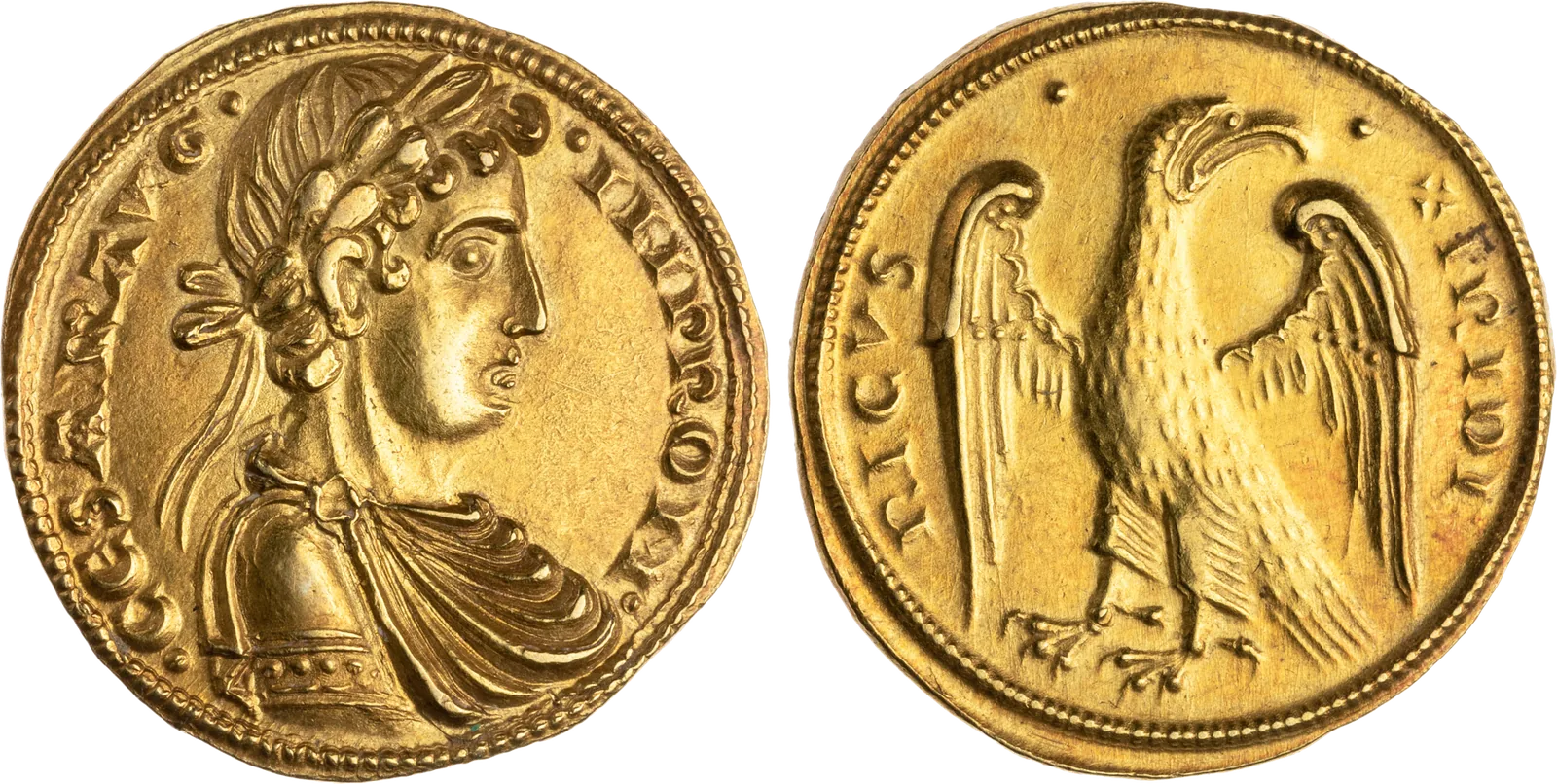
Gold augustale of Frederick II, Brindisi, 1230–1250. American Numismatic Society (ANS) · Public domain · Source page
Gold augustale of Frederick II, Brindisi, 1230–1250. American Numismatic Society (ANS)
The augustale was struck from 1231 at Brindisi and Messina: a gold coin modelled on the old Roman aureus. Frederick used it to proclaim himself the heir of Rome, not of the Church.
- What is written on the obverse, and who is the figure? The emperor, bust with a laurel wreath, and a Latin legend in the style of Roman emperors. It is an inscription of imperial rule, not of the Church.
- What is on the reverse, and what is missing? An eagle, and the name Frederick. There is no cross and no religious text. What is missing tells us that the emperor wanted to present himself as the heir of Rome.
- Why gold? Gold was a sign of rank and power, and it circulated widely. The coin spoke to two audiences: his subjects and other rulers.
A court of scholars
A court that asked everything
At his courts in Palermo and Foggia, scientists, lawyers, poets and translators of all faiths met. Michael Scot, an astrologer and translator from Arabic, served there. Leonardo of Pisa, known as Fibonacci, dedicated his Liber Quadratorum to Frederick in 1225.
Frederick began Castel del Monte in Apulia in 1240. A letter of 29 January 1240 orders building materials for it. Its eight-sided plan is famous, and historians still disagree about what it was for.
Germany
The princes take their share
In Germany Frederick ruled by agreement. In 1220 he had already granted the ecclesiastical princes wide privileges. In 1231 his son Henry (VII), under pressure from the princes, issued the Statute in favour of the princes. It gave them the right to strike their own coins and to levy tolls, and the emperor lost much of his direct sovereignty.
In Germany his power still rested on the princes’ consent.
1237
Cortenuova
In the cities of the north the emperor did not win everything. The Lombard League of northern Italian cities opposed him. On 27 November 1237 his army crushed the League at Cortenuova, and captured the carroccio of Milan, the cart that carried the city’s banner. Frederick celebrated with a triumph at Cremona, in the manner of a Roman emperor.
Victory did not break the cities. Milan and Bologna kept resisting, and the siege of Brescia failed in October 1238. The Guelphs in the cities backed the pope, and the Ghibellines backed the emperor, so every town was a battle line.
The end, the argument and the test
1239–1245
A second ban
On Palm Sunday, 20 March 1239, Gregory IX excommunicated Frederick for the second time. Britannica gives as the trigger Frederick’s move into Sardinia, a papal fief, to back his son Enzio’s claim to its crown. Frederick answered by expelling the Franciscans and Dominicans from Lombardy.
Gregory died on 22 August 1241, as Frederick’s forces came close to Rome. At the council of Lyon, on 17 July 1245, Innocent IV declared Frederick deposed and called him a forerunner of the Antichrist.
In February 1248 the imperial army was defeated outside Parma, where Frederick was not present. His camp at Vittoria, built for the siege, was overrun, and the imperial treasury, insignia and the Cremona carroccio were taken. He recovered, but this was the lowest point of his last years.
Myth
Frederick was an atheist, and even the Antichrist himself.
The truth
The atheism charge rests on the so-called Treatise of the Three Impostors, a text rumoured to call Moses, Jesus and Muhammad three deceivers. Its existence is doubtful, and Frederick denied any knowledge of it. He was unusually free in religious matters for his century, and his enemies made the most of it.
The Antichrist label was papal propaganda. Innocent IV called him a forerunner of the Antichrist. Both sides wrote propaganda; neither is evidence of what he believed.
The evidence
Salimbene di Adam, Chronica; David Abulafia, Frederick II: A Medieval Emperor (1988).
Source: A king with a falcon, in a book copied after his death
Vatican Apostolic Library, Pal. lat. 1071, copy dated 1258–1266
The manuscript Pal. lat. 1071 is dated by the Vatican to 1258–1266, eight to sixteen years after Frederick’s death. Manfred, his son, added notes to it. This image, like the coin, represents a dynasty rather than recording a face. The English labels on the file are modern captions, not medieval writing.
- Who sits on the throne, and who is below? A crowned emperor with a falcon on its perch. Below, a younger crowned figure points, and two falconers stand with birds. The English labels on the file are modern additions, not medieval writing.
- When was this copy made, and why does it matter? Years after Frederick’s death, while the dynasty was weakening. The picture does not show Frederick as he was; it builds his image when no living ruler could contradict it.
- What does the picture want us to believe? That the author of this hunting book was a king who knew the craft from inside, and that the dynasty continued through Manfred. It is propaganda for a dynasty at the moment it was losing power.
What followed
- 13 December 1250 Frederick dies at Castel Fiorentino. His will named Conrad, his son, as heir.
- 21 May 1254 Conrad IV dies of malaria at Lavello. For most historians, the Great Interregnum starts here, though some date it from 1250.
- 26 February 1266 Manfred is killed at Benevento, where Charles of Anjou defeats him. The Hohenstaufen rule in Sicily ends.
- 29 October 1268 Conradin, Frederick’s grandson and the son of Conrad IV, is executed in the market square of Naples. The direct line ends.
- 1273 Rudolf of Habsburg is elected King of the Romans, and the interregnum closes. The empire never regains the power it had under Frederick.
Writing history
One man, two stories
Almost everything we know about Frederick comes from people who took sides. Christian chroniclers wrote from the papal camp or from the coast; Muslim writers from Damascus and Cairo; and the emperor’s own archives kept what he wanted kept. So every question about his faith, his motives or his aims is open to argument.
Even so, his story reaches us from both directions, and each side’s account is a clue to the other.
Medieval or Renaissance?
Was Frederick a ruler of the Middle Ages, or a Renaissance man before his time? And if he failed, was the failure his, or his heirs’?
- Ernst Kantorowicz In his book on Frederick, first published in German in 1927, he saw a forerunner of the modern state and wrote with open admiration. Later historians criticised the romance of the book, but it shaped how many readers think of him.
- David Abulafia In Frederick II: A Medieval Emperor (1988) he presents a ruler who thought in medieval terms: claims to Rome, crusade and feudal law. He resists the later label of a Renaissance man.
The question of failure stays open. The empire did not unite; Sicily and the north broke apart. Some blame the concessions to the German princes; others blame the long war with the papacy. The answer remains open.
Check yourself
Why did Gregory IX excommunicate Frederick in September 1227?
Answer: Because Frederick turned back from a crusade after the pope had set its deadline.. Right. Frederick sailed, fell ill and turned back as the deadline agreed at San Germano was running out, and the pope saw one more delay.
Check yourself
What did the Treaty of Jaffa leave under Muslim control?
Answer: The Haram al-Sharif, the Temple Mount.. Right. The Haram stayed with a Muslim garrison and judge, and Christians and Muslims could both pray there.
Check yourself
What was the augustale?
Answer: A gold coin first struck in 1231 at Brindisi and Messina.. Right. It was modelled on the Roman aureus and carried Frederick’s name.
Check yourself
What do historians agree about the purpose of Castel del Monte?
Answer: That its purpose is still disputed.. Right. A hunting lodge, a hall for audiences, an observatory and a ritual bath have all been proposed, and none is proven.
Check yourself
Why do historians treat Salimbene’s experiment stories with caution?
Answer: Because he was a hostile Franciscan writing later, and modern historians treat him as unreliable.. Right. His bias and his taste for gossip make the tales doubtful, so they are not proven.
Check yourself
Who was Conradin?
Answer: Frederick’s grandson, the last heir of the direct line, executed at Naples in 1268.. Right. He was the son of Conrad IV, and his execution marked the end of the direct line.
Terms
- crusade A holy war called by the pope, whose fighters took a vow and sewed a cross on their clothes. The Sixth Crusade sailed in 1228, led by Frederick II.
- excommunication A Church penalty that cuts a person off from the sacraments and the community. In the pope’s view, an excommunicated ruler could not lawfully lead a crusade.
- interdict A Church ban on a place, such as a city, which closed churches and stopped most services. Jerusalem was put under interdict in March 1229.
- Hohenstaufen The German royal and imperial dynasty that Frederick belonged to. He was the grandson of Barbarossa and the last great Hohenstaufen emperor.
- Ayyubid The Muslim dynasty founded by Saladin, which ruled Egypt, Damascus and the north in the thirteenth century. Its princes often fought one another.
- Haram al-Sharif “The Noble Sanctuary” in Arabic: the Temple Mount in Jerusalem, with the Dome of the Rock and al-Aqsa mosque. It stayed in Muslim hands under the Treaty of Jaffa.
- Guelph A party in Italy and Germany that backed the pope; in Germany it was tied to the Welf dynasty, rivals of the Hohenstaufen.
- Ghibelline A party in Italy that backed the emperor. In the towns and families of Italy it fought the Guelphs.
- Lombard League An alliance of northern Italian cities, founded against Barbarossa in 1167 and revived against Frederick II.
- augustale Frederick’s gold coin, first struck in 1231 at Brindisi and Messina. Its name comes from the Latin Augustus.
- carroccio A cart that carried a city’s banner into battle and rallied its army, drawn by oxen. Losing it in battle was a great humiliation.
- Henry VI Frederick's father, who seized the kingdom of Sicily by force. He died at Messina in 1197.
- Innocent III The pope who became Frederick's guardian as a boy. Constance chose this herself, seeing the Church as protection.
- Charlemagne The Frankish king whose city was Aachen. Frederick was crowned there again in 1215.
- Otto of Brunswick Frederick's rival for the crown. The pope had excommunicated him in 1210.
- Honorius III The pope who crowned Frederick emperor in 1220 and took his promise to go on crusade.
- San Germano A town south of Rome, where the crusade deadline was agreed. A peace treaty was signed there in 1230.
- Brindisi A port in southern Italy, where Frederick's crusade fleet was waiting.
- Hermann von Salza Master of the Teutonic Knights and one of Frederick's most trusted advisers. He urged him to return to land.
- Teutonic Knights A military religious order. While Frederick was excommunicated, the military orders were reluctant to serve under him.
- Gregory IX Pope who excommunicated Frederick in 1227 and again in 1239. He died in 1241, as Frederick's forces came close to Rome.
- Cyprus An island in the eastern Mediterranean, where Frederick clashed with the powerful Ibelin family.
- Philip of Novara A soldier on Cyprus who wrote memoirs of its events. He served the Ibelin family, so his account is one-sided.
- John of Brienne Isabella II's father, who lost the title of king of Jerusalem when Frederick claimed it for himself. Later he invaded southern Italy against him.
- Isabella II Heiress of the kingdom of Jerusalem. She married Frederick in 1225 and died in 1228, after bearing him a son.
- Michael Scot An astrologer and translator from Arabic, who served at Frederick's court.
- Cortenuova A battle site in northern Italy, where in 1237 Frederick crushed the Lombard League and took Milan's carroccio.
- Cremona A city in northern Italy, where Frederick celebrated his victory like a Roman emperor.
- Innocent IV The pope who declared Frederick deposed in 1245 and called him a forerunner of the Antichrist.
- Salimbene di Adam A Franciscan friar and hostile witness, who told gossip about an experiment on infants. Historians read him with caution.
- Antichrist In Christianity, a figure who opposes Christ before the end of time. In the fight between pope and emperor, Frederick was given this name.
- Castel del Monte A castle in Apulia that Frederick began in 1240. Its eight-sided plan is famous, and its purpose is still debated.
- Assizes of Capua Laws that Frederick issued from December 1220 to take back royal lands for the crown.
- Leonardo of Pisa A mathematician from Pisa, known as Fibonacci, who dedicated his Liber Quadratorum to Frederick in 1225.
- Henry (VII) Frederick's son. In 1231 he issued a law that gave the princes many rights at the emperor's expense.
Sources
- Philip of Novara, Les Gestes des Ciprois, trans. James A. Brundage, The Crusades (Milwaukee: Marquette University Press, 1962), pp. 227–232
- Matthew Paris, Chronica majora, ed. H. R. Luard, Rolls Series (London, 1872–1883)
- Salimbene de Adam, Chronica, in Monumenta Germaniae Historica, Scriptores 32, ed. Oswald Holder-Egger (Hanover, 1905–1913)
- Liber Augustalis, or Constitutions of Melfi, trans. James M. Powell (Syracuse: Syracuse University Press, 1971)
- David Abulafia, Frederick II: A Medieval Emperor (London: Allen Lane, 1988)
- Thomas C. Van Cleve, The Emperor Frederick II of Hohenstaufen: Immutator Mundi (Oxford: Clarendon Press, 1972)
- Ernst Kantorowicz, Kaiser Friedrich der Zweite (Berlin, 1927); English translation, Frederick the Second, 1194–1250 (London, 1931)
- Wolfgang Stürner, Friedrich II., 2 vols (Darmstadt, 1992–2000)
- Thomas Asbridge, The Crusades: The War for the Holy Land (London: Simon & Schuster, 2010)
- Charles Homer Haskins, “The De Arte Venandi cum Avibus of the Emperor Frederick II”, English Historical Review 36 (1921)
- Hiroshi Takayama, “Frederick II’s Crusade: An Example of Christian–Muslim Diplomacy”, Mediterranean Historical Review 25/2 (2010), pp. 169–185
Image credits
- Photo: ParisTaras, 2022. Wikimedia Commons, Castel del Monte – Andria · CC BY-SA 4.0 · Source page
- Vatican Apostolic Library, Pal. lat. 1071, f. 1v. Photo: Ray Oaks, 2021 · CC BY-SA 4.0 · Source page
- Matthew Paris, map of Palestine, about 1250. Corpus Christi College, Oxford · Public domain · Source page
- Gold augustale of Frederick II, Brindisi, 1230–1250. American Numismatic Society (ANS) · Public domain · Source page


