Frederick the Great: a small king against three great powers
In December 1757 Prussia was close to defeat. At Leuthen Frederick beat an army far larger than his own. How did he do it, and how did he survive to the end of the war?
Decisions, questions and your own progress, in the app
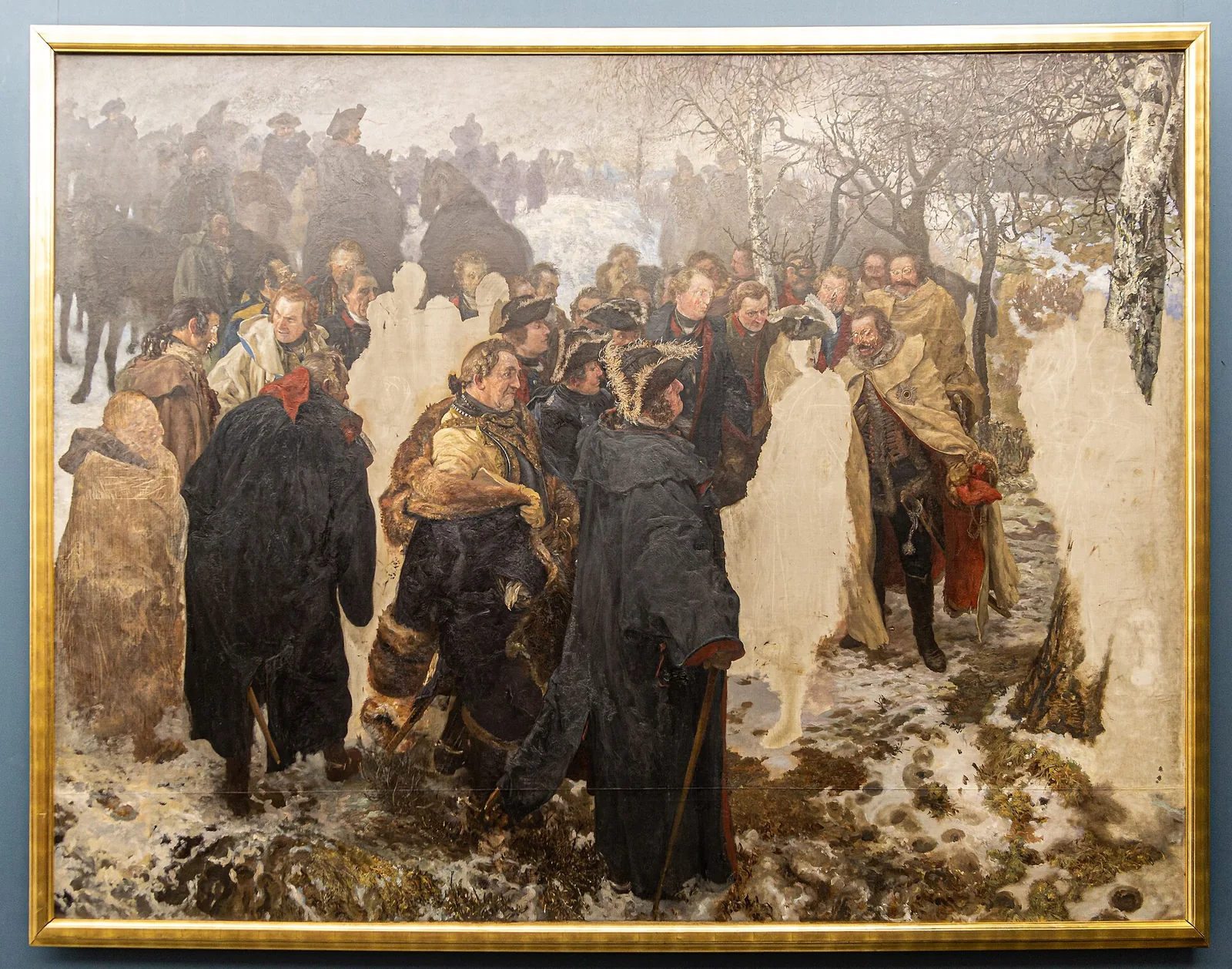
Adolph Menzel, Frederick the Great addresses his generals before Leuthen, 1859–61. Alte Nationalgalerie, Berlin · Public domain · Source page
The son who had to watch (1730–1740)
A prince made to watch
On 6 November 1730, at the fortress of Küstrin on the Oder, an eighteen-year-old prince was made to watch his friend die. The friend was Hans Hermann von Katte, a young officer. The prince's father, the king, had ordered it.
Ten years later that prince became king of Prussia.
Background
A father who was a soldier
Frederick William I, the prince's father, built a large and disciplined army and filled the royal treasury. He ruled Prussia as a soldier-king. To him his son's love of music, the flute and French books looked like weakness, and the two men did not get on.
In 1730 the prince planned, with his friend Katte, to flee the kingdom. The plan was exposed when a letter the prince had written to Katte was found.
The sentence
A verdict the king changed
The king did not accept the verdict. He changed Katte's sentence to death.
On 6 November 1730 Katte was beheaded at Küstrin. The king had ordered his son to stand and watch. The prince fainted before the blow fell.
The crown
A young king
On 31 May 1740 his father died, and the prince, aged twenty-eight, became king of Prussia.
His father left him a large army and a full treasury. Across Europe, few people yet knew what kind of king he would be.
A book
A book against Machiavelli
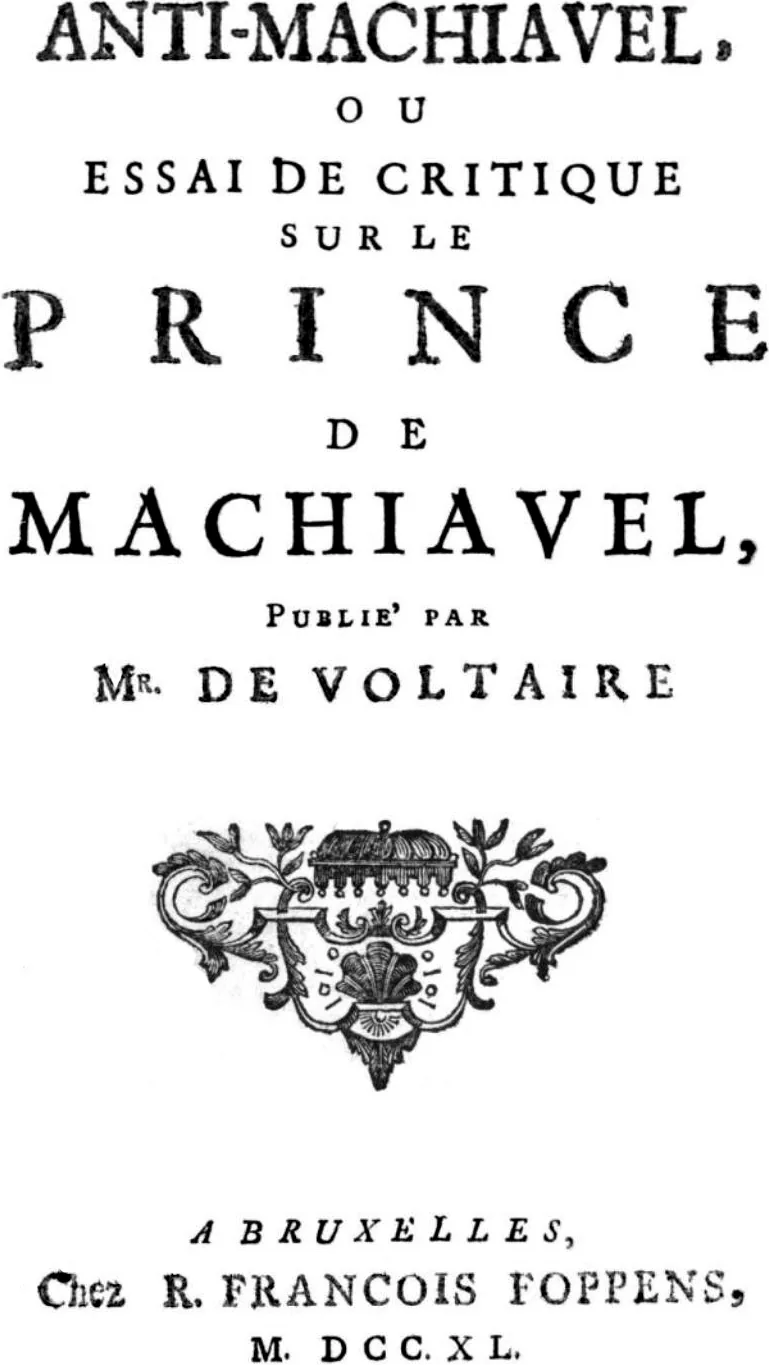
Frederick II, Anti-Machiavel, title page, Brussels: François Foppens, 1740 · Public domain · Source page
In 1740 an anonymous book appeared, the Anti-Machiavel, attacking Machiavelli. Its target was The Prince, the handbook in which Machiavelli advised rulers that they might lie and break their word. Few readers knew that its author was Crown Prince Frederick.
Voltaire, the French writer, helped to get the book read and distributed it in Amsterdam. In the second printing he changed one phrase. Frederick had written that the ruler is the ‘first servant’ of the state. Voltaire changed it to ‘the first magistrate’, a grander title.
This is a small example of a large problem. Texts change when they are copied, edited and printed. When you read a source, ask who copied it, who edited it and who printed it.
The new king’s first choice (1740 – 1742)
The inheritance
The emperor dies
In the autumn of 1740 the Emperor Charles VI died.
His daughter, Maria Theresa, aged twenty-three, inherited his lands. Among them was Silesia, a rich province under Habsburg rule that lay next to the Prussian border.
The claim
An old claim
Maria Theresa's right rested on the Pragmatic Sanction, an edict of 1713 in which the Emperor Charles VI made sure his daughter could inherit his lands. It did not cover the imperial title, which was elected.
Frederick had an old claim to Silesia, based on a treaty of 1537, the Treaty of Brieg. Historians differ on how strong it was, and some call it a pretext.
A decision point
You are Frederick II, King of Prussia.
Berlin, the palace, December 1740.
You are twenty-eight and have been king since 31 May. Your father left you a large, disciplined army and a full treasury.
Charles VI is dead. His daughter Maria Theresa, aged twenty-three, now holds the Habsburg lands. You have an old claim to Silesia, a rich province that lies next to your border. Three courses are open to you.
What do you do?
- Cross the frontier now and take Silesia. Probably you take the province quickly, but you go to war with the Habsburgs, and you become the man who broke the Pragmatic Sanction.
- Recognise the Pragmatic Sanction and bargain for Silesia. Probably you keep your word and gain little or nothing. Silesia stays with Vienna, and your large army has no war to justify it.
- Wait for a stronger ally, such as France or Bavaria, if one can be found. Probably you wait for an alliance that may never come, and meanwhile the court in Vienna strengthens its position. If an ally does come, you go to war together.
What really happened
Cross the frontier now and take Silesia.
On 16 December 1740 Frederick sent about 27,000 men across the frontier. On 10 April 1741 his army won at Mollwitz, but he left the field, and it was his first battle as king. On 11 June 1742 the Treaty of Breslau gave Prussia most of Silesia, except three districts in the south.
We know only part of Frederick's reasons. His official claim was the old one about Silesia, and beside it stood the obvious temptation of a rich province. What he really thought, we cannot know from the record we have.
Mollwitz
A win, and a departure from the field
At Mollwitz, on 10 April 1741, the two armies met in the open. The Prussians won the battle, but Frederick left the field. According to the sources, his old field marshal, Kurt Christoph von Schwerin, urged him to go.
The victory was real, but the king had not stayed on the field to see it through.
Myth
Frederick the Great won every battle he fought.
The truth
Not true. At Mollwitz his army won, but the king left the field. He also lost battles later in the war, as this lesson will show.
The evidence
The image of an unbeaten king is a later one, and it does not survive a look at the record of the battles. Check the battles themselves, not the legend about them.
A first peace
The Treaty of Breslau
On 11 June 1742 the Treaty of Breslau gave Prussia most of Silesia, and the province became part of its state.
Maria Theresa did not accept the loss. The peace was a pause, not an end. In August 1744 Frederick invaded Bohemia, and a second war for Silesia began.
The reversal of alliances (1756)
Opening
Enemies become partners
For more than two centuries France and Austria had been rivals. In 1756 they became allies. It was a large surprise in European diplomacy, and Prussia found itself in a position it had not planned for.
The new alliances
Who joined whom
The diplomatic revolution of 1756 turned the old alliances upside down. On 16 January 1756 Britain and Prussia signed the Convention of Westminster. Prussia agreed to protect Hanover, a German electorate ruled by the British king, from France, and Britain agreed not to aid Austria in a new war over Silesia.
On 1 May 1756 France and Austria signed the First Treaty of Versailles. Each promised to send 24,000 troops to defend the other.
Russia was not part of this. It joined the enemies of Prussia only in 1757.
A common picture shows Austria, France and Russia against Prussia from the start. That is wrong for 1756: in that year Prussia had a British ally, and Russia was still outside the war.
A decision point
You are Frederick II, King of Prussia.
Berlin, August 1756.
Britain is your ally. France and Austria have joined together, and Saxony, your neighbour to the south, is tied to Vienna by an alliance.
You believe your enemies are preparing an attack on Prussia. You have no proof, but the signs are troubling. Vienna has not promised in writing to leave Silesia alone. Three courses are open to you.
What do you do?
- Strike Saxony first, before the attack can come. Probably the Saxon army is caught before it can join Austria. But Europe will see an unprovoked war, and the coalition against you will harden.
- Stay within your borders, and defend yourself if you are attacked. Probably your enemies press ahead with their plans, and time works against you. If the attack comes, you fight on your own soil, with less room to manoeuvre.
- Demand a written Austrian promise to leave Silesia alone, and see whether Vienna gives it. Probably Vienna refuses or stalls, and the delay gives your enemies time. If the promise is given, you gain security for a while, though a promise can be broken.
What really happened
Strike Saxony first, before the attack can come.
On 29 August 1756 Prussian troops crossed into Saxony without a formal declaration of war. The Saxon army was cornered at Pirna, surrendered in October 1756, and its men were forced into the Prussian army. At Lobositz, on 1 October, Frederick fought an Austrian army and claimed a victory.
Frederick believed that his enemies were preparing an attack. Historians disagree about whether this was a pre-emptive strike against a real danger, or an aggressive war dressed up as defence.
After
The war spreads
The invasion of Saxony strengthened everyone who wanted to stop Prussia. A second treaty between France and Austria followed in 1757, and Russia joined the enemies of Prussia that year.
Frederick now faced Austria, France and Russia at once, with Britain still at his side.
Three battles in one year (1757)
1757
6 May: a win in Bohemia
On 6 May 1757 Frederick's army met an Austrian army outside Prague, in Bohemia. The Prussians numbered about 64,000 and the Austrians about 60,000 to 61,000, depending on the source. Prussia won.
Losses on each side were in the range of 13,000 to 14,500 killed and wounded.
1757
18 June: the defeat
On 18 June 1757 Frederick lost at Kolin to Field Marshal Daun. The Prussians numbered about 33,000 to 34,000, and the Austrians about 53,800 to 54,000. Prussian losses were about 13,700 to 14,000 killed and wounded; Austrian losses were about 8,000.
After Kolin Frederick had to lift his siege of Prague and leave Bohemia.
1757
5 November: a quick win
On 5 November 1757 Frederick met a French army and the Reichsarmee at Rossbach. He had about 22,000 men; they had about 41,000 to 45,000. The battle was decided within a few hours.
Prussia lost about 550 men, 169 killed and 379 wounded. The French and imperial side lost about 8,000 to 10,000 killed, wounded and captured.
Interim
Win, defeat, win
In one year Frederick won at Prague, lost at Kolin and won at Rossbach. The war, known as the Seven Years' War, had already lasted more than a year.
About a month after Rossbach, he faced a far larger Austrian army in Silesia. There the Austrians had gained the upper hand.
Leuthen, 5 December 1757
The forces
A far larger army
The Austrian army lay in a long line around Leuthen under Prince Charles of Lorraine, with Daun beside him. It was close to twice the size of the Prussian army.
A decision point
You are Frederick II, at Borne.
4 and 5 December 1757, after Kolin and Rossbach.
You lost at Kolin in June and won at Rossbach in November. Now an Austrian army larger than yours stands before you: about 65,000 to 66,000 men against your 33,000 to 39,000. The figures come from different sources, so they are given as ranges.
The ground is known to you. Low hills could hide the march of an army. If you attack, you stake all that is left. If you withdraw into Saxony, you give up Silesia for now.
What do you do?
- Attack the Austrian flank in oblique order, with most of your force. If it works, you win a battle the Austrians will struggle to recover from. If the flank does not break, you may lose the army you have left in a single day.
- Withdraw into Saxony and give up Silesia for now. Probably you keep the army whole, but Silesia stays in Austrian hands for another winter, and your position in the war weakens each month.
- Dig in near Breslau and wait for reinforcements. Probably the Austrians have time to bring up more guns, and you fight on ground they chose. Reinforcements may not arrive in time.
What really happened
Attack the Austrian flank in oblique order, with most of your force.
Frederick attacked. He sent a diversion against the Austrian front at Frobelwitz, moved most of his army south behind low hills, and struck the Austrian left flank in oblique order. The attack succeeded.
The oblique order was a manoeuvre the army had practised: one main force strikes one flank, while the rest of the line holds or waits. The Austrian line was long and its left flank exposed. The diversion, the march behind the hills and the guns on the Butterberg were all part of the plan.
Leuthen
Dawn at Leuthen
In the early hours of 5 December 1757, in thin light, the Prussian columns ran into an enemy outpost near the village of Borne and swept it aside. According to Thomas Carlyle, Frederick then rode up a height and studied the Austrian line for a long time.
Carlyle wrote about a century after the battle, and he was not there, so the details need care.
The battle
The battle itself
The diversion at Frobelwitz drew the Austrians' attention to the front. Then most of the Prussian army turned south behind the low hills and struck the Austrian left. The Austrian commander moved his reserves toward the threatened wing.
Prussian guns on the Butterberg fired into the Austrian line, and Zieten's cavalry joined the attack. The Austrian line broke, and many of its men were captured.
Leuthen, 5 December 1757
5 December 1757
Near Leuthen (now Lutynia), Poland
Prussia
- Commanders: Frederick II
- Strength: 33,000 (Online encyclopedia article, main text); 36,000 (Online encyclopedia article, summary box); about 39,000 (warhistory.org (popular history))
- Losses: about 6,300 in all, including about 1,100 killed and 5,100 wounded (Summary box of the encyclopedia article)
About 167 to 170 guns, by the same sources.
Austria
- Commanders: Prince Charles of Lorraine, with Daun
- Strength: 65,000 (Online encyclopedia article, summary box); 66,000 (Online encyclopedia article, main text; warhistory.org)
- Losses: about 22,000 in all, of whom about 3,000 killed, 7,000 wounded and 12,000 captured (Summary box of the encyclopedia article)
210 to 250 guns, by the sources.
Outcome: A decisive Prussian victory
The strength and loss figures come from popular online sources, not from the armies' own returns. The gaps between sources are real, so each figure is shown in its own row. Austrian losses include many prisoners.
Myth
Leuthen was won by the oblique order alone.
The truth
Not true. The plan had a diversion at Frobelwitz, a march hidden behind the hills, guns on the Butterberg and Zieten's cavalry. The oblique order was one part of it.
The evidence
A modern historian reports that some participants credited the artillery barrage, more than the Prussian infantry, with the victory. Those are the participants’ own views, not a neutral record.
Source: Carlyle on the hymn
The fact is very certain, very strange to me: details not very precise, except that here, as specimen, is a verse of their Hymn.
Carlyle wrote about a century after the battle. Notice how he states his certainty.
- Who wrote this, and when? Thomas Carlyle, a British historian, in the 1850s and 1860s. He wrote about a century after the battle, and he was not there.
- What does Carlyle claim is certain, and what does he admit is not? He is sure of the fact, but admits the details are ‘not very precise’. He is sure that the singing happened, but not of the exact words. Ask what evidence he gives for each claim.
- Why would a nineteenth-century writer find this story welcome? Carlyle admired Frederick, and a story of soldiers singing a Lutheran hymn fitted the picture of the king as a Protestant hero. What suits a writer is not necessarily true.
A painting
A speech no record keeps
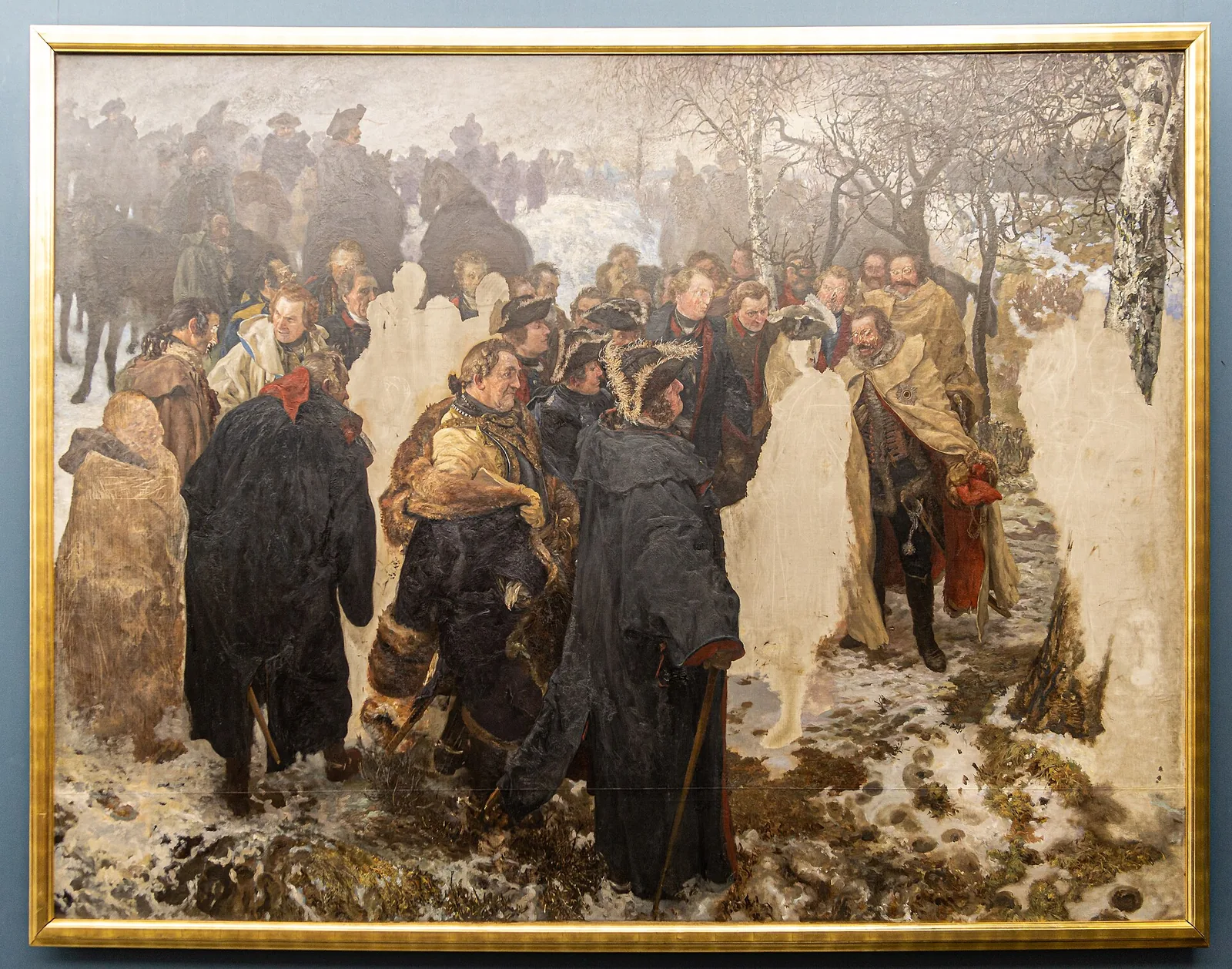
Adolph Menzel, Frederick the Great addresses his generals before Leuthen, 1859–61. Alte Nationalgalerie, Berlin · Public domain · Source page
Adolph Menzel painted Frederick addressing his generals before Leuthen between 1859 and 1861, more than a century after the battle. No source from the period records such a speech. The painting shows the image that nineteenth-century Germans wanted of their king, not what was said on the field.
Kunersdorf (1759)
Before the battle
Six nights without sleep
On 3 August 1759, writing from Beeskow to his minister Finckenstein, Frederick said: ‘For six nights I have not closed an eye.’ He added: ‘Show this Letter to everybody, that it may be known the State is not undefended.’
Against him stood the Russian and Austrian armies, together about 59,500 men by one estimate, against about 48,000 Prussians, by Frederick’s own figure.
Kunersdorf
12 August 1759
On 12 August 1759 Frederick’s army met the Russian and Austrian armies at Kunersdorf, near Frankfurt on the Oder.
A decision point
You are Frederick II, King of Prussia.
The evening of 12 August 1759, after Kunersdorf.
The battle is lost. Your army has broken up. At the start of the day you had about 48,000 men, and now only a few thousand stay with you.
The Russian and Austrian army is still in the field, with about 59,500 men by estimate. What do you do with what is left?
What do you do?
- Fight on with what is left, and with the troops that General Finck and your brother Henry can gather. Probably the war goes on for years, at a high cost in men and money. Prussia may survive if its enemies tire first.
- Ask for peace at once, while a Prussian army still exists to negotiate. Probably your enemies set harsh terms, and you lose Silesia and more. But the fighting stops, and the men who survived are spared.
- Seek help from the Ottoman Empire, and try to bring it into the war against Austria and Russia. Probably the attempt fails, or comes too late, since the Ottomans have their own interests and quarrels. But if they joined, they could split the alliance against Prussia.
What really happened
Fight on with what is left, and with the troops that General Finck and your brother Henry can gather.
Frederick fought on. He gave command to General Finck and named his brother Henry commander-in-chief. He tried, without success, to bring the Ottoman Empire into the war.
The sources do not record what was said that night. What is clear is that he did not ask for peace at once. How far his despair was real, and how far it was written for others to read, the record does not settle.
The battle
Come to me
At Kunersdorf, near Frankfurt on the Oder, the battle was going against Frederick. Later accounts report him calling to his men: ‘Children, my children, come to me!’ One account says they did not hear him, or chose not to obey.
Source: The letter of the evening
It is a great calamity; and I will not survive it: the consequences of this Battle will be worse than the Battle itself. I have no resources more; and, to confess the truth, I hold all for lost. I will not survive the destruction of my Country. Farewell forever.
The letter was written on the evening of the battle. The place is uncertain: some accounts give Reitwein, Carlyle gives Oetscher, and the original letter names no place.
- Who was the letter for, and who might read it? To the minister Finckenstein. A letter to a minister can be copied and passed on. In his letter of 3 August the king asked for his words to be shown to everyone. So ask how far this letter was written for an audience.
- Does the letter show that the king was not calm, as the myth would have it? Yes, it shows a king in despair. But a letter is also a performance, written to be read. It is evidence of a mood, not a full account of what he felt.
- What is missing from the letter? The letter sets out no plan for the next day and makes no request for peace. It states a mood, and leaves the decision open.
Kunersdorf, 12 August 1759
12 August 1759
Near Frankfurt on the Oder
Prussia
- Commanders: Frederick II
- Strength: 48,000 (Frederick's own count, in his letter); about 50,000 (Online encyclopedia article, main text); 50,900 (Online encyclopedia article, summary box)
- Losses: 18,609 (An estimate of 1801); 20,700 (An estimate of 1908); about 21,000 (An estimate of 2013); about 19,000 (An estimate of 2015: about 6,000 killed and 13,000 wounded)
The loss estimates differ by year, and each has its own count.
Russia and Austria
- Commanders: Pyotr Saltykov (Russia), Laudon (Austria)
- Strength: 59,500 (Russia 41,000, Austria 18,500) (Online encyclopedia article, summary box)
- Losses: 16,332 (Russia 14,031, Austria 2,301) (Online encyclopedia article, summary box)
Outcome: A Russian and Austrian victory
All figures are estimates from different sources. The gaps lie in the arithmetic, not in what happened: a large battle, and very heavy losses on both sides.
The cost
What the day cost
Counting the dead, the wounded and the captured together, the two sides lost between about 35,000 and 37,000 men in one day, by the sum of the estimates. The figure shows the scale. Behind it are men who lay wounded for hours and families who did not know what had become of their sons.
Every number is an estimate, and it should be read as a range rather than as a precise count.
Myth
Frederick was a calm philosopher-king who never lost his nerve.
The truth
Not true. ‘Philosopher-king’ was a phrase of Voltaire’s, and it expressed flattery and hope rather than a description of temper. In his letter of 12 August 1759 Frederick wrote that he held all for lost, and at the battle he called his men back to him.
The evidence
Two sources in this lesson contradict the picture: the king's letter and the rally cry. Neither describes a cold, untroubled king, though how deep his distress went is open to argument.
The Miracle and the long peace (1762–1786)
1762
The empress dies
In January 1762 the Russian Empress Elizabeth died. She had been one of Frederick’s fiercest enemies. On 22 January he wrote that the ‘Messalina of the North’ was dead, and, in Italian, ‘Morta la bestia’: the beast is dead. The letter is quoted in David Fraser’s 2000 biography.
The turn of events that followed became known as the Miracle of the House of Brandenburg.
A change of course
Peter III changes course
Elizabeth’s successor, Peter III, admired Frederick and reversed her war policy. He made an armistice in March 1762, and in May a treaty of peace and friendship was signed between Russia and Prussia.
Russia left the war, and Austria lost a powerful ally.
The peace
Hubertusburg, February 1763
On 15 February 1763 Prussia, Austria and Saxony signed the Treaty of Hubertusburg, at a palace in Saxony. It ended the Third Silesian War and restored the borders as they had been before the fighting. Austria and Saxony gave up their claims to Silesia.
Five days earlier the Treaty of Paris had ended the war between Britain and France, and with it the wider Seven Years’ War.
Poland
A slice of Poland, 1772
In 1772 Prussia, Austria and Russia each took slices of Poland, in the First Partition. Frederick annexed Royal Prussia, a region that had belonged to Poland, and from then on styled himself King of Prussia.
Poland lost territory, and it lost more in the partitions that followed.
Jews
Tolerance with conditions
Frederick became known for religious toleration, but it was toleration with limits. In 1750 a General Regulation for the Jews of Prussia and the March of Brandenburg was enacted. It was dated 1750 but not promulgated until 1756. It fixed the number of protected Jews in Berlin at 150, and only the eldest son could inherit the protected status.
In his Political Testament of 1752, written for his successors, he argued that there were too many Jews in the towns. In his view they were useful only on the Polish border, where they traded, and elsewhere they harmed Christian merchants. He also wrote that he had never persecuted anyone of any sect. Read these words as policy, not as the picture of a tolerant ruler.
Mendelssohn
A patent for Moses Mendelssohn
In October 1763 Frederick issued a protected Jew patent to the philosopher Moses Mendelssohn, in the ‘extraordinary’ category. It was a status for one man. In the same year the succession to protected status was widened to second sons, on condition that they took up manufacturing.
The Jewish Encyclopedia of 1906 put it bluntly: “He was not friendly to the Jews, although he issued a ‘Schutzjude’ patent to Moses Mendelssohn in October, 1763.” That is a judgement from 1906, and a reminder that writers have told this story in different ways.
Source: A flute concert at Sanssouci
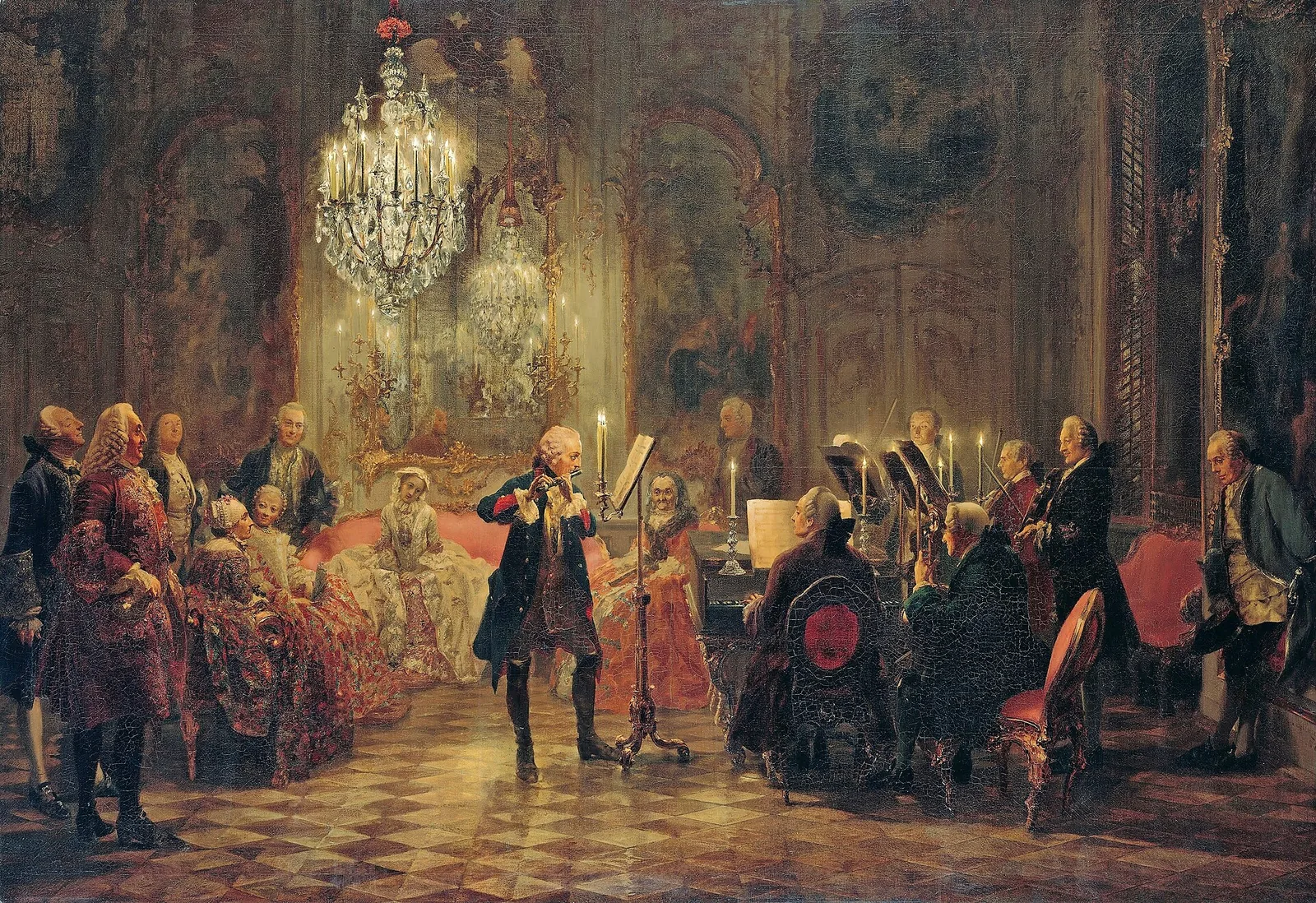
Adolph Menzel, A Flute Concert of Frederick the Great at Sanssouci, 1850–52. Alte Nationalgalerie, Berlin · Public domain · Source page
Adolph Menzel, A Flute Concert of Frederick the Great at Sanssouci, 1850–52, Alte Nationalgalerie, Berlin
Menzel painted the scene between 1850 and 1852, about sixty-five years after the king’s death. He shows him in a candlelit music room, surrounded by musicians and courtiers. The scene is imagined.
- Who painted this, and when? Adolph Menzel, in 1850–52. He was not at Frederick’s court, and the picture was painted about sixty-five years after the king’s death.
- What does the painter want the viewer to see? A calm and cultured king playing music at his court, not a general at war. The picture shows peace inside the king’s life.
- What is missing from the picture? Any sign of the wars, the battles, the dead, or the letters that gave the orders. Choosing to show only the concert is a choice about what to show, not a record of his whole life.
The end
Potsdam, 1786
Frederick died at Potsdam on 17 August 1786, aged seventy-four. He was buried in the crypt at Sanssouci, as his will of 1769 had asked. The will asked for a plain burial, without pomp, as a philosopher.
Frederick II, King of Prussia
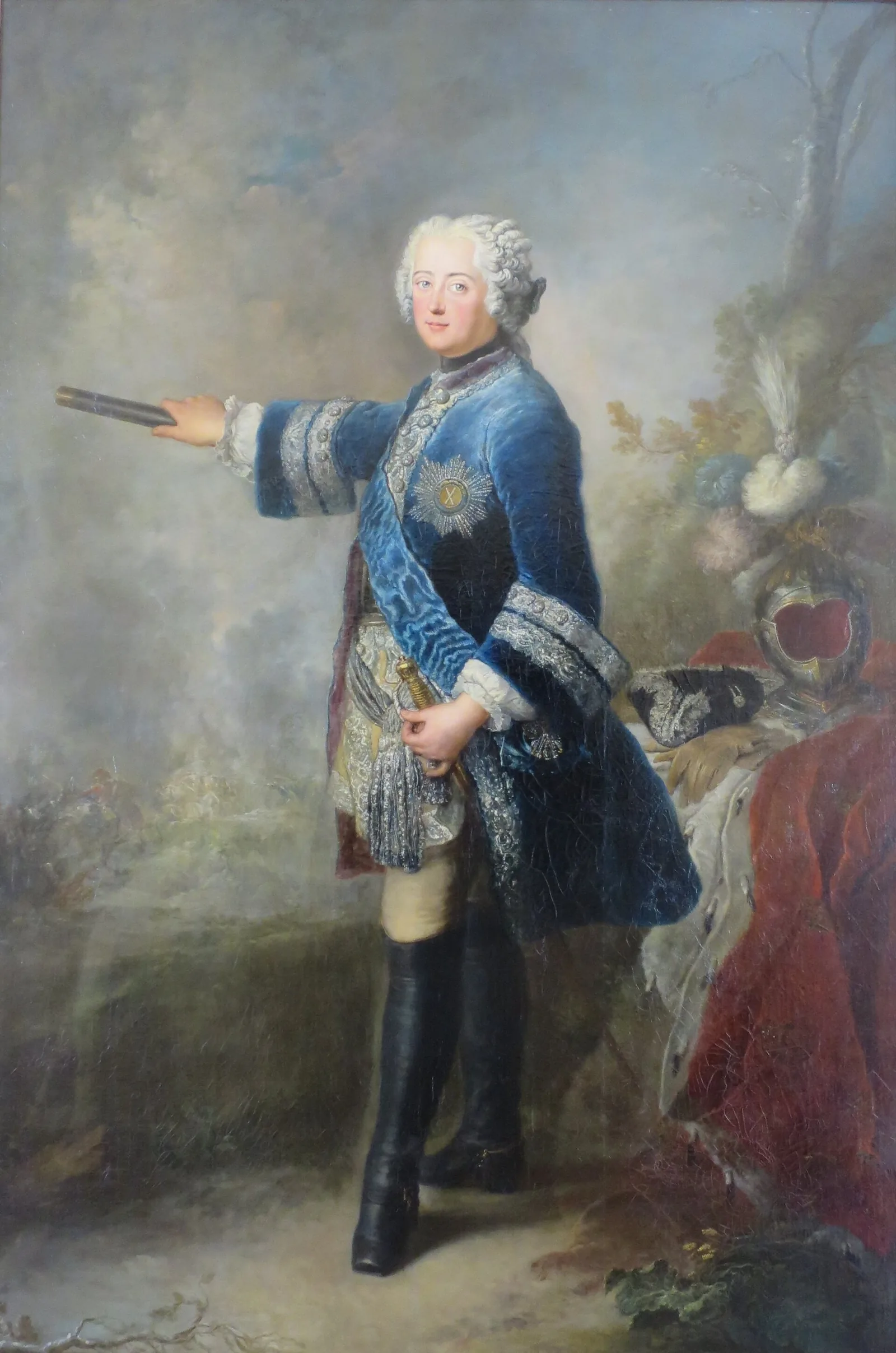
Antoine Pesne, Portrait of Frederick II, about 1743. The Hermitage, St Petersburg · Public domain · Source page
A king who fought Austria, France and Russia for seven years and kept Silesia, the province he invaded in 1740.
- Born: 1712, Berlin
- Died: 1786, Potsdam
- Won: Mollwitz, 1741; Hohenfriedberg, 1745; Prague, 1757; Rossbach, 1757; Leuthen, 1757
- Lost: Kolin, 1757; Kunersdorf, 1759
For six nights I have not closed an eye.
What came next
- 1742 Treaty of Breslau: Prussia gets most of Silesia.
- 1756 The alliances flip, and Prussia invades Saxony.
- 1757 Prague (win), Kolin (defeat), Rossbach (win), Leuthen (win).
- 1759 Kunersdorf: a heavy defeat in one day. The king fights on.
- 1762 Elizabeth dies. Peter III makes peace with Prussia.
- 1763 Hubertusburg: the borders return to their prewar state, and Silesia stays with Prussia.
- 1772 The First Partition of Poland. Frederick styles himself King of Prussia.
- 1786 Frederick dies at Potsdam, aged 74.
Myth
Frederick the Great introduced the potato to Prussia.
The truth
Not quite. The potato was known in Prussia before him, and he did not bring it in. He promoted it: he issued orders for planting and encouraged farmers to grow it. For this he was nicknamed the Potato King.
The evidence
A 2012 exhibition in Potsdam, ‘König & Kartoffel’, presented the belief that he introduced the potato as a myth. A review of Rebecca Earle’s 2020 book, Feeding the People: The Politics of the Potato, says her research shows that peasants were more discerning than the story of a clever ruler winning them over. Visitors still leave potatoes on his grave at Sanssouci.
Source: The king everywhere
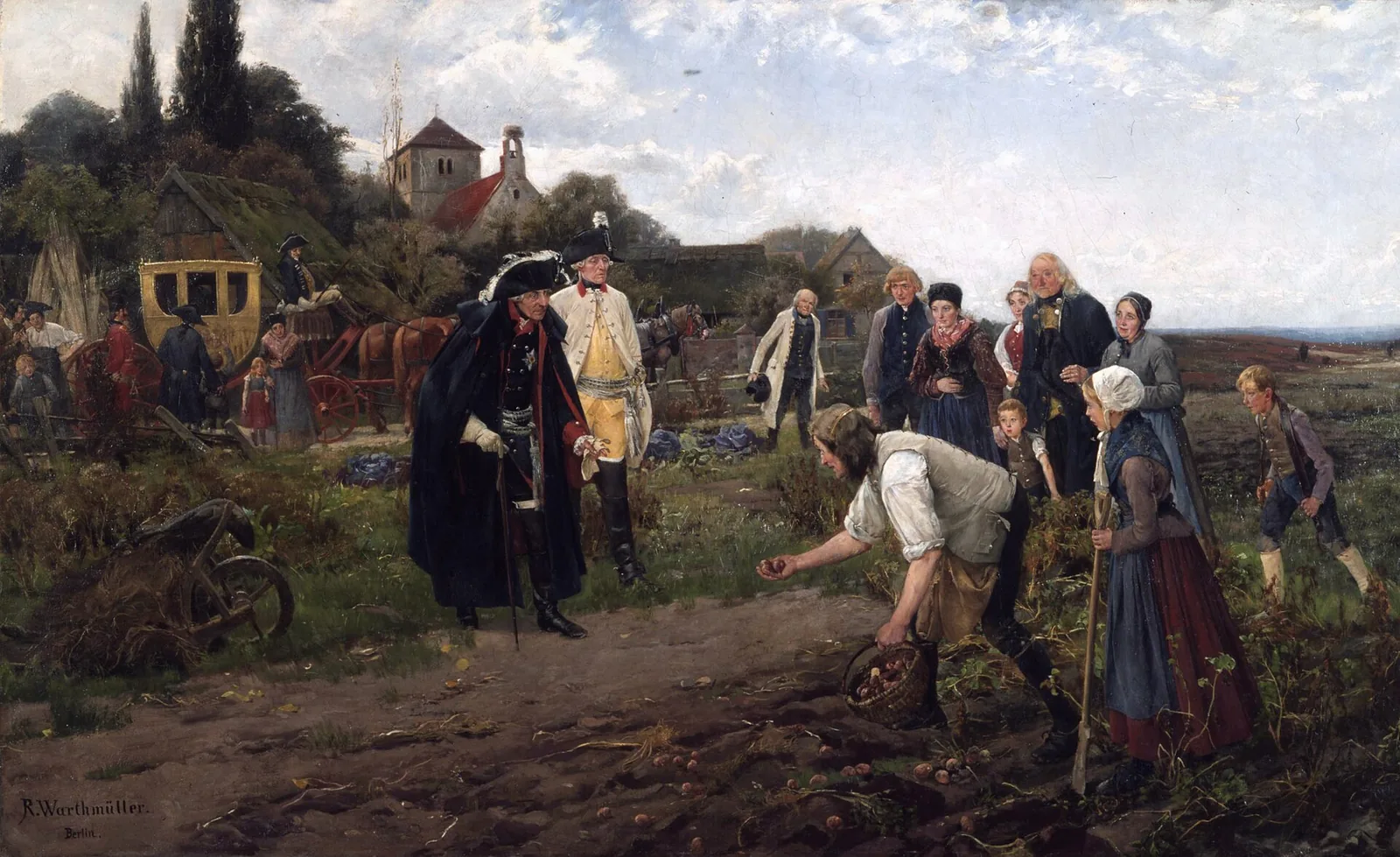
Robert Warthmüller, Der König überall (The King Everywhere), 1886. Deutsches Historisches Museum, Berlin · Public domain · Source page
Robert Warthmüller, Der König überall (The King Everywhere), 1886, Deutsches Historisches Museum, Berlin
The painting was made about a century after the king’s death, in a period when German writers and painters often used Frederick as a national hero. The scene is imagined: the king in a potato field, watching the harvest among the farmers.
- What does the painter want us to believe? That the king worked himself, went out among the fields and looked at the harvest with his own eyes. The painting makes him a hard-working king who cares for his people.
- When was the painting made, and what was Germany like then? In 1886, when Germany was a new empire and Frederick’s figure was used to strengthen national identity. The date matters: it tells us the image was made late.
- What is missing from the scene? Any sign of the wars, the battles, or what they cost. The picture shows a ruler at peace with his fields, and says nothing of the price of his wars.
Did the army sing at Leuthen?
Did the army sing the Lutheran chorale ‘Nun danket alle Gott’ before Leuthen, as the story says? And does the answer matter?
- Thomas Carlyle (1858–65) He treats the singing as certain. Yet he admits the details are not very precise, and he assumes the fact itself is right.
- Bernhard R. Kroener (essay in Gott mit uns, 2000) The story is best read as a political myth, built in the 19th and 20th centuries around Frederick as a Protestant hero, with the hymn as its symbol.
Even if the singing did not happen, the story tells us about the people who told it. Which matters more to you: what happened on the field, or what the tellers wanted to say?
Check yourself
How old was Frederick when he became king on 31 May 1740?
Answer: Twenty-eight, when his father died.. Correct. He was born in 1712 and his father died in 1740, so he was twenty-eight when he became king.
Check yourself
About how many soldiers crossed into Silesia on 16 December 1740?
Answer: About 27,000 soldiers.. Correct. The sources we use give about 27,000 men crossing on that day.
Check yourself
What is true of Mollwitz in April 1741?
Answer: Prussia won the battle, but the king left the field.. Correct. The army won, and the king did not stay to the end.
Check yourself
What happened after the Empress Elizabeth died in January 1762?
Answer: Her successor, Peter III, made peace with Prussia in May 1762.. Correct. Peter III reversed the war policy, and Russia made peace with Prussia.
Check yourself
Which states signed the Treaty of Hubertusburg in 1763?
Answer: Prussia, Austria and Saxony, which restored the old borders.. Correct. The borders returned to their prewar state, and Austria and Saxony gave up their claims to Silesia.
Check yourself
Where and when did Frederick die?
Answer: At Potsdam, on 17 August 1786, aged seventy-four.. Correct. He died at Potsdam on 17 August 1786, aged 74.
Terms
- oblique order An attack in which the army advances at an angle to the enemy line, so that its main weight falls on one flank while the rest of the line holds or waits.
- Pragmatic Sanction An edict of 1713 by the Emperor Charles VI, which let his daughter inherit the Habsburg lands. It did not cover the imperial title.
- diplomatic revolution The reversal of alliances in 1756: Britain and Prussia became allies, while France and Austria, old rivals, made an alliance of their own.
- Reichsarmee The army of the Holy Roman Empire, made up of contingents from the German princes, raised when the Empire went to war.
- chorale A hymn with a simple, slow tune that a congregation sings together. In Lutheran Germany such hymns were part of everyday church life.
- Schutzjude A Jew who received protected status from the king, which allowed him to live and trade in a particular place. The status was limited, and it passed by inheritance only to certain heirs.
- Anti-Machiavel A critique of Machiavelli’s The Prince, written in French by Frederick and published anonymously in 1740. Voltaire helped to distribute it and edited its wording.
- Silesia A rich province, mostly in modern Poland, that belonged to the Habsburg lands. Prussia took most of it in 1742 and kept it.
- Miracle of the House of Brandenburg The name given to the turn of events in 1762, when the death of Empress Elizabeth took Russia out of the war against Prussia.
- Political Testament A document Frederick wrote in 1752 as guidance for his successors on the state, the army and its finances, with his views on several groups of people.
- Hans Hermann von Katte A young officer and close friend of Prince Frederick. He was beheaded at Küstrin in 1730, after a plan to flee together.
- Küstrin A fortress on the Oder river, where Katte was beheaded in 1730 before the prince's eyes.
- Frederick William I The father of Prince Frederick. He built a large, disciplined army and ruled Prussia as a soldier-king.
- Voltaire A famous French writer. He helped distribute an anti-Machiavelli book in Amsterdam and changed one phrase in it.
- Machiavelli An Italian writer. His book The Prince advised rulers that they might lie and break their word.
- Amsterdam A city in the Netherlands, where a book against Machiavelli was distributed with Voltaire's help.
- Charles VI An emperor who issued the Pragmatic Sanction in 1713. He died in the autumn of 1740 and left his lands to his daughter.
- Maria Theresa Charles VI's daughter, who inherited the Habsburg lands at the age of twenty-three. She did not accept the loss of Silesia.
- Treaty of Breslau A peace treaty signed in 1742 between Prussia and Maria Theresa. Prussia kept most of Silesia.
- Mollwitz A battle in 1741 that the Prussian army won, though the king left the field.
- Kurt Christoph von Schwerin An old field marshal of Frederick's. According to the sources, he urged the king to leave the field at Mollwitz.
- Bohemia A region in central Europe, today part of the Czech Republic. Frederick invaded it in 1744.
- Kolin A battle in 1757 that Frederick lost to Field Marshal Daun. After it he had to lift his siege of Prague.
- Rossbach A battle in 1757 that Frederick won against a French army and the Reichsarmee. It was decided within a few hours.
- Leuthen A battle in 1757 in which Frederick beat a larger Austrian army by attacking its left flank.
- Zieten Frederick's cavalry commander. His horsemen joined the attack on the Austrian flank at Leuthen.
- Prague A city in Bohemia. Frederick won a battle outside it in 1757, but later had to lift his siege of the city.
- Kunersdorf A village near Frankfurt on the Oder. In 1759 Frederick lost the battle there and his army broke up.
- Peter III Elizabeth's successor in Russia. He admired Frederick and reversed Russia's war policy in 1762.
- Hubertusburg A palace in Saxony, where Prussia, Austria and Saxony signed a peace treaty in 1763.
- Moses Mendelssohn A Jewish philosopher who received a protected Jew patent from Frederick in 1763. It was a personal status for one man.
- Thomas Carlyle A British historian who wrote about Frederick about a century after the battles. He was not there himself.
Sources
- Frederick II to Count Finckenstein, 12 August 1759, trans. Thomas Carlyle, in History of Friedrich II of Prussia, vol. 19 (London, 1858–65)
- Frederick II to Count Finckenstein, 3 August 1759, trans. Thomas Carlyle, in History of Friedrich II of Prussia, vol. 19 (London, 1858–65)
- Thomas Carlyle, History of Friedrich II of Prussia, called Frederick the Great, vols. 18 and 19 (London, 1858–65)
- Frederick II, Anti-Machiavel (Brussels: François Foppens, 1740), title page
- Frederick II, Political Testament (1752), in several editions; the passage on Jews is paraphrased, not quoted
- The Jewish Encyclopedia (1906), article ‘Frederick II’ (public domain)
- David Fraser, Frederick the Great: King of Prussia (London: Allen Lane, 2000)
- Bernhard R. Kroener, essay in Hartmut Lehmann and Gerd Krumeich (eds.), Gott mit uns: Nation, Religion und Gewalt im 19. und 20. Jahrhundert (Göttingen: Vandenhoeck & Ruprecht, 2000)
- Rebecca Earle, Feeding the People: The Politics of the Potato (Cambridge: Cambridge University Press, 2020)
- warhistory.org, ‘Leuthen 1757: victory for quality’
- Wikipedia (English), articles ‘Battle of Leuthen’, ‘Battle of Kunersdorf’ and ‘Frederick the Great’, used for battle figures and dates, checked against the sources above

Image credits
- Adolph Menzel, Frederick the Great addresses his generals before Leuthen, 1859–61. Alte Nationalgalerie, Berlin · Public domain · Source page
- Frederick II, Anti-Machiavel, title page, Brussels: François Foppens, 1740 · Public domain · Source page
- Adolph Menzel, Frederick the Great addresses his generals before Leuthen, 1859–61. Alte Nationalgalerie, Berlin · Public domain · Source page
- Adolph Menzel, A Flute Concert of Frederick the Great at Sanssouci, 1850–52. Alte Nationalgalerie, Berlin · Public domain · Source page
- Antoine Pesne, Portrait of Frederick II, about 1743. The Hermitage, St Petersburg · Public domain · Source page
- Robert Warthmüller, Der König überall (The King Everywhere), 1886. Deutsches Historisches Museum, Berlin · Public domain · Source page


