Elizabeth I
Declared illegitimate at two, jailed at 20, crowned at 25. Then the real danger began.
Decisions, questions and your own progress, in the app
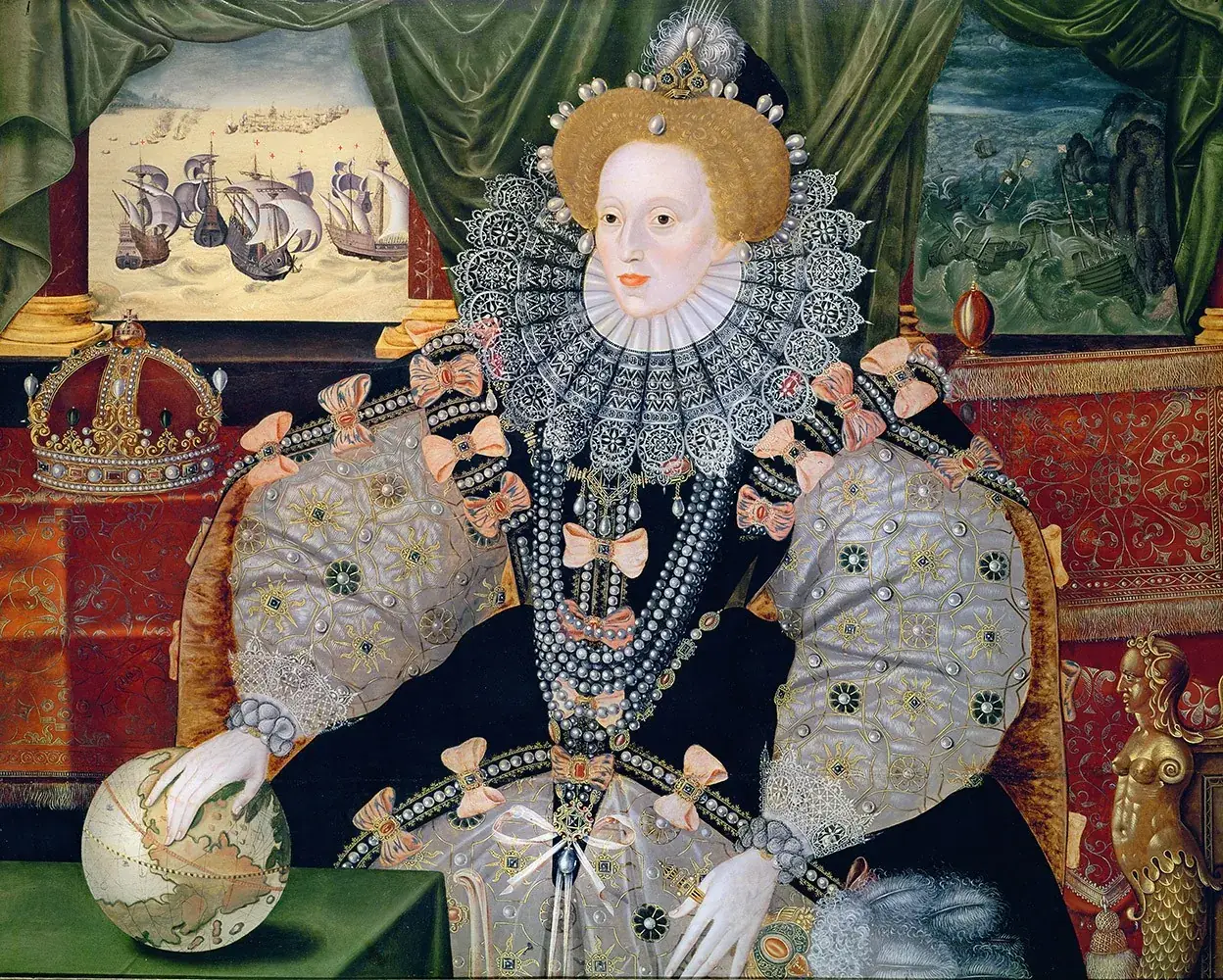
Unknown artist (formerly attributed to George Gower), Armada Portrait of Elizabeth I, c. 1588. Woburn Abbey · Public domain · Source page
Rowed to the Tower
A barge to the Tower
Palm Sunday, 18 March 1554. A barge slides down the grey Thames towards the Tower of London. Inside sits a young woman of 20: Elizabeth, daughter of King Henry VIII.
Her half-sister, Queen Mary, suspects her of treason. Almost eighteen years ago, inside the walls ahead, Elizabeth's mother was beheaded.
Look at the painting. One day this prisoner will rule England for 44 years and face down the most powerful empire in Europe. Today she does not know if she will live to see the summer.
The Tide Letter
Buying a day with a pen
The day before, two lords had come to take her. Elizabeth begged to write to her sister first.
She wrote slowly. She swore she had never plotted against Mary, and asked to answer her face to face. Above her signature she drew lines across the empty space, so no one could add a forged confession.
By the time she finished, the tide had turned, and the barge could no longer pass safely under London Bridge. The journey waited until morning. Was that her plan? Perhaps. Mary never answered.
The famous scene at the Tower gate, Elizabeth sitting on a wet stone in the rain and refusing to go in, comes from John Foxe, a Protestant writer who told it after she became queen. No other source confirms it.
What is certain: the rebels had hoped to crown her, but no proof was found that she knew. Their leader, Thomas Wyatt, declared her innocent on the scaffold. On 19 May 1554, eighteen years to the day after her mother's death, she left the Tower for house arrest. She had survived by saying nothing that could be used against her.
A daughter instead of a son
Background
Princess, then nobody
Elizabeth is born on 7 September 1533. Her father, Henry VIII, has broken with the Pope in order to marry her mother, Anne Boleyn. He wanted a son. He got a daughter.
In May 1536 Anne is beheaded, accused of adultery and treason. Most historians think the charges were false. Elizabeth is two years old. Parliament declares her illegitimate: no longer Princess Elizabeth, just 'the Lady Elizabeth'.
When she is ten, a new law puts her back in the line of succession, after her younger half-brother Edward and her older half-sister Mary. It never declares her legitimate.
She grows up clever and watchful, and learns Latin, Greek, French and Italian. At eleven she translates a long French poem for her stepmother, Katherine Parr.
Three faiths
A kingdom that keeps changing its faith
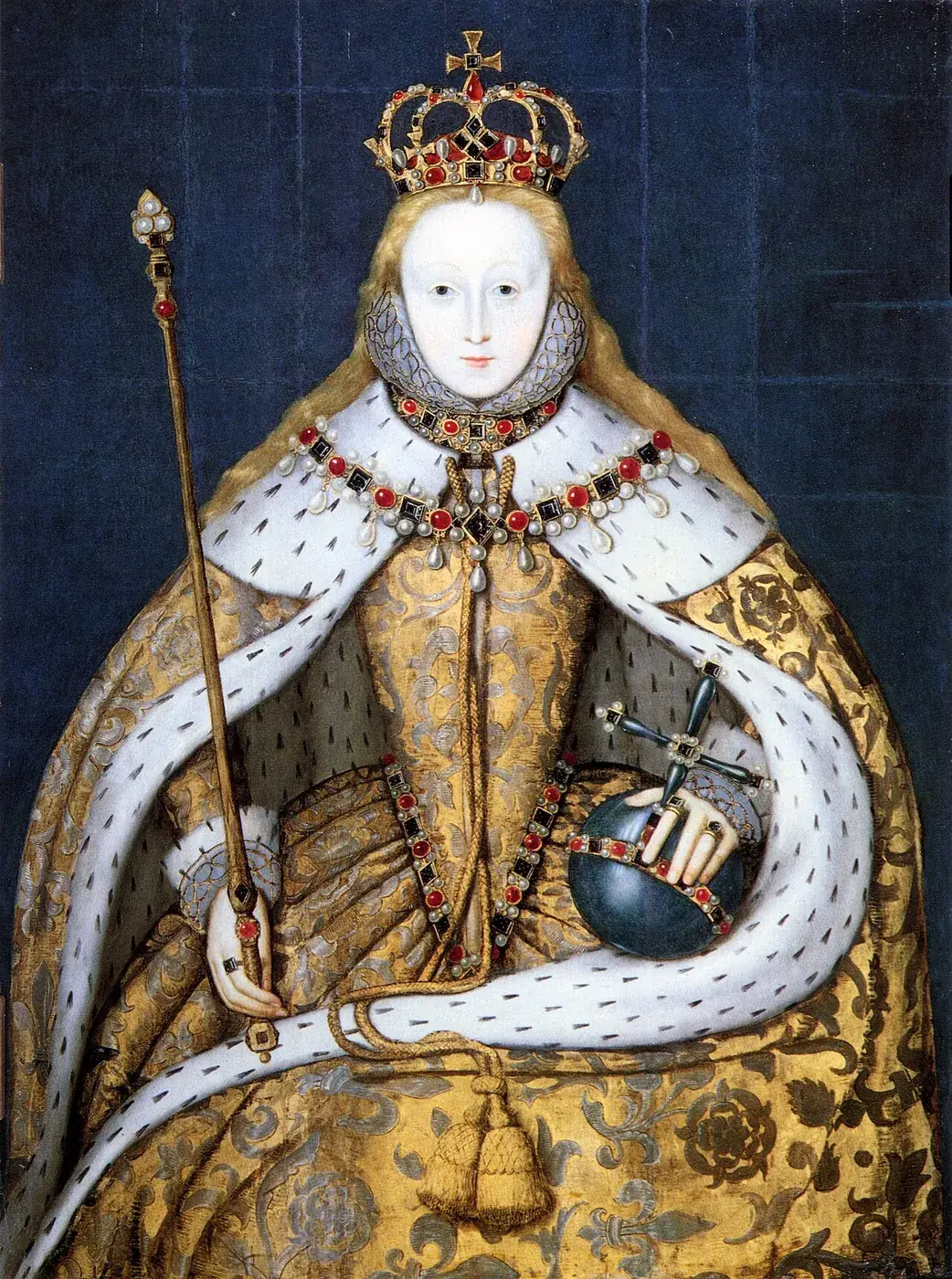
Unknown artist, Elizabeth I in her coronation robes, c. 1600–1610, after a lost original of about 1559. National Portrait Gallery, London · Public domain · Source page
25
Henry's new Church of England has no Pope, but it still looks Catholic: Latin Mass, unmarried priests, candles.
Edward VI, king at nine in 1547, makes it Protestant: services in English, church walls whitewashed, statues smashed. He dies at fifteen.
Mary I, a devout Catholic, restores the Mass in 1553, reunites England with Rome in 1554 and marries Philip, prince of Spain. From 1555 about 280 to 300 Protestants are burned alive as heretics. In January 1558 England loses Calais, its last foothold in France.
On 17 November 1558 Mary dies, childless. Elizabeth is queen at 25. In January she is crowned in Westminster Abbey, her hair loose as was the custom for a queen.
The danger
A queen many said had no right to rule
To the Pope and much of Catholic Europe, Henry's marriage to Anne was never valid, so Elizabeth has no right to the crown. The true heir, they say, is her cousin Mary Stuart, Queen of Scots, a Catholic married to the heir to the French throne.
England has about three million people and an empty treasury. And its ruler is a woman. That same year the Scottish preacher John Knox has printed The First Blast of the Trumpet Against the Monstrous Regiment of Women. 'Regiment' meant rule. A woman ruling men, Knox wrote, went against nature and God.
He was aiming at Catholic queens, but the timing could not have been worse. Every queen regnant faced the same doubt: could a woman command men, armies and a Church? Elizabeth would have to answer it every day.
A Church, and a husband?
A decision point
You are Elizabeth I.
Early 1559, Westminster
You have been queen for a few weeks. In 25 years England has changed its religion three times. Every bishop in office is Catholic and loyal to Rome. Protestant exiles are hurrying home from Geneva and Zurich, hungry for a thorough reformation.
Many ordinary people, especially in the north, still love the old ways. Spain and France are Catholic powers. You were raised Protestant, but you love ceremony, and keep candles and a crucifix in your own chapel.
Parliament meets in January.
Which Church do you choose?
- Keep Mary's Catholic Church, loyal to the Pope Probably calm for a while, and a friendly Spain. But you would be bowing to a Church that calls your parents' marriage invalid, and your crown illegitimate. The Protestants who cheered your accession would feel betrayed.
- Build a fully Protestant Church on the Geneva model: no bishops, plain worship, strict discipline Probably the returning exiles would cheer, but much of the country would resist, and Spain and France might treat England as a heretic state at once. Without bishops you would also lose a chain of command running from the crown into every parish.
- A Protestant Church with you at its head, which keeps bishops, robes and some old ceremony Two new laws in spring 1559. The Catholic bishops in the House of Lords fight them hard, and the law on worship scrapes through there by three votes.
What really happened
A Protestant Church with you at its head, which keeps bishops, robes and some old ceremony
The Act of Supremacy made Elizabeth Supreme Governor of the Church of England. The Act of Uniformity brought back a Protestant prayer book in English and required everyone to attend their parish church on Sundays, on pain of a twelve-penny fine.
All but one of the bishops refused and lost their posts. Most parish priests stayed, and so did their flocks.
Her father had called himself Supreme Head. 'Governor' sounded less like a claim to priesthood. It reassured Catholics, and Protestants who doubted that a woman could head a Church.
She cared more about outward obedience than private belief. A famous line says she would not 'make windows into men's souls'. The words are Francis Bacon's, written about thirty years later to describe her policy (he actually wrote 'hearts and secret thoughts'). Catholic plots later made her government much harsher.
A decision point
You are Elizabeth I.
January 1563, Westminster
In October you caught smallpox and nearly died. Your Privy Council panicked: you have no child and no named heir. By blood, the next in line is Mary, Queen of Scots, a Catholic.
Now Parliament begs you to marry. Suitors have come from Spain, Sweden and Austria. At home there is Robert Dudley, your friend since childhood. In 1560 his wife was found dead at the foot of a staircase. A jury called it an accident; half of Europe whispers murder.
A husband could give you an heir. He would also expect to rule: Mary's Spanish husband dragged England into a war that cost it Calais. And childbirth kills many women, queens among them.
What do you do?
- Marry a foreign prince, such as Archduke Charles Probably a powerful ally and the hope of an heir. But a Catholic husband would split the Church you have just built, and his family's wars could become England's, as under Mary.
- Marry Robert Dudley, the man you trust Probably a husband you love and an English heir. But the great nobles resent Dudley, and after his wife's death the rumours would say the queen had married a murderer. A rival faction might rise against you.
- Promise nothing: keep the suitors hoping and use courtship as diplomacy Parliament is frustrated, and the succession stays open. But foreign courts keep sending envoys, and keep hoping, and that buys England friends.
What really happened
Promise nothing: keep the suitors hoping and use courtship as diplomacy
Elizabeth never married and never named an heir. Yet she kept negotiating for twenty years: talks with Archduke Charles ran until 1567.
Her last serious suitor, the French Duke of Anjou, was over twenty years younger; she called him her 'frog'. In 1581, ambassadors reported, she kissed him in public and gave him a ring. Within days she drew back.
A husband meant sharing power with a man, and perhaps with his country. Naming an heir was dangerous too: in 1561, as the Scottish envoy William Maitland reported, she told him that people worship the rising sun rather than the setting one. An heir would draw plotters, as she had under Mary.
Historians such as Susan Doran argue that some matches were serious, and failed mostly because her councillors were divided and the religious gap was too wide.
Myth
Elizabeth decided as a young woman never to marry, and proudly called herself the Virgin Queen from the start.
The truth
Marriage was on the table for more than twenty years, from Philip of Spain's offer in 1559 to the Anjou courtship that ended in 1581–82. Her councillors expected her to marry and pressed her to. The cult of the Virgin Queen grew mostly from the late 1570s, once a royal child had become unlikely: poets and painters turned a political fact into a legend.
The evidence
Look at the dates. The 'Sieve Portraits', in which she holds the sieve of a Roman Vestal virgin, date from about 1579–83. Edmund Spenser's The Faerie Queene, which celebrates her as Gloriana, appeared in 1590. In the 1560s, while she was still negotiating to marry, such images are hard to find.
Two queens, one island
The rival
The queen in the cage
In May 1568 Mary, Queen of Scots, crosses into England in a fishing boat. Her own nobles have forced her to give up her throne to her baby son, James. She asks her cousin Elizabeth for help.
Elizabeth cannot set her free: Mary is the Catholic claimant to the English crown. Nor will she hand a crowned queen back to the rebels who deposed her. So Mary stays, a prisoner, for almost nineteen years.
The danger grows. In 1569 the northern earls rise in a Catholic rebellion. In 1570 the Pope's bull of excommunication declares Elizabeth a heretic and frees her subjects from obeying her. Plot follows plot, each aiming to put Mary on the throne. In 1584 an assassin shoots dead William of Orange, leader of the Dutch Protestants. Could it happen in London?
A decision point
You are Elizabeth I.
Summer 1585, Nonsuch Palace
Across the narrow sea, the Dutch provinces have been fighting their ruler, Philip II of Spain, for seventeen years. Philip rules Spain, Portugal, much of Italy and an empire in the Americas. Now the Duke of Parma's army is taking city after city, and Antwerp is about to fall.
If the revolt collapses, Europe's best army will stand on the coast facing England. And in May Philip seized English ships in Spanish ports.
Until now you have helped the Dutch quietly: loans, volunteers, and privateers like Francis Drake raiding Spanish shipping. Now the Dutch beg for an army, and even offer you their crown. Your treasury is small, and you dislike rebels against anointed kings.
What do you do?
- Stay out, and keep the peace with Spain Probably cheaper for now. But if Parma crushes the revolt, Spain holds the Dutch ports and can choose when to strike England. Your Protestant subjects would call it betrayal.
- Keep helping in secret, with money and volunteers Probably cheaper, and deniable. But the Dutch say they cannot hold out without real troops, and Philip already treats you as an enemy. It may be too little, too late.
- Sign a treaty and send an English army openly Open war with the most powerful empire in Europe, paid for out of a small kingdom's purse.
What really happened
Sign a treaty and send an English army openly
In August 1585, at Nonsuch, Elizabeth agreed to send several thousand soldiers and money. In return the Dutch handed over two ports, Flushing and Brill, as security. She refused their crown. Robert Dudley, Earl of Leicester, led the army.
Philip took the treaty as a declaration of war. His plans for an invasion, the 'Enterprise of England', moved ahead fast.
She published a declaration in several languages: she was not grabbing land, only defending England's safety and the Dutch people's ancient liberties. Historians such as Wallace MacCaffrey see a queen pushed reluctantly into war, because a Spanish victory next door seemed even more dangerous.
A decision point
You are Elizabeth I.
February 1587, Greenwich Palace
Last summer your spymaster, Sir Francis Walsingham, uncovered a plot: a young Catholic gentleman, Anthony Babington, and his friends planned to kill you, free Mary and welcome a Spanish invasion. Mary's secret letters, smuggled in beer barrels, were read by Walsingham's men. In one, she approved the plan.
In October a court of English lords found Mary guilty. Parliament begs you to execute her.
But Mary is an anointed queen, like you. If one queen can be tried and killed, so can another. Her son James rules Scotland. Catholic Europe would call it murder.
Mary's death warrant lies on your table. What do you do?
- Sign the death warrant Mary dies, and the plotters lose their queen. But you become the queen who killed a queen, and Catholic Europe is outraged. Philip of Spain probably loses a reason to hesitate: an invasion would no longer crown Mary, whose ties were French, so he could claim England for his own family.
- Keep her prisoner, under tighter guard than ever Probably no royal blood on your hands. But every plotter in Europe would still aim at freeing her, and your council and Parliament would believe you had gambled with the kingdom's safety.
- Send her out of England, to Scotland or France Probably the riskiest choice. In France, Mary would be a claimant to your crown with friendly armies around her. In Scotland her son James, now a grown king, would not want her back: she could cost him his throne.
What really happened
Sign the death warrant
On 1 February 1587 Elizabeth signed the warrant and gave it to her secretary, William Davison. That day her secretaries, apparently at her hint, wrote to Mary's jailer suggesting he quietly end Mary's life. He refused.
Her council, led by Lord Burghley, sent the warrant without telling her. Mary was beheaded at Fotheringhay Castle on 8 February. Elizabeth raged. Davison was sent to the Tower and fined a crushing 10,000 marks.
Elizabeth wrote to James VI that his mother's death was a miserable accident, against her will. Some historians see genuine horror at killing a fellow monarch. Others see theatre: by blaming Davison she kept James friendly and the deed off her own hands.
Either way, she wanted Mary dead without being the one who killed her. Her councillors decided for her.
The year of the Armada
The Enterprise of England
A fleet that filled the sea
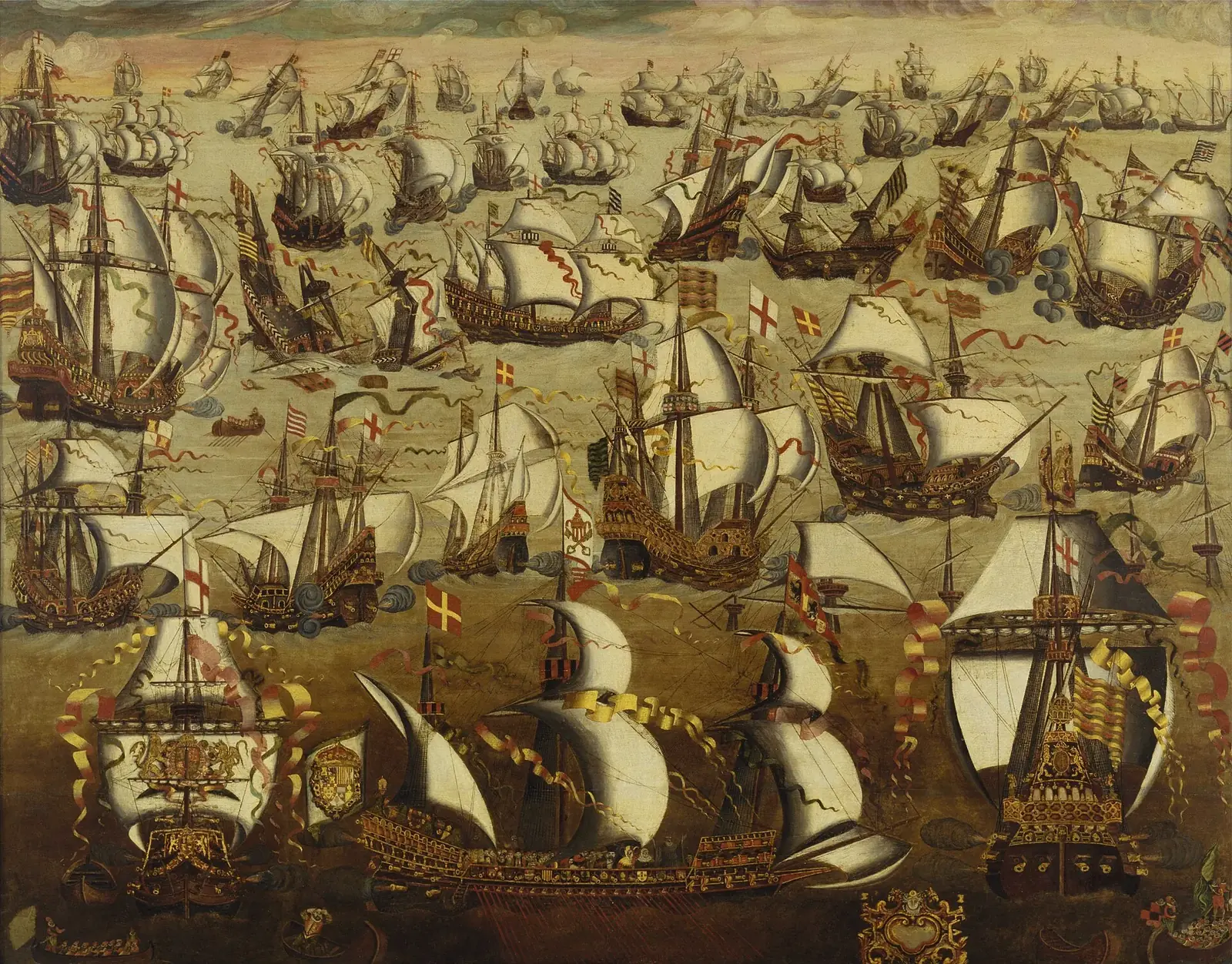
English school, English Ships and the Spanish Armada, August 1588, late 16th century. National Maritime Museum, Greenwich · Public domain · Source page
In late May 1588 the Armada leaves Lisbon: about 130 ships and some 30,000 men under the Duke of Medina Sidonia. Its task: sail up the Channel, join the Duke of Parma's army in Flanders and shield his barges across the sea to Kent.
The English fleet, under Lord Howard of Effingham with Drake as his deputy, follows it for a week, firing from long range and doing little harm. The Spanish hold a tight crescent formation.
On 27 July, by the English calendar, the Armada anchors off Calais. Parma is not ready, and Dutch ships block his ports. The next night the English send eight burning fireships into the anchorage. The Spanish cut their anchor cables and scatter. At dawn, off Gravelines, the English attack at close range.
Then the wind decides. It drives the Armada north, away from Parma, into the North Sea. The only way home is the long way round: past Scotland and Ireland.
Myth
The English navy smashed the Armada in one great sea battle.
The truth
The fireships and the battle off Gravelines broke the Armada's formation and ended any hope of meeting Parma. But only a handful of Spanish ships were sunk or captured in the Channel. Most losses came on the voyage home, in the September gales off Scotland and Ireland; more than twenty ships were wrecked on the Irish coast alone. Hunger, thirst and disease killed thousands more.
The evidence
Spanish survivors' reports, and wrecks found by divers off Ireland and Scotland, tell the story. Of about 130 ships, somewhere between a third and a half never returned to Spain. In England, many saw the storms as God's verdict.
Source: The queen at Tilbury
“I know I have the body of a weak and feeble woman; but I have the heart and stomach of a king, and of a king of England too, and think foul scorn that Parma or Spain, or any prince of Europe, should dare to invade the borders of my realm.”
Gravelines was more than a week past, but no one in England knew the danger was over: Parma's army still waited in Flanders. Elizabeth came to the army camp at Tilbury on the Thames and rode through the ranks.
- Who wrote this down, and when? Not Elizabeth, and not on the day. Leonel Sharp, a chaplain at the camp, says he was told to read the speech to the army again the next day, so he may have had a copy. But he sent it to Buckingham more than thirty years later, and other early copies differ. We probably have her ideas, if not every word.
- Why might Sharp send it in the 1620s? England was again arguing about war with Spain, and Buckingham wanted it. A queen defying Spain was a useful memory. That does not make the text false, but it gives Sharp a reason to polish it.
- Why begin with ‘a weak and feeble woman’? She names her listeners' doubt before they can think it, then turns it around: a woman's body, a king's courage and office. It is John Knox's doubt of 1558, answered in front of an army.
Source: A portrait as a victory speech
Armada Portrait, unknown artist (formerly attributed to George Gower), c. 1588. Woburn Abbey
Painted soon after the victory, in at least three versions, when the queen was about 55. You saw it at the start of the lesson; now read it as evidence.
- What does the painter want you to believe? That the victory was hers. In the left window, English ships sail in calm sunlight. In the right, Spanish ships break on rocks in a storm. The queen sits between the two scenes, as if she caused the first and the second followed.
- Where is her hand, and what is under it? On a globe, with her fingers resting on the Americas, where Spain ruled a vast empire. In 1588 England had no lasting colony across the ocean; Roanoke was failing. The painting claims a future; it does not describe the present.
- What is left out? The sailors who died of disease after the victory, unpaid. Parma's army, which never crossed. A war that went on for sixteen more years. Instead the painter gives us a crown by her hand and ropes of pearls, a symbol of purity: royal power, and a queen who belongs to no man. This is propaganda, and very good propaganda.
The mask of youth
The 1590s
Gloriana grows old
The 1590s are grim. Harvests fail four years running, from 1594 to 1597, and food prices soar. The war with Spain drags on; new armadas sail in 1596 and 1597, and storms scatter both. In Ireland, a great rebellion begins.
Her old councillors die: Leicester in 1588, Walsingham in 1590, Burghley in 1598. The dashing young Earl of Essex fails in Ireland, and in February 1601 tries to raise London against her ministers. Few follow him. He is beheaded.
Yet she can still hold a room. In November 1601, at 68, she tells a crowd of MPs that the glory of her crown is to have reigned with their love. Later generations called it the Golden Speech.
Source: Forever young
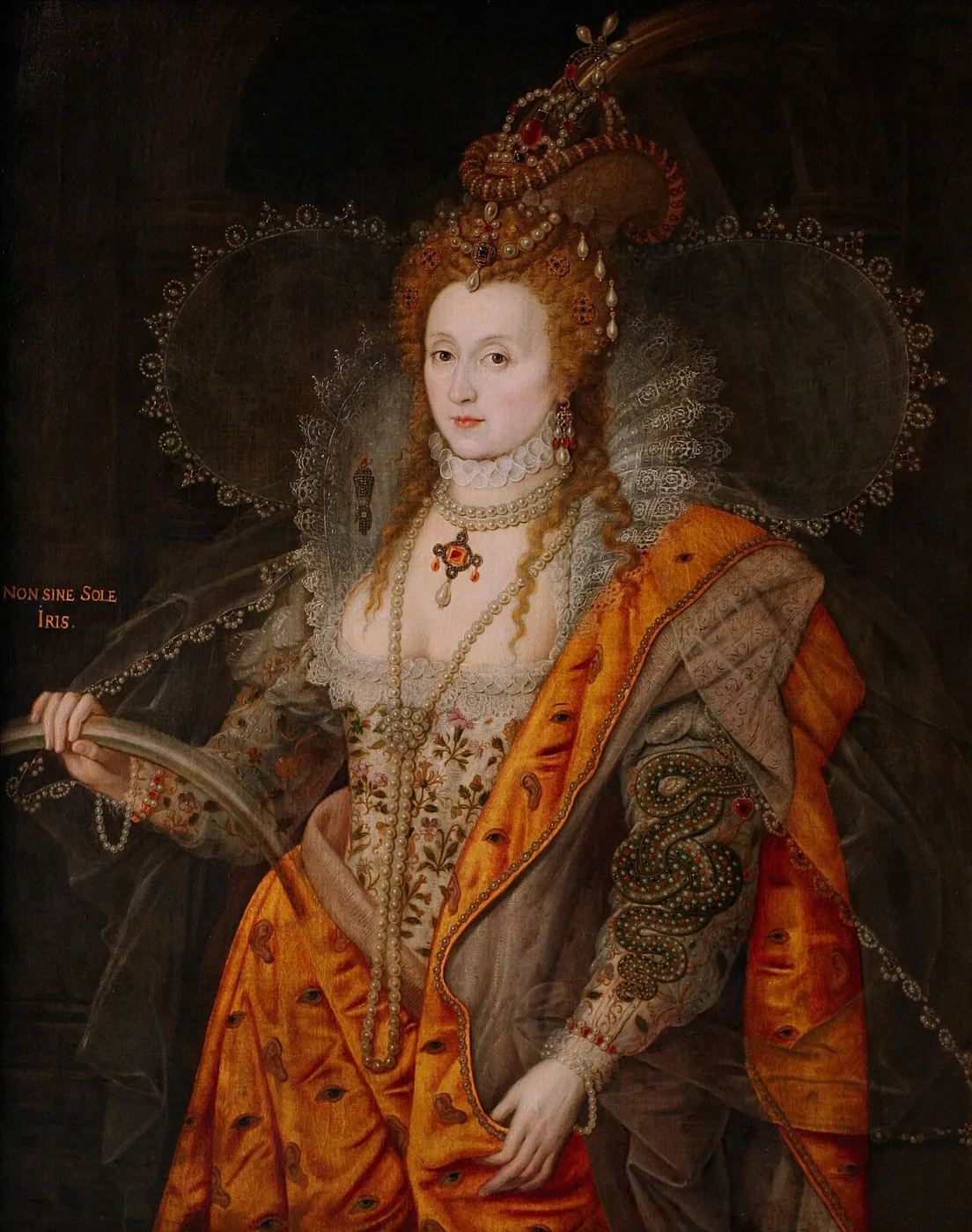
Unknown artist (formerly attributed to Isaac Oliver or Marcus Gheeraerts the Younger), The Rainbow Portrait, c. 1600–1602. Hatfield House, collection of the Marquess of Salisbury · Public domain · Source page
Rainbow Portrait, unknown artist (formerly attributed to Isaac Oliver or Marcus Gheeraerts the Younger), c. 1600–1602. Hatfield House
Probably painted for Robert Cecil, Burghley's son and her chief minister, whose family still owns it. The queen was nearly 70.
- How old does she look? How old was she? She looks perhaps thirty, with loose hair like an unmarried girl's. She was 67 to 69. From the mid-1590s, official images used a fixed young face that the art historian Roy Strong called ‘the mask of youth’. It showed a queen, and a crown, that never weaken.
- Look at her cloak and sleeve. What do you see, and why? Eyes and ears all over the cloak: most historians read them as a queen who sees and hears everything, perhaps through her ministers and informers. On her sleeve, a jewelled serpent, a common symbol of wisdom.
- She holds a rainbow. The Latin says ‘Non sine sole iris’: no rainbow without the sun. Who is the sun? She is. As a rainbow needs sunlight, peace after the storm needs her. It was painted in years of war, rebellion and hunger, which is exactly why the message mattered.
What she left behind
- 1559 The Church of England takes the broad shape it still has: Protestant teaching, bishops, and the monarch as Supreme Governor.
- 1580 Cut off from Catholic Europe, England looks to the Muslim world. The Ottoman sultan Murad III grants English merchants trading rights, and a Moroccan ambassador visits London in 1600.
- 1585–1590 Roanoke, England's first colony in North America. The war with Spain holds back the supply ships; when they arrive in 1590, the settlers have vanished.
- 1585–1604 The war with Spain outlasts the Armada by sixteen years. Peace comes only in 1604, after Elizabeth's death.
- 1594–1603 The Nine Years' War in Ireland. Hugh O'Neill, Earl of Tyrone, leads the most serious rising against English rule in her reign. English armies win partly by destroying crops, and famine kills many Irish civilians.
- 1600 Elizabeth grants a charter to the East India Company, London merchants trading with Asia. Within two centuries it will rule much of India.
- 1603 On 24 March Elizabeth dies at Richmond Palace, aged 69. The crown passes to James VI of Scotland, son of the Mary she had executed. Whether she named him on her deathbed is uncertain.
Gloriana: great queen, or great image?
Was Elizabeth a brilliant ruler, or a cautious survivor whose legend outgrew her record?
- J. E. Neale, Queen Elizabeth (1934) The heroic queen. Neale's Elizabeth is wise, brave and loved, a ruler who held a divided nation together, kept the peace while she could and fought when she had to. Her delays were statecraft, not weakness. For a generation, this was the Elizabeth most readers knew.
- Christopher Haigh, Elizabeth I (1988) A superb performer more than a great planner. Haigh's Elizabeth rules through image and theatre, and avoids hard decisions on religion, marriage and the succession. Her achievements were fragile, and by the end many of her subjects were tired of her.
- John Guy, Elizabeth: The Forgotten Years (2016) Look at the last twenty years. Working from the archives, Guy finds an ageing woman often at odds with her councillors, short of money, fighting a war she never wanted, and struggling to stay in control among men who thought they knew better.
If a ruler's image is a weapon, is building it part of good government, or a cover for its failures? And should a queen who had to prove every day that she was not ‘weak and feeble’ be judged by the same measure as a king?
Final quiz
Check yourself
What title did the Act of Supremacy of 1559 give Elizabeth?
Answer: Supreme Governor of the Church of England. Right. 'Governor' sounded less priestly than 'Head', which reassured Catholics, and Protestants who doubted a woman could lead a Church.
Check yourself
Which statement about Elizabeth and marriage fits the evidence best?
Answer: She negotiated with suitors for over twenty years; the last serious courtship ended around 1581. Right. Marriage was a real possibility, and a diplomatic tool, until she was almost fifty.
Check yourself
What happened after Elizabeth signed the death warrant of Mary, Queen of Scots?
Answer: Her council sent it without telling her; afterwards she blamed and punished her secretary, William Davison. Right. Davison went to the Tower and was fined heavily. Whether her fury was real or staged is still debated.
Check yourself
Where did the Spanish Armada lose most of its ships?
Answer: On the voyage home, wrecked in storms off Scotland and Ireland. Right. More than twenty ships were wrecked on the Irish coast alone, and hunger and disease killed thousands more.
Check yourself
Why do historians debate the exact words of the Tilbury speech?
Answer: The best-known text comes from a letter Leonel Sharp wrote more than thirty years later. Right. Sharp was at the camp and may have had a copy, but he wrote in the 1620s, when England was again arguing about war with Spain.
Check yourself
In the Rainbow Portrait Elizabeth is nearly 70, but looks young. Why?
Answer: Official images used a fixed young face, the ‘mask of youth’, to show a queen and a crown that never weaken. Right. It was a message, not a likeness. A French envoy who met her in 1597 saw a very different face.
Terms
- John Foxe English Protestant writer (c. 1517–1587). His huge Acts and Monuments (1563), known as the Book of Martyrs, told the stories of Protestants persecuted under Mary I.
- illegitimate Born to parents whose marriage the law or the Church did not recognise. Such a child could not normally inherit the crown.
- succession The order in which people inherit the crown. In Tudor England, Acts of Parliament and the king's will could change it.
- Protestant Belonging to the Christian churches that broke with the Pope in the 16th century, following reformers like Martin Luther and John Calvin. They put the Bible, in people's own language, at the centre.
- queen regnant A queen who rules in her own right, not as a king's wife. Mary I, crowned in 1553, was the first woman crowned to rule England in her own right. Elizabeth was the second.
- Supreme Governor Elizabeth's title as head of the Church of England from 1559. Her father had called himself Supreme Head; 'Governor' claimed control of the Church without claiming to be its priest.
- Privy Council A small group of senior advisers, a dozen or so, who met almost daily and ran the government in the queen's name.
- excommunication Expulsion from the Catholic Church by the Pope. In 1570 Pope Pius V excommunicated Elizabeth and declared that her subjects no longer owed her obedience.
- privateer A private captain allowed by a ruler to attack enemy ships and keep part of the loot. To the Spanish, men like Drake were simply pirates.
- Armada Spanish for 'fleet'. In English it came to mean the great fleet Philip II sent against England in 1588. The Spanish called it the 'Great and Most Fortunate Navy'.
- fireship An old ship packed with pitch and anything that burns, set alight and sent with wind and tide into an enemy fleet at anchor. Its guns are left loaded, so they go off in the heat.
- Tower of London An old fortress by the River Thames in London, where important prisoners were held before execution.
- Thomas Wyatt The leader of a revolt against Queen Mary. He declared Elizabeth innocent before his execution.
- Anne Boleyn Elizabeth's mother. Henry VIII married her, and she was beheaded in 1536 on charges of treason.
- Katherine Parr Elizabeth's stepmother, the last wife of Henry VIII. Elizabeth translated a French poem for her.
- Edward VI Elizabeth's younger half-brother, who became king as a child and led a Protestant reform.
- Mary I Elizabeth's older half-sister, a devout Catholic who ruled after Edward and restored Catholicism.
- Philip of Spain The prince of Spain who married Mary I. He later became king of Spain.
- Calais A port city in northern France. England lost it in 1558, its last foothold in France.
- Westminster Abbey A great church in London where the kings and queens of England are crowned.
- the Pope The head of the Catholic Church, based in Rome. He decided who the Catholics saw as the lawful ruler.
- Book of Martyrs The nickname of John Foxe's book about Protestants who died under Mary. It was written to strengthen Protestant faith.
- Tide Letter A letter Elizabeth sent to her sister Mary. In it she swore she had not plotted against her.
- House of Lords One of the two houses of the English Parliament. It was made up of nobles and bishops.
- House of Commons One of the two houses of the English Parliament. Its members represented towns and counties.
- Act of Supremacy A law that made the monarch the head of the English Church, in place of the Pope.
- Act of Uniformity A law that set one English prayer book and required everyone to attend church on Sundays.
- smallpox A contagious and deadly disease that leaves scars on the skin. It killed many people at the time.
- Earl of Leicester Robert Dudley, Elizabeth's friend since childhood. He led the army sent to the Netherlands.
- Mary, Queen of Scots Elizabeth's Catholic cousin, who claimed the English crown. Elizabeth held her prisoner for many years.
- William of Orange Leader of the Dutch Protestants, shot dead in 1584 by an assassin.
- Duke of Parma The commander of Spain's army in Flanders. He took Dutch cities and was meant to lead an invasion of England.
Sources
- Elizabeth I: Collected Works, ed. Leah S. Marcus, Janel Mueller and Mary Beth Rose (University of Chicago Press, 2000)
- Princess Elizabeth to Queen Mary I, 17 March 1554 (the 'Tide Letter'), The National Archives, Kew, SP 11/4/2
- John Foxe, Acts and Monuments (London: John Day, 1563, and later editions)
- Leonel Sharp to the Duke of Buckingham (1620s), printed in Cabala, Mysteries of State (London, 1654)
- André Hurault, Sieur de Maisse, A Journal of All That Was Accomplished by Monsieur de Maisse, Ambassador in England from King Henri IV to Queen Elizabeth, Anno Domini 1597, trans. G. B. Harrison and R. A. Jones (Nonesuch Press, 1931)
- J. E. Neale, Queen Elizabeth (Jonathan Cape, 1934)
- Christopher Haigh, Elizabeth I (Longman, 1988)
- John Guy, Elizabeth: The Forgotten Years (Viking, 2016)
- Susan Doran, Monarchy and Matrimony: The Courtships of Elizabeth I (Routledge, 1996)
- Norman L. Jones, Faith by Statute: Parliament and the Settlement of Religion, 1559 (Royal Historical Society, 1982)
- Wallace MacCaffrey, Elizabeth I: War and Politics, 1588–1603 (Princeton University Press, 1992)
- Colin Martin and Geoffrey Parker, The Spanish Armada (Hamish Hamilton, 1988)
- Roy Strong, Gloriana: The Portraits of Queen Elizabeth I (Thames and Hudson, 1987)
- Helen Hackett, Virgin Mother, Maiden Queen: Elizabeth I and the Cult of the Virgin Mary (Macmillan, 1995)
- Jerry Brotton, This Orient Isle: Elizabethan England and the Islamic World (Allen Lane, 2016)
- Janet M. Green, '"I My Self": Queen Elizabeth I's Oration at Tilbury Camp', Sixteenth Century Journal 28 (1997), 421–445
Image credits
- Unknown artist (formerly attributed to George Gower), Armada Portrait of Elizabeth I, c. 1588. Woburn Abbey · Public domain · Source page
- Unknown artist, Elizabeth I in her coronation robes, c. 1600–1610, after a lost original of about 1559. National Portrait Gallery, London · Public domain · Source page
- English school, English Ships and the Spanish Armada, August 1588, late 16th century. National Maritime Museum, Greenwich · Public domain · Source page
- Unknown artist (formerly attributed to Isaac Oliver or Marcus Gheeraerts the Younger), The Rainbow Portrait, c. 1600–1602. Hatfield House, collection of the Marquess of Salisbury · Public domain · Source page


