Einstein: from patent clerk to the symbol of a century
In 1905 Einstein was a 26-year-old patent clerk in Bern, publishing papers that changed physics. In 1939 he signed a letter to the US president; in 1952 he was asked whether he would accept the presidency of Israel. What is accurate in the story of the man, and what is legend?
Decisions, questions and your own progress, in the app
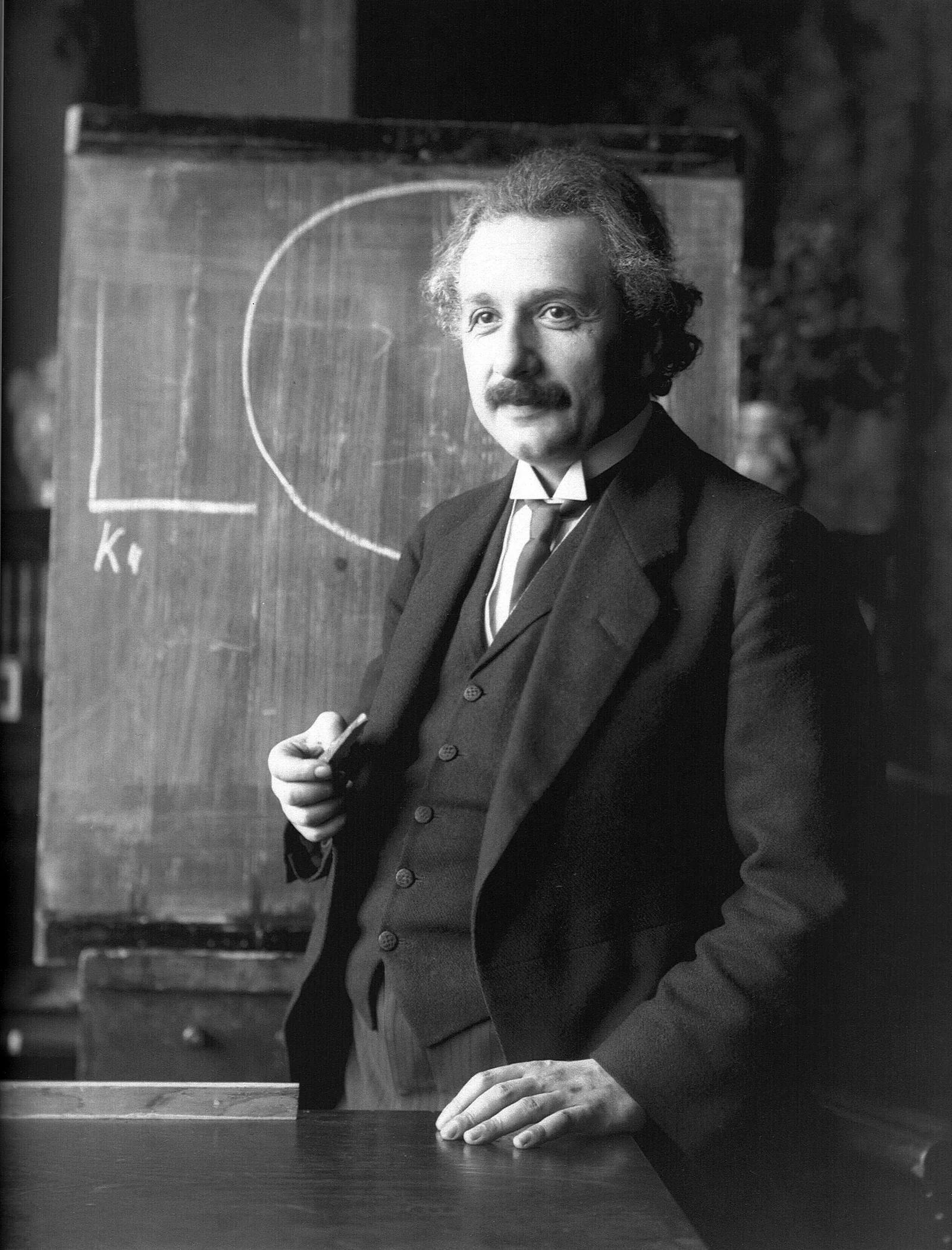
Ferdinand Schmutzer, Albert Einstein, 1921. Public domain · Public domain · Source page
A clerk in Bern
A 26-year-old patent clerk
Bern, 1905. A young man sits at a desk in the Swiss patent office. All day he checks the drawings and descriptions of other people’s inventions. Between the forms he works out the physics that will change the century.
By the end of the year he has published four papers. They change how we understand light, atoms, time and mass. Within fourteen years he is famous across the world. Which parts of this story are true, and which are legend?
Albert Einstein
A physicist who rewrote our picture of space, time and light, and who became, in his own lifetime, the face of science.
- Born: 14 March 1879, Ulm, Germany
- Died: 18 April 1955
- Won: Special relativity, 1905; General relativity, 1915; Nobel Prize in Physics for 1921 (awarded 1922)
“I am at all events convinced that He does not play dice.”
Background
A pupil who did not like school
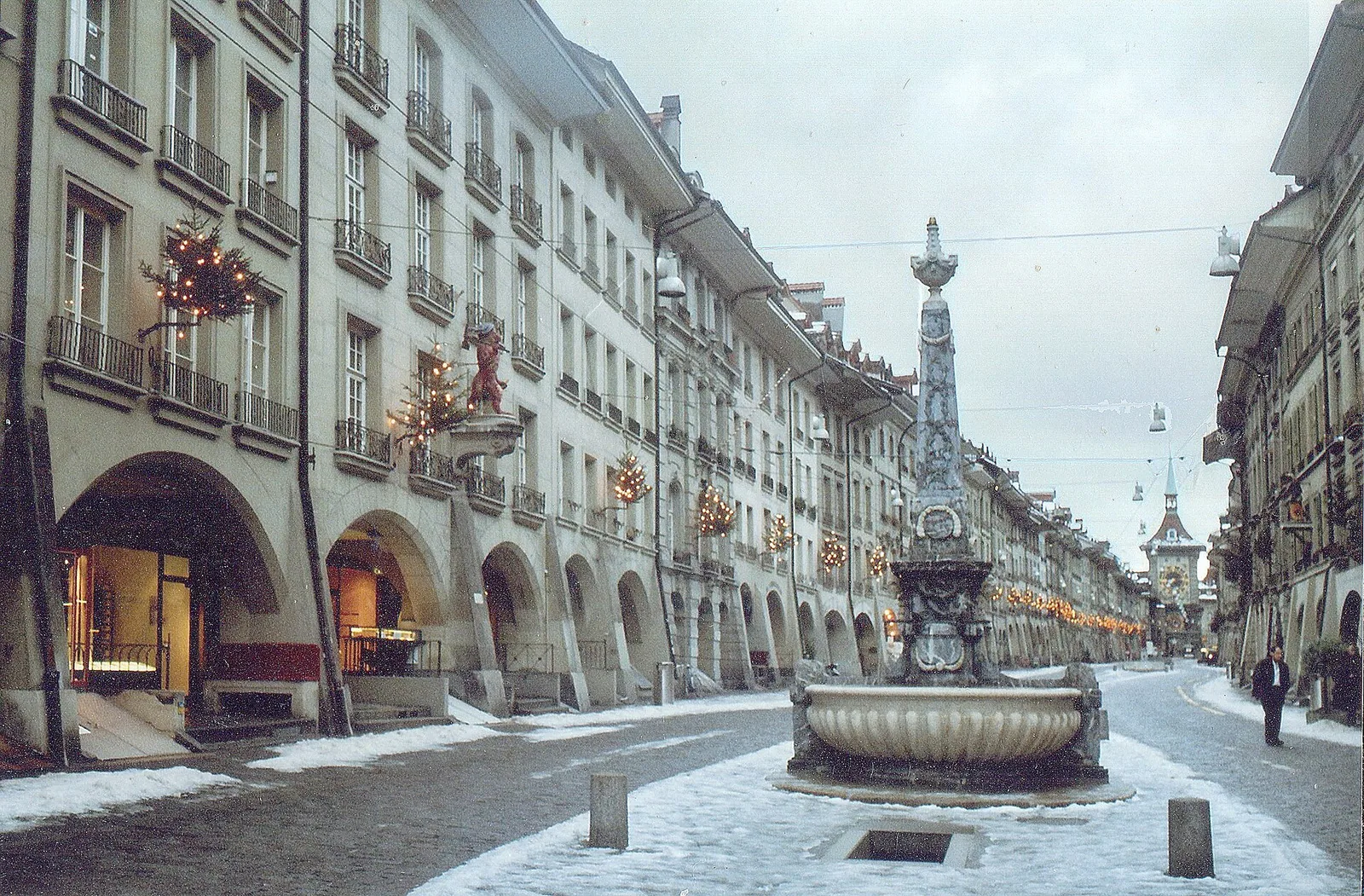
Vitold Muratov, Kramgasse, Bern, 2019. CC BY-SA 4.0 · CC BY-SA 4.0 · Source page
Albert Einstein was born in Ulm, in southern Germany, on 14 March 1879, into a secular Jewish family. His father ran an electrical business. The family moved to Munich when Albert was still a small child.
He disliked the strict German schools of the time. At fifteen he left school without a diploma and joined his parents in Italy, where the family business was. He taught himself mathematics and physics from books.
A year later he tried for the Zurich polytechnic, the Swiss federal institute of technology, which trained engineers and scientists. After a year at a school in Aarau, Switzerland, he entered the polytechnic in 1896 and specialised in physics and mathematics.
Myth
Einstein failed mathematics at school.
The truth
No. Mathematics was one of his strengths. In 1895 he failed to reach the required standard in the general part of the entrance examination for the Zurich polytechnic, but he did very well in mathematics and physics.
The single failure survived as legend because it makes a tidy story: the clever boy whom the school got wrong. Anyone who reads the results sees a gap in the general subjects, not in mathematics.
The evidence
Accounts of the 1895 examination describe a failure in the general part of the test, and distinction in physics and mathematics.
1902
The patent office
In 1902 Einstein found a post as a technical expert at the Swiss federal patent office in Bern. The work was routine and useful. He examined applications for devices: electrical apparatus, clocks, machines. He had to decide what was really new, and whether the machine would work as the applicant described it.
The office gave him a steady salary and a settled life, but no university chair. Outside Switzerland, few physicists knew his name.
Everything else he did in those years, he did after work or between his official tasks.
The miracle year
1905
Four papers in one year
In 1905 Einstein sent four papers to Annalen der Physik, a German physics journal. Historians call that year his annus mirabilis, his miracle year.
The first paper proposed that light arrives in packets of energy, now called light quanta or photons. Einstein used the idea to explain the photoelectric effect: when light falls on certain metals, it knocks electrons out of them. The energy of those electrons depends on the colour of the light, not on how bright it is. Waves alone could not explain that.
The second paper explained the restless jiggling of tiny particles in a liquid, Brownian motion, as the result of molecules bumping into them. It gave a way to measure the size of molecules, and experiments confirmed it within a few years.
The third paper, on special relativity, changed the idea of time. Two observers moving at different speeds need not agree on whether two events happened at the same moment. Light has the same speed for both of them, and the theory needs no invisible medium to carry it.
The fourth, a few pages long, came in September. It showed that a body which gives off energy E as radiation loses mass equal to E divided by the square of the speed of light. The formula we know as E = mc² is a shorter, later way of writing that idea.
Doctorate
A thesis on molecules
Einstein also needed a doctorate. His thesis was called A New Determination of Molecular Dimensions. It estimated the size of sugar molecules from the way dissolved sugar changes the stickiness of water.
He finished the work in 1905, and the faculty at Zurich approved it that summer. The degree was formally awarded in January 1906. The papers of that year are what made him famous, but the thesis shows what else he was doing: testing physics against numbers that could be measured.
1901 and after
Mileva Marić
Mileva Marić studied physics in Zurich and was Einstein’s fellow student there. They married in January 1903. Their relationship, and the question of her part in his work, are at the centre of the debate later in this lesson.
In a letter of 27 March 1901, written before they married, Einstein wrote to her:
“How happy and proud I will be, when we two together have victoriously led our work on relative motion to an end!”
The letter is one of the few pieces of evidence about her part in the work of those years, and historians read it in very different ways. We come back to that at the end.
A manifesto in Berlin
October 1914
The professors at war
In August 1914 the great powers of Europe went to war. By the autumn the German universities were full of patriotic speeches, and the professors had begun to choose sides in print.
In early October 1914 ninety-three German writers, scientists and artists signed a public statement defending Germany’s conduct of the war. Historians call it the Manifesto of the Ninety-Three.
You are now in Berlin, a member of the Prussian Academy of Sciences, and your colleagues are reading the names in the newspapers.
A decision point
You are Albert Einstein, physicist, in Berlin.
Berlin, October 1914
Europe is at war, and you are in the capital of Germany. Two papers lie on your desk. One is the Manifesto of the Ninety-Three, with its list of famous names. The other is a draft by Georg Nicolai, a Berlin physician. It calls on the scholars of Europe to remember that they share one culture, and to stop treating one another as enemies.
Nicolai asks for your signature. Many of your colleagues have already signed the first paper. A public signature in wartime could cost you friends and standing.
What do you do?
- Sign the Manifesto of the Ninety-Three, as many of your colleagues have done. Your name would stand with the ninety-three in the newspapers. You would be seen as backing the government’s war, and that would be hard to undo later.
- Sign nothing. Keep to your research and say nothing in public. You would avoid the quarrel. But you would stay silent while colleagues divide Europe in print, and Nicolai’s appeal would gather fewer names.
- Sign Nicolai’s appeal, and try to bring other scholars of Europe to sign it too. A signature for peace is a bold public act in a country at war. It would mark you as a critic of the government, and it could cost you friends and standing.
What really happened
Sign Nicolai’s appeal, and try to bring other scholars of Europe to sign it too.
In the real story you did not sign the Manifesto of the Ninety-Three. You signed Nicolai’s appeal. It circulated among professors and gained no signers beyond the four men who put their names to it: Nicolai, Einstein, the astronomer Wilhelm Foerster and the philosopher Otto Buek. Foerster had signed the Manifesto of the Ninety-Three himself, and later regretted it. The appeal was not printed in 1914. A Swiss publisher printed it without the authors’ permission in 1917.
The sources give no single account of Einstein’s reasons, so historians reason from the context. Nicolai, a physician, wanted scholars to speak across the lines of war. One account has Foerster helping to draft the appeal. Einstein’s name gave the appeal weight among physicists, who already knew him, but not yet among the wider world.
Source: The Appeal to Europeans
“While technology and traffic clearly drive us toward a factual recognition of international relations …”
Written as a reply to the Manifesto of the Ninety-Three, which is dated 4 October 1914. The appeal circulated among professors and gained no more signers than the four men named here.
- Who wrote it, and who signed it? Nicolai is credited as its author, and three others signed it: Einstein, Foerster and Buek. Four names in all. A text with four names is a small voice, however well argued.
- What does the first line claim about the modern world? That transport and technology are bringing nations into closer contact, so that the peoples of Europe must come to see their shared interests. The argument is about the future, not about who started the war.
- Why would a text that nobody printed in 1914 matter to historians? Because it shows that a minority voice existed inside the German academic world, and that it was small. Ask who could read it, and who could not.
The eclipse and the newspaper
1915–1919
A test for the theory
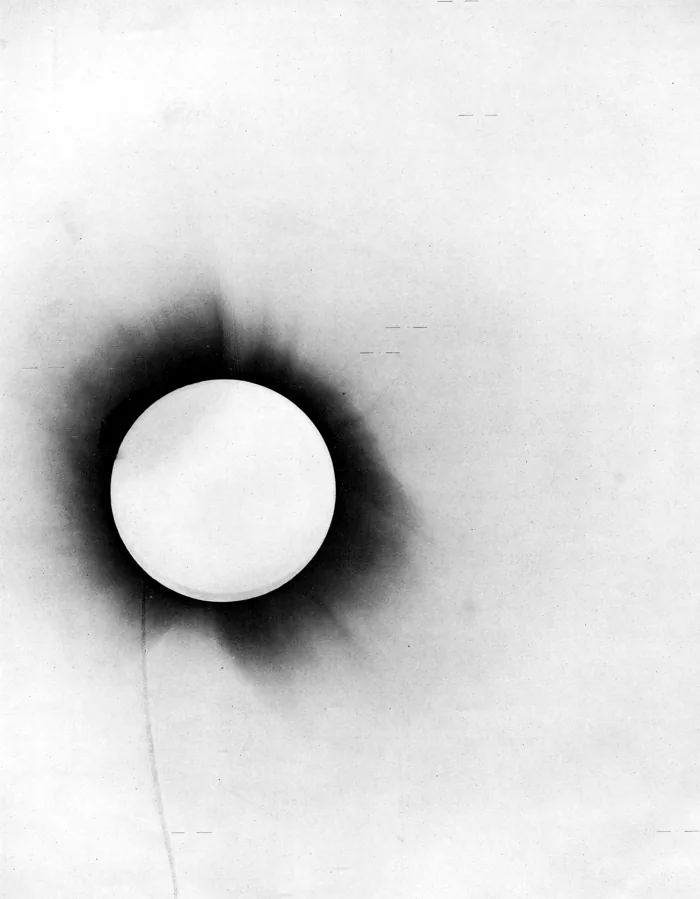
F. W. Dyson, A. S. Eddington and C. Davidson, Philosophical Transactions of the Royal Society A (1920), plate 1. Public domain · Public domain · Source page
General relativity, completed in November 1915, said that mass bends space, and that light follows the bend. Starlight passing close to the Sun should therefore be bent. Newton’s theory predicts a small bend; Einstein’s predicts about twice as much.
The bend can be measured only when the stars near the Sun are visible, which means during a total solar eclipse, when the Moon blocks the Sun’s glare. On 29 May 1919 British astronomers sent two expeditions: one to Sobral in north-eastern Brazil, and one to the island of Príncipe, off West Africa.
The picture here is one of the plates taken at Sobral and printed in the expedition’s report.
Príncipe
Eddington’s island
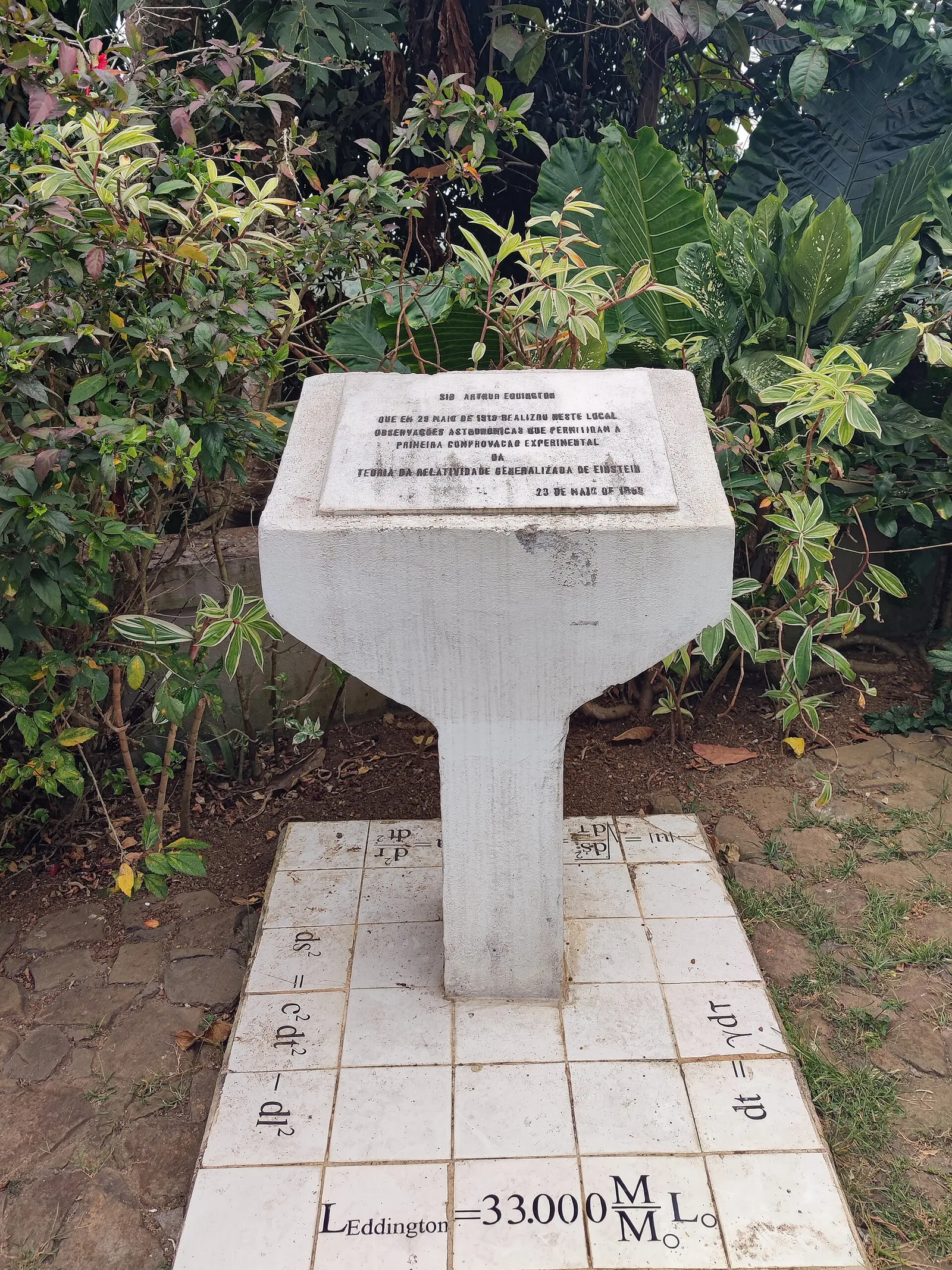
Jialiang Gao, Eddington memorial, Roça Sundy, Príncipe, 2022. CC BY-SA 4.0 · Jialiang Gao www.peace-on-earth.org · CC BY-SA 4.0 · Source page
Arthur Eddington, an astronomer at Cambridge, led the team on Príncipe. A memorial now stands at Roça Sundy, the estate on the island where he observed. Its inscription, dated 1989, records his observations of 29 May 1919 and calls them the first experimental confirmation of Einstein’s general theory of relativity.
The photographs needed careful measurement, and the results were not published until 1920, in the Philosophical Transactions of the Royal Society.
6 November 1919
Announced in London
On 6 November 1919 the Royal Society and the Royal Astronomical Society held a joint meeting in London. Frank Dyson, Eddington and Charles Davidson reported that the bending of starlight matched Einstein’s figure, not Newton’s.
The next day, Friday 7 November, The Times of London reported the meeting under a headline. Headlines are usually written by editors, not by the scientists, and this one is the next source to read.
Source: The Times, 7 November 1919
REVOLUTION IN SCIENCE
NEW THEORY OF THE UNIVERSE
NEWTONIAN IDEAS OVERTHROWN
Headlines are usually written by the newspaper’s editors, not by the astronomers. The words are the editor’s choice, and they tell us about the paper’s taste for drama as much as about the science.
- Whose name appears in the headline? None. The headline is about a theory and about Newton. The man at the centre of the story is missing from it, which is odd for a paper announcing a triumph.
- Which words make the story dramatic? ‘Revolution’ and ‘overthrown’. Science was rarely reported that way. The headline turns a careful measurement into a battle, with a winner and a loser.
- What is missing? Doubt. Later historians argue about the quality of the Príncipe plates, and the headline has no room for that.
1921
A fundraising tour
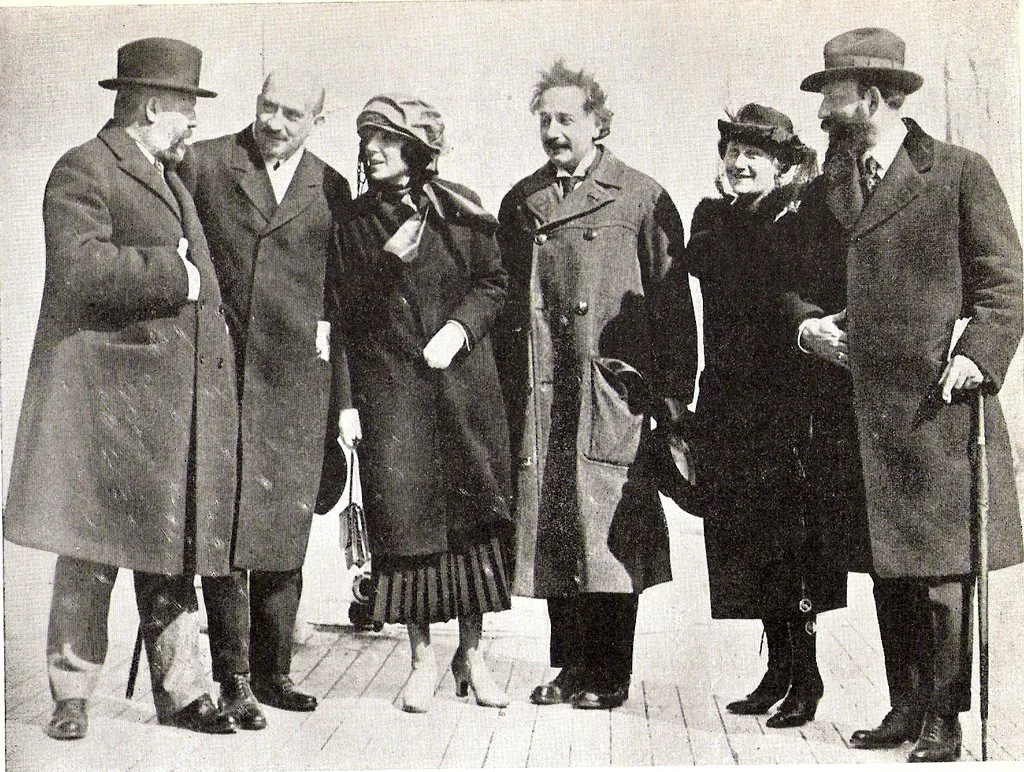
Underwood & Underwood, 2 April 1921. Public domain · Public domain · Source page
In April 1921 Einstein crossed the Atlantic with Chaim Weizmann, the leader of the Zionist movement, and a Zionist delegation to the United States. The aim was to raise money for the Hebrew University in Jerusalem, which was still only an idea.
He lectured on the tour.
Around the same time, the Nobel committee held back the 1921 physics prize and awarded it in 1922, for his work on the photoelectric effect, not for relativity.
In 1923 he visited Palestine and lectured in support of the new university.
Antwerp, 1933
January 1933
While Hitler took power
On 30 January 1933 Adolf Hitler was appointed chancellor of Germany. Einstein was not in Berlin. He was in America, on a visiting appointment at the California Institute of Technology in Pasadena, which he had taken up in December 1932.
The new government moved quickly against its opponents and against Jews. In Germany the Nazi press soon attacked relativity as “Jewish physics”, and one of Germany’s best-known scientists had to decide where to go next.
In March 1933 he and his wife Elsa set out for Europe. Their home was in Berlin, and their summer cottage at Caputh, outside the city, was also theirs.
A decision point
You are Albert Einstein. You have just landed in Antwerp, Belgium.
Antwerp, Belgium, 28 March 1933
The ship has brought you across the Atlantic and to the coast of Belgium. On the voyage you learned that officers of the new regime had searched your flat in Berlin in February and March, and that your summer cottage at Caputh had been ransacked.
Your work, your papers and most of your belongings are in Germany. Your post with the Prussian Academy of Sciences is still yours. The new government has already shown what it does to people like you, and it has not yet said what it will do to you.
You can go back to Berlin with your wife and wait for things to settle, or stay outside Germany and build a new life.
What do you do?
- Go back to Berlin, keep your post, and hope things calm down. You would be back under a government that had already searched your home. You would have little protection against what it might do next, and the Academy would be a weak shield.
- Stay outside Germany, give up your German citizenship, and look for work abroad. You would be free to speak and work. You would almost certainly lose your Berlin post and whatever remained of your property there, and you would have to start again.
- Wait in Belgium with your Berlin post on paper, and decide later. You would keep your options open for a few weeks. But the state was moving faster than your decision, and each month of uncertainty would weaken your position.
What really happened
Stay outside Germany, give up your German citizenship, and look for work abroad.
In the real story you chose the second option, although the plan had been to go home. On 28 March 1933 you handed in your German passport at a German consulate in Belgium and renounced your citizenship. On the same day you wrote to the Prussian Academy of Sciences to resign your membership. The German government then confiscated what remained of your property and money in Germany.
Einstein’s reasons, as he gave them that spring, were that he would not return while the regime persecuted Jews and its opponents. Historians add that the decision was also practical: his property, his post and his safety were all in question, and he had prospects abroad. The sources do not agree on every detail of the consulate and the order of the letters, so only what is well attested is set out here.
1933–1934
Princeton
Einstein did not go back to Germany. He spent some time on the Belgian coast under protection, and then crossed to the United States. He reached New York in October 1933.
He took a post at the Institute for Advanced Study in Princeton, New Jersey, a place where scholars could work without teaching duties. Princeton remained his home until he died in 1955.
For German science it was a loss. The physicists who had built Berlin’s reputation in theory scattered across the world, and many never returned.
A letter to the president
December 1938
Splitting the atom
In December 1938 the German chemists Otto Hahn and Fritz Strassmann, working in Berlin, found that bombarding uranium with neutrons produced lighter elements. At first they could not explain the result.
The explanation came from Lise Meitner and her nephew Otto Frisch, who had fled Germany. They saw that the nucleus had split in two, and Frisch named the process nuclear fission.
A split releases a great deal of energy. If each split also released neutrons that caused further splits, the process could become a chain reaction. Physicists quickly saw that such a chain might release energy far beyond any explosive, and that it might be turned into a weapon.
One of the physicists who saw this was Leó Szilárd, a Hungarian who had left Germany in 1933 and now worked in the United States. He feared that Germany would build such a weapon first.
Summer 1939
Long Island
Szilárd believed that only the president himself would act on such a warning, and that the president would listen to a famous name. He needed one. In July 1939 he travelled to see Einstein at his summer house on Long Island, New York, to ask for one.
A decision point
You are Albert Einstein, on Long Island.
Long Island, New York, July 1939
Leó Szilárd, a Hungarian physicist, has come to see you at your summer house. He has drafted a letter to President Franklin D. Roosevelt. It explains that a chain reaction in uranium may be possible, and that a bomb of a new kind might be built and carried by ship. It warns that Germany may be working on the same problem.
Szilárd asks you to sign, because the president will read a letter that carries your name. You have never worked on weapons, and you are wary of governments. You left a country whose government turned on its critics and on its Jews, and you know that governments are not always right.
What do you do?
- Sign Szilárd’s letter as it stands. The president would have the warning, with your name on it. Government attention to uranium research would probably start months earlier than otherwise. You would be the author of a warning about a weapon, and could not take that back.
- Refuse, on the principle of pacifism: you will not put your name to anything that might lead to a weapon. The letter might go unsigned, or reach the president under a weaker name. Government attention to uranium would come later. You would keep your conscience clear, at a cost that no one could measure.
- Write your own letter, in your own words, and send it yourself. Your letter alone might take longer to reach the president, and it would not carry Szilárd’s close knowledge of the physics. It would probably come later, and say less.
What really happened
Sign Szilárd’s letter as it stands.
You signed. The letter is dated 2 August 1939, and Szilárd wrote it. It reached Roosevelt in October: on 11 October 1939 Alexander Sachs took it to the president in Washington. The original is held at the Franklin D. Roosevelt Library, at Hyde Park, New York.
Szilárd wrote the letter, and Einstein’s signature gave it a name the president would not ignore. Historians say that Einstein signed because he trusted Szilárd’s judgement on the physics and believed the danger was real. They also note the letter’s limits: it asked for contact, for follow-up and for money for experiments, and the large effort came only after the United States entered the war in December 1941. Accounts differ on the roles of other physicists in drafting, so the letter is credited mainly to Szilárd.
Source: The letter to Roosevelt, 2 August 1939
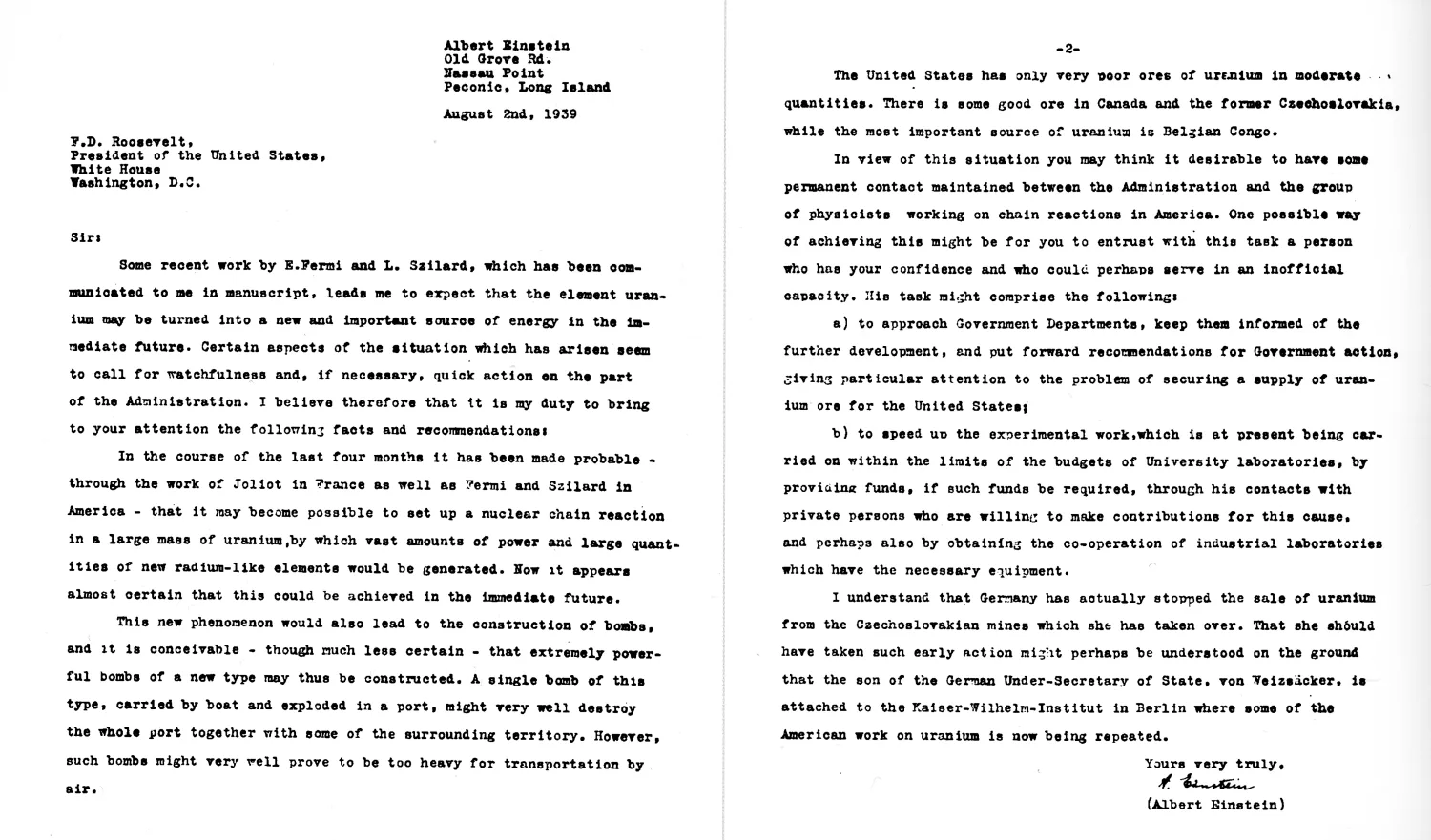
Albert Einstein to F. D. Roosevelt, 2 August 1939. Scan: Franklin D. Roosevelt Presidential Library & Museum. Public domain · Public domain · Source page
“Some recent work by E. Fermi and L. Szilard, which has been communicated to me in manuscript,”
“However, such bombs might very well prove to be too heavy for transportation by air.”
“Germany has actually stopped the sale of uranium from the Czechoslovakian mines which she has taken over.”
Typed on Einstein’s letterhead on Long Island, and signed by him. Szilárd wrote it. Alexander Sachs carried it to Roosevelt in October 1939.
- Who wrote it, and whose name is at the bottom? Szilárd wrote most of it. Einstein signed. The famous name gave a text by a physicist of less public fame the authority it needed to reach the president.
- Why mention the uranium from the Czechoslovakian mines? The writers wanted the president to see that Germany was already acting. This is an argument for urgency, not a neutral report.
- What does the phrase “too heavy for transportation by air” suggest? That such a bomb might be too heavy to fly. The writers were not picturing an aircraft carrying it.
Myth
E = mc² made the atomic bomb.
The truth
The equation says how much energy is released when a given amount of mass is lost. It holds for every nuclear reaction, including those in the Sun. But it does not say how to split a uranium nucleus, how to start a chain reaction, or how to separate the fuel. Experiment and engineering solved those problems, most of them after 1939.
The 1939 letter grows out of the discovery of fission in December 1938, by Hahn and Strassmann, and the chain-reaction idea that followed. It does not rest on the equation of 1905.
The evidence
Hahn and Strassmann’s experiments in Berlin, and Meitner and Frisch’s explanation of them, rested on laboratory results. The weapons programmes of the 1940s drew on that experimental work.
After the fame
November 1952
After Weizmann
On 9 November 1952 Chaim Weizmann died. He had been Israel’s first president, and Einstein had been his companion on the 1921 tour. The office would need a successor.
Israel’s leaders wanted a figure who would lend the young state prestige abroad. Einstein was then one of the best-known scientists in the world, and he was a Jew who had left Germany.
The question reached him in a letter from Israel’s embassy in Washington, signed by the diplomat Abba Eban. The next step gives the question itself.
A decision point
You are Albert Einstein, in Princeton.
Princeton, November 1952
You are seventy-three. You have lived in America for nineteen years, and your home and your work are in Princeton.
A letter from Israel’s embassy in Washington, signed by Abba Eban, asks “whether you would accept the Presidency of Israel if it were offered you by a vote of the Knesset.” Accepting would mean moving to Israel and taking its citizenship. The office is largely ceremonial, but it carries public duties, and it would make you a public figure in a new state.
What do you do?
- Accept, move to Israel and take citizenship. You would give the new state a famous name and a scientist at its head. You would leave your work and your home in America, and the Knesset might not elect you at all.
- Accept on conditions, such as a base in Princeton for your research. The embassy would have to refer the conditions to the government, which would probably refuse them. The answer would be no, delivered slowly.
- Decline, and explain why. The state would look elsewhere, and the office would go to another candidate. Your name would stay out of Israeli politics, and you would keep your work.
What really happened
Decline, and explain why.
In the real story you declined. Einstein wrote back that he was deeply moved by the offer, but that he would be unsuited to the duties of that high office. The sources we used do not give the date of his reply. On 16 December 1952 Yitzhak Ben-Zvi was elected the second president.
The reply itself gives the reason: he judged himself unsuited to the office. Historians read this as modesty and as a sincere judgement of himself. They also note that the offer depended on a vote of the Knesset, so it was never a plain invitation.
Source: Einstein’s reply
“I should be unsuited to fulfill the duties of that high office.”
The quoted line gives the reason for declining. The other sources paraphrase the rest of the reply as thanks for the offer.
- Is he refusing the state, or the job? The job. The reply thanks the state for the offer, then declines the office on personal grounds: he thinks he is unsuited to it.
- What reason does the quoted line give? A personal one: he judges himself unfit for the office. The line says nothing about Israeli politics or the Knesset vote, so the reader has to weigh the modesty as a judgement about the man, not about the state.
Myth
Einstein was president of Israel.
The truth
He never was. In 1952 he was asked whether he would accept the office if the Knesset elected him, and he declined. Chaim Weizmann had been the first president. Yitzhak Ben-Zvi was elected the second on 16 December 1952.
The evidence
The embassy letter poses a conditional question, the reply declines it, and the public record names Ben-Zvi as the second president.
1954–1955
The mistake, as Pauling recalled it
The chemist Linus Pauling later wrote down a conversation he said he had with Einstein in November 1954. According to Pauling, Einstein spoke of his part in the 1939 letter as a mistake he regretted. These are Pauling’s words, written down afterwards. Einstein’s own account of the conversation is not in the sources we used. Pauling’s note dates the talk to 16 November, while another biography places it on 11 November.
Einstein died in Princeton on 18 April 1955, aged seventy-six. Thomas Harvey, the pathologist who performed the autopsy, removed his brain and kept it. Whether Einstein had agreed is disputed. Later his son Hans Albert approved the removal, with conditions.
Shortly before his death Einstein had signed a manifesto with the philosopher Bertrand Russell. It was published in London in July 1955, after his death, and called on governments to face the danger of nuclear war.
Myth
Einstein’s brain explains his genius.
The truth
One brain was studied, and no study of one brain can explain genius. A 1999 study in The Lancet reported unusual features in the parietal lobes, which sit at the top and back of the cortex, and its authors suggested a link with his thinking. The study rests on one brain, and other researchers dispute its findings. Brain size and shape do not measure intelligence.
The evidence
The brain was cut into many blocks. Studies of it describe one brain, which cannot show what made him a genius.
What followed
- 1905 Four papers: light quanta, Brownian motion, special relativity, mass and energy.
- 1919 The eclipse of 29 May; the Royal Society meeting of 6 November; The Times on 7 November.
- 1922 The Nobel Prize for 1921, awarded for the photoelectric effect.
- 1933 Hitler becomes chancellor (January); Einstein renounces German citizenship in Belgium (March); Princeton (October).
- 1939 The letter is signed on 2 August and delivered to Roosevelt on 11 October.
- 1945 The United States drops atomic bombs on Hiroshima and Nagasaki, in August.
- 1952 Weizmann dies (9 November); Einstein declines the presidency; Ben-Zvi is elected (16 December).
- 1955 Einstein dies in Princeton (18 April); the Russell–Einstein Manifesto is published in London (9 July).
What was Mileva Marić’s part?
How much of the 1905 work was hers?
- The co-author view In 1955 the Soviet physicist Abram Joffe wrote that Marić had been a co-author of the 1905 work, and some later writers have repeated the claim. Joffe’s memoir was written long after the events, in Russian, and it is the chief source for this view. Historians who doubt it ask what other evidence there is.
- The sceptical view Most historians who have studied the papers, the letters and the memoirs find no significant contribution by Marić to the 1905 papers. Among them are Abraham Pais (1994), Gerald Holton (1996), John Stachel (2002), Alberto Martinez (2005) and A. Calaprice and T. Lipscombe (2005). They stress that the claim rests on Joffe’s memoir.
- The partner view Other writers, among them Senta Troemel-Ploetz (1990), E. H. Walker (1991) and Ruth Howes and Caroline Herzenberg (1999), see Marić as a real partner in the work and in the discussions of those years, and some think her part was larger than the sceptics allow. The 1901 letter is one of their main pieces of evidence.
The evidence is thin: a few letters, one memoir and what friends later remembered. The question matters to historians, because a famous name can hide the work of those around it. They disagree on how much.
Check yourself
What did the 1919 eclipse observations test?
Answer: Whether the Sun’s gravity bends the light of stars. Right. Einstein’s theory predicted a bigger bend than Newton’s, and the expeditions tried to measure that bend close to the Sun.
Check yourself
Who wrote the 1939 letter to Roosevelt?
Answer: Leó Szilárd, with Einstein signing it. Right. Szilárd wrote most of the letter, and Einstein’s name at the bottom gave it weight with the president.
Check yourself
Why did Einstein decline the presidency of Israel?
Answer: He said he was unsuited to that high office. Right. In his reply he said he would be unsuited to the duties of the office, and that the offer moved him deeply.
Check yourself
Which statement about E = mc² is accurate?
Answer: It gives the energy released by a loss of mass. Right. The equation says how much energy a given loss of mass releases. It does not say how to build a bomb.
Check yourself
What does the 1919 Times headline show about newspapers?
Answer: Headlines are written by editors, and they add drama. Right. The headline turns a careful result into a battle, and the scientists did not write it.
Check yourself
Why do historians doubt the claim that Marić was a co-author of the 1905 papers?
Answer: It rests mainly on a 1955 memoir. Right. The chief source is Abram Joffe’s memoir, and the historians who doubt the claim ask what other evidence there is.
Terms
- relativity Einstein’s two theories of space and time. Special relativity (1905) deals with motion at constant speed; general relativity (1915) treats gravity as the bending of space-time.
- light quantum (photon) A packet of light energy. Einstein proposed in 1905 that light arrives in such packets. The name ‘photon’ came later.
- Manifesto of the Ninety-Three A statement of October 1914, signed by ninety-three German writers, scientists and artists, defending Germany’s conduct of the war.
- Prussian Academy of Sciences A learned society in Berlin whose members were leading scholars; membership was a mark of scientific standing.
- Hebrew University The university in Jerusalem that Zionist leaders wanted to found, funded by donations from abroad.
- nuclear fission The splitting of a heavy atomic nucleus, such as uranium, into lighter parts, releasing energy. Discovered in Berlin in December 1938.
- chain reaction A process in which each split sets off further splits. In a bomb it must grow fast; in a reactor it is held steady.
- Knesset Israel’s parliament, which elects the president.
- pacifism The belief that war and violence are wrong in principle, and that one should refuse to take part in them.
- Swiss patent office Government office in Bern that checked patent applications for new inventions. Einstein worked there as a technical examiner.
- Zurich polytechnic Swiss institute of technology in Zurich that trained engineers and scientists. Einstein studied physics and mathematics there.
- Annalen der Physik German physics journal. In 1905 Einstein published four papers in it.
- Photoelectric effect When light hits certain metals, it knocks electrons out of them. Einstein explained this with packets of light.
- Brownian motion Constant jiggling of tiny particles in a liquid, caused by molecules bumping into them.
- E = mc² Einstein's famous formula. It shows how much mass a body loses when it gives off energy as radiation.
- Max Born German physicist who exchanged letters with Einstein about quantum theory.
- Georg Nicolai Berlin physician who drafted an appeal to the scholars of Europe to remember that they share one culture. Einstein signed it.
- Wilhelm Foerster Astronomer who signed Nicolai's appeal, but had also signed the Manifesto of the Ninety-Three and later regretted it.
- Otto Buek Philosopher who signed Nicolai's appeal. The appeal gained no more signers.
- Arthur Eddington Cambridge astronomer who led the 1919 expedition to the island of Príncipe.
- Royal Society Britain's national academy of sciences. In November 1919 the results of the eclipse expeditions were presented there.
- Sobral Town in north-east Brazil, where British astronomers recorded the 1919 solar eclipse.
- Príncipe Island off the coast of West Africa, where Eddington watched the 1919 eclipse.
- California Institute of Technology Well-known research institute in Pasadena, California. Einstein held a visiting post there when Hitler came to power.
- Institute for Advanced Study Research institute in Princeton where scholars can work without teaching duties. Einstein took a post there.
- Otto Hahn German chemist who worked in Berlin. With Strassmann he found in 1938 that bombarding uranium with neutrons made lighter elements.
- Lise Meitner Physicist who had fled Germany. With her nephew she saw that the nucleus had split in two.
- Leó Szilárd Hungarian physicist who feared Germany would build such a weapon first. He asked Einstein to sign a letter to President Roosevelt.
- The Lancet Well-known British medical journal. In 1999 it published a study of Einstein's brain.
- Parietal lobes Regions at the top and back of the cortex. A 1999 study reported unusual features in them in Einstein's brain.
- Linus Pauling Chemist who wrote down a conversation he said he had with Einstein in 1954. In his account, Einstein regretted his part in the 1939 letter.
- Thomas Harvey Pathologist who performed Einstein's autopsy, removed his brain and kept it.
- Abba Eban Israeli diplomat who sent Einstein the question of whether he would accept the presidency of Israel.
Sources
- Albert Einstein to Franklin D. Roosevelt, 2 August 1939. English transcription on Wikisource.
- Abba Eban to Albert Einstein, 17 November 1952, and Einstein’s reply, as reproduced by the Jewish Virtual Library.
- Frank W. Dyson, Arthur S. Eddington and Charles Davidson, “A Determination of the Deflection of Light by the Sun’s Gravitational Field, from Observations Made at the Total Eclipse of May 29, 1919”, Philosophical Transactions of the Royal Society A 220 (1920), 291–333.
- Georg Nicolai and signatories, “Manifesto to the Europeans” (October 1914). English text on Wikisource, translator not named.
- The Times (London), 7 November 1919, report of the Royal Society and Royal Astronomical Society meeting of 6 November 1919.
- Albert Einstein to Mileva Marić, 27 March 1901, in the translation given in John Stachel, Einstein from ‘B’ to ‘Z’ (Birkhäuser, 2002), p. 36.
- Abraham Pais, Einstein Lived Here (Oxford: Oxford University Press, 1994).
- John Stachel, Einstein from ‘B’ to ‘Z’ (Boston: Birkhäuser, 2002).
- Walter Isaacson, Einstein: His Life and Universe (New York: Simon & Schuster, 2007).
- Richard Rhodes, The Making of the Atomic Bomb (New York: Simon & Schuster, 1986).
- Max Born, The Born–Einstein Letters, trans. Irene Born (London: Macmillan, 1971).
- The Collected Papers of Albert Einstein, Einstein Papers Project (Princeton: Princeton University Press, 1987 onwards).
Image credits
- Ferdinand Schmutzer, Albert Einstein, 1921. Public domain · Public domain · Source page
- Vitold Muratov, Kramgasse, Bern, 2019. CC BY-SA 4.0 · CC BY-SA 4.0 · Source page
- F. W. Dyson, A. S. Eddington and C. Davidson, Philosophical Transactions of the Royal Society A (1920), plate 1. Public domain · Public domain · Source page
- Jialiang Gao, Eddington memorial, Roça Sundy, Príncipe, 2022. CC BY-SA 4.0 · Jialiang Gao www.peace-on-earth.org · CC BY-SA 4.0 · Source page
- Underwood & Underwood, 2 April 1921. Public domain · Public domain · Source page
- Albert Einstein to F. D. Roosevelt, 2 August 1939. Scan: Franklin D. Roosevelt Presidential Library & Museum. Public domain · Public domain · Source page


