Louis-Nicolas Davout, the Iron Marshal
At Auerstedt Davout beat the main Prussian army, twice his size, while Napoleon thought he was fighting it somewhere else.
Decisions, questions and your own progress, in the app
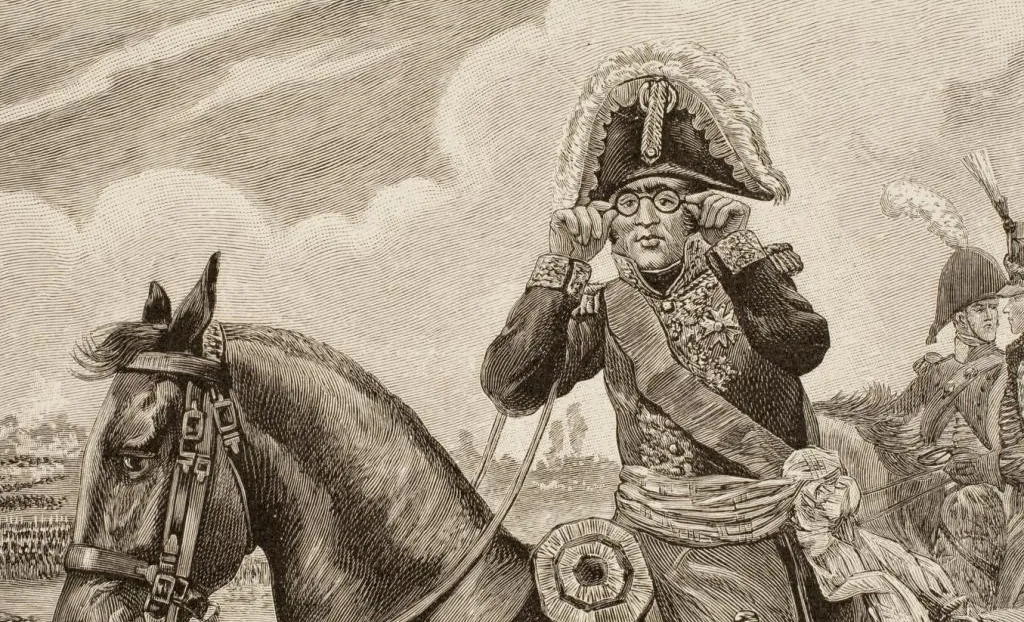
Jacques Onfroy de Bréville (1858–1931), Marshal Davout on the battlefield, engraving (detail) · Public domain · Source page
Fog on the plateau
Seven in the morning, and fog
14 October 1806, seven in the morning. On a bare plateau in the middle of Germany the fog is so thick that a man cannot see the next company. Out of it comes the sound of hoofs: Prussian cavalry.
In front of them stands a short-sighted French marshal in round spectacles, with about 26,000 men. Behind him is a single bridge over the river Saale. Some twenty kilometres away Napoleon is fighting at Jena, sure that he faces the whole Prussian army. He is wrong. The main Prussian army, with the king himself and perhaps twice as many men as the marshal has, is marching straight into Louis-Nicolas Davout.
Louis-Nicolas Davout
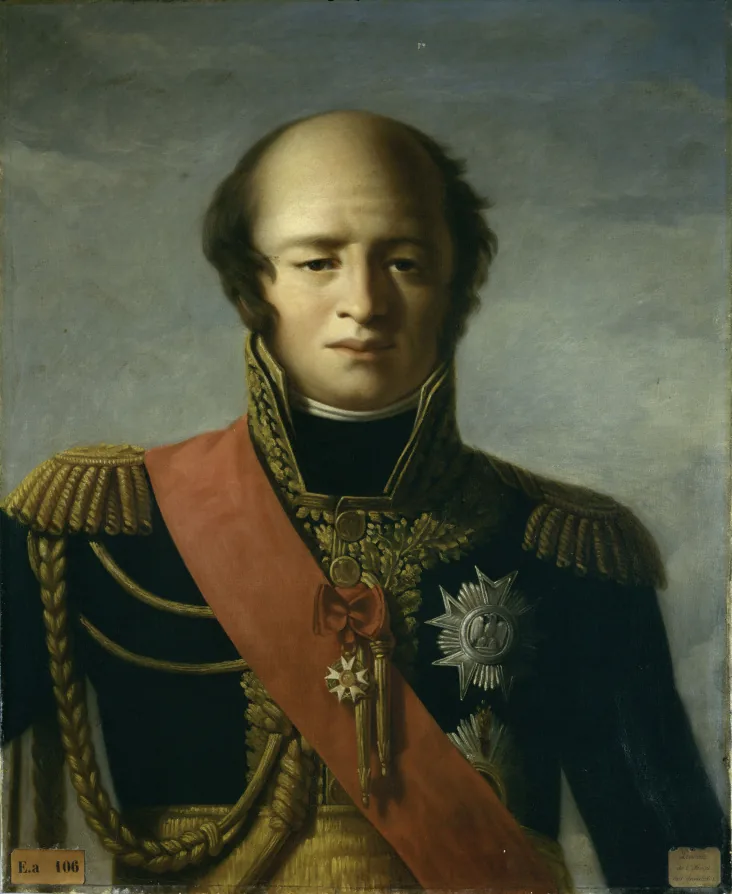
Pierre-Claude Gautherot, Louis-Nicolas Davout, c. 1805 · Public domain · Source page
A minor Burgundian nobleman who joined the Revolution, became Napoleon’s youngest marshal, and won his greatest battle against a force twice his own.
- Born: 10 May 1770, Annoux in Burgundy, eldest son of a cavalry officer from a minor noble family
- Died: 1 June 1823, aged 53, Paris, of an illness (tuberculosis is often named, but that is not certain)
- Won: Auerstedt, 1806; Teugen-Hausen and Eckmühl, 1809; Wagram, 1809 (on his wing)
- Lost: His corps shattered at Krasnoi, 1812; Göhrde, 1813 (a division of his corps, without him)
“...firmness of character, the first quality of a man of war.”
A Burgundian noble in a revolution
Background
A minor nobleman’s son
Louis-Nicolas d’Avout, later Davout, is born in 1770 in Annoux, a village in Burgundy, the eldest son of a cavalry officer. His father dies in a hunting accident in 1779, when the boy is eight. He goes to a royal military school run by Benedictine monks at Auxerre, and at 15 to the military school in Paris. By 1788 he is a junior officer in the Royal-Champagne cavalry, the regiment in which his father, grandfather and an uncle had served.
Myth
Davout was a classmate of Napoleon at the military school of Brienne.
The truth
Davout never studied at Brienne. The best-documented account of his schooling (Jean Linden, 1979) has him at Auxerre from December 1779, then at the military school in Paris, which he entered on 27 September 1785. Napoleon was still there for a month, but had already passed his final examination, and left for his regiment on 28 October. No source says that the two met.
The evidence
Many books still say Brienne, and even a notice at the entrance to the school there counts him among its pupils. Linden says plainly that he was never a pupil there, and Jean Tulard’s Dictionnaire Napoléon (1999) names Auxerre and Paris and leaves Brienne out. The claim is tempting: it ties two great men together.
The Revolution
The nobleman who sided with the people
The Revolution breaks out when he is 19. Unlike most of his fellow officers, Davout welcomes it. In 1790 he takes the soldiers’ side against the aristocratic officers of his regiment and spends some weeks in prison at Arras. In 1791 the volunteers of his home region elect him lieutenant-colonel and second-in-command of their battalion. In April 1793, when General Dumouriez deserts to the Austrians, Davout’s men fire on the fleeing commander-in-chief.
Then the Revolution turns on its own nobles. In July 1793, newly a brigadier general, he is promoted general of division. He refuses, pleading his noble birth, and resigns as a decree pushes the former nobles out of the army. After Robespierre falls he is back, and in September 1794, at 24, he is again a brigadier general.
Egypt
Desaix, Egypt and a marriage
On the Rhine, in 1796–97, he becomes the close friend of General Louis Desaix. In 1798 Desaix takes him to Egypt with Bonaparte. Davout commands his cavalry at the battle of the Pyramids and in the chase after the Mamluks up the Nile. There is evidence of harsh repression in Upper Egypt. In March 1800 the two friends sail for France; the British hold them up for a month, and Davout misses Marengo, where Desaix is killed on 14 June.
In November 1801 he marries Aimée Leclerc. Her brother, General Leclerc, is married to Napoleon’s sister Pauline. Davout enters the Bonaparte family, but not into Napoleon’s heart: Napoleon respected him and trusted him more than he liked him.
1804
The youngest marshal
In 1803 Napoleon sends him to a camp at Bruges, near the Channel coast, to build an army to invade England. Davout turns 25,000 men into the III Corps: long drills, wooden huts against the rain, punishment for plunder and slackness.
On 19 May 1804, at 34, he is one of the eighteen marshals of the Empire, and the youngest. Beside Masséna, the hero of Zurich, he is a newcomer. All his life he will have to prove he deserves it. (Napoleon’s own story is told in his lesson.)
Auerstedt, 1806
1805
110 kilometres in two days
110 km
In the autumn of 1805 Austria and Russia attack Napoleon. Davout’s III Corps is near Vienna when the Emperor calls it to the field of Austerlitz, in Moravia. The forced march sets out on the night of 29–30 November: about 110 kilometres in some two days, with full packs. On 2 December only part of the corps arrives, a few thousand men of Friant’s division and some dragoons, but they hold the French right at the villages of Telnitz and Sokolnitz against far bigger columns, while Soult takes the Pratzen Heights in the centre. (The battle is told in the Soult lesson.)
October 1806
Napoleon’s mistake
In 1806 Prussia declares war. Napoleon marches into Saxony so fast that on 13 October his men see the enemy’s campfires on the hills by Jena. He takes it for the whole Prussian army and orders an attack at dawn. In fact it is only about half of it. The main army, under the aged Duke of Brunswick and with King Frederick William III in the camp, is marching north-east, along the road that passes the village of Auerstedt and heads for the Kösen pass.
Davout has already taken Naumburg. At 3 a.m. on 14 October he receives Napoleon’s order, written the night before: march by Kösen on Apolda and fall on the enemy’s rear. So the III Corps climbs out of the Saale valley, in fog, straight towards the Prussian army.
A decision point
You are Marshal Davout.
14 October 1806, about 7 a.m., on the plateau west of the river Saale
You left Naumburg before dawn, crossed the Saale at Kösen and climbed onto this plateau behind Gudin’s division, in thick fog. Your scouts have just run into Prussian cavalry, and Gudin’s leading regiments are reaching the village of Hassenhausen. You do not know how many Prussians are near.
Friant’s and Morand’s divisions are still on the road behind you, and behind them is the single bridge over the Saale. Bernadotte is close, but does not answer to you. The plateau is flat as a table. Hassenhausen, with its orchards, fences and a sunken road, is the only strong ground on it.
What do you do?
- Pull Gudin back to the pass at Kösen and hold the river crossing with the whole corps You would probably have kept the bridge, but your three divisions would have fought with the river at their backs and the Prussians would have owned the plateau. Napoleon’s plan to strike the enemy’s rear would have died, and a retreat down the narrow, steep road with the enemy close behind could easily have turned into a rout.
- Hold Hassenhausen with Gudin and rush up Friant and Morand as fast as they can march Gudin’s men held the village until the others arrived: the first Prussian cavalry charges broke on the French squares in the fog, and the French won the time they needed.
- Send word to Napoleon and Bernadotte and wait for orders before committing to a fight Napoleon was some twenty kilometres away and fighting himself. A rider would have needed hours to go and come back, and the Prussians would not have waited. Gudin would probably have been overrun before any answer came.
What really happened
Hold Hassenhausen with Gudin and rush up Friant and Morand as fast as they can march
Davout held. He told Gudin to defend Hassenhausen, rode forward himself and sent officers back to hurry Friant and Morand. Gudin’s infantry formed squares in the fog, and the Prussian cavalry charged them again and again and was thrown back.
The English historian F. Loraine Petre, drawing on Davout’s own account, gives the reason: between Hassenhausen and the edge of the plateau there was no point of support. Lose the village and Gudin would be broken before help arrived; hold it and the others could come up. Other historians add that the Prussians were slow to grasp what they faced, and that he was lucky as well as bold.
Auerstedt: who fought whom
14 October 1806
The plateau at Hassenhausen, about 10 km west of Naumburg
France: the III Corps
- Commanders: Davout, Gudin, Friant and Morand, the division commanders
- Strength: 26,000 men, 44 guns (Davout’s own report); about 29,000 (Lettow-Vorbeck (1890s), via Petre); 25,000 (Marbot (memoirs))
- Losses: about 7,050, over a quarter of the corps (Davout’s report); 1,000–1,200 killed and 3,000 wounded (Napoleon’s bulletin (whole army, both battles))
Davout’s corps alone lost more than the bulletin admits for the whole army.
Prussia: the main army
- Commanders: The Duke of Brunswick (commander in name), King Frederick William III present; Blücher, Schmettau, Wartensleben, Prince William and Kalckreuth
- Strength: about 49,800, 230 guns (Höpfner (1850–51) and Lettow-Vorbeck (1890s), via Petre); about 53,000 (37,000 plus a late reserve of 15,750) (Digby Smith (1998)); more than 60,000, 230 guns (Jean Linden (1979)); more than 80,000 (Marbot (memoirs)); 50,000 (Napoleon’s 5th bulletin)
- Losses: 15,000 killed and wounded, 3,000 prisoners, 115 guns (Davout’s report); 10,000–15,000 killed and wounded and about 3,000 prisoners (Modern estimates); admits at least 57 guns (Höpfner (1850–51), via Petre)
Outcome: A French victory. The main Prussian army loses its line of retreat and, within weeks, ceases to exist as a fighting force.
The numbers differ because they count different things, and because French writers liked a bigger enemy. On the higher counts the Prussians were more than twice as many; on the lowest, about 1.7 to 1.
The battle of Auerstedt
14 October 1806, from about seven in the morning to half past four in the afternoon
On 14 October 1806, at about seven in the morning, Davout's III Corps, some 26,000 men, climbs in thick fog onto a flat plateau west of the river Saale. Napoleon takes the campfires near Jena for the whole Prussian army, but about half of it is marching north-east along the road past Auerstedt.
A reconstruction after F. Loraine Petre, Napoleon’s Conquest of Prussia, 1806 (1907), pp. 149–163, which draws on Davout’s own report and the German histories of Höpfner and Lettow-Vorbeck, checked against modern maps of the villages. Times are approximate to about half an hour, and the exact place of each unit is not known. The village of Spielberg, the Sonnenberg heights and the hamlet of Poppel are placed approximately. Units are drawn smaller than life: a deployed division covered about a kilometre of front.
Phases of the battle
- Contact in the fog About seven o’clock. Gudin’s leading regiment has come out of the Kösen pass and, in the fog, runs into Blücher’s cavalry near Poppel. Gudin seizes Hassenhausen and posts troops on each side of the road. Friant and Morand are still coming up; the Prussian divisions arrive from the south-west one by one.
- Blücher’s charges From seven to about half past eight. Blücher leads some 1,150 horsemen to the north and charges Gudin’s squares north of the road again and again. The squares hold, and Davout rides from one to the next. Friant’s first regiment arrives, and the Prussian horse flees into the woods beyond Spielberg.
- The village holds From half past eight to ten. Davout sends Friant to the right, to the north, not to his hard-pressed left. Schmettau and Wartensleben attack Hassenhausen again and again, and the 85th is pushed back to the road. About ten the Duke of Brunswick is shot through both eyes and Schmettau is mortally wounded. The Prussian command falls apart.
- Morand on the left: the turn From ten to about noon. Morand arrives in columns and deploys south of the road, just as Gudin’s left is about to break. Prince William’s cavalry charges him without any common plan and breaks on his squares. Morand takes the Sonnenberg heights, and Friant pushes on from Spielberg towards Poppel: the high ground on both flanks is in French hands. About eleven Davout orders a general counter-attack.
- The Prussians fall back From noon to half past four. From both hills French guns fire along the Prussian line, and Gudin storms forward in the centre and takes Taugwitz. Kalckreuth’s reserve covers the retreat westwards. At half past four the French enter Eckartsberga. Davout has almost no cavalry for the pursuit, and his men are exhausted.
The strategy
- French: III Corps: Napoleon wants Davout to march through Kösen and strike the enemy's rear. But in the fog the corps finds itself facing the main Prussian army, so Davout holds Hassenhausen with Gudin and hurries up Friant and Morand.
- Prussians: The main Prussian army marches north-east towards the Kösen pass. Blücher's cavalry charges the French squares again and again, while Schmettau and Wartensleben attack Hassenhausen, the only strong ground on the plateau. This reconstruction does not explain why they took this route.
What decided it: The village and the French squares held, and Morand reached the left just as it was about to break. After the Duke of Brunswick and Schmettau were wounded, the Prussian command fell apart.
Charles William Ferdinand, Duke of Brunswick
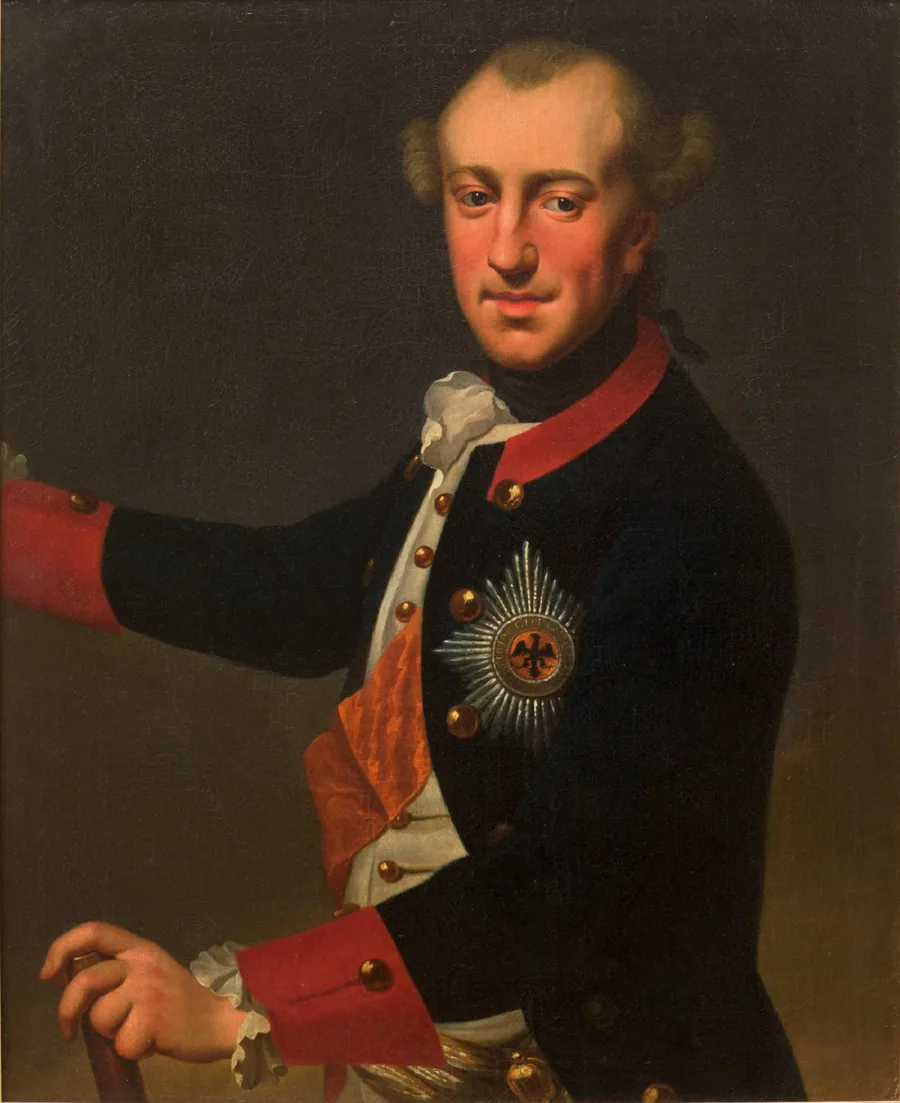
After Johann Georg Ziesenis, Charles William Ferdinand, Duke of Brunswick, c. 1780 · Public domain · Source page
The most famous general of old Prussia: his name stood on the 1792 manifesto threatening Paris, and at 71 he was shot through both eyes at Auerstedt.
- Born: 9 October 1735, Wolfenbüttel, Germany
- Died: 10 November 1806, Ottensen, near Altona, of his wound, in exile
- Won: Holland, 1787; Kaiserslautern, 1793
- Lost: Valmy, 1792 (the invasion of France halted); Auerstedt, 1806
“Brunswick usurped his reputation.”
Source: “The battle of Jena”: Napoleon’s bulletin
“On our right, Marshal Davout’s corps worked wonders. Not only did it hold, it drove back for more than three leagues the bulk of the enemy troops who were to come out on the Kösen side. This marshal showed distinguished courage and firmness of character, the first quality of a man of war.”
Written the day after the battles, to be printed in the French newspapers and read across Europe, this bulletin carries a single name, “Jena”, and says that the Prussian army, nearly 150,000 strong, was beaten there.
- Whom was the bulletin written for, and what does it call the day’s fighting? For the French public and for Europe: it is propaganda as much as news. Napoleon calls it all “the battle of Jena”, so Davout’s fight against the main Prussian army becomes an episode “on our right” of Napoleon’s own battle.
- The bulletin puts the whole army’s losses at about 4,000 killed and wounded; Davout reported about 7,000 in his corps alone. What does that tell you? That the bulletin shrinks the cost of victory and cannot be trusted for numbers. The praise of Davout is real, but in Napoleon’s story Napoleon’s battle comes first.
After
On the plateau, then and after
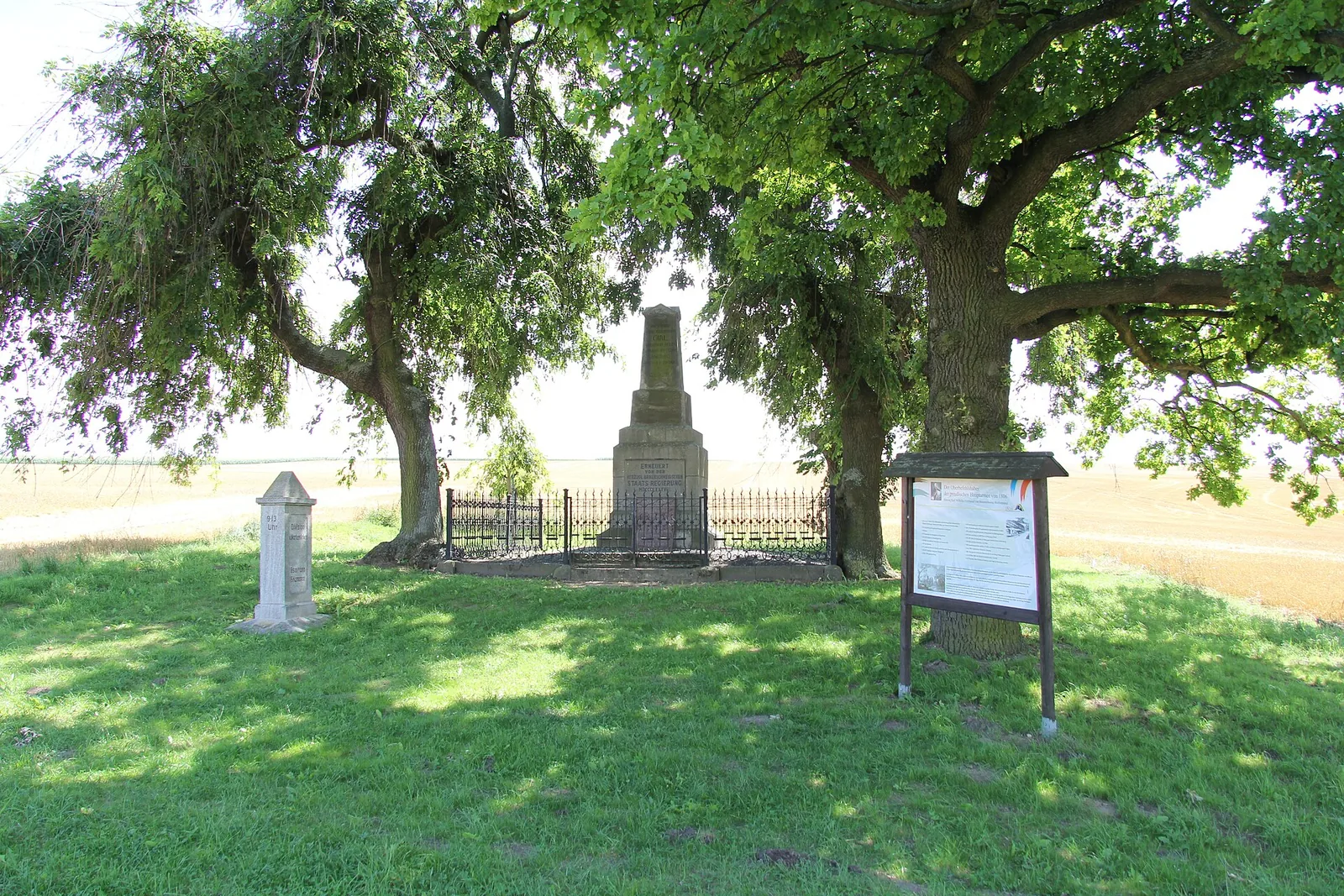
Monument to the Duke of Brunswick, Hassenhausen (Bad Kösen), 2012. Photo: Rabe! · CC BY-SA 3.0 · Source page
Where the Duke fell a monument now stands in open fields. He was carried away blind and died at Ottensen, near Altona, on 10 November. The Prussian army does not recover: on 25 October Davout’s corps is the first into Berlin, and by 7 November the last Prussian field forces west of the Oder have surrendered.
Prince of Eckmühl, 1807–1811
1807
Snow at Eylau
8 February 1807, East Prussia, a snowstorm. Napoleon is fighting the Russians at Eylau, and his centre is bleeding. At midday Davout’s corps, about 15,000 men, comes up and attacks the Russian left flank. He drives it back, until at four in the afternoon some 9,000 Prussians under Lestocq arrive and push him back in turn. At nightfall the battle ends with no winner and tens of thousands of dead and wounded on the snow. The Russians withdraw in the night.
After the peace of Tilsit in July 1807, Davout stays in the east as governor of the Duchy of Warsaw, and in March 1808 he becomes Duke of Auerstedt.
1809
Alone against the Archduke
In April 1809 Austria invades Bavaria. Because of muddled orders from headquarters, Davout stands alone near Regensburg on the Danube with about 35,000 men, closer to Archduke Charles’s Austrian army than to any French help. He slips away to the south-west, and on 19 April at Teugen-Hausen he fights off attacks by two Austrian corps that try to block his way. On 22 April, at Eckmühl, he pins the Austrians until Napoleon arrives from the south, and the Archduke retreats across the Danube.
On 6 July, at Wagram near Vienna, Davout’s corps turns the Austrian left at Markgrafneusiedl, and his horse is shot under him. (Masséna’s Wagram was in the previous lesson.) Napoleon makes him Prince of Eckmühl. From the end of 1810 he governs Hamburg and the North Sea ports, and there he enforces the Continental System with a hard hand.
Russia and Hamburg, 1812–1814
1812
The biggest corps
In June 1812 Davout crosses the Niemen into Russia at the head of the I Corps, about 70,000 men, the biggest in the army. At Minsk and Mogilev he almost traps Bagration’s army, but the Russians slip away. At Borodino, on 7 September, he leads an assault on the Russian earthworks himself, his horse is shot, and he is thrown down so hard that word reaches Napoleon that he is dead. He returns to the fight badly bruised. Napoleon reaches Moscow, but the Tsar does not give in.
The retreat
Snow, Cossacks and a quarrel
In October the retreat from Moscow begins, and Davout commands the rearguard. He stops to gather the stragglers, and Napoleon complains that he is too slow and methodical. After Vyazma, early in November, Ney replaces him. On 17 November, near Krasnoi, Russian guns tear his corps apart. Cossacks take his baggage, his maps and even his marshal’s baton. Of the corps only a few thousand men are left.
Ney, further back, is cut off and escapes only by night across the ice of the Dnieper. He accuses Davout of abandoning him; Davout’s defenders answer that he followed Napoleon’s orders.
Hamburg
A city under siege
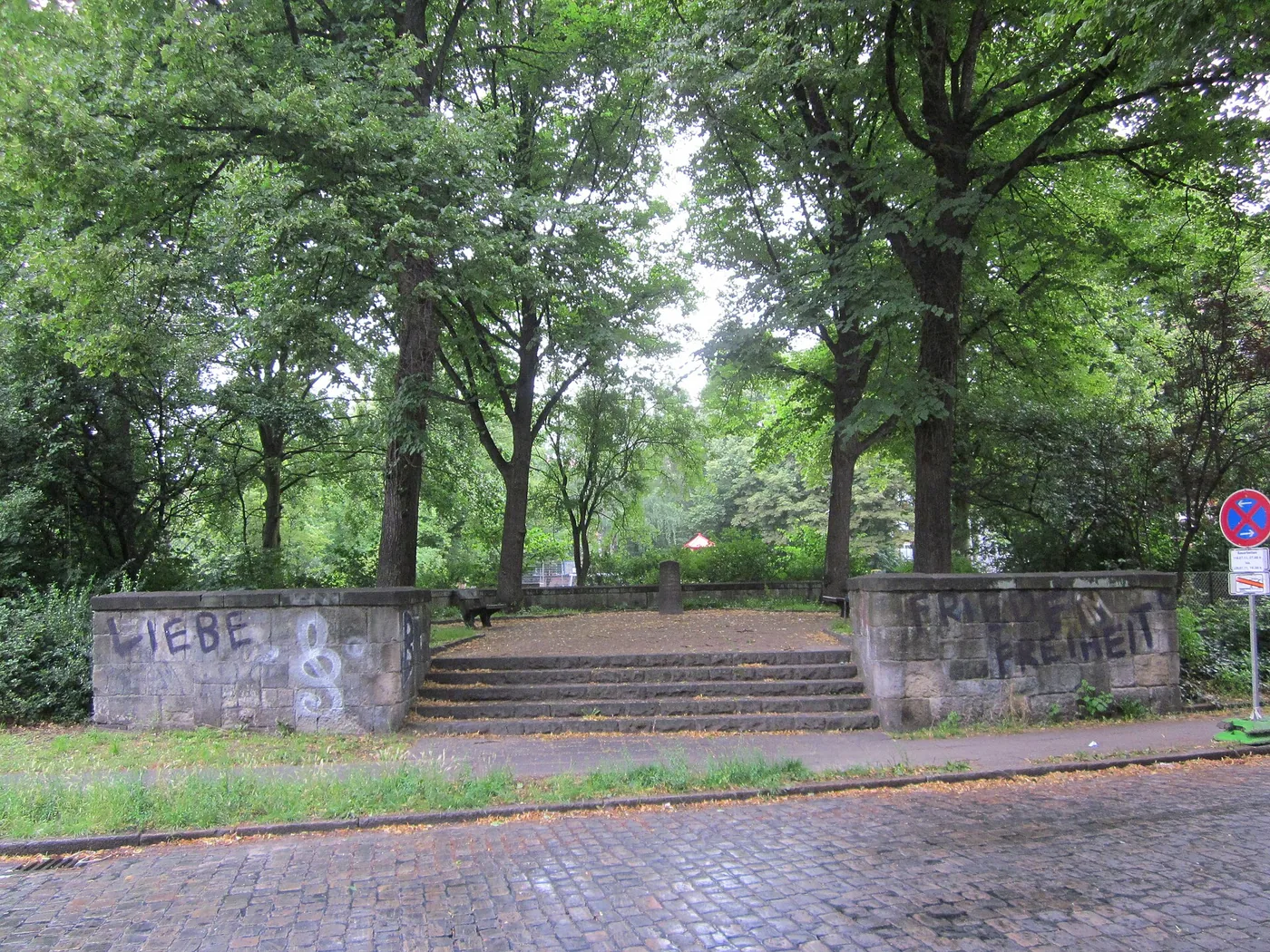
Memorial stone for the victims of the French occupation, Hamburg-Barmbek, 2011. Photo: Claus-Joachim Dickow · CC BY-SA 3.0 · Source page
In May 1813, after a rising against the French, Davout retakes Hamburg. Napoleon lays a heavy war levy on the city. Davout turns the city into a fortress, pulling down houses near the walls. After Napoleon’s defeat at Leipzig in October he is cut off, and in November he seizes the funds of the Bank of Hamburg to pay his troops.
In December the siege closes. To make the food last for the garrison, Davout expels everyone who has not laid in six months’ supplies. On 24–26 December, in freezing cold, many thousands leave the city, most of them poor. Many die of cold and typhus in neighbouring Altona and on the roads.
A decision point
You are Marshal Davout.
Late April 1814, besieged Hamburg
For four months you have held Hamburg against a far bigger army, with a garrison that began at about 40,000 men, many of them sick. You have no contact with France.
Now the commander of the besiegers, the Russian general Bennigsen, sends you news: Napoleon abdicated on 6 April, and the Bourbons have been called back to the throne. So, he says, you must hand over the city. A letter from Tsar Alexander confirms it. But no messenger from any French government has reached you.
What do you do?
- Accept the news and hand the city to the besiegers on the best terms you can get You would probably have saved a few weeks of siege, but you would have given a whole city and an army to the enemy on his word alone. Had the news turned out to be a trick, you would have been called a traitor.
- Refuse to take news from the enemy, and hold until an order comes from France itself The city stays in your hands and the garrison stays whole, but the siege and the townspeople’s suffering go on for weeks after the war has already been decided.
- Break out westwards with the garrison towards France before everything closes in Several hundred kilometres through enemy country, with thousands of sick and no supplies, against bigger armies. Most of the garrison would probably have been captured or scattered on the way.
What really happened
Refuse to take news from the enemy, and hold until an order comes from France itself
Davout refused to believe news from the enemy. When the besiegers showed a white flag with the Bourbon lilies in front of the French outposts, he ordered it fired on. Only on 28 April did he agree to an armistice, and the next day the Bourbons’ white flag flew over the city. On 11 May General Gérard arrived from Paris with the new government’s orders, and at the end of May about 26,000 fit men marched out of the city with their weapons.
In his view a soldier does not hand over a fortress on what the enemy tells him, only on an order from his own government. His admirers see loyalty and discipline in it; his critics in Hamburg see an obstinacy that drew out the city’s suffering. In 1814 the king’s government accused him over the flag, the bank and arbitrary acts, but in July it dropped the matter.
Myth
Davout was never defeated.
The truth
Davout never lost a battle in which he was in overall command on the field. “Never defeated” is a wider slogan than that. At Eylau Lestocq’s Prussians drove him back; in 1812 Bagration slipped away from him, his corps was mauled at Vyazma and, under Napoleon’s eye, torn apart at Krasnoi; and in September 1813 one of his divisions was beaten at the Göhrde, without him.
The evidence
The words “the only marshal of the Empire who was never defeated” even appear in the Fondation Napoléon’s online biography, taken from Tulard’s Dictionnaire Napoléon. The battles themselves show a more complicated picture: an outstanding commander, not an unbeatable one.
The Hundred Days and the end, 1815–1823
A decision point
You are Marshal Davout.
20 March 1815, Paris
Since you came back from Hamburg you have lived on your estate at Savigny, away from court. The king’s ministers accused you, and Louis XVIII gave you no post. Now Napoleon has landed from Elba, reached Paris without firing a shot, and the king has fled. The Hundred Days have begun.
Napoleon offers you the Ministry of War. Europe’s kings have declared him an outlaw and are raising armies. The Bourbons sent many soldiers home, and someone must rebuild the army within months. But a minister sits in Paris, and you may be the best field commander Napoleon has left.
What do you do?
- Accept the Ministry of War and build the army The army of 1815 is built with surprising speed, but you stay in Paris when it goes to war.
- Ask for a command in the field instead of the ministry You might have gone to Belgium in June in place of another marshal, but the ministry would have passed to a weaker man, and part of the army might not have been ready in time.
- Refuse and stay out of politics You would probably have stayed suspect to both sides: a traitor in Napoleon’s eyes, and still the Emperor’s marshal in the eyes of the Bourbons.
What really happened
Accept the Ministry of War and build the army
Davout refused at first, so his biographers say, and then accepted. In under three months he raised, armed and clothed a large army again. When Napoleon left for Belgium on 12 June, Davout stayed in Paris as minister and governor of the city. He was not at Waterloo on 18 June.
Napoleon needed an honest, hard and loyal man in Paris to hold the rear and the War Ministry. Historians have asked ever since whether he would have served better in Belgium.
Source: “Proclamation of the Minister of War”
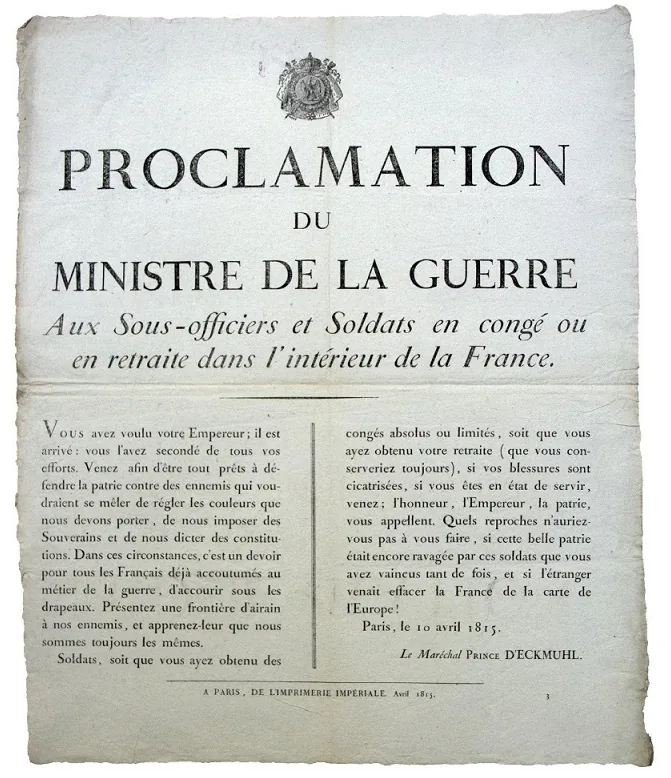
Proclamation of the Minister of War, 10 April 1815. Photo: Damned · CC BY-SA 4.0 · Source page
Printed sheet, Imperial Printing House, Paris, 10 April 1815
A sheet like this was meant to be posted on walls. It speaks to non-commissioned officers and soldiers on leave or retired, and calls them back to the army.
- When was it printed, and what does that tell you about the army? Only three weeks after Napoleon’s return. Calling back men on leave and in retirement shows that the army of 1815 had to be rebuilt from soldiers the Bourbons had sent home.
- How is the sheet signed, and why does it matter? “The Marshal Prince of Eckmühl”: a title from Napoleon that recalls a victory. It is an administrative paper, but propaganda too, recruiting with the glory of Eckmühl.
After Waterloo
The marshal who stood up for others
After Waterloo Napoleon abdicates again, and Davout commands the army around Paris. His envoys negotiate with Wellington and with Blücher, who had charged him at Auerstedt. Under the agreement of 3 July the army leaves Paris for beyond the Loire, and Article 12 promises that no one will be pursued for their acts or opinions. On 14 July Davout submits to the king.
When the king publishes a list of officers to be put on trial, Davout writes to the new Minister of War, Gouvion Saint-Cyr, that they only carried out his orders, and asks to be tried in their place. In December he testifies at Marshal Ney’s trial and says that Article 12 was meant to protect men like him. The Chamber of Peers will not let the defence rely on it, and Ney is shot on 7 December 1815.
Davout is sent to live at Louviers in Normandy and loses his pay. In 1817 his marshal’s baton is restored, in 1819 he enters the Chamber of Peers, and in 1822 he becomes mayor of Savigny-sur-Orge. He dies in Paris on 1 June 1823, aged 53, and is buried at Père Lachaise.
Source: Two Napoleons on one man
“Fouché betrayed me; Davout let himself be deceived. Bah! he betrayed me too. He has a wife and children; he thought that all was lost; he wanted to keep what he had got.”
Gourgaud was Napoleon’s aide in exile, and noted his words in a journal published only in 1899. In the same book the French editor reports a note Napoleon once wrote in the margin of a book that attacked Davout: “Young man, do not insult one of the most pure and glorious men in France.”
- The two sentences contradict each other. What does that teach about Napoleon’s St Helena words as a source? That in exile Napoleon was shaping his memory and explaining his defeat, settling scores as the mood took him. Each such sentence tells us more about Napoleon than about Davout.
- What weakens the margin note as evidence? It reaches us second-hand, through a French editor who says the book is kept at Sens. Gourgaud’s journal, too, is a single witness, and in translation.
Myth
Davout was nothing but a cold and cruel disciplinarian.
The truth
He really was hard: endless drills at Bruges, repression in Egypt, the winter expulsion from Hamburg. But the same man faced down his own volunteers in 1792 to save seven prisoners from a lynching, asked in 1815 to be tried in place of his subordinates, and testified for Ney, with whom he had quarrelled.
The evidence
The 1792 story comes from his biographer Jean Linden: the volunteers levelled their muskets at him, and he still would not give way. He was severe and honest, loyal to duty as he understood it, and harsh when he thought duty required it. Both halves are true.
What came after
- 1806 After Jena and Auerstedt the Prussian army falls apart within a month.
- 1807 The Treaty of Tilsit: Prussia loses about half its territory.
- 1807–1813 Prussian reformers such as Scharnhorst, who fought at Auerstedt, rebuild the army.
- 1815 Blücher, beaten at Auerstedt, helps to decide Waterloo.
- 1817 Hamburg sets up a memorial stone to the inhabitants expelled during the siege.
- 1823 Davout dies in Paris. His name is carved on the Arc de Triomphe, completed in 1836.
What explains Auerstedt, and how should Davout be judged?
Was Auerstedt above all Davout’s work, and where does Hamburg belong in judging him?
- The biographers: François-Guy Hourtoulle (1975), John Gallaher (1976), Pierre Charrier (2005) Davout was a tactician of the first rank: he read the situation quickly, was always at the decisive point, and sent Friant to the right instead of shoring up his left. The discipline of the III Corps, which he had built himself, let the squares stand in the fog. A saying attributed to Hourtoulle has it that at Jena Napoleon won a battle he could not lose, and at Auerstedt Davout won a battle he could not win.
- F. Loraine Petre (1907) and the historians of numbers A great feat, but also the result of Prussian failures: there was no unity of command, the cavalry attacked “without any common direction or object”, the divisions came up piecemeal, and the reserve came late. German figures such as Lettow-Vorbeck’s cut the odds to about 1.7 to 1. Davout won, but not against a whole army at once.
- Hamburg: Helmut Stubbe da Luz (2009) against Charrier (2005) Charrier finds little fault with Davout as governor, and sees the siege as a matter of honour to his memory. Stubbe da Luz, from Hamburg’s side, replies that the subject is still sensitive and that the memory of the expelled townspeople and the seized bank must enter the judgement. The reviewer Frederick Schneid wrote that the burghers of Hamburg “would sorely disagree” with Charrier.
Can one admire the commander of Auerstedt and at the same time judge the governor of Hamburg harshly? And what would have happened if the Prussians had been better co-ordinated?
What do you know now?
Check yourself
What was Napoleon’s mistake on 14 October 1806?
Answer: He thought he was fighting the main Prussian army at Jena, but the main army met Davout at Auerstedt. Right. At Jena he faced only part of the Prussian army; the main army, with the king and the Duke of Brunswick, marched into Davout.
Check yourself
Why did Davout decide to hold Hassenhausen rather than fall back to the Kösen pass?
Answer: Because the village was the only strong ground on the plateau, and a retreat with the river behind could have become a rout. Right. Between the village and the edge of the plateau there was no point of support. If the village held, Friant and Morand could come up.
Check yourself
Napoleon’s bulletin puts the whole army’s losses at about 4,000 killed and wounded. What does that teach?
Answer: That the bulletin shrank the cost of the victory, because it was propaganda too. Right. It was written for the French public and for Europe, and presented the day as one great, cheap victory of Napoleon’s at Jena.
Check yourself
Which is the most accurate thing to say about Davout?
Answer: He never lost a battle in which he was in overall command on the field. Right. It is a narrow claim, but a defensible one.
Check yourself
Why did Davout refuse to hand over Hamburg in April 1814?
Answer: Because he would not take news from the enemy, and waited for an order from his own government. Right. Only once the news was confirmed did he agree to an armistice, and in May he handed over the city on orders from Paris.
Check yourself
Why was Davout not at Waterloo?
Answer: Because Napoleon left him in Paris as Minister of War and governor of the city. Right. Napoleon needed him in the rear, and historians still ask whether that was a mistake.
Terms
- corps A small self-contained army, usually of 15,000 to 30,000 men, with its own infantry and cavalry divisions, guns and staff, led by a marshal or general. Napoleon’s corps marched apart and joined to fight. Davout’s was the III Corps.
- Marshal of the Empire The highest rank in Napoleon’s army. On 19 May 1804 Napoleon named eighteen marshals of the Empire; Davout was the youngest of them.
- forced march A march much faster than usual, for a day or more, with almost no rest. The soldiers arrive exhausted, but at a place where the enemy does not expect them.
- square Infantry standing in a hollow box, bayonets out on every side. Cavalry could rarely break a steady one.
- flank The side of an army, its weak point: the men there face forward, not towards an enemy coming in from the side.
- bulletin An official report on a campaign, dictated by Napoleon himself and printed in the French newspapers. It was news and propaganda at once.
- rearguard The force that marches last in a retreat and holds off the pursuers so that the rest can get away. The most dangerous job in a retreat.
- Continental System Napoleon’s ban, from November 1806, on trade between Britain and continental Europe, meant to ruin Britain’s economy. It hit ports such as Hamburg hard.
- siege Surrounding a fortified city to starve it or batter it into surrender.
- Hundred Days March to July 1815: from Napoleon’s return to Paris from Elba on 20 March to Louis XVIII’s return on 8 July. Waterloo, on 18 June, decided them.
- Division A large unit of an army, made up of several regiments. Several divisions make up a corps.
- Infantry The foot soldiers of an army, who fight on foot rather than on horseback.
- Dragoons A kind of cavalry that could also fight on foot. They rode to the battle, then dismounted to fight.
- War levy Money a conqueror demands from a conquered town, as punishment or as a war tax. Napoleon imposed one on Hamburg.
- Garrison The troops left in a town or fortress to defend it.
- Austerlitz A battlefield in Moravia, now in the Czech Republic, where Napoleon defeated the Austrian and Russian armies.
- Eylau A town in East Prussia. Napoleon fought the Russians there in a snowstorm, and neither side clearly won.
- Wagram A village near Vienna, where Napoleon fought the Austrians in a major battle in July.
- Regensburg A city in Bavaria on the Danube. Davout stood there alone when the Austrians invaded.
- Borodino A village near Moscow, site of one of the great battles of Napoleon's march into Russia.
- Krasnoi A town in Russia where Russian artillery tore Davout's corps apart in November.
- Leipzig A city in Germany, where Napoleon was defeated in a great battle in October. Davout was cut off from him afterwards.
- Tilsit A town in East Prussia, where a peace treaty between Napoleon, Russia and Prussia was signed in July.
- Louis Desaix A French general and Davout's close friend. He took Davout to Egypt and was killed at Marengo.
- Bernadotte Commander of the I Corps, who took part in neither battle that day. He later became king of Sweden.
- Gudin A French general whose infantry formed squares to beat back the Prussian cavalry near Hassenhausen.
- Lestocq A Prussian commander who arrived at Eylau in the afternoon and pushed Davout back.
- Gourgaud A French general, Napoleon's aide in exile, who noted his words in a journal. He attacked the accuracy of Ségur's account of a talk with Davout.
- Marbot A French officer who wrote memoirs decades after the battles. His claims about Bernadotte are not backed by evidence.
- Ney A French marshal who replaced Davout in command of the rearguard during the retreat from Russia. After Waterloo he was tried and shot.
- Masséna A veteran French marshal, known as the hero of Zurich.
- Dumouriez A French general who deserted to the Austrians during the French Revolution.
Sources
- Napoleon, 5th Bulletin of the Grand Army, Jena, 15 October 1806, in Œuvres de Napoléon Bonaparte, vol. 4 (Paris: Panckoucke, 1821). French text, Project Gutenberg no. 13192
- Philippe-Paul de Ségur, History of the Expedition to Russia, undertaken by the Emperor Napoleon in the year 1812, vol. 1, book 7, ch. 7 (London: Treuttel and Wurtz, 1827; first French edition 1824)
- Louis-Nicolas Davout, Proclamation du ministre de la Guerre aux sous-officiers et soldats en congé ou en retraite, Paris, 10 April 1815 (printed sheet, Imprimerie impériale)
- General Baron Gourgaud, Talks of Napoleon at St. Helena, trans. Elizabeth Wormeley Latimer (Chicago: A. C. McClurg, 1903), pp. 125, 194, 264–265
- Baron de Marbot, The Memoirs of Baron de Marbot, trans. Arthur John Butler, vol. 1 (London: Longmans, Green, 1892), pp. 229–231
- Procès-verbal of the trial of Marshal Ney before the Chamber of Peers, 4–6 December 1815 (Paris: Didot, 1815), witness no. 32
- Friedrich Rückert, “Die Gräber zu Ottensen: Erstes Grab” (1814), in Werke, vol. 1 (Leipzig and Vienna, [1897]), pp. 29–31
- Jean Tulard (ed.), Dictionnaire Napoléon, 2 vols (Paris: Fayard, 1999)
- Fondation Napoléon, “DAVOUT ou D’AVOUT, Louis-Nicolas, duc d’Auerstaedt, prince d’Eckmühl (1770–1823), maréchal”, notice from J. Tulard (ed.), Dictionnaire Napoléon (1999)
- F. Loraine Petre, Napoleon’s Conquest of Prussia, 1806 (London: John Lane, 1907), pp. 149–174
- John G. Gallaher, The Iron Marshal: A Biography of Louis N. Davout (Carbondale: Southern Illinois University Press, 1976)
- Pierre Charrier, Le Maréchal Davout (Paris: Nouveau Monde éditions / Fondation Napoléon, 2005)
- François-Guy Hourtoulle, Davout le Terrible (Paris: Maloine, 1975)
- David G. Chandler, The Campaigns of Napoleon (New York: Macmillan, 1966); and (ed.), Napoleon’s Marshals (New York: Macmillan, 1987)
- Richard K. Riehn, 1812: Napoleon’s Russian Campaign (New York: McGraw-Hill, 1990); Adam Zamoyski, 1812: Napoleon’s Fatal March on Moscow (London: HarperCollins, 2004)
- Jean Linden, ‘Davout, homme de devoir. 1. Le soldat’, Revue du Souvenir napoléonien, no. 303 (January 1979), pp. 4–20
- Frederick C. Schneid, review of Pierre Charrier, Le Maréchal Davout, H-France Review 6, no. 135 (October 2006)
- Helmut Stubbe da Luz, ‘Le maréchal Davout, “le beau siège de Hambourg” en 1813/14 et “le nom français”’, Francia 36 (2009)
Image credits
- Jacques Onfroy de Bréville (1858–1931), Marshal Davout on the battlefield, engraving (detail) · Public domain · Source page
- Pierre-Claude Gautherot, Louis-Nicolas Davout, c. 1805 · Public domain · Source page
- After Johann Georg Ziesenis, Charles William Ferdinand, Duke of Brunswick, c. 1780 · Public domain · Source page
- Monument to the Duke of Brunswick, Hassenhausen (Bad Kösen), 2012. Photo: Rabe! · CC BY-SA 3.0 · Source page
- Memorial stone for the victims of the French occupation, Hamburg-Barmbek, 2011. Photo: Claus-Joachim Dickow · CC BY-SA 3.0 · Source page
- Proclamation of the Minister of War, 10 April 1815. Photo: Damned · CC BY-SA 4.0 · Source page


