Cyrus the Great
A minor king from the hills of Persia built the largest empire the world had yet seen, and was praised even by peoples he conquered.
Decisions, questions and your own progress, in the app
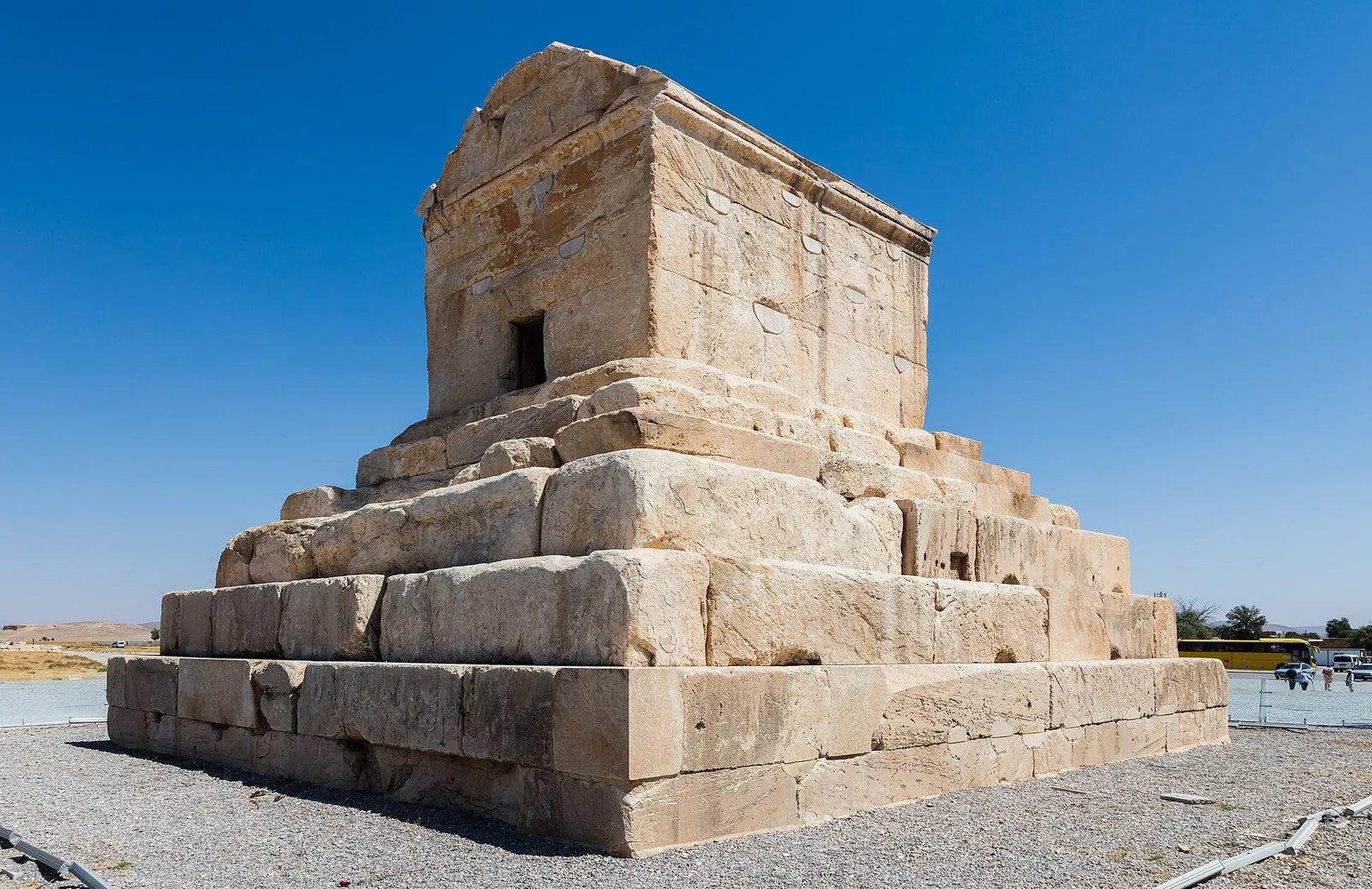
Tomb of Cyrus, Pasargadae, Iran. Photo: Diego Delso, 2016 · CC BY-SA 4.0 · Source page
The tomb in the plain
A narrow door
Pasargadae, in the highlands of Persia, 324 BC. Alexander the Great, back from India, finds the tomb of Cyrus broken open.
A stone house on six giant steps, with a door so narrow, wrote his officer Aristobulus, that “even a small man could with difficulty enter.” Robbers have torn the lid off the golden coffin and thrown out the body. Alexander, says Plutarch, executes the culprit, a Macedonian noble.
Why would the conqueror of Persia care about its founder? Because two centuries on, Cyrus was still the king everyone wanted to be compared with. Persians called him “the father”, the Book of Isaiah calls him God's “anointed”, Babylonian scribes wrote that their god had chosen him, and Greeks made him the hero of a novel about the perfect ruler.
He began as a minor king in the hills of Persia. In about twenty years he conquered the Medes, Lydia and Babylon, and built the largest empire the world had yet seen. How did he do it? And how far does he deserve his good name?
Cyrus II, “the Great”
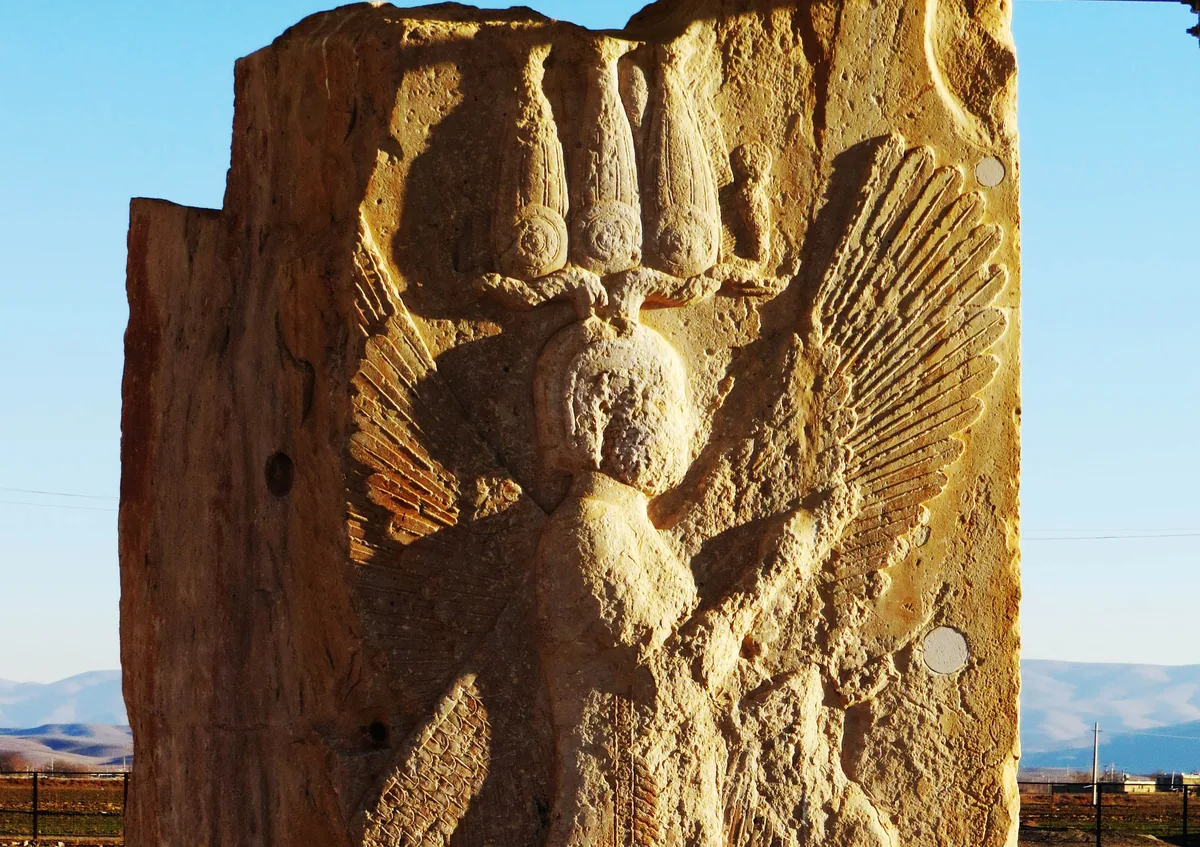
Winged guardian relief, Gate R, Pasargadae, Iran; not a portrait of Cyrus. Photo: Nima Boroumand, 2016 · CC BY-SA 4.0 · Source page
A minor king of Anshan who in twenty years conquered the Medes, Lydia and Babylon, and was remembered well even by peoples he conquered.
- Born: c. 600–590 BC (an estimate), Probably Persis, south-west Iran
- Died: 530 BC, On the north-eastern frontier, in Central Asia, probably of a battle wound; the sources disagree
- Won: The war on Astyages, 550 BC; Sardis, 547 or 546 BC; Opis, 539 BC; Babylon, without a siege, 539 BC
- Lost: Pteria, against Croesus: a draw, c. 547 BC; His last war, 530 BC: probably killed
“I am Cyrus, king of the world, the great king, the powerful king, king of Babylon, king of Sumer and Akkad, king of the four quarters of the world”
From Anshan to Ecbatana
Background
A small kingdom among giants
Around 560 BC four great powers share the Near East. The Medes, under King Astyages, dominate much of the Iranian plateau from their capital, Ecbatana; how far their power reached is debated. Lydia, under Croesus, holds western Anatolia. Babylon rules Mesopotamia and Syria, and from 556 BC its king is Nabonidus. Egypt stands apart on the Nile.
Far to the south, in the hills of Persis, lies a small kingdom: Anshan. Its kings are vassals of the Medes. In 559 BC a new one takes the throne: Cyrus, son of Cambyses. Inscriptions written in his name list his father, grandfather and great-grandfather, all “kings of Anshan”. Later his family will be called the Achaemenids.
Legend
The baby who should have died
Herodotus tells a famous story. Astyages dreams that a vine grows from his daughter Mandane, married to a Persian, and covers all Asia. He orders his kinsman Harpagus to kill her newborn son. Harpagus hands the baby to a herdsman, and the herdsman and his wife raise him as their own.
At ten the boy plays king with the village children and is recognised. Astyages lets him live, but serves Harpagus his own son at a feast.
It is a wonderful story, and almost certainly a legend. Babies left to die who grow up to lead nations appear in the tales of Sargon of Akkad, Moses and Romulus. Herodotus himself says he knew three other versions, and Ctesias claims Cyrus was not related to Astyages at all.
A decision point
You are Cyrus, king of Anshan.
About 553 BC, in Persis
For six years you have ruled Anshan as a vassal of Astyages, king of the Medes, whose armies are far larger than yours.
But the Persian clans resent Median rule, and the Median court is divided. In Herodotus's telling, Harpagus, one of Astyages' great nobles, secretly urges you to revolt and promises that Medes will come over to you. To the west, Nabonidus of Babylon is hostile to the Medes and wants back the city of Harran, which they hold.
If you rise and fail, you lose your kingdom, and probably your life.
What do you do?
- Stay loyal, pay your tribute and wait for the old king to die Anshan would probably stay safe, and small. But a divided court could slide into civil war when Astyages dies, and a loyal vassal might end up serving whoever wins it.
- First seek an alliance with Babylon, then decide Nabonidus would welcome a rival to the Medes. But you would rise as Babylon's junior partner, and word of the talks could reach Astyages before your army is ready.
- Rise now, counting on the Persian clans and on Medes ready to change sides A huge gamble: everything depends on the Median army not fighting for its king.
What really happened
Rise now, counting on the Persian clans and on Medes ready to change sides
Cyrus rose, and the war lasted about three years. In 550 BC, a Babylonian chronicle records, Astyages marched against him, and “the troops of Astyages rebelled against him, and, taking him prisoner, they handed him over to Cyrus” (trans. in R. F. Harper, 1901). Cyrus took Ecbatana and carried its treasure home. Astyages was spared: Cyrus, says Herodotus, “kept him in his own house till Astyages died.”
Herodotus makes it a personal drama, Harpagus's revenge for his murdered son. The chronicle confirms the core from the Babylonian side: the Median army changed sides. Most historians think a split among the Median nobles decided the war.
What Cyrus did next mattered as much. He treated the Medes as partners: Medes such as Harpagus became his generals, and for generations Greeks called the Persians ‘the Medes’.
The richest king in the world
Lydia
Gold from the river
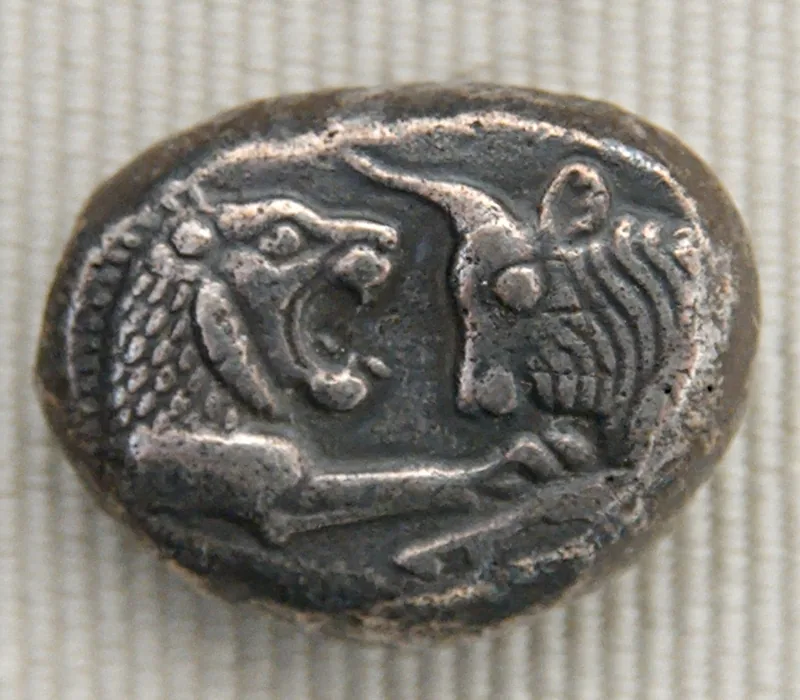
Silver Lydian coin of Croesus's type (a 'croeseid'). Cabinet des Médailles, Bibliothèque nationale de France, Paris. Photo: Jastrow, 2008 · CC BY 2.5 · Source page
West of the Halys river lies Lydia. Its capital, Sardis, stands under the cliffs of Mount Tmolus, and the Pactolus stream carried gold dust down through the city. The Lydians, says Herodotus, “were the first men (known to us) who coined and used gold and silver currency.”
Their king Croesus struck the first coins of pure gold and pure silver, stamped with a lion facing a bull: the croeseids. He had conquered the Greek cities of the Aegean coast and showered gifts on the Greek gods. His wealth became a proverb: ‘as rich as Croesus’.
Astyages was his brother-in-law. When the Persians took Ecbatana, Croesus watched the new power in the east with alarm.
Croesus, king of Lydia
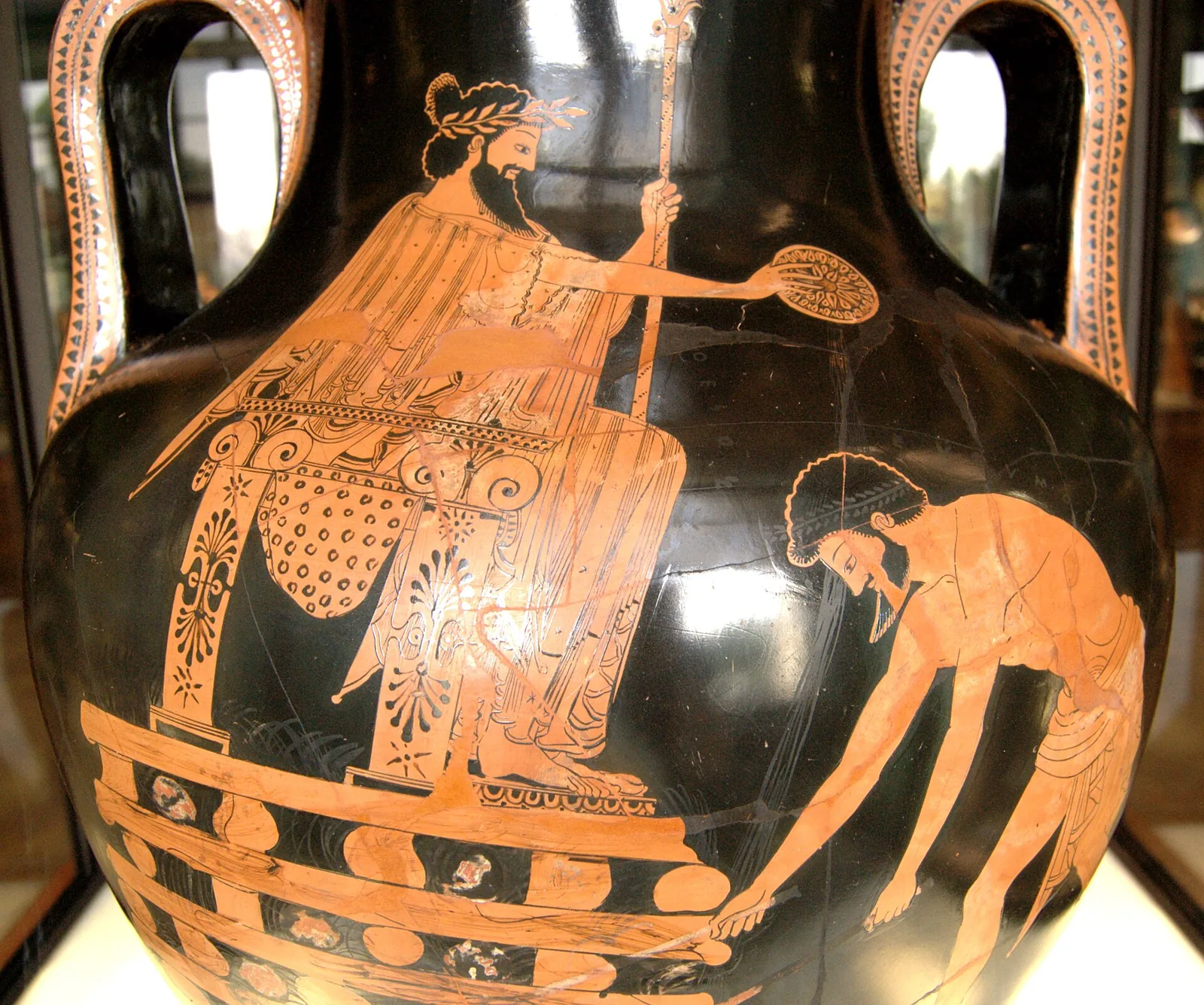
Myson, red-figure amphora, c. 500–490 BC, from Vulci. Louvre, Paris (G 197). Photo: Bibi Saint-Pol · Public domain · Source page
The richest king of his age, who crossed a river to destroy a great empire, and destroyed his own.
- Born: c. 595 BC (if his reign began in 560), Lydia, son of King Alyattes
- Died: Unknown, killed in 547 or 546 BC, or spared to grow old at the Persian court: the sources disagree
- Won: Ephesus and the Greek cities of Ionia; Pteria taken, c. 547 BC
- Lost: The battle at Pteria, against Cyrus: a draw; Sardis, 547 or 546 BC
“No man is so foolish as to desire war more than peace: for in peace sons bury their fathers, but in war fathers bury their sons.”
Source: An answer that could not be wrong
“the judgment given to Croesus by each of the two oracles was the same, to wit, that if he should send an army against the Persians he would destroy a great empire.”
Croesus had sent rich gifts to Apollo's oracle at Delphi. After Sardis fell, Herodotus says, the priestess told him he should have asked “whether the god spoke of Croesus' or of Cyrus' empire.”
- Could this prophecy ever have turned out wrong? No. Whichever side won, ‘a great empire’ would fall. An answer that fits every outcome cannot be proved false.
- Herodotus wrote about a century later. When was this story most likely shaped? After the fall, when everyone knew the ending. Delphi had every reason to remember an answer in which the god was right and the king foolish; the wording may have been polished, or invented, afterwards.
547 BC
A draw at Pteria
Croesus struck first. He crossed the Halys, the old border with the Medes, and took the city of Pteria, probably the great hill-fort excavated at Kerkenes Dağ in central Turkey, which was burnt at about this time. Cyrus marched to meet him.
The battle was fierce and ended at nightfall with neither side ahead. Croesus's army “was by far smaller than that of Cyrus”, so he went home to Sardis. He summoned his allies, Egypt, Babylon and Sparta, to join him there in five months, and of his own army “all of them who were not of his nation he disbanded.” Surely, he thought, the Persians would also wait for spring.
The winter march
A decision point
You are Cyrus, king of the Medes and Persians.
Autumn 547 BC (or 546), in central Anatolia
The battle at Pteria has ended in a draw. Croesus has marched back west to Sardis, some 600 kilometres away across the Anatolian plateau.
Your scouts bring news: he is sending his foreign soldiers home and calling his allies to Sardis for the spring. Winter is coming, and the plateau is high, cold and far from your bases.
Your army is tired, and Media itself was conquered only three years ago.
What do you do?
- Winter where you are and fight in spring Your army would rest, but in spring you would probably face Croesus with Egyptian, Babylonian and Greek allies beside him, in a far harder war.
- Go home and secure Media first Safer for now. But Croesus would keep Pteria and the Halys line, and you would look like a king who had been stopped.
- March on Sardis at once, before the allies can gather Speed could catch Croesus without his mercenaries and allies. But a winter march across Anatolia is a gamble, and if Sardis holds out, your army will be stranded far from home.
What really happened
March on Sardis at once, before the allies can gather
Cyrus set out at once. In Herodotus's words, “he marched his army into Lydia and so himself came to bring the news of it to Croesus.” There was no time to recall the allies. Croesus led out the Lydians, famous horsemen who fought “on horseback, carrying long spears”, into the plain before Sardis.
Speed and surprise decided this campaign. Croesus had made a sensible plan for a normal war; Cyrus refused to fight one.
But be careful with the details. Only Herodotus describes this campaign, and both its season and its year are disputed.
Sardis: who fought whom
Late 547 or 546 BC
The plain before Sardis, Lydia (western Turkey)
Persians and Medes
- Commanders: Cyrus, Harpagus the Mede, his adviser
- Strength: no figure; at Pteria, bigger than Croesus's (Herodotus); unknown (Modern estimate)
- Losses: “Many of both armies fell” (Herodotus)
Lydians
- Commanders: Croesus
- Strength: no figure; mercenaries sent home (Herodotus); 120,000 Egyptians alone (Xenophon (a novel; for a battle he invents)); unknown (Modern estimate)
- Losses: a burnt city, dead left unburied (Archaeology)
In Herodotus, the Egyptians never came.
Outcome: A Persian victory. After a 14-day siege the citadel is climbed and Sardis sacked. Croesus is captured; Lydia becomes a Persian province ruled from Sardis by a satrap.
Only Herodotus describes this battle. The surviving summary of Ctesias, who wrote about 400 BC, mentions none: Cyrus set up wooden figures of Persian soldiers round the walls, which so frightened the inhabitants that the city was easily taken. Herodotus gives no numbers; Xenophon's novel, written later still, invents a world war.
The battle in the plain of Sardis
Late 547 or 546 BC
Cyrus, with the Persians and Medes, has come down the valley, probably from the east, faster than anyone expected. Croesus is riding out with his Lydian cavalry onto the wide, bare plain before Sardis, and Cyrus fears those horsemen.
Only Herodotus (1.79–84) describes the battle and the climb; the surviving summary of Ctesias mentions no battle, and Xenophon's version is a novel. This map follows Herodotus's order of battle on the modern landscape, after the plans of the Sardis excavations (N. D. Cahill, 2010). Where the armies stood is unknown beyond “the plain before the city”; a Persian approach from the east is probable, not attested. The Hermus is drawn on its modern course, the Hyllus cannot be identified with certainty, and the walls and acropolis are approximate.
Phases of the battle
- Two armies in the plain Cyrus has come down the valley from the east faster than anyone expected. Croesus leads his cavalry out into “the plain, wide and bare, which is before the city”. Cyrus fears those horsemen, and Harpagus the Mede has an idea.
- The camels Harpagus's plan: unload the baggage camels, put riders on them and send them first, with the infantry behind and the cavalry last, because, Herodotus explains, “horses fear camels and can endure neither the sight nor the smell of them.” The Lydian horses smell the camels, turn and bolt.
- On foot “Nevertheless the Lydians were no cowards,” Herodotus says. They leap from their horses and fight the Persian infantry on foot. Many fall on both sides.
- Fourteen days At last the Lydians break and are driven inside their walls. Cyrus surrounds the city. For fourteen days Sardis holds out. Then Cyrus sends riders through the camp promising a reward to the first man up the wall, but the assault fails.
- The cliff A Mardian soldier, Hyroeades, had seen a Lydian climb down the sheer cliff the day before, on the side “which faces towards Tmolus”, to fetch a fallen helmet. Now he climbs up the same way, others follow, and the citadel falls. Archaeologists found the wall burnt and torn down, 136 arrowheads by the west gate, and two young soldiers left unburied.
The strategy
- Persians and Medes: Cyrus marches on Sardis at once, before Croesus's allies can gather, though winter is coming. In Herodotus's account, Harpagus proposes sending the baggage camels first, with riders on them, the infantry behind and the cavalry last, because horses fear camels. Afterwards Cyrus surrounds the city and offers a reward to the first man up the wall.
- Lydians: Croesus has gone back to Sardis to wait for spring and his allies, and is sending his foreign mercenaries home. When Cyrus appears, he rides out with his cavalry onto the wide, bare plain before the city, where horses can charge.
What decided it: According to Herodotus, the camels decided the battle in the field, but the citadel fell by a climb. A Mardian soldier had seen a Lydian climb down the sheer cliff the day before; now he climbed up it himself, and others followed. An assault on the walls had failed first.
Source: Croesus on the pyre
“Croesus was not minded to await the further woe of grievous slavery. He caused a pyre to be built in front of his courtyard with walls of bronze”
Herodotus says Cyrus put Croesus on a pyre, then relented; when the flames would not die, Croesus prayed to Apollo, a sudden storm put them out, and he lived on as Cyrus's adviser. Two older sources differ. On this vase, painted about fifty years after Sardis fell, Croesus sits calmly enthroned on the pyre, crowned with laurel, pouring an offering. In Bacchylides' poem of 468 BC he builds the pyre himself; Zeus sends rain, and Apollo carries him away to the edge of the world.
- Put the three sources in date order. Who puts Croesus on the pyre in each? The vase (about 500 BC) and Bacchylides (468 BC): Croesus himself, choosing death over slavery. Herodotus (about 430 BC): Cyrus. The further the story travels, the more it becomes about Cyrus.
- Does the scene on the vase look like a punishment? No. A king on his throne, sceptre in hand, pouring a libation while an attendant tends the logs: it looks like a ritual, a death chosen with dignity.
- So how did Croesus really end? We do not know. Ctesias has him spared and given a city in Media. The Babylonian chronicle says that in 547 Cyrus marched against a land and “killed its king”, but the land's name is broken, and it may not be Lydia. Four versions, and none can be proved.
The Greeks of Asia
The fish that would not dance
Before Pteria, Cyrus had asked the Greek cities of Ionia, on the Aegean coast, to desert Croesus. They refused, and now they asked him for the terms they had had under Croesus.
Cyrus answered, Herodotus says, with a fable. A flute-player played to the fish in the sea, hoping they would come ashore and dance. They did not, so he caught them in a net, and as they leapt about he said: “You had best cease from your dancing now; you would not come out and dance then, when I played to you.”
His general Harpagus took the Greek cities one by one, piling up earth ramps against their walls. Fifty years later they would revolt, and that revolt would bring a Persian army to Marathon. Cyrus himself turned east, to wars in Central Asia that we know almost nothing about.
King of Babylon
A decision point
You are Cyrus, king of the Medes and Persians.
October 539 BC, at Sippar, north of Babylon
Your army has beaten the Babylonians at Opis on the Tigris, and Sippar, a holy city a few days' march from Babylon, has opened its gates without a fight.
Babylon lies ahead, its walls far too strong to storm easily. Its king, Nabonidus, spent about ten years at the oasis of Tayma in Arabia; without him the akitu, the New Year festival of Marduk, Babylon's chief god, could not be held, and Marduk's priests resent him. Now he has fled.
Everyone here remembers what Assyria did: in 689 BC King Sennacherib destroyed Babylon, and his successors spent decades crushing revolts and rebuilding it.
How will you rule Babylon?
- Punish the city: plunder it and deport its leaders You would show strength and gain loot. But you would make enemies of the priests and scribes you need, and probably face revolt after revolt, as Assyria did.
- Put a Babylonian on the throne as your vassal Babylon would keep a king of its own, and you would rule it from afar. But a native king could easily lead the next rebellion.
- Become king of Babylon yourself: honour Marduk, keep the officials, protect the temples You would inherit Babylon's ancient machinery of government and the blessing of its gods. The price: you must play the part of a Babylonian king.
What really happened
Become king of Babylon yourself: honour Marduk, keep the officials, protect the temples
Cyrus chose to be Babylon's king. On 12 October 539 BC his general Ugbaru entered the city “without battle”, the chronicle says; his troops guarded the gates of Marduk's temple, and its rites went on without a break. Nabonidus was captured. On 29 October Cyrus entered the city himself and sent greetings of peace to all Babylon. He took the old titles, ‘king of Babylon, king of Sumer and Akkad’, sent home the gods Nabonidus had gathered into the city, and kept the officials at their desks. The next spring his son Cambyses took part in the New Year rites.
Historians agree it was shrewd. Babylon was too rich and too proud to hold by force alone, and Cyrus needed its scribes, its taxes and its priests. But it was not new: Assyrian kings had also courted Marduk's priests when they wanted Babylon quiet. Nor did it make Babylon love Persia for ever: the city revolted twice in 522–521 BC, and again in 484 BC.
Myth
Cyrus took Babylon by draining the Euphrates: his soldiers walked in along the riverbed while the Babylonians feasted.
The truth
That is Herodotus's story, written about a century later; Xenophon repeats it, and the biblical tale of Belshazzar's feast sets the fall on a night of revelry. But the Cyrus Cylinder, written within months, and the Babylonian chronicle, which draws on Babylonian records, say the Persians entered the city without battle after Opis and Sippar fell. No siege, no riverbed. Herodotus may be confusing the fall of Babylon with Darius's real sieges of the city some twenty years later.
The evidence
Herodotus 1.189–191; Xenophon, Cyropaedia 7.5; Daniel 5; Nabonidus Chronicle, column iii; Cyrus Cylinder, lines 17–24.
Source: “Without battle and conflict”
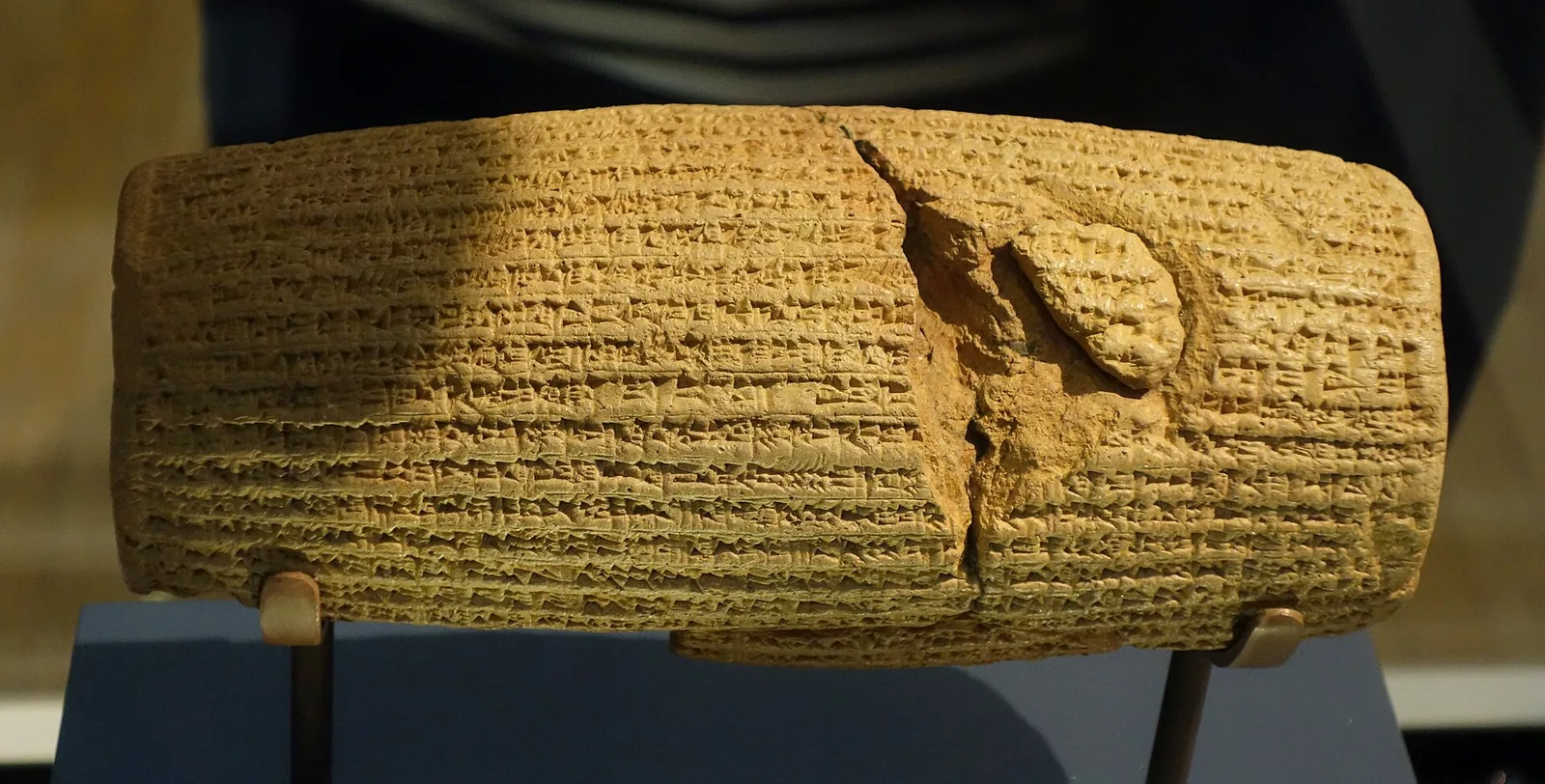
The Cyrus Cylinder, Babylon, 539–538 BC. British Museum, London. Photo: Daderot, 2024 · CC0 · Source page
“Cyrus, king of Anshan, he called by name, to lordship over the whole world he appointed him.”
“Without battle and conflict he permitted him to enter Babylon. He spared his city Babylon a calamity. Nabonidus, the king, who did not fear him, he delivered into his hand.”
Babylonian scribes wrote this clay barrel in cuneiform in Cyrus's name and buried it in the foundations of Babylon's inner wall when he repaired it. Its 45 lines blame Nabonidus for neglecting the gods, say that Marduk chose Cyrus, list his titles, and record that he returned gods and peoples to their cities.
- Who wrote this, and who was meant to read it? Babylonian temple scribes, for the new king. Buried in a wall's foundations, it spoke to the gods and to future kings, like the Assyrian building inscriptions it imitates; it even mentions finding one of Ashurbanipal's in the same wall.
- Compare the Cylinder with the chronicle. What is missing? The battle of Opis, where, on the usual reading of the chronicle, Cyrus's army plundered and killed. Propaganda can be true and still selective: “without battle” is true of Babylon itself, not of the whole campaign.
- The Cylinder says Marduk chose Cyrus. What does that tell us about Cyrus? That he spoke to each people in its own religious language. Was he sincere? We cannot see into his mind; we can see that it worked.
A decision point
You are Cyrus, king of Babylon.
538 BC, in Babylon
Babylon is full of people who never chose to live here. Nebuchadnezzar deported whole communities from the lands he conquered, among them thousands of Judeans taken from Jerusalem in 597 and 586 BC, when he burned the Temple of Solomon. Statues of gods from other cities have also been gathered here.
Some exiles long to go home; a Judean prophet among them already hails you as a liberator. But many have lived here for two generations, farming the land and paying taxes. Moving people costs money and could unsettle your richest province.
What do you do with the exiles and their gods?
- Leave everyone where they are Babylonia would keep its farmers and taxpayers. But you would be one more foreign master, and lose the chance to win grateful peoples on the edges of your empire.
- Let exiles and their gods return and rebuild their temples, if they wish Cheap and popular: those who go home owe you their temples, and those who stay keep farming. And you would have loyal subjects along the road to Egypt.
- Send everyone home with royal money and an escort Generous and long remembered, but expensive and disruptive for a king with a new empire still to organise.
What really happened
Let exiles and their gods return and rebuild their temples, if they wish
The Cylinder says Cyrus returned gods and peoples to cities east of the Tigris; it never mentions Judah. But the Book of Ezra preserves a permission, issued in Cyrus's first year, to rebuild the Temple in Jerusalem and take back the sacred vessels Nebuchadnezzar had carried off. A first group returned under a leader named Sheshbazzar. The Temple was finished only in 515 BC, under Darius.
One policy fitted many peoples: let them worship their gods at home, and they owe their temples to you. A loyal Judah also sat on the road to Egypt, the last great power left.
Many Judeans stayed. About 200 clay tablets from a Babylonian village called Al-Yahudu, ‘Judah-town’, show Judean families farming and doing business there into the 400s BC.
Source: “His anointed”
“Thus saith the LORD to his anointed, to Cyrus, whose right hand I have holden, to subdue nations before him”
“I have even called thee by thy name: I have surnamed thee, though thou hast not known me.”
Chapters 40–55 of the Book of Isaiah are the work of a later prophet, often called Second Isaiah, writing among the exiles while Cyrus was winning his wars. He calls Cyrus God's “shepherd” and his anointed, a title of Israel's own kings, given to no other foreigner in the Hebrew Bible.
- Marduk “called by name” Cyrus, and so does Isaiah's God: “I have even called thee by thy name”. What does the echo suggest? Two peoples, two gods, one claim: the conqueror was chosen by our god. Each community fitted Cyrus into its own faith, and Cyrus let it.
- Did Cyrus convert to the God of Israel? No. The prophet himself says “thou hast not known me”, and in Babylon Cyrus honoured Marduk. The prophet's point is theological: God can use even a foreign king who does not know him.
- The prophet wrote before Babylon fell. Is that a weakness or a strength in a source? Both. It cannot tell us what Cyrus did; it shows, at the time, the hopes he raised among people who were waiting for him.
Death on the frontier, and life after death
530 BC
Three deaths
In 530 BC Cyrus died far to the north-east, probably on campaign beyond the great rivers of Central Asia. How, we do not know: our sources tell three different stories.
Herodotus: Cyrus invaded the land of the Massagetae, nomad horse-archers ruled by Queen Tomyris. With a trick, a camp full of wine left as bait, he trapped part of her army. Then came a battle Herodotus judged “the stubbornest of all fights that were ever fought by men that were not Greek.” Cyrus fell, and Tomyris dipped his head in a skin full of blood. Herodotus adds: “Many stories are related of Cyrus' death; this, that I have told, is the worthiest of credence.”
Ctesias: in a battle against another people an Indian's javelin wounded him in the thigh, and he died three days later. Xenophon: an old man dying in bed in Persia, after a long farewell speech to his sons.
Most historians think he died of a battle wound on the frontier. The head in the skin of blood is a Greek moral tale about a man who never had enough.
After Cyrus
- 530 BC His son Cambyses becomes king. Cyrus is buried at Pasargadae, where Magi guard his tomb for two centuries.
- 525 BC Cambyses conquers Egypt. The empire now stretches from the Aegean and the Nile to Central Asia.
- 522 BC After a crisis at court, Darius I takes the throne and crushes revolts everywhere, Babylon's among them. He calls his family Achaemenid, and may be the one who carved “I am Cyrus the king, an Achaemenid” on Cyrus's buildings.
- 499 BC The Greek cities of Ionia, conquered for Cyrus by Harpagus, revolt against Persia. The next year they burn Sardis with help from Athens. Persia's revenge will lead to Marathon.
- c. 370 BC Xenophon writes the Cyropaedia, a novel in which Cyrus is the perfect ruler and dies peacefully in bed. Cicero saw Cyrus portrayed there “not as an historical character, but as a model of righteous government”. It became a classic of advice for rulers.
- 330 BC Alexander the Great ends the Persian Empire. In 324 BC he restores Cyrus's tomb.
- 13th century AD Sa'd ibn Zangi, ruler of Fars, builds a mosque around the tomb, by then known as the Tomb of the Mother of Solomon. That name probably saved it.
- 1879 The Cyrus Cylinder is dug up at Babylon.
- 1971 The Shah of Iran celebrates 2,500 years of Persian monarchy at Cyrus's tomb; a copy of the Cylinder goes to the United Nations.
Myth
The Cyrus Cylinder is the world's first charter of human rights.
The truth
The Cylinder is a Babylonian building inscription praising a new king. It says nothing about rights, equality or freedom of religion as principles, and slavery went on in Babylonia under Cyrus. The label was spread by the last Shah of Iran around 1971. A longer ‘Cyrus charter’ circulating online, in which Cyrus abolishes slavery and guarantees freedom of religion, is a modern invention: none of it is on the Cylinder.
The evidence
Cyrus Cylinder, 45 lines (British Museum BM 90920); A. Kuhrt (1983); I. Finkel (ed.), The Cyrus Cylinder (2013). Still, the text does show a policy of accommodation, which is why later ages read their own ideals into it.
Merciful king, or brilliant conqueror?
Was Cyrus a uniquely merciful ruler, or a brilliant conqueror using old Near Eastern methods?
- A. T. Olmstead, History of the Persian Empire (1948), and Max Mallowan (1972) The admiring view. Cyrus's mercy to Astyages and Croesus, his respect for local gods and his return of exiles were real and remarkable. Babylonians, Judeans and Greeks, who agree on almost nothing else, all remember him well, and that agreement is itself evidence.
- Amélie Kuhrt (1983) and R. J. van der Spek (2014) The sceptical view. The Cylinder is conventional Babylonian royal propaganda modelled on Assyrian texts; Assyrian kings also returned gods and courted Babylon's priests. Cyrus could be brutal, as at Opis. Calling him a pioneer of human rights is anachronistic.
- Pierre Briant (2002), Matt Waters (2022) and Lloyd Llewellyn-Jones (2022) The pragmatic view. With few Persians to rule a vast and varied empire, Cyrus won over local elites and their gods and ruled each land as its own king. Mercy and calculation were not opposites. His good name came from the groups that gained by his policy: Babylonian priests, Judean exiles, and Greeks who contrasted him with Xerxes.
Almost nothing survives in Cyrus's own voice. Every portrait comes from people who needed him to be a certain kind of king. Can we ever know who he really was?
What do you know now?
Check yourself
How did the war between Cyrus and Astyages end, according to the Babylonian chronicle?
Answer: Astyages' own troops mutinied and handed him over to Cyrus. Right. The chronicle says “the troops of Astyages rebelled against him”. Herodotus tells the same core through the story of Harpagus's revenge.
Check yourself
What is our evidence for the camels in the battle in the plain of Sardis?
Answer: Only Herodotus describes them; archaeology confirms the sack of Sardis, not the details of the battle. Right. The excavations found a burnt wall, arrowheads and unburied soldiers, but none of that proves or disproves the camels. The surviving summary of Ctesias does not even mention a battle.
Check yourself
Why do historians doubt that “he would destroy a great empire” was really said before the war?
Answer: It could not be wrong whatever happened, and it was told after the event by people with an interest in Delphi's good name. Right. An answer that fits every outcome is safe for the oracle, and the story we have was shaped once the ending was known.
Check yourself
Why is it misleading to call the Cyrus Cylinder ‘the first charter of human rights’?
Answer: It is a Babylonian building inscription praising the king, with no rights as principles, and it leaves out the battle at Opis. Right. It follows an old Mesopotamian pattern of royal inscriptions. It does show accommodation, but it is not a declaration of rights.
Check yourself
Isaiah calls Cyrus God's ‘anointed’. What does that tell us?
Answer: That Judean exiles saw him as God's instrument, although, as the prophet admits, Cyrus did not know their God. Right. In Babylon Cyrus honoured Marduk; each people fitted him into its own faith.
Check yourself
Which account of Cyrus's death do most historians accept?
Answer: None in detail: he probably died of a battle wound on the north-eastern frontier in 530 BC. Right. The versions disagree on the details, but the two earlier ones, Herodotus and Ctesias, agree that he fell fighting on the frontier. Xenophon's peaceful death belongs to his novel.
Terms
- Anshan An ancient city and kingdom in Persis (modern Fars, south-west Iran), once Elamite. Cyrus and his forefathers called themselves “king of Anshan”.
- Medes An Iranian people of north-west Iran, with their capital at Ecbatana (modern Hamadan). The Median king was overlord of the Persians until Cyrus.
- Achaemenids The royal house of the Persian Empire, named after an ancestor, Achaemenes. Cyrus's own inscriptions name only Teispes as his forefather; Darius I made the Achaemenid name official.
- oracle A shrine where a god was believed to answer questions; the word also means the answer itself. At Delphi, Apollo spoke through his priestess, the Pythia.
- croeseid The first coins struck separately in pure gold and pure silver, with a lion facing a bull, made at Sardis under Croesus. Earlier Lydian coins were of electrum, a natural mix of gold and silver.
- satrap The governor of a Persian province (a satrapy). Cyrus appointed governors, but the full satrapy system is clearly seen only under Darius I.
- cuneiform Writing made of wedge-shaped marks pressed with a reed into wet clay. It was used in Mesopotamia and its neighbours for some 3,000 years, for Sumerian, Akkadian, Elamite and later Old Persian.
- Marduk The chief god of Babylon, whose great temple was the Esagila. The Cyrus Cylinder says Marduk chose Cyrus to be king.
- akitu Babylon's New Year festival in spring, when the statue of Marduk was led out in procession. It could not be held without the king.
- anointed A king or priest consecrated with oil (Hebrew mashiach); in the Bible, someone chosen by God. The Book of Isaiah gives the title to Cyrus, the only foreigner so called in the Hebrew Bible.
- Massagetae Nomad horse-archers of Central Asia, east of the Caspian Sea. Herodotus says Cyrus died fighting them and their queen, Tomyris.
- Cyropaedia ‘The Education of Cyrus’, written by the Athenian Xenophon about 370 BC: a novel about the ideal ruler, not a history.
- Cyrus Cylinder A clay cylinder inscribed in cuneiform by Babylonian scribes in Cyrus's name. It describes the conquest and says Cyrus returned gods and peoples to their cities.
- Book of Isaiah A prophetic book of the Hebrew Bible. Its later part calls Cyrus God's shepherd and anointed one.
- Book of Ezra A book of the Hebrew Bible about the return of exiles from Babylon to Jerusalem. It quotes a decree of Cyrus allowing the Temple to be rebuilt, and was written long after Cyrus.
- Babylonian chronicle A Babylonian record of events in Cyrus's time. It draws on records kept at the time, and most historians trust it.
- Pasargadae An ancient city in the highlands of Persia, where Cyrus's tomb was built. The tomb still stands there today.
- Ecbatana The capital of the Medes, on the Iranian plateau. Cyrus carried its treasure away after he conquered it.
- Sardis The capital of Lydia, at the foot of Mount Tmolus. After it fell, Croesus lost his kingdom.
- Lydia A kingdom in western Anatolia, ruled by Croesus. According to Herodotus, the Lydians were the first to mint coins.
- Ionia A region of Greek cities on the Aegean coast. Cyrus asked them to desert Croesus, and later Harpagus conquered them.
- Pteria A fortified city in central Anatolia, where Cyrus and Croesus fought a battle that ended in a draw.
- Delphi A Greek town with a temple to Apollo and a famous oracle. The prophecies were given by a priestess.
- Halys A river in what is today central Turkey. It was the old border between Lydia and Media.
- Opis A city on the Tigris, where the Babylonian chronicle records a battle.
- Borsippa A town near Babylon. According to Berossus, Nabonidus was beaten in battle and shut himself up there.
- Harpagus A Median noble who served Astyages. According to Herodotus he urged Cyrus to revolt, and later became his general.
- Ctesias A Greek doctor at the Persian court, who wrote about Cyrus. He contradicts many other sources, and even in ancient times he was not trusted.
- Herodotus A Greek historian from Halicarnassus, who wrote about the Persians from stories people told him. He admitted he knew four versions of Cyrus's life.
- Xenophon A Greek writer. His book about Cyrus is a novel about the perfect ruler, not a historical record.
- Berossus A Babylonian priest who wrote about the fall of Babylon. According to him Nabonidus was beaten in battle, and Cyrus ordered the outer walls of the city pulled down.
- Tomyris Queen of the Massagetae, nomad horse-archers. According to Herodotus, Cyrus fell in battle against her army, and she dipped his head in a skin full of blood.
- Darius I A king of Persia from a side branch of Cyrus's family. He made the name Achaemenid the name of the royal house.
- Nebuchadnezzar A king of Babylon who conquered Jerusalem and burned the Temple. He deported whole communities from the lands he conquered to Babylon.
- Sennacherib King of Assyria who destroyed Babylon. His successors spent decades crushing revolts and rebuilding it.
Sources
- Herodotus, Histories 1.26–94 (Lydia), 1.95–130 (Cyrus and the Medes), 1.141–177 (the Greeks of Asia), 1.178–191 (Babylon), 1.201–214 (death), 3.89; trans. A. D. Godley, Loeb Classical Library, vols I–II (Heinemann, 1920–1921)
- The Cyrus Cylinder (British Museum BM 90920), trans. R. W. Rogers, Cuneiform Parallels to the Old Testament (Eaton & Mains, 1912), 380–384
- The Nabonidus Chronicle (BM 35382, ABC 7), in A. K. Grayson, Assyrian and Babylonian Chronicles (J. J. Augustin, 1975); older trans. in R. F. Harper (ed.), Assyrian and Babylonian Literature (D. Appleton, 1901), 168–171
- Isaiah 44:24–45:7; Ezra 1:1–11 and 6:1–15; King James Version (1611); Hebrew: the Masoretic text
- Bacchylides, Ode 3, trans. R. C. Jebb, Bacchylides: The Poems and Fragments (Cambridge University Press, 1905)
- Ctesias, Persica, in Photius, Bibliotheca cod. 72, trans. J. H. Freese, The Library of Photius, vol. I (SPCK, 1920)
- Xenophon, Cyropaedia, trans. H. G. Dakyns
- Arrian, Anabasis of Alexander 6.29 (after Aristobulus), trans. E. J. Chinnock (Hodder and Stoughton, 1884)
- Plutarch, Life of Alexander 69, trans. B. Perrin, Plutarch's Lives vol. VII (Loeb Classical Library, 1919)
- Cicero, Letters to his Brother Quintus 1.1.23, trans. E. S. Shuckburgh, The Letters of Cicero, vol. I (George Bell, 1899)
- Pierre Briant, From Cyrus to Alexander: A History of the Persian Empire, trans. Peter T. Daniels (Eisenbrauns, 2002)
- Matt Waters, King of the World: The Life of Cyrus the Great (Oxford University Press, 2022)
- Amélie Kuhrt, The Persian Empire: A Corpus of Sources from the Achaemenid Period (Routledge, 2007)
- Amélie Kuhrt, ‘The Cyrus Cylinder and Achaemenid Imperial Policy’, Journal for the Study of the Old Testament 25 (1983), 83–97
- Irving Finkel (ed.), The Cyrus Cylinder: The King of Persia's Proclamation from Ancient Babylon (I. B. Tauris, 2013)
- R. J. van der Spek, ‘Cyrus the Great, Exiles, and Foreign Gods: A Comparison of Assyrian and Persian Policies on Subject Nations’, in M. Kozuh et al. (eds), Extraction & Control: Studies in Honor of Matthew W. Stolper (Oriental Institute, 2014), 233–264
- Lloyd Llewellyn-Jones, Persians: The Age of the Great Kings (Wildfire, 2022)
- Nicholas D. Cahill (ed.), The Lydians and Their World (Yapı Kredi, 2010), esp. Cahill, ‘The Persian Sack of Sardis’
- Robert W. Wallace, ‘Redating Croesus: Herodotean Chronologies, and the Dates of the Earliest Coinages’, Journal of Hellenic Studies 136 (2016), 168–181
- Robert Rollinger, ‘The Median “Empire”, the End of Urartu and Cyrus the Great's Campaign in 547 B.C. (Nabonidus Chronicle II 16)’, Ancient West & East 7 (2008), 51–65
- David Stronach, Pasargadae: A Report on the Excavations Conducted by the British Institute of Persian Studies from 1961 to 1963 (Clarendon Press, 1978)
- Elias Bickerman, ‘The Edict of Cyrus in Ezra 1’, Journal of Biblical Literature 65 (1946), 249–275
- Laurie E. Pearce and Cornelia Wunsch, Documents of Judean Exiles and West Semites in Babylonia in the Collection of David Sofer (CDL Press, 2014)
- Max Mallowan, ‘Cyrus the Great (558–529 B.C.)’, Iran 10 (1972), 1–17
- A. T. Olmstead, History of the Persian Empire (University of Chicago Press, 1948)
Image credits
- Tomb of Cyrus, Pasargadae, Iran. Photo: Diego Delso, 2016 · CC BY-SA 4.0 · Source page
- Winged guardian relief, Gate R, Pasargadae, Iran; not a portrait of Cyrus. Photo: Nima Boroumand, 2016 · CC BY-SA 4.0 · Source page
- Silver Lydian coin of Croesus's type (a 'croeseid'). Cabinet des Médailles, Bibliothèque nationale de France, Paris. Photo: Jastrow, 2008 · CC BY 2.5 · Source page
- Myson, red-figure amphora, c. 500–490 BC, from Vulci. Louvre, Paris (G 197). Photo: Bibi Saint-Pol · Public domain · Source page
- The Cyrus Cylinder, Babylon, 539–538 BC. British Museum, London. Photo: Daderot, 2024 · CC0 · Source page


