Marie Curie and radioactivity
Decisions, questions and your own progress, in the app
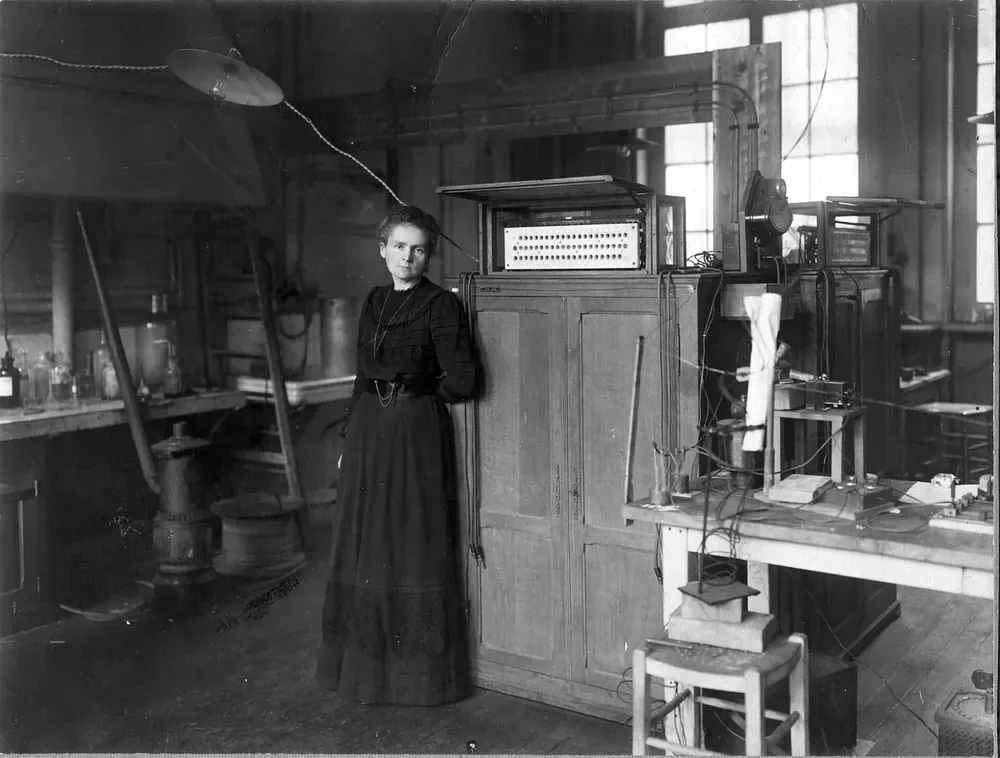
Marie Curie in her Paris laboratory, 1912 · unattributed · Public domain · Source page
A student from Warsaw
Maria Sklodowska grew up in Warsaw under Russian rule, where women could not attend university. In 1891, she moved to Paris to study at the Sorbonne. She lived on very little and studied physics and mathematics.
Two new elements
Marie married the physicist Pierre Curie in 1895. Together they studied the rays given off by uranium ore. In 1898, they discovered two new elements, polonium and radium. Marie named polonium after Poland.
A double first
2 Nobel Prizes
In 1903, Curie became the first woman to win a Nobel Prize, in physics. In 1911, she won a second, in chemistry. She remains the only person to win Nobel Prizes in two different sciences.
X-rays on wheels
During the First World War, Curie helped fit vans with X-ray machines. Soldiers called them little Curies. She learned to drive one herself and trained women to run them. Doctors used them to find bullets and broken bones.
A hidden danger
No one yet understood how harmful radiation was. Curie handled radium with little protection. She died in 1934 from a blood disease most likely caused by radiation. Her notebooks are still radioactive today.
Why it still matters
Curie's work opened the way to nuclear physics and to radiation treatment for cancer. She also showed that a woman could lead science at the highest level, at a time when many doubted it.
Review question
Which element did Marie Curie name after her home country?
Answer: Polonium. Curie named polonium after Poland, which had no independent state at the time. It was a quiet political statement.
What was special about Curie's 1911 Nobel Prize?
Answer: It made her the first person to win two Nobel Prizes. Her 1911 chemistry prize followed her 1903 physics prize. No one had won two Nobel Prizes before.
Image credits
- Marie Curie in her Paris laboratory, 1912 · unattributed · Public domain · Source page
