The Cuban Missile Crisis, 1962
Thirteen days in October 1962, when the world came closest to nuclear war.
Decisions, questions and your own progress, in the app
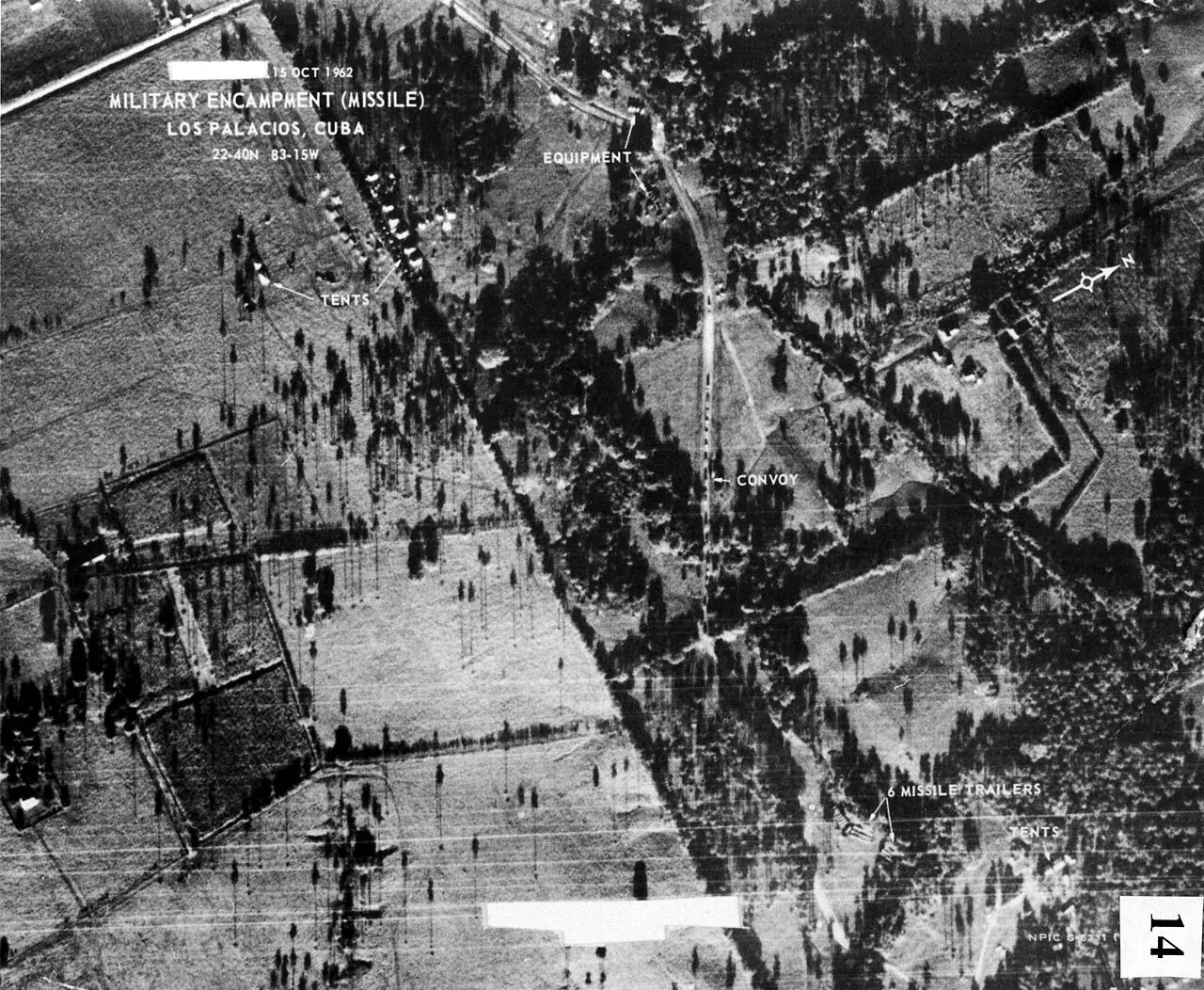
US Air Force U-2 photograph, 14 October 1962, labelled by the National Photographic Interpretation Center (NPIC). National Museum of the US Air Force · Public domain · Source page
Photographs before breakfast
Tuesday 16 October 1962, just before nine. President John F. Kennedy is still in his pyjamas, reading the papers. His adviser McGeorge Bundy brings photographs.
Two days earlier a U-2 spy plane flew over western Cuba. The pictures show sites for Soviet ballistic missiles, built to carry nuclear warheads. From Cuba they could reach Washington.
Background
Why missiles, and why Cuba?
It is the Cold War. The United States and the Soviet Union, both nuclear powers, compete for the world. America is far ahead, and its Jupiter missiles in Turkey and Italy can reach Soviet soil.
In 1961 CIA-trained Cuban exiles landed at the Bay of Pigs to overthrow Cuba's revolutionary leader, Fidel Castro. They were crushed in three days. Castro drew closer to Moscow.
Now the Soviet leader, Nikita Khrushchev, is secretly sending missiles to Cuba: to protect Castro, to narrow the gap with America, perhaps to gain leverage over Berlin. Historians weigh these reasons differently.
A decision point
You are John F. Kennedy.
The White House, October 1962
For days you have met in secret with your advisers, the ExComm. More sites keep appearing; some missiles may be ready to fire within days. Moscow has promised it is sending Cuba only defensive weapons.
In September you warned publicly that offensive missiles would raise "the gravest issues". Your generals want to attack. Others fear an attack could start a nuclear war.
What do you do?
- Order a surprise air strike on the missile sites Probably not a clean strike. The Air Force admits it cannot promise to destroy every missile, and one that survives could be fired. Soviet soldiers at the sites would be killed, and Khrushchev would be under heavy pressure to hit back: in Cuba, in Berlin or in Turkey.
- Strike, then invade Cuba and remove Castro too Probably a far bigger war than you expect. There are things you do not know: about 42,000 Soviet troops are on the island (your intelligence guesses about 10,000), with roughly a hundred tactical nuclear weapons meant for exactly this kind of landing.
- Ring Cuba with warships and demand the missiles go Not a solution but a pause. No one has been killed yet, so Khrushchev has time to think and room to step back. But the missiles already in Cuba stay, and work on them goes on. If talks fail, you face the same choice again, with the missiles readier.
- Negotiate with Khrushchev in secret Probably the worst of both. While you talk, the missiles become ready to fire and Khrushchev bargains from strength. If the secret leaks, or you seem to accept the missiles after your September warning, you look weak to Moscow, to your allies and to voters, three weeks before congressional elections.
What really happened
Ring Cuba with warships and demand the missiles go
On 22 October Kennedy went on television. He avoided the word blockade, an act of war in international law, and announced a quarantine on ships bringing offensive weapons. Any nuclear missile launched from Cuba, he warned, would be regarded "as an attack by the Soviet Union on the United States, requiring a full retaliatory response upon the Soviet Union."
Kennedy wanted a firm step that left Khrushchev a way out. His brother Robert likened a surprise attack to Pearl Harbor in reverse, and no strike was sure to get every missile. The quarantine bought time; the bombers stayed ready.
What really happened
Black Saturday
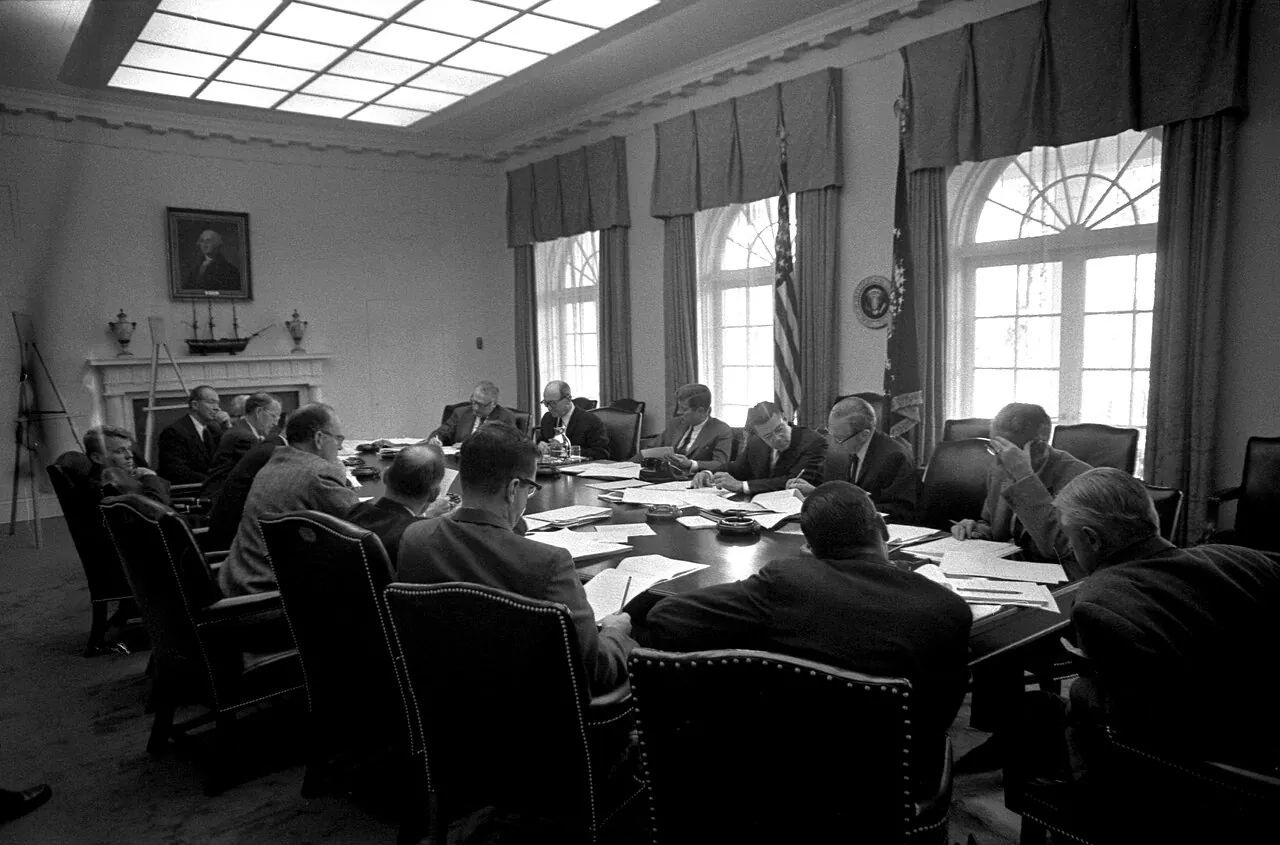
Cecil Stoughton, White House photograph, 29 October 1962. John F. Kennedy Presidential Library and Museum, Boston · Public domain · Source page
27 October
Soviet missile ships turned back before reaching the quarantine line, but work on the missiles in Cuba went on.
Saturday 27 October was the worst day. Soviet officers in Cuba, without asking Moscow, shot down a U-2; its pilot, Major Rudolf Anderson, was killed. Khrushchev sent two letters: the first offered to remove the missiles for a no-invasion promise; the second also demanded the Jupiters out of Turkey.
Kennedy publicly accepted the first offer. That evening Robert Kennedy secretly told Ambassador Anatoly Dobrynin that the Jupiters would go within months, if no one said so. On 28 October Khrushchev announced the missiles would leave.
In 1963 came a Washington–Moscow "hotline" and a treaty banning all but underground nuclear tests.
Source: Reading a spy photo
US Air Force U-2 photograph, 14 October 1962; labels added by the National Photographic Interpretation Center (NPIC), 15 October 1962
You saw it at the start. On 15 October analysts spotted Soviet medium-range missiles in it, the first found in Cuba.
- Cover the white labels. What can you actually see? Fields, trees, a road, small pale shapes. Analysts who knew Soviet equipment recognised trailers and tents, and their layout. A spy photo becomes evidence only once an expert reads it.
- The board says 15 October; the plane flew on the 14th. Who labelled it, and for whom? The analysts, the day after the flight, for the president and his advisers: their interpretation, written to convince busy people fast. Similar boards were later shown at the UN.
- What can a photo from 20 kilometres up not tell you? Whether nuclear warheads had arrived, how many soldiers were on the island, what Khrushchev intended. Washington guessed about 10,000 Soviet troops; there were about 42,000.
Myth
Kennedy stood firm, Khrushchev "blinked", and America won through toughness alone.
The truth
On 24 October Secretary of State Dean Rusk said: "We're eyeball to eyeball, and I think the other fellow just blinked." But the Soviet ships had been ordered home a day earlier, far from the line. And the crisis ended in a compromise with a secret trade over Turkey.
The evidence
Washington denied any deal for years. In 1989 Kennedy's aide Ted Sorensen admitted cutting it from Robert Kennedy's memoir, Thirteen Days; Soviet records later confirmed it. An open trade would have looked like defeat, and alarmed NATO allies.
Check yourself
Why did Kennedy call his naval blockade a "quarantine"?
Answer: In international law a blockade is an act of war, and he wanted to leave Khrushchev room to back down. Right. The ships did the same job under either name, but a softer word made it easier for Moscow to step back without feeling it was already at war.
Check yourself
How did the crisis actually end?
Answer: The Soviet missiles left Cuba; America promised not to invade, and secretly agreed to remove its missiles from Turkey. Right. A compromise, with one part hidden. The Jupiters were gone by April 1963, and the secret held for decades.
Check yourself
Which of these did Washington NOT know during the crisis?
Answer: How many Soviet troops were in Cuba, and that about a hundred tactical nuclear weapons were there too. Right. US intelligence guessed about 10,000 troops; there were about 42,000. The tactical nuclear weapons became widely known only in the early 1990s, when former Soviet officers spoke about them.
Terms
- Cold War The long rivalry, from about 1947 to 1991, between the United States and its allies and the Soviet Union and its allies. They armed against each other and fought through others, but never fought each other directly.
- U-2 An American spy plane that flew more than 20 kilometres up and took very sharp photographs. In 1960 the Soviets shot one down over their territory and captured its pilot.
- medium-range ballistic missile A rocket that climbs high and falls on its target. The Soviet R-12 missiles sent to Cuba could fly about 2,000 kilometres, each carrying one nuclear warhead.
- ExComm The Executive Committee of the National Security Council: the small group of senior officials who advised Kennedy through the crisis. Kennedy secretly taped many of its meetings.
- quarantine Kennedy's name for the naval blockade of Cuba, in force from 24 October 1962: US warships could stop and search ships heading there, and turn back any carrying offensive weapons.
- Jupiter missiles American nuclear missiles placed in Italy and Turkey in 1961 and 1962, able to reach the Soviet Union. Even Kennedy's own advisers thought them out of date.
- tactical nuclear weapon A smaller, short-range nuclear weapon made for the battlefield: for example, against troops landing on a beach. Small by nuclear standards, it could still destroy the centre of a town.
- McGeorge Bundy President Kennedy's adviser on national security. He brought him the photographs taken over Cuba.
- Bay of Pigs A bay on Cuba's southern coast. Cuban exiles trained by the CIA landed there to overthrow Castro and were crushed within days.
- Anatoly Dobrynin The Soviet ambassador in Washington. Robert Kennedy secretly passed him a proposal about the missiles in Turkey.
- Dean Rusk The US Secretary of State during the crisis. He said the other side had blinked, meaning it backed down.
- Robert Kennedy The president's brother, and his attorney general. During the crisis he secretly told the Soviet ambassador that the Jupiter missiles would leave Turkey within months.
- Rudolf Anderson An American pilot of the U-2 spy plane. His plane was shot down over Cuba by Soviet officers, and he was killed.
- Arkhipov A senior Soviet officer in a flotilla. According to one account, he talked the submarine's captain out of firing the nuclear torpedo.
- Depth charges Bombs that explode underwater at a set depth. They can be dropped to harass a submarine or force it to surface.
- Nuclear torpedo A torpedo carrying a nuclear warhead. The submarine B-59 carried one, and the Americans did not know it.
- Warhead The part of a missile or bomb that carries the explosive. A nuclear warhead carries an atomic bomb.
- Submarine B-59 A Soviet submarine that carried a nuclear torpedo. During the crisis American destroyers dropped practice depth charges on it.
- Flotilla A group of ships or submarines that work together under one commander.
- CIA The US intelligence agency. It trained the Cuban exiles who tried to invade Cuba.
- Nikita Khrushchev The Soviet leader during the crisis. He secretly sent missiles to Cuba, and in the end announced they would be removed.
- Fidel Castro The leader of Cuba's revolution. After the failed landing at the Bay of Pigs he drew closer to Moscow.
- Soviet Union A huge communist state that included Russia and many other republics. It was the rival of the United States in the Cold War.
- Exiles People forced to leave their homeland, usually for political reasons, and to live elsewhere.
- Offensive weapons Weapons designed to attack rather than defend. During the crisis the US imposed a quarantine on ships carrying such weapons to Cuba.
- Nuclear test An explosion of a nuclear weapon to test it. After the crisis a treaty banned all nuclear tests except underground ones.
- Nuclear balance A situation in which two powers have similar nuclear strength, so that each deters the other.
- Spy plane An aircraft that flies over another country to take photographs and gather intelligence. The U-2 was such a plane.
Sources
- John F. Kennedy, Address on the Buildup of Arms in Cuba (radio and television address), 22 October 1962
- National Security Archive, The Cuban Missile Crisis, 1962: photographs (U-2 and low-level reconnaissance, with NPIC captions)
- Ernest R. May and Philip D. Zelikow (eds.), The Kennedy Tapes: Inside the White House during the Cuban Missile Crisis (Harvard University Press, 1997)
- Robert F. Kennedy, Thirteen Days: A Memoir of the Cuban Missile Crisis (W. W. Norton, 1969)
- Aleksandr Fursenko and Timothy Naftali, "One Hell of a Gamble": Khrushchev, Castro, and Kennedy, 1958–1964 (W. W. Norton, 1997)
- Michael Dobbs, One Minute to Midnight: Kennedy, Khrushchev, and Castro on the Brink of Nuclear War (Alfred A. Knopf, 2008)
- Serhii Plokhy, Nuclear Folly: A History of the Cuban Missile Crisis (W. W. Norton, 2021)
Image credits
- US Air Force U-2 photograph, 14 October 1962, labelled by the National Photographic Interpretation Center (NPIC). National Museum of the US Air Force · Public domain · Source page
- Cecil Stoughton, White House photograph, 29 October 1962. John F. Kennedy Presidential Library and Museum, Boston · Public domain · Source page

