The Third Crusade: Richard and Saladin, 1189–1192
For more than a year Richard and Saladin fought, bargained and exchanged gifts. They never once met.
Decisions, questions and your own progress, in the app
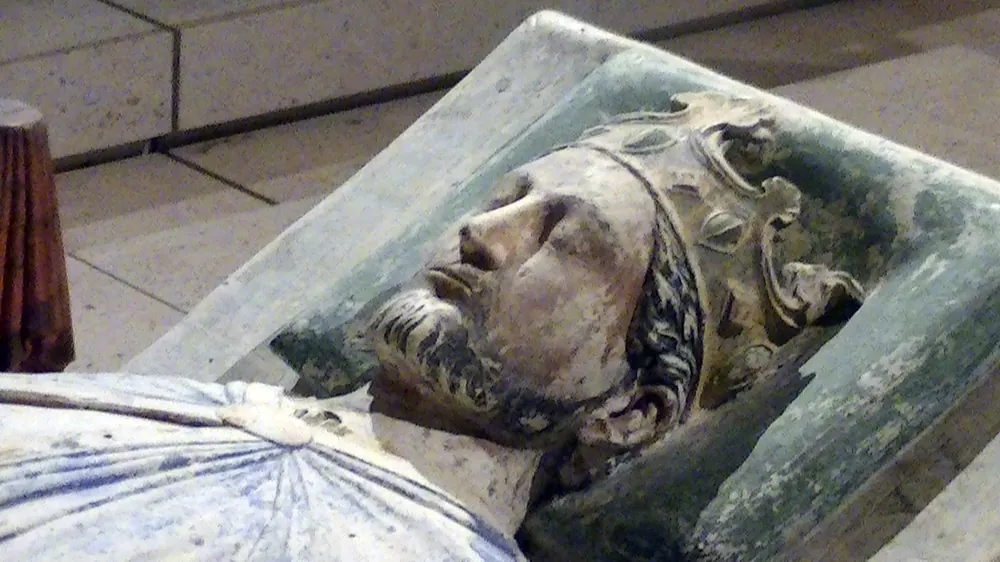
Tomb effigy of Richard I, Fontevraud Abbey, about 1200. Photo: Adam Bishop, 2011 · CC BY-SA 3.0 · Source page
Two kings
Enemies who never met
For more than a year Richard I of England and Saladin fought each other, bargained, and exchanged envoys, horses, fruit and snow from the mountains. They never once met face to face.
Jaffa, 1 August 1192. Saladin’s army broke into the town yesterday; its last defenders hold out in the citadel. Now Richard’s galleys sail into the harbour, and the king lands with a small force and drives the sultan’s men out. He was not even armed, he will tell Saladin’s envoys, and still had on the shoes he wore on board.
In 1187 Saladin had destroyed the army of the kingdom of Jerusalem at Hattin and taken the Holy City. Europe answered with a great crusade, led by an emperor and two kings. What did it win, and who paid the price?
Who tells the story
Witnesses from both camps
On Richard’s side: Ambroise, a Norman poet who marched with the army; the Itinerarium Peregrinorum, a Latin chronicle that retells his poem; and Roger of Howden, a royal clerk who copied the king’s letters.
On Saladin’s side: Baha ad-Din Ibn Shaddad, a judge in his army and his close companion, who wrote after the sultan’s death; and Ibn al-Athir of Mosul, who wrote some forty years later and was no uncritical admirer of him.
When enemies agree, we can trust it. When they disagree, we have to ask why.
Richard I
A king of England who spent perhaps six months of his ten-year reign in England, lost no major battle in the Holy Land, and never reached Jerusalem.
- Born: 8 September 1157, Beaumont Palace, Oxford
- Died: 6 April 1199, Châlus-Chabrol, in the Limousin (France), of an infected crossbow wound, while besieging the castle
- Won: Cyprus, May–June 1191; Acre, July 1191, with Philip II; Arsuf, 7 September 1191; Jaffa, August 1192
- Lost: Jerusalem: turned back twice, January and July 1192; Captured in Austria in December 1192 and held until February 1194
“This Sultan is mighty, and there is none greater or mightier than him in this land of Islam.”
The call
1187–1190
Rulers take the cross
On 2 October 1187 Saladin entered Jerusalem. The shock in the West was enormous, and Pope Gregory VIII called a new crusade.
In January 1188 two enemies, Henry II of England and Philip II of France, both took the cross. To pay for it Henry ordered the Saladin tithe: everyone who did not go gave a tenth of their income and goods.
The first to set out was the oldest, the German emperor Frederick Barbarossa, nearly seventy, with a large army. In June 1190 he drowned in the river Saleph in Anatolia; the sources disagree on how, and even on the day. Most of his army melted away.
1189–1190
A coronation and a massacre
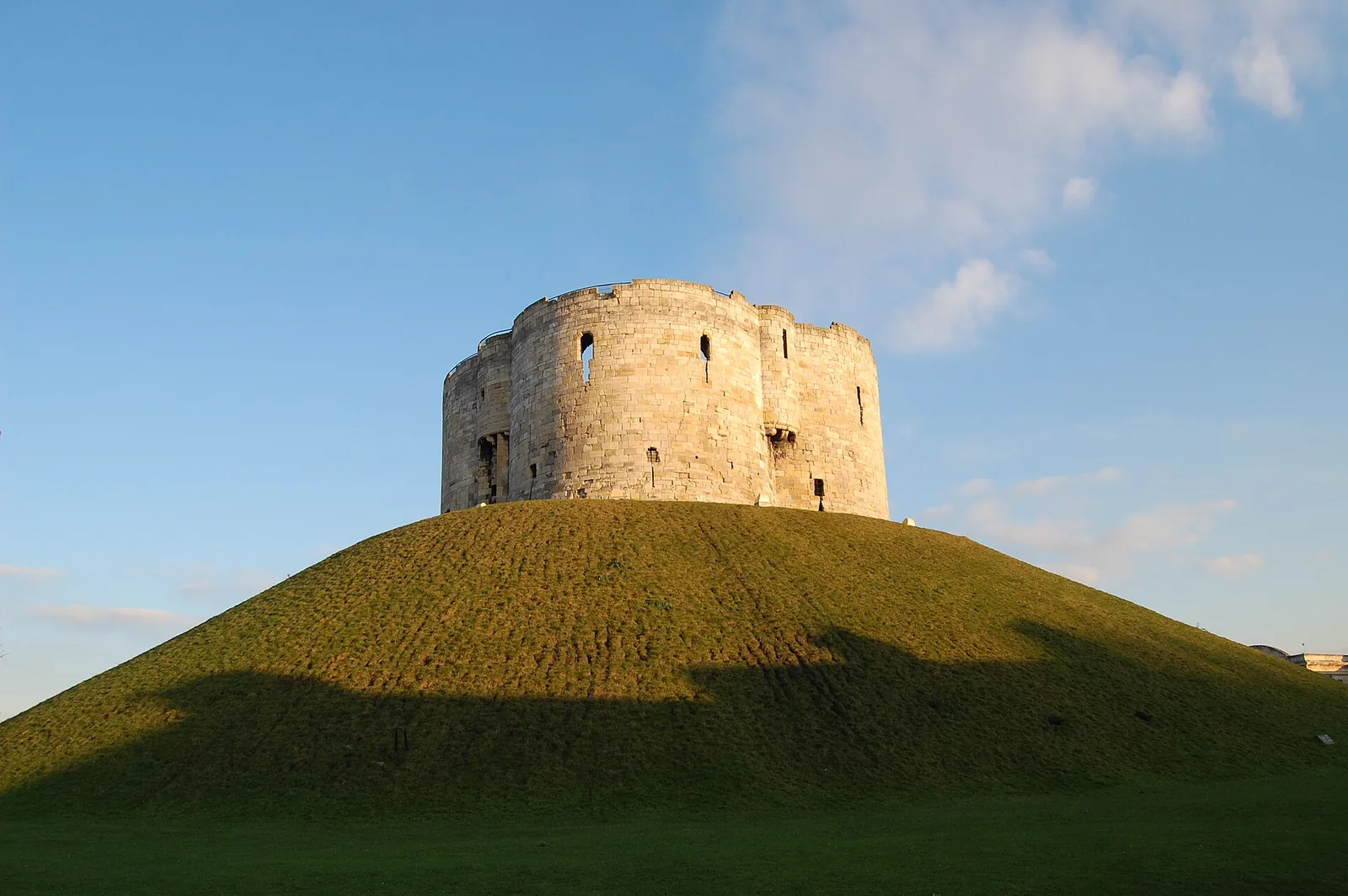
Clifford’s Tower, York. Photo: Steven Fruitsmaak, 2007 · Public domain · Source page
Richard became king in July 1189. On the day of his coronation at Westminster, 3 September 1189, a mob attacked the Jews of London, killing some and burning their houses. Afterwards the king ordered that the Jews be left in peace.
In 1190 attacks spread to other towns. In York, in March, the Jews fled into the royal castle. A mob besieged them, led by local men who owed them money. Many of those trapped chose death rather than be killed or forced to convert: the men killed their wives and children and then themselves. Those who came out on a promise of safety were murdered. The dead are usually counted at about a hundred and fifty.
Source: Who led the mob?
“Those who urged them on to venture upon these measures were certain persons of higher rank, who owed large sums to those impious usurers. [...] Some also of those who had accepted the sign of the Lord [...] could more easily be impelled to aid the expenses of a journey undertaken for the Lord, out of the plunder of His enemies.”
William, a canon in Yorkshire, wrote a few years after the massacre. “The sign of the Lord” is the crusader’s cross.
- William calls the Jewish lenders “impious”. Does that make his account worthless? No. A hostile witness who still blames the killers is valuable.
- Who is missing from this passage? The victims. Their voice reaches us through the Hebrew chronicle of Ephraim of Bonn and the memory of the community, not from here.
A decision point
You are Richard I, king of England.
Early May 1191, off Limassol, Cyprus
Storms scattered your fleet on the way from Sicily. Some ships were wrecked on Cyprus, and the island’s ruler, Isaac Komnenos, a Byzantine noble who calls himself emperor, has imprisoned the survivors and taken their goods.
The ship carrying your sister Joan and Berengaria of Navarre, the princess you are to marry, lies off Limassol, and Isaac will not let it into the harbour. Philip II has already reached Acre.
What do you do?
- Take the women aboard and sail straight for Acre You reach the siege a month earlier. But the prisoners stay in Isaac’s hands, and a hostile ruler sits on the sea road the army depends on.
- Demand the prisoners and their goods, then sail on If Isaac gives way, you lose no time. If he refuses, you must fight anyway, or sail off after being defied in front of your whole fleet.
- Land, fight Isaac and take the island A rich base for food and ships close to Syria, and an answer for the prisoners. But it costs weeks, and you make war on a Christian ruler on your way to fight Saladin.
What really happened
Land, fight Isaac and take the island
Richard sent envoys three times, and Isaac refused. On 6 May Richard landed and took Limassol, and on 12 May he married Berengaria there. In under a month the whole island was conquered.
The practical gains were large: Cyprus fed the army at Acre and stayed under Latin rulers, the Lusignan kings and then Venice, until 1571. The Byzantine side is not told by the Latin chronicles.
Acre
August 1189
The siege before the kings
The crusade began before the kings arrived. Guy of Lusignan, king of Jerusalem, captured at Hattin and released, was turned away from Tyre by Conrad of Montferrat. Guy marched south with a small army, and on 28 August 1189 camped outside Acre, Saladin’s rich port.
It was a reckless move, and it worked. Saladin ringed the besiegers with his own army, and ships brought thousands of Franks from northern Europe. For almost two years the two camps fought, starved and fell sick on the plain of Acre.
Acre, 1189–1191: who fought whom
28 August 1189 – 12 July 1191
The plain round Acre, at the north end of the Bay of Haifa
The crusaders
- Commanders: Guy of Lusignan, king of Jerusalem, Philip II of France (from April 1191), Richard I of England (from June 1191), Conrad of Montferrat, Henry of Champagne, Leopold of Austria
- Strength: 2,000 horse and 30,000 foot, “I have never met anyone who estimated their numbers at less” (Baha ad-Din, autumn 1189); Guy’s army 9,000; the Danes and Frisians who joined him 12,000 (The Itinerarium); about 25,000 in summer 1191, after the kings arrived (One modern estimate)
- Losses: over 10,000 dead in the first year alone; many more later in the siege, many from disease (One modern estimate); 4,000 dead in one failed attack, 25 July 1190 (A letter from the camp, 1190)
The garrison of Acre
- Commanders: Baha ad-Din Qaraqush, Sayf ad-Din al-Mashtub
- Strength: no reliable figure; it was reinforced by sea several times (The sources)
- Losses: about 2,600 (Richard) to more than 3,000 (Baha ad-Din) (Prisoners killed on 20 August 1191)
Saladin’s army
- Commanders: Saladin, His brother al-Adil and his nephew Taqi ad-Din
- Strength: no reliable figure; it grew and shrank with the seasons, as emirs came and went (The sources)
- Losses: no count (The sources)
Outcome: Acre surrendered on 12 July 1191, after almost two years. Its garrison became hostages until Saladin paid the agreed price.
Nobody counted these armies, and they changed with the seasons. Every figure is a guess.
The siege of Acre
28 August 1189 – 20 August 1191
Guy of Lusignan camps on the hill of Toron, facing Acre, Saladin’s rich port, while Saladin camps at Tell Keisan. The city is held by its own garrison, and the two armies stand against each other around it.
One reconstruction, after Baha ad-Din (trans. Wilson and Conder, 1897, with Conder’s identifications of the places), the Itinerarium (trans. Archer, 1888) and W. B. Stevenson (1907). The coastline, the river Na’aman, Tel Akko and Tell Keisan are drawn from a modern map (OpenStreetMap and Wikipedia coordinates). North is up; about 1 km = 60 map units. Today’s shore is not exactly the shore of 1189.
Which way the peninsula points: on the modern map the old city sits at the south-western tip of a small headland, with the sea to the west and south and the harbour on its south-east side, facing the bay; the land walls ran along the north and east. Archer wrote that the tongue of land juts out “towards the south-east”; he probably meant the side the harbour opens to, and this map follows the modern map.
Uncertain or disputed: the site of Tell al-Ayyadiyya (no secure modern identification was found; it is placed by Conder’s “5 miles east of Acre, north of the Belus”); the shape and depth of the Latin ditches; where Philip’s and Richard’s camps stood (guessed here); the size of the armies.
Phases of the battle
- 1189: besiegers besieged Guy camps on the hill of Toron, Saladin at Tell Keisan. In mid-September the crusaders close the ring, and the sultan’s army breaks through along the northern shore into the city.
- 4 October 1189: the great sortie The crusaders attack the sultan’s line. His right wing breaks, but the crusaders are driven back, and the Master of the Templars, Gerard of Ridefort, is killed.
- 1189–1191: a double ring Both camps dig in; the crusaders face both the city and Saladin. In May 1190 the defenders burn the siege towers with Greek fire.
- April–July 1191: the kings Philip and Richard arrive. Their siege engines batter the walls, and miners dig under the towers. The sultan’s attacks on the ditches fail. On 12 July the garrison surrenders.
- 12 July – 20 August 1191 Saladin pulls his camp back to the hills of Shefa-Amr. On 20 August Richard leads his army and the prisoners onto the plain.
The strategy
- Crusaders: Guy camped before Acre in a reckless move that worked. The crusaders closed the ring round the city and dug ditches, to face the city and Saladin at once. When the kings came, they brought siege engines that battered the walls, and miners who dug under the towers.
- Acre’s garrison: The garrison stayed inside the walls to hold the city. It burned the siege towers with Greek fire, and the city was reinforced by sea several times.
- Saladin’s army: Saladin ringed the besiegers with his army, to squeeze the siege from outside. His army broke through along the northern shore into the city to strengthen the defenders, and tried to storm the Latin ditches.
What decided it: What decided it was the kings’ arrival with siege engines and miners: the walls were battered and the towers undermined, while Saladin’s attacks on the ditches failed. The city surrendered on 12 July 1191.
Saladin
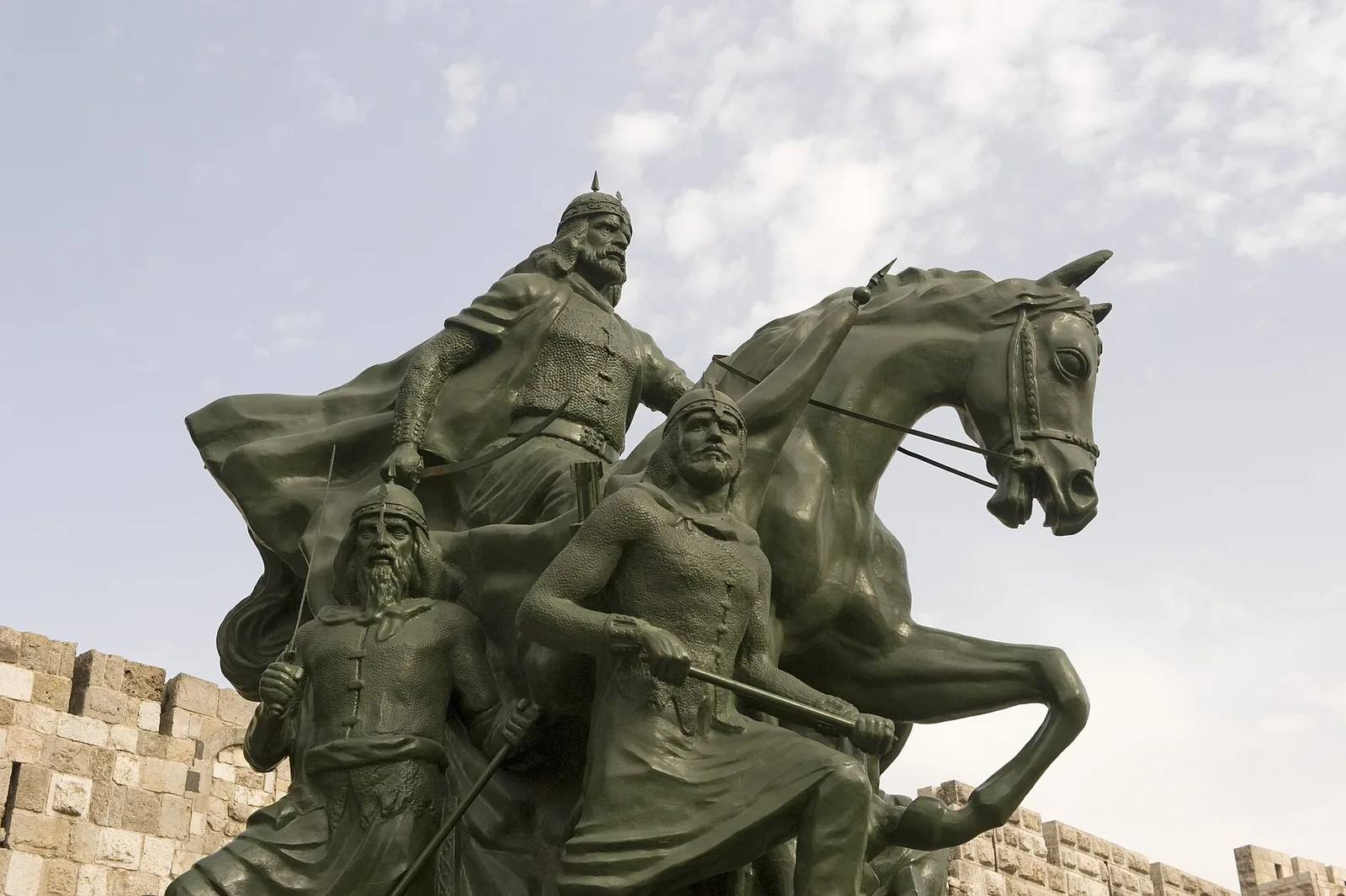
Statue of Saladin, Citadel of Damascus. Photo: Dosseman, 2009 · CC BY-SA 4.0 · Source page
A Kurdish officer’s son who united Egypt and Syria, took Jerusalem in 1187, and spent his last years holding off the Third Crusade.
- Born: 1137 or 1138, The citadel of Tikrit (Iraq)
- Died: 4 March 1193 (one day uncertain), Damascus, of a fever, after twelve days
- Won: Hattin, 4 July 1187; Jerusalem, 2 October 1187; Kept Jerusalem against the Third Crusade
- Lost: Acre, surrendered 12 July 1191; Arsuf, 7 September 1191; Jaffa, 5 August 1192
“I am an old man now, I have no longer any desire for the pleasures of this world.”
April–July 1191
The kings arrive
Philip II arrived on 20 April 1191, Richard on 8 June. Baha ad-Din described the English king as a man of “good judgment and wide experience”, of “extreme daring and insatiable ambition”.
Three weeks later Philip, ill and at odds with Richard, sailed home. “It will be a shame and a disgrace for my lord if he goes away without having completed the business on which he came hither,” Richard answered; but if Philip was ill, “his will be done.”
Philip II
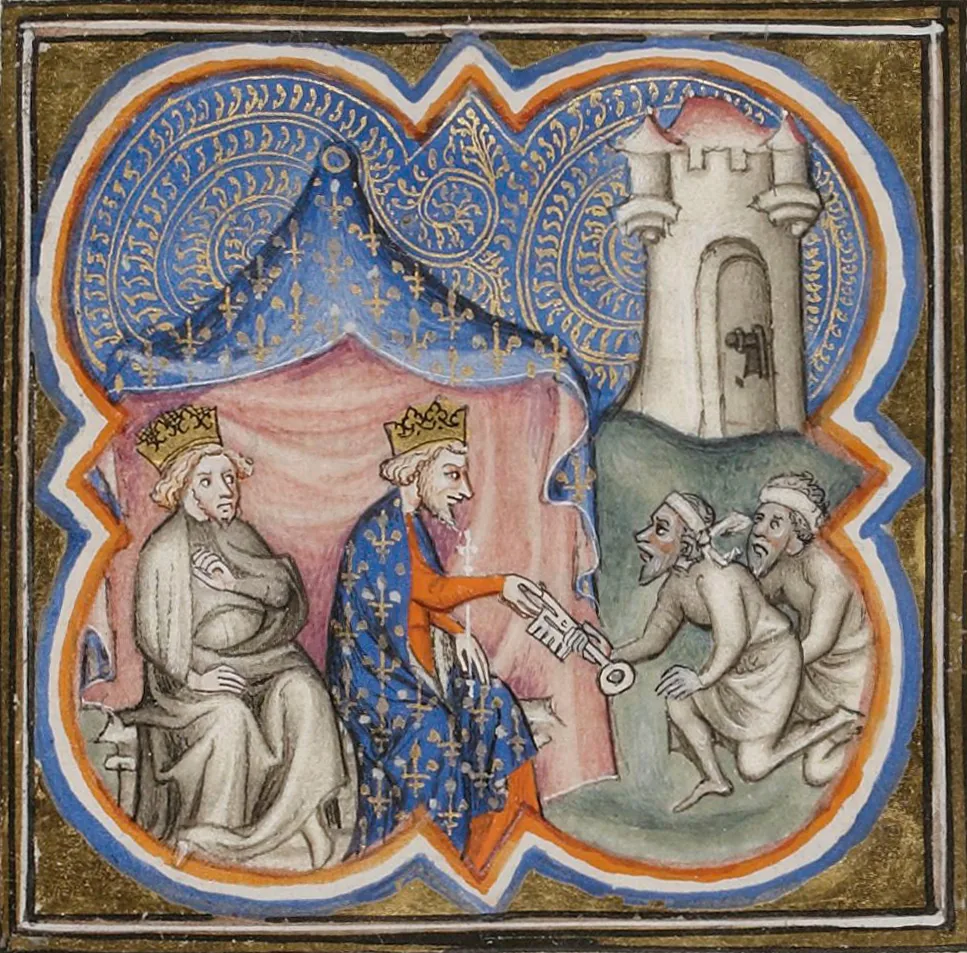
Anonymous, Grandes Chroniques de France, about 1375–80. Bibliothèque nationale de France, MS Français 2813, fol. 238v · Public domain · Source page
The king of France who reached Acre first, fell ill, went home weeks after it fell, and later took most of the French lands of Richard and his brother.
- Born: 21 August 1165, Gonesse, near Paris
- Died: 14 July 1223, Mantes, on the road to Paris
- Won: Acre, July 1191, with Richard; Normandy, taken from King John, 1204; Bouvines, 1214
- Lost: Fréteval, 1194: lost his baggage and royal archives to Richard
“take care of himself, for the devil was now let loose.”
A decision point
You are Saladin, sultan of Egypt and Syria.
Sunday 11 August 1191, your camp in the hills east of Acre
A month ago your emirs in Acre, at the end of their strength, surrendered the city on terms you did not set: 200,000 gold dinars, the True Cross taken at Hattin, and, by the Franks’ count, about 1,500 Christian captives, in instalments. Until you pay, the garrison, some three thousand men, are Richard’s hostages.
The first payment is due today. The money and the Cross are ready, but not all the captives of rank the Franks named have yet been brought in.
You do not know whether Richard will free your men once he holds the Cross and the gold.
How do you hand over the first payment?
- Hand over everything now and trust Richard to free your men If Richard keeps faith, the garrison walks free and the deal is done. If not, you have given up the Cross, the gold and the captives, and your men are still in his hands.
- Offer an exchange with a guarantee: hostages from one side or the other until both have delivered Fair to both sides, and you risk nothing. But it needs Richard to trust you in turn, and he may see it as playing for time.
- Ask for more time until every named captive is found It costs nothing today. But the deadline in the treaty passes, and the garrison’s lives hang on it.
What really happened
Offer an exchange with a guarantee: hostages from one side or the other until both have delivered
Saladin offered a guarantee in two forms (they are quoted in a source below). Richard’s envoys refused both and offered their oath. Saladin would not pay against an oath alone, and the deadline passed with nothing exchanged.
Baha ad-Din says Saladin feared treachery; the Latin writers say he never meant to pay. Both sides had reasons for mistrust.
20 August 1191
On the plain below Acre
On the afternoon of Tuesday 20 August, Richard led his army out of Acre onto the plain, in sight of Saladin’s advance guard. The Muslim prisoners were brought out, tied together with ropes, and killed.
In Richard’s own letter about 2,600 died; in the Itinerarium, 2,700; in Baha ad-Din, more than 3,000. A few men of rank were kept alive, to be exchanged for Christian captives.
Saladin, for his part, now had Frankish prisoners who fell into his hands killed.
Source: In Richard’s own words
“... the lives being saved of the Saracens who had been sent for the purpose of defending and protecting it [...] However, the time having expired, and the stipulation which he had agreed to being utterly disregarded, we put to death about two thousand six hundred of the Saracens whom we held in our hands, as we were bound to do.”
Richard wrote about six weeks after the killing, to a powerful churchman in France. “Saracens” is a Latin name for Muslims.
- Richard says the garrison’s lives were “saved”. Why, then, was he “bound” to kill them? He treats the prisoners as pledges, forfeit once the day passed. Baha ad-Din says the terms meant slavery, not death, if Saladin failed to pay.
- Who is the letter for, and what does Richard leave out? Christian readers in Europe. He says nothing of Saladin’s offer of hostages: he wants to show a king keeping the rules.
Source: From Saladin’s camp
11 August 1191, Saladin’s offer to the Franks: “either send our comrades back to us and accept the instalment due for this period, and we will give you hostages [...] or receive the instalment we are sending you to-day, and send us hostages to be retained until our comrades [...] are returned to us.”
June 1191, when Richard asked to meet him: “It is not customary for kings to meet, unless they have previously laid the foundations of a treaty.”
Baha ad-Din wrote after the sultan’s death, for his family: an admirer, but frank about defeats.
- Baha ad-Din and the Latin writers disagree. How can we judge? Neither is neutral. But Baha ad-Din gives details and admits that not all the captives had been collected; the Latin writers give a verdict, not terms.
- Why would a king refuse to meet his enemy? Kings who had met and exchanged tokens of trust could not decently fight afterwards: a meeting ended a war.
Myth
Richard killed the prisoners of Acre in revenge for Hattin.
The truth
None of the sources we read says so, although Saladin had indeed had the Templars and Hospitallers captured at Hattin killed.
Baha ad-Din gives two reasons: revenge for Christians killed in the siege, or Richard’s wish not to leave so many prisoners behind him. “God knows what his reason really was,” he ends. The Latin writers blame Saladin’s missed deadline; the Itinerarium adds vengeance for Christians the captives had killed during the siege.
The evidence
Baha ad-Din, ch. 116; Richard’s letter of 1 October 1191; W. B. Stevenson, The Crusaders in the East (1907).
Arsuf
August–September 1191
A wall of foot soldiers
On 22 August the army left Acre and marched south along the coast towards Jaffa, the port nearest Jerusalem, with the fleet beside it.
Richard kept the column tight: the foot soldiers as a wall on the landward side, the knights inside it, the baggage between the army and the sea. Baha ad-Din saw Frankish foot soldiers “with from one to ten arrows sticking in them, and still advancing at their ordinary pace without leaving the ranks.”
Arsuf: who fought whom
Saturday 7 September 1191
North of Arsuf, between the Nahr al-Falaq (the Poleg) and the town; Arsuf is about 16 km north of Jaffa
The Frankish army
- Commanders: Richard I, Hugh III, duke of Burgundy, with the French, The Templars and the Hospitallers
- Strength: “did not exceed 100,000” (The Itinerarium); about 10,000 to 20,000, perhaps 1,200 of them knights (Modern estimates)
- Losses: “no man of importance” except James of Avesnes (Richard’s letter (trans. Archer)); no more than about 700 (One modern estimate)
Saladin’s army
- Commanders: Saladin, His nephew Taqi ad-Din, with the sultan’s guard
- Strength: 300,000 (The Itinerarium); about 25,000, almost all horsemen (some say up to 35,000) (Modern estimates)
- Losses: 7,000 dead, including 32 emirs (The Itinerarium); three leading emirs by name, and “a great number” killed and wounded on both sides (Baha ad-Din)
Outcome: A Frankish victory. Saladin’s army broke but rallied the same evening; it was not destroyed. On 10 September the Franks reached Jaffa.
The Itinerarium’s 300,000 against 100,000 is rhetoric, not a count.
A decision point
You are Richard I.
Saturday 7 September 1191, afternoon, on the road to Arsuf
Since morning Saladin’s archers have poured arrows into your column, and horses are dying. At the rear the crossbowmen are walking backwards, facing the enemy, and the Hospitallers, hard pressed, ride on.
The head of the column is nearing Arsuf, where the army can camp. You have a plan: when the enemy comes close and tires, six trumpets will sound and all the knights will charge together.
The Master of the Hospitallers rides up: his knights are losing their horses for nothing, and men will call them cowards. He begs leave to charge now.
What do you tell him?
- Wait: hold on until the signal The column stays whole, and the charge, when it comes, will hit a tired enemy who has come close. But men and horses keep falling, and patience at the rear may crack.
- Let the Hospitallers charge now They may drive off the attackers at the rear. But one division charging alone could be cut off, and that is exactly what Saladin wants.
- Sound the trumpets now for a general charge Everyone strikes together. But the enemy may simply scatter and come back, as horse archers do, leaving your knights spread across the plain.
- Halt and form a battle line where you stand Perhaps safer than marching under fire. But an army standing in the open is an easier target still, and Saladin need not attack it.
What really happened
Wait: hold on until the signal
Richard said wait. Then, says the Itinerarium, two knights, the Hospitallers’ marshal and Baldwin le Carron, charged; the Hospitallers followed, then the whole army. Richard rode in and turned the moment into a general attack.
In the sources Richard wanted one joint charge at the right moment. The scene comes from his admirers, and the historian Stephen Bennett doubts it (see below).
The battle of Arsuf
Saturday 7 September 1191, from morning to evening
On 7 September 1191 the Frankish army marches south along the coast from Acre towards Jaffa, with the fleet beside it. The column is tight: foot soldiers on the landward side, knights inside, baggage between the army and the sea. Saladin’s army is inland, near the wood, and may attack the column from the land side.
One reconstruction, after the Itinerarium (trans. Archer, 1888) and Baha ad-Din, who was at the battle (trans. Wilson and Conder, 1897). The coastline and the Poleg (the Nahr al-Falaq, the crusaders’ Rochetaillée) are drawn from a modern map (OpenStreetMap), and Arsuf from the coordinates of Apollonia National Park. The map is turned: the coast, which runs from north-north-east to south-south-west, goes from left to right, with the sea at the bottom and inland at the top; the arrow shows north. About 1 km = 60 map units.
Uncertain or disputed: the exact site of the battle (an archaeological survey in 2013–14 suggested the plain north-east of Arsuf); the edge of the wood, drawn here roughly; the order of the column on the day (the Itinerarium, Baha ad-Din and Roger of Howden describe it differently); the length of the column; who gave the order to charge; and the numbers.
Phases of the battle
- Morning: leaving the river The column leaves its camp by the Nahr al-Falaq. The Templars lead, the Hospitallers bring up the rear. Horse archers ride out of the wood.
- Midday: pressure on the rear The head of the column nears Arsuf and the column is stretched out. The enemy presses on the rear and the landward side, and many horses fall.
- Afternoon: the charge Two knights break out, the Hospitallers follow, then the whole army charges inland. Saladin’s wings break; for a moment, writes Baha ad-Din, only seventeen men stood by the sultan’s banner.
- Counter-attack and pursuit The sultan’s guard under Taqi ad-Din strikes near the standard, and Richard charges again. The Franks pursue for about three kilometres and halt. James of Avesnes is killed.
- Evening: camp at Arsuf The Franks camp by Arsuf. Saladin rallies his men at the edge of the wood, and the next day faces them again.
The strategy
- Frankish army: Richard kept the column tight, with foot soldiers as a wall on the landward side, knights inside it and baggage between the army and the sea, so that horse archers could not break it up. The aim was to reach Arsuf, where the army could camp.
- Saladin’s army: Saladin’s horse archers rode out of the wood and shot at the rear and landward side of the column, to kill horses and wear the army down along the road. The sultan’s guard under Taqi ad-Din was kept ready for a counter-attack.
What decided it: What decided it was the Frankish charge inland, which broke Saladin’s wings. His army fell back, but rallied the same evening and was not destroyed.
Source: Arsuf from both sides
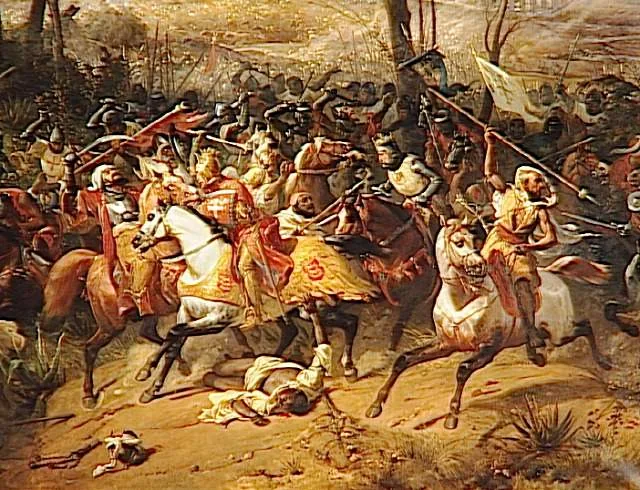
Éloi Firmin Féron, The Battle of Arsuf, Château de Versailles · Public domain · Source page
*The Itinerarium:* To whom the king made reply, “My good master, it must needs be endured, [seeing that] none can be everywhere.”
Baha ad-Din: “I myself saw their knights gathered together in the midst of a protecting circle of infantry; they put their lances in rest, uttered a mighty war-cry, and the ranks of infantry parted to allow them to pass; then they rushed out, and charged in all directions.”
The Itinerarium was written years later by an admirer of Richard. Baha ad-Din was on the field with Saladin.
- Which details could only an eyewitness give? Baha’s: the ranks of foot soldiers opening for the knights, the war-cry. The Itinerarium’s dialogue is a scene a writer shapes.
- What does each writer want you to admire? The Itinerarium, Richard’s self-control. Baha ad-Din, the enemy’s strength, which explains the defeat.
Jerusalem
October 1191 – January 1192
Fighting and talking
Through the autumn the two sides fought and negotiated at once. Saladin’s brother al-Adil even dined with Richard, and Richard proposed that his sister Joan marry al-Adil and that the two rule the coast together. Nothing came of it.
Saladin, meanwhile, had pulled down the walls of Ascalon, fearing Richard would take it, and sent most of his emirs home for the winter. The Frankish army crept inland through the rain, and at the turn of the year reached Beit Nuba, about twenty kilometres from Jerusalem.
A decision point
You are Richard I.
January 1192, the camp at Beit Nuba, about twenty kilometres from Jerusalem
For two weeks it has rained, hailed and snowed. Horses die of cold, food rots, armour rusts.
The Templars, the Hospitallers and the Pullani, the Franks born in the East, warn you: Saladin’s army will fall on you from the hills, and your supply road is long. And who will hold the city when the pilgrims sail home?
You have never seen Jerusalem. You ask the local Franks to draw you a plan of it.
What do you do?
- Besiege Jerusalem now, whatever the weather The army’s spirit is high, and the city’s garrison suffers the same cold. But you would besiege a strong city with Saladin’s army behind you, at the end of a long supply road.
- Turn back to the coast, rebuild Ascalon and think about Egypt You keep the army whole and cut Saladin’s road between Egypt and Syria. But the soldiers came for Jerusalem, and turning away may break the crusade apart.
- Hold Beit Nuba and wait for spring and more men Better weather, perhaps more men. But a winter camp in the hills eats men and horses, and Saladin’s emirs will be back in spring too.
What really happened
Turn back to the coast, rebuild Ascalon and think about Egypt
Around 13 January 1192 the army turned back. The French left in anger, and Richard rebuilt Ascalon.
In June he camped again at Beit Nuba. Around 22 June, says the Itinerarium, a council of twenty (five Templars, five Hospitallers, five French nobles and five local Franks) advised an attack on Egypt instead of Jerusalem; the French would not agree, and on 4 July the army withdrew again.
Ibn al-Athir reports (trans. Archer, 1888) that Richard, looking at the plan, saw the deep valley round the city and said it could not be taken “so long as Saladin lives and the Musulmans are at peace one with the other”. On the eve of the retreat, in early July 1192, a spy of Saladin’s reported Richard saying that the springs round the city had been fouled: “where, then, shall we find water?”
April–May 1192
A murder in Tyre
In April 1192 the barons of the kingdom chose Conrad of Montferrat, the defender of Tyre, as king of Jerusalem in place of Guy; Richard, who had backed Guy, gave way and made peace with Conrad. On 28 April (some say the 27th), two men stabbed him to death in Tyre; most sources say they were Assassins.
Within about a week Count Henry of Champagne married Conrad’s widow Isabella and became ruler of the kingdom.
Myth
Unable to free Jerusalem, Richard covered his eyes so as not to see the city.
The truth
The story is first written down by Jean de Joinville, about 1305–09. He tells it as an argument at the council of Louis IX at Jaffa in the early 1250s, some fifty years after Richard’s death.
The Itinerarium, written much closer to the events, says the opposite: in June 1192, chasing Turks, “the king looked up and saw afar off the city of Jerusalem”.
The evidence
Joinville, Life of Saint Louis, ch. 108; the Itinerarium, book 5; both in T. A. Archer, The Crusade of Richard I (1888), who comments that “it is impossible to feel sure of the details”.
Jaffa and the peace
July–August 1192
Jaffa
On 28 July 1192 Saladin besieged Jaffa, and on 31 July his miners brought down the walls.
The next day Richard landed in the harbour and drove the sultan’s men out of the town. On 5 August, at dawn, Saladin attacked his camp. Richard’s men, between a few hundred and two thousand foot depending on the source, many of them Genoese and Pisan crossbowmen, and between nine and fifty-five knights, held their ground. Saladin’s tired soldiers would not press the attack home.
Myth
When Richard lay ill, Saladin sent him his own doctor and ice from the mountains.
The truth
The snow is true. It was the sick Richard who asked for “fruit and snow”, in 1191 and 1192, and Saladin sent them; according to Baha ad-Din he used the messengers to learn the state of Richard’s army.
No source of the time that we have read mentions a doctor. The doctor seems to come from Walter Scott’s novel The Talisman (1825), where Saladin comes to Richard disguised as a physician.
The evidence
Baha ad-Din, trans. Wilson and Conder (1897), pp. 263 and 378–379.
A decision point
You are Richard I.
Late August 1192, sick with fever, in your camp near Jaffa
You are ill, your army is small, and news from England tells of your brother John plotting against you with Philip II.
Saladin will make peace: the coast from Tyre to Jaffa can stay yours, and Christian pilgrims may visit Jerusalem. But he insists that Ascalon, which you rebuilt on his road to Egypt, be pulled down. You have said you cannot allow “a single stone to be thrown down” from its walls.
What do you do?
- Hold out for Ascalon and fight on Ascalon is the key to Egypt, and giving it up undoes a winter’s work. But a sick king with a shrinking army may lose more than a fortress, and his kingdom at home is in danger.
- Give up Ascalon and make peace for the coast and the pilgrims You keep almost everything you won and can go home to save your lands. But Jerusalem, the goal of the whole crusade, stays with Saladin.
- Sail home with no treaty at all You save time. But the Franks you leave behind would face Saladin’s full strength with no truce to protect them.
What really happened
Give up Ascalon and make peace for the coast and the pilgrims
Richard gave up Ascalon. On 2 September 1192 he gave his hand on the treaty but refused to swear, saying “that kings never did so”; his nobles swore for him, and Saladin’s side swore the next day. The peace was set for three years: the coast stayed Frankish, Ramla and Lydda were shared, Ascalon was demolished, and pilgrims could go up to Jerusalem.
Baha ad-Din reports Richard saying that his own country “beyond the seas is being ruined”. Saladin’s troops were exhausted and out of money. “I am afraid of making peace,” Saladin told Baha ad-Din.
1192–1194
Pilgrims, a prison and a death
In September three groups of crusaders went up to Jerusalem as pilgrims. Richard did not go. On 9 October he sailed from Acre.
Shipwrecked in the Adriatic, he was seized in disguise near Vienna in December 1192 by the men of Duke Leopold, who handed him to the emperor Henry VI. He was freed in February 1194 for an enormous ransom: 100,000 marks of silver, with 50,000 more promised.
Saladin did not live to see it. He died in Damascus in March 1193, aged about fifty-five.
Myth
Richard and Saladin met face to face: they fought a duel, shook hands, feasted together.
The truth
They never met. Richard asked for a meeting more than once, and Saladin refused: kings do not meet before a treaty, and they had no language in common. They dealt through envoys and through al-Adil. These tiles, made in England some sixty years later, show the two in combat: the legend grew fast.
The evidence
Baha ad-Din, chs. 105, 108 and 136 (trans. Wilson and Conder, 1897).
Myth
The Third Crusade, led by Richard the Lionheart, won Jerusalem back.
The truth
It did not. Twice the army came within about twenty kilometres of the city and turned back; the treaty only let pilgrims visit. The crusade won back the coast, and with it the Latin kingdom, its capital now Acre, survived another century.
From Hattin to the fall of Acre
- 1187 Hattin; Saladin enters Jerusalem
- 1188 The Saladin tithe
- 1189 The siege of Acre begins; Richard is crowned; a riot against the Jews of London
- 1190 The massacre of the Jews of York; Frederick Barbarossa drowns
- 1191 Cyprus; Acre surrenders; the prisoners are killed; Arsuf
- 1192 Two retreats from Beit Nuba; Jaffa; the peace treaty
- 1193 Saladin dies; his realm is divided among his sons and his brother al-Adil, who later reunites it
- 1291 Acre falls to the Mamluks, and the crusader kingdom on the mainland comes to an end
Why did Richard not take Jerusalem?
Was the retreat from Beit Nuba a sound military decision, or a missed chance?
- John Gillingham, Richard I (1999) A sound decision. In Gillingham’s view, in winter the weather and Saladin’s army outside the city made a siege too dangerous; in summer 1192, as the Itinerarium tells it, Richard and most of his council wanted to strike at Egypt, the source of Saladin’s power, while the French insisted on Jerusalem, and the army split.
- W. B. Stevenson, The Crusaders in the East (1907) A failure of leadership. Not the crusaders’ lack of enthusiasm prevented the siege, but Richard’s own unwillingness; in his view Richard chose the council of twenty so that it would decide what he wanted.
- T. A. Archer, The Crusade of Richard I (1888) The city could probably have been taken in June 1192, but it is doubtful whether it could have been held once the crusaders went home. The true road to the Holy Land, he wrote, lay across the Nile Delta.
- Baha ad-Din, an eyewitness on Saladin’s side His account backs neither side completely. It shows Saladin expecting a siege and praying in al-Aqsa, and his emirs dreading the fate of Acre’s garrison; but also fouled water and emirs who would rather fight in the open: Jerusalem was no easy prize.
Historians still weigh supply, water, weather and the army’s mood against the chance that was missed. The sources do not even agree on who wanted to go.
What do you know now?
Check yourself
Why did Saladin refuse to meet Richard?
Answer: Kings do not meet before a treaty. Right. According to Baha ad-Din, kings who had met and exchanged tokens of trust could not decently fight each other afterwards. He added that they had no language in common.
Check yourself
What did Saladin offer on 11 August 1191, when the first payment fell due?
Answer: An exchange with hostages. Right. Either the Franks would free his men and he would give hostages for the later payments, or they would take the payment and give him hostages until his men came home.
Check yourself
How many Muslim prisoners were executed outside Acre on 20 August 1191?
Answer: Between 2,600 and more than 3,000: the sources disagree. Right. About 2,600 in Richard’s letter, 2,700 in the Itinerarium, more than 3,000 in Baha ad-Din.
Check yourself
At Arsuf the Master of the Hospitallers asked to charge, and Richard said wait. Why?
Answer: He planned for all the knights to charge together at a signal, once the enemy came close and tired. Right. A charge by one division alone could be cut off, which was exactly what Saladin wanted.
Check yourself
What, according to the sources, lay behind the retreats from Beit Nuba?
Answer: Weather, water, supplies, and fear of the sultan’s army outside the city. Right. The military orders and the Pullani warned of Saladin’s army; Ibn al-Athir tells of the valley round the city; and in summer, says the spy, Richard worried about water.
Check yourself
What did the peace of 2 September 1192 give the Christians?
Answer: The coast, and pilgrimage to Jerusalem. Right. The coast from Tyre to Jaffa stayed Frankish, Ramla and Lydda were shared, and Christian pilgrims could visit Jerusalem, for about three years.
Terms
- Franks What Muslims and Byzantines called all Western Europeans, whatever their language (in Arabic, Ifranj). The crusaders used the word too.
- sultan Arabic for “power”: the title of a Muslim ruler who held real power, beside the caliph in Baghdad. Saladin was sultan of Egypt and Syria.
- emir Arabic for “commander”: a Muslim prince or army commander. Saladin’s emirs brought their own men, and could refuse to fight.
- Saladin tithe A tax of a tenth of income and movable goods, ordered by Henry II of England in 1188 to pay for the crusade. Those who took the cross were exempt.
- Templars A military order founded in Jerusalem about 1120: knights who took monks’ vows and fought for the crusader states. They were named after their headquarters on the Temple Mount.
- Hospitallers A military order that grew out of a hospital for pilgrims in Jerusalem. By the 1180s, like the Templars, it was one of the strongest forces in the kingdom.
- True Cross A relic believed to be wood from the cross of Jesus, carried into battle by the kings of Jerusalem. Saladin captured it at Hattin in 1187.
- hostages People held as a guarantee that a promise will be kept. At Acre the garrison became hostages until Saladin paid the agreed price.
- Pullani Franks born in the East: the local Latin Christians of the crusader states. The Latin chronicles call them Pullani.
- Assassins A branch of the Nizari Ismailis, a Shi’ite movement, which held castles in the Syrian mountains. Its leader, “the Old Man of the Mountain”, sent devoted agents to kill his enemies.
- Richard de Templo A canon of Holy Trinity in London, to whom the Latin chronicle of the crusade is usually credited. A recent study doubts he wrote it.
- Ambroise A Norman poet who marched with Richard's army. The Latin chronicle retells his poem.
- Itinerarium Peregrinorum A Latin chronicle of Richard's crusade. It retells Ambroise's poem and was written years later by an admirer of Richard.
- Roger of Howden A royal clerk of Richard who copied the king's letters. In his own narrative he gives five thousand killed in the massacre of the prisoners.
- Baha ad-Din A judge in Saladin's army and his close companion. He wrote after the sultan's death: an admirer, but frank about defeats.
- Ibn al-Athir A historian of Mosul who wrote some forty years later and was no uncritical admirer of Saladin.
- W. B. Stevenson A historian who wrote in 1907 that the battle account in the Itinerarium is highly coloured, because it translates a poem.
- Stephen Bennett A modern historian who reread the sources on the battle near Arsuf and argued that the story of indiscipline rests on two closely related sources.
- Jean de Joinville A French chronicler who wrote about 1305–09, some fifty years after Richard's death. He was the first to write this story down.
- Westminster The great church near London where English kings were crowned, including Richard in 1189.
- Saleph A river in Anatolia where Emperor Frederick Barbarossa drowned in June 1190.
- Isaac Komnenos A Byzantine noble who called himself emperor and ruled Cyprus. He would not let the ship carrying Richard's sister into the harbour.
- Limassol A port city on Cyprus. Richard captured it, and there he married Berengaria.
- Berengaria A princess of Navarre whom Richard married on Cyprus.
- Guy of Lusignan King of Jerusalem, captured at Hattin. He marched south with a small army and camped outside Acre.
- Conrad of Montferrat Defender of Tyre, who kept Guy out of the city. He was chosen king of Jerusalem in 1192 and murdered that year.
- Hattin A hill in Galilee where Saladin destroyed the army of the kingdom of Jerusalem in 1187.
- Acre A rich port on the Mediterranean coast, fought over by both camps for almost two years.
- Jaffa The port on the coast nearest Jerusalem. Richard landed there in 1192 and drove out the sultan's men.
- Ascalon A coastal city. Richard rebuilt it, and Saladin had pulled down its walls.
- Beit Nuba A village about twenty kilometres from Jerusalem, where the crusader army camped twice and turned back.
- al-Adil Saladin's brother. He dined with Richard, and they discussed sharing the coast.
- Old Man of the Mountain Leader of the Assassins in Syria. According to one source, one of Conrad's murderers named him before he died.
- Frederick Barbarossa Emperor of Germany, the oldest of the crusade's leaders. He drowned in the river Saleph in 1190, and most of his army melted away.
Sources
- Bahā’ ad-Dīn Ibn Shaddād, The Life of Saladin (“What befell Sultan Yūsuf”), trans. C. W. Wilson, revised by C. R. Conder, Palestine Pilgrims’ Text Society vol. 13 (London, 1897)
- T. A. Archer, The Crusade of Richard I, 1189–92 (London: David Nutt, 1888): translated extracts of the Itinerarium Peregrinorum et Gesta Regis Ricardi, Ibn al-Athīr, Ernoul, Joinville and others
- Roger of Howden, Chronica: Richard I to the abbot of Clairvaux, 1 October 1191; the ransom agreement of 1193; in The Annals of Roger de Hoveden, trans. Henry T. Riley, vol. 2 (London: H. G. Bohn, 1853)
- William of Newburgh, Historia rerum Anglicarum, book 4, chs. 7–11, in The Church Historians of England, vol. 4 part 2, trans. Joseph Stevenson (London: Seeleys, 1856)
- John Gillingham, Richard I (New Haven and London: Yale University Press, 1999)
- John D. Hosler, The Siege of Acre, 1189–1191: Saladin, Richard the Lionheart, and the Battle That Decided the Third Crusade (New Haven: Yale University Press, 2018) (further reading)
- Thomas Asbridge, The Crusades: The War for the Holy Land (London: Simon & Schuster, 2010) (further reading)
- Jonathan Phillips, The Life and Legend of the Sultan Saladin (London: Bodley Head, 2019) (further reading)
- Carole Hillenbrand, The Crusades: Islamic Perspectives (Edinburgh: Edinburgh University Press, 1999) (further reading)
- Christopher Tyerman, God’s War: A New History of the Crusades (London: Allen Lane, 2006) (further reading)
- R. B. Dobson, The Jews of Medieval York and the Massacre of March 1190, Borthwick Papers 45 (York, 1974) (further reading)
- W. B. Stevenson, The Crusaders in the East (Cambridge: Cambridge University Press, 1907)
Image credits
- Tomb effigy of Richard I, Fontevraud Abbey, about 1200. Photo: Adam Bishop, 2011 · CC BY-SA 3.0 · Source page
- Clifford’s Tower, York. Photo: Steven Fruitsmaak, 2007 · Public domain · Source page
- Statue of Saladin, Citadel of Damascus. Photo: Dosseman, 2009 · CC BY-SA 4.0 · Source page
- Anonymous, Grandes Chroniques de France, about 1375–80. Bibliothèque nationale de France, MS Français 2813, fol. 238v · Public domain · Source page
- Éloi Firmin Féron, The Battle of Arsuf, Château de Versailles · Public domain · Source page


