The Fourth Crusade and the sack of Constantinople, 1204
An army sworn to free Jerusalem broke into Constantinople, the greatest Christian city in the world. It never reached Jerusalem.
Decisions, questions and your own progress, in the app
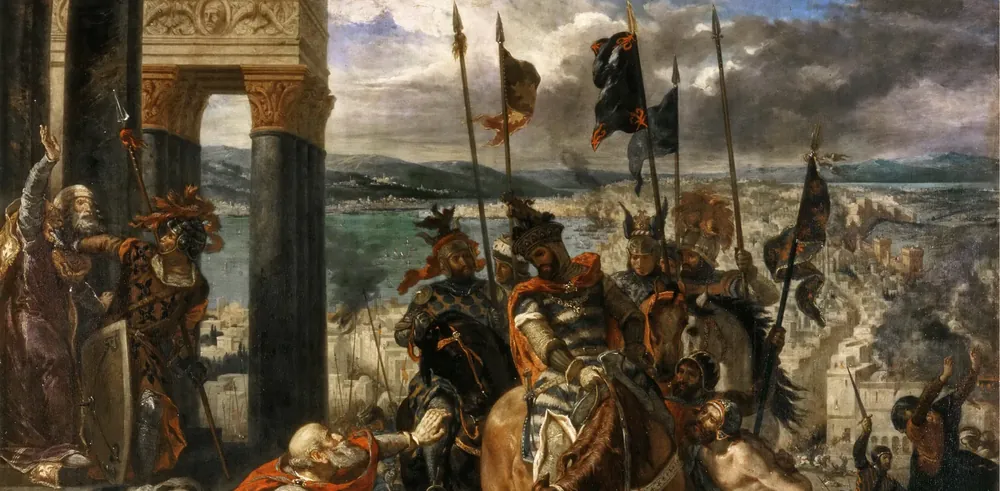
Eugène Delacroix, The Entry of the Crusaders into Constantinople, 1840 (detail). Musée du Louvre, Paris · Public domain · Source page
The greatest Christian city
An army that never reached Jerusalem
Monday 12 April 1204. A north wind pushes two Venetian ships, the Pilgrim and the Paradise, against a tower on the walls of Constantinople. A ladder touches the stone, two men climb in, and the defenders run.
By the next day the greatest Christian city in the world belongs to an army of Christians, sworn to fight for Jerusalem. They never went there.
How did it happen? Not by a master plan, most historians think, but through a contract nobody could pay, an exiled prince’s promise and a chain of choices. The end was a catastrophe.
Who tells the story
The witnesses
Geoffrey of Villehardouin, marshal of Champagne, sat in the leaders’ councils; his chronicle is the official version, silent about what embarrassed them. Robert of Clari, a poor knight from Picardy, tells what the ordinary soldiers heard.
On the other side stands Niketas Choniates, a senior Byzantine official who lived through the sack and wrote its lament. No Jewish account of 1203–1204 is known to us.
Enrico Dandolo
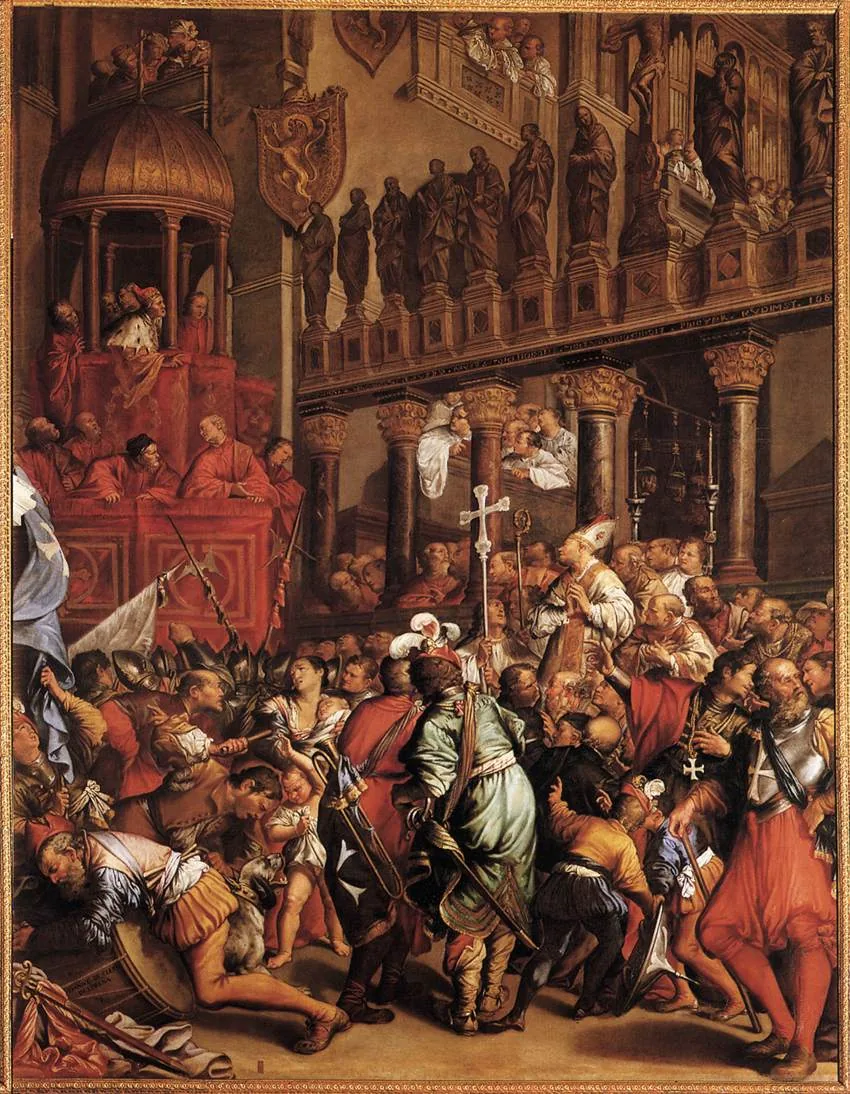
Jean Le Clerc, Doge Enrico Dandolo Recruiting for the Crusade, 1621. Image: Web Gallery of Art · Public domain · Source page
The blind, very old doge of Venice who sold a crusade its fleet, took the cross himself, led an assault from the prow of his galley, and died in the city he helped to conquer.
- Born: about 1107, according to a source of about 1500; some historians think later, Venice
- Died: May or June 1205, Constantinople, of an illness; buried in Hagia Sophia
- Won: Zara, November 1202; The Golden Horn wall, 17 July 1203; Constantinople, 12 April 1204
- Lost: The first assault on Constantinople, 9 April 1204
“I am a man old and feeble, who should have need of rest, and I am sick in body; but I see that no one could command and lead you like myself, who am your lord.”
A contract with Venice
Before 1198
Two Christian worlds
In 1200 Constantinople was the largest city in Christendom, capital of the Byzantine Empire. The Latins of the West called its people Greeks, and the churches had been divided since the schism of 1054.
In 1171 the emperor arrested every Venetian in the empire; in 1182 a mob massacred the Latin merchants of the city. And in 1195 Alexios III overthrew his brother, Emperor Isaac II, had him blinded, and locked him up with his young son, Alexios.
1198–1201
A crusade for Egypt
85,000 marks
In August 1198 the new pope, Innocent III, called a crusade to win back Jerusalem, lost in 1187.
The lords who took the cross, Thibaut of Champagne, Louis of Blois and Baldwin of Flanders, had no fleet. So in 1201 six envoys, Villehardouin among them, went to Venice. The doge, Enrico Dandolo, named a price: ships and food for 33,500 men and 4,500 horses for 85,000 marks of silver, plus fifty Venetian war galleys for half of all conquests. The secret target was Egypt.
Then Thibaut died, and the barons chose a new leader: Boniface, marquis of Montferrat, brother of the Conrad who had saved Tyre in the Third Crusade.
Source: The contract, in the words of a man who signed it
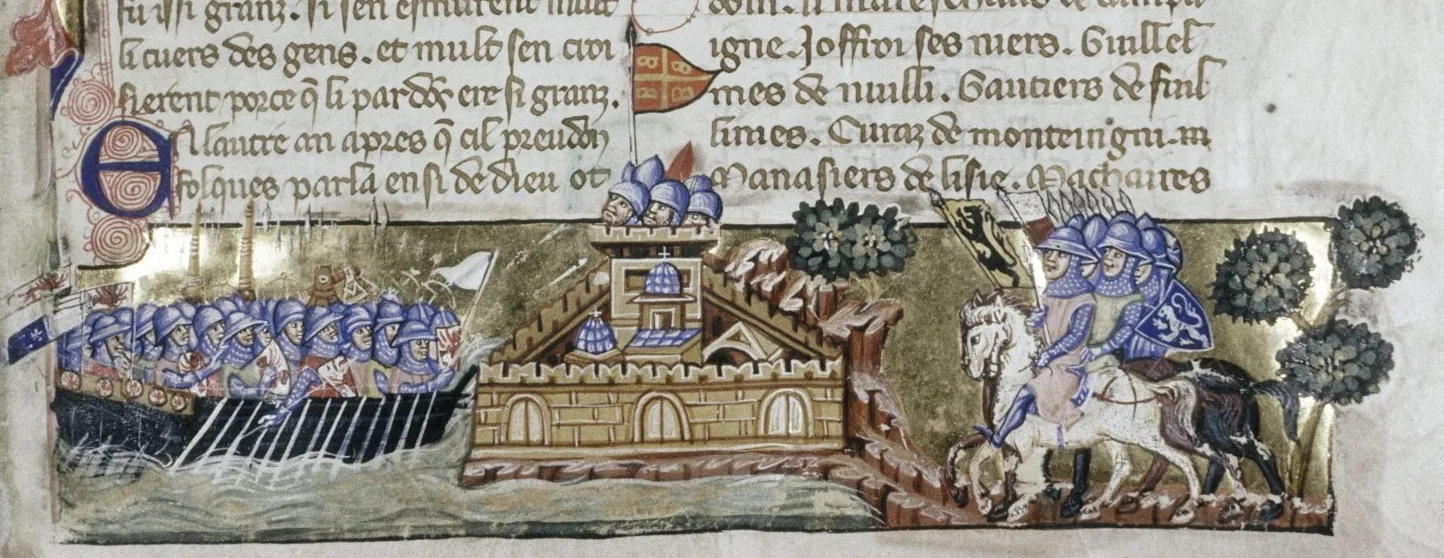
Anonymous, Villehardouin, La Conquête de Constantinople, about 1330. Bodleian Library, Oxford, MS Laud Misc. 587, fol. 1r · Public domain · Source page
“We will build transports to carry four thousand five hundred horses, and nine thousand squires, and ships for four thousand five hundred knights, and twenty thousand sergeants of foot. [...] Now the sum total of the expenses above named amounts to 85,000 marks.”
The doge is speaking to the six envoys, Villehardouin among them. The picture, from the first page of a copy of his book made about 1330, shows the attack on the city, not the speech.
- Villehardouin was in the room. Does that make his account reliable? More than most witnesses: he heard the terms. But he wrote years later, as a leader defending his name.
- Look at the picture. What shows it was painted long after 1204? The city flies the flag of the Palaiologan emperors, who ruled it only from 1261. The artist drew the city of his own day.
A decision point
You are Enrico Dandolo, doge of Venice.
Summer 1202, Venice
In June 1202 the fleet is ready; your city halted its trade for more than a year to build it. But many crusaders sailed from other ports, and those who came to the Lido are perhaps a third of the number promised. They have handed over their money and their plate, and still owe 34,000 marks (36,000, says Robert of Clari).
They are pilgrims under the pope’s protection, and all Europe is watching. And across the Adriatic lies Zara, a Catholic port that broke away from Venice and placed itself under the king of Hungary.
What do you do?
- Refuse to sail until the debt is paid Venice loses nothing more. But the crusade dies on the Lido, the fleet lies idle, and Venice is blamed for it before all Christendom.
- Send the army home and keep what was paid Simple, and perhaps lawful. But Venice is left with an empty fleet, and many will say it robbed pilgrims.
- Sail for Egypt and take the debt out of the first conquests The crusade goes ahead as planned. But you stake your city’s money on an army that may lose, and put Venice’s trade with Egypt at risk.
- Put off the debt if the army first helps you win back Zara The fleet sails, and your city regains a rebel port. But Zara is a Christian city, and the pope has forbidden crusaders to attack Christians. You would be using an army of pilgrims for Venice’s own war.
What really happened
Put off the debt if the army first helps you win back Zara
Dandolo proposed Zara: the debt would wait until the army could pay from its conquests. In late summer he took the cross himself in St Mark’s, and in early October the fleet sailed.
In Villehardouin, the doge fears that if Venice keeps the money “we should be greatly blamed”. In Robert of Clari the Zara plan comes only later, in secret. Many modern historians see a creditor finding a way to be paid, not a plot.
Zara, and an exiled prince
November 1202
A Christian city
On 10 November 1202 the fleet reached Zara (today Zadar, in Croatia); next morning it broke the chain across the harbour. The townsmen offered to surrender, and then the abbot of Vaux, a Cistercian monk, stood up and spoke in the pope’s name.
The barons sided with the doge, and Zara surrendered within two weeks (Villehardouin counts about five days of assault). The pope excommunicated those who had attacked it. Villehardouin reports only his displeasure and his pardon of the crusaders, not the excommunication, nor that the Venetians stayed under it.
Source: Two answers at Zara
The abbot of Vaux: “Lords, I forbid you, on the part of the Pope of Rome, to attack this city; for those within it are Christians, and you are pilgrims.”
The barons: “Great is the outrage of those who have caused this agreement to be broken [...]. Now are we shamed if we do not help to take the city.”
The abbot spoke for those who wanted to sail straight to Syria; Villehardouin calls them “those who wished to disperse the host”.
- What does each side appeal to? The abbot to the pope and to what pilgrims may do; the barons to honour, the treaty and the army’s unity. Neither mentions Venice’s profit.
- Both speeches reach us through one of the barons. What is missing? The opponents’ case in their own words, and the voice of the people of Zara. The abbot left the army soon afterwards.
A decision point
You are Pope Innocent III.
Early February 1203, Rome
You called this crusade and approved its contract with Venice. In November the army took Zara, a Christian city, against your ban, and you excommunicated it.
Now the army’s envoys kneel before you: without Venice’s ships, they say, there is no crusade. The Venetians have not asked forgiveness. And you have heard of a Byzantine prince who wants the army to restore his father.
What do you decide?
- Forgive no one and call the crusade off Your authority is upheld. But the crusade collapses, its men owe Venice money they do not have, and the Holy Land gets nothing.
- Forgive the crusaders if they swear obedience, keep the Venetians excommunicated, forbid attacks on Christians You save the crusade and uphold the rule. But your orders travel by letter, to an army that depends on Venice’s ships, and you cannot enforce them.
- Forgive everyone, the Venetians too Peace in the camp, and perhaps a quick start for Egypt. But you reward the attack on Zara, and every army will learn that a papal ban can be got round.
- Send your legate to take command A churchman at its head might hold the army to its vow. But your legate has no ships, money or knights, and the barons and the doge can simply ignore him.
What really happened
Forgive the crusaders if they swear obedience, keep the Venetians excommunicated, forbid attacks on Christians
Innocent forgave the crusaders on condition of obedience, refused to absolve the Venetians, and forbade any attack on the Greeks. The leaders went ahead with Alexios’s plan all the same.
In Villehardouin, the pope knew “that it was through the default of others that the host had been impelled to do this great mischief”, and wanted it held together. He could command the crusade; he could not steer it.
A decision point
You are a knight who never liked the plan: Odo of Champlitte, say, or Peter of Amiens.
May 1203, the island of Corfu
At Zara an offer came from young Alexios Angelos, who had escaped his uncle’s prison: restore him and his blind father in Constantinople, and he would pay 200,000 marks, send 10,000 men to Egypt and bring the Greek Church under Rome. The leaders agreed.
You took the cross for Jerusalem. More than half the army, Villehardouin admits, thinks as you do. Then the leaders come, with the young prince, and fall on their knees before you, weeping.
What do you do?
- Stay on Corfu and send for ships to Syria You keep your vow as you understood it. But the army splits, both halves may be too weak to achieve anything, and you may wait for ships that never come.
- Go home Your conscience is clear and your life is safe. But your vow is unfulfilled, and your money is spent.
- Go on only until an agreed date, on an oath that you will then get ships for Syria The army stays together, and you hold a promise. But a promise from men who owe Venice money is only as good as their next success.
- Sail on to Constantinople, no conditions The army is strong. But you have given up the argument, and with it any say in what happens next.
What really happened
Go on only until an agreed date, on an oath that you will then get ships for Syria
The dissenters agreed to stay until the end of September, on an oath that they would then get ships for Syria. On 24 May the fleet sailed. Several of them, Peter of Amiens among them, later fought bravely at Constantinople.
Villehardouin, on the other side, wants us to think them short-sighted. At Corfu he reports only that the venture “seemed very long and very perilous” to them; at Zara their party had said “it was not to fall on Christians that they had left their homes”. Clari gives a brief echo.
Myth
The pope planned the attack on Constantinople.
The truth
He did not. Innocent III approved the crusade and its contract with Venice, forbade the attack on Zara, and forbade any attack on the Greeks.
After the conquest he rejoiced that the Greek Church had come under Rome, while condemning the way the city was won. He did not plan the conquest; he accepted it, with anger and relief together.
The evidence
Villehardouin (trans. Marzials, 1908); Innocent’s letters in Munro (1896) and Pears (1885).
The first siege
June 1203
A city hard to believe
On 23 June 1203 the fleet sighted Constantinople. Those who had never seen it, writes Villehardouin, “never thought there could be in all the world so rich a city”.
It filled a triangle: the Sea of Marmara to the south, the Golden Horn, a harbour closed by a chain, to the north, and the land walls to the west, with the emperor’s Varangian Guard at the Blachernae corner. When the crusaders showed young Alexios to the people, nobody came over to him.
Constantinople 1203: who fought whom
5–18 July 1203
Galata, the Golden Horn and the Blachernae corner of the walls
The crusaders
- Commanders: Boniface of Montferrat, Baldwin of Flanders and his brother Henry, Louis of Blois, Hugh of Saint-Pol
- Strength: seven divisions: four attacked, three guarded the camp (Villehardouin); no reliable figure; far fewer than the 33,500 of the contract (Modern historians)
- Losses: no figure (Villehardouin)
The Venetians
- Commanders: Doge Enrico Dandolo
- Strength: 50 war galleys, besides transports (The contract); a line of ships “well three crossbow-shots in length” (Villehardouin)
- Losses: no figure (Villehardouin)
The Byzantines
- Commanders: Emperor Alexios III Angelos, The Varangian Guard
- Strength: six divisions against the Greeks’ “full forty” (Villehardouin); “for every man that was in the host there were over two hundred men in the city” (Villehardouin)
- Losses: the fire of 17 July left about 20,000 homeless; the August fire was far larger (One modern estimate)
Outcome: On the night of 17 July Alexios III fled the city. The Greeks brought blind Isaac II out of prison and put him back on the throne, and his son was crowned beside him on 1 August.
Nobody counted these armies. Villehardouin’s “full forty” divisions against six is his way of saying the crusaders were badly outnumbered.
The first siege of Constantinople
5–18 July 1203
The Venetian fleet and the crusaders reach Constantinople, a city walled by land and sea, with the Golden Horn closed by a chain. The emperor Alexios III’s army stands on the shore. The crusaders have brought young Alexios with them, but nobody in the city comes over to him.
One reconstruction, after Villehardouin (trans. Marzials, 1908) and the topography in Edwin Pears (1885). The coastline and the land walls are drawn from a modern map (OpenStreetMap), and the key places from their Wikipedia coordinates: Hagia Sophia, the Blachernae palace, Sarayburnu and Üsküdar (Scutari). Today’s shore differs a little from that of 1203, mostly because of quays and landfill. North is up; 88 map units = 1 km.
Unknown or disputed: where the Tower of Galata of 1203 stood (the Genoese tower seen today was built only in 1348; here it is put by the shore, opposite the tip of the city); where the bridge at the head of the Golden Horn was repaired; the site of the camp (“the castle of Boemond”, a walled abbey); which barbican was attacked, and the gates by which Alexios III came out; the dates of the landing and of the tower’s capture (5 or 6 July); and the numbers.
Phases of the battle
- 5 July: landing at Galata The fleet crosses the Bosphorus. The knights leap into the sea “up to their waists”, and the emperor’s army falls back without a fight.
- 6 July: the tower and the chain The crusaders camp in the Jewish quarter of Galata. The tower is taken, the chain is broken, and the fleet sails into the Golden Horn.
- 7–16 July: round the head of the Horn The army marches round the head of the Horn, repairs a broken stone bridge, and camps facing the Blachernae palace. The fleet moves up the Horn.
- 17 July: the assault The French ladders are thrown back by the English and Danes. The Venetians, blind Dandolo in the prow of his galley, land, take 25 towers and start a fire.
- 17–18 July: the emperor comes out, and flees Alexios III comes out with a large army, and withdraws without fighting. In the night he flees, and the Greeks set blind Isaac back on the throne.
The strategy
- Crusaders: The crusaders land at Galata, take the tower, break the chain and sail the fleet into the Golden Horn, so that the walls can be attacked from the water. They then camp facing Blachernae and raise ladders against the wall.
- Venetians: The Venetians fight from the sea: their ships bring men ashore facing the towers, and they try to take them from the water. The blind doge, Dandolo, stands in the prow of his galley.
- Byzantines: The army of the emperor Alexios III falls back without a fight. The wall rests on the English and Danes of the Varangian Guard, who throw back the French ladders. The emperor’s own plan is not recorded.
What decided it: What decided it was that the Venetian attack from the sea took 25 towers and started a fire, and Alexios III, who had withdrawn without fighting, fled in the night. The Greeks then put blind Isaac back on the throne.
Alexios IV Angelos
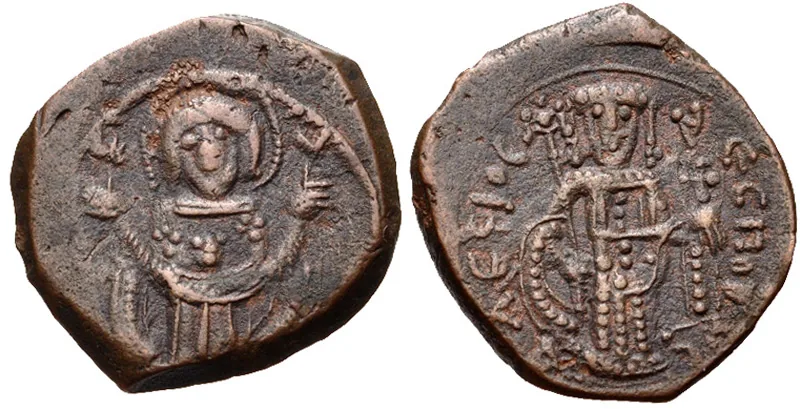
Copper tetarteron of Isaac II and Alexios IV, Constantinople, 1203–1204. Photo: Classical Numismatic Group (CNG) · CC BY-SA 2.5 · Source page
A prince of about twenty who bought his throne with promises he could not keep, and lost it, and his life, six months later.
- Born: about 1182, not recorded
- Died: about 8 February 1204, Constantinople, strangled in prison on the orders of Alexios Doukas Mourtzouphlos
- Won: The throne, with the crusaders’ help, July 1203
- Lost: Could not pay what he had promised the crusaders; The Greek fire-ships against the Venetian fleet, January 1204; His throne and his life, January–February 1204
“if you abandon me, the Greeks hate me because of you: I shall lose my land, and they will kill me.”
A decision point
You are Alexios IV, emperor of the Romans, about twenty-one.
Autumn 1203, Constantinople
You promised the crusaders 200,000 marks, an army for Egypt and the obedience of your Church to Rome. You have paid about 100,000, and the treasury is empty.
Your people hate the foreign army that put you on the throne, and many hate you for it. The army’s contract with Venice ends at the end of September. If they leave, you may not last a month; if they stay, they will want their money.
What do you do?
- Break with the crusaders and rely on your people The city may rally to you. But the army is camped across the Horn, unpaid and angry, and your own nobles may decide they do not need you either.
- Ask the crusaders to stay until spring at your expense You buy time, and with the army behind you the provinces may submit. But the debt grows, and every month the foreigners stay, your people hate you more.
- Take the rest from the churches and the rich You might pay the army off. But you would turn the clergy and the great families against you, the people who decide whether an emperor lives.
What really happened
Ask the crusaders to stay until spring at your expense
Alexios asked the army to stay until March. But, writes Villehardouin, “he led them on from delay to delay”, and the payments “ceased and came to naught”. That winter the army defied him in his own palace.
Villehardouin paints him as ungrateful and arrogant: the creditors’ view. In Robert of Clari the doge tells him in anger: “we have raised you from the mire, and we will throw you into the mire again.”
August 1203 – February 1204
Fire, and a murder
On 19 August 1203 a fire broke out that burned for two days and two nights. According to Pears, following Choniates, it began with an attack by Flemings, Venetians and Pisans on a mosque of the Muslim merchants; Villehardouin says only that “certain people—who they were I know not” set the city alight.
One night at the end of January 1204 a senior court official, Alexios Doukas, nicknamed Mourtzouphlos, seized the young emperor and proclaimed himself emperor. About 8 February Alexios IV was strangled in prison.
Galata
The Jews across the Horn
At Galata the crusaders camped “in the Jewry that is called Stenon”, writes Villehardouin, “a good city, and very rich”. Decades earlier Benjamin of Tudela had found about 2,000 Rabbanite and 500 Karaite Jews there, outside the city walls, with “much hatred against them”.
What happened to them we know only in outline. The historian David Jacoby concluded that the crusaders burned the suburb in July 1203, and the Jewish quarter was destroyed. But the community survived: a few years later Nicholas of Otranto, a Greek-speaking priest from southern Italy who served the papal legate in the city, wrote that he had debated with Rabbanite and Karaite Jews.
No Jewish account of the siege or the sack is known to us, and no source we have read tells of a massacre of Jews in 1204.
April 1204
March 1204
A treaty to divide an empire
In March the leaders and the doge signed a new treaty: they would take the city and share the booty, and six Venetians and six Franks would choose a Latin emperor.
The clergy in the army declared the war “lawful and just”, since the Greeks had murdered their lord and broken away from Rome, and promised the indulgence to those who fell. The pope had forbidden any attack on the Greeks.
Constantinople 1204: who fought whom
9 and 12 April 1204
The sea wall along the Golden Horn, by the Petrion quarter
The crusaders
- Commanders: Boniface of Montferrat, Baldwin of Flanders, Louis of Blois
- Strength: “no more than twenty thousand armed men”, probably with the Venetians (Villehardouin); about 22,000 attackers in all (One modern estimate)
- Losses: “those of the host lost more than the Greeks” (Villehardouin, 9 April); no figure (Villehardouin, 12 April)
The Venetians
- Commanders: Doge Enrico Dandolo
- Strength: a line of ships “full half a French league” long (Villehardouin); about 60 war galleys and 150 transports (One modern estimate)
- Losses: no figure (The sources)
The Byzantines
- Commanders: Emperor Alexios V Doukas Mourtzouphlos, The Varangian Guard
- Strength: “four hundred thousand men, or more”: a boast, not a count (Villehardouin); about 15,000 defenders, about 5,000 of them Varangians (One modern estimate)
- Losses: no figure for the dead in the fighting (The sources); “about two thousand” citizens on the first day (Gunther of Pairis, in the sack)
Outcome: The first assault, on 9 April, failed. The second, on 12 April, broke into the city. Mourtzouphlos fled in the night, and on 13 April the crusaders held Constantinople.
Villehardouin’s “twenty thousand armed men” against “four hundred thousand men, or more” is his way of saying how impossible the victory seemed, not a count.
A decision point
You are the leaders of the army: Boniface of Montferrat, Baldwin of Flanders, Louis of Blois and the doge.
The evening of Friday 9 April 1204, in a church across the Golden Horn
This morning your ships attacked the sea wall along the Golden Horn and were driven back; you lost more men than the defenders, who had raised their towers with wooden storeys.
Some barons want to attack the weaker walls on the Sea of Marmara, but the Venetians warn that the current there would sweep the ships away. Some of your men, Villehardouin admits, would be glad if it did.
What do you decide?
- Attack the same wall on Monday, with ships tied in pairs Two ships against each tower doubles your men at each point. But the wall that beat you once is still there, and the defenders know exactly where you will come.
- Move the attack to the walls along the Sea of Marmara Weaker walls. But the current may scatter the fleet, and you would fight where your ships cannot hold their place.
- Offer terms to Mourtzouphlos again No more lives lost on the walls. But talks already failed in February, and the emperor who killed young Alexios has no reason to pay his debts.
- Give up the siege and sail for Syria or Egypt At last you keep the vow. But you sail owing Venice money, with no supplies and no Greek help, and the empire you swore to share is lost.
What really happened
Attack the same wall on Monday, with ships tied in pairs
The leaders decided to bind the ladder-ships together “two and two, so that two ships should be in case to attack one tower”, and to attack again on the Monday. On Sunday the bishops preached that the war was righteous.
Retreat meant debt, a broken army and a vow unfulfilled. Robert of Clari remembers the sermons: the Greeks, the bishops said, were “traitors and murderers” who had killed their lord, and “worse than Jews”. That was a slur: the preachers used the Jews as a byword for the worst of men, and Clari repeats it without comment.
The assault on the Golden Horn wall
9 and 12 April 1204
In March 1204 the leaders agreed to take the city. On 9 April the crusader and Venetian ships cross the Golden Horn in a long line towards the sea wall. The defenders have raised their towers with wooden storeys, and the emperor Mourtzouphlos’s tents stand on the hill above.
One reconstruction, after Villehardouin (trans. Marzials, 1908), Robert of Clari (in Marzials’s English) and the topography of Edwin Pears (1885), who placed the emperor’s tents by the monastery of the Pantepoptes. The coastline is drawn from a modern map (OpenStreetMap), and the places from their Wikipedia coordinates: the Blachernae palace, Fener (the Petrion), the Pantepoptes monastery (traditionally identified with the Eski İmaret mosque; the identification is disputed) and Galata. The map is turned so that the Golden Horn runs from left to right, with the city below; the arrow shows north. 200 map units = 1 km. The sea wall is drawn a little inside today’s shore, which later quays have pushed out.
Unknown or disputed: exactly which stretch of wall was attacked on 9 and 12 April; the tower reached by the Pilgrim and the Paradise; where the four towers, the three gates and the postern were; where the crusaders camped across the Horn; how far the fire spread; and the length of the line of ships (“full half a French league” in Villehardouin, “a league” in Clari).
Phases of the battle
- Friday 9 April: a line of ships The ships cross the Horn in a long line. The towers have been raised with wooden storeys; the emperor’s tents stand on the hill above.
- Until mid-afternoon: thrown back At more than a hundred places they fight hand to hand. By mid-afternoon the crusaders are driven back to their ships.
- Monday 12 April: the north wind The ships are tied in pairs, and a north wind drives them to the wall. From the Pilgrim a Venetian and the knight Andrew of Urboise get into a tower.
- Midday: four towers, three gates Four towers fall and three gates are broken in. The knights ride for the emperor’s tents, and his men run. At a bricked-up postern Aleaume, Robert of Clari’s brother, crawls through.
- Evening and night: fire, and flight The crusaders camp inside the walls and set fire to the houses before them. In the night Mourtzouphlos flees. Next day Boniface takes the Bucoleon, and Henry, Baldwin’s brother, Blachernae.
The strategy
- Crusaders: After the first attack was thrown back on 9 April, the crusaders attack the same wall again on 12 April. Their ships are tied in pairs, and a north wind drives them to the wall; from the Pilgrim a Venetian and the knight Andrew of Urboise get into a tower. Why the ships were paired is not recorded.
- Venetians: The Venetians fight from the sea: their galleys bring men to the wall along the Horn, and the Pilgrim and the Paradise reach the towers.
- Byzantines: The defenders hold the wall from towers raised with wooden storeys, so that they fight from above the ships. Mourtzouphlos sits in his tents on the hill, and no further plan of his is recorded. At midday on 12 April the knights ride for the tents, and his men run.
What decided it: What decided it was the second attack: four towers fell, three gates were broken, and the knights rode for the emperor’s tents. With the defence broken, Mourtzouphlos fled in the night.
13–15 April 1204
The sack
From 13 April, for three days, the city was plundered. Houses, churches and monasteries were stripped. Men were killed and women raped; Choniates describes it, and so, in anger, does the pope, who writes of rape and of churches robbed. In Hagia Sophia the altar was broken into pieces and shared out among the soldiers, and pack animals were led into the sanctuary to carry off the silver.
How many died, nobody counted. Gunther of Pairis in Alsace, a German monk, gives about two thousand citizens killed on the first day. The booty was gathered in three churches, and some who hid their share were hanged.
Source: Two witnesses to the sack
Niketas Choniates: “How shall I begin to tell of the deeds wrought by these nefarious men! Alas, the images, which ought to have been adored, were trodden under foot! Alas, the relics of the holy martyrs were thrown into unclean places!”
Geoffrey of Villehardouin: “The booty gained was so great that none could tell you the end of it [...] never, since the world was created, had so much booty been won in any city.”
Choniates lived through the sack and wrote in exile; Villehardouin was the conquering army’s marshal.
- What does each writer see? Choniates sees sacrilege and suffering. Villehardouin sees booty. Each is silent about what the other describes: the Greek about the sharing of the loot, the Frank about the screams.
- Choniates writes like a mourner. Should we discount him? Weigh the rhetoric, but not the facts: the pope’s own letters confirm what he describes.
Myth
The crusaders destroyed Hagia Sophia and burned the great library of Constantinople.
The truth
Hagia Sophia was robbed, not destroyed: a month later Baldwin of Flanders was crowned emperor in it, and a year later the doge was buried there. For 57 years it was a Latin cathedral.
As for the library: no source we have read mentions an imperial library burned in 1204. Books surely perished in the fires and the plunder; the famous story is not in the evidence.
The evidence
Villehardouin on the coronation and on Dandolo’s burial (trans. Marzials, 1908); Choniates on Hagia Sophia (trans. Munro, 1896).
Baldwin of Flanders
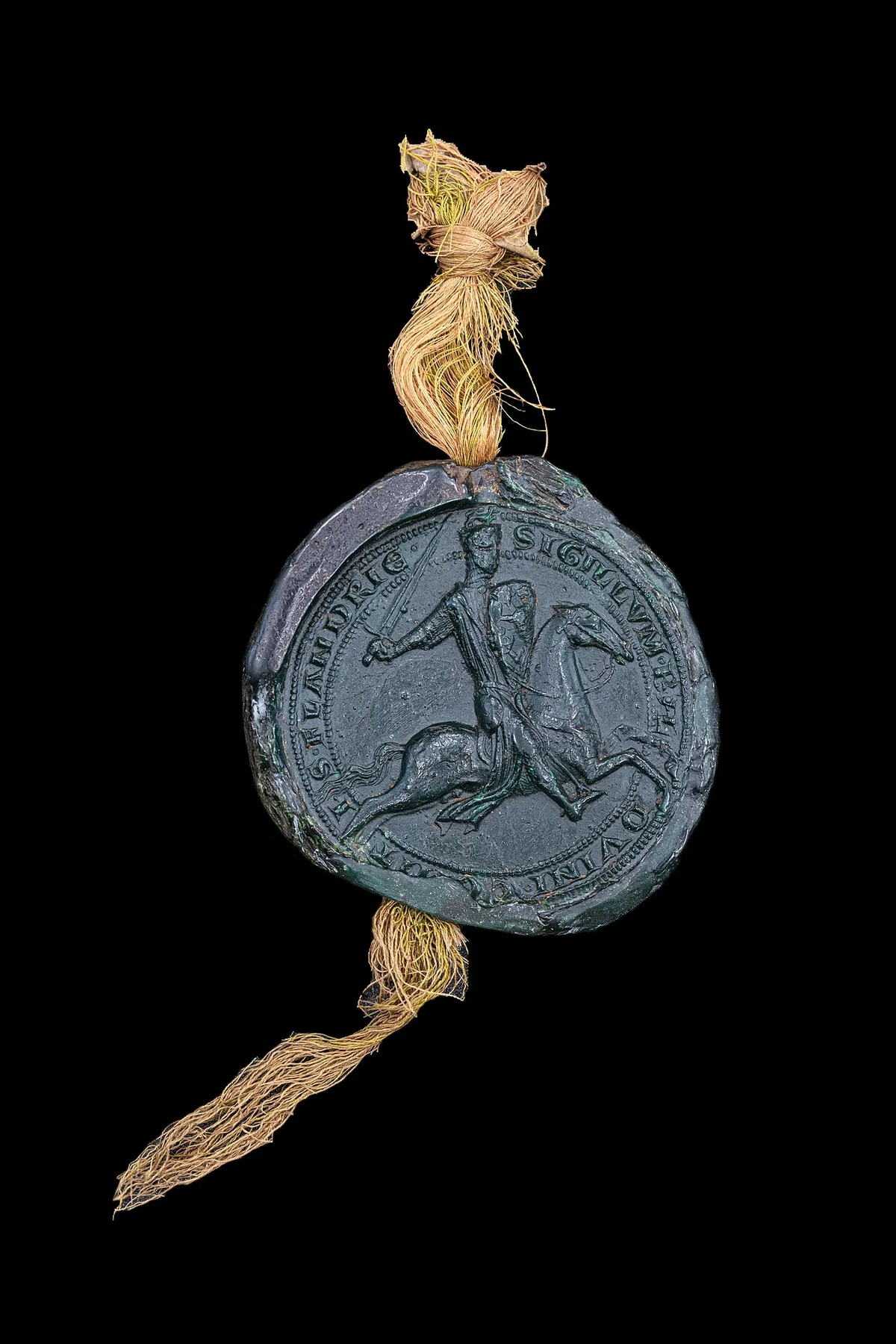
Seal of Baldwin, count of Flanders, 1197. Archives municipales et communautaires de Valenciennes · CC0 · Source page
A count of thirty-one who became the first Latin emperor of Constantinople, and vanished into a Bulgarian prison less than a year later.
- Born: July 1172, Valenciennes
- Died: probably 1205, Tărnovo, Bulgaria, in captivity; how, nobody knows
- Won: Constantinople, July 1203 and April 1204, with the other leaders
- Lost: Adrianople, 14 April 1205: defeated and captured by Kaloyan, king of the Bulgarians
“never did knight defend himself better with his hands than did the emperor.”
After 1204
1204–1205
Sharing out an empire
On 9 May Baldwin of Flanders was elected emperor, and in the autumn the empire was divided on paper: a quarter for the emperor, and three-eighths each for the partners, Venice and the other crusaders.
Most of it they never held. Greek rulers set up states at Nicaea, in Epirus and at Trebizond. Other Christians took sides too: the Armenians of Asia Minor, writes Villehardouin, turned to the Latins, for they “greatly hated the Greeks”.
Source: The pope after the conquest
To the army in Constantinople: “If the Lord had [...] transferred, as He has now done, the empire of Constantinople from the Greeks to the Latins before the fall of the Holy Land, perhaps Christianity would not be weeping to-day over the desolation of the land of Jerusalem.”
From another letter: “you have not drawn your sword against Saracens, but against Christians; you have not conquered Jerusalem, but Constantinople; you have preferred earthly to heavenly riches.”
The first, to the army, probably of 1205, tells it to stay a year.
- The two letters seem to contradict each other. Can both be sincere? Yes. Innocent could condemn the way the city was taken and still hope that God would turn it to good: a united Church, and help for the Holy Land.
- Why must we be careful with the second quotation? It is Pears’s condensed English of 1885, not a word-for-word translation, and its exact date is uncertain.
Myth
The bronze horses of St Mark’s are the work of Lysippos, Alexander the Great’s sculptor.
The truth
They were indeed taken from the Hippodrome of Constantinople after 1204. But there is no evidence that they are by Lysippos. Scholars date them anywhere from the 5th–4th century BC to the 3rd century AD.
The Lysippos work that Choniates mourned was a giant bronze Hercules, melted down for coin.
The evidence
Choniates on the melted statues, in Pears’s English (1885); modern studies of the horses.
Myth
An old blind man’s revenge: Dandolo, blinded by the Greeks, planned it all from the start to destroy Byzantium.
The truth
Three claims, none of them proved. His age: a source of about 1500 puts his birth about 1107, which would make him over ninety in 1204; some think he was younger. His blindness: Villehardouin, who knew him, says his eyes looked sound and that he lost his sight “through a wound in the head”.
And the plan: the tale that the sultan of Egypt bribed Venice comes from a later chronicle whose dates do not fit. Venice wanted its money; that is a motive, not proof of a plot.
The evidence
Villehardouin (trans. Marzials, 1908, with his notes); Gibbon, ch. 60; Munro’s notes (1896) on the continuation of William of Tyre.
What followed 1204
- 1204 Baldwin of Flanders is crowned the first Latin emperor in Hagia Sophia (16 May).
- 1204 The empire is divided: three-eighths to Venice. Greek states arise at Nicaea, in Epirus and at Trebizond.
- 1205 Adrianople: Kaloyan of Bulgaria routs the Latins and captures Baldwin. Dandolo dies in Constantinople.
- 1261 Nicaea retakes Constantinople; Michael VIII Palaiologos restores the Byzantine Empire after 57 years of Latin rule.
- 1453 Constantinople, weakened and much smaller, falls to the Ottoman Turks.
Accident or plan?
How did a crusade bound for Egypt end up at Constantinople?
- The plot school: nineteenth-century historians (Mas Latrie, Hopf, Riant, and in English Edwin Pears) Villehardouin’s smooth story hides a plan: either he was kept in the dark (Mas Latrie) or he was an apologist for the planners (Riant). Venice wanted to protect its trade with Egypt and settle its score with Byzantium; Boniface and Philip of Swabia wanted young Alexios on the throne. The detours to Zara and Constantinople were steps in one design. The evidence: Villehardouin’s silences, the doge’s two proposals in Clari, and the bribery story from the later chronicle.
- A chain of events: Natalis de Wailly, Villehardouin’s editor, in the 1870s; in our time Donald Queller and Thomas Madden No plot is proved. A contract for too large an army created a debt; the debt led to Zara; the prince’s offer arrived by chance and seemed to solve everything; and the decision to conquer the city was taken only after Alexios IV was murdered. Each step made the next more likely.
- Historians who stress the longer Byzantine-Latin background, such as Charles Brand, Donald Nicol and Michael Angold The story begins long before 1202: decades of mistrust between Greeks and Latins, the arrests of 1171, the massacre of 1182, and the weakness of the Angelos emperors, whose family quarrels opened the door to foreign armies.
Most historians today reject a master plan, but they disagree about how much Boniface and Venice’s leaders foresaw, and when. The evidence is thinnest exactly where it matters: in what was said behind closed doors.
What changed
A wound that stayed open
The Byzantine Empire came back in 1261, but never fully recovered, and fell to the Ottomans two centuries later.
For Orthodox Christians, 1204 became the memory of a betrayal by brothers in the faith. In 2001, in Athens, Pope John Paul II said: “It is tragic that the assailants, who had set out to secure free access for Christians to the Holy Land, turned against their own brothers in the faith.”
What do you know now?
Check yourself
What exactly were the 85,000 marks in the contract with Venice for?
Answer: Ships and food for 33,500 men and 4,500 horses. Right. Four marks a horse and two a man, for transport and nine months’ food, for a year’s service. Venice’s war galleys came in return for half the conquests.
Check yourself
What did Pope Innocent III do after the army took Zara?
Answer: He forgave the crusaders on conditions, but not the Venetians. Right. He wanted to save the crusade and uphold the rule, but he could not enforce his orders.
Check yourself
Why did the dissenters at Corfu agree to go on with the army?
Answer: The leaders begged them in tears and swore to give them ships for Syria. Right. They stayed until an agreed date, in return for an oath. In the autumn they were persuaded to wait again.
Check yourself
What do the sources tell us about the Jews of Constantinople in 1203–1204?
Answer: Their quarter probably burned, but the community survived. Right. Villehardouin mentions the quarter, Jacoby concludes it burned, and no Jewish account of the events is known to us.
Check yourself
How many people were killed in the sack of Constantinople?
Answer: Nobody counted; Gunther gives about 2,000 on the first day. Right. Choniates laments at length but gives no number, and Gunther gives one figure for one day.
Check yourself
Which of these is true of Hagia Sophia after 1204?
Answer: It was plundered, and Baldwin was crowned emperor in it. Right. The altar was broken up and the silver taken, but on 16 May 1204 Baldwin was crowned there, and a year later Dandolo was buried there.
Terms
- Byzantines The modern name for the people of the Eastern Roman Empire, ruled from Constantinople. They spoke Greek and called themselves Romans; Westerners called them Greeks.
- Latins Western Christians who belonged to the Church of Rome and worshipped in Latin: French, Flemings, Italians, Germans. The Byzantines called them all Latins or Franks.
- schism The split between the Latin Church of Rome and the Greek Orthodox Church. For centuries they had quarrelled over the pope’s authority and over ritual; in 1054 their representatives excommunicated each other, but the split itself grew over centuries.
- doge The elected ruler of the Republic of Venice, for life. The doge shared power with the city’s councils. Enrico Dandolo was doge from 1192 until his death in 1205.
- mark A weight of silver, about a quarter of a kilo (it varied from place to place), used to count large sums. The price in the contract with Venice was set in marks of silver.
- indulgence A promise of the Church: a hard act of devotion, such as a crusade, would take the place of the penance a sinner owed. Innocent III promised it to those who took the cross and served for a year.
- excommunication The Church’s heaviest punishment: cutting a person off from the sacraments and from the community of the faithful until they repent and seek pardon.
- legate An envoy who acts with the pope’s authority. Innocent III sent his legate, Cardinal Peter Capuano, to the crusade.
- Varangian Guard The Byzantine emperor’s bodyguard: foreign axemen, loyal mercenaries. In 1203 Villehardouin saw Englishmen and Danes defending the wall.
- relics Bodily remains of saints, or objects linked to Jesus and the saints, believed to carry holy power. Constantinople held one of the richest collections in Christendom.
- Geoffrey of Villehardouin Marshal of Champagne, who sat in the leaders' councils. His chronicle is the official version, and it stays silent on what embarrassed the crusaders.
- Robert of Clari A poor knight from Picardy who did not sit in the leaders' councils. He tells what the ordinary soldiers heard.
- Niketas Choniates A senior Byzantine official who lived through the sack of Constantinople and wrote a lament for it. He wrote in exile.
- Edwin Pears A Victorian historian who wrote in 1885 that Villehardouin's main fault was hiding unpleasant facts.
- Innocent III The pope who called the crusade and approved its deal with Venice. He forbade attacking the Greeks and excommunicated those who attacked Zara.
- Zara A Catholic port across the Adriatic, today Zadar in Croatia. It broke away from Venice and placed itself under the king of Hungary.
- Stenon The name Villehardouin gives to the Jewish quarter at Galata.
- Galata A suburb across the Golden Horn from Constantinople, where the crusaders camped before entering the city.
- Benjamin of Tudela A Jewish traveller from Tudela who visited Constantinople and wrote where and how the Jews lived there. Scholars disagree on when he visited.
- Nicholas of Otranto A Greek-speaking priest from southern Italy who served the papal legate in the city. He wrote that he debated with Rabbanite and Karaite Jews.
- David Jacoby A historian who concluded that the crusaders burned the Jewish suburb in July 1203, and that the Jewish quarter was destroyed.
- Gunther of Pairis A German monk from Alsace who wrote admiringly of the sack of Constantinople. By his count about two thousand citizens were killed on the first day.
- Martin of Pairis The abbot of Pairis. He threatened an old priest in a Greek church and came back with many relics.
- Hagia Sophia The great church of Constantinople, where Baldwin was crowned emperor. It was robbed in 1204 and for 57 years was a Latin cathedral.
- Hippodrome The chariot-racing arena of Constantinople. Many statues were taken from it after 1204.
- Lysippos An ancient Greek sculptor. The work Choniates mourned was a giant bronze Hercules, melted down for coin.
- Ottomans A Muslim dynasty of rulers. The Byzantine Empire fell to it about two centuries after it returned in 1261.
- Nicaea A Greek state set up by Greek rulers after the Latin conquest of Constantinople.
- Epirus A region in north-west Greece, where a Greek state arose after the Latin conquest.
- Trebizond A port on the Black Sea, where Greek rulers set up a state after the Latin conquest.
- Armenians A Christian people of Asia Minor who, according to Villehardouin, turned to the Latins because they greatly hated the Greeks.
- Peter of Amiens A crusader among the dissenters, who wanted to sail straight to Syria. Later he fought bravely at Constantinople.
- Boniface of Montferrat The leader of the crusade chosen after Thibaut died. Brother of Conrad, who saved Tyre in the Third Crusade.
- Thibaut of Champagne One of the leaders of the crusade. He died before the fleet sailed, and the barons chose a new leader.
Sources
- Geoffrey of Villehardouin, The Conquest of Constantinople, in Memoirs of the Crusades by Villehardouin and de Joinville, trans. Sir Frank T. Marzials (London: J. M. Dent, Everyman’s Library, 1908)
- Dana C. Munro (ed.), The Fourth Crusade, Translations and Reprints from the Original Sources of European History, vol. 3, no. 1 (Philadelphia: Department of History, University of Pennsylvania, 1896): extracts of Robert of Clari, Niketas Choniates, Gunther of Pairis and Innocent III
- The Itinerary of Benjamin of Tudela, ed. and trans. Marcus Nathan Adler (London: Henry Frowde, 1907)
- John Paul II, Address to His Beatitude Christodoulos, Archbishop of Athens and Primate of Greece, Athens, 4 May 2001
- Edwin Pears, The Fall of Constantinople, Being the Story of the Fourth Crusade (London: Longmans, Green, 1885): a Victorian narrative, with English versions of Choniates and of Innocent III’s letters
- Edward Gibbon, The History of the Decline and Fall of the Roman Empire, ch. 60 (London, 1788)
- Donald E. Queller and Thomas F. Madden, The Fourth Crusade: The Conquest of Constantinople, 2nd ed. (Philadelphia: University of Pennsylvania Press, 1997)
- Jonathan Phillips, The Fourth Crusade and the Sack of Constantinople (London: Jonathan Cape, 2004)
- Michael Angold, The Fourth Crusade: Event and Context (Harlow: Pearson Longman, 2003)
- Thomas F. Madden, Enrico Dandolo and the Rise of Venice (Baltimore: Johns Hopkins University Press, 2003)
- Donald M. Nicol, Byzantium and Venice: A Study in Diplomatic and Cultural Relations (Cambridge: Cambridge University Press, 1988)
- Charles M. Brand, Byzantium Confronts the West, 1180–1204 (Cambridge, Mass.: Harvard University Press, 1968)
- Alfred J. Andrea, Contemporary Sources for the Fourth Crusade (Leiden: Brill, 2000)
- David Jacoby, “The Jewish Community of Constantinople from the Komnenan to the Palaiologan Period”, Vizantiiskii Vremennik 55 (1998), pp. 31–40
Image credits
- Eugène Delacroix, The Entry of the Crusaders into Constantinople, 1840 (detail). Musée du Louvre, Paris · Public domain · Source page
- Jean Le Clerc, Doge Enrico Dandolo Recruiting for the Crusade, 1621. Image: Web Gallery of Art · Public domain · Source page
- Anonymous, Villehardouin, La Conquête de Constantinople, about 1330. Bodleian Library, Oxford, MS Laud Misc. 587, fol. 1r · Public domain · Source page
- Copper tetarteron of Isaac II and Alexios IV, Constantinople, 1203–1204. Photo: Classical Numismatic Group (CNG) · CC BY-SA 2.5 · Source page
- Seal of Baldwin, count of Flanders, 1197. Archives municipales et communautaires de Valenciennes · CC0 · Source page


