Clermont and the First Crusade, 1095–1099
Nobody wrote down the speech at Clermont. Four years later, tens of thousands stood before the walls of Jerusalem.
Decisions, questions and your own progress, in the app
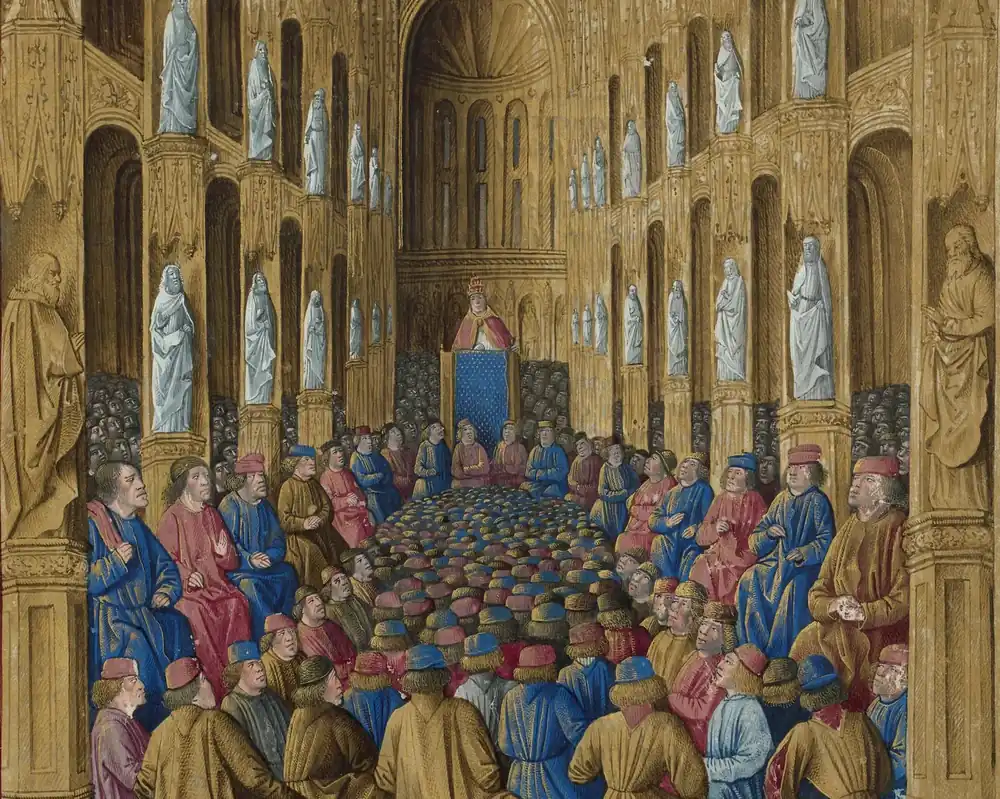
Jean Colombe, miniature in Sébastien Mamerot, Les passages d’outremer, about 1474. Bibliothèque nationale de France, MS Fr. 5594, fol. 19r · Public domain · Source page
A speech in a field
A speech nobody wrote down
Clermont, central France, 27 November 1095. According to Robert the Monk, the crowd is too big for any building, so Pope Urban II speaks on an open plain.
Nobody wrote his words down. Four churchmen later wrote versions of the speech, years afterwards, knowing how the story ended. No two agree.
What came next is clearer. Within four years tens of thousands had walked thousands of kilometres east, starved outside Antioch, and on 15 July 1099 stormed Jerusalem and killed a great many of its people.
Why did they go? And why did Byzantines, Turks, Egyptians and Eastern Christians each see it so differently? This was the first crusade.
Who tells the story
Witnesses who took sides
Almost everything we know comes from people who took sides. The fullest accounts are by Franks, as Westerners were called in the East.
The Gesta Francorum, “The Deeds of the Franks”, was written about 1100 by an unnamed knight of Bohemond’s, on Bohemond’s side. Raymond of Aguilers, chaplain to Bohemond’s rival Raymond of Toulouse, saw most of what he describes and believed in miracles. Fulcher of Chartres went to Edessa in 1098, so he never saw Jerusalem fall.
The other sides speak later: Anna Komnene, daughter of the Byzantine emperor, fifty years on; Ibn al-Athir of Mosul, 130 years on. Always ask: who is telling this, and why?
Urban II
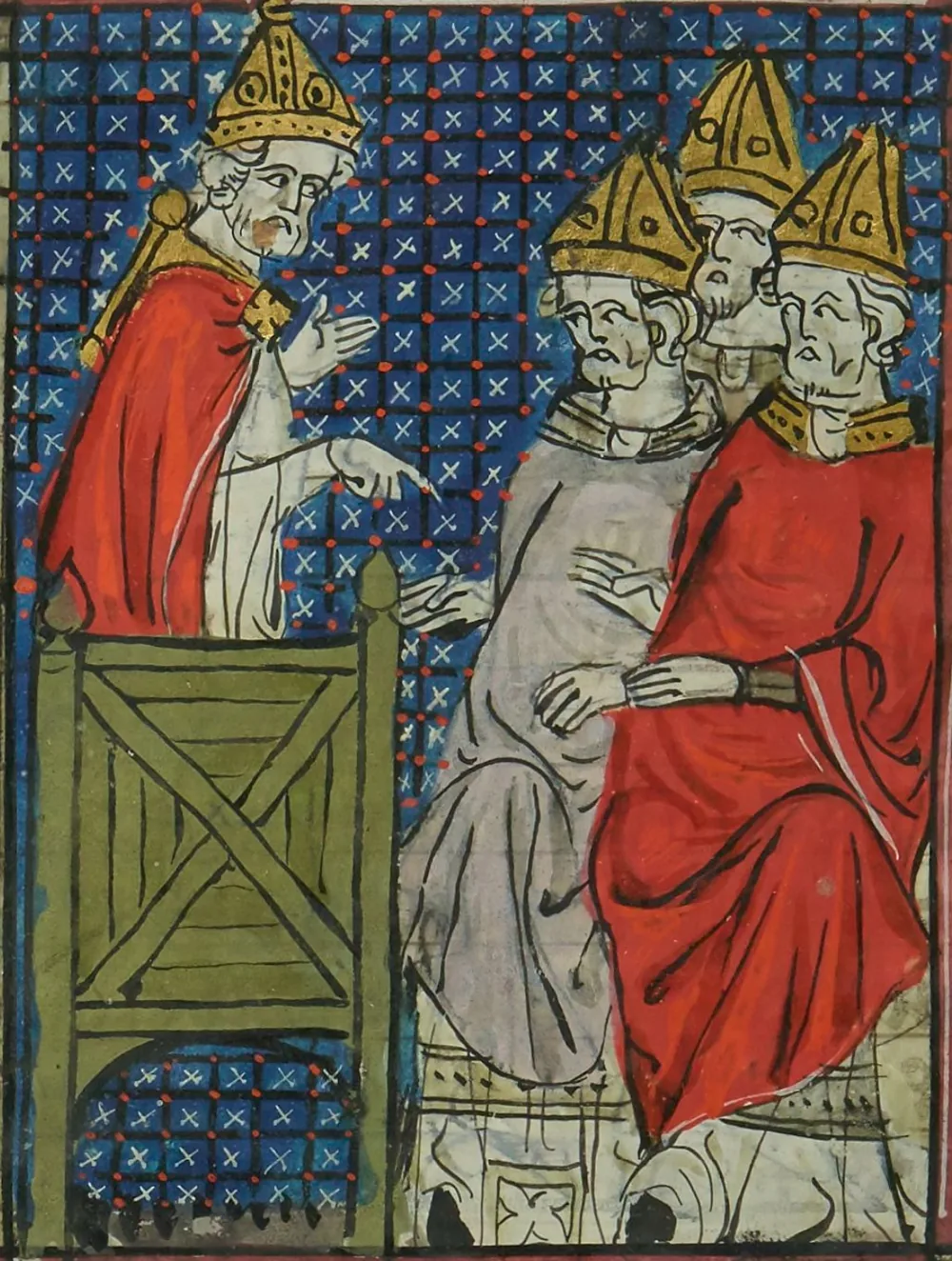
Anonymous illuminator, 14th century. Miniature from a manuscript of the Roman de Godefroi de Bouillon · Public domain · Source page
A French monk who became pope while a rival pope held Rome, launched the First Crusade, and died before the news of Jerusalem reached him.
- Born: c. 1035, Châtillon-sur-Marne, Champagne (France)
- Died: 29 July 1099, Rome
- Won: The Council of Piacenza, March 1095; The call at Clermont, November 1095; The expedition he called took Jerusalem, two weeks before his death
- Lost: For years he could not hold Rome against the antipope Clement III, backed by Emperor Henry IV; The reunion with the Greek Church that he may have hoped for never came
“I speak to those who are present, I proclaim it to the absent, but Christ commands.”
Clermont
Background: the East
A world in pieces
In 1071, at Manzikert, the Seljuk Turks crushed a Byzantine army and captured its emperor. Within ten years a Seljuk prince ruled Anatolia from Nicaea, less than 100 km from Constantinople.
Then the Turkish world split. After the sultan Malik-Shah and his vizier Nizam al-Mulk died in 1092, sons, brothers and generals fought over the pieces. Aleppo and Damascus were ruled by two rival brothers.
In Cairo ruled the Shi’ite Fatimids, enemies of the Sunni Seljuks. Among them all lived Greek, Armenian and Syriac Christians, and Jewish communities, under Muslim rule for over four centuries.
Background: the West
A pope without Rome
In March 1095, at a council in Piacenza, envoys of the Byzantine emperor Alexios I asked Urban for help against the Turks. Only one Western chronicler, Bernold of Constance, reports it.
Urban had his own troubles. A rival pope, backed by the German emperor Henry IV, held Rome for much of his reign. And French knights fought endless private wars, which bishops had long tried to tame with the Peace of God.
A decision point
You are Urban II, the pope.
November 1095, the Council of Clermont, in the Auvergne
The emperor in Constantinople wants soldiers against the Turks. Helping him might also bring the Greek and Latin Churches, estranged since 1054, closer together.
But you cannot command kings: Henry IV backs your rival, and Philip I of France is under the Church’s ban. Gregory VII tried a call like this in 1074. No army came.
You have already won over Adhemar, bishop of Le Puy, and Raymond, count of Toulouse. The crowd at Clermont is waiting.
What do you ask of them?
- Keep to Church reform, and answer Alexios with letters Probably not much would change. Alexios could go on hiring Western soldiers for pay, as emperors had before, and the council would be remembered for its decrees on peace and reform, like many others.
- Call the knights of the West east as armed pilgrims, with forgiveness of sins as their reward A huge gamble. If the knights answer, the papacy, not the kings, leads the greatest enterprise of Christendom. But you cannot control who goes, or what they do on the way.
- Ask the kings to raise an army for the emperor Henry IV is your enemy and Philip I is under your ban. A war led by kings would be their war, not the Church’s, and it might never start.
What really happened
Call the knights of the West east as armed pilgrims, with forgiveness of sins as their reward
Urban preached on 27 November and made Adhemar his legate. The council decreed that whoever went to Jerusalem “to free the church of God”, from devotion and not for gain, would have the journey count instead of all penance.
In Fulcher’s version, knights who fight each other should fight the enemies of Christians instead. Whether Jerusalem was Urban’s aim from the start is still debated.
Source: What did Urban say?
Fulcher of Chartres: “Let those who have formerly been accustomed to contend wickedly in private warfare against the faithful, fight against the infidel ...”
Robert the Monk: “Jerusalem is the navel of the world ...”
Urban’s own letter, December 1095: “... to free the churches of the East.”
No one wrote the speech down. Fulcher, probably present, wrote about 1100–1106; Robert, who says he was there, about 1107. Both knew Jerusalem had fallen. The oldest account, the Gesta (about 1100), has no speech at all.
- Fulcher’s Urban never names Jerusalem as the goal; Robert’s praises it. Which is closer to 1095? Probably Fulcher’s: it is earlier and matches Urban’s own letter about “the churches of the East”. Jerusalem grows in the later versions, though the council’s decree names it.
- Every version was written after 1099. Why does that matter? The writers knew the ending, and each made Urban speak in his own style: these are memories and sermons, not a transcript.
Myth
Urban called for a holy war, and the crowd roared “Deus vult!”, “God wills it!”
The truth
We do not have the speech, only four versions written 5 to 13 years later. Only Robert the Monk has the crowd shout “Deus vult”. Fulcher’s Urban speaks of reform, peace at home and help for the East.
The roads east
1096
Taking the cross
Those who vowed to go sewed a cloth cross on their clothes. Their reasons were mixed: faith, and the indulgence Urban had promised; prayer at Christ’s tomb; loyalty to a lord; fame; for some, land; for many, fear of hell.
It cost a fortune. Robert, duke of Normandy, pawned his duchy to his brother, the king of England. Godfrey of Bouillon sold or mortgaged lands.
In August 1096 the princes’ armies set out for Constantinople, with priests, servants, women and the poor.
Spring–autumn 1096
The first to go
Many did not wait. In spring 1096 crowds followed preachers such as Peter the Hermit east. Very few were trained knights.
In the Rhineland, bands led by Count Emicho and others attacked the Jewish communities of Speyer, Worms, Mainz and Cologne, killing many. That story is the subject of the next lesson.
Alexios ferried Peter’s followers to Asia. In October 1096, near Civetot, the Seljuk sultan Kilij Arslan destroyed them; about 3,000 survivors were rescued by Byzantine ships. Later writers made Peter the man who started it all. No early version of Urban’s speech mentions him.
Myth
The crusaders were landless younger sons out for land and loot.
The truth
Some did win lands, like Bohemond and Baldwin. But most leaders were wealthy heads of families who spent far more than they gained, selling and pawning land.
The evidence
Jonathan Riley-Smith, The First Crusaders (1997).
Alexios I Komnenos
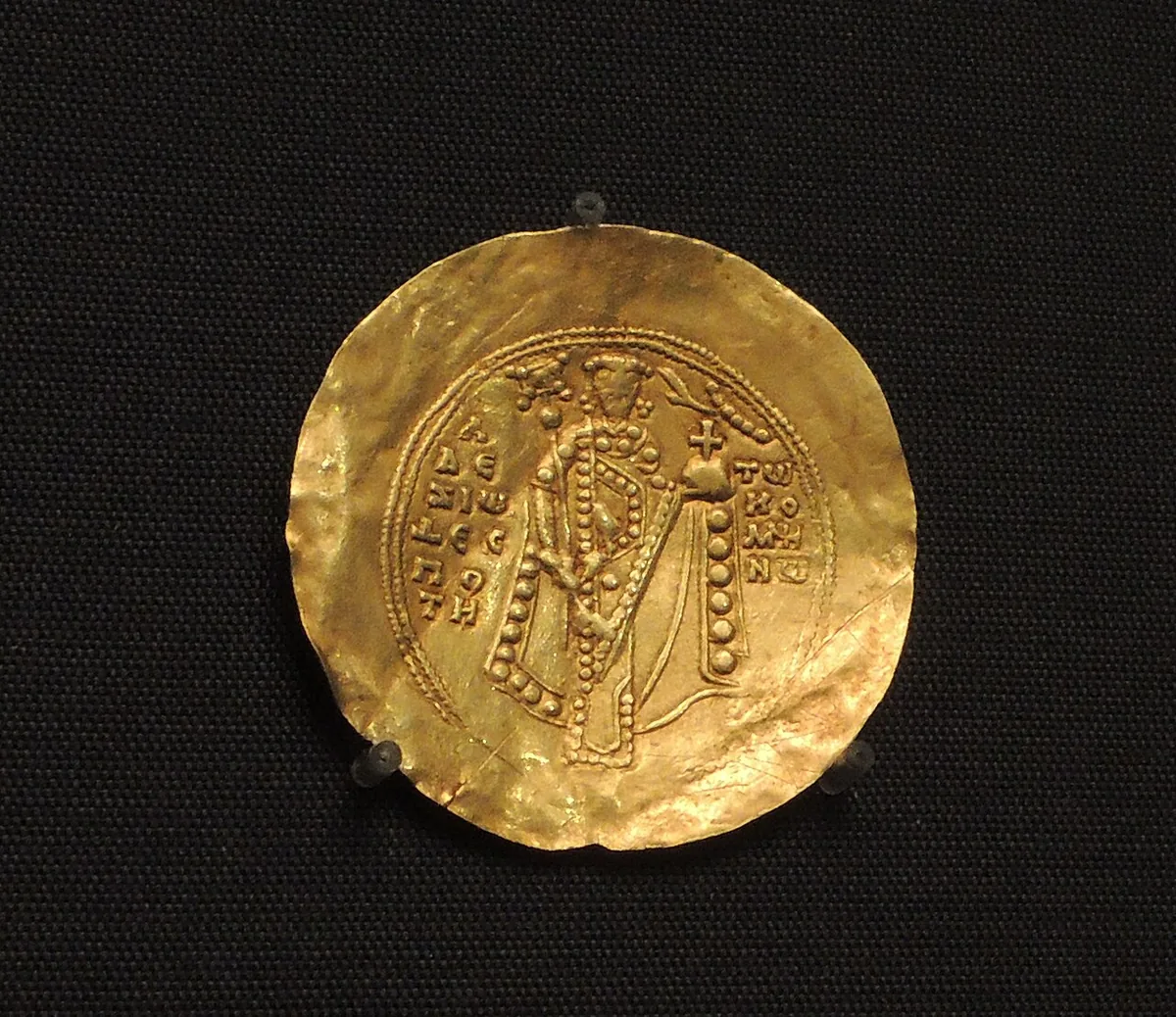
Gold hyperpyron of Alexios I Komnenos, Constantinople, 1092–1118. Museums of the Moscow Kremlin. Photo: shakko · CC BY-SA 4.0 · Source page
A general who seized a broken empire in 1081, asked the West for soldiers, and got a host of armed pilgrims he could neither command nor send home.
- Born: c. 1057
- Died: 15 August 1118, Constantinople, after a long illness
- Won: Levounion, 1091: the Pechenegs crushed, with Cuman allies; Nicaea, 1097: surrendered to his officer, not to the crusaders; Treaty of Devol, 1108: Bohemond submits; Philomelion, 1116, against the Seljuks
- Lost: Dyrrhachium, 1081, against Robert Guiscard and Bohemond; Antioch: kept by Bohemond, never handed back
“If you did not find a fight when you sought for it then, now the time has come which will give you your fill of fighting.”
A decision point
You are Alexios I Komnenos, basileus of the Romans.
Winter–spring 1096–1097, Constantinople
You asked for soldiers. What is coming is something else: army after army of Western lords, tens of thousands of people, camping outside your walls. One of the leaders, Bohemond, is on his way: he fought you in the Balkans in the 1080s.
You need fighters against the Turks, who hold your former cities. But you cannot feed these armies for long.
What do you do?
- Close the gates and the markets until hunger sends them home They could not go home: they had sold their lands and taken a vow. Starving armies would plunder your provinces, and might attack the city itself.
- Feed them, ferry them to Asia, and make each leader swear to return your former cities You keep the armies moving and turn them against your enemies. But an oath is only as strong as the men who swear it.
- Take command of the expedition yourself You might control them. But you would leave your capital, which you seized yourself in a coup, open to plots, and the Western princes would not easily obey a Greek emperor.
What really happened
Feed them, ferry them to Asia, and make each leader swear to return your former cities
Alexios fed them, ferried them across and demanded oaths. Godfrey refused until fighting broke out outside the walls in Holy Week 1097; then he swore. Bohemond swore; Raymond of Toulouse swore only to respect the emperor’s life and honour. Alexios sent his officer Tatikios with them as guide.
Anna says her father knew how fearsome the Westerners’ charge was and prepared for war. When fighting broke out at the walls in Holy Week he ordered his archers to shoot at the horses, not the riders, because he did not want Christians killed.
Source: An invasion, seen from Constantinople
“For the whole of the West and all the barbarian tribes which dwell between the further side of the Adriatic and the pillars of Heracles, had all migrated in a body and were marching into Asia through the intervening Europe, and were making the journey with all their household.”
Anna, the emperor’s daughter, was 12 or 13 when the crusaders came and wrote about fifty years later, for Greek readers. She calls the Westerners “Kelts” and “Latins”. She never mentions Pope Urban.
- “The whole of the West”: is it true? No. Perhaps 60,000 to 100,000 set out. Anna exaggerates to show the danger her father faced, as when she gives Peter the Hermit 100,000 horsemen.
- The Latins call this a pilgrimage; Anna, a migration of barbarians. What does each side leave out? The Latins leave out how much they leaned on Byzantine food, ships and guides; Anna, the faith that set so many on the road.
May–June 1097
Nicaea: a victory for someone else
In May 1097 the armies besieged Nicaea, the Seljuk capital, and beat off Kilij Arslan’s relief army. Alexios had boats dragged overland to the city’s lake. In June Nicaea surrendered, not to the crusaders, but to Alexios’s officer. There was no plunder. On 26 June the army marched on; within days it split in two.
Dorylaeum: who fought whom
Wednesday 1 July 1097
Near Dorylaion (Şarhöyük, by modern Eskişehir), Anatolia; the exact field is unknown
The crusaders
- Commanders: Vanguard: Bohemond, Tancred, Robert of Normandy, Stephen of Blois, Main column: Godfrey, Raymond of Toulouse, Adhemar, Hugh, Robert of Flanders
- Strength: no figure (Gesta Francorum); vanguard perhaps 10,000–20,000, many of them non-combatants; the main column larger (Modern estimate)
- Losses: two knights by name, and some other knights and foot (Gesta Francorum); 4,000 (Albert of Aachen)
The Seljuk Turks and allies
- Commanders: Kilij Arslan I, sultan of Rum, The Danishmendid emir
- Strength: 360,000, and Arabs beyond counting (Gesta Francorum); from 6,000–7,000 horsemen to perhaps 30,000, or more (Modern estimates)
- Losses: 3,000 (Albert of Aachen)
Outcome: A crusader victory. The Turks fled and left their camp behind; the road across Anatolia lay open.
The Gesta’s 360,000 means “countless”. The bare plateau could not have fed tens of thousands of horses, which argues for the lower modern figures. Albert’s 4,000 and 3,000 are round numbers, not counts.
The battle of Dorylaeum
1 July 1097, from morning to evening
Bohemond’s vanguard has camped by a river near Dorylaeum, in Anatolia, with the main column well behind. The Seljuk Turks wait in ambush in the hills around, and the road across Anatolia runs through this ground.
A schematic diagram, not a map: the exact field near Dorylaion has not been identified, so there is no compass. The course of the battle follows the Gesta Francorum and Fulcher of Chartres; the river, marsh and hills are illustrative and the distances approximate.
Disputed: who struck the decisive blow from the flank (the Gesta names Adhemar), whether the Turks surrounded the camp on every side, and how far behind the second column was (perhaps about five kilometres), and who stood where (Fulcher puts Robert of Flanders with Bohemond’s vanguard, the Gesta with Godfrey).
Phases of the battle
- Morning: ambush Bohemond’s vanguard has camped by a river. Turks pour from the hills. The knights dismount, and the foot and non-combatants gather in the middle.
- Midday: pinned Horse archers shoot, wheel away and charge again. Women carry water to the fighters. Messengers ride back for the main column.
- The main column arrives Godfrey and Hugh ride ahead with their knights, then Raymond, and strike the Turks in the flank.
- The bishop’s ride Adhemar comes over another hill and falls on the Turkish rear. The Turks are surrounded.
- Evening: rout The Turks flee and their camp is taken. The road across Anatolia is open.
The strategy
- Crusaders: The vanguard, ambushed, dismounts and gathers with the foot into one mass, and sends riders back to the main column. When it arrives, Godfrey, Hugh and Raymond strike the Turks in the flank, and Adhemar comes over another hill onto their rear. Who delivered the decisive blow from the flank is disputed.
- Seljuk Turks: The Turks struck from ambush: they poured down from the hills onto the vanguard’s camp, and their horse archers shot, wheeled away and charged again to pin the enemy in place. Whether they surrounded the camp on every side is disputed.
What decided it: What decided it was that the vanguard held on until the main column came. When the blow fell from the flank and the rear, the Turks were surrounded, fled and left their camp behind.
Antioch
October 1097 – May 1098
Seven months outside Antioch
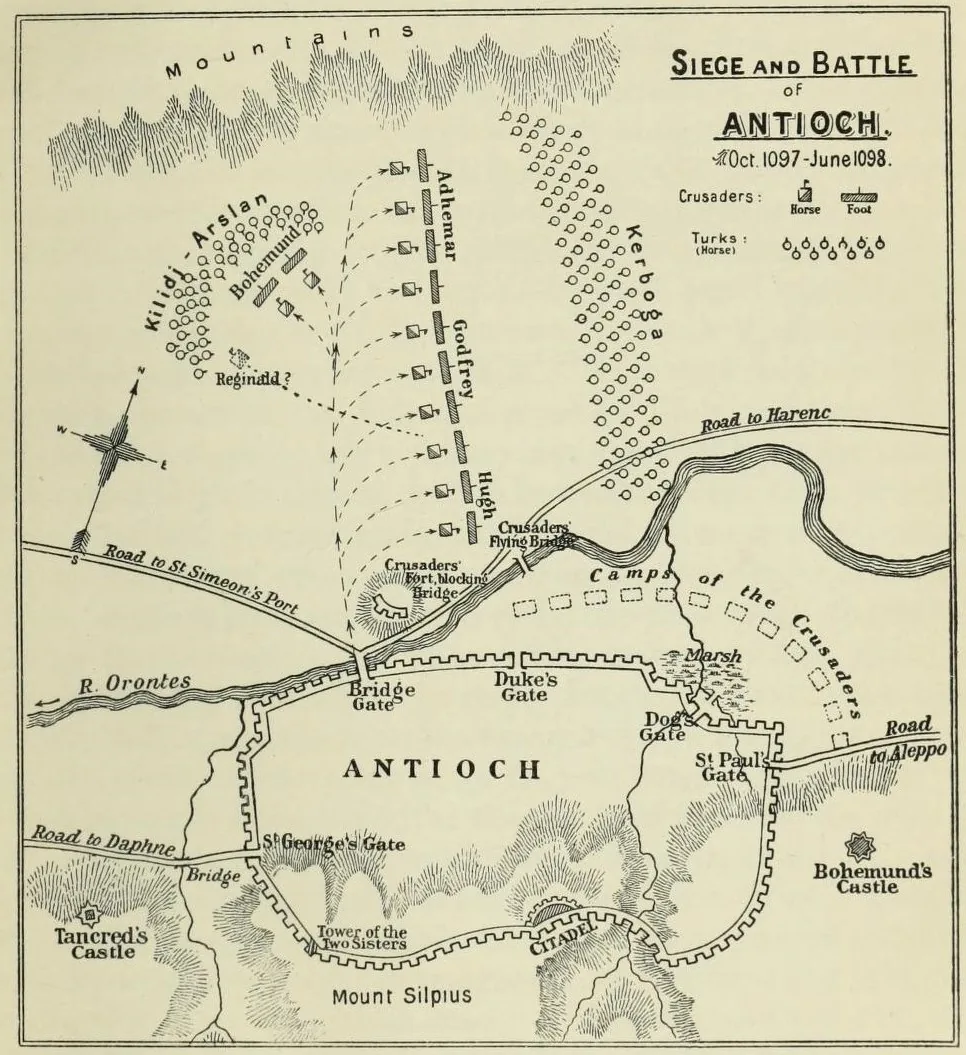
Charles Oman, A History of the Art of War: The Middle Ages (London, 1898), plan of Antioch · Public domain · Source page
In October 1097 the army reached Antioch. Its walls climbed a steep mountain to a citadel, and the city was too big to surround.
Winter brought hunger. Horses died; people ate what they could find. Two relief armies came, from Damascus in December and from Aleppo in February, each alone, because their rulers were rival brothers, and each was beaten.
In February the emperor’s officer Tatikios left. Far to the east, in March 1098, Godfrey’s brother Baldwin became count of the Armenian city of Edessa after its ruler Thoros was killed in a riot: the first crusader state.
Bohemond of Taranto
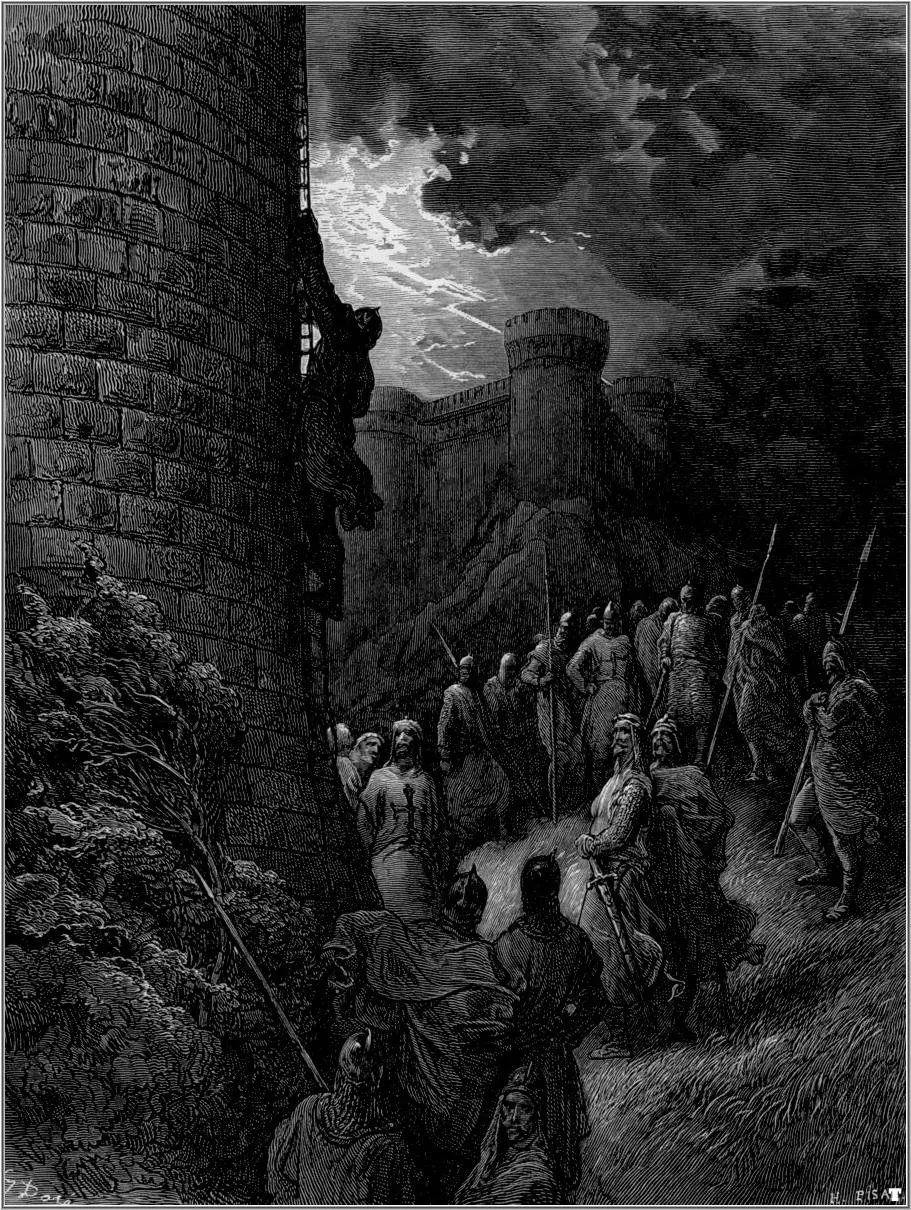
Gustave Doré, wood engraving (engraved by H. Pisan), for Joseph-François Michaud, Histoire des croisades, 1877 · Public domain · Source page
A Norman prince without an inheritance who fought Byzantium, swore loyalty to its emperor, and kept Antioch for himself.
- Born: between 1050 and 1058, probably c. 1054, southern Italy, possibly San Marco Argentano in Calabria
- Died: March 1111, Apulia; buried at Canosa
- Won: Dorylaeum, 1097: held the camp; The Lake of Antioch, February 1098; The capture of Antioch, 3 June 1098; The battle against Kerbogha, 28 June 1098
- Lost: The siege of Larissa, 1083; Captured near Melitene, 1100, and held until 1103; Harran, 1104; Dyrrhachium, 1107–1108, ended by the Treaty of Devol
“Let one of us put himself ahead of the rest, and if he can acquire or contrive (the capture of) the city ... let us with one voice grant him the city as a gift.”
A decision point
You are Bohemond of Taranto.
Late May 1098, in the camp outside Antioch
After seven months of siege your army is starving. Now scouts report that Kerbogha, ruler of Mosul, is coming with a great army, perhaps a week away.
You have a secret: Firuz, who guards three towers, will let your men in by night. But you want Antioch for yourself, the other leaders refuse to give it to one man, and you all swore to return the emperor’s former cities.
What do you do?
- Keep the secret and wait for the emperor’s army Kerbogha would probably arrive first. An army caught between a fortress and a relief army is in deadly danger.
- Fall back to the coast and the ships Safer for the army, perhaps. But seven months of suffering would be wasted, and a retreat might break up the crusade.
- Offer to take the city if the leaders agree it will be yours If they agree, you take the city before Kerbogha arrives, and you have a claim to keep it.
What really happened
Offer to take the city if the leaders agree it will be yours
The leaders agreed, on condition that “if the Emperor comes to our aid” they would return it. On the night of 2–3 June about sixty men climbed into Firuz’s tower. In the Gesta Firuz, seeing how few have come up, cries in Greek: “Micro Francos echome — There are few Franks here!” By morning Antioch had fallen, with great killing, Christians among the dead. Only the citadel held out.
He was saving the army, and winning a principality. Anna says he wanted a state from the start; the Gesta, by one of his own knights, calls it a rescue.
June 1098
Besieged in their turn
Within days Kerbogha arrived, and the besiegers were besieged. Stephen of Blois, who had fled, met Alexios marching to help and told him all was lost. Alexios turned back. The crusaders never forgave him.
In the starving city a poor man from Provence, Peter Bartholomew, said St Andrew had shown him where the Holy Lance, the spear that pierced Christ, lay buried. On 14 June (some modern books say 15 June) a piece of iron was dug up in St Peter’s church. Many believed, and the leaders decided to fight.
Source: A lance in the ground
“And I, who have written this, kissed it when the point alone had as yet appeared above ground.”
“The Bishop, however, thought it nothing except words; but the Count believed it and handed over the man that had said this to his chaplain, Raymond, to guard.”
Raymond was chaplain to the count who protected Peter Bartholomew. “The Bishop” is Adhemar, the legate; Raymond records his doubt before the dig. About ten months later, in April 1099, Peter walked through fire to prove his visions; he died about twelve days later.
- What does Raymond tell you about himself, and why does it matter? That he was there and kissed the point: an eyewitness, but also a believer whose lord gained prestige from the Lance.
- Why would a believer admit that the legate doubted it? The doubt was well known. Admitting it makes him look honest, and a partisan who records the other side is more useful.
A decision point
You are Kerbogha, ruler of Mosul.
Monday 28 June 1098, morning, outside Antioch
Your army is a coalition of emirs, among them Duqaq of Damascus, rivals of one another and of you. If you wait too long, they will go home.
The Franks are starving and their horses are dead. Yesterday you sent their envoys away. This morning they march out across the bridge, one division at a time. Some of your commanders urge you to attack now.
What do you do?
- Attack the first divisions as they cross the bridge Probably your best chance: men crossing a bridge cannot form a line. But your army is spread round the city, and some emirs may be slow to obey.
- Let them come out, and send horse archers round their open flank You avoid fighting them piece by piece and try to wear them down in the open. But you give the Franks time to form their lines.
- Pull back and starve them out Probably sensible, if your coalition holds together. But the emirs are restless, and the Franks are coming out to fight now, whether you like it or not.
What really happened
Let them come out, and send horse archers round their open flank
Kerbogha let them come out and sent riders round their left. According to the Gesta, a seventh division was formed from Godfrey’s and Robert of Normandy’s men under Reynald to meet them (modern accounts say Bohemond gave the order). The Frankish lines marched on Kerbogha’s main army. Then Duqaq and other emirs left the field, and the coalition broke and fled.
The Gesta gives Kerbogha a proud mother and scornful speeches, all invented. Modern historians stress the coalition: the emirs feared his power almost as much as the Franks.
Antioch, 28 June 1098: who fought whom
Monday 28 June 1098
The plain north of the river Orontes, outside Antioch (Antakya, Turkey)
The crusaders
- Commanders: Bohemond, in reserve, directing the battle, Hugh and Robert of Flanders, Godfrey, Robert of Normandy, Tancred; Adhemar’s division, with the Lance (carried, says Raymond of Aguilers, by himself), Raymond of Toulouse, ill, guarding against the citadel
- Strength: “scarcely a hundred good horses in our whole army” (The leaders’ letter to the pope, 1099 (on the siege as a whole)); about 20,000, most of them on foot (some estimates go up to 30,000) (Modern estimates)
- Losses: names no losses (Gesta Francorum); light (Modern view)
Kerbogha’s coalition
- Commanders: Kerbogha, ruler of Mosul, Duqaq of Damascus, Soqman ibn Ortuq, Janah al-Dawla of Homs, In the citadel: Ahmad ibn Marwan
- Strength: “countless” (Latin sources); no reliable figure; modern estimates run from the low tens of thousands to about 40,000 or more (Modern estimates)
- Losses: no reliable figure (The sources)
Outcome: A crusader victory. The coalition broke and fled; the citadel surrendered the same day, to Bohemond’s banner rather than Raymond’s.
Every Latin writer wanted a miracle, and none counted honestly. Modern estimates rest on what Mosul could raise and what the plain could feed.
The battle outside Antioch
28 June 1098, from the morning
After seven months besieging Antioch, the crusaders are now besieged inside it, starving after three days of fasting. They march out through the Bridge Gate division by division, against Kerbogha, ruler of Mosul, and a coalition of emirs including Duqaq of Damascus. Raymond, ill, stays to watch the citadel.
After the Gesta Francorum and Raymond of Aguilers, with the layout of the city, river and gates after Charles Oman’s plan (1898), itself a reconstruction. North is up; distances are approximate.
Disputed: where Kerbogha’s army stood and how far away his camp was; the number of crusader divisions (six and a seventh in the Gesta; Raymond of Aguilers counts differently); exactly which way the Turkish outflanking move came; and why the grass was set alight (a signal to flee in the Gesta, a way to frighten the rear in Raymond).
Phases of the battle
- Out through the Bridge Gate After three days of fasting, the Franks march out across the bridge, division by division. Raymond, ill, stays to watch the citadel.
- Six divisions in line They deploy from the river towards the mountains, facing Kerbogha. Bohemond waits in reserve.
- Round the open flank Turkish horse archers ride round the left flank and set the grass on fire. A seventh division under Reynald forms to face them.
- The coalition breaks The Franks advance on Kerbogha’s main army. Duqaq and other emirs leave the field. The Gesta sees saints on white horses: a vision, not history.
- Rout Kerbogha’s army flees towards the Iron Bridge. The citadel surrenders to Bohemond.
The strategy
- Crusaders: The leaders decided to fight after a piece of iron was dug up in St Peter’s church, which many believed was the Holy Lance. They drew up six divisions from the river to the mountains, facing Kerbogha, with Bohemond in reserve. When Turkish horse archers rode round the left flank, Reynald formed a seventh division to face them.
- Kerbogha’s coalition: Kerbogha does not attack the divisions as they cross the bridge. He lets them come out onto the open ground, and sends horse archers round their open left flank to set the grass alight. The coalition cannot wait long, since its emirs may go home, and the purpose of the fire is disputed.
What decided it: What decided it was that the coalition broke when Duqaq and the other emirs left the field as the Franks advanced on Kerbogha’s main army. The flank attack had already met Reynald’s seventh division.
Myth
The crusaders faced a united Muslim world fighting a holy war.
The truth
The Muslim world was divided. Aleppo and Damascus were rivals; Kerbogha’s coalition broke on the field; Shi’ite Egypt negotiated with the Franks and took Jerusalem from the Turks for itself. Jihad was preached in Damascus about 1105 but found little echo; holy war became real policy decades later, under Zengi, Nur al-Din and Saladin.
The evidence
Carole Hillenbrand, The Crusades: Islamic Perspectives (1999).
Jerusalem
July 1098 – June 1099
The road south
Victory brought quarrels. Adhemar died in an epidemic on 1 August 1098, and Bohemond and Raymond both claimed Antioch. For months the army sat still.
At Ma’arrat al-Numan, stormed in December, the people were massacred, and some starving crusaders ate the bodies of the dead, as their own leaders admitted. The poor pilgrims threatened to march on alone. In January 1099 Raymond led the march south, barefoot.
On 7 June 1099 the army stood before Jerusalem.
Myth
The crusaders came to take Jerusalem back from the Turks, who had just conquered it.
The truth
Muslims had ruled Jerusalem since 637–638. Turkish commanders took it from the Fatimids in the 1070s, but in August 1098, while the crusaders were at Antioch, the Fatimid vizier al-Afdal took it back from the Turkish Artuqid emirs who held it. The crusaders besieged a Fatimid city, not the Turks the emperor had asked for help against.
June–July 1099
Thirst and towers
The governor, Iftikhar al-Dawla, held the city for Egypt. The crusaders had perhaps 12,000 fighting men, too few to surround it, and little water: the spring of Siloam, Raymond of Aguilers says, flowed only every third day. A first assault failed for want of ladders. Then timber from ships that reached Jaffa became siege towers.
Jerusalem, June–July 1099: who fought whom
7 June – 15 July 1099
Jerusalem; the crusaders attacked from the north, and from Mount Zion in the south-west
The crusaders
- Commanders: North: Godfrey of Bouillon, Robert of Normandy, Robert of Flanders, Tancred, Mount Zion: Raymond of Toulouse
- Strength: “not more than twelve thousand able to bear arms”, and 1,200–1,300 knights (Raymond of Aguilers)
- Losses: no reliable figure (The sources)
The Fatimid garrison
- Commanders: Iftikhar al-Dawla, governor for the vizier al-Afdal
- Strength: 60,000 fighting men (Raymond of Aguilers); perhaps a thousand or so soldiers, with Egyptian cavalry and armed townspeople (Modern estimate)
- Losses: see below: no one knows (The dead in the city)
Outcome: The city fell on Friday 15 July 1099, and a great many of its people were killed.
Raymond’s 60,000 defenders is impossible; his 12,000 for his own side is believable. Nobody counted the dead.
The siege of Jerusalem
7 June – 15 July 1099
The crusaders stand before Jerusalem, held for Egypt by its governor. They have perhaps 12,000 fighting men, too few to ring the city, and little water. On 7 June 1099 they draw up the siege lines, and the east is barely watched.
After Raymond of Aguilers, the Gesta Francorum and Fulcher of Chartres, with the line of the walls after Herder’s plan (1831) and descriptions of the city at the time. The Fatimid wall enclosed about 1 km by 900 m, and Mount Zion lay outside it. North is up; positions are approximate.
Disputed: the date of the first assault (13 June in most books, 8 June in Fulcher), the names of the gates, the exact place where the wall was crossed, the size of the garrison, and the hour (noon in Fulcher, the hour of the Passion in the Gesta). The map does not draw the killing inside the city.
Phases of the battle
- 7 June: the siege lines The two Roberts camp to the north, Godfrey and Tancred at the north-west corner, Raymond to the west. The east is barely watched.
- 13 June: the first assault The outer wall is breached, but there are too few ladders for the inner wall. Fulcher dates this attack to 8 June.
- Building towers Raymond moves to Mount Zion and fills the ditch. On 8 July the army walks barefoot round the walls to the Mount of Olives.
- The tower moves By night Godfrey moves his tower east, “between the church of St Stephen and the valley of Josaphat”, where the wall is weaker.
- 15 July: over the wall Around midday men cross from Godfrey’s tower onto the wall. The defenders flee to the Temple Mount and the Tower of David.
The strategy
- Crusaders: The two Roberts camp to the north, Godfrey and Tancred at the north-west corner, and Raymond to the west, since they have too few men to ring the whole city. By night Godfrey moves his tower east, where the wall is weaker. Raymond fills the ditch at Mount Zion so that his tower can reach the wall.
- Fatimid garrison: The governor’s aim was to hold the city for Egypt; any plan beyond that is not recorded. The defence rests on the walls and a garrison of perhaps a thousand soldiers or a little more, with Egyptian cavalry and armed townspeople.
What decided it: What decided it was Godfrey’s tower, moved to the weaker stretch in the east, which let fighters cross onto the wall; once the wall was lost the defenders could not hold the city. The exact point of the breach is disputed.
A decision point
You are Raymond, count of Toulouse.
Friday 15 July 1099, afternoon, before the Tower of David
Your tower has reached the wall by Mount Zion, but in the north Godfrey’s men are already inside. Killing has begun in the streets.
The governor and his soldiers have shut themselves in the Tower of David, a strong keep with its own moat. They will surrender to you if you promise them their lives. An Egyptian army may march from Ascalon.
What do you do?
- Storm the citadel now The keep could hold out for days and cost you many men, and a garrison with nothing to lose would fight to the end.
- Accept: their lives and a safe escort to Ascalon, the citadel to you You gain the citadel at once, without a fight, and the garrison lives, if your word holds.
- Leave a guard round it and join the others in the city The garrison stays a danger inside the city, and someone else may take its surrender, and the fortress, instead of you.
What really happened
Accept: their lives and a safe escort to Ascalon, the citadel to you
Raymond accepted. The Gesta: “But Raymond caused the Emir and the others who were with him to be conducted to Ascalon, whole and unhurt.” Ibn al-Athir, writing 130 years later, tells of a similar surrender: the garrison was granted its life and left for Ascalon by night. Two sources from opposite sides agree on the outcome.
Storming the keep would have been costly, and the citadel gave Raymond a claim to the city. The Franks, says Ibn al-Athir, kept their word.
15–16 July 1099
The killing in Jerusalem
The Latin chroniclers do not hide what followed; many celebrate it. Through that day and the next, the crusaders killed the people they found in the streets, in houses and on the Temple Mount, where many had fled to the al-Aqsa mosque: Muslim men, women and children. The Latin eyewitnesses do not mention Jews in Jerusalem. Ibn al-Qalanisi, writing in Damascus decades later, says the Franks burned the synagogue with the Jews inside; he is the only source I know that says Jews were inside.
Some were spared, for a while. Tancred gave his protection to people on the mosque’s roof, but next morning others killed them, Raymond of Aguilers writes. Some captives were later ransomed by the Jews of Ascalon and Egypt.
How many died? No one knows. Modern estimates run from a few thousand to perhaps ten or twenty thousand. Historians such as Benjamin Kedar argue that it was exceptional even by the harsh standards of the time.
On 22 July Godfrey of Bouillon was chosen to rule the city. What happened to Jerusalem’s Jews, and to the Jews of the Rhineland in 1096, is the subject of the next lesson.
Source: “Up to their knees”: the Latin accounts
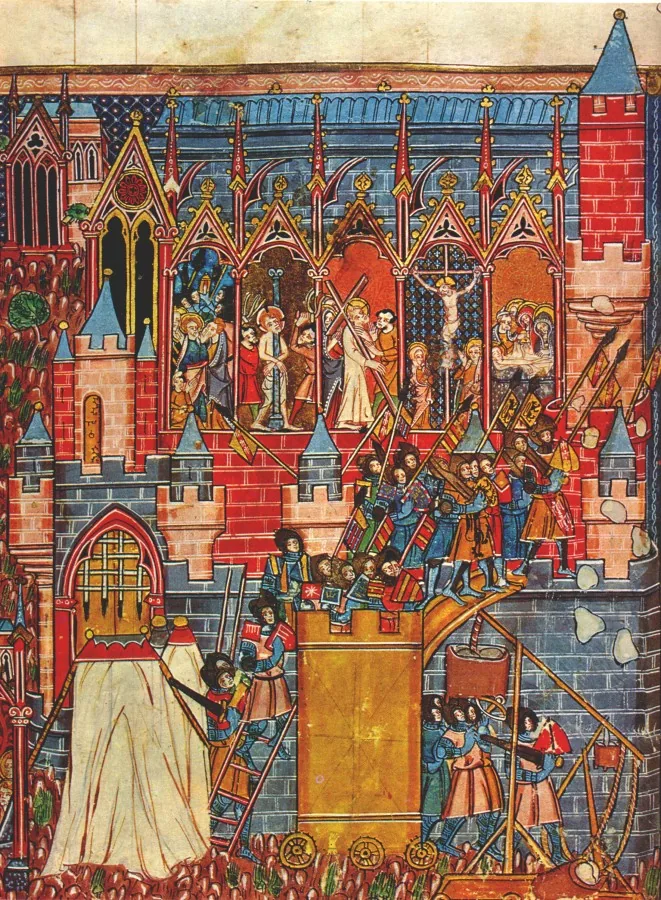
Anonymous, 14th century. William of Tyre, Histoire d’Outremer, Bibliothèque nationale de France, MS Fr. 352, fol. 62 (as given on Wikimedia Commons) · Public domain · Source page
Raymond of Aguilers (present): “... men rode in blood up to their knees and bridle reins. Indeed, it was a just and splendid judgment of God ...”
Fulcher of Chartres (not present): “Indeed, if you had been there you would have seen our feet colored to our ankles with the blood of the slain.”
The Gesta Francorum (present): “... no one knows their number except God alone.”
“The Temple” was the crusaders’ name for the al-Aqsa mosque. No old translation of the Muslim and Jewish accounts can be quoted; in summary, Ibn al-Athir (about 1231) gives more than 70,000 dead in al-Aqsa, and letters of the Jews of Ascalon (about 1100) tell of captives ransomed.
- “Up to their knees and bridle reins”: is that a measurement? No. It echoes the Bible, Revelation 14:20. The Gesta and Fulcher say “ankles”. It shows that Raymond saw the killing as God’s judgment.
- Was Fulcher there? No: he was in Edessa. Vivid is not the same as eyewitness.
- What did the painter put inside the walls, and why? Scenes of Christ’s Passion, painted over 200 years later: to him, taking Jerusalem meant freeing the place where Christ suffered.
What the crusade left
1099–1100
A kingdom over the sea
On 12 August 1099 the crusaders routed al-Afdal’s Egyptian army outside Ascalon. Then most went home, their vow fulfilled. Urban II had died on 29 July, before the news reached him.
Godfrey’s brother Baldwin was crowned the first king of Jerusalem on Christmas Day 1100; Bohemond ruled Antioch. Europeans called these states Outremer, “over the sea”: a small Frankish minority ruling Muslims, Eastern Christians and Jews.
From Clermont to Edessa
- 27 November 1095 Urban preaches at Clermont
- 1096 The People’s Crusade; attacks on the Jews of the Rhineland; Civetot (October)
- 1 July 1097 The battle of Dorylaeum
- March 1098 Baldwin becomes count of Edessa: the first crusader state
- June 1098 Antioch falls (3 June); Kerbogha’s army is routed (28 June)
- August 1098 The Fatimids take Jerusalem from the Turks
- 15 July 1099 Jerusalem is stormed; the massacre
- 1144 Zengi of Mosul takes Edessa; the Second Crusade follows
What was the crusade for?
Was Jerusalem Urban’s goal from the start, and who really set the crusade in motion?
- Jonathan Riley-Smith, The First Crusade and the Idea of Crusading (1986); The First Crusaders (1997) The crusade was something new: an armed pilgrimage, bound by a vow, that earned remission of penance, and Jerusalem was its aim from the beginning. The crusaders’ own documents call it a pilgrimage, and his study of their families shows that most spent far more than they gained: piety, not land hunger, moved them.
- Carl Erdmann (1935), Hans Eberhard Mayer, Georg Strack (2016) Urban’s first aim was to help the churches of the East. In his own letters Jerusalem appears only in second place, and perhaps only because the people writing to him named it; the speeches that put Jerusalem at the centre were written after 1099. Critics answer that the council’s decree does name Jerusalem.
- Peter Frankopan, The First Crusade: The Call from the East (2012) The crusade cannot be understood from the West alone. Alexios’s appeals and diplomacy shaped what Urban did. Critics reply that Alexios asked for soldiers he could pay and command, not for an army of pilgrims, and that some of the evidence for his appeals is doubtful.
- Carole Hillenbrand, The Crusades: Islamic Perspectives (1999) Seen from the Muslim side, the conquest of Jerusalem was a disaster recorded with sorrow, but at first without a call to arms; calls for a holy war against the Franks were heard early but took hold only decades later, with Zengi, Nur al-Din and Saladin. The Muslim world was split between Cairo, Damascus, Aleppo, Mosul and Baghdad.
Historians still disagree about how much Jerusalem mattered to Urban in 1095, and how much of the crusade was made in the East. The sources, almost all written after the victory, make it hard to settle.
What do you know now?
Check yourself
What do we actually have of Urban’s speech at Clermont?
Answer: Several versions written years later, which do not agree. Right. Fulcher, Baldric, Robert and Guibert wrote between about 1100 and 1108. Fulcher’s has no Jerusalem; Robert’s makes it “the navel of the world”.
Check yourself
Robert of Normandy pawned his duchy to go. What does that say about “land-hungry younger sons”?
Answer: That it is overstated: many spent more than they gained. Right. Studies of crusading families show sales and mortgages to pay for the journey. Some did win land, like Bohemond and Baldwin, but motives were mixed.
Check yourself
Why did Alexios ask the crusade leaders to swear an oath to him?
Answer: To get back his empire’s former cities. Right. That is why Nicaea surrendered to his officer, and why the Byzantines saw Bohemond, who kept Antioch, as an oath-breaker.
Check yourself
Who held Jerusalem when the crusaders reached it in June 1099?
Answer: The Fatimids of Egypt, who had retaken it in August 1098. Right. The vizier al-Afdal took it from the Turks in August 1098, while the crusaders were at Antioch, and his governor Iftikhar al-Dawla defended it.
Check yourself
Why did Kerbogha’s great army break outside Antioch on 28 June 1098?
Answer: Rival emirs left the field, and the coalition fell apart. Right. The emirs feared Kerbogha’s power almost as much as the Franks, and did not fight to the end.
Check yourself
Fulcher wrote of the Temple: “if you had been there you would have seen ...”. Why is this not eyewitness evidence?
Answer: He was in Edessa in July 1099, and wrote from what others told him. Right. He went with Baldwin to Edessa in 1098 and reached Jerusalem only at Christmas 1099. Vivid is not the same as eyewitness.
Terms
- crusade An armed pilgrimage called by the pope, whose members took a vow to fight and sewed a cross on their clothes. The word itself came later; in 1095–1099 people spoke of “the journey” or “the pilgrimage”.
- indulgence The Church’s promise that a good work would take the place of the penance owed for sins. At Clermont Urban promised that the journey would replace all penance; the fully developed doctrine of indulgences came later.
- Peace of God A movement led by bishops from the late 10th century to protect clergy, peasants and the poor from knights’ private wars. Its partner, the Truce of God, banned fighting on certain days.
- legate An envoy who acts with the pope’s authority. Urban made Adhemar, bishop of Le Puy, his legate with the crusading army.
- Franks What Byzantines and Muslims called all Western Europeans, whatever their language (in Arabic, Ifranj). The crusaders used the word for themselves too.
- basileus Greek for “king”: the title of the Byzantine emperor, who saw himself as emperor of the Romans.
- Seljuks A Turkish dynasty from Central Asia that took Baghdad in 1055 and most of Anatolia after 1071. By 1095 their empire had split among rival princes.
- Fatimids A Shi’ite Muslim dynasty that ruled Egypt from Cairo and claimed the caliphate; rivals of the Sunni Seljuks. In 1099 they held Jerusalem.
- emir Arabic for “commander”: a Muslim prince, or the governor of a city or a region.
- vizier The chief minister of a Muslim ruler. In Egypt the vizier al-Afdal, not the caliph, held the real power.
- Holy Lance The spear that, the Gospel of John says, pierced Christ’s side on the cross. Several churches claimed to own it; one was “found” at Antioch in June 1098.
- Outremer French for “over the sea”: the name Western Europeans gave the crusader states founded in Syria and Palestine from 1098.
- Robert the Monk A monk who wrote one of the versions of Urban's speech at Clermont, and says he was there himself.
- Raymond of Aguilers Chaplain to Raymond of Toulouse. He saw most of what he describes and believed in miracles.
- Fulcher of Chartres A chronicler who went to Edessa in 1098, so he never saw Jerusalem fall. His book was written around 1100–1106.
- Anna Komnene The daughter of the Byzantine emperor, who wrote about fifty years on. She calls Westerners Kelts and Latins.
- Ibn al-Athir A Muslim historian from Mosul, writing about 130 years after the events. He gives very large death tolls in Jerusalem.
- Bernold of Constance A Western chronicler who reports the emperor's appeal for help at the council of Piacenza. He is the only Western chronicler to report it.
- Peter the Hermit A preacher who led crowds east in spring 1096. The Turks destroyed his followers near Civetot.
- Kilij Arslan A Seljuk sultan. In 1096 he destroyed Peter the Hermit's followers, and in 1097 his relief army failed to save Nicaea.
- Civetot A place in Asia where the Seljuk sultan destroyed Peter the Hermit's followers in 1096.
- Tatikios An officer of Emperor Alexios, sent with the crusaders as a guide. In February 1098 he left them.
- Stephen of Blois A French count made leader of the expedition against his will, who wrote letters home from camp. In 1098 he slipped away from Antioch and went home.
- Matthew of Edessa An Armenian chronicler of Edessa, who told the city's story from the Armenian side decades later.
- Thoros The Armenian ruler of Edessa, killed in a riot. Baldwin became count of the city after him.
- Kerbogha The ruler of Mosul, who came to Antioch with a great army, so that the besiegers became besieged. His coalition broke on the field.
- Firuz The guard of three towers in Antioch, who let the crusaders in through his tower by night. According to the story, he cried out in Greek that there were few Franks there.
- Duqaq The emir of Damascus in Kerbogha's coalition. He left the battlefield, and the coalition broke.
- Ascalon A port city in the Holy Land. Outside it, on 12 August 1099, the crusaders defeated al-Afdal's Egyptian army.
- al-Afdal The Fatimid vizier of Egypt, who took Jerusalem back from the Turkish Artuqid emirs in August 1098.
- Tower of David A strong fortress in Jerusalem, with its own moat, where the governor and his soldiers shut themselves in during the siege.
- al-Aqsa A mosque in Jerusalem on the Temple Mount, where many Muslims fled in 1099. The crusaders called it the Temple.
- Tancred A crusader leader in Jerusalem who gave protection to people on the mosque's roof. The next morning others killed them.
- Ibn al-Qalanisi A writer in Damascus, who wrote decades later. He says the Franks burned the synagogue with Jews inside it.
- Ma’arrat al-Numan A town stormed in December, where its people were massacred.
- Saladin A Muslim leader under whom holy war against the Franks became real policy, decades after the first crusade.
- Nicaea The Seljuk capital in Anatolia. In June 1097 it surrendered, not to the crusaders but to an officer of the emperor.
Sources
- Gesta Francorum et aliorum Hierosolimitanorum, Books 1–10, in August C. Krey, The First Crusade: The Accounts of Eyewitnesses and Participants (Princeton University Press, 1921)
- Raymond of Aguilers, Historia Francorum qui ceperunt Iherusalem, extracts in Krey, The First Crusade (Princeton University Press, 1921)
- Fulcher of Chartres, Historia Hierosolymitana I.3; Robert the Monk, Historia Hierosolymitana I.1; the decree of the Council of Clermont (usually called canon 2): in Dana C. Munro, “Urban and the Crusaders”, Translations and Reprints from the Original Sources of European History 1.2 (University of Pennsylvania, 1895)
- Fulcher of Chartres, Historia Hierosolymitana I.27, in Frederic Duncalf and August C. Krey, Parallel Source Problems in Medieval History (Harper & Brothers, 1912)
- Urban II, letter to the faithful in Flanders, December 1095, in Krey, The First Crusade (1921), pp. 42–43
- Letters of Stephen of Blois to Adela (29 March 1098) and of Daimbert, Godfrey and Raymond to Pope Paschal II (September 1099), in Dana C. Munro, “Letters of the Crusaders”, Translations and Reprints 1.4 (University of Pennsylvania, 1896)
- Anna Komnene, Alexiad, Book 10, chs. 5, 9 and 10, trans. Elizabeth A. S. Dawes, The Alexiad of the Princess Anna Comnena (Kegan Paul, Trench, Trubner, 1928)
- Ibn al-Athir, al-Kamil fi’l-ta’rikh, years 491–492 AH (paraphrased in this lesson); English trans. D. S. Richards, The Chronicle of Ibn al-Athir for the Crusading Period from al-Kamil fi’l-Ta’rikh, Part 1 (Ashgate, 2006)
- Ibn al-Qalanisi, Dhayl ta’rikh Dimashq (paraphrased in this lesson); English trans. H. A. R. Gibb, The Damascus Chronicle of the Crusades (Luzac, 1932)
- S. D. Goitein, “Contemporary Letters on the Capture of Jerusalem by the Crusaders”, Journal of Jewish Studies 3:4 (1952), 162–177
- Jonathan Riley-Smith, The First Crusade and the Idea of Crusading (London: Athlone Press, 1986)
- Jonathan Riley-Smith, The First Crusaders, 1095–1131 (Cambridge University Press, 1997)
- Thomas Asbridge, The First Crusade: A New History (Oxford University Press, 2004)
- John France, Victory in the East: A Military History of the First Crusade (Cambridge University Press, 1994)
- Carole Hillenbrand, The Crusades: Islamic Perspectives (Edinburgh University Press, 1999)
- Peter Frankopan, The First Crusade: The Call from the East (London: Bodley Head, 2012)
- Carl Erdmann, The Origin of the Idea of Crusade, trans. Marshall W. Baldwin and Walter Goffart (Princeton University Press, 1977; German original 1935)
- Hans Eberhard Mayer, The Crusades, 2nd ed. (Oxford University Press, 1988)
- Georg Strack, “Pope Urban II and Jerusalem: a re-examination of his letters on the First Crusade”, Journal of Religious History, Literature and Culture 2/1 (2016), 51–70
- Benjamin Z. Kedar, “The Jerusalem Massacre of July 1099 in the Western Historiography of the Crusades”, Crusades 3 (2004)
- Joshua Prawer, The Latin Kingdom of Jerusalem: European Colonialism in the Middle Ages (London: Weidenfeld & Nicolson, 1972)
Image credits
- Jean Colombe, miniature in Sébastien Mamerot, Les passages d’outremer, about 1474. Bibliothèque nationale de France, MS Fr. 5594, fol. 19r · Public domain · Source page
- Anonymous illuminator, 14th century. Miniature from a manuscript of the Roman de Godefroi de Bouillon · Public domain · Source page
- Gold hyperpyron of Alexios I Komnenos, Constantinople, 1092–1118. Museums of the Moscow Kremlin. Photo: shakko · CC BY-SA 4.0 · Source page
- Charles Oman, A History of the Art of War: The Middle Ages (London, 1898), plan of Antioch · Public domain · Source page
- Gustave Doré, wood engraving (engraved by H. Pisan), for Joseph-François Michaud, Histoire des croisades, 1877 · Public domain · Source page
- Anonymous, 14th century. William of Tyre, Histoire d’Outremer, Bibliothèque nationale de France, MS Fr. 352, fol. 62 (as given on Wikimedia Commons) · Public domain · Source page


