The Hundred Years’ War I: Edward III to Crécy and Calais
An English king claims the crown of France. At Crécy, his archers’ arrows fall like snow.
Decisions, questions and your own progress, in the app
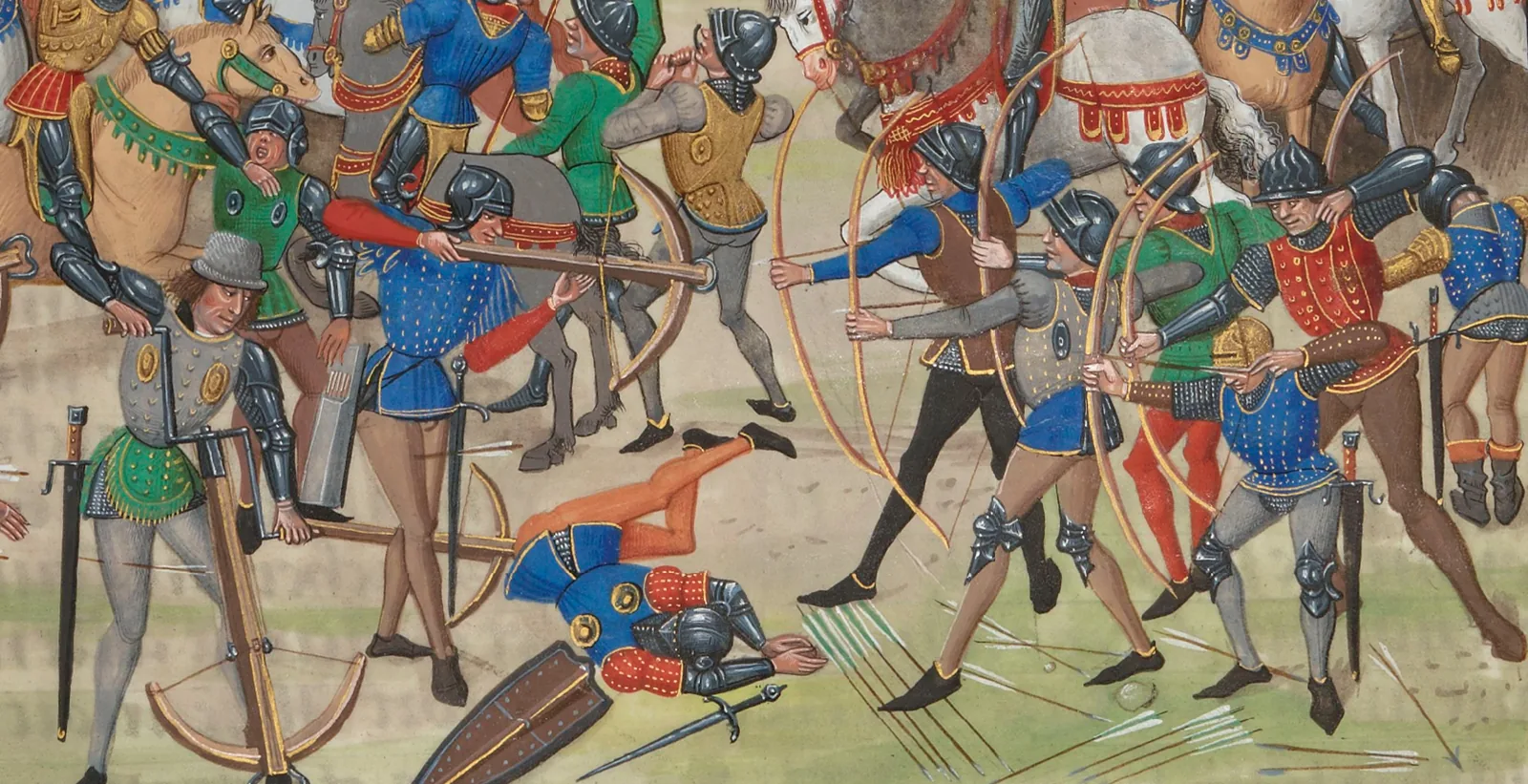
Loyset Liédet, the battle of Crécy, in Froissart’s Chronicles, Bruges, c. 1470–75. Bibliothèque nationale de France, MS Français 2643 · Public domain · Source page
Snow in August
Arrows like snow
Saturday, 26 August 1346, late afternoon, near the small town of Crécy in northern France. A thunderstorm has just passed. Thousands of soldiers from Genoa, armed with crossbows, cross a shallow valley, shouting, towards a slope where the English wait on foot. They halt and shoot.
Then, says the chronicler Jean Froissart, the English archers step forward one pace and loose their arrows so thick ‘that it seemed snow’. By midnight more than 1,500 French lords and knights lie dead on the slope, a blind king among them.
How did a king of England come to be fighting deep inside France, for the crown of France? It begins with a throne left without an heir.
A warning
The storyteller was about nine
9
That was, as far as we know, Jean Froissart’s age on the day of Crécy: he was born around 1337. The most famous account of this war comes from a man of Valenciennes in Hainault, now in northern France, who saw none of its battles. From 1361 he served England’s queen, Philippa, herself from Hainault. He questioned veterans of both sides, copied much from an older chronicler, Jean le Bel, and kept revising for thirty years.
Froissart wrote to celebrate chivalry. Common soldiers appear mostly as ‘rascals’, numbers swell, and speeches are written up. He also tells the best stories; this lesson checks them against letters from the campaign, other chronicles and pay records.
Edward III
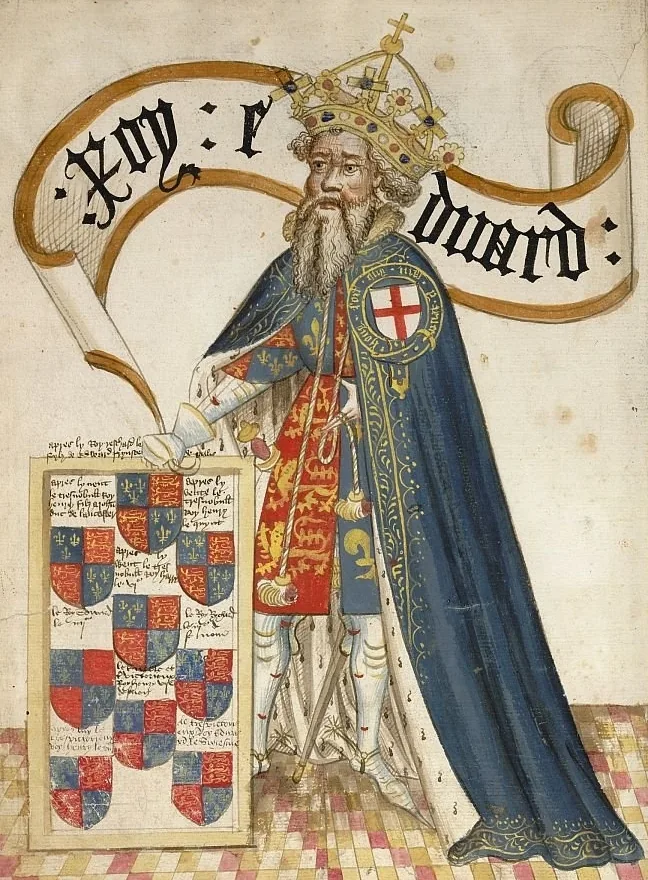
The Bruges Garter Book, made for William Bruges, Garter King of Arms, c. 1430–40. British Library, Stowe MS 594 · Public domain · Source page
A boy king who took back his throne at 17, claimed the crown of France and won the war’s most famous battles, then lived long enough to see most of his gains slip away.
- Born: 13 November 1312, Windsor Castle, England
- Died: 21 June 1377, Sheen Palace, near London, probably of a stroke, after years of illness
- Won: Halidon Hill, 1333; Sluys, 1340; Crécy, 1346; The siege of Calais, 1346–47
- Lost: The siege of Tournai, 1340 (failed); The Reims campaign, 1359–60 (city not taken)
“Fair son, God give you good perseverance; ye are my good son, thus ye have acquitted you nobly: ye are worthy to keep a realm.”
A vassal and a crown
Background
A king on his knees
Since 1066 the kings of England had also been great lords in France. Since the Treaty of Paris of 1259 they held what was left of the duchy of Aquitaine, in practice Gascony around Bordeaux, as vassals of the king of France.
So an English king had to kneel to a French one. In the ceremony of homage, the vassal put his hands between his lord’s hands and swore to be his man. And a Gascon who lost a case in the duke’s court could appeal over his head to the king’s court in Paris. Quarrels over appeals and borders had already led to war twice, in 1294 and in 1324.
1328
Three brothers, no sons
King Philip IV of France had three sons. Each became king in turn, and each died without a surviving son; the last, Charles IV, in February 1328. The closest male relative was Philip IV’s grandson through his daughter Isabella: Edward III, the fifteen-year-old king of England. He had been crowned the year before, after his mother and her lover, Roger Mortimer, deposed his father, Edward II, the king beaten at Bannockburn.
The French lords did not want an English boy king ruled by those two. They chose a grown Frenchman: Philip of Valois, son of Philip IV’s brother. A woman, they argued, could not pass on a right she could not hold herself. In 1329 young Edward came to Amiens and did homage to King Philip VI for Gascony.
Philip VI
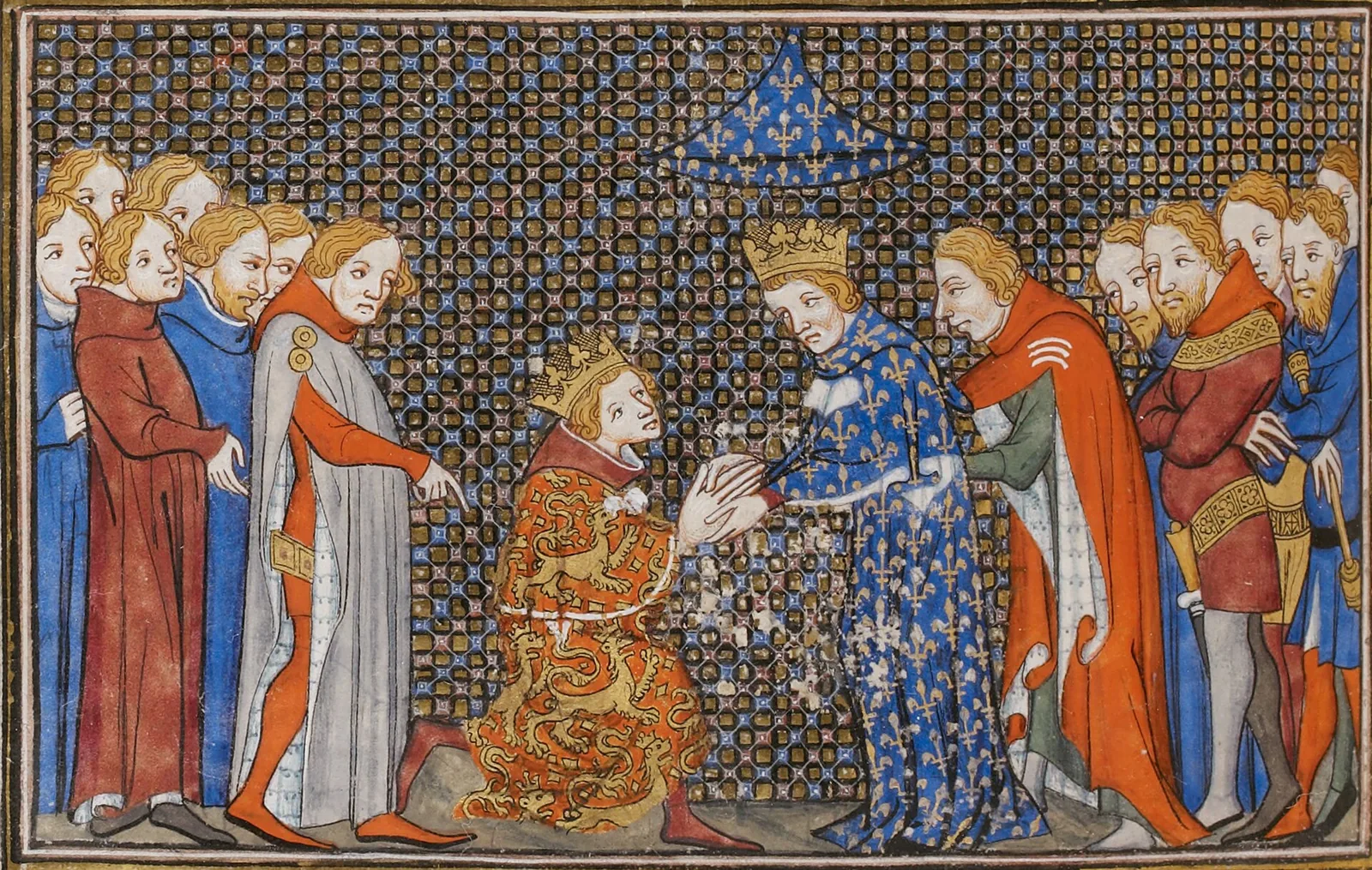
Grandes Chroniques de France of Charles V, Paris, c. 1375–80, unknown illuminator. Bibliothèque nationale de France, MS Français 2813 · Public domain · Source page
A cousin never meant to be king, chosen by the French lords in 1328; cautious by nature, he still lost a fleet, a battle and a port to Edward.
- Born: 1293, France; son of Charles, count of Valois
- Died: 22 August 1350, Nogent-le-Roi, west of Paris
- Won: Cassel, 1328, against the Flemish rebels
- Lost: Sluys, 1340; Crécy, 1346; Calais, 1347
“Open your gate quickly, for this is the fortune of France.”
1330–1337
Scotland, wool and a refugee
In 1330, at 17, Edward seized Mortimer and had him hanged. Then he turned north. Robert the Bruce had died in 1329, leaving a five-year-old son, David II. Edward backed a rival, and in 1333 he won at Halidon Hill, where archers and knights on foot cut down the Scots. David fled to France, and Philip insisted that any peace must include Scotland, France’s old ally.
Flanders’ cloth towns, Ghent, Bruges and Ypres, lived on English wool, but their count was loyal to Philip. In 1336 Edward stopped wool exports to Flanders, to push the towns to his side, and sheltered Robert of Artois, Philip’s brother-in-law and bitter enemy.
On 24 May 1337 Philip declared Gascony confiscated. The Hundred Years’ War is usually dated from that day. On and off, it lasted until 1453.
A decision point
You are Edward III, king of England.
1337–1340, after Philip seizes Gascony
You are 24. Philip has seized Gascony, shelters the young king of Scots and gathers ships in the Channel ports. In 1328 you, not he, were the closest heir, even though you did him homage.
You need allies. The Flemish towns want English wool, but they have sworn obedience to the king of France. French lords with grievances might change sides, if they could do it lawfully. And France has perhaps four times as many people as England.
What do you fight for?
- Fight only as duke of Aquitaine, to win back Gascony A limited war that French lords would understand. But the Flemings could not lawfully fight their own king beside you, and Philip would remain your lord, free to summon you to his court the moment the fighting stopped.
- Claim the crown of France for yourself Your allies become loyal subjects of ‘the true king’, and every French lord with a grudge gains a lawful reason to join you. But you raise the stakes as high as they can go, and you may unite France behind Philip.
- Give way: hand over Robert of Artois and keep what is left of Gascony Probably peace for a while, at the price of a smaller duchy and a humbled king, with the same quarrels over appeals and borders still waiting. And Philip would have learned that pressure works.
What really happened
Claim the crown of France for yourself
Edward began calling himself king of France in letters in October 1337, and on 26 January 1340, at Ghent, he formally took the title; the Flemish towns recognised him as their king. He put the lilies of France on his coat of arms, beside the English lions and in the place of honour.
The Flemings needed it: now they could fight for ‘their’ king of France with a clear conscience. Whether Edward meant it is still argued: a bargaining chip, or a real ambition?
War at sea
1338–1340
A war bought on credit
In 1338 Edward crossed to Antwerp and bought allies in the Low Countries and Germany, with borrowed money and English wool. In 1339 he led his first chevauchée into northern France: a mounted raid that burned villages, drove off cattle and took ransoms from towns. Philip brought up a larger army, and then would not fight.
French ships and hired Genoese galleys raided the English coast and in 1338 burned Southampton. By June 1340 Philip had gathered a great fleet in the Zwin, the broad estuary that led to Bruges, to stop Edward from bringing a new army to Flanders.
Sluys: who fought whom
24 June 1340
The Zwin estuary, off the port of Sluys in Flanders
England
- Commanders: Edward III, aboard the cog Thomas
- Strength: 120–160 ships (Modern estimate (ships)); a few thousand men-at-arms and archers; exact figures disputed (Modern estimate (fighting men))
- Losses: a few hundred dead (English chroniclers)
Froissart claims the French were four to one.
France
- Commanders: Hugues Quiéret and Nicolas Béhuchet, the admirals, Pietro Barbavera, captain of the Genoese galleys
- Strength: more than 120 great ships, and about 40,000 men (Froissart); about 200 ships; over 19,000 men, nearly all seamen (French treasury accounts)
- Losses: 16,000–20,000 killed or drowned (Contemporary estimates); nearly the whole fleet taken or sunk (Modern historians)
Outcome: An English victory. The French fleet was destroyed, and for years English armies could cross the Channel in safety.
The French figures come from Philip’s own treasury accounts, which list the ships and crews he paid for. Of more than 19,000 men, only about 150 were men-at-arms and 500 crossbowmen; the rest were seamen.
The battle of Sluys
24 June 1340, from the early afternoon into the night
On 23 June 1340 Edward III’s English fleet reaches the Flemish coast. In the Zwin, before Sluys, the French fleet is packed in, its ships roped together in lines. Edward means to bring a new army to Flanders, and the French mean to stop him. The Genoese captain Barbavera urges the admirals to put out to sea, and they refuse.
A schematic reconstruction, after Jonathan Sumption (1990), N. A. M. Rodger (1997) and Froissart. The Zwin has since silted up and the coastline of 1340 cannot be drawn exactly; Sluys now lies several kilometres inland. Whether the French stood in three lines or four, and when exactly the English attacked, are disputed. Positions are approximate.
Phases of the battle
- A forest of masts On 23 June the English fleet reaches the Flemish coast. Its scouts see the French fleet packed into the Zwin before Sluys, the ships roped together in lines. The Genoese captain, Barbavera, urges the admirals to put out to sea. They refuse.
- Wind, tide and arrows In the afternoon of 24 June the English come in with the wind and the tide behind them, ships full of archers beside each ship of men-at-arms. The archers sweep the French decks; the men-at-arms throw grappling hooks and board.
- The first line falls The front line, roped together, cannot manoeuvre, and it falls ship by ship. The great cog Christopher, which the French had taken from the English two years before, is recaptured and turned against them. As evening comes, Flemish ships from Sluys attack the French rear.
- Night: a fleet destroyed The fighting goes on into the night. Only Barbavera’s galleys and a few other ships break out to sea. Admiral Quiéret is killed; Béhuchet is hanged from a mast. For years, English armies will cross the Channel safely.
The strategy
- English: Edward sends the English fleet into the estuary with the wind and tide behind it, each ship of men-at-arms with a ship of archers beside it. The archers sweep the French decks, and the men-at-arms throw grappling hooks and board, so that the fighting is close, on the decks.
- French: Barbavera urges the admirals to put out to sea, and they refuse.
- Flemings of Sluys: No source says what the Flemings of Sluys planned or why they joined in. As evening comes they attack the French rear, while the French front line falls ship by ship.
What decided it: The French had roped their ships together in lines, so the front line could not manoeuvre and fell ship by ship. The English archers swept the decks, and the men-at-arms boarded one ship after another.
Source: The king in a ship
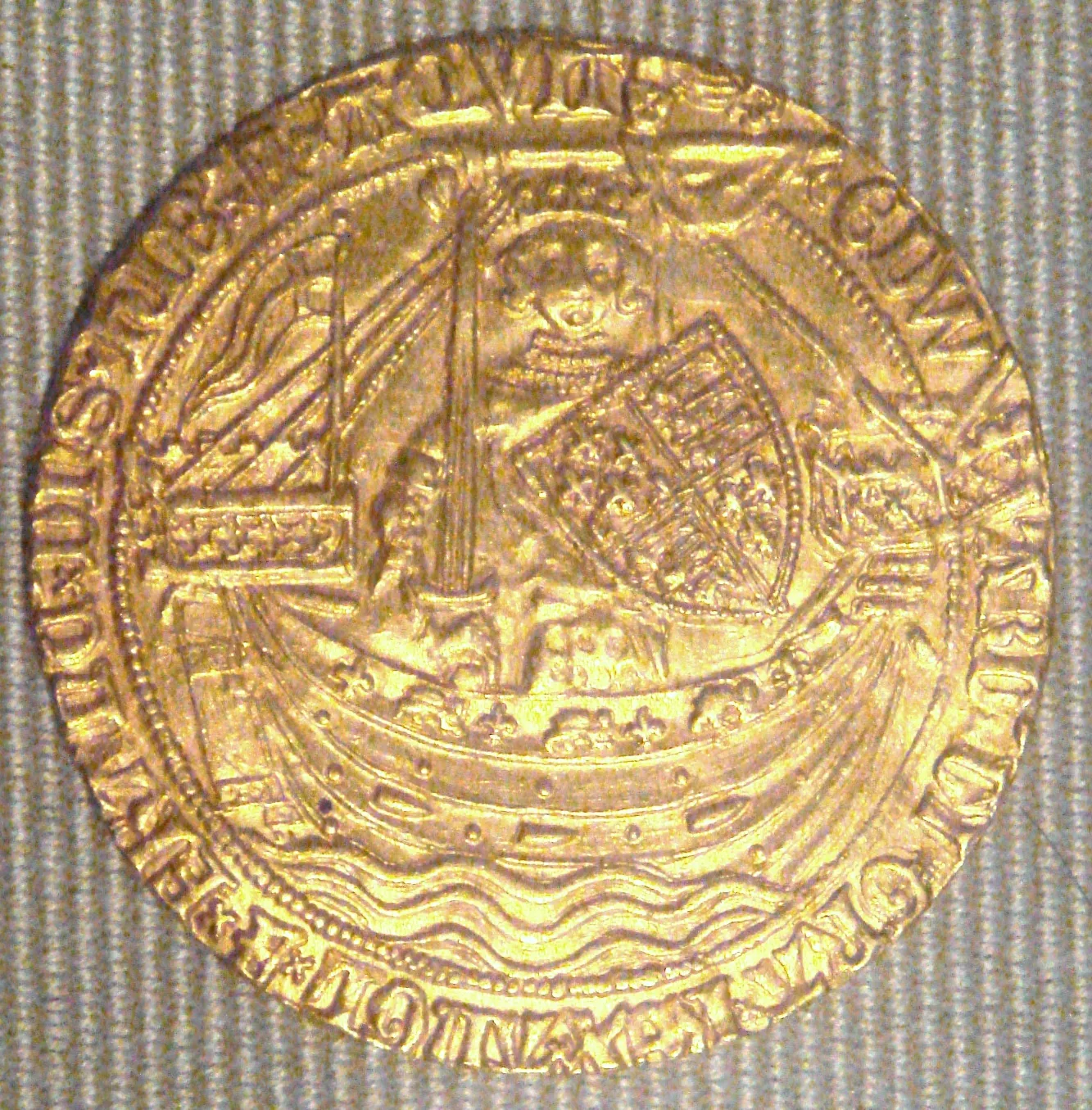
Gold noble of Edward III. Cabinet des Médailles, Bibliothèque nationale de France, Paris. Photo: PHGCOM · Public domain · Source page
Gold noble of Edward III, a type first struck in 1344
In 1344 Edward introduced a large new gold coin, the noble. On it he stands crowned in a ship, sword in hand, with a shield of the lilies of France and the lions of England.
- Why a ship? The coin does not say. It is usually read as a reminder of Sluys and of England’s claim to command the sea.
- Who saw this picture, and how often? Merchants and nobles in England and the Low Countries, every time they paid or were paid in gold. A coin is propaganda that travels in every purse.
- What title does Edward claim on it? King of England and France: the title he took at Ghent in 1340.
The road to Crécy
July–August 1346
From Normandy to the Somme
In July 1346 Edward landed at Saint-Vaast-la-Hougue in Normandy with about 14,000 men. On the beach he knighted his eldest son, Edward, Prince of Wales, aged 16, whom later writers called the Black Prince. The army marched east in a broad chevauchée, burning as it went. On 26 July it stormed and sacked Caen, killing many townspeople, then crossed the Seine at Poissy and burned villages near Paris, with Philip’s growing army behind it.
North of Paris the English were trapped between Philip and the river Somme, whose bridges were broken or guarded. A local prisoner, says Froissart, bought his freedom by showing them a ford near the river’s mouth: Blanchetaque, the ‘white spot’, a bed of white marl passable at low tide. On 24 August the English waded across under fire. When Philip arrived, the tide had come in again.
A decision point
You are Edward III.
25 August 1346, north of the Somme
You have crossed the Somme. Philip is at Abbeville, about 16 km away, with a far larger army. Your men have marched and fought for six weeks; they are tired, and short of bread and of shoes.
Your fleet has gone home. To the north lie Flanders and the sea. Around you lies Ponthieu, your family’s county, held by your mother until Philip confiscated it in 1337. Near the little town of Crécy runs a long, gentle slope, with a stream and the town at one end and a hamlet at the other.
What do you do?
- Keep marching north, to Flanders and the coast Probably the safest course. But the campaign would end as a long raid, Philip could boast that he had chased you out of France, and a tired army on the march can be caught strung out along the road.
- Stop on the slope at Crécy and offer battle You choose the ground and let Philip come to you. If he attacks uphill into your archers, you may win a great victory. If you lose, you lose everything, perhaps your own life and your son’s.
- Turn back and attack Philip near Abbeville Surprise might help for a day, but you would be attacking a far larger army near a walled town, on ground of its choosing. Most commanders of the time would have called it reckless.
What really happened
Stop on the slope at Crécy and offer battle
Edward stopped at Crécy. On 25 August his army rested while his marshals chose and prepared the ground. Froissart gives him the words: ‘I am on the right heritage of the queen my mother.’
Clifford Rogers argues that Edward had sought battle all along: his raids were meant to force Philip to fight on English terms, or be shamed. Others think he was heading for Flanders and fought because the French had caught up and the ground was good.
The ground
A slope, a valley, a windmill
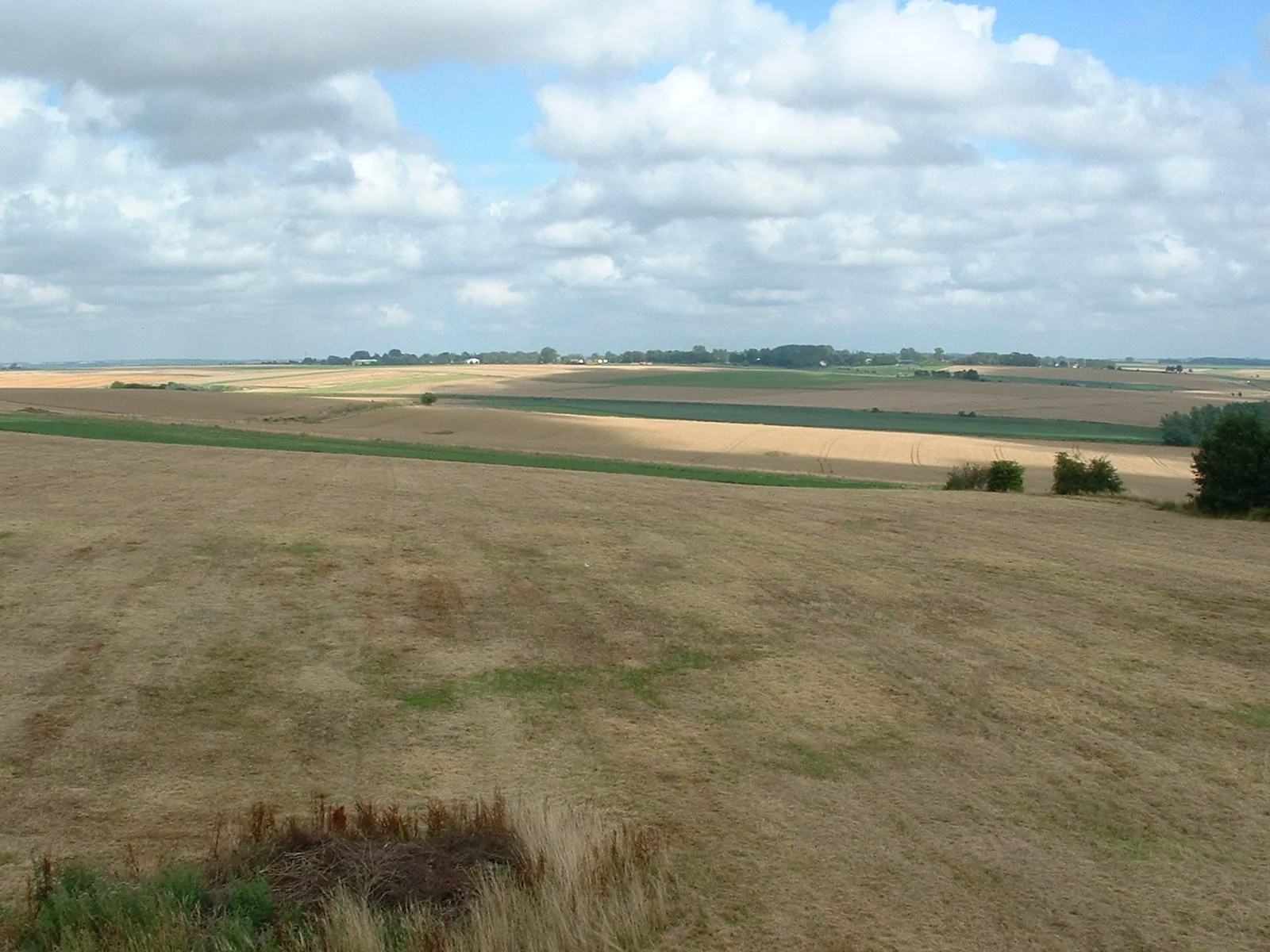
The battlefield of Crécy, Crécy-en-Ponthieu, 2005. Photo: Chris Hartford · CC BY 2.0 · Source page
As most historians reconstruct it, Edward’s line ran for about two kilometres along a gentle slope between Crécy and the hamlet of Wadicourt, facing south-east over a shallow dry valley, the Vallée des Clercs. On a mound at the Crécy end stood a windmill: Edward’s command post.
His men-at-arms stood on foot in three ‘battles’, archers on their wings, with the horses and carts in a ring behind. One English chronicler adds that they dug small pits in front of the line to trip the horses.
Crécy: who fought whom
Saturday 26 August 1346, from late afternoon into the night
Between Crécy-en-Ponthieu and Wadicourt, about 16 km north of Abbeville
England
- Commanders: Edward III, Edward, Prince of Wales (16), with the earls of Warwick and Oxford, The earls of Northampton and Arundel
- Strength: about 2,300 men-at-arms, 5,200 archers and 1,000 others, Welsh among them (Froissart (the three battles)); 4,000 horsemen, 10,000 archers and 10,000 Welsh and foot (Jean le Bel); about 14,000 at the landing; 10,000–15,000 at Crécy (Modern estimate (pay records))
- Losses: about 40 dead (English accounts after the battle); perhaps 100–300 (Modern estimate)
France and allies
- Commanders: Philip VI, Charles, count of Alençon, the king’s brother, John the Blind, king of Bohemia, Louis, count of Flanders, Ottone Doria and Carlo Grimaldi, the Genoese captains
- Strength: more than 100,000, about 15,000 of them Genoese (Froissart); 20,000 armoured horsemen and over 100,000 foot (Jean le Bel); 12,000 horsemen, 6,000 crossbowmen and foot ‘almost without number’ (Villani); 20,000–30,000: perhaps twice the English (Modern estimate)
- Losses: 11 princes, 1,200 knights and ‘more than thirty thousand other’ (Froissart (the heralds’ count)); 1,542 knights and squires on the day, and about 2,000 more the next (An English royal clerk’s letter); about 1,500 nobles and thousands of common soldiers (Modern estimate)
Outcome: A crushing English victory. The French king fled the field, and the English marched north and laid siege to Calais.
The English figures rest on pay records; the French on scattered treasury accounts that miss the unpaid town militias. Chroniclers counted by impression, years later, and a big number made the victory greater, or the defeat less shameful.
A decision point
You are Philip VI, king of France.
Saturday 26 August 1346, late afternoon, near Crécy
You left Abbeville this morning. Your army is strung out for kilometres behind you, the rear hours away. The Genoese have marched all day, and they say they are too tired to fight well.
Your scouts report the English rested, drawn up on a slope, and waiting. They advised you to camp and attack tomorrow, and you gave the order; but the lords at the back would not stop until they stood at the front. Now your vanguard can see the enemy, and the day is far gone.
Twice this summer the English slipped away from you. For six weeks they have burned your kingdom. Your lords want battle.
What do you do?
- Attack now, with the Genoese in front, before the English slip away again You strike while your men’s blood is up, and before nightfall. But they will attack uphill, tired and out of order, with the rear still arriving.
- Pull the army back and camp; attack in the morning in good order The wise course, as your scouts said: by morning all your men would be in place and rested. But it is hard to pull back an excited army, and you risk the English slipping away in the night once more.
- Do not attack at all: hold the roads, starve them and let them try to escape The English are short of food deep inside your kingdom. In time this might force them to attack you or surrender. But your lords would call it cowardice, and every day of waiting would cost you face. Yet a generation later Charles V won back most of the English gains in just this way, by refusing battle, as you yourself had done in 1339.
What really happened
Attack now, with the Genoese in front, before the English slip away again
When Philip saw the English, says Froissart, ‘his blood changed’. He ordered the Genoese forward to begin the battle.
Froissart and Jean le Bel blame the pride and indiscipline of the French lords: ‘the king nor his marshals could not rule them’. Many historians agree that Philip had lost control of his army before the first bolt flew, but stress how hard it was for a king to refuse battle in sight of an enemy who had burned his lands.
The battle of Crécy
26–27 August 1346, from late afternoon to the next morning
On 26 August 1346, near Crécy and north of the Somme, Edward III’s English have waited all day on a gentle slope, after six weeks of burning through France. The French, led by Philip VI, come from Abbeville in a long, disordered column.
The traditional site, accepted by most historians (Burne 1955; Sumption 1990; Rogers 2000; Ayton and Preston 2005), drawn from modern maps and elevation data. Michael Livingston (2015, 2022) argues for a site about 5 km to the south, by the forest of Crécy; no archaeology has yet settled the question. Also disputed: the road the French came by, the English formation (Froissart’s archers ‘in manner of a herse’), the pits, the number of charges and of guns, who led the second battle (Froissart: Northampton; Ayton: Arundel), and whether the king sent help to his son. Positions are approximate.
Phases of the battle
- The English wait All day the English wait on the slope, three battles on foot with archers on their wings. Edward watches from the windmill.
- The Genoese The French arrive from Abbeville in a long, disordered column. A storm passes, and the sun comes out behind the English, into the eyes of the French. The Genoese, weary and without their pavises, cross the valley and shoot. The archers answer with perhaps three arrows to every bolt, and the Genoese break.
- Through the Genoese Philip’s horsemen, Alençon and the count of Flanders in front, ride down the fleeing Genoese and charge up the slope. Arrows bring down horses and riders in heaps. Some reach the Prince’s men-at-arms; Northampton’s battle comes to help, and a knight runs to the windmill to ask the king for aid.
- Wave after wave New French contingents charge as they arrive, without a plan, into the dark; Geoffrey le Baker counted fifteen attacks. The blind King John of Bohemia rides in with his reins tied to his knights’ and dies with them. Philip, wounded and his horse killed under him, is led away to the castle of La Broye.
- Sunday, in the fog At dawn a thick fog covers the field. English horsemen and archers cut down French town militias still arriving, unaware of the defeat. Then the heralds count the noble dead; an English royal clerk writes of 1,542 fallen on Saturday alone, besides thousands of common soldiers.
The strategy
- English: Edward, whose men are tired and short of bread and shoes, chose to stop on the slope and offer battle. His men-at-arms stand on foot in three battles, the archers on the wings, and the horses and carts in a ring behind, so the French must climb the slope. The pits in front of the line, reported by one English chronicler, are disputed.
- French and allies: Philip VI, on his counsellors’ advice, orders the army to camp and attack next morning in good order. But the lords at the back will not stop until they stand at the front, and his nobles want battle before the English slip away again.
What decided it: The French charged again and again, each contingent as it arrived, uphill and with no shared plan, into English archery that brought down horses and riders in heaps. Those piecemeal attacks decided the battle.
Froissart’s story
‘Let the boy win his spurs’
When a knight from the Prince’s battle reached the windmill, says Froissart, Edward asked whether his son was dead or wounded. No, said the knight. Then let them ‘suffer him this day to win his spurs’, said the king: let him prove his new knighthood by deeds. He sent no help.
Only Froissart has this perfect chivalric scene. In Geoffrey le Baker’s version the king sent twenty knights, who found the Prince and his men leaning on their swords among heaps of dead. A speech in a chronicle is not a recording.
Myth
The longbow was England’s secret weapon, and it alone won Crécy.
The truth
The bow was not new. Welsh and English archers had served in English armies by the thousand under Edward I, and the French knew archers well. What was new was the system: men-at-arms fighting on foot beside massed archers, on ground chosen in advance, a method the English had learned against the Scots at Dupplin Moor (1332) and Halidon Hill (1333). Arrows killed and maddened horses more often than they pierced good armour. Crécy was won by the slope, by discipline and by French disorder as much as by the longbow.
The evidence
The chroniclers of Crécy simply say ‘bows’; ‘longbow’ is a later name. Modern studies: Rogers (2000); Ayton and Preston (2005); Strickland and Hardy (2005).
Calais
1346–1347
Eleven months at Calais
Edward did not march on Paris. He went north to Calais, the port facing Dover. Its walls were strong and its marshes soft, so Edward settled down to starve it out, from a wooden town built outside the walls.
In October 1346 Philip’s ally David II of Scotland invaded northern England. At Neville’s Cross, near Durham, the northern lords destroyed his army and captured him.
By the next summer the town was eating its last food. In late July Philip came with a relief army, looked at the marshes and the English lines, and went away. On 3 August Calais asked for terms.
A decision point
You are Edward III.
Early August 1347, before Calais
After eleven months, Calais offers to surrender if its people and garrison may leave with their lives. You hate this town: its ships have killed many of your sailors. By the custom of war, a town that refused to surrender could be sacked, as Caen was last year.
Your captain Walter Manny warns you: kill the garrison after they yield, and the French will do the same to English garrisons. You want Calais as a permanent English port, and all Christendom is watching.
What terms do you set?
- Surrender at your mercy: you will put to death whom you choose The law of war allowed it, and it would frighten every town in France. But your own captains warn of reprisals, and a massacre would stain a king who wants to be seen as the model of chivalry.
- Mercy to all: the townspeople keep their homes as your subjects Generous, and it might win you friends in France. But a town full of loyal Frenchmen inside your new fortress could open its gates to Philip one night.
- Spare the town, but six leading citizens must give themselves up to you, ropes round their necks The town is saved, honour is satisfied, and six men carry the punishment for all. Whether they live is up to you.
- Spare their lives, but expel the people and settle the town with English Calais would become a secure English town. But thousands would lose their homes and goods, and be left with nothing on the roads of France.
What really happened
Spare the town, but six leading citizens must give themselves up to you, ropes round their necks
In Froissart’s account Edward demanded six of the leading citizens. Eustace of Saint-Pierre, the richest man in the town, offered himself first, and five others followed, barefoot, in their shirts, ropes round their necks. Edward ordered them beheaded. Then Queen Philippa knelt and begged for them, and he gave them to her. Afterwards, though, most of the people of Calais were expelled and the town was settled with English.
Froissart, following Jean le Bel, makes Manny’s warning the turning point. Edward wanted to look both terrible and merciful. Some historians read the scene as a ritual with a known script (see the deeper panel).
Source: The queen kneels
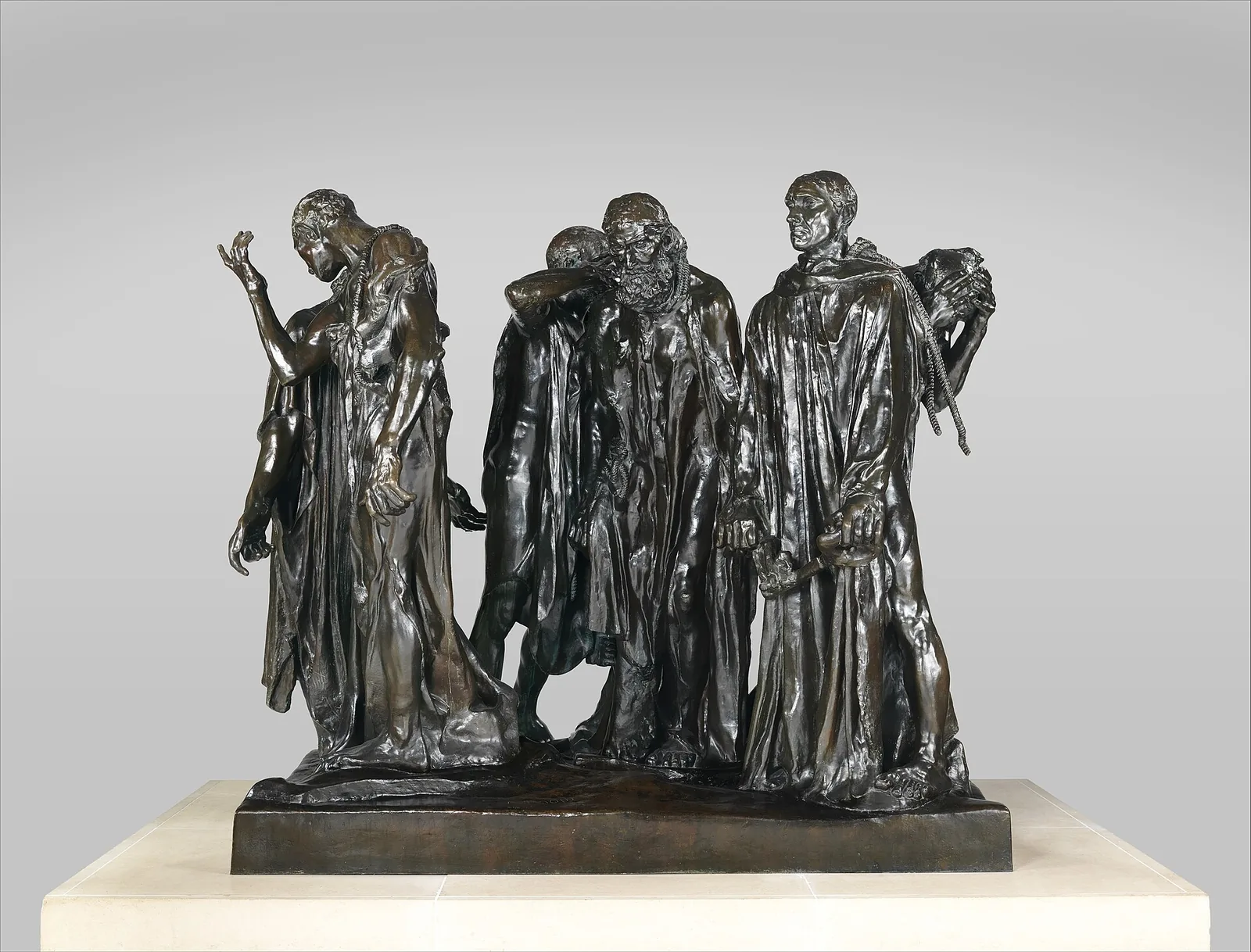
Auguste Rodin, The Burghers of Calais (modelled 1884–95; this cast 1985). Metropolitan Museum of Art, New York · CC0 · Source page
“Then the queen, being great with child, kneeled down and sore weeping said: ‘Ah, gentle sir, sith I passed the sea in great peril, I have desired nothing of you; therefore now I humbly require you… that ye will take mercy of these six burgesses.’”
Froissart took the story from Jean le Bel, who wrote within about fifteen years. The statue is Auguste Rodin’s Burghers of Calais (1884–89), made for Calais after France’s defeat by Prussia in 1870.
- Whom had Froissart served before he wrote this chapter? Queen Philippa, until her death in 1369; soon afterwards he began this book for her sister’s husband, Robert of Namur. A story in which the queen saves six lives honours his late patroness.
- Look at Rodin’s men. Heroes in a row? No: six separate figures, bowed by fear and doubt. Calais had hoped for heroes; Rodin gave it men walking to their deaths. The statue tells us about France after 1870 as much as about 1347.
Sources, plague and a treaty
Source: ‘So thick that it seemed snow’
“Then the English archers stept forth one pace and let fly their arrows so wholly [together] and so thick, that it seemed snow. When the Genoways felt the arrows piercing through heads, arms and breasts, many of them cast down their cross-bows and did cut their strings and returned discomfited.”
Seeing the Genoese run, Philip cries: ‘Slay these rascals, for they shall let [hinder] and trouble us without reason.’ Froissart says he learned all this ‘specially of the Englishmen’, and from John of Hainault’s knights, who stood at Philip’s side.
- Froissart was about nine in 1346. Where did this come from? From veterans he questioned years later, and from Jean le Bel, whom he copied: old memories, polished into a good story.
- Who are the heroes here, and who are the ‘rascals’? Kings and knights. Hired crossbowmen are ‘rascals’ to the French king; a few lines on, Froissart scorns English foot soldiers who knifed fallen knights. A chronicle of chivalry, for noble readers.
- There was a shower before the attack. Did the rain ruin the crossbows? Some accounts say so, but Froissart and Villani mention only the rain, not the strings. The Genoese had also marched all day, without their big shields. When one tidy cause is offered, ask who first gave it.
Myth
The insulting two-finger ‘V’ sign comes from English archers, showing the French the fingers they had threatened to cut off.
The truth
No medieval source records such a gesture. A 15th-century chronicler says that before Agincourt (1415) Henry V told his archers the French meant to cut three fingers off their right hands; no source says it was done, or that archers waved their fingers. The first sure record of the insulting V sign is a film of 1901. The historian Anne Curry thinks it almost certainly a modern myth.
The evidence
Jean de Waurin’s chronicle (15th century); Mitchell and Kenyon’s film of workers at Rotherham, 1901 (British Film Institute).
1348
The plague and the Garter
In the summer of 1348 the Black Death reached England. Within two years it had killed perhaps a third to a half of the people of England and France. The war almost stopped.
Yet Edward also found time to celebrate. Around 1348 he founded the Order of the Garter: himself, his eldest son and twenty-four companions, many of whom had fought at Crécy. Its motto, in French, is still in use: Honi soit qui mal y pense, ‘Shame on him who thinks ill of it’.
1350–1360
A king captured, a treaty signed
Philip VI died in 1350, and his son John II became king. In September 1356, at Poitiers, the Black Prince’s army defeated the French and captured King John himself. That battle belongs to the next lesson.
With the king of France a prisoner in London, Edward invaded again in 1359, hoping to be crowned at Reims. Reims shut its gates. In May 1360, at Brétigny, the two sides agreed terms: Edward received a greatly enlarged Aquitaine, Calais and Ponthieu, owing homage to no one, and a ransom of three million gold écus for King John. In return he was to give up his claim to the French crown. The documents of renunciation were never exchanged.
What came next
- 1346–1357 David II of Scotland is a prisoner in England, freed at last for a ransom of 100,000 marks.
- 1369 War again. Within a few years Charles V wins back most of the English gains.
- 1377 Edward III dies; his grandson Richard II, aged 10, succeeds. The Black Prince had died the year before.
- 1415–1453 Henry V revives the claim and wins at Agincourt; the war ends at Castillon (later lessons).
- 1558 France takes Calais, England’s last foothold on the Continent.
- 1801 The lilies of France are finally removed from the British royal arms.
Did Edward really want the crown of France?
Was the claim of 1340 a bargaining chip, or a real ambition?
- Édouard Perroy (1945) and Grant Templeman (1952) A lever, not a goal. The war was about Gascony and who was sovereign there; the title was a bargaining counter and a legal cover for allies such as the Flemings.
- John Le Patourel (1958) A real claim. Edward acted as king of France: he rewarded French lords and provinces that recognised him, and the war was partly a French civil war, with Bretons, Normans and Flemings on his side.
- Clifford Rogers (2000) and Mark Ormrod (2011) Ambitions that grew. Edward began with modest goals and was ready to trade the title; but after Crécy and Poitiers he reached for the crown itself, marching on Reims in 1359 to be crowned there. Jonathan Sumption stresses how readily he traded it at Brétigny.
Brétigny suggests he would trade the crown for a sovereign Aquitaine; the march on Reims suggests he wanted it. Both may be true, at different moments. His gold coins tell the same story: from 1361 to 1369, while the peace held, the title ‘king of France’ disappeared from his gold nobles; in 1369 it came back.
What do you know now?
Check yourself
Why did the king of England hold land in France at all?
Answer: He was duke of Aquitaine, holding Gascony as a vassal of the king of France. Right. Since 1259 the English kings had held the duchy as vassals, owing homage to the French king: the root of endless quarrels.
Check yourself
When was the ‘Salic law’ first used against the English claim?
Answer: Around 1400, some seventy years after 1328. Right. In 1328 the lords argued that a woman could not pass on a right she could not hold. The Salic law argument came later, from royal lawyers such as Jean de Montreuil.
Check yourself
Froissart says Edward had ‘not the eighth part’ of Philip’s numbers at Crécy. What do modern historians think?
Answer: The French clearly outnumbered the English, perhaps two to one or more. Right. English pay records point to about 10,000–15,000 men; modern estimates for the French run to 20,000–30,000. Chroniclers inflated numbers, often to make a victory more glorious.
Check yourself
What was really new about the English way of fighting at Crécy?
Answer: Men-at-arms fighting on foot beside massed archers, on ground chosen in advance. Right. The English had learned it in Scotland, at Dupplin Moor and Halidon Hill. The bow itself was old.
Check yourself
After Calais surrendered in 1347, what happened to most of its people?
Answer: They were expelled, and the town was settled with English. Right. The six burghers were spared, Froissart says, at the queen’s plea; but most of the townspeople lost their homes. Calais stayed English until 1558.
Check yourself
What did Edward gain by the Treaty of Brétigny in 1360?
Answer: A greatly enlarged Aquitaine, Calais and Ponthieu, owing homage to no one. Right. In return he was to give up his claim to the French crown, though the renunciations were never formally exchanged.
Terms
- vassal A lord who held land from a higher lord and owed him loyalty and service in return. As dukes of Aquitaine, the kings of England were vassals of the kings of France.
- homage The ceremony in which a vassal knelt, put his hands between his lord’s hands and promised to be his man. Edward III did homage to Philip VI at Amiens in 1329.
- Salic law The law code of the early Franks. From about 1400, French royal lawyers used one of its clauses to argue that the crown could not pass to a woman, or through one.
- chevauchée French for ‘a ride’: a mounted raid through enemy country that burned, looted and took ransoms, to ruin the land and shame the lord who could not protect it.
- man-at-arms A soldier in full armour, a knight or a squire, who usually fought on horseback. At Crécy the English men-at-arms fought on foot.
- longbow A bow of yew as tall as a man, drawn to the ear. A trained archer could shoot perhaps ten arrows a minute. People at the time simply called it a bow.
- crossbow A short, powerful bow fixed across a wooden stock and drawn with a mechanism. It shot heavy bolts, but far more slowly than a bow: only a few shots a minute.
- pavise A tall standing shield. A crossbowman sheltered behind it while he reloaded. At Crécy the Genoese pavises were still back with the baggage.
- herald An officer who knew every coat of arms. Heralds carried messages between armies and, after a battle, identified and counted the noble dead.
- Order of the Garter The brotherhood of knights Edward III founded around 1348: the king, his eldest son and 24 companions. It still exists, the oldest order of chivalry in Britain.
- cog The ordinary merchant ship of northern Europe: broad, high-sided, with one square sail. In war, wooden ‘castles’ were built at bow and stern and the ship was filled with soldiers.
- Jean Froissart A chronicler who wrote the most famous account of the Hundred Years' War. He saw none of its battles and wrote to celebrate chivalry.
- Jean le Bel A canon of Liège cathedral who wrote a chronicle in the 1350s. Froissart copied him for almost everything up to 1360.
- Giovanni Villani A banker of Florence who wrote about Crécy within months, from the letters of Italian merchants. He died of the plague in 1348.
- Geoffrey le Baker An English clerk who wrote a vivid, patriotic chronicle in the 1350s.
- Jean de Montreuil A royal secretary of France. Around 1400–1410 he turned an ancient Frankish law code into an argument against the English claim.
- Abbeville A town in northern France, which Philip's army left on the morning of the battle of Crécy.
- Ponthieu A county in northern France that Edward's mother held until Philip confiscated it in 1337.
- Blanchetaque A shallow ford on the river Somme, near its mouth. Its bed is white marl, and it could be crossed at low tide.
- Somme A river in northern France. In 1346 Edward's army was trapped between the river and Philip's army.
- Calais A port in northern France, facing Dover. Edward besieged it until it asked for terms after eleven months.
- Neville’s Cross A battle near Durham in northern England, in October 1346. The northern lords destroyed David II's army there.
- David II King of Scots, son of Robert the Bruce. He was an ally of Philip and was captured in England at Neville's Cross.
- Robert the Bruce King of Scots, who died in 1329 leaving a five-year-old son. He defeated Edward II at Bannockburn.
- Halidon Hill A battle in 1333 where Edward beat the Scots. Archers and knights fighting on foot cut them down.
- Robert of Artois A French lord, Philip's brother-in-law and bitter enemy, whom Edward sheltered in 1336.
- Zwin A broad sea estuary that led to Bruges. In June 1340 Philip gathered a great fleet there to stop Edward reaching Flanders.
- Southampton An English port that French ships and hired Genoese galleys burned in 1338.
- Bardi A great banking family of Florence. Edward borrowed from it and could not repay on time.
- Roger Mortimer The lover of Queen Isabella, with whom he deposed Edward II. In 1330 Edward had him hanged.
- Bannockburn A battle in Scotland where Edward II was beaten. Robert the Bruce's army won it.
- Walter Manny An English captain in Edward's army. He warned the king that if the garrison was killed after surrendering, the French would do the same to English garrisons.
- Eustace of Saint-Pierre The richest man in Calais. He offered himself first among six leading citizens Edward demanded, and according to the story he was spared through the queen's plea.
- Auguste Rodin A sculpture by Auguste Rodin showing the Burghers of Calais. It was made for Calais after France's defeat by Prussia in 1870.
- Agincourt A battle in northern France in 1415, which King Henry V of England won against the French.
- Black Death A great plague that reached England in the summer of 1348. Within two years it killed perhaps a third to a half of the people of England and France.
Sources
- Jean Froissart, Chronicles, Book I, trans. John Bourchier, Lord Berners (1523–25), ed. G. C. Macaulay, The Chronicles of Froissart (London: Macmillan, 1895; repr. 1913, the scan linked): Crécy, and the surrender of Calais (ch. 146)
- Froissart's Crécy chapters (Berners, ed. Macaulay), reprinted in Chronicle and Romance: Froissart, Malory, Holinshed, Harvard Classics 35 (New York: P. F. Collier, 1910)
- Jean le Bel, Chronique, ed. J. Viard and E. Déprez, 2 vols (Paris: Société de l'histoire de France, 1904–05), vol. II, ch. 72 (Crécy)
- Giovanni Villani, Nuova Cronica, Book XII, ch. 66–67 (Crécy)
- Geoffrey le Baker, Chronicon Galfridi le Baker de Swynebroke, ed. E. Maunde Thompson (Oxford: Clarendon Press, 1889), pp. 82–85 (Crécy)
- W. J. Ashley (ed.), Edward III and his Wars, 1327–1360: Extracts from the Chronicles of Froissart, Jehan le Bel, Knighton, Adam of Murimuth, Robert of Avesbury and others (London: David Nutt, 1887)
- George Wrottesley, Crecy and Calais from the Public Records (London: Harrison, 1898)
- Andrew Ayton and Philip Preston, The Battle of Crécy, 1346 (Woodbridge: Boydell Press, 2005)
- Jonathan Sumption, The Hundred Years War, I: Trial by Battle (London: Faber and Faber, 1990)
- Clifford J. Rogers, War Cruel and Sharp: English Strategy under Edward III, 1327–1360 (Woodbridge: Boydell Press, 2000)
- W. Mark Ormrod, Edward III (New Haven and London: Yale University Press, 2011)
- Michael Livingston and Kelly DeVries (eds), The Battle of Crécy: A Casebook (Liverpool: Liverpool University Press, 2015)
- Anne Curry, The Hundred Years War, 2nd edn (Basingstoke: Palgrave Macmillan, 2003)
- Matthew Strickland and Robert Hardy, The Great Warbow: From Hastings to the Mary Rose (Stroud: Sutton, 2005)
- Jean-Marie Moeglin, Les Bourgeois de Calais: essai sur un mythe historique (Paris: Albin Michel, 2002)
- Richard Barber, Edward III and the Triumph of England: The Battle of Crécy and the Company of the Garter (London: Allen Lane, 2013)
- N. A. M. Rodger, The Safeguard of the Sea: A Naval History of Britain, 660–1649 (London: HarperCollins, 1997)
- Craig Taylor, ‘The Salic Law and the Valois Succession to the French Crown’, French History 15 (2001), 358–377
- John Le Patourel, ‘Edward III and the Kingdom of France’, History 43 (1958), 173–189
- Grant Templeman, ‘Edward III and the Beginnings of the Hundred Years War’, Transactions of the Royal Historical Society, 5th series, 2 (1952), 69–88
- Édouard Perroy, La Guerre de Cent Ans (Paris: Gallimard, 1945); English translation, The Hundred Years War (London: Eyre & Spottiswoode, 1951)
Image credits
- Loyset Liédet, the battle of Crécy, in Froissart’s Chronicles, Bruges, c. 1470–75. Bibliothèque nationale de France, MS Français 2643 · Public domain · Source page
- The Bruges Garter Book, made for William Bruges, Garter King of Arms, c. 1430–40. British Library, Stowe MS 594 · Public domain · Source page
- Grandes Chroniques de France of Charles V, Paris, c. 1375–80, unknown illuminator. Bibliothèque nationale de France, MS Français 2813 · Public domain · Source page
- Gold noble of Edward III. Cabinet des Médailles, Bibliothèque nationale de France, Paris. Photo: PHGCOM · Public domain · Source page
- The battlefield of Crécy, Crécy-en-Ponthieu, 2005. Photo: Chris Hartford · CC BY 2.0 · Source page
- Auguste Rodin, The Burghers of Calais (modelled 1884–95; this cast 1985). Metropolitan Museum of Art, New York · CC0 · Source page


