Cortes and Tenochtitlan: the conquest from both sides
A few hundred Spaniards and thousands of allies brought down an empire. What really happened between 1519 and 1521, and what is legend?
Decisions, questions and your own progress, in the app
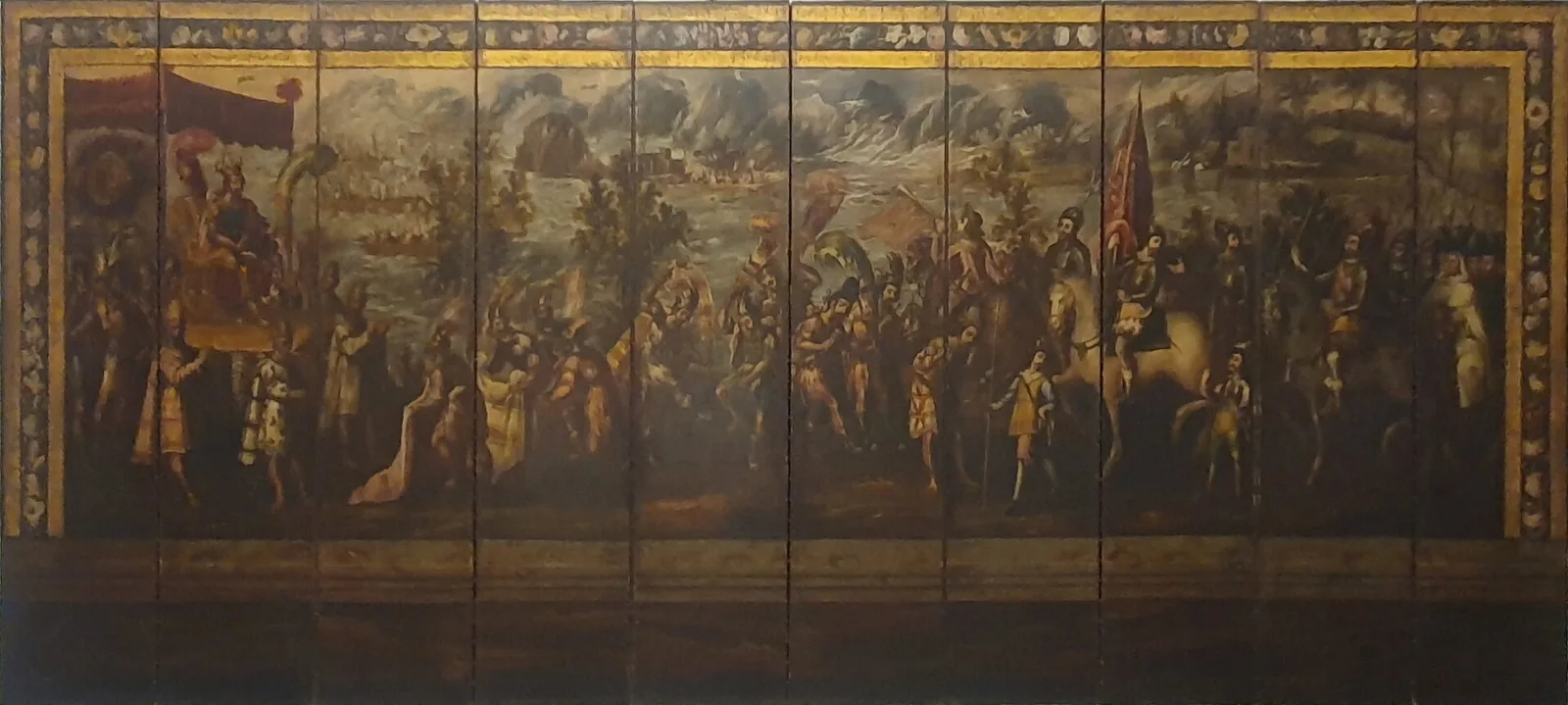
Juan Correa, ‘El Encontro de Cortés y Moctezuma’, c. 1690, painted folding screen. Museo Foro Valparaíso, Mexico. Photo: José Luiz, 2024 · CC BY-SA 4.0 · Source page
A governor’s order, a royal town
The fleet at the island
A Spanish fleet lies at anchor off the Gulf coast of what is now Mexico. About five hundred men are on board. That figure is the commander’s own, written years later, and beside what they are about to face it is very small.
Who gave the man in charge his orders, and what should he do when he reaches the shore?
Background
A governor’s commission
Spain ruled the Caribbean from Cuba. Its royal governor there, Diego Velázquez, had sent this expedition out. The commission was his, and the man he chose to lead it was Hernán Cortés.
Cortés answered to the governor. His authority came from Velázquez’s commission.
The count of 530 men comes from Cortés’s own memorandum of 1534, written for his residencia, the judicial review of his conduct.
April 1519
Demands from the shore
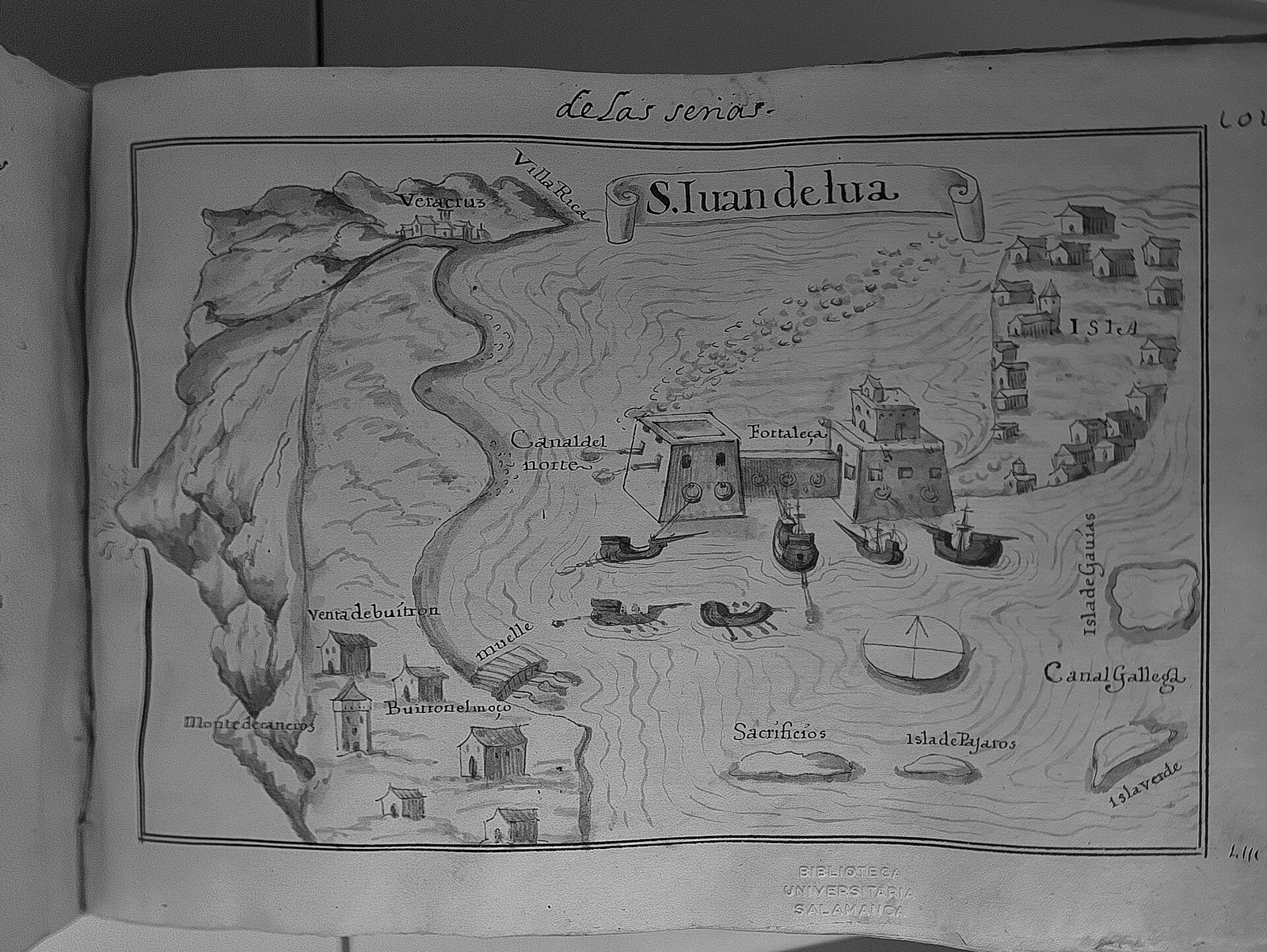
Baltasar Vellerino de Villalobos, manuscript Luz de navegantes, 1592. Photo: Jl FilpoC. Biblioteca General Histórica, Salamanca · CC BY-SA 4.0 · Source page
The fleet reached the island of San Juan de Ulúa on 21 April 1519, by the Julian calendar. On the mainland opposite, the men began to ask for something new.
According to Cortés’s own letter, they asked him to found a royal town and to take the king’s authority over it. He had to decide, and they were waiting.
A decision point
You are Hernán Cortés, captain of the expedition.
The island of San Juan de Ulúa, spring and summer 1519
Your orders come from Diego Velázquez, governor of Cuba, and you answer to him. You have about five hundred men and a fleet at anchor.
The men want a royal town, under the king and not under the governor. They want a captain who holds the king’s authority, and they say so openly. You could accept that authority. You could also keep to the governor’s word.
Nothing is settled. No word has come from the king, and Velázquez will hear what you do sooner or later.
What do you do?
- Keep to the governor’s commission. Sail back to Cuba and trade. Velázquez would be pleased, and the fleet would go home with whatever trade it had made. No royal town would be founded here, and you would be a loyal servant of the governor, not a founder.
- Found a royal town here, and let its council take the king’s authority in its name: give up the governor’s commission, accept the captaincy, and write to the king yourself. You would be the king’s man in a new town and the governor’s enemy. You would have to defend the choice to Velázquez, who would be angry. Whether the king would accept it, nobody could tell.
- Sail on along the coast without founding anything, and look for a better harbour. You would avoid the quarrel for now. But without a town your men would have no ground to stand on, and you would have little to show the king.
What really happened
Found a royal town here, and let its council take the king’s authority in its name: give up the governor’s commission, accept the captaincy, and write to the king yourself.
The choice made was to found the town and accept the authority. On Good Friday, 22 April 1519, by the Julian calendar, the expedition founded a town on the coast and named it Villa Rica de la Vera Cruz: the rich town of the true cross. The town had notaries, magistrates (alcaldes) and a council, as any Spanish town did.
Cortés’s letter tells the rest in two steps. First he formally gave up the authority he held from Velázquez. Then the town’s council appointed him captain-general and chief justice of the new town.
Letters to the king, dated 10 July 1519 in the 1908 edition, went with two of Cortés’s officers, Puertocarrero and Montejo, who sailed on 16 July with treasure.
We cannot read his mind, only his letters. In them the men of the town ask for a royal authority, and Cortés accepts it in the king’s name. Read the letter with care: it was written to the king by a man who needed the king’s favour. Whether he planned this from the start, or followed his men, is a question the letters leave open.
After the vote
The ships are beached
Around the same time, the fleet was broken up. In his letter Cortés says the ships were beached “on the pretext that they were unseaworthy.” A pretext is an excuse, and the sentence leaves the real reason open.
Who gave the order? The sources disagree. A footnote in the 1908 edition reports that two of Cortés’s officers wrote that the captains proposed destroying all but three of the ships, because they were unseaworthy. Bernal Díaz, according to the same footnote, says the decision came from a general discussion, and that Cortés did not want the blame. Later writers went further: Clavigero, in the eighteenth century, thought pilots had scuttled one or two ships; Orozco y Berra, in the nineteenth, thought Cortés had raised the idea himself.
Myth
Cortés burned his ships so that no man could turn back.
The truth
The ships were beached. Cortés’s letter does not say he burned them. Officers’ accounts say the captains proposed breaking up all but three. Who decided it, and why, is still disputed.
The evidence
Cortés’s First Letter, in the 1908 English edition, speaks of the ships being beached. The 1908 footnote gives the officers’ account of the captains’ proposal, and the later views of Bernal Díaz, Clavigero and Orozco y Berra. The burning of four brigantines in 1520 is a different event (chapter 4), and should not be mixed up with these ships.
Cempoala, then Tlaxcala
Background
Allies on the coast
Beyond the coast lay a larger world. The Mexica ruled a network of towns that paid them tribute, from their capital, Tenochtitlan, on the high plateau of central Mexico.
On the coast, the first local allies were the lords of Cempoala, a town of the Totonac people. A few hundred Spaniards could not get far without local help, and Cortés built his alliances one town at a time.
The mountains
The republic in the mountains
East of the lake city lay Tlaxcala, a mountain state that the Mexica never conquered. The 1908 editor calls it a republic made of four federated states. It was not one army under one king, and its people did not give in easily.
Cortés fought its armies. His letters describe hard fighting, with large enemy forces around his men. Then the question changed: not how to win, but whether to make peace.
A decision point
You are Hernán Cortés, in the Tlaxcalan country.
Tlaxcala, 1519, after fighting
You have fought the Tlaxcalan armies, and they have not given in. Your men are tired and some are hurt, and the road to the lake city runs through their land. Your Cempoalan allies had advised you to take this road.
Tlaxcalan envoys have come to talk. Their republic is strong, it has its own leaders, and it is not under the Mexica. Peace would bring you allies, and it would also bring obligations you could not control alone.
What do you do?
- Keep fighting until Tlaxcala is broken, then turn back to the coast. A long war would use up your men and horses far from the coast, and the lake city would hear of every loss. You would probably end with an exhausted army and no road west.
- Make peace and an alliance with Tlaxcala, then march west with its army to the lake city. You would reach the lake with a large allied army, which would change the balance of forces. The allies would expect something in return, and that would shape your choices from then on.
- Go back to Veracruz and wait for men from Cuba. The men might never come, and the lake city would have time to prepare. You would probably have to make peace later, on worse terms, or not at all.
What really happened
Make peace and an alliance with Tlaxcala, then march west with its army to the lake city.
Cortés made peace and an alliance. The 1908 editor describes Tlaxcala as four federated states, and the alliance brought Tlaxcalan soldiers onto the march west.
This lesson gives no day for this war or this peace, because the sources here do not pin one down.
Cortés writes that his Cempoalan advisers had urged the road through Tlaxcala, and that he took it. Why the Tlaxcalans chose peace is a separate question. They had their own state, their own enemies and their own choice to make. Calling their decision a betrayal of the Mexica would make them props in a Spanish story. They were people making a choice.
Language
Who spoke for whom?
Cortés could not speak to the people he met. Every formal word passed through interpreters. In his Second Letter he writes that he made his formal demand “through the interpreters whom I had brought with me, and before a notary public.” That demand, the requirement, was a Spanish legal form calling on the other side to make peace.
He does not name the interpreters in that passage. Bernal Díaz del Castillo, a soldier who was there, does name the interpreter Doña Marina. Mexicans later called her La Malinche, and she remains one of the most debated figures of the conquest.
The city in the lake
The road west
Cholula
Cortés went west with his men and his allies. At Cholula, Spanish and Tlaxcalan accounts differ on what happened, and this lesson gives no number.
Cholula matters for what comes next. Cortés names its chief god as Quetzalcoatl, a name the Spaniards would hear again.
The approach
A large army goes home
Near the lake the allied army began to thin. Cortés describes his approach to the city, and the numbers in that description are his own: “about a hundred thousand men, well furnished for warfare, accompanied me to within about two leagues from the city, when after many importunities, they returned, though some five or six thousand of them still remained with me.”
Keep that figure in mind: it is Cortés’s own, and chapter 6 returns to it.
Tenochtitlan
The city in the lake
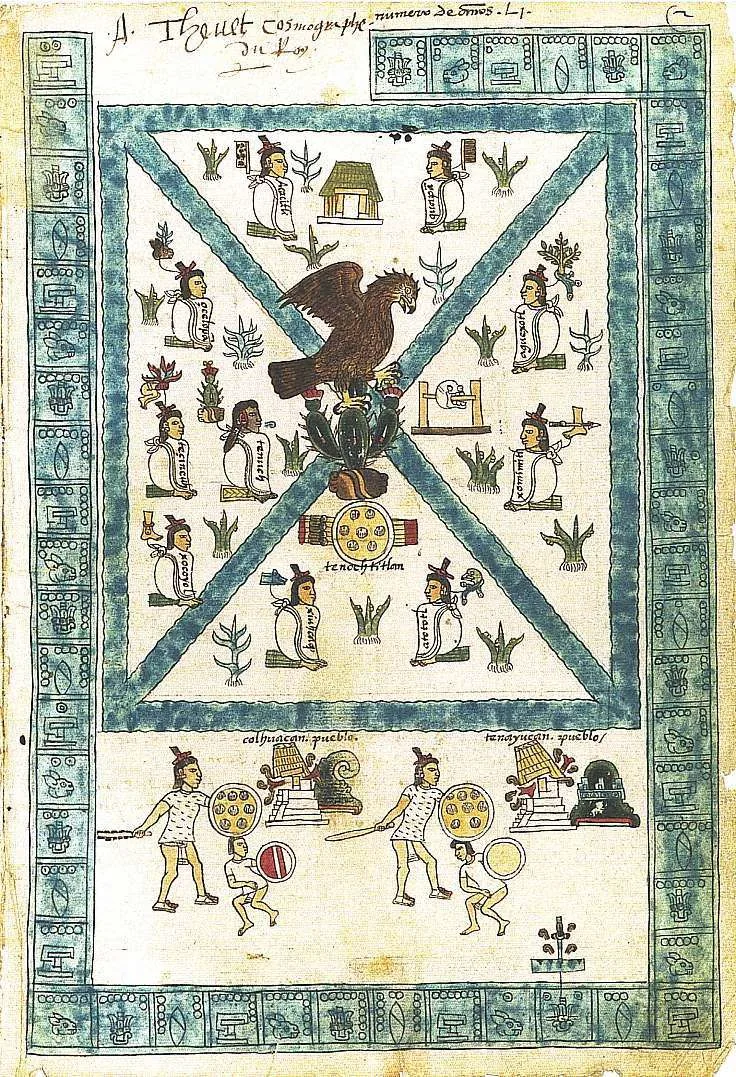
Codex Mendoza, folio 2r, c. 1541. Bodleian Libraries, University of Oxford · Public domain · Source page
Tenochtitlan stood on an island in Lake Texcoco, and causeways linked it to the shore. Canals, temples and markets were built out over the water.
The Mexica told their origin as a sign: an eagle on a cactus, growing from a rock in the lake. This page is from a painted manuscript that Nahua scribes made about 1541 for Spanish readers, long after the foundation it shows. Estimates of how many people lived in the city vary very widely. See the note below.
Moctezuma
The ruler comes out
Cortés writes that Moctezuma II, the ruler of the city, came out to meet him with his nobles. The ruler had sat on the throne for many years. The 1908 editor calls him the ninth king of Mexico.
The words Cortés gives to the ruler come next. Read them with one question in mind: whose words are these?
Source: Cortés reports what Moctezuma said
“Look at me, and see that I am flesh and bones, the same …”
Cortés’s report of what Moctezuma said, which reached him through interpreters. The words come after a sentence in which Moctezuma says he knows the Spaniards have heard that he has houses with walls of gold, and that he is, or makes himself, a god.
- Who reports these words, and through how many people? Cortés, in a letter to the king. They reached him through interpreters, from Nahuatl into Spanish, so at every step the meaning could change.
- What does the letter want the king to believe? That the ruler was only a man, which makes the Spaniards’ bold acts look less like sacrilege. The letter defends Cortés’s conduct, and that shapes which words it keeps.
- What is missing? The Mexica side. We hear Moctezuma only through a Spanish letter, and nothing in the passage lets us check it against a Nahua voice.
Myth
The Mexica took Cortés for the god Quetzalcoatl, returning, and that is why Moctezuma gave in without a fight.
The truth
This is not proven. Cortés’s own report has Moctezuma deny being a god. Historians disagree about how old the story of a returning Quetzalcoatl is, and how far it shaped Moctezuma’s choices. According to Matthew Restall, the idea that the peoples of Mexico took Europeans for gods is one of the myths of the conquest.
The evidence
Cortés’s report, quoted above, has Moctezuma say he is flesh and bones. In Cortés’s letter the chief god of Cholula is Quetzalcoatl. The 1908 editor writes that the teachings and prophecies attributed to Quetzalcoatl “potently influenced” the attitude of the Mexica towards the Spaniards, and asks that his mythical and historical character both be considered. Ask of any version: when was it written, and by whom?
Spring 1520: a rival and a disease
April 1520
A rival arrives
In April 1520 news reached Cortés in the city: a Spanish expedition had arrived on the Veracruz coast. It was led by Pánfilo de Narváez, and it had come from Cuba to deal with Cortés.
Cortés had left a Spanish garrison in the city, and Moctezuma was still in Spanish hands as a captive. Now a rival was on the coast, and Cortés had to decide what to do about him.
The coast
Smallpox arrives
Smallpox reached central Mexico in 1520. It was deadly, and people who had never met it had no immunity.
The sources do not agree on where it came from. According to David McCaa’s essay, it arrived near Veracruz, among Narváez’s men in April 1520. Another popular account says enslaved people from Cuba were already infected before the expedition reached the coast. An encyclopedia entry says a soldier who came with Cortés carried it.
What is clear is that the disease was in the country that year.
A decision point
You are Hernán Cortés, in Tenochtitlan.
Tenochtitlan, spring 1520
Narváez has come to the Veracruz coast with a Spanish force sent from Cuba, and you have already sent messengers to him. He is a rival with his own claim to the expedition.
In the city you hold Moctezuma in the Spanish quarters. A garrison of your men stays behind, but it is small, and the city’s people are watching it closely.
Your men cannot be in two places at once. You must decide where your strength is needed.
What do you do?
- Stay in the city with your men together, and wait for Narváez to come to you. Your force would stay together, but Narváez would be free to deal with the coast as he chose, and your letters to Spain would be delayed. Time would be on his side.
- Ride to the coast with part of your men to meet Narváez, and leave a garrison in the city. You would meet Narváez with your best men, and you might win or make a deal. But a small garrison in a large city that is watching it would probably be in danger.
- Send envoys and letters first, and ask Moctezuma to help secure a truce. Narváez might accept talks, but the ruler’s help would count for little while he is your captive. The talks would probably stall, and the city would grow angrier.
What really happened
Ride to the coast with part of your men to meet Narváez, and leave a garrison in the city.
Cortés left the city in the spring of 1520 with part of his men, to meet Narváez on the coast. He left a garrison behind.
After he left, the garrison came under attack, as the next step describes.
A rival had landed on the coast with Spanish men. Staying in the city meant letting Narváez choose the ground. Leaving meant trusting a small garrison in a large city. Cortés’s letter presents the journey as the answer to a rival who had come to fight him. Historians ask how far he expected the garrison to hold.
While he was away
Tradition and the great temple
With Cortés on the coast, the city changed. Tradition says that in May 1520, during a festival in the great temple, Spanish soldiers under Pedro de Alvarado attacked the people there and killed many of them. The details are not confirmed here, and this lesson does not say who began the fighting.
Cortés’s letter
The fort under attack
Cortés writes that the Mexica attacked the Spanish fort in the city. They set fire to it in many places and dug tunnels beneath it, which he calls mines. In the same passage he writes that they “had burned my four brigantines.” Those boats were his, and they were lost in the city.
Keep this event apart from the ships beached in 1519. Those were a fleet on the coast. This is a different loss, in a different place, a year later.
Moctezuma’s death, and the sad night
Late June 1520
Back to the city
Cortés came back to the city from the coast. The Spaniards who had stayed were under attack, and the city’s people were angry with their ruler, who was still in Spanish hands.
What happened to Moctezuma is one of the most disputed moments of the conquest. We have a Spanish letter, a Spanish soldier’s memory, a friar’s history, a Texcoco writer’s account and an editor’s footnote, and they do not match.
Source: Cortés’s version of the blow
“one of his own subjects struck him on the head with a stone, with such force that within three days he died.”
Cortés’s own account of Moctezuma’s death, written to the king four months after the events.
- Who is blamed in this sentence? Moctezuma’s own people: “one of his own subjects”. The sentence puts the blow on the Mexica, not on the Spaniards.
- What does the sentence leave out? Where Moctezuma was, who stood near him, and what the Spanish soldiers were doing. No Spaniard appears in the sentence.
- Why would a letter to the king need this sentence? It tells the king that the ruler’s death was the Mexica’s own doing. Cortés was writing to defend his conduct, and this sentence helps him do it.
Other witnesses
Other witnesses
Bernal Díaz, the soldier who wrote decades later, tells the same story as Cortés. The 1908 appendix paraphrases him: Cortés and his captains wept as though they had lost a father. Herrera, a Spanish historian of the seventeenth century, says the wound was not fatal, and that Moctezuma died after refusing food. Others, as we shall see, say the Spaniards killed him.
The 1908 editor dates the death:
“Montezuma Xocoyotzin ninth king of Mexico died on June 30, 1520, in the fifty-fourth year of his age, the eighteenth of his reign, and in the seventh month of his captivity.”
Source: A friar, decades later
“They found him dead with chains upon his feet, and five dagger wounds in his breast, and with him many other of the chiefs and lords who were prisoners.”
A friar writing in New Spain, decades after the events.
- Who writes, when, and for whom? A friar in New Spain, around 1581, more than sixty years after the events. He used Nahua informants, and he wrote for Spanish readers.
- What kind of detail is this? Chains and wounds make a death look like a killing. Ask where the friar had the detail from, and whether he could check it.
- Does the sentence name the killers? No. It describes the body and the prisoners and leaves the rest to the reader. Read beside the accounts that say the Spaniards killed him, it points that way; read alone, it does not.
Source: A Texcoco writer’s account
“although his vassals say that the Spaniards themselves killed him, …”
The account reports what his vassals say about the death. The sentence goes on with a crude detail, which this lesson leaves out.
- Whose voice is this? A writer from Texcoco, writing about a Mexica king in the early seventeenth century. He reports what others said, and he had interests of his own in how the story was told.
- What is the claim, and where does it come from? That the Spaniards killed Moctezuma. It comes from what his vassals said, as the writer heard it. We do not have their words directly.
- What do you do with the part that is left out? Set it aside. It is a crude detail, and it proves nothing about who did what.
The night
The night of flight
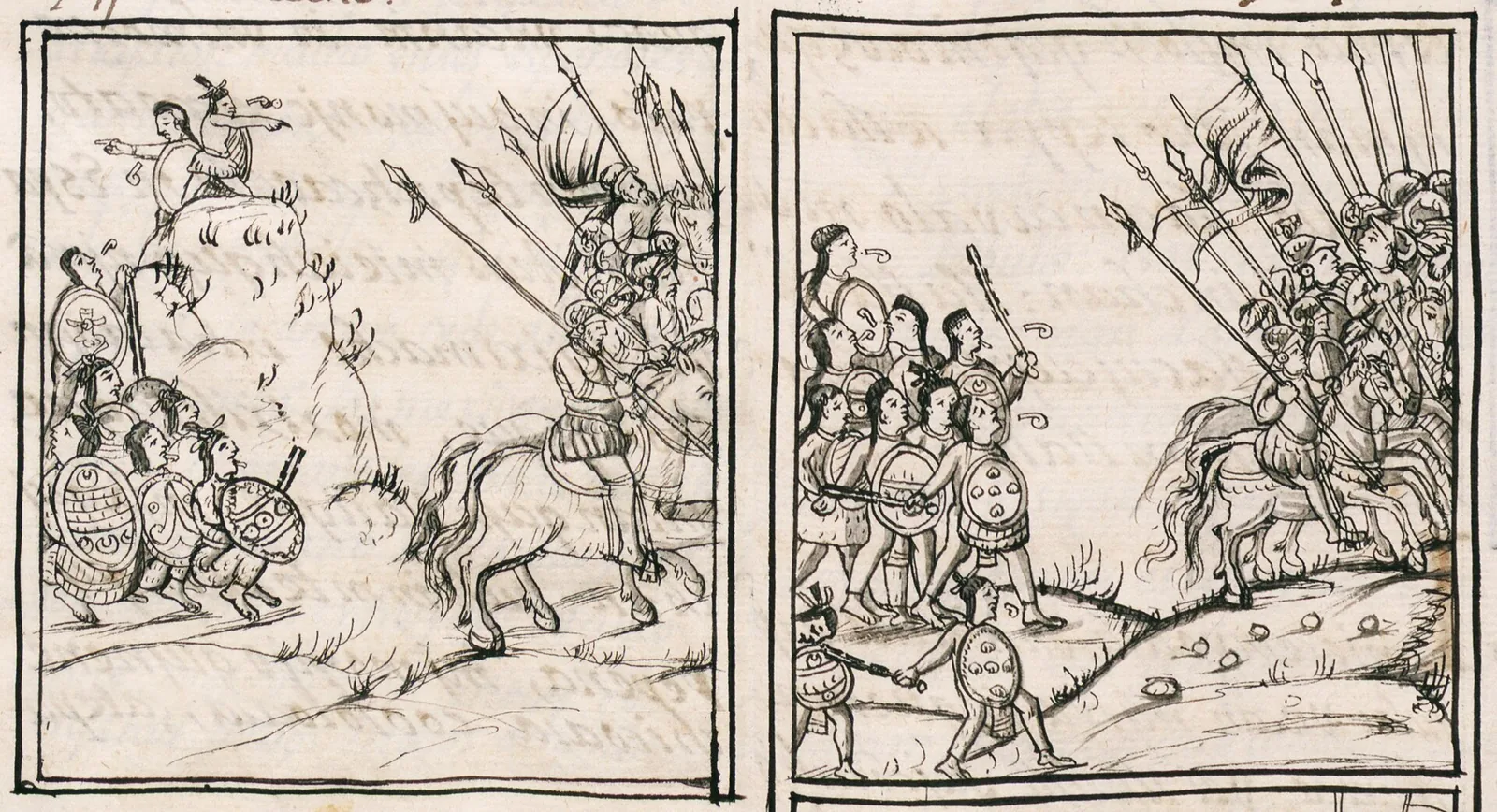
Florentine Codex, Book XII, f. 51, 16th century. Bernardino de Sahagún. World Digital Library · Public domain · Source page
Tradition calls the Spanish flight from the city the Noche Triste, the sad night. It dates the flight to the night of 30 June to 1 July 1520.
The Spaniards tried to leave along the causeways. The Mexica attacked them there, and many Spaniards and their allies died. The treasure they carried and the wounded made escape harder.
The night of flight and the death of Moctezuma are different events, even though the traditional dates overlap on 30 June. Keep them apart.
Choices after the retreat
A decision point
You are Hernán Cortés, in Tlaxcala, after the sad night.
Tlaxcala, summer 1520
You have lost many men, Spanish and allied, and many of the wounded cannot march. The survivors are exhausted, and the country around you is not safe.
The lake city is still in Mexica hands. Its ruler has died, and a new one has been chosen, though the sources name different men. The causeways that lead out of the city are its defence.
Going back to the coast means giving up the lake city and the whole aim of the expedition. Staying in Tlaxcala means building something new, and that takes time.
What do you do?
- Give up. Go back to the coast and return to Cuba. The wounded and the treasure would make the march hard, but you would survive. The expedition would end in failure, and you would have no city to show the king.
- Rebuild in Tlaxcala and build boats for the lake, for a siege of the city. The work would take months, and the Mexica would have time to prepare. But boats on the lake could reach where horses could not, and could cut the city off from its shore.
- Open talks with the new ruler and offer a way out. The new ruler would probably refuse. Any terms would be the Mexica’s, and they had already shown what they thought of a deal made through Moctezuma.
What really happened
Rebuild in Tlaxcala and build boats for the lake, for a siege of the city.
Cortés went to Tlaxcala, where his allies were, and set about building boats for the lake.
Herrera, a Spanish historian of the seventeenth century, reports that after Moctezuma’s death the Mexica said they wanted him neither living nor dead. Whatever they meant, it gave no opening to a deal through him.
Boats were a reasonable answer to a city on a lake. A horse cannot cross open water, and a causeway can be blocked. Cortés’s letters give his reasons for the boats.
1521
The disease inside the walls
When the Spaniards came back to the lake, smallpox had been in the city for months. Some encyclopedia entries give one-third to one-half of the population as dead. According to David McCaa, the disease’s role is often overstated, and both Spanish and Nahua accounts of it need careful reading.
Two names
Who ruled the city?
After Moctezuma’s death the Mexica chose a new ruler. The sources do not agree on who he was. Bernal Díaz says the new king was Cuitlahuac. The 1908 appendix says the nation chose another leader, Cuauhtemoc, whom it calls a brave man. Bernal Díaz wrote decades later, and the 1908 appendix is a modern editor’s note that quotes older sources.
Cuitlahuac’s own end is disputed too. Some popular accounts say smallpox killed him after about eighty days in power. One biography says his own people stoned him, or that the Spaniards killed him as they fled. We cannot settle it from these sources.
The siege
The lake turns against the city
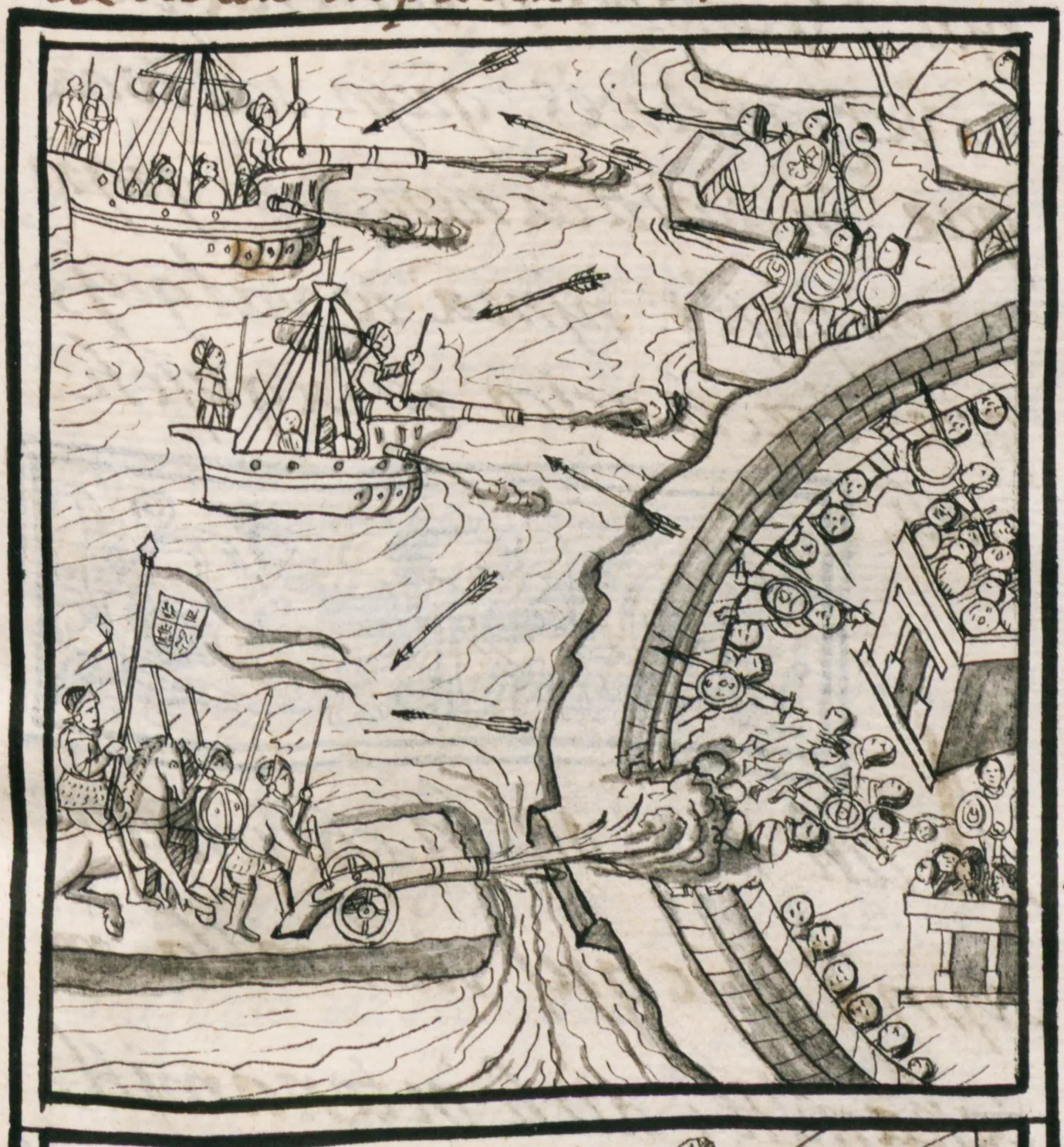
Florentine Codex, Book XII, f. 56, c. 1579. Bernardino de Sahagún. World Digital Library · Public domain · Source page
In the picture, Spanish brigantines fire their cannon over the lake. On the causeway into the city, horsemen and a cannon press forward against Mexica warriors and archers. It was drawn in the late sixteenth century, for Sahagún’s history, and it shows the siege from a later point of view.
Cortés’s own figures for his allies are very large (see chapter 3), and they come from a letter written to justify his conduct. According to Matthew Restall, the native allies outnumbered the Spaniards by a wide margin, and did much of the fighting.
Myth
A few hundred Spaniards beat an empire on their own.
The truth
The Spanish force was small: about 530 men had left Cuba, by Cortés’s own later count. But the allied armies that fought beside them were far larger. By Cortés’s own account, one allied army around him numbered about a hundred thousand. The myth leaves out the allies.
The evidence
Cortés’s 1534 memorandum gives the 530 men (the 1908 footnote notes that other authorities differ). In his letter on the approach to the city, the allied army numbers about a hundred thousand, and when it turned back, five or six thousand stayed (chapter 3). According to Restall, the native allies did most of the fighting.
Who wrote the conquest?
Sources
Who had a reason to write
Almost everything we know about the conquest was written by someone with a reason. Cortés wrote to the king to defend himself. Bernal Díaz del Castillo, a soldier, wrote decades later, from memory, and his book was printed in 1632.
The Florentine Codex, Book 12, gives a Nahua account of the conquest. The friar Bernardino de Sahagún compiled it with Nahua informants in the later sixteenth century. The Lienzo de Tlaxcala, a painted record made in Tlaxcala in the sixteenth century, speaks for the Tlaxcalan side, and its pictures show what its makers wanted to show.
Each has a point of view. For each one, ask who wrote it, for whom, and why.
What followed, in order
- 22 April 1519 Villa Rica de la Vera Cruz is founded on Good Friday, by the Julian calendar.
- 16 July 1519 Letters to the king, dated 10 July, sail with treasure in the hands of two of Cortés’s officers.
- April 1520 Narváez’s expedition reaches the Veracruz coast, according to one scholarly source.
- 30 June 1520 Moctezuma dies, on the date the 1908 editor gives. The night of flight falls at about the same time.
- 30 October 1520 Cortés dates his Second Letter to the king, the letter with the stone story.
- August 1521 Tradition dates the fall of the city, after a siege, to this month.
- After 1521 Spanish rule follows over the lands of the Mexica, and many of the written sources on the conquest come from the conquering side or from people who wrote under it.
Was the Mexica side heard?
Can the story of the conquest be told from the Mexica side, from the Spanish side, or only from both together?
- Matthew Restall, Seven Myths of the Spanish Conquest (2003) According to Restall, many of the myths of the conquest come from Spanish writers who wanted glory or an explanation for their success. The native allies did most of the fighting, and the Spanish accounts hide the role of their interpreters.
- Camilla Townsend, Fifth Sun: A New History of the Aztecs (2019) According to reviews of her book, Townsend tells the story from sources in Nahuatl, and argues that the Mexica side has been used too little, showing them as a people with their own politics and choices.
Both books can be read critically. Ask of each: whose words are these, and whom did the writer want to convince? Is the Mexica voice in the sources really theirs, or is it the Spanish writers’ use of it?
Check yourself
On what day was Villa Rica de la Vera Cruz founded?
Answer: Good Friday, 22 April 1519. Right: the Spanish sources give Good Friday, 22 April 1519, by the Julian calendar. The fleet had reached the island the day before.
Check yourself
How many men, by Cortés’s own count of 1534, left Cuba with the expedition?
Answer: 530 men. Right: 530, in the memorandum Cortés wrote for his residencia in 1534. Other authorities give other figures, so the number is his.
Check yourself
When did Moctezuma die, and in which year of his reign?
Answer: 30 June 1520, in the 18th year of his reign. Right, by the 1908 editor’s appendix. The cause of death is disputed, but the date and the reign year come from the editor.
Check yourself
Cortés’s Second Letter to Charles V is dated?
Answer: 30 October 1520. Right: the Second Letter, the one with the stone story, is dated 30 October 1520 in the contents of the 1908 edition.
Check yourself
According to Cortés, who struck Moctezuma with the fatal stone?
Answer: One of his own subjects. Right: in the Second Letter Cortés writes that one of his own subjects struck him on the head. Some later accounts say the Spaniards killed him, but that is not Cortés’s version.
Check yourself
What did Cortés call the chief god of Cholula?
Answer: Quetzalcoatl, the fair god. Right: Cortés names the chief god of Cholula as Quetzalcoatl, the fair god. What that shows about Mexica belief is another question; see the myth.
Terms
- Julian calendar The calendar introduced by Julius Caesar, used in Spain in 1519. Its dates ran about ten days behind the Gregorian calendar, which Catholic countries adopted later.
- captain-general The commander-in-chief of an expedition or a town in Spanish service. Cortés was given the title by the council of the town he had founded.
- Mexica The people who ruled the empire centred on Tenochtitlan, on the high plateau of central Mexico. Older books call them Aztecs; they called themselves Mexica.
- Tlaxcala A mountain state east of Tenochtitlan that was never conquered by the Mexica. Its people, the Tlaxcalans, became Cortés’s main allies.
- causeway A raised road built across shallow water. The causeways that linked Tenochtitlan to the shore were narrow, and an army on them could be attacked from the water.
- Nahuatl The language of the Mexica and of many peoples of central Mexico. Many sources on the conquest were written in it, or translated from it.
- smallpox A deadly virus disease. Peoples who had never met it had no immunity, and it spread quickly.
- residencia A judicial review of an official’s conduct at the end of his term. Cortés’s memorandum of 1534, which gives the count of 530 men, was written for his residencia.
- brigantine A small ship with sails and oars, suited to shallow water and to sailing on a lake.
- Noche Triste The Spanish name for the night the Spaniards fled from Tenochtitlan. Tradition dates it to the night of 30 June to 1 July 1520; the name means the sad night.
- Florentine Codex A history of Nahua life and of the conquest, in twelve books, compiled in the later sixteenth century by the friar Bernardino de Sahagún with Nahua informants. Book XII covers the conquest.
- Diego Velázquez The royal governor of Cuba. He sent out Cortés's expedition, which was meant to answer to him.
- Pedro de Alvarado A Spanish officer under Cortés. Tradition says he led the soldiers who attacked people in the city during a festival in the great temple.
- Pánfilo de Narváez A Spanish commander who came from Cuba to the Veracruz coast to deal with Cortés, with a claim of his own.
- Bernal Díaz del Castillo A Spanish soldier who took part in the conquest and wrote about it decades later, from memory.
- Doña Marina The interpreter who translated for the Spaniards. Mexicans later called her La Malinche, and she remains one of the most debated figures of the conquest.
- Matthew Restall A historian of the conquest. According to him, Cortés hid the part his interpreters played.
- Tenochtitlan The Mexica capital, on an island in Lake Texcoco and linked to the shore by causeways. Its site is now part of Mexico City.
- Cempoala A town of the Totonac people on the coast. Its lords were Cortés's first local allies.
- Totonac A native people of Mexico. Their town, Cempoala, was among Cortés's first allies on the coast.
- Texcoco A lake in central Mexico, with the Mexica capital, Tenochtitlan, built on an island in it.
- Lienzo de Tlaxcala A painted record made in Tlaxcala in the sixteenth century. It speaks for the Tlaxcalan side of the conquest.
- Bernardino de Sahagún A friar who compiled the Florentine Codex with Nahua informants, giving a Nahua account of the conquest.
- Cuitlahuac A Mexica ruler who, according to Bernal Díaz, was chosen after Moctezuma's death. Other sources name a different leader.
- Cuauhtemoc A leader whom the 1908 appendix says the nation chose after Moctezuma's death. It calls him a brave man.
- Herrera A Spanish historian of the seventeenth century. He reports that the Mexica wanted their ruler neither living nor dead.
- Acosta A writer of the late sixteenth century. He says the Spaniards stabbed Moctezuma.
- Ixtlilxochitl A writer from Texcoco who reports both versions of Moctezuma's death.
- Codex Ramírez A manuscript cited by Orozco y Berra. It says the Spaniards stabbed Moctezuma.
- Orozco y Berra A nineteenth-century writer. He thought Cortés had raised the idea of breaking up the ships himself.
- Clavigero A writer of the eighteenth century. He thought pilots had scuttled one or two of the ships.
- Caribbean The sea between North and South America, with many islands. Spain ruled it from Cuba.
- San Juan de Ulúa An island off the Gulf coast of Mexico, where the Spanish fleet arrived in 1519.
- Cholula A city in central Mexico. Cortés names its chief god as Quetzalcoatl, and the accounts of what happened there differ.
- Quetzalcoatl A feathered-serpent god of the peoples of central Mexico. Historians disagree on how far a story of his return shaped Moctezuma's choices.
Sources
- Hernán Cortés, Letters of Cortés, ed. F. A. MacNutt (1908), English edition: First Letter; Second Letter, dated 30 October 1520 (pp. 235, 289–290 cited in the text); and the editor’s appendices, including appendix VII on the death of Montezuma
- Bernal Díaz del Castillo, The True History of the Conquest of New Spain, trans. A. P. Maudslay (Hakluyt Society, 1908–16). Cited as paraphrased in the 1908 appendix
- Diego Durán, Historia de las Indias de Nueva España (written c. 1581), ch. 76, as quoted in the appendix to the 1908 edition of Cortés’s letters
- Florentine Codex (Historia general de las cosas de Nueva España), Book XII, trans. Arthur J. O. Anderson and Charles E. Dibble (School of American Research, 1955). Paraphrased in this lesson
- Codex Mendoza, folio 2r (c. 1541), Bodleian Libraries, University of Oxford
- Matthew Restall, Seven Myths of the Spanish Conquest (Oxford University Press, 2003)
- Camilla Townsend, Fifth Sun: A New History of the Aztecs (Oxford University Press, 2019)
- William H. Prescott, History of the Conquest of Mexico (1843). Cited through the 1908 footnotes
- David McCaa, ‘Spanish and Nahuatl Views on Smallpox and Demographic Catastrophe’ (web essay)
- Spanish Ministry of Defence, article on the 1519 fleet at San Juan de Ulúa and the founding of Veracruz
- Encyclopedia.com, entry on Motecuhzoma II (c. 1466–c. 1520)
Image credits
- Juan Correa, ‘El Encontro de Cortés y Moctezuma’, c. 1690, painted folding screen. Museo Foro Valparaíso, Mexico. Photo: José Luiz, 2024 · CC BY-SA 4.0 · Source page
- Baltasar Vellerino de Villalobos, manuscript Luz de navegantes, 1592. Photo: Jl FilpoC. Biblioteca General Histórica, Salamanca · CC BY-SA 4.0 · Source page
- Codex Mendoza, folio 2r, c. 1541. Bodleian Libraries, University of Oxford · Public domain · Source page
- Florentine Codex, Book XII, f. 51, 16th century. Bernardino de Sahagún. World Digital Library · Public domain · Source page
- Florentine Codex, Book XII, f. 56, c. 1579. Bernardino de Sahagún. World Digital Library · Public domain · Source page


