Confucius: the teacher who wandered between courts
The book of his sayings was put together by his students, and he himself failed in politics and wandered, by tradition, for thirteen or fourteen years between courts that would not listen. How did he shape two thousand years of China, and what do we really know of what he said?
Decisions, questions and your own progress, in the app
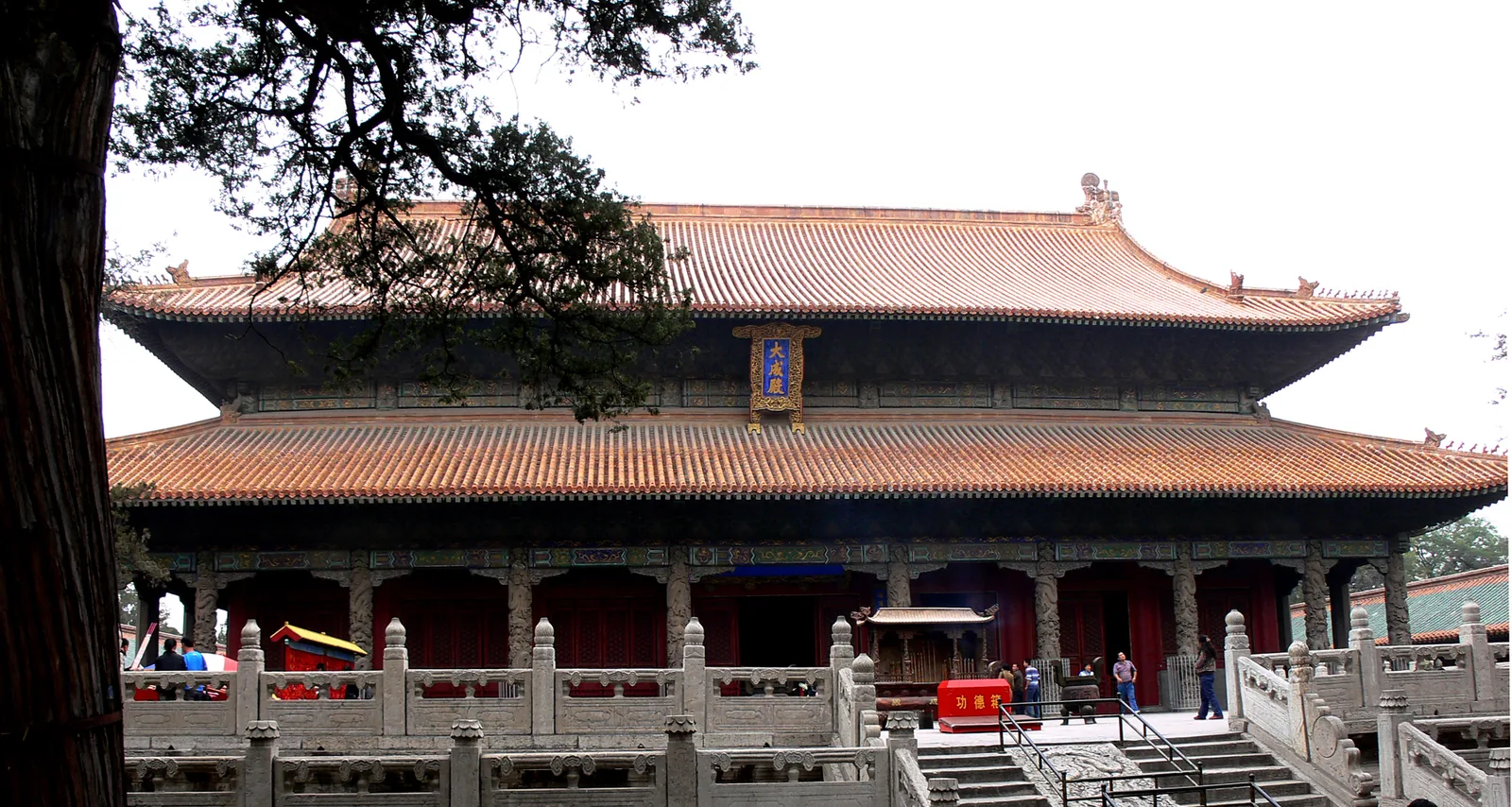
Gisling, Dacheng Hall, 2008. Own work. · CC BY 3.0 · Source page
Who he was
At fifteen, he says, he set his mind on learning
At fifteen, he says, he set his mind on learning.
The man is Confucius, a teacher from the small state of Lu. The book that quotes him was put together by his students and their followers, not by him. So what do we really know about him?
Background
A small state, a long time ago
Traditionally 551–479 BCE
Confucius (Kong Qiu, or Kongzi, ‘Master Kong’) was born in Lu, a small state near present-day Qufu in Shandong. Traditional dates put his life at 551 to 479 BCE, in the Spring and Autumn period, when rival states competed for power.
His father died when he was a small child, and the family was poor. The best-known ancient biography is in the Shiji, written by Sima Qian, a court historian of the Han dynasty, several centuries after Confucius died.
Office in Lu, and a gift from Qi
Office
Posts in Lu, as the sources give them
The sources agree that he held office in Lu, but not on which post. The Shiji says he began as steward of an estate in Zhongdu, then became Minister of Works and, for a time, acting Chancellor.
An early source, the Zuo Commentary, calls him Sikou, the official in charge of punishments, in the years 509 and 500 BCE. The versions do not match, so historians do not know exactly what he did in Lu.
Event
Musicians from Qi
Tradition tells of a gift that the state of Qi sent to Lu: female musicians. Chi Hwan, a Lu leader named in the text, received them. For three days no court was held. The Analects tells this in one short passage.
A decision point
You are Confucius.
Lu, traditionally about 497 BCE
You are a teacher with many students, and you have held office in Lu. You want the rulers of your own state to take your advice. For three days no court is held, and your students are waiting to see what you will do.
What do you do?
- Stay in Lu and keep working inside the court. Probably you stay close to power, and must take part in things you dislike.
- Go to the leader and rebuke him in public. Probably an open quarrel. He may listen, but a public rebuke could cost you your standing.
- Leave Lu and look for a ruler who will use your advice. Probably a long journey with no promise of a post. You keep your principles and lose your place in Lu.
What really happened
Leave Lu and look for a ruler who will use your advice.
He left Lu. The Analects says that, after three days with no court held, Confucius took his departure. Another tradition gives a different trigger: a Lu official failed to send the sacrificial meat. Tradition dates the leaving to about 497 BCE.
The Analects gives no reason in his own words. Read the musicians as the cause with care: it is a short anecdote, and tradition offers more than one trigger.
On the road, and the question of war
The road
Years on the road
About 13 or 14 years (tradition)
Stories place him in Wei, Song, Chen, Cai and Chu. Tradition says the wandering lasted about thirteen or fourteen years, and the sources disagree on it.
Tradition gives him seventy-two disciples and some three thousand students. The Shiji names seventy-seven direct disciples. The three thousand is a traditional figure.
A decision point
You are Confucius, in Wei.
Wei, during the years of travel. The date is not known.
Duke Ling of Wei, the ruler of the state, asks you about tactics: how to set out an army and win a battle.
Your learning is about ritual and the old texts. Your students sit close enough to hear every word.
What do you answer?
- Describe a battle plan as if you know the art of war. Probably the duke is pleased for a while. But you would claim a skill you lack, and anyone who knows war would see through it.
- Say that you have studied ritual and sacrificial vessels, not war, and that war is not your field. Probably the duke loses interest. The answer is honest, but it may close the way to a post in Wei.
- Refuse to answer and tell the duke he should not ask such things. Probably a quarrel with the ruler. You may lose any chance of a hearing in Wei at once.
What really happened
Say that you have studied ritual and sacrificial vessels, not war, and that war is not your field.
Confucius replied that he had heard all about sacrificial vessels but had not learned military matters. The Analects adds: “On this, he took his departure the next day.”
Readers often take the answer as a refusal to pretend. The passage is short, though, and we do not know what the duke thought or why he asked.
Hunger in Chen, and words of others
Chen
Hunger in Chen
The next passage in the same chapter places him in Chen. Their provisions ran out, and his followers became so ill that they were unable to rise.
Zilu, one of his students, asked with evident dissatisfaction: “Has the superior man likewise to endure in this way?”
A decision point
You are Confucius, in Chen, with hungry students.
Chen, on the road. The date is not known.
Food has run out. Your followers can barely stand after a long road behind you.
Zilu asks, angrily, whether the superior man has to suffer like this too.
What do you tell them?
- Tell them the hunger shows they are on the wrong road, and turn back. Probably the group turns back. The students go home believing the road was a mistake, and the search for a ruler ends at the first hard test.
- Say nothing about it, keep going, and hope food turns up. Probably a silent march. Hungry people with no explanation may grow resentful, and the resentment may spread.
- Tell them that hardship comes to everyone. A person of character holds firm, while a petty person falls into disorder. Probably the answer reaches some students and not others. It moves the test from the road to character, which may steady them, but it feeds no one.
What really happened
Tell them that hardship comes to everyone. A person of character holds firm, while a petty person falls into disorder.
He answered Zilu: “The superior man may indeed have to endure want, but the mean man, when he is in want, gives way to unbridled license.” The passage does not say how the hunger ended.
The answer moves the test from the road to character. Historians read it as an argument about behaviour under pressure. It promises no food.
Source: A transmitter, not a maker
A transmitter and not a maker, believing in and loving the ancients, I venture to compare myself with our old P'ang.
The line is the book’s claim about its speaker, and the book was compiled by his disciples.
- Who is speaking here, and who wrote the words down? The text presents Confucius as the speaker. Disciples and their followers wrote the book, so the words reached us through several hands.
- What does the line want you to believe? That his teaching is old wisdom passed on, not something new he invented. It is a self-portrait he chooses to present.
- What is missing? A date, and proof that the ‘ancients’ said what he claims. The line tells us how he wanted to be seen, not what he did.
Myth
Confucius said: “Find something you love to do, and you will never have to work a day in your life.”
The truth
He did not say it. The line is not in the Analects, and no source earlier than 1982 has been found. The first link to Confucius appears in 1985.
The evidence
Quote Investigator traced the line. The earliest version it found is from a 1982 Princeton alumni magazine, crediting an unnamed “old-timer”. The first link to Confucius appears in 1985.
What was left of him
What came after, in order
- Traditionally 551 BCE Born in Lu, near present-day Qufu.
- Traditionally c. 497 BCE Leaves Lu after the musicians story. Tradition gives another reason too.
- Traditionally 479 BCE Dies in Lu, traditionally aged 73.
- About the 2nd century BCE The Analects takes roughly the form we read today. Scholars disagree on how the text grew.
- Traditionally 136 BCE Tradition says the Han court made Confucian learning the basis of state training. Historians dispute the date.
Today
Statues and a temple
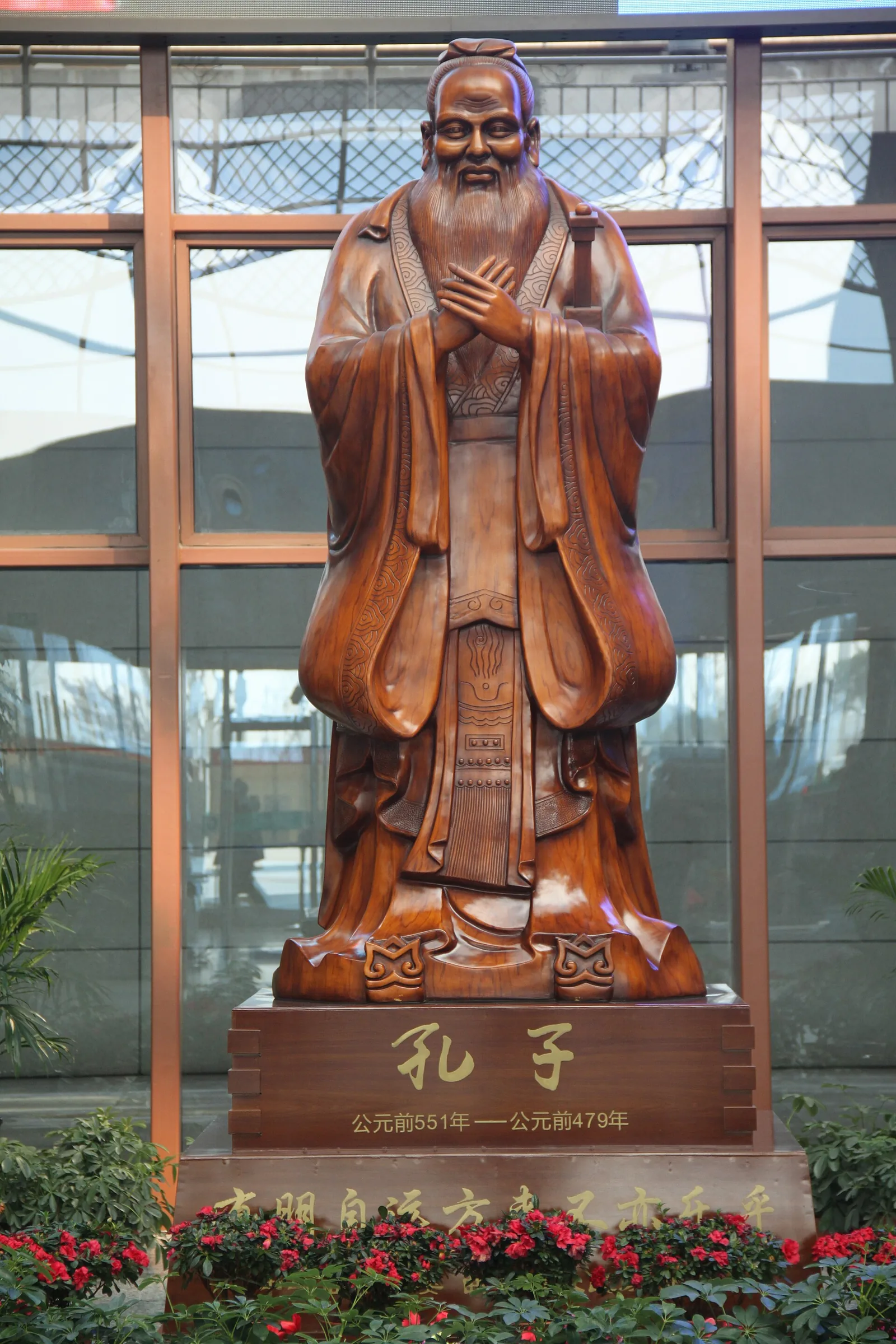
Gary Todd, East Railway Station, Qufu, 2014. CC0 · CC0 · Source page
Statues of him stand in several cities today. This one, at Qufu’s East Railway Station, is a modern sculpture, so its face is the sculptor’s idea, not a record.
Source: A painting from a tomb
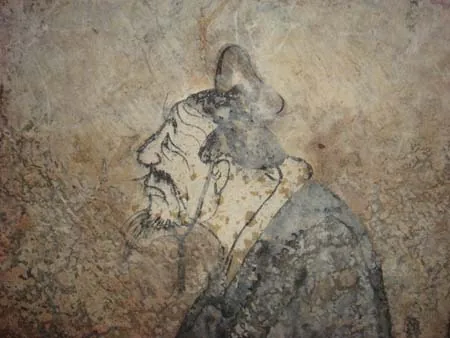
Anonymous painter of the Western Han period. Du Guodong, Xinhua, October 2007 · Public domain · Source page
Wall painting from a Western Han tomb, Dongping County, Shandong, found in 2007. Caption: Xinhua news agency
The painting is about 2,000 years old, roughly five centuries after Confucius died. The name Confucius comes from the news caption.
- Who painted it, and when? An unnamed painter of the Western Han period, about 2,000 years ago. He lived centuries after Confucius, so he could not have painted him from life.
- Why would a tomb have a picture of a sage? We cannot be sure. The caption does not say why a sage was painted there.
- How far can the caption be trusted? The caption gives a name, not a proof. Ask what evidence stands behind it.
How much of the Analects is his voice?
Do the Analects keep Confucius’s own words, or the words of those who compiled them?
- Ban Gu (39–92 CE) His first- and second-generation disciples compiled the book. They knew him, and on this view the book stays close to his teaching.
- E. Bruce and Taeko Brooks, 1998 The book grew over centuries. Its sayings come from different times, so there is not one author here but many layers.
If the book grew over time, which sayings are his, and how could we tell?
Check yourself
Which statement about Confucius’s dates is right?
Answer: His life is traditionally dated 551 to 479 BCE.. Right. The lesson calls these dates traditional, because later sources hand them down.
Check yourself
Who compiled the Analects?
Answer: His disciples and their followers, over a long period.. Right. His disciples and their followers compiled the book, and its form took shape over time.
Check yourself
What does the Chen passage say about the superior man in want?
Answer: The superior man may endure want, but the mean man gives way to license.. Right. The distinction is about character under pressure. Hunger is the test.
Check yourself
According to the myth step, what is the earliest date for the line ‘Find something you love’?
Answer: In a 1982 Princeton magazine, credited to an unnamed old-timer.. Right. The earliest version found is from 1982, and it credits an unnamed ‘old-timer’, not Confucius.
Check yourself
Which statement about the numbers of Confucius’s disciples is right?
Answer: The Shiji names seventy-seven direct disciples; 3,000 is traditional.. Right. The Shiji gives 77 direct disciples. The three thousand is a traditional figure.
Check yourself
How is it best to read the Shandong tomb painting as a source?
Answer: As a 2,000-year-old painting whose name comes from a caption.. Right. The name comes from a caption, so ask what that caption rests on.
Terms
- Analects A book of short sayings and episodes from Confucius, in twenty chapters, compiled by his disciples and their followers. Its present form probably took shape around the 2nd century BCE.
- Lu A small state in the Zhou period, in what is now Shandong. Confucius was born there, near present-day Qufu.
- Shiji “Records of the Grand Historian”, a history written by Sima Qian, a court historian of the Han dynasty. Chapter 47 tells the story of Confucius.
- Han dynasty The dynasty in which the Shiji was written. Tradition dates to 136 BCE the making of Confucian learning into the basis of state training. Historians dispute the date and the story.
- the superior man Legge’s rendering of the Chinese term junzi, the ideal person of character in the Analects. Other translators use other words.
- Zuo Commentary An early commentary on the chronicle of Lu. In 509 and 500 BCE it calls Confucius Sikou, the official in charge of punishments.
- interpolation A passage added to a text later, by someone other than its first author.
- Qufu A city in Shandong province in eastern China, once the capital of the state of Lu. Today it has a great temple to Confucius and the Kong family cemetery.
- Shandong A province in eastern China, on the coast. In Confucius’s time the states of Lu and Qi lay on its land.
- Spring and Autumn period A period in China, about 770–476 BCE, when the Zhou kings grew weak and many states fought one another. It is named after the Spring and Autumn Annals, the chronicle of Lu.
- Sima Qian A court historian of the Han dynasty who lived about 145–86 BCE. He wrote the Shiji and is sometimes called the father of Chinese history.
- Zhongdu A town in the state of Lu. According to the Shiji, Confucius began his government career there before rising to higher posts.
- Minister of Works An official in charge of the state’s public works, such as building, canals, dykes and roads.
- Chancellor The highest minister, who ran the affairs of state for the ruler. According to the Shiji, Confucius held the post only for a time.
- Qi A large, rich state, Lu’s neighbour to the north, in what is now Shandong. It was far stronger than Lu.
- Chi Hwan (Ji Huan) Head of the Ji family, the most powerful clan in Lu. In his day the great ministerial families held more power than the duke who ruled Lu.
- sacrificial meat After a great sacrifice, the ruler shared out the meat among his high officials as a mark of honour. Anyone left out knew he had been slighted.
- Wei A state of the Spring and Autumn period, west of Lu, in what is now northern Henan. Confucius stayed there several times during his travels.
- Song A small state south-west of Lu. Its rulers descended from the kings of the earlier Shang dynasty, and tradition says Confucius’s family came from there.
- Duke Ling of Wei Ruler of the state of Wei for about forty years (534–493 BCE). Confucius visited his court several times during his travels.
- ritual (li) In Chinese, li: the rules of ceremony and proper conduct, from offerings to ancestors to how to greet a guest. For Confucius they held an orderly society together.
- the old texts Books that were already old in his day, such as the Book of Songs and the Book of Documents. Confucius taught from them, and later they became the core of Chinese education.
- sacrificial vessels Decorated bronze vessels, such as bowls, footed cauldrons and cups, used to offer food and wine to ancestors in ceremonies. They were symbols of rank and power.
- Zilu One of Confucius’s oldest and closest disciples, known for his courage and blunt speech. In the Analects he often argues with his teacher.
- the mean man Legge’s rendering of the Chinese term xiaoren, ‘small person’: the opposite of the superior man, someone who thinks only of his own gain.
- Ban Gu A Chinese historian of the Han dynasty (32–92 CE). He wrote the Book of Han, the history of the Western Han.
- E. Bruce and Taeko Brooks Two scholars of ancient China at the University of Massachusetts who worked together. In The Original Analects (1998) they argue that the book was written in layers over centuries.
- Shabbat 31a A Talmud reference: tractate Shabbat, folio 31, side a. Each folio of the Talmud is counted on both its sides, a and b.
Sources
- Analects, trans. James Legge, The Chinese Classics, vol. 1 (1861), Books II, VII, XV and XVIII
- Sima Qian, Shiji (Records of the Grand Historian), chapter 47, the Hereditary House of Confucius
- Zuo Zhuan (Zuo Commentary), entries for 509 and 500 BCE
- Babylonian Talmud, Shabbat 31a, as quoted in the Wikipedia article on Hillel the Elder
- E. Bruce Brooks and Taeko Brooks, The Original Analects (Columbia University Press, 1998)
- Stanford Encyclopedia of Philosophy, entry on Confucius
- Quote Investigator, on the line about loving your work (2014)
- Du Guodong, “Frescos found in a tomb in Shandong Province”, Xinhua, October 2007
Image credits
- Gisling, Dacheng Hall, 2008. Own work. · CC BY 3.0 · Source page
- Gary Todd, East Railway Station, Qufu, 2014. CC0 · CC0 · Source page
- Anonymous painter of the Western Han period. Du Guodong, Xinhua, October 2007 · Public domain · Source page


