The Grand Condé
At 21 he broke Spain’s legendary infantry at Rocroi. Then he went over to Spain.
Decisions, questions and your own progress, in the app
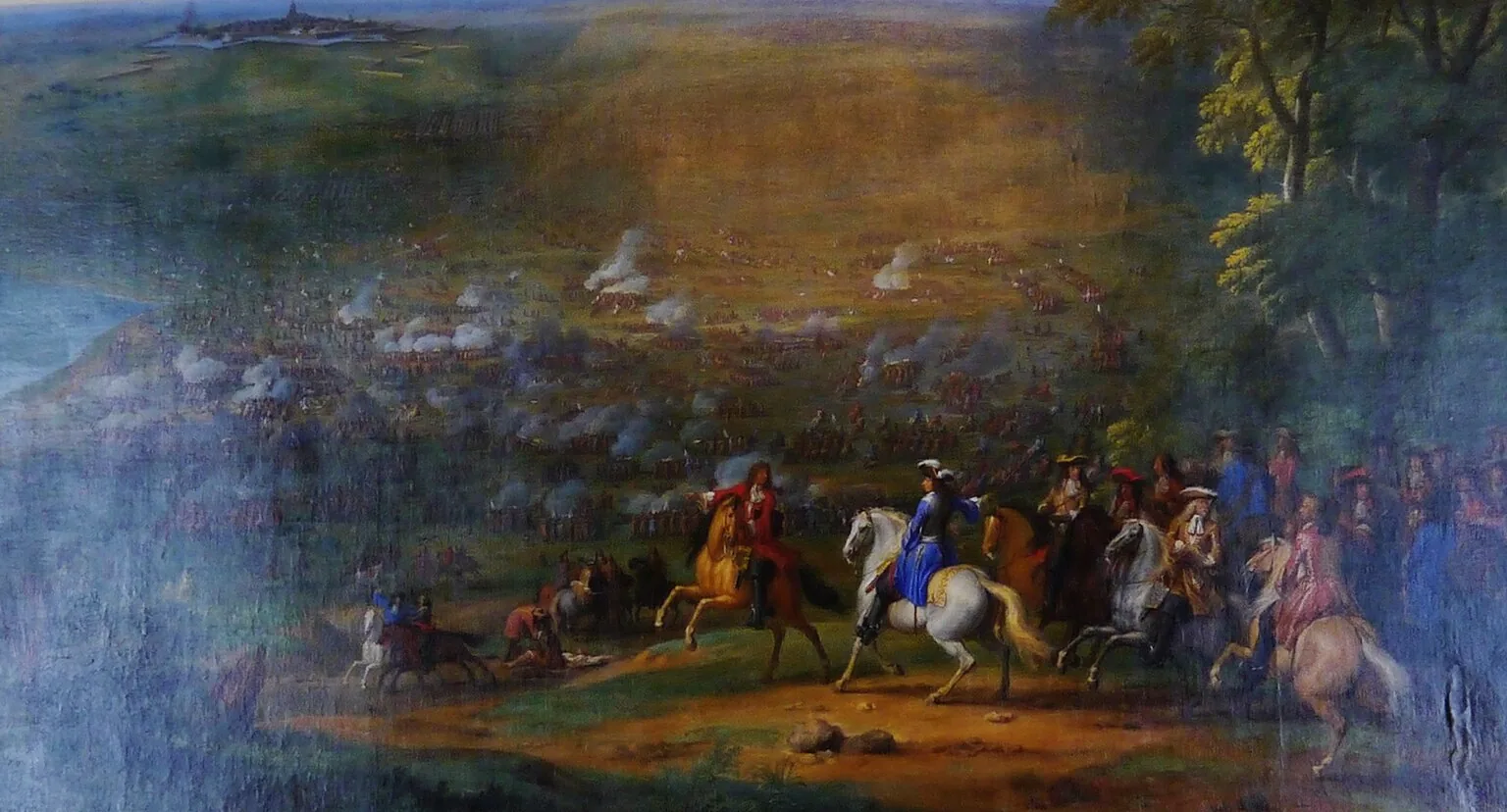
Sauveur Le Conte, The Battle of Rocroi (detail), 1686–1694. Galerie des Batailles, Château de Chantilly (Musée Condé). Photo: Zairon · CC BY-SA 4.0 · Source page
Twenty-one
The king is dead. A boy has the army.
19 May 1643, dawn on a wet upland in the Ardennes, in north-eastern France. Five days ago the king of France died. His heir is four years old. The army meant to protect him is led by a prince of 21 who has never commanded in a battle.
Facing him stands the most famous infantry in Europe, the tercios of Spain. By midday the prince will have broken the Spanish army. Nine years later he will be fighting for Spain, against the king he saved.
Louis II de Bourbon, prince de Condé
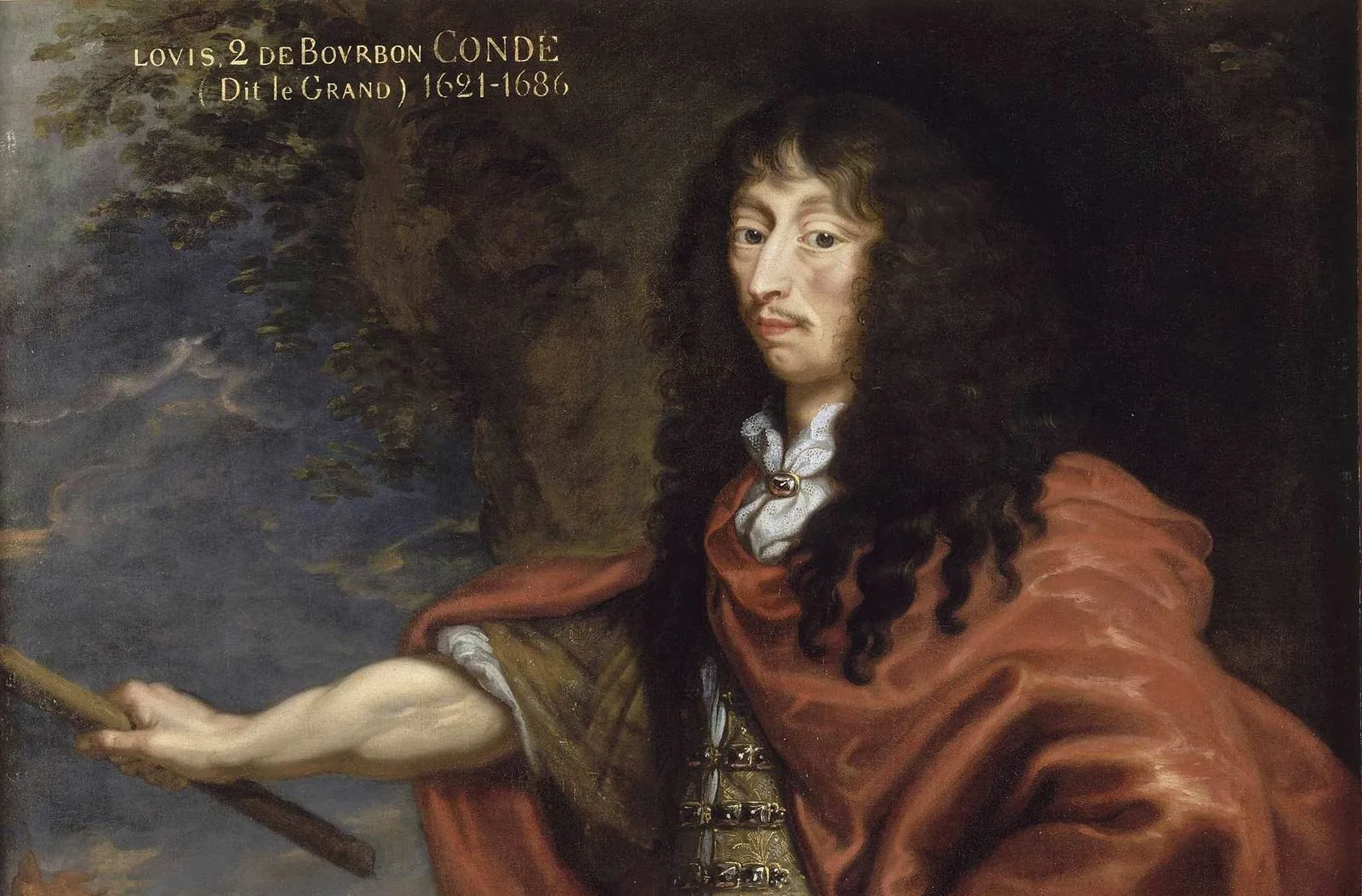
Justus van Egmont, Portrait of Louis de Bourbon, Prince of Condé, third quarter of the 17th century · Public domain · Source page
The prince who won France’s most famous battle at 21, made war on his own king, and was forgiven.
- Born: 8 September 1621, Paris
- Died: 11 December 1686, Fontainebleau, of illness, at 65, worn out by gout and years of war
- Won: Rocroi, 1643; Nördlingen, 1645; Dunkirk, 1646; Lens, 1648; Valenciennes, 1656 (for Spain); Franche-Comté, 1668
- Lost: Freiburg, 1644 (a costly draw); The siege of Lérida, 1647; Faubourg Saint-Antoine, 1652; Arras, 1654; The Dunes, 1658; Seneffe, 1674 (both sides claimed it)
“Very well, I am willing, we will obey; but where are you going to take us? I hope it will be to some warm place.”
A Bourbon prince
Background
Born close to the crown
Louis de Bourbon was born in Paris in 1621. His father, Henri, prince de Condé, was the first prince of the blood: only the king and his brother stood closer to the throne. The father had once rebelled and spent three years in prison; since then he had been a loyal ally of Cardinal Richelieu, Louis XIII’s powerful minister.
The son, known by the heir’s title of duc d’Enghien, studied Latin, history, law and mathematics with the Jesuits at Bourges, then riding and war at the royal academy in Paris. Schooling did not tame him: he was brilliant, proud and impatient.
1641
A marriage for the cardinal
In February 1641 his father married him to Claire-Clémence de Maillé-Brézé, not yet 13, Richelieu’s niece. The young prince loved someone else and fought the match, but the marriage bound the house of Condé to the cardinal and opened the way to a command.
It was not a happy marriage. Some thirty years later her husband had her shut away in a distant castle by a lettre de cachet, and there she stayed until she died.
1635–1643
War with Spain, a dying king
Since 1635 France has been at war with Spain, the great power of Europe. In the Spanish Netherlands, roughly today’s Belgium, stands the Army of Flanders, and at its heart the tercios, Spanish infantry regiments of pikemen and musketeers.
In December 1642 Richelieu died. Louis XIII himself is dying, and his son is four. France faces a weak regency. In spring 1643 Enghien, only 21, is given the army of Picardy on the northern frontier. Beside him, to keep him safe, stands a cautious veteran, Marshal L’Hôpital.
Rocroi, 19 May 1643
May 1643
A small fortress on an upland
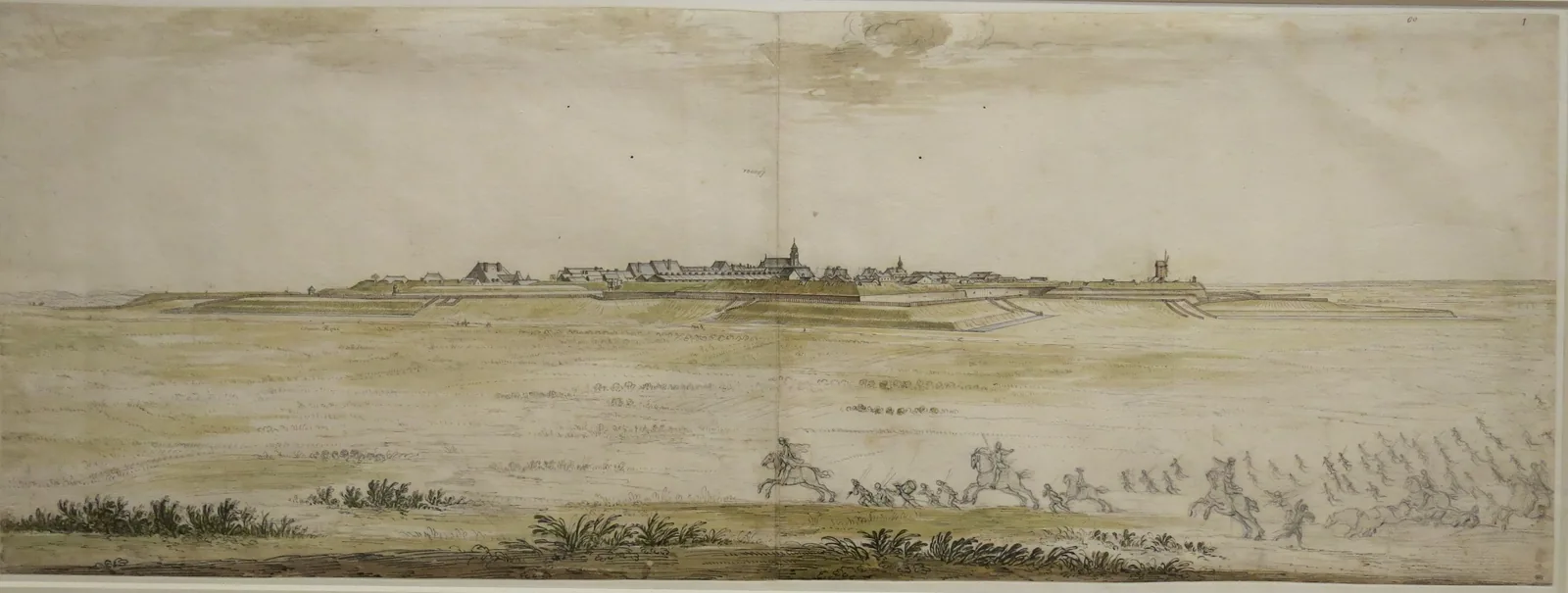
Israël Silvestre, View of Rocroi, c. 1665. Musée du Louvre, Département des Arts graphiques · Public domain · Source page
In mid-May 1643 Francisco de Melo, governor of the Spanish Netherlands, invades France with more than 20,000 men and lays siege to Rocroi. It is a small star-shaped fortress with only about a thousand defenders, on a flat, wet upland ringed by woods. If it falls, the road to Paris lies open.
On 14 May Louis XIII dies. Enghien hears of it two or three days later and keeps it from his army.
Francisco de Melo
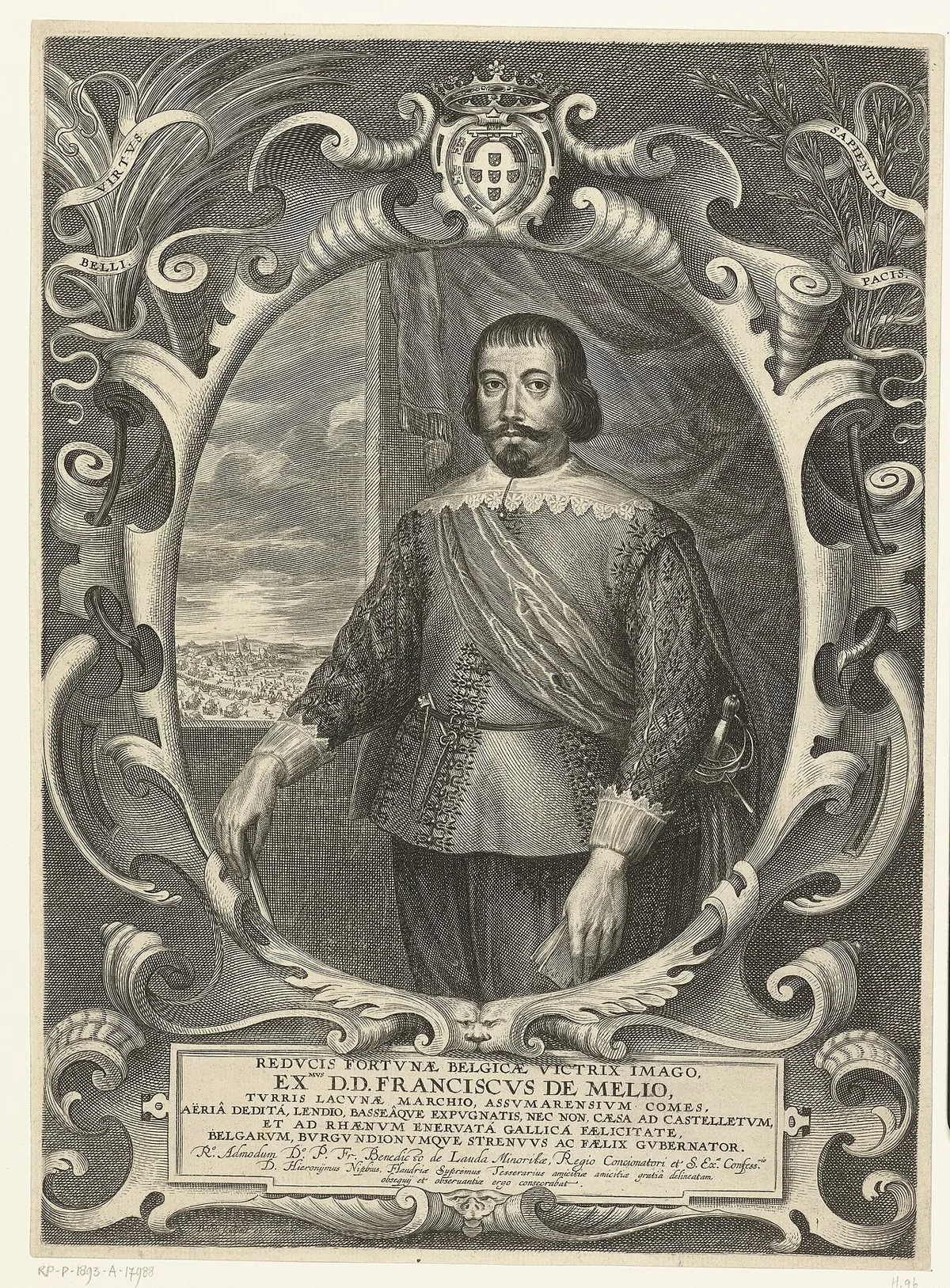
Pieter de Bailliu, Portrait of Francisco de Melo, engraving. Rijksmuseum, Amsterdam · CC0 · Source page
A Portuguese nobleman in Spain’s service who beat the French in 1642, and is remembered only for the battle he lost in 1643.
- Born: 1597, Portugal, then ruled by the king of Spain
- Died: 18 December 1651
- Won: Honnecourt, 1642; Lens and La Bassée taken, 1642
- Lost: Rocroi, 1643
“…vigorous and fortunate governor of the Belgians and Burgundians.”
A decision point
You are the duc d’Enghien, 21, commander of the army of Picardy.
17 May 1643, a château near Rumigny, some 20 km from Rocroi
Melo has been besieging Rocroi for several days. The king is dead, and only you know it. The regent and her minister, Mazarin, are not yet secure, and if your army is beaten there is no other army between the Spanish and Paris.
Between you and the upland lie woods, and a narrow way between wood and marsh. The Spanish have not blocked it. Rumour says reinforcements under General Beck are on the way.
At the council of war Marshal L’Hôpital, your veteran adviser, proposes slipping men and powder into the town by night and avoiding a full battle. Gassion and Sirot, two of your commanders, want to fight.
What do you do?
- Slip reinforcements into the town by night and avoid a battle Safer for your army. But Melo has closed every way into the town; small parties would probably be caught, and Rocroi would fall anyway.
- Give up Rocroi, block the road to Paris and wait for more troops Your army stays whole, but the regency opens its first week with a lost fortress and an open frontier, and Beck reaches Melo before your reinforcements reach you.
- Cross the woods at once and offer battle on the upland before Beck arrives You stake everything on one day. If you lose, the road to Paris is open, and a four-year-old’s reign begins with a disaster.
What really happened
Cross the woods at once and offer battle on the upland before Beck arrives
Enghien chose to fight; L’Hôpital stayed opposed. On 18 May the French crossed the woods unopposed and formed up on the upland. That night a deserter reported that Beck was due in the morning, and Enghien decided to attack at dawn.
According to the duc d’Aumale, who published the army’s letters in 1886, Enghien argued that half-measures carried all the risks of defeat and no chance of victory: at stake was the young king’s crown, not just Rocroi. He was ambitious, the regency needed a victory, and Melo let him through the woods.
The common phrase ‘against orders’ is too strong: the decision was his, and his senior adviser only urged caution.
Rocroi: who fought whom
19 May 1643, from dawn to mid-morning
The upland south-west of Rocroi, in the Ardennes
France
- Commanders: The duc d’Enghien, 21, Marshal L’Hôpital (wounded), Gassion, Sirot, La Ferté
- Strength: about 23,000: 15,000–16,000 foot, 6,000–7,000 horse; 12–14 guns (French muster of 17 May (in Aumale)); 22,000–23,000 (Modern estimate)
- Losses: about 2,000–4,000 killed and wounded (Modern estimates)
Army of Flanders (Spain)
- Commanders: Francisco de Melo, Count of Fontaine, infantry (killed), Isembourg, Alburquerque
- Strength: 26,000–28,000; 18 guns (Aumale (1886), counting every unit that came); 22,000–27,000 (Modern estimates, on the field); about 4,000 (Beck’s reinforcements, too late)
- Losses: about 6,000 casualties and 4,000 prisoners (Melo’s report to Madrid); 7,000–10,000 killed, wounded and captured; every gun (Modern estimates)
Most of the Spanish cavalry got away. Of some 7,000 infantry raised in Spain itself, fewer than 2,000 made it back to the Netherlands.
Outcome: A complete French victory. Rocroi was saved, but the French did not invade the Netherlands; Enghien turned instead to Thionville.
French bulletins inflated the Spanish losses. The figures also count different things: the whole army or only the Spanish-born infantry, the dead alone or the prisoners too.
The battle of Rocroi
18–19 May 1643
In May 1643 Francisco de Melo, governor of the Spanish Netherlands, besieges Rocroi, a small fortress with about a thousand defenders on a flat, wet upland. If it falls, the road to Paris lies open. The 21-year-old duc d’Enghien stands with the French army behind the woods, facing the upland, and rumour says reinforcements under General Beck are on the way.
Follows the plan of the duc d’Aumale (1886), built on the French order of battle of 17–18 May and the report of the Spanish army secretary Vincart; most later maps derive from it. The sequence is checked against Esteban Ribas (2022) and Lynn (1997). The map is turned so that the armies face each other: up is north-east, towards Rocroi.
Disputed: whether 500 or 1,000 Spanish musketeers held the copse; whether Enghien’s attack from the rear fell on Isembourg’s cavalry or on the Italians; the times (French and Spanish accounts differ by up to an hour); how many assaults the tercios threw back; and how exactly their resistance ended. The pond and the marsh have since disappeared.
Phases of the battle
- Out of the woods On 18 May the French come out of the woods unopposed and form up on the upland under cannon fire. Melo, waiting for Beck, does not attack. On the French left La Ferté tries to go round the pond and is called back just in time.
- The right wing strikes At first light French musketeers clear the copse. Gassion rides round it on the right, Enghien on the left. Alburquerque turns to face Gassion, and Enghien hits him in the flank. The Spanish horsemen break and flee.
- Disaster on the left On the other wing La Ferté again tries to get round the pond. Isembourg’s cavalry charges, routs him and takes the French guns; L’Hôpital is wounded. The Italians advance and the French infantry gives ground; only Sirot’s reserve holds.
- The sweep behind the lines Enghien does not chase the beaten horsemen. He wheels his squadrons left, rides across the rear of the Spanish army and breaks the Walloon and German battalions from behind. Then he falls on Isembourg’s cavalry and scatters it. The lost guns are retaken.
- The last square Only the Spanish tercios still stand, packed round their guns. They throw back two or three assaults; their old commander, Fontaine, is killed in his chair. Surrounded and shelled, their officers ask for terms. Shots during the parley set off a massacre until Enghien stops it. The survivors surrender.
The strategy
- French army: Enghien means to cross the woods at once and offer battle on the upland before Beck arrives. The narrow way between wood and marsh has not been blocked, and if his army is beaten there is no other army between the Spanish and Paris.
- Army of Flanders (Spain): Melo chooses to keep the siege going and wait for Beck’s reinforcements rather than attack. Musketeers hold the copse, and cavalry stands on both wings. How many musketeers held the copse is disputed.
What decided it: What decided it was Enghien’s choice not to chase the beaten horsemen. He wheeled his squadrons left, rode across the rear of the Spanish army and broke the Walloon and German battalions from behind. The surrounded tercios were then shelled and surrendered.
Myth
At Rocroi the Spanish tercios fought to the last man, and the young victor wept over his brave enemies.
The truth
Both halves are later legends, one Spanish and one French, and both make the end nobler than it was. The Spanish infantry did not fight to the last man: its officers asked for terms. During the parley shots were fired, perhaps by mistake; the French charged, and men trying to surrender were cut down until Enghien stopped the killing. Then the survivors surrendered, some of them, Spanish accounts say, on terms close to honours of war. Melo’s own report to Madrid counted some 4,000 prisoners.
No source of the time shows Enghien weeping. In Bossuet’s sermon of 1687 he stops the slaughter and kneels to thank God; the only tears it records are Louis XIV’s, 43 years later, when Condé’s last letter was read to him.
The evidence
Melo’s report to Madrid and the Spanish lists of soldiers who came back (in González de León, 2009). The famous answer ‘Count the dead!’ appears in no source of the time.
Source: Flags for Notre-Dame
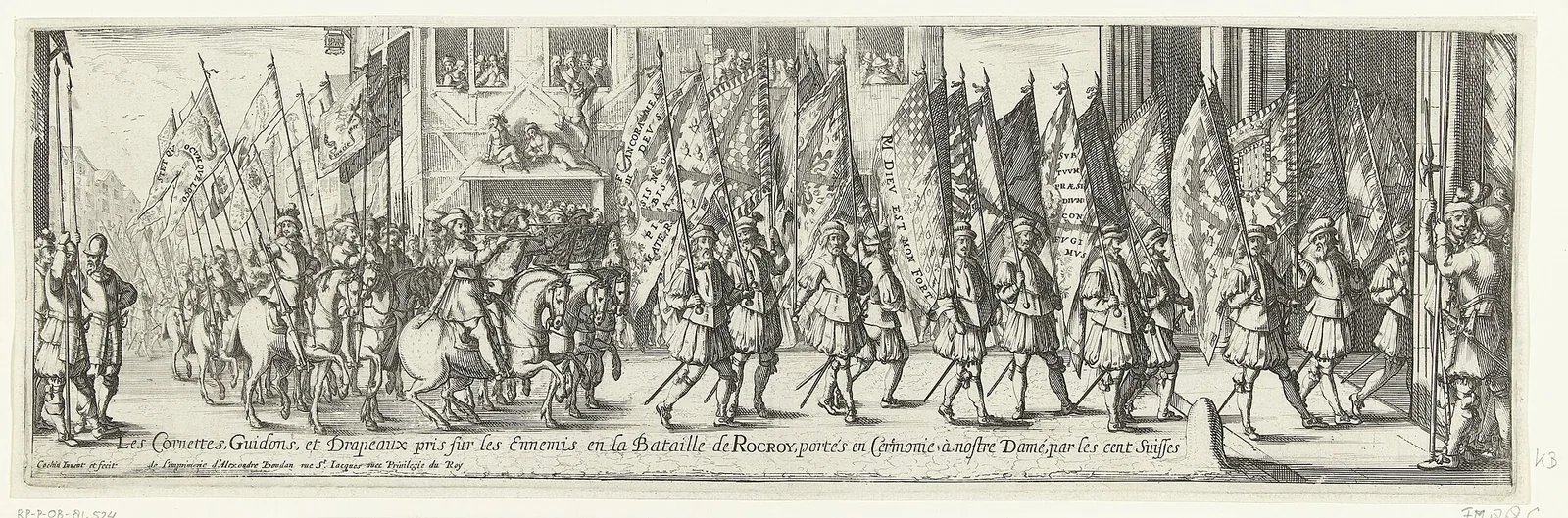
Nicolas Cochin, ‘The cornets, guidons and flags taken from the enemy at the battle of Rocroi’, etching, 1643. Rijksmuseum, Amsterdam · CC0 · Source page
Nicolas Cochin, etching published in Paris by Alexandre Boudan, 1643
Within weeks of the battle the Hundred Swiss, the king’s guard, carried the flags and cavalry standards taken at Rocroi in solemn procession to Notre-Dame cathedral. A Paris print shop sold this picture of the parade.
- Who made this picture, and for whom? A Paris print shop, for buyers who read prints as news, weeks after the battle, when the new regency needed good news. Its title counts trophies: cornets, guidons and flags. Of the dead and the prisoners it says nothing.
- Why carry the flags to a cathedral? To thank God in public and tie the victory to the new government: a regent who was the king of Spain’s sister and an Italian-born minister needed God and Rocroi on their side.
Hero, prisoner, rebel
1643–1648
Five years of battles
After Rocroi Enghien took Thionville and moved on to Germany. At Freiburg in 1644, with Turenne, he attacked a Bavarian army dug in on wooded hills; three days of assaults cost thousands of French dead, and most historians call it a costly draw. In 1645 he won at Nördlingen, and in 1646 he took Dunkirk. That year his father died: from now on he is the prince de Condé.
He was not invincible. In 1647 his siege of Lérida, in Catalonia, failed, and Paris laughed. In August 1648 he beat the Spanish at Lens, drawing them out of position with a pretended retreat.
1648–1651
From victory to prison
A week after Lens, Paris rose against Mazarin and threw up barricades: the Fronde had become an open revolt. Condé stood with the court and in 1649 blockaded the capital until peace was made. Then he demanded a reward in posts, fortresses and influence, and humiliated Mazarin in public.
On 18 January 1650 he came to a council meeting at the Palais-Royal and was arrested there with his brother and brother-in-law, on the queen’s order and without trial. At the castle of Vincennes, says Madame de Motteville, they played cards all the first night. She had the details of the arrest a few days later from Comminges, the officer who took them to Vincennes.
While he was in prison, his wife and his agent Pierre Lenet raised Bordeaux for him. After 13 months Mazarin was forced to flee France, and freed the princes himself.
A decision point
You are Louis, prince de Condé, aged 29.
Summer 1651, Paris
You have been free for six months, after 13 months in prison without trial. Mazarin, who arranged it, is in exile but still advises the queen by letter. You are rich, governor of Guyenne, and the most famous soldier in France.
Troops are moving round Paris, and friends warn you of a second arrest. On 7 September the king, aged 13, will be declared of age: from that day any revolt is a revolt against the king himself, not against his minister.
Spain, still at war with France, would gladly pay a French prince. Your clients and the city of Bordeaux will follow you.
What do you do?
- Go back to court and trust the queen’s word You keep your loyalty and your rank. But you are within reach of a second arrest, and Mazarin will probably return.
- Withdraw to your province and bargain from there, without war Safe for now, and still strong. But your enemies at court have time to turn the young king against you.
- Raise your provinces and towns, ally with Spain, and get rid of Mazarin for good Civil war: French against French, with a foreign enemy paying your soldiers.
What really happened
Raise your provinces and towns, ally with Spain, and get rid of Mazarin for good
In July Condé left Paris by night, fearing arrest. He stayed away from the king’s coming of age and rode for Guyenne, where Bordeaux rose for him; by the autumn his troops and the king’s were fighting. In November he signed a treaty with Spain, and in January 1652 Mazarin came back with an army.
His rank was his world: arrest without trial, ordered by an Italian-born cardinal, insulted the blood of the kings. The historian Katia Béguin sees the revolt as the politics of a great house defending its clients, fortresses and offices, not ‘treason’ in the modern sense. Cardinal de Retz, who knew him well, thought his upbringing had never taught him to think like a statesman.
1652
At the gates of Paris
In spring 1652 Condé beat a royal army at Bléneau, but Turenne, now the king’s general, stopped him. On 2 July Turenne trapped him under the walls of Paris, in the Faubourg Saint-Antoine; the king’s cousin, Anne, duchesse de Montpensier, had a gate opened and the Bastille’s guns fired on the royal army, and Condé escaped into the city. You saw that battle from Turenne’s side in the previous lesson.
Two days later Condé’s supporters stormed the Hôtel de Ville during an assembly, and dozens were killed. Paris blamed him, and the city he had defended turned against him.
A decision point
You are the prince de Condé.
October 1652, Paris
Paris is no longer yours. Mazarin has left France again, to take away your excuse for war, and the king offers an amnesty. Your allies are making peace one by one.
You still hold several fortresses and have loyal troops. Spain offers you command of its armies in the Netherlands.
What do you do?
- Accept the amnesty and submit You would probably keep your life and lands, but lose your power. The king’s ministers would not forget 1652, and a second prison was possible.
- Hold out in your fortresses and wait for better terms Your fortresses would fall one by one, with no army to relieve them.
- Go to the Spanish Netherlands and fight on as Spain’s general You keep an army and a voice in any future peace. But you will fight against your own country, and can be tried as a traitor.
What really happened
Go to the Spanish Netherlands and fight on as Spain’s general
In October 1652 Condé left Paris with his troops for the Spanish Netherlands, and Louis XIV entered the capital. In 1654 the Parlement of Paris condemned him to death in his absence and stripped him of his titles. For six years Condé commanded for Spain.
Every other road led to the loss of his power. In Spain’s service he kept an army, his name and a place at the peace table, and in 1659 it paid off. For the high nobility of the 17th century, serving a foreign king was not unheard of; Louis XIV saw it as treason, and did not forget.
For Spain, then for the king again
1653–1660
Spain’s general
In 1653, for Spain, Condé took Rocroi itself, the town he had saved ten years before. In 1654, when Turenne broke the Spanish siege lines round Arras, Condé’s rearguard saved part of the Spanish army. In 1656, with Don Juan José, the king of Spain’s illegitimate son, he beat Turenne at Valenciennes.
The Spanish did not always listen to him: at the Dunes in 1658 they ignored his warnings, and Turenne, with English troops lent by Cromwell, won. In the Peace of the Pyrenees of 1659 Spain insisted on one clause: Condé’s pardon and the return of his estates. In January 1660 he knelt before Louis XIV at Aix-en-Provence. The king forgave him, but gave him no command for eight years.
1668–1672
A second career
In 1668 he finally got an army again, and took the Spanish Franche-Comté, east of Burgundy, in about two weeks of winter. The peace that year gave it back to Spain, but he had proved himself. In 1672, at the start of the war with the Dutch Republic, he led the crossing of the Rhine and was shot in the wrist; his nephew, the young duc de Longueville, was killed in the same fight.
A decision point
You are the prince de Condé, 52, commanding the king’s army in the Netherlands.
11 August 1674, near the village of Seneffe, in today’s Belgium
The Dutch War has dragged on for two years. Your army, about 45,000 men, sits in strong entrenchments behind a stream. Facing you is William of Orange, 23, with Dutch, Imperial and Spanish troops, perhaps 60,000 or more.
Since dawn the allies have been marching south-west across your front, in long columns on bad roads, between hedges, copses and walled villages. Their rearguard lags behind at Seneffe.
Your task this summer is defensive: to guard the frontier. But the enemy is strung out and exposed.
What do you do?
- Stay in your lines No risk. The allies march on towards France’s frontier fortresses, and a chance is lost.
- Strike the rearguard, take prisoners and baggage, and pull back before the main body turns round A limited and fairly safe success, before William has time to form up.
- Strike the rearguard, then press on and destroy the whole allied army If it works, the war in the Netherlands may be decided in a day. If the allies manage to form a line in that broken country, your men will be attacking walls and hedges.
What really happened
Strike the rearguard, then press on and destroy the whole allied army
Condé crushed the rearguard at Seneffe at about ten in the morning, then took the priory of Saint-Nicolas and much of the allied baggage. Instead of stopping, he attacked the new allied line at Fayt until darkness fell. Both armies then withdrew, and both claimed the victory.
This was Condé’s way: attack, and keep attacking. The first blow was brilliant; the frontal assaults cost thousands. John Lynn calls the later fighting confused and costly; Olaf van Nimwegen argues that those assaults actually rescued William from a serious defeat.
Seneffe: who fought whom
11 August 1674, from morning to night
Seneffe, Manage and Fayt, between Mons and Charleroi
France
- Commanders: The prince de Condé, The duc de Luxembourg, The duc d’Enghien, Condé’s son
- Strength: 45,000–50,000; about 60 guns (Modern estimates (Lynn; van Nimwegen))
- Losses: about 7,000 (Périni, a French military historian); about 10,000 (Bodart (1908); van Nimwegen (2010))
Allies: Dutch, Imperial, Spanish
- Commanders: William of Orange, Count de Souches (Imperial army), Prince of Vaudémont (rearguard)
- Strength: 60,000–65,000; about 70 guns (Modern estimates (Lynn; van Nimwegen))
- Losses: about 10,000 (Périni); about 14,000–15,000, including prisoners (Bodart; van Nimwegen)
Outcome: Undecided. The French took prisoners, flags and baggage, but the allied army survived. Both sides claimed the victory.
One of the bloodiest battles of the century. The sources differ mainly over prisoners, and over France’s low official figures.
The battle of Seneffe
11 August 1674
On 11 August 1674, near the village of Seneffe in today’s Belgium, Condé’s French army of about 45,000 sits in strong entrenchments behind a stream. William of Orange’s Dutch, Imperial and Spanish army of perhaps 60,000 or more marches across the French front in long columns, and its rearguard lags behind at Seneffe.
A sketch, not an exact reconstruction. The sequence follows van Nimwegen (2010) and Lynn (1999); the places follow modern maps of Seneffe, Manage and Fayt and the course of the river Samme. A contemporary manuscript plan survives in the British Royal Collection.
Disputed or uncertain: the order of the allied columns; the exact site of the priory (placed here near today’s Manage); the extent of the French camp; and the losses. Five phases simplify a battle that lasted some 17 hours.
Phases of the battle
- The allies on the march From four in the morning the allied columns cross the Samme at Seneffe and turn south-west. The rearguard is left behind near the village. Condé watches them from the heights by his camp and decides to strike.
- The rearguard crushed At about ten Condé crosses the Samme by a ford and routs the rearguard’s cavalry. Luxembourg storms the village, and the allied battalions inside surrender after a bombardment.
- The priory and the baggage William tries to make a stand by the priory of Saint-Nicolas. The Spanish horse charges the French and breaks. The French take the priory and much of the baggage, and William falls back to Fayt. Condé himself is thrown from his horse, and his son rescues him.
- Assaults on Fayt De Souches’s Imperials come back and join William at Fayt. Condé brings up his infantry and throws it at the village and its hedges, at five, at seven, and again. The French break in and are driven out. Only at nine does Condé stop, and the firing goes on by moonlight.
- Night, and two victories In the night a panic runs through the French ranks. Both armies withdraw, Condé to Charleroi, William to Mons. Both claim the victory.
The strategy
- French army: Condé, whose task this summer is defence, watches the allied columns from the heights and decides to strike the rearguard left behind. He crosses the Samme at a shallow ford and routs the rearguard’s cavalry.
- Allies: The allied columns march south-west across the French front, and their order is disputed. When the rearguard is hit, William tries to hold the priory, then falls back to Fayt, where De Souches’s Imperials join him.
What decided it: The French broke the rearguard early, but the allied main body was not destroyed: De Souches’s Imperials joined William at Fayt, and the French assaults on the village were driven back again and again. Both armies withdrew in the night.
1675
The last campaign
In July 1675 Turenne was killed by a cannonball at Sasbach, across the Rhine from Alsace, and the king sent Condé to take his place. He forced the Imperial general Raimondo Montecuccoli to lift the sieges of Haguenau and Saverne, and held the frontier. It was his last campaign: at 54, crippled by gout, he retired to Chantilly.
Chantilly and memory
1671–1686
A court of writers
At Chantilly, with new gardens by Le Nôtre, Condé entertained the greatest writers of France: Molière, whose Tartuffe he backed when it was banned, Racine, Boileau, La Fontaine and Bishop Bossuet. Jean de La Bruyère was his grandson’s tutor.
In April 1671 the king came to Chantilly with the court, a visit of reconciliation. Condé’s maître d’hôtel, Vatel, saw the roast run short at some tables and the fish arrive late, and took his own life. “I have lost my honour!” he had said, according to a letter of Madame de Sévigné, who was not there and had the story from others.
1686–1687
A last letter
In December 1686 Condé, old and ill, hurried to Fontainebleau, to the bedside of his grandson’s wife, the king’s daughter, who had smallpox. She recovered; he died there on 11 December, aged 65. In a last letter to the king he confessed the ‘faults’ of the middle of his life. When it was read, says Bossuet, the king wept.
In March 1687 Bossuet preached the funeral oration in Notre-Dame.
Source: A bishop describes Rocroi
“The formidable Spanish infantry remained still unsubdued, which separating into several close-compacted battalions, stood like towers amidst the general ruin. Three times did our heroic youth, collecting his full force, rush on these intrepid combatants, and every time met with a repulse.”
Bossuet, bishop of Meaux and the great preacher of the court, had been close to Condé in his last years. He spoke 44 years after Rocroi.
- Why make the enemy so strong? The stronger the foe, the greater the victor. Towers that throw back three charges make the young prince an epic hero; Bossuet even calls him ‘another Alexander’.
- Can we trust the details? Only with care. The sermon has Enghien sleeping so soundly before the battle that ‘this other Alexander’ had to be woken, the scene Plutarch tells of Alexander before Gaugamela: a literary model, not a report. Bossuet was not at Rocroi, and he spoke 44 years later, before the prince’s family.
- What is missing? The Fronde and the six years in Spain’s service appear only as a hint, as ‘faults’ the prince himself confessed. A funeral oration praises; it does not investigate.
Source: The missing pages
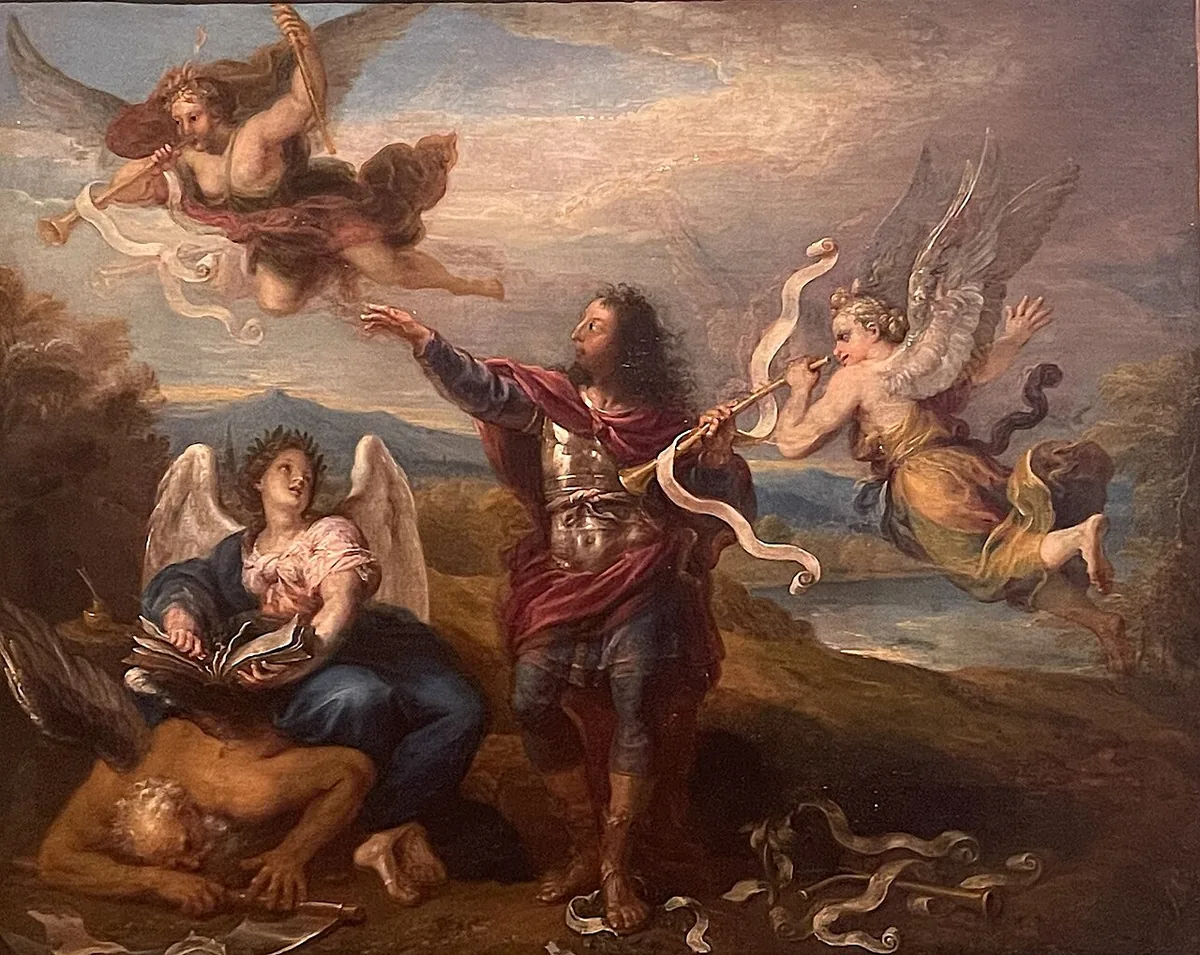
Michel Corneille the Younger, The Repentance of the Grand Condé, c. 1691. Musée du Grand Siècle, Saint-Cloud · Public domain · Source page
Michel Corneille the Younger, The Repentance of the Grand Condé, c. 1691
After Condé’s death his son filled the Galerie des Batailles at Chantilly with paintings of his father’s victories. One problem remained: the victories of 1653–1659 were won for Spain. This was the family’s solution.
- What do you see? Condé in Roman armour reaches towards Fame and her trumpet. History, winged, sits with her book, Time lies at her feet, and loose pages lie on the ground: pages are missing from History’s book.
- Who paid for this, and why? His son, for a gallery of the family’s glory. The Spanish years appear only as something to regret and erase; the usual reading is that Condé silences Fame. It is evidence of how the family wanted him remembered, not of what happened, just like Bossuet’s sermon.
Myth
Rocroi ended Spain’s military power.
The truth
Spain fought France for 16 more years. It held Lérida against Condé in 1647, retook Barcelona and Dunkirk in 1652, and beat Turenne at Valenciennes in 1656, with Condé on its side. Most of the Spanish cavalry escaped Rocroi. What Rocroi changed was reputation: the tercios could be beaten in the open. Spain’s decline had deeper causes: debt, the revolts of Catalonia and Portugal in 1640, an empire stretched too thin.
The evidence
Cardinal de Retz, writing about 1675, some 30 years on: “the battle of Rocroi was such a blow to the Spanish infantry that they could not recover in an age.” Hindsight, from a Frenchman. Against it: Parker (1972), Stradling (1981), González de León (2009).
What he left behind
- 1643 Rocroi secures the regency in its first week; a prince of 21 becomes a national hero.
- 1650–1653 The Fronde. The young Louis XIV learns that a great noble with an army of his own is a danger.
- 1659 The Peace of the Pyrenees: France gains Roussillon and most of Artois, and Condé’s pardon is written into the treaty.
- From 1661 Louis XIV rules alone. Generals command only by the king’s grace, and the army is loyal to the crown.
- 1674–1675 Seneffe and the last campaign. His pupil, the duc de Luxembourg, will win the great battles of the 1690s.
- 1686–1691 His death, Bossuet’s sermon and the Chantilly gallery fix the family’s version.
- 1701 A new war begins, this time over the crown of Spain itself: the next lesson.
- 1898 The Musée Condé opens at Chantilly, left to the Institut de France by the duc d’Aumale, the family’s historian.
Who was the Grand Condé?
A genius whose rebellion was a tragic mistake, or a prince playing for his house?
- The duc d’Aumale, History of the Princes of Condé (1863–1896) A soldier-historian and heir of Chantilly. To him Rocroi is genius and a turning point, and the Fronde a great soul’s mistake, regretted and forgiven. His work rests on the family archive he owned: very rich, and partisan.
- Katia Béguin, Les Princes de Condé (1999) The Condés were a princely house managing rank, clients and money. Revolt, exile in Spain and return were the strategies of a great family; after 1660 they became courtiers and patrons. The ‘repentant hero’ is an image the family built.
- John A. Lynn (1997, 1999) and military historians A brilliant, aggressive commander who sought battle in an age turning to sieges and attrition, and paid heavily in men, as at Seneffe. Rocroi’s fame is greater than its effect: Spain’s decline had other causes.
How much of Rocroi was Enghien’s plan, and how much Gassion’s ideas and Melo’s mistakes? And was his service to Spain treason by the standards of his own century? Historians still disagree.
What do you know now?
Check yourself
What decided the battle of Rocroi?
Answer: Enghien rode his cavalry behind the Spanish infantry and struck it from the rear. Right. After beating the horsemen in front of him, he did not chase them but turned left, across the Spanish rear, and broke the battalions from behind.
Check yourself
Which fact disproves the claim that Rocroi ended Spain’s military power?
Answer: Spain fought on for 16 years, and in 1656 beat Turenne at Valenciennes. Right. An army that took a blow was winning again within a few years. Rocroi hurt Spain’s reputation; it did not destroy its power.
Check yourself
Why did Condé rebel in 1651?
Answer: He feared a second arrest without trial, and saw Mazarin as an enemy of his rank. Right. After 13 months in prison without trial, and with Mazarin still advising the queen, he chose to defend his rank by force.
Check yourself
How did Condé return to the service of the French king?
Answer: Spain insisted on his pardon in the Peace of the Pyrenees. Right. His pardon and the return of his estates were a Spanish condition for the peace of 1659. He knelt before the king in January 1660.
Check yourself
The painting ‘The Repentance of the Grand Condé’ is mainly good evidence of…
Answer: how his family wanted his years in Spain’s service to be remembered. Right. His son ordered it for the family’s gallery of glory, and the Spanish years appear in it as pages torn from History’s book.
Check yourself
How did the battle of Seneffe end in 1674?
Answer: After a bloody, undecided day, both sides withdrew and both claimed victory. Right. Condé crushed the rearguard, but the assaults on Fayt cost thousands, and the allied army survived.
Terms
- tercio A Spanish infantry regiment of pikemen and musketeers who fought in deep blocks. The ‘old tercios’, raised in Spain itself, were thought for over a century to be the best infantry in Europe.
- pike A spear five to six metres long. Blocks of pikemen shielded the musketeers from cavalry charges.
- musketeer A foot soldier armed with a musket, a heavy gun fired by a burning match. Reloading was slow, so musketeers fought alongside pikemen.
- squadron The cavalry unit that charged as one body, usually of one to two hundred riders.
- prince of the blood A descendant of a French king in the male line, and so in line for the throne. The princes of the blood stood at the head of the nobility, below only the king and his closest family.
- regency Rule on behalf of a child king. After Louis XIII died in 1643, Louis XIV’s mother, Anne of Austria, ruled as regent, with Cardinal Mazarin as her chief minister.
- Fronde The wave of revolts in France from 1648 to 1653 against Cardinal Mazarin and the queen mother’s regency: first the Parlement of Paris, then the great princes. The name comes from the fronde, the sling with which Paris children shot stones.
- honours of war Terms of surrender that let a beaten force march away with its flags, weapons and drums, in recognition of its courage.
- Army of Flanders Spain’s standing army in the Spanish Netherlands, roughly today’s Belgium. Spaniards, Italians, Walloons, Burgundians and Germans served in it.
- lettre de cachet An order under the king’s seal to imprison someone without trial. In 1671 Condé himself had his wife confined by one.
- funeral oration A formal sermon in praise of the dead, preached in church before the family and the court. Bishop Bossuet’s orations are counted among the masterpieces of French prose.
- maître d’hôtel The man who ran the kitchens, the table and the feasts of a great noble house.
- House of Condé A French princely family. Its members stood closest to the throne, after the king and his brother.
- Richelieu A French cardinal and the powerful minister of Louis XIII. He died in December 1642.
- Louis XIII King of France. He died in May 1643, leaving a son of four.
- Louis XIV The king who followed Louis XIII. He built a state in which nobody kept an army of his own.
- Mazarin A senior minister who ran France for the queen. He planned the princes' arrest.
- L’Hôpital A cautious veteran French marshal. He advised Enghien to avoid a full battle at Rocroi.
- Jean de Gassion An experienced French cavalry officer. He knew the ground at Rocroi and pushed for battle.
- Francisco de Melo Governor of the Spanish Netherlands. He invaded France and besieged Rocroi.
- Thionville A town in north-eastern France, which Enghien took after Rocroi.
- Freiburg A city in southern Germany. In 1644 Condé attacked a Bavarian army dug in on hills there.
- Nördlingen A town in southern Germany, where Condé won a battle in 1645.
- Lérida A city in Catalonia, Spain, where Condé's siege failed in 1647.
- Lens A town in northern France, where Condé beat the Spanish in August 1648.
- Bléneau The place where Condé beat a royal army in spring 1652.
- Faubourg Saint-Antoine A suburb of Paris where Condé fought Turenne in 1652.
- Bastille A fortress and prison in Paris. In 1652 its guns fired on the royal army.
- Hôtel de Ville Paris's city hall. In 1652 Condé's supporters stormed it, and dozens were killed.
- Vincennes A castle near Paris, where the princes were held in prison in 1650.
- Comminges The officer who escorted the princes to Vincennes after their arrest in 1650.
- Bordeaux A large port city in south-west France. In 1650 it rose in revolt for Condé.
- Jesuits A Catholic religious order whose members ran schools and taught young men.
- Turenne A French general who became the king's commander. He fought Condé and the Spanish armies.
- Seneffe A village where a major battle was fought in the Dutch War. Both sides claimed victory there.
- Eylau The site of a major battle fought by Napoleon in 1807.
- Napoleon A French general and emperor. After Eylau, a cynical line is attributed to him as it is to Condé.
Sources
- Jacques-Bénigne Bossuet, Oraison funèbre de Louis de Bourbon, prince de Condé, prononcée à Notre-Dame le 10 mars 1687
- The Funeral Orations of Bossuet, pronounced at the interment of Henrietta, Duchess of Orleans, and Louis of Bourbon, Prince of Condé, anonymous translation, 2nd ed. (London: W. Clarke, 1800), pp. 29–33
- Memoirs of Madame de Motteville on Anne of Austria and her Court, trans. Katharine Prescott Wormeley, 3 vols (Boston: Hardy, Pratt & Co., 1902), I 77 and II 219–221
- Memoirs of Jean François Paul de Gondi, Cardinal de Retz, anonymous English translation (Project Gutenberg #3846)
- The Letters of Madame de Sévigné to her Daughter and Friends, ed. Mrs. Hale (Boston: Roberts Brothers, 1869), letters of 24 and 26 April 1671
- Pierre Lenet, Mémoires (written in the 1650s; first published 1729)
- Henri d’Orléans, duc d’Aumale, Histoire des princes de Condé pendant les XVIe et XVIIe siècles, vol. IV (Paris: Calmann Lévy, 1886)
- Katia Béguin, Les princes de Condé: rebelles, courtisans et mécènes dans la France du Grand Siècle (Seyssel: Champ Vallon, 1999)
- Bernard Pujo, Le Grand Condé (Paris: Albin Michel, 1995)
- John A. Lynn, Giant of the Grand Siècle: The French Army, 1610–1715 (Cambridge: Cambridge University Press, 1997)
- John A. Lynn, The Wars of Louis XIV, 1667–1714 (London: Longman, 1999)
- Geoffrey Parker, The Army of Flanders and the Spanish Road, 1567–1659 (Cambridge: Cambridge University Press, 1972; 2nd ed. 2004)
- Fernando González de León, The Road to Rocroi: Class, Culture and Command in the Spanish Army of Flanders, 1567–1659 (Leiden: Brill, 2009)
- Alberto Raúl Esteban Ribas, The Battle of Rocroi 1643: Clash of Seventeenth Century Superpowers (Warwick: Helion, 2022)
- R. A. Stradling, Europe and the Decline of Spain: A Study of the Spanish System, 1580–1720 (London: Allen & Unwin, 1981)
- Peter H. Wilson, Europe’s Tragedy: A History of the Thirty Years War (London: Allen Lane, 2009)
- Orest Ranum, The Fronde: A French Revolution, 1648–1652 (New York: Norton, 1993)
- Olaf van Nimwegen, The Dutch Army and the Military Revolutions, 1588–1688 (Woodbridge: Boydell, 2010)
- Louise M. Richter, Chantilly in History and Art (London: John Murray, 1913)
Image credits
- Sauveur Le Conte, The Battle of Rocroi (detail), 1686–1694. Galerie des Batailles, Château de Chantilly (Musée Condé). Photo: Zairon · CC BY-SA 4.0 · Source page
- Justus van Egmont, Portrait of Louis de Bourbon, Prince of Condé, third quarter of the 17th century · Public domain · Source page
- Israël Silvestre, View of Rocroi, c. 1665. Musée du Louvre, Département des Arts graphiques · Public domain · Source page
- Pieter de Bailliu, Portrait of Francisco de Melo, engraving. Rijksmuseum, Amsterdam · CC0 · Source page
- Nicolas Cochin, ‘The cornets, guidons and flags taken from the enemy at the battle of Rocroi’, etching, 1643. Rijksmuseum, Amsterdam · CC0 · Source page
- Michel Corneille the Younger, The Repentance of the Grand Condé, c. 1691. Musée du Grand Siècle, Saint-Cloud · Public domain · Source page


