Cleopatra VII: the queen behind the myth
She came from a Greek dynasty that ruled Egypt, and her mother is unknown. Almost everything written about her was written by the Romans, her enemies. What do we really know about Cleopatra, and what is left of the myth?
Decisions, questions and your own progress, in the app
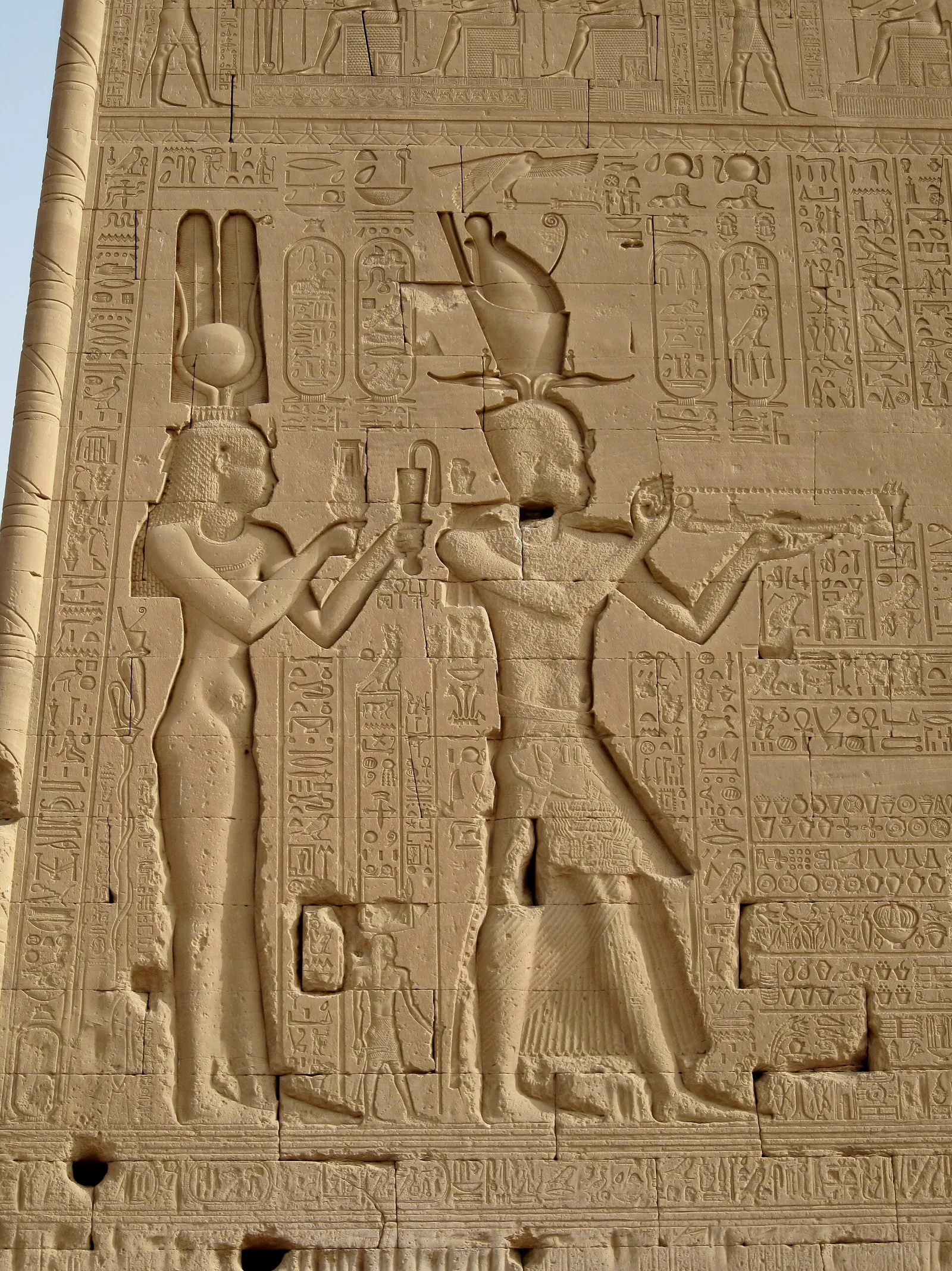
Relief of Cleopatra VII and Caesarion, temple of Hathor, Dendera, Egypt, 2011. Photo: Olaf Tausch · CC BY 3.0 · Source page
A Greek family on the Nile
A question at the palace gate
Alexandria, autumn 48 BC. A Roman general has taken the royal palace, and the city is full of soldiers who want him gone. Outside the walls is the queen of Egypt, about twenty-one years old, with a small army and no way in.
Her enemies hold the roads and the gates. Her younger brother the king and his advisers hold the palace. The Roman general, Julius Caesar, will decide who is in the right. How does a queen get into a palace she was thrown out of, to face the one man who can decide her fate?
Many people will tell you the answer. Most of them are wrong.
Background
Greeks on the Nile
Cleopatra was not the first of her line to rule Egypt, but she was the last. Her family, the Ptolemies, began with a Macedonian general named Ptolemy, who had served Alexander the Great. After Alexander died in 323 BC, his generals shared out his empire. Ptolemy took Egypt, and in 305 BC he proclaimed himself its king.
His descendants ruled for almost three centuries from Alexandria, a Greek city on the Mediterranean coast that Alexander had founded. At court they spoke Greek, kept Greek customs and married within the family. They also took the title of pharaoh and built temples in the Egyptian style. Historians call the Greek-speaking world of this age Hellenistic.
Myth
Cleopatra was an Egyptian queen, the last pharaoh, ruling as one of her own people.
The truth
Her family was Greek-Macedonian, and its founder had served Alexander. Her mother is unknown, so no ancestry can be proved either way.
The evidence
Plutarch writes that the kings before her had not even made an effort to learn the native language of Egypt. He presents her as the exception: she spoke the languages of many peoples, Egyptian among them. She was Greek by family, but she was willing to speak the language of her subjects, and that is what made her legend.
58–51 BC
The flute-player's daughter
Her father, Ptolemy XII, was nicknamed ‘the flute-player’ by the Alexandrians. His rule was never secure. The city crowds disliked him, and to keep his throne he borrowed heavily from Roman bankers and sought Rome's support. Rome had become the great power of the Mediterranean, and a Hellenistic king could only save his crown by keeping on Rome's good side.
He died in 51 BC. His will left the throne to his daughter Cleopatra, then about eighteen or nineteen, and to her younger brother, Ptolemy XIII, who was to be her husband, as the dynasty's custom allowed. The two would rule together, and the danger was that each would want all of it.
Cleopatra VII
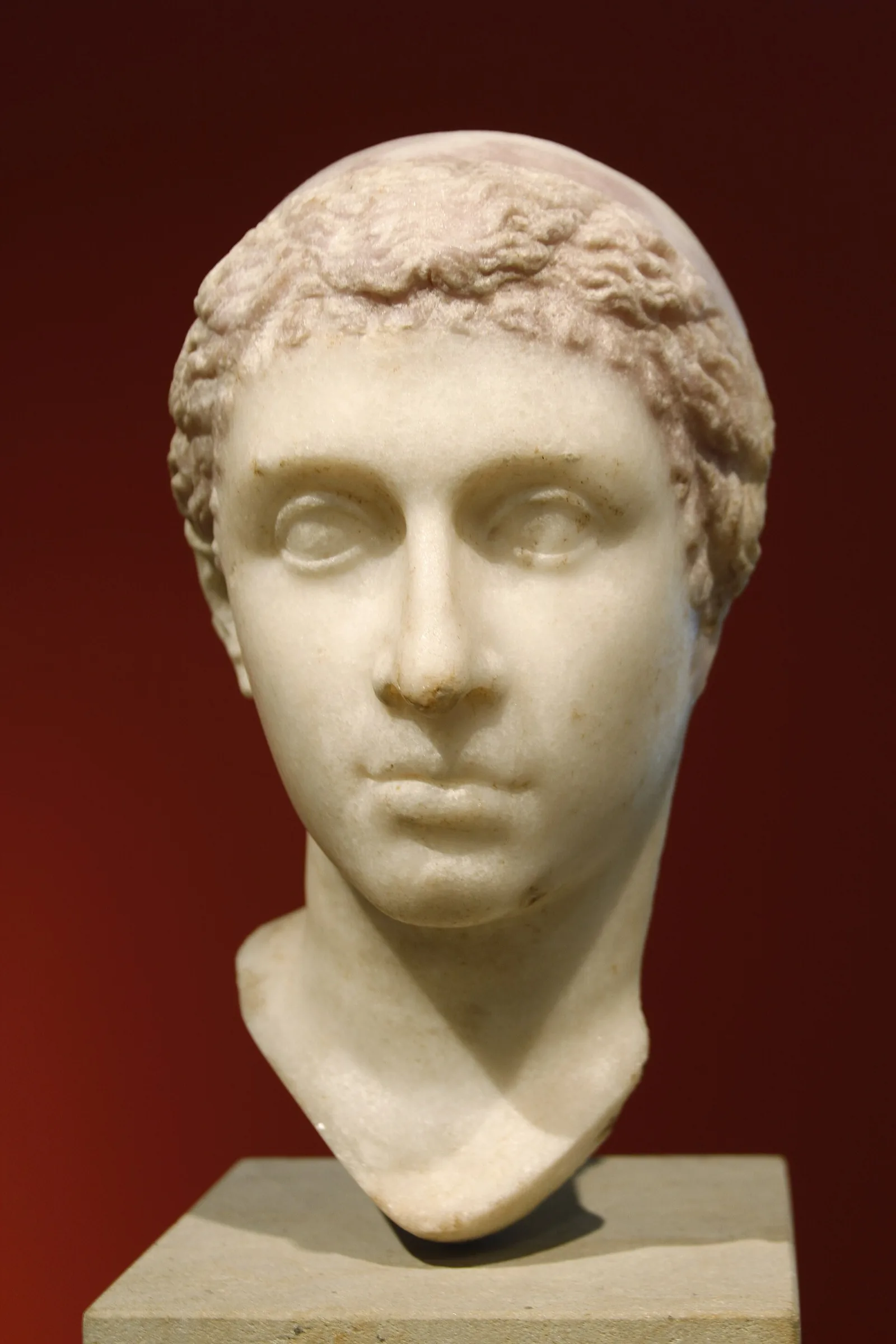
Head of a woman identified as Cleopatra VII, Altes Museum, Berlin, 2017. Photo: José Luiz · Public domain · Source page
A Greek queen of Egypt who spoke many languages, allied herself with two Romans, and lost her kingdom to a third.
- Born: 70 or 69 BC, Probably Alexandria
- Died: 10 or 12 August 30 BC, Alexandria, The manner is disputed (chapter 7)
- Won: Kept the throne of Egypt for more than twenty years
- Lost: Actium, 31 BC, and the fall of Alexandria, 30 BC
‘converse with her had an irresistible charm’
Caesar in the palace
September 48 BC
A gift for the new master
Pompey had been beaten at Pharsalus and fled east. He hoped that Egypt, which owed his family many favours, would take him in. The young king's advisers thought otherwise: if they killed Pompey, they reasoned, Caesar would be grateful. In September Pompey came ashore on the Egyptian coast, and was killed as he landed.
A few days later Caesar arrived, and was handed the head of his rival as a gift. Plutarch says Caesar turned away from it in horror. The advisers had made two mistakes: they did not win Caesar's favour, and they had let a Roman general's murder become an Egyptian problem.
October 48 BC
A judge in the palace
Caesar entered Alexandria with a small force and found a city at war. Egypt owed large sums to Roman lenders, and Caesar needed both the money and order. The king's soldiers held the palace, and the queen's men stood outside. Caesar took the palace for himself and made himself the judge between the two siblings. He ordered both to disband their armies and bring their quarrel before him.
A decision point
You are Cleopatra, about twenty-one.
Autumn 48 BC, outside Alexandria
Caesar is in the palace and has summoned both siblings before him. Your brother's men hold the palace and the roads. You are outside the walls, with a small force of your own, a few loyal friends and what is left of your court.
Your advisers are divided. Some say that appearing before Caesar as a suppliant would lose everything. Others say that every day you wait, the king's party gets the chance to speak first.
What do you do?
- Raise a larger army in Syria and march on Alexandria by force You might take the city by arms. But Caesar's soldiers are inside it, a siege would turn the capital into a battlefield, and Rome might side with your brother.
- Send a formal petition and wait for Caesar to summon you to his court Your petition would be read first by your brother's advisers. You would be the petitioner, with your rival in the room, making the case while you wait.
- Get into the palace without anyone knowing, and meet Caesar face to face A private meeting could win Caesar over before the advisers shape his mind. But it is dangerous: if you were discovered you would be a prisoner or dead, and the king's party would have a new reason to act.
What really happened
Get into the palace without anyone knowing, and meet Caesar face to face
In Plutarch's account, Cleopatra was smuggled into the palace inside a bed-sack. She stretched herself out inside it, and Apollodorus, a Sicilian and the only friend she had with her, tied the sack with a cord and carried it indoors to Caesar. The detail Plutarch gives is a bed-sack, not a carpet.
Her reason was practical. Her brother's men controlled the roads and the gates, so a petition would pass first through his advisers. A secret visit reached Caesar directly.
Plutarch wrote more than a century after these events, so historians doubt some details. But the smuggling is believable, and Plutarch states it plainly, without dressing it up.
A painting of 1866
The carpet Plutarch never mentions
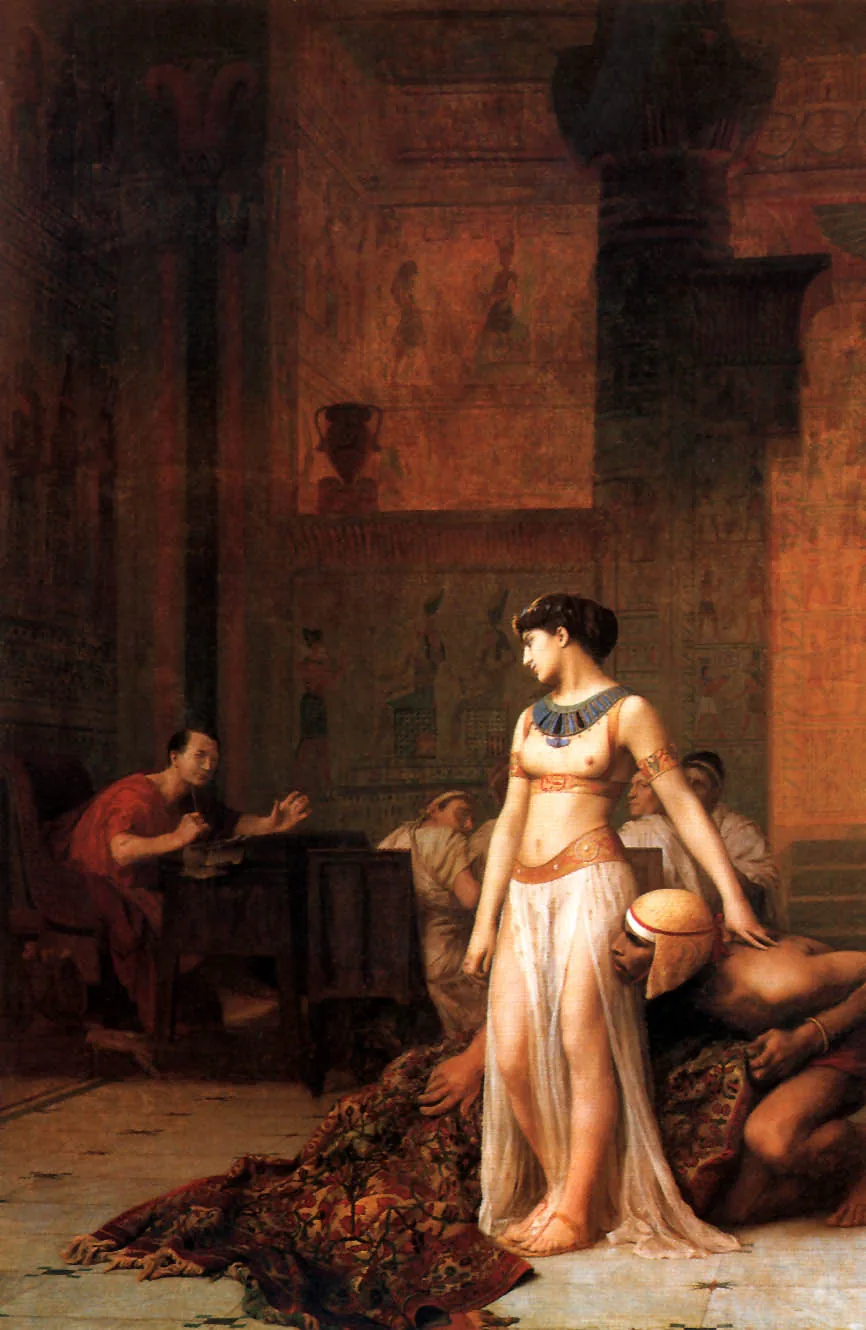
Jean-Léon Gérôme, Cleopatra before Caesar, 1866, oil on canvas · Public domain · Source page
The famous image of Cleopatra unrolling from a carpet before Caesar is not in Plutarch. Later retellings, and paintings like this one, show a carpet where Plutarch has a bed-sack. Jean-Léon Gérôme's painting of 1866 is an example: an artist imagining a scene nearly 1,900 years after it happened.
47 BC
The palace war
The fighting in the streets and by the harbour lasted for months, and the sources give only rough figures. In early 47 BC the king, Ptolemy XIII, was lost in the Nile, and most accounts say he drowned while trying to escape. Caesar restored the throne to Cleopatra, with her younger brother Ptolemy XIV as partner in name only.
Later that year she bore a son, Ptolemy Caesar, whom people would call Caesarion, ‘Little Caesar’. She claimed that Caesar was his father.
Myth
Caesar burned the great Library of Alexandria, and with it the learning of the ancient world.
The truth
The sources do not agree on how much was destroyed, or even whether the building itself burned. Plutarch says a fire that began in the dockyards spread and destroyed the Library of Alexandria. Seneca, writing about a century later, says forty thousand books burned at Alexandria, and does not mention the Library at all.
The evidence
None of the sources describes an order to burn books; they describe a fire during the fighting. Some historians think the books that were lost were kept near the harbour, not in the great building, but that is a theory without proof. What is certain is that nobody knows exactly what was kept, and what was lost.
Rome, Tarsus and the gilded barge
46–44 BC
Caesar's guest
Cleopatra came to Rome in 46 BC, and stayed in Caesar's villa across the Tiber. Romans noticed her, and some senators resented a foreign queen living in the city. In March 44 BC Caesar was stabbed to death in the Senate house, as the lesson on the Ides of March tells. She left Rome soon afterwards, and the city was soon at war with itself again.
A decision point
You are Cleopatra, about twenty-eight.
41 BC, Cilicia, in what is now southern Turkey
Mark Antony, Caesar's old officer, now commands the Roman East. He is preparing a war against Parthia, the great empire beyond the Euphrates, and needs money and ships. He has sent for you, and the order is to meet him in Cilicia, the region of southern Turkey.
Egypt is rich, and Antony needs its money and grain. Some of your advisers warn that Antony is a dangerous man to trust. Others say that a queen who ignores an order from the strongest Roman in the East may lose her crown next year.
What do you do?
- Go in plain dress as a petitioner, plead Egypt's case and apologise for the past He would see a supplicant, not a partner. You might be kept waiting, or made to pay twice for every favour.
- Sail up the river to meet him in state, in your own splendid barge You would show that Egypt is rich and that you depend on no one. He might be dazzled, or he might take the display as an insult from a queen.
- Refuse to go, and send gifts and a letter in your place You would avoid a dangerous meeting. But Antony could treat Egypt as an enemy, or take what he needs from its treasury without asking.
What really happened
Sail up the river to meet him in state, in your own splendid barge
In Plutarch's story the barge worked: Antony was captivated, and he followed her to Alexandria, where they spent the winter together. The political result was an alliance. Egypt's money went to Antony's armies, and Egypt gained the backing of the strongest Roman in the East.
Why choose display? Plutarch gives a romantic answer. A better one is that a Hellenistic queen used display to speak the language of Greek kings: wealth, a splendid court, and a stage on which she was the equal of a Roman commander.
Many historians think the politics mattered more than the romance. Whoever sailed up that river was speaking for Egypt.
Source: Plutarch: a goddess on a golden boat
“… to sail up the river Cydnus in a barge with gilded poop, its sails spread purple … She herself reclined beneath a canopy spangled with gold, adorned like Venus in a painting.”
Plutarch wrote about a century and a half after these events, for readers who knew the Roman stories. He was a Greek moralist, not an eyewitness, and he loved a vivid scene.
- Who wrote this, when, and why? Plutarch, a Greek writing in the early second century AD, about a century and a half later. He wrote biographies to teach moral lessons, and a golden barge makes a good lesson.
- What is the writer trying to make us see? A goddess on a golden stage. The picture makes Cleopatra a spectacle, which tells us more about the story's appeal than about what happened that day.
- What is missing from the scene? The politics: Antony's war against the Parthians, Egypt's money and the alliance. Plutarch writes about charm, not policy.
41–40 BC
A winter in Alexandria
Antony followed her to Egypt. Plutarch says the winter passed in feasts and pleasures, and that the company around them called itself ‘the Inimitable Livers’. Behind the banquets lay money and planning: Antony's army needed grain and silver, and Alexandria was where he and she could supply them.
Their bond lasted for years. From here on Rome began to see Cleopatra as a threat not only to its politics, but to its moral order.
Twins, a war and the gifts
40 BC
Two children, two titles
In 40 BC Cleopatra bore twins, a boy and a girl, Alexander and Cleopatra. Antony gave them titles that said exactly what he hoped for them: Sun and Moon. In the same period Antony had married Octavia, the sister of Octavian, as part of a political deal between Rome's two strongest men. Octavia was his Roman wife, and Cleopatra was a foreign queen; both were in his life at once.
So Antony lived between two worlds. He had a wife in Rome and a queen in Alexandria, and the double life became a powerful weapon in Octavian's propaganda against him.
36 BC
A campaign against Parthia
Antony planned a great campaign against Parthia, to avenge the Roman defeat of 53 BC. His army became stranded in long marches through mountain country, and many of his men were lost in the retreat. Egypt's money and grain helped keep the army in the field, and without them it is hard to see how he would have held together.
The retreat counts as a military failure. It did not remove Antony from power in the East, but it made the alliance with Alexandria more important than ever.
37–36 BC
Land for an alliance
Antony gave Cleopatra lands along the eastern Mediterranean coast. In Plutarch's list these were Phoenicia, Coele Syria, Cyprus and a large part of Cilicia: coastal regions rich in harbours, islands and trade. They were part of the bargain between the two of them, and Rome had not agreed to it.
The Romans heard about the gifts, and they did not forget them. In Rome the alliance began to look less like a private affair and more like a transfer of Roman power to a foreign queen.
34 BC
The Donations of Alexandria
In 34 BC Antony held a great public ceremony in Alexandria. He declared Cleopatra queen of Egypt, Cyprus, Libya and Coele Syria, and named her sons by him ‘kings of kings’. Caesarion, whom the Romans saw as Caesar's son, was given a special place in the ceremony. The event is called the Donations of Alexandria, and it looked as if Antony were sharing out the Roman East as his own property.
Octavian turned the ceremony into a weapon. In his propaganda, the Donations proved that Antony had betrayed Rome and given the East to a foreign woman. Octavian used the ceremony to present the coming war as one between Rome and Egypt, not only between two Roman leaders.
Herod and the balsam
40–37 BC
A king under protection
Herod was made king of Judea by the Roman Senate in 40 BC, with the support of Antony and Octavian, and in 37 BC he took Jerusalem with Roman help. He was what the Romans called a client king: his throne rested on Roman approval, and his borders on the goodwill of Rome's leading men.
His kingdom included the Judean hills, the Jordan valley and the country around Jericho. There grew the balsam shrubs, whose resin was valued as a medicine and as a costly perfume. Whoever controlled the balsam controlled income and trade, and every ruler wanted it.
34 BC
The guest on her way home
In 34 BC Antony led a campaign into Armenia, and Cleopatra went with him as far as the Euphrates, according to Josephus. On the way back to Egypt she came through Judea and met Herod there. The usual dating is 34 BC, though some chronologies put the meeting a year earlier.
She did not come as a casual guest. Antony had already given her wide lands, and she had asked him for more, including parts of Judea and Arabia. Her claim was financial, and for Herod the question was political.
A decision point
You are Herod, king of Judea.
34 BC, Judea
Cleopatra, queen of Egypt and Antony's partner, is on her way home from his Armenian campaign. She has come through your kingdom with an escort, and she has a request: Antony has given her wide lands, and she wants more. Among other things she claims the income from the balsam groves near Jericho, and the Arabian lands on your border.
Your advisers are divided. Some say that a queen now in your power is a chance that will not come again. Others say that Antony's favour is worth more than any income, and that an insult to his partner would be a mistake you could never undo.
What do you do?
- Keep her in your power, as a guest who is not allowed to leave Antony would take it as an insult to his partner. Your kingdom would become a target in a quarrel between Rome's strongest men, and anything you gained, Antony could take back.
- Receive her with honour, give her gifts, and rent from her the revenues of the Jericho lands and Arabia You keep Antony's favour and gain a valuable income, and she leaves with gifts. But you would be paying her for rights in your own land, and that looks like humiliation.
- Refuse to receive her in person, and send envoys to negotiate a lease on the revenues You avoid a face-to-face meeting that could go wrong. But Antony's partner would take the cold treatment as an insult, and the deal would be harder to close at a distance.
What really happened
Receive her with honour, give her gifts, and rent from her the revenues of the Jericho lands and Arabia
Josephus says Herod received her with honour, leased from her the income from the Arabian lands and from the region around Jericho, where balsam grew, gave her gifts, and sent her on her way to Egypt. According to Josephus, Herod called his friends together to ask whether he should kill her, now that she was in his power. Some urged him to do it, but in the end his friends would not let him. No one was killed.
Herod owed his throne to Rome and needed Antony's goodwill. A friendly reception kept the most powerful Roman in the East on his side, and the revenues were worth the price. Josephus does not explain Herod's reasons in detail, so money and politics are the best guide we have.
Killing her would have been a crime with no clear gain. Josephus makes the restraint of Herod's friends the turning point, which makes the king look merciful. That is a choice made by the writer, and we should read it as one.
Source: Josephus: a king, a guest and money
“… This country bears that balsam, which is the most precious drug that is there, and grows there alone.” … “So he treated Cleopatra kindly, and made her presents, and conducted her on her way to Egypt.”
Josephus was a Judean commander who surrendered to the Romans in AD 67, and then wrote in Rome under the Flavian emperors for a Roman and Greek audience. He finished the Jewish Antiquities around AD 93, more than a century after these events.
- What does Josephus stress about Herod's behaviour? Restraint: the king is shown turning away from the advice to kill, which makes him look wise and merciful. A story about a ruler's mercy is also a story about the ruler's image.
- What is missing from the record? Cleopatra's own voice. Nothing she said at this meeting survives. We know her only through the men who met her, and through a writer who needed her to make the story work.
- Why does money matter in the story? Josephus mentions income twice: the lease and the balsam. Money turns the visit into a political transaction, not only a royal visit. A careful reader asks what Josephus chose to emphasise, and what he left aside.
Actium: the queen's ships
32 BC
A war against a queen
By 32 BC Octavian and Antony, who had shared power in the Second triumvirate since 43 BC, were rivals for power in Rome and in the East. Octavian made public the contents of Antony's will. His propaganda presented the struggle as a war against a foreign queen, rather than against a Roman general. Rome declared war on Cleopatra.
It was hard for Antony to answer this. Egyptian money was in his army, and many Romans no longer saw that army as Roman.
A decision point
You are Cleopatra, about thirty-nine.
2 September 31 BC, the Gulf of Actium
The sea battle off western Greece has gone on since the morning, and its outcome is still unclear. Octavian's fleet is pressing hard, and Antony is in the middle of the fight aboard his great ship. Cassius Dio says the battle stayed undecided for a long time.
You command a squadron of sixty ships on the edge of the battle, and your treasure is aboard. Some of your men want to fight on beside Antony to the end. Others want to save the ships and the gold, and go home.
What do you order?
- Stay in the line and fight to the end, beside Antony You might share a victory, or a defeat that ends everything. If the squadron is lost, Egypt has no navy, and Octavian takes your treasure too.
- Raise the signal and sail with your squadron and your treasure for Egypt You would save the gold and the core of Egypt's fleet, and keep a kingdom to defend. But Antony would be left in the fight, and his allies would read your flight as desertion.
- Send envoys to Octavian now, to offer terms before the fleets are destroyed A deal might save your kingdom and some of your people. But Octavian had no reason to make terms while the battle was undecided, and such an offer would brand you as a traitor in Antony's camp.
What really happened
Raise the signal and sail with your squadron and your treasure for Egypt
According to Plutarch, Cleopatra's sixty ships were seen hoisting their sails and running out of the battle. When Antony saw her ship sailing off, he left his own fleet behind, took a galley and followed her, and she took him aboard. His fleet fought on, and it was broken.
The battle itself is told in the Actium lesson. What matters here is the queen's choice: to save her gold and her kingdom first.
Historians have argued for more than a century: was the breakout a plan, or a panic? Plutarch says that when Antony saw her go, he forgot everything else. That line points to a love story, and Octavian's propaganda called it treason.
The choice can be read as practical: the queen tried to save what she had, her treasure, her fleet and her crown. But she also left her partner in the fight, and that is why many remember her as a betrayer.
31–30 BC
The fleet breaks, the kings remain
Antony's fleet was broken at the battle, and his army and navy then wore away. Many of his men deserted him. Octavian moved his army east and invaded Egypt. Antony and Cleopatra returned to Alexandria and tried to raise forces, but Egypt had few soldiers left, and the city had little hope.
The sources describe feasts in Alexandria, plans for a last fight, and talk of flight. In these months the queen appears as someone planning fast: she sends envoys, tries to buy time, and looks for a way to keep her house.
Source: A coin with a queen on it
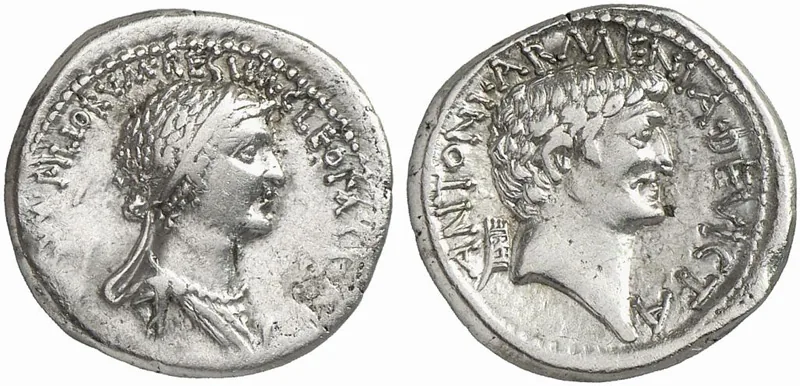
Denarius of Mark Antony and Cleopatra, c. 32–31 BC. Classical Numismatic Group, 2010 (photo) · CC BY-SA 2.5 · Source page
“CLEOPATRAE REGINAE REGVM FILIORVM REGVM” (the Latin legend). Translation: ‘Of Cleopatra, queen of kings, and of her sons, kings of kings’
A silver denarius. Several varieties of this coin exist, and their dates vary by type. This one is usually dated to about 32–31 BC.
- Whose name comes first, and what does that say? The legend gives Cleopatra's title before her sons. A Roman-minted coin that puts a foreign queen first is exactly what Octavian's propaganda would make much of.
- Who was the coin meant for? Antony's soldiers were paid in coins like this, and the design told them whose men they were. The legend is in Latin, so Roman officers could read it too.
- What is missing from the coin? Octavian, and the Republic he claimed to defend. The coin shows one side of the argument: the queen and her kings. The other side is in Octavian's propaganda.
The end, the story and the argument
1 August 30 BC
The gate that opened
Octavian's army reached Alexandria in the summer of 30 BC. Antony's last cavalry went over to the enemy, and the city opened to Octavian on 1 August. According to Plutarch, Antony was told that the queen was dead, and fell on his own sword. He died in her arms, in the building where she had shut herself in. Octavian wanted her alive to display in his triumph in Rome, and offered her terms if she surrendered.
August 30 BC
The last negotiation
Cleopatra tried to negotiate, and perhaps hoped to save Egypt for Caesarion or for her children with Antony. The Romans watched her closely. Within about ten days she was dead in Alexandria. The date given is 10 or 12 August 30 BC. All the sources agree that she died in the city, and that Octavian did not get to display her in his triumph.
Myth
Cleopatra died of a snakebite: a poisonous asp was brought to her in a basket of figs, and she let it bite her.
The truth
Nobody knows how she died. Plutarch and Cassius Dio both tell the asp story, but with different details: a basket of figs with a snake hidden under the leaves (Plutarch), or a snake brought in a water-jar or hidden in flowers (Dio). Plutarch also mentions poison kept in a hollow comb hidden in her hair, and Dio writes that she prepared to die ‘as painlessly as possible’.
The evidence
Plutarch writes: ‘the truth of the matter no one knows’. Dio writes: ‘No one knows clearly in what way she perished’. Some say two faint marks were seen on her arm, but marks like that can come from many things. The asp story suits the picture of a queen who chose death over a Roman triumph. That does not prove that it happened. In 2010 the German historian Christoph Schaefer suggested, in a television documentary, that she may have been poisoned with a mix of plant poisons, such as opium and hemlock. It is a hypothesis, not a settled answer.
What came after
- 41 BC Tarsus. Cleopatra meets Antony in Cilicia, and their alliance begins.
- 2 September 31 BC Actium. Cleopatra's squadron sails for Egypt, and Antony follows her.
- 1 August 30 BC Alexandria falls. Antony takes his own life, and Octavian takes the city.
- 10 or 12 August 30 BC Cleopatra dies in Alexandria. The sources disagree on how.
- 30 BC Octavian has Caesarion put to death, after his mother's death. Egypt becomes a Roman province, governed by a prefect of the equestrian class rather than by a senator.
- Later Her daughter Selene marries Juba II, king of Mauretania, who had grown up in Rome. The younger children of Cleopatra and Antony were taken into Octavia's household and reared with her own children.
What do the enemies' words tell us?
Can we know Cleopatra from sources written by her enemies?
- Duane W. Roller (2010), a biographer who uses Egyptian and Ptolemaic evidence Yes, if we read with care. The Roman texts are biased, but inscriptions, coins and Ptolemaic documents let us test them. The case for this view is that she ran a state, negotiated, and used every tool she had, not only charm.
- Ronald Syme (1939), in The Roman Revolution No, not without suspicion. Syme argued that the history of Augustus's age was shaped by the regime's propaganda. On this view, later Roman writers repeated what the regime wanted, so every detail about her is a claim someone had a reason to make.
Both sides agree that Octavian's propaganda shaped the record. They disagree about how much is left once it is removed. If one letter in her own hand were found, would the argument change?
Check yourself
Which dynasty did Cleopatra belong to?
Answer: The Ptolemies, a Greek-Macedonian family that ruled from Alexandria. Right. Ptolemy I, a general of Alexander, founded the line, and became king in 305 BC.
Check yourself
According to Plutarch, how did Cleopatra get into the palace to see Caesar?
Answer: Inside a bed-sack, carried in by her friend Apollodorus. Right. Plutarch names Apollodorus, who tied the sack with a cord and carried it in.
Check yourself
What does Plutarch say about Cleopatra's looks?
Answer: Her looks were not outstanding, but her talk and her languages charmed. Right. Plutarch says her beauty was ‘not altogether incomparable’, but that conversation with her had an irresistible charm.
Check yourself
What did Herod do, according to Josephus, when Cleopatra came to Judea?
Answer: He honoured her, rented her revenues and sent her away with gifts. Right. Josephus says Herod leased the revenues from Arabia and the Jericho region, and sent her on her way with gifts.
Check yourself
What do the ancient sources say about how Cleopatra died?
Answer: Plutarch and Dio tell different stories, and neither is sure. Right. The details differ, and both writers admit the uncertainty.
Check yourself
Which ancient writer says that forty thousand books were burned at Alexandria?
Answer: Seneca, in his essay on tranquillity of mind, at chapter nine. Right. Seneca wrote about a century after the fire, and gives the number without naming the Library.
Terms
- Ptolemies The Greek-Macedonian dynasty that ruled Egypt from 305 BC until Cleopatra's death. Its founder was Ptolemy, a general of Alexander, and its kings were named Ptolemy.
- pharaoh The title of the rulers of ancient Egypt. The Greek rulers took it too, and appeared on temple reliefs in the dress of pharaohs.
- Hellenistic The age after Alexander the Great (323–30 BC), when Greek language and culture spread across the eastern Mediterranean and the Near East. The Ptolemaic kingdom was one of its states.
- triumvirate A board of three who share power. The Second Triumvirate, from 43 BC, joined Octavian, Mark Antony and Lepidus in an office granted power to set the state in order.
- denarius Rome's standard silver coin. Generals struck denarii to pay their soldiers, and to remind them whose men they were.
- client king A king whose throne rested on Roman approval and Roman protection. Herod, king of Judea, was a client king of Rome.
- Donations of Alexandria A ceremony in Alexandria in 34 BC, where Mark Antony declared Cleopatra and her children rulers of Roman lands. Octavian used it in propaganda against Antony.
- balsam A fragrant resin from a shrub that grew mainly near Jericho. It was valued as a medicine and as an expensive perfume.
- Caesarion ‘Little Caesar’: Cleopatra's son, born in 47 BC, whom she claimed as Caesar's son. He was put to death in 30 BC, after his mother's death.
- Library of Alexandria The famous collection of books of the Ptolemaic kings in Alexandria. Its size is uncertain, and so is what was lost from it, and when.
- Alexander the Great The king of Macedonia who built a huge empire in the east. After his death his generals shared it out.
- Ptolemy XII Cleopatra's father. His rule was never secure, and he borrowed heavily from Roman bankers.
- Ptolemy XIII Cleopatra's younger brother. He was meant to be her husband and co-ruler, and he was lost in the Nile.
- Ptolemy XIV Cleopatra's second younger brother. He was her co-ruler in name only.
- Pompey A Roman general and rival of Caesar. After his defeat he was killed on the coast of Egypt.
- Pharsalus A place in Greece where Caesar defeated Pompey.
- Plutarch A Greek writer who wrote lives of famous Greeks and Romans. He wrote about a century and a half after these events.
- Seneca A Roman philosopher and teacher. He wrote about books burned at Alexandria, about a century after the events.
- Cassius Dio A Roman historian who wrote about the battle of Actium and about Cleopatra's death.
- Josephus A Judean historian who surrendered to the Romans and wrote in Rome about the Jewish past.
- Herod King of Judea, installed with Rome's support. He met Cleopatra on her way home to Egypt.
- Jericho A city in the Jordan valley. Balsam shrubs grew around it.
- Armenia A mountainous land north of the Euphrates. Antony led a military campaign into it.
- Parthia A great empire beyond the Euphrates, Rome's rival in the East.
- Euphrates A great river in the Middle East, flowing through today's Iraq.
- Cilicia A coastal region in the south of today's Turkey.
- Actium A place on the west coast of Greece, where a great sea battle was fought between Octavian's and Antony's fleets.
- Octavian Caesar's heir and a Roman ruler. He defeated Antony and Cleopatra.
- Octavia Octavian's sister and Antony's Roman wife.
- Mark Antony A senior Roman officer under Caesar, who ruled the Roman East. He was Cleopatra's partner.
- Apollodorus A Sicilian, the only friend with Cleopatra, who carried her into the palace inside a sack.
- Jean-Léon Gérôme A French painter. His painting of 1866 shows Cleopatra on a carpet, unlike Plutarch's bed-sack.
- Ides of March The date on which Caesar was murdered in the Senate house in Rome.
- Roman Senate The highest governing body in Rome, made up of the city's leading men.
Sources
- Plutarch, Life of Antony 25–28, 36, 54, 66–67, 85–87, trans. Bernadotte Perrin, Plutarch's Lives IX (Loeb Classical Library, 1920)
- Plutarch, Life of Caesar 48–49, trans. Bernadotte Perrin (Loeb Classical Library, 1919)
- Flavius Josephus, Jewish Antiquities 15.88–103, trans. William Whiston (1737)
- Cassius Dio, Roman History 50–51, trans. Earnest Cary (Loeb Classical Library, 1917)
- Seneca, On Tranquillity of Mind 9.5, trans. J. W. Basore (Loeb Classical Library, 1932)
- Duane W. Roller, Cleopatra: A Biography. Oxford University Press, 2010.
- Ronald Syme, The Roman Revolution. Oxford: Clarendon Press, 1939.
- Rogue Classicism, ‘Cleopatra's death: another theory’ (29 June 2010), quoting the Telegraph on Christoph Schaefer's poison hypothesis
Image credits
- Relief of Cleopatra VII and Caesarion, temple of Hathor, Dendera, Egypt, 2011. Photo: Olaf Tausch · CC BY 3.0 · Source page
- Head of a woman identified as Cleopatra VII, Altes Museum, Berlin, 2017. Photo: José Luiz · Public domain · Source page
- Jean-Léon Gérôme, Cleopatra before Caesar, 1866, oil on canvas · Public domain · Source page
- Denarius of Mark Antony and Cleopatra, c. 32–31 BC. Classical Numismatic Group, 2010 (photo) · CC BY-SA 2.5 · Source page


