Churchill: the man, the decisions and the myths
Churchill's speeches contain lines the whole world knows, but not all of them were said the way we remember. What really happened in the cabinet room in May 1940, and which legends about the man are not true?
Decisions, questions and your own progress, in the app
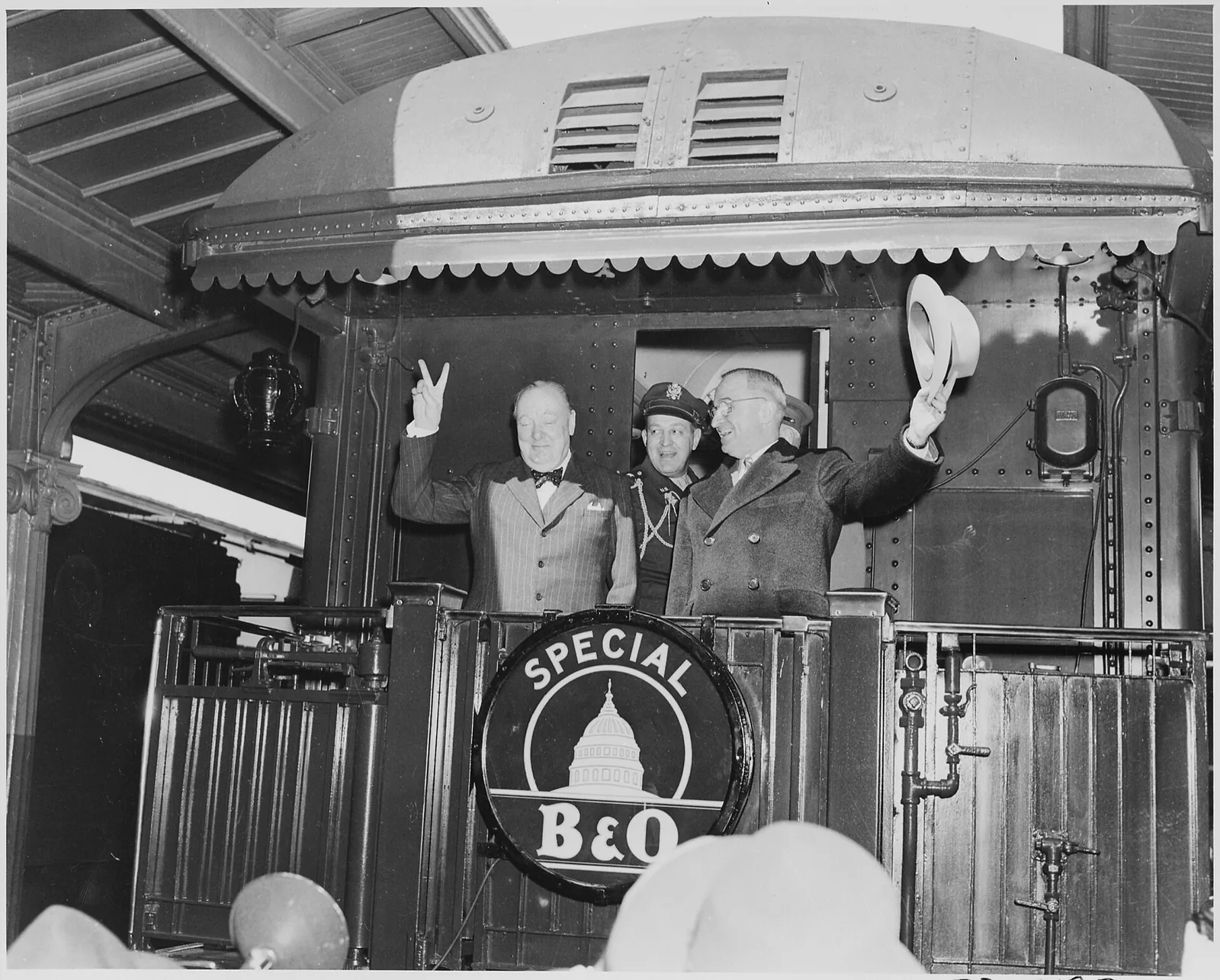
US National Archives (NARA), photograph by Abbie Rowe, about 4 March 1946 · Public domain · Source page
The gunfight in the East End
A minister at a gunfight
In January 1911 a gunfight raged in the East End of London. Three men, who had already killed police officers, were trapped in a house on Sidney Street, and police and soldiers were firing at it.
On the scene, close enough to be photographed, stood the Home Secretary. He was the minister in charge of the police. What was he doing there?
Winston Churchill
A soldier, war correspondent and politician, who led Britain as prime minister in the Second World War.
- Born: 30 November 1874
- Died: 24 January 1965, London
- Won: Nobel Prize in Literature, 1953
- Lost: Lost the general election, July 1945
I have nothing to offer but blood, toil, tears and sweat.
Background
A war correspondent in the Boer War
Churchill had been an army officer, and then he went to South Africa as a correspondent for a London newspaper during the Boer War. In November 1899 he was captured by the Boers and held in Pretoria.
In December he escaped. He got away on a freight train, then hid in a coal mine until he could reach Portuguese East Africa, which is Mozambique today. The escape made his name in Britain, and the young prisoner became a public figure.
Home Secretary
A minister in the East End
By 1910 Churchill was Home Secretary, the minister in charge of the police and of law and order in Britain. In January 1911 the police traced three armed men to a house on Sidney Street in the East End. The men had already killed police officers. Now they would not come out, and the house was surrounded.
Churchill went to the scene himself. The siege ended when a fire broke out in the house. The photograph below was printed in the Illustrated London News on 7 January 1911, and it shows whom the paper thought the story was about.
Source: The scene, as a newspaper printed it
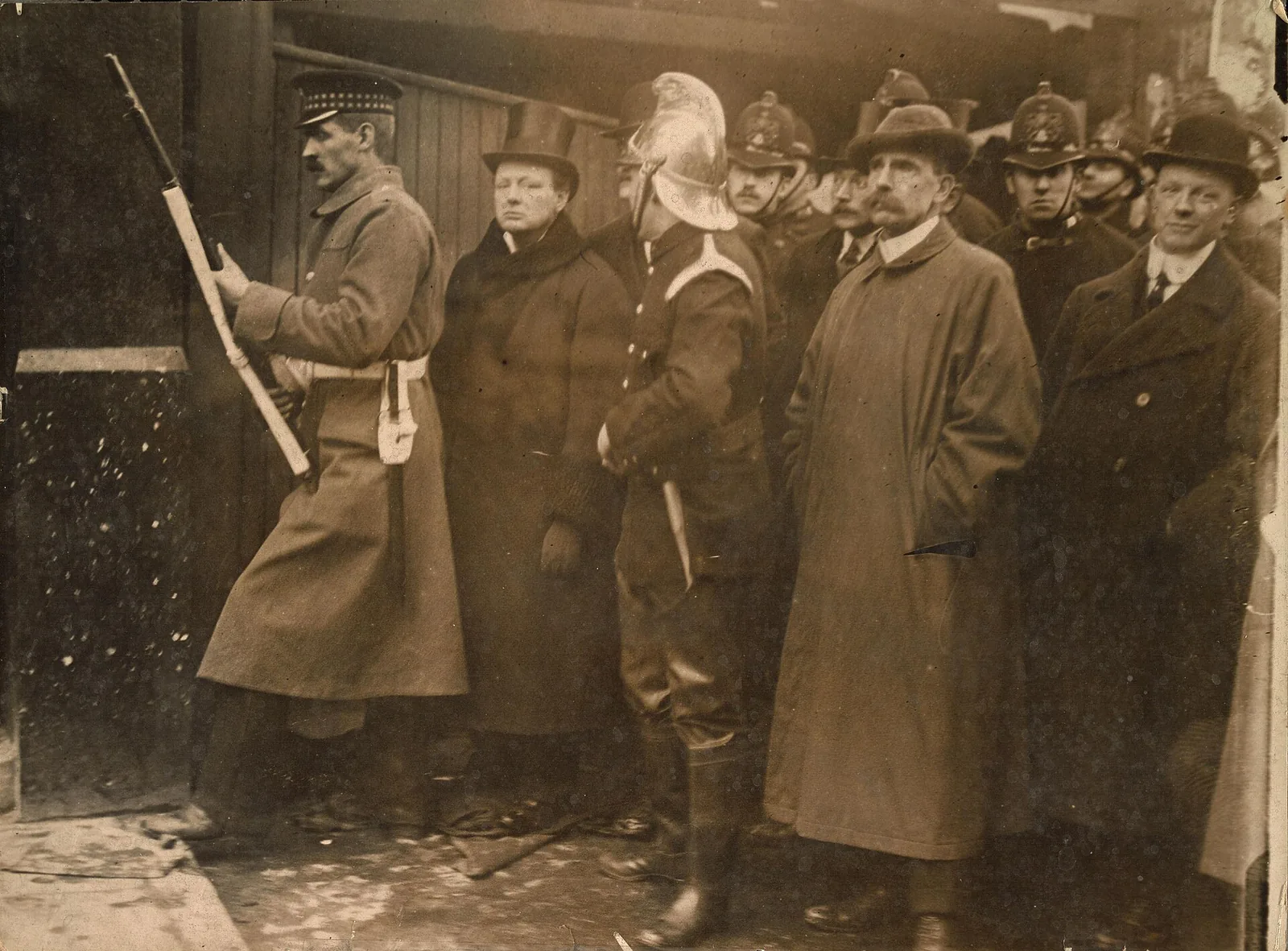
The Illustrated London News, 7 January 1911, page 6 · Public domain · Source page
The Illustrated London News, 7 January 1911, page 6
A weekly picture paper, read by readers who wanted pictures of dramatic events. The article on this page is about soldiers in action, and the caption names the minister. Standard accounts identify the man in the tall hat, second from left, as Churchill.
The page's six photographs are credited to picture agencies, so we do not know for certain who took this one.
- The article is about soldiers, and the caption names the minister. Why would the paper do both? The picture sells two stories at once: a dramatic event with soldiers in action, and a minister who was there. The reader sees a state at work, with a well-known politician at its centre.
- Who chose the frame, and what does it leave out? The photographer chose where to stand, and an editor chose which of six photographs to print. The frame shows men by a wall and a soldier with a rifle. It leaves out the house, the danger and the fire that ended the siege.
- Is a 1911 press photograph a neutral record of the siege? No. It shows what the paper chose to print, with a caption written for readers. Its value to a historian lies in what it teaches about how the paper wanted its readers to see the minister and the event.
The Dardanelles plan
Background
A strait, a fleet and a closed route
At the end of 1914 the Ottoman Empire joined the war on Germany’s side. The Dardanelles, the narrow strait that links the Aegean Sea with the Sea of Marmara, were in Ottoman hands. Ships that forced the strait could reach Constantinople, the Ottoman capital, and from there the Russian ports on the Black Sea.
Russia was Britain’s ally, and it badly needed supplies. Its Black Sea ports could not be reached from the west.
The Admiralty
The First Lord of the Admiralty
Churchill was the First Lord of the Admiralty, the minister in charge of the Royal Navy. In early 1915 he pushed a simple plan: battleships would force the straits. The reports that reached London described weak forts along the Dardanelles, a thin Ottoman army on the Gallipoli peninsula, and a fleet that could get through quickly.
The ships that were available were older battleships, and not all of them were suited to the task. But the navy was ready, and time was short.
A decision point
You are Winston Churchill, First Lord of the Admiralty.
London, early 1915.
Reports reaching you say that the Dardanelles can be forced from the sea. The forts look weak, and the fleet can be ready quickly.
But some advisers point out that ships cannot hold ground, and no troops are ready to land. If the ships fail, you will lose ships and men, and the navy’s name will suffer. The Russians are waiting for supplies, and you know they will not wait for ever.
What do you propose?
- Send the battleships to force the straits from the sea alone, now. Probably the fleet tries to force the straits without troops on shore. Mines and gun batteries can stop ships, and the losses could be heavy. A failure would hurt the navy, and the army would be called in afterwards.
- Wait and plan a joint attack, with ships and troops together and time to prepare. Probably the attack comes later, with more men and better planning. But waiting gives the Ottomans time to strengthen the defences, and the Russians wait longer for supplies.
- Drop the straits and put the navy’s effort into the Western Front. Probably Russia stays cut off from its allies’ supplies, and the Ottoman defences stay as they are. But the main front in France and Belgium gets the men and guns it asks for.
What really happened
Send the battleships to force the straits from the sea alone, now.
In the event, the naval attack came first. On 18 March 1915 the ships tried to force the strait. Mines and the guns on the shore hit the fleet, and the attack failed.
On 25 April 1915 troops landed on the Gallipoli peninsula, among them Australian and New Zealand forces. The plan failed to break inland, and the Ottoman defenders held the ground.
In May 1915 a coalition government was formed, and Churchill was moved out of the Admiralty. In November 1915 he resigned from the government.
Churchill argued for speed. A quick naval victory, he believed, would open the way to Constantinople and to Russia, and might knock the Ottoman Empire out of the war. The plan rested on reports of Ottoman troop strength that proved wrong, and on the belief that ships could get through quickly.
Whether the plan was his alone, or a shared failure of planning and intelligence, is still argued. Historians disagree, and see the panel below.
25 April 1915
A narrow, steep beach
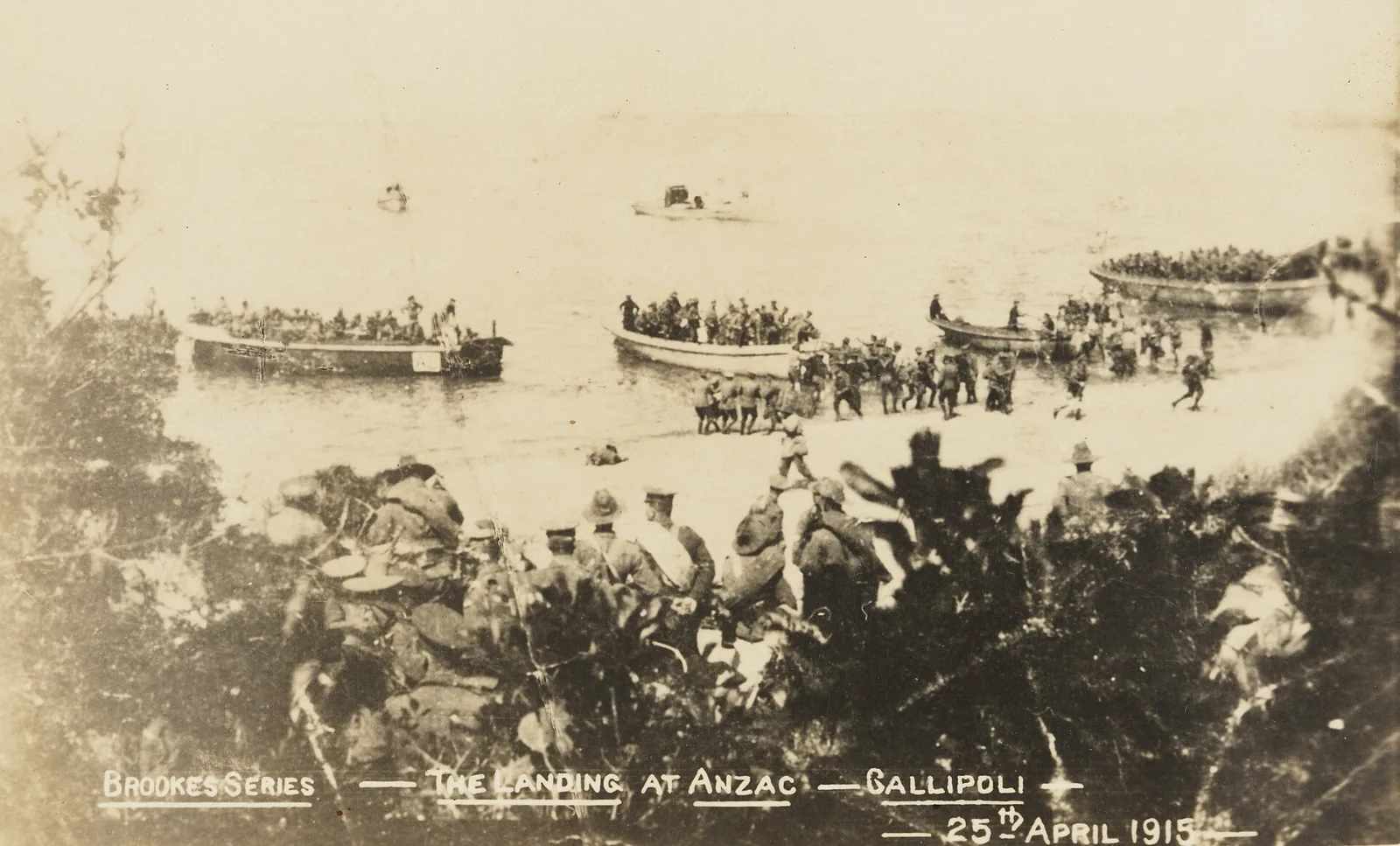
Brookes Series postcard. State Library of New South Wales, PXB 592 · Public domain · Source page
Early on 25 April 1915, Australian and New Zealand troops came ashore on a steep, narrow beach. The cove was later named ANZAC Cove, after the corps that landed there.
The men held the beach, but they could not push inland.
The cost
Losses on both sides
The campaign dragged on for months, under fire, in the heat, with disease and little water on both sides. British, Australian, New Zealand, French and Ottoman soldiers were killed or wounded in their tens of thousands. The losses on each side deserve the same words.
When people speak of Gallipoli, they should remember that it was not only one side’s story. The Ottomans lost men in the same way.
May 1915
Moved aside, and then gone
In May 1915 a coalition government was formed. The Conservatives agreed to join only if Churchill left the Admiralty. He was given a sinecure: Chancellor of the Duchy of Lancaster, an office with a title and a salary but almost no real work.
In November 1915 he resigned from the government. He then served on the Western Front until early 1916.
Words in the Commons
13 May 1940
A new prime minister speaks
On the day Churchill became prime minister, German forces invaded the Netherlands, Belgium and France. Three days later he rose in the House of Commons to present his new government.
This was not a speech of victory. He told the House what he had to offer, and it was not a promise of an easy time.
What was said
What he promised
He spoke about the new government and the men who had just joined it. He told the House what he had said to them: that he could promise little beyond effort and hardship, and that the country would have to bear both.
He did not promise a quick victory. He asked the House to work, and to hold on.
Source: The Commons record of 13 May 1940
“I have nothing to offer but blood, toil, tears and sweat.”
Hansard is the official record of what is said in Parliament. It was written up after the sitting from the official reporters’ notes, and it is not a sound recording.
- Who wrote this text, and when? The official reporters of Parliament, after the sitting, for the printed record. The text is what was written down, not necessarily the way the speech was delivered.
- Is this the phrase people remember? Not in this order. The record prints “blood, toil, tears and sweat”. The version “blood, sweat and tears” came later, as a rewording.
- What is missing from the record? The voice, the mood in the chamber and the reactions of the members. The record keeps the words and loses the delivery.
Myth
Churchill’s line was always “blood, sweat and tears”.
The truth
The Commons record of 13 May 1940 prints “blood, toil, tears and sweat”. The better-known version, “blood, sweat and tears”, is a later rewording: it drops “toil” and changes the order.
The evidence
The official Hansard record of 13 May 1940, which prints the words as they were written down from the notes of the reporters.
How a speech becomes a legend
The words get shorter
A speech in the Commons is heard once, by the members in the chamber. Then it is printed. Over the years the words are shortened and changed to be easier to remember, and each generation adjusts them to its own feelings.
The famous phrase is not always the phrase that was said.
Three days in the war cabinet
End of May 1940
Cut off on the coast
At the end of May 1940 the British forces fighting in France were cut off in the north and pushed back towards the port of Dunkirk.
In London sat the War Cabinet, a small group of the most senior ministers, which made the great decisions. Lord Halifax, the Foreign Secretary, favoured a negotiated settlement, and hoped that Mussolini would broker one.
27 May
A memo about Mussolini
On 27 May a memo by Halifax came up for discussion, proposing that Britain test whether Mussolini could broker an agreement. The War Cabinet met in seven top-secret sessions across three days, and two of them were adjourned and resumed.
Opinion in the room was divided. Some ministers thought it worth asking; others doubted that Hitler would offer fair terms at all.
A decision point
You are Winston Churchill, prime minister, in the Cabinet room.
London, 26–28 May 1940.
Your army is cut off in northern France, and it may lose much of its equipment within days. Halifax proposes to test whether Mussolini could broker a peace. You doubt that Hitler would deal fairly.
But some ministers are tempted by the idea. If you refuse outright, can you keep the government united, or will it split?
What do you decide?
- Let Halifax sound out Mussolini, with no promises. Probably the talks open a door to terms written in Berlin, or at least look that way. The British public would lose faith in its leaders.
- Refuse any approach and fight on. Probably Britain fights on alone, and saves what is left of its army. But allies and supplies are uncertain, and the cost in lives and money is unknown in advance.
- Keep the door open quietly, with no commitment, while the army gets away. Probably the talks leak, and the government looks divided. Mussolini and Germany gain time.
What really happened
Refuse any approach and fight on.
Churchill’s view prevailed. On 28 May he called a wider group of 25 senior ministers, the outer cabinet, and it backed fighting on unanimously. Halifax accepted the decision.
Churchill did not trust Hitler’s terms, and he thought any talks through a go-between would be read as weakness, even by Britain’s allies. Halifax believed that a broker might win better terms and protect Britain’s position and its army.
Both men saw the risk. They differed on whether talking was a trap or an opening. Historians disagree about how close the question came, and see the panel below.
Dunkirk
The army comes home
In the days that followed, the defeat in northern France went on, and many British soldiers were taken off the beaches by sea. Dunkirk was not a victory. But the evacuation brought many soldiers out of the trap and home to Britain.
The speech everyone remembers
4 June 1940
A statement to the House
On 4 June 1940 Churchill rose in the House of Commons to report on the war. The evacuation from Dunkirk ran through these same days. He described what had happened, and warned that Britain itself might be invaded.
He spoke for about half an hour, from 3.40 to 4.14 in the afternoon. The members listened, and the words went into the official record.
Myth
The famous 4 June speech was broadcast live to the whole nation.
The truth
It was spoken in the Commons, between 3.40 and 4.14 in the afternoon. That evening a BBC announcer read sections of it on the news. Churchill did not broadcast it, and he did not record it until 1949.
The evidence
The Commons record of 4 June 1940, and the British government’s history blog, which also says that the story of the actor Norman Shelley reading the speech on air is false.
1949
The recording that became the sound
In 1949 Churchill recorded the speech himself, years after it was delivered, so that later generations could hear it. That recording is the familiar sound of the speech.
When we hear it today, we are hearing a 1949 recording, not the voice of 1940.
The legend
A voice in the air
If the speech was not broadcast on the day, how did it become part of the national memory? It was read out, quoted in the news, printed in the papers, and later recorded. Each step made it seem as if the whole nation had heard it live.
Grain, ships and a famine
Bengal, 1943
A famine in ranges
In 1943 hunger spread through Bengal, a province in eastern India then under British rule.
This chapter does not show photographs of the dead. The numbers of the dead come later in the chapter, with their sources. What matters first is who made the decisions, and on what evidence.
Summer 1943
The Viceroy asks for grain
The Viceroy of India pressed London to send grain as hunger grew. In London the government had to decide where its ships would go, while the war was taking up a great deal of shipping.
On the official account, shipping was short. Ships were needed for the army, for the Mediterranean and for the planned operations of the coming year.
A decision point
You are Winston Churchill, prime minister, in the summer of 1943.
London, summer 1943. Bengal is short of food.
The Viceroy asks for grain. Getting it to Bengal depends on ships, and ships are wanted everywhere. Your officials say that shipping is short.
The army needs supplies in the Mediterranean, and the plans for the coming year also need ships. If you release ships for Bengal, the other plans lose them. If you do not, the famine may worsen.
Where do the ships go?
- Give Bengal’s grain imports first call on the ships available. Probably imports rise and deaths would fall, though not everywhere. The ships would be taken from the Mediterranean and the planned operations, and the forces there would have to wait.
- Keep the ships for the war effort and leave Bengal to manage its own supply. Probably imports stay small. Food would have to come from within the province, where stocks and prices were already a problem. Deaths from hunger and disease would probably rise.
- Ask the United States and Australia for ships and grain, and redirect cargoes already at sea. Probably some grain arrives, but it takes time. Allies have needs of their own, and the delay itself costs lives.
What really happened
Keep the ships for the war effort and leave Bengal to manage its own supply.
In the event, imports to Bengal stayed limited. The official reason given was a wartime shortage of shipping. Whether ships really were short is the question in dispute, and see the debate at the end of this chapter.
The government’s case was that the ships were needed for the war. Critics, among them Madhusree Mukerjee, say that the ships were in fact available. Historians disagree about who was responsible, and see the debate at the end of this chapter.
1944
The worst year
The famine ran through 1943 and 1944, and many of the deaths came in the second year. Not all of those who died starved directly: many died of diseases that spread among a population weakened by hunger.
Myth
The 1943 famine was a natural disaster: a severe drought that no one could have stopped.
The truth
A 2019 study led by Vimal Mishra and colleagues found no serious drought: rainfall in late 1943 was above average. It links the famine to policy failure rather than to a failure of the monsoon. How far Churchill was personally responsible remains disputed.
The evidence
The Guardian’s report on the study, March 2019, and the study itself in Geophysical Research Letters.
Who was responsible?
Who is responsible for the deaths of 1943–1944, and can the question of the ships be settled?
- Madhusree Mukerjee, Churchill’s Secret War (2010) Churchill is directly responsible. In her account, ships were available, and grain ships from Australia passed India on their way to the Mediterranean. She builds the case on ministry and private papers.
- Richard Langworth, a Churchill scholar writing on his blog, and the Churchill Centre Food was no scarcer in 1943 than in 1941. The defenders blame hoarding, wages, prices and the distribution of food within India.
- Amartya Sen, economist, in Poverty and Famines (1981) Sen counts between 2.7 and 3 million deaths in 1943–1946. This lesson gives only his count; his argument about the famine is in the book.
If the ships really were short, does that clear the government? If they were not, what evidence would prove it?
After the vote
July 1945
The vote and the count
On 5 July 1945 Britain voted. The war in Europe had ended in May, and the election felt like a decision about the future. The count was slow, partly because of ballots cast by voters who were away from home, and the result was declared on 26 July.
Labour won a large majority, with 393 seats. Churchill, leader of the Conservatives and prime minister in wartime, lost.
Leader of the Opposition
A former prime minister
Churchill remained an MP, and was now Leader of the Opposition. The Soviet Union, which had fought alongside Britain against Germany, now controlled much of eastern Europe. In London and Washington there were fears that the alliance on which victory had been built was coming apart.
Through 1945 and 1946 relations between Moscow and the West turned cold. There was no direct war, but a rivalry had begun that sometimes looked like a threat. Historians call the period that followed the Cold War.
A decision point
You are Winston Churchill, a former prime minister and Leader of the Opposition.
The United States, winter 1945–46.
You have been invited to speak at a college in a small town in the American Midwest. The President of the United States, Harry S. Truman, will travel with you and be present.
The Soviet Union controls much of eastern Europe. Relations with Moscow are cold, and some in London and Washington fear the tension will grow. Your speech will be read in every capital. What do you say?
What do you say, and how?
- Give a public speech on the division of Europe, and call for a close partnership between Britain and the United States. Probably the speech angers Moscow and divides opinion in Britain and the United States. The partnership becomes a public issue, and the Soviet response is sharp.
- Talk privately with Truman and say nothing in public. Probably the talk stays out of the press. Moscow sees no challenge, and the Western public stays unaware of the division. But the partnership would be built behind closed doors, with less public support.
- Give a speech on cooperation through the United Nations, without naming the Soviet Union. Probably the speech is welcomed, and the Soviet Union is not offended. But the warning the West wants to hear is missing, and the division is not named.
What really happened
Give a public speech on the division of Europe, and call for a close partnership between Britain and the United States.
On 5 March 1946 Churchill gave the speech at Westminster College in Fulton, Missouri, with Truman present. It is known as “The Sinews of Peace”, and it lasted about 46 minutes. He described the division of Europe, and called for a close partnership between Britain and the United States.
The speech became one of the best-known of the early Cold War, and its political effect is still argued over.
Churchill believed the West had to speak openly about the Soviet threat, and that only a close partnership with the United States could hold the line. He knew how to speak plainly, and he had the experience of wartime leadership behind him.
Critics said then, and some say now, that the speech damaged the wartime alliance and helped start the Cold War. Defenders say that he warned of a real danger. Both sides agree the speech mattered, and they disagree about whether it was right to give it.
Source: Setting out for Fulton
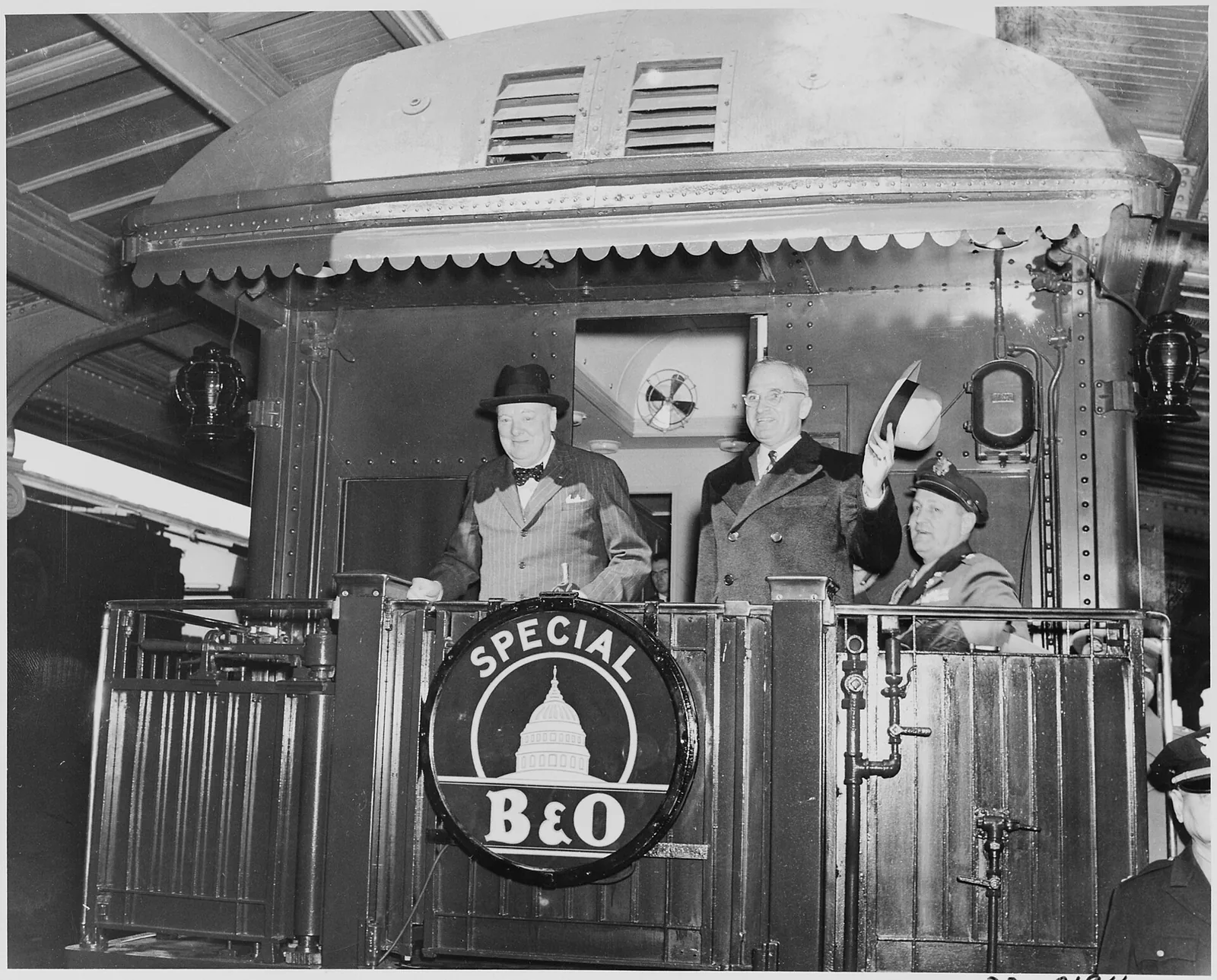
US National Archives (NARA), photograph by Abbie Rowe, about 4 March 1946 · Public domain · Source page
US National Archives (NARA), photograph by Abbie Rowe, about 4 March 1946
The photograph shows Truman and Churchill on the rear platform of a special Baltimore and Ohio train, setting out for Fulton. The sign on the train reads ‘Special B&O’. Official photographs like this present officials as a pair. Nothing in the picture says what the two men discussed.
- Who wanted this picture to look like this, and for whom was it made? Official photographers and the two governments, for the American and British press. A photograph of two leaders on a railway platform sends a message: they are close and in agreement.
- What does the picture not tell us? What the two men said to each other, and whether they agreed with the speech. A photograph shows posture and smiles, not positions.
- Is a photograph like this evidence of the relationship between the two men? Only in part. It is evidence of a public moment, which may have been arranged in advance. To judge the relationship, a historian needs letters, notes, the text of the speech and the reactions to it.
What came after
- May 1915 Churchill leaves the Admiralty, and the Gallipoli campaign goes on without him.
- November 1915 He resigns from the government, and by early 1916 his service on the Western Front is over.
- 28 May 1940 The outer cabinet backs fighting on, and Halifax accepts the decision.
- 1943–1944 Famine in Bengal. Many of the dead died in 1944, and many of them of disease.
- 26 July 1945 The election result is declared. Labour has won, and Churchill leaves office.
- 5 March 1946 The Fulton speech, which public memory links to the beginning of the Cold War.
Check yourself
In which year did Churchill win the Nobel Prize in Literature?
Answer: 1953. Correct. The Nobel committee honoured his historical and biographical writing, and his oratory, in 1953.
Check yourself
In the speech of 13 May 1940, which order is printed for the four things he offered?
Answer: blood, toil, tears and sweat. Correct. The Commons record prints the words in this order.
Check yourself
The speech of 4 June 1940 was:
Answer: spoken in the Commons, partly read by a BBC announcer, recorded in 1949. Correct. It was spoken in the Commons, a BBC announcer read parts of it that evening, and the recording dates from 1949.
Check yourself
In May 1915 Churchill was:
Answer: moved to Chancellor of the Duchy of Lancaster. Correct. It was a nominal post, with a title and a salary, and almost no work.
Check yourself
In the July 1945 election, the Labour Party won how many seats?
Answer: 393. Correct. Labour won 393 seats, a large majority. The result was declared on 26 July.
Check yourself
The Fulton speech was given on 5 March 1946 at Westminster College, in which US state?
Answer: Missouri. Correct. The speech was given at Westminster College in Fulton, Missouri.
Terms
- Hansard The official record of debates in the British Parliament. It is written up after each sitting from the official reporters’ notes. It is a written record, not a sound recording.
- First Lord of the Admiralty The British minister in charge of the Royal Navy and its administration. Churchill held the post until May 1915.
- the Dardanelles The narrow strait between the Aegean Sea and the Sea of Marmara, in Ottoman hands in 1915. The attempt to force it, in the Gallipoli campaign, failed.
- war cabinet A small group of the most senior ministers, which made the major decisions in wartime.
- outer cabinet A wider group of ministers and senior figures, beyond the small war cabinet. In 1940 it had 25 members.
- sinecure An office with a title and a salary, but almost no real work.
- Home Secretary The British cabinet minister responsible for the police, public order and internal affairs.
- ANZAC The Australian and New Zealand Army Corps, which landed at Gallipoli in 1915. The name became a word for the soldiers of both countries, and for their memory.
- Viceroy The chief representative of the British Crown in India, appointed from London and ruling in its name.
- Cold War The political, military and ideological rivalry between the Soviet Union and the United States and their allies after 1945, without direct war between them.
- Boers Descendants of Dutch settlers in South Africa. They fought the British in the Boer War.
- Pretoria A city in South Africa. Churchill was held there as a prisoner of the Boers.
- Mozambique A country in East Africa. At the time of Churchill's escape the area was called Portuguese East Africa.
- Gallipoli A peninsula near the Dardanelles, in today's Turkey. In 1915 British, Australian and New Zealand troops landed there, and the campaign failed.
- Ottoman Empire A large empire centred in Turkey, with many lands around it. It joined the First World War on Germany's side.
- Constantinople The capital of the Ottoman Empire. Today it is called Istanbul.
- Royal Navy The navy of Britain. It answers to the minister in charge of British warships.
- House of Commons The lower house of the British Parliament. Its members are elected.
- Conservative Party A major British party, the rival of the Labour Party.
- Labour Party A major British party. In 1945 it won the election by a large majority.
- BBC The British public broadcaster.
- Bengal A large province in eastern India, then under British rule. In 1943 a severe famine spread there.
- Halifax A British lord and Foreign Secretary during the war. He favoured a negotiated settlement with Germany.
- Mussolini The leader of fascist Italy, an ally of Germany in the Second World War.
- Harry S. Truman The President of the United States at that time. He was present at Churchill's speech in Fulton.
- Fulton A small town in Missouri, in the United States. Churchill gave a famous speech there in 1946.
- Missouri A state in the American Midwest.
- Aegean Sea A sea between Greece and Turkey. It is linked to the Sea of Marmara by the Dardanelles.
- Black Sea A large sea between Europe and Asia. Russia's ports on it could not be reached from the west during the war.
- Western Front The front in France and Belgium in the First World War, where the big armies fought.
- Sidney Street A street in east London. In 1911 armed men barricaded in a house there were besieged.
- East End A district of east London, long known as a working-class and poor area.
- Dunkirk A port in northern France. In May 1940 many British soldiers were evacuated by sea from there.
- Amartya Sen An economist who counted the deaths in the Bengal famine of 1943–1946.
Sources
- House of Commons, ‘His Majesty’s Government’, Hansard, 13 May 1940
- House of Commons, ‘War Situation’, Hansard, 4 June 1940
- The Illustrated London News, 7 January 1911, p. 6, photograph of the siege of Sidney Street
- Winston Churchill, ‘The Sinews of Peace’, Westminster College, Fulton, Missouri, 5 March 1946. Cambridge, Churchill Archives Centre, catalogue record
- Nobel Prize, ‘Winston Churchill: facts’, Literature 1953
- UK Government history blog, post of 2 December 2013 on Churchill’s speech of 4 June 1940
- John Lukacs, Five Days in London (1999)
- Benjamin Schwarz, review of John Lukacs, Five Days in London (2000)
- Madhusree Mukerjee, Churchill’s Secret War (2010)
- Kirkus Reviews, review of Madhusree Mukerjee, Churchill’s Secret War (2010)
- Amartya Sen, Poverty and Famines (1981)
- Vimal Mishra and colleagues, study of rainfall and the 1943 Bengal famine, Geophysical Research Letters (2019)
- The Guardian, 29 March 2019, report on the Mishra study of the 1943 Bengal famine
Image credits
- US National Archives (NARA), photograph by Abbie Rowe, about 4 March 1946 · Public domain · Source page
- The Illustrated London News, 7 January 1911, page 6 · Public domain · Source page
- Brookes Series postcard. State Library of New South Wales, PXB 592 · Public domain · Source page
- US National Archives (NARA), photograph by Abbie Rowe, about 4 March 1946 · Public domain · Source page


