Charles V and Luther at Worms, 1521
18 April 1521: a monk refuses to recant before a king of twenty-one, ruler of Spain and the Netherlands, elected to be emperor. They will never meet again.
Decisions, questions and your own progress, in the app
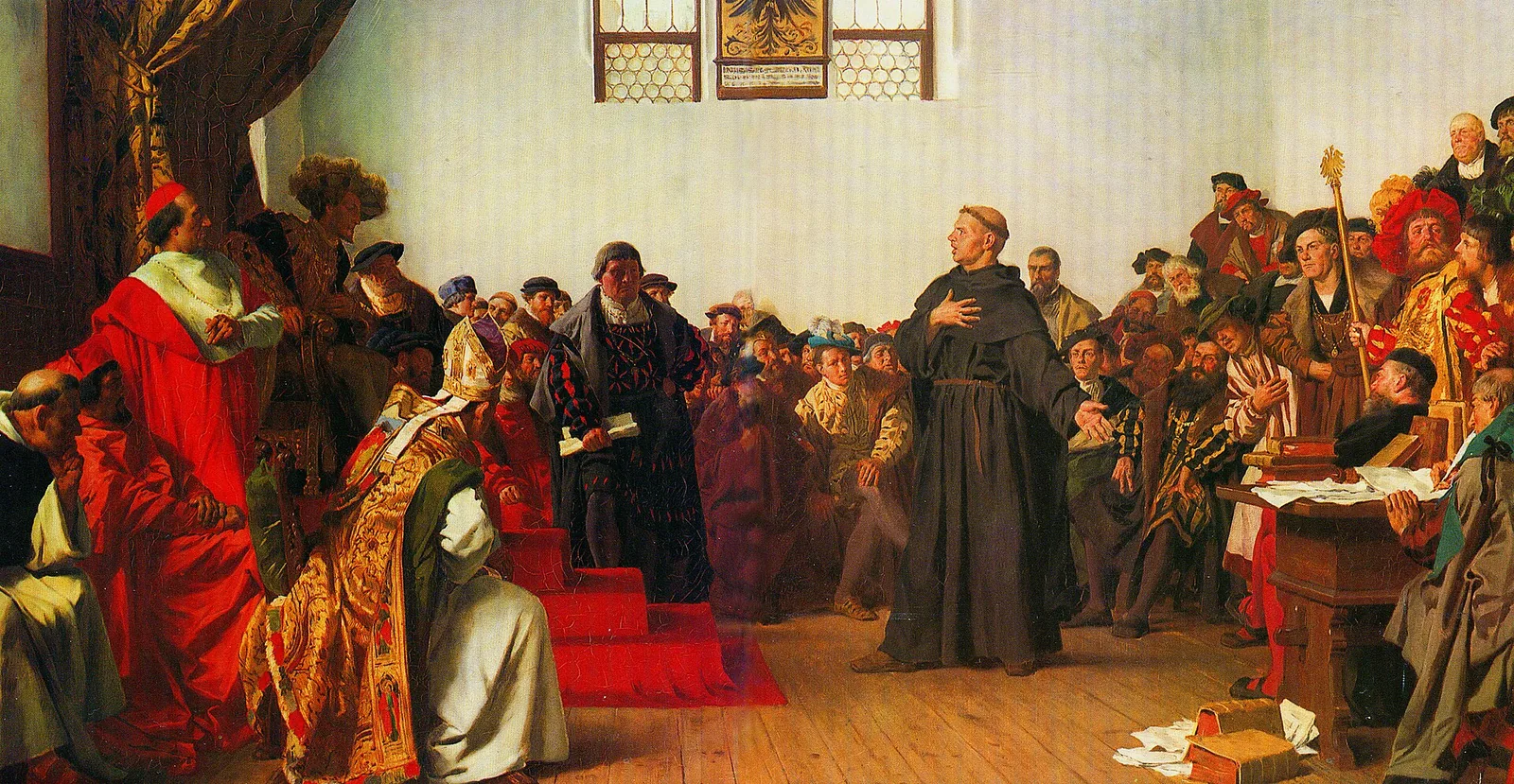
Anton von Werner, Luther at the Diet of Worms, 1877. Staatsgalerie Stuttgart · Public domain · Source page
An inheritance of lands
18 April 1521, Worms
In one hall in Worms stands a monk of thirty-seven, facing a king of twenty-one.
The king rules Spain, the Netherlands and large parts of Italy. The monk has no army and no land. He has words, and he will not take them back.
Charles V
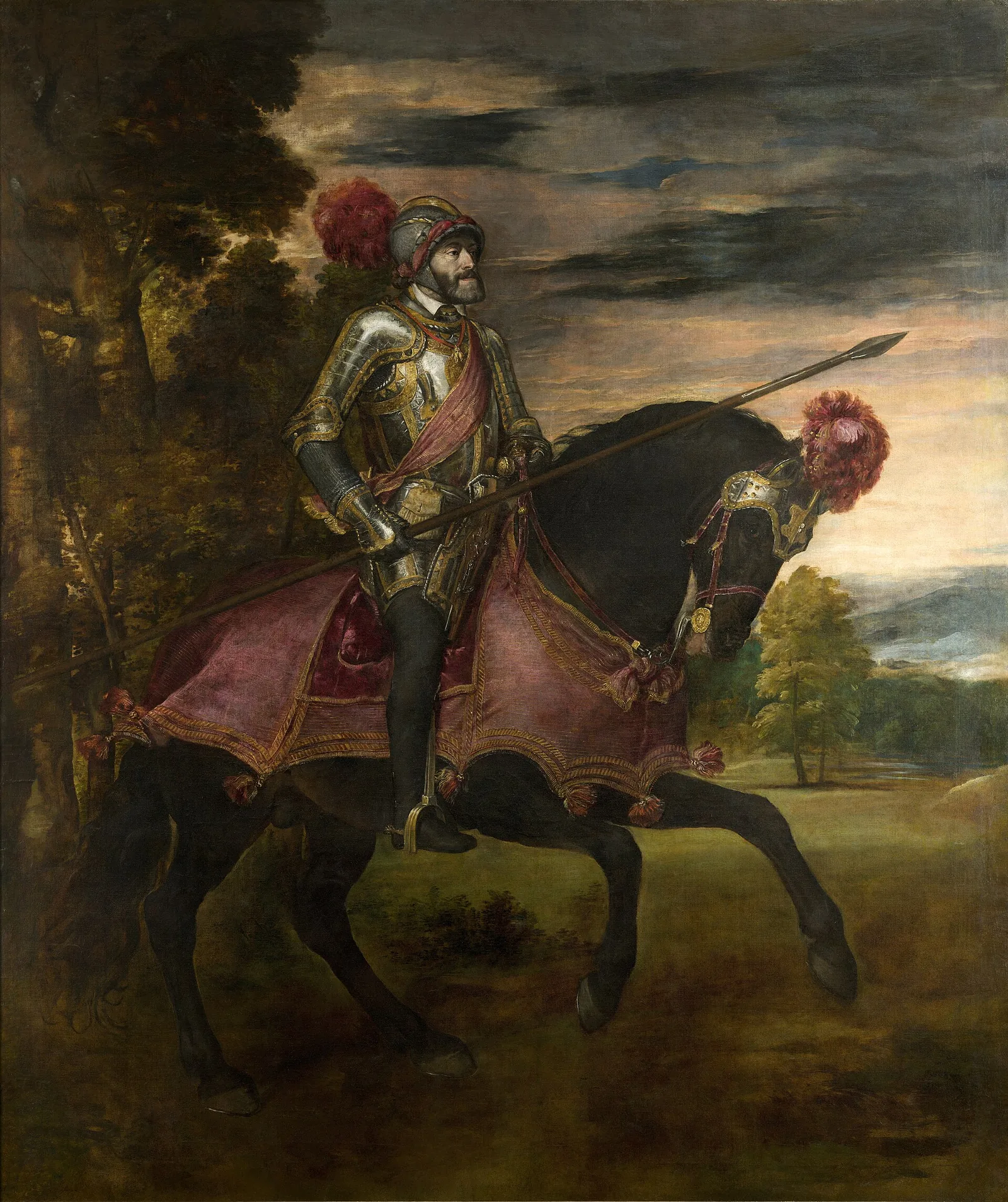
Titian, Emperor Charles V at Mühlberg, between April and September 1548. Museo del Prado, Madrid · Public domain · Source page
The prince who inherited more lands than almost any other ruler in Europe, and found he had too little money to hold them all.
- Born: 24 February 1500, Ghent, Flanders
- Died: 21 September 1558, Monastery of Yuste, Spain
- Won: Tunis, 1535; Pavia, 1525; Mühlberg, 1547
- Lost: Algiers, 1541
“A single monk, misled by his own folly, has risen against the faith of Christendom.”
Background
An inheritance of lands
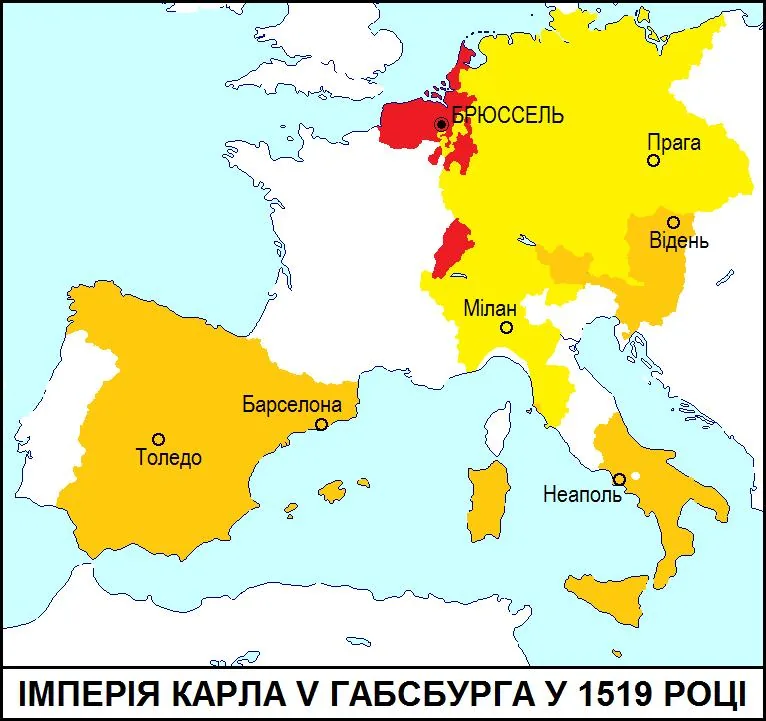
O. Mustafin, Charles V's empire in 1519, 2013 (CC0) · CC0 · Source page
Charles was born on 24 February 1500 in Ghent. His father, Philip, inherited the Burgundian Netherlands; his mother, Joanna, was the daughter of the Catholic kings of Spain. Then the relatives died. In 1506 his father died, and the boy of six became lord of the Netherlands. In 1516 his grandfather Ferdinand died, and Charles was proclaimed king of Castile and Aragon alongside his mother. In 1519 his other grandfather Maximilian died. In 1521 the Austrian lands were given to Charles's younger brother Ferdinand, who had grown up in Spain.
The sketch map shows how spread out the lands were, from Brussels to Naples and from Vienna to Toledo. They were not one state. Each land had its own laws, assemblies and taxes.
The family method
Marry rather than fight
The Habsburgs won lands by marriage as often as by war. Maximilian I married Mary of Burgundy in 1477, and so the Burgundian Netherlands came into the family. Charles's parents, Philip and Joanna, married in 1496 and brought Castile. Charles himself married Isabella of Portugal in 1526.
The Latin motto often quoted for this policy, Bella gerant alii, tu felix Austria nube (“Let others wage war; you, happy Austria, marry”), was recorded long after these marriages, and its attribution to the Hungarian king Matthias Corvinus is doubtful.
A phrase to treat with care
The sun that never sets
The sun
Later writers described Charles's realm as an empire on which the sun never sets. Historians trace the image to older claims of universal rule, from Rome and Persia.
The auction for the crown
January 1519
A crown that is not inherited
The emperor Maximilian I died on 12 January 1519. The Empire did not pass by inheritance: seven electors chose the next King of the Romans, and the imperial title came after. Two young men wanted it. Charles, Maximilian's grandson, was nineteen. Francis I, king of France, was twenty-four, and had won at Marignano in 1515.
The money
An auction with IOUs
About 850,000
The Fugger bank of Augsburg, which lent to popes, princes and emperors, lent Charles huge sums. About 850,000 florins were spent on the election, and the Fuggers supplied about 543,000 of them; the sources differ on the details. Francis offered money too. In 2001 the historian H. J. Cohn questioned the bribery story. Money probably helped, but it did not decide the vote on its own.
The contract
The price of the crown
After the vote, Charles agreed to an electoral capitulation, a written contract that set out what the candidate would do for the Empire. It is dated 3 July 1519. He promised a council of princes to govern the Empire, German officials, no foreign troops in the Empire without the princes' consent, confirmation of the Golden Bull of 1356, and a pledge to curb the irregular payments Rome drew from Germany. He would also abolish the great merchant companies.
A decision point
You are Frederick III, Elector of Saxony, known as “the Wise”.
Frankfurt, June 1519
Maximilian is dead. Charles is young and far from most of the Empire, but he already rules Spain and the Netherlands, and he has money. Francis offers gifts, and his army waits near the Italian frontier.
You do not want a foreign king on the throne: a French army in Germany or Italy would drag the Empire into someone else's war. You have refused to stand yourself. Seven votes decide it, and yours is one.
Whom do you vote for?
- Charles, Maximilian's grandson, who promises the princes their rights in writing. Probably the Habsburg lands grow larger still, and the princes' power to hold the emperor back is tested in every crisis for decades.
- Francis I, who offers rich gifts and a French army near the border. Probably a long war between France and the Habsburgs over Italy and the Rhine, with the German princes drawn into French politics.
- Yourself: a German prince on the throne would keep the Empire German. Probably the other electors refuse, and the vote splits. A divided Empire opens the door to a foreign power.
What really happened
Charles, Maximilian's grandson, who promises the princes their rights in writing.
On 28 June 1519 all seven electors chose Charles. The older Britannica account (1911) says Frederick had declined to stand himself.
Historians suppose he preferred a German king who would keep the peace. The Fugger loans are well documented. How much bribery changed the votes themselves is still debated.
Worms, 1521
January to March 1521
The monk the pope had condemned
Pope Leo X excommunicated Martin Luther, an Augustinian monk from Wittenberg, on 3 January 1521. The question now was what the young king would do at the Diet of Worms, an assembly of princes, archbishops and cities. The papal nuncio, Girolamo Aleander, wanted an immediate condemnation. Frederick the Wise insisted that Luther be heard first.
A decision point
You are Charles, King of the Romans, aged 21.
Worms, March 1521
The nuncio wants an immediate condemnation. Frederick asks for a fair hearing. Luther is willing to come, if you summon him under a safe-conduct.
Everyone knows what happened to Jan Hus at Constance in 1415. He came under a safe-conduct from the emperor Sigismund. The council held him anyway and burned him on 6 July 1415.
What do you do?
- Summon Luther under the safe-conduct, hear him in public, and let him go home if he will not recant. Probably a public hearing and a public refusal. The German princes would see fairness, and the pope would look beaten.
- Condemn him in his absence, as the nuncio asks. Probably the princes would see the Diet as a tool of Rome, and Luther's followers would call it a second Constance.
- Summon him, and if he will not recant, hold him after the hearing, as at Constance. Probably Luther dies, or spends years in prison. He would become a martyr across Germany, and Frederick of Saxony a bitter enemy.
What really happened
Summon Luther under the safe-conduct, hear him in public, and let him go home if he will not recant.
Charles summoned Luther under a safe-conduct dated 6 March 1521, and he kept it. Luther was heard in public and allowed to leave on 26 April.
A trap would have looked like Constance and cost Charles the goodwill of Frederick, the prince who had voted for him. Historians disagree on how far Charles believed a hearing was right, and how far the princes forced it on him.
16 and 17 April
Luther enters Worms
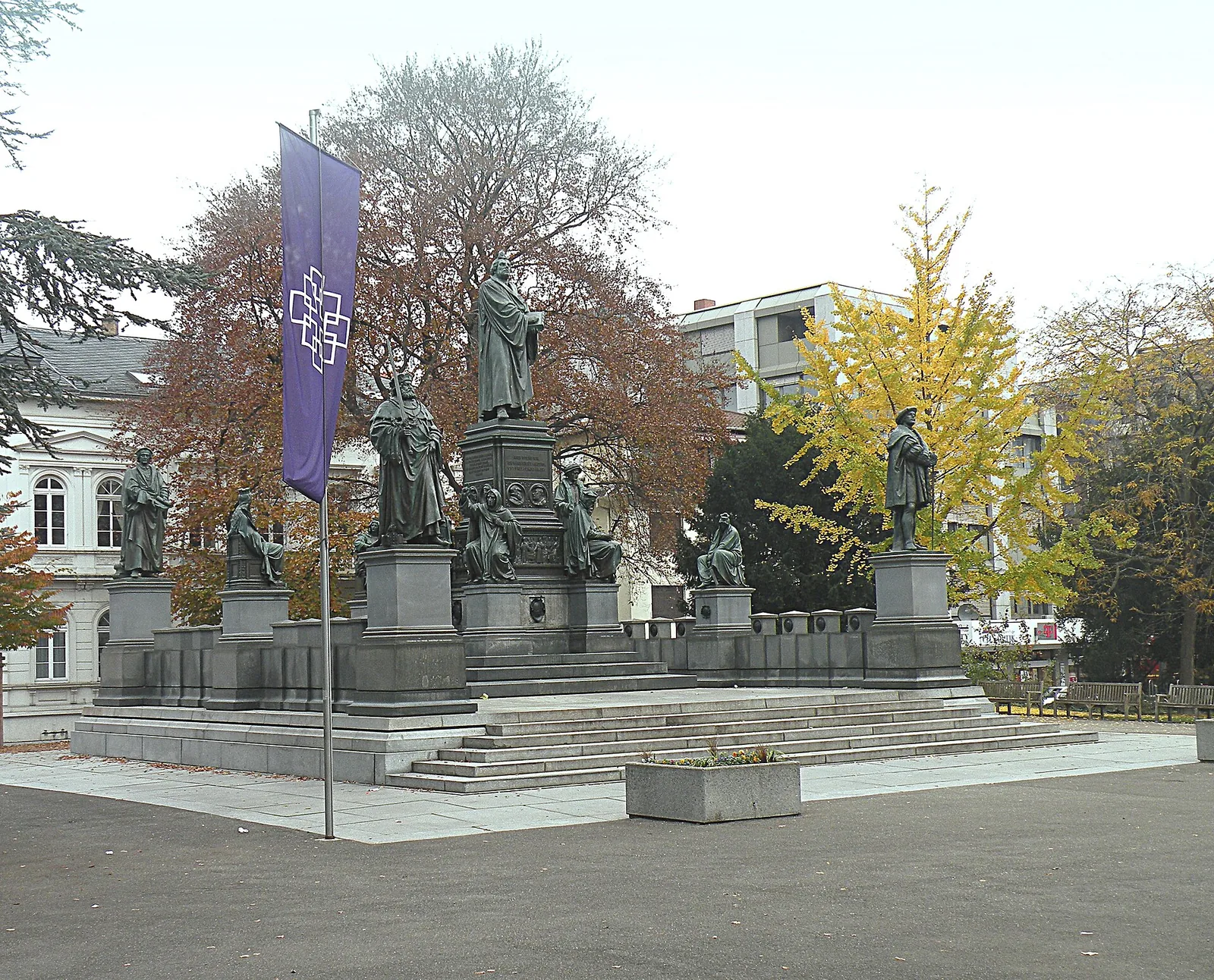
Vitold Muratov, Lutherdenkmal (Worms), 2011 · CC BY-SA 3.0 · Source page
Luther reached Worms on 16 April 1521. On 17 April, in the bishop's palace, an official of the archbishop of Trier put one question to him: did he stand behind his books, and would he recant them? Luther asked for a day to think. He was given it, and used it to shape his answer. Today a monument to him, unveiled in 1868, stands in Worms.
Martin Luther
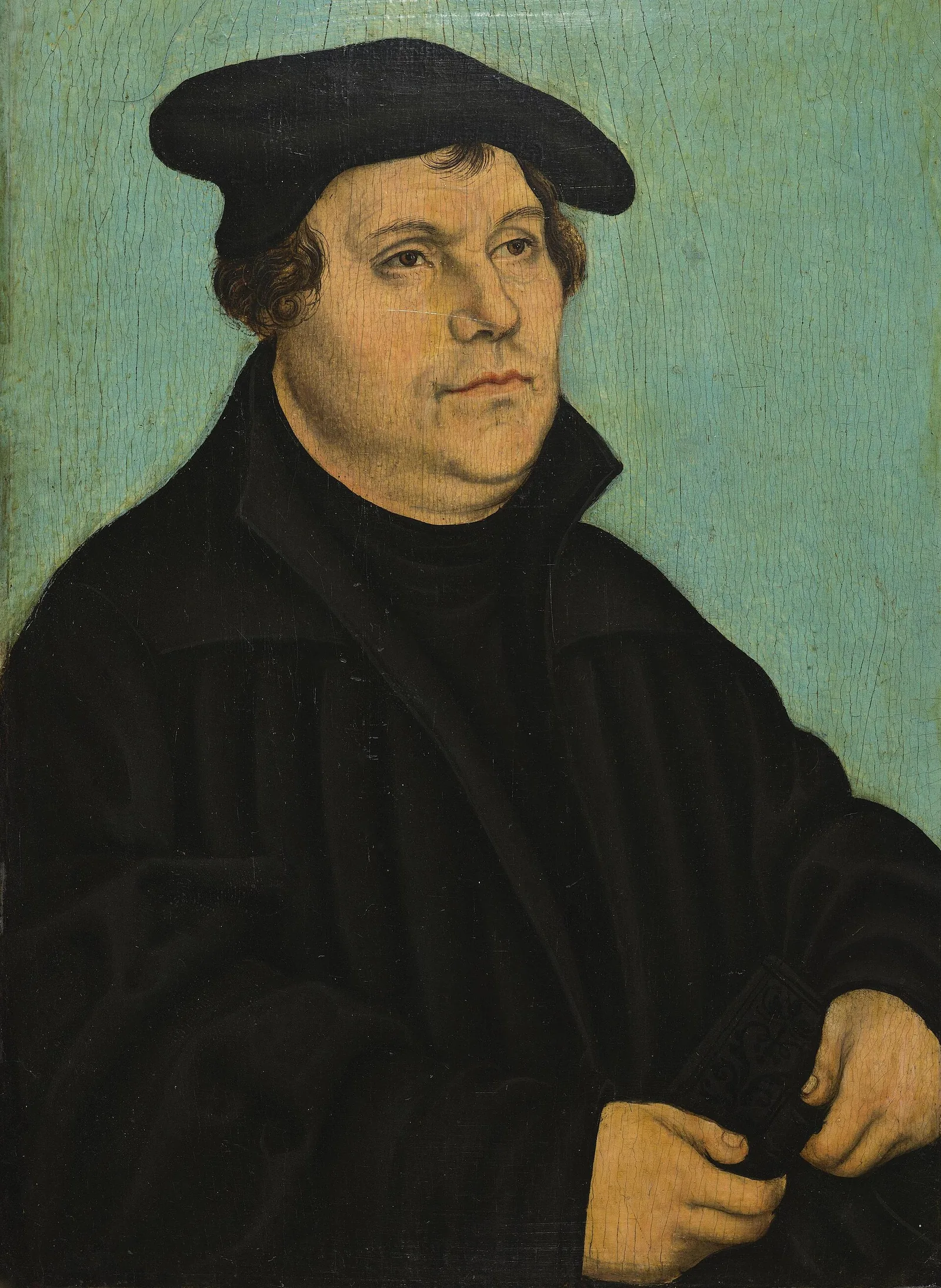
Workshop of Lucas Cranach the Elder, Portrait of Martin Luther, about 1532. Hermitage, St Petersburg · Public domain · Source page
An Augustinian monk and professor of theology at Wittenberg, who wrote the 95 Theses in 1517 and refused to recant in 1521.
- Born: 10 November 1483, Eisleben, Saxony
- Died: 18 February 1546, Eisleben
- Won: The indulgence debate, 1517
- Lost: Worms, 1521: would not recant
“I cannot and I will not retract.”
A decision point
You are Martin Luther, aged 37, a monk and theology professor at Wittenberg.
Worms, 18 April 1521, in the afternoon
Yesterday you asked for a day. Today the chancellor of the archbishop of Trier demands a plain answer: will you recant, or not? Your books have been printed across Germany, the pope has condemned you, and Frederick will protect you only up to a point.
You will give up any error proved to you from Scripture or clear reason. You will not rely on popes or councils alone, since they have erred and contradicted each other.
What do you answer?
- Recant all your writings, as the Diet demands. Probably the reform in Wittenberg stalls, your followers are shamed, and the Church wins quickly.
- Retract the books that attack named people, and keep the rest. Probably a compromise nobody likes. The Church keeps demanding the rest, and the argument goes on in print.
- Ask for more time and go home to think. Probably the Diet sends you home with a demand to recant later, and the pressure goes on.
- Refuse: unless Scripture or clear reason proves me wrong, I cannot and will not retract, since it is neither safe nor right to act against conscience. Probably an imperial ban and perhaps death, unless a prince hides you.
What really happened
Refuse: unless Scripture or clear reason proves me wrong, I cannot and will not retract, since it is neither safe nor right to act against conscience.
Luther refused to recant unless Scripture or clear reason proved him wrong. He added that acting against conscience was neither safe nor right.
He believed Scripture stood above councils and popes. Historians do not doubt the refusal itself. They doubt the exact words, especially the last sentence.
Source: Luther's answer, 18 April 1521
“Unless therefore I am convinced by the testimony of Scripture, or by the clearest reasoning ... I cannot and I will not retract, for it is unsafe for a Christian to speak against his conscience.”
An English version of a Genevan Protestant preacher's account, made from earlier reports. Luther's words survive in several Latin and German versions, which differ.
- Who wrote this, and when? A Genevan Protestant preacher, Jean-Henri Merle d'Aubigné, in the 1830s and 1840s. He admired Luther and wrote to strengthen his readers' faith.
- What does the writer want you to feel? Courage. The capitals at the end read like a sermon shouted from the pulpit.
- What is missing? The room: the noise, the princes' reaction, and the fact that Luther had already had a day to think. There is no original document here.
Myth
Luther stood before Charles and said: “Here I stand, I can do no other.”
The truth
Probably not in these words. The sentence is missing from some transcripts and present in others. The earliest printed version added it, and most historians think it was added afterwards, though some defend it. Some scholars think the words may still be genuine.
The evidence
The woodcut in the next step prints the words thirty-five years after the event.
Source: A woodcut of 1556
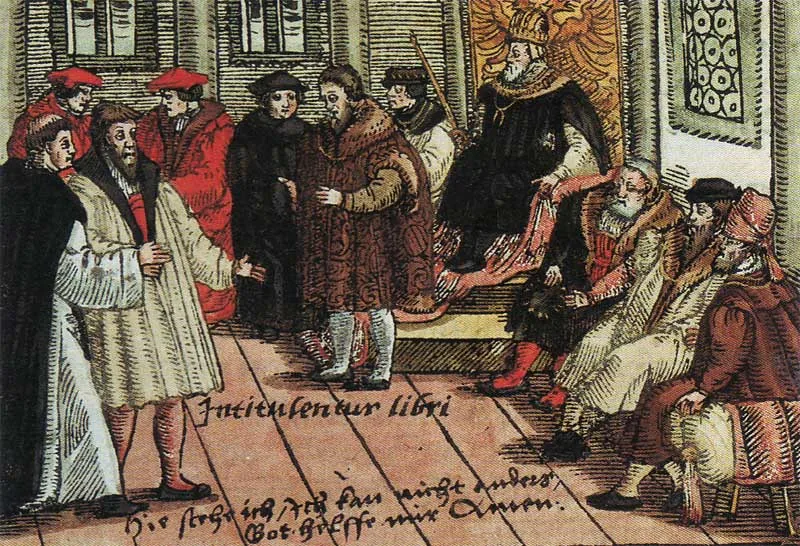
Ludwig Rabus, Historien der Heyligen Außerwölten Gottes Zeügen, 1556. · Public domain · Source page
Ludwig Rabus, Historien of God's witnesses (1556)
A coloured woodcut from Ludwig Rabus's book of God's witnesses, 1556. It tells the story to readers thirty-five years later.
- Who stands, and who sits? Luther stands left, in a white robe, facing the emperor, who sits under a canopy with the imperial eagle. Princes in furs stand between them.
- What is printed under the picture? “Here I stand, I can't help it, God help me, Amen”, in German. By 1556 the words had become part of the picture's message.
- Who was the book for? For Protestant readers who loved stories of people who stood firm. It was meant to strengthen belief, not to record events.
After Worms
Source: Charles's declaration, 19 April 1521
“A single monk, misled by his own folly, has risen against the faith of Christendom. To stay such impiety, I will sacrifice my kingdoms, my treasures, my friends, my body, my blood, my soul, and my life.”
Read to the Diet on 19 April, the day after Luther's answer. Translations differ: “single monk” in some, “single brother” in others.
- Who speaks, and to whom? Charles, as King of the Romans, to the princes, invoking his dynasty: the Spanish kings, the Austrian archdukes and the dukes of Burgundy.
- What does he promise? Everything: kingdoms, treasures, friends, body and life. It is a formula of loyalty and drama.
- How much of the text is his own voice? Unknown. Emperors had secretaries. The claim that he wrote it himself comes from a writer about three centuries later.
May 1521
The Edict of Worms
26 May
The Diet closed on 25 May 1521. The Edict of Worms, dated 8 May and signed in late May, put Luther under the imperial ban: anyone could seize him, and no one could shelter him. It banned printing, copying, selling or defending his books. In much of Germany it was not enforced. In the Habsburg Netherlands it was used against Luther's supporters.
4 May 1521
The planned abduction
On the road home to Wittenberg, Luther was seized on 4 May by armed riders in the Thuringian forest and taken to the Wartburg castle above Eisenach. It was a staged rescue, arranged by Frederick the Wise. In the castle he called himself Junker Jörg, and began translating the New Testament into German. He stayed until March 1522.
A decision point
You are Charles, aged 21, in Worms after the Diet closes.
Worms, late May 1521
The Edict is signed, but Luther has vanished. The pope wants it enforced to the letter. The princes do not want to arrest a popular monk in their own lands.
France is preparing a new war, and to win it you need the princes' money and troops. Not every prince is glad to see Luther outlawed.
You could enforce the Edict by force, leave it to the princes, call a general council, or offer Luther a pardon for retracting some things.
What do you do?
- Order every ruler to seize Luther and burn his books, sending troops if needed. Probably civil war in parts of Germany. Saxony and Hesse would resist, and you would be fighting princes while also fighting France.
- Leave enforcement to the princes and turn to France. Probably the Edict stays on paper in most places, and the princes use it when it suits them.
- Call a general council to settle the question, as some princes want. Probably years of debate. The pope would resist, and the reform would keep spreading in print and in the towns.
- Offer Luther a pardon if he retracts some things. Probably Luther refuses, and Rome objects. But if he accepted, the offer might have calmed things.
What really happened
Leave enforcement to the princes and turn to France.
Charles signed the Edict, and war with France broke out that year. Enforcement was left largely to the princes, and in much of Germany the Edict stayed on paper.
He needed the princes for the war, and they made clear they would not enforce the Edict by force. His advisers and the nuncio wanted enforcement, but he had no army of his own in Germany. Historians disagree about whether he ever meant to enforce it.
War on every front
1524 to 1525
The Peasants' War
In 1524 and 1525 peasants rose across south and central Germany, demanding lower taxes and other rights. Some rebels quoted Luther. In 1525 he published a fierce attack on them and urged the princes to crush the revolt. Tens of thousands died, most in battles and executions.
24 February 1525
Pavia: the king in captivity
Pavia
On Charles's twenty-fifth birthday, 24 February 1525, his troops beat the French near Pavia in northern Italy. Francis I was captured and taken to Spain. To go home he signed the Treaty of Madrid in 1526, giving up claims in Italy and Burgundy, and then disowned it. The Treaty of Cambrai in 1529 finally settled the peace.
1526 to 1529
Mohács and Vienna
On 29 August 1526 the Ottoman sultan Suleiman I defeated the Hungarian army at Mohács. King Louis II, married to Charles's sister Mary, died in the flight. The Ottoman siege of Vienna began on 27 September 1529. It ended in mid-October, when the army withdrew, and the city held. The defence was led by Count Niklas Salm and Wilhelm von Roggendorf, not by Ferdinand, who had left for Bohemia.
6 May 1527
Rome is sacked
1527
Charles's army in Italy had gone unpaid for months. The troops mutinied and marched on Rome under Charles, Duke of Bourbon, a French noble who had turned against his king. On 6 May 1527 they stormed the city. Bourbon was killed, and the pope was trapped in Castel Sant'Angelo. Thousands died, and the city was looted. Charles had not ordered the attack, but he had not paid the men either.
1529 to 1530
A protest and a confession
At Speyer in 1529 most princes voted to enforce the Edict of Worms. A minority protested, and the protesters came to be called Protestants. On 24 February 1530, on his thirtieth birthday, Charles was crowned emperor at Bologna by Pope Clement VII, the last emperor crowned by a pope. On 25 June 1530 the Lutheran princes presented the Augsburg Confession at Augsburg: twenty-eight articles written by Philip Melanchthon.
27 February 1531
The league of Schmalkalden
In February 1531 Protestant princes and cities formed a defensive alliance at Schmalkalden, the Schmalkaldic League, led by Philip of Hesse and John Frederick, Elector of Saxony. Charles needed German princes against the Ottomans and France, so he could not crush the league at once.
Mühlberg and the Interim
1546
Luther dies, and Germany divides
Luther died on 18 February 1546 in Eisleben, where he had been born. The Schmalkaldic League held a large army, and the Council of Trent, opened in December 1545, met without the Protestants. Charles, forty-six and suffering from gout, still wanted religious peace on his own terms. But war was expensive, and his bankers had already lent him a great deal.
A decision point
You are Charles V, aged 46, in the summer of 1546.
Summer 1546
The league refuses your authority in religious matters, and its army is larger than yours in Germany. The pope offers money and troops if you act. Maurice of Saxony, a Protestant cousin of John Frederick, leans towards you, for a share of the lands.
Your money is limited, and your troops are scattered. But every year of waiting strengthens the league.
What do you do?
- Declare the league rebellious and fight now with the pope's money. Probably a short war that you win, because you have more troops. But it would cost a great deal and divide Germany for generations.
- Wait, offer a general council, and talk to the princes. Probably years of talk. Trent would go on meeting without the Protestants, and the league would grow.
- Buy the league's leaders with gifts and promises. Probably the league stays together, the money is wasted, and some princes keep squeezing you.
- Sign a treaty recognising the Protestant princes' rights, in return for political submission. Probably a compromise that protects the princes' lands and leaves the religious question open.
What really happened
Declare the league rebellious and fight now with the pope's money.
Charles chose war. On 20 July 1546 he put the league's leaders, John Frederick and Philip of Hesse, under the imperial ban as rebels, and the Schmalkaldic War began. It was short: the league split, and Maurice sided with the emperor.
Historians still argue whether he fought for the faith or for his authority over the princes. The decision combined both, and the pope's money made the religious side more prominent.
Source: Titian, Charles V at Mühlberg, 1548
Titian (Tiziano Vecellio), Venetian painter. The painting is in the Museo del Prado, Madrid.
A painting made in Augsburg in 1548, about a year after the battle. It is not a record of the fight but an image of victory.
- What is the emperor doing in the painting? He is on horseback in armour, calm and in command. He is not fighting.
- Who is missing from the picture? The dead, the Protestant soldiers, and any sign of how many were killed. The battle has been erased.
- Why is he in armour? The armour is the message: the emperor fought, survived and won. It is a political statement.
24 April 1547
Mühlberg: the river and the fog
24 April
On the evening of 23 April 1547 Charles reached the Elbe. His generals wanted to wait, but he chose to attack. Gout had flared that day, and he was carried in a litter. Spanish and Italian veterans crossed in fog and darkness, by a ford a local man had shown them and a bridge made from commandeered boats. The Saxon army was surprised.
John Frederick was wounded and captured. Charles had him sentenced to death to force Wittenberg to surrender; the sentence was not carried out, and the city capitulated on 19 May 1547. Philip of Hesse surrendered in June 1547.
1548 to 1552
The Interim
The electorate of Saxony passed from John Frederick to his cousin Maurice, who had fought on the emperor's side. John Frederick spent years in captivity. On 15 May 1548, at Augsburg, Charles issued the Augsburg Interim, a temporary religious order: Protestants would accept Catholic practice, with concessions such as clerical marriage and communion in both kinds, until a council decided. Most Protestants rejected it, and it settled nothing. In 1552 Maurice, who had been rewarded with the electorate, turned against the emperor, and the religious wars resumed.
The settlement, the farewell and the question
25 September 1555
The Peace of Augsburg
1555
The diet at Augsburg proclaimed the religious peace on 25 September 1555. Each prince could choose whether his land would be Catholic or Lutheran, and the Lutherans gained legal recognition beside the Catholics. The Calvinists were left out. A subject who did not want his ruler's faith could leave the land, but not choose another faith inside it.
The agreement was reached largely through his brother Ferdinand. Charles never formally approved the settlement.
A Latin tag
“Whose realm, his religion”
The Latin tag cuius regio, eius religio (“whose realm, his religion”) is not in the text of the peace. It was coined in 1612 by the jurist Joachim Stephani of Greifswald. It is a handy shorthand, not a quotation.
1555 to 1558
The farewell
On 25 October 1555 Charles handed the Netherlands to his son Philip, in Brussels. On 16 January 1556 he ceded Castile and Aragon, with their dependencies, to Philip. The imperial title went to his brother Ferdinand, whom the Imperial Diet accepted as emperor only in 1558.
Charles retired to the monastery of Yuste in Extremadura in 1557 according to most sources (some say 1556). He died there on 21 September 1558, aged 58. His body was later moved to the Escorial, the palace-monastery his son had built.
What the years brought
- 1521 Worms: the Edict against Luther, and Luther hidden at the Wartburg.
- 1525 Pavia: Francis I captured. The Peasants' War is crushed.
- 1526 Mohács: the Hungarian army is destroyed and King Louis killed.
- 1527 Rome is sacked by troops who had not been paid.
- 1529 Vienna holds out, and at Speyer the name “Protestants” is born.
- 1530 The Augsburg Confession, and Charles crowned emperor at Bologna.
- 1531 The Schmalkaldic League is founded.
- 1547 Mühlberg: the league is defeated and John Frederick captured.
- 1555 The Peace of Augsburg, and the abdication in the Netherlands.
- 1556 Spain and the colonies pass to Philip. The imperial title passes to Ferdinand.
- 1568 Revolt in the Netherlands against Philip, the start of the Dutch Revolt.
Myth
Charles V ruled Europe as its all-powerful master.
The truth
His lands were vast, but he never had enough money, a standing army or the power to force his will. Each land had its own laws and assemblies. In Germany he depended on the electors and princes, in Italy on the pope. He paid for wars with loans from bankers, among them the Fuggers and the Welsers. In 1557 Philip II suspended repayments on his large loans from bankers. His power rested on consent, not command.
The evidence
Look at the Edict of Worms: Charles signed it, and the princes did not enforce it. Look at 1552: Maurice, who had received Saxony from him, turned against him.
Why did the Reformation survive Charles V?
Charles was stronger than almost any other ruler of his time, yet Lutheranism survived. Why?
- Heinz Schilling Schilling, who with Wolfgang Reinhard developed the idea of confessionalisation in the 1980s, argues that church and state grew together. Religion became part of how each territory was governed and disciplined. On this view Lutheranism survived because it had already become part of the state's structure.
- Peter H. Wilson In Heart of Europe (2016) Wilson argues that the Empire was not a failed state but a system of compromises that worked. The Reformation tested it, and the 1555 settlement showed its flexibility. On this view it survived through its institutions, not through force.
- Geoffrey Parker In Emperor (2019) Parker analyses Charles's achievements within personal and structural limits: money, distance and an inheritance of scattered lands. On his approach the question is what Charles chose within those limits, not only what his character was.
- Hugh Trevor-Roper In his 1967 essays on religion, the Reformation and social change, Trevor-Roper argued that religious change cannot be explained by religion alone, and must be read alongside economic and social change.
Did the Reformation survive because of religion itself, or because of the structure of the Empire and its economy? For the full picture, Diarmaid MacCulloch's Reformation: Europe's House Divided (2003) is a good start. Decide for yourself after reading the sources in this lesson.
Check yourself
Why could Charles not simply enforce the Edict of Worms in 1521?
Answer: Because the princes would not enforce it by force, and he needed them against France.. Correct. Charles depended on the princes for his war, and they made clear they would not enforce the Edict by force.
Check yourself
When was the English account of Luther's answer, from which the quoted words come, written?
Answer: In the 1830s and 1840s, by Jean-Henri Merle d'Aubigné.. Correct. A Genevan Protestant preacher wrote it about three centuries after the Diet, from earlier reports.
Check yourself
In which printed appearance does the phrase “Here I stand, I can do no other” first appear?
Answer: In printed versions of the speech that appeared after 1521.. Correct. The earliest printed version added it, and most historians think it was added afterwards.
Check yourself
Which battle led to the capture of Francis I?
Answer: Pavia, 1525.. Correct. The battle was in northern Italy, on Charles's twenty-fifth birthday, and the French king was captured in it.
Check yourself
What did the Peace of Augsburg (1555) leave out?
Answer: The Calvinist churches, and individual subjects' free choice of religion.. Correct. The Calvinists were not recognised, and a subject who did not want the ruler's faith could mostly only leave the land.
Check yourself
What does the phrase “the sun that never sets” tell a careful reader?
Answer: That it is a later description, with roots in older claims of universal rule.. Correct. The phrase describes his inheritance, but it was written by later writers.
Terms
- Diet The assembly of the Empire's princes, bishops and cities, summoned by the emperor. The Diet of Worms of 1521 judged Luther's case.
- elector One of the seven princes who chose the King of the Romans, and so the emperor. In 1519 they were three archbishops and four secular princes, one of them the king of Bohemia.
- electoral capitulation A written contract that the electors required each candidate for the crown to sign, listing what he promised the Empire. Charles signed one in 1519.
- Fugger A family of merchant bankers from Augsburg, among the richest in Europe in the early 16th century. They lent money to popes, princes and emperors.
- safe-conduct A written guarantee that a person may travel to a place and return without arrest. Breaking one was a serious offence against honour.
- Edict of Worms The imperial decree against Luther, dated 8 May 1521 and signed in late May. It put him under the ban and outlawed his books.
- imperial ban An emperor's declaration that puts a person outside the law. Anyone may seize him, and no one may shelter him.
- Schmalkaldic League A defensive alliance of Protestant princes and cities, founded at Schmalkalden in 1531. Its leaders were Philip of Hesse and John Frederick of Saxony.
- Augsburg Confession The Lutheran statement of faith: 28 articles written by Philip Melanchthon and presented to the emperor at Augsburg on 25 June 1530.
- Augsburg Interim A temporary religious order that Charles issued in 1548, meant to bring the Protestants back to Catholic practice until a council decided. Most Protestants rejected it.
- Habsburgs Great European royal family. In Charles's time it ruled Spain, Austria and many other lands.
- Netherlands Region in north-west Europe, today part of Belgium, the Netherlands and Luxembourg.
- Castile Large kingdom in Spain. Charles's parents brought it to the Habsburgs through marriage.
- Isabella of Portugal Portuguese princess who married Charles. The marriage was part of the Habsburg policy of marriage.
- Francis I King of France and Charles's rival for the imperial crown. He won at Marignano but was captured near Pavia.
- Pavia City in northern Italy. Charles's troops beat the French there, and Francis I was captured.
- Golden Bull The basic law of the Empire, which set out how the emperor was chosen and who the electors were.
- Bella gerant alii Latin saying that describes the Habsburg marriage policy. Its attribution to the Hungarian king Matthias Corvinus is doubtful.
- Matthias Corvinus King of Hungary to whom the Latin saying on Habsburg marriages is attributed, though doubtfully.
- Speyer City in Germany. At the diet held there, most princes voted to enforce the Edict of Worms, and a minority protested.
- Bologna City in northern Italy, where the pope crowned Charles emperor.
- Pope Clement VII Pope who crowned Charles emperor. He was the last emperor a pope crowned.
- Pope Leo X Pope who excommunicated Martin Luther.
- Nuncio The pope's official envoy at the court of a king or prince.
- Frederick the Wise Prince of Saxony who protected Luther and insisted that he be heard before any punishment.
- Jan Hus Religious reformer from Bohemia, burned at Constance after arriving under a safe-conduct.
- Wittenberg German town that Luther came from, and to which he returned from Worms.
- Wartburg Castle in Thuringia above Eisenach. Luther hid there under a false name and began translating the New Testament.
- Council of Trent Catholic council that met in the city of Trent in northern Italy, without the Protestants.
- Protestants The name given to those who opposed the Edict of Worms at Speyer. Later it came to mean anyone who broke from the Catholic Church.
- Religious Peace of Augsburg Agreement proclaimed at the diet in Augsburg: each prince chose whether his land would be Catholic or Lutheran.
- Cuius regio, eius religio Latin phrase meaning whose realm, his religion. It is not in the text of the peace; it is a later shorthand for the settlement.
- Gout A painful joint disease caused by a build-up of uric acid in the body.
- Escorial Palace-monastery in Spain, built by Charles's son. Charles's body was moved there later.
- Yuste Monastery in Spain to which Charles withdrew from power, and where he died.
Sources
- Jean-Henri Merle d'Aubigné, History of the Reformation in the Sixteenth Century, trans. David Dundas Scott, book "The Diet of Worms, 1521, January to May" (public domain)
- Edict of Worms, dated 8 May 1521 and signed in late May 1521 (German text in the records of the Diet)
- Ludwig Rabus, Historien der Heyligen Außerwölten Gottes Zeügen (1556), woodcut of Luther at Worms
- Roland H. Bainton, Here I Stand: A Life of Martin Luther (New York: Abingdon-Cokesbury, 1950)
- Geoffrey Parker, Emperor: A New Life of Charles V (New Haven: Yale University Press, 2019)
- Peter H. Wilson, Heart of Europe: A History of the Holy Roman Empire (Cambridge, MA: Harvard University Press, 2016)
- Heinz Schilling, Martin Luther: Rebel in an Age of Upheaval, trans. Rona Johnston (Oxford: Oxford University Press, 2017)
- Diarmaid MacCulloch, Reformation: Europe's House Divided, 1490–1700 (London: Allen Lane, 2003)
- H. J. Cohn, "Did Bribes Induce the German Electors to Choose Charles V as Emperor in 1519?", German History (2001)
- Hugh Trevor-Roper, Religion, the Reformation and Social Change, and Other Essays (1967)
- Burgdorf, Die Wahlkapitulationen der römisch-deutschen Könige und Kaiser 1519–1792 (Historische Kommission bei der Bayerischen Akademie der Wissenschaften, 2015)
- Encyclopaedia Britannica, 1911 edition, article "Frederick III., Elector of Saxony" (Wikisource)
- Worms city website (worms.de), Luther Monument entry

Image credits
- Anton von Werner, Luther at the Diet of Worms, 1877. Staatsgalerie Stuttgart · Public domain · Source page
- Titian, Emperor Charles V at Mühlberg, between April and September 1548. Museo del Prado, Madrid · Public domain · Source page
- O. Mustafin, Charles V's empire in 1519, 2013 (CC0) · CC0 · Source page
- Vitold Muratov, Lutherdenkmal (Worms), 2011 · CC BY-SA 3.0 · Source page
- Workshop of Lucas Cranach the Elder, Portrait of Martin Luther, about 1532. Hermitage, St Petersburg · Public domain · Source page
- Ludwig Rabus, Historien der Heyligen Außerwölten Gottes Zeügen, 1556. · Public domain · Source page


