Catherine the Great: a woman, a crown and an empire
A minor German princess came to Russia and became one of the best-known empresses in history. Which choices made her who she was, and which stories about her are legend?
Decisions, questions and your own progress, in the app
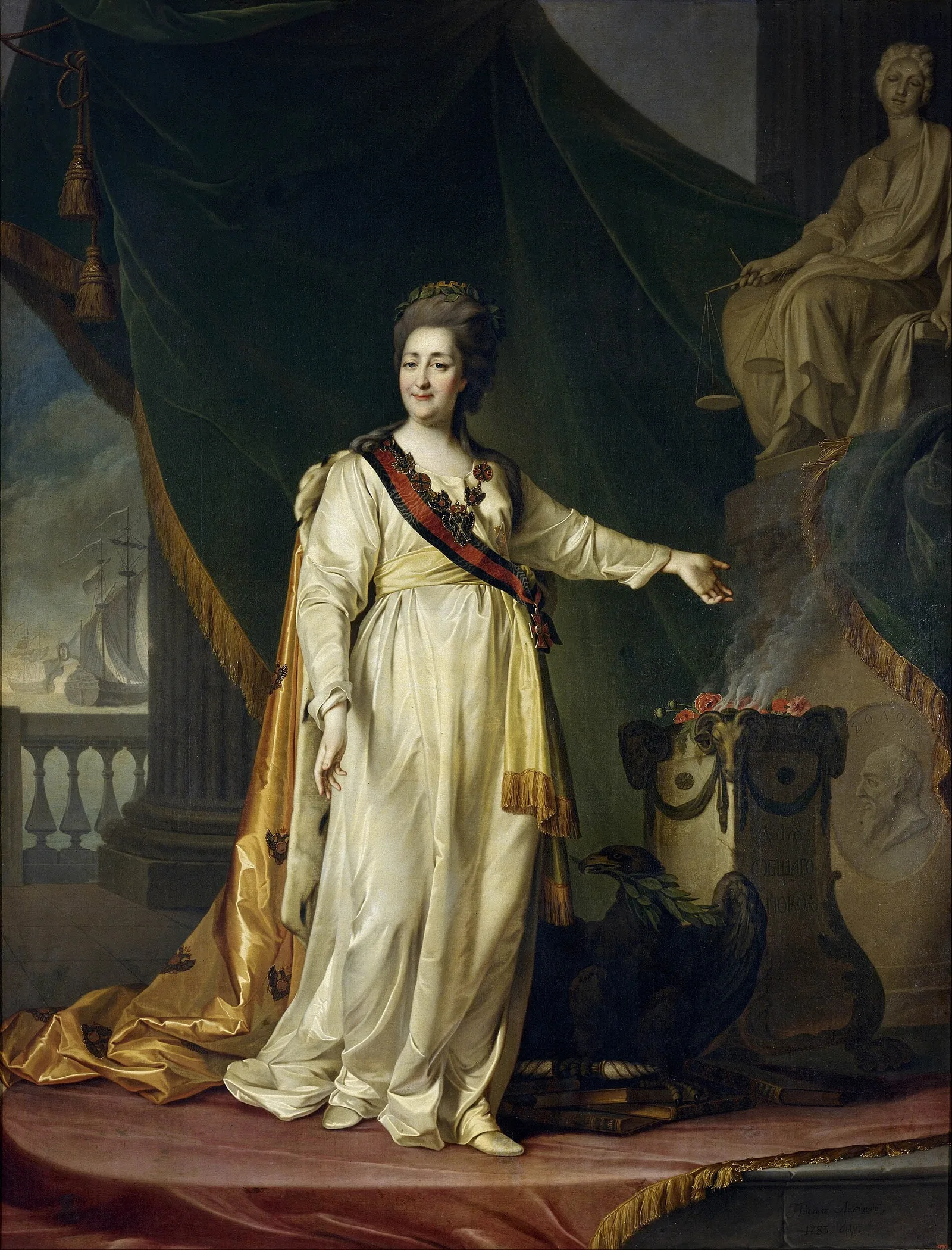
Dmitry Levitsky, Catherine II the Legislatress, 1783. State Russian Museum, Saint Petersburg · Public domain · Source page
A German girl in Saint Petersburg
A rumour about a horse
When she died, satirical papers in London and Paris printed a scandal: the Empress of Russia, they said, had died after a scene with a horse.
It is a lie, and that is why it is a good place to start. Who was the woman behind the rumour, and what in her story is true?
Catherine the Great was born a German princess and became one of the best-known rulers in history. Part of her story is well documented. Part of it is gossip. In this lesson you will sit in her place four times, and check each story against the sources.
Read this first
Two calendars
Russia used the Julian calendar, Old Style (OS), until 1918. In the eighteenth century it was eleven days behind the Gregorian calendar used in western Europe, New Style (NS). So 2 May 1729 NS was 21 April 1729 OS.
Every Russian date in this lesson is marked OS or NS, so you can see which calendar it follows.
Background
Stettin, 1729
1729
Sophie Auguste Friederike, a princess of the small German house of Anhalt-Zerbst, was born on 2 May 1729 (NS) in Stettin. The city then belonged to Prussia. Today it is Szczecin, in Poland.
Nobody in Stettin could have guessed what the girl would become.
Russia
A new name, 1744
At about fifteen, in 1744, Sophie came to Russia. The Empress Elizabeth had chosen her as a bride for her nephew Peter, a grandson of Peter the Great.
On 28 June 1744 (OS) she was received into the Orthodox Church and took the name Ekaterina Alekseyevna. Eighteen years later, on the same day of the year, a palace coup would take place. That was a coincidence, not a link.
The court
A bride for the Empress's nephew
Elizabeth ruled the court, and she controlled the young couple. Catherine learned Russian, read Voltaire and the Roman historian Tacitus, and watched how power worked. She married Peter in 1745, at sixteen. Their son Paul was born in 1754.
Myth
She died after a scene with a horse.
The truth
False. The rumour was spread by satirical British and French publications when she died in 1796. Ask who spread it, and why.
The evidence
Wikipedia traces the rumour to satirical and anti-Russian writing, and to a travel book of 1647 by Adam Olearius. The story is propaganda: it says more about the people who wrote it than about her.
Peter's year
Background
The Empress dies
Elizabeth died on 5 January 1762 (NS), which was 25 December 1761 (OS). Her nephew Peter became emperor that same day, as Peter III.
Policy
Peace with the enemy
Peter admired Frederick II, king of Prussia. Russia had been fighting Prussia in the Seven Years' War, and Peter made peace at once. The Guards, the elite regiments of the capital, were angry. That anger matters later.
Reform
Freedom for the nobles
In 1762 Peter issued a manifesto that freed the nobles from compulsory state service. Until then they had been required to serve the state. Catherine did not undo the manifesto later.
Conspiracy
The circle around her
Catherine knew that Peter was hated by many at court and in the Guards. Her favourite, Grigory Orlov, served in the Guards. Through him his brother Alexei joined the plot. A young princess, Ekaterina Dashkova, who was nineteen by Catherine's own account, knew opposition circles and, by one account, introduced Catherine to them.
June 1762 (OS)
A season of waiting
By June 1762 (OS) the plotters were ready to act, or nearly so. Everything depended on the Guards: the regiments of the capital could decide who ruled within a day. Peter was still emperor, with his court and his title.
The dawn of 28 June (OS)
The night before
Peterhof, 27 June (OS)
Catherine was at Peterhof, a palace on the Gulf of Finland near Saint Petersburg. Peter was at Oranienbaum, down the coast, with his court.
The sources disagree on when the news reached her: the night of 27 June (OS), according to Wikipedia, or six in the morning of 28 June (OS), according to her own letter. Both versions fit one fact: the plot had reached the point where it must move.
A decision point
You are Catherine, at Peterhof, on 28 June 1762 (OS).
Peterhof, near Saint Petersburg. About six in the morning, Old Style. In New Style it is 9 July 1762.
Alexei Orlov has come into your room and says that everything is ready for you to be proclaimed. One of the plotters has already been arrested, and the others will not wait. Peter is at Oranienbaum, not far away, with his court.
The Guards in the capital can decide who rules within a day. You have the support of their officers, but you do not know how many soldiers will follow. If you wait, the plot may reach Peter first. If you go, you expose yourself completely.
What do you do?
- Stay at Peterhof and wait to see whether the plot holds. Probably the arrests would continue and the plotters would be questioned. With no force of your own, your fate would rest in other people's hands.
- Ride to the Izmailovsky barracks, ask the Guards to proclaim you, then go on to the capital. Probably the soldiers accept you, since their officers are with you, and Peter loses his throne within a day. If the soldiers hesitate, the plot is exposed in public, and turning back is too late.
- Write to Peter and propose a council, or a regency for your son Paul with you at its head. Probably Peter refuses or stalls. The letter itself becomes evidence against you, and the plotters who are still free are in danger.
What really happened
Ride to the Izmailovsky barracks, ask the Guards to proclaim you, then go on to the capital.
In fact, by Old Style, Catherine rode to the Izmailovsky barracks with Alexei Orlov. Her letter says they found only twelve men and a drummer there, and the drummer beat the alarm at once. From the barracks she went on to the Synod and the Senate, and both swore loyalty to her.
Peter signed his abdication at Oranienbaum. The sources disagree on the day: Wikipedia gives 28 June (OS), while Catherine's letter says 29 June (OS).
Catherine wrote later that the plot could not wait. The plotters were in danger, and the Guards were the force that could act fastest. Alexei Orlov brought her from Peterhof. His brother Grigory, her favourite, was one of the plotters.
Put yourself in that room. Nobody knew the odds, and the choice was a bet.
Source: Catherine's letter to Poniatowski
At six o'clock on the morning of the 28th, Alexis Orloff entered my room, awoke me, and said very quietly, 'It is time to get up; everything is prepared for proclaiming you.'
A winner's account, written after the event to a former lover. It appears in Herzen's 1859 edition. Its dates are Old Style.
- Who wrote it, and to whom? Catherine herself, after the event, writing to Poniatowski, a former lover. A letter like this explains the writer and leaves a good impression of her.
- What is missing? The other plotters, and Dashkova. Catherine writes that Princess Dashkova 'wishes to arrogate to herself all the honour of this revolution'. Dashkova's own claim comes in the debate below.
- Can we trust it? With care. It is the account of the winner, and no second witness checks its details. Use it alongside other sources, not instead of them.
Who made the coup?
Did Catherine decide alone, or did others deserve most of the credit?
- Ekaterina Dashkova, in her memoirs of 1840 She claims a central part in organising the coup. The memoirs were written decades after the event, so they must be read with care.
- Catherine II, in her letter to Poniatowski She presents herself as the one who decided and acted. She describes Dashkova as ambitious, with a poor reputation and too young to inspire trust.
Which other witnesses could settle the matter? If there are none, which documents would you look for?
Ropsha, July 1762 (OS)
Exile
A palace on the road
Peter was taken to Ropsha, a palace 27 versts (about 29 km) from the capital, under the guard of Alexei Orlov. According to Catherine's letter, Peter asked to take his mistress, his big dog, a servant and his violin. She says she sent the dog, the servant and the violin, but not the mistress.
A plan that never happened
Schlüsselburg
In her letter, Catherine also describes a plan to move Peter to the fortress of Schlüsselburg, with relay horses placed along the road. The move never happened. Peter stayed at Ropsha, and he died there.
6 July (OS)
The death at Ropsha
Peter died at Ropsha on 6 July 1762 (OS), which is 17 July (NS). Many accounts give only the New Style date, 17 July. Wikipedia says it is unknown how he died.
Three accounts
Three explanations
The official explanation was a severe attack of colic and a stroke.
Catherine's letter adds a fear. She wrote that she was afraid the officers might have poisoned him, because he was so hated. She had an examination made, and it found no poison.
A third account, which Wikipedia reports, says that he was strangled. The sources we read do not prove any of the three.
Source: Herzen's preface
The manuscript terminates abruptly towards the close of the year 1759.
The memoirs the editor published stop about two and a half years before the coup. Herzen wrote the preface in London, where he lived as a Russian exile.
- Who wrote this, when and why? Alexander Herzen, a Russian exile in London, in 1858. He published the text and added a preface with claims of his own.
- What does the preface say about 1762? Very little directly. The memoirs stop in 1759, so they do not describe the coup. Herzen adds that among Catherine's papers, sealed after her death on the orders of her son Paul, was a celebrated letter from Alexei Orlov, announcing Peter's killing to the Empress. The text of that letter is not printed in the sources we read, and its existence is disputed.
- What is missing here? The proof. A reader must ask where the letter is, who read it, and who checked the seals. Before you accept a claim, ask for the evidence.
Myth
She ordered her husband's murder.
The truth
Nobody knows. Wikipedia says it is unknown how Peter died, and none of the sources we read proves that she gave the order.
The evidence
Accounts agree that she benefited from his death. Benefiting is not the same as ordering. Her letter gives a stroke and denies poison, and the letter Herzen describes has not been printed. Lesson: whoever benefits from a death did not necessarily order it.
A law code for an empire
The idea
A code for a vast empire
By 1766 Catherine had been on the throne for four years. Russia's laws were old and scattered across many decrees, and courts did not always decide alike. She set out to write new principles for the empire, and to call a commission that would turn them into law.
Borrowed words
Montesquieu and Beccaria
The Nakaz, the Instruction Catherine wrote, borrowed heavily. Wikipedia counts more than 400 articles copied word for word from the French philosopher Montesquieu, the Italian jurist Cesare Beccaria and others. The main books behind them are Montesquieu's The Spirit of the Laws and Beccaria's book on crimes and punishments.
A decision point
You are Catherine, in Saint Petersburg, in 1767.
Saint Petersburg, before the Legislative Commission meets. The Instruction is almost finished.
The Legislative Commission will meet with more than five hundred delegates from the nobility, the towns and other groups. Your Instruction will set its agenda. It speaks of law that is equal for all, of an end to torture, and of the Enlightenment ideas that Europe admires.
But the serfs, who are bound by serfdom to their masters, will have no seat in the Commission. The draft has not yet settled what you will do about serfdom. The nobles, who are the real power in the Commission, will not welcome a big change to their land and to their peasants.
What goes into the code?
- Print the Enlightenment ideas in full, including the criticism of serfdom. Probably the nobles would fight it, and the delegates would turn against the draft. The Commission would stall at once, and you would lose the initiative.
- Print the principles on law, equality and torture, but leave serfdom out of the law. Probably the Commission has something to debate, and the nobles' position is safe. But critics in Europe will see the gap between words and deeds, and the serfs gain nothing.
- Write a plain list of the existing laws, with no new principles. Probably the Commission has no reason to meet. Europe's thinkers would lose interest, and the old laws would stay as they are.
What really happened
Print the principles on law, equality and torture, but leave serfdom out of the law.
This is the choice closest to what happened, not the exact one. The Instruction printed principles on law, equality and torture, and did not propose ending serfdom.
The German and Russian editions were printed in Moscow in the summer of 1767, and the Commission opened that year, with no serf delegates. It was dissolved in 1768 without passing a new code. The sources we read do not say clearly why.
Catherine wanted to be seen as a modern ruler, by Europe and by her own court. The Instruction was also a tool for governing a vast and varied empire. Historians disagree on how much of it she meant, and how much was display.
Afterwards
The Commission closes
The Commission dissolved, and the great code was never written. In 1775 a provincial reform followed, but it was not a code. The philosopher Denis Diderot, who criticised the Instruction in writing, argued (as Wikipedia reports it) that the true sovereign is the nation, not the ruler. Contemporaries saw the gap between words and deeds too.
A needle for the Empress
Smallpox
A disease that left marks
Smallpox was one of the deadliest diseases of the eighteenth century. Those who survived often carried scars for life. An old method, known as inoculation, had reached Europe in that century. A little material from a sore was put into a healthy person's skin through a small cut. The person caught a mild case, recovered, and was then protected.
The method was not safe. Some of those inoculated died.
A physician
Dimsdale comes to Petersburg
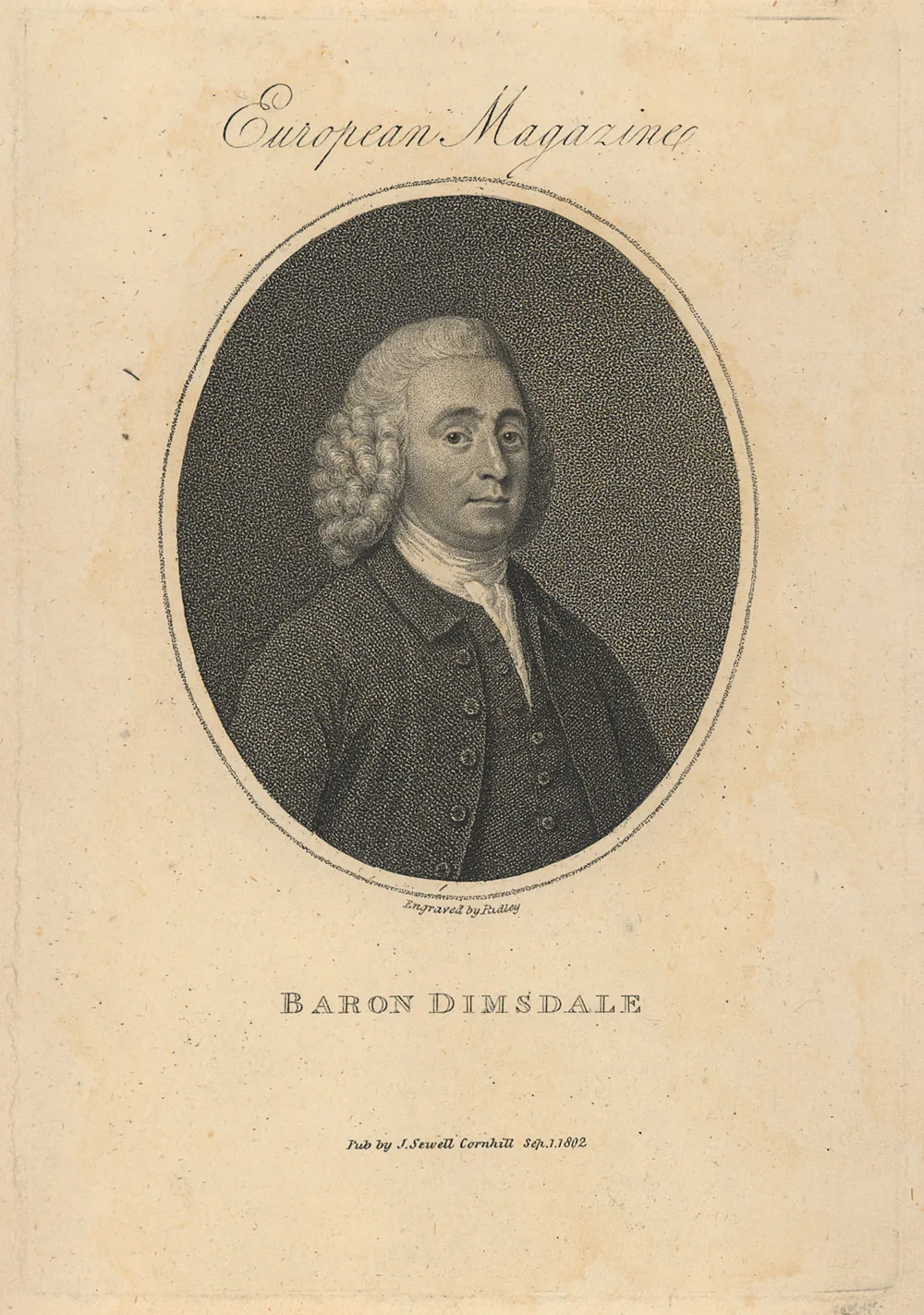
Baron Dimsdale, engraved by William Ridley, European Magazine, 1802. Public domain · Public domain · Source page
In 1768 the English physician Thomas Dimsdale came to Saint Petersburg to advise the court on inoculation. He was a physician, a banker and a Member of Parliament in England.
A decision point
You are Catherine, in Saint Petersburg, in October 1768 (OS).
Saint Petersburg, autumn 1768, Old Style.
Smallpox is deadly, and it is common in your capital. Dimsdale says inoculation saves lives if it is done carefully. Many in Russia have never seen the method, and many fear it. Even a mild case can kill, and someone who has been inoculated can pass the disease on.
Your son Paul is fourteen. The court is watching you. The question is not only whether to be inoculated, but where to begin, and how far the method should reach.
Where do you start?
- Start with the poor and the towns, as the doctor's plans suggested. Probably the most lives are saved in the long run, but the poor would carry the first risk, and the court would not follow at once.
- Be inoculated yourself and your son first, as an example, and let the court follow. Probably the court follows the Empress, and the fear of the method falls. If the operation goes badly, the blame falls on you and on the state.
- Keep inoculation to the court, and leave the rest of the empire to its fate. Probably the court is protected, while the wider population stays exposed. Little changes, and the method remains a court matter.
What really happened
Be inoculated yourself and your son first, as an example, and let the court follow.
On 12 October 1768 (OS, which is 23 October NS) Catherine was inoculated, and then Paul. Wikipedia says that more than 140 courtiers followed. Dimsdale wrote up the cases so that they would be published, to remove prejudice. According to Wikipedia he was rewarded with £10,000, a pension of £500 a year, expenses and a Russian barony.
Historians regard her efforts as a success.
Catherine's reason, as Wikipedia reports it, was to set an example: she wanted to save the many subjects who feared the method and did not know its value. We could not check her own words, so treat this as a report.
The example carried a risk for her too. If the operation had failed, the blame would have fallen on the ruler.
Source: Dimsdale writes for English readers
Although this matter has not been attended to here, it did not escape the penetration of the Empress of Russia; who, with a regard to the happiness of her people that deserves much greater commendation than I am able to bestow, was extremely solicitous to render Inoculation general among her subjects.
Dimsdale wrote for English readers, who were not yet convinced. By his own account, his Petersburg tracts were printed in 1770, at the Empress's command.
- Who is writing, and for whom? A physician paid by the Empress, writing in English for English readers. He wants them to see inoculation as safe, and as the Empress's achievement.
- What does the praise leave out? Who would carry the danger. Praise for 'the happiness of her people' speaks of the Empress's intentions. It does not say who would be inoculated first, or who would take the risk.
- Why does the date matter? The tracts were written close to the events, in 1768, but printed in 1770. A text written to persuade is an argument, not a neutral record, so read it that way.
Afterwards
Two million by 1800
2 million
Wikipedia gives about two million inoculations in the Russian Empire by 1800, which it puts at almost six per cent of the population. That is a single source's figure, and we did not check how it was counted. If it is right, it followed from her decision, though it does not prove her motives.
The man who said he was Peter
1773
A Cossack who said he was Peter
In September 1773 (OS) a rising began in the Yaik region, in the south-east of the empire. Its leader, Yemelyan Pugachev, a Cossack from the Yaik, claimed to be Peter III, the dead emperor. According to his claim, Peter had survived and would end serfdom. Pugachev was a pretender.
Whether Pugachev believed his own claim, or used it to recruit, is not known.
A decision point
You are Catherine, in Saint Petersburg, late in 1773.
Saint Petersburg, late 1773.
The rising grows. It takes towns and forts, and Cossacks, peasants and workers join it. In his proclamations he announces an end to serfdom, and many in the countryside listen. Your army is far away, and it takes time to reach the rebels.
The court wants order. You know that a pardon or relief offered to a man who claims to be your late husband would look, at court, like weakness.
How do you end the rising?
- Offer a pardon and some relief to the peasants and Cossacks, and open talks about their complaints. Probably some rebels accept, the rising splits, and the nobles see weakness. Pugachev may refuse, and the talks would drag on.
- Send a large army under a trusted general, and crush the rising. Probably the army wins the main battles, at a high cost in lives on both sides. The rebel leader is hunted down, but the grievances of the peasants remain.
- Split the rebels by bargaining with the Cossack leaders who have not yet joined him. Probably some leaders take money and rank and leave Pugachev. The rising loses its unity, but those who bargained may later be blamed for it.
What really happened
Send a large army under a trusted general, and crush the rising.
You chose the army. In fact, Catherine sent troops under General Johann von Michelsohn, who defeated the rebels at Tsaritsyn in August 1774 (OS). That autumn Pugachev was betrayed by his own Cossacks and handed over. He was taken to Moscow and executed there on 10 January 1775 (OS).
Sources give about 9,000 to 10,000 rebels dead at Tsaritsyn, or 10,000 killed or taken prisoner, and they differ. Reprisals followed under General Peter Panin.
A rising that could spread through the south-east threatened the state, and the nobles wanted order quickly. An army was the fastest answer. A pardon to a man who claimed to be her dead husband would have looked, at court, like a concession to a pretender.
Notice the cost of the choice. The sources count the dead in numbers, and each number is a cost of the decision you just made.
Source: A portrait painted over a portrait
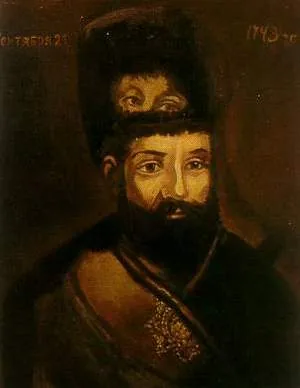
Pugachev, painted over a portrait of Catherine, 1773. Unknown artist. State Historical Museum, Moscow · Public domain · Source page
Unknown artist. According to the Commons file description, a portrait of Pugachev painted over a portrait of Catherine, dated 1773. State Historical Museum, Moscow.
The painting is small and plain, and its date and place come from the file description. Read it as a claim, not a record.
- What does the picture claim? That the rebel leader can take the Empress's place, in the picture and in the eyes of the people. He is painted over her portrait, and the earlier face still shows through the paint.
- Who made it, and for whom? The artist is unknown. The file dates the portrait to 1773, during the rising. That suggests the rebels or their followers made it. It is a reading of the file description, not a proven fact.
- What is the lesson for a historian? A picture is an argument. A portrait painted over the Empress's own portrait shows what the rebels wanted people to believe, and it shows that the Empress's image was itself part of the struggle.
Consequences
Poland disappears from the map
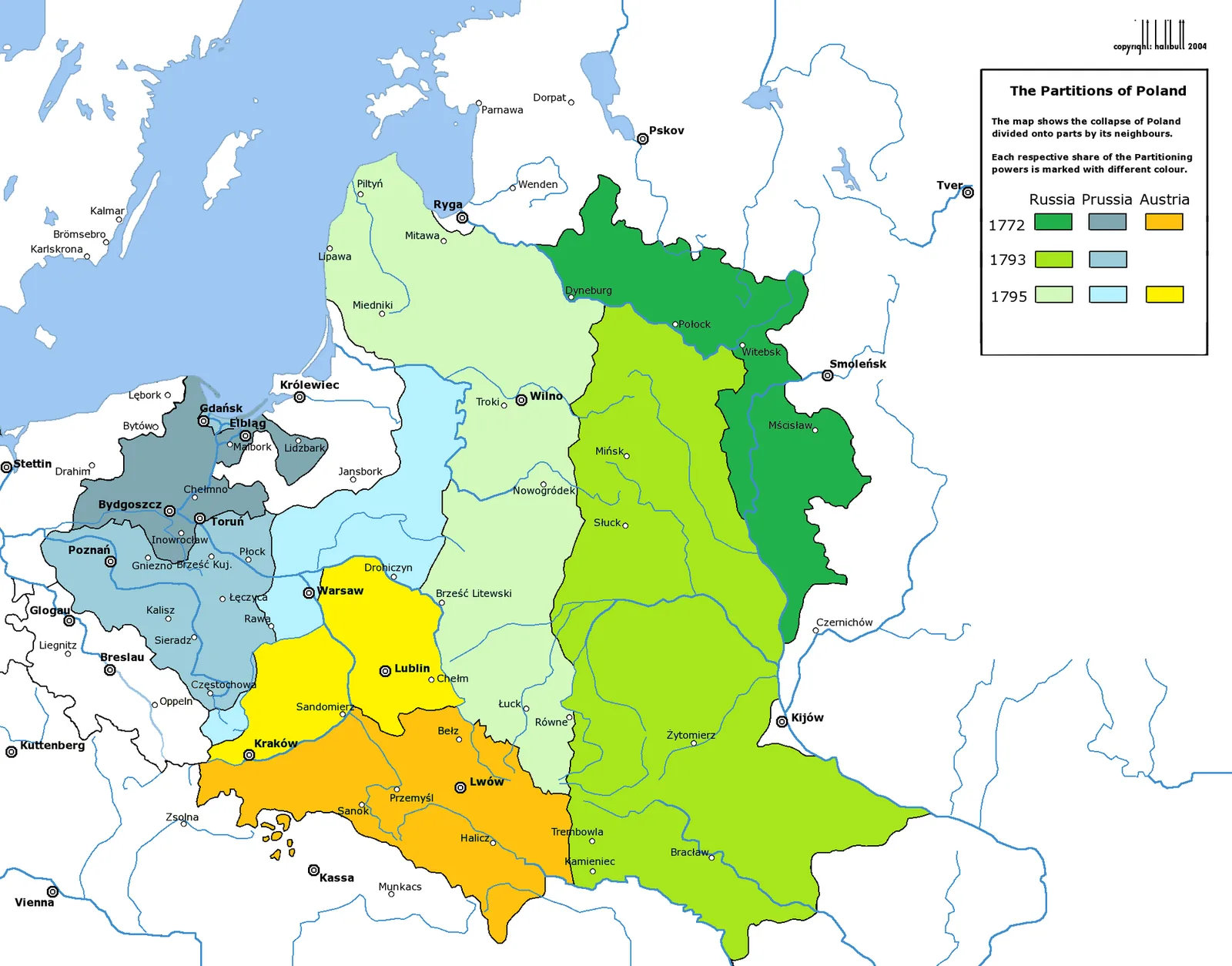
Partitions of the Polish–Lithuanian Commonwealth, 1772, 1793 and 1795. Map by Halibutt and Sneecs, Wikimedia Commons, licence CC BY-SA 3.0 · Rzeczpospolita_Rozbiory_3.png: Halibutt derivative work: Sneecs (talk) · CC BY-SA 3.0 · Source page
The Polish–Lithuanian Commonwealth lost its independence in stages. In 1772, before the rising began, Russia, Prussia and Austria carried out the first partition. Frederick II of Prussia had proposed the idea. In the 1790s Catherine led the next two, in 1793 and 1795, and the state vanished from the map.
In 1772 Maria Theresa of Austria protested only mildly, and her adviser Kaunitz was proud of Austria's share. The state did not return to the map for more than 120 years.
The sequence
- June–July 1762 The coup on 28 June (OS), and Peter's death at Ropsha on 6 July (OS).
- 1768 Catherine and Paul are inoculated on 12 October (OS). The Legislative Commission is dissolved without a new code.
- 1772–1795 Three partitions of the Polish–Lithuanian Commonwealth: 1772, 1793 and 1795.
- 1773–1775 Pugachev's rising. He is executed in Moscow on 10 January 1775 (OS).
- 1796 Catherine dies on 17 November (NS), which is 6 November (OS).
Myth
Potemkin built painted fake villages along Catherine's route in 1787, to show her a false prosperity.
The truth
Mostly a myth. Historians agree the story is exaggerated. Simon Sebag Montefiore's 2000 biography of Potemkin calls the tale largely fictional, and the Russian historian Aleksandr Panchenko, who works on nineteenth-century Russia, calls it a myth.
The evidence
What is true: Potemkin improved and decorated settlements that already existed, along a journey of about six months in 1787. The difference between 'exaggerated' and 'invented' is the lesson here: a story can grow from a true kernel.
Legacy
Books, paintings and a museum
Catherine's lasting legacy is in art and books. In 1764 she bought about 225 paintings from a Berlin merchant, Gotzkowsky. The paintings had been gathered for Frederick II, who would not buy them after the Seven Years' War. The Hermitage museum began as her private collection with this purchase. Sources give 225 to 317 paintings, with 225 the most common figure.
In 1765 she bought the library of the philosopher Denis Diderot for 15,000 livres. Diderot kept the books in Paris, and she paid him 1,000 livres a year to act as its librarian. The books reached Saint Petersburg after his death in 1784, about 1785. They did not reach Russia in the 1760s.
Check yourself
On which day, by Old Style, did the coup against Peter take place?
Answer: 28 June (OS). Yes. By Old Style the coup took place on 28 June (OS), which is 9 July (NS) in New Style.
Check yourself
In which year was Catherine inoculated against smallpox?
Answer: 1768. Yes. She was inoculated on 12 October 1768 (OS), and Paul after her.
Check yourself
Where was Pugachev executed?
Answer: Moscow. Yes. He was taken to Moscow and executed there on 10 January 1775 (OS).
Check yourself
In which year was the third partition of Poland?
Answer: 1795. Yes. The third and last partition was in 1795.
Check yourself
Where was Catherine born?
Answer: Stettin. Yes. Born on 2 May 1729 (NS) in Stettin, then in Prussia.
Check yourself
Which two authors did the Nakaz borrow from most?
Answer: Montesquieu and Beccaria. Yes. Wikipedia names these two as the main sources of the copied passages.
Terms
- Old Style (OS) and New Style (NS) Russia used the Julian calendar, Old Style (OS), until 1918. In the eighteenth century it was eleven days behind the Gregorian calendar, New Style (NS), used in western Europe.
- propaganda Material written or spread to win people to a cause, often by telling a story that is not true or not complete.
- the Guards The elite regiments of the imperial household in Saint Petersburg. Their officers and soldiers could decide who ruled.
- palace coup The seizure of power by a small group inside the court or capital, often with the help of the guards, without open war.
- serfdom A condition in which peasants were bound to a landowner and to his land. In Russia, serfs could be bought and sold.
- inoculation Deliberately giving a healthy person a mild smallpox infection, by putting material from a sore under the skin, so that they become protected. The method was old in parts of Asia and reached Europe in the 18th century. It was risky, and some people died of it.
- Enlightenment An eighteenth-century European movement that argued for reason, science, law and the rights of the individual against arbitrary power.
- Nakaz The Instruction Catherine wrote in 1767 for the Legislative Commission. It borrowed heavily from Enlightenment writers, but it did not become a code of law.
- Legislative Commission A body of delegates convened in 1767 to draft a new code of law for the empire. It was dissolved in 1768 without a new code.
- partition The division of a state among its neighbours. The Polish–Lithuanian Commonwealth was partitioned in 1772, 1793 and 1795, and vanished from the map.
- pretender A person who claims to be someone else, usually a lost heir or a dead ruler. Pugachev claimed to be Peter III.
- Potemkin village A legend: a fake village built as a stage set to impress a distinguished visitor. The name comes from Grigory Potemkin, though historians say the story is mostly myth.
- Ekaterina Dashkova A young princess who knew the circles opposed to Peter. By one account she introduced them to Catherine.
- Grigory Orlov Catherine's favourite, who served in the Guards. Through him his brother Alexei joined the plot.
- Alexei Orlov Brother of Grigory and a plotter. He rode with Catherine to the barracks and guarded Peter at Ropsha.
- Frederick II King of Prussia, whom Peter admired. He proposed the idea of dividing Poland.
- Thomas Dimsdale English doctor who advised the Russian court on smallpox inoculation. He was also a banker and a Member of Parliament.
- Voltaire Famous French writer and philosopher. Catherine read his works.
- Tacitus Roman historian who wrote about the Roman emperors. Catherine read his books.
- Montesquieu French philosopher who wrote about law and government. Parts of Catherine's Nakaz were copied from his books.
- Cesare Beccaria Italian jurist who wrote about crimes and punishments. Parts of the Nakaz were copied from his book.
- Denis Diderot French philosopher who criticised the Nakaz in writing. Catherine bought his library and paid him as its librarian.
- Herzen Russian writer and publisher who lived in exile in London. He edited the memoirs in which the letter appears.
- Simon Sebag Montefiore British historian who wrote a biography of Potemkin. He calls the Potemkin village story largely fictional.
- Maria Theresa Ruler of Austria who protested only mildly at the first partition of Poland.
- Kaunitz Adviser to Maria Theresa, who was proud of Austria's share of Poland.
- Yemelyan Pugachev Cossack from the Yaik who led a large rising and claimed to be the dead Peter III.
- Johann von Michelsohn Russian general sent against Pugachev's rebels, who beat them at Tsaritsyn.
- Tsaritsyn Town on the Volga where Catherine's forces beat Pugachev's rebels. Today it is called Volgograd.
- Ropsha Palace outside the capital, where Peter was taken under Alexei Orlov's guard and died.
- Peterhof Palace on the Gulf of Finland, near Saint Petersburg. Catherine was there when the news of the coup reached her.
- Oranienbaum Palace down the coast from Peterhof, where Peter was staying with his court.
- Holy Synod Governing body of the Russian Orthodox Church. During the coup it swore loyalty to Catherine.
- Senate The highest state institution in Russia at the time. It also swore loyalty to Catherine that day.
- Cossacks Groups of horse-riding warriors on the edges of the Russian Empire, living in semi-independent communities.
- Hermitage Large art museum in Saint Petersburg. It began as Catherine's private collection.
- Peter the Great Tsar of Russia who opened the country to western Europe. Peter III was his grandson.
Sources
- Catherine II, letter to Stanisław August Poniatowski (undated), in her memoirs with the letter, ed. Alexander Herzen (New York: Appleton, 1859), with Herzen's preface (London, 1858); Project Gutenberg eBook 46407
- Thomas Dimsdale, Thoughts on General and Partial Inoculations (London; year not checked here), with his Petersburg tracts of 1768; Project Gutenberg eBook 49476
- Portrait of Pugachev painted over a portrait of Catherine, 1773, State Historical Museum, Moscow; Wikimedia Commons, file Pugachev b.jpg
- Simon Sebag Montefiore, Prince of Princes: The Life of Potemkin (2000)
- Lucy Ward, The Empress and the English Doctor (year not checked)
- Wikipedia (English): articles Catherine the Great, Peter III of Russia, Nakaz, Potemkin village, Thomas Dimsdale, Yemelyan Pugachev, Pugachev's Rebellion and Partitions of Poland. Read as a map to the sources above; their figures are marked where they are disputed

Image credits
- Dmitry Levitsky, Catherine II the Legislatress, 1783. State Russian Museum, Saint Petersburg · Public domain · Source page
- Baron Dimsdale, engraved by William Ridley, European Magazine, 1802. Public domain · Public domain · Source page
- Pugachev, painted over a portrait of Catherine, 1773. Unknown artist. State Historical Museum, Moscow · Public domain · Source page
- Partitions of the Polish–Lithuanian Commonwealth, 1772, 1793 and 1795. Map by Halibutt and Sneecs, Wikimedia Commons, licence CC BY-SA 3.0 · Rzeczpospolita_Rozbiory_3.png: Halibutt derivative work: Sneecs (talk) · CC BY-SA 3.0 · Source page


